1 Peter 1:15

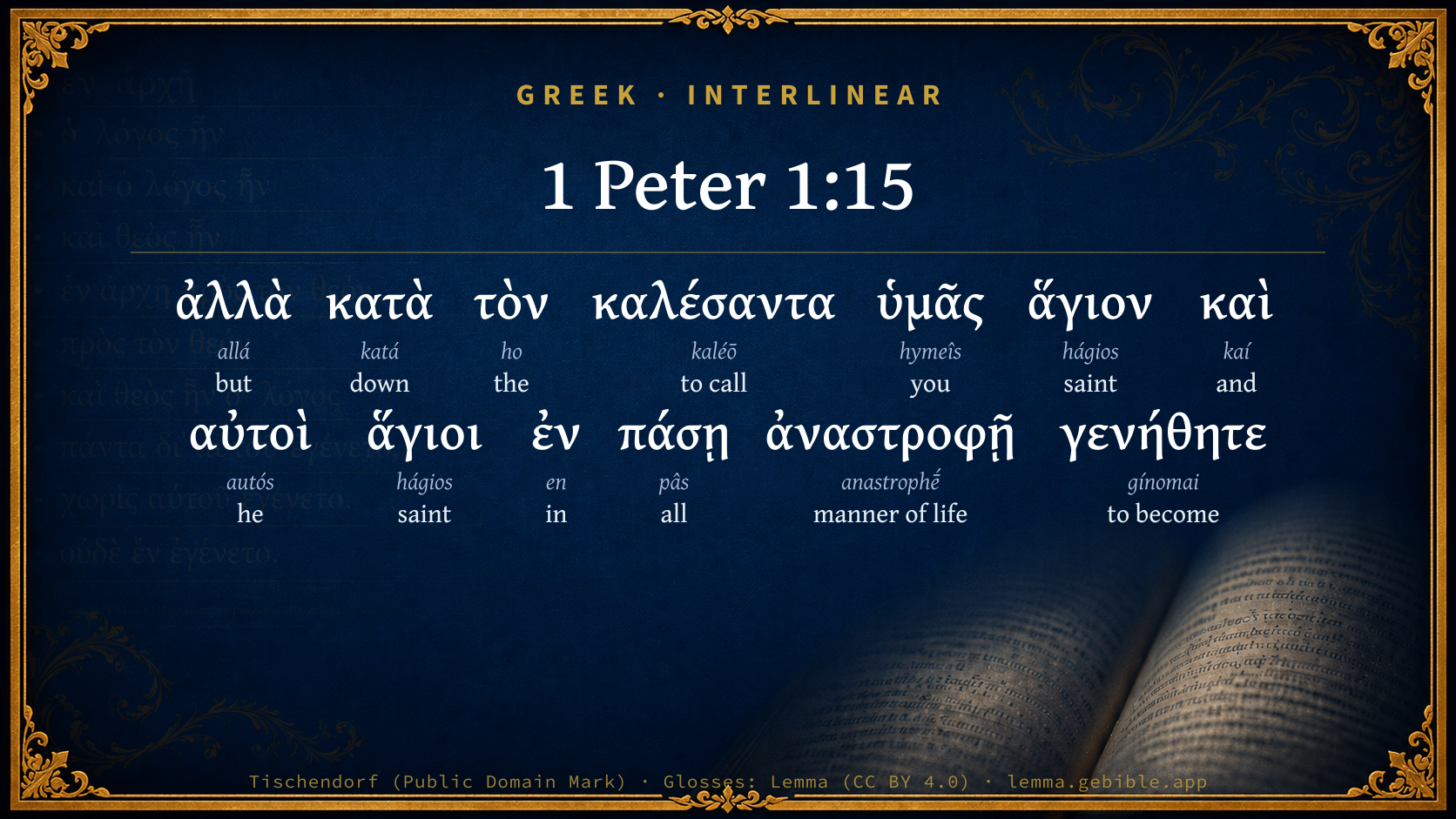
Greek (Tischendorf 8th ed.) 1 Peter 1:15 appears in the Greek New Testament. The text above is from the Tischendorf 8th edition. Each word links to its Strong’s number and a concise gloss. Click any word for its full Thayer’s Greek Lexicon entry.
Download image
Cite this verse

1 Peter 1:15 (World English Bible). Public Domain. Lemma interlinear Bible study tool, https://lemma.gebible.app/v/1-peter/1/15.

Show BibTeX & RIS
BibTeX
RIS
English Translation
but just as he who called you is holy, you yourselves also be holy in all of your behavior;
World English Bible · Public Domain
Download a study sheet

One document with this verse’s original text, its word-by-word gloss line, the meaning frame, cross-references with their text, attributed commentary, and full source and license credits — printable, and it pastes into notes with its structure intact.

This verse Autodidact and up

Study sheet (.html) Plain text (.txt)

A passage Seminary Student

Up to 50 verses in one chapter. A passage sheet keeps up to 6 commentary sources and 12 cross-references per verse, in the order this page ranks them, and says so on the sheet whenever that leaves anything out. Ask for a single verse and you get the Autodidact verse sheet above.

Everything on this page stays free to read, with no account — the sheet is a download of what is already on screen, not access to it.

Want to remove ads? Support Godless Engineer
Compare translations 3

The same verse in 3 English versions, stacked beneath the original-language interlinear above. Click any original word for its lexicon entry.

Each is an independent rendering of the whole verse — the interlinear is not word-aligned to these translations.

Highlighted words mark where these versions differ — a whole-verse word diff, not a word-by-word alignment.

  • World English Bible Public Domain
    but just as he who called you is holy, you yourselves also be holy in all of your behavior;
  • King James Version Public Domain
    But as he which hath called you is holy, so be ye holy in all manner of conversation;
  • unfoldingWord Literal Text CC BY-SA 4.0
    but as the one having called you holy, you yourselves also be holy in all your behavior.

unfoldingWord Literal Text — © unfoldingWord, licensed CC BY-SA 4.0. Word-aligned USFM3 via Door43 (git.door43.org/unfoldingWord/en_ult).

Versions to compare (up to 4)

3 of 4 selected

Show all 19 translations

Every available English version of this verse, each an independent rendering of the whole verse.

  • World English Bible Public Domain
    but just as he who called you is holy, you yourselves also be holy in all of your behavior;
  • Berean Standard Bible Public Domain
    But just as He who called you is holy, so be holy in all you do,
  • Majority Standard Bible Public Domain
    But just as He who called you is holy, so be holy in all you do,
  • King James Version Public Domain
    But as he which hath called you is holy, so be ye holy in all manner of conversation;
  • American Standard Version (1901) Public Domain
    but like as he who called you is holy, be ye yourselves also holy in all manner of living;
  • Revised Version (1885) Public Domain
    but like as he which called you is holy, be ye yourselves also holy in all manner of living;
  • Geneva Bible (1599) Public Domain
    But as hee which hath called you, is holie, so be yee holie in all maner of conuersation;
  • Douay-Rheims (1899) Public Domain
    But according to him that hath called you, who is holy, be you also in all manner of conversation holy:
  • Young's Literal Translation Public Domain
    but according as He who did call you `is' holy, ye also, become holy in all behaviour,
  • Literal Standard Version CC BY-SA 4.0
    but according as He who called you [is] holy, you also, become holy in all behavior,
  • Unlocked Literal Bible CC BY-SA 4.0
    But as the one who called you is holy, you, too, be holy in your whole behavior.
  • unfoldingWord Literal Text CC BY-SA 4.0
    but as the one having called you holy, you yourselves also be holy in all your behavior.
  • Darby Bible Public Domain
    but as he who has called you is holy, be ye also holy in all [your] conversation;
  • World Messianic Bible Public Domain
    but just as he who called you is holy, you yourselves also be holy in all of your behavior,
  • Webster's Bible Public Domain
    But as he who hath called you is holy, so be ye holy in all manner of deportment.
  • Free Bible Version CC BY-SA 4.0
    Now you need to be holy in everything you do, just as the one who called you is holy.
  • Bible in Basic English Public Domain
    But be holy in every detail of your lives, as he, whose servants you are, is holy;
  • Text-Critical English NT CC BY 4.0
    But just as he who called you is holy, you also must be holy in all your conduct,
  • Tyndale New Testament (1534) Public Domain
    but as he which called you is holy even so be ye holy in all maner of conuersacion

Literal Standard Version (2020), Covenant Press — licensed CC BY-SA 4.0. Text via the HelloAO Bible API (eBible.org). Unlocked Literal Bible (unfoldingWord) — licensed CC BY-SA 4.0. Text via the HelloAO Bible API (eBible.org). unfoldingWord Literal Text — © unfoldingWord, licensed CC BY-SA 4.0. Word-aligned USFM3 via Door43 (git.door43.org/unfoldingWord/en_ult). Free Bible Version, Dr. Jonathan Gallagher — licensed CC BY-SA 4.0. Text via the HelloAO Bible API (eBible.org).

Word by word

More ways to search: Search by grammar → Find every occurrence → Compare this word →

Practice this passage: Drill this verse → Learn its vocabulary →

About this verse

These counts appear in no published source. They are computed here, from the morphology-tagged text and Lemma’s own curated glosses. What Lemma adds →

13
words
12
distinct lemmas
General Epistles
section

Notable vocabulary

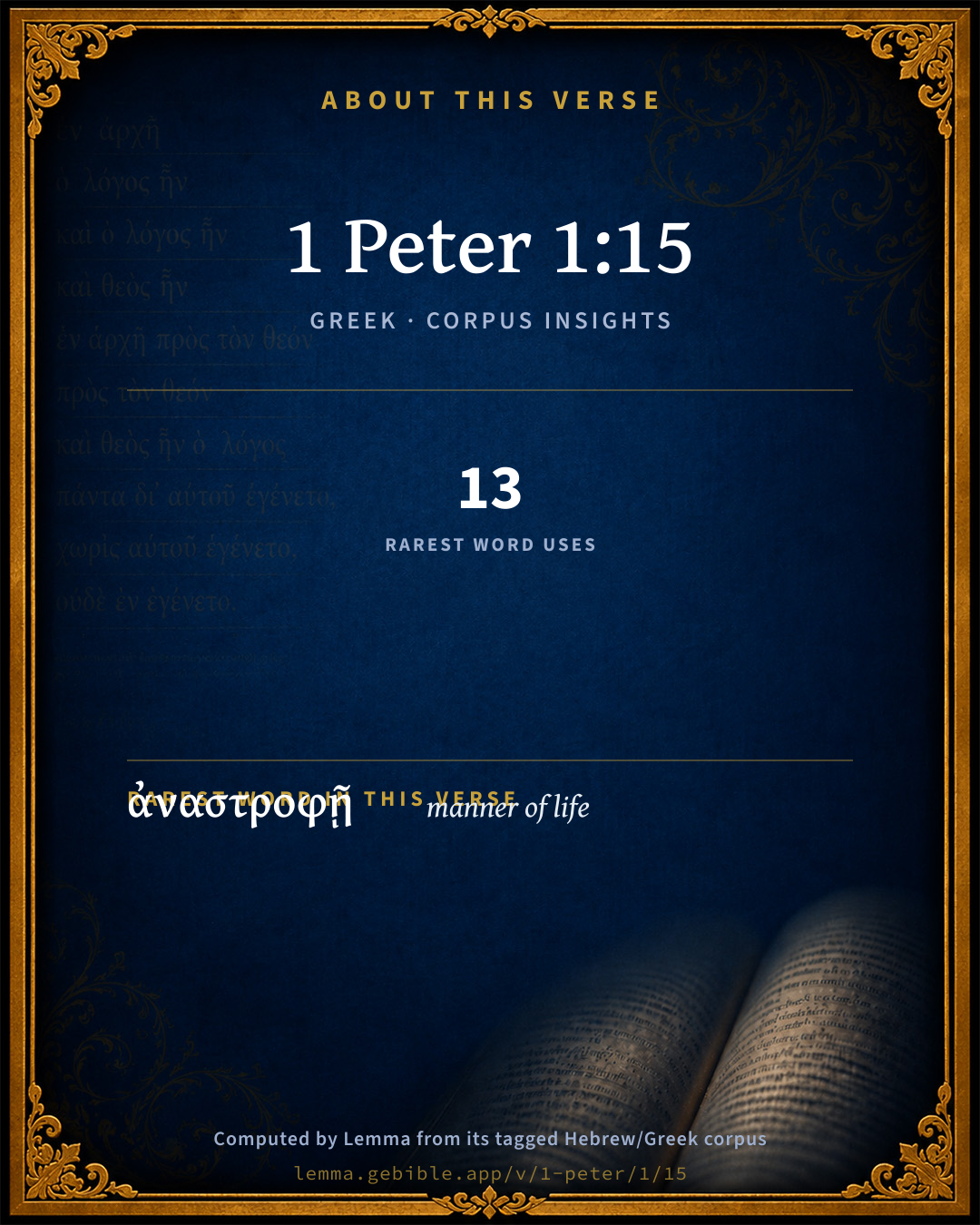
The rarest word here is ἀναστροφῇ manner of life G391 — appearing just 13 times in the whole Greek New Testament.

Shared distinctive vocabulary

ἀναστροφῇ manner of life G391 occurs in 13 verses of the Greek New Testament. Also found in:

Repetition

A word recurs within this verse:

  • ἅγιον saint G40 ×2

Cross-references

31

Topical passages linked to 1 Peter 1:15 in the Treasury of Scripture Knowledge — connected by theme and wording, ordered by reader-vote popularity; previews shown in the World English Bible.

  • Matthew 5:48 Therefore you shall be perfect, just as your Father in heaven is perfect.
  • 2 Corinthians 7:1 Having therefore these promises, beloved, let us cleanse ourselves from all defilement of flesh and spirit, perfecting holiness in the fear of God.
  • Hebrews 12:14 Follow after peace with all men, and the sanctification without which no man will see the Lord,
  • James 3:13 Who is wise and understanding among you? Let him show by his good conduct that his deeds are done in gentleness of wisdom.
  • Ephesians 5:1–2 Be therefore imitators of God, as beloved children.
  • 1 John 3:3 Everyone who has this hope set on him purifies himself, even as he is pure.
  • 1 Thessalonians 4:3–7 For this is the will of God: your sanctification, that you abstain from sexual immorality,
  • Philippians 2:15–16 that you may become blameless and harmless, children of God without blemish in the midst of a crooked and perverse generation, among whom you are seen as lights in the world,
  • 1 Peter 2:12 having good behavior among the nations, so in that which they speak against you as evil-doers, they may by your good works, which they see, glorify God in the day of visitation.
  • 1 Peter 2:9 But you are a chosen race, a royal priesthood, a holy nation, a people for God's own possession, that you may show forth the excellencies of him who called you out of darkness into his marvelous light:
  • Philippians 1:27 Only let your manner of life be worthy of the Gospel of Christ, that, whether I come and see you or am absent, I may hear of your state, that you stand firm in one spirit, with one soul striving for the faith of the Gospel;
  • Luke 1:74–75 To grant to us that we, being delivered out of the hand of our enemies, should serve him without fear,
  • Romans 8:28–30 We know that all things work together for good for those who love God, to those who are called according to his purpose.
  • Hebrews 13:5 Be free from the love of money, content with such things as you have, for he has said, "I will in no way leave you, neither will I in any way forsake you."
  • 2 Peter 3:11–14 Therefore since all these things are thus to be destroyed, what manner of persons ought you to be in holy living and godliness,
  • Isaiah 6:3 One called to another, and said, "Holy, holy, holy, is Yahweh of Hosts! The whole earth is full of his glory!"
  • Titus 3:14 Let our people also learn to maintain good works for necessary uses, that they may not be unfruitful.
  • Revelation 3:7 "To the angel of the assembly in Philadelphia write: "He who is holy, he who is true, he who has the key of David, he who opens and no one can shut, and who shuts and no one opens, says these things:
  • Philippians 3:14 I press on toward the goal for the prize of the high calling of God in Christ Jesus.
  • Philippians 3:20 For our citizenship is in heaven, from where we also wait for a Savior, the Lord Jesus Christ;
  • 2 Timothy 1:9 who saved us and called us with a holy calling, not according to our works, but according to his own purpose and grace, which was given to us in Christ Jesus before times eternal,
  • Titus 2:11–14 For the grace of God has appeared, bringing salvation to all men,
  • 2 Peter 1:3–10 seeing that his divine power has granted to us all things that pertain to life and godliness, through the knowledge of him who called us by his own glory and virtue;
  • 1 Timothy 4:12 Let no man despise your youth; but be an example to those who believe, in word, in your way of life, in love, in spirit, in faith, and in purity.
  • 1 Thessalonians 2:12 to the end that you should walk worthily of God, who calls you into his own Kingdom and glory.
  • Titus 3:8 This saying is faithful, and concerning these things I desire that you affirm confidently, so that those who have believed God may be careful to maintain good works. These things are good and profitable to men;
  • 1 Peter 3:16 having a good conscience; that, while you are spoken against as evildoers, they may be disappointed who curse your good manner of life in Christ.
  • 1 Peter 5:10 But may the God of all grace, who called you to his eternal glory by Christ Jesus, after you have suffered a little while, perfect, establish, strengthen, and settle you.
  • Revelation 6:10 They cried with a loud voice, saying, "How long, Master, the holy and true, until you judge and avenge our blood on those who dwell on the earth?"
  • Revelation 4:8 The four living creatures, each one of them having six wings, are full of eyes around about and within. They have no rest day and night, saying, "Holy, holy, holy, holy, holy, holy, holy, holy, holy is the Lord God, the Almighty, who was and who is and who is to come!"
  • Romans 9:24 us, whom he also called, not from the Jews only, but also from the Gentiles?

Cross-references courtesy of OpenBible.info (CC BY 4.0).

Commentary

Notes on 1 Peter 1:15 from classic Christian and Jewish commentators (each source and its license shown beneath its notes). The classic Christian expositions comment on the surrounding passage and are grouped to its opening verse, so a note may address several verses; the Jewish commentaries on the Tanakh (Rashi and others) are per-verse, so they appear only where the commentator wrote on this verse.

Lemma curates 59 commentaries, every one of them public domain or Creative Commons licensed, each selected and text-cleaned for this edition rather than reprinted as found. About our sources →

Adam Clarke's Commentary

Verse 15. But as he which hath called you] Heathenism scarcely produced a god whose example was not the most abominable; their greatest gods, especially, were paragons of impurity; none of their philosophers could propose the objects of their adoration as objects of imitation. Here Christianity has an infinite advantage over heathenism. God is holy, and he calls upon all who believe in him to imitate his holiness; and the reason why they should be holy is, that God who has called them is holy, 1Pet 1:15.

Adam Clarke's Commentary on the Bible (1810–1826) — public domain. Text from a community e-Sword/MySword module.

MacLaren's Expositions of Holy Scripture

Alexander MacLaren

1 Peter

THE FAMILY LIKENESS

1Pe 1:15.

That is the sum of religion--an all-comprehensive precept which includes a great deal more than the world’s morality, and which changes the coldness of that into something blessed, by referring all our purity to the Lord that called us. One may well wonder where a Galilean fisherman got the impulse that lifted him to such a height; one may well wonder that he ventured to address such wide, absolute commandments to the handful of people just dragged from the very slough and filth of heathenism to whom he spoke. But he had dwelt with Christ, and they had Christ in their hearts. So for him to command and for them to obey, and to aim after even so wide and wonderful an attainment as perfecting like God’s was the most natural thing in the world. ‘Be ye holy as He that hath called you is holy, and that in all manner of conversation.’ The maximum of possible attainment, the minimum of imperative duty!

So, then, there are three things here--the pattern, the field, and the inspiration or motive of holiness.

I. The Pattern of Holiness.

‘As He that hath called you is holy.’ God’s holiness is the very attribute which seems to separate Him most from the creatures; for its deepest meaning is His majestic and Divine elevation above all that is creatural. But here, of course, the idea conveyed by the word is not that, if I may so say, metaphysical one, but the purely moral one. The holiness of God which is capable of imitation by us is His separation from all impurity. There is a side of His holiness which separates Him from all the creatures, to which we can only look up, or bow with our faces in the dust; but there is a side of His holiness which, wonderful as it is, and high above all our present attainment as it is, yet is not higher than the possibilities which His indwelling Spirit puts within our reach, nor beyond the bounds of the duty that presses upon us all. ‘As He which hath called you is holy.’ Absolute and utter purity is His holiness, and that is the pattern for us.

Religion is imitation. The truest form of worship is to copy. All through heathenism you find that principle working. ‘They that make them are like unto them.’ Why are heathen nations so besotted and sunken and obstinate in their foulnesses? Because their gods are their examples, and they, first of all, make the gods after the pattern of their own evil imaginations, and then the evil imaginations, deified, react upon the maker and make him tenfold more a child of hell than themselves. Worship is imitation, and there is no religion which does not necessarily involve the copying of the example or the pattern of that Being before whom we bow. For religion is but love and reverence in the superlative degree, and the natural operation of love is to copy, and the natural operation of reverence is the same. So that the old Mosaic law, ‘Be ye holy as I am holy,’ went to the very heart of religion. And the New Testament form of it, as Paul puts it in a very bold word, ‘Be ye imitators of God, as beloved children,’ sets its seal on the same thought that we are religious in the proportion in which we are consciously copying and aspiring after God.

But then, says somebody or other, ‘it is not possible.’ Well, if it were not possible, try it all the same. For in this world it is aim and not attainment that makes the noble life; and it is better to shoot at the stars, even though your arrow never reaches them, than to fire it along the low levels of ordinary life. I do not see that however the unattainableness of the model may be demonstrated, that has anything to do with the duty of imitation. Because, though absolute conformity running throughout the whole of a life is not possible here on earth, we know that in each individual instance in which we came short of conformity the fault was ours, and it might have been otherwise. Instead of bewildering ourselves with questions about ‘unattainable’ or ‘attainable,’ suppose we asked, at each failure, ‘Why did I not copy God then; was it because I could not, or because I would not?’ The answer would come plain enough to knock all that sophisticated nonsense out of our heads, and to make us feel that the law which puts an unattainable ideal before the Christian as his duty is an intensely practical one, and may be reduced to practice at each step in his career. Imitation of the Father, and to be perfect, ‘as our Father in heaven is perfect,’ is the elementary and the ultimate commandment of all Christian morality. ‘Be ye holy as He that hath called you is holy.’

Then let me remind you that the unattainableness is by no means so demonstrable as some people seem to think. A very tiny circle may have the same centre as one that reaches beyond the suburbs of the universe, and holds all stars and systems within its great round. And the tiniest circle will have the same geometrical laws applied to it as the greatest. The difference between finite and infinite has nothing to do with the possibility of our becoming like God, if we believe that ‘in the image of God created He him’; and that men who have been not only made by original creation in the Divine image, but have been born again by the incorruptible seed of the Word into a kindred life with His, and derived from Him, can surely grow like what they have got, and unfold into actually possessed and achieved resemblance to their Father the kindred life that is poured into their veins.

So every way it is better indefinitely to approximate to that great likeness, though with many flaws and failures, than to say it cannot be reached, and so I will content myself down here, in my sins and my meannesses. No! dear brethren, ‘we are saved by hope,’ and one prime condition of growth in nobleness is to believe it possible that, by His blessing we may be like Him here on earth in the measure of our perception of His beauty and reception of His grace.

II. Again, notice the field of this Godlike holiness.

‘In all manner of conversation.’ Of course I do not need to remind you that the word ‘conversation’ does not mean talk, but conduct; that it applies to the whole of the outward life. Peter says that every part of the Christian man’s activity is to be the field on which his possession of the holiness derived from and like God’s is to be exhibited. It is to be seen in all common life. Here is no cloistered and ascetic holiness which tabooes large provinces of every man’s experience, and says ‘we must not go in there, for fear of losing our purity,’ but rather wherever Christ has trod before we can go. That is a safe guide, and whatever God has appointed there we can go and that we can do. ‘On the bells of the horses shall be written Holiness to the Lord.’ The horse-bells that make merry music on their bridles are not very sacred things, but they bear the same inscription as flamed on the front of the high priest’s mitre; and the bowls in every house in Jerusalem, as the prophet says, shall bear the same inscription that was written on the sacrificial vessels, and all shall belong to Him.

Only, whilst thus we maintain the possibility of exhibiting Godlike holiness in all the dusty fields of common life, let us remember the other side.

In this day there is very little need to preach against an ascetic Christianity. There has been enough said of late years about a Christian man being entitled to go into all fields of occupation and interest, and there to live his Christianity. I think the time is about come for a caution or two to be dropped on the other side, ‘Blessed is he that condemneth not himself in the thing which he alloweth.’ Apply this commandment vigorously and honestly to trade, to recreation--especially to recreation--to social engagements, to the choice of companions, to the exercise of tastes. Ask yourselves ‘Can I write Holiness to the Lord on them?’ If not, do not have anything to do with them. I wonder what the managers of theatres and music-halls would say if anybody proposed that motto to be put upon the curtain for the spectators to read before it is drawn up for the play. Do you think it would fit? Don’t you, Christian men and women, don’t you go into places where it would not fit. And remember that ‘in all manner of conversation’ has two sides to it, one declaring the possibility of sanctifying every creature of God, and one declaring the impossibility of a Christian man going, without dreadful danger and certain damage, into places where he cannot carry that consecration and purity with him.

Again the field is all trivial things. ‘In all manner of conversation.’ There is nothing that grows so low but that this scythe will travel near enough to the ground to harvest it. There is nothing so minute but it is big enough to mirror the holiness of God. The tiniest grain of mica, upon the face of the hill, is large enough to flash back a beam; and the smallest thing we can do is big enough to hold the bright light of holiness. ‘All’! Ah! If our likeness to God does not show itself in trifles, what in the name of common sense is there left for it to show itself in? For our lives are all made up of trifles. The great things come three or four of them in the seventy years; the little ones come every time the clock ticks. And as they say, ‘Take care of the pence, and the pounds will take care of themselves.’ If we keep the little things rigidly under the dominion of this principle, no doubt the big things will fall under it too, when they emerge. And if we do not--as the old Jewish book says:--’He that despiseth little things shall fall by little and little.’ Whosoever has not a Christianity that sanctifies the trifles has a Christianity that will not sanctify the crises of his life. So, dear brother, this motto is to be written over every portal through which you and I go; and whatsoever we can put our hands to, in it we may magnify and manifest the holiness of God.

III. Now, lastly, note the motive or inspiration of holiness.

The language of my text might read like ‘the Holy One who hath called you.’ Peter would stir his hearers to the emulation of the Divine holiness by that thought of the bond that unites Him and them. ‘He hath called you.’ In which word, I suppose, he includes the whole sum of the Divine operations which have resulted in the placing of each of his auditors within the circle of the Christian community as the subjects of Christ’s grace, and not only the one definite act to which the theologians attach the name of ‘calling.’ In the briefest possible way we may put the motive thus--the inspiration of imitation is to be found in the contemplation of the gifts of God. What He has said and done to me, calling me out of my darkness and alienation and lavishing the tokens of His love, the voice of His beseechings, the monitions of His Spirit, the message of His Son, the Incarnate Word, and invitation of God--all these things are included in His call. And all of them are the reasons why, bound by thankfulness, overcome by his forbearance, responding to His entreaties, and glued to Him by the strength of the hand that holds us, and the tenacity of His love, we should strive to ‘walk worthy of the vocation wherewith we are called.’

And not only so, but in the thought of the Divine calling there lies a fountain of inspiration when we remember the purpose of the calling. As Paul puts it in one of his letters: ‘God has not called us to uncleanness but to holiness.’ That to which He summons, or invites {for you may use either word}, is holiness like His own. That is the crown of all His purposes for men, the great goal and blessed home to which He would lead us all.

And so, if in addition to the fact of His ‘gift and calling’ and all that is included within it, if in addition to the purpose of that calling we further think of the relation between us and Him which results from it, so as that we, as the next verse says, call Him who hath called us, ‘Our Father,’ then the motive becomes deeper and more blessed still. Shall we not try to be like the Father of our spirits, and seek for His grace, to bear the likeness of sons?

My text speaks only of effort, let us not forget that the truest way to be partakers of His holiness is to open our hearts for the entrance of the Spirit of His Son, and possessing that--having these promises and that great fulfilment of them--then to perfect holiness in the fear and love of the Lord.

Alexander MacLaren, Expositions of Holy Scripture (1904–1910) — public domain. Text from a community e-Sword module.

Tyndale Open Study Notes

Tyndale Open Resources

1:15-16 “You must be holy because I am holy”: This is a common refrain in Scripture, that God’s people must be holy as God is holy (see Lev 11:44-45; 19:2; 20:7; see also Ezek 20:12; Eph 1:4; 1 Thes 4:3; Rev 22:11).

Tyndale Open Study Notes — © Tyndale Open Resources, licensed CC BY-SA 4.0. Text via the HelloAO Bible API.

Bengel's Gnomon

Johann Albrecht Bengel

1Pe 1:15. Κατὰ, according to) The highest example.—καλέσαντα, who hath called you) Peter often brings forward this calling, ch. 1Pe 2:9; 1Pe 2:21, 1Pe 3:9, 1Pe 5:10; 2Pe 1:3; 2Pe 1:10.—ἀναστροφῇ, in conversation) 1Pe 1:17-18.

Bengel's Gnomon of the New Testament — English translation (T&T Clark, Edinburgh, 1860) — public domain. Text from a community e-Sword module.

Meyer's Critical & Exegetical Commentary

Heinrich August Wilhelm Meyer

1Pe_1:15-16. ἀλλὰ κατὰ τὸν καλέσαντα ὑμᾶς ἅγιον] Steiger: this positive instruction, instead of forming a participial clause of its own, like the preceding (negative), is in animated discourse at once merged into the principal clause; there is, accordingly, nothing to be supplied; still Oecumenius explains, in sense, correctly: ἀλλὰ νῦν γοῦν, λέγει, τῷ καλέσαντι συσχηματιζόμενοι, ἁγίῳ ὄντι κ.τ.λ.

ἅγιον] is here a substantive, to which the participle καλ. is added as nearer definition (cf. 2Pe_2:1), and that by way of strengthening the exhortation (as ye are bound to do, since He hath called you). The behaviour of those called must correspond with the nature of Him who has called them. Schott rightly remarks that the καλεῖν must here be taken as an effectual calling, by which the readers are delivered from their state of estrangement from God, and introduced into one of fellowship with Him.

καὶ αὐτοὶ ἅγιοι ἐν πάσῃ ἀναστροφῇ γενήθητε] καὶ αὐτοί forms the antithesis to τὸν ἅγιον; Schott incorrectly: as against what God has, on His part, by His calling, done to you and made you.

ἐν πάσῃ ἀναστροφῇ] not: in (your) whole (de Wette), but in (your) every walk.[85]

ΓΕΝΉΘΗΤΕ] denotes not the becoming, but the being; Luther correctly: like Him … be ye also holy.[86]1Pe_1:16. διότι γέγραπται] διότι, i.e. ΔΙᾺ ΤΟῦΤΟ ὍΤΙ, for this reason because, indicates the reason for the preceding exhortation, and not simply for the use of the word ἅγιον (de Wette). The apostle goes back to the command given to Israel, as to the reason why the Christians, called as they were by the God of holiness, should be holy in their every walk. The holiness of God laid Israel under the obligation to be holy, since God had chosen them to be His peoplethe same is the case, as Peter suggests by καλέσαντα ὑμᾶς, with the N. T. church of believers, the true Israel, on whom, though doubtless in a form adapted to them, for this reason the commandments of the O. C. are still binding. Schott justly observes that the passage quoted by Peter is not meant to establish the duty of holiness in itself, but to show that the fact of belonging to God involves as a matter of duty the necessity of an holy walk. The expression, which the apostle quotes, occurs more than once in the book of Lev_11:44; Lev_19:2; Lev_20:7; Lev_20:26.

[85] For it must be observed that in the case of a collective expression, πᾶς is accompanied by the article when the totality is conceived of as forming one whole; the article is wanting when it is considered as composed of many; e.g. πᾶς ὁ λαός means: the whole people, but πᾶς λαός: all people, when not: every people, in which case the collective expression is the special idea.

[86] Wiesinger asks why? The reasons are(1) because both in the LXX. and Apocrypha of the O. T., as also in the N. T., instead of the imper. of εἶναι, which is but rarely used, there is very generally the imper. aorist of γίγνομαι, in the LXX. translation of הֱיֵה, הֱיוּ (cf. specially Psa_69:26); (2) because the exhortation be holy is more suited to the condition of Christians than become holy.

Meyer — Critical and Exegetical Commentary on the New Testament — English translation by Peter Christie, edited by Frederick Crombie (T&T Clark, 1880) — public domain. Text from a community e-Sword module.

Expositor's Greek Testament

ed. W. Robertson Nicoll

1Pe 1:15 f. The command Ye shall be holy for I am holy is connected originally with the deliverance from Egypt and the distinction between clean and unclean, which lays down the principle of separation involved in the Exodus (Lev 11:44-46 , etc.; cf. Isa 52:11 ). St. Peter combines the Scripture with the Word of Jesus for κατὰ τὸν … corresponds to ὡς of Mat 5:48 . Gentiles needed God’s summons before they could regard Him as their heavenly Father; hence Him that called you . Compare Deu 18:13 (whence τέλειος of Matt. l.c. ) where also contrast with abominations of the heathen. ἅγιον is better taken as predicate than as substantive, since ὁ καλέσας ( καλῶν ) is well-established as a title of God in His relation to Gentile Christians ( cf. 1Pe 2:9 , etc.). ἐν πάσῃ ἀναστροφῇ , cf. 1Pe 1:18 , 1Pe 2:12 , 1Pe 3:1-2 ; 1Pe 3:16 ; Tob 4:19 , ἴσθι πεπαιδευμένος ἐν πάσῃ ἀ . σου . The corresponding verb, ἀναστρέφεσθαι is found as rendering of הלך in the same sense (Pro 20:7 , ἀναστρέφεται ἄμωμος ); both verb and noun are so used in late Greek authors (especially Epictetus). γενήθητε become as you were not or show yourselves as you are ; the latter sense suits ἀ . which is distinctively outward behaviour.

The Expositor's Greek Testament, edited by W. Robertson Nicoll (1897–1910) — public domain. Text from a community e-Sword module.

Jamieson, Fausset & Brown

Robert Jamieson, A. R. Fausset & David Brown

Literally, "But (rather) after the pattern of Him who hath called you (whose characteristic is that He is) holy, be (Greek, 'become') ye yourselves also holy." God is our grand model. God's calling is a frequently urged motive in Peter's Epistles. Every one that begets, begets an offspring resembling himself [EPIPHANIUS]. "Let the acts of the offspring indicate similarity to the Father" [AUGUSTINE].

conversation--deportment, course of life: one's way of going about, as distinguished from one's internal nature, to which it must outwardly correspond. Christians are already holy unto God by consecration; they must be so also in their outward walk and behavior in all respects. The outward must correspond to the inward man.

Jamieson, Fausset & Brown — Commentary Critical and Explanatory on the Whole Bible (1871) — public domain (CC PDM 1.0). Text via the HelloAO Bible API.

John Calvin's Commentaries

15 He who hath called you is holy He reasons from the end for which we are called. God sets us apart as a peculiar people for himself; then we ought to be free from all pollutions. And he quotes a sentence which had been often repeated by Moses. For as the people of Israel were on every side surrounded by heathens, from whom they might have easily adopted the worst examples and innumerable corruptions, the Lord frequently recalled them to himself, as though he had said, “Ye have to do with me, ye are mine; then abstain from the pollutions of the Gentiles.” We are too ready to look to men, so as to follow their common way of living. Thus it happens, that some lead others in troops to all kinds of evil, until the Lord by his calling separates them.

In bidding us to be holy like himself, the proportion is not that of equals; but we ought to advance in this direction as far as our condition will bear. And as even the most perfect are always very far from coming up to the mark, we ought daily to strive more and more. And we ought to remember that we are not only told what our duty is, but that God also adds, “I am he who sanctify you.”

It is added, In all manner of conversation, or, in your whole conduct. There is then no part of our life which is not to be redolent with this good odour of holiness. For we see that in the smallest things and almost insignificant, the Lord accustomed his people to the practice of holiness, in order that they might exercise a more diligent care as to themselves.

John Calvin's Commentaries (1540-1563) — public domain. Text from the Calvin Translation Society English edition (1840s-50s) via the Christian Classics Ethereal Library (ccel.org). Calvin's coverage is partial (roughly two-thirds of the Bible); uncommented books and verses are honest gaps, never fabricated. The 19th-century editor's footnotes and remarks are omitted so the notes are faithfully Calvin's own voice.

Ellicott's Commentary for English Readers

(15) But as he which hath called you is holy.—More correctly, But according to (or, after, i.e., in the likeness of: see Eph_4:24, “after God”) the Holy One who called you. The “calling” is mentioned because of the obligation it imposes upon us. Bengel notices how fond St. Peter is of the words “call,” “calling.” (See 1Pe_2:9; 1Pe_2:21; 1Pe_3:9; 1Pe_5:10; 2Pe_1:3; 2Pe_1:10.) The “call” here seems to mean specially the call to be children of God.

So be ye holy.—Perhaps the imperative would come out stronger thus, Do ye also show yourselves holy in every part of your conduct. Leighton says, “He hath severed you from the mass of the profane world, and picked you out to be jewels for Himself; He hath set you apart for this end; that you may be holy to Him, as the Hebrew word that signifies ‘holiness’ imports ‘setting apart,’ or fitting for a peculiar use; be not then untrue to His design. It is sacrilege for you to dispose of yourselves after the impure manner of the world, and to apply yourself to any profane use, whom God hath consecrated to Himself.”

A Bible Commentary for English Readers, edited by Charles John Ellicott (1878–1897) — public domain. Text from a community e-Sword module.

The Cambridge Bible for Schools and Colleges

gen. ed. J. J. S. Perowne

15. be ye holy in all manner of conversation] Better, in every form of conduct. The word “conversation,” once used in its true meaning (conversari = living, moving to and fro, with others), has during the last hundred and fifty years settled down almost irrecoverably into a synonym for “talking.” Swift is, I believe, the first writer in whom the later meaning takes the place of the earlier. In Cowper’s poem “Conversation” it is used without even a reminiscence of the fuller significance of the word. For its use in the Authorized Version, see Psa_37:14; Psa_50:23; 2Co_1:12; Gal_1:13, and many other passages. In the reference to the holiness of God as calling us to reproduce, in our measure, that holiness in our own lives, we have an echo of the teaching of the Sermon on the Mount (Mat_5:48). The Greek of the previous clause has a force which the English but imperfectly represents. More literally we might say after the pattern of the Holy One who called you.

The Cambridge Bible for Schools and Colleges (gen. ed. J. J. S. Perowne; Cambridge University Press, 1878–1918) — public domain. Text from a community e-Sword module.

John Gill's Exposition

But as he which hath called you is holy,.... Which is a periphrasis of God the Father, who had called them, not merely in an external way, by the outward ministry of the word; but internally, powerfully, and efficaciously, by his Spirit and grace; and who had called them to holiness of life and conversation, as well as in calling had implanted principles of holiness in them, and therefore is said to call them with an holy calling; and who himself is holy, naturally, perfectly, and originally, and in such sense as no creature is, angels or men; and is glorious in holiness, and is the source and fountain of holiness in others: therefore

so be ye holy in all manner of conversation; which respects not internal holiness, but supposes it; for that is God's work, and not the creature's act; it is the sanctification of the Spirit, of which he is the author; this they were chosen unto from the beginning, and made partakers of in regeneration; but external holiness, holiness of life and conversation, in all the parts and branches of it, both with respect to God and men, in matters both of religion and civil life: and to be holy in this sense is an imitating of God, a copying after him, though he is far from being equalled by a sinful creature, or even by an angel in heaven; however, the arguments to it, taken from the nature of God, and of his effectual calling to grace and holiness, are very strong and powerful; for it is walking worthy of him, who has called us to his kingdom and glory; and walking worthy of that calling wherein we are called; and a following of God, as dear and obedient children; and what is according to his will, and what he directs unto, and requires, as appears from what follows.

John Gill's Exposition of the Whole Bible (1746–1763) — public domain (CC PDM 1.0). Text via the HelloAO Bible API.

Trapp's Complete Commentary

John Trapp

15 But as he which hath called you is holy, so be ye holy in all manner of conversation;

Ver. 15. In all manner of conversation] Our very civilities must savour of sanctity, and our common conversation relish of religion. St Paul’s civil conversation, πολιτευμα, was in heaven, Php 3:20. Holiness must be written upon our bridles when we war; upon our cups when we drink, Zec 14:20-21. It is said of a certain Scotch divine, that he did even eat, and drink, and sleep eternal life.

John Trapp, A Commentary or Exposition upon All the Books of the Old and New Testament (1647–1656) — public domain. Text from a community e-Sword module.

Albert Barnes' Notes on the Bible

But as he which hath called you is holy - On the word called, see the notes at Eph 4:1. The meaning here is, that the model or example in accordance with which they were to frame their lives, should be the character of that God who had called them into his kingdom. They were to be like him. Compare the notes at Mat 5:48.

So be ye holy in all manner of conversation - In all your conduct. On the word “conversation,” see the notes at Phi 1:27. The meaning is, that since God is holy, and we profess to be his followers, we also ought to be holy.

Albert Barnes' Notes on the Bible (1834–1885) — public domain. Text from a community e-Sword/MySword module.

Matthew Poole's English Annotations

But as he which hath called you; God the Father, to whom, as the First Cause, our calling is frequently ascribed, Rom 9:11,24; 1Co 7:15; Gal 1:6,15. It may be rendered: According to the Holy One that hath called you, i.e. according to his example; you are children, and should therefore imitate your Father, Eph 5:1.

Called you; viz. effectually, to the knowledge and faith of Christ.

Is holy; so God is often styled by Isaiah and other penmen of the Scripture, as the fountain and exemplar of holiness.

So be ye holy in all manner of conversation; either, through the whole course, and in the several parts, of your conversation; or, in all manner of conversation, as we read it, i.e. with whomsoever ye converse, believers or infidels, friends or enemies, relations or strangers; and in whatsoever condition ye are in, peace or trouble, prosperity or adversity.

Matthew Poole's English Annotations on the Holy Bible (1683–1685) — public domain. Text from a community e-Sword/MySword module.

Whedon's Commentary on the Bible

Daniel D. Whedon

15, 16. The positive side of the holiness is now set forth, with the same idea of fashioning yourself. Translate, but after the example of the Holy One who called you, be ye also yourselves holy in all your conduct. He is the model of all holiness.

Called—From the former lusts and life.

Conversation—Conduct, behaviour, with the old idea of walking and turning about, and meaning that holiness is to pervade every part of the life.

Written—See Lev_11:44; Lev_19:2; Lev_20:7; Lev_20:26. The ritual separation from impurity in these passages is typical of the moral sanctification required then as now. St. Peter’s use of the quotation brings out its spiritual significance as freed from the ritualistic, and presents it as the law of the New Testament. God is holy in his very essence, and the fountain of all holiness in men. His holiness is the reason for their holiness, as well as its pattern.

Daniel D. Whedon (gen. ed.), Commentary on the Old and New Testaments (1874–1909) — public domain. Text from a community e-Sword module.

The Pulpit Commentary

But as he which hath called you is holy; rather, after the pattern of the Holy One who called you. The calling is the fulfillment of the election:, "Whom he did predestinate, them he also called." The Christian"s effort must be to fashion himself, by God"s grace, after the likeness of God. not according to the former lusts. (comp. Mat_5:45, Mat_5:48; also Col_3:10; Eph_4:24) So be ye holy in all manner of conversation. In the whole course of your daily life, in all its details, as you move hither and thither among men, take the holiness of God for your pattern: "Be not conformed to this world.". (For the word "conversation" (ajnastrofh), comp. Gal_1:13; Eph_4:22; 1Ti_4:12; Heb_13:7)

The Pulpit Commentary (1880–1919), ed. H.D.M. Spence-Jones & Joseph S. Exell — public domain. Text from a community e-Sword module.

The People's New Testament

B. W. Johnson

15. But as he which hath called you. God the Father, to whom the calling is assigned in the Scriptures. Obedient children will seek to please and to be like their father. Our Father is holy, and the duty rests upon us of seeking holy lives.

B. W. Johnson's The People's New Testament with Notes (1889–1891) — public domain. Electronic text from the Christian Classics Ethereal Library (CCEL) ThML edition.

unfoldingWord translationNotes

Door43 World Missions Community

For it is written

This refers to God's message in the scripture. This can be stated in active form. AT: "For as God said" (See: Active or Passive)

Be holy, because I am holy

Here the word "I" refers to God.

go through the time of your journey

Peter speaks of his readers as if they were people living in a foreign land away from their home. AT: "use the time you are living away from your true home" (See: Metaphor)

translationWords

call

holy

written

God the Father

judge

works

revere

unfoldingWord translationNotes — © Distant Shores Media and the Door43 World Missions Community, licensed CC BY-SA 4.0. Source: git.door43.org/Door43/en_tn.

Cambridge Greek Testament for Schools and Colleges

15. κατὰ τὸν καλέσαντα ὑμᾶς ἅγιον (cf. Eph 1:4; Eph 4:1; Eph 5:1, etc.). After the model of Him that called you, Who is holy. Here we have the true model (εἰκών) to which men’s lives are to be conformed (σύμμορφοι, cf. Rom 8:29; Col 3:10). The original purpose of God in creation was that man made in His image should grow into His likeness. “By divers portions and in divers manners” culminating in the Incarnation the divine likeness has been gradually revealed, and those who are “called” into covenanted relationship with God are bidden to be “imitators of God as beloved children,” Eph 5:1.

ἅγιος, like the Hebrew קָדו̇שׁ, meant originally “set apart,” distinct from ordinary things. It was at first applied to persons (e.g. Exo 22:31), places (Exo 3:5, etc.) or things (1Ki 7:51) which were “set apart” for religious use, regarded as being connected with the presence or service of God. It is not easy to decide how the same word came also to be applied to God Himself. Some would suggest that it was because God was regarded as “set apart,” separated from what was common or unclean. Others think that as things set apart for God were required to be without stain or blemish, the word ἅγιος applied to them acquired the meaning of “pure,” “unblemished,” and, as applied to persons, moral purity as well as physical would gradually be understood as being necessary. In this sense (the idea of “set apart” being lost sight of) the word might be applied to God. And in proportion as the conception of God became elevated and purified so the idea of (God’s Holiness would acquire a more awful purity (e.g. Isa 6:3). But in either case, when once the word ἅγιος had come to be applied to God, the idea of what “holiness” must mean in God would react upon all the lower applications of the word to men. Those who claimed a special relationship to God would be understood as requiring to have a moral character conformable to that of God.

Generally in the N.T. the title ἅγιος describes the Christian’s privilege, as one whom God has “set apart” for Himself, rather than the Christian’s character. But such consecration to God demands a corresponding character, and here St Peter emphasizes that demand by quoting the standard laid down in the “Law of Holiness,” “Ye shall be holy, for I am holy,” Lev 11:44-45; Lev 19:2. In the former passage the words are connected with things which were to be regarded as clean or unclean, but in the latter they are connected with various moral laws.

γενήθητε. Shew yourselves to be, prove yourselves worthy of the title which you claim in every detail of your dealings with other men. ἀναστροφή = your converse or intercourse with those around you.

Cambridge Greek Testament for Schools and Colleges (Cambridge University Press, 1896; 21 vols, various authors incl. Carr, Maclear, Plummer, Farrar, Lumby, Moule, M. R. James, Simcox) — public domain. Text from a community e-Sword module.

Alford’s Greek Testament

Henry Alford

15.] nay rather (owing to the broken construction, ἀλλά is not, strictly speaking, the negation of μὴ συνσχημ., but of whatever we supply to complete it; and thus is stronger than merely ‘but.’ So Œc., ἀλλὰ νῦν γοῦν, λέγει, τῷ καλέσαντι συσχηματιζόμενοι, ἁγίῳ ὄντι κ.τ.λ.) after the pattern of (the prep. still carries on the idea of conformity of σχῆμα) that Holy One (ἄγιον is a substantive, not an adjectival predicate, as Œc. above, E. V., and De Wette) who called you, be ye yourselves also (γενήθητε, aor. imperat., setting forth the completeness with which this holiness is to be put on. But the passive sense of ἐγενήθην must not be every where pressed: see notes on 1Th 1:5: Heb 4:3. The attempt to assign an agent wherever ἐγενήθην is used, quite breaks down in some passages, e. g. 2Co 3:7; 2Co 7:14) holy in all (manner of, every instance of: not πάσῃ τῇ nor τῇ πάσῃ: nor need we suppose, as De W., an irregular construction such as it is almost impossible to avoid recognizing in Eph 2:21) behaviour (conversation, in the old sense of turning and walking about in life: “Nulla sit pars vitæ quæ non hunc bonum sanctitatis odorem redoleat.” Calv.):

Henry Alford, The Greek Testament (1849–1861) — public domain. Text from a community e-Sword module.

Vincent's Word Studies in the New Testament

Marvin R. Vincent

As he which hath called you is holy [κατα τον καλεσαντα υμας αγιον] . As of the A. V. is according to, or after the pattern of; and holy is to be taken as a personal name; the which hath called being added for definition, and in order to strengthen the exhortation. Render, therefore, after the pattern of the Holy One who called you. So, nearly, Rev., in margin. A similar construction occurs 2Pe 2:1 : the Lord that bought them.

Conversation [αναστροφη] . A favorite word with Peter; used eight times in the two epistles. From ajna, up, and strefw, to turn. The process of development in the meaning of the word is interesting.

1. A turning upside down.

2. A turning about or wheeling.

3. Turning about in a place, going back and forth there about one's business; and so,

4. one's mode of life or conduct.

This is precisely the idea in the word conversation (Lat., conversare, to turn around) which was used when the A. V. was made, as the common term for general deportment or behavior, and was, therefore, a correct rendering of ajnastrofh. So Latimer (" Sermons ") : "We are not bound to follow the conversations or doings of the saints." And Shakspeare, 2 Hen 4, 5, 5

"But all are banished till their conversation Appear more wise and modest to the world."

Our later limitation of the meaning to the interchange of talk makes it expedient to change the rendering, as Rev., to manner of living.

Marvin R. Vincent, Word Studies in the New Testament (1887–1900) — public domain. Text from a community e-Sword/MySword module.

Lesson kit

Teaching starters — assembled from the data on this page, not authored interpretation. Every prompt links to the verse data it draws on. Edit before teaching.

1 Peter, in the General Epistles, opens this verse with 13 words (12 distinct Greek lemmas). Its most distinctive word is anastrophḗ (“manner of life”). A historical commentator’s framing appears above. Read the whole chapter for the surrounding context.

Discussion questions

  1. What does “manner of life” (anastrophḗ) contribute to the verse as a whole?
  2. Galatians 1:13 shares the word «manner of life» with this verse. How do the two illuminate each other?
  3. “saint” occurs 2× in this one verse. What is the effect of the repetition?
  4. These translations render this verse differently; the difference is in the English rendering, not the original. What questions does that raise?
  5. Reading how Adam Clarke's Commentary and MacLaren's Expositions of Holy Scripture read this verse, where do the two commentators agree and where do they part?

Things to notice

Reading settings

Reading text

Shown beneath each verse's original-language words.

Old Testament
Old Testament edition

Read the OT as the Masoretic Hebrew (MT) or the Greek Septuagint (LXX).

English shown for the Greek Septuagint (in the Hebrew ↔ Greek comparison).

Comparing translations? Open the Compare panel on any verse page to stack up to four side by side.