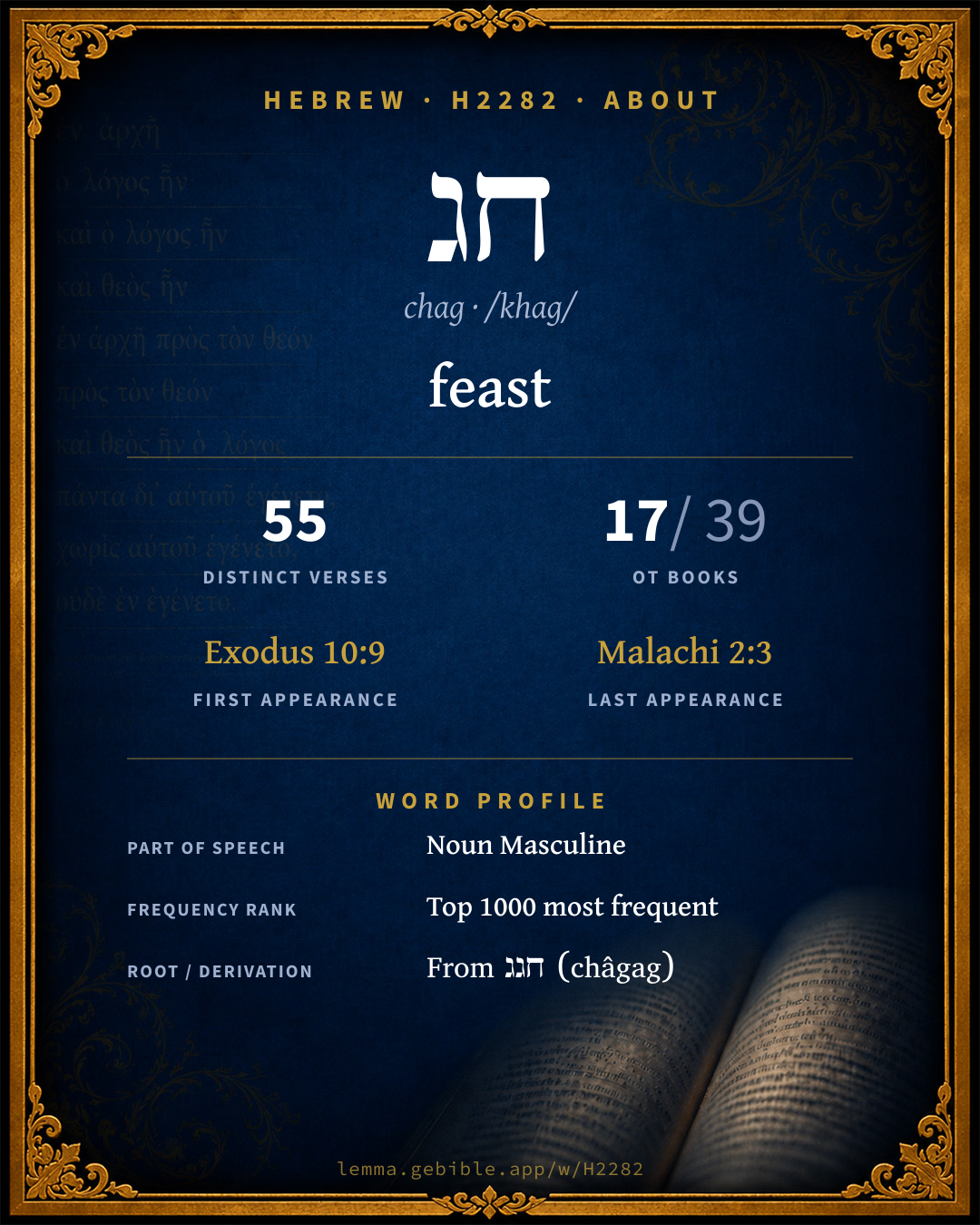
חַג
feast
also: festival, festival-gathering, pilgrim-feast fuller range ↓
Full lexicon entry — Brown-Driver-Briggs (BDB)
From Brown-Driver-Briggs (BDB)
Where this word appears
See every Construct-state word in the Hebrew Bible →
Grammar key — what these labels mean
Part of speech
- Noun
- A naming word — a person, place, thing, or idea.
Noun type
- Common
- A common noun — a general class of person, place, or thing (“king,” “city,” “water”), not a specific name.
State
- Construct
- A noun bound to a following noun in a possessive / “of” relationship (the construct chain).
- Absolute
- The independent form of a noun, not bound to a following word.
Gender
- Masculine
- Grammatically masculine.
Number
- Singular
- One.
- Plural
- More than one (in Hebrew, generally three or more).
Grammatical forms
- Noun, Common, Masculine, Singular, Construct 34 times (55%)
- Noun, Common, Masculine, Singular, Absolute 21 times (34%)
- Noun, Common, Masculine, Plural, Construct 4 times (6%)
- Noun, Common, Masculine, Plural, Absolute 3 times (5%)
Parsed forms decoded from the imported morphology (morphhb / Westminster Leningrad Codex — WLC text public domain, morphhb tagging CC BY 4.0), counted across 62 parsed occurrences — not distinct verses.
Every verse where H2282 appears — 55 distinct verses across 17 books. Click any verse to open its interlinear word-by-word view. Verse text shown in the World English Bible for context — . Each verse’s Hebrew form is shown with its reference; the English is not keyword-highlighted, since the data carries no word-level English alignment. Use “Compare translations” on any verse to read it across multiple English versions. This concordance covers the Hebrew Bible; Septuagint (Greek Old Testament) occurrences are not indexed here.
Exodus 10 verses
- Exodus 10:9 חַג n c ms cs Moses said, "We will go with our young and with our old; with our sons and with our daughters, with our flocks and with our herds will we go; for we must hold a feast to Yahweh."
- Exodus 12:14 חַ֣ג n c ms This day shall be to you for a memorial, and you shall keep it a feast to Yahweh: throughout your generations you shall keep it a feast by an ordinance forever.
- Exodus 13:6 חַ֖ג n c ms Seven days you shall eat unleavened bread, and in the seventh day shall be a feast to Yahweh.
- Exodus 23:15 חַ֣ג n c ms cs You shall observe the feast of unleavened bread. Seven days you shall eat unleavened bread, as I commanded you, at the time appointed in the month Abib (for in it you came out from Egypt), and no one shall appear before me empty.
- Exodus 23:16 וְ/חַ֤ג וְ/חַ֤ג conj + n c ms cs conj + n c ms cs And the feast of harvest, the first fruits of your labors, which you sow in the field: and the feast of harvest, at the end of the year, when you gather in your labors out of the field.
- Exodus 23:18 חַגִּ֖/י n c ms cs + sfx pers 1cs "You shall not offer the blood of my sacrifice with leavened bread, neither shall the fat of my feast remain all night until the morning.
- Exodus 32:5 חַ֥ג n c ms When Aaron saw this, he built an altar before it; and Aaron made a proclamation, and said, "Tomorrow shall be a feast to Yahweh."
- Exodus 34:18 חַ֣ג n c ms cs "You shall keep the feast of unleavened bread. Seven days you shall eat unleavened bread, as I commanded you, at the time appointed in the month Abib; for in the month Abib you came out from Egypt.
- Exodus 34:22 וְ/חַ֤ג וְ/חַג֙ conj + n c ms cs conj + n c ms cs You shall observe the feast of weeks with the first fruits of wheat harvest, and the feast of harvest at the year's end.
- Exodus 34:25 חַ֥ג n c ms cs "You shall not offer the blood of my sacrifice with leavened bread; neither shall the sacrifice of the feast of the Passover be left to the morning.
Leviticus 4 verses
- Leviticus 23:6 חַ֥ג n c ms cs On the fifteenth day of the same month is the feast of unleavened bread to Yahweh. Seven days you shall eat unleavened bread.
- Leviticus 23:34 חַ֧ג n c ms cs "Speak to the children of Israel, and say, 'On the fifteenth day of this seventh month is the feast of tents for seven days to Yahweh.
- Leviticus 23:39 חַג n c ms cs "'So on the fifteenth day of the seventh month, when you have gathered in the fruits of the land, you shall keep the feast of Yahweh seven days: on the first day shall be a solemn rest, and on the eighth day shall be a solemn rest.
- Leviticus 23:41 חַ֣ג n c ms You shall keep it a feast to Yahweh seven days in the year: it is a statute forever throughout your generations; you shall keep it in the seventh month.
Numbers 2 verses
- Numbers 28:17 חָ֑ג n c ms On the fifteenth day of this month shall be a feast: seven days shall unleavened bread be eaten.
- Numbers 29:12 חַ֛ג n c ms On the fifteenth day of the seventh month you shall have a holy convocation; you shall do no servile work, and you shall keep a feast to Yahweh seven days:
Deuteronomy 5 verses
- Deuteronomy 16:10 חַ֤ג n c ms cs You shall keep the feast of weeks to Yahweh your God with a tribute of a freewill-offering of your hand, which you shall give, according as Yahweh your God blesses you:
- Deuteronomy 16:13 חַ֧ג n c ms cs You shall keep the feast of tents seven days, after that you have gathered in from your threshing floor and from your winepress:
- Deuteronomy 16:14 בְּ/חַגֶּ֑/ךָ prep + n c ms cs + sfx pers 2ms and you shall rejoice in your feast, you, and your son, and your daughter, and your man-servant, and your maid-servant, and the Levite, and the foreigner, and the fatherless, and the widow, who are within your gates.
- Deuteronomy 16:16 בְּ/חַ֧ג וּ/בְ/חַ֥ג וּ/בְ/חַ֣ג prep + n c ms cs conj + prep + n c ms cs conj + prep + n c ms cs Three times in a year shall all your males appear before Yahweh your God in the place which he shall choose: in the feast of unleavened bread, and in the feast of weeks, and in the feast of tents; and they shall not appear before Yahweh empty:
- Deuteronomy 31:10 בְּ/חַ֥ג prep + n c ms cs Moses commanded them, saying, At the end of [every] seven years, in the set time of the year of release, in the feast of tents,
Judges 1 verse
1 Kings 4 verses
- 1 Kings 8:2 בֶּ/חָ֑ג prep det + n c ms All the men of Israel assembled themselves to king Solomon at the feast, in the month Ethanim, which is the seventh month.
- 1 Kings 8:65 הֶ/חָ֡ג ptcl def.art + n c ms So Solomon held the feast at that time, and all Israel with him, a great assembly, from the entrance of Hamath to the brook of Egypt, before Yahweh our God, seven days and seven days, even fourteen days.
- 1 Kings 12:32 חָ֡ג כֶּ/חָ֣ג n c ms prep det + n c ms Jeroboam ordained a feast in the eighth month, on the fifteenth day of the month, like the feast that is in Judah, and he went up to the altar; so did he in Bethel, sacrificing to the calves that he had made: and he placed in Bethel the priests of the high places that he had made.
- 1 Kings 12:33 חָג֙ n c ms He went up to the altar which he had made in Bethel on the fifteenth day in the eighth month, even in the month which he had devised of his own heart: and he ordained a feast for the children of Israel, and went up to the altar, to burn incense.
2 Chronicles 7 verses
- 2 Chronicles 5:3 בֶּ/חָ֑ג prep det + n c ms And all the men of Israel assembled themselves to the king at the feast, which was [in] the seventh month.
- 2 Chronicles 7:8 הֶ֠/חָג ptcl def.art + n c ms So Solomon held the feast at that time seven days, and all Israel with him, a very great assembly, from the entrance of Hamath to the brook of Egypt.
- 2 Chronicles 7:9 וְ/הֶ/חָ֖ג conj + ptcl def.art + n c ms On the eighth day they held a solemn assembly: for they kept the dedication of the altar seven days, and the feast seven days.
- 2 Chronicles 8:13 בְּ/חַ֧ג וּ/בְ/חַ֥ג וּ/בְ/חַ֥ג prep + n c ms cs conj + prep + n c ms cs conj + prep + n c ms cs even as the duty of every day required, offering according to the commandment of Moses, on the Sabbaths, and on the new moons, and on the set feasts, three times in the year, [even] in the feast of unleavened bread, and in the feast of weeks, and in the feast of tents.
- 2 Chronicles 30:13 חַ֥ג n c ms cs There assembled at Jerusalem much people to keep the feast of unleavened bread in the second month, a very great assembly.
- 2 Chronicles 30:21 חַ֧ג n c ms cs The children of Israel who were present at Jerusalem kept the feast of unleavened bread seven days with great gladness; and the Levites and the priests praised Yahweh day by day, [singing] with loud instruments to Yahweh.
- 2 Chronicles 35:17 חַ֥ג n c ms cs The children of Israel who were present kept the Passover at that time, and the feast of unleavened bread seven days.
Ezra 2 verses
- Ezra 3:4 חַ֥ג n c ms cs They kept the feast of tents, as it is written, and [offered] the daily burnt offerings by number, according to the ordinance, as the duty of every day required;
- Ezra 6:22 חַג n c ms cs and kept the feast of unleavened bread seven days with joy: for Yahweh had made them joyful, and had turned the heart of the king of Assyria to them, to strengthen their hands in the work of the house of God, the God of Israel.
Nehemiah 2 verses
- Nehemiah 8:14 בֶּ/חָ֖ג prep det + n c ms They found written in the law, how that Yahweh had commanded by Moses, that the children of Israel should dwell in booths in the feast of the seventh month;
- Nehemiah 8:18 חָג֙ n c ms Also day by day, from the first day to the last day, he read in the book of the law of God. They kept the feast seven days; and on the eighth day was a solemn assembly, according to the ordinance.
Psalms 2 verses
Isaiah 2 verses
- Isaiah 29:1 חַגִּ֥ים n c mp Ho Ariel, Ariel, the city where David encamped! add you year to year; let the feasts come round:
- Isaiah 30:29 חָ֑ג n c ms You shall have a song as in the night when a holy feast is kept; and gladness of heart, as when one goes with a pipe to come to the mountain of Yahweh, to the Rock of Israel.
Ezekiel 5 verses
- Ezekiel 45:17 בַּ/חַגִּ֤ים prep det + n c mp It shall be the prince's part to give the burnt offerings, and the meal-offerings, and the drink-offerings, in the feasts, and on the new moons, and on the Sabbaths, in all the appointed feasts of the house of Israel: he shall prepare the sin-offering, and the meal-offering, and the burnt offering, and the peace-offerings, to make atonement for the house of Israel.
- Ezekiel 45:21 חָ֕ג n c ms In the first [month], in the fourteenth day of the month, you shall have the Passover, a feast of seven days; unleavened bread shall be eaten.
- Ezekiel 45:23 הֶ/חָ֜ג ptcl def.art + n c ms The seven days of the feast he shall prepare a burnt offering to Yahweh, seven bulls and seven rams without blemish daily the seven days; and a male goat daily for a sin-offering.
- Ezekiel 45:25 בֶּ/חָ֔ג prep det + n c ms In the seventh [month], in the fifteenth day of the month, in the feast, shall he do the like the seven days; according to the sin-offering, according to the burnt offering, and according to the meal-offering, and according to the oil.
- Ezekiel 46:11 וּ/בַ/חַגִּ֣ים conj + prep det + n c mp In the feasts and in the solemnities the meal-offering shall be an ephah for a bull, and an ephah for a ram, and for the lambs as he is able to give, and a hin of oil to an ephah.
Hosea 2 verses
Amos 2 verses
- Amos 5:21 חַגֵּי/כֶ֑ם n c mp cs + sfx pers 2mp I hate, I despise your feasts, And I can't stand your solemn assemblies.
- Amos 8:10 חַגֵּי/כֶ֜ם n c mp cs + sfx pers 2mp I will turn your feasts into mourning, And all your songs into lamentation; And I will make you wear sackcloth on all your bodies, And baldness on every head. I will make it like the mourning for an only son, And the end of it like a bitter day.
Nahum 1 verse
Zechariah 3 verses
- Zechariah 14:16 חַ֥ג n c ms cs It will happen that everyone who is left of all the nations that came against Jerusalem will go up from year to year to worship the King, Yahweh of Hosts, and to keep the feast of tents.
- Zechariah 14:18 חַ֥ג n c ms cs If the family of Egypt doesn't go up, and doesn't come, neither will it rain on them. This will be the plague with which Yahweh will strike the nations that don't go up to keep the feast of tents.
- Zechariah 14:19 חַ֥ג n c ms cs This will be the punishment of Egypt, and the punishment of all the nations that don't go up to keep the feast of tents.
Malachi 1 verse
About this entry
At a glance — auto-summarized from this page’s data, not written by a person. Every figure links to its source below. This summary describes the numbers; it doesn’t interpret them.
At its core, חג (chag) means “feast.” Its English rendering has broadened — “feast” classically, “festival of” (unfoldingWord Literal Text) in modern versions; see the renderings breakdown. Spanning 55 verses in 17 books, it ranks among the moderately common words of the Hebrew Bible. It first appears in Exodus 10:9. Beyond its headline sense, its full sense range takes in “festival”, “festival-gathering”, and “pilgrim-feast”. Dig into 55-verse concordance and the renderings breakdown below.
Gloss history
Strong's 1890 vs modern scholarship
About this word
Strong's H2282 catalogs a Hebrew word from the Hebrew Old Testament.
These counts are not copied from any lexicon or concordance. They are computed here, from the morphology-tagged Hebrew Old Testament. What Lemma adds →
- 55
- distinct verses
- The word appears in 55 distinct verses.
- 17 / 39
- OT books
- The word appears in 17 of 39 Old Testament books.
- #623
- by frequency
- Top 1000 most frequent Hebrew words (rank 623 of 8,640 Hebrew words by occurrence).
View all 55 occurrences in the concordance →
Most concentrated in
- Exodus 10 verses 18%
- 2 Chronicles 7 verses 13%
- Deuteronomy 5 verses 9%
By section of the Old Testament
By traditional corpus
Conventional, traditional groupings — biblical authorship is debated, so this is a traditional corpus grouping, not an authorship claim. Each share is this word’s portion of its verses in that division of the Hebrew canon. Each figure is a share of the word’s 55 distinct verses.
- Torah (Pentateuch) 21 verses · 38%
- Prophets (Nevi'im) 21 verses · 38%
- Writings (Ketuvim) 13 verses · 24%
How translations render this word
Counts come from each version’s own published word-to-Strong’s tagging or interlinear alignment — an approximate guide to how each version renders this word, not a word-level alignment the data otherwise carries. Because each total is that version’s own tagged count, the per-version totals vary from one another and need not match the appearance or distinct-verse counts above. These counts may also differ from a printed concordance because Lemma counts each distinctly tagged rendering and does not collapse phrase taggings into a single head-word total. This is a fixed set of word-tagged versions (KJV, ASV, BSB, ULT) and does not change with the reading translation you choose elsewhere. Each version’s license is shown beside its name below (and on Sources).
- King James Version: Feast 41×, Feasts 3×, Feast days 2×
- American Standard Version: Feast 43×, Feasts 7×, Shall be a feast 3×
- Berean Standard Bible: Feast 46×, Feasts 6×, During the feast 2×
- unfoldingWord Literal Text: Festival of 13×, Festival 12×, Feast 11×
King James Version Public Domain
Renders H2282 across 62 tagged occurrences — most commonly:
Plus 10 renderings that appear only once — usually multi-word phrases or single function words the recovered tagging swept in, not distinct renderings.
American Standard Version Public Domain
Renders H2282 across 62 tagged occurrences — most commonly:
Plus 7 renderings that appear only once — usually multi-word phrases or single function words the recovered tagging swept in, not distinct renderings.
Berean Standard Bible Public Domain
Renders H2282 across 62 tagged occurrences — most commonly:
Plus 6 renderings that appear only once — usually multi-word phrases or single function words the recovered tagging swept in, not distinct renderings.
unfoldingWord Literal Text CC BY-SA 4.0
Renders H2282 across 66 tagged occurrences — most commonly:
Plus 13 renderings that appear only once — usually multi-word phrases or single function words the recovered tagging swept in, not distinct renderings.
Senses in the full BDB
What do BDB’s symbols mean?
BDB uses these scholarly abbreviations:
| Symbol | Meaning |
|---|---|
| 𝔊 | the Septuagint (the ancient Greek translation, LXX) |
| 𝔙 | the Vulgate (the Latin translation) |
| 𝔖 | the Syriac version (the Peshitta) |
| 𝔗 | the Targum (the Aramaic translation) |
| ψ | the Psalms |
| √ | root (the underlying root or stem) |
| ‖ | parallel passage (a synonymous or contrasted parallel) |
| † | the dagger: every passage where the word occurs is cited |
The 4 senses and sub-senses the full Brown-Driver-Briggs lexicon distinguishes for this word, in lexicon order (not ranked by frequency), with BDB’s own verbatim wording and sub-sense lettering. Shown in Hebrew script with BDB’s own scholarly abbreviations. The condensed entry is in the Lexicon Entry tab. See also the Forms in the corpus table below.
- 1. feast, especially one observed by a pilgrimage (Ex 23:14, 17): e.g. Exodus 23:14
- a. special feast to the golden calf Ex 32:5 (J; where there was a sacred dance v 19); a feast in the 8th month observed by Jeroboam in place of the feast of the 7th month in Judah 1 K 12:32, 33; pilgrim feast proposed by Moses Ex 10:9 (JE); feast at Shiloh Ju 21:19. Elsewhere e.g. Exodus 32:5
- b. apparently always of the three great pilgrim feasts, celebrated by processions and dancing: (1) in general Is 30:29 Am 8:10 Na 2:1; חגים ינקפו let feasts come round Is 29:1; ‖ עצרות Am 5:21; חַג לי׳ Lv 23:41 (H); disting. from the more gen. מועדים (sacred seasons) Ez 45:17; 46:11 Ho 9:5 (יום חג), and from specif. חדשׁים, שׁבתות as well, Ho 2:13; (2) in particular: unleavened cakes and Passover חג (ה)מצות Ex 23:15 = 34:18 (JE); Lv 23:6 (P), Dt 16:16 2 Ch 8:13; 30:13, 21; 35:17 Ezr 6:22; חג Ex 12:14 (P); first day of the seven Nu 28:17 (P); the last day Ex 13:6 (J); the seven Ez 45:21, 23; חג חפסח Ex 34:25, חגי Ex 23:18 (both JE); בַּכֶּסֶה לְיּוֹם חַגֵּנוּ ψ 81:4 (probably the full moon of Passover); חג הקציר Ex 23:16 = חג שׁבעת Ex 34:22 (JE), cf. Dt 16:10, 16 2 Ch 8:13; חג האס(י)ף Ex 23:16 = 34:22 (JE) = חג הסכ(ו)ת Lv 23:34 (P), Dt 16:13, 16; 31:10 2 Ch 8:13 Ezr 3:4 Zc 14:16, 18, 19; also חג י׳ Lv 23:39 (H), הֶחָג 1 K 8:2, 65 = 2 Ch 5:3; 7:8, 9, Ez 45 Ne 8:14; חַגֶּךָ֑ (i.e. of people) Dt 16:14; 7 days Nu 29:12 (P), Ne 8:18.—Vbs. c. חג are: חגג Lv 23:39, 41 (H), Ex 12:14 Nu 29:12 (P), Na 2:1 Zc 14:16, 18, 19; שׁמר Ex 23:15 = 34:18 (JE); התקדשׁ Is 30:29; but usually עשׂה Ex 34:22 (JE), Dt 16:10, 13 1 K 8:65; 12:32, 33 2 Ch 7:8, 9; 30:13, 21; 35:17 Ezr 3:4; 6:22 Ne 8:18. e.g. Isaiah 30:29
- 2. festival sacrifice (cf. NH חֲגִיגָה) ψ 118:27 (see מזבח 12); Mal 2:3 (RV after Thes Ke al.: but AV Ew Or feast). e.g. Psalms 118:27
Senses from the full Brown-Driver-Briggs lexicon (Brown, Driver, Briggs; Oxford 1906 — public domain), digitized via Sefaria, supplemented by the OpenScriptures HebrewLexicon (CC BY 4.0). Full attribution on Sources.
Word origin
n.m. Is 29:1 festival-gathering, feast, pilgrim-feast (NH id.; Aramaic ܚܰܓܳܐ, חַגָּא; Arabic حَجٌّ pilgrimage; Sab. חג DHMEpigr. Denkm. 31; NöZMG 1887, 719; RSProph. Lect. ii. n. 6; > WeSkizzen iii. 106, 165 sacred dance)—חַג abs. and cstr. Ex 10:9 + 36 times; חָ֑ג Nu 28:17 + 13 times; sf. חַגִּי Ex 23:18; חַגֶּךָ֑ Dt 16:14; חַגָּהּ Ho 2:13; חַגֵּנוּ ψ 81:4; pl. חַגִּים Is 29:1 + 2 times; sf. חַגַּיִךְ Na 2:1; חַגֵּיכֶם Am 5:21 + 2 times;—
— Brown-Driver-Briggs (Oxford 1906, public domain), digitized via Sefaria, supplemented by the OpenScriptures HebrewLexicon (CC BY 4.0). See Sources.
Derived from חגג (châgag) (H2287) — to feast.
Jastrow Dictionary
A second Hebrew/Aramaic lexicon for comparison, covering Aramaic and post-biblical (Talmudic, Targumic, Midrashic) usage that the biblical-Hebrew BDB does not. Matched by lemma rather than by Strong’s number, so a lemma may carry more than one Jastrow headword (shown separately below), and the entries cover usage well beyond the Bible.
חָג
- , v. חגג, חוג.
חָג ²
- 1. anniversary, festival. Lev. R. s. 29; Pesik. Baḥod. p. 153ᵃ ויש לו חג וחַגּוֹ בן יומו a New-Moon of a month in which there is a festival and whose festival coincides with the New-Moon, v. כָּסָה I. Y. Taan. IV, 69ᵇ bot., v. דְּרוֹמָאָה. Sot. 36ᵇ יום חַגָּם their (the Egyptians’) festive day; a. fr.—Esp. ḥag (festive period), the Feast of Booths with its Eighth Day of Convocation (שמיני עצרת). Succ. IV, 2 י"ט הראשון של חג the first Holy Day of the ḥag; ib. 5 י"ט האחרון וכ׳ the last &c. (the eighth day); a. fr.
- 2. pilgrim’s festive offering. Ḥag. 10ᵇ, v. next w., a. חֲגִיגָה.—Pl. חַגִּים, constr. חַגֵּי. Ber. 33ᵇ ח׳ נדבה periods of free-will offerings.
A Dictionary of the Targumim, the Talmud Babli and Yerushalmi, and the Midrashic Literature (Marcus Jastrow; London, Luzac, 1903) — Public Domain. Digitized via Sefaria. Digitized via Sefaria. Full attribution on Sources.
Forms in the corpus
The 35 distinct written forms H2282 takes in the Hebrew Bible, most frequent first — each parse links to that state’s occurrences in the concordance. Hebrew forms include their vowel points and cantillation, so a single lemma takes many written forms.
Same root — word family
Other BDB entries built from the same root as H2282, grouped by Strong’s listed origin. These share a root / origin per the lexicon — not necessarily a shared meaning. Each links to that word’s own entry.
Derives from
Shares the same root
Proper names from this root
People and places named from this root — a name, not an additional meaning of the word.
Compare all same-root words → Showing 4 of 7 — not the complete family. 3 of the same-root words are proper names (people or places). They share a root, not necessarily a meaning.
Septuagint verse parallels
This word appears in 52 verses that also exist in the Greek Old Testament (Septuagint), out of the 55 Hebrew verses it occurs in. You can read those verses in Greek by switching the Old Testament edition to the Septuagint.
Read these verses in the Septuagint
- Exodus 10:9
- Leviticus 23:6
- Numbers 28:17
- Deuteronomy 16:10
- Judges 21:19
- 1 Kings 8:2
- 2 Chronicles 5:3
- Ezra 3:4
- Psalms 81:3
- Isaiah 29:1
- Ezekiel 45:17
- Hosea 2:11
This is a verse-level parallel only — the same verses exist in both the Hebrew and Greek Old Testaments. No word-level Hebrew↔Greek correspondence is claimed: the data carries no such alignment, so no Greek word is shown as this Hebrew word’s translation. Coverage is not total — the Septuagint omits the deuterocanon and renumbers the Psalms, so some Hebrew verses have no direct Greek parallel.