2 Peter 2:21

Greek (Tischendorf 8th ed.) 2 Peter 2:21 appears in the Greek New Testament. The text above is from the Tischendorf 8th edition. Each word links to its Strong’s number and a concise gloss. Click any word for its full Thayer’s Greek Lexicon entry.
Download image
Cite this verse

2 Peter 2:21 (World English Bible). Public Domain. Lemma interlinear Bible study tool, https://lemma.gebible.app/v/2-peter/2/21.

Show BibTeX & RIS
BibTeX
RIS
English Translation
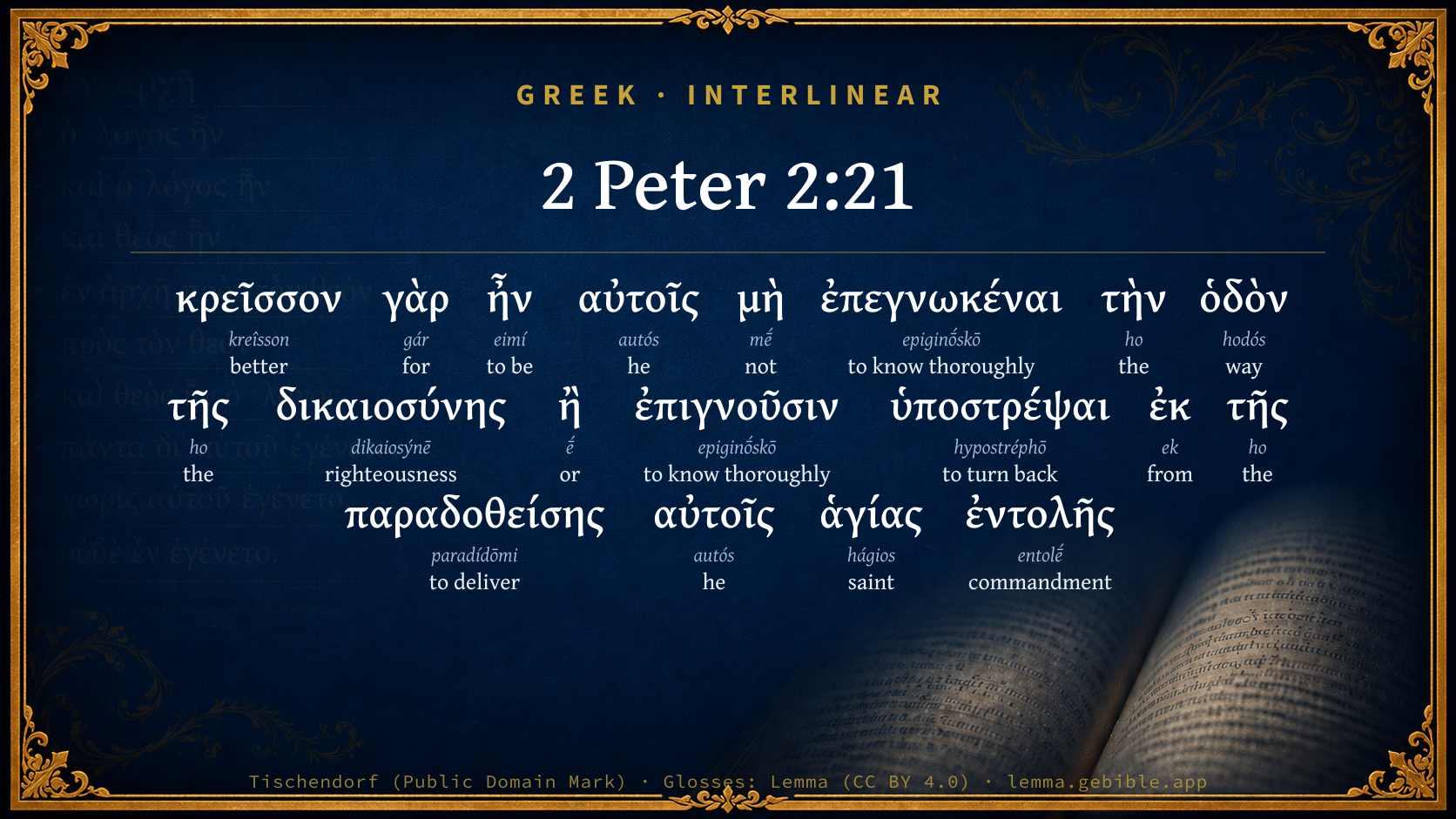
For it would be better for them not to have known the way of righteousness, than, after knowing it, to turn back from the holy commandment delivered to them.
World English Bible · Public Domain
Download a study sheet

One document with this verse’s original text, its word-by-word gloss line, the meaning frame, cross-references with their text, attributed commentary, and full source and license credits — printable, and it pastes into notes with its structure intact.

This verse Autodidact and up

Study sheet (.html) Plain text (.txt)

A passage Seminary Student

Up to 50 verses in one chapter. A passage sheet keeps up to 6 commentary sources and 12 cross-references per verse, in the order this page ranks them, and says so on the sheet whenever that leaves anything out. Ask for a single verse and you get the Autodidact verse sheet above.

Everything on this page stays free to read, with no account — the sheet is a download of what is already on screen, not access to it.

Want to remove ads? Support Godless Engineer
Compare translations 3

The same verse in 3 English versions, stacked beneath the original-language interlinear above. Click any original word for its lexicon entry.

Each is an independent rendering of the whole verse — the interlinear is not word-aligned to these translations.

Highlighted words mark where these versions differ — a whole-verse word diff, not a word-by-word alignment.

  • World English Bible Public Domain
    For it would be better for them not to have known the way of righteousness, than, after knowing it, to turn back from the holy commandment delivered to them.
  • King James Version Public Domain
    For it had been better for them not to have known the way of righteousness, than, after they have known it, to turn from the holy commandment delivered unto them.
  • unfoldingWord Literal Text CC BY-SA 4.0
    For it was better for them not to know the way of righteousness than, having known, to turn away from the holy commandment that has been delivered to them.

unfoldingWord Literal Text — © unfoldingWord, licensed CC BY-SA 4.0. Word-aligned USFM3 via Door43 (git.door43.org/unfoldingWord/en_ult).

Versions to compare (up to 4)

3 of 4 selected

Show all 19 translations

Every available English version of this verse, each an independent rendering of the whole verse.

  • World English Bible Public Domain
    For it would be better for them not to have known the way of righteousness, than, after knowing it, to turn back from the holy commandment delivered to them.
  • Berean Standard Bible Public Domain
    It would have been better for them not to have known the way of righteousness than to have known it and then to turn away from the holy commandment passed on to them.
  • Majority Standard Bible Public Domain
    It would have been better for them not to have known the way of righteousness than to have known it and then to turn away from the holy commandment passed on to them.
  • King James Version Public Domain
    For it had been better for them not to have known the way of righteousness, than, after they have known it, to turn from the holy commandment delivered unto them.
  • American Standard Version (1901) Public Domain
    For it were better for them not to have known the way of righteousness, than, after knowing it, to turn back from the holy commandment delivered unto them.
  • Revised Version (1885) Public Domain
    For it were better for them not to have known the way of righteousness, than, after knowing it, to turn back from the holy commandment delivered unto them.
  • Geneva Bible (1599) Public Domain
    For it had bene better for them, not to haue acknowledged the way of righteousnes, then after they haue acknowledged it, to turne from the holy commandement giuen vnto them.
  • Douay-Rheims (1899) Public Domain
    For it had been better for them not to have known the way of justice, than after they have known it, to turn back from that holy commandment which was delivered to them.
  • Young's Literal Translation Public Domain
    for it were better to them not to have acknowledged the way of the righteousness, than having acknowledged `it', to turn back from the holy command delivered to them,
  • Literal Standard Version CC BY-SA 4.0
    for it were better to them not to have acknowledged the way of righteousness, than having acknowledged [it], to turn back from the holy command delivered to them,
  • Unlocked Literal Bible CC BY-SA 4.0
    It would have been better for them not to know the way of righteousness than to know it and turn away from the holy commandment delivered to them.
  • unfoldingWord Literal Text CC BY-SA 4.0
    For it was better for them not to know the way of righteousness than, having known, to turn away from the holy commandment that has been delivered to them.
  • Darby Bible Public Domain
    For it were better for them not to have known the way of righteousness, than having known [it] to turn back from the holy commandment delivered to them.
  • World Messianic Bible Public Domain
    For it would be better for them not to have known the way of righteousness, than after knowing it, to turn back from the holy commandment delivered to them.
  • Webster's Bible Public Domain
    For it had been better for them not to have known the way of righteousness, than, after they have known it, to turn from the holy commandment delivered to them.
  • Free Bible Version CC BY-SA 4.0
    It would have been better not to have known the right way of truth, than to have known it and then turn away from the sacred instructions they'd been given.
  • Bible in Basic English Public Domain
    For it would have been better for them to have had no knowledge of the way of righteousness, than to go back again from the holy law which was given to them, after having knowledge of it.
  • Text-Critical English NT CC BY 4.0
    It would have been better for them not to have known the way of righteousness than, after knowing it, to turn back from the holy commandment that was passed on to them.
  • Tyndale New Testament (1534) Public Domain
    For it had bene better for the not to have knowne the waye of righteousnes then after they have knowe it to turne from the holy commaundment geve vnto them.

Literal Standard Version (2020), Covenant Press — licensed CC BY-SA 4.0. Text via the HelloAO Bible API (eBible.org). Unlocked Literal Bible (unfoldingWord) — licensed CC BY-SA 4.0. Text via the HelloAO Bible API (eBible.org). unfoldingWord Literal Text — © unfoldingWord, licensed CC BY-SA 4.0. Word-aligned USFM3 via Door43 (git.door43.org/unfoldingWord/en_ult). Free Bible Version, Dr. Jonathan Gallagher — licensed CC BY-SA 4.0. Text via the HelloAO Bible API (eBible.org).

Word by word

More ways to search: Search by grammar → Find every occurrence → Compare this word →

Practice this passage: Drill this verse → Learn its vocabulary →

κρεῖσσον
kreîsson
G2908
“better”
Adjective, Nominative, Singular, Neuter
Part of Speech
Adjective
Case
Nominative
Number
Singular
Gender
Neuter
Full Thayer's Definition

Origin: neuter of an alternate form of G2909

TDNT: None

1. better
  1. γὰρ gár G1063 “for” Conjunction
  2. ἦν eimí G1510 “to be” Verb, Imperfect, Active, Indicative, 3rd person, Singular
  3. αὐτοῖς autós G846 “he” Personal pronoun, Dative, Plural, Masculine
  4. μὴ mḗ G3361 “not” Particle, Negative
  5. ἐπεγνωκέναι epiginṓskō G1921 “to know thoroughly” Verb, Perfect, Active, Infinitive
  6. τὴν ho G3588 “the” Article, Accusative, Singular, Feminine
  7. ὁδὸν hodós G3598 “way” Noun, Accusative, Singular, Feminine
  8. τῆς ho G3588 “the” Article, Genitive, Singular, Feminine
  9. δικαιοσύνης dikaiosýnē G1343 “righteousness” Noun, Genitive, Singular, Feminine
  10. ἢ ḗ G2228 “or” Particle
  11. ἐπιγνοῦσιν epiginṓskō G1921 “to know thoroughly” Verb, Aorist, Active, Participle, Dative, Plural, Masculine
  12. ὑποστρέψαι hypostréphō G5290 “to turn back” Verb, Aorist, Active, Infinitive
  13. ἐκ ek G1537 “from” Preposition
  14. τῆς ho G3588 “the” Article, Genitive, Singular, Feminine
  15. παραδοθείσης paradídōmi G3860 “to deliver” Verb, Aorist, Passive, Participle, Genitive, Singular, Feminine
  16. αὐτοῖς autós G846 “he” Personal pronoun, Dative, Plural, Masculine
  17. ἁγίας hágios G40 “saint” Adjective, Genitive, Singular, Feminine
  18. ἐντολῆς entolḗ G1785 “commandment” Noun, Genitive, Singular, Feminine

About this verse

These counts appear in no published source. They are computed here, from the morphology-tagged text and Lemma’s own curated glosses. What Lemma adds →

19
words
15
distinct lemmas
General Epistles
section

Notable vocabulary

The rarest word here is κρεῖσσον better G2908 — appearing just 6 times in the whole Greek New Testament.

Shared distinctive vocabulary

κρεῖσσον better G2908 occurs in 6 verses of the Greek New Testament. Also found in:

Repetition

Words recur within this verse:

  • ἐπεγνωκέναι to know thoroughly G1921 ×2
  • τὴν the G3588 ×3
  • αὐτοῖς he G846 ×2

Cross-references

17

Topical passages linked to 2 Peter 2:21 in the Treasury of Scripture Knowledge — connected by theme and wording, ordered by reader-vote popularity; previews shown in the World English Bible.

  • Ezekiel 18:24 But when the righteous turns away from his righteousness, and commits iniquity, and does according to all the abominations that the wicked man does, shall he live? None of his righteous deeds that he has done shall be remembered: in his trespass that he has trespassed, and in his sin that he has sinned, in them shall he die.
  • Hebrews 6:4–6 For concerning those who were once enlightened and tasted of the heavenly gift, and were made partakers of the Holy Spirit,
  • James 4:17 To him therefore who knows to do good, and doesn't do it, to him it is sin.
  • Ezekiel 3:20 Again, when a righteous man does turn from his righteousness, and commit iniquity, and I lay a stumbling block before him, he shall die: because you have not given him warning, he shall die in his sin, and his righteous deeds which he has done shall not be remembered; but his blood will I require at your hand.
  • Luke 12:47 That servant, who knew his lord's will, and didn't prepare, nor do what he wanted, will be beaten with many stripes,
  • John 15:22 If I had not come and spoken to them, they would not have had sin; but now they have no excuse for their sin.
  • John 9:41 Jesus said to them, "If you were blind, you would have no sin; but now you say, 'We see.' Therefore your sin remains.
  • 1 Thessalonians 4:2 For you know what charge we gave you through the Lord Jesus.
  • Zephaniah 1:6 those who have turned back from following Yahweh, and those who haven't sought Yahweh nor inquired after him.
  • Proverbs 16:31 Gray hair is a crown of glory. It is attained by a life of righteousness.
  • Matthew 21:32 For John came to you in the way of righteousness, and you didn't believe him, but the tax collectors and the prostitutes believed him. When you saw it, you didn't even repent afterward, that you might believe him.
  • Psalms 36:3–4 The words of his mouth are iniquity and deceit. He has ceased to be wise and to do good.
  • Romans 7:12 Therefore the law indeed is holy, and the commandment holy, and righteous, and good.
  • Psalms 125:5 But as for those who turn aside to their crooked ways, Yahweh will lead them away with the workers of iniquity. Peace be on Israel.
  • Proverbs 12:28 In the way of righteousness is life; In its path there is no death.
  • Ezekiel 23:13 I saw that she was defiled; they both took one way.
  • Matthew 11:23–24 You, Capernaum, who are exalted to Heaven, you will go down to Hades. For if the mighty works had been done in Sodom which were done in you, it would have remained until this day.

Cross-references courtesy of OpenBible.info (CC BY 4.0).

Commentary

Notes on 2 Peter 2:21 from classic Christian and Jewish commentators (each source and its license shown beneath its notes). The classic Christian expositions comment on the surrounding passage and are grouped to its opening verse, so a note may address several verses; the Jewish commentaries on the Tanakh (Rashi and others) are per-verse, so they appear only where the commentator wrote on this verse.

Lemma curates 59 commentaries, every one of them public domain or Creative Commons licensed, each selected and text-cleaned for this edition rather than reprinted as found. About our sources →

Bengel's Gnomon

Johann Albrecht Bengel

2Pe 2:21. Ἢ ἐπιγνοῦσιν, than when they have known it) Understand it is, from it had been.—παραδοθείσης, delivered to them) Jud 1:3.

Bengel's Gnomon of the New Testament — English translation (T&T Clark, Edinburgh, 1860) — public domain. Text from a community e-Sword module.

Meyer's Critical & Exegetical Commentary

Heinrich August Wilhelm Meyer

2Pe_2:21. κρεῖττον γὰρ ἦν αὐτοῖς] The same use of the imperf. where we should employ the conjunct., Mar_14:21 : καλὸν ἦν αὐτῷ; cf. on the constr. Winer, p. 265 [E. T. 352].

μὴ ἐπεγνωκέναι τὴν ὁδὸν τῆς δικαιοσύνης] ἡ ὁδὸς τῆς δικαιοσ. is not: the way to virtue, or the way of salvation which leads to the moral condition of righteousness (Schott), but a designation of Christianity in so far as a godly righteous life belongs to it; cf. 2Pe_2:2.[82]

ἤ ἐπιγνοῦσιν] The dat. instead of the accus., dependent on αὐτοις; by an attraction not uncommon in Greek.

ἐπιστρέψαι] is to be taken here in the sense of: to turn back to the former things; cf. 2Pe_2:22, as in Mar_13:16; Luk_17:31, where it is connected with εἰς τὰ ὀπίσω; in Luk_8:55, nevertheless, it is used in the same sense without adjunct; see critical remarks.

ἐκ τῆς … ἐντολῆς] With παραδοθείσης αὐτοῖς, cf. Jud_1:3.

ἡ ἁγία ἐντολή is the law of the Christian life, cf. 1Ti_6:14; here mentioned because the passage treats of the moral corruption of the false teachers.

[82] In Steinfass observation: By the δικαιοσύνης of the ὁδὸν δικαιοσύνης righteousness is understood as being not the end, but the wayfarer, the first is right, but the second wrong.

Meyer — Critical and Exegetical Commentary on the New Testament — English translation by Peter Christie, edited by Frederick Crombie (T&T Clark, 1880) — public domain. Text from a community e-Sword module.

Expositor's Greek Testament

ed. W. Robertson Nicoll

2Pe 2:21 . ὁδὸν τῆς δικαιοσύνης . Also called “the way of truth,” 2Pe 2:2 , “the straight way,” 2Pe 2:15 . ἐντολῆς . Elsewhere in N.T. the singular is used to mean a particular precept. Cf. Rom 7:12 , 1Ti 6:14 . It is characteristic of this writer to emphasise the aspect of Christianity, not only as faith, but as the moral law ἁγίας ἐντολῆς . Cf. 2Pe 1:5 . ἐν τῇ πίστει ὑμῶν τὴν ἀρετήν . A strong ethical note pervades the teach-of 2 Peter.

The Expositor's Greek Testament, edited by W. Robertson Nicoll (1897–1910) — public domain. Text from a community e-Sword module.

Jamieson, Fausset & Brown

Robert Jamieson, A. R. Fausset & David Brown

the way of righteousness--"the way of truth" (Pe2 2:2). Christian doctrine, and "the knowledge of the Lord and Saviour."

turn--back again; so the Greek.

from the holy commandment--the Gospel which enjoins holiness; in opposition to their corruption. "Holy," not that it makes holy, but because it ought to be kept inviolate [TITTMANN].

delivered--once for all; admitting no turning back.

Jamieson, Fausset & Brown — Commentary Critical and Explanatory on the Whole Bible (1871) — public domain (CC PDM 1.0). Text via the HelloAO Bible API.

Adam Clarke's Commentary

Verse 21. For it had been better for them not to have known] For the reasons assigned above; because they have sinned against more mercy, are capable of more sin, and are liable to greater punishment.

The holy commandment] The whole religion of Christ is contained in this one commandment, "Thou shalt love the Lord thy God with all thy heart, with all thy soul, with all thy mind, and with all thy strength; and thy neighbour as thyself." He who obeys this great commandment, and this by the grace of Christ is possible to every man, is saved from sinning either against his God or against his neighbour. Nothing less than this does the religion of Christ require.

Adam Clarke's Commentary on the Bible (1810–1826) — public domain. Text from a community e-Sword/MySword module.

John Calvin's Commentaries

21. By saying that having forsaken the commandment delivered unto them, they returned to their own pollutions, he intimates first, how inexcusable they were; and secondly, he reminds us that the doctrine of a holy and virtuous life, though common to all and indiscriminately belonging to all, is yet peculiarly taught to those whom God favors with the light of his gospel. But he declares that they who make themselves slaves again to the pollutions of the world fall away from the gospel. The faithful also do indeed sin; but as they allow not dominion to sin, they do not fall away from the grace of God, nor do they renounce the profession of sound doctrine which they have once embraced. For they are not to be deemed conquered, while they strenuously resist the flesh and its lusts.

John Calvin's Commentaries (1540-1563) — public domain. Text from the Calvin Translation Society English edition (1840s-50s) via the Christian Classics Ethereal Library (ccel.org). Calvin's coverage is partial (roughly two-thirds of the Bible); uncommented books and verses are honest gaps, never fabricated. The 19th-century editor's footnotes and remarks are omitted so the notes are faithfully Calvin's own voice.

Ellicott's Commentary for English Readers

(21) It had been better for them not to have known.—There are many things of which the well-known lines.

“’Tis better to have loved and lost,

Than never to have loved at all,”

do not hold good. To have loved a great truth, to have loved a high principle, and after all to lose them, is what often causes the shipwreck of a life. To have loved Jesus Christ and lost Him is to make shipwreck of eternal life.

The way of righteousness.—The life of the Christian. That which from a doctrinal point of view is “the way of truth” (2Pe_2:2), from a moral point of view is “the way of righteousness.” So also “the faith delivered to the saints” of Jud_1:3, is the doctrinal equivalent of “the holy commandment delivered unto them” of this verse.

A Bible Commentary for English Readers, edited by Charles John Ellicott (1878–1897) — public domain. Text from a community e-Sword module.

The Cambridge Bible for Schools and Colleges

gen. ed. J. J. S. Perowne

21. For it had been better for them not to have known the way of righteousness] The verb for “known” is, like the noun in the preceding verse, that which implies the fullest form of knowledge, as in 1Co_13:12; 2Co_6:9; 1Ti_4:3. The “way of righteousness” is like the “way of truth” in 2Pe_2:2, a comprehensive description of the religion of Christ as a whole, regarded here in its bearing on life, as there in its relation to belief.

to turn from the holy commandment delivered unto them] The word “delivered” implies, as in Luk_1:2; 1Co_11:2; 1Co_11:23; 1Co_15:3; Jude, 2Pe_2:3, the oral teaching of the elements of Christian faith and life which was imparted to all converts prior to their baptism. Stress is laid on the “commandment” because the Apostle is contemplating chiefly the sins of impurity of which the heresiarchs had been guilty rather than their dogmatic heresies as such.

The Cambridge Bible for Schools and Colleges (gen. ed. J. J. S. Perowne; Cambridge University Press, 1878–1918) — public domain. Text from a community e-Sword module.

John Gill's Exposition

For it had been better for them,.... Not that ignorance is good, or to be excused; but it would have been a lesser evil, and not so much aggravated:

not to have known the way of righteousness; the same with "the way of truth", Pe2 2:2, and "the right way", Pe2 2:15, the Gospel, which points out the way and method of a sinner's justification before God, which is not by the works of the law, but by the righteousness of Christ imputed to them, and received by faith; and which teaches men to live soberly, righteously, and godly; and a large, notional, though not an experimental knowledge, these apostates had of the word and doctrine of righteousness, and indeed of the whole of the Christian religion, which may truly go by this name:

than after they have known it; owned, embraced, and professed it:

to turn: the Vulgate Latin version, and some copies, as the Alexandrian and others, add, to that which is behind; to their former lusts, or errors, or worse, which they had turned their backs upon externally:

from the holy commandment delivered unto them; by the commandment is meant the Gospel also, see Pe2 3:2; called holy, because of its nature and influence, and in opposition to the pollutions of the world; and which is the faith once delivered, Jde 1:3, and which they received, as delivered to them; and, particularly, the ordinances of it, which they once submitted to, kept, and observed, as they were delivered to them, but now relinquished, or corrupted: wherefore, it would have been better for them to have been in their former ignorance, either in Judaism, or in Gentilism, since proportionate to a man's light is his guilt, and so his punishment, see Rom 2:12.

John Gill's Exposition of the Whole Bible (1746–1763) — public domain (CC PDM 1.0). Text via the HelloAO Bible API.

Trapp's Complete Commentary

John Trapp

21 For it had been better for them not to have known the way of righteousness, than, after they have known it, to turn from the holy commandment delivered unto them.

Ver. 21. It had been better] Nocuit sane Iudae fuisse apostolum, et Iuliano Christianum. To begin well and not to proceed is but to aspire to a higher pitch, that the fall may be the more desperate. Non quaeruntur in Christianis initia, sed finis, The begining of a Christian is not to be sought but the end, saith Jerome. Bp Bonner seemed at first to be a good man, and a favourer of Luther’s doctrines. Harding was once a powerful preacher against Popery, afterwards a cruel persecutor of the truth. Dr Shaxton, bishop of Salisbury, said to William Wolsey, martyr, and to others brought before him, Good brethren, remember yourselves and become new men. For I myself was in this fond opinion that you are now in, but I am now become a new man. Ah, said Wolsey, are you become a new man? woe be to thee, thou wicked new man! for God shall justly judge thee for an apostate. {a} Islebius Agricola, that first Antinomian, condemned his error, publicly recanted it, and printed his revocation. Yet, when Luther was dead, he relapsed into that error.

{a} Queen Ann Boleyn procured Latimer and Shaxton to be made bishops, for the good opinion she had of them both. Acts and Mon. 1558.

John Trapp, A Commentary or Exposition upon All the Books of the Old and New Testament (1647–1656) — public domain. Text from a community e-Sword module.

Albert Barnes' Notes on the Bible

For it had been better for them ... - Compare the notes at Mat 26:24. It would have been better for them, for:

(1)Then they would not have dishonored the cause of religion as they have now done;

(2)They would not have sunk so deep in profligacy as they now have; and,

(3)They would not have incurred so aggravated a condemnation in the world of woe. If people are resolved on being wicked, they had better never pretend to be good. If they are to be cast off at last, it had better not be as apostates from the cause of virtue and religion.

Albert Barnes' Notes on the Bible (1834–1885) — public domain. Text from a community e-Sword/MySword module.

Matthew Poole's English Annotations

It had been better for them not to have known; their sin had been less if they had not known the truth, but now they sin against knowledge, and therein their apostacy is much worse than their ignorance would have been.

The way of righteousness; the way of obtaining righteousness by Christ, and of living godly in Christ, 2Ti 3:12, prescribed in the gospel; the same which is called the right way, 2Pe 2:15, and the way of truth, 2Pe 2:2.

The holy commandment; the same in other words. It is called holy, not only as proceeding from God, who is holy, but as teaching nothing but what is holy, and being the means God useth in making men holy, and as being opposed to the pollutions of the world before mentioned.

Matthew Poole's English Annotations on the Holy Bible (1683–1685) — public domain. Text from a community e-Sword/MySword module.

Whedon's Commentary on the Bible

Daniel D. Whedon

21. Way of righteousness—The way of justification from sin through faith in Christ, and of holy living. The laws for walking in this way constitute the holy commandment given them to be kept; but after keeping it for a time, they are now turned back out of it. Surely, then, they were once in it. Besides, the compound word rendered known means to know increasingly, and implies that they had once been living, growing Christians.

It had been better—Because in ceasing to add to their faith, virtue, etc., (2Pe_1:5,) they came to forget how Christ saved them, (2Pe_1:9,) and fell into the guilt of apostasy and a lower depth of sin; because they sin against greater knowledge and have less excuse; and because they will therefore receive a severer punishment. 2Pe_2:20-21 forcibly show the fall of these false teachers from a state of grace. Their certain doom is pronounced in 2Pe_2:1; 2Pe_2:3; 2Pe_2:9; 2Pe_2:12; 2Pe_2:17.

Daniel D. Whedon (gen. ed.), Commentary on the Old and New Testaments (1874–1909) — public domain. Text from a community e-Sword module.

The Pulpit Commentary

For it had been better for them not to have known the way of righteousness; better, as in the Revised Version, for it were better. (For this use of the imperfect indicative, see Winer, 3:41, 2, a.) The verb ejpegnwkekai, "to have known," here, and the participle ejpignousin, "after they have known," in the next clause, correspond with the noun ejpignwsiv of the preceding, and, like that, imply that these unhappy men once had the full knowledge of Christ. (For "the way, of righteousness," compare "the way of truth" in verse 2, and note there.) Than, after they have known it, to turn from the holy commandment delivered unto them. The manuscripts exhibit some slight variations here: the Sinaitic and Alexandrine give "to turn back." By "the holy commandment" St. Peter means the whole moral Law, which the Lord enforced and widened in his sermon on the mount; from this the false teachers turned away. For the word "delivered" (paradoqeishv), comp.dosiv, Jud_1:3. Like thecorresponding word para tradition, (2Th_3:6) it implies the oral transmission of Christian teaching in the first ages. (comp. 1Pe_1:18)

The way of righteousness.

By this expression the Apostle Peter denotes the same course of moral life as he designates in previous verses "the way of truth" and "the right way." The epithet "righteous" here employed to define and describe what in the New Testament is sometimes called "the way," is peculiarly suggestive and instructive.

I IT IS THE WAY DESIGNED BY A RIGHTEOUS GOD. There is nothing that more signally distinguishes the true God from the deities of the heathen than his inflexible righteousness. His character is righteous; his works and the administration of his moral government are righteous; the laws which he promulgates for the direction of his subjects are righteous. "Righteous and true are thy ways, O thou King of the ages!

II IT IS A WAY CONSTRUCTED BY A RIGHTEOUS SAVIOUR. The execution of God"s righteous plans for man"s salvation was by him entrusted to his own Son. In Christ God appears before men as "a just God and a Saviour." The mediatorial dispensation in all its provisions is distinguished by righteousness; it is a revelation of righteousness as much as of love.

III IT IS A WAY WHICH AVOIDS THE PATHS OF UNRIGHTEOUSNESS. This, it may be objected, is tautological. But it is well to insist upon the fact that there can be no fellowship between light and darkness; that however professed travelers in the narrow way may disgrace their profession by unrighteous conduct, the religion of Christ can tolerate no such practices. Other religions may require only verbal assent or ceremonial conformity, but Christianity demands righteousness of life and, what is more, righteousness of heart. "Except your righteousness," says the Founder of our faith, "exceed the righteousness of the scribes and Pharisees, ye shall in no wise enter into the kingdom of heaven.

IV IT IS THE WAY TRODDEN BY RIGHTEOUS MEN. The interest and attractiveness of a road depend in no small measure upon those who are its habitual frequenters. Judged by this test, the way of righteousness has attractions far beyond any other. It is the path which has for centuries been trodden by the great and good. The stimulus and encouragement afforded by the noblest and the best society are there enjoyed.

V IT IS THE WAY WHICH LEADS TO THE NEW HEAVENS AND THE NEW EARTH WHEREIN DWELLETH RIGHTEOUSNESS. AS is the road, so is its termination, its destination. If righteousness has a hard battle to fight for existence here on earth, it is comforting and inspiriting to be assured that the state to which we are advancing is one where unrighteousness is altogether and for ever unknown.

APPLICATION.

1. Seek and find this way.

2. Having entered upon it, turn not back, but persevere even unto the end. J.R.T.

The Pulpit Commentary (1880–1919), ed. H.D.M. Spence-Jones & Joseph S. Exell — public domain. Text from a community e-Sword module.

John Wesley's Explanatory Notes

The commandment - The whole law of God, once not only delivered to their ears, but written in their hearts.

John Wesley, Explanatory Notes Upon the Whole Bible (1754–1765) — public domain. Text via the GEBible commentary corpus.

Burkitt's Expository Notes on the New Testament

William Burkitt

As if the apostle had said, The sin and misery of these men had been far less, if they had never known the way of righteousness revealed by the gospel of Christ, than after they have known it, to forsake the practice of holiness, which by their baptismal profession they had obliged themselves unto.

Learn hence, That to sin against light and knowledge received in and by the gospel is a very heinous aggravation of sin. The condition of persons simply ignorant is not so sad by far as theirs who have been enlightened, and yet afterwards have apostatized. A relapse is ever more dangerous than the first sickness, more soon incurred, more hardly cured. Wo to those that relapse from God to the world, from truth to error, from grace to vice; their latter end will be worse than their beginning, if they recover not themselves again by timely repentance.

William Burkitt's Expository Notes on the New Testament (1700–1703) — public domain. Text from a community e-Sword module.

The People's New Testament

B. W. Johnson

21. For it had been better, etc. To other sins there is then added the sin of rejecting the way of righteousness after an experimental knowledge of it.

B. W. Johnson's The People's New Testament with Notes (1889–1891) — public domain. Electronic text from the Christian Classics Ethereal Library (CCEL) ThML edition.

Cambridge Greek Testament for Schools and Colleges

21. τὴν ὁδὸν τῆς δικαιοσύνης occurs in the Apocalypse of Peter, §§ 7, 13. It is not a common phrase.

Cambridge Greek Testament for Schools and Colleges (Cambridge University Press, 1896; 21 vols, various authors incl. Carr, Maclear, Plummer, Farrar, Lumby, Moule, M. R. James, Simcox) — public domain. Text from a community e-Sword module.

Alford’s Greek Testament

Henry Alford

21.] Reason of these last words. For it were (that use of the imperfect without ἄν, answering to the Latin “faciebam, ni:” see on Rom 9:3) better for them not to have known the way of righteousness (viz. the Christian life: cf. ἡ ὁδὸς τῆς ἀληθείας, ver. 2) than, having known it (dat. instead of accus. by a very common attraction), to turn back (not perf., but aor.: now implying merely the final character of the act) from (out of, as out of a way) the holy commandment (the moral law of the gospel: here so designated, because it is of moral corruption that the Apostle is treating) delivered to them (cf. ref. Jude, τῇ ἅπαξ παραδοθείσῃ τοῖς ἁγίοις πίστει: where the arrangement of words is the same as here: παραδοθείσῃ being thrown forward and having the emphasis).

Henry Alford, The Greek Testament (1849–1861) — public domain. Text from a community e-Sword module.

Lesson kit

Teaching starters — assembled from the data on this page, not authored interpretation. Every prompt links to the verse data it draws on. Edit before teaching.

2 Peter, in the General Epistles, opens this verse with 19 words (15 distinct Greek lemmas). Its most distinctive word is kreîsson (“better”). A historical commentator’s framing appears above. Read the whole chapter for the surrounding context.

Discussion questions

  1. What does “better” (kreîsson) contribute to the verse as a whole?
  2. How does 1 Corinthians 7:38, which shares the word «better», read alongside this verse?
  3. What does the repetition of “to know thoroughly” (2× in this one verse) do in this verse?
  4. The translations on this page render this verse differently — a whole-verse word diff, not a word-by-word alignment. What might account for the different wordings?
  5. Compare how Bengel's Gnomon and Meyer's Critical & Exegetical Commentary read this verse. Where do they agree or differ?

Things to notice

  • These translations choose different wording for 11 words in this verse.
  • “to know thoroughly” occurs 2× in this single verse.
  • 15 distinct Greek lemmas span 19 words in this verse.

Reading settings

Reading text

Shown beneath each verse's original-language words.

Old Testament
Old Testament edition

Read the OT as the Masoretic Hebrew (MT) or the Greek Septuagint (LXX).

English shown for the Greek Septuagint (in the Hebrew ↔ Greek comparison).

Comparing translations? Open the Compare panel on any verse page to stack up to four side by side.