Acts 13:9

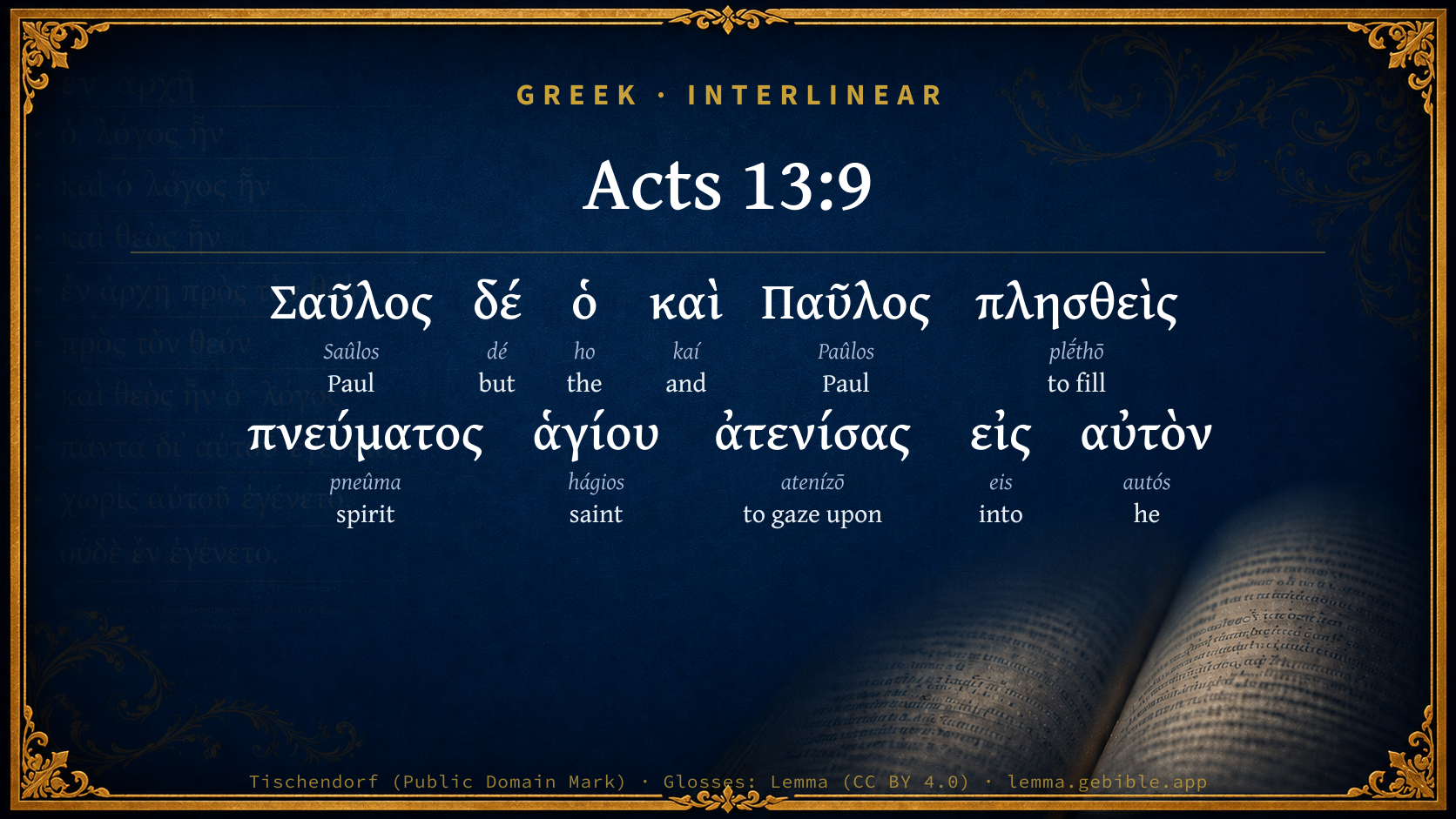
Greek (Tischendorf 8th ed.) Acts 13:9 appears in the Greek New Testament. The text above is from the Tischendorf 8th edition. Each word links to its Strong’s number and a concise gloss. Click any word for its full Thayer’s Greek Lexicon entry.
Download image
Cite this verse

Acts 13:9 (World English Bible). Public Domain. Lemma interlinear Bible study tool, https://lemma.gebible.app/v/acts/13/9.

Show BibTeX & RIS
BibTeX
RIS
English Translation
But Saul, who is also called Paul, filled with the Holy Spirit, fastened his eyes on him,
World English Bible · Public Domain
Download a study sheet

One document with this verse’s original text, its word-by-word gloss line, the meaning frame, cross-references with their text, attributed commentary, and full source and license credits — printable, and it pastes into notes with its structure intact.

This verse Autodidact and up

Study sheet (.html) Plain text (.txt)

A passage Seminary Student

Up to 50 verses in one chapter. A passage sheet keeps up to 6 commentary sources and 12 cross-references per verse, in the order this page ranks them, and says so on the sheet whenever that leaves anything out. Ask for a single verse and you get the Autodidact verse sheet above.

Everything on this page stays free to read, with no account — the sheet is a download of what is already on screen, not access to it.

Want to remove ads? Support Godless Engineer
Compare translations 3

The same verse in 3 English versions, stacked beneath the original-language interlinear above. Click any original word for its lexicon entry.

Each is an independent rendering of the whole verse — the interlinear is not word-aligned to these translations.

Highlighted words mark where these versions differ — a whole-verse word diff, not a word-by-word alignment.

  • World English Bible Public Domain
    But Saul, who is also called Paul, filled with the Holy Spirit, fastened his eyes on him,
  • King James Version Public Domain
    Then Saul, (who also is called Paul,) filled with the Holy Ghost, set his eyes on him.
  • unfoldingWord Literal Text CC BY-SA 4.0
    But Saul, also Paul, being filled with the Holy Spirit, staring at him intently,

unfoldingWord Literal Text — © unfoldingWord, licensed CC BY-SA 4.0. Word-aligned USFM3 via Door43 (git.door43.org/unfoldingWord/en_ult).

Versions to compare (up to 4)

3 of 4 selected

Show all 19 translations

Every available English version of this verse, each an independent rendering of the whole verse.

  • World English Bible Public Domain
    But Saul, who is also called Paul, filled with the Holy Spirit, fastened his eyes on him,
  • Berean Standard Bible Public Domain
    Then Saul, who was also called Paul, filled with the Holy Spirit, looked directly at Elymas
  • Majority Standard Bible Public Domain
    Then Saul, who was also called Paul, filled with the Holy Spirit, looked directly at Elymas
  • King James Version Public Domain
    Then Saul, (who also is called Paul,) filled with the Holy Ghost, set his eyes on him.
  • American Standard Version (1901) Public Domain
    But Saul, who is also `called' Paul, filled with the Holy Spirit, fastened his eyes on him,
  • Revised Version (1885) Public Domain
    But Saul, who is also called Paul, filled with the Holy Ghost, fastened his eyes on him,
  • Geneva Bible (1599) Public Domain
    Then Saul (which also is called Paul) being full of the holy Ghost, set his eyes on him,
  • Douay-Rheims (1899) Public Domain
    Then Saul, otherwise Paul, filled with the Holy Ghost, looking upon him,
  • Young's Literal Translation Public Domain
    And Saul -- who also `is' Paul -- having been filled with the Holy Spirit, and having looked stedfastly on him,
  • Literal Standard Version CC BY-SA 4.0
    And Saul—who also [is] Paul—having been filled with the Holy Spirit, and having looked steadfastly on him,
  • Unlocked Literal Bible CC BY-SA 4.0
    But Saul, who is also called Paul, filled with the Holy Spirit, stared at him intensely.
  • unfoldingWord Literal Text CC BY-SA 4.0
    But Saul, also Paul, being filled with the Holy Spirit, staring at him intently,
  • Darby Bible Public Domain
    But Saul, who also [is] Paul, filled with [the] Holy Spirit, fixing his eyes upon him,
  • World Messianic Bible Public Domain
    But Saul, who is also called Paul, filled with the Holy Spirit, fastened his eyes on him
  • Webster's Bible Public Domain
    Then Saul (who also is called Paul) filled with the Holy Spirit, set his eyes on him,
  • Free Bible Version CC BY-SA 4.0
    Saul, also called Paul, was filled with the Holy Spirit, and looked straight at him.
  • Bible in Basic English Public Domain
    But Saul, whose other name is Paul, being full of the Holy Spirit, looking hard at him, said,
  • Text-Critical English NT CC BY 4.0
    But Saul, also known as Paul, filled with the Holy Spirit, looked intently at Elymas
  • Tyndale New Testament (1534) Public Domain
    Then Saul which also is called Paul beinge full of the holy goost set his eyes on him

Literal Standard Version (2020), Covenant Press — licensed CC BY-SA 4.0. Text via the HelloAO Bible API (eBible.org). Unlocked Literal Bible (unfoldingWord) — licensed CC BY-SA 4.0. Text via the HelloAO Bible API (eBible.org). unfoldingWord Literal Text — © unfoldingWord, licensed CC BY-SA 4.0. Word-aligned USFM3 via Door43 (git.door43.org/unfoldingWord/en_ult). Free Bible Version, Dr. Jonathan Gallagher — licensed CC BY-SA 4.0. Text via the HelloAO Bible API (eBible.org).

Word by word

More ways to search: Search by grammar → Find every occurrence → Compare this word →

Practice this passage: Drill this verse → Learn its vocabulary →

About this verse

These counts appear in no published source. They are computed here, from the morphology-tagged text and Lemma’s own curated glosses. What Lemma adds →

11
words
11
distinct lemmas
Acts
section

Notable vocabulary

The rarest word here is ἀτενίσας to gaze upon G816 — appearing just 14 times in the whole Greek New Testament.

Shared distinctive vocabulary

ἀτενίσας to gaze upon G816 occurs in 14 verses of the Greek New Testament. Also found in:

Cross-references

6

Topical passages linked to Acts 13:9 in the Treasury of Scripture Knowledge — connected by theme and wording, ordered by reader-vote popularity; previews shown in the World English Bible.

  • Micah 3:8 But as for me, I am full of power by the Spirit of Yahweh, And of judgment, and of might, To declare to Jacob his disobedience, And to Israel his sin.
  • Acts 4:8 Then Peter, filled with the Holy Spirit, said to them, "You rulers of the people, and elders of Israel,
  • Acts 2:4 They were all filled with the Holy Spirit, and began to speak with other languages, as the Spirit gave them the ability to speak.
  • Acts 7:55 But he, being full of the Holy Spirit, looked up steadfastly into heaven, and saw the glory of God, and Jesus standing on the right hand of God,
  • Mark 3:5 When he had looked around at them with anger, being grieved at the hardening of their hearts, he said to the man, "Stretch out your hand." He stretched it out, and his hand was restored as healthy as the other.
  • Acts 4:31 When they had prayed, the place was shaken where they were gathered together. They were all filled with the Holy Spirit, and they spoke the word of God with boldness.

Cross-references courtesy of OpenBible.info (CC BY 4.0).

Commentary

Notes on Acts 13:9 from classic Christian and Jewish commentators (each source and its license shown beneath its notes). The classic Christian expositions comment on the surrounding passage and are grouped to its opening verse, so a note may address several verses; the Jewish commentaries on the Tanakh (Rashi and others) are per-verse, so they appear only where the commentator wrote on this verse.

Lemma curates 59 commentaries, every one of them public domain or Creative Commons licensed, each selected and text-cleaned for this edition rather than reprinted as found. About our sources →

The Biblical Illustrator

Joseph S. Exell

Act_13:9-11

Then Saul (who also is called Paul).

The crisis in Sauls history and his change of name

From this point Paul appears as the great figure in every picture, and Barnabas falls into the background. The great apostle now enters on his work as preacher to the Gentiles; and simultaneously his name is changed. As Abram was changed into Abraham when God promised that he should be the father of many nations; as Simon was changed into Peter when it was said, On this rock I will build My Church; so Saul is changed into Paul at the moment of his victory among the heathen. What the plains of Mamre were to the patriarch, what Caesarea Philippi was to the fisherman of Galilee, that was Paphos to the tent maker of Tarsus. Are we to suppose that the name was now given for the first time--that he adopted it as significant of his own feelings--or that Sergius Paulus conferred it on him in grateful commemoration of the benefits he had received, or that Paul, having been a Gentile form of the apostles name in early life conjointly with the Hebrew Saul, was now used to the exclusion of the other to indicate that he had receded from his position as a Jewish Christian, to become the friend and teacher of the Gentiles? We are inclined to the opinion that the Cilician apostle had this Roman name before he was a Christian. This adoption of a Gentile name is so far from being alien to the spirit of a Jewish family, that a similar practice may be traced through all the periods of Hebrew history. Beginning with the Persian epoch (B.C. 550-350), we find such names as Nehemiah, Sehammai, Betteshazzar, which betray an oriental origin, and show that Jewish appellatives followed the growth of the living language. In the Greek period we encounter the names of Philip, and his son Alexander, and of Alexanders successors--Antiochus, Lysimachus, Ptolemy, Antipater; the names of Greek philosophers, such as Zeus and Epicurus; even Greek mythological names, as Jason and Menelaus. When we mention the Roman names adopted by the Jews the coincidence is still more striking--Crispus, Justus, Niger, Drusilla and Priscilla might have been Roman matrons. The Aquila of St. Paul is the counterpart of the Apella of Horace. Again, in the earlier part of the Middle Ages we find Jews calling themselves Basil, Leo, Theodosius, Sophia, and in the latter part Albert, Benedict, Crispin, Denys. It is indeed remarkable that the separated nation should bear in the very names recorded in its annals the trace of every nation with whom it has come in contact and never united. It is important to our present purpose to remark that double names often occur in combination, the one national, the other foreign. The earliest instances are Belteshazzar-Daniel and Esther-Hadasa. Frequently there was no resemblance or natural connection between the two words, as in Herod-Agrippa, Salome-Alexandra, Inda-Aristobulus, Simon Peter. Sometimes the meaning was reproduced, as in Malich-Kleodemus. At other times an alliterating resemblance of sound seems to have dictated the choice, as in Jose-Jason, Hillel-Julus, Saul-Paulus. Thus satisfactory reasons can be adduced for the apostles double name without having recourse to the hypothesis of Jerome, who suggests that as Scipio was called Africanus from the conquest of Africa, and Metellus Creticus from the conquest of Crete, so Saul carried away his new name as a trophy of his victory over the heathenism of the proconsul Paulus, or to the notion of Augustine when he alludes to the literal meaning of the word Paulus, and contrasts Saul the unbridled king, the proud, self-confident persecutor of David, with Paul, the lowly, the penitent, who deliberately wished to indicate by his very name that he was the least of the apostles and less than the least of all saints. Yet we must not neglect the coincident occurrence of these two names just here. We need not hesitate to dwell on the associations which are connected with the name of Paulus, or on the thoughts which are naturally called up when we notice the critical passage where it is first given to Saul. It is surely not unworthy of notice that as Peters first Gentile convert was a member of the Cornelian house, so the surname of the noblest family of the Cornelian house was the link between the Apostle of the Gentiles and his convert at Paphos. Nor can we find a nobler Christian version of any line of a heathen poet than by comparing what Horace says of him who fell at Canute, Animae magnae prodigum Paulum, with the words of him who said at Miletus, I count not my life dear unto myself, etc. And though Saul most probably had the name of Paul at an earlier period, and that it came from some connection of his ancestors (perhaps as manumitted slaves) with some member of the AEmilian Pauli; yet we cannot believe it accidental that it occurs at this point of the inspired narrative. The heathen name rises to the surface at the moment Paul enters on his office as apostle to the heathen. The Roman name is stereotyped at the moment when he converts the Roman governor; and the place where this occurs is the very spot which was notorious for what the gospel forbids and destroys. Here, having achieved his victory, the apostle erected his trophy, as Moses, when Amalek was discomfited, built an altar, and called the name of it Jehovah-nissi--the Lord my banner. (J. S. Howson, D. D.)

Filled with the Holy Ghost, set his eyes on him, and said, O full of all subtlety and mischief.--

Sin and its punishment

Pauls rebuke, of course, applies to the specific iniquity of Elymas, but with a master hand the apostle at the same time delineates the characteristics of sin in general. The punishment of Elymas is also typical.

I. Sin.

1. Its subtle methods. There is nothing straightforward about sin; nor can there be: for were its nature and consequences clear, it would be universally shunned and abhorred. Its methods, therefore, must needs be crooked and insinuating. Evil is dressed up in the guise of good. The fruit of the tree was made pleasant to the eyes of Eve. So is it all through time.

2. Its mischievous effects. It debases the body, degrades the mind, debilitates the will, and damns the soul.

3. Its Satanic paternity. The serpent was more subtle than all the beasts of the field. The devil injects the sinful thought, guides the sinful resolution, helps the sinful action, and enjoys the sinful effect.

4. Its enmity to righteousness. Right and wrong are not coordinate powers which, like adjacent states, can flourish side by side and enter into peaceful alliances with each other. They are ever in irreconcilable antagonism, and the prosperity of the one is absolutely dependent on the destruction of the other.

5. Its perversion of the right ways of the Lord. This is the essence of sin. It is not simply negation, but perversion; and its highest achievement is to secure the acceptance of evil under the guise of good. Elymas, as a Jewish prophet, armed with the authority of a Divine dispensation, threw a spell over the mind of the proconsul, and endeavoured to use his usurped authority for selfish and villainous purposes. Wherein does he differ from the modern hypocrite?

II. Its punishment.

1. Its subtlety is detected.

(1) Sometimes sin overreaches itself; it is not sufficiently comprehensive in its views. Ahab calculated on getting Naboths vineyard, but did not calculate on Elijah. So here Elymas overlooked the possibility of the advent of a Paul.

(2) Sometimes its detection is the result of some extraordinary Divine agency--Saul, filled with the Holy Ghost. The common saying, Murder will out. How often, by a trivial oversight on the part of the criminal, or by some trifling coincidence, has a great crime been revealed.

2. Its mischievous effects are turned upon the sinner. He who sought to blind the intellect of Sergius Paulus is himself made blind. Be sure your sin will find you out.

3. The son inherits the fathers punishment. Satan is the prince of darkness, and his children are doomed to walk in darkness. The dark ways in which the devil leads his victims leads to outer darkness.

4. Its enmity to righteousness is met by the righteous God. Though hand join in hand the wicked shall not go unpunished.

5. Its perversion is met by perversion. He went about, etc. (verse 11). (J. W. Burn.)

Reproof: how a true servant of God uses his office of

1. Not in carnal passion, but in the Holy Ghost (verse 9).

2. Not with worldly weapons, but with the sword of the Word, by which he discloses the evil state of the heart (verse 10), and announces the judgment of God (verse 11).

3. Not for death or condemnation, but for warning and for the salvation of souls. (K. Gerok.)

The punishment of Elymas was

I. In correspondence with the transgression. He who blinded others is himself blinded.

II. Striking and convincing for the spectators.

III. With all its severity conducive to amendment by an intimation of the Divine mercy. Paul himself, at his conversion, had been blind for a season, and knew from his experience how profitable this darkness was for internal collection and composure of mind. (Apostolic Pastor.)

The exceptional character of the miracle

The miracles of the New Testament are generally distinguished from the Old by being worthy works of mercy. Two only of our Lords were inflictions of severity, and those were attended with no harm to the bodies of men. The same law pervades the miracles of the apostles. One miracle of wrath was worked by Peter and Paul; and we can see sufficient reasons why liars and hypocrites like Ananias and Sapphira, and impostors like Elymas, should be publicly punished, and made examples of. A passage in the life of Peter presents a parallel which is closer in some respects with this interview of Paul with Bar-Jesus. As Simon Magus, who had long time bewitched the Samaritans with his sorceries, was denounced by Peter as still in the gall of bitterness, etc., and solemnly told that his heart was not right in the sight of God; so Paul, conscious of his apostolic power, and under the power of immediate inspiration, rebuked Elymas as a child of that devil who is the father of lies, as a worker of deceit and mischief, etc. He proceeded to denounce an instantaneous judgment, and according to his prophetic word, the hand of the Lord struck the sorcerer, as it had once struck the apostle himself--the sight of the magician began to waver, and presently a darkness settled on it so thick that he ceased to behold the suns light. This blindness of the false prophet opened the eyes of the deputy. That which had been intended as an opposition to the gospel proved the means of its extension. We are ignorant of the degree of this extension in Cyprus. But we cannot doubt that when the proconsul was converted, his influence would make Christianity reputable; and that from this moment the Gentiles of the island as well as the Jews had the news of salvation brought home to them. (J. S. Howson, D. D.)

Seeking to turn men from the faith

Unprincipled white men have often been great stumbling blocks in the way of Indian evangelisation. An Englishman made his boast that he could induce the Indians again to drink; and providing himself with ardent spirits, he moved in his canoe over to the island where the Indians were encamped. Leaving all at the shore, he went up to the camp, and, inviting the Indians down, brought forth his bottle. Come, he said, we always good friends; we once more take a good drink in friendship. No, said Captain Paudaush, we drink no more of the fire waters. Oh, but you will drink with me; we always good friends; but while this son of Belial was urging them to drink, the Indians struck up, in the tune of Walsall, the hymn they had lately learned to sing--

O for a thousand tongues to sing

The great Redeemers praise!

And while the Indians were singing, this bacchanalian, defeated in his wicked device, and looking completely crestfallen, paddled away from the island, leaving the Indians to their temperance and their religious devotions!

An enemy off righteousness

Mr. Beecher once met Colonel Ingersoll, a great American atheist, and Colonel Ingersoll began to discourse on his atheistic views. Mr. Beecher for some time was silent, but, after a time, asked to be allowed to tell a story. On being requested to do so, he said, As I was walking down town today, I saw a poor man slowly and carefully picking his way through mud, in the endeavour to cross a street. He had just reached the middle of the filth when a big, burly ruffian, himself all bespattered, rushed up to him, jerked the crutches from under the unfortunate man, and left him sprawling and helpless in the pool of liquid dirt, which almost engulfed him. What a brute he was! said the colonel. What a brute he was! they all echoed. Yes, said the old man, rising from his chair, and brushing back his long white hair, yes, Colonel Ingersoll, and you are the man. The human soul is lame, but Christianity gives it crutches to enable it to pass the highway of life. It is your teaching that knocks these crutches from under it, and leaves it a helpless and rudderless wreck in the Slough of Despond. If robbing the human soul of its only support on this earth--religion--be your profession, why, ply it to your hearts content. It requires an architect to erect a building; an incendiary may reduce it to ashes.

Seeking to turn men from the truth

A boy was impressed in one of Mr. Moodys meetings. But his mother said he was good enough without religion, and threw her influence against Mr. Moodys efforts to win him to Christ. She succeeded, and some time after Mr. Moody found him in the county jail. How came you here? Does your mother know of it? No, sir, and pray dont tell her. I came in under an assumed name, and am going to Joliet State prison for four years. She thinks I am in the army. And Mr. Moody often heard her afterwards, mourning that her boy was killed.

The Biblical Illustrator, edited by Joseph S. Exell (c. 1880s–1900s) — public domain. Text from a community e-Sword module.

Joseph Benson's Commentary

Act 13:9-11. Then Saul, who also is called Paul — Moved by an immediate inspiration of the Holy Ghost, set his eyes on him — Looked steadfastly on that impostor, and said, with just indignation, O full of all subtlety — Παντος δολου, of all guile, as a false prophet; and all mischief — As a magician; thou child of the devil — A title well suited to a magician; and one who not only was himself unrighteous, but laboured to keep others from all goodness; wilt thou not cease — Even now, when thou hast heard the truth of the gospel; to pervert — By thy crafty and diabolical misrepresentations; the right ways of the Lord — The ways of truth, piety, and virtue; the only right ways. And now, behold, the hand of the Lord is upon thee — The hand of the heavy displeasure of the Lord Jesus, whose gospel thou opposest; and thou shalt be blind — Totally so, not seeing even the sun at noon-day, for a season — That thou mayest be convinced of thy sin and folly; and, if possible, be brought to repentance for it. And immediately — While Paul was yet speaking; there fell on him a mist and a darkness — That is, a gradually increasing darkness; and he went about — In the utmost confusion; seeking some to lead him by the hand — As not being able so much as to find the door without a guide, and afraid that he might run upon any person or thing that stood in his way.

Joseph Benson's Commentary on the Old and New Testaments (1811–1818) — public domain. Text from a community e-Sword module.

MacLaren's Expositions of Holy Scripture

Alexander MacLaren

Acts

TO THE REGIONS BEYOND

WHY SAUL BECAME PAUL

Act 13:9.

Hitherto the Apostle has been known by the former of these names, henceforward he is known exclusively by the latter. Hitherto he has been second to his friend Barnabas, henceforward he is first. In an earlier verse of the chapter we read that ‘Barnabas and Saul’ were separated for their missionary work, and again, that it was ‘Barnabas and Saul’ for whom the governor of Cyprus sent, to hear the word of the Lord. But in a subsequent verse of the chapter we read that ‘Paul and his company loosed from Paphos.’

The change in the order of the names is significant, and the change in the names not less so. Why was it that at this period the Apostle took up this new designation? I think that the coincidence between his name and that of the governor of Cyprus, who believed at his preaching, Sergius Paulus, is too remarkable to be accidental. And though, no doubt, it was the custom for the Jews of that day, especially for those of them who lived in Gentile lands, to have, for convenience’ sake, two names, one Jewish and one Gentile-one for use amongst their brethren, and one for use amongst the heathen-still we have no distinct intimation that the Apostle bore a Gentile name before this moment. And the fact that the name which he bears now is the same as that of his first convert, seems to me to point the explanation.

I take it, then, that the assumption of the name of Paul instead of the name of Saul occurred at this point, stood in some relation to his missionary work, and was intended in some sense as a memorial of his first victory in the preaching of the Gospel.

I think that there are lessons to be derived from the substitution of one of these names for the other which may well occupy us for a few moments.

I. First of all, then, the new name expresses a new nature.

Jesus Christ gave the Apostle whom He called to Himself in the early days, a new name, in order to prophesy the change which, by the discipline of sorrow and the communication of the grace of God, should pass over Simon Barjona, making him into a Peter, a ‘Man of Rock.’ With characteristic independence, Saul chooses for himself a new name, which shall express the change that he feels has passed over his inmost being. True, he does not assume it at his conversion, but that is no reason why we should not believe that he assumes it because he is beginning to understand what it is that has happened to him at his conversion.

The fact that he changes his name as soon as he throws himself into public and active life, is but gathering into one picturesque symbol his great principle; ‘If any man be in Christ Jesus, he is a new creature. Old things are passed away and all things are become new.’

So, dear brethren, we may, from this incident before us, gather this one great lesson, that the central heart of Christianity is the possession of a new life, communicated to us through faith in that Son of God, Who is the Lord of the Spirit. Wheresoever there is a true faith, there is a new nature. Opinions may play upon the surface of a man’s soul, like moonbeams on the silver sea, without raising its temperature one degree or sending a single beam into its dark caverns. And that is the sort of Christianity that satisfies a great many of you-a Christianity of opinion, a Christianity of surface creed, a Christianity which at the best slightly modifies some of our outward actions, but leaves the whole inner man unchanged.

Paul’s Christianity meant a radical change in his whole nature. He went out of Jerusalem a persecutor, he came into Damascus a Christian. He rode out of Jerusalem hating, loathing, despising Jesus Christ; he groped his way into Damascus, broken, bruised, clinging contrite to His feet, and clasping His Cross as his only hope. He went out proud, self-reliant, pluming himself upon his many prerogatives, his blue blood, his pure descent, his Rabbinical knowledge, his Pharisaical training, his external religious earnestness, his rigid morality; he rode into Damascus blind in the eyes, but seeing in the soul, and discerning that all these things were, as he says in his strong, vehement way, ‘but dung’ in comparison with his winning Christ.

And his theory of conversion, which he preaches in all his Epistles, is but the generalisation of his own personal experience, which suddenly, and in a moment, smote his old self to shivers, and raised up a new life, with new tastes, views, tendencies, aspirations, with new allegiance to a new King. Such changes, so sudden, so revolutionary, cannot be expected often to take place amongst people who, like us, have been listening to Christian teaching all our lives. But unless there be this infusion of a new life into men’s spirits which shall make them love and long and aspire after new things that once they did not care for, I know not why we should speak of them as being Christians at all. The transition is described by Paul as ‘passing from death unto life.’ That cannot be a surface thing. A change which needs a new name must be a profound change. Has our Christianity revolutionised our nature in any such fashion? It is easy to be a Christian after the superficial fashion which passes muster with so many of us. A verbal acknowledgment of belief in truths which we never think about, a purely external performance of acts of worship, a subscription or two winged by no sympathy, and a fairly respectable life beneath the cloak of which all evil may burrow undetected-make the Christianity of thousands. Paul’s Christianity transformed him; does yours transform you? If it does not, are you quite sure that it is Christianity at all?

II. Then, again, we may take this change of name as being expressive of a life’s work.

Paul is a Roman name. He strips himself of his Jewish connections and relationships. His fellow-countrymen who lived amongst the Gentiles were, as I said at the beginning of these remarks, in the habit of doing the same thing; but they carried both their names; their Jewish for use amongst their own people, their Gentile one for use amongst Gentiles. Paul seems to have altogether disused his old name of Saul. It was almost equivalent to seceding from Judaism. It is like the acts of the renegades whom one sometimes hears of, who are found by travellers, dressed in turban and flowing robes, and bearing some Turkish name, or like some English sailor, lost to home and kindred, who deserts his ship in an island of the Pacific, and drops his English name for a barbarous title, in token that he has given up his faith and his nationality.

So Paul, contemplating for his life’s work preaching amongst the Gentiles, determines at the beginning, ‘I lay down all of which I used to be proud. If my Jewish descent and privileges stand in my way I cast them aside. “Circumcised the eighth day, of the stock of Israel, of the tribe of Benjamin, an Hebrew of the Hebrews, as touching the law, a Pharisee,”-all these I wrap together in one bundle, and toss them behind me that I may be the better able to help some to whom they would have hindered my access.’ A man with a heart will throw off his silken robes that his arm may be bared to rescue, and his feet free to run to succour.

So we may, from the change of the Apostle’s name, gather this lesson, never out of date, that the only way to help people is to go down to their level. If you want to bless men, you must identify yourself with them. It is no use standing on an eminence above them, and patronisingly talking down to them. You cannot scold, or hector, or lecture men into the possession and acceptance of religious truth if you take a position of superiority. As our Master has taught us, if we want to make blind beggars see we must take the blind beggars by the hand.

The spirit which led the Apostle to change the name of Saul, with its memories of the royal dignity which, in the person of its great wearer, had honoured his tribe, for a Roman name is the same which he formally announces as a deliberately adopted law of his life. ‘To them that are without law I became as without law . . . that I might gain them that are without law . . . I am made all things to all men, that I might by all means save some.’

It is the very inmost principle of the Gospel. The principle that influenced the servant in this comparatively little matter, is the principle that influenced the Master in the mightiest of all events. ‘He who was in the form of God, and thought not equality with God a thing to be eagerly snatched at, made Himself of no reputation, and was found in fashion as a man and in form as a servant, and became obedient unto death.’ ‘For as much as the children were partakers of flesh and blood, He Himself likewise took part of the same’; and the mystery of incarnation came to pass, because when the Divine would help men, the only way by which the Infinite love could reach its end was that the Divine should become man; identifying Himself with those whom He would help, and stooping to the level of the humanity that He would lift.

And as it is the very essence and heart of Christ’s work, so, my brother, it is the condition of all work that benefits our fellows. It applies all round. We must stoop if we would raise. We must put away gifts, culture, everything that distinguishes us, and come to the level of the men that we seek to help. Sympathy is the parent of all wise counsel, because it is the parent of all true understanding of our brethren’s wants. Sympathy is the only thing to which people will listen, sympathy is the only disposition correspondent to the message that we Christians are entrusted with. For a Christian man to carry the Gospel of Infinite condescension to his fellows in a spirit other than that of the Master and the Gospel which he speaks, is an anomaly and a contradiction.

And, therefore, let us all remember that a vast deal of so-called Christian work falls utterly dead and profitless, for no other reason than this, that the doers have forgotten that they must come to the level of the men whom they would help, before they can expect to bless them.

You remember the old story of the heroic missionary whose heart burned to carry the Gospel of Jesus Christ amongst captives, and as there was no other way of reaching them, let himself be sold for a slave, and put out his hands to have the manacles fastened upon them. It is the law for all Christian service; become like men if you will help them,-’To the weak as weak, all things to all men, that we might by all means save some.’

And, my brother, there was no obligation on Paul’s part to do Christian work which does not lie on you.

III. Further, this change of name is a memorial of victory.

The name is that of Paul’s first convert. He takes it, as I suppose, because it seemed to him such a blessed thing that at the very moment when he began to sow, God helped him to reap. He had gone out to his work, no doubt, with much trembling, with weakness and fear. And lo! here, at once, the fields were white already to the harvest,

Great conquerors have been named from their victories; Africanus, Germanicus, Nelson of the Nile, Napier of Magdala, and the like. Paul names himself from the first victory that God gives him to win; and so, as it were, carries ever on his breast a memorial of the wonder that through him it had been given to preach, and that not without success, amongst the Gentiles ‘the unsearchable riches of Christ.’

That is to say, this man thought of it as his highest honour, and the thing best worthy to be remembered about his life, that God had helped him to help his brethren to know the common Master. Is that your idea of the best thing about a life? What would you, a professing Christian, like to have for an epitaph on your grave? ‘He was rich; he made a big business in Manchester’; ‘He was famous, he wrote books’; ‘He was happy and fortunate’; or, ‘He turned many to righteousness’? This man flung away his literary tastes, his home joys, and his personal ambition, and chose as that for which he would live, and by which he would fain be remembered, that he should bring dark hearts to the light in which he and they together walked.

His name, in its commemoration of his first success, would act as a stimulus to service and to hope. No doubt the Apostle, like the rest of us, had his times of indolence and languor, and his times of despondency when he seemed to have laboured in vain, and spent his strength for nought. He had but to say ‘Paul’ to find the antidote to both the one and the other, and in the remembrance of the past to find a stimulus for service for the future, and a stimulus for hope for the time to come. His first convert was to him the first drop that predicts the shower, the first primrose that prophesies the wealth of yellow blossoms and downy green leaves that will fill the woods in a day or two. The first convert ‘bears in his hand a glass which showeth many more.’ Look at the workmen in the streets trying to get up a piece of the roadway. How difficult it is to lever out the first paving stone from the compacted mass! But when once it has been withdrawn, the rest is comparatively easy. We can understand Paul’s triumph and joy over the first stone which he had worked out of the strongly cemented wall and barrier of heathenism; and his conviction that having thus made a breach, if it were but wide enough to let the end of his lever in, the fall of the whole was only a question of time. I suppose that if the old alchemists had turned but one grain of base metal into gold they might have turned tons, if only they had had the retorts and the appliances with which to do it. And so, what has brought one man’s soul into harmony with God, and given one man the true life, can do the same for all men. In the first fruits we may see the fields whitening to the harvest. Let us rejoice then, in any little work that God helps us to do, and be sure that if so great be the joy of the first fruits, great beyond speech will be the joy of the ingathering.

IV. And now last of all, this change of name is an index of the spirit of a life’s work.

‘Paul’ means ‘little’; ‘Saul’ means ‘desired.’ He abandons the name that prophesied of favour and honour, to adopt a name that bears upon its very front a profession of humility. His very name is the condensation into a word of his abiding conviction: ‘I am less than the least of all saints.’ Perhaps even there may he an allusion to his low stature, which may be pointed at in the sarcasm of his enemies that his letters were strong, though his bodily presence was ‘weak.’ If he was, as Renan calls him, ‘an ugly little Jew,’ the name has a double appropriateness.

But, at all events, it is an expression of the spirit in which he sought to do his work. The more lofty the consciousness of his vocation the more lowly will a true man’s estimate of himself be. The higher my thought of what God has given me grace to do, the more shall I feel weighed down by the consciousness of my unfitness to do it. And the more grateful my remembrance of what He has enabled me to do, the more shall I wonder that I have been enabled, and the more profoundly shall I feel that it is not my strength but His that has won the victories.

So, dear brethren, for all hope, for all success in our work, for all growth in Christian grace and character, this disposition of lowly self-abasement and recognised unworthiness and infirmity is absolutely indispensable. The mountain-tops that lift themselves to the stars are barren, and few springs find their rise there. It is in the lowly valleys that the flowers grow and the rivers run. And it is they who are humble and lowly in heart to whom God gives strength to serve Him, and the joy of accepted service.

I beseech you, then, learn your true life’s task. Learn how to do it by identifying yourselves with the humbler brethren whom you would help. Learn the spirit in which it must be done; the spirit of lowly self-abasement. And oh! above all, learn this, that unless you have the new life, the life of God in your hearts, you have no life at all.

Have you, my brother, that faith by which we receive into our spirits Christ’s own Spirit, to be our life? If you have, then you are a new creature, with a new name, perhaps but dimly visible and faintly audible, amidst the imperfections of earth, but sure to shine out on the pages of the Lamb’s Book of Life; and to be read ‘with tumults of acclaim’ before the angels of Heaven. ‘I will give him a white stone, and in the stone a new name written, which no man knoweth save he that receiveth it.’

Alexander MacLaren, Expositions of Holy Scripture (1904–1910) — public domain. Text from a community e-Sword module.

Tyndale Open Study Notes

Tyndale Open Resources

13:9 Luke makes the significant transition from the name Saul (a Hebrew name) to Paul (a Greco-Roman name), perhaps indicating that Paul was now on a predominantly Gentile mission. For the rest of the book of Acts, he is called Paul except when he recounts his conversion (as in 22:7, 13; 26:14).

Tyndale Open Study Notes — © Tyndale Open Resources, licensed CC BY-SA 4.0. Text via the HelloAO Bible API.

Bengel's Gnomon

Johann Albrecht Bengel

Act 13:9. Ὁ καὶ Παῦλος, who also Paul) Paul having laid aside his old name, which he had borne from the time of his circumcision, receives a new name, equivalent to the surname קטון [= little: the Latin paulus, Paulus], which it seems implied by the particle καὶ that he bore in entering upon his apostleship; and this new name was given him in consequence of his first gospel victory towards the west among the Greeks, the single letter being changed (S into [70]), not by an error of the Greeks of Cyprus, but by the Divine counsel, appropriately and seasonably. The cause is either external or internal. Externally, he seems to have adopted the name of the proconsul, because lie had showed himself the friend of Paul, perhaps in confirming his right as a Roman citizen; for this was wont to be a reason for assuming a name. See Cic. l. 13, fam. ep. 35 and 36. The inner cause is, that Sergius Paulus himself, the first-fruits of this expedition, had formed a spiritual tie of connection with the apostle. This name besides was one familiar to the Gentiles, of whom he was presently after the apostle, and agreeable to them, rather than the Hebrew name, Saul; it answered also to his stature, 2Co 10:10 (“His bodily presence is weak:” Paulus = little), and to his feeling as respects himself, Eph 3:8, with which comp. Psa 68:27.—πλησθεὶς, filled) by a present active operation, against this energetic sorcerer. Therefore Barnabas gives place to him from this point: Act 13:13.—Πνεύματος Ἁγίου, with the Holy Ghost) Joh 20:22-23.

[70] Guelpherbytana: libr. Wolfenbuttel: Gospels def.: sixth cent.: publ. by Knittel, 1763.

Bengel's Gnomon of the New Testament — English translation (T&T Clark, Edinburgh, 1860) — public domain. Text from a community e-Sword module.

Meyer's Critical & Exegetical Commentary

Heinrich August Wilhelm Meyer

Act_13:9. Σαῦλος δὲ, ὁ καὶ Παῦλος] sc. λεγόμενος. Schaefer, ad Bos Ell. p. 213.

As Saul (שָׁאוּל, the longed for) is here for the first time and always henceforth (comp. the name Abraham from Gen_17:5 onwards) mentioned under his Roman name Paul, but before this, equally without exception, only under his Hebrew name, we must assume a set historical purpose in the remark ὁ καὶ Παῦλος introduced at this particular point, according to which the reader is to be reminded of the relationotherwise presupposed as well knownof this name to the historical connection before us. It is therefore the most probable opinion, because the most exempt from arbitrariness, that the name Paul was given to the apostle as a memorial of the conversion of Sergius Paulus effected by him.[6] A primo ecclesiae spolio, proconsule Sergio Paulo, victoriae suae trophaea retulit, erexitque vexillum, ut Paulus diceretur e Saulo, Jerome, in ep. ad Philem.; comp. de vir. ill. 5. The same view is adopted by Valla, Bengel, Olshausen, Baumgarten, Ewald; also by Baur, I. p. 106, ed. 2, according to whom, however, legend alone has wished to connect the change of name somehow adopted by the apostlewhich contains a parallel with Peter, Mat_16:16with an important act of his apostolic life; comp. Zeller, p. 213. Either the apostle himself now adopted this name, possibly at the request of the proconsul (Ewald), orwhich at least excludes entirely the objection often made to this view, that it is at variance with the modesty of the apostlethe Christians, perhaps first of all his companions at the time, so named him in honourable remembrance of that memorable conversion effected on his first missionary journey. Kuinoel, indeed, thinks that the servants of the proconsul may have called the apostle, whose name Saul was unfamiliar (?) to them, Paul; and that he thenceforth was glad to retain this name as a Roman citizen, and on account of his intercourse with the Gentiles. But such a purely Gentile origin of the name is hardly reconcilable with its universal recognition on the part of the Christian body. Since the time of Calvin, Grotius, and others, the opinion has become prevalent, that it was only for the sake of intercourse with those without, as the ambassador of the faith among the Gentiles, that the apostle bore, according to the custom of the time, the Roman name; comp. also Laurent, neut. Stud. p. 147. Certainly it is to be assumed that he for this reason willingly assented to the new name given to him, and willingly left his old name to be forgotten; but the origin of the new name, occurring just here for the first time, is, by this view, not in the least explained from the connection of the narrative before us.

Heinrichs oddly desires to explain this connection by suggesting that on this occasion, when Luke had just mentioned Sergius Paulus, it had occurred to him that Saul also was called Paul. Such an accident is wholly unnatural, as, when Luke wrote, the name Saul was long out of use, and that of Paul was universal. The opinion also of Witsius and Hackspan, following Augustine, is to be rejected: that the apostle in humility, to indicate his spiritual transformation, assigned to himself the name (Paulus = exiguus); as is also that of Schrader, d. Ap. Paul. II. p. 14 (after Drusius and Lightfoot), that he received at his circumcision the double name; comp. also Wieseler, p. 222 f.

πλησθεὶς πνεύμ. ἁγ.] actu praesente adversus magum acrem, Bengel. Comp. Act_4:8; Act_4:31, Act_7:55, Act_13:52.

[6] Lange, apost. Zeitalt. p. 368 (comp. Herzogs Encykl. XI. p. 243), sees in the name Paul (the little) a contrast to the name Elymas; for he had in the power of humility confronted this master of magic, and had in a N.T. character repeated the victory of David over Goliath. Against this play of the fancy it is decisive, that Elymas is not termed and declared a master of magic, but simply ὁ μάγος.

Meyer — Critical and Exegetical Commentary on the New Testament — English translation by Peter Christie, edited by Frederick Crombie (T&T Clark, 1880) — public domain. Text from a community e-Sword module.

Expositor's Greek Testament

ed. W. Robertson Nicoll

Act 13:9 . Σαῦλος δέ , ὁ καὶ Παῦλος : since the days of St. Jerome ( De Vir. Ill. , chap. 6, cf. Aug [257] , Confess. , viii., 4, etc., cf. amongst moderns Bengel, Olshausen, Ewald, Meyer) it has been thought that there is some connection here emphasised by the writer between the name Sergius Paulus and the assumption of the name Paul by the Apostle at this juncture. (Wendt (1899) inclines to the view that the name Paul was first used in Act 13:1 . See in loco and critical notes.) So too Baur, Zeller, Hausrath, Overbeck, Hilgenfeld are of opinion that Luke intended some reference to the name of the proconsul, although they regard the narrative of his conversion as unhistorical. But Wendt rightly maintains (1899) that the simple ὁ καὶ without the addition of ἀπὸ τότε would not denote the accomplishment of a change of name at this juncture, and that if the change or rather addition of name had been now effected, the mention of it would naturally have followed after the mention of the conversion of the proconsul in Act 13:13 . The connection seemed so strained and artificial to many that they abandoned it, and regarded the collocation of the two names as a mere chance incident, whilst Zöckler (whose note should be consulted, Apostelgeschichte, in loco , second edition), who cannot thus get rid of the striking similarity in the names of the two men, thinks that the narrative of St. Luke is too condensed to enable us fully to solve the connection. But since it was customary for many Jews to bear two names, a Hebrew and a Gentile name, cf. Act 1:23 ; Act 12:25 ; Act 13:1 , Col 4:11 , Jos., Ant. , xii., 9, 7, and frequent instances in Deissmann, Bibelstudien , pp. 182, 183, cf. Winer-Schmiedel, p. 149 note, it may well be that Luke wished to intimate that if not at this moment, yet during his first missionary journey, when the Apostle definitely entered upon his Gentile missionary labours, he employed not his Jewish but his Gentile name to mark his Apostleship to the Gentile world (“Seit 13. 1. ist der jüdische Jünger Σαῦλος Weltapostel,” Deissmann); by a marvellous stroke of historic brevity the author sets before us the past and the present in the formula ὁ καὶ Π . a simple change in the order of a recurring pair of names: see Ramsay’s striking remarks, St. Paul , p. 83 ff., with which however, mutatis mutandis , his more recent remarks, Was Christ born at Bethlehem? p. 54, should be carefully compared. See also Deissmann, u. s. , Nösgen, Wendt, Hackett, Felten, and Zöckler, in loco , and McGiffert, Apostolic Age , p. 176. This preference by St. Luke of the Gentile for the Hebrew name has its analogy in St. Paul’s own use in his Epistles (and in his preference for Roman provincial names in his geographical references, cf. 1Co 16:1 , 2Co 8:1 ; 2Co 9:2 , Rom 15:26 , Phi 4:15 ).

[257] Augustine.

The Expositor's Greek Testament, edited by W. Robertson Nicoll (1897–1910) — public domain. Text from a community e-Sword module.

Jamieson, Fausset & Brown

Robert Jamieson, A. R. Fausset & David Brown

Then Saul . . . also . . . called Paul--and henceforward Paul only; a softening of his former name, in accommodation to Roman ears, and (as the word signifies "little") probably with allusion as elsewhere to his insignificance of stature and appearance (Co2 10:1, Co2 10:10) [WEBSTER and WILKINSON].

filled with the Holy Ghost--the Spirit coming mightily upon him.

set his eyes on him and said--Henceforward Barnabas sinks into the background. The whole soul of his great colleague, now drawn out, as never before, shoots, by the lightning gaze of his eye, through the dark and tortuous spirit of the sorcerer. What a picture!

Jamieson, Fausset & Brown — Commentary Critical and Explanatory on the Whole Bible (1871) — public domain (CC PDM 1.0). Text via the HelloAO Bible API.

Adam Clarke's Commentary

Verse 9. Saul, who also is - Paul] This is the first time the name Paul occurs, and the last time in which this apostle is called Saul, as his common or general name.

Saul, שאול Shaul, was the name of the first Israelitish king, and signifies asked, sought; from שאל shaal, he asked, inquired, c.

Paul, Paulus, if derived from the Latin, signifies little, dwarfish: but if from the Hebrew, פלא pala, it signifies extraordinary, wonderful and this appears to have been the derivation assigned to it by St. Jerome, com. in Ep. Pauli ad Philem., who translates it mirabilis, wonderful, and Hesychius must have had the same in view, for he defines it thus, Παυλος, θαυμαστος, ηεκλεκτος, συμβουλος, Paul, wonderful, or elect, counsellor. The lexicographer had probably here in view, Isa 9:6: his name shall be called (פלא יועיץ pelé yoêts) wonderful, counsellor; which he might corrupt into paulus, and thus make his θαυμαστος συμβουλος out of it by way of explanation. Triller, however, supposes the συμβουλος of Hesychius to be corrupted from συνδουλος fellow servant, which is a term not unfrequently applied to apostles, c., in the New Testament, who are called the servants of God and it is used by Paul himself, Col 1:7; Col 4:7. The Latin original is the most probable. It is well known that the Jews in the apostolic age had frequently two names, one Hebrew, the other Greek or Roman. Saul was born of Jewish parents, a Hebrew of the Hebrews; he had therefore his first name from that language, שאול Shaul, asked or begged; as it is possible he might have been a child for whom his parents had addressed their fervent petitions to God. The case of Samuel is one in point. See 1Sa 1:9-18. As he was born in Tarsus, in Cilicia, he was consequently born a free Roman citizen; and hence his parents would naturally give him, for cognomen, some name borrowed from the Latin tongue, and Paulus, which signifies little, might indicate that he was at his birth a small or diminutive child. And it is very likely that he was low in stature all his days; and that it is to this he refers himself, 2Co 10:10, for his bodily presence is weak, and his speech contemptible. If he were small in stature, his voice would be naturally low and feeble; and the Greeks. who were fond of a thundering eloquence, would despise him on this very account.

Filled with the Holy Ghost] Therefore the sentence he pronounced was not from himself, but from God. And indeed, had he not been under a Divine influence, it is not likely he would have ventured thus to accost this sorcerer in the presence of the governor, who, no doubt, had greatly admired him.

Adam Clarke's Commentary on the Bible (1810–1826) — public domain. Text from a community e-Sword/MySword module.

John Calvin's Commentaries

9. And Saul, who was also called Paul. Luke showeth now how God brake the bond wherein the deputy was bound. For seeing that he was too much addicted to the magician, he could not embrace true doctrine as one that was free and at liberty; for the devil keepeth those minds (which he hath entangled) in his slavery after a wonderful and incredible manner, that they cannot see even the most plain truth; but so soon as he was once vanquished, Paul could easily enter in unto the deputy. And mark what Luke saith, that the faith is overthrown when the word of God is resisted. Whence we may gather that faith is so grounded in the word, that without this shore it fainteth at every assault; yea, that it is nothing else but the spiritual building of the word of God.

John Calvin's Commentaries (1540-1563) — public domain. Text from the Calvin Translation Society English edition (1840s-50s) via the Christian Classics Ethereal Library (ccel.org). Calvin's coverage is partial (roughly two-thirds of the Bible); uncommented books and verses are honest gaps, never fabricated. The 19th-century editor's footnotes and remarks are omitted so the notes are faithfully Calvin's own voice.

Ellicott's Commentary for English Readers

(9) Then Saul, (who also is called Paul).—It is impossible not to connect the mention, and probably the assumption, of the new name with the conversion of the proconsul. It presented many advantages. (1) It was sufficiently like his own name in sound to fall within the general practice which turned Jesus into Jason, Hillel into Pollio, Silas into Silvanus. (2) It was a Roman, not a Greek, name, and as such fell in with the ultimate work of the Apostle, already, it may be, contemplated in thought (comp. Rom_15:23), of bearing his witness to Christ in the imperial city. (3) It formed a link between him and the illustrious convert whom he had just made. He was, as it were, claiming a brotherhood with him. From this point of view, it is interesting to compare the name of Lucas or Lucanus, as borne both by the evangelist and the poet. (Comp. Introduction to St. Luke, Vol. I., p. 237.) Other reasons that have been assigned, as (1) that the Greek word Saulos had an opprobrious meaning, as = wanton, or (2) that the meaning of Paulus, as = little, commended itself to the Apostle’s humility, may be dismissed as more or less fantastic.

Filled with the Holy Ghost.—The tense of the Greek participle, implies a sudden access of spiritual power, showing itself at once in insight into character, righteous indignation, and prevision of the divine chastisement.

Set his eyes on him.—The word is that already so often noted, as in Act_1:10, and elsewhere. As applied to St. Paul it may possibly connect itself with the defect of vision which remained as the after-consequence of the brightness seen on the way to Damascus. The Greek word, however, it is right to add, may just as well express the fixed gaze of men of strong powers of sight, as that of those who suffer from some infirmity. (See Act_1:10; Act_3:4; Luk_4:20; Luk_22:56.)

A Bible Commentary for English Readers, edited by Charles John Ellicott (1878–1897) — public domain. Text from a community e-Sword module.

The Cambridge Bible for Schools and Colleges

gen. ed. J. J. S. Perowne

9. Then [But] Saul, who also is called Paul] The proconsul had been determined in his purpose, and Saul had come before him. At this point we first meet the name by which the great Apostle is best known throughout the Christian Church, and many reasons have been given why he assumed this name, and why at this time. Some have thought that the name was adopted from the proconsul’s, his first convert of distinction, but this is utterly alien to all we know of the character of St Paul, with his sole glory in the cross of Christ. Far more likely is he to have been attracted to it, if it were not his before, by the meaning of the Latin word (paullus = little) and its fitness to be the name of him who called himself the least of the Apostles. But perhaps he only did what other Jews were in the habit of doing when they went into foreign lands, and chose him a name of some significance (for the Jews were fond of names with a meaning) among those with whom he was about to mix. Dean Howson (Life and Letters of St Paul, i. p. 164) compares Jose—Jason; Hillel—Julus, and probably the similarity of sound did often guide the choice of such a name, and it may have been so with the Apostle’s selection. St Luke, recognizing that the history of St Paul is now to be his chief theme and that the work for which he was separated was now begun, names the Apostle henceforth only by the name which became most current in the Churches.

filled with the Holy Ghost] So that the punishment inflicted on Elymas was dictated to the Apostle by the Spirit, and he knew from the inward prompting thereof, that what he spake would come to pass.

set [fastened] his eyes on him] For Elymas was standing by, doubtless ready to catch at anything which he might be able to turn to the discredit of the Apostles.

The Cambridge Bible for Schools and Colleges (gen. ed. J. J. S. Perowne; Cambridge University Press, 1878–1918) — public domain. Text from a community e-Sword module.

John Gill's Exposition

Then Saul (who also is called Paul),.... He was called by both these names; as he was a Jew by birth, his parents called him Saul, that was his Jewish name, and by which he went among the Jews; and as he was a citizen of a Roman city, Tarsus in Cilicia, he went among the Romans, or Gentiles, by the name of Paul, a Roman name; and it was usual with the Jews to be called after this manner, that is, to have one name among themselves, and another among the Gentiles: it is a rule with them (n), that

"the Israelites out of the land, their names are as the names of the Gentiles;''

yea, their names differed in Judea and Galilee; a woman went by one name in Judea, and another in Galilee (o): and it is observable, that Luke calls the apostle by his Jewish name Saul, whilst he was among the Jews, and only preached among them; but now he is got among the Gentiles, and was about to appear openly to be their apostle, he all along hereafter calls him by his Gentile name Paul: though some think his name was changed upon his conversion, as it was usual with Jewish penitents to do; when a man repented of his sin, he changed his name (says Maimonides) (p),

"as if he should say, I am another, and not the man that did those (evil) works.''

So when Maachah, Asa's mother, or rather grandmother, was converted, or became right, she changed her name into Michaihu, the daughter of Uriel of Gibeah; that her former name might not be remembered, lest it should be a reproach unto her (q): though others think, that the apostle was so called, from Sergius Paulus the deputy, whose conversion he was the instrument of; and whose family might choose to call him so, because of the nearness in sound between the two names: others think he had his name Paul, or Paulus, from the smallness of his stature and voice, to which he seems to have some respect, in Co2 10:10 and there is one Samuel the little, which the Jewish doctors often speak of, and who by some is taken to be the same with the Apostle Paul. This name is by Jerom, or Origen (r), interpreted "wonderful", as if it came from the Hebrew word "pala"; and others derive it from "paul", which signifies to work; and a laborious worker the apostle was, and a workman also which needed not to be ashamed; but since it is certain that Saul was his Hebrew name, it is most likely that this was a Gentile one, and not of Hebrew derivation: the first account of these names, and the reason of them, seems to be the best: now of him it is said,

that he was filled with the Holy Ghost; which does not design the gifts and graces of the Holy Ghost in general, with which he was always filled, and thereby qualified for his work as an apostle; but in particular, that he had by the Spirit, not only a discerning of the wickedness of this man, but of the will of God, to make him at this time a public example of divine wrath and vengeance, for his opposition to the Gospel: wherefore he

set his eyes on him; very earnestly, thereby expressing an abhorrence of him, and indignation against him, and as it were threatening him with some sore judgment to fall upon him.

(n) T. Hieros. Gittin, fol. 43. 2. (o) Ib. fol. 45. 3. (p) Hilchot Teshuva, c. 2. sect 4. (q) Targum in 2 Chron 15. 16. (r) De nominibus Hebraicis, fol. 106. H.

John Gill's Exposition of the Whole Bible (1746–1763) — public domain (CC PDM 1.0). Text via the HelloAO Bible API.

Trapp's Complete Commentary

John Trapp

9 Then Saul, (who also is called Paul,) filled with the Holy Ghost, set his eyes on him,

Ver. 9. Who also is called Paul] Here Saul is first called Paul, for memory (it is probable) of the first spoils he brought into the Church, not the head, but the heart of this Sergius Paulus. The popes likewise change their names at their enthronization, to show, saith the Gloss, ad permutationem nominis, factam mutationem hominis. But if they change at all, it is for the worse, as Pius Secundus, Sextus Quintus, & c. Pope Marcellus would needs retain his old name, to show his constancy, and that in his private estate he had thoughts worthy of the popedom.

Set his eyes on him] As if he would have looked through him. After which lightning followed that terrible thunder crack, Act 13:10. Bajazet, of his fiery looks, was surnamed Gilderun, or lightning. In Tamerlane’s eyes sat such a rare majesty, as a man could hardly endure to behold them without closing his own; and many with talking with him, and often beholding them, became dumb. The like is reported of Augustus. And of St Basil it is reported that when Valens the Arian emperor came unto him, while he was in his holy exercises, it struck such a terror into the emperor that he reeled and had fallen had he not been upheld by those that were near him. {a} Godly men have a daunting presence.

{a} Greg. Orat. de Laudib. Basilii.

John Trapp, A Commentary or Exposition upon All the Books of the Old and New Testament (1647–1656) — public domain. Text from a community e-Sword module.

Albert Barnes' Notes on the Bible

}Then Saul, (who is also called Paul) - This is the last time that this apostle is called “Saul.” Henceforward, he is designated by the title by which he is usually known, as “Paul.” When, or why, this change occurred in the name, has been a subject on which commentators are not agreed. From the fact that the change in the name is here first intimated, it would seem probable that it was first used in relation to him at this time. By whom the name was given him whether he assumed it himself, or whether it was first given him by Christians or by Romans - is not intimated. The name is of Roman origin. In the Latin language the name Paulus signifies little, dwarfish; and some have conjectured that it was given by his parents to denote that he was small when born; others, that it was assumed or conferred in subsequent years because he was little in stature. The name is not of the same signification as the name Saul. This signifies one that is asked, or desired. After all the conjectures on this subject, it is probable:

(1) That this name was first used here; for before this, even after his conversion, he is uniformly called Saul.

(2) That it was given by the Romans, as being a name with which they were more familiar, and one that was more consonant with their language and pronunciation. It was made by the change of a single letter; and probably because the name Paul was common among them, and pronounced, perhaps, with greater facility.

(3) Paul suffered himself to be called by this name, as he was employed chiefly among the Gentiles. It was common for names to undergo changes quite as great as this, without our being able to specify any particular cause, in passing from one language to another. Thus, the Hebrew name Jochanan among the Greeks and Latins was Johannes, with the French it is Jean, with the Dutch Hans, and with us John (Doddridge). Thus, Onias becomes Menelaus; Hillel, Pollio; Jakim, Alcimus; Silas, Silvanus, etc. (Grotius).

Filled with the Holy Ghost - Inspired to detect his sin; to denounce divine judgment; and to inflict punishment on him. See the notes on Act 2:4.

Set his eyes on him - Looked at him intently.

Albert Barnes' Notes on the Bible (1834–1885) — public domain. Text from a community e-Sword/MySword module.

Haydock's Catholic Bible Commentary

Then Saul, who also is Paul. This is the first time we find the apostle called Paul. Some, therefore, think it was given him when he converted this proconsul, Sergius Paulus. Others, that Saul being a Hebrew word, the Greeks, or rather the Romans, turned it into Paul. (Witham) --- This is the first place in which this apostle is called Paul. He took this name out of respect to the illustrious convert he had made in the person of the proconsul, the governor of the island. (Menochius) --- Or, more probably, his former name, by a small change, was modelled into Paulus, which was a sound more adapted to a Roman ear. He begins to bear this name only, when he enters on his mission to the Gentiles. (Calmet)

George Leo Haydock (1774–1849), Haydock's Catholic Family Bible and Commentary, 1859 edition — public domain. Excludes Psalms (Douay-Rheims chapter numbering differs from Protestant) and Deuterocanonical books (Catholic canon only).

Matthew Poole's English Annotations

It is observable, that St. Luke never before called this great apostle by the name of Paul, and henceforth never calls him by the name of Saul. Though there be no great difference in these names,

Saul might be more acceptable to the Jews, amongst whom hitherto he had conversed; and

Paul a more pleasing name unto the Gentiles, unto whom he was now sent, and with whom for the future he should most converse. He was called Saul as he was a Jew born, a Hebrew of the Hebrews; and Paul, as he was a denizen of Rome; the Romans having that name in good account in several of their chief families.

Filled with the Holy Ghost; zeal for God’s glory, and faith and power to work the ensuing miracle.

Matthew Poole's English Annotations on the Holy Bible (1683–1685) — public domain. Text from a community e-Sword/MySword module.

Whedon's Commentary on the Bible

Daniel D. Whedon

9. Also… Paul—Literally, Saul, the also Paul. It has ever been a question how, when, and why this second name was assumed. We have repeatedly had occasion to allude to the custom of the Jews, when surrounded with Gentiles and speaking two languages, to have two names, a Hebrew and a Greek. Sometimes the one was a translation of the other, as Thomas became Didymus, both signifying twin. Sometimes the new name was conferred, even in the same language, from some new event or newly developed fact or quality; thus Joses became Barnabas, a son of Christian exhortation. Sometimes the new name was selected from vocal resemblance, as Jesus, Justus. As to Paul’s name we may note, 1. From this time his mission and apostolate were to be among Gentiles, and all the ordinary rules of custom and convenience required the adoption of a Gentile name. Luke’s mention of the change at this point, his uniform use of Saul heretofore, and uniform use of Paul hereafter, decisively prove that it was at this point that this change was made. The Gentile apostle assumes a Gentile name. This amply explains the assumption of a new name, but not of this particular name. 2. For the particular name there was the resemblance of sound. The almost identity of Saul and Paul would render the last of all names most suitable. But the singular proximity of the proconsul Paulus does clearly suggest a confirmatory reason. So that we must finally agree with Jerome, who says that, as Scipio was surnamed Africanus from having conquered Africa, so Saul became Paul from the conversion of Sergius Paulus. With this transition from Saul to Paul there is a plain transition to the full recognition of his apostolic and Gentile office. Paul was his apostolic as well as Gentile name, perhaps divinely bestowed.

Filled with the Holy Ghost—From this moment of filling by the Spirit and mighty authentication by consequent miracle and assumption of his new apostolic name, Paul, as acknowledged apostle, henceforth takes precedence of Barnabas.

Set his eyes—Burning with an inspired indignation.

Daniel D. Whedon (gen. ed.), Commentary on the Old and New Testaments (1874–1909) — public domain. Text from a community e-Sword module.

The Pulpit Commentary

But for then, A.V.; is also for also is, A.V.; fastened for set, A.V. (above, Acts ill 4, note). Who is also called Paul. The explanation ofJerome, Augustine, Bede, and many modern commentators, as Meyer, Olshausen, etc., and not rejected by Renan, is that Saul took the name of Paul on the occasion of this remarkable and important conversion of Sergius Paulus. Saul"s future intercourse with Gentiles made it desirable that, after the common custom of the Jews of his day as seen in Peter, Stephen, Mark, Lucius, Jason, Crispus, Justus, Niger, Aquila, Priscilla, Drusilla etc. he should have a Gentile name, and so, in honor of his illustrious convert, or in memory of his conversion, or at the special request of Sergius Paulus (Baronius), he took the name of Paul, which in sound was not unlike his Hebrew name. The fact of this change of name being recorded by St. Luke at this precise moment makes this the most simple and natural explanation. Compare Gideon"s change of name to Jerubbaal. (Jud_1:6:32 7:1 8:29, 35) Alford, on the ether hand, thinks it strange that any one should make such a mistake as Jerome"s, and says that "this notice marks the transition from the former part of his history from the narratives of others to "the joint memoirs of himself and St. Paul." But this gives no account of the coincidence of the two Pauls, nor is it true that the latter half of the Acts begins here. It began at ver. 1, and the name of Saul has been retained three times in the early part of this chapter. Farrar speaks of this explanation as, long and deservedly abandoned," and as having in it an element of vulgarity. Howson thinks that Paul had long been his Roman name, but that the conversion of Sergius Paulus, as it were, stereotyped the Roman name as that by which the apostle was henceforth to be known. The idea of Augustine and others, that he took the name of Paul (paulus, small) from humility, to indicate that he was "the least" of the apostles, is fanciful. Neither is Chrysostom"s assertion, that he changed his name at his ordination or consecration, borne out by the facts. Renan ("Saint Paul," 1:19) notes that "Paul" was a very common name in Cilicia. No certainty can be arrived at in the matter.

The Pulpit Commentary (1880–1919), ed. H.D.M. Spence-Jones & Joseph S. Exell — public domain. Text from a community e-Sword module.

John Wesley's Explanatory Notes

Then Saul, who was also called Paul - It is not improbable, that coming now among the Romans, they would naturally adapt his name to their own language, and so called him Paul instead of Saul. Perhaps the family of the proconsul might be the first who addressed to or spoke of him by this name. And from this time, being the apostle of the Gentiles, he himself used the name which was more familiar to them.

John Wesley, Explanatory Notes Upon the Whole Bible (1754–1765) — public domain. Text via the GEBible commentary corpus.

Godbey's Commentary on the New Testament

William B. Godbey

9. “O thou full of all hypocrisy and all rascality, thou son of the devil, thou enemy of all righteousness, wilt thou not cease perverting the right ways of the Lord?”

William B. Godbey, Commentary on the New Testament (1896–1900) — public domain. Text from a community e-Sword module.

McGarvey & Pendleton's Commentaries

J. W. McGarvey

See notes one verse 8

J. W. McGarvey (with Philip Y. Pendleton), Commentaries on the New Testament (The Fourfold Gospel, 1914; Acts; and the epistles) — public domain. Text from a community e-Sword/MySword module.

The People's New Testament

B. W. Johnson

9. But Saul, who is also called Paul. From this date he is the chief figure of the Acts. Barnabas, who had hitherto been the leader, falls behind. The origin of the name Paul is unknown. It is a Roman name, that of a great Roman family, and it is likely that the great apostle had two names, one Jewish, the other Gentile, a common thing anciently. Peter, Daniel, Esther, and many others afford examples. Filled with the Holy Ghost. Acting under the impulse of the Holy Spirit.

B. W. Johnson's The People's New Testament with Notes (1889–1891) — public domain. Electronic text from the Christian Classics Ethereal Library (CCEL) ThML edition.

unfoldingWord translationNotes

Door43 World Missions Community

Connecting Statement:

While on the island of Paphos, Paul begins to talk to Elymas.

General Information:

The words "him," "You," and "you" refer to the magician Elymas (also called Bar Jesus). (See: Acts 13:6-8)

Saul, who is also called Paul

"Saul" as his Jewish name, and "Paul" was his Roman name. Since he was speaking to a Roman official, he used his Roman name. AT: "Saul, who now called himself Paul" (See: Active or Passive)

stared at him intensely

"looked at him intensely"

You son of the devil

Paul is saying the man is acting like the devil. AT: "You are like the devil" or "You act like the devil" (See: Metonymy)

you are full of all kinds of deceit and wickedness

"you are always intent in causing others to believe what is not true using falsehood and always doing what is wrong"

wickedness

In this context it means to be lazy and not diligent in following God's law.

You are an enemy of every kind of righteousness

Paul is grouping Elymas with the devil. Just as the devil is an enemy of God and is against righteousness, so also was Elymas.

You will never stop twisting the straight paths of the Lord, will you?

Paul uses this question to rebuke Elymas for opposing God. AT: "You are always saying that the truth about the Lord God is false!" (See: Rhetorical Question)

the straight paths of the Lord

Here "straight paths" refer to the ways that are true. AT: "the true ways of the Lord" (See: Idiom)

translationWords

Paul

filled with the Holy Spirit

Satan

deceive

adversary

righteous

lord

unfoldingWord translationNotes — © Distant Shores Media and the Door43 World Missions Community, licensed CC BY-SA 4.0. Source: git.door43.org/Door43/en_tn.

Cambridge Greek Testament for Schools and Colleges

9. καὶ before ἀτενίσας omitted with אABCL. Not represented in Vulg.

9. Σαῦλος δέ, ὁ καὶ Παῦλος, but Saul, who also is called Paul. In spite of Elymas, the proconsul had been determined in his purpose, and Saul had come before him. At this point we first meet the name by which the great Apostle is best known throughout the Christian Church, and many reasons have been given why he assumed this name, and why at this time. Some have thought that the name was adopted from the proconsul’s, his first convert of distinction, but this is utterly alien to all we know of the character of St Paul, with his sole glory in the cross of Christ. Far more likely is he to have been attracted to it, if it were not his before, by the meaning of the Latin word (paullus = little, see Ter. And. 1. 5. 31; Adelph. 5. 4. 22), and its fitness to be the name of him who called himself the least of the Apostles. But perhaps he did only what other Jews were in the habit of doing when they went into foreign lands, and chose him a name of some significance (for the Jews were fond of names with a meaning) among those with whom he was about to mix. Dean Howson (Life and Letters of St Paul, I. p. 164) compares Joses—Jason; Hillel—lulus, and probably the similarity of sound did often guide the choice of such a name, and it may have been so with the Apostle’s selection. St Luke, recognizing that the history of St Paul is now to be his chief theme and that the work for which that Apostle was separated was now begun, names him henceforth only by the name which became most current in the Churches.

The article ὁ before καὶ belongs to the understood καλούμενος, and is not to be considered a substitute for the relative.

πλησθεὶς πνεύματος ἁγίου, filled with the Holy Ghost. So we learn that the punishment inflicted on Elymas was dictated to the Apostle by the Spirit, and that he knew, from the inward prompting thereof, what would be the result to the offender.

ἀτενίσας εἰς αὐτὸν εἶπεν, fastened his eyes on him and said. For Elymas was standing by, ready to catch at anything which he could turn to the discredit of the Apostles. This is meant by St Paul’s rebuke of him, as διαστρέφων τὰς ὁδοὺς κυρίου τὰς εὐθείας.

Cambridge Greek Testament for Schools and Colleges (Cambridge University Press, 1896; 21 vols, various authors incl. Carr, Maclear, Plummer, Farrar, Lumby, Moule, M. R. James, Simcox) — public domain. Text from a community e-Sword module.

Alford’s Greek Testament

Henry Alford

9. ὁ καὶ Παῦλος] This notice marks the transition from the former part of his history, where he is uniformly called Saul, to the latter and larger portion, where he is without exception known as Paul. I do not regard it as indicative of any change of name at the time of this incident, or from that time: the evidence which I deduce from it is of a different kind, and not without interest to enquirers into the character and authorship of our history. Hitherto, our Evangelist has been describing events, the truth of which he had ascertained by research and from the narratives of others. But henceforward there is reason to think that the joint memoirs of himself and the great Apostle furnish the material of the book. In those memoirs the Apostle is universally known by the name Paul, which superseded the other. If this was the first incident at which Luke was present, or the first memoir derived from Paul himself, or, which is plain, however doubtful may be the other alternatives, the commencement of that part of the history which is to narrate the teaching and travels of the Apostle Paul,—it would be natural that a note should be made, identifying the two names as belonging to the same person.

The καί must not be understood as having any reference to Sergius Paulus, ‘who also (as well as Sergius) was called Paul.’ Galen (see above) uses the same expression in speaking of his Sergius Paulus: Σέργιός τε, ὁ καὶ Παῦλος.…, and then, a few lines down, calls him ὁ Παῦλος. It signifies that Paulus was a second name borne by Saul, in conformity with a Jewish practice as old as the captivity (or even as Joseph, see Gen 41:45), of adopting a Gentile name. Mr. Howson traces it through the Persian period (see Dan 1:7; Est 2:7), the Greek (1 Macc. 12:16; 16:11; 2 Macc. 4:29), and the Roman (ver. 1; ch. 1:23; 18:8, &c.), and the middle ages, down to modern times. Jerome has conjectured that the name was adopted by Saul in memory of this event: ‘Diligenter attende, quod hic primum Pauli nomen inceperit. Ut enim Scipio, subjecta Africa, Africani sibi nomen assumpsit, et Metellus, Creta insula subjugata, insigne Cretici suæ familiæ reportavit;—et imperatores nunc usque Romani ex subjectis gentibus Adiabenici, Parthici, Sarmatici nuncupantur: ita et Saulus ad prædicationem gentium missus, a primo ecclesiæ spolio Proconsule Sergio Paulo victoriæ suæ tropæa retulit, erexitque vexillum ut Paulus diceretur e Saulo.’ (In Ep. ad Phm 1:1, vol. vii. pp. 746 f.) It is strange that any one could be found capable of so utterly mistaking the character of St. Paul, or of producing so unfortunate an analogy to justify the mistake. (I may observe that Wordsw.’s apology, that Jerome does not say that the Apostle gave himself this name on this account, is distinctly precluded by Jerome’s language, “erexitque vexillum ut Paulus diceretur e Saulo.” This Wordsw., translating the final words “and instead of Saul was called Paul,” has missed seeing. Notice too Augustine’s “amavit,” below.) It is yet stranger that Augustine should, in his Confessions (viii. 4, vol. i. p. 753), adopt the same view: ‘Ipse minimus Apostolorum tuorum … ex priore Saulo Paulus vocari amavit, ob tam magnæ insigne victoriæ.’ (Elsewhere Augustine gives another, but not much better reason: ‘Paulus Apostolus, cum Saulus prius vocaretur, non ob aliud, quantum mihi videtur, hoc nomen elegit, nisi ut se ostenderet parvum, tanquam minimum Apostolorum.’ De Spir. et Lit. c. 7, vol. x. p. 207.) So also Olshausen. A more probable way of accounting for the additional name is pointed out by observing that such names were often alliterative of or allusive to the original Jewish name:—as Grotius in his note: ‘Saulus qui et Paulus: id est, qui, ex quo cum Romanis conversari cœpit, hoc nomine, a suo non abludente, cœpit a Romanis appellari. Sic qui Jesus Judæis, Græcis Jason (or Justus, Col 4:11): Hillel, Pollio: Onias, Menelaus (Jos. Antt. xii. 5. 1): Jakim (= Eliakim), Alcimus. Apud Romanos, Silas, Silvanus, ut notavit Hieronymus: Pasides, Pansa, ut Suetonius in Crassitio: Diocles, Diocletianus: Biglinitza, soror Justiniani, Romane Vigilantia.’

ἀτενίσας εἰς αὐτόν] It seems probable that Paul never entirely recovered his sight as before, after the δόξα τοῦ φωτὸς ἐκείνου. We have several apparent allusions to weakness in his sight, or to something which rendered his bodily presence contemptible. In ch. 23:1, the same expression, ἀτενίσας τῷ συνεδρίῳ, occurs, and may have some bearing (see note there) on his not recognizing the high priest. See also Gal 4:13, Gal 4:15; Gal 6:11, and 2Co 12:7, 2Co 12:9, and notes. The traditional notices of his personal appearance (see C. and H. p. 181, note) represent him as having contracted and overhanging eyebrows.

Whatever the word may imply, it appears like the graphic description of an eye witness, who was not Paul himself. So also περιάγων ἐζήτει χειραγωγούς, below.

Henry Alford, The Greek Testament (1849–1861) — public domain. Text from a community e-Sword module.

Vincent's Word Studies in the New Testament

Marvin R. Vincent

Saul - Paul. The first occurrence of the name of Paul in the Acts. Hereafter he is constantly so called, except when there is a reference to the earlier period of his life. Various explanations are given of the change of name. The most satisfactory seems to be that it was customary for Hellenistic Jews to have two names, the one Hebrew and the other Grreek or Latin. Thus John was also called Marcus; Symeon, Niger; Barsabas, Justus. As Paul now comes prominently forward as the apostle to the Gentiles, Luke now retains his Gentile name, as he did his Jewish name during his ministry among the Jews. The connection of the name Paul with that of the deputy seems to me purely accidental. It was most unlike Paul to assume the name of another man, converted by his instrumentality, out of respect to him or as a memorial of his conversion. Farrar justly observes that there would have been in this "an element of vulgarity impossible to St. Paul"

Set his eyes on him. See on Luk 4:20.

Marvin R. Vincent, Word Studies in the New Testament (1887–1900) — public domain. Text from a community e-Sword/MySword module.

Lesson kit

Teaching starters — assembled from the data on this page, not authored interpretation. Every prompt links to the verse data it draws on. Edit before teaching.

Acts, in the Acts, opens this verse with 11 words (11 distinct Greek lemmas). Its most distinctive word is atenízō (“to gaze upon”). A historical commentator’s framing appears above. Read the whole chapter for the surrounding context.

Discussion questions

  1. The word atenízō carries the sense “to gaze upon.” How does it shape the verse?
  2. Luke 4:20 shares the word «to gaze upon» with this verse. How do the two illuminate each other?
  3. These translations render this verse differently; the difference is in the English rendering, not the original. What questions does that raise?
  4. Reading how The Biblical Illustrator and Joseph Benson's Commentary read this verse, where do the two commentators agree and where do they part?

Things to notice

Reading settings

Reading text

Shown beneath each verse's original-language words.

Old Testament
Old Testament edition

Read the OT as the Masoretic Hebrew (MT) or the Greek Septuagint (LXX).

English shown for the Greek Septuagint (in the Hebrew ↔ Greek comparison).

Comparing translations? Open the Compare panel on any verse page to stack up to four side by side.