2 Kings 4:9

Hebrew (Westminster Leningrad Codex) 2 Kings 4:9 appears in the Hebrew Old Testament. The text above is from the Westminster Leningrad Codex. Each word links to its Strong’s number, a concise gloss, and parsing drawn from the Open Scriptures Hebrew Bible morphology. Click any word for its full Brown-Driver-Briggs (BDB) entry.
Download image
Cite this verse

2 Kings 4:9 (World English Bible). Public Domain. Lemma interlinear Bible study tool, https://lemma.gebible.app/v/2-kings/4/9.

Show BibTeX & RIS
BibTeX
RIS
English Translation
She said to her husband, See now, I perceive that this is a holy man of God, that passes by us continually.
World English Bible · Public Domain
Download a study sheet

One document with this verse’s original text, its word-by-word gloss line, the meaning frame, cross-references with their text, attributed commentary, and full source and license credits — printable, and it pastes into notes with its structure intact.

This verse Autodidact and up

Study sheet (.html) Plain text (.txt)

A passage Seminary Student

Up to 50 verses in one chapter. A passage sheet keeps up to 6 commentary sources and 12 cross-references per verse, in the order this page ranks them, and says so on the sheet whenever that leaves anything out. Ask for a single verse and you get the Autodidact verse sheet above.

Everything on this page stays free to read, with no account — the sheet is a download of what is already on screen, not access to it.

Want to remove ads? Support Godless Engineer
Compare translations 3

The same verse in 3 English versions, stacked beneath the original-language interlinear above. Click any original word for its lexicon entry.

Each is an independent rendering of the whole verse — the interlinear is not word-aligned to these translations.

Highlighted words mark where these versions differ — a whole-verse word diff, not a word-by-word alignment.

  • World English Bible Public Domain
    She said to her husband, See now, I perceive that this is a holy man of God, that passes by us continually.
  • King James Version Public Domain
    And she said unto her husband, Behold now, I perceive that this is an holy man of God, which passeth by us continually.
  • unfoldingWord Literal Text CC BY-SA 4.0
    And she said to her husband, “Behold, please, I know that he a holy man of God, the one passing by to us regularly.

unfoldingWord Literal Text — © unfoldingWord, licensed CC BY-SA 4.0. Word-aligned USFM3 via Door43 (git.door43.org/unfoldingWord/en_ult).

Versions to compare (up to 4)

3 of 4 selected

Show all 18 translations

Every available English version of this verse, each an independent rendering of the whole verse.

  • World English Bible Public Domain
    She said to her husband, See now, I perceive that this is a holy man of God, that passes by us continually.
  • Berean Standard Bible Public Domain
    Then the woman said to her husband, “Behold, now I know that the one who often comes our way is a holy man of God.
  • Majority Standard Bible Public Domain
    Then the woman said to her husband, “Behold, now I know that the one who often comes our way is a holy man of God.
  • King James Version Public Domain
    And she said unto her husband, Behold now, I perceive that this is an holy man of God, which passeth by us continually.
  • American Standard Version (1901) Public Domain
    And she said unto her husband, Behold now, I perceive that this is a holy man of God, that passeth by us continually.
  • Revised Version (1885) Public Domain
    And she said unto her husband, Behold now, I perceive that this is an holy man of God, which passeth by us continually.
  • Geneva Bible (1599) Public Domain
    And she sayde vnto her husband, Beholde, I know now, that this is an holy man of God that passeth by vs continually.
  • Douay-Rheims (1899) Public Domain
    And she said to her husband: I perceive that this is a holy man of God, who often passeth by us.
  • Young's Literal Translation Public Domain
    and she saith unto her husband, `Lo, I pray thee, I have known that a holy man of God he is, passing over by us continually;
  • Literal Standard Version CC BY-SA 4.0
    and she says to her husband, “Now behold, I have known that he is a holy man of God, passing over by us continually;
  • Unlocked Literal Bible CC BY-SA 4.0
    The woman said to her husband, “See, now I realize that this is a holy man of God who is always passing by.
  • unfoldingWord Literal Text CC BY-SA 4.0
    And she said to her husband, “Behold, please, I know that he a holy man of God, the one passing by to us regularly.
  • Darby Bible Public Domain
    And she said to her husband, Behold now, I perceive that this is a holy man of God, who passes by us continually.
  • World Messianic Bible Public Domain
    She said to her husband, “See now, I perceive that this is a holy man of God who passes by us continually.
  • Webster's Bible Public Domain
    And she said to her husband, Behold now, I perceive that this is a holy man of God, who passeth by us continually.
  • Free Bible Version CC BY-SA 4.0
    She told her husband, “I'm sure that this man who regularly visits us is a holy man of God.
  • Bible in Basic English Public Domain
    And she said to her husband, Now I see that this is a holy man of God, who comes by day after day.
  • JPS Tanakh (1917) Public Domain
    And she said unto her husband: 'Behold now, I perceive that this is a holy man of God, that passeth by us continually.

Literal Standard Version (2020), Covenant Press — licensed CC BY-SA 4.0. Text via the HelloAO Bible API (eBible.org). Unlocked Literal Bible (unfoldingWord) — licensed CC BY-SA 4.0. Text via the HelloAO Bible API (eBible.org). unfoldingWord Literal Text — © unfoldingWord, licensed CC BY-SA 4.0. Word-aligned USFM3 via Door43 (git.door43.org/unfoldingWord/en_ult). Free Bible Version, Dr. Jonathan Gallagher — licensed CC BY-SA 4.0. Text via the HelloAO Bible API (eBible.org).

Word by word

More ways to search: Search by grammar → Find every occurrence → Compare this word →

Practice this passage: Drill this verse → Learn its vocabulary →

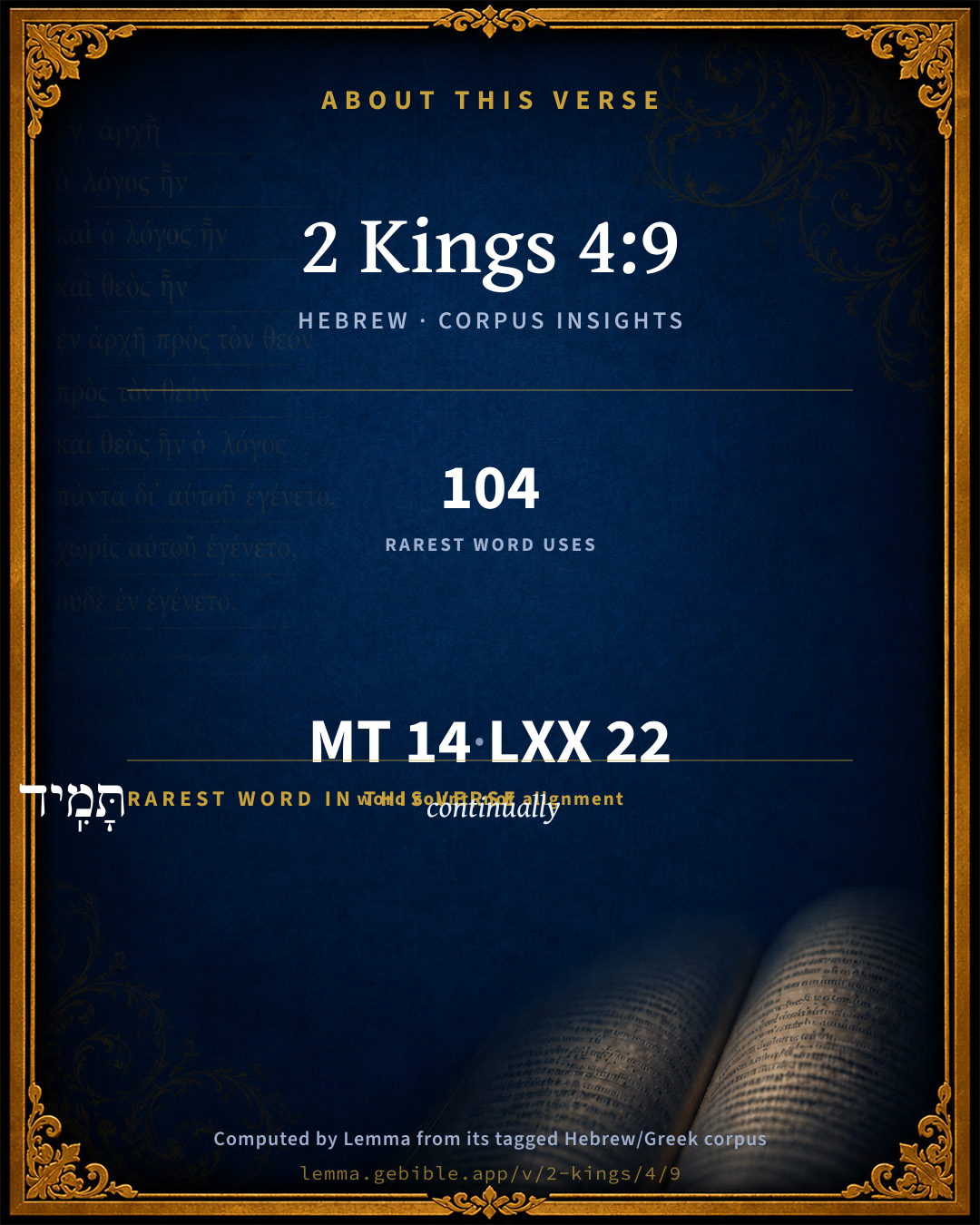
תָּמִֽיד
tâmîyd
H8548
“continually”
Noun, Common, Masculine, Singular, Absolute
Part of Speech
Noun
Type
Common
Gender
Masculine
Number
Singular
State
Absolute
Full BDB Definition

Origin: from an unused root meaning to stretch

TWOT: 1157a

continuity, perpetuity, to stretch - continually, continuously (as adverb) - continuity (substantive)
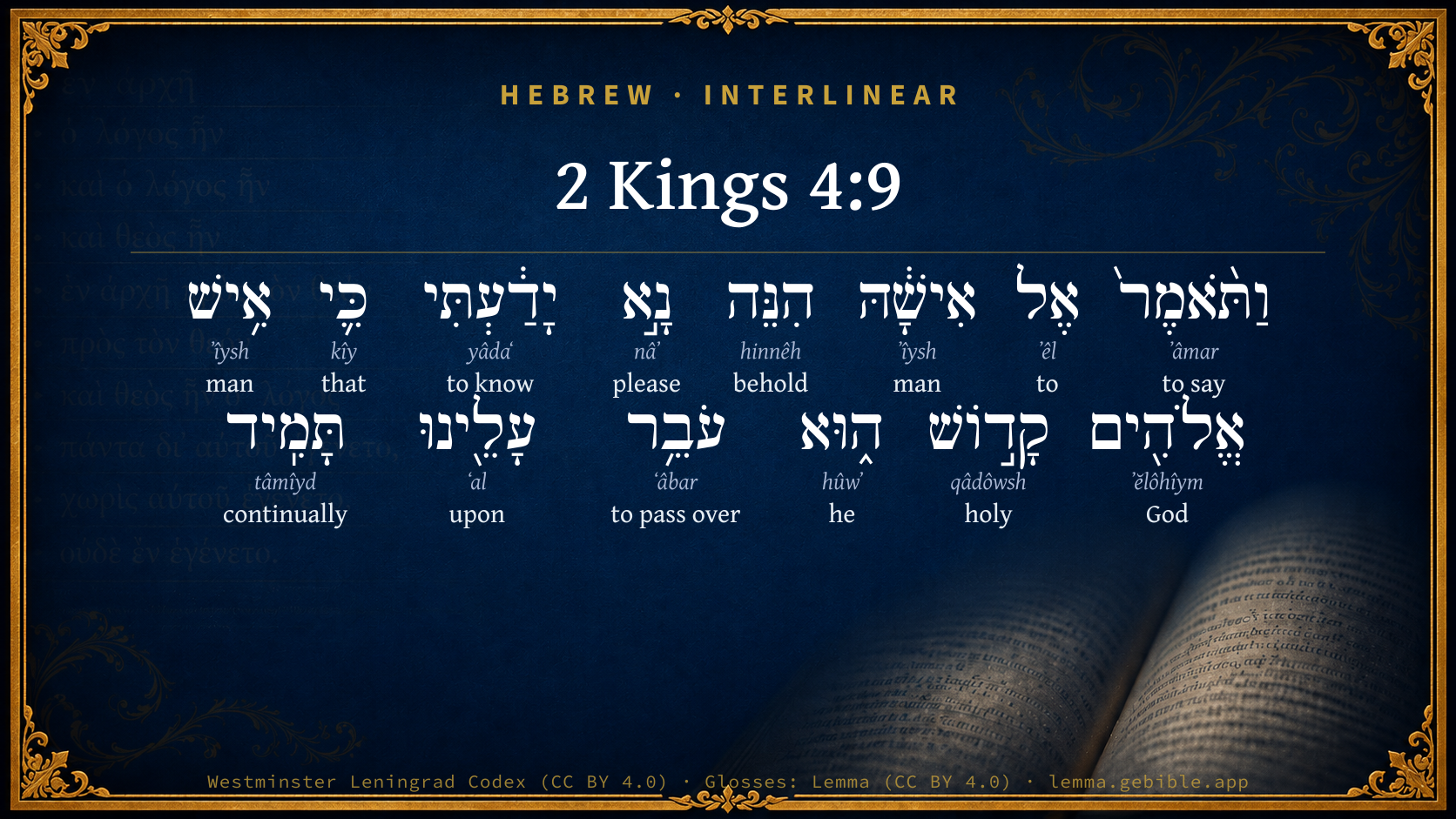
  1. וַתֹּ֨אמֶר֙ ʼâmar H559 “and · to say” Conjunction + Verb, Qal, Sequential Imperfect, 3rd Person, Feminine, Singular
  2. אֶל ʼêl H413 “to” Preposition
  3. אִישָׁ֔הּ ʼîysh H376 “man · her” Noun, Common, Masculine, Singular, Construct + Suffix, Personal, 3rd Person, Feminine, Singular
  4. הִנֵּה hinnêh H2009 “behold” Particle, Demonstrative
  5. נָ֣א nâʼ H4994 “please” Particle, Exhortation
  6. יָדַ֔עְתִּי yâdaʻ H3045 “to know” Verb, Qal, Perfect, 1st Person, Common, Singular
  7. כִּ֛י kîy H3588 “that” Conjunction
  8. אִ֥ישׁ ʼîysh H376 “man of” Noun, Common, Masculine, Singular, Construct
  9. אֱלֹהִ֖ים ʼĕlôhîym H430 “God(s)” Noun, Common, Masculine, Plural, Absolute
  10. קָד֣וֹשׁ qâdôwsh H6918 “holy” Adjective, Adjective, Masculine, Singular, Absolute
  11. ה֑וּא hûwʼ H1931 “he” Pronoun, Personal, 3rd Person, Masculine, Singular
  12. עֹבֵ֥ר ʻâbar H5674 “passing over” Verb, Qal, Participle Active, Masculine, Singular, Absolute
  13. עָלֵ֖ינוּ ʻal H5921 “upon · us” Preposition + Suffix, Personal, 1st Person, Common, Plural

About this verse

These counts appear in no published source. They are computed here, from the morphology-tagged text and Lemma’s own curated glosses. What Lemma adds →

14
words
13
distinct lemmas
Historical
section

Grammatical profile

  • 3 verbs
  • 4 nouns
  • 1 adjective
  • 1 pronoun
  • 2 prepositions
  • 1 conjunction
  • 2 particles

Verb forms

  • וַתֹּ֨אמֶר֙ Qal · Sequential Imperfect
  • יָדַ֔עְתִּי Qal · Perfect
  • עֹבֵ֥ר Qal · Participle Active

Repetition

A word recurs within this verse — often emphatic in Hebrew:

  • אִישָׁ֔הּ man H376 ×2

Hebrew & Septuagint length

In English translation the verse runs 22 words from the Hebrew and 25 from the Septuagint (LXX English) — closely comparable.

A rough comparison of the two English renderings, which tokenize alike — not a word-level alignment.

Word counts can differ between the Hebrew and the Greek without any difference in meaning — e.g. the Hebrew direct-object marker אֵת has no separate Greek word, and Greek often adds the article ὁ.

In the original languages it is 14 Hebrew tokens and 22 Greek tokens — but the two are counted differently (Hebrew bundles its prefixes and suffixes into one token; the Greek is in lemma form), so that isn’t a like-for-like length.

Cross-references

9

Topical passages linked to 2 Kings 4:9 in the Treasury of Scripture Knowledge — connected by theme and wording, ordered by reader-vote popularity; previews shown in the World English Bible.

  • 1 Kings 17:24 The woman said to Elijah, Now I know that you are a man of God, and that the word of Yahweh in your mouth is truth.
  • Proverbs 31:10–11 Who can find a worthy woman? For her price is far above rubies.
  • 2 Kings 4:7 Then she came and told the man of God. He said, Go, sell the oil, and pay your debt, and live you and your sons of the rest.
  • 1 Thessalonians 2:10 You are witnesses with God, how holy, righteously, and blamelessly we behaved ourselves toward you who believe.
  • Titus 1:8 but given to hospitality, as a lover of good, sober-minded, fair, holy, self-controlled;
  • 1 Kings 17:18 She said to Elijah, What have I to do with you, you man of God? You have come to me to bring my sin to memory, and to kill my son!
  • Matthew 5:16 Even so, let your light shine before men; that they may see your good works, and glorify your Father who is in heaven.
  • Deuteronomy 33:1 This is the blessing, with which Moses the man of God blessed the children of Israel before his death.
  • 1 Peter 3:1 In like manner, wives, be in subjection to your own husbands; so that, even if any don't obey the Word, they may be won by the behavior of their wives without a word;

Cross-references courtesy of OpenBible.info (CC BY 4.0).

Hebrew and Greek witnesses Masoretic Hebrew ↔ Greek Septuagint

The same verse in the two great witnesses to the Old Testament, shown verse-for-verse.

These are two independent witnesses, not word-aligned to each other, and the Septuagint is shown in lemma (dictionary) form.

Hebrew 2 Kings 4:9 Masoretic · Westminster Leningrad Codex

וַתֹּ֨אמֶר֙ אֶל אִישָׁ֔הּ הִנֵּה נָ֣א יָדַ֔עְתִּי כִּ֛י אִ֥ישׁ אֱלֹהִ֖ים קָד֣וֹשׁ ה֑וּא עֹבֵ֥ר עָלֵ֖ינוּ תָּמִֽיד

She said to her husband, See now, I perceive that this is a holy man of God, that passes by us continually.

World English Bible · Public Domain

Greek LXX 2 Kings 4:9 Septuagint · lemma form

καί εἶπον ὁ γυνή πρός ὁ ἀνήρ αὐτός ἰδού δή γιγνώσκω ὅτι ἄνθρωπος ὁ θεός ἅγιος οὗτος διαπορεύομαι ἐπί ἐγώ διά πᾶς

And the woman said to her husband, See now, I know that this is a holy man of God who comes over continually to us.

LXX2012 (modern English Septuagint) · Public Domain

Hebrew: Westminster Leningrad Codex (CC BY 4.0). Greek: Septuagint (public domain); English from LXX2012 (modern English Septuagint) (Public Domain). How the Septuagint differs from the Hebrew →

Targum (Aramaic paraphrase)

1

The Targum is the ancient Jewish Aramaic paraphrase of the Hebrew Scriptures — an interpretive translation, not the Hebrew text itself. Onkelos (literal) and Pseudo-Jonathan (expansive) render the Torah, and Jonathan the Prophets. Coverage is partial: where no permissively-licensed English translation exists for a verse, only the Aramaic is shown. This is verse-level text, not a word-by-word alignment to the Hebrew.

  1. Targum Jonathan Prophets (Joshua–Malachi)
    וַאֲמַרַת לְבַעֲלָהּ הָא כְעַן יְדַעְנָא אֲרֵי נְבִיָא דַייָ קַדִישָׁא הוּא מִתְפְּנֵי לְוָתָנָא תְּדִירָא:

    (no public-domain English translation for this verse)

    Targum Jonathan — Aramaic: “Mikraot Gedolot” (public domain). English: “Sefaria Community Translation” (CC0 1.0 (public-domain dedication)); “London "Chaldee Paraphrase," 1871” (public domain). Text via Sefaria.

Commentary

Notes on 2 Kings 4:9 from classic Christian and Jewish commentators (each source and its license shown beneath its notes). The classic Christian expositions comment on the surrounding passage and are grouped to its opening verse, so a note may address several verses; the Jewish commentaries on the Tanakh (Rashi and others) are per-verse, so they appear only where the commentator wrote on this verse.

Lemma curates 59 commentaries, every one of them public domain or Creative Commons licensed, each selected and text-cleaned for this edition rather than reprinted as found. About our sources →

Trapp's Complete Commentary

John Trapp

2Ki 4:9 And she said unto her husband, Behold now, I perceive that this [is] an holy man of God, which passeth by us continually.

Ver. 9. Behold now, I perceive that this is a holy man.] Holiness will as little be hid as light, fire, musk, &c. A holy man is like a crystai glass with a clear lamp in the midst of it.

Which passeth by us continually.] Shunem was not far from mount Carmel; and this prophet went still about doing good.

John Trapp, A Commentary or Exposition upon All the Books of the Old and New Testament (1647–1656) — public domain. Text from a community e-Sword module.

Joseph Benson's Commentary

2Ki 4:9-10. She said to her husband — In frequent conversation with him. This is a holy man of God — A prophet, and that of eminent holiness; by our kindness to whom we shall procure a blessing to ourselves. Which passeth by us continually — For Shunem was in his way as he went from Carmel, which was not far from hence, to Beth-el and Jericho, and other places of the sons of the prophets. Let us make him a little chamber — on the wall — A private room, remote from the house, where he may retire, and be free from the noise of family business; and enjoy that privacy, which, I perceive, he desires for his prayers and meditations. Let us set for him there a bed and a table, &c. — He will not be troublesome or chargeable to us: he cares not for rich furniture or costly entertainment, but is content with bare necessaries. And — he shall turn in thither — Take up his lodging there, if he think good.

Joseph Benson's Commentary on the Old and New Testaments (1811–1818) — public domain. Text from a community e-Sword module.

Tyndale Open Study Notes

Tyndale Open Resources

4:9-10 Because the Shunemite woman recognized that Elisha was a true prophet—a holy man of God—she wished to provide hospitality for him during his frequent travels (see Isa 58:7; Heb 13:2; 3 Jn 1:5). • A small room . . . on the roof, reached by an outside stairway, assured privacy for both Elisha and his hosts.

Tyndale Open Study Notes — © Tyndale Open Resources, licensed CC BY-SA 4.0. Text via the HelloAO Bible API.

Adam Clarke's Commentary

Verse 9. This is a holy man of God] That is, a prophet, as the Chaldee interprets it.

Which passeth by us continually.] It probably lay in his way to some school of the prophets that he usually attended.

Adam Clarke's Commentary on the Bible (1810–1826) — public domain. Text from a community e-Sword/MySword module.

Ellicott's Commentary for English Readers

(9) An holy man of God.—The term “holy” is not a merely ornamental or conventional epithet of the “man of God” (i.e., prophet) as such, but denotes the special moral elevation of Elisha.

Continually.—At stated intervals, regularly.

A Bible Commentary for English Readers, edited by Charles John Ellicott (1878–1897) — public domain. Text from a community e-Sword module.

The Cambridge Bible for Schools and Colleges

gen. ed. J. J. S. Perowne

9. she said unto her husband] The woman was not content with providing food, but out of reverence for the character of the visitor, desired to provide a lodging also.

I perceive that this is a holy man of God] Probably before the first invitation the woman had learnt something of Elisha’s work and the reason of his frequent journeys. Now when he became their guest she had full opportunity of enquiring from Gehazi, and observing for herself the way in which he laboured to keep alive the true worship of God in the land. The existence of a family like this of the Shunammite is evidence that amid much corruption God was not yet forgotten in the ten tribes. The name ‘man of God’ was applied to Elijah (1Ki_17:24) by the widow of Zarephath after she had beheld what great things God did through his ministry. She added also ‘the word of the Lord in thy mouth is truth’, which probably represents much of the feeling of the Shunammite when she spake of Elisha as ‘holy’.

The Cambridge Bible for Schools and Colleges (gen. ed. J. J. S. Perowne; Cambridge University Press, 1878–1918) — public domain. Text from a community e-Sword module.

John Gill's Exposition

And she said unto her husband,.... Not being willing to do any thing without his leave and consent:

behold now, I perceive that this is an holy man of God which passeth by us continually: and calls here frequently: this she perceived by his discourse and conversation; and by his carriage and behaviour he appeared to be a prophet, and one very eminent for holiness and religion.

John Gill's Exposition of the Whole Bible (1746–1763) — public domain (CC PDM 1.0). Text via the HelloAO Bible API.

Matthew Poole's English Annotations

An holy man of God; a prophet, as Jdg 13:6, and that of eminent holiness, by our kindness to whom we shall procure a blessing to ourselves.

Matthew Poole's English Annotations on the Holy Bible (1683–1685) — public domain. Text from a community e-Sword/MySword module.

The Pulpit Commentary

And she said unto her husband, Beheld now, I perceive that this is a holy man of God. Not all the soi-disant men of God were truly religious and God-fearing. In Elisha"s time, as in all others, there were among the teachers of religion some who were "wolves in sheep"s clothing:" The Shunammite woman, after a certain length of acquaintance, came to the conclusion that Elisha deserved the title which he commonly bore, was truly a "man of God," a real devoted servant of Jehovah. She therefore wished to do more for him than she had hitherto done. Which passeth by us continually; i.e. who passes through our village, and has his meals with us so frequently.

The Pulpit Commentary (1880–1919), ed. H.D.M. Spence-Jones & Joseph S. Exell — public domain. Text from a community e-Sword module.

John Wesley's Explanatory Notes

This is - A prophet, and that of eminent holiness: by our kindness to whom, we shall procure a blessing to ourselves.

John Wesley, Explanatory Notes Upon the Whole Bible (1754–1765) — public domain. Text via the GEBible commentary corpus.

Rashi

Rabbi Shlomo Yitzchaki (Rashi)

“Behold, now I know.” Because she never saw a fly at his table or semen on his sheet.

Rashi on the Tanakh — English translations: “The Judaica Press complete Tanach with Rashi, translated by A. J. Rosenberg” (CC BY 4.0); “Pentateuch with Rashi's commentary by M. Rosenbaum and A.M. Silbermann, 1929-1934” (public domain); “The Metsudah Tanach series, Lakewood, N.J” (CC BY 4.0); and “The Book of Joshua, Metsudah Publications, 1997” (CC BY 4.0). Text via Sefaria.

Lesson kit

Teaching starters — assembled from the data on this page, not authored interpretation. Every prompt links to the verse data it draws on. Edit before teaching.

2 Kings, in the Historical, opens this verse with 14 words (13 distinct Hebrew lemmas). Its most distinctive word is tâmîyd (“continually”). A historical commentator’s framing appears above. Read the whole chapter for the surrounding context.

Discussion questions

  1. How does “continually” (tâmîyd) shape what this verse is saying?
  2. How does 1 Kings 17:24, which shares this passage’s theme, read alongside this verse?
  3. What does the repetition of “man” (2× in this one verse) do in this verse?
  4. These translations render this verse differently; the difference is in the English rendering, not the original. What questions does that raise?
  5. «וַתֹּ֨אמֶר֙» is a Qal Sequential Imperfect verb. How does that grammatical form shape the action described?
  6. Compare how Trapp's Complete Commentary and Joseph Benson's Commentary read this verse. Where do they agree or differ?

Things to notice

Reading settings

Reading text

Shown beneath each verse's original-language words.

Old Testament
Old Testament edition

Read the OT as the Masoretic Hebrew (MT) or the Greek Septuagint (LXX).

English shown for the Greek Septuagint (in the Hebrew ↔ Greek comparison).

Comparing translations? Open the Compare panel on any verse page to stack up to four side by side.