
1 Peter 2:9

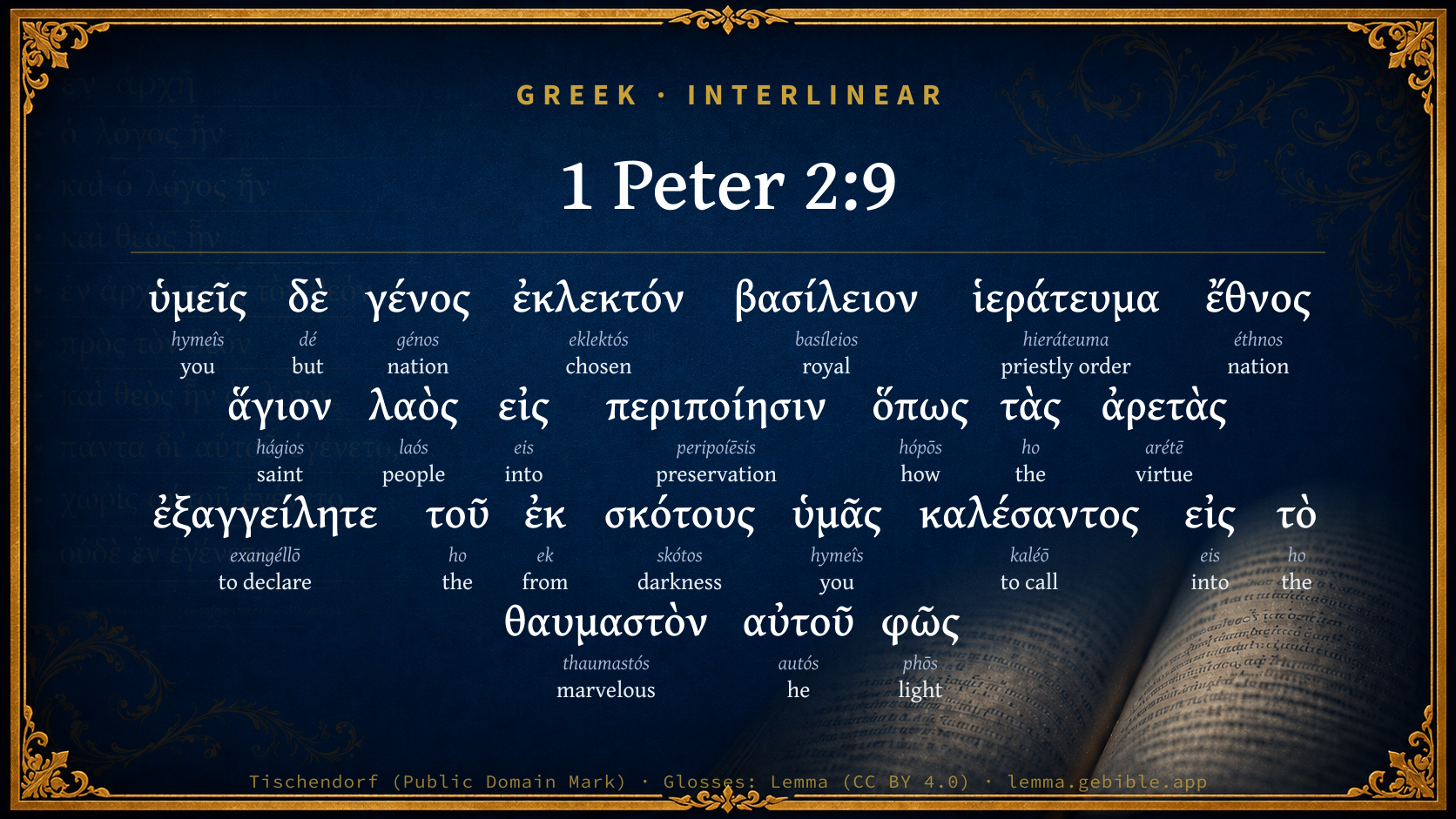
Greek (Tischendorf 8th ed.) 1 Peter 2:9 appears in the Greek New Testament. The text above is from the Tischendorf 8th edition. Each word links to its Strong’s number and a concise gloss. Click any word for its full Thayer’s Greek Lexicon entry.
Download image
Cite this verse

1 Peter 2:9 (World English Bible). Public Domain. Lemma interlinear Bible study tool, https://lemma.gebible.app/v/1-peter/2/9.

Show BibTeX & RIS
BibTeX
RIS
English Translation
But you are a chosen race, a royal priesthood, a holy nation, a people for God's own possession, that you may show forth the excellencies of him who called you out of darkness into his marvelous light:
World English Bible · Public Domain
Highlights
  • 1 hapax legomenon — only here in the Greek New Testament
  • 1 first appearance in the Greek New Testament
Full analysis ↓
Download a study sheet

One document with this verse’s original text, its word-by-word gloss line, the meaning frame, cross-references with their text, attributed commentary, and full source and license credits — printable, and it pastes into notes with its structure intact.

This verse Autodidact and up

Study sheet (.html) Plain text (.txt)

A passage Seminary Student

Up to 50 verses in one chapter. A passage sheet keeps up to 6 commentary sources and 12 cross-references per verse, in the order this page ranks them, and says so on the sheet whenever that leaves anything out. Ask for a single verse and you get the Autodidact verse sheet above.

Everything on this page stays free to read, with no account — the sheet is a download of what is already on screen, not access to it.

Want to remove ads? Support Godless Engineer
Compare translations 3

The same verse in 3 English versions, stacked beneath the original-language interlinear above. Click any original word for its lexicon entry.

Each is an independent rendering of the whole verse — the interlinear is not word-aligned to these translations.

Highlighted words mark where these versions differ — a whole-verse word diff, not a word-by-word alignment.

  • World English Bible Public Domain
    But you are a chosen race, a royal priesthood, a holy nation, a people for God's own possession, that you may show forth the excellencies of him who called you out of darkness into his marvelous light:
  • King James Version Public Domain
    But ye are a chosen generation, a royal priesthood, an holy nation, a peculiar people; that ye should shew forth the praises of him who hath called you out of darkness into his marvellous light;
  • unfoldingWord Literal Text CC BY-SA 4.0
    But you a chosen family, a royal priesthood, a holy nation, a people for possession, so that you might proclaim the praiseworthy actions of the one having called you out from darkness into his marvelous light,

unfoldingWord Literal Text — © unfoldingWord, licensed CC BY-SA 4.0. Word-aligned USFM3 via Door43 (git.door43.org/unfoldingWord/en_ult).

Versions to compare (up to 4)

3 of 4 selected

Show all 19 translations

Every available English version of this verse, each an independent rendering of the whole verse.

  • World English Bible Public Domain
    But you are a chosen race, a royal priesthood, a holy nation, a people for God's own possession, that you may show forth the excellencies of him who called you out of darkness into his marvelous light:
  • Berean Standard Bible Public Domain
    But you are a chosen people, a royal priesthood, a holy nation, a people for God’s own possession, to proclaim the virtues of Him who called you out of darkness into His marvelous light.
  • Majority Standard Bible Public Domain
    But you are a chosen people, a royal priesthood, a holy nation, a people for God’s own possession, to proclaim the virtues of Him who called you out of darkness into His marvelous light.
  • King James Version Public Domain
    But ye are a chosen generation, a royal priesthood, an holy nation, a peculiar people; that ye should shew forth the praises of him who hath called you out of darkness into his marvellous light;
  • American Standard Version (1901) Public Domain
    But ye are a elect race, a royal priesthood, a holy nation, a people for `God's' own possession, that ye may show forth the excellencies of him who called you out of darkness into his marvellous light:
  • Revised Version (1885) Public Domain
    But ye are an elect race, a royal priesthood, a holy nation, a people for God’s own possession, that ye may shew forth the excellencies of him who called you out of darkness into his marvelous light:
  • Geneva Bible (1599) Public Domain
    But yee are a chosen generation, a royall Priesthoode, an holy nation, a people set at libertie, that yee shoulde shewe foorth the vertues of him that hath called you out of darkenesse into his marueilous light,
  • Douay-Rheims (1899) Public Domain
    But you are a chosen generation, a kingly priesthood, a holy nation, a purchased people: that you may declare his virtues, who hath called you out of darkness into his marvellous light:
  • Young's Literal Translation Public Domain
    and ye `are' a choice race, a royal priesthood, a holy nation, a people acquired, that the excellences ye may shew forth of Him who out of darkness did call you to His wondrous light;
  • Literal Standard Version CC BY-SA 4.0
    But you [are] a chosen race, a royal priesthood, a holy nation, a people acquired, that you may show forth the excellencies of Him who called you out of darkness into His wonderful light,
  • Unlocked Literal Bible CC BY-SA 4.0
    But you are a chosen people, a royal priesthood, a holy nation, a people for God's possession, so that you would announce the wonderful actions of the one who called you out from darkness into his marvelous light.
  • unfoldingWord Literal Text CC BY-SA 4.0
    But you a chosen family, a royal priesthood, a holy nation, a people for possession, so that you might proclaim the praiseworthy actions of the one having called you out from darkness into his marvelous light,
  • Darby Bible Public Domain
    But *ye* [are] a chosen race, a kingly priesthood, a holy nation, a people for a possession, that ye might set forth the excellencies of him who has called you out of darkness to his wonderful light;
  • World Messianic Bible Public Domain
    But you are a chosen race, a royal priesthood, a holy nation, a people for God’s own possession, that you may proclaim the excellence of him who called you out of darkness into his marvelous light.
  • Webster's Bible Public Domain
    But ye are a chosen generation, a royal priesthood, a holy nation, a peculiar people; that ye should show forth the praises of him who hath called you out of darkness into his marvelous light:
  • Free Bible Version CC BY-SA 4.0
    In complete contrast, you are a specially-chosen family, a royal priesthood, a holy nation, a people belonging to God. Consequently you can reveal the wonderful things he's done, calling you out of darkness into his marvelous light.
  • Bible in Basic English Public Domain
    But you are a special people, a holy nation, priests and kings, a people given up completely to God, so that you may make clear the virtues of him who took you out of the dark into the light of heaven.
  • Text-Critical English NT CC BY 4.0
    But you are a chosen lineage, a royal priesthood, a holy nation, a people for God's own possession, so that you may proclaim the excellencies of him who called you out of darkness into his marvelous light.
  • Tyndale New Testament (1534) Public Domain
    But ye are a chosyn generacion a royall presthod an holy nacion and a peculiar people that ye shuld shewe the vertues of him that called you out of darknes into hys marvelous light

Literal Standard Version (2020), Covenant Press — licensed CC BY-SA 4.0. Text via the HelloAO Bible API (eBible.org). Unlocked Literal Bible (unfoldingWord) — licensed CC BY-SA 4.0. Text via the HelloAO Bible API (eBible.org). unfoldingWord Literal Text — © unfoldingWord, licensed CC BY-SA 4.0. Word-aligned USFM3 via Door43 (git.door43.org/unfoldingWord/en_ult). Free Bible Version, Dr. Jonathan Gallagher — licensed CC BY-SA 4.0. Text via the HelloAO Bible API (eBible.org).

Word by word

More ways to search: Search by grammar → Find every occurrence → Compare this word →

Practice this passage: Drill this verse → Learn its vocabulary →

ἐξαγγείλητε
exangéllō
G1804
“to declare”
Verb, Aorist, Active, Subjunctive, 2nd person, Plural
Part of Speech
Verb
Tense
Aorist
Voice
Active
Mood
Subjunctive
Person
2nd person
Number
Plural
Full Thayer's Definition

Origin: from G1537 and the base of G32

TDNT: 02:09,1

1. to tell out or forth 2. to declare abroad, divulge, publish 3. to make known by praising or proclaiming, to celebrate
  1. ὑμεῖς hymeîs G5210 “you” Personal pronoun, 2nd person, Nominative, Plural
  2. δὲ dé G1161 “but” Conjunction
  3. γένος génos G1085 “nation” Noun, Nominative, Singular, Neuter
  4. ἐκλεκτόν eklektós G1588 “chosen” Adjective, Nominative, Singular, Neuter
  5. βασίλειον basíleios G934 “royal” Adjective, Nominative, Singular, Neuter
  6. ἱεράτευμα hieráteuma G2406 “priestly order” Noun, Nominative, Singular, Neuter
  7. ἔθνος éthnos G1484 “nation” Noun, Nominative, Singular, Neuter
  8. ἅγιον hágios G40 “saint” Adjective, Nominative, Singular, Neuter
  9. λαὸς laós G2992 “people” Noun, Nominative, Singular, Masculine
  10. εἰς eis G1519 “into” Preposition
  11. περιποίησιν peripoíēsis G4047 “preservation” Noun, Accusative, Singular, Feminine
  12. ὅπως hópōs G3704 “how” Adverb
  13. τὰς ho G3588 “the” Article, Accusative, Plural, Feminine
  14. ἀρετὰς arétē G703 “virtue” Noun, Accusative, Plural, Feminine
  15. τοῦ ho G3588 “the” Article, Genitive, Singular, Masculine
  16. ἐκ ek G1537 “from” Preposition
  17. σκότους skótos G4655 “darkness” Noun, Genitive, Singular, Neuter
  18. ὑμᾶς hymeîs G5210 “you” Personal pronoun, 2nd person, Accusative, Plural
  19. καλέσαντος kaléō G2564 “to call” Verb, Aorist, Active, Participle, Genitive, Singular, Masculine
  20. εἰς eis G1519 “into” Preposition
  21. τὸ ho G3588 “the” Article, Accusative, Singular, Neuter
  22. θαυμαστὸν thaumastós G2298 “marvelous” Adjective, Accusative, Singular, Neuter
  23. αὐτοῦ autós G846 “he” Personal pronoun, Genitive, Singular, Masculine
  24. φῶς phōs G5457 “light” Noun, Accusative, Singular, Neuter

About this verse

These counts appear in no published source. They are computed here, from the morphology-tagged text and Lemma’s own curated glosses. What Lemma adds →

25
words
21
distinct lemmas
General Epistles
section

Notable vocabulary

1 hapax legomenon — a word that appears only here in the entire Greek New Testament:

  • ἐξαγγείλητε to declare G1804

First appearance in Scripture

This word makes its first canonical appearance in the Greek New Testament here:

  • ἐξαγγείλητε to declare G1804

Shared distinctive vocabulary

βασίλειον royal G934 occurs in 2 verses of the Greek New Testament. Also found in:
Repetition

Words recur within this verse:

Cross-references

44

Topical passages linked to 1 Peter 2:9 in the Treasury of Scripture Knowledge — connected by theme and wording, ordered by reader-vote popularity; previews shown in the World English Bible.

  • Exodus 19:5–6 Now therefore, if you will indeed obey my voice, and keep my covenant, then you shall be my own possession from among all peoples; for all the earth is mine;
  • Deuteronomy 7:6 For you are a holy people to Yahweh your God: Yahweh your God has chosen you to be a people for his own possession, above all peoples who are on the face of the earth.
  • Revelation 1:6 and he made us to be a Kingdom, priests to his God and Father; to him be the glory and the dominion forever and ever. Amen.
  • Revelation 5:10 And made them kings and priests to our God, And they reign on earth."
  • Isaiah 61:6 But you shall be named the priests of Yahweh; men shall call you the ministers of our God: you shall eat the wealth of the nations, and in their glory shall you boast yourselves.
  • 2 Timothy 1:9 who saved us and called us with a holy calling, not according to our works, but according to his own purpose and grace, which was given to us in Christ Jesus before times eternal,
  • Deuteronomy 26:18–19 and Yahweh has declared you this day to be a people for his own possession, as he has promised you, and that you should keep all his commandments;
  • Deuteronomy 14:2 For you are a holy people to Yahweh your God, and Yahweh has chosen you to be a people for his own possession, above all peoples who are on the face of the earth.
  • Ephesians 5:8–11 For you were once darkness, but are now light in the Lord. Walk as children of light,
  • 1 Peter 2:5 You also, as living stones, are built up as a spiritual house, to be a holy priesthood, to offer up spiritual sacrifices, acceptable to God through Jesus Christ.
  • Titus 2:14 who gave himself for us, that he might redeem us from all iniquity, and purify for himself a people for his own possession, zealous for good works.
  • Deuteronomy 10:15 Only Yahweh had a delight in your fathers to love them, and he chose their seed after them, even you above all peoples, as at this day.
  • Acts 26:18 to open their eyes, that they may turn from darkness to light and from the power of Satan to God, that they may receive remission of sins and an inheritance among those who are sanctified by faith in me.'
  • Psalms 33:12 Blessed is the nation whose God is Yahweh, The people whom he has chosen for his own inheritance.
  • Isaiah 26:2 Open you the gates, that the righteous nation which keeps faith may enter in.
  • Revelation 20:6 Blessed and holy is he who has part in the first resurrection. Over these, the second death has no power, but they will be priests of God and of Christ, and will reign with him one thousand years.
  • Isaiah 60:1–3 Arise, shine; for your light is come, and the glory of Yahweh is risen on you.
  • Matthew 5:16 Even so, let your light shine before men; that they may see your good works, and glorify your Father who is in heaven.
  • Deuteronomy 4:20 But Yahweh has taken you, and brought you forth out of the iron furnace, out of Egypt, to be to him a people of inheritance, as at this day.
  • Colossians 1:13 who delivered us out of the power of darkness, and translated us into the Kingdom of the Son of his love;
  • Acts 20:28 Take heed, therefore, to yourselves, and to all the flock, in which the Holy Spirit has made you overseers, to shepherd the assembly of the Lord and God which he purchased with his own blood.
  • 1 Corinthians 3:17 If anyone destroys the temple of God, God will destroy him; for God's temple is holy, which you are.
  • Isaiah 66:21 Of them also will I take for priests [and] for Levites, says Yahweh.
  • Isaiah 9:2 The people who walked in darkness have seen a great light: those who lived in the land of the shadow of death, on them has the light shined.
  • Isaiah 42:16 I will bring the blind by a way that they don't know; in paths that they don't know will I lead them; I will make darkness light before them, and crooked places straight. These things will I do, and I will not forsake them.
  • Isaiah 41:8 But you, Israel, my servant, Jacob whom I have chosen, the seed of Abraham my friend,
  • Isaiah 43:20–21 The animals of the field shall honor me, the jackals and the ostriches; because I give waters in the wilderness, and rivers in the desert, to give drink to my people, my chosen,
  • Philippians 3:14 I press on toward the goal for the prize of the high calling of God in Christ Jesus.
  • Isaiah 44:1 Yet now hear, Jacob my servant, and Israel, who I have chosen:
  • Matthew 4:16 The people who sat in darkness saw a great light, To those who sat in the region and shadow of death, To them light has dawned."
  • 1 Thessalonians 5:4–8 But you, brothers, aren't in darkness, that the day should overtake you like a thief.
  • Philippians 2:15–16 that you may become blameless and harmless, children of God without blemish in the midst of a crooked and perverse generation, among whom you are seen as lights in the world,
  • Psalms 106:5 That I may see the prosperity of your chosen, That I may rejoice in the gladness of your nation, That I may glory with your inheritance.
  • Luke 1:79 To shine on those who sit in darkness and the shadow of death; To guide our feet into the way of peace."
  • Romans 9:24 us, whom he also called, not from the Jews only, but also from the Gentiles?
  • 1 Peter 1:2 according to the foreknowledge of God the Father, in sanctification of the Spirit, that you may obey Jesus Christ and be sprinkled in his blood: Grace to you and peace be multiplied.
  • Acts 26:28 Agrippa said to Paul, "With a little persuasion are you trying to make me a Christian?"
  • Psalms 22:30 Posterity shall serve him. Future generations shall be told about the Lord.
  • Ephesians 1:6 to the praise of the glory of his grace, by which he freely bestowed favor on us in the Beloved,
  • 1 Peter 4:11 If any man speaks, let it be as it were oracles of God. If any man serves, let it be as of the strength which God supplies, that in all things God may be glorified through Jesus Christ, to whom belong the glory and the dominion forever and ever. Amen.
  • Psalms 73:15 If I had said, "I will speak thus;" Behold, I would have betrayed the generation of your children.
  • John 17:19 For their sakes I sanctify myself, that they themselves also may be sanctified in truth.
  • Ephesians 1:14 who is a pledge of our inheritance, to the redemption of God's own possession, to the praise of his glory.
  • Ephesians 3:21 to him be the glory in the assembly and in Christ Jesus to all generations forever and ever. Amen.

Cross-references courtesy of OpenBible.info (CC BY 4.0).

Commentary

Notes on 1 Peter 2:9 from classic Christian and Jewish commentators (each source and its license shown beneath its notes). The classic Christian expositions comment on the surrounding passage and are grouped to its opening verse, so a note may address several verses; the Jewish commentaries on the Tanakh (Rashi and others) are per-verse, so they appear only where the commentator wrote on this verse.

Lemma curates 59 commentaries, every one of them public domain or Creative Commons licensed, each selected and text-cleaned for this edition rather than reprinted as found. About our sources →

The Biblical Illustrator

Joseph S. Exell

1Pe_2:9-10

But ye are a chosen generation.

The true Israel

I. Ye are a chosen generation-the word generation here meaning not contemporaries but the offspring of one common parent, the offshoots of one original stock.

1. The Israelites were a special generation, having sprung from Abraham as their common progenitor. Similarly, believers are a distinct generation of men, being all born of one God, and animated by the self-same Divine life. Consequently a striking family likeness prevails among them.

2. The Jews were, moreover, a chosen generation-called out of the darkness of Chaldaean idolatry to the marvellous light of Divine revelation. And so it is with believers now,

3. Ye are a chosen generation, that ye should show forth the praises-the excellences-of Him who hath called you. The mistake of the Jews was to take for granted that they were chosen to show forth their own excellences. Their election they converted into food for pride. Let us remember the Church is a generation to show forth the excellences of God. Through good men, not necessarily great men, does God reveal His character; through holy men, not necessarily able men, does He make known the benevolence, the uprightness, the genial warmth of His nature.

II. Ye are a royal priesthood-a phrase borrowed from Exo_19:6.

1. The Jewish nation was a nation of priests, its fundamental idea being religious, not secular. This idea is now embodied in the Christian Church. Every believer is now a priest, having a right to enter into the Holiest of all.

2. A royal priesthood. Ye are kings and priests-kings over yourselves and priests unto God.

3. Ye are a royal priesthood, to show forth the excellences of Him who hath called you. By your holy conversation, upright demeanour, you are to show forth the character of your God.

III. Ye are a holy nation.

1. The Israelites in Egypt were a chosen generation, but not a holy nation. Not till they were established in their own land, with laws and a king of their own, did they develop into a nation. Believers, scattered in the world, without mutual recognition, might be of the right seed; but not till they attach themselves to a Christian institution, variously termed the kingdom or the Church, do they become a nation.

2. A holy nation. God set the Israelites apart from all the world. He made them what all nations ought to be-holy. True, they did not live up to their profession; but in theory, in ideal, they were holy.

3. As a people bound together for the purposes of holiness, we should show forth the excellences of our God. As a holy nation, scattered amongst all the nations of Europe, we ought to propagate the principles of Gods kingdom.

IV. Ye are a peculiar people.

1. Ye are a people. The Israelites were brought out of Egypt a host of undisciplined slaves, capabilities of great things slumbering within them, but only half civilised. But after forty years pilgrimage in the wilderness, God was able to form them into a people, and settle them in the land promised unto their fathers. And in our natural state, we cannot be said to be a people in the true sense of the word, bound together by rational and spiritual ties. As individuals you can hardly be said to really exist till you believe. Of Him ye are in Christ Jesus. Ye were not before, but now ye are-you live in the higher ranges of the soul. Before you only lived in your animal nature-you did not live the distinctive life of man. But through union with Christ first, and with the Church afterwards, you fulfil the idea of your being, you live in the higher faculties instead of the lower, having higher purposes and different interests from the rest of the world.

2. Ye are a peculiar people, the word peculiar here being used in its etymological, not its colloquial sense, as meaning property, not singularity. These people have I formed for Myself-they are My very own.

3. But mark, we are Gods, purchased at a great price, in order that we may tell forth with a loud voice His praises. The word for show forth means literally to proclaim to those without what has taken place within. Here Israel failed. Let the Christian Church beware of committing the same mistake-God has purchased us to be His special possession, on purpose that we should proclaim to the world lying in darkness the excellences of His love in the Gospel of His Son. We must either send or carry the light to the heathen. (J. C. Jones, D. D.)

The Christian estate

I. The state of Christians, a chosen generation; so in Psa_24:1-10. The psalmist there speaks first of Gods universal sovereignty, then of His peculiar choice. As men who have great variety of possessions have yet usually their special delight in some one beyond all the rest, and choose to reside most in it, and bestow most expense on it to make it pleasant; so doth the Lord of the whole earth choose out to Himself from the rest of the world a number that are a chosen generation. Generation. This imports them to be of one race or stock. They are of one nation, belonging to the same blessed land of promise, all citizens of the New Jerusalem, yea, all children of the same family, whereof Jesus Christ, the root of Jesse, is the stock, who is the great King and the great High Priest. And thus they are a royal priesthood. They are of the seed royal, and of the holy seed of the priesthood, inasmuch as they partake of a new life from Christ. Thus, in Rev_1:5-6, there is first His own dignity expressed, then His dignifying us. There is no doubt that this kingly priesthood is the common dignity of all believers; this honour have all the saints. They are kings, have victory and dominion given them over the powers of darkness and the lusts of their own hearts, that held them captive and domineered over them before. This royalty takes away all attainders, and leaves nothing of all that is past to be laid to our charge, or to dishonour us. Believers are not shut out from God as they were before, but, being in Christ, ale brought near unto Him, and have free access to the throne of His grace. They resemble, in their spiritual state, the legal priesthood very clearly.

1. In their consecration. The levitical priests were washed; therefore this is expressed (Rev_1:5), He hath washed us in His own blood, and then follows, and hath made us kings and priests.

2. Let us consider their services, which were diverse. They had charge of the sanctuary, vessels, lights, and were to keep the lamps burning. Thus the heart of every Christian is made a temple to the Holy Ghost, and he himself, as a priest consecrated unto God, is to keep it diligently, and the furniture of Divine grace in it; to have the light of spiritual knowledge within him, and to nourish it by drawing continually new supplies from Jesus Christ. The priests were to bless the people. And truly it is this spiritual priesthood, the elect, that procure blessings upon the rest of the world, and particularly on the places where they live.

3. Let us consider their course of life. We shall find rules given to the legal priests, stricter than to others, of avoiding legal pollutions, etc. And from these, this spiritual priesthood must learn an exact holy conversation, keeping themselves from the pollutions of the world: as here it follows: A holy nation, and that of necessity; if a priesthood, then holy.

II. The opposition of the estate of Christians to that of unbelievers; we are most sensible of the evil or good of things by comparison. Though the estate of a Christian is very excellent and, when rightly valued, hath enough in itself to commend it, yet it doth and ought to raise our esteem of it the higher, when we compare it both with the misery of our former condition, and with the continuing misery of those that abide still and are left to perish in that woeful estate. We have here both these parallels. The happiness and dignity to which they are chosen and called, is opposed to the rejection and misery of them that continue unbelievers and rejectors of Christ.

III. The end of their calling. That ye should show forth the praises, etc. To magnify the grace of God the more, we have here:

1. Both the terms of this motion or change, from whence and to what it is.

2. The principle of it, the calling of God.

(1) From darkness. The estate of lost mankind is indeed nothing but darkness, being destitute of all spiritual truth and comfort, and tending to utter and everlasting darkness. And it is so, because by sin, the soul is separate from God, who is the first and highest light, the primitive truth. And the soul being made capable of Divine light, cannot be happy without it. And as the estate from whence we are called by grace is worthily called darkness, so that to which it calls us deserves as well the name of light. Christ likewise, who came to work our deliverance, is frequently so called in Scripture, not only in regard of His own nature, being God equal with the Father and therefore light, but relatively to men: The life was the light of men. There is a spirit of light and knowledge flowing from Jesus Christ into the souls of believers, that acquaints them with the mysteries of the kingdom of God, which cannot otherwise be known. And this spirit of knowledge is withal a spirit of holiness; for purity and holiness are likewise signified by this light. Then from this light arise spiritual joy and comfort, which are frequently signified by this expression. There are two things spoken of this light, to commend it, His marvellous light; that is-it is after a peculiar manner Gods-and it is marvellous. All light is from God, the light of sense, and that of reason; therefore He is called the Father of lights. But this light of grace is after a peculiar manner His, being a light above the reach of nature, infused into the soul in a supernatural way, the light of the elect world, where God specially and graciously resides. Now this light being so peculiarly Gods, no wonder if it be marvellous. And if this light of grace be so marvellous, how much more marvellous shall the light of glory be, in which it ends! Hence learn to esteem highly of the gospel, in which this light shines unto us; the apostle calls it therefore the glorious gospel. Surely we have no cause to be ashamed of it, but of ourselves that we are so unlike it.

(2) The principle of this change, the calling of God. He hath called you. Those who live in the society and profess the faith of Christians, are called unto light, the light of the gospel that shines in the Church of God. Now this is no small favour, while many people are left in darkness and in the shadow of death, to have this light arise upon us and to be in the region of it, the Church, the Goshen of the world; for by this outward light we are invited to the happy state of saving inward light, and the former is here to be understood as the means of the latter. This is Gods end in calling us, to communicate His goodness to us, that so the glory of it may return to Himself. As this is Gods end, it ought to be ours, and therefore ours because it is His. And for this very purpose, both here and elsewhere are we put in mind of it, that we may be true to His end and intend it with Him. This is His purpose in calling us, and therefore it is our great duty, being so called, to declare His praises. All things and persons shall pay this tribute, even those who are most unwilling; but the happiness of His chosen is, that they are active in it, others are passive only. (Abp. Leighton.)

The Church of Christ

I. The divine origin of the Church.

1. An elect race. Separated, called, chosen, quickened. Not a casual result out of ordinary forces.

II. Her function in the world-a royal priesthood. Here king and priest are blended to show the power and function of the priesthood. We plead with man for God and with God for man: the regal kings are the saints of God.

III. The beauty of her character-a holy nation. With us holiness frequently is a bundle of negation, an emptiness; but holiness is a cluster of positive glories, the glory of courage, the gleam of tenderness, the radiancy of mercy.

IV. Her preciousness to God. A peculiar people. His delight, joy, resting place. It is easy to depreciate. It takes a wise man to see the background as well as the figure on it. If the Church can be chosen, royal, priestly, beauteous, dear to God, she wants no earthly help.

V. Her work in the world-that ye may show forth the excellencies of Him Who called you out of darkness into His marvellous light.

1. Every quickened soul has its own story to tell. There is a gospel according to you and me. The truth of God is the gathering up of all these gospels.

2. We have the power to utter praise.

3. We have the motive-gratitude for deliverance from darkness. (R. Glover, D. D.)

The glory of the Church as a commonwealth

I. The glory of the Church in its characteristics. A people for Gods own possession. First, by acquirement-He gave, etc.; second, by endearment-He loved, etc.

II. The glory of the Church in its mission. Here is its great purpose-That. This throws us back on the thought in the word elect-chosen for what end, choice for what uses? The purpose is:

1. A great manifestation. That ye may show forth. Tell out by word and deed some great message.

2. A great manifestation of the true greatness of God. The excellencies of Him. The virtues, the glories of God; what

(1) a lofty theme;

(2) boundless theme;

(3) sacred theme.

3. A manifestation of the excellencies of God in blessing men. Who called you out of darkness into His marvellous light. The Spirit of God calls from

(1) the darkness of ignorance;

(2) the darkness of guilt;

(3) the darkness of dread.

The Spirit of God calls to

(a) the marvellous light of truth;

(b) the marvellous light of holiness;

(c) the marvellous light of love;

(d) the marvellous light of heaven.

III. The glory of the Church in its present condition as contrasted with the past history of its members. Which in times past-the mention of this is to kindle gratitude, to inspire humility, to awaken watchfulness. (Homilist.)

A royal priesthood.-

Every baptized man a priest of God

I. It is amongst the most common, and certainly not the least dangerous, of the mistakes of the present day to identify the Church with the clergy, as though the laity were not to the full one of its constituent parts. I am indeed a minister of the Church, but not on that account more a member of the Church than any of those amongst whom I officiate. We are not speaking of what that community may be by practice, but only of what it is by profession; and of what it would be if it acted up to the obligations taken on itself. Let a parish of nominal Christians be converted into a parish of real Christians, so that there should not be one within its circuit who did not adorn the doctrine of the gospel; and what should we have but a parish of priests to the living God? We call it a parish of priests, because we can feel that it would be as a kind of little sanctuary in the midst of country or city, which might elsewhere be deformed by great ignorance and profligacy. There would be no trenching upon functions which belong exclusively to men who have been ordained to the service of the temple; but, nevertheless, there would be that thorough exhibition of Christianity, which is amongst the most powerful of preaching, and that noble presentation of every energy to God, which is far above the costliest of sacrifices and burnt offerings, And you will easily see that, in passing from a parish to a nation, we introduce no change into our argument! We only enlarge its application. We cannot tell you what a spectacle it would be in the midst of the earth, if any one people as a body acted on the principles of Christianity; but we are sure that no better title than that of our text could be given to such a people. Neither is it only through the example they would set, and the exhibition they would furnish of the beneficial power of Christianity, that the inhabitants of this country would be as the priests of the Most High, You cannot doubt that such a nation would be, in the largest sense, a missionary nation, Conscious of the inestimable blessing which Christianity had proved to its own families, this people would not send forth a single ship on any enterprise of commerce, without making it also a vehicle for transmitting the principles of religion.

II. But consider next: certain of the consequences which would follow, if the priestly character were universally recognised. We begin with observing that the members of the church watch its ministers with singular jealousy, and that faults which would be comparatively overlooked if committed by a merchant or a lawyer, are held up to utter execration when they can be fastened on a clergyman. We might press them home with the question, are not ye priests? You may be forgetful, you may be ignorant of your high calling; but, nevertheless, you belong incontrovertibly to a royal priesthood; and if there be avarice amongst you, it is the avarice of a priest; if there be pride amongst you, it is the pride of a priest; if there be sensuality amongst you, it is the sensuality of a priest. We are quite persuaded that men vastly underrate, even where they do not wholly overlook, the injury which the vices of any private individual work to the cause of God and religion.

III. If you were to regard yourselves as the priests of God, you could not be indolent with respect to any enterprise of Christian philanthropy. You have been appointed to the priesthood that you may show forth the praises of Him who hath called you out of darkness into His marvellous light. If ye be priests of Christianity, for what end can you have been consecrated, if not that you may disseminate the religion which you have embraced as the true? (H. Melvill, B. D.)

The sacred in the secular

The New Testament knows no such thing as different degrees of consecration to Gods service for different men. A man is no more consecrated to the work of God when he is made a clergyman than he was before as a layman. He is simply consecrated to a special department of that work; to the department, namely, of the Word and Sacraments. But, in fact, the ministry of Christ takes in much more than this. The word ministry means simply service; and in this sense all Christian people belong to the Christian ministry. We are all ordained to it in Holy Baptism. In which department of this one great ministry a man is to work-whether in the department of the Word and Sacraments or in what may be called the department of temporal supplies-this is a question which the man must settle for himself; but whether or not he shall serve in the ministry of Christ at all, this is not an open question for anyone. It has been settled. One man may go to the altar, and another to the counting room; but the man who goes to the counting room has no better right to be selfish than the man who goes to the altar. Many people in entering the Church think not to do anything in particular, but to keep out of danger; not to battle for the truth, but simply to flee from the wrath to come. In the most solemn manner they pledge themselves wholly to Gods service, and yet seem to have no idea of serving anyone but themselves in what they call their secular sphere; that is, in by far the greater part of their inner and outer life. What is worse than all, the Church does not seem shocked at the inconsistency. If pleasure have been a mans aim in the world, pleasure may continue to be his aim in the Church; only in the Church his pleasures must be innocent. They may be selfish, but they must be innocent. If the mans aim in the world was to amass wealth just for selfish uses, he may pursue that aim quite as safely in the Church, and perhaps a trifle more successfully; only his methods must be honest. If he has no ambition in this direction; if he says, I have enough to supply my wants, I have no desire for further gains, I will retire from work and live on what I have; the selfish indifference is likely enough to be taken as a mark of Christian moderation. I have enough. No matter for others. No matter that want, myriad voiced, is crying from altar and from hearthstone. Suppose that a clergyman should talk in this way: I am now fifty years old; I have for many years been in receipt of a large salary; I have, by Gods blessing, been able to lay up enough of it to maintain me the remainder of my days; I will stop preaching. The inconsistency in that case would shock people. Why not the same inconsistency in the case of a layman? Simply because of the unscriptural distinction between religious and secular in a Christians life and work. A gospel which does nothing more than simply provide Christian manners for selfish lives will never do. Only the gospel which directs all human motives to the one supreme end, of serving God; which proclaims the priesthood of all believers, and the sacredness of all spheres of duty and of life; only this is the true gospel of the kingdom, and only this can win the world. (J. S. Shipman, D. D.)

An holy nation.-

Corporate holiness

On first hearing these words, we may think that they have more of a Jewish than a Christian sound. Undoubtedly they have a Jewish application. Three times over, at the least, it was declared to the Jews by God: Ye are a holy nation; Thou art an holy people to the Lord thy God; and certainly they were so. It was both their glory and their condemnation. But, besides that we cannot think that any blessing conferred upon the Jews is withheld from Christians, these words were expressly spoken by St. Peter of Christians-of Christians as a body, and they declare one of the great blessings resting upon them, a condition of their individual and personal blessings, one which they could not forget or deny without great injury to themselves. I propose to draw out this great truth, the truth, I mean, of the corporate holiness of Christians, a holiness of which, by being incorporated into Christ, they are made to partake together; and separation from, or loss of, which is death. See how this is brought out, not merely by the apostles, but by our Lord Himself. It is remarkable how the words and the symbols of our Lord all pointed to the disciples as a body; how He called them the salt of the earth; called them friends; how He addressed them as His flock, His household, as a vine branches at least of it, for He was the Vine, and they all lived in Him. Observe how St. Paul enlarges the same idea, using his favourite image of a body; the whole body living in Christ, and Christ in it; how he speaks of Christians as a family, a peculiar people, a Temple of God; nay, addresses them all as saints, though we know that several of them personally could not claim the title of holy. Still, in virtue of their having been made members of a spiritual body, they were sharers of the Spirit that dwelt in the whole body until they had utterly cast it from them and were reprobate. Even their children were declared in this respect to be holy; they themselves were said to be called with an holy calling, partakers of the Divine Nature; not some only, but all. What the exact nature of this corporate holiness pervading the whole body is, I do not attempt to describe beyond saying that it is union with Christ. Only it is not a fiction, not merely a title, it constitutes a real consecration to God and the participation of a real gift, which cannot be done despite to without danger of sacrilege. Let us try to grasp this truth. It brings into full light and gives reality to the relation of each Christian to Christ. There is not a baptized soul to whom we may not say, God hath chosen and called you by a holy calling in His Son; He hath sealed you, as He has consecrated the whole body, with the spirit of promise; and if in that soul there is any power of making a true response, we use the strongest engine in our hands to quicken it to newness of life. See the power of this argument in effecting a true conversion. The first prerequisite in a converted soul is repentance. Must it not deepen that repentance for one to feel that all along, up to that time (in whatever measure it may be so) he has been sinning against grace, resisting his holy calling, dishonouring Christ? See, too, how this truth tends to check that narrow spirit which leads many pious people to form themselves into small parties of those like minded with themselves; thus, not merely rending the body of Christ, but frequently fostering a temper of much uncharitableness and self-assumption. (A. Grant, D. C. L.)

A peculiar people.-

A people proper to the Lord

That is a people proper to the Lord which He Himself hath purchased, whom He keeps under His protection, to whom also He reveals His secrets: His undefiled. In the flood He saved His Church, when all others were drowned. No marvel, though the Lord set such store by His Church, seeing He hath been at such cost therewith, as to redeem it with the blood of His Son, and to give His Spirit thereto, to sanctify and make it like Himself. The lands we purchase are dear to us; we are Gods purchase.

1. If we be so peculiar and choice to the Lord, how choicely should we walk; how should we set as great store by the Lord and His commandments, as He hath done by us!

2. This is a comfort that God makes such special reckoning of His; therefore, though we have many and mighty enemies, yet we need not fear.

3. Terror to the wicked. How dare they hurt or persecute any of these little ones, lest their angel he let loose to destroy them (Jdg_5:23)! (John Rogers.)

A peculiar people

The word peculiar, by which the thought is expressed in English, we derive directly through the Latin, and the use of the term in the secular life of the Romans will throw light on its meaning here in the spiritual sphere. The system of slavery prevailed in the Roman Empire. It interpenetrated all society. An elaborate code of laws had sprung up to regulate its complicated and unnatural relations. The slave, when he fell into slavery, lost all. He became the property of his master. But if he served faithfully, law and custom permitted him to acquire private property through his own skill or industry. A man might, for example, hire himself from his owner, paying him so much a day. He might then employ himself in art or even merchandise, and, if successful, might soon accumulate a considerable sum. Some slaves in this manner purchased their own liberty and raised themselves to a high position. Now the savings of a slave, after satisfying the demands of the master, were called his peculium. The law protected him in his right to this property. It may be supposed to have been very dear to the poor man. It constituted his sole anchor of hope. He cherished it accordingly. From this a conception and expression have been borrowed to show the kind of ownership that God is pleased to claim in the persons who have been won back to Himself after they were lost. (W. Arnot.)

A peculiar people

A people of purchase; such as comprehend, as it were, all Gods gettings, His whole stock that He makes any great reckoning of. (J. Trapp.)

A purchased people

(margin, A.V.):-Suppose you go out and make some purchase. You pay down the price and get the receipt, and tell the seller to send it home to you at once. The day goes by and it does not come. Weeks go by and it does not come. You send to the shop a message, What are you doing with what I bought? They reply, We sent it up. Well, it has not arrived. Then the errand boy has kept it on the way; we suppose he is using it for himself for a bit before he gives it over to you. You do not make purchases on these terms. How often Gods own people are like that errand boy! You have been bought with a price. Have you sent yourself home to the purchaser, or have you kept yourself on the way? I keep myself to myself, people will say. That is the last thing a Christian ought to do; he ought to give himself away to God at once. (Hubert Brooke, M. A.)

Show forth the praises of Him.-

Mirrors of God

The Revised Version, instead of praises, reads excellencies-and even that is but a feeble translation of the remarkable word here employed. For it is that usually rendered virtues; and by that word, of course, when applied to God, we mean the radiant excellences and glories of His character, of which our earthly qualities, designated by the same name, are but shadows. It is, indeed, true that this same expression is employed in the Greek version of the Old Testament in Isa_43:1-28, in a verse which evidently was floating before Peters mind: This people have I formed for Myself; they shall show forth My praise.

I. Here we get a wonderful glimpse into the heart of God. Note the preceding words, in which the writer describes all Gods mercies to His people, making them a chosen generation, a royal priesthood, a holy nation; a people His own possession. All that is done for one specific purpose-that ye should show forth the praises of Him who hath called you out of darkness. Now that aim has been put so as to present an utterly hard and horrible notion. That Gods glory is His only motive may be so stated as to mean merely an Almighty selfishness. But if you think for a moment about this statement, all that appears repellent drops away from it, and it turns out to be another way of saying God is love. Because what is there more characteristic of love than an earnest desire to communicate itself and to be manifested and beheld? That is what God wants to be known for. Is that hard and repellent? Why does He desire that He should be known? for any good that it does to Him? No; except the good that even His creatures can do to Him when they gladden tits paternal heart by recognising Him for what He is, the Infinite Lover of all souls. But the reason why He desires most of all that the light of His character may pour into every heart is because He would have every heart gladdened and blessed forever by that received and believed light. The Infinite desires to communicate Him self, that by the communication men may be blessed.

II. There is another thing here, and that is a wonderful glimpse of what Christian people are in the world for. This people have I formed for Myself, says the fundamental passage in Isaiah already referred to, they shall show forth My praise. It was not worth while forming them; it was still less worth while redeeming them except for that. But you may say, I am saved in order that I may enjoy all the blessings of salvation, immunities from fear and punishment, and the like. Yes, certainly! But is that all? I think not. There is not a creature in Gods universe so tiny but that it has a claim on Him that made it for its well-being. That is very certain. And so my salvation is an adequate end with God, in all His dealing, and especially in His sending of Jesus Christ. But there is not a creature in the whole universe, though he were mightier than the archangels that stand nearest Gods throne, who is so great and independent that his happiness is the sole aim of Gods gifts to him. Every man that receives anything from God is thereby made a steward to impart it to others. So we may say, You were not saved for your own sakes. One might almost say that that was a by-end. You were saved-shall I say?-for Gods sake, and you were saved for mans sake? Every yard of line in a new railway when laid down is used to carry materials to make the next yard; and so the terminus is reached. Even so Christian people were formed for Christ that they might show forth His praise. Look what a notion that gives us of the dignity of the Christian life, and of the special manifestation of God which is afforded to the world in it. You, if you set forth as becomes you His glorious character, have crowned the whole manifestation that He makes of Himself in Nature and in Providence. What people learn about God from a true Christian is a better revelation than has ever been made or can be made elsewhere.

III. Lastly, we have here a piece of stringent practical direction. The world takes its notions of God, most of all, from the people who say that they belong to Gods family. They read us a great deal more than they read the Bible. They see us; they only hear about Jesus Christ. Thou shalt not make unto thee any graven image nor any likeness of the Divine, but thou shalt make thyself an image of Him, that men looking at it may learn a little more of what He is. If we have any right to say that we are a royal priesthood, a chosen nation, Gods possession, then there will be in us some likeness of Him to whom we belong stamped more or less perfectly upon our characters; and just as people cannot look at the sun, but may get some notion of its power when they gaze upon the rare beauty of the tinted clouds that lie round about it, if in the poor, wet, cold mistiness of our lives there be caught, as it were, and tangled some stray beams of the sunshine, there will be colour and beauty there. A bit of worthless tallow may be saturated with a perfume which will make it worth its weight in gold. So our poor natures may be drenched with God and give Him forth fragrant and precious, and men may be drawn thereby. Nor does that exclude the other kind of showing forth the praises, by word and utterance, at fit times and to the right people. But above all, let us remember that none of these works can be done to any good purpose if any taint of self mingles with it. Let your light so shine before men that they may behold your good works and glorify-whom? you?-your Father which is in heaven. (A. Maclaren, D. D.)

Showing forth the excellences of Christ

I. The sphere in which we are to serve God. In His marvellous light. There is-

1. The light of His truth (Psa_118:29; Psa_119:105; Psa_119:130).

2. The light of His favour (Psa_4:6; Num_6:26).

3. The light of His holiness (Eph_5:8; 1Jn_1:7).

II. In what does this service consist?

1. In a life of gratitude (Heb_13:15; Eph_5:20).

2. In a life of testimony (1Jn_1:1-3; Php_2:15-16).

3. In a life of godliness. Show forth the excellences of Christ (2Co_4:10; Php_1:11).

III. What are the chief hindrances to that service?

1. Some are afraid to begin, lest they should fall back (1Co_1:8; Jud_1:24; Psa_56:13).

2. Some are hindered by a feeling of shame (Mar_8:38; Rom_1:16).

3. Others are idle, because they do not see their resources (Php_4:13; Eph_1:3). (E. H. Hopkins.)

Christians must be real and true

There is a headman of a kraal in Natal, South Africa, who does not object to his people becoming Christians, but who decidedly objects to their becoming bad Christians. This is how he puts it to natives who profess conversion: If you become better men and women by being Christians, you may remain so; if not, I wont let you be Christians at all. (Christian World.)

Showing forth Gods excellences

The picture of a dear friend should be hung up in a conspicuous place of the house; so should Gods holy image and grace in our hearts. (J. Trapp.)

A living doxology

A child of God should be a visible beatitude for joy and happiness, and a living doxology for gratitude and adoration. (C. H. Spurgeon.)

Called out of darkness into His marvellous light.-

Darkness and light

I. The darkness from which the soul has been delivered.

1. It is a darkness which involves the loss of truth, the light and life of the soul, and of the soul itself.

2. This darkness carries with it a heavy load of guilt.

3. This darkness, as regards the moral nature, is woe and misery.

II. The marvellous light to which the soul is admitted.

1. Its nature.

2. Its source.

3. Its effects. (Homilist.)

Out of darkness into light

I. What from.

1. The power of Satan.

2. Moral confusion.

3. Impurity.

4. Spiritual loss-ignorance.

5. A state of misery.

6. A state of danger.

7. God calls us out of this darkness; and if we do not obey His call we love darkness rather than light, because our deeds are evil. But let us count the cost of such a choice.

II. What to.

1. Gods kingdom.

2. Moral order.

3. True wisdom.

4. Spiritual purity.

5. Heaven in prospective.

III. What for.

1. That we may be obedient to His will, and follow the example of Christ-Gods ideal of perfected humanity.

2. To live as His children, and render unto Him a loving, loyal service, bearing His gentle yoke with cheerfulness and meekness, and so recommend the service of God by our conduct before men, that they shall be drawn to God by our example. (W. Harris.)

Spiritual darkness and light

It is very desirable that Christians should realise both what they have been and what they are; both the degradation and disadvantages of the condition from which they have been delivered, and the dignity and privileges of the condition into which they have been called. Peter contrasts the two conditions of life by characterising the one as darkness and the other as marvellous light. Perhaps it may help in some degree to give vividness to his thoughts if we recall an incident in the history of Israel in Egypt. One of the plagues sent on the Egyptians-the last but one, and probably the severest, except the last-was a darkness which might be felt. The humblest hut of an Israelite was far preferable to the palace of Pharaoh. When we regard this as a figure of what still exists, there are everywhere two peoples dwelling side by side, one of which is enshrouded in a darkness more dismal than that which lay upon the Egyptians, while the other is enjoying a far more pleasant light than was in the dwellings of the Israelites. There are two conditions of life which divide between them all human society-a state of nature and a state of grace. And these two states are as opposite as night and day. Gods people know both conditions, for they have been delivered out of the one and brought into the other. The world lieth in darkness; there is darkness in our natures, a darkness which hides the light, which turns away from it, although the light may be shining all around it. This darkness extends to the whole spiritual nature, and affects its observation, sentiments, and actions, after the manner that physical darkness affects the senses, sensations, and emotions of the body; broods, for example, over and within the intellect of man. It hides from him, in consequence, one vast region of most important truth, and it does not allow him to attain what is the highest kind of knowledge. There is a natural world with which natural sense and intellect are competent to deal, but it does not follow that there is not also a spiritual world with which they are incompetent to deal. This is what Scripture testifies. Natural things do not need to be spiritually discerned, spiritual things do. We may know, indeed, much about even many of these things in a natural way; we may become versed in the controversies of theology, we may be able to discourse learnedly of the Divine attributes-on redemption, on regeneration, and kindred themes-but so may a blind man theorise and discourse on optics or painting. A true perception of spiritual things, however, is as impossible to the merely natural man as a true perception of light and shade and colour is to the bodily blind. Let us not suppose that this spiritual blindness is a slight misfortune. There can be none greater. Physical blindness only excludes the perception of some of the works of God, and from enjoyment of some of His gifts; spiritual blindness deprives us of the perception and enjoyment of God Himself, and of all living insight into His ways and dispensations. God can easily and richly compensate a man for the want of knowledge of anything finite; but what compensation can there be for the want of knowledge of His own perfections, and especially of His love and mercy in Jesus Christ, when that knowledge is the highest good, true, and eternal life? Spiritual blindness is the most awful blindness; blindness as to what is alone essential, and as to all that is essential; blindness which involves loss of the truth, the light and the life of the soul, the loss of the soul itself. The darkness of which Peter speaks presses not merely on the intellect of man, it extends also to his will, and affects his whole moral life and dignity. It involves moral as well as intellectual blindness, wickedness not less than ignorance. For one thing, this darkness, implying as it does love of the darkness and aversion to the light, is not only a cause of sin, but is of itself a grievous sin. Our rejection of this light can only be because while it is pure we are impure; while it is Divine love, there rages in us selfish and carnal passion; and, in short, that through perversity of heart, we will not recognise God to be what He is, or acknowledge His claims to our admiration, gratitude, and services. This darkness is itself sin, but it also calls forth and shelters all other sin. The evil in us is not only unchecked, but fostered, and every passion which prompts to wicked action is allowed a most dangerous advantage. Spiritual darkness thus tends to spread and deepen into outermost moral darkness and corruption. But yet, further, the darkness of mans merely natural state is, as regards the intellect, ignorance and blindness; and, as regards the will and moral life, a guilt and sin. As regards our moral nature, it is guilt and misery. Light and enjoyment are always associated; darkness and sadness are as naturally joined. It is pleasant to the eyes to behold the light of the sun. Gladness seems to shrink away in proportion as light is withdrawn. The happy rejoice in the light, but the sorrowful seek to be in darkness; night is the season of terrors, of dismal clouds, and of a million fancies and gloomy forebodings. Here, too, outward darkness is a symbol of the inward. So long as a man is in the spiritual darkness of his natural state, so long as he is not cheered by the light from the countenance of a reconciled God and Father, he cannot be happy. God has so made each human heart that it can only find true satisfaction in Himself, and when it lives under the light of His approval. Happiness must be something real, permanent, and elevating, not something fleeting, delusive, and degrading. And it is only this true happiness which I say cannot be where God is ignored, where the light of His presence is not recognised, and the blessings of His presence are not felt. I have dwelt long on the state and condition of life which Peter calls darkness, but I may touch so much the more briefly in consequence on that which he calls marvellous light. For darkness and light are contrasted, and not only cannot be understood except as contrasted, but whatever is truly said about either implies something true about the other. Therefore, as you have already had explained to you how the darkness of which Peter speaks is in one ignorance and error, in another sin and unrighteousness, and in yet another disquiet and unhappiness, so you may, without further explanation, conclude that the light of which Peter speaks must be knowledge and truth in the intellect, obedience and holiness in the moral life, and joy and happiness in the heart. Marvellous light! So St. Peter most appropriately calls it. It is marvellous in its source, a marvellous light of Him who is called the Father of Lights. It comes from no earthly luminary, but directly from Himself, specially revealed through His Son Jesus Christ, conveyed to the soul by the Divine genius of His own Spirit, freely given to whom, in His wisdom, He will; so given, that many a poor, uneducated man can see what the wise of this world are blind to. It is marvellous, too, as appearing after such darkness; the nature of the light of the world is very marvellous, although, owing to its commonness, we seldom think how marvellous it is. But a prisoner brought from long confinement in a darkened dungeon, or a blind man restored to sight, will not fail to appreciate it aright. It is those who have just been brought out of the darkness of the state of nature into the light of a state of grace who feel most vividly how marvellous the light of the Father is. It is marvellous, also, in its own nature; marvellous for its exquisite beauty, and marvellous because it is so pure and penetrative. It reveals to men sins and shortcomings in their own hearts of which the light of nature had awakened no suspicion, and causes evils of all kinds, even the most secret and subtle, to be seen in their real hatefulness. It is marvellous in the extent of its disclosures, in rendering clear and intelligible to us the wonders of redemption, and marvellous in its power of diffusing light and happiness. It is exceedingly marvellous in its issues, for it is this light of grace which shineth more and more unto the perfect day, and ends as the light of heavenly glory. I have still to remind you that, according to the teaching of the apostle, those who have passed from the darkness to the marvellous light are bound to show forth the praises, or-as may be more accurately rendered-the excellences of Him to whom the change is due. They have not worked their own way out of the darkness into the light, but God has had compassion on them. The final end of redemption, as of creation, is to show forth the glory of God. It becomes every rational creature, and it becomes still more every partaker of redemption, to act on this truth. But what will doing so imply? Clearly this at least, that we are not ashamed to honour His name, or defend His cause with our lips; that we are willing to declare His perfections when we can do so; that whenever a word in season tending to exalt the character or justify the ways of God can be uttered by us with good effect, we are ready and glad to utter it. But not less certainly it means also that whatever excellence of nature or grace God has imparted to us, we should so use it as that the glory should redound to the Giver, and the wealth of His excellences be seen in the richness of His love to us. It implies that we should consecrate our talents to His services, dedicate to Him our reasons, imaginations, affections, and souls, and strive to render and keep them as worthy of Him as we can. (Prof. R. Flint.)

Darkness and light

I. Our original condition as sinners. In darkness.

II. The gracious change produced. Called out of darkness into marvellous light.

III. The results of being thus called. That ye show forth Gods praises.

1. By extolling His mercy (Psa_103:3-5; Psa_103:11-13).

2. By exhibiting His image (Eph_5:8; 1Th_5:5-6).

3. By obedience to His authority (2Co_10:4-6).

4. And by zeal for His glory (2Co_10:17; Gal_6:14).

IV. The improvement.

1. Consider the state of the sinner before God, as in darkness of soul.

2. The only way of deliverance is by the death and obedience of Jesus Christ, as made known by the gospel.

3. Also let the Christian learn from this subject his great obligations to God, and consider what ought to be his conduct.

4. But especially let him see to whom the glory of so much mercy belongs. (T. B. Baker.)

The gospel a light

Why is this a marvellous light?

I. Because it is a light upon spiritual realities. The sun can light up landscapes, but where is the light which can reveal man to himself and God to man? We need another light-a light above the brightness of the sun.

1. The gospel throws a marvellous light upon sin.

2. Upon the holiness and awfulness of Divine law.

3. Upon the elements which are requisite to a perfect reconciliation to God.

II. Because it is a light upon spiritual destinies. Man can throw no light on his own future. He can but speculate and hope. The gospel distinctly deals with the mystery of time to come.

1. Judgment.

2. Rewards and punishments.

3. Duration.

4. Service.

The fact that the gospel claims to be a marvellous light shows-

(1) That the world is in a state of marvellous darkness.

(2) That the diffusion of the gospel is a diffusion of light.

(3) That all who believe the gospel should walk as children of the day. (J. Parker, D. D.)

Refusing light

Is it not strange that any will refuse to receive this light? If anyone would persist in living in a dark cave far away from the light of the sun, with only dim candles of his own making to pour a few feeble, flickering beams upon the gloom, we should consider him insane. What shall we say of those who persist in living in the darkness of sin, with no light but the candles of earths false hopes to shine upon their souls? (R. Miller.)

Opened eyes

There is an old legend dating back to the seventh century, of St. Modabert, who had such sympathy for his blind mother that he one day rushed forward and kissed her eyes, and her sight came immediately to her, and she rejoiced in the beauties of nature as they shone about her. Whether the legend contains any truth it matters not; but it certainly gives us a very striking illustration of the kiss of Christs love as it opens the eyes of the penitent believer, and reveals to him the riches and beauty of the pardon of all sin, and makes him a dweller in the kingdom of our God. (G. W. Bibb.)

The superior light of the gospel

In the old dispensation the light that broke through clouds was but that of the rising morning. It touched the mountain tops of the loftiest spirits; a Moses, a David, an Elijah; caught the early gleams while all the valleys slept in the pale shadow, and the mist clung in white folds to the plains. But the noon has come, and from its steadfast throne in the very zenith, the sun which never sets pours down its rays into the deep recesses of the narrowest gorge, and every little daisy and hidden flower catches its brightness, and there is nothing hid from the light thereof.

Children of light

There are children of light and children of darkness. The latter shun the bright, the pure azure shining sky of truth with all its loving beams. Their world is like the world of insects, and is the world of night. Insects are all light shunners. Even those which, like the bee, labour during the daytime, prefer the shades of obscurity. The children of light are like the birds. The world of birds is the world of light-of song. Nearly all of them, says Michelet, live in the sun, fill themselves with it, or are inspired by it. Those of the south carry its reflected radiance on their wings; those of our colder climates in their songs; many of them follow it from land to land. (Scientific Illustrations and Symbols.)

Which in time past were not a people.-

Consider what you were

In that he sets before them the time past, and what they were; note, that for a people to look to their beginnings is of singular use. As for us, who since Christs coming are admitted to the same privileges with the Jews. This serves-

1. To make us humble and take down our pride.

2. To stir us up to thankfulness.

3. To strengthen our faith to believe in God forever afterwards, and for all blessings needful to salvation. (John Rogers.)

The people of God

The apostle is speaking of believers not individually, but collectively. He says of them that in their former condition they were not a people; that is, they had no organised existence. The present condition of the Jews may supply us with an illustration. They are now not a people. They exist as individuals, and in a state of distinctness from all the nations amongst which, in their calamitous dispersion, they are scattered; but they have no national existence-no king, no country, no organisation, no government, no political being. Just so the great community of believers-Gods spiritual commonwealth-had no being; for the members who now compose it stood in no covenant relation to God, and they had no bond of union, no spiritual incorporation among themselves. Reverse the statement and you have their present condition. For, in the first place, all believers, by virtue of their faith in Christ, are in covenant with God. God and believers walk with each other in amity. Whereas once there was alienation and enmity, there is now mutual love. They have taken Him to be their God, and He has taken them to be His people. And then, secondly, being in covenant with God, all believers are in union with each other. This second conjunction flows by a necessary consequence from the first; for, being reduced under one sovereignty, they necessarily compose one community. While they were estranged from God, they were estranged from one another. Now of this commonwealth of the faithful, many things may be said.

1. God places Himself at its head. As He stands in close connection with every individual member of it, so He establishes a connection, not less close, between Himself and all the members collectively. He originates the community, and He governs it.

2. It is composed of all believers. This great community excludes from its fellowship none whom Christ does not exclude from salvation. All the saints are your fellow subjects in that kingdom. Not all the saints on earth simply, but the saints also in heaven.

3. The blessings of the new covenant constitute its privileges. These blessings consist in whatever is obtained through the blood of Christ; all spiritual blessings in heavenly places, or heavenly things; things, that is, which have a heavenly origin and nature, and a tendency to prepare us for heaven. Hence all believers are justified and sanctified.

4. Heaven is the place of its perfect development, and its everlasting home. It is never seen as a whole on earth. Here it has never existed otherwise than in detachments, and separated portions. And these never stay long. Gods people are gathered out of the world, collected into little fellowships, trained, sanctified, and then drafted away to the great meeting place of the redeemed. (E. Steane, D. D.)

The Biblical Illustrator, edited by Joseph S. Exell (c. 1880s–1900s) — public domain. Text from a community e-Sword module.

Joseph Benson's Commentary

1Pe 2:9-10. But ye — Who have been born again of incorruptible seed, and have purified your souls by obeying the truth, &c., (1Pe 1:22-23,) and have tasted that the Lord is gracious, (1Pe 2:3,) and are built up upon him as lively stories; ye, who bear this character are a chosen generation — Εκλελτον γενος, an elect race; all such, and such only, have that title, and other titles of a similar import, in the New Testament. See on Eph 1:3-7; 2Th 2:13-14. A royal priesthood — Kings and priests unto God, Rev 1:6. As princes, you have power with God, and victory over sin and Satan, the world and the flesh: as priests, ye are consecrated to God for the purpose of offering spiritual sacrifices; a holy nation — Under Christ, your King; a peculiar or purchased people, as λαος εις περιποιησιν is rendered in the margin; that is, a people who, being purchased by the blood of Christ, and dedicated to, and accepted of, God, are taken into covenant with him, and are his in a peculiar sense. See on Tit 2:14; that ye should show forth — In your spirit and conduct, in all your tempers, words, and works; the praises — Τας αρετας, the virtues, that is, the perfections; the wisdom, power, goodness, truth, justice, mercy, the holiness, the love; of him — Christ, or the Father, in and through Christ; who hath called you out of darkness — Out of that state of ignorance and error, sin and misery, in which you lay formerly involved; into his marvellous light — The light of knowledge, wisdom, holiness, and happiness, into which you are now brought. Which in time past were not a people — (Much less the people of God,) but scattered individuals of many nations. This is a quotation from Hos 2:23, where the conversion of the Gentiles is foretold, as the Apostle Paul informs us, Rom 9:25. Upon which passages see the notes; which had not, formerly, obtained mercy — Namely, the pardoning, saving mercy of God; but now — In consequence of repentance, and faith in our Lord Jesus Christ; have obtained mercy — Are forgiven, accepted, and made God’s children.

Joseph Benson's Commentary on the Old and New Testaments (1811–1818) — public domain. Text from a community e-Sword module.

Whedon's Commentary on the Bible

Daniel D. Whedon

II. THE HIGH CALLING, DIGNITY, AND DUTIES OF THE NEW AND SPIRITUAL ISRAEL, 1Pe_2:9 to 1Pe_3:12.

1. The Christian Israel described, 1Pe_2:9-10.

9. Its character is unfolded in a series of terms originally given to the literal Israel, and entirely applicable to the new and spiritual.

A chosen generation—Isa_43:20. A race selected out of the world.

A royal priesthood—”A kingdom of priests.” Exo_19:6. Every believer is both king and priest.

A holy nation—Exo_19:6. Because called by a holy God.

A peculiar people—Deu_7:6. A people for a possession, as absolutely God’s own.

Show forth—Publish, by telling out.

Praises—The infinite perfections, moral excellences, and wonderful grace of God.

Darkness—The realm of ignorance, sin, and wretchedness.

Light—The realm of knowledge of God and Christ, of holiness and bliss. They who have obeyed the gracious call, and made the blessed transition, are prepared to proclaim its glories to the world; and for this purpose are they thus separated to God.

Daniel D. Whedon (gen. ed.), Commentary on the Old and New Testaments (1874–1909) — public domain. Text from a community e-Sword module.

The Preacher's Complete Homiletical Commentary

Joseph S. Exell (gen. ed.)

CRITICAL AND EXEGETICAL NOTES

1Pe_2:9. Chosen generation.—These terms describe the new spiritual Israel in terms taken from the old Israel. God chose the Abrahamic race; God called out a particular priesthood. The entire nation was holy, in the sense of separated unto God. The Jews were a peculiar, or purchased, people, in view of the redemption from Egypt, which was the beginning of their national life. So the new Israel was a race chosen in Christ, constituted as a kingdom of priests, separated from the world unto God, and specially related to God as the purchase of His own sacrifice. Out of darkness.—Not the darkness of heathenism, but of the formal Judaism of that day.

1Pe_2:10. Not a people.—For this figure see Hos_2:23. The Jews are still addressed, but from this point of view—while they had disbelieved and rejected God’s Son whom He had sent, they were not God’s people. All disbelief and disobedience put them out of covenant relations. When they believed and obeyed Christ they became God’s people again, and now in a new and higher sense.

MAIN HOMILETICS OF THE PARAGRAPH.—1Pe_2:9-10

Christian Jews are the True Jews.—These verses may at first sight seem to describe the dignities and privileges of the Jews as the elect nation. But any such praise of the Jews would be quite out of harmony with the truth St. Peter is presenting. His whole argument is that we have something now far better than old Judaism; something so much better that, for the sake of it, we may cheerfully give up the old. St. Peter is writing to Christian Jews, whom he regards now as the true Israel; he would not suddenly turn aside to praise those who clung to the older system. The figures of speech are taken from the older associations, and, however difficult the work may be to us, we must fit them to the new spiritual nation made up of Christian Jews. St. Peter even suggests that, before accepting Christ as Messiah and Saviour, these Christian Jews were “not a people”; by accepting Him, and by virtue of the new life in Him, they had become the true, elect race. They “now are the people of God.” They “had not obtained mercy, but now have obtained mercy.” “The glories that attach to the company of believers in Christ are brought before us in a mosaic of Old Testament phraseology.” For “chosen generation,” see Isa_43:20. For “royal priesthood,” Exo_19:6, LXX. For “peculiar people,” compare Deu_7:6; Isa_43:21; Mal_3:17. The words would be better rendered, “a people of purchase.” The “praises” of 1Pe_2:9 would be better rendered, “excellences,” “attributes,” “distinguishing qualities.”

I. The Divine election is always to responsibility and service.—It is the Divine method, illustrated in every ration and in every department of life, to secure the advancement of moral beings by setting forth elect men. What we have in the Bible is simply the Divine election relative to the world’s religion. It is most helpful to the understanding of election, thus to recognise it as an ever-working Divine method. God always has had His elect nations; He has had, and has, His elect individuals in the spheres of government, science, art, poetry, literature, family life, priesthoods, ministries, etc. The election is always, and essentially, a special call to service, and it always involves the previous endowment of the man, by God, with the particular gifts which He will need for the service. The Jewish race had been called out by God for a particular service in relation to humanity, and for that service they were endowed with an extraordinary sense of God; that marks the Jewish off from every other human race. They were to keep, as living truths for humanity, the unity and spirituality of God, and they were to preserve the oracles which recorded the revelations of that one spiritual being. That was their service, and in rendering that service lay their responsibility. The Christian Jews are bidden to think of themselves as an elect race, called to this service for humanity, to show forth the excellences and the grace of God, as manifested in the person, and in the redemptive work, of His Son Jesus Christ. In Christ God had called them “out of darkness into marvellous light.” Their service was to show Him forth by life and by lip. It is the calling and election of every Christian now.

II. The Divine election always carries with it dignity and privilege.—The mistake is often made of putting the privilege of Divine election before the responsibility; and this tends, in frail men, to nourish a perilous self-satisfaction. Men come to think of themselves as the “favourites” of heaven, to the disadvantage of others. And on this idea of election privilege, sects are formed which isolate themselves from the whole community of Christians. It is dignity to be called to Divine service, but we had better think more about the service than the dignity. It is privilege to receive a sacred trust, but it is healthier for us to think about the trust than about the privilege. We may cheer our souls sometimes with the thought of our privilege, but we should inspire our souls always with the thought of our trust.

SUGGESTIVE NOTES AND SERMON SKETCHES

1Pe_2:9. A Chosen Generation.—The greatness of the Christian privilege is a chief reason for our failing worthily to realise it. And we do not feel the claims and responsibilities aright when we are not duly impressed by the privilege. In this text we have—

I. Christian privilege.—“A chosen generation.” There is reference to Abraham and Israel. Chosen in Divine sovereignty, and also in Divine love. This suggests duty as last clause of verse.

II. Christian dignity.—“Royal Priesthood.” Reference to Israel as a nation. Union of two highest dignities, King and Priest, in Melchizedek. Explain the kingly sphere. Wherever God reigns—self or world, there the renewed man reigns as God’s vicegerent. Explain the priestly sphere. The renewed man is to be his own offerer. What have we to offer? “Sacrifice of praise.” “Ourselves as living sacrifices.” This involves duty.

III. Christian quality.—“Holy nation.” Holiness is the profession of every Christian. Holiness is the expectation concerning every Christian. Holiness is first an internal quality, and then an external manifestation.

IV. Christian peculiarity.—“A peculiar people.” Not meaning an odd people, but a separated, an appropriated people. A people having a definite set of characteristics. Peculiar as a family of one type of countenance, and one disposition. Peculiar as having a special idea and aim in life. Here, also, duty comes in. The better we know the privileges which Divine grace has bestowed upon us, and does bestow, the better shall we feel the claims which Divine grace makes upon us, and the more disposed shall we be to respond to them.

Interest in Ancestry.—It is counted a matter of great moment unto noble families, if but for honour’s sake, to know their descent from houses more ancient and sovereign; that they have sprung from such and such marriages, and conjunctions of sovereign princes, although they be in alliance very far removed from them. So is this here to us; the saints are “a chosen generation, a royal priesthood,” as Peter speaks, the royalest family heaven or earth affords, and that in respect of the descent thereof.—Dr. T. Goodwin.

ILLUSTRATIONS TO CHAPTER 2

1Pe_2:10. Marvellous Light.—The phenomena of light and vision have for all minds surpassing interest, whether in regard to the beauty of light or its utility. The beauty is seen spread over a varied landscape, in the verdure of fields and forests, among the beds of the flower garden, in the plumage of birds, in the clouds around the rising and setting sun, in the circles of the rainbow. And the utility is such that, if a man had needed to supply his wants by groping in utter and unchangeable darkness, even if originally possessed of all knowledge now existing in the world, he would scarcely have secured his existence for one day. Eternal night would have been universal death Light, then, while the beauteous garb of nature, is also the absolutely necessary medium of communication between living creatures and the universe around them. The rising sun is what converts the wilderness of darkness which night covered, and which, to the mind of a child not yet aware of the regularity of nature’s changes, is so full of horror, into a visible and lovely paradise.—Rev. W. Arnot.

The Preacher's Complete Homiletical Commentary (gen. ed. Joseph S. Exell; Funk & Wagnalls, c. 1892) — public domain (pre-1929). A full-Bible homiletical/sermon-outline anthology covering 65 of 66 books (2 John is absent from the source module). Text from a community e-Sword module.

MacLaren's Expositions of Holy Scripture

Alexander MacLaren

1 Peter

MIRRORS OF GOD

1Pe 2:9.

The Revised Version, instead of ‘praises,’ reads excellencies--and even that is but a feeble translation of the remarkable word here employed. For it is that usually rendered ‘virtues’; and by the word, of course, when applied to God, we mean the radiant excellencies and glories of His character, of which our earthly qualities, designated by the same name, are but as shadows.

It is, indeed, true that this same expression is employed in the Greek version of the Old Testament in Isaiah 43. in a verse which evidently was floating before Peter’s mind. ‘This people have I formed for Myself; they shall show forth My praise.’

But even while that is admitted, it is to be observed that the expression here does not merely mean that the audible praise of God should be upon the lips of Christian people, but that their whole lives should, in a far deeper sense than that, be the manifestation of what the Apostle here calls ‘excellencies of God.’

I. Here we get a wonderful glimpse into the heart of God.

Note the preceding words, in which the writer describes all God’s mercies to His people, making them ‘a chosen generation, a royal priesthood, a holy nation’; a people ‘His own possession.’ All that is done for one specific purpose--’that ye should show forth the praises of Him who hath called you out of darkness.’ That is to say, the very aim of all God’s gracious manifestations of Himself is that the men who apprehend them should go forth into the world and show Him for what He is.

Now that aim may be, and often has been, put so as to present an utterly hard and horrible notion. That God’s glory is His only motive may be so stated as to mean nearly an Almighty Selfishness, which is far liker the devil than God. People in old days did not always recognise the danger that lay in such a representation of what we call God’s motive for action. But if you think for a moment about this statement, all that appears hard and repellent drops clean away from it, and it turns out to be another way of saying, ‘God is Love.’ Because, what is there more characteristic of love than an earnest desire to communicate itself and to be manifested and beheld? And what is it that God reveals to the world for His own glory but the loftiest and most wondrous compassion, that cannot be wearied out, that cannot be provoked, and the most forgiving Omnipotence, that, in answer to all men’s wanderings and rebellions, only seeks to draw them to itself? That is what God wants to be known for. Is that hard and repellent? Does that make Him a great tyrant, who only wants to be abjectly worshipped? No; it makes Him the very embodiment and perfection of the purest love. Why does He desire that He should be known? for any good that it does to Him? No; except the good that even His creatures can do to Him when they gladden His paternal heart by recognising Him for what He is, the Infinite Lover of all souls.

But the reason why He desires, most of all, that the light of His character may pour into every heart is because He would have every heart gladdened and blessed for ever by that received and believed light. So the hard saying that God’s own glory is His supreme end melts into ‘God is Love.’ The Infinite desires to communicate Himself, that by the communication men may be blessed.

II. There is another thing here, and that is, a wonderful glimpse of what Christian people are in the world for.

‘This people have I formed for Myself,’ says the fundamental passage in Isaiah already referred to, ‘they shall show forth My praise.’ It was not worth while forming them except for that. It was still less worth while redeeming them except for that.

But you may say, ‘I am saved in order that I may enjoy all the blessings of salvation, immunities from fear and punishment, and the like.’ Yes! Certainly! But is that all? Or is it the main thing? I think not. There is not a creature in God’s universe so tiny, even although you cannot see it with a microscope, but that it has a claim on Him that made it for its well-being. That is very certain. And so my salvation--with all the blessedness for me that lies wrapped up and hived in that great word--my salvation is an adequate end with God, in all His dealing, and especially in His sending of Jesus Christ.

But there is not a creature in the whole universe, though he were mightier than the archangels that stand nearest God’s throne, who is so great and independent that his happiness and well-being is the sole aim of God’s gifts to him. For every one of us the Apostle means the word, ‘No man liveth to himself’--he could not if he were to try--’and no man dieth to himself.’ Every man that receives anything from God is thereby made a steward to impart it to others. So we may say--and I speak now to you who profess to be Christians--’you were not saved for your own sakes.’ One might almost say that that was a by-end. You were saved--shall I say?--for God’s sake; and you were saved for man’s sake? Just as when you put a bit of leaven into a lump of dough, each grain of the lump, as it is leavened and transformed, becomes the medium for passing on the mysterious transforming influence to the particle beyond, so every one of us, if we have been brought out of darkness into marvellous light, have been so brought, not only that we may recreate and bathe our own eyes in the flooding sunshine, but that we may turn to our brothers and ask them to come too out of the doleful night into the cheerful, gladsome day. Every man that Jesus Christ conquers on the field He sends behind Him, and says, ‘Take rank in My army. Be My soldier.’ Every yard of line in a new railway when laid down is used to carry materials to make the next yard; and so the terminus is reached. Even so, Christian people were formed for Christ that they might show forth His praise.

Look what a notion that gives us of the dignity of the Christian life, and of the special manifestation of God which is afforded to the world in it. You, if you love as you ought to do, are a witness of something far nobler in God than all the stars in the sky. You, if you set forth as becomes you His glorious character, have crowned the whole manifestation that He makes of Himself in Nature and in Providence. What people learn about God from a true Christian is a better revelation than has ever been made or can be made elsewhere. So the Bible talks about principalities and powers in heavenly places who have had nobody knows how many millenniums of intercourse with God, nobody knows how deep and intimate, learning from Christian people the manifold wisdom which had folds and folds in it that they had never unfolded and never could have done. ‘Ye are My witnesses,’ saith the Lord. Sun and stars tell of power, wisdom, and a whole host of majestic attributes. We are witnesses that ‘He giveth power to the faint; and to them that have no might He increaseth strength.’ Who was it that said

‘‘Twas great to speak a world from naught,

‘Tis greater to redeem?’

‘Ye are saved that ye may show forth the praise of Him who hath called you out of darkness into His marvellous light.’

III. Lastly, we have here a piece of stringent practical direction.

All that I have been saying thus far refers to the way in which the very fact of a man’s being saved from his sin is a revelation of God’s mercy, love, and restoring power. But there are two sides to the thought of my text; and the one is that the very existence of Christian people in the world is a standing witness to the highest glory of God’s name; and the other is that there are characteristics which, as Christian men, we are bound to put forth, and which manifest in another fashion the excellencies of our redeeming God.

The world takes its notions of God, most of all, from the people who say that they belong to God’s family. They read us a great deal more than they read the Bible. They see us; they only hear about Jesus Christ. ‘Thou shalt not make unto thee any graven image’ nor any likeness of the Divine, but thou shalt make thyself an image of Him, that men looking at it may learn a little more of what He is. If we have any right to say that we are a royal priesthood, a chosen nation, God’s ‘possession,’ then there will be in us some likeness of Him to whom we belong stamped more or less perfectly upon our characters; and just as people cannot look at the sun, but may get some notion of its power when they gaze upon the rare beauty of the tinted clouds that lie round about it, if, in the poor, wet, cold mistiness of our lives there be caught, as it were, and tangled some stray beams of the sunshine, there will be colour and beauty there. A bit of worthless tallow may be saturated with a perfume which will make it worth its weight in gold. So our poor natures may be drenched with God and give Him forth fragrant and precious, and men may be drawn thereby. The witness of the life which is Godlike is the duty of Christian men and women in the world, and it is mainly what we are here for.

Nor does that exclude the other kind of showing forth the praises, by word and utterance, at fit times and to the right people. We are not all capable of that, in any public fashion; we are all capable of it in some fashion. There is no Christian that has not somebody to whom their words--they may be very simple and very feeble--will come as nobody else’s words can. Let us use these talents and these opportunities for the Master.

But, above all, let us remember that none of these works--either the involuntary and unconscious exhibition of light and beauty and excellencies caught from Him; or the voluntary and vocal proclamations of the name of Him from whom we have caught them--can be done to any good purpose if any taint of self mingles with it. ‘Let your light so shine before men that they may behold your good works and glorify’--whom? you?--’your Father which is in heaven.’

The harp-string gives out its note only on condition that, being touched, it vibrates, and ceases to be visible. Be you unseen, transparent, and the glory of the Lord shall shine through you.

Alexander MacLaren, Expositions of Holy Scripture (1904–1910) — public domain. Text from a community e-Sword module.

Scofield Reference Notes

C. I. Scofield

priesthood

The New Testament priesthood, Summary:

(1) Until the law was given the head of each family was the family priest Gen 8:20; Gen 26:25; Gen 31:54.

(2) When the law was proposed, the promise to perfect obedience was that Israel would be unto God "a kingdom of priests" Exo 19:6. but Israel violated the law, and God shut up the priestly office to the Aaronic family, appointing the tribe of Levi to minister to them, thus constituting the typical priesthood Exo 28:1.

(3) In the dispensation of grace, all believers are unconditionally constituted a "kingdom of priests" 1Pe 2:9; Rev 1:6 the distinction which Israel failed to achieve by works. The priesthood of the believer is, therefore, a birthright; just as every descendant of Aaron was born to the priesthood Heb 5:1.

(4) The chief privilege of a priest is access to God. Under law the high priest only could enter "the holiest of all," and that but once a year Heb 9:7, but when Christ died, the veil, type of Christ’s human body Heb 10:20 was rent, so that now the believer-priests, equally with Christ the High Priest, have access to God in the holiest Heb 10:19-22.

The high Priest is corporeally there Heb 4:14-16; Heb 9:24; Heb 10:19-22.

(5) In the exercise of his office the New Testament believer-priest is

(1) a sacrificer who offers a threefold sacrifice: (a) his own living body. Rom 12:1; Php 2:17; 2Ti 4:6; 1Jn 3:16; Jas 1:27 (b) praise to God, "the fruit of the lips that make mention of His name" (R.V.), to be offered "continually"; Heb 13:15; Exo 25:22 "I will commune with thee from above the mercy seat"); (c) his substance; Heb 13:16; Rom 12:13; Gal 6:6; 3Jn 1:5-8; Heb 13:2; Gal 6:10; Tit 3:14.

(2) The N.T. priest is also an intercessor 1Ti 2:1; Col 4:12

The Scofield Reference Bible (1917 edition), notes by C. I. Scofield — public domain. Text from a community e-Sword module.

Tyndale Open Study Notes

Tyndale Open Resources

2:9 Peter applies descriptions of the Israelites in the Old Testament (see, e.g., Exod 19:5-6) to his primarily Gentile audience, indicating that they—like all Christians—are truly God’s people in the new covenant era.

Tyndale Open Study Notes — © Tyndale Open Resources, licensed CC BY-SA 4.0. Text via the HelloAO Bible API.

Bengel's Gnomon

Johann Albrecht Bengel

1Pe 2:9. Ὑμεῖς δὲ, but ye) Supply are. After the mention of a subject so sorrowful he consoles the pious; as 2Th 2:13.—γένος—εἰς περιποίησιν, a generation—for a peculiar possession) He twice mentions two remarkable sentences, which signify the relation of believers, as towards their Father and towards their God: Isa 43:20-21, Septuagint, τὸ γένος μου τὸ ἐκλεκτόν· λαόν μου ὃν περιεποιησάμην, τὰς ἀρετάς μου διηγεῖσθαι: My nation [“people”], My chosen: My people whom I have reserved as a possession [“formed”] for Myself, to “show forth My praises.” Exo 19:5-6, λαὸς περιούσιος ἀπὸ πάντων τῶν ἐθνῶν, βασίλειον ἱεράτευμα, καὶ ἔθνος ἅγιον: a peculiar people from all the nations, a royal priesthood, and a holy nation. Περὶ in composition often denotes something surviving: as περιγίνεσθαι, to conquer, the enemy being driven back; περιποιεῖσθαι, to reserve something, when you give up the rest; περιβιοῦν, not to put to death; περιόντες, שרידים, the surviving, Job 27:15. And thus for סגלה the Septuagint has περιούσιος, Exodus, as quoted above, etc.; περιουσιασμὸς and περιποίησις, Mal 3:17. Peter does not add, ἀπὸ πάντων τῶν ἔθνων, from all the nations; because he honours the Gentiles also with this title: 1Pe 2:10.—ἐκλεκτὸν) chosen, excellent.—βασίλειον ἱεράτευμα, ἔθνος ἅγιον, λαὸς εἰς περιποίησιν, a royal priesthood, a holy nation, a people for a peculiar possession) A kingdom of priests is a Hebrew expression. God is a king; His priests are the faithful: Rev 1:6. Comp. 2Sa 8:18 with 1Ch 18:17. A holy nation, the property of God. Περιποίησις in the abstract is the same as περιούσιος in the concrete, in the Septuagint. Comp. Eph 1:14, note.—τὰς ἀρετὰς, His excellencies) His wonderful glory in this verse, His mercy in the following verse, His goodness in 1Pe 2:3.[15] St Paul only once uses the word ἀρετὴ, Php 4:8, of the righteous: St Peter, in this one passage only of this Epistle, of God: in the second Epistle, ch. 1Pe 1:3, he employs it a second time of God, and in 1Pe 2:5 (of the same chapter) he uses it of the faithful. The Hebrew is תהלתי at the passage already quoted; which word in Isa 42:8; Isa 42:12; Isa 63:7, the Septuagint translates by ἀρετὰς, just as they put ἀρετὴ for הוד, Hab 3:3; Zec 6:13. Eustathius on Hom. Odyss. Σ., ἀρετὴν οὐ μίαν τινὰ λέγει, ἀλλὰ τὸ εὔδαιμον τῆς ζώῆς καὶ μακαριστὸν, ἢ καὶ πᾶσαν δεξιότητα, οὐ μόνον τὴν κατὰ φρένας, ἀλλὰ καὶ τὴν κατὰ ἔργα καὶ οἰκονομίαν καὶ ὅσα τοιαῦτα: he does not speak of any one excellency, but of the happiness and blessedness of life, or even all cleverness, not only in mind, but in deed and in management, and things of this kind. And so he says everywhere.—ἘΞΑΓΓΕΊΛΗΤΕ, should show forth or declare) The sense is, that ye acknowledge and declare. Septuagint, Isa 42:12, ΤᾺς ἈΡΕΤᾺς ΑὐΤΟῦ ἘΝ ΤΑῖς ΝΉΣΟΙς ἈΝΑΓΓΕΛΟῦΣΙ, they shall declare His praises in the islands. Ἐξ in ἐξαγγείλητε expresses the ignorance of many, to whom the faithful ought to declare the excellencies of God.—τοῦ) of God: 2Pe 1:3, note.

[15] Comp. Num 14:17.—V. g.

Bengel's Gnomon of the New Testament — English translation (T&T Clark, Edinburgh, 1860) — public domain. Text from a community e-Sword module.

Meyer's Critical & Exegetical Commentary

Heinrich August Wilhelm Meyer

1Pe_2:9. ὑμεῖς δέ] The apostle returns again to his readers, contrasting them with the unbelievers (not with the people of Israel, as Weiss thinks) he had just spoken of. The nature of believers, as such, is described by the same predicates which were originally applied to the O. T. church of God (cf. Exo_19:5-6), but have found their accomplishment only in that of the N. T. Schott justly remarks that what in 1Pe_2:5 had been expressed in the form of an exhortation, is here predicated of the Christians as an already present condition.

γένος ἐκλεκτόν] after Isa_43:20 (עַמִּי בְחִירִי, LXX.: γένος μου τὸ ἐκλεκτόν); cf. also Deu_7:6 ff.; Isa_43:10; Isa_44:1-2; Isa_45:4, etc. This first designation sets forth that the Christians, in virtue of Gods love, have been elected to be a people which no longer belongs to this world; cf. chap. 1Pe_1:1.

βασίλειον ἱεράτευμα] after Exo_19:6, LXX. (in Hebrew מַמְלֶכֶת בֹּהֲנִים, a kingdom of priests); most interpreters take it as simple combination of the two ideas: kings and priests. Still it is more correct to regard ἱεράτευμα as the principal idea (cf. 1Pe_2:3), and βασίλειον as a more precise definition: a royal priesthood. Several commentators explain: a priesthood possessing a royal character, inasmuch as it not only offers up sacrifices (1Pe_2:5), but exercises sway (over the world); cf. Rev_1:6; Rev_5:10 (Wiesinger). Weiss (p. 125), on the other hand: a priesthood serving Jehovah the King, just as we speak of the royal household. Since all the other predicates express the belonging to God, the second explanation deserves the preference, only it must be modified so far as to include in βασίλ. not only the relation of service, but that also of belonging to and participation in the glory of the king founded thereon. Schott is not justified in assuming that Peter did not intend to convey the force of the Greek, but that of the Hebrew expression: מַמְלֶכֶת בֹּהֲנִים, namely: a kingdom which consists of priests. It is inadequate to understand, with Hofmann, by the term: a priesthood of princely honours, or βασίλειον as equal to, magnificus, splendidus (Aretius, Hottinger, etc.), or to find in it the expression of the highest freedom[126] (subject only to God) (de Wette).

ἜΘΝΟς ἍΓΙΟΝ] in like manner after Exo_19:6, LXX. (גּוֹי קָדוֹשׁ).

ΛΑῸς ΕἸς ΠΕΡΙΠΟΊΗΣΙΝ] corresponding passages in the O. T. are Deu_7:6 (עַם סְגֻלָּה), Mal_3:17 (סְגֻלָּה), and especially Isa_43:21, LXX.: ΛΑΌΝ ΜΟΥ ὋΝ ΠΕΡΙΕΠΟΙΗΣΆΜΗΝ ΤᾺς ἈΡΕΤΆς ΜΟΥ ΔΙΗΓΕῖΣΘΑΙ (עַם־זוּ יָצַרְתִּי לִי תְּהִלָּתִי יְסַפֵּרוּ). The words following show that the apostle had this last passage chiefly in his mind; still it must be noted that this idea is contained already in Exo_19:5 (ΛΑῸς ΠΕΡΙΟΎΣΙΟς). ΠΕΡΙΠΟΊΗΣΙς is strictly the acquiring (Heb_10:39); here, what is acquired, possession; neither destinatus (Vorstius) nor positus (Calovius) is to be supplied to ΕἸς, they would not correspond with the sense; ΕἸς is here to be explained from Mal_3:17, LXX.: ἜΣΟΝΤΑΊ ΜΟΙ … ΕἸς ΠΕΡΙΠΟΊΗΣΙΝ; on ΕἾΝΑΙ ΕἸς, cf. Winer, p. 173 [E. T. 229]; in sense it is equivalent to ΛΑῸς ΠΕΡΙΟΎΣΙΟς, Tit_2:14. Schott attributes to this expression an eschatological reference, explaining: a people destined for appropriation, for acquisition; this is incorrect, for, understood thus, it would fall out of all analogy with the other expressions. The apostle does not here state to what the Christian church is destined, but what she already is; her complete liberation from all cosmic powers is not, as Brückner justly remarks, an acquiring on Gods side, but only the final redemption of those whom He already possesses. Schotts assertion, that in the N. T. ΠΕΡΙΠΟΊΗΣΙς has always an eschatological reference, is opposed by Eph_1:14; cf. Meyer in loc.

Although a difference of idea founded on the etymologies of γένος, ἔθνος λαός is not to be pressed;[127] yet it must be observed that by these expressions, as also by ἱεράτευμα, Christians are spoken of as a community united together in itself, and although diverse as to natural descent, they, as belonging to God (and all the names employed by the apostle point to this), form one people, from the fact that God has joined them to Himself.

ὅπως τὰς ἀρετὰς ἐξαγγείλητε τοῦ κ.τ.λ.] ὅπως connects itself, after Isa_43:21, in the first instance with what immediately goes before, in such a way, however, that the preceding ideas point towards it as their end.

τὰς ἀρετάς] thus the LXX. translate תְּהִלָּה in the above-mentioned passage (in general, in the LXX., ἀρετή occurs only as the translation of הוֹד, Hab_3:3, Zec_6:13; ἀρεταί as the translation of תְּהִלָּה, Isa_42:8; Isa_42:12; Isa_43:21, and of תְּהִלּוֹת, Isa_63:7); accordingly the Alexandrine translators understand by הוֹד and תְּהִלָּה in the passages in question, not the glory or praise of God, but the object of the glory, that is, the excellence or the glorious attributes of God. Peter took the word, in this meaning of it, from them.[128]

ἐξαγγείλητε] cf. Isa_42:12, LXX.: τὰς ἀρετὰς αὐτοῦ ἐν ταῖς νήσοις ἀπαγγελοῦσι; ἐξαγγέλλειν; strictly, iis qui foris sunt nunciare quae intus fiunt (Xen. Anab. ii. 4. 21), is employed for the most part without this definite application; in the LXX. the translation of סִפֵּר; in the N. T. in this passage only; it is possible that Peter thought of the word here in its original force (Bengel, Wiesinger).

τοῦ ἐκ σκότους ὑμᾶς καλέσαντος] i.e. ΘΕΟῦ, not ΧΡΙΣΤΟῦ; ΚΑΛΕῖΝ is almost uniformly attributed to God.

ΣΚΌΤΟΥς, not equivalent to, miseria (Wahl), but is used to designate the whole unhappy condition of sin and lying in which the natural and unregenerate man is, cf. Col_1:13; here employed, no doubt, with special reference to the former heathenism of the readers.

ΕἸς ΤῸ ΘΑΥΜΑΣΤῸΝ ΑὙΤΟῦ Φῶς] To render Φῶς by cognitio melior (Wahl), is arbitrarily to weaken the force of the word; it is rather the complete opposite of ΣΚΌΤΟς, and denotes the absolutely holy and blessed natureas ΑὙΤΟῦ showsof God. The Christian is translated from darkness to the light of God, so that he participates in this light, and is illumined by it.[129] Schott incorrectly understands by σκότος: heathen humanity left to itself, and by τὸ … αὑτοῦ φῶς: the church; the church lives in Gods light, but it is not the light of God.

καλεῖν is here applied, as it is by Paul, to the effectual, successful calling of God.

θαυμαστόν (cf. Mat_21:42) denotes the inconceivable glory of the φῶς Θεοῦ.

[126] Clemens Al. interprets: regale, quoniam ad regnum vocati sumus et sumus Christi sacerdotium autem propter oblationem quae fit orationibus et doctrinis, quibus adquiruntur animae, quae afferuntur Deo.

[127] Steiger draws the following distinction: γένος is the race, people of like descent; ἔθνος, a people of like customs; λαός, people as the mass. Schott thinks that ἔθνος includes within it a reference to the intellectual and moral characteristics of the people, and that λαός points to its being gathered together under one Lord. In this urging of distinctionswhich are not even correctly drawnis to be found the reason why Schott exchanges the Greek expression βασιλ. ἱεράτευμα for the Hebrew, because ἱεράτευμα is not analogous to the other three designations, whilst βασίλεια is so, as a national community.Peter certainly, in selecting these expressions, did not reflect on the original distinction of the ideas, but made use of them simply as they were presented to him in the O. T.

[128] It is arbitrary to understand the word to mean only this or that attribute of God; nor must the meaning, as is done by Gerhard, be limited to the virtutes Dei, quae in opere gratuitae vocationis et in toto negotio salutis nostrae relucent. Schotts interpretation is linguistically incorrect: αἱ ἀρεταί equal to τὰ μεγαλεῖα τ. Θ. (Act_2:11), the great deeds of God. Cornelius a Lapide entirely misses the point in explaining: virtutes, quas Christus in nobis operatur, humilitatem, caritatem, etc.; and Salmeron: virtutes Christi, quas in diebus carnis suae exhibuit.

[129] Wiesinger disputes this interpretation, holding that what is meant is that light which has appeared to the world in Christ; but is not this light the light of God?Certainly φῶς is here not i. q. Χριστός. According to de Wette, αὑτοῦ designates the light as the work of God, and consequently a different thing from the φῶς which He is Himself.

Meyer — Critical and Exegetical Commentary on the New Testament — English translation by Peter Christie, edited by Frederick Crombie (T&T Clark, 1880) — public domain. Text from a community e-Sword module.

Expositor's Greek Testament

ed. W. Robertson Nicoll

1Pe 2:9 f. The Church, God’s new people, has all the privileges which belonged to the Jews. In enumerating them he draws upon a current conflation of Isa 43:20 f., ποτίσαι τὸ γένος μου το ἐκλεκτὸν (1) λαόν μου ὃν περιεποιησάμην (4) τὰς ἀρετάς μου διηγεῖσθαι with Exod. 19:65, ὑμεῖς δὲ ἔσεσθέ μοι βασίλειον ἱεράτευμα (2) καὶ ἔθνος ἅγιον (3) ἔσεσθέ μοι λαὸς περιούσιος (4) ἀπὸ πάντων τῶν ἐθνῶν (1); and Psa 107:14 , καὶ ἐξήγαγεν αὐτοὺς καὶ ἐκ σκιᾶς θανάτου … ἐξομολογησάσθων τῷ κυρίῳ τὰ ἐλέη αὐτοῦ καὶ τὰ θαυμάσια αὐτοῦ τοῖς υἱοῖς τῶν ἀνθρώπων to which is appended Hos 1:6 ; Hos 1:8 . γένος ἐκλεκτόν , Isa. l.c. LXX (Heb., my people my chosen ); γένος , race implies that all the individual members of it have a common Father (God) and are therefore brethren ( cf. υἱοὶ γένους Ἁβραάμ , Act 13:26 ); cf. 1Pe 1:1 ; 1Pe 1:6 . βασίλειον ἱεράτευμα , a royal priesthood , from Exod. l.c. LXX (Heb., a kingdom of priests = Rev 1:6 , βασιλείαν ἱερεῖς ). Christians share Christ’s prerogatives. The priesthood is the chief point (see 1Pe 2:5 ) it is royal . Clement of Alexandria says: “Since we have been summoned to the kingdom and are anointed ( sc. as Kings)”. The comparison of Melchizedek with Christ perhaps underlies the appropriation of the title. ἔθνος ἅγιον , to the Jew familiar, with the use of ἔθνη for Gentiles, as much a paradox as Christ crucified . But λαός , the common rendering of עם in this connexion is wanted below, and St. Peter is content to follow his authority. λαὸς εἰς περιποίησιν , a people for possession = עם סגלה . The source of the Greek phrase is Mal 3:17 , but the Hebrew title variously rendered occurs in the two great passages drawn upon. Deut. (Deu 17:6 , etc.) has λαὸς περιούσιος which is adopted by St. Paul (Tit 2:14 ); but the phrase εἰς π . is well established in the Christian vocabulary, Heb 10:39 ; 1Th 5:9 ; 2Th 2:14 , and the whole title is apparently abbreviated to περιποίησις in Eph 1:14 . ὅπως … ἐξαγγείλητε , from Isa. l.c. + Ps. l.c. , the latter containing the matter of the following designation of God. In Isa. τὰς ἀρετάς μου stands for תהלהי my praise ; and this sense reappears in Esther 14:10. ἀνοῖξαι στόμα ἐθνῶν εἰς ἀρετάς ματαίων , the praises of idols . Elsewhere it stands for הוד . glory (Hab 3:3 ; Zec 6:13 ). In the books of Maccabees (especially the fourth) it has its ordinary sense of virtue , which cannot be excluded altogether here. The whole clause is in fact the pivot on which the Epistle turns. Hitherto Peter has addressed himself to the Christians and their mutual relations, now he turns to consider their relations to the outside world (1Pe 1:2 f.). In 2Pe 1:3 , ἀ . corresponds to θεία δύναμις , a sense which might be supported by Ps. l.c. (for discussion of other

Very uncertain evidence see Deissmann, Bible Studies , pp. 95 ff., 362) and the events of Pentecost (see especially Act 2:11 ). τοῦ … φῶς is derived from Ps. l.c. ; the natural antithesis light is readily supplied ( cf. Eph 5:8 ; Eph 5:14 ); darkness = heathenism in cf. 10.

The Expositor's Greek Testament, edited by W. Robertson Nicoll (1897–1910) — public domain. Text from a community e-Sword module.

Geneva Bible (1599)

Geneva Bible translators

The contrary member, to wit, he describeth the singular excellency of the elect: and also lest any man should doubt whether he be chosen or not, the Apostle calleth us back to the effectual calling, that is, to the voice of the Gospel sounding both in our ears and minds by the outward preaching and Sacraments, whereby we may certainly understand that everlasting decree of our salvation, (which otherwise is most secret and hidden) and that through the only mercy of God, who freely chooseth and calleth us. Therefore this only remaineth, sayeth he, that by all means possible we set forth so great goodness of the most mighty God.

Geneva Bible (1599) marginal notes — public domain. Text via Bolls.life.

Jamieson, Fausset & Brown

Robert Jamieson, A. R. Fausset & David Brown

Contrast in the privileges and destinies of believers. Compare the similar contrast with the preceding context.

chosen--"elect" of God, even as Christ your Lord is.

generation--implying the unity of spiritual origin and kindred of believers as a class distinct from the world.

royal--kingly. Believers, like Christ, the antitypical Melchisedec, are at once kings and priests. Israel, in a spiritual sense, was designed to be the same among the nations of the earth. The full realization on earth of this, both to the literal and the spiritual Israel, is as yet future.

holy nation--antitypical to Israel.

peculiar people--literally, "a people for an acquisition," that is, whom God chose to be peculiarly His: Act 20:28, "purchased," literally, "acquired." God's "peculiar treasure" above others.

show forth--publish abroad. Not their own praises but His. They have no reason to magnify themselves above others for once they had been in the same darkness, and only through God's grace had been brought to the light which they must henceforth show forth to others.

praises--Greek, "virtues," "excellencies": His glory, mercy (Pe1 2:10), goodness (Greek, Pe1 2:3; Num 14:17-18; Isa 63:7). The same term is applied to believers, Pe2 1:5.

of him who hath called you-- (Pe2 1:3).

out of darkness--of heathen and even Jewish ignorance, sin, and misery, and so out of the dominion of the prince of darkness.

marvellous--Peter still has in mind Psa 118:23.

light--It is called "His," that is, God's. Only the (spiritual) light is created by God, not darkness. In Isa 45:7, it is physical darkness and evil, not moral, that God is said to create, the punishment of sin, not sin itself. Peter, with characteristic boldness, brands as darkness what all the world calls light; reason, without the Holy Spirit, in spite of its vaunted power, is spiritual darkness. "It cannot apprehend what faith is: there it is stark blind; it gropes as one that is without eyesight, stumbling from one thing to another, and knows not what it does" [LUTHER].

Jamieson, Fausset & Brown — Commentary Critical and Explanatory on the Whole Bible (1871) — public domain (CC PDM 1.0). Text via the HelloAO Bible API.

Adam Clarke's Commentary

Verse 9. Ye are a chosen generation] The titles formerly given to the whole Jewish Church, i.e. to all the Israelites without exception, all who were in the covenant of God by circumcision, whether they were holy persons or not, are here given to Christians in general in the same way; i.e. to all who believed in Christ, whether Jews or Gentiles, and who received baptism in the name of the Father, and of the Son, and of the Holy Ghost.

The Israelites were a chosen or elected race, to be a special people unto the Lord their God, above all people that were upon the face of the earth, De 7:6.

They were also a royal priesthood, or what Moses calls a kingdom of priests, Ex 19:6. For all were called to sacrifice to God; and he is represented to be the King of that people, and Father of those of whom he was king; therefore they were all royal.

They were a holy nation, Ex 19:6; for they were separated from all the people of the earth, that they might worship the one only true God, and abstain from the abominations that were in the heathen world.

They were also a peculiar people, λαος εις περιποιησιν, a purchased people; סגלה segullah, a private property, belonging to God Almighty, De 7:6; none other having any right in them, and they being under obligation to God alone. All these things the apostle applies to the Christians, to whom indeed they belong, in their spirit and essence, in such a way as they could not belong to the Hebrews of old. But they were called to this state of salvation out of darkness - idolatry, superstition, and ungodliness, into his marvellous light - the Gospel dispensation, which, in reference to the discoveries it had made of God, his nature, will, and gracious promises towards mankind, differed as much from the preceding dispensation of the Jews, as the light of the meridian sun from the faint twinkling of a star. And they had these privileges that they might show forth the praises of Him who had thus called them; αρετας, the virtues, those perfections of the wisdom, justice, truth, and goodness of God, that shone most illustriously in the Christian dispensation. These they were to exhibit in a holy and useful life, being transformed into the image of God, and walking as Christ himself walked.

Adam Clarke's Commentary on the Bible (1810–1826) — public domain. Text from a community e-Sword/MySword module.

John Calvin's Commentaries

9 But ye are a chosen generation, or race. He again separates them from the unbelieving, lest driven by their example (as it is often the case) they should fall away from the faith. As, then, it is unreasonable that those whom God has separated from the world, should mix themselves with the ungodly, Peter here reminds the faithful to what great honor they had been raised, and also to what purpose they had been called. But with the same high titles which he confers on them, Moses honored the ancient people, (Exodus 19:6;) but the Apostle’s object was to shew that they had recovered again, through Christ, the great dignity and honor from which they had fallen. It is at the same time true, that God gave to the fathers an earthly taste only of these blessings, and that they are really given in Christ.

The meaning then is, as though he had said,

“Moses called formerly your fathers a holy nation, a priestly kingdom, and God’s peculiar people: all these high titles do now far more justly belong to you; therefore you ought to beware lest your unbelief should rob you of them.” (Exodus 19:6)

In the meantime, however, as the greater part of the nation was unbelieving, the Apostle indirectly sets the believing Jews in opposition to all the rest, though they exceeded them in number, as though he had said, that those only were the children of Abraham, who believed in Christ, and that they only retained possession of all the blessings which God had by a singular privilege bestowed on the whole nation.

He calls them a chosen race, because God, passing by others, adopted them as it were in a special manner. They were also a holy nation; for God had consecrated them to himself, and destined that they should lead a pure and holy life. He further calls them a peculiar people, or, a people for acquisition, that they might be to him a peculiar possession or inheritance; for I take the words simply in this sense, that the Lord hath called us, that he might possess us as his own, and devoted to him. This meaning is proved by the words of Moses,

“If ye keep my covenant, ye shall be to me a peculiar treasure beyond all other nations.” (Exodus 19:5.)

There is in the royal priesthood a striking inversion of the words of Moses; for he says, “a priestly kingdom,” but the same thing is meant. So what Peter intimated was this, “Moses called your fathers a sacred kingdom, because the whole people enjoyed as it were a royal liberty, and from their body were chosen the priests; both dignities were therefore joined together: but now ye are royal priests, and, indeed, in a more excellent way, because ye are, each of you, consecrated in Christ, that ye may be the associates of his kingdom, and partakers of his priesthood. Though, then, the fathers had something like to what you have; yet ye far excel them. For after the wall of partition has been pulled down by Christ, we are now gathered from every nation, and the Lord bestows these high titles on all whom he makes his people.”

There is further, as to these benefits, a contrast between us and the rest of mankind, to be considered: and hence it appears more fully how incomparable is God’s goodness towards us; for he sanctifies us, who are by nature polluted; he chose us, when he could find nothing in us but filth and vileness; he makes his peculiar possession from worthless dregs; he confers the honor of the priesthood on the profane; he brings the vassals of Satan, of sin, and of death, to the enjoyment of royal liberty.

That ye should shew forth, or declare. He carefully points out the end of our calling, that he might stimulate us to give the glory to God. And the sum of what he says is, that God has favored us with these immense benefits and constantly manifests them, that his glory might by us be made known: for by praises, or virtues, he understands wisdom, goodness, power, righteousness, and everything else, in which the glory of God shines forth. And further, it behoves us to declare these virtues or excellencies not only by our tongue, but also by our whole life. This doctrine ought to be a subject of daily meditation, and it ought to be continually remembered by us, that all God’s blessings with which he favors us are intended for this end, that his glory may be proclaimed by us.

We must also notice what he says, that we have been called out of darkness into God’s marvellous or wonderful light; for by these words he amplifies the greatness of divine grace. If the Lord had given us light while we were seeking it, it would have been a favor; but it was a much greater favor, to draw us out of the labyrinth of ignorance and the abyss of darkness. We ought hence to learn what is man’s condition, before he is translated into the kingdom of God. And this is what Isaiah says,

“Darkness shall cover the earth, and gross darkness the people; but over thee shall the Lord be seen, and his glory shall in thee shine forth.” (Isaiah 60:2.)

And truly we cannot be otherwise than sunk in darkness, after having departed from God, our only light. See more at large on this subject in the second chapter of the Epistle to the Ephesians.

John Calvin's Commentaries (1540-1563) — public domain. Text from the Calvin Translation Society English edition (1840s-50s) via the Christian Classics Ethereal Library (ccel.org). Calvin's coverage is partial (roughly two-thirds of the Bible); uncommented books and verses are honest gaps, never fabricated. The 19th-century editor's footnotes and remarks are omitted so the notes are faithfully Calvin's own voice.

Ellicott's Commentary for English Readers

(9) But ye.—Like St. Paul in 2Th_2:13, St. Peter turns with an outburst of triumph to the happier and more practical and attractive theme. All the most splendid titles of the old Israel belong in a fuller sense to these Hebrews who have joined the new Israel. In 1Pe_2:5 they are bidden to aim at being what here they are said to be. (Comp. Col_3:3; Col_3:5.)

A chosen generation.—Better, a chosen, or elect race. As originally the clan of Abraham was selected from among “all the families of the earth” (Amo_3:2), so out of the clan of Abraham after the flesh were these men selected to be a new clan, or race. They are not merely individuals selected one by one and left in isolation, but a tribe consolidated, only the bond henceforth is not merely one of common physical descent.

A royal priesthood, an holy nation.—These words are a direct quotation from Exo_19:6, according to the LXX. version. The Hebrew has “a kingdom of priests,” as in Rev_1:6 (according to the best reading); which would mean, God’s organised empire, every member of which is a priest. Nor is the thought far different here. The word “royal” does not seem intended to imply that every Christian is a king, or of royal birth (though that, of course, may be shown from elsewhere), but describes his belonging to the King as we might speak of the royal apartments, the royal borough, the royal establishment, or even of the royal servants. The substitution, therefore, of “royal priesthood” for “kingdom of priests” brings out more clearly the personal relation to the Personal King. But if the writer had said” royal priests,” the notion of organisation would have slipped out of sight altogether. By way of compensation, therefore, it is restored in the substitution of “priesthood” (see Note on 1Pe_2:5) instead of “priests.” This, and the next phrase, “an holy (i.e., consecrated) nation,” describe the whole Israelite nation as they stood beneath Mount Sinai. This must be taken into consideration in dealing with the doctrine of the Christian ministry. The sacerdotal office was as common to all Israelites under the Law as it is to all the new Israel under the Gospel.

A peculiar people.—This curious phrase is literally, a people for a special reservation. It is, no doubt, intended to represent Exo_19:5, though it differs both from the Greek and the Hebrew, the variation being due to a recollection of the Greek of two other passages of the Old Testament (Isa_43:21; Mal_3:17). The word rendered “peculiar” means properly “making over and above,” and would be represented in Latin by the word peculium, which means a man’s private pocket-money, as, for instance, the money a slave could make by working over hours, or such as a wife might have apart from her husband. When children speak of a thing being their “very own” it exactly expresses what we have here. From this sense of “making over and above,” by working out of hours, the word comes in other places to mean “earning by hard work,” in such a way as to establish peculiar rights of property over the thing earned. So in Act_20:28, where St. Paul is probably thinking of the passage of Isaiah above referred to, both the hard earning and the special possession are intended: “the Church of God, which He won so hard for His very own, by His own blood.” Here, perhaps, the thought of “earning” is less obvious, and it means “a people to be His very own.” Comp. 1Th_5:9, and Eph_1:7, where (according to Dr. Lightfoot) it means “for a redemption which consists of taking possession of us for His own.”

That ye should shew forth the praises.—This is an adaptation, though not exactly according to the LXX., of Isa_43:21, which passage is brought to St. Peter’s mind by the word rendered “peculiar.” The word “praises” is put here in accordance with the English version there. The Greek means “virtues,” or “powers,” or “excellencies,” a rare word in the New Testament (see 2Pe_1:3). And the word for “shew forth,” which is nowhere else found in the New Testament, means by rights “to proclaim to those without what has taken place within.” This strict signification is very suitable here. St. Peter says that God has taken us for a people peculiarly near to Him, and the purpose is, not that we may stand within His courts and praise Him, but that we may carry to others the tidings of what we have been admitted to see. This was the true function of the old Israel, “Do My prophets no harm” (Psa_105:15). They were not elect for their own sake, but to act as God’s exponents to the world. This function they abdicated by their selfish exclusiveness, and it has descended to the new Israel. St. Peter and St. Paul are at one.

Of him who hath called you out of darkness.—This is to be understood of the Father, not of Christ. For one thing, the act of calling is almost always ascribed in the New Testament to God Himself; and for another thing, it is probable that St. Peter regards our Lord as Head of this “people of God,” just as He is corner-stone of the Temple, and High Priest of the hierarchy. The act of calling (literally it is, ‘who called, not “who hath called”) was that of sending the preachers of the gospel to them, i.e., St. Paul and his followers (comp. 1Pe_1:12; 1Pe_1:25). Here again, then, we have St. Peter speaking in praise of St. Paul’s mission, and, indeed, speaking in the same tones of unbounded admiration: “His marvellous light.” But could Hebrew Christians be said to have gone through so great a change in becoming believers? Had they been in “darkness?” We may answer that St. Peter’s use of the word “marvellous” is no affectation of sympathy. He himself found the change to be what he here describes, therefore there is no difficulty in supposing that other Hebrews should have found it so too. Besides which, the state of the Jews immediately before Christ and without Him is often described as “darkness.” (See Mat_4:16; Luk_1:79.) This very passage is quoted a few years later by St. Clement of Rome (chap. 36), as applying to himself among others, and Dr. Lightfoot has clearly established that St. Clement was a Jew.

A Bible Commentary for English Readers, edited by Charles John Ellicott (1878–1897) — public domain. Text from a community e-Sword module.

The Cambridge Bible for Schools and Colleges

gen. ed. J. J. S. Perowne

9. But ye are a chosen generation] The glories that attach to the company of believers in Christ are brought before us in a mosaic of Old Testament phraseology. The “chosen generation” comes from Isa_43:20, the “royal priesthood” from the LXX. of Exo_19:6, where the English version has more accurately “a kingdom of priests.” We note the recurrence of the thought in Rev_1:6; Rev_5:10. The same passage supplies the “holy nation.”

a peculiar people] This somewhat singular word calls for a special note. The English translators appear to have used the term in its strictly etymological and almost forensic sense. The people of Christ, like Israel of old, were thought of as the special peculium, the possession, or property, of God. The adjective, however, has acquired in common usage so different a meaning that it would be better to translate the words, a people for a special possession. The noun or the cognate verb is found in the LXX. of the “special people” of Deu_7:6, in the “jewels” of Mal_3:17. The context shews however that Isa_43:21 was most prominently in the Apostle’s thoughts, “This people have I formed for myself (or, gained as a possession for myself); they shall shew forth my praise.” In Eph_1:14 the noun is rendered by “purchased possession,” in 1Th_5:9, 2Th_2:14, by “obtaining,” in Heb_10:39 by “saving.” The primary idea of the Greek verb is that of acquiring for oneself by purchase or otherwise, and the noun accordingly denotes either the act of acquiring or that which is so acquired. Cranmer’s Bible gives “a people which are won:” the Rhemish Version “a people of purchase.”

that ye should shew forth the praises of him who hath called you] The word for “praises” is that commonly used by Greek ethical writers for “virtue,” and is so rendered in Php_4:8 and 2Pe_1:3; 2Pe_1:5. St Peter’s choice of the term was determined apparently, as intimated in the preceding note, by its use in the LXX. of Isa_43:21. Here, since the associations of the word in English hardly allow us to speak of the “virtues” of God, “excellences” would perhaps be a more adequate rendering: the Greek word, though connected both by Greek ethical writers (Aristot. Eth. Nicom. iii. 1) and by St Paul (Php_4:8) with the thought of praise, cannot well itself have that meaning. The almost uniform reference, throughout the New Testament, of the act of calling to the Father, justifies the conclusion that St Peter so thinks of it here.

Darkness is, of course, the natural symbol for man’s ignorance of God (comp. Joh_8:12, Act_26:18, Eph_5:8-13, Rom_13:12), as light is for the true knowledge of Him. The epithet “marvellous,” or wonderful, as applied to that light is peculiar to St Peter. Looking to the stress laid on the glory of the Transfiguration in 2Pe_1:16-18, we may, perhaps, see in this passage the impression which had been made upon him by what he had then seen of the “marvellous light” of the Eternal. Into that light, of which what he had seen was but the outward symbol, not he only but all who believed in Christ had now been called.

The Cambridge Bible for Schools and Colleges (gen. ed. J. J. S. Perowne; Cambridge University Press, 1878–1918) — public domain. Text from a community e-Sword module.

John Gill's Exposition

Which in time were not a people,.... A "Loammi" being put upon them; see Hos 1:9 to which the apostle here refers: God's elect, whether among Jews or Gentiles, were, from eternity, his chosen people, and his covenant people; and, as such, were given to Christ, and they became his people, and his care and charge; and he saved them by his obedience, sufferings, and death, and redeemed them to himself, a peculiar people: but then, before conversion, they are not a people formed by God for himself, and his praise; nor Christ's willing people, either to be saved by him, or to serve him; nor are they, nor can they be truly known by themselves, or others, to be the people of God: the Syriac version gives the true sense of the phrase, by rendering it "these who before were not" "reckoned or accounted a people"; that is, by others:

but are now the people of God; being regenerated, called, and sanctified, they are avouched by God to be his people; they have the witness of the Spirit to their spirits, that they are the people of God; they can then claim their relation to God, and are known, acknowledged, and called the people of God, by others:

which had not obtained mercy, but now have obtained mercy; being called formerly, Loruhamah, Hos 1:6 which passages the apostle has in view: before conversion there is mercy in God's heart towards his elect, and so there is in the covenant of grace, and which was shown in the provision of his Son, as a Saviour, in the mission of him, and redemption by him; but this is not manifested to them, until they are begotten again, according to abundant mercy, and then they obtain mercy; having in their regeneration an evident display of the mercy of God towards them, and an application of his pardoning grace and mercy, through the blood of his Son, unto them.

John Gill's Exposition of the Whole Bible (1746–1763) — public domain (CC PDM 1.0). Text via the HelloAO Bible API.

Trapp's Complete Commentary

John Trapp

9 But ye are a chosen generation, a royal priesthood, an holy nation, a peculiar people; that ye should shew forth the praises of him who hath called you out of darkness into his marvellous light:

Ver. 9. But ye are a chosen generation] A picked people, the dearly beloved of God’s soul; such as he first chose for his love, and then loves for his choice.

A royal priesthood] Or as Moses hath it, Exo 19:6, a kingdom of priests. Priests God’s people are in respect of God, kings in respect of men. The righteous are kings: "many righteous men have desired," &c., saith Matthew, Mat 13:17; "many kings," saith Luke, Luk 10:24. Indeed they are somewhat obscure kings here, as was Melchizedek in the land of Canaan; but princes they are in all lands, Psa 45:16, and more excellent than their neighbours, let them dwell where they will, Pro 12:26.

A peculiar people] Gr. λαος εις περιποιησιν, a people of purchase: such as comprehend, as it were, all God’s gettings, his whole stock that he makes any great reckoning of.

Show forth the praises] Gr. εξαγγειλητε, preach forth the virtues by our suitable practice. The picture of a dear friend should be hung up in a conspicuous place of the house; so should God’s holy image and grace in our hearts.

" Vile latens virtus; quid enim submersa tenebris

Proderit?" (Claud.)

Jerome said that he did diligere Christum habitantem in Augustino, love Christ dwelling in Austin. So ought we to walk, that others may see and love Christ dwelling in us. He is totus desiderabilis, saith the spouse in the Canticles, Son 5:16, all over desirable; and there is in him that which may well attract all hearts unto him.

John Trapp, A Commentary or Exposition upon All the Books of the Old and New Testament (1647–1656) — public domain. Text from a community e-Sword module.

Albert Barnes' Notes on the Bible

But ye are a chosen generation - In contradistinction from those who, by their disobedience, had rejected the Saviour as the foundation of hope. The people of God are often represented as his chosen or elected people. See the notes at 1Pe 1:2.

A royal priesthood - See the notes at 1Pe 2:5. The meaning of this is, probably, that they “at once bore the dignity of kings, and the sanctity of priests” - Doddridge. Compare Rev 1:6; “And hath made us kings and priests unto God.” See also Isa 61:6; “But ye shall be named priests of the Lord; men shall call ye ministers of our God.” It may be, however, that the word royal is used only to denote the dignity of the priestly office which they sustained, or that they constituted, as it were, an entire nation or kingdom of priests. They were a kingdom over which he presided, and they were all priests; so that it might be said they were a kingdom of priests - a kingdom in which all the subjects were engaged in offering sacrifice to God. The expression appears to be taken from Exo 19:6 - “And ye shall be unto me a kingdom of priests” - and is such language as one who had been educated as a Jew would be likely to employ to set forth the dignity of those whom he regarded as the people of God.

An holy nation - This is also taken from Exo 19:6. The Hebrews were regarded as a nation consecrated to God; and now that they were cast off or rejected for their disobedience, the same language was properly applied to the people whom God had chosen in their place - the Christian church.

A peculiar people - Compare the notes at Tit 2:14. The margin here is purchased. The word “peculiar,” in its common acceptation now, would mean that they were distinguished from others, or were singular. The reading in the margin would mean that they had been bought or redeemed. Both these things are so, but neither of them expresses the exact sense of the original. The Greek λαὸς εἰς περιποίησιν laos eis peripoiēsin) means, “a people for a possession;” that is, as pertaining to God. They are a people which he has secured as a possession, or as his own; a people, therefore, which belong to him, and to no other. In this sense they are special as being His; and, being such, it may be inferred that they should be special in the sense of being unlike others (unique) in their manner of life. But that idea is not necessarily in the text. There seems to be here also an allusion to Exo 19:5; “Ye shall be a peculiar treasure with me (Septuagint λαὸς περιούσιος laos periousios) above all people.”

That ye should show forth the praises of him - Margin, “virtues.” The Greek word (ἀρετὴ aretē) means properly “good quality, excellence” of any kind. It means here the excellences of God - His goodness, His wondrous deeds, or those things which make it proper to praise Him. This shows one great object for which they were redeemed. It was that they might proclaim the glory of God, and keep up the remembrance of His wondrous deeds in the earth. This is to be done:

(a)By proper ascriptions of praise to him in public, family, and social worship;

(b)By being always the avowed friends of God, ready ever to vindicate His government and ways;

(c)By endeavoring to make known His excellences to all those who are ignorant of Him; and,

(d)By such a life as shall constantly proclaim His praise - as the sun, the moon, the stars, the hills, the streams, the flowers do, showing what God does. The consistent life of a devoted Christian is a constant setting forth of the praise of God, showing to all that the God who has made him such is worthy to be loved.

Who hath called you out of darkness into his marvelous light - On the word called, see the notes at Eph 4:1. Darkness is the emblem of ignorance, sin, and misery, and refers here to their condition before their conversion; light is the emblem of the opposite, and is a beautiful representation of the state of those who are brought to the knowledge of the gospel. See the notes at Act 26:18. The word marvelous means wonderful; and the idea is, that the light of the gospel was such as was unusual, or not to be found elsewhere, as that excites wonder or surprise which we are not accustomed to see. The primary reference here is, undoubtedly, to those who had been pagans, and to the great change which had been produced by their having been brought to the knowledge of the truth as revealed in the gospel; and, in regard to this, no one can doubt that the one state deserved to be characterized as darkness, and the other as light. The contrast was as great as that between midnight and noonday. But what is here said is substantially correct of all who are converted, and is often as strikingly true of those who have been brought up in Christian lands, as of those who have lived among the pagans. The change in conversion is often so great and so rapid, the views and feelings are so different before and after conversion, that it seems like a sudden transition from midnight to noon. In all cases, also, of true conversion, though the change may not be so striking, or apparently so sudden, there is a change of which this may be regarded as substantially an accurate description. In many cases the convert can adopt this language in all its fulness, as descriptive of his own conversion; in all cases of genuine conversion it is true that each one can say that he has been called from a state in which his mind was dark to one in which it is comparatively clear.

Albert Barnes' Notes on the Bible (1834–1885) — public domain. Text from a community e-Sword/MySword module.

Haydock's Catholic Bible Commentary

You are....a purchased people, whom Christ purchased, bought and redeemed with the price of his precious blood. --- That you may declare his [4] virtues; i.e. the excellencies and perfections of God, who hath called you, and now made you his people, which you were not, at least in this matter before, neither you that were Jews, nor especially you that were Gentiles. (Witham)

===============================

[BIBLIOGRAPHY]

Virtutes ejus, Greek: tas aretas, not Greek: dunameis, and so should not be translated powers, as by Mr. N.

George Leo Haydock (1774–1849), Haydock's Catholic Family Bible and Commentary, 1859 edition — public domain. Excludes Psalms (Douay-Rheims chapter numbering differs from Protestant) and Deuterocanonical books (Catholic canon only).

Matthew Poole's English Annotations

But ye; ye believers, in opposition to those reprobates that are disobedient to the word. He shows that those dignities and privileges, which were mentioned by Moses as belonging to their forefathers, did much more belong to them; and that they had the real exhibition in Christ, of those good things whereof their fathers had but a taste, and which the rest of the Jews had lost by their unbelief.

Are a chosen generation; a people chosen of God, not only out of the world, but from among the rest of your own nation, and not only to an external adoption, and outward privileges, (as the whole body of the nation was), but to eternal salvation.

A royal priesthood; or, kingdom of priests. He called them an holy priesthood, 1Pe 2:5, now he calls them a royal priesthood, to show that they were made not only spiritual priests, but spiritual kings; which privilege they had not as Jews, but as believers, who are all of them as priests in respect of God, to whom they are consecrated, and to whom they offer up spiritual sacrifices; so kings in respect both of their enemies, over whom they are victorious, and of the kingdom they are hereafter to inherit.

An holy nation; Moses calls your fathers an holy people, Deu 7:6, in respect of their separation from the impurities of the Gentiles, their dedication to God, and the many laws God gave them, obliging them to external and ceremonial purity, whereby they were admonished of internal and real holiness; but ye are a holy nation in respect of that true and inward holiness itself, whereof that ceremonial holiness was but a signification. He seems particularly to allude to Isa 62:12.

A peculiar people: Exo 19:5, it is a peculiar treasure; so the same word is rendered, a special people, Deu 7:6, and, a peculiar people, Deu 14:2; the word used by the LXX. implying as much; but Mal 3:17, where we render it jewels, the LXX. use the same word which Peter doth here, which is as much as, a people of acquisition, or which God hath acquired to himself for his peculiar possession or treasure. God had rescued the Israelites from their Egyptian bondage, and taken them to be his peculiar people above all others, and claimed a right to them, and counted them precious, as having redeemed them with a strong hand, and got possession of them at the expense of so much power, and so many miracles. This deliverance of theirs was the type of Christ’s delivering the church from the tyranny of Satan, the spiritual Pharaoh, and the world, the spiritual Egypt, and a state of sin, the worst bondage; upon the account whereof God’s people are called a peculiar people, or a people thus acquired, Tit 2:14, and a purchased possession, Eph 1:14, where the same word is likewise used. That ye should show forth, &c.: this notes the end of all these privileges vonchsafed them, viz. that they should glorify God in the enjoyment of them. He seems to refer to Isa 43:7,21; This people have I formed for myself, ( or acquired, as the LXX. hath it), they shall show forth my praise.

Show forth; publish and declare, both in words and deeds, that others may be excited to glorify, God in the like manner. The praises of him; or virtues, that wisdom, power, goodness, righteousness, truth &c., which God hath manifested in his vouchsafements to you, and in the acknowledgment of which he may be glorified.

Who hath called you; by an effectual calling, according to his purpose, Rom 8:28.

Out of darkness; the darkness of ignorance, unbelief, sin, and misery. The time before the publication of the gospel, was a time of darkness, Mat 9:16; Luk 1:79.

Into his marvellous light; the light of knowledge, faith, holiness, comfort: see Eph 5:8. It is called marvellous, because men see what they never saw before, wonderful things out of God’s law, Psa 119:18; and because it is a marvellous thing, that they who sat in so gross darkness should be translated into so glorious a light.

Matthew Poole's English Annotations on the Holy Bible (1683–1685) — public domain. Text from a community e-Sword/MySword module.

The Pulpit Commentary

But ye are a chosen generation. The pronoun "ye" is emphatic. St. Peter is drawing a contrast between the disobedient and unbelieving Jews and Christian people whether Jews or Gentiles; he ascribes to Christians, in a series of phrases quoted from the Old Testament, the various privileges which had belonged to the children of Israel. The words, "a chosen generation" (genov ejklekton), are fromnov Isa_43:20, Ge mou ton. The Cornerstone is elect, precious; the living stones built thereupon are elect likewise. The whole Christian Church is addressed as an elect race, one race, because all its members are begotten again of the one Father. A royal priesthood. Instead of "holy," as in ver. 5, St. Peter has here the epithet "royal." He follows the Septuagint Version of Exo_19:6; the Hebrew has "a kingdom of priests." The word "royal" may mean that God"s elect shall sit with Christ in his throne, and reign with him, (Rev_3:21 Rev_5:10) and that in some sense they reign with him now over their lower nature, their desires and appetites; or, more probably, the priesthood of Christians is called "royal" because it belongs to the King priesthood serving Jehovah the King, just as we speak of "the royal household (Weiss, quoted by Huther). A holy nation. Also from Exo_19:6. The Israelites were a holy nation as separated from the heathen and consecrated to God"s service by circumcision. Christians of all nations, and kindreds, and people, and tongues, are one nation under one King, separated to his service, dedicated to him in holy baptism. A peculiar people. The Greek words. laohsin, represent the words, hLgus of. Deu_7:6, translated by the LXX laosion, "a special people" (Authorized Version) St. Paul also has this translation in Tit_2:14. The Hebrew word hLgus in Mal_3:17 is rendered by the LXX eijv peripoihsin, by the Authorized Version "my jewels." The children of Israel are called hwOjy tLgus, as the peculium, the private, special, treasured possession of God. God says of them, in Isa_43:21, "This people have I formed for myself; they shall show forth my praise;" rendered by the LXX Laon mou o periepoihsamhn tav mou dihgeisqai, God hath now chosen us Christians to be the Israel of God; the Christian Church is his peeulium, his treasure, "a people for God"s own possession" (Revised Version). The literal meaning of the Greek words used by St. Peter is "a people for acquisition," or "for keeping safe," the verb having the sense of "gaining, acquiring," and also that of "preserving, keeping for one"s self" (comp. 1Th_5:9 Act_20:28, "The Church of God, which he purchased (h periepoihsato) with his own blood"). That ye should show forth the praises of him. That ye should tell out, publish abroad. The verb is found nowhere else in the New Testament. The word translated "praises" (ajretav, literally, "virtues"), so very common in classical writers, occurs in the New Testament only here, 2Pe_1:3, 2Pe_1:5, and Php_4:8. Here St. Peter is quoting from the Septuagint Version of Isa_43:21. (the word is similarly used in Isa_42:12 Isa_63:7) Perhaps the bestrendering is that of the Revised Version, "excellencies." Who hath called you out of darkness into his marvelous light. He had chosen them before the foundation of the world; he called them when they received the gospel: "Whom he did predestinate, them he also called." He called them out of the darkness of ignorance and sin. The Gentiles walked in utter darkness, in less measure the Jews also. The light of his presence is marvelous, wonderful; those who walk in that light feel something of its irradiating glory.

Ver. 9 (last clause).

What the Church is for.

"This people have I formed for myself," says the Divine voice through the Prophet Isaiah; "they shall show forth my praise." The Revised Version gives the latter clause as the purpose of the former, "that they might set forth," thus showing still more distinctly a verbal correspondence with the text, which is evidently quoted from the prophet. The apostle"s mind is full of the Old Testament representations of the sacred office and dignity of Israel as a royal priesthood and God"s chosen possession, and he transfers the whole without hesitation to the Christian Church, which he, like all the New Testament writers, regards as the heir of Israel"s forfeited position. The remarkable word rendered "praise" in the Authorized Version makes the quotation from Isaiah unmistakable, as it is found in the Septuagint rendering of the verse, from which the apostle is quoting. It literally means "virtues," or, if that word is felt to be inappropriate to the Divine nature, the translation of the Revised Version, "excellencies," may be adopted. In either case the meaning is that the great end of the Church"s existence is to manifest the glories of the Divine character, and so to praise him. We praise God best when we set forth what he is. The act of praise follows on the exhibition of the Object of praise.

I WE HAVE HERE A REMARKABLE VIEW OR THE GREAT PURPOSE OF GOD IN HIS HIGHEST WORKING.

The manifestation of his own character that his creatures may see it and magnify him, is his end, so far as we can speak of God as having ends which he reaches by his acts. Self-manifestation to creatures who can somewhat feel the infinite beauty and bow adoring and blessed Before it, is his supreme purpose in all his acts. Such an end alone is fully congruous with anal worthy of God. For this end creation came into being, that it might be a mirror of God, and eyes were made that in the mirror they might behold him and rejoice in the vision. Every creature has this for its highest end, to glorify God, because that was God"s end in its creation. Of creatures man is the highest revelation of the Divine character; and among men, man redeemed is the highest. This great thought as to God"s supreme end being the manifestation of himself has often been stated so as to repel, and to make God almighty selfishness. "For a man to seek his own glory is not glory," and the same thing is true about some forms into which this truth has been thrown. But rightly understood, it is but another way of saying, "God is love." For the impulse and need to impart one"s self is the very life of love, and he seeks in all his acts to reveal himself, because, being love, he delights to give himself to his creatures, and because their highest blessedness and their eternal life stand in the knowledge of his Name.

II WE HAVE, SECOND, AN IMPRESSIVE THOUGHT AS TO THE MANNER IN WHICH THIS GREAT PURPOSE IS EFFECTED.

It is largely entrusted to the members of the Christian Church, who are, as George Herbert says of mankind as a whole, "the secretaries of his praise." And there are three ways in which they are and should be so.

1. The very existence of the Church proclaims God"s excellences. Its founding, in the one wondrous act of Christ"s death, proclaims his wisdom, power, and love, all in superlative degree. All his character shines forth there with brightness before which the revelation of him in creation pales and dwindles, and is as a nebula to a sun. Its preservation, notwithstanding the imperfections and sins of its members and the opposition of its enemies, shows forth his guarding and sustaining power no less than his long-suffering. If the Church had less than almightiness to preserve it, the faults of Christians would have destroyed it long ago, and would have provoked him to destroy it if he bad not been infinite in patience. The great evidence of Christianity is Christ, and the second is the Church.

1. The characters of Christian men reclaim God"s excellences. They are "called out of darkness," as the text says, "into his marvelous light," That implies, as part of its meaning, that Christian men do in some measure enter into and walk in that light in which he is. The process of conversion is their passage from the darkness of self, which is ignorance, and sin, and sadness, into the possession, in part at least, of his light, which brings knowledge and goodness and joy. The black thunder-clouds are borne into the sunlight, which pours on their ebon masses and touches them into luster or thins them away. Thus we may and should become means of making God visible and lovely to dim eyes which could not bear to look on his brightness except as reflected in the mirror of our characters. All the beauty of self-sacrifice which has ever irradiated a saint, all the heroism of the martyr, all the wisdom and eloquence of the teachers, all the prudence of the leaders, all the charity and benevolence, are but the reflex of his excellences. All these, which gleam so brightly in the dark world, are but

2. diamond dust, microscopic fragments, as it were, from the solid rock of his infinite perfection. They tell of him, as the stream of its source. How profound the depth, how wide the expanse, how pellucid the waters of that great lake which pours through the ages that broad stream of human goodness that flows between the banks of the Christian Church!

3. We should proclaim God"s excellences by direct works, as occasion serves. Every Christian is bound both to witness for God by a life made fair by communion with him, and by speech, when "speech may be used. It is not enough to show forth his Name in our lives, for sometimes life needs a commentary, and a Christian will often have to avow the principles which guide his actions, in plain words, if the actions are to be intelligible or he to be faithful. Common honesty requires it. Loyalty to our Lord requires it. Ordinary humanity requires it. God has entrusted all Christian men with the treasure of his love in Christ, not that they may themselves be enriched only, but also that by them it may be ministered to others; and the dumb Christian who has never opened his mouth to press the gospel on others incurs a worse "curse" than that which falls on him who "withholdeth bread" from starving lips. Alas! for the many professing Christians who do their best to thwart the Divine purpose in their conversion by cowardly indolent silence! Their duty cannot be delegated, their responsibility cannot be evaded, nor the punishment which comes in their feeble hold of the concealed truth eluded.

III WE HAVE HERE, TOO, AN EXHIBITION OF SOME OF THE MOTIVES IMPELLING THE DISCHARGE OF THIS DUTY.

The greatness of the blessing is suggested by the emphatic words which describe God as calling us out of darkness into his marvelous light. His love and his power have summoned us into light which is his own, thus giving us to participate in the very element of his own being, and which is marvelous, as being bestowed by processes beyond nature which may well call forth wonder, and as in its own luster so far transcending all other light. A gift so wondrous is meant to call forth gratitude, and that gratitude should express itself in a continual offering up of self to manifest God"s glory. Thankfulness, then, to him who has called us is the first motive to which the apostle appeals. It is a poor gratitude which never mentions the name of its benefactor. Dumb thankfulness is no thankfulness. If his praises die on our lips, gratitude must be dead in our hearts. A second motive is a sense of responsibility arising from possession of the gift. If we have the light, and are walking in it, how can we bear to know that there are poor souls stumbling in the dark! Put the candle in your window. It may light home some lost wanderer on the dreary moor. A third motive arises from the consideration of God"s purpose to which we have already referred. Surely his purpose should be our aim. Our own happiness or salvation is not all God"s meaning in his mercy towards us.

cloth with us, as we with torches do, Not light them for themselves.

We have received Christ that we may impart Christ. "God hath shined in our hearts, that we might give to others the light of the knowledge of the glory of God in the face of Jesus Christ." Let us see to it that we fulfill that Divine purpose. Let us not be silent recipients of his grace, like the sand that sucks up the rain and bears no flowers; but let us give back in praise and witness what his mercy gives to us. A.M.

Vers. 9, 10.

The glory of the Church as a commonwealth.

To the apostle"s vision the Church was a whole. Its unity did not depend upon geography, or upon chronology, but on character, temper, spirit.

I The glory of the Christian commonwealth in ITS CHARACTERISTICS.

"An elect race;" "a race," i.e. descendants from one stock and kindred one to another. "Elect;" that is, at once choice and chosen. Chosen to be blessed, and to be made a blessing. "A royal priesthood." A kingdom of priests. "Thou hast made us kings and priests." What is the true conception of a king or of a priest? One who lives for others; the king, if you will, in open field; the priest in sacred retirement. We are both. "A holy nation;" i.e. consecrated to religion. Rome may be a martial nation, Greece a cultured nation, Babylon a commercial nation. Israel was nothing if not religious. The Christian commonwealth is to be the Israel of today. "A people for God"s own possession," or for special reservation. "Peculiar," a word used to describe the earnings of the slave in his overtime his "very own." We are the "very own" of God. "He gave himself for us, that he might redeem," etc.; "bought with blood.

II The glory of the Christian commonwealth in ITS MISSION.

"That ye may," etc. This throws us back on the word "elect." We are chosen for this purpose. "Ye may show forth;" tell out to those without what has taken place within. "The excellences of him virtues, glories, of God. What a boundless theme! "Who hath called you out of darkness into his marvelous light." God"s call, by his Spirit, through his Word, through the conscience, through the ministry, through the sacraments, through providential events, reaches all of us. But "the called" usually denotes those who have responded to the call. The call is from "darkness," i.e. ignorance, error, misery, sin, helplessness, to "light," truth, joy, purity, activity; from the sepulcher to the garden, from the dungeon to the temple, from midnight to noon.

III These glories of the Christian commonwealth ARE IN STRIKING CONTRAST WITH THE FAST HISTORY OF ITS MEMBERS.

"Which in time past." The reference is doubtless

(1) to quicken humility;

(2) to kindle gratitude;

(3) to awaken watchfulness.

"Were no people;" isolated, each self-centered; a chaos, not a commonwealth. "But are now the people of God;" not merely a commonwealth, but a sacred commonwealth, a theocracy. "Which had not obtained mercy," etc.; had not realized it as their own. Pity is care for the weak. Compassion is care lot the suffering. Mercy is care for the undeserving. And it is mercy that has met the Christian man, and made him what he is. U.R.T.

The Pulpit Commentary (1880–1919), ed. H.D.M. Spence-Jones & Joseph S. Exell — public domain. Text from a community e-Sword module.

John Wesley's Explanatory Notes

But ye - Who believe in Christ Are - In a higher sense than ever the Jews were. A chosen or elect race, a royal priesthood - "Kings and priests unto God," Rev. i, 6. As princes, ye have power with God, and victory over sin, the world, and the devil: as priests, ye are consecrated to God, for offering spiritual sacrifices. Ye Christians are as one holy nation, under Christ your King. A purchased people - Who are his peculiar property. That ye may show forth - By your whole behaviour, to all mankind. The virtues - The excellent glory, the mercy, wisdom, and power of him, Christ, who hath called you out of the darkness of ignorance, error, sin, and misery.

John Wesley, Explanatory Notes Upon the Whole Bible (1754–1765) — public domain. Text via the GEBible commentary corpus.

Kretzmann's Popular Commentary

Paul E. Kretzmann

The royal priesthood of the Christians:

v. 9. But ye are a chosen generation, a royal priesthood, an holy nation, a peculiar people, that ye should show forth the praises of Him who hath called you out of darkness into His marvelous light;

v. 10. which in time past were not a people, but are now the people of God; which had not obtained mercy, but now have obtained mercy.

A greater contrast cannot be conceived of than that which the apostle here presents with regard to the unbelievers and the believers. The unbelievers, by their own fault, have become subject to the condemnation of the Lord, and their lot is inexpressibly sad, since, if they persist in their unbelief, they are forever cast off by God. But to the believers the apostle applies all the honoring designations which were given to the people of God in the Old Testament: But you are the chosen generation, the royal priesthood, the holy nation, the people of His possession, that you may tell out the virtues of Him who has called you out of darkness into His wonderful light, Exo 19:6. These excellencies do not appear, of course, before the eyes of men. According to the opinion of the world, on the contrary, the believers are a negligible quantity of misguided fools, to whom no sane person will pay serious attention. But hear the opinion of the Lord. He calls them the chosen generation; they have been chosen, or elected, for the position they hold by the resolution of God before the foundation of the world; not only the individual sojourners, but the entire congregation of saints was included in the plan of God; a royal priesthood, for Christ has made us kings and priests unto God and His Father, Rev 1:6; the holy, the consecrated nation, separated from the world and reflecting the holiness of the Lord; the people of His possession, of His purchasing, that belong to Him, with regard to whose members all the plans of their enemies will prove futile. Because we occupy this wonderful position in the sight of God, therefore it behooves us, therefore it is natural for us to publish, to proclaim freely and widely, the virtues, the excellencies, of our God, to tell men of, to praise, the goodness, kindness, mercy, grace of God. We can do this with all the greater impressiveness, because we have experienced these attributes in ourselves, because He has called us out of the darkness of our natural condition into the wonderful light of His love in the Gospel, assuring us, at the same time, of the complete forgiveness of all our sins.

Of this the apostle has still more to say: Who formerly were not a people, but now the people of God, who had not become partakers of mercy, but now have received mercy. See Hos 2:23. The readers whom Peter addresses had formerly, before their conversion, been a non-people, they had not been in the kingdom of the Lord. But now they have been transferred out of the darkness of heathenism and enmity toward God to the glory of the Kingdom of Grace. In their former state they were not under mercy, but under God’s wrath and condemnation. But now they have become partakers of the mercy of God in Jesus Christ. It is the same miracle which the Christians of all times have experienced. And this fact they are to make known to others, telling them of their deliverance from destruction, of their redemption from death, of their salvation through the blood of Christ. That is the best occupation in which Christians may engage.

Paul E. Kretzmann, Popular Commentary of the Bible (1921–1924) — public domain. Text from a community e-Sword module.

Burkitt's Expository Notes on the New Testament

William Burkitt

In these words our apostle acquaints these believing Jews, who were built upon Christ, the foundation-stone, that the same titles did now belong to them in a more excellent manner as Christians, which were formerly given to their ancestors of the Jewish nation by God himself, Deu 7:6-7

As the Jews of old were a chosen generation, a kingdom of priests, an holy nation, a peculiar people; that is, they were a people chosen by God before all other people whatsoever, to bear his name, and to bear witness to his truth; they were a people in covenant with him, and so inexpressibly dear unto him, that he that hurt them touched the apple of God’s eye: in like manner these Jews, and proselyted Gentiles of the dispersion, who were converted to Christianity, have all the forecited titles belonging to them.

A chosen generation, by effectual vocation separated from the world to the service of Christ, whose name they bear.

A royal priesthood, that is, kings and priests; kings to reign with him, and priests to offer spiritual sacrifices to him.

An holy nation; so are all the professors of Christianity federally holy, and for that reason all the Christian churches called out of the world, and dedicated to the service of Christ, are styled saints in all St. Paul’s epistles.

A peculiar people, in covenant with God, purchased by the blood of Christ.

Next the apostle declares the end of all these distinguished favours being granted to them; namely, that they might show forth the virtues, that is, publish and proclaim the wisdom, power, goodness, and mercy, the righteousness and truth, of God, who had called them out of the darkness of sin, ignorance, and misery, into the marvellous light of knowledge, faith, holiness, and comfort.

Lastly, To enhance their thankfulness for all these distinguishing favours, he puts them in mind of what they were before their conversion to Christianity; in times past they were not a people, that is, not a people beloved of God, and in covenant with him; the Lord having given the Jews a bill of divorce, and said to them, Lo-ammi, Ye are not my people, Hos 1:9 but now upon their believing in Christ they were restored to all their church-privileges, by the special mercy and grace of God.

Learn hence, That till persons subject themselves to the government of Christ, and become obedient to the gospel, they are in God’s account no people: to live without Christ in the world, is a life worse than death.

Learn, 2. That when a people are brought near to God by Jesus Christ, and partake of all the rich and invaluable blessings and privileges of the gospel, they are exceedingly indebted for all the rich mercy and free grace of God; Which had not obtained mercy, but now have obtained mercy.

William Burkitt's Expository Notes on the New Testament (1700–1703) — public domain. Text from a community e-Sword module.

The People's New Testament

B. W. Johnson

9, 10. But ye are a chosen generation. God's chosen race, like ancient Israel. Christians are now the chosen people (Isa. 43:21). A royal priesthood. See Exod. 19:6. The Hebrew passage which Peter refers to means “a kingdom of priests.” Either this is its meaning, or that all in it, “anointed ones” like Christ, are in some sense like him, priest-kings. An holy nation. Set apart to God. A peculiar people. Differing from the world in life. That ye should show forth. They differ from the world that their holy lives may shine as a light and honor God. Out of darkness. In this and the next verse Peter surely has in mind Gentile Christians.

B. W. Johnson's The People's New Testament with Notes (1889–1891) — public domain. Electronic text from the Christian Classics Ethereal Library (CCEL) ThML edition.

unfoldingWord translationNotes

Door43 World Missions Community

General Information:

In verse 10 Peter quotes a verse from the prophet Hosea. Some modern versions do not format this as a quote, which is also acceptable.

a chosen people

You can clarify that God is the one who has chosen them. AT: "a people whom God has chosen" (See: Active or Passive)

a royal priesthood

Possible meanings are 1) "a group of kings and a group of priests" or 2) "a group of priests who serve the king."

a people for God's possession

"a people who belong to God"

who called you out

"who called you to come out"

from darkness into his marvelous light

Here "darkness" refers to their condition as sinful people who did not know God, and "light" refers to their condition as people who do know God and practice righteousness. AT: "from a life of sin and ignorance of God to a life of knowing and pleasing him" (See: Metaphor)

translationWords

chosen one

royal

priest

holy

nation

people of God

possess

call

darkness

light

receive

mercy

unfoldingWord translationNotes — © Distant Shores Media and the Door43 World Missions Community, licensed CC BY-SA 4.0. Source: git.door43.org/Door43/en_tn.

Cambridge Greek Testament for Schools and Colleges

9. St Peter applies to his Gentile readers, as the new Israel of God rescued from the slavery of sin, titles of honour which were used (1) in Exo 19:5 of Israel as the Covenant people rescued from Egypt, (2) in Isa 43:20 of the mission for which God was restoring them from Babylon.

Just as within the nation a special body of priests was chosen to do God’s work for the benefit of the whole nation, so among the nations of the world Israel was to be the “priestly nation” through whom all nations were to be blessed, and this is true also of the Church, the new Israel of God.

γένος ἐκλεκτόν from Isa 43:20.

βασίλειον ἱεράτευμα from Exo 19:5 where the Hebrew is “a kingdom of priests.” The LXX. evidently intended both words as substantives, “a body of kings, a body of priests,” so in Rev 1:6; Rev 5:10, βασιλείαν ἱερεῖς τῷ θεῷ. Here however βασίλειον is almost certainly an adjective and the old Hebrew expression which meant a priestly kingdom or nation is changed into “a royal priesthood or body of priests.” The epithet royal here probably means priests in the service of the king, not as in the Apocalypse that Christians are kings as well as priests.

ἔθνος—λαός. Two different Hebrew words were applied to Israel. ἔθνος describes their position as one of the nations of the world, who were distinguished from others by being consecrated (ἅγιον) to God. λαός describes them as the covenant people of God. In the Epp. ἔθνος is nowhere else used of Israel, but in the Gospels and Acts it is used of Israel in speaking to foreigners like Pilate or Felix, or of the conduct of foreigners towards Israel. In Joh 11:50 Caiaphas says, “It is expedient that one man should die for the people (λαός) and not that the whole nation (ἔθνος) should perish,” where ἔθνος might mean the population as distinct from the community or the civil organization, that the Romans would deprive them of all national existence.

λαὸς εἰς περιποίησιν. The sense though not the actual Greek phrase is borrowed from Exo 19:5 where the Hebrew is “Ye shall be a peculiar possession,” סְגֻלָּה, but the LXX. rendering is λαὸς περιούσιος, which is the phrase used by St Paul in Tit 2:14, “Christ gave himself on our behalf that he might ransom us from all lawlessness and purify for himself a peculiar people, zealous for good works.” The same Hebrew word סְגֻלָּה is however translated εἰς περιποίησιν in Mal 3:17, “They shall be to me in the day which I make (i.e. my appointed day) for a special possession” (not as A.V. “they shall be mine in the day that I make up my jewels”). The substitution of εἰς περιποίησιν for the LXX. περιούσιος would be further suggested to St Peter by Isa 43:21, a passage from which he has already borrowed the words γένος ἐκλεκτόν. There Israel are described by God as λαόν μου ὃν περιεποιησάμην τὰς ἀρετάς μου διηγεῖσθαι. The same verb περιποιεῖσθαι is used of God purchasing the Church in Act 20:28 and of men losing their lives in attempting to secure them as their own, Luk 17:33. The substantive περιποίησις is used of God’s rights of possession over the Church in Eph 1:14. Elsewhere it is used of winning (a) salvation, 1Th 5:9, (b) glory, 2Th 2:14, (c) life, Heb 10:39.

ἀρετάς. In classical Greek ἀρετή originally meant excellence or eminence of any kind, but gradually it came to be used of moral excellence only, i.e. virtue. In the passage which St Peter is quoting, Isa 43:21, and in three other passages it represents the Hebrew “praise.” In the two other passages where it occurs in the O.T. it represents the Hebrew “glory” or “majesty.” Here the idea is that Christians are intended to manifest God’s own excellencies by their lives, cf. Mat 5:16, “that they may see your good works and glorify your Father.” The only other places where ἀρετή occurs in the N.T. are Php 4:8 and 2Pe 1:5.

ἐκ σκότους καλέσαντος. Used of the admission of Gentiles, Act 26:18; Eph 5:8; Col 1:13. So here St Peter almost certainly refers to the transition from heathenism.

θαυμαστόν. God’s light is described as “marvellous” because by it our eyes are opened to see “wondrous things.”

Cambridge Greek Testament for Schools and Colleges (Cambridge University Press, 1896; 21 vols, various authors incl. Carr, Maclear, Plummer, Farrar, Lumby, Moule, M. R. James, Simcox) — public domain. Text from a community e-Sword module.

Alford’s Greek Testament

Henry Alford

9.] But ye (emphatic) are a chosen generation (not, as De Wette, “the chosen generation;” though this is implied, it is not in the words, nor does it correspond with the indefinite predicates which follow. On the expression, cf. ref. Isa., τὸ γένος μου τὸ ἐκλεκτόν. γένος betokens a common origin and unity of related life: but perhaps Wiesinger goes too far in pressing the idea here), a kingly priesthood (ἱεράτευμα as above, see note. The expression is from the LXX of Exo 19:6. Cf. Rev 1:6, ἐποίησεν ἡμᾶς βασιλείαν ἱερεῖς τῷ θεῷ, and 5:10. In the N. T. church these two elements, the kingship and the priesthood, are united in every individual believer, as in our great Head, Jesus Christ, who alone unites them in the O. T. church; the two coexisting, but never, except in the case of Melchisedek His foretype, united in the same Person), an holy nation (also from Exo 19:6, LXX; God’s declaration at Sinai respecting Israel), a people for acquisition (i. e. peculiarly God’s own, as interpreted by what follows in the place of Isaiah referred to, as well as here. There it stands, λαόν μου ὃν περιεποιησάμην τὰς ἀρετάς μου διηγεῖσθαι. See, on the word, ref. 1 Thess. note. In the place of Exodus which was before quoted, ch. 19:5, we read ἔσεσθέ μοι λαὸς περιούσιος ἀπὸ πάντων τῶν ἐθνῶν. See also Deu 7:6. Œc. says, περιποίησιν ἡμᾶς καλεῖ διὰ τὸ περιποιήσασθαι ἡμᾶς τὸν θεόν, as in Act 20:28, τὴν ἐκκλησίαν τοῦ θεοῦ, ἣν περιεποιήσατο διὰ τοῦ αἵματος τοῦ ἰδίου), that ye may tell out (ἐξαγγ. not = ἀναγγ. The prep. gives the sense of publishing forth) the virtuess (i. e. gracious dealings, excellent and glorious attributes: see Isa. above, and in reff. Philo repeatedly uses ἀρεταί in this sense; e. g. De Mut. Nom. § 34, vol. i. p. 606, πολλὴ δὲ ἄγνοια νομίζειν τὰς θεοῦ ἀρετὰς τὰς ἀῤῥεπεῖς καὶ παγιωτάτας χωρῆσαι ψυχὴν ἀνθρώπου δύνασθαι.… ἀκράτους μὲν γὰρ ἀναγκαῖον εἶναι τὰς τοῦ θεοῦ ἀρετάς: see other passages in Loesner) of Him (God: the Father) who called you out of darkness (“tenebræ ignorantiæ, errorum, peccatorum, miseriæ, adeoque totum diaboli regnum,” Gerh.) to (not exactly “into:” εἰς with καλέσαντος gives more the aim of the call, than its local result: to, i. e. to attain unto and be partakers of: to walk in and by) His wonderful light (this expression here can hardly mean the light of our Christian life only; but must import that light of God’s own Presence and Being, after which our walking in light is to be fashioned: the light to which St. John alludes, when he says, ἐὰν ἐν τῷ φωτὶ περιπατῶμεν, ὡς αὐτός ἐστιν ἐν τῷ φωτί. Had not this been intended, surely neither εἰς nor αὐτοῦ would have been used. “It is wonderful,” says De Wette, “just as to one coming out of long darkness the light of day would be wonderful.” The figure of the corner-stone has not quite passed away from the Apostle’s mind; in the end of the prophecy concerning which we read, Ps. 117:23 (Mat 21:42), παρὰ κυρίου ἐγένετο αὕτη, καὶ ἔστιν θαυμαστὴ ἐν ὀφθαλμοῖς ἡμῶν:

Henry Alford, The Greek Testament (1849–1861) — public domain. Text from a community e-Sword module.

Vincent's Word Studies in the New Testament

Marvin R. Vincent

Generation [γενος] . Better, Rev., race : a body with a common life and descent.

Nation [εθνος] . People [λαος] . The distinction between these three words cannot be closely pressed. Race emphasizes the idea of descent; nation, of community. Laov, people, occurring very often in the Septuagint, is used there mostly of the Israelites, the chosen people. The same use is also frequent in the New Testament; but it is employed in a more general sense, as by Luk 2:10. It would seem that this idea, however, in its metaphorical and Christian application, the chosen Israel of God, directed Peter's choice of the word, since he adds, a people for God 's own possession.

Peculiar [εις περιποιησιν] . Lit., a people for acquisition. Rev., a people for God 's own possession. Wyc., a people of purchasing. Cranmer, a people which are won. The word occurs 1Th 5:9, rendered obtaining (Rev.); Eph 1:14, God 's own possession (Rev.). See Isa 43:21 (Sept.), where the kindred verb occurs : " This people have I formed for myself [περιεποιησαμην] .

Shew forth [εξαγγειλητε] . Only here in New Testament. Proclaim, tell abroad.

The praises [τας αρετας] . Lit., the virtues. So Rev., excellencies. The word occurs Isa 43:21 (Sept., see above), and is rendered praise. See, also, Isa 43:12 (Sept.), "Declare his praise [αρετας] in the islands."

Marvin R. Vincent, Word Studies in the New Testament (1887–1900) — public domain. Text from a community e-Sword/MySword module.

Lesson kit

Teaching starters — assembled from the data on this page, not authored interpretation. Every prompt links to the verse data it draws on. Edit before teaching.

1 Peter, in the General Epistles, opens this verse with 25 words (21 distinct Greek lemmas). Its most distinctive word is exangéllō (“to declare”). A historical commentator’s framing appears above. Read the whole chapter for the surrounding context.

Discussion questions

  1. The word exangéllō carries the sense “to declare.” How does it shape the verse?
  2. This verse holds 1 word here found nowhere else in the Greek New Testament. What might the rare word draw attention to?
  3. The word “to declare” first appears here in Scripture. What is being introduced at this debut?
  4. Luke 7:25 shares the word «royal» with this verse. How do the two illuminate each other?
  5. “into” occurs 2× in this one verse. What is the effect of the repetition?
  6. These translations render this verse differently. What is at stake in choosing one wording over another?
  7. Reading how The Biblical Illustrator and Joseph Benson's Commentary read this verse, where do the two commentators agree and where do they part?

Things to notice

  • 1 word in this verse appears nowhere else in the Greek New Testament.
  • 1 word makes its first canonical appearance in Scripture here.
  • These translations choose different wording for 24 words in this verse.
  • “into” occurs 2× in this single verse.
  • 21 distinct Greek lemmas span 25 words in this verse.

Reading settings

Reading text

Shown beneath each verse's original-language words.

Old Testament
Old Testament edition

Read the OT as the Masoretic Hebrew (MT) or the Greek Septuagint (LXX).

English shown for the Greek Septuagint (in the Hebrew ↔ Greek comparison).

Comparing translations? Open the Compare panel on any verse page to stack up to four side by side.