Romans 7:12

Greek (Tischendorf 8th ed.) Romans 7:12 appears in the Greek New Testament. The text above is from the Tischendorf 8th edition. Each word links to its Strong’s number and a concise gloss. Click any word for its full Thayer’s Greek Lexicon entry.
Download image
Cite this verse

Romans 7:12 (World English Bible). Public Domain. Lemma interlinear Bible study tool, https://lemma.gebible.app/v/romans/7/12.

Show BibTeX & RIS
BibTeX
RIS
English Translation
Therefore the law indeed is holy, and the commandment holy, and righteous, and good.
World English Bible · Public Domain
Download a study sheet

One document with this verse’s original text, its word-by-word gloss line, the meaning frame, cross-references with their text, attributed commentary, and full source and license credits — printable, and it pastes into notes with its structure intact.

This verse Autodidact and up

Study sheet (.html) Plain text (.txt)

A passage Seminary Student

Up to 50 verses in one chapter. A passage sheet keeps up to 6 commentary sources and 12 cross-references per verse, in the order this page ranks them, and says so on the sheet whenever that leaves anything out. Ask for a single verse and you get the Autodidact verse sheet above.

Everything on this page stays free to read, with no account — the sheet is a download of what is already on screen, not access to it.

Want to remove ads? Support Godless Engineer
Compare translations 3

The same verse in 3 English versions, stacked beneath the original-language interlinear above. Click any original word for its lexicon entry.

Each is an independent rendering of the whole verse — the interlinear is not word-aligned to these translations.

Highlighted words mark where these versions differ — a whole-verse word diff, not a word-by-word alignment.

  • World English Bible Public Domain
    Therefore the law indeed is holy, and the commandment holy, and righteous, and good.
  • King James Version Public Domain
    Wherefore the law is holy, and the commandment holy, and just, and good.
  • unfoldingWord Literal Text CC BY-SA 4.0
    So then, the law indeed holy, and the commandment holy and righteous and good.

unfoldingWord Literal Text — © unfoldingWord, licensed CC BY-SA 4.0. Word-aligned USFM3 via Door43 (git.door43.org/unfoldingWord/en_ult).

Versions to compare (up to 4)

3 of 4 selected

Show all 19 translations

Every available English version of this verse, each an independent rendering of the whole verse.

  • World English Bible Public Domain
    Therefore the law indeed is holy, and the commandment holy, and righteous, and good.
  • Berean Standard Bible Public Domain
    So then, the law is holy, and the commandment is holy, righteous, and good.
  • Majority Standard Bible Public Domain
    So then, the law is holy, and the commandment is holy, righteous, and good.
  • King James Version Public Domain
    Wherefore the law is holy, and the commandment holy, and just, and good.
  • American Standard Version (1901) Public Domain
    So that the law is holy, and the commandment holy, and righteous, and good.
  • Revised Version (1885) Public Domain
    So that the law is holy, and the commandment holy, and righteous, and good.
  • Geneva Bible (1599) Public Domain
    Wherefore the Lawe is holy, and that commandement is holy, and iust, and good.
  • Douay-Rheims (1899) Public Domain
    Wherefore the law indeed is holy, and the commandment holy, and just, and good.
  • Young's Literal Translation Public Domain
    so that the law, indeed, `is' holy, and the command holy, and righteous, and good.
  • Literal Standard Version CC BY-SA 4.0
    so that the Law, indeed, [is] holy, and the command holy, and righteous, and good.
  • Unlocked Literal Bible CC BY-SA 4.0
    So the law is holy, and the commandment is holy, righteous, and good.
  • unfoldingWord Literal Text CC BY-SA 4.0
    So then, the law indeed holy, and the commandment holy and righteous and good.
  • Darby Bible Public Domain
    So that the law indeed [is] holy, and the commandment holy, and just, and good.
  • World Messianic Bible Public Domain
    Therefore the law indeed is holy, and the commandment holy, righteous, and good.
  • Webster's Bible Public Domain
    Wherefore the law is holy, and the commandment holy, and just, and good.
  • Free Bible Version CC BY-SA 4.0
    However, the law is holy, and the commandment is holy, right, and good.
  • Bible in Basic English Public Domain
    But the law is holy, and its orders are holy, upright, and good.
  • Text-Critical English NT CC BY 4.0
    So then, the law is holy, and the commandment is holy, righteous, and good.
  • Tyndale New Testament (1534) Public Domain
    Wherfore the lawe is holy and the commaundement holy iust and good.

Literal Standard Version (2020), Covenant Press — licensed CC BY-SA 4.0. Text via the HelloAO Bible API (eBible.org). Unlocked Literal Bible (unfoldingWord) — licensed CC BY-SA 4.0. Text via the HelloAO Bible API (eBible.org). unfoldingWord Literal Text — © unfoldingWord, licensed CC BY-SA 4.0. Word-aligned USFM3 via Door43 (git.door43.org/unfoldingWord/en_ult). Free Bible Version, Dr. Jonathan Gallagher — licensed CC BY-SA 4.0. Text via the HelloAO Bible API (eBible.org).

Word by word

More ways to search: Search by grammar → Find every occurrence → Compare this word →

Practice this passage: Drill this verse → Learn its vocabulary →

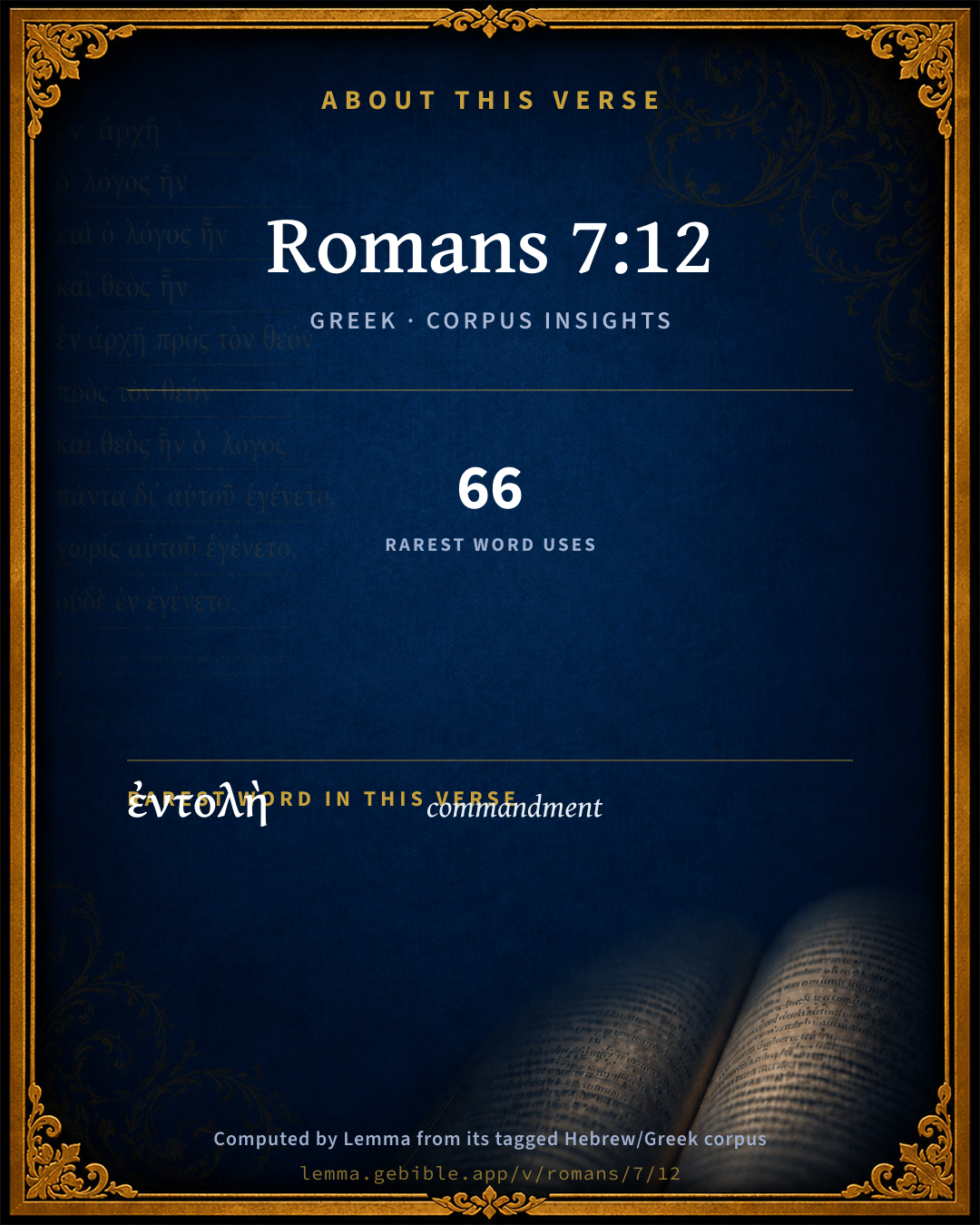
ἐντολὴ
entolḗ
G1785
“commandment”
Noun, Nominative, Singular, Feminine
Part of Speech
Noun
Case
Nominative
Number
Singular
Gender
Feminine
Full Thayer's Definition

Origin: from G1781

TDNT: 11:05,2

1. an order, command, charge, precept, injunction a. that which is prescribed to one by reason of his office 2. a commandment a. a prescribed rule in accordance with which a thing is done 1. a precept relating to lineage, of the Mosaic precept concerning the priesthood 2. ethically used of the commandments in the Mosaic law or Jewish tradition
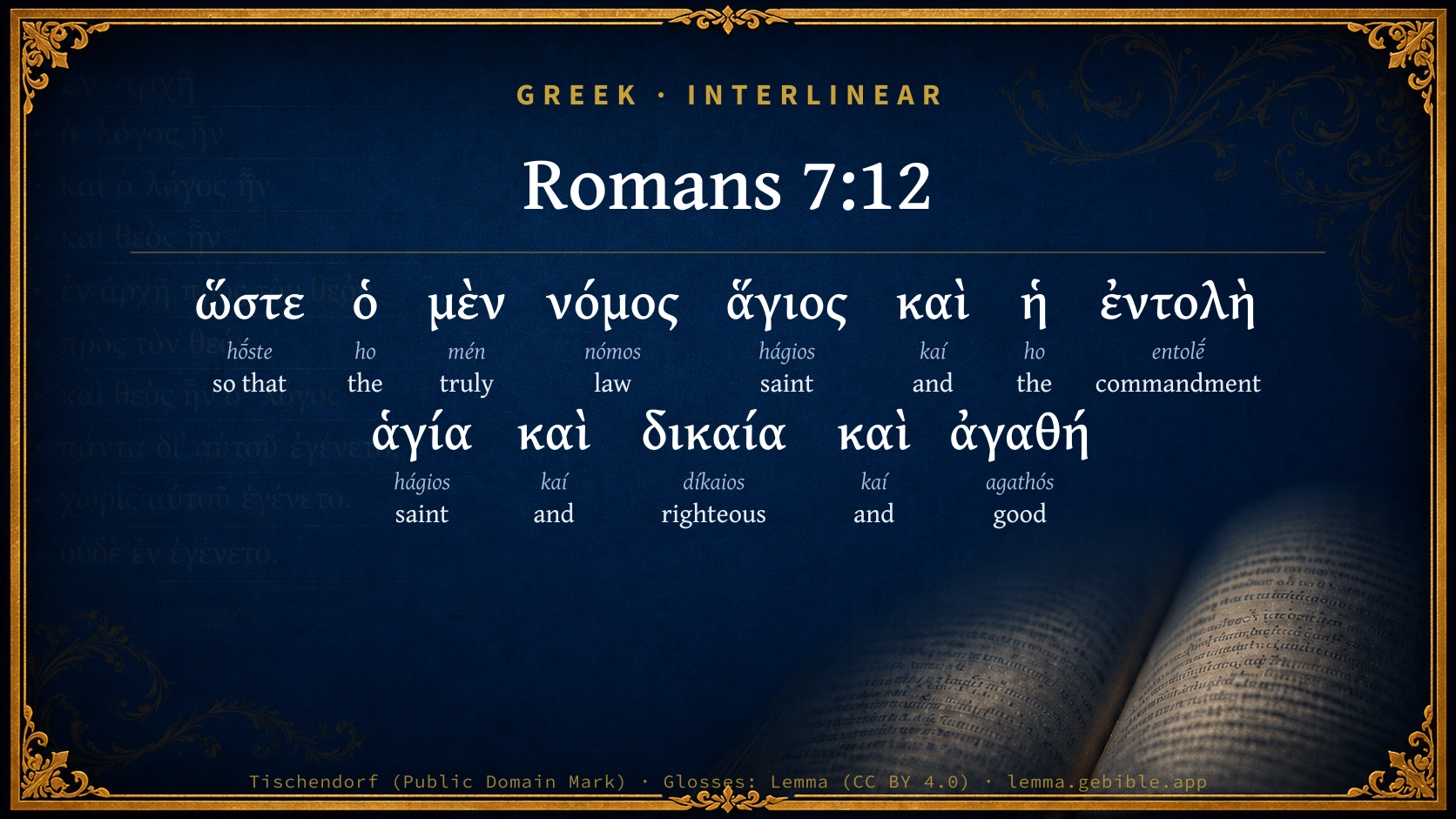
  1. ὥστε hṓste G5620 “so that” Conjunction
  2. ὁ ho G3588 “the” Article, Nominative, Singular, Masculine
  3. μὲν mén G3303 “truly” Particle
  4. νόμος nómos G3551 “law” Noun, Nominative, Singular, Masculine
  5. ἅγιος hágios G40 “saint” Adjective, Nominative, Singular, Masculine
  6. καὶ kaí G2532 “and” Conjunction
  7. ἡ ho G3588 “the” Article, Nominative, Singular, Feminine
  8. ἁγία hágios G40 “saint” Adjective, Nominative, Singular, Feminine
  9. καὶ kaí G2532 “and” Conjunction
  10. δικαία díkaios G1342 “righteous” Adjective, Nominative, Singular, Feminine
  11. καὶ kaí G2532 “and” Conjunction
  12. ἀγαθή agathós G18 “good” Adjective, Nominative, Singular, Feminine

About this verse

These counts appear in no published source. They are computed here, from the morphology-tagged text and Lemma’s own curated glosses. What Lemma adds →

13
words
9
distinct lemmas
Pauline Epistles
section

Repetition

Words recur within this verse:

  • ἅγιος saint G40 ×2
  • καὶ and G2532 ×3
  • ὁ the G3588 ×2

Cross-references

15

Topical passages linked to Romans 7:12 in the Treasury of Scripture Knowledge — connected by theme and wording, ordered by reader-vote popularity; previews shown in the World English Bible.

  • 1 Timothy 1:8 But we know that the law is good, if a man uses it lawfully,
  • Psalms 119:137 You are righteous, Yahweh. Your judgments are upright.
  • Psalms 19:7–12 Yahweh's law is perfect, restoring the soul. Yahweh's testimony is sure, making wise the simple.
  • Romans 7:14 For we know that the law is spiritual, but I am fleshly, sold under sin.
  • Psalms 119:172 Let my tongue sing of your word, For all your commandments are righteousness.
  • Nehemiah 9:13 You came down also on Mount Sinai, and spoke with them from heaven, and gave them right ordinances and true laws, good statutes and commandments,
  • Romans 3:31 Do we then nullify the law through faith? May it never be! No, we establish the law.
  • Deuteronomy 4:8 What great nation is there, that has statutes and ordinances so righteous as all this law, which I set before you this day?
  • Psalms 119:127 Therefore I love your commandments more than gold, Yes, more than pure gold.
  • Psalms 119:140 Your promises have been thoroughly tested, And your servant loves them.
  • Psalms 119:86 All of your commandments are faithful. They persecute me wrongfully. Help me!
  • Romans 7:16 But if what I don't desire, that I do, I consent to the law that it is good.
  • Romans 12:2 Don't be conformed to this world, but be transformed by the renewing of your mind, so that you may prove what is the good, well-pleasing, and perfect will of God.
  • Deuteronomy 10:12 Now, Israel, what does Yahweh your God require of you, but to fear Yahweh your God, to walk in all his ways, and to love him, and to serve Yahweh your God with all your heart and with all your soul,
  • Psalms 119:38 Fulfill your promise to your servant, That you may be feared.

Cross-references courtesy of OpenBible.info (CC BY 4.0).

Commentary

Notes on Romans 7:12 from classic Christian and Jewish commentators (each source and its license shown beneath its notes). The classic Christian expositions comment on the surrounding passage and are grouped to its opening verse, so a note may address several verses; the Jewish commentaries on the Tanakh (Rashi and others) are per-verse, so they appear only where the commentator wrote on this verse.

Lemma curates 59 commentaries, every one of them public domain or Creative Commons licensed, each selected and text-cleaned for this edition rather than reprinted as found. About our sources →

The Biblical Illustrator

Joseph S. Exell

Rom_7:12

Wherefore the law is holy, and the commandment holy: and Just, and good.

The law

I. Its nature. It is--

1. Universal in its extent. It is binding at all times, in all places, and upon all.

2. Perpetual in its obligation: it can allow of no change. Other laws, the ceremonial laws, e.g., may be abrogated or altered, but the moral law, being founded upon the Divine nature, knows no change. Heaven and earth shall pass away, etc.

3. Perfect in its character. Being the expression and emanation of the perfect nature and will of God, the law of the Lord is perfect, converting the soul.

4. Spiritual (Rom_7:14). It comes from God who is Spirit; and it demands of man spiritual obedience.

5. Holy; free from all spot and blemish.

6. Just, founded upon the eternal principles of right.

7. Good, benevolent in its design, tending to promote happiness, and promising life to those that observe it.

II. Its excellence and importance. This is implied in its nature; but it will further appear if we consider--

1. It was originally implanted in the constitution of mans nature. A written law was not necessary, for the love of God, the essential principle of this law, was bound up in the constitution of Adam (Gen_1:27; Rom_2:15). And it is the purpose of God to replace the law in the position which it originally occupied; to rewrite it upon mans heart.

2. In the giving of this law at Sinai we see another illustration of its excellence.

(1) The law contained in the ten commandments was given directly by word of mouth from God. All the other commandments were given through Moses.

(2) It was written twice by the finger of God upon both sides of the tables, perhaps covered the whole of them to show that there was to be no addition or alteration.

(3) It was written not upon parchment, but upon stone, to show its perpetual obligation.

3. Our Lord

(1) Ever recognised it, vindicated its authority, expounded its import, and enforced it by His own sanction and teaching.

(2) Not only taught the law, but practised it, rendering it a perfect and sinless obedience.

(3) Honoured it by undergoing the penalty which it threatens against all that break its enactments.

III. Its use.

1. To mankind at large--

(1) It exhibits, magnifies, and explains the character of God.

(2) It teaches men the principles of right and wrong, and how they are bound to act with reference to God, their neighbour, and themselves. The gospel has in no sense superseded or abrogated the law. It comes in as a supplemental system, saving man from the penalty which the law threatens, and placing man in a position whereby he may render obedience to that law.

2. But whilst saying this a considerable difficulty suggests itself as to the relation of the believer to the law. We find a class of passages which appear to teach its eternal obligation upon all men (Mat_5:1-48; Rom_3:31; Rom_13:10; Jam_1:25; Jam_2:8). But we find other passages which appear to teach that the Christian is not under the law (1Ti_1:9; Rom_6:14; Rom_7:6). How are we to understand this? The true believer is not under the law--

(1) As a ground of condemnation or as a ground of justification. Inasmuch as Christ has perfectly obeyed the law, and atoned for the Jaws breach, that work is imputed and made over to him that believes, so that he is delivered from the condemnation of the law (Rom_8:1-39). So far therefore as his judicial standing before God is concerned, he and the law are altogether separated.

(2) In regard to sanctification. When a man believes truly in Christ, he has not only imputed to him the merits of Christ, but he has imparted to him the power of Christs new life. He is born again of the Spirit. And where that Holy Spirit is, every desire which He inspires, every principle which He suggests, is holy. The man is no longer under the law as a handwriting against him, for he has its principle implanted in his heart, and he can say, Oh, how I love Thy law; it is my meditation all the day.

3. Of what use then is the law to a believer? I answer that if the work of grace were perfected within us, that if we acted in perfect harmony with the instincts and quickenings of the Spirit of God, it would be of no use. But inasmuch as the work of grace is not perfected within us, inasmuch as there is a tendency oftentimes towards evil, the law of God is necessary for him who is not under the law, but under grace.

(1) In keeping us under grace. The law not only leads him as to a schoolmaster first of all to Christ, but keeps him trusting in the Saviour.

(2) In restraining the believer from sin. There are those who think there is but one motive which ought to influence a Christians heart--love, and no doubt perfect love would be enough. But we are not perfect, and therefore, though we are delivered from the fear of bondage and the fear of terror, yet the fear of reverence ought ever to influence the Christian.

4. As regards the unconverted, the law is of great importance.

(1) As a restraining principle to keep them back from open and notorious sin.

(2) As a convincing principle (Rom_7:9).

(3) As a principle of conversion. The law of the Lord is perfect, converting the soul. Use it honestly, prayerfully, perseveringly, and you will find you can have no rest, until it has shut you up into the faith, until it has been the means of driving you to that refuge which is open for the sinner in Christ. (E. Bayley, B. D.)

The law holy and just and good

Observe--

I. The doctrine laid down in my text.

1. The law has different meanings. At one time it stands for the whole religion of Moses; as when the Jews are said to make their boast of the law. In another place it means the ceremonies which formed a prominent part of that religion; in which sense the law had a shadow of good things to come. But, very frequently the ten commandments are meant, as here.

(1) By quoting the tenth commandment in Rom_7:7, Paul shows that the whole argument relates to the moral law.

(2) This allusion also explains the repetition in the text. The whole law, but particularly that commandment to which I have alluded, is holy, just, and good.

(3) The selection of this particular command shows that Paul viewed it as a spiritual law; extending, not to actions only, but to desires. He never knew what the law was till this tenth commandment came with power to his conscience; e.g., the sixth, he thought, forbad only actual murder; the seventh, actual adultery; the eighth, actual stealing. But when at length it was said, Thou shalt not covet, he then perceived that even the desire of things forbidden was sinful.

2. What, then, is the doctrine laid down by St. Paul concerning this heart-searching law?

(1) It is holy.

(a) The things which it forbids are evil; the dispositions which it requires are excellent.

(b) By what standard shall we estimate holiness and unholiness?

There is none other but the will and character of God. Those actions and dispositions which are agreeable to His nature, and which resemble His inimitable perfections, are holy; those of a contrary kind are unholy. Gods law is the very copy of His own Holy character; were it perfectly obeyed man would be holy, as God is holy.

(2) It is just.

(a) God could require nothing short of this. Anything less than entire purity of heart is not only different from Gods nature, but directly opposed to it. We may, without offence, be less wise or powerful; but it is impossible to admit the thought of His consenting that we shall be less holy. God made man in His own image, and after His own likeness; God made man upright. Was it unreasonable to require that man should preserve this holy likeness?

(b) But you may object that we have now lost our original likeness to God; and that it is therefore no longer just to demand from us perfect obedience. But Gods rights cannot be diminished by any change in our condition. A bankrupt has lost the power of paying his debts; yet it is still just in the creditor to demand them, especially when, as is the case with men, the bankruptcy is the result of wickedness.

(3) It is good. The whole of it tends to our welfare. If we had never broken it, there would have been no such thing as sorrow; and, if men would govern their hearts and lives by it, the worlds miseries would soon have an end. For what is the sum and substance of its requirements? Love to God above all, love to our neighbour as to ourselves. Now we know that love is happiness. The joys of heaven will consist of perfect love to God, and the mutual love of each other.

II. Its practical uses. Learn--

1. A lesson of the deepest self-abasement. The law, when first given to man, only made known to him his duty; but ever since the fall it has taught the knowledge of sin. The law is holy; but what are we? Moreover, the doctrine shuts out all excuse. We cannot complain of the law, for it is just and good. Yet have we all our lives acted contrary to it.

2. A lesson of despair. Whatever it may have been to man in a state of innocence, it is now the ministration of condemnation. It pronounces a curse on every transgressor; it worketh wrath; it has shut us up like prisoners, under a charge of sin so fully proved that it cannot be evaded. From all this let us learn that by the deeds of the law no flesh can be saved. Perfect obedience is necessary if we are to be justified by it. Can you, then, stand up and claim a full acquittal? If once you have sinned your soul is lost. Learn this and you will then be prepared to hear of a Saviour, who hath redeemed us from the curse of the law, being made a curse for us, and despair will prove the parent of hope and joy.

3. How you ought to walk and please God. The law is what it ever was, holy, and just, and good. And therefore, though it cannot justify us as a covenant, it must still instruct us as a guide. (J. Jowett, M. A.)

The law holy and just and good

I. Holy.

1. In principle.

2. In requirement.

3. In operation.

4. In tendency.

As a whole and in each commandment it bears the character and expresses the mind and will of Him who is infinitely holy, and requires only what is holy and pure (Mic_6:8).

II. Just. It demands what is just and right and nothing more, and requires only what man was made capable of rendering. It tends to promote justice and righteousness everywhere; and secures to each his due--God, our neighbour, ourselves.

III. Good--useful, beneficial, tending to the happiness of man. The commandment broken was Paradise lost; the commandment observed will be Paradise restored. (T. Robinson, D. D.)

The law holy and just and good

Some think these high characters are given to the law as being holy, in teaching us our duty towards God; just in prescribing our duty towards our neighbour, and good in regard to ourselves. Others thus, the law is holy respecting the matter of it, because it prescribeth holy things; just in propounding rewards and punishments, and good in respect to the end, leading to holiness and happiness. But I think we ought to carry the point much further: all these titles are given to the law, both in relation to the Author, the matter, and the end of the law. The Author of the law is holy, just and good; so is the doctrine or matter contained in the law; and so is the end proposed by the law. (J. Stafford.)

The excellence of the law

Holy in its origin, just in its requirements, good in its purpose. (Archdn. Farrar.)

The holy law

Holy in its nature, just in its form, good in its end. (T. Robinson, D. D.)

Perfection of the law

Gods justice is seen in the law given to man as the universal law of his existence. To give law to rational creatures is the prerogative of their Creator, and His law is, by an inevitable consequence, holy, just and good; it neither prohibits nor enjoins anything that is not in the most perfect accordance with the infinite perfections of God and the true and best interests of man. It represents Him as the Righteous Governor of the universe, whose laws are in perfect consistency with the principles of equity, and whose character is in accordance with His laws. Referring to these principles of morality which are engraven on the heart of man, it declares that they were engraven by the finger of God, and that conscience is His vicegerent, speaking to us in His name, and making known to us the principles of His moral administration. And it unfolds a more copious code of morality, in which the same principles are revealed, for our better information and surer guidance--principles which, being engraven in the book of nature, and revealed in the written Word, are infallibly certain, and ought to be regarded as a true manifestation of the righteous character of Him who is the Author alike of nature and of revelation. (J. Buchanan.)

The law and the gospel

I. Their difference.

1. In time and mode of original relation. The law is coeval with creation; the gospel was made known after the fall. The law is discoverable by the light of nature, the gospel is a hidden mystery.

2. The law addresses man as a creature, the gospel as a sinner.

3. Command, the characteristic of the law; promise of the gospel is the promise of life in Christ. Contrast between the covenant of Sinai and the covenant of grace.

4. The law condemns, the gospel justifies. Law only acquits or condemns, mercy is revealed in the gospel.

5. The law requires, the gospel enables. No enabling power in a command; motive and power supplied by the gospel.

II. Their harmony.

1. There is no real antagonism.

(1) The law prepares the way for the gospel.

(2) The gospel fulfils, and so establishes the law. There are two ways of dealing with law, repeal and relaxation. Neither mode supposable in Divine government. How can man be saved and yet the law upheld? Perfect obedience the one condition of life. Christ undertakes for man. Fulfilment in mans own person. Faith lays hold of precepts as well as promises. The law is a rule of life, written on the heart. The gospel secures its fulfilment for man and in man.

(a) Assigns its just place and value to the Law in the Christian scheme.

(b) Assigns its just place and value to the gospel.

Conclusion;

1. How sure a foundation laid for the believers hope.

2. How sure a provision made for the believers holiness. (E. Bayley, B. D.)

The Biblical Illustrator, edited by Joseph S. Exell (c. 1880s–1900s) — public domain. Text from a community e-Sword module.

Joseph Benson's Commentary

Rom 7:12-13. Wherefore — Since then, by what has been said, it appears that the law is not the cause of sin or death, except indirectly and by accident, it must be acquitted from this charge, and acknowledged to be holy; and the commandment — The preceptive part of the moral law, and every particular precept of it; is holy, just, and good — It springs from and partakes of the holy nature of God; tends only to promote holiness and a conformity to God, and prescribes our duty to God in his worship and service. It is every way just and right in itself, and commands nothing but what is agreeable to those common apprehensions of right and equity which are imprinted in our natures: it is designed wholly for the good of man, 1Ti 1:8, and is really profitable and conducive to our good, both temporal and eternal, and subservient to the common interest of mankind. Was then that which is good made the cause of evil to me? — Yea, of death, which is the greatest of evils? Was it made the proper and direct cause of death? Not so: But it was sin, which was made death to me, inasmuch as it wrought death in me, even by that which is good. Here the apostle clearly distinguishes between a proper cause and an occasion, or cause by accident. The law is the occasion of death to sinners; but sin is the proper or efficient cause of that evil. That it might appear sin — Might appear superlatively vile; working death in me by that which is good — By the good law: that sin by the commandment — Manifesting and forbidding it, and thereby awakening and irritating it; might become exceeding sinful — That, being quickened and excited by so innocent and holy a thing as the commandment, it might thereby show its horrid and vile nature; the guilt of it being hereby greatly aggravated. “Our translators suppose that αμαρτωλος [rendered sinful] is put here for the adjective. But, as Beza observes, it is used as a substantive, and signifies a sinner. For the apostle carries on the personification of sin, begun chap. Rom 6:6, by showing its exceeding sinfulness in this respect, that it makes the law, which was intended for life, the occasion of men’s death.” — Macknight.

Joseph Benson's Commentary on the Old and New Testaments (1811–1818) — public domain. Text from a community e-Sword module.

Bengel's Gnomon

Johann Albrecht Bengel

Rom 7:12. Ἅγιος, holy) supply from what follows, and just and good; although it was necessary to accumulate these synonymous terms chiefly in defence of the commandment, with its stinging power [rather than of the law]: holy, just, good, in relation respectively to its efficient cause, its form, and its end; (as we find in the MS. notes of Dorscheus) or holy in respect of my duties to God; just, in respect of my neighbour; good in respect of my own nature;[71] with which whatever is commanded is in harmony, for life is promised, Rom 7:10. The third of these three epithets is taken up with very great propriety in the following verse.

[71] Δίκαιος Th. δίκη, is that which is precisely what it should be, without regard to the question whether good or evil flow from it, just, right. But ἀγαθός, what is profitable and of benefit to men. The commandment is δίκαια, for it teaches nothing but what is just; ἀγαθή, for it regards the happiness of those, to whom it is given. It is also ἅγια, not because it makes holy, but because it is holy in itself, sacred to God, and therefore to be held inviolate.—See Tittmann Syn. Gr. Text.—ED.

Bengel's Gnomon of the New Testament — English translation (T&T Clark, Edinburgh, 1860) — public domain. Text from a community e-Sword module.

Meyer's Critical & Exegetical Commentary

Heinrich August Wilhelm Meyer

Rom_7:12. Ὥστε] The result of Rom_7:7-11.

ὁ μὲν νόμος] The contrast for which μέν prepares the way was intended to be: but sin has to me redounded unto death through the law, which in itself is good. This follows in Rom_7:13 as regards substance, but not as regards form. See on Rom_7:13.

The predicates

ἅγιος (holy, as Gods revelation of Himself, Rom_7:14; 2Ma_6:23; 2Ma_6:28), which is assigned to the Mosaic law generally, and ἁγία, δικαία (just, in respect to its requirements, which are only such as accord with the holiness), and ἀγαθή (excellent, on account of its salutary object), which are justly (comp. Act_7:38) attributed to the ἐντολήexhaust the contents of the opposite of ἁμαρτία in Rom_7:7. They are accumulated on ἡ ἐντολή, because the latter had just been specially described in Rom_7:7 ff. as that which occasioned the activity of the sin-principle.

Meyer — Critical and Exegetical Commentary on the New Testament — English translation by Peter Christie, edited by Frederick Crombie (T&T Clark, 1880) — public domain. Text from a community e-Sword module.

Expositor's Greek Testament

ed. W. Robertson Nicoll

Rom 7:12 . The conclusion is that the law is holy (this is the answer to the question with which the discussion started in Rom 7:7 : ὁ νόμος ἁμαρτία ;), and the commandment, which is the law in operation, holy and just and good. ἁγία means that it belongs to God and has a character corresponding; δικαία that its requirements are those which answer to the relations in which man stands to God and his fellow-creatures; ἀγαθή that in its nature and aim it is, beneficent; man’s weal, not his woe, is its natural end. There is no formal contrast to ὁ μὲν νόμος , such as was perhaps in the Apostle’s mind when he began the sentence, and might have been introduced by ἡ δὲ ἁμαρτία ; but a real contrast is given in Rom 7:13 .

The Expositor's Greek Testament, edited by W. Robertson Nicoll (1897–1910) — public domain. Text from a community e-Sword module.

Hodge's Commentary on Romans, Ephesians & First Corinthians

Charles Hodge

Rom_7:12

Wherefore the law is holy, and the commandment holy, just, and, good. This is the conclusion from the preceding exhibition. The law is not evil, Rom_7:5. Sin is the true source of all the evil which incidentally flows from the law. In itself the law is holy, (i.e. the whole law,) and the commandment, i.e. the specific command, Thou shalt not covet, is holy, just, and good. That is, it is in every aspect what it should be. It is in every way excellent. It is holy as the revelation of the holiness of God; it is in its own nature right, and it is good, i.e. excellent. In the next verse all these attributes are summed up in one, τὸ ἀγαθόν goodness. Hence this is probably the generic term of which the others are the species. Lex ipsa, says Calvin, et quicquid lege praecipitur, id totum sanctum est, ergo summa dignitate reverendum; justum, ergo nullius injustitiae insimulandum; bonum, ergo omni vitio purum ac vacuum.

Charles Hodge — Commentary on Romans (1835), First Corinthians (1857), and Ephesians (1856) — public domain. Text from a community e-Sword module.

Geneva Bible (1599)

Geneva Bible translators

The conclusion: That the law of itself is holy, but all the fault is in us which abuse the law.

Touching not coveting.

Geneva Bible (1599) marginal notes — public domain. Text via Bolls.life.

Jamieson, Fausset & Brown

Robert Jamieson, A. R. Fausset & David Brown

Wherefore--"So that."

the law is--"is indeed"

good, and the commandment--that one so often referred to, which forbids all lusting.

holy, and just, and good.

Jamieson, Fausset & Brown — Commentary Critical and Explanatory on the Whole Bible (1871) — public domain (CC PDM 1.0). Text via the HelloAO Bible API.

Adam Clarke's Commentary

Verse 12. Wherefore the law is holy] As if he had said, to soothe his countrymen, to whom he had been showing the absolute insufficiency of the law either to justify or save from sin: I do not intimate that there is any thing improper or imperfect in the law as a rule of life: it prescribes what is holy, just, and good; for it comes from a holy, just, and good God. The LAW, which is to regulate the whole of the outward conduct, is holy; and the COMMANDMENT, Thou shalt not covet, which is to regulate the heart, is not less so. All is excellent and pure; but it neither pardons sin nor purifies the heart; and it is because it is holy, just, and good, that it condemns transgressors to death.

Adam Clarke's Commentary on the Bible (1810–1826) — public domain. Text from a community e-Sword/MySword module.

John Calvin's Commentaries

12. So then the law is indeed holy, etc. Some think that the words law and commandment is a repetition of the same thing; with whom I agree; and I consider that there is a peculiar force in the words, when he says, that the law itself and whatever is commanded in the law, is holy, and therefore to be regarded with the highest reverence, — that it is just, and cannot therefore be charged with anything wrong, — that it is good, and hence pure and free from everything that can do harm. He thus defends the law against every charge of blame, that no one should ascribe to it what is contrary to goodness, justice, and holiness.

John Calvin's Commentaries (1540-1563) — public domain. Text from the Calvin Translation Society English edition (1840s-50s) via the Christian Classics Ethereal Library (ccel.org). Calvin's coverage is partial (roughly two-thirds of the Bible); uncommented books and verses are honest gaps, never fabricated. The 19th-century editor's footnotes and remarks are omitted so the notes are faithfully Calvin's own voice.

Ellicott's Commentary for English Readers

(12) Wherefore.—This word introduces a conclusion, not from the verse immediately preceding, but from the whole of the last five verses. The Apostle glances back for a moment over the course of his argument.

A Bible Commentary for English Readers, edited by Charles John Ellicott (1878–1897) — public domain. Text from a community e-Sword module.

The Cambridge Bible for Schools and Colleges

gen. ed. J. J. S. Perowne

12. Wherefore, &c.] This is not a direct inference from the preceding passage. The holiness of the Law is rather assumed as an axiom than proved. But the fault of Sin has been so brought out as to leave the faultlessness of the Law vividly in view.

the law—the commandment] The general and the particular. Here “Thou shalt not lust” is the specimen-commandment. Observe the emphasis on the goodness of the commandment; it is not merely “holy” but “holy, and just, and good:” q. d., “not only is the Law in the abstract a sacred thing, but its most definite and restraining precepts are so also, in the fullest sense.” See Mat_5:19; (also ch. Rom_12:2.)

This verse is sometimes arranged as the close of a sub-paragraph. It seems better to take it as equally connected with the past and coming contexts; introducing now the fuller and deeper statement of the case.

The Cambridge Bible for Schools and Colleges (gen. ed. J. J. S. Perowne; Cambridge University Press, 1878–1918) — public domain. Text from a community e-Sword module.

John Gill's Exposition

Therefore the law is holy,.... This is a conclusion or inference drawn from the preceding discourse, in commendation of the law; that standing clear of any charge or imputation of sin, as being the cause of it. This epithet the apostle gives to the law is what the Jews frequently give it; worthy are the Israelites, say they (h),

"to whom is given "the holy law"; in which they study day and night.''

By "the law" is meant the whole body of the precepts of it in general; and by

the commandment, either the same, or everyone of the commandments in particular, and especially that which is cited, "thou shall not covet". Some have thought that the three properties of it design the threefold division of the law; and suppose that by that which is "holy" is meant the ceremonial law, which sanctified to the purifying of the flesh; by that which is "just", the judicial law, which pointed out to the Jewish commonwealth what was right and wrong; and by that which is "good", the moral law in all its precepts: but nothing is more certain, than that the moral law is only spoken of in this context, which may be said to be

holy, because of its author, the holy God, from whom nothing can come but what is holy; and because of the matter of it, it is a transcript of the holy nature of God, a declaration of his holy will; it requires holiness both of heart and life; it forbids whatever is unholy, and commands nothing but what is holy; it teaches men to live holy, sober, righteous, and godly lives. It may be truly called

just, or righteous, as it demands perfect obedience to all its precepts, or it will not admit of it as a righteousness; as it pronounces guilty, curses and condemns for every disobedience of it; as it deals impartially with persons the transgressors of it; and as it acquits believers upon the foot of the righteousness of Christ, the fulfilling end of it. It is rightly called

good, from the author of it, God, from whom every good thing comes, and nothing else; from the matter of it, and from the use of it both to saints and sinners.

(h) Zohar in Gen. fol. 48. 4.

John Gill's Exposition of the Whole Bible (1746–1763) — public domain (CC PDM 1.0). Text via the HelloAO Bible API.

Trapp's Complete Commentary

John Trapp

12 Wherefore the law is holy, and the commandment holy, and just, and good.

Ver. 12. The commandment] Vis legis in mandando et praecipiendo. The word (εντολη) properly signifieth an affirmative precept.

John Trapp, A Commentary or Exposition upon All the Books of the Old and New Testament (1647–1656) — public domain. Text from a community e-Sword module.

Albert Barnes' Notes on the Bible

Wherefore - So that. The conclusion to which we come is, that the Law is not to be blamed, though these are its effects under existing circumstances. The source of all this is not the Law, but the corrupt nature of man. The Law is good; and yet the position of the apostle is true, that it is not adapted to purify the heart of fallen man. Its tendency is to excite increased guilt, conflict, alarm, and despair. This verse contains an answer to the question in Rom 7:7, “Is the law sin?”

Is holy - Is not sin; compare Rom 7:7. It is pure in its nature.

And the commandment - The word “commandment” is here synonymous with the Law. It properly means what is enjoined.

Holy - Pure.

Just - Righteous in its claims and penalties. It is not unequal in its exactions.

Good - In itself good; and in its own nature tending to produce happiness. The sin and condemnation of the guilty is not the fault of the Law. If obeyed, it would produce happiness everywhere. See a most beautiful description of the law of God in Psa 19:7-11.

Albert Barnes' Notes on the Bible (1834–1885) — public domain. Text from a community e-Sword/MySword module.

Matthew Poole's English Annotations

Wherefore the law is holy; and so the objection, Rom 7:7, was a groundless objection: for though the law were the occasion of sin, or were made advantage of by sin, as Rom 7:8, yet it was not the cause of it; that, on all hands, is acknowledged to be holy, &c.

The law; the law in all the branches of it.

The commandment; particularly the preceptire part of the law, and every particular precept.

Holy, and just, and good: the three epithets here given the law of God may be thus distinguished; it is holy in respect of the ceremonial part, it is just in respect of the judicial part, and good in respect of the moral part of it. Or else the law is holy, as it teacheth us our duty unto God; just, as it showeth us our duty to our neighbour; good, in regard of the effect and end, as it works goodness in the observer thereof, and is conducive to his temporal and eternal good.

Matthew Poole's English Annotations on the Holy Bible (1683–1685) — public domain. Text from a community e-Sword/MySword module.

Whedon's Commentary on the Bible

Daniel D. Whedon

12. Wherefore—The conclusion is that the law stands vindicated in its divine perfection.

Law—The eternal law universally taken.

Commandment—The law manifested in some special requirement, as to Adam, in the ten commandments, and in the details of the Mosaic requirements.

Daniel D. Whedon (gen. ed.), Commentary on the Old and New Testaments (1874–1909) — public domain. Text from a community e-Sword module.

The Pulpit Commentary

Vers. 12, 13. So that the Law is holy, and the commandment holy, and just, and good. Has then that which is good become death unto me? God forbid. But sin, that it might appear sin, through that which is good working death unto me; that sin might become exceeding sinful through the commandment. The question of ver. 7, "Is the Law sin?" has now been answered so far as this that, far from being so, the commandment was in itself "unto life", (cf. Lev_18:5 Rom_10:5) only that sin took occasion by it, and so got power to slay. But still it would appear that law was ultimately the cause of death. Was, then, its purpose and effect, after all, deadly? for, though not sin, it seems to have been death to us. No, it is replied; away with the thought! Its effect was only to reveal sin in its true light; it was only an Ithuriel"s spear ("Par. Lost," bk. 4), bringing out and exposing the deadly thing that before was latent. And (as is elsewhere set forth in pursuance of the line of thought) its effect in the end was really "unto life;" for its awakening of the sense of sin, and of a craving for redemption from it, was the necessary preparation for such redemption. (cf. Gal_3:19, seq. )

The Pulpit Commentary (1880–1919), ed. H.D.M. Spence-Jones & Joseph S. Exell — public domain. Text from a community e-Sword module.

John Wesley's Explanatory Notes

The commandment - That is, every branch of the law. Is holy, and just, and good - It springs from, and partakes of, the holy nature of God; it is every way just and right in itself; it is designed wholly for the good of man.

John Wesley, Explanatory Notes Upon the Whole Bible (1754–1765) — public domain. Text via the GEBible commentary corpus.

Burkitt's Expository Notes on the New Testament

William Burkitt

Observe here, What care and holy caution the apostle uses to vindicate and clear the holy law of God from all fault and blame, charging his guilt, not upon the commandment, but upon the corruption of his own heart, which took occasion to be stirring in him, and by the commandment slew him; affirming nevertheless, that the law of God in itself, and in its own nature, is holy, just, and good.

Here note, that the apostle adorns the law with the most excellent eulogy and commendation.

’Tis holy, 1. As it enjoins all acts of piety towards God; namely, adoration of his majesty, imitation of his purity, resignation to his providence, obedience to his commands.

2. ’Tis just, as it directs us in our duty to others in every capacity and relative wherein we stand, and obliges us to walk by that rule of equity, to do to others as we would they should do unto us.

3. ’Tis good to the man that keeps it, commanding nothing but what is influential upon his well-being both here and hereafter.

Could we set aside the authority of the Lawgiver, yet all the precepts of the law, for their moral goodness, deserve our esteem, and choice, and entire observation; nothing being required of us but what is our duty and interest as men, and which tends to the perfecting and ennobling of our natures: Well then might our apostle determine, that the law is holy, the commandment holy, and just, and good.

William Burkitt's Expository Notes on the New Testament (1700–1703) — public domain. Text from a community e-Sword module.

Godbey's Commentary on the New Testament

William B. Godbey

12. “So the law indeed is holy, just and good.” That is certainly true, because the law is the very radiation of the divine purity and glory, yet when antagonized becomes the swift vehicle of condemnation, infinitely augmenting eternal responsibility.

William B. Godbey, Commentary on the New Testament (1896–1900) — public domain. Text from a community e-Sword module.

McGarvey & Pendleton's Commentaries

J. W. McGarvey

So that the law is holy, and the commandment holy, and righteous, and good . [In the days of his youth (and perhaps also even in his young manhood-- Phi_3:6 ), Paul had that free, untroubled conscience which is enjoyed by the innocent, and felt that he lived, and was entitled to live, before God; but later, as to its fullest extent he grasped the meaning of the law, he found how vain was his confidence; and that he was really a condemned man in the sight of God, having no true life in him ( Rom_6:21-23 ), being dead in trespasses and sin. Thus the law which was ordained to give life, and had the promise of life attached to it ( Rom_10:5 ; Lev_18:5 ), he found, to his amazed surprise, to be to him, because of his sinfulness, only a means of death: for sin, finding in the law a golden opportunity to accomplish his ruin, deceived him into breaking the law, and, by thus drawing down upon him the curse of the violated law, slew him. It has been observed that sin, as here personified, occupies the place filled by Satan in literal life ( Gen_3:14 ; 2Co_11:3 ). Again we should note how Satan, operating on the sinful nature of Paul, beguiled and deceived him into supposing that he could obtain righteousness and life by keeping the Mosaic law ( Phi_3:4-7 ), and also into thinking that in persecuting Christians he was doing God service ( Act_26:9 ), while in reality he was making himself the chief of sinners ( 1Ti_1:15 ). So, clearing the law of this doubt which his own argument had raised, the apostle declares in conclusion that it is worthy of all the unquestioned respect and confidence which it had so long enjoyed as a holy, righteous and good institution of God.]

J. W. McGarvey (with Philip Y. Pendleton), Commentaries on the New Testament (The Fourfold Gospel, 1914; Acts; and the epistles) — public domain. Text from a community e-Sword/MySword module.

The People's New Testament

B. W. Johnson

12. Wherefore the law is holy. The law is holy; it occasions sin only because our carnal nature rebels against its holy restraints.

B. W. Johnson's The People's New Testament with Notes (1889–1891) — public domain. Electronic text from the Christian Classics Ethereal Library (CCEL) ThML edition.

Cambridge Greek Testament for Schools and Colleges

12. ὁ μὲν κ.τ.λ. The antithesis is not expressed; an interruption is caused by the occurrence of one more false conclusion which has to be removed. Then the line of thought is resumed in Rom 7:14.

δικαία = right.

Cambridge Greek Testament for Schools and Colleges (Cambridge University Press, 1896; 21 vols, various authors incl. Carr, Maclear, Plummer, Farrar, Lumby, Moule, M. R. James, Simcox) — public domain. Text from a community e-Sword module.

Alford’s Greek Testament

Henry Alford

12.] So that (seeing it was not the law in general, nor this particular commandment, that wrought coveting in me, but the sinful principle in me taking advantage of these, which themselves were given εἰς ζωήν and not εἰς θάνατον) the law (indeed) is holy (μέν, as understanding a δέ to fellow—‘but it was sin,’ &c.: which does follow in an expanded form, in ver. 13), and the commandment (οὐκ ἐπιθυμήεις, ver. 8) holy and just and good (Theodoret thus accounts for the epithets: ἀγίαν προσηγόρευσεν ὡς τὸ δέον διδάξασαν· δικαίαν δέ, ὡς ὀρθῶς τοῖς παραβάταις τὴν ψῆφον ἐξενεγκοῦσαν· ἀγαθὴν δέ, ὡς ζωὴν τοῖς φυλάττουσιν εὐτρεπίζουσαν. See also 1Ti 1:8).

Henry Alford, The Greek Testament (1849–1861) — public domain. Text from a community e-Sword module.

International Critical Commentary

12. ὁ μὲν νόμος. The μέν expects a following δέ. St. Paul had probably intended to write ἡ δὲ ἁμαρτία κατηργάσατο ἐν ἐμοὶ τὸν θάνατον, or something of the kind; but he digresses to explain how a good Law can have evil consequences, and so he fails to complete the sentence on the same plan on which he had begun it. On St. Paul’s view of the nature and functions of the Law see below.

It is hardly safe to argue with Zahn (Gesch. d. K. ii. 517) from the language of Tertullian (given above on ver. 7) that that writer had before him a corrupt Marcionitic text—not, Zahn thinks, actually due to Marcion, but corrupted since his time—ἡ ἐντολὴ αὐτοῦ δικαία for ἡ ἐντ. ἁγία καὶ δικαία. It is more probable that Tert. is reproducing his text rather freely: in De Pudic. 6 he leaves out καὶ δικαία, lex quidem sancta est et praeceptum sanctum et optimum (the use of superlative for positive is fairly common in Latin versions and writers).

International Critical Commentary — older volumes (1896–1929), various authors — public domain. Text from a community e-Sword module.

Vincent's Word Studies in the New Testament

Marvin R. Vincent

Holy, just, good. Holy as God 's revelation of Himself; just (Rev., righteous) in its requirements, which correspond to God 's holiness; good, salutary, because of its end.

Marvin R. Vincent, Word Studies in the New Testament (1887–1900) — public domain. Text from a community e-Sword/MySword module.

Godet's Commentaries

Frédéric Louis Godet

Vv. 12, 13. “So that the law assuredly is holy, and the commandment holy, just, and good. Did then that which is good become death unto me? Let it not be so! But sin, that it might appear sin, wrought death in me by that which is good; that sin by the commandment might become exceeding sinful.”

The result formulated in these two verses is this: The holier the law is, the more does sin, which has used it to produce evil, appear thereby in the blackness of its nature.

The apostle begins, in view of the result indicated, by removing from the law all suspicion of blame. The μέν, undoubtedly, has no corresponding δέ, but. So far as the sense goes, the δέ is found in Rom 7:13 b This μέν is intended to guard beforehand the unassailable character of the law. Whatever may be said afterward, nothing shall invalidate the character of holiness belonging to the law. The law, ὁ νόμος, here denotes the Mosaic system in its entirety, and the commandment ἡ ἐντολή, each article of the code in particular. The term ἅγιος, holy, is the word which in Scripture denotes the perfect love of good; when it is applied to God, it is the identity of His will with goodness; when it is applied to the creature, it is his voluntary consecration to God, the one Being essentially good. The law is holy, precisely because it demands this consecration, and the commandment also, because each commandment only demands this consecration in a particular relation. The two characteristics just and good flow from and are included in that of holiness. The commandment is just (δικαία), because it regulates in a normal way the relations between different beings. It is good (ἀγαθή), in the sense of beneficent; this epithet is explained by the preceding words: fitted to give life (Rom 7:10).

Frédéric Louis Godet — Commentaries on Luke, John, Romans, and 1 Corinthians — English translation (T&T Clark, Edinburgh, 1870s–1890s) — public domain. Text from a community e-Sword module.

Lesson kit

Teaching starters — assembled from the data on this page, not authored interpretation. Every prompt links to the verse data it draws on. Edit before teaching.

Romans, in the Pauline Epistles, opens this verse with 13 words (9 distinct Greek lemmas). Its most distinctive word is entolḗ (“commandment”). A historical commentator’s framing appears above. Read the whole chapter for the surrounding context.

Discussion questions

  1. How does “commandment” (entolḗ) shape what this verse is saying?
  2. 1 Timothy 1:8 shares this passage’s theme. How do the two illuminate each other?
  3. “saint” occurs 2× in this one verse. What is the effect of the repetition?
  4. The translations on this page render this verse differently — a whole-verse word diff, not a word-by-word alignment. What might account for the different wordings?
  5. Reading how The Biblical Illustrator and Joseph Benson's Commentary read this verse, where do the two commentators agree and where do they part?

Things to notice

  • These translations choose different wording for 5 words in this verse.
  • “saint” occurs 2× in this single verse.
  • 9 distinct Greek lemmas span 13 words in this verse.

Reading settings

Reading text

Shown beneath each verse's original-language words.

Old Testament
Old Testament edition

Read the OT as the Masoretic Hebrew (MT) or the Greek Septuagint (LXX).

English shown for the Greek Septuagint (in the Hebrew ↔ Greek comparison).

Comparing translations? Open the Compare panel on any verse page to stack up to four side by side.