Romans 8:27

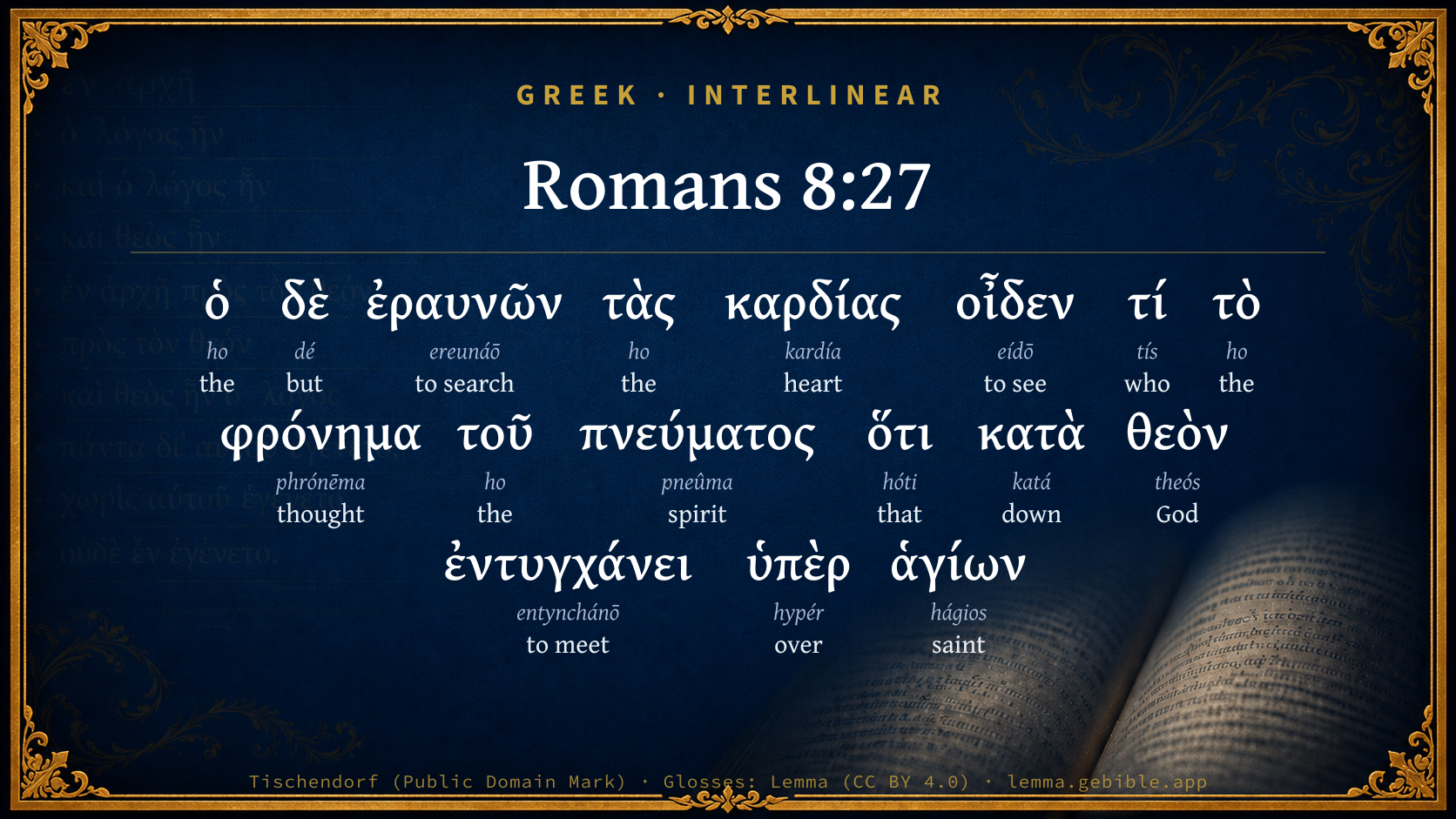
Greek (Tischendorf 8th ed.) Romans 8:27 appears in the Greek New Testament. The text above is from the Tischendorf 8th edition. Each word links to its Strong’s number and a concise gloss. Click any word for its full Thayer’s Greek Lexicon entry.
Download image
Cite this verse

Romans 8:27 (World English Bible). Public Domain. Lemma interlinear Bible study tool, https://lemma.gebible.app/v/romans/8/27.

Show BibTeX & RIS
BibTeX
RIS
English Translation
He who searches the hearts knows what is on the Spirit's mind, because he makes intercession for the saints according to God.
World English Bible · Public Domain
Download a study sheet

One document with this verse’s original text, its word-by-word gloss line, the meaning frame, cross-references with their text, attributed commentary, and full source and license credits — printable, and it pastes into notes with its structure intact.

This verse Autodidact and up

Study sheet (.html) Plain text (.txt)

A passage Seminary Student

Up to 50 verses in one chapter. A passage sheet keeps up to 6 commentary sources and 12 cross-references per verse, in the order this page ranks them, and says so on the sheet whenever that leaves anything out. Ask for a single verse and you get the Autodidact verse sheet above.

Everything on this page stays free to read, with no account — the sheet is a download of what is already on screen, not access to it.

Want to remove ads? Support Godless Engineer
Compare translations 3

The same verse in 3 English versions, stacked beneath the original-language interlinear above. Click any original word for its lexicon entry.

Each is an independent rendering of the whole verse — the interlinear is not word-aligned to these translations.

Highlighted words mark where these versions differ — a whole-verse word diff, not a word-by-word alignment.

  • World English Bible Public Domain
    He who searches the hearts knows what is on the Spirit's mind, because he makes intercession for the saints according to God.
  • King James Version Public Domain
    And he that searcheth the hearts knoweth what is the mind of the Spirit, because he maketh intercession for the saints according to the will of God.
  • unfoldingWord Literal Text CC BY-SA 4.0
    But the one searching the hearts knows what the mindset of the Spirit, because he intercedes on behalf of the saints in accordance with God.

unfoldingWord Literal Text — © unfoldingWord, licensed CC BY-SA 4.0. Word-aligned USFM3 via Door43 (git.door43.org/unfoldingWord/en_ult).

Versions to compare (up to 4)

3 of 4 selected

Show all 19 translations

Every available English version of this verse, each an independent rendering of the whole verse.

  • World English Bible Public Domain
    He who searches the hearts knows what is on the Spirit's mind, because he makes intercession for the saints according to God.
  • Berean Standard Bible Public Domain
    And He who searches our hearts knows the mind of the Spirit, because the Spirit intercedes for the saints according to the will of God.
  • Majority Standard Bible Public Domain
    And He who searches our hearts knows the mind of the Spirit, because the Spirit intercedes for the saints according to the will of God.
  • King James Version Public Domain
    And he that searcheth the hearts knoweth what is the mind of the Spirit, because he maketh intercession for the saints according to the will of God.
  • American Standard Version (1901) Public Domain
    and he that searcheth the hearts knoweth what is the mind of the Spirit, because he maketh intercession for the saints according to `the will of' God.
  • Revised Version (1885) Public Domain
    and he that searcheth the hearts knoweth what is the mind of the Spirit, because he maketh intercession for the saints according to the will of God.
  • Geneva Bible (1599) Public Domain
    But he that searcheth the heartes, knoweth what is the meaning of the Spirit: for he maketh request for ye Saints, according to the wil of God.
  • Douay-Rheims (1899) Public Domain
    And he that searcheth the hearts, knoweth what the Spirit desireth; because he asketh for the saints according to God.
  • Young's Literal Translation Public Domain
    and He who is searching the hearts hath known what `is' the mind of the Spirit, because according to God he doth intercede for saints.
  • Literal Standard Version CC BY-SA 4.0
    and He who is searching the hearts has known what [is] the mind of the Spirit, because according to God He intercedes for holy ones.
  • Unlocked Literal Bible CC BY-SA 4.0
    He who searches the hearts knows the mind of the Spirit, because he intercedes on behalf of the saints according to the will of God.
  • unfoldingWord Literal Text CC BY-SA 4.0
    But the one searching the hearts knows what the mindset of the Spirit, because he intercedes on behalf of the saints in accordance with God.
  • Darby Bible Public Domain
    But he who searches the hearts knows what [is] the mind of the Spirit, because he intercedes for saints according to God.
  • World Messianic Bible Public Domain
    He who searches the hearts knows what is on the Spirit’s mind, because he makes intercession for the holy ones according to God.
  • Webster's Bible Public Domain
    And he that searcheth the hearts knoweth what is the mind of the Spirit, because he maketh intercession for the saints, according to the will of God.
  • Free Bible Version CC BY-SA 4.0
    The one who examines the minds of everyone knows the Spirit's motives, because the Spirit pleads God's cause on behalf of the believers.
  • Bible in Basic English Public Domain
    And he who is the searcher of hearts has knowledge of the mind of the Spirit, because he is making prayers for the saints in agreement with the mind of God.
  • Text-Critical English NT CC BY 4.0
    And he who searches the hearts knows the mind of the Spirit, because the Spirit intercedes for the saints according to the will of God.
  • Tyndale New Testament (1534) Public Domain
    And he that searcheth the hertes knoweth what is the meaninge of the sprite: for he maketh intercession for the sayntes accordinge to the pleasure of god.

Literal Standard Version (2020), Covenant Press — licensed CC BY-SA 4.0. Text via the HelloAO Bible API (eBible.org). Unlocked Literal Bible (unfoldingWord) — licensed CC BY-SA 4.0. Text via the HelloAO Bible API (eBible.org). unfoldingWord Literal Text — © unfoldingWord, licensed CC BY-SA 4.0. Word-aligned USFM3 via Door43 (git.door43.org/unfoldingWord/en_ult). Free Bible Version, Dr. Jonathan Gallagher — licensed CC BY-SA 4.0. Text via the HelloAO Bible API (eBible.org).

Word by word

More ways to search: Search by grammar → Find every occurrence → Compare this word →

Practice this passage: Drill this verse → Learn its vocabulary →

φρόνημα
phrónēma
G5427
“thought”
Noun, Nominative, Singular, Neuter
Part of Speech
Noun
Case
Nominative
Number
Singular
Gender
Neuter
Full Thayer's Definition

Origin: from G5426

TDNT: 12:40,1

1. what one has in the mind, the thoughts and purposes
  1. ὁ ho G3588 “the” Article, Nominative, Singular, Masculine
  2. δὲ dé G1161 “but” Conjunction
  3. ἐραυνῶν ereunáō G2045 “to search” Verb, Present, Active, Participle, Nominative, Singular, Masculine
  4. τὰς ho G3588 “the” Article, Accusative, Plural, Feminine
  5. καρδίας kardía G2588 “heart” Noun, Accusative, Plural, Feminine
  6. οἶδεν eídō G1492 “to see” Verb, Perfect, Active, Indicative, 3rd person, Singular
  7. τί tís G5101 “who” Interrogative pronoun, Nominative, Singular, Neuter
  8. τὸ ho G3588 “the” Article, Nominative, Singular, Neuter
  9. τοῦ ho G3588 “the” Article, Genitive, Singular, Neuter
  10. πνεύματος pneûma G4151 “spirit” Noun, Genitive, Singular, Neuter
  11. ὅτι hóti G3754 “that” Conjunction
  12. κατὰ katá G2596 “down” Preposition
  13. θεὸν theós G2316 “God” Noun, Accusative, Singular, Masculine
  14. ἐντυγχάνει entynchánō G1793 “to meet” Verb, Present, Active, Indicative, 3rd person, Singular
  15. ὑπὲρ hypér G5228 “over” Preposition
  16. ἁγίων hágios G40 “saint” Adjective, Genitive, Plural, Masculine

About this verse

These counts appear in no published source. They are computed here, from the morphology-tagged text and Lemma’s own curated glosses. What Lemma adds →

17
words
14
distinct lemmas
Pauline Epistles
section

Notable vocabulary

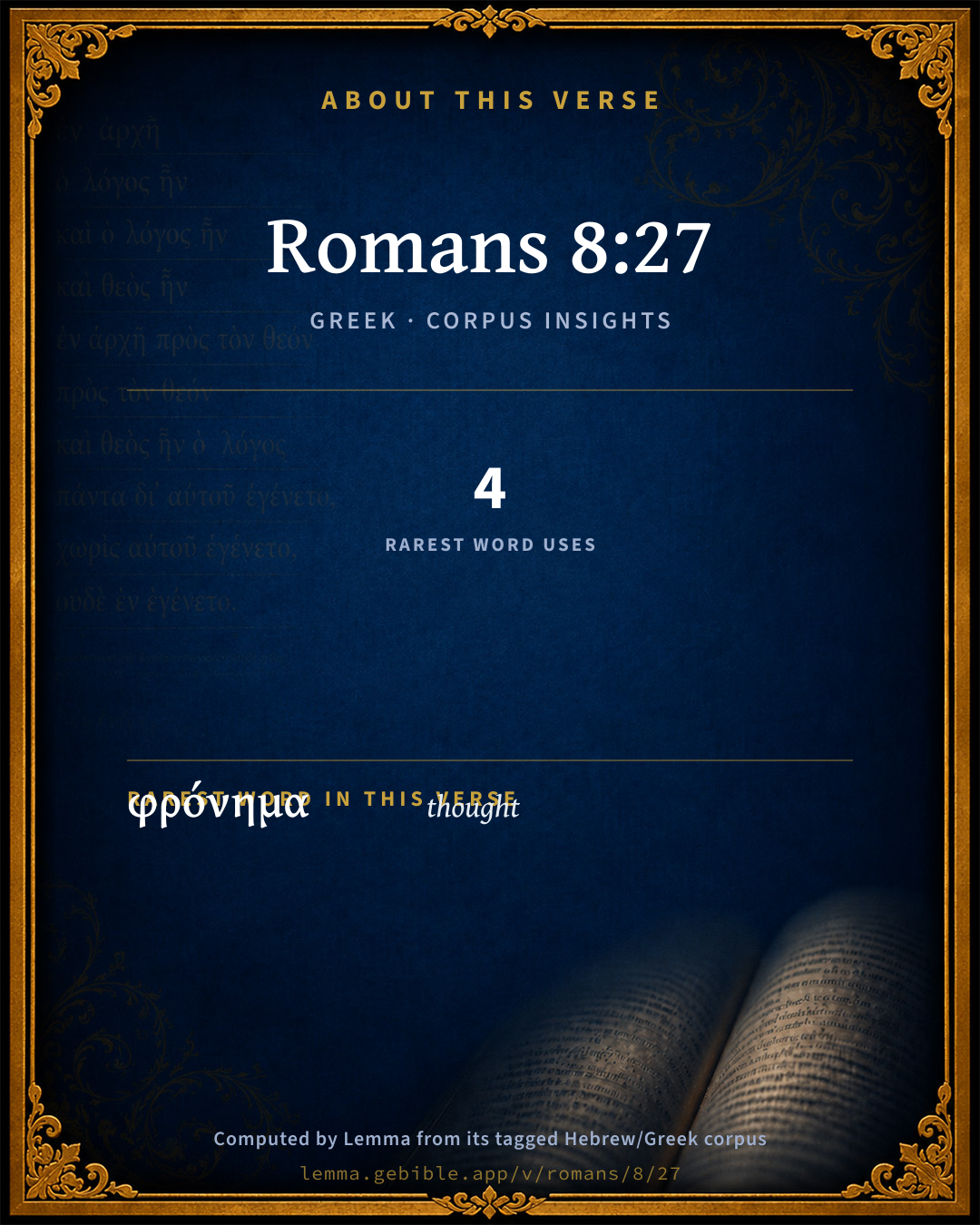
The rarest word here is φρόνημα thought G5427 — appearing just 4 times in the whole Greek New Testament.

Shared distinctive vocabulary

φρόνημα thought G5427 occurs in 3 verses of the Greek New Testament. Also found in:

Repetition

A word recurs within this verse:

Cross-references

27

Topical passages linked to Romans 8:27 in the Treasury of Scripture Knowledge — connected by theme and wording, ordered by reader-vote popularity; previews shown in the World English Bible.

  • Jeremiah 17:10 I, Yahweh, search the mind, I try the heart, even to give every man according to his ways, according to the fruit of his doings.
  • 1 John 5:14–15 This is the boldness which we have toward him, that, if we ask anything according to his will, he listens to us.
  • Ephesians 2:18 For through him we both have our access in one Spirit to the Father.
  • Acts 1:24 They prayed, and said, "You, Lord, who know the hearts of all men, show which one of these two you have chosen
  • Romans 8:34 Who is he who condemns? It is Christ who died, yes rather, who was raised from the dead, who is at the right hand of God, who also makes intercession for us.
  • 1 Chronicles 28:9 You, Solomon my son, know the God of your father, and serve him with a perfect heart and with a willing mind; for Yahweh searches all hearts, and understands all the imaginations of the thoughts: if you seek him, he will be found of you; but if you forsake him, he will cast you off forever.
  • Psalms 44:21 Won't God search this out? For he knows the secrets of the heart.
  • 1 John 3:21–22 Beloved, if our hearts don't condemn us, we have boldness toward God;
  • Proverbs 17:3 The refining pot is for silver, and the furnace for gold, But Yahweh tests the hearts.
  • Jeremiah 11:20 But, Yahweh of Hosts, who judge righteously, who try the heart and the mind, I shall see your vengeance on them; for to you have I revealed my cause.
  • Acts 15:8 God, who knows the heart, testified about them, giving them the Holy Spirit, just like he did to us.
  • 1 Thessalonians 2:4 But even as we have been approved by God to be entrusted with the Gospel, so we speak; not as pleasing men, but God, who tests our hearts.
  • Jeremiah 20:12 But, Yahweh of Hosts, who tests the righteous, who sees the heart and the mind, let me see your vengeance on them; for to you have I revealed my cause.
  • Matthew 6:8 Therefore don't be like them, for your Father knows what things you need, before you ask him.
  • John 14:13 Whatever you will ask in my name, that will I do, that the Father may be glorified in the Son.
  • Revelation 2:23 I will kill her children with Death, and all the assemblies will know that I am he who searches the minds and hearts. I will give to each one of you according to your deeds.
  • Psalms 7:9 Oh let the wickedness of the wicked come to an end, But establish the righteous; Their minds and hearts are searched by the righteous God.
  • Luke 16:15 He said to them, "You are those who justify yourselves in the sight of men, but God knows your hearts. For that which is exalted among men is an abomination in the sight of God.
  • Hebrews 4:13 There is no creature that is hidden from his sight, but all things are naked and laid open before the eyes of him with whom we have to do.
  • 1 Chronicles 29:17 I know also, my God, that you try the heart, and have pleasure in uprightness. As for me, in the uprightness of my heart I have willingly offered all these things: and now have I seen with joy your people, that are present here, offer willingly to you.
  • Psalms 38:9 Lord, all my desire is before you. My groaning is not hidden from you.
  • Psalms 66:18–19 If I cherished sin in my heart, The Lord wouldn't have listened.
  • Jeremiah 29:12–13 You shall call on me, and you shall go and pray to me, and I will listen to you.
  • James 5:16 Confess your offenses to one another, and pray one for another, that you may be healed. The effective, earnest prayer of a righteous man is powerfully effective.
  • James 1:5–6 But if any of you lacks wisdom, let him ask of God, who gives to all liberally and without reproach; and it will be given to him.
  • John 21:17 He said to him the third time, "Simon, son of Jonah, do you have affection for me?" Peter was grieved because he asked him the third time, "Do you have affection for me?" He said to him, "Lord, you know everything. You know that I have affection for you." Jesus said to him, "Feed my sheep.
  • Romans 8:6 For the mind of the flesh is death, but the mind of the Spirit is life and peace;

Cross-references courtesy of OpenBible.info (CC BY 4.0).

Commentary

Notes on Romans 8:27 from classic Christian and Jewish commentators (each source and its license shown beneath its notes). The classic Christian expositions comment on the surrounding passage and are grouped to its opening verse, so a note may address several verses; the Jewish commentaries on the Tanakh (Rashi and others) are per-verse, so they appear only where the commentator wrote on this verse.

Lemma curates 59 commentaries, every one of them public domain or Creative Commons licensed, each selected and text-cleaned for this edition rather than reprinted as found. About our sources →

Bengel's Gnomon

Johann Albrecht Bengel

Rom 8:27. Δὲ) [Not and, as Engl. Vers., but] refers to a privative in ἀλαλήτοις [Though they can not be uttered, yet, etc.]—τὰς καρδίας, the hearts) The Spirit dwells in the hearts [of believers], and makes intercession. Christ is in heaven. He who searches the hearts is the Father, to whom especially that act is attributed in Scripture.—τὸ φρόνημα τοῦ πνεύματος, the mind of the Spirit).—Comp. φρόνημα, Rom 8:6, Sensum,[97] the nominative: from the plural sensa, sensorum.—τοῦ πνεύματος, of the Spirit) the Holy Spirit, as in the preceding verse.—κατὰ) according to [ad], κατὰ Θεὸν, according to God, not κατὰ ἄνθρωπον, according to man (comp. 1Jn 3:20) [after the manner of God, not man], as is worthy of God, and in a manner acceptable and manifest to Him. The Holy Spirit understands the style of the court of heaven, which is acceptable to the Father. Κατὰ is the emphatic word of the sentence, inasmuch as it is placed at the beginning of the clause.—ὑπὲρ ἁγίων, for saints) The article is not added; they are saints, who are both near to God, and are deemed worthy of assistance, being those for whom [the Spirit] makes intercession.

[97] Beng. uses sensum here to express φρόνημα, not the accus. of sensus, but an old disused nominative singular, the plural of which is often found sensa sensorum.—ED.

Bengel's Gnomon of the New Testament — English translation (T&T Clark, Edinburgh, 1860) — public domain. Text from a community e-Sword module.

Meyer's Critical & Exegetical Commentary

Heinrich August Wilhelm Meyer

Rom_8:27. ʼΟ ἐρευν. τὰς καρδ.] Traditionally hallowed (1Sa_16:7; 1Ki_8:39; Psa_7:10; Pro_15:11; Jer_17:9 f.), description of God, bearing on the subject in hand; for it is in the heart, as in the central laboratory of the personal self-conscious life (comp. Delitzsch, Psychol. p. 254), that the praying Spirit sighs, Gal_4:6.

ὅτι] Not for, as many think, including Tholuck, Rückert, de Wette, Philippi, Ewald, and Umbreit. What follows in fact conveys no real ground, since God would in every case know the purpose of the Spirit, and to take οἶδε in the pregnant sense: understands and hears (so Rückert, following Calvin), is utterly unjustifiable, especially after ὁ ἐρευν. κ.τ.λ. The ὅτι is rather that, annexed by way of explanation: that He, namely. Comp. Grotius, Estius, Benecke, Reiche, Fritzsche, Maier, Krehl, Baumgarten-Crusius, Bisping, Reithmayr, van Hengel, and Hofmann. See on Php_1:27; Php_2:22, al.

κατὰ Θεόν] This, explained by Origen secundum divinitatem, does not mean: on the instigation of God (Tholuck, appealing improperly to 1Co_12:8), but: in accordance with God, i.e. so as God desires it, κατὰ γνώμην αὐτοῦ, Theodore of Mopsuestia. Comp. 2Co_7:9-10; 4Ma_15:2; Plat. Apol. pp. 22 A, 23 B. The sense: in pursuance of the divine disposal, more common in classic usage (see Wetstein on the passage, and Valcken. ad Herod. iii. 153), is here foreign. Böhme, Reiche, and Fritzsche render it before God, with God (in Deum quasi converses). This is indeed justifiable from a linguistic point of view (Bernhardy, p. 240), comp. Wis_5:1, Sir_34:6; but how superfluous and unsuited to the emphasis of the prominent position assigned to it! With the emphasis on κατὰ Θεόν it cannot appear strange that Paul has not written κατʼ αὐτόν, but has rather named the subject. Comp. Xen. Mem. i. 3. 2 : εὔχετο δέ πρὸς τοὺς θεοὺς, … ὡς τοὺς θεοὺς κὰλλιστα εἰδότας κ.τ.λ. The omission of the article, which does not render the expression adverbial (against Hofmann), establishes in the case of Θεός no difference of sense (Winer, p. 115 f. [E. T. 151]).

ὑπὲρ ἁγίων] for saints, without the article because qualitative; sancti sunt et Deo propinqui et auxilio digni, pro quibus intercedit, Bengel. On ἐντυγχ. ὑπέρ τινος, to pray for any one, see Bähr on Plut. Flamin. p. 83.

Meyer — Critical and Exegetical Commentary on the New Testament — English translation by Peter Christie, edited by Frederick Crombie (T&T Clark, 1880) — public domain. Text from a community e-Sword module.

Expositor's Greek Testament

ed. W. Robertson Nicoll

Rom 8:27 . This intercession, with which our heart goes, though it is deeper than words, the Heart Searcher understands. τί τὸ φρόν . τοῦ πνεύματος : what the Spirit is set upon, the whole object of its thought and endeavour. ὅτι , viz. , that He intercedes κατὰ θεόν in agreement with God’s will, see 2Co 7:9-11 . ὑπὲρ ἁγίων on behalf of those who are God’s. Both the intercession of Christ and the intercession of the Spirit are represented in the N.T. as made on behalf of those who are in Christ saints, the Church, not mankind in general.

The Expositor's Greek Testament, edited by W. Robertson Nicoll (1897–1910) — public domain. Text from a community e-Sword module.

Hodge's Commentary on Romans, Ephesians & First Corinthians

Charles Hodge

Rom_8:27

Although these desires are not, and cannot be uttered, the eye of Him who searches the heart can read and understand them. And (rather, but) he who searcheth the hearts. To search the heart is the prerogative of God, as it implies omniscience. As no man knoweth the things of a man, but the spirit of man that is in him, to read the unexpressed emotions of the soul must be the work of Him to whose eyes all things are naked. I the Lord, search the heart, I try the reins. Jer_17:10; Psalm 139; Psa_7:9; Rev_2:23. Knoweth the mind of the Spirit. By φρόνημα τοῦ πνεύματος is meant the meaning, intention of the Spirit, what he means by these unutterable groanings. By Spirit must be here understood, as the context requires, the Holy Spirit. It is that Spirit who intercedes for the saints and in them, and who is expressly distinguished from the soul in which he dwells. God is said to know the mind of the Spirit. As the word to know is so often used with the implication of the idea of approval, this may mean, God recognizes or approves of the mind of the Spirit. Hic verbi nosse, says Calvin, adnotanda est proprietas; significat enim, Deum non novos et insolentes illos Spiritus affectus non animadvertere, vel tanquam absurdos rejicere; sed agnoscere, et simul benigne excipere ut agnitos sibi et probatos. If this be the meaning of the word, then the following ὃτι is causal, and introduces the reason why God thus approves of the mind of the Spirit. It is because the Spirit maketh intercession for the saints κατὰ Θεόν, according to God, i.e. agreeably to his will. The desires produced by the Spirit of God himself are, of course, agreeable to the will of God, and secure of being approved and answered. This is the great consolation and support of believes. They know not either what is best for themselves or agreeable to the will of God; but the Holy, Spirit dictates those petitions and excites those desires which are consistent with the divine purposes, and which are directed towards the blessings best suited to our wants. Such prayers are always answered. And this is the confidence that we have in him, that if we ask any thing according to his will, he heareth us, 1Jo_5:14. But if οἶδε is to be taken in its ordinary sense, then ὃτι is explicative. God knows that the Spirit, etc. Those who adopt this view generally render κατὰ Θεόν, towards God, i.e. before God. The Spirit intercedes before God for the saints. In favor of this interpretation of the passage, it is urged that this is the proper place of the word oi]de and as to the clause κατὰ Θεόν, it is said, Gods knowing the mind of the Spirit, does not depend on its being according to his will. He would know it whether in accordance with his will or not. This difficulty, however, does not exist if οἶδε means he recognizes and approves. It is making the verse say comparatively little, if it is made to mean simply that the Searcher of hearts knows that the Spirit intercedes in his presence (or toward him) for the saints. The interpretation adopted by our translators, therefore, is to be preferred. It is more to the apostles purpose if he assigns the reason why God receives the unutterable desires and longings of the heart as true prayer. This indeed is a consolation to believes.

Charles Hodge — Commentary on Romans (1835), First Corinthians (1857), and Ephesians (1856) — public domain. Text from a community e-Sword module.

Geneva Bible (1599)

Geneva Bible translators

Because he teacheth the godly to pray according to God’s will.

What sobs and sighs proceed from the instinct of his Spirit.

Geneva Bible (1599) marginal notes — public domain. Text via Bolls.life.

Jamieson, Fausset & Brown

Robert Jamieson, A. R. Fausset & David Brown

And--rather, "But," inarticulate though these groanings be.

he that searcheth the hearts knoweth what is the mind of the Spirit, because he--the Spirit

maketh intercession for the saints according to the will of God--As the Searcher of hearts, He watches the surging emotions of them in prayer, and knows perfectly what the Spirit means by the groanings which He draws forth within us, because that blessed Intercessor pleads by them only for what God Himself designs to bestow.

Note, (1) Are believers "led by the Spirit of God" (Rom 8:14)? How careful then should they be not to "grieve the Holy Spirit of God" (Eph 4:30)! Compare Psa 32:8-9 : "I will . . . guide thee with Mine eye. Be not (then) as the horse, or as the mule," &c. (2) "The spirit of bondage," to which many Protestants are "all their lifetime subject," and the "doubtsome faith" which the Popish Church systematically inculcates, are both rebuked here, being in direct and painful contrast to that "spirit of adoption," and that witness of the Spirit, along with our own spirit, to the fact of our sonship, which it is here said the children of God, as such, enjoy (Rom 8:15-16). (3) As suffering with Christ is the ordained preparation for participating in this glory, so the insignificance of the one as compared with the other cannot fail to lighten the sense of it, however bitter and protracted (Rom 8:17-18). (4) It cannot but swell the heart of every intelligent Christian to think that if external nature has been mysteriously affected for evil by the fall of man, it only awaits his completed recovery, at the resurrection, to experience a corresponding emancipation from its blighted condition into undecaying life and unfading beauty (Rom 8:19-23). (5) It is not when believers, through sinful "quenching of the Spirit," have the fewest and faintest glimpses of heaven, that they sigh most fervently to be there; but, on the contrary, when through the unobstructed working of the Spirit in their hearts, "the first-fruits" of the glory to be revealed are most largely and frequently tasted, then, and just for that reason, is it that they "groan within themselves" for full redemption (Rom 8:23). For thus they reason: If such be the drops, what will the ocean be? If thus "to see through a glass darkly" be so very sweet, what will it be to "see face to face?" If when "my Beloved stands behind our wall, looking forth at the windows, showing Himself through the lattice" (Sol 2:9) --that thin veil which parts the seen from the unseen--if He is even thus to me "Fairer than the children of men," what shall He be when He stands confessed before my undazzled vision, the Only-begotten of the Father in my own nature, and I shall be like Him, for I shall see Him as He is? (6) "The patience of hope" (Th1 1:3) is the fitting attitude for those who with the joyful consciousness that they are already "saved" (Ti2 1:9; Tit 3:5), have yet the painful consciousness that they are saved but in part: or, "that being justified by His grace, they are made (in the present state) heirs according to the hope (only) of eternal life," Tit 3:7 (Rom 8:24-25). (7) As prayer is the breath of the spiritual life, and the believer's only effectual relief under the "infirmity" which attaches to his whole condition here below, how cheering is it to be assured that the blessed Spirit, cognizant of it all, comes in aid of it all; and in particular, that when believers, unable to articulate their case before God, can at times do nothing but lie "groaning" before the Lord, these inarticulate groanings are the Spirit's own vehicle for conveying into "the ears of the Lord of Sabaoth" their whole case; and come up before the Hearer of prayer as the Spirit's own intercession in their behalf, and that they are recognized by Him that sitteth on the Throne, as embodying only what His own "will" determined before to bestow upon them (Rom 8:26-27)! (8) What a view do these two verses (Rom 8:26-27) give of the relations subsisting between the Divine Persons in the economy of redemption, and the harmony of their respective operations in the case of each of the redeemed!

THIRD: Triumphant Summary of the Whole Argument (Rom 8:28-39).

Jamieson, Fausset & Brown — Commentary Critical and Explanatory on the Whole Bible (1871) — public domain (CC PDM 1.0). Text via the HelloAO Bible API.

Adam Clarke's Commentary

Verse 27. He maketh intercession for the saints] The word εντυγχανω signifies to apply one's self to a person in behalf of another; to intercede or negotiate for. Our Lord makes intercession for us, by negotiating and managing, as our friend and agent, all the affairs pertaining to our salvation. And the Spirit of God makes intercession for the saints, not by supplication to God on their behalf, but by directing and qualifying their supplications in a proper manner, by his agency and influence upon their hearts; which, according to the Gospel scheme, is the peculiar work and office of the Holy Spirit. See Taylor.

According to the will of God.] κατα θεον. According to the mind, intention, or design of God. And thus the prayers which we offer up, and the desires which subsist in the unutterable groanings, are all such as are pleasing in the sight of God. So that God, whose is the Spirit, and who is acquainted with the mind of the Spirit, knows what he means when he leads the saints to express themselves in words, desires, groans, sighs, or tears: in each God reads the language of the Holy Ghost, and prepares the answer according to the request.

From all this we learn that a fluency in prayer is not essential to praying: a man may pray most powerfully in the estimation of God, who is not able to utter even one word. The unutterable groan is big with meaning, and God understands it, because it contains the language of his own Spirit. Some desires are too mighty to be expressed; there is no language expressive enough to give them proper form and distinct vocal sound: such desires show that they came from God; and as they came from him, so they express what God is disposed to do, and what he has purposed to do. This is a matter of great encouragement to all those who are agonizing to enter in at the strait gate.

Adam Clarke's Commentary on the Bible (1810–1826) — public domain. Text from a community e-Sword/MySword module.

John Calvin's Commentaries

27. But he who searches hearts, etc. This is a remarkable reason for strengthening our confidence, that we are heard by God when we pray through his Spirit, for he thoroughly knows our desires, even as the thoughts of his own Spirit. And here must be noticed the suitableness of the word to know; for it intimates that God regards not these emotions of the Spirit as new and strange, or that he rejects them as unreasonable, but that he allows them, and at the same time kindly accepts them, as allowed and approved by him. As then Paul had before testified, that God then aids us when he draws us as it were into his own bosom, so now he adds another consolation, that our prayers, of which he is the director, shall by no means be disappointed. The reason also is immediately added, because he thus conforms us to his own will. It hence follows, that in vain can never be what is agreeable to his will, by which all things are ruled. Let us also hence learn, that what holds the first place in prayer is consent with the will of the Lord, whom our wishes do by no means hold under obligation. If then we would have our prayers to be acceptable to God, we must pray that he may regulate them according to his will.

John Calvin's Commentaries (1540-1563) — public domain. Text from the Calvin Translation Society English edition (1840s-50s) via the Christian Classics Ethereal Library (ccel.org). Calvin's coverage is partial (roughly two-thirds of the Bible); uncommented books and verses are honest gaps, never fabricated. The 19th-century editor's footnotes and remarks are omitted so the notes are faithfully Calvin's own voice.

Ellicott's Commentary for English Readers

(27) God recognises the voice of His own Spirit, because the prayers that the Spirit prompts are in strict accordance with His will.

What is the mind of the Spirit.—What are the thoughts of the Spirit, and therefore what is the echo of those thoughts in the prayers that are offered to Him.

A Bible Commentary for English Readers, edited by Charles John Ellicott (1878–1897) — public domain. Text from a community e-Sword module.

The Cambridge Bible for Schools and Colleges

gen. ed. J. J. S. Perowne

27. He that searcheth the hearts] Certainly here, the Father. But it is the more noteworthy that the same words are used of the Son, Rev_2:23.—“The hearts” here are human hearts. In them the Father sees, below the surface of “ignorance what to pray for as they ought,” the sacred longings which are the expression of the Spirit’s influence.

knoweth] And meeteth with a corresponding answer; crossing perhaps the saint’s explicit prayer, but granting the implicit.

the mind] The whole Aim and Choice of the great Intercessor.

because] If this rendering is kept, the connexion is; “The Father knows (and welcomes) the ‘mind of the Spirit,’ because in its requests it is in Divine harmony with His own.”—But it is better to render that. “The Father knows the mind of the Spirit; He knows that He intercedes in harmony with His Own will and purpose, and for His Own children.”

the saints] Lit. saints (without article). Such is the character of those for whom He pleads.

according to the will of God] Lit. according to God; in unerring coincidence with the Father’s will. The words are used in emphatic contrast to the possible errors in detail of the saint’s unaided desires and prayers.

The Cambridge Bible for Schools and Colleges (gen. ed. J. J. S. Perowne; Cambridge University Press, 1878–1918) — public domain. Text from a community e-Sword module.

John Gill's Exposition

And he that searcheth the hearts,.... This is peculiar to God, and a "periphrasis" of him; angels, neither good nor bad, can search into the hearts of men; one man cannot know the heart of another, nor any man fully know his own; this is the prerogative of God: and

he knoweth what is the mind of the Spirit; not the spirit of men, but of God: that affectionate desire and meaning of the Spirit of God, in the unalterable groans of the saints; he knows the wise meaning there is in them, for so may signify, and is opposed to the carnal mind, or wisdom of the flesh, which desires foolish things. The searcher of hearts knows this, not barely by his omniscience, but he regards it, approves of it, attends, and gives an answer to it; which is no small encouragement to pray, though it be but with sighs and groans unutterable; since the omniscient God understands, and respects such kind of prayer: and the reason is,

because he, the Spirit of God,

maketh intercession for the saints, according to the will of God; the persons for whom he intercedes are saints: to whom Christ is made sanctification; who are called to be saints; are sanctified by the Spirit of God, and walk after him: now such are the objects of God's delight, they are chosen by him, preserved in Christ, and have his righteousness imputed to them; to these he has made known his Gospel, has given his grace, and will at last the inheritance; so that intercession made for such will certainly be regarded: it may be rendered, "he maketh intercession for holy things according to God"; for spiritual blessings, divine favours, things that belong to God; or divine things, which are agreeably to his nature and will: and since it is the Holy Spirit that makes intercession, and the persons are holy for whom he makes it, and this is made for holy things, and all according to the will of God, which the Spirit of God must fully know, saints may be confident of the prevalence and success of such intercession.

John Gill's Exposition of the Whole Bible (1746–1763) — public domain (CC PDM 1.0). Text via the HelloAO Bible API.

Trapp's Complete Commentary

John Trapp

27 And he that searcheth the hearts knoweth what is the mind of the Spirit, because he maketh intercession for the saints according to the will of God.

Ver. 27. Knoweth the mind, &c.] Quomodo enim non exauditur spiritus a patre, qui exaudit cum patre? (Augustine.)

John Trapp, A Commentary or Exposition upon All the Books of the Old and New Testament (1647–1656) — public domain. Text from a community e-Sword module.

Albert Barnes' Notes on the Bible

And he that searcheth the hearts - God. To search the heart is one of his attributes which cannot be communicated to a creature; Jer 17:10.

Knoweth what is the mind of the Spirit - Knows the desires which the Holy Spirit excites and produces in the heart. He does not need that those deep emotions should be expressed in words; he does not need the eloquence of language to induce him to hear; but he sees the anxious feelings of the soul, and is ready to aid and to bless.

Maketh intercession for the saints - Aids and directs Christians.

According to the will of God - Greek, “According to God.” It is according to his will in the following respects:

(1) The Spirit is given according to his will. It is his gracious purpose to grant his aid to all who truly love him.

(2) The desires which he excites in the heart of the Christian are those which are according to his will; they are such as God wishes to exist; the contrite, humble, and penitent pleading of sinners for mercy.

(3) He superintends and guards Christians in their prayers.

It is not meant that they are infallible, or that they never make an improper petition, or have an improper desire; but that he has a general superintendence over their minds, and that so far as they will yield themselves to his direction, they shall not be led into error That man is most safe who yields himself most entirely to the influence of the Holy Spirit. And the doctrine here stated is one that is full of consolation to the Christian. We are poor, and needy, and ignorant, and blind; we are the creatures of a day, and are crushed before the moth. But in the midst of our feebleness we may look to God for the aid of his Spirit, and rejoice in his presence, and in his power to sustain us in our sighings, and to guide us in our wanderings.

Albert Barnes' Notes on the Bible (1834–1885) — public domain. Text from a community e-Sword/MySword module.

Matthew Poole's English Annotations

He that searcheth the hearts; this phrase is a periphrasis of God, and is spoken of him after the manner of men. God doth not properly search or inquire into any thing; but because amongst men knowledge comes by searching, therefore, by way of resemblance, this is attributed to God, though that which is intended by it is only this, that God knoweth the heart, Jer 17:10; Act 1:24.

Knoweth what is the mind of the Spirit, both with the knowledge of apprehension and approbation.

Maketh intercession for the saints according to the will of God: our prayers shall be sure to speed, if they are of this sort, 1Jo 5:14,15. Praying according to the will of God, respects;

1. The matter of our prayers.

2. The manner of our praying.

3. The end thereof, Jam 4:3.

Matthew Poole's English Annotations on the Holy Bible (1683–1685) — public domain. Text from a community e-Sword/MySword module.

Whedon's Commentary on the Bible

Daniel D. Whedon

27. He… hearts—As the Spirit knoweth and sympathizeth with our feeble human minds, so that Spirit is in communication with God, the heart-searcher.

Knoweth… the mind—The Spirit inspires our unutterable things; yet God, knowing the mind of the Spirit, knoweth the things unuttered. So is the Spirit a mediator of communion between our spirit and God our father.

Daniel D. Whedon (gen. ed.), Commentary on the Old and New Testaments (1874–1909) — public domain. Text from a community e-Sword module.

John Wesley's Explanatory Notes

But he who searcheth the hearts - Wherein the Spirit dwells and intercedes. Knoweth - Though man cannot utter it. What is the mind of the Spirit, for he maketh intercession for the saints - Who are near to God. According to God - According to his will, as is worthy of God. and acceptable to him.

John Wesley, Explanatory Notes Upon the Whole Bible (1754–1765) — public domain. Text via the GEBible commentary corpus.

Burkitt's Expository Notes on the New Testament

William Burkitt

Observe here, 1. The title or attribute given and appropriated unto God: He searcheth, or knoweth, the heart. He was the maker of the heart, and is the disposer of the heart, and will judge every man according to his heart; and therefore he must know the heart thoroughly and perfectly, certainly and infallibly; and it is the joy of an upright person, that God knoweth and searcheth the heart.

When the world condemns him for insincerity, he rejoiceth that God knoweth his integrity; and when he has it in the purpose of his heart to do good, but wants power in his hand to accomplish and effect it, this is his consolation, That God accepts as done, what he did desire and resolve to do, 2Ch 6:8.

Observe, 2. The action here attributed to the heart-searching God: he knoweth what is the mind of the Spirit; that is, he knoweth the workings of the Holy Spirit, and of our own spirits also, in the duty of prayer. It is a great comfort to the children of God, that the Lord knoweth what is the mind of our spirits in that matter. God doth not only hear his people’s prayers, but he hears their desires: and grants not only the desires of our lips, but the desires of our hearts, which have not been expressed by our lips.

Observe, 3. Who the persons are whom the Holy Spirit intercedes for in prayer: they are saints, He maketh intercession for the saints; for them exlusively, and none but them; for them inclusively, for all and everyone of them: the Spirit sanctifies all those in whom and for whom he intercedes: he is first a spirit of regeneration, before he is a spirit of intercession; he first puts gracious dispositions into us, and then stirs up holy desires in us.

Observe, 4. The qualification necessary to render our prayers acceptable to God, they must be according to God; that is, according to the will and mind of God.

And that, 1. In respect of the matter of them: we must pray only for things lawful and warrantable.

2. In regard of the manner of them: we must pray in faith, with fervency, and in the name of Christ.

3. In respect of the end of them, and what we propound to ourselves in them; which is, the glory of God.

Notwithstanding Christ’s mediation, and the Spirit’s intercession, we may ask, and not receive, if we ask amiss; that is, for bad ends, that we may consume it upon our lusts.

William Burkitt's Expository Notes on the New Testament (1700–1703) — public domain. Text from a community e-Sword module.

Godbey's Commentary on the New Testament

William B. Godbey

27. “He who searcheth the hearts knoweth what is the mind of the Spirit, because he maketh intercession toward God in behalf of the saints.” Here is a most wonderful and infinitely consolatory fact revealed. While the English language contains one hundred and fifty thousand words, the common people only use three or four hundred; great scholars, only seven to ten thousand. Not only are many saints straitened to common words and phases, but with most ample flow of language many of our petitions are too deep for utterance. The most of earthly language is too materialistic and symbolic to express the deep spiritual truths of this wonderful salvation, especially appertaining to glorification, which is super-experimental. When Paul was in heaven (2 Corinthians 12) he heard and saw things too glorious and spiritual for mortal utterance. This deficiency of language the Holy Spirit supplies with groanings which can not be uttered. Hence our most important and efficient prayers are given by the Holy Spirit, and are too deep and spiritual to be formulated in words. Elijah prayed with prayer (Jas 5:17), not as E. V., “prayed earnestly,” but prayed with the prayer the Holy Ghost gave him. Hence the miraculous effect of his prayers. “He that searcheth the heart,” i. e., Jesus, who answers our prayers, “knoweth the mind of the Spirit.” Now you see this wonderful problem; the Holy Spirit indicts our prayers, which are often too deep for utterance. But remember He is the Spirit of Jesus (Chapter 8:9 and Acts 5), i. e., the spiritual Christ on the earth (Mat 28:20); while the glorified Jesus is interceding for us at God’s right hand, who actually understands perfectly all the petitions indicted by the Holy Ghost and groaned out by us, and answers faithfully, though too deeply for verbal utterance. Hence the most illiterate can shake heaven, earth and hell by their prayers. I have known people converted and sanctified in our meetings while praying in their native tongue, which was entirely unknown to the congregation. The Holy Spirit is the Author of a truly efficient prayer. He knows all languages, whether in words or groans. Consequently all true hearts under all circumstances can pray right up to God the petition indicted by the Holy Spirit, whether in words or groans, understood by our glorious Intercessor and presented directly to the Father.

William B. Godbey, Commentary on the New Testament (1896–1900) — public domain. Text from a community e-Sword module.

McGarvey & Pendleton's Commentaries

J. W. McGarvey

and he that searcheth the hearts knoweth what is the mind of the Spirit, because he maketh intercession for the saints according to the will of God . [Though we, in our ignorance, do not know how to express these inward groanings, or yearnings, and though the Holy Spirit, in his operations within us, can not so lead or train us as to make us able to give them articulate utterance, yet God, who searcheth the heart, or that inner man where the Spirit dwells, knows what it is that the Spirit has in mind; i. e., what the Spirit is prompting us to desire, because the Spirit pleads for the saints according to the will of God, asking those things which accord with the plans, purposes and desires of God. "In short," says Beet, "our own yearnings, resulting as they do from the presence of the Spirit, are themselves a pledge of their own realization." The remainder of the chapter gives the third ground of encouragement, which is briefly this: the Christian has nothing to fear (outside of himself), for nothing can defeat the plan or purpose which God cherishes toward him, and nothing can separate him from the love of God.]

J. W. McGarvey (with Philip Y. Pendleton), Commentaries on the New Testament (The Fourfold Gospel, 1914; Acts; and the epistles) — public domain. Text from a community e-Sword/MySword module.

The People's New Testament

B. W. Johnson

27. Knoweth what is the mind of the Spirit. These speechless groanings are understood by God, because it is according to his will that the Spirit intercedes.

B. W. Johnson's The People's New Testament with Notes (1889–1891) — public domain. Electronic text from the Christian Classics Ethereal Library (CCEL) ThML edition.

Cambridge Greek Testament for Schools and Colleges

27. ὁ δὲ ἐραυνῶν τὰς καρδίας. Cf. Rev 2:23; Psa 7:10; Jer 17:10; 1Co 2:10. The point seems to be that GOD’S knowledge of the hearts of men and their needs enables Him to understand the particular line (τὸ φρόνημα) of the Spirit’s intercession which is uttered with and through man’s spirit; cf. Act 15:8; Act 1:24; Luk 16:15; Gal 4:6.

ὄτι, ‘that.’ κατὰ θεὸν = after the standard and measure of the character of GOD, not with the imperfection of human utterance.

ὑπὲρ ἁγίων = on behalf of men who belong to GOD, (so |[166] κατὰ θεόν), and therefore in pursuance of His will for them.

[166] | parallel to

Cambridge Greek Testament for Schools and Colleges (Cambridge University Press, 1896; 21 vols, various authors incl. Carr, Maclear, Plummer, Farrar, Lumby, Moule, M. R. James, Simcox) — public domain. Text from a community e-Sword module.

Alford’s Greek Testament

Henry Alford

27.] But (opposed to ἀλαλήτοις—‘though unutterable by us’) He who searcheth the hearts (God) knoweth what is the mind (intent, or bent, as hidden in those sighs) of the Spirit. A difficulty presents itself in the rendering of the next clause. If ὅτι be causal, because He (the Spirit) pleads for the saints according to the will of God, it would seem that οἶδεν must bear the meaning ‘approves,’ otherwise the connexion will not be apparent; and so Calv. and Rückert have rendered it. Hence Grot., Reiche, Meyer, Fritz. render ὅτι, ‘that,’ and construe,—‘knows what is the mind of the Spirit,’—that He pleads with God (so Reiche and Fritz., and Winer, edn. 6, § 49. d, for κατὰ θ.) for the saints: justifying the repetition of θεόν, implied before, by 1Jn 4:8, ὁ μὴ ἀγαπῶν οὐκ ἔγνω τὸν θεόν, ὅτι ὁ θεὸς ἀγάπη ἐστίν. But I must confess that the other rendering seems to me better to suit the context: and I do not see that the ordinary meaning of οἶδεν need be changed. The assurance which we have that God the Heart-Searcher interprets the inarticulate sighings of the Spirit in us, is,—not strictly speaking, His Omniscience,—but the fact that the very Spirit who thus pleads, does it κατὰ θεόν,—in pursuance of the divine purposes and in conformity with God’s good pleasure. So that, as its place before the verb would suggest, κατὰ θεόν is emphatic, and furnishes the reason of the οἶδεν. A minor objection against the explicative ὅτι is, that we have οἴδαμεν ὅτι immediately following.

All these pleadings of the Spirit are heard and answered, even when inarticulately uttered; we may extend the same comforting assurance to the imperfect and mistaken verbal utterances of our prayers, which are not themselves answered to our hurt, but the answer is given to the voice of the Spirit which speaks through them, which we would express, but cannot. Compare 2Co 12:7-10, for an instance in the Apostle’s own case.

Henry Alford, The Greek Testament (1849–1861) — public domain. Text from a community e-Sword module.

International Critical Commentary

27. ὅτι. Are we to translate this ‘because’ (Weiss Go. Gif. Va.) or ‘that’ (Mey. Oltr. Lips. Mou.)? Probably the latter; for if we take ὅτι as assigning a reason for οἶδε τί τὸ φρόνημα, the reason would not be adequate: God would still ‘know’ the mind, or intention, of the Spirit even if we could conceive it as not κατὰ Θεόν and not ὑπὲρ ἁγίων. It seems best therefore to make ὅτι describe the nature of the Spirit’s intercession.

κατὰ Θεόν = κατὰ τὸ θέλημα τοῦ Θεοῦ: cf. 2Co 7:9-11.

The Jews had a strong belief in the value of the intercessory prayer of their great saints, such as Moses (Ass. Moys. xi. 11, 17; xii. 6), Jeremiah (Apoc. Bar. 2:2): cf. Weber, p. 287 ff. But they have nothing like the teaching of these verses.

THE ASCENDING PROCESS OF SALVATION

8:28-30. With what a chain of Providential care does God accompany the course of His chosen! In eternity, the plan laid and their part in it foreseen; in time, first their call, then their acquittal, and finally their reception into glory.

28Yet another ground of confidence. The Christian knows that all things (including his sufferings) can have but one result, and that a good one, for those who love God and respond to the call which in the pursuance of His purpose He addresses to them. 29Think what a long perspective of Divine care and protection lies before them! First, in eternity, God marked them for His own, as special objects of His care and instruments of His purpose. Then, in the same eternity, He planned that they should share in the glorified celestial being of the Incarnate Son—in order that He, as Eldest Born, might gather round Him a whole family of the redeemed. 30Then in due course, to those for whom He had in store this destiny He addressed the call to leave their worldly lives and devote themselves to His service. And when they obeyed that call He treated them as righteous men, with their past no longer reckoned against them. And so accounted righteous He let them participate (partially now as they will do more completely hereafter) in His Divine perfection.

International Critical Commentary — older volumes (1896–1929), various authors — public domain. Text from a community e-Sword module.

Godet's Commentaries

Frédéric Louis Godet

Vv. 27. The δέ, but, contrasts the knowledge of God, which thoroughly understands the object of this groaning, with the ignorance of the heart from which it proceeds. God is often called in the O. T. the καρδιογνώστης, the searcher of hearts. As to the blessing to which the aspiration of the Spirit goes forth in the believer’s heart, he knows its nature, he discerns its sublime reality. Why? This is what is told us in the second part of the verse: Because this supreme object of the Spirit’s aspiration is what God Himself has prepared for us. The groaning of the Spirit is κατὰ Θεόν, according to God. The preposition κατά, according to, denotes the standard; God does not require the man who prays to express to Him the things he needs, since the groaning of the Spirit is in conformity with the plan of God which is to be realized. If it is so, how should not God understand such a groan? For the Spirit fathoms the divine plans to the bottom, 1Co 2:10. It is obvious how far Meyer and Hofmann are mistaken in alleging that ὅτι should signify that and not because. They have not apprehended the bearing of the κατὰ Θεόν, according to God; Paul has a reason for making this word the opening one of the proposition. What is according to Him cannot remain unintelligible to Him. It is impossible to conceive a more superfluous thought than the one here substituted by the two commentators referred to: “God knows that the Spirit intercedes, and that He does so according to Him for the saints.” Did this knowing require to be affirmed? The last words, ὑπὲρ ἁγίων, literally, “for saints,” are very weighty. These saints are beings in whom the Spirit already dwells. After what He has already done in them, is it not natural for Him to interest Himself in the completion of their salvation?

In the words: according to God and for saints, there is already enunciated a thought which is now to become that of the following passage, the thought of a divine plan conceived from all eternity in favor of the elect. It is to the accomplishment of this plan that the operation of the Spirit tends.

What a demonstration of the unutterable disorder which reigns throughout creation, and consequently of the state of imperfection in which it still is, notwithstanding the redemption which has been accomplished! Nature throughout all her bounds has a confused feeling of it, and from her bosom there rises a continual lament claiming a renovation from heaven. The redeemed themselves are not exempt from this groaning, and wait for their own renewal which shall be the signal of universal restoration; and finally, the Spirit, who is intimate with the plans of God for our glory (1Co 2:7), and who distinctly beholds the ideal of which we have but glimpses, pursues its realization with ardor. Thus is exhausted the first of the two leading ideas of this paasage, that of the συμπάσχειν, suffering with Christ. The apostle now passes to the second, that of the συνδοξᾳσθῆναι, being glorified with Him. The first was the condition (εἴπερ, if so be, Rom 8:17); the second is the final aim.

Frédéric Louis Godet — Commentaries on Luke, John, Romans, and 1 Corinthians — English translation (T&T Clark, Edinburgh, 1870s–1890s) — public domain. Text from a community e-Sword module.

Lesson kit

Teaching starters — assembled from the data on this page, not authored interpretation. Every prompt links to the verse data it draws on. Edit before teaching.

Romans, in the Pauline Epistles, opens this verse with 17 words (14 distinct Greek lemmas). Its most distinctive word is phrónēma (“thought”). A historical commentator’s framing appears above. Read the whole chapter for the surrounding context.

Discussion questions

  1. How does “thought” (phrónēma) shape what this verse is saying?
  2. How does Romans 8:6, which shares the word «thought», read alongside this verse?
  3. What does the repetition of “the” (4× in this one verse) do in this verse?
  4. The translations on this page render this verse differently — a whole-verse word diff, not a word-by-word alignment. What might account for the different wordings?
  5. Compare how Bengel's Gnomon and Meyer's Critical & Exegetical Commentary read this verse. Where do they agree or differ?

Things to notice

Reading settings

Reading text

Shown beneath each verse's original-language words.

Old Testament
Old Testament edition

Read the OT as the Masoretic Hebrew (MT) or the Greek Septuagint (LXX).

English shown for the Greek Septuagint (in the Hebrew ↔ Greek comparison).

Comparing translations? Open the Compare panel on any verse page to stack up to four side by side.