

Romans 12:1
Greek (Tischendorf 8th ed.) Romans 12:1 appears in the Greek New Testament. The text above is from the Tischendorf 8th edition. Each word links to its Strong’s number and a concise gloss. Click any word for its full Thayer’s Greek Lexicon entry.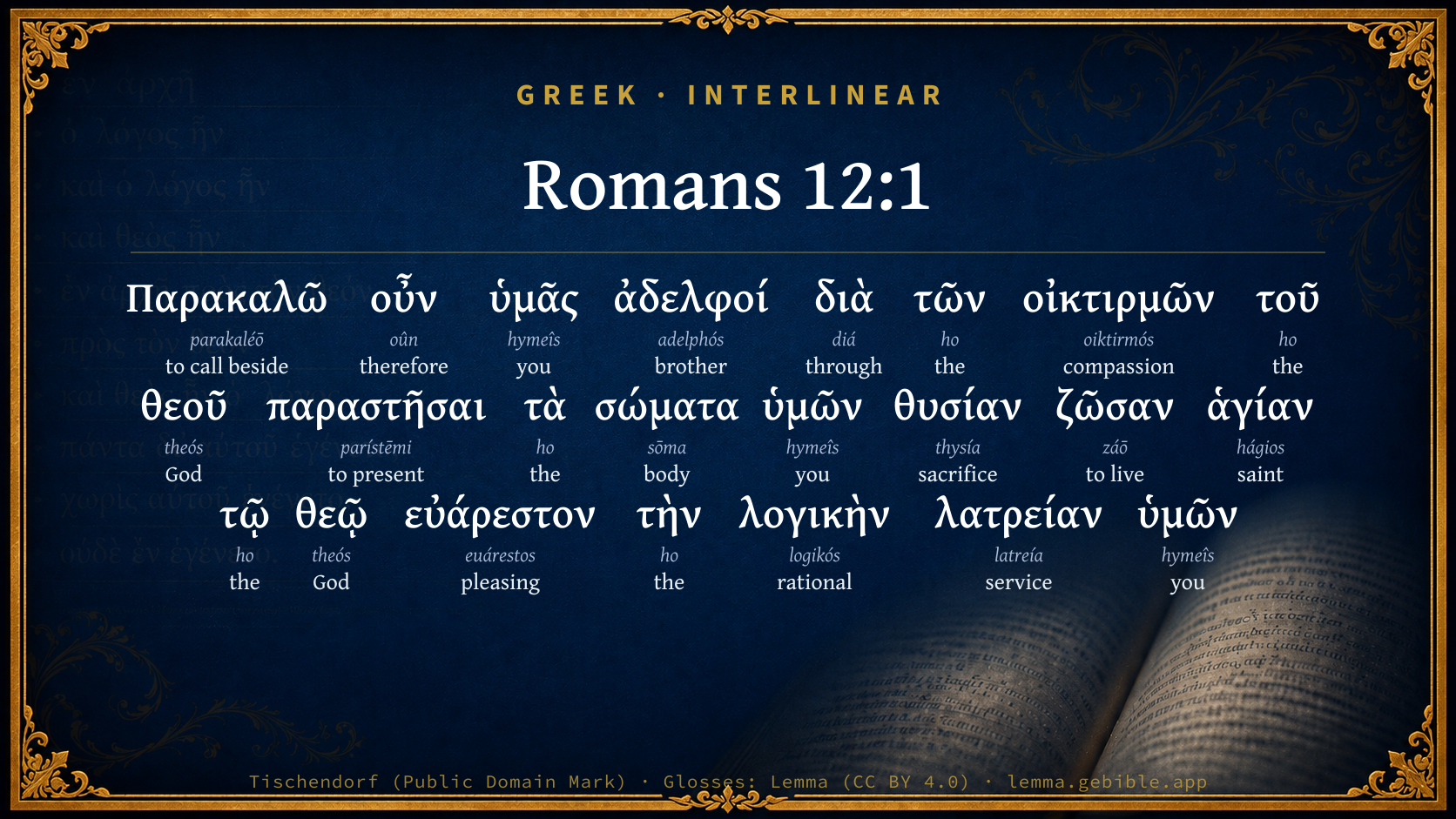
Therefore I urge you, brothers, by the mercies of God, to present your bodies a living sacrifice, holy, acceptable to God, which is your spiritual service.
Download a study sheet
One document with this verse’s original text, its word-by-word gloss line, the meaning frame, cross-references with their text, attributed commentary, and full source and license credits — printable, and it pastes into notes with its structure intact.
This verse Autodidact and up
A passage Seminary Student
Up to 50 verses in one chapter. A passage sheet keeps up to 6 commentary sources and 12 cross-references per verse, in the order this page ranks them, and says so on the sheet whenever that leaves anything out. Ask for a single verse and you get the Autodidact verse sheet above.
Everything on this page stays free to read, with no account — the sheet is a download of what is already on screen, not access to it.
Compare translations 3
The same verse in 3 English versions, stacked beneath the original-language interlinear above. Click any original word for its lexicon entry.
Each is an independent rendering of the whole verse — the interlinear is not word-aligned to these translations.
Highlighted words mark where these versions differ — a whole-verse word diff, not a word-by-word alignment.
-
World English Bible Public Domain
Therefore I urge you, brothers, by the mercies of God, to present your bodies a living sacrifice, holy, acceptable to God, which is your spiritual service.
-
King James Version Public Domain
I beseech you therefore, brethren, by the mercies of God, that ye present your bodies a living sacrifice, holy, acceptable unto God, which is your reasonable service.
-
unfoldingWord Literal Text CC BY-SA 4.0
I urge you therefore, brothers, by the compassions of God, to present your bodies a living sacrifice, holy, well-pleasing to God, which your reasonable service.
unfoldingWord Literal Text — © unfoldingWord, licensed CC BY-SA 4.0. Word-aligned USFM3 via Door43 (git.door43.org/unfoldingWord/en_ult).
Show all 19 translations
Every available English version of this verse, each an independent rendering of the whole verse.
-
World English Bible Public Domain
Therefore I urge you, brothers, by the mercies of God, to present your bodies a living sacrifice, holy, acceptable to God, which is your spiritual service.
-
Berean Standard Bible Public Domain
Therefore I urge you, brothers, on account of God’s mercy, to offer your bodies as living sacrifices, holy and pleasing to God, which is your spiritual service of worship.
-
Majority Standard Bible Public Domain
Therefore I urge you, brothers, on account of God’s mercy, to offer your bodies as living sacrifices, holy and pleasing to God, which is your spiritual service of worship.
-
King James Version Public Domain
I beseech you therefore, brethren, by the mercies of God, that ye present your bodies a living sacrifice, holy, acceptable unto God, which is your reasonable service.
-
American Standard Version (1901) Public Domain
I beseech you therefore, brethren, by the mercies of God, to present your bodies a living sacrifice, holy, acceptable to God, `which is' your spiritual service.
-
Revised Version (1885) Public Domain
I beseech you therefore, brethren, by the mercies of God, to present your bodies a living sacrifice, holy, acceptable to God, which is your reasonable service.
-
Geneva Bible (1599) Public Domain
I Beseech you therefore brethren, by the mercies of God, that yee giue vp your bodies a liuing sacrifice, holy, acceptable vnto God, which is your reasonable seruing of God.
-
Douay-Rheims (1899) Public Domain
I BESEECH you therefore, brethren, by the mercy of God, that you present your bodies a living sacrifice, holy, pleasing unto God, your reasonable service.
-
Young's Literal Translation Public Domain
I call upon you, therefore, brethren, through the compassions of God, to present your bodies a sacrifice -- living, sanctified, acceptable to God -- your intelligent service;
-
Literal Standard Version CC BY-SA 4.0
I call on you, therefore, brothers, through the compassions of God, to present your bodies [as] a sacrifice—living, sanctified, acceptable to God—your intelligent service;
-
Unlocked Literal Bible CC BY-SA 4.0
I urge you therefore, brothers, by the mercies of God, to present your bodies a living sacrifice, holy, acceptable to God. This is your reasonable service.
-
unfoldingWord Literal Text CC BY-SA 4.0
I urge you therefore, brothers, by the compassions of God, to present your bodies a living sacrifice, holy, well-pleasing to God, which your reasonable service.
-
Darby Bible Public Domain
I beseech you therefore, brethren, by the compassions of God, to present your bodies a living sacrifice, holy, acceptable to God, [which is] your intelligent service.
-
World Messianic Bible Public Domain
Therefore I urge you, brothers, by the mercies of God, to present your bodies a living sacrifice, holy, acceptable to God, which is your spiritual service.
-
Webster's Bible Public Domain
I beseech you therefore, brethren, by the mercies of God, that ye present your bodies a living sacrifice, holy, acceptable to God, which is your reasonable service.
-
Free Bible Version CC BY-SA 4.0
So I encourage you, my brothers and sisters, because of God's compassion for you, to dedicate your bodies as a living offering that is holy and pleasing to God. This is the logical way to worship.
-
Bible in Basic English Public Domain
For this reason I make request to you, brothers, by the mercies of God, that you will give your bodies as a living offering, holy, pleasing to God, which is the worship it is right for you to give him.
-
Text-Critical English NT CC BY 4.0
I urge you therefore, brothers, by the mercies of God, to present your bodies as living sacrifices, holy and acceptable to God, your reasonable religious service.
-
Tyndale New Testament (1534) Public Domain
I beseche you therfore brethren by the mercyfulnes of God that ye make youre bodyes aquicke sacrifise holy and acceptable vnto God which is youre resonable seruynge of god.
Literal Standard Version (2020), Covenant Press — licensed CC BY-SA 4.0. Text via the HelloAO Bible API (eBible.org). Unlocked Literal Bible (unfoldingWord) — licensed CC BY-SA 4.0. Text via the HelloAO Bible API (eBible.org). unfoldingWord Literal Text — © unfoldingWord, licensed CC BY-SA 4.0. Word-aligned USFM3 via Door43 (git.door43.org/unfoldingWord/en_ult). Free Bible Version, Dr. Jonathan Gallagher — licensed CC BY-SA 4.0. Text via the HelloAO Bible API (eBible.org).
Word by word
More ways to search: Search by grammar → Find every occurrence → Compare this word →
Practice this passage: Drill this verse → Learn its vocabulary →
- Appears 2× in the Greek New Testament
- First appears here
- Part of Speech
- Adjective
- Case
- Accusative
- Number
- Singular
- Gender
- Feminine
Full Thayer's Definition
- Παρακαλῶ parakaléō G3870 “to call beside” Verb, Present, Active, Indicative, 1st person, Singular
- οὖν oûn G3767 “therefore” Conjunction
- ὑμᾶς hymeîs G5210 “you” Personal pronoun, 2nd person, Accusative, Plural
- ἀδελφοί adelphós G80 “brother” Noun, Vocative, Plural, Masculine
- διὰ diá G1223 “through” Preposition
- τῶν ho G3588 “the” Article, Genitive, Plural, Masculine
- οἰκτιρμῶν oiktirmós G3628 “compassion” Noun, Genitive, Plural, Masculine
- τοῦ ho G3588 “the” Article, Genitive, Singular, Masculine
- θεοῦ theós G2316 “God” Noun, Genitive, Singular, Masculine
- παραστῆσαι parístēmi G3936 “to present” Verb, Aorist, Active, Infinitive
- τὰ ho G3588 “the” Article, Accusative, Plural, Neuter
- σώματα sōma G4983 “body” Noun, Accusative, Plural, Neuter
- ὑμῶν hymeîs G5210 “you” Personal pronoun, 2nd person, Genitive, Plural
- θυσίαν thysía G2378 “sacrifice” Noun, Accusative, Singular, Feminine
- ζῶσαν záō G2198 “to live” Verb, Present, Active, Participle, Accusative, Singular, Feminine
- ἁγίαν hágios G40 “saint” Adjective, Accusative, Singular, Feminine
- τῷ ho G3588 “the” Article, Dative, Singular, Masculine
- θεῷ theós G2316 “God” Noun, Dative, Singular, Masculine
- εὐάρεστον euárestos G2101 “pleasing” Adjective, Accusative, Singular, Feminine
- τὴν ho G3588 “the” Article, Accusative, Singular, Feminine
- λογικὴν logikós G3050 “rational” Adjective, Accusative, Singular, Feminine
- λατρείαν latreía G2999 “service” Noun, Accusative, Singular, Feminine
- ὑμῶν hymeîs G5210 “you” Personal pronoun, 2nd person, Genitive, Plural
About this verse
These counts appear in no published source. They are computed here, from the morphology-tagged text and Lemma’s own curated glosses. What Lemma adds →
- 23
- words
- 16
- distinct lemmas
- Pauline Epistles
- section
Notable vocabulary
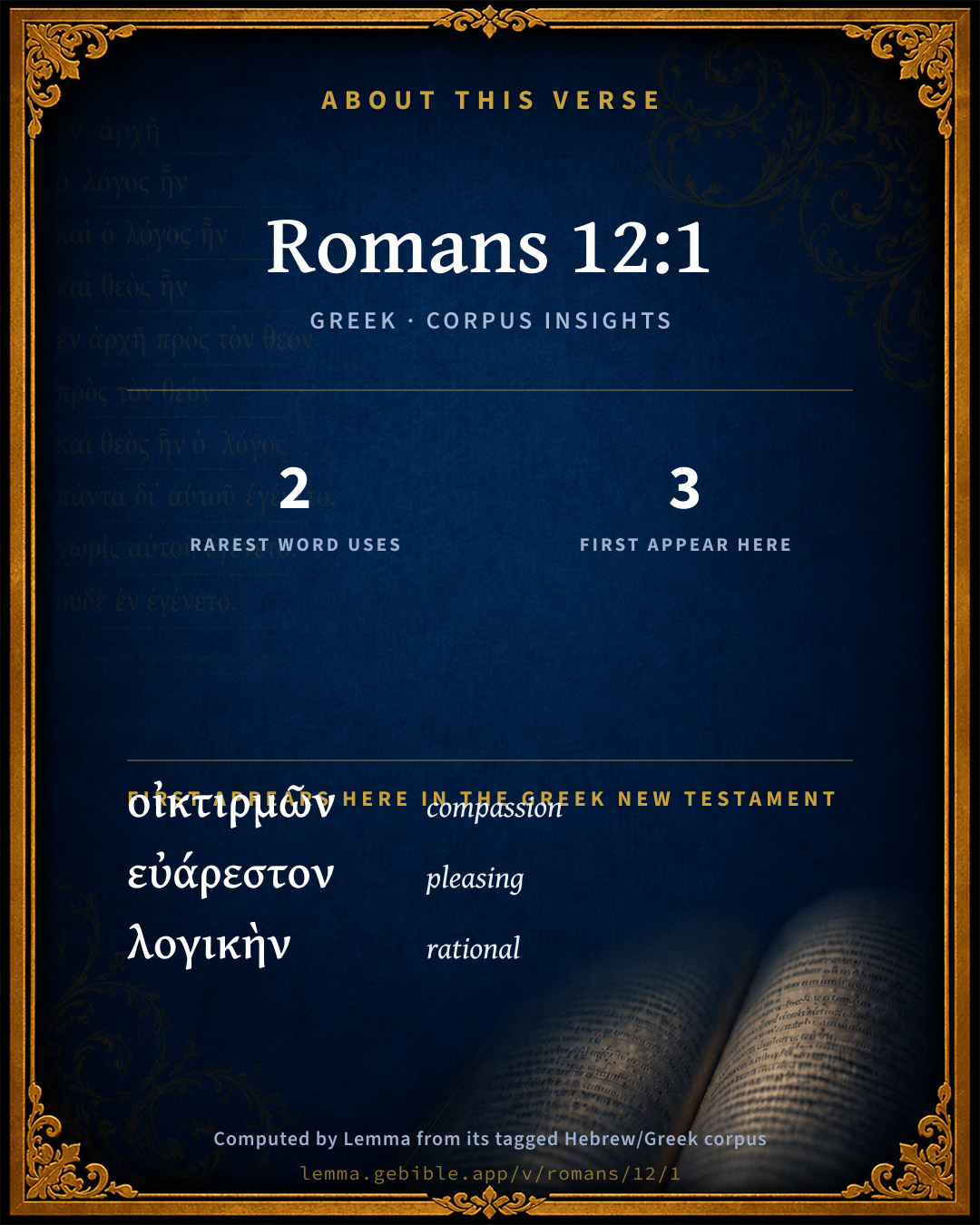
The rarest word here is λογικὴν rational G3050 — appearing just 2 times in the whole Greek New Testament.
First appearance in Scripture
These words make their first canonical appearance in the Greek New Testament here:
Shared distinctive vocabulary
λογικὴν rational G3050 occurs in 2 verses of the Greek New Testament. Also found in:
Cross-references
45Topical passages linked to Romans 12:1 in the Treasury of Scripture Knowledge — connected by theme and wording, ordered by reader-vote popularity; previews shown in the World English Bible.
- 1 Peter 2:5 You also, as living stones, are built up as a spiritual house, to be a holy priesthood, to offer up spiritual sacrifices, acceptable to God through Jesus Christ.
- Romans 6:13 Neither present your members to sin as instruments of unrighteousness, but present yourselves to God, as alive from the dead, and your members as instruments of righteousness to God.
- Hebrews 13:15–16 Through him, then, let us offer up a sacrifice of praise to God continually, that is, the fruit of lips which make confession to his name.
- Romans 6:19 I speak in human terms because of the weakness of your flesh, for as you presented your members as servants to uncleanness and to wickedness upon wickedness, even so now present your members as servants to righteousness for sanctification.
- Ephesians 4:1 I therefore, the prisoner in the Lord, beg you to walk worthily of the calling with which you were called,
- Romans 12:2 Don't be conformed to this world, but be transformed by the renewing of your mind, so that you may prove what is the good, well-pleasing, and perfect will of God.
- Psalms 19:14 Let the words of my mouth and the meditation of my heart Be acceptable in your sight, Yahweh, my rock, and my redeemer.
- 1 Peter 2:10–12 who in time past were no people, but now are God's people, who had not obtained mercy, but now have obtained mercy.
- Romans 6:16 Don't you know that to whom you present yourselves as servants to obedience, his servants you are whom you obey; whether of sin to death, or of obedience to righteousness?
- Psalms 116:12 What will I give to Yahweh for all his benefits toward me?
- 2 Corinthians 4:16 Therefore we don't faint, but though our outward man is decaying, yet our inward man is renewed day by day.
- 1 Corinthians 6:13–20 "Foods for the belly, and the belly for foods," but God will bring to nothing both it and them. But the body is not for sexual immorality, but for the Lord; and the Lord for the body.
- Titus 3:4–8 But when the kindness of God our Savior and his love toward mankind appeared,
- 1 Thessalonians 4:1 Finally then, brothers, we beg and exhort you in the Lord Jesus, that as you received from us how you ought to walk and to please God, that you abound more and more.
- 1 Corinthians 5:7–8 Purge out the old yeast, that you may be a new lump, even as you are unleavened. For indeed Christ, our Passover, has been sacrificed in our place.
- 2 Corinthians 5:14–15 For the love of Christ constrains us; because we judge thus, that one died for all, therefore all died.
- Ephesians 2:4–10 But God, being rich in mercy, for his great love with which he loved us,
- 2 Corinthians 5:20 We are therefore ambassadors on behalf of Christ, as though God were entreating by us. We beg you on behalf of Christ, be reconciled to God.
- Hebrews 10:20–22 by the way which he dedicated for us, a new and living way, through the veil, that is to say, his flesh;
- Ephesians 5:10 proving what is well-pleasing to the Lord.
- Isaiah 56:7 even them will I bring to my holy mountain, and make them joyful in my house of prayer: their burnt offerings and their sacrifices shall be accepted on my altar; for my house shall be called a house of prayer for all peoples.
- Psalms 69:30–31 I will praise the name of God with a song, And will magnify him with thanksgiving.
- 1 Corinthians 1:10 Now I beg you, brothers, through the name of our Lord, Jesus Christ, that you all speak the same thing and that there be no divisions among you, but that you be perfected together in the same mind and in the same judgment.
- Philippians 2:17 Yes, and if I am poured out on the sacrifice and service of your faith, I rejoice, and rejoice with you all.
- Romans 11:30–31 For as you in time past were disobedient to God, but now have obtained mercy by their disobedience,
- Romans 2:4 Or do you despise the riches of his goodness, forbearance, and patience, not knowing that the goodness of God leads you to repentance?
- Philippians 4:18 But I have all things, and abound. I am filled, having received from Epaphroditus the things that came from you, a sweet-smelling fragrance, an acceptable and well-pleasing sacrifice to God.
- 1 Peter 2:20 For what glory is it if, when you sin, you patiently endure beating? But if, when you do well, you patiently endure suffering, this is commendable with God.
- Romans 15:30 Now I beg you, brothers, by our Lord Jesus Christ, and by the love of the Spirit, that you strive together with me in your prayers to God for me,
- Romans 15:16 that I should be a servant of Christ Jesus to the Gentiles, ministering as a priest the Gospel of God, that the offering up of the Gentiles might be made acceptable, sanctified by the Holy Spirit.
- 2 Corinthians 6:1 Working together, we entreat also that you not receive the grace of God in vain,
- Philippians 1:20 according to my earnest expectation and hope, that I will in no way be disappointed, but with all boldness, as always, now also Christ will be magnified in my body, whether by life, or by death.
- Psalms 50:13–14 Will I eat the flesh of bulls, Or drink the blood of goats?
- Jeremiah 6:20 To what purpose comes there to me frankincense from Sheba, and the sweet cane from a far country? your burnt offerings are not acceptable, nor your sacrifices pleasing to me.
- Philippians 2:1–5 If there is therefore any exhortation in Christ, if any consolation of love, if any fellowship of the Spirit, if any tender mercies and compassion,
- 1 Timothy 2:3 For this is good and acceptable in the sight of God our Savior;
- Luke 7:47 Therefore I tell you, her sins, which are many, are forgiven, for she loved much. But to whom little is forgiven, the same loves little."
- Hosea 14:2 Take words with you, and return to Yahweh. Tell him, "Forgive all our sins, And accept that which is good: So we offer like bulls our lips.
- 2 Corinthians 4:1 Therefore seeing we have this ministry, even as we obtained mercy, we don't faint.
- 1 Thessalonians 5:12 But we beg you, brothers, to know those who labor among you, and are over you in the Lord, and admonish you,
- 1 Timothy 5:4 But if any widow has children or grandchildren, let them learn first to show piety towards their own family, and to repay their parents, for this is acceptable in the sight of God.
- Hebrews 13:22 But I exhort you, brothers, endure the word of exhortation, for I have written to you in few words.
- Romans 9:23 and that he might make known the riches of his glory on vessels of mercy, which he prepared beforehand for glory,
- 1 Thessalonians 4:10 for indeed you do it toward all the brothers who are in all Macedonia. But we exhort you, brothers, that you abound more and more;
- 2 Corinthians 10:1 Now I Paul, myself, entreat you by the humility and gentleness of Christ; I who in your presence am lowly among you, but being absent am of good courage toward you.
Cross-references courtesy of OpenBible.info (CC BY 4.0).
Lesson kit
Teaching starters — assembled from the data on this page, not authored interpretation. Every prompt links to the verse data it draws on. Edit before teaching.
Romans, in the Pauline Epistles, opens this verse with 23 words (16 distinct Greek lemmas). Its most distinctive word is logikós (“rational”). A historical commentator’s framing appears above. Read the whole chapter for the surrounding context.
Discussion questions
- How does “rational” (logikós) shape what this verse is saying?
- 3 words here appear for the first time in Scripture. What is being introduced at this debut?
- 1 Peter 2:2 shares the word «rational» with this verse. How do the two illuminate each other?
- “God” occurs 2× in this one verse. What is the effect of the repetition?
- These translations render this verse differently; the difference is in the English rendering, not the original. What questions does that raise?
- Reading how Matthew Henry's Commentary and Adam Clarke's Commentary read this verse, where do the two commentators agree and where do they part?
Things to notice
- 3 words make their first canonical appearance in Scripture here.
- These translations choose different wording for 10 words in this verse.
- “God” occurs 2× in this single verse.
- 16 distinct Greek lemmas span 23 words in this verse.
Commentary
Notes on Romans 12:1 from classic Christian and Jewish commentators (each source and its license shown beneath its notes). The classic Christian expositions comment on the surrounding passage and are grouped to its opening verse, so a note may address several verses; the Jewish commentaries on the Tanakh (Rashi and others) are per-verse, so they appear only where the commentator wrote on this verse.
Lemma curates 59 commentaries, every one of them public domain or Creative Commons licensed, each selected and text-cleaned for this edition rather than reprinted as found. About our sources →
Matthew Henry's Commentary
Matthew Henry's Commentary on the Whole Bible (1708–1710) — public domain (CC PDM 1.0). Text via the HelloAO Bible API.
Adam Clarke's Commentary
Adam Clarke's Commentary on the Bible (1810–1826) — public domain. Text from a community e-Sword/MySword module.
The Cambridge Bible for Schools and Colleges
gen. ed. J. J. S. Perowne
The Cambridge Bible for Schools and Colleges (gen. ed. J. J. S. Perowne; Cambridge University Press, 1878–1918) — public domain. Text from a community e-Sword module.
The Biblical Illustrator
Joseph S. Exell
The Biblical Illustrator, edited by Joseph S. Exell (c. 1880s–1900s) — public domain. Text from a community e-Sword module.
Joseph Benson's Commentary
Joseph Benson's Commentary on the Old and New Testaments (1811–1818) — public domain. Text from a community e-Sword module.
Dummelow's Commentary on the Holy Bible
J. R. Dummelow
J. R. Dummelow, A Commentary on the Holy Bible (Macmillan, 1909) — public domain. Text from a community e-Sword module.
Whedon's Commentary on the Bible
Daniel D. Whedon
Daniel D. Whedon (gen. ed.), Commentary on the Old and New Testaments (1874–1909) — public domain. Text from a community e-Sword module.
The Preacher's Complete Homiletical Commentary
Joseph S. Exell (gen. ed.)
The Preacher's Complete Homiletical Commentary (gen. ed. Joseph S. Exell; Funk & Wagnalls, c. 1892) — public domain (pre-1929). A full-Bible homiletical/sermon-outline anthology covering 65 of 66 books (2 John is absent from the source module). Text from a community e-Sword module.
Lange's Commentary on the Holy Scriptures
Lange's Commentary on the Holy Scriptures (Critical, Doctrinal, and Homiletical), ed. John Peter Lange, English translation edited by Philip Schaff (1864–1880) — public domain. Text from a community e-Sword module.
MacLaren's Expositions of Holy Scripture
Alexander MacLaren
Alexander MacLaren, Expositions of Holy Scripture (1904–1910) — public domain. Text from a community e-Sword module.
The Annotated Bible
Arno C. Gaebelein
Arno C. Gaebelein, The Annotated Bible (1913–1922) — public domain. Text from a community e-Sword module.
Kretzmann's Popular Commentary
Paul E. Kretzmann
Paul E. Kretzmann, Popular Commentary of the Bible (1921–1924) — public domain. Text from a community e-Sword module.
The Sermon Bible
William Robertson Nicoll (ed.)
The Sermon Bible, ed. William Robertson Nicoll (1888–1900) — public domain. Text from a community e-Sword module.
McGarvey & Pendleton's Commentaries
J. W. McGarvey
J. W. McGarvey (with Philip Y. Pendleton), Commentaries on the New Testament (The Fourfold Gospel, 1914; Acts; and the epistles) — public domain. Text from a community e-Sword/MySword module.
F. W. Grant's Numerical Bible
F. W. Grant, The Numerical Bible (4th ed., 1903) — public domain. Text from a community e-Sword module.
The Expositor's Bible
William Robertson Nicoll, ed., The Expositor's Bible (London: Hodder & Stoughton, 1887–1910) — public domain. 65 of 66 books (1 Corinthians is not separately keyed, as that volume carries no machine-parseable verse references); section-level commentary keyed to the opening verse. Introductory and overview sections not keyed to a specific passage are excluded.
Tyndale Open Study Notes
Tyndale Open Resources
Tyndale Open Study Notes — © Tyndale Open Resources, licensed CC BY-SA 4.0. Text via the HelloAO Bible API.
Bengel's Gnomon
Johann Albrecht Bengel
Bengel's Gnomon of the New Testament — English translation (T&T Clark, Edinburgh, 1860) — public domain. Text from a community e-Sword module.
Meyer's Critical & Exegetical Commentary
Heinrich August Wilhelm Meyer
Meyer — Critical and Exegetical Commentary on the New Testament — English translation by Peter Christie, edited by Frederick Crombie (T&T Clark, 1880) — public domain. Text from a community e-Sword module.
Expositor's Greek Testament
ed. W. Robertson Nicoll
The Expositor's Greek Testament, edited by W. Robertson Nicoll (1897–1910) — public domain. Text from a community e-Sword module.
Cambridge Greek Testament for Schools and Colleges
Cambridge Greek Testament for Schools and Colleges (Cambridge University Press, 1896; 21 vols, various authors incl. Carr, Maclear, Plummer, Farrar, Lumby, Moule, M. R. James, Simcox) — public domain. Text from a community e-Sword module.
Alford’s Greek Testament
Henry Alford
Henry Alford, The Greek Testament (1849–1861) — public domain. Text from a community e-Sword module.
International Critical Commentary
International Critical Commentary — older volumes (1896–1929), various authors — public domain. Text from a community e-Sword module.
Godet's Commentaries
Frédéric Louis Godet
Frédéric Louis Godet — Commentaries on Luke, John, Romans, and 1 Corinthians — English translation (T&T Clark, Edinburgh, 1870s–1890s) — public domain. Text from a community e-Sword module.
Hodge's Commentary on Romans, Ephesians & First Corinthians
Charles Hodge
Charles Hodge — Commentary on Romans (1835), First Corinthians (1857), and Ephesians (1856) — public domain. Text from a community e-Sword module.
Geneva Bible (1599)
Geneva Bible translators
Geneva Bible (1599) marginal notes — public domain. Text via Bolls.life.
John Calvin's Commentaries
John Calvin's Commentaries (1540-1563) — public domain. Text from the Calvin Translation Society English edition (1840s-50s) via the Christian Classics Ethereal Library (ccel.org). Calvin's coverage is partial (roughly two-thirds of the Bible); uncommented books and verses are honest gaps, never fabricated. The 19th-century editor's footnotes and remarks are omitted so the notes are faithfully Calvin's own voice.
Ellicott's Commentary for English Readers
A Bible Commentary for English Readers, edited by Charles John Ellicott (1878–1897) — public domain. Text from a community e-Sword module.
John Gill's Exposition
John Gill's Exposition of the Whole Bible (1746–1763) — public domain (CC PDM 1.0). Text via the HelloAO Bible API.
Trapp's Complete Commentary
John Trapp
John Trapp, A Commentary or Exposition upon All the Books of the Old and New Testament (1647–1656) — public domain. Text from a community e-Sword module.
Albert Barnes' Notes on the Bible
Albert Barnes' Notes on the Bible (1834–1885) — public domain. Text from a community e-Sword/MySword module.
Haydock's Catholic Bible Commentary
George Leo Haydock (1774–1849), Haydock's Catholic Family Bible and Commentary, 1859 edition — public domain. Excludes Psalms (Douay-Rheims chapter numbering differs from Protestant) and Deuterocanonical books (Catholic canon only).
Matthew Poole's English Annotations
Matthew Poole's English Annotations on the Holy Bible (1683–1685) — public domain. Text from a community e-Sword/MySword module.
The Pulpit Commentary
The Pulpit Commentary (1880–1919), ed. H.D.M. Spence-Jones & Joseph S. Exell — public domain. Text from a community e-Sword module.
John Wesley's Explanatory Notes
John Wesley, Explanatory Notes Upon the Whole Bible (1754–1765) — public domain. Text via the GEBible commentary corpus.
Scofield Reference Notes
C. I. Scofield
The Scofield Reference Bible (1917 edition), notes by C. I. Scofield — public domain. Text from a community e-Sword module.
Burkitt's Expository Notes on the New Testament
William Burkitt
William Burkitt's Expository Notes on the New Testament (1700–1703) — public domain. Text from a community e-Sword module.
Godbey's Commentary on the New Testament
William B. Godbey
William B. Godbey, Commentary on the New Testament (1896–1900) — public domain. Text from a community e-Sword module.
Darby's Synopsis of the New Testament
John Nelson Darby
John Nelson Darby — Synopsis of the Books of the Bible: the New Testament (c. 1857–1862) — public domain. Text from a community e-Sword module.
The People's New Testament
B. W. Johnson
B. W. Johnson's The People's New Testament with Notes (1889–1891) — public domain. Electronic text from the Christian Classics Ethereal Library (CCEL) ThML edition.
unfoldingWord translationNotes
Door43 World Missions Community
unfoldingWord translationNotes — © Distant Shores Media and the Door43 World Missions Community, licensed CC BY-SA 4.0. Source: git.door43.org/Door43/en_tn.
Vincent's Word Studies in the New Testament
Marvin R. Vincent
Marvin R. Vincent, Word Studies in the New Testament (1887–1900) — public domain. Text from a community e-Sword/MySword module.