Acts 5:3

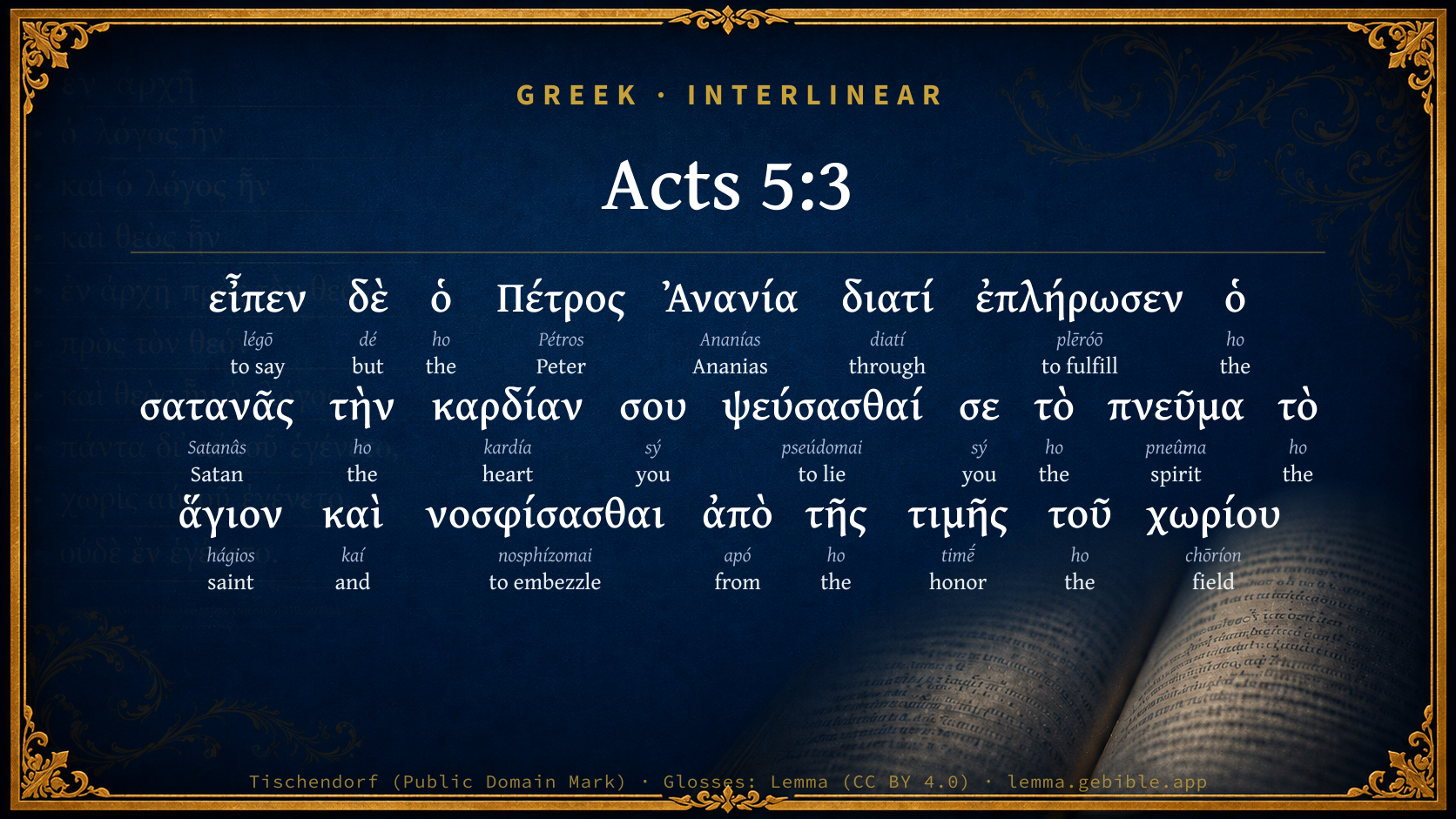
Greek (Tischendorf 8th ed.) Acts 5:3 appears in the Greek New Testament. The text above is from the Tischendorf 8th edition. Each word links to its Strong’s number and a concise gloss. Click any word for its full Thayer’s Greek Lexicon entry.
Download image
Cite this verse

Acts 5:3 (World English Bible). Public Domain. Lemma interlinear Bible study tool, https://lemma.gebible.app/v/acts/5/3.

Show BibTeX & RIS
BibTeX
RIS
English Translation
But Peter said, "Ananias, why has Satan filled your heart to lie to the Holy Spirit, and to keep back part of the price of the land?
World English Bible · Public Domain
Download a study sheet

One document with this verse’s original text, its word-by-word gloss line, the meaning frame, cross-references with their text, attributed commentary, and full source and license credits — printable, and it pastes into notes with its structure intact.

This verse Autodidact and up

Study sheet (.html) Plain text (.txt)

A passage Seminary Student

Up to 50 verses in one chapter. A passage sheet keeps up to 6 commentary sources and 12 cross-references per verse, in the order this page ranks them, and says so on the sheet whenever that leaves anything out. Ask for a single verse and you get the Autodidact verse sheet above.

Everything on this page stays free to read, with no account — the sheet is a download of what is already on screen, not access to it.

Want to remove ads? Support Godless Engineer
Compare translations 3

The same verse in 3 English versions, stacked beneath the original-language interlinear above. Click any original word for its lexicon entry.

Each is an independent rendering of the whole verse — the interlinear is not word-aligned to these translations.

Highlighted words mark where these versions differ — a whole-verse word diff, not a word-by-word alignment.

  • World English Bible Public Domain
    But Peter said, "Ananias, why has Satan filled your heart to lie to the Holy Spirit, and to keep back part of the price of the land?
  • King James Version Public Domain
    But Peter said, Ananias, why hath Satan filled thine heart to lie to the Holy Ghost, and to keep back part of the price of the land?
  • unfoldingWord Literal Text CC BY-SA 4.0
    But Peter said, “Ananias, why has Satan filled your heart for you to lie to the Holy Spirit and to keep back from the price of the land?

unfoldingWord Literal Text — © unfoldingWord, licensed CC BY-SA 4.0. Word-aligned USFM3 via Door43 (git.door43.org/unfoldingWord/en_ult).

Versions to compare (up to 4)

3 of 4 selected

Show all 19 translations

Every available English version of this verse, each an independent rendering of the whole verse.

  • World English Bible Public Domain
    But Peter said, "Ananias, why has Satan filled your heart to lie to the Holy Spirit, and to keep back part of the price of the land?
  • Berean Standard Bible Public Domain
    Then Peter said, “Ananias, how is it that Satan has filled your heart to lie to the Holy Spirit and withhold some of the proceeds from the land?
  • Majority Standard Bible Public Domain
    Then Peter said, “Ananias, how is it that Satan has filled your heart to lie to the Holy Spirit and withhold some of the proceeds from the land?
  • King James Version Public Domain
    But Peter said, Ananias, why hath Satan filled thine heart to lie to the Holy Ghost, and to keep back part of the price of the land?
  • American Standard Version (1901) Public Domain
    But Peter said, Ananias, why hath Satan filled thy heart to lie to the Holy Spirit, and to keep back `part' of the price of the land?
  • Revised Version (1885) Public Domain
    But Peter said, Ananias, why hath Satan filled thy heart to lie to the Holy Ghost, and to keep back part of the price of the land?
  • Geneva Bible (1599) Public Domain
    Then saide Peter, Ananias, why hath Satan filled thine heart, that thou shouldest lye vnto the holy Ghost, and keepe away part of the price of this possession?
  • Douay-Rheims (1899) Public Domain
    But Peter said: Ananias, why hath Satan tempted thy heart, that thou shouldst lie to the Holy Ghost, and by fraud keep part of the price of the land?
  • Young's Literal Translation Public Domain
    And Peter said, `Ananias, wherefore did the Adversary fill thy heart, for thee to lie to the Holy Spirit, and to keep back of the price of the place?
  • Literal Standard Version CC BY-SA 4.0
    And Peter said, “Ananias, why did Satan fill your heart, for you to lie to the Holy Spirit, and to keep back of the price of the place?
  • Unlocked Literal Bible CC BY-SA 4.0
    But Peter said, “Ananias, why has Satan filled your heart to lie to the Holy Spirit and to keep back part of the price of the land?
  • unfoldingWord Literal Text CC BY-SA 4.0
    But Peter said, “Ananias, why has Satan filled your heart for you to lie to the Holy Spirit and to keep back from the price of the land?
  • Darby Bible Public Domain
    But Peter said, Ananias, why has Satan filled thy heart that thou shouldest lie to the Holy Spirit, and put aside for thyself a part of the price of the estate?
  • World Messianic Bible Public Domain
    But Peter said, “Hananiah, why has Satan filled your heart to lie to the Holy Spirit and to keep back part of the price of the land?
  • Webster's Bible Public Domain
    But Peter said, Ananias, Why hath Satan filled thy heart to lie to the Holy Spirit, and to keep back part of the price of the land?
  • Free Bible Version CC BY-SA 4.0
    Then Peter asked him, “Ananias, why did you let Satan convince you to lie to the Holy Spirit and keep back some of the money from the land you sold?
  • Bible in Basic English Public Domain
    But Peter said, Ananias, why has the Evil One put it into your heart to be false to the Holy Spirit, and to keep back part of the price of the land?
  • Text-Critical English NT CC BY 4.0
    But Peter said, “Ananias, why has Satan filled yoʋr heart to lie to the Holy Spirit and keep back some of the proceeds of the plot of land?
  • Tyndale New Testament (1534) Public Domain
    Then sayde Peter: Ananias how is it that Satan hath filled thyne hert that thou shuldest lye vnto the holy goost and kepe awaye parte of the pryce of the lyvelod:

Literal Standard Version (2020), Covenant Press — licensed CC BY-SA 4.0. Text via the HelloAO Bible API (eBible.org). Unlocked Literal Bible (unfoldingWord) — licensed CC BY-SA 4.0. Text via the HelloAO Bible API (eBible.org). unfoldingWord Literal Text — © unfoldingWord, licensed CC BY-SA 4.0. Word-aligned USFM3 via Door43 (git.door43.org/unfoldingWord/en_ult). Free Bible Version, Dr. Jonathan Gallagher — licensed CC BY-SA 4.0. Text via the HelloAO Bible API (eBible.org).

Word by word

More ways to search: Search by grammar → Find every occurrence → Compare this word →

Practice this passage: Drill this verse → Learn its vocabulary →

νοσφίσασθαι
nosphízomai
G3557
“to embezzle”
Verb, Aorist, Middle, Infinitive
Part of Speech
Verb
Tense
Aorist
Voice
Middle
Mood
Infinitive
Full Thayer's Definition

Origin: middle voice from nosphi (apart or clandestinely)

TDNT: None

1. to set apart, separate, divide 2. to set apart or separate for one's self 3. to purloin, embezzle, withdraw covertly and appropriate to one's own use
  1. εἶπεν légō G3004 “to say” Verb, Aorist, Active, Indicative, 3rd person, Singular
  2. δὲ dé G1161 “but” Conjunction
  3. ὁ ho G3588 “the” Article, Nominative, Singular, Masculine
  4. Πέτρος Pétros G4074 “Peter” Noun, Nominative, Singular, Masculine
  5. Ἀνανία Ananías G367 “Ananias” Noun, Vocative, Singular, Masculine
  6. διατί diatí G1302 “through” Particle, Interrogative
  7. ἐπλήρωσεν plēróō G4137 “to fulfill” Verb, Aorist, Active, Indicative, 3rd person, Singular
  8. ὁ ho G3588 “the” Article, Nominative, Singular, Masculine
  9. σατανᾶς Satanâs G4567 “Satan” Noun, Nominative, Singular, Masculine
  10. τὴν ho G3588 “the” Article, Accusative, Singular, Feminine
  11. καρδίαν kardía G2588 “heart” Noun, Accusative, Singular, Feminine
  12. σου sý G4771 “you” Personal pronoun, 2nd person, Genitive, Singular
  13. ψεύσασθαί pseúdomai G5574 “to lie” Verb, Aorist, Middle deponent, Infinitive
  14. σε sý G4771 “you” Personal pronoun, 2nd person, Accusative, Singular
  15. τὸ ho G3588 “the” Article, Accusative, Singular, Neuter
  16. πνεῦμα pneûma G4151 “spirit” Noun, Accusative, Singular, Neuter
  17. τὸ ho G3588 “the” Article, Accusative, Singular, Neuter
  18. ἅγιον hágios G40 “saint” Adjective, Accusative, Singular, Neuter
  19. καὶ kaí G2532 “and” Conjunction
  20. ἀπὸ apó G575 “from” Preposition
  21. τῆς ho G3588 “the” Article, Genitive, Singular, Feminine
  22. τιμῆς timḗ G5092 “honor” Noun, Genitive, Singular, Feminine
  23. τοῦ ho G3588 “the” Article, Genitive, Singular, Neuter
  24. χωρίου chōríon G5564 “field” Noun, Genitive, Singular, Neuter

About this verse

These counts appear in no published source. They are computed here, from the morphology-tagged text and Lemma’s own curated glosses. What Lemma adds →

25
words
18
distinct lemmas
Acts
section

Notable vocabulary

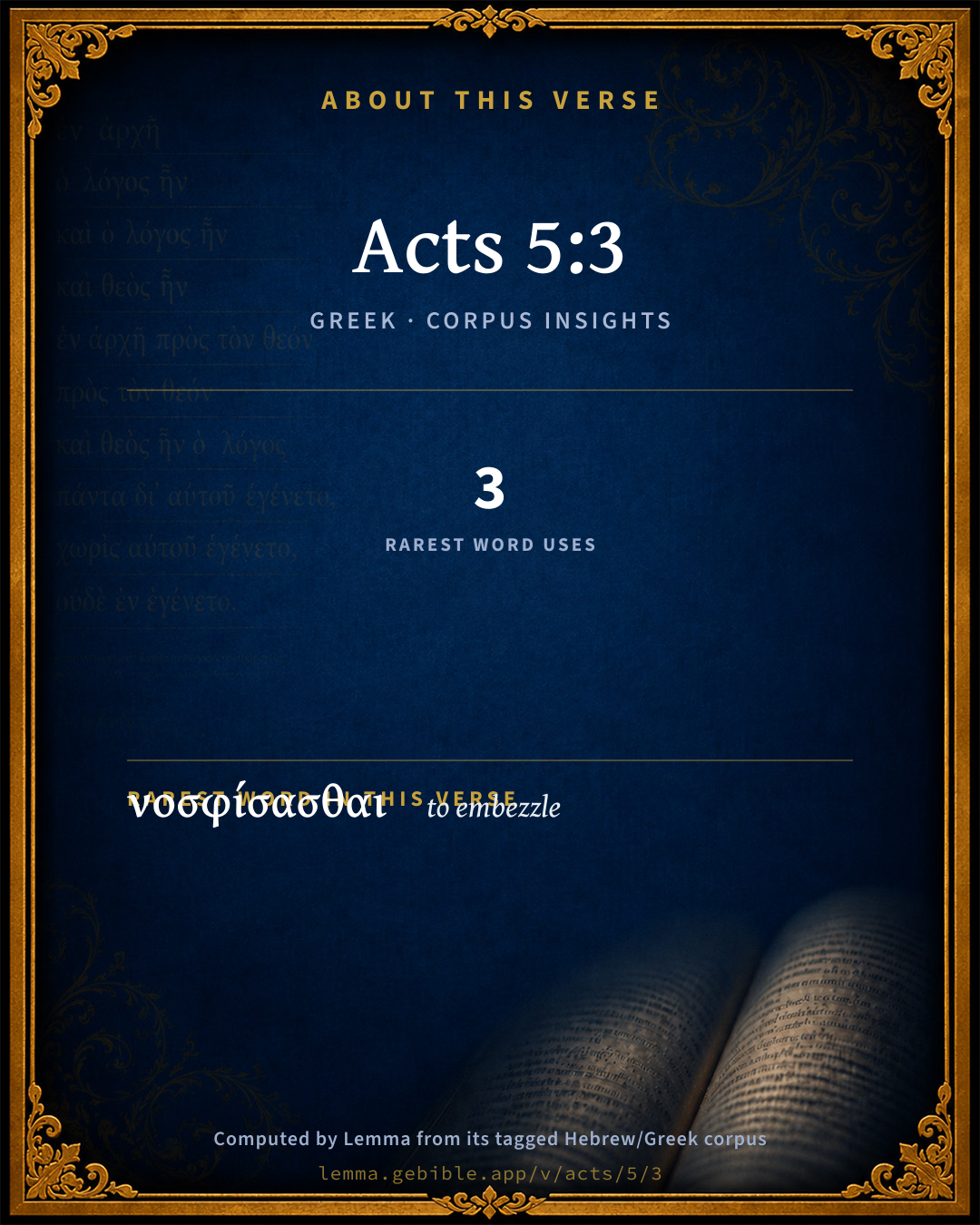
The rarest word here is νοσφίσασθαι to embezzle G3557 — appearing just 3 times in the whole Greek New Testament.

Shared distinctive vocabulary

νοσφίσασθαι to embezzle G3557 occurs in 3 verses of the Greek New Testament. Also found in:

Repetition

Words recur within this verse:

Cross-references

25

Topical passages linked to Acts 5:3 in the Treasury of Scripture Knowledge — connected by theme and wording, ordered by reader-vote popularity; previews shown in the World English Bible.

  • Jeremiah 23:24 Can any hide himself in secret places so that I shall not see him? says Yahweh. Don't I fill heaven and earth? says Yahweh.
  • Isaiah 29:15 Woe to those who hide deep their counsel from Yahweh, and whose works are in the dark, and who say, Who sees us? and who knows us?
  • John 13:2 After supper, the devil having already put into the heart of Judas Iscariot, Simon's son, to betray him,
  • John 13:27 After the piece of bread, then Satan entered into him. Then Jesus said to him, "What you do, do quickly."
  • Acts 5:9 But Peter asked her, "How is it that you have agreed together to tempt the Spirit of the Lord? Behold, the feet of those who have buried your husband are at the door, and they will carry you out."
  • 1 Peter 5:8 Be sober and self-controlled. Be watchful. Your adversary the devil, walks around like a roaring lion, seeking whom he may devour.
  • Job 22:13 You say, 'What does God know? Can he judge through the thick darkness?
  • Ecclesiastes 5:4 When you vow a vow to God, don't defer to pay it; for he has no pleasure in fools. Pay that which you vow.
  • Ephesians 6:11–16 Put on the whole armor of God, that you may be able to stand against the wiles of the devil.
  • James 4:7 Be subject therefore to God. But resist the devil, and he will flee from you.
  • Numbers 30:2 When a man vows a vow to Yahweh, or swears an oath to bind his soul with a bond, he shall not break his word; he shall do according to all that proceeds out of his mouth.
  • Deuteronomy 23:21 When you shall vow a vow to Yahweh your God, you shall not be slack to pay it: for Yahweh your God will surely require it of you; and it would be sin in you.
  • Psalms 94:7–9 They say, "Yah will not see, Neither will Jacob's God consider."
  • Luke 22:3 Satan entered into Judas, who was surnamed Iscariot, who was numbered with the twelve.
  • Acts 5:2 and kept back part of the price, his wife also being aware of it, and brought a certain part, and laid it at the apostles' feet.
  • Acts 5:4 While you kept it, didn't it remain your own? After it was sold, wasn't it in your power? How is it that you have conceived this thing in your heart? You haven't lied to men, but to God."
  • Genesis 3:13–17 Yahweh God said to the woman, "What is this you have done?" The woman said, "The serpent deceived me, and I ate."
  • 1 Chronicles 21:1–3 Satan stood up against Israel, and moved David to number Israel.
  • Matthew 4:3–11 The tempter came and said to him, "If you are the Son of God, command that these stones become bread."
  • Romans 2:21–22 You therefore who teach another, don't you teach yourself? You who preach that a man shouldn't steal, do you steal?
  • Revelation 12:9–11 The great dragon was thrown down, the old serpent, he who is called the devil and Satan, the deceiver of the whole world. He was thrown down to the earth, and his angels were thrown down with him.
  • 1 Kings 22:21–22 There came forth a spirit, and stood before Yahweh, and said, I will entice him.
  • Proverbs 20:25 It is a snare to a man to make a rash dedication, Then later to consider his vows.
  • Hosea 11:12 Ephraim surrounds me with falsehood, And the house of Israel with deceit; And Judah still us unruly with God, And is unfaithful to the Holy One.
  • Matthew 13:19 When anyone hears the word of the Kingdom, and doesn't understand it, the evil one comes, and snatches away that which has been sown in his heart. This is what was sown by the roadside.

Cross-references courtesy of OpenBible.info (CC BY 4.0).

Commentary

Notes on Acts 5:3 from classic Christian and Jewish commentators (each source and its license shown beneath its notes). The classic Christian expositions comment on the surrounding passage and are grouped to its opening verse, so a note may address several verses; the Jewish commentaries on the Tanakh (Rashi and others) are per-verse, so they appear only where the commentator wrote on this verse.

Lemma curates 59 commentaries, every one of them public domain or Creative Commons licensed, each selected and text-cleaned for this edition rather than reprinted as found. About our sources →

The Biblical Illustrator

Joseph S. Exell

Act_5:3

Why hath Satan filled thine heart to lie to the Holy Ghost.

Satan

is a Hebrew word meaning adversary or opponent, whether in war (1Ki_5:4) or litigation (Psa_109:6), often applied to human enemies, but in one place to an angel (Num_26:22), and with the article (2Sa_24:1), was a proper name without it (1Ch_21:1), to the evil spirit or prince of the fallen angels, as the adversary and accuser of mankind (Job_1:7; Job_2:2; Zec_3:1-2; cf. Rev_12:9-10). In this sense and application it is nearly equivalent to Diabolus (Rev_12:9; Rev_20:2), meaning slanderer, informer, false accuser; to which the English devil may be easily traced back, through the intermediate forms of the French Diable and Italian Diavolo. As the same being is the tempter of our race from the beginning (2Co_11:3), the name Satan sometimes has that special meaning (Mat_4:10; Mat_16:23; Mar_8:33), and so it is used here. (J. W. Alexander, D. D.)

Satan filling the heart

The question contains more than one truth in reference to Satan.

I. The existence and reality of Satan, that is to say of the evil spirit who is the prince of darkness, is throughout undeniably to be understood. It cannot here be considered as a mere allegory; the matter was too serious, and the speech of the apostle is much too impressive, severe and direct for that.

II. Evil does not exist and grow isolated in the human breast, but is connectively interwoven with the kingdom of evil in the invisible world. And precisely the worst sins, the subtlest hypocrisy, where evil clothes itself in the holiest garments of light, are the operations of Satan.

III. There are different degrees of the working of Satan, from the smallest temptation to the filling of the heart, i.e., entirely and completely taking possession of it, which is the terrible contrast to the fulness of the Holy Spirit.

IV. Man is responsible, and his will free even in relation to the powerful promptings of the devil. For Peter says not only Satan has filled thy heart, but asks why. And the reason he seeks lies evidently not in Satan, but in Ananias. Why hast thou permitted it? The apostle indirectly testifies that man, if he will, may resist the devil (1Pe_5:9; Jam_4:7). There is no irresistible power of Satan. (G. V. Lechler, D. D.)

Lying to the Holy Spirit

Falsehood is particularly a sin against the Holy Spirit. It is a sin against--

I. His nature. One of His titles is the Spirit of Truth. It is essentially inherent in Him. He cannot Himself be false, and falsehood cannot dwell in His presence.

II. His word. Christ prayed Sanctify them through Thy truth; Thy Word is truth. This is the instrument by which He accomplishes all His purposes; and He will use no other. He tells all the truth as it regards God, man, sin, and salvation, time and eternity. Of such Jesus says, Ye shall know the truth, and the truth shall make you free. A lie is the rejection of the truth, and a direct resistance to the testimony and word of the Spirit.

III. His work in the heart. Thou desirest truth in the inward parts. When God writes His law upon the heart it is as a standard of truth which He sets up there. Establishing it within us, He entwines around it all our principles, affections and practices, He makes us true men.

IV. The character which He forms in His people. They are of the truth, do the truth, speak the truth in their heart, and are girt about with truth. (J. Morgan. D. D.)

The resistibility of evil

The Bible is a book of personalities--it has nothing to do with personifications, streams of tendency, etc. Here the personality of the Holy Spirit is clearly recognised, and Satan is no figure of speech. The resistibility of evil is the greatest moral of the text. Satans action is fully assumed, but Ananias is held responsible for the result: Why hast thou permitted it? Now we are all quite ready to blame the tempting power for our bad conduct. Supernatural evil comes in like a flood, and we think there is much to be said for us if we are swept away. We are told that in the East robbers employ magic to effect their nefarious purpose, their victims lying, with their eyes open, helpless spectators of the spoliation of their homes. Some men persuade themselves that they are similarly helpless in the presence of the arch thief. Not so, says the text. You can resist the devil and he will flee. There is no enchantment in wickedness which may prevail against a sincere and steadfast soul.

I. The very epithet we use to express the action of evil implies the resistibility of evil. Satan is the tempter, the initial action of evil is temptation. This is only another word for experiment or trial. It was the design of God (Deu_8:2), through certain discipline, to show Israel what was in His heart. Satan also tempts men, makes experiments upon their moral nature. But there is always this great distinction. God is ever aiming to realise the good that is in us, and to purge the evil; Satan to realise the evil and to purge the good. But uncertainty is of the very nature of temptation. When Satan makes an experiment upon us he may possibly succeed, he may possibly fail, according to the quality of our nature. He cannot coerce. Christ affirmed, The prince of this world cometh and hath nothing in Me Nothing that owned his sway. He was pure gold, and as such He went into the crucible, and as such He came out again. The alchemist sought to transmute base metals into gold; the devil seeks to turn gold into cinders, which can never be done in the physical world, much less in the ethical. If you are of baser metal in your inmost self--I do not care how much gilt you put on the surface, nor whether you have got the hall mark of the Church--if you are at the centre base metal when you are put into the crucible, base metal you will come out. But if there is nothing of the devil in us he can get nothing out of us. Loyal to the truth in your deepest thought and sympathy, the black storm may bow you down, but having done all, you stand; rotten at the heart, when the storm comes upon you, great is your fall. Experiment demonstrates: it does not necessitate.

II. The method of its approach and action indicates the resistibility of evil. The devil uses deceit. Temptation is cajolery. Evil comes in the wriggle of the serpent. All this is consolatory so far as it reveals the weakness which underlies all wickedness. Strong men do not resort to these equivocal methods; they wear no masks, proffer no bribes, tell no lies. The devil comes as a conjurer, not as a conqueror. The fowler setting his net shows that we are free; the destroyer proffering his sorcerous cup confesses that he has no authority to smite or bind; and seeing the serpent wriggling in the grass, it flashes on us in a moment how easily we may bruise his head. Irresistibility does not trick itself out in motley disguises. Be true in the inward parts and you shall be more than conqueror. The properties of a sorceror--mirrors, vapours, charms, incantations--will prevail nothing against the armour of light; the liar of ages will not deceive the simplicity of a little child (2Th_2:7-12). The root of the whole matter is here. Do you love the truth in your inmost heart, and are you prepared to follow it at all sacrifices? Then no mystery of lawlessness or lying wonders, etc., shall lead you astray, but you shall hear a heavenly voice saying, This is the way, and walking in it you shall be safe from the fear of evil.

III. If evil were irresistible it would possess a power which God does not permit Himself to exercise. God respects the nature He has given, and does not compel us along any line of action. Behold I stand at the door and knock. The heart of man seems but a but of clay, yet before its lowly door stands the Majesty of the skies asking admittance. God respects the freedom He first gave, and if ever He enters we shall have to turn the key. He knocks, but He does no more. God made the human heart to be opened only from within; and be sure what God will not do no other power shall be permitted to do. We have kept God out, and surely we can keep the devil out. The deceiver may post himself before the windows of our soul, and we cannot drive him away; but as sure as we are men he can never put his sooty foot across the red threshold of our heart except we agree to it (Luk_22:31). The French proverb is right, The devil goes away from a closed door. The door of the soul is sacred: keep it shut, latch it with caution, bolt it with resolution, lock it with prayer, and all hell may gather about, as the Sodomites did about the door of Lot, yet they shall be baffled. But once have the door open, begin coquettings with evil, and the devil will soon be your guest and master.

IV. Evil is being constantly vanquished. Nothing is more terrible than that we should be convinced of the invulnerability of evil. Cortes sought to make the Mexicans believe that a Spaniard could not die, an illusion which unnerved them in the day of battle. We must entertain no such belief about evil. The spirits of wickedness are being tramped under foot every day. The Bible is full of the records of victory over temptation and sin. What is the lesson of the victory of our Lord in the wilderness but the powerlessness of the devil in the presence of faith and purity. In His strength His victory is being ever repeated Whats done we partly may compute, but we know not whats resisted. We see the ugly side of life: if anybody goes to the bad we all know it. But all around us magnificent moral victories are being scored: if our eyes were opened and we could see everything that is going on many a sublime spectacle would inspire us with exultation. Now a young man has the cup of guilty pleasure pressed to his lips, but in the critical moment, on which hangs eternity, he dashes it to the ground; now a young maiden, by the grace of heaven, turns away from some alluring cluster, keeping her purity and her paradise; now a struggling tradesman prefers honesty to gold; now a politician loses an election rather than self respect. Poor human nature! We often get the worst of it, but not always. You have innumerable brothers and sisters in tribulation, who by Gods grace in miry pathways walk with unspotted robes, and the same grace shall be perfected in your weakness. The Jewish tradition says, The devil cannot overcome except he first see your face. Turn your face to the light and your back to the devil, and you shall never perish. Conclusion:

1. If you do not want Satan to fill your heart, take care that God fills it first. Satan filled Ananias heart because it was empty. Of his brethren we read they were all filled with the Holy Ghost. Satan could do nothing there. Here is our safety. When the devil finds an empty brain he fills it with false ideas, wicked plans; when he finds empty hands he fills them with mischiefs; when he finds an empty heart he fills it with vanities, burning passions, vicious sympathies and delights. If you wish to be saved from temptations power, keep your heart full of the love of God, your hands full of noble work, your mind full of high thought and desire.

2. You say, Satan has filled my heart; oh wretched man that I am. There is hope. The dispossessing power is sufficient. It is hard for a landlord to dispossess a bad tenant. He will not go out for the telling, you cannot frighten, coax, starve him out, it is only when the kings officer comes that you will get rid of the objectionable party. It is terrible work indeed to get the diabolism out of our heart. The Rationalist says, I will persuade him out, but iniquity does not yield to argument. The Optimist says, I will coax him out, but passion does not yield to blandishments. The Legalist says, I will frighten him out, but lust will not yield to law. The Ascetic says, I will starve him out, but pride, selfishness, and sensuality do not yield to discipline. The Pessimist says, Death shall pull down the tabernacle, and so give us relief from the ghastly dilemma, to find relief only in the destruction of the house is to confess ourselves utterly vanquished. Appeal from earth to heaven. The strong man armed shall bind the strong man and eject him. Seek the delivering Christ, and although your fetters have been riveted through years of transgression, you shall be led into liberty and peace. Evil irresistible! never. Thine is the kingdom, and the power, etc. (W. L. Watkinson.)

Insincere Christians an easy prey to Satan

A good coloured man once said, in a class-meeting: Brethren, when I was a boy, I took a hatchet and went into de woods. When I found a tree dat was straight, big, and solid, I didnt touch dat tree; but when I found one leaning a little and hollow inside, I soon had him down. So when de debbil goes after Christians, he dont touch dem dat stand straight and true; but dem dat lean a little and are hollow inside.

The devils trade wind

One of W. Jays peculiarities was the manner in which he would surprise his hearers by a startling sentence. Preaching on the repentance of Judas he took occasion to attack the love of money, and at the close of one of the divisions of his subject, he cried out, Avarice, avarice is the monsoon, the devils trade wind from the Church into hell. At another time, speaking of the inconsistency of many professors of the gospel, after making a powerful appeal, he exclaimed, Some of you, my dear brethren, are so inconsistent and undecided that if at this moment I saw the devil running away with you, I could not call out, Stop thief!--he would but carry off his own property!

Satans worms of avarice

A journal devoted to the interests of horticulture states that a gardener in the employ of a gentleman at Pittsford, New York, has recently solved a problem which has long perplexed him. In the garden under his care is a large lawn, on which he has bestowed much labour, and which was his especial pride. For some time past a small patch on this lawn disfigured it, for the grass that grew there was poor and withered, in marked contrast to all around. For a long time the gardener vainly endeavoured to discover the cause of its decay. One day, as he stood meditatively gazing at it, he saw several birds settle upon it and thrust their beaks through the sod with much diligence and satisfaction. The gardener had the curiosity to turn up a portion of the punctured turf, and discovered, to his amazement, that the earth beneath was alive with a greedy multitude of large white grubs, which had completely consumed the roots of the grass. He continued the work, and at every fresh removal of the sod the same phenomenon presented itself, until quarts of the larvae were gathered and destroyed. It is to be feared that the lack of vigorous life in some portions of Christs vineyard, the Church, may have a similar cause. The root of the piety of the members is being destroyed by Satans worms of avarice, ambition, and love of pleasure. (Christian Herald.)

The Biblical Illustrator, edited by Joseph S. Exell (c. 1880s–1900s) — public domain. Text from a community e-Sword module.

Joseph Benson's Commentary

Act 5:3-4. But Peter said — Under the direction of the Holy Spirit, which immediately suggested to him the fraud; Why has Satan — Through thine own wickedness in yielding to his temptations; filled thy heart — With such a degree of covetousness, falsehood, folly, and presumption, as to induce thee to lie to, or, as Dr. Waterland renders ψευσασθαι σε το πνευμα το αγιον, to put a fallacy, or cheat upon the Holy Ghost; that is, that thou shouldst attempt to impose upon the Spirit of God, namely, the Spirit with which the apostles were endued. Here we see St. Peter, under the infallible guidance of the Spirit of truth, of wisdom, and revelation, acknowledging and bearing testimony to the agency of Satan in exciting men to and promoting wickedness: and what faith then have they in the inspiration of the apostles, who call in question the very existence of the devil, and even venture to give it as their opinion that there is no such being in the universe? And to keep back part of the price — When thou pretendest to have brought the whole. While it remained unsold, was it not thine own? — It evidently appears from hence, that no Christian converts were obliged to sell their estates. And when it was sold, was it not still in thine own power — To have given, or not given, the whole or any part of the price of it into the treasury of the church, as thou shouldest think proper? Why then hast thou conceived this thing, &c. — So meanly and profanely to dissemble on this solemn occasion? Thou hast not lied unto men — That is, to men alone, whose treasurers we are; but unto God — Who resides in us by his Divine Spirit. Hence it is justly inferred, that the Holy Ghost is God; since lying to him is said to be lying to God.

Joseph Benson's Commentary on the Old and New Testaments (1811–1818) — public domain. Text from a community e-Sword module.

Tyndale Open Study Notes

Tyndale Open Resources

5:3-4 In lying about their property sale, Ananias was not just lying to others but to the Holy Spirit—that is, to God. His actions compromised the transparent sincerity, unity, and integrity of the church at its very foundation, and thus he fell under the direct judgment of God (cp. Lev 10:1-5; Josh 7:16-26).

Tyndale Open Study Notes — © Tyndale Open Resources, licensed CC BY-SA 4.0. Text via the HelloAO Bible API.

Bengel's Gnomon

Johann Albrecht Bengel

Act 5:3. Ἐπλήρωσεν) hath filled, viz. with audacity and fraud, without there being any resistance made to him on thy part. Ananias himself perhaps did not think that Satan was lurking beneath the temptation. The fulness of heart which comes from Satan is the highest degree of wickedness.—ψεύσασθαί σε) that thou shouldest deceive, as far as it lay in thy power, as if the Holy Spirit did not know thy deception: Act 5:9. Ψεύδομαι, with the Accusative occurs, Deu 33:29, LXX., ψεύσονταί σε οἱ ἐχθροί σου: thence in Psalms 66. (in Sept. 65) 3; Job 6:10; Job 8:18. It is more expressive than if joined with the Dative.[40]—τὸ Πνεῦμα τὸ Ἅγιον, the Holy Spirit) Who is in us (comp. 2Co 13:3, “Christ speaking in me”), 1Th 4:8, “He therefore that despiseth, despiseth not man, but God, who hath also given unto us His Holy Spirit;” and by whose direction the goods of the Church are administered.

[40] With the Accus. “to deceive a person by a lie:” with the Dat. ver. 4, “to tell a lie to or in reference to a person.”—E. and T.

Bengel's Gnomon of the New Testament — English translation (T&T Clark, Edinburgh, 1860) — public domain. Text from a community e-Sword module.

Meyer's Critical & Exegetical Commentary

Heinrich August Wilhelm Meyer

Act_5:3. Peter recognises the scheme of Ananias as the work of the devil, who, as the liar from the beginning (Joh_8:44), and original enemy of the πνεῦμα ἃγιον and of the Messianic kingdom, had entered into the heart of Ananias (comp. on Joh_13:27; Luk_22:3), and filled it with his presence. Ananias, according to his Christian destination and ability (Jam_4:7; 1Pe_5:9), ought not to have permitted this, but should have allowed his heart to be filled with the Holy Spirit; hence the question, διατί ἐπλήρωσεν κ.τ.λ.

ψεύσασθαί σε τὸ πνεῦμα τὸ ἃγ.] that thou shouldest by lying deceive the Holy Spirit: this is the design of ἐπλήρωσεν. The explanation is incorrect which understands the infinitive ἐκβατικῶς, and takes it only of the attempt: unde accidit, ut πνεῦμα ἅγ. decipere tentares (Heinrichs, Kuinoel). The deceiving of the Holy Spirit was, according to the design of Satan, really to take place; and although it was not in the issue successful, it had actually taken place on the part of Ananias.

τὸ πνεῦμα τὸ ἃγιον] Peter and the other apostles, as overseers of the church, were pre-eminently the bearers and organs of the Holy Spirit (comp. Act_13:2; Act_13:4); hence through the deception of the former the latter was deceived.

For examples of ψεύδεσθαι, of de facto lying, deception by an act, see Kypke, II. p. 32 f. The word with the accusative of the person (Isa_57:11; Deu_33:29; Hos_9:2) occurs only here in the N. T.; often in the classical writers, see Blomfield, Gloss. ad Aesch. Pers. 478.

This instantaneous knowledge of the deceit is an immediate perception, wrought in the apostle by the Spirit dwelling in him.

Meyer — Critical and Exegetical Commentary on the New Testament — English translation by Peter Christie, edited by Frederick Crombie (T&T Clark, 1880) — public domain. Text from a community e-Sword module.

Expositor's Greek Testament

ed. W. Robertson Nicoll

Act 5:3 . διὰ τί : not simply “why?” but “how is it that?” R.V., cf. Luk 2:49 ; the force of the Greek seems to emphasise the fact that Ananias had it in his power to have prevented such a result, cf. Jas 4:7 , 1Pe 5:9 ἐπλήρωσεν , occupavit ( cf. Joh 16:6 ), so that there is room for no other influence, Ecc 9:3 . On the Vulgate, tentavit , which does not express the meaning here, see Felten’s note. ψεύσασθαι , sc. , ὥστε , often omitted; cf. Luk 1:54 , the infinitive of conceived result, see Burton, N. T. Moods and Tenses , pp. 148, 154. The verb with the accusative of the person only here in N.T., but in LXX, Deu 33:29 , Psa 65:3 , Isa 57:11 , Hos 9:2 , 4Ma 5:34 , etc., and frequently in classical writers.

The Expositor's Greek Testament, edited by W. Robertson Nicoll (1897–1910) — public domain. Text from a community e-Sword module.

Geneva Bible (1599)

Geneva Bible translators

For when they had appointed that farm or possession for the Church, they stuck not at it to keep away a part of the price, as though they had had to do with men, and not with God, and therefore he saith afterward that they tempted God.

Fully possessed.

Geneva Bible (1599) marginal notes — public domain. Text via Bolls.life.

Jamieson, Fausset & Brown

Robert Jamieson, A. R. Fausset & David Brown

why hath Satan filled--"why . . . fill--"why hast thou suffered him to fill"

thine heart--so criminally entertaining his suggestion? Compare Act 5:4, "why hast thou conceived this thing in thine heart?" And see Joh 13:2, Joh 13:27.

to lie to the Holy Ghost--to men under His supernatural illumination.

Jamieson, Fausset & Brown — Commentary Critical and Explanatory on the Whole Bible (1871) — public domain (CC PDM 1.0). Text via the HelloAO Bible API.

Adam Clarke's Commentary

Verse 3. Why hath Satan filled thine heart] The verb πληροειν, which we translate to fill, Kypke has showed by many examples to signify, to instigate, excite, impel, c., and it was a common belief, as well among the heathens as among the Jews and Christians, that, when a man did evil, he was excited to it by the influence and malice of an evil spirit. It is strange that, by the general consent of mankind, sin against God has been ever considered so perfectly unnatural, and so evil in itself, that no man would commit it unless impelled to it by the agency of the devil. The words of St. Peter here prove that such an agency is not fictitious: if there had been no devil, as some wish and perhaps feel it their interest to believe, or if this devil had no influence on the souls of men, Peter, under the agency of the Holy Spirit, would not have expressed himself in this way for, if the thing were not so, it would have been the most direct means to lead the disciples to form false opinions, or to confirm them in old and absurd prejudices.

To lie to the Holy Ghost] Ψευσασθαι το Πνευμα το Ἁγιον, To deceive the Holy Spirit. Every lie is told with the intention to deceive; and they wished to deceive the apostles, and, in effect, that Holy Spirit under whose influence they professed to act. Lying against the Holy Ghost is in the next verse said to be lying against God; therefore the Holy Ghost is GOD.

To keep back part of the price] Νοσφισασθαι απο της τιμης. The verb νοσφιζειν, νοσφιζεσθαι, is used by the Greek writers to signify purloining part of the public money, peculation. The word is used here with great propriety, as the money for which the estate was sold was public property; as it was for this purpose alone that the sale was made.

Adam Clarke's Commentary on the Bible (1810–1826) — public domain. Text from a community e-Sword/MySword module.

John Calvin's Commentaries

3. And Peter said. How did Peter know Ananias’ fraud (and purloining?) Undoubtedly by the revelation of the Spirit. Therefore, Luke signifieth unto us, that the apostles did after a sort represent God’s person, and supply his room. If the Spirit of God, by the mouth of a mortal man, do so sore urge an hypocrite, being otherwise painted with the beautiful color of virtues, how shall the reprobate abide the voice of God himself, with the sound of the trumpet, when they shall appear before his judgment-seat? Furthermore, Peter pointeth out the cruelness and horribleness of the offense by his question, when he saith, that Satan had filled the heart of Ananias. For there is no man whose heart is not pricked with the pricks of Satan, and all men are also many ways tempted, yea, these temptations pierce into their minds; but where Satan possesseth the heart, he reigneth in the whole man, having, as it were, expelled God. This is a sign of a reprobate, to be so addicted and given over to Satan, that the Spirit of God hath no place. That which followeth afterward concerning lying may have a double sense; either that he did falsely bear a show of the Spirit, or that he lied against the Spirit. And, indeed, it is word for word mentiri Spiritum; but forasmuch as the Greek word [ψευδεσθαι] is joined with a double accusative case and that doth better agree with the text [context,] I am rather of this mind, that Ananias is reprehended, because he did lie falsely to the Holy Ghost. Which he confirmeth shortly after, when he upbraideth this unto him, that he hath lied unto God, and not unto men. Wherefore we must take great heed, that hypocrisy reign not in us, which hath this wickedness proper to it, to go about to deceive God, and, as it were cornicum oculos configere. To go about to make blind those which are most wise; which cannot be without a disloyal and unseemly mock. Wherefore it is not without cause that Peter saith, that where this cometh to pass the heart is possessed of Satan. For who durst (unless he were void of reason) so blaspheme God? Therefore Peter asketh him as of some wonder, because such blindness is horrible.

John Calvin's Commentaries (1540-1563) — public domain. Text from the Calvin Translation Society English edition (1840s-50s) via the Christian Classics Ethereal Library (ccel.org). Calvin's coverage is partial (roughly two-thirds of the Bible); uncommented books and verses are honest gaps, never fabricated. The 19th-century editor's footnotes and remarks are omitted so the notes are faithfully Calvin's own voice.

Ellicott's Commentary for English Readers

(3) Why hath Satan filled thine heart?—The narrative is obviously intended to leave the impression that St. Peter’s knowledge of the fact came from a supernatural insight. He had that prophetic gift which gave him insight into the hearts of men, and through this outward show of generous devotion he read the baseness and the lie. And that evil he traced to its fountain-head. Like the sin of Judas (Joh_13:2; Joh_13:27), it had in it a malignant subtlety of evil, which implied the perversion of conscience and will just at the moment when they seemed to be, and, it may be, actually were, on the point of attaining a higher perfection than before. The question “why” implies that resistance to the temptation had been possible. Had he resisted the Tempter, he would have fled from him (Jas_4:7).

To lie to the Holy Ghost.—The words admit of two tenable interpretations. Ananias may be said to “have lied unto the Holy Ghost,” either (1) as lying against Him who dwelt in the Apostles whom he was seeking to deceive; or (2) as against Him who was the Searcher of the secrets of all hearts, his own included, and who was “grieved” (Eph_4:31) by this resistance in one who had been called to a higher life. The apparent parallelism of the clause in Act_5:4 is in favour of (1); but there is in the Greek a distinction, obviously made deliberately, between the structure of the verb in the two sentences. Here it is used with the accusative of the direct object, so that the meaning is “to cheat or deceive the Holy Spirit;” there with the dative, “to speak a lie, not to men, but to God;” and this gives a sense which is at least compatible with (2). The special intensity of the sin consisted in its being against the light and knowledge with which the human spirit had been illumined by the divine. The circumstance that it was also an attempt to deceive those in whom that Spirit dwelt in the fulness of its power comes in afterwards as a secondary aggravation.

A Bible Commentary for English Readers, edited by Charles John Ellicott (1878–1897) — public domain. Text from a community e-Sword module.

The Cambridge Bible for Schools and Colleges

gen. ed. J. J. S. Perowne

3. But Peter said, Ananias, why, &c.] The interrogative particle is of a strengthened form in the original, and seems to indicate that there had been a possibility of resisting the influence which led to this offence, had Ananias been desirous to do so. We must believe that the Holy Spirit gave Peter knowledge of the deception which Ananias was seeking to practise on the Church, and most likely also of the punishment which should come upon the offender. Otherwise we can hardly account for the calm manner of the Apostle when such a startling judgment was inflicted in an instant.

hath Satan filled thine heart] i.e. made thee bold enough. Cp. Est_7:5, “that durst presume in his heart,” and Ecc_8:11.

to lie to the Holy Ghost] for it was the power of the Holy Ghost that was manifested in the Apostles. It is much to be noticed how from the first the Apostles disclaim any power in themselves. It is Christ who works the miracles, the God of Abraham who gives the power of healing, and the Holy Ghost who is grieved by sins like that of Ananias. There is no trace of any seeking after consideration for themselves and their deeds among the records of these Acts of the Apostles, and no sign could be more indicative of the earliest age of the Christian Church. Before the apostolic age was past the internal character of the Church was much altered from this.

and to keep back part of the price of the land] As before, the sense is that of fraudulent concealment and purloining.

The Cambridge Bible for Schools and Colleges (gen. ed. J. J. S. Perowne; Cambridge University Press, 1878–1918) — public domain. Text from a community e-Sword module.

John Gill's Exposition

But Peter said, Ananias,.... Peter, by divine revelation, or by a spirit of discerning, such as Elisha had, who knew what his servant Gehazi had done, knowing what a reserve Ananias had made, calls him by his name, and says to him,

why hath Satan filled thine heart? or emboldened thee, given thee so much spirit and courage to act in such an impudent and audacious manner; so the phrase is used in Est 7:5 see the Septuagint there, and often in Talmudic writings.

"Says R. Joshua, I never , "filled my heart"; or my heart never filled me to say to a man, go and take the change of these three things, &c. (d).''

And says another Rabbi (e),

"though I say so, , "I never filled my heart", or my heart never filled me to transgress the words of the companions;''

that is, I never durst do so. And again (f), it being observed, that Isaiah should say, "hear, O heavens!" it is said,

"who, or what is this, who , "hath filled his heart", or whose heart has filled him to call to the heavens to hear.''

But this instance of Ananias was such, that none but Satan could have put him upon, or emboldened him to have done; who from hence appeared to have the power over him, and to have possessed him, to have great access to him, even to his heart, and great influence upon it, so as to prompt him

to lie to the Holy Ghost; who was in the apostles, and by whom they were acted, and to whom he had given a discerning of spirits; so that it was a daring action, and downright madness, to go about to deceive them: or he pretended he had an impulse from the Spirit of God to sell his estate, and give the whole price of it to the apostles, and yet kept back part of it; which was acting contrary to that Spirit he pretended to be influenced by.

And to keep back part of the price of the land: that is, he lied against the Holy Ghost, by keeping back part of the price the land was sold for; when he had declared he sold it with this view, to give the whole for charitable uses, and affirmed that what he brought was the whole.

(d) T. Hieros. Maaserot, fol. 48. 4. (e) Sabbat, fol. 14. 3. (f) Tzeror Hammor, fol. 160. 1. Vid. Shaare ora, fol. 2. 1.

John Gill's Exposition of the Whole Bible (1746–1763) — public domain (CC PDM 1.0). Text via the HelloAO Bible API.

Trapp's Complete Commentary

John Trapp

3 But Peter said, Ananias, why hath Satan filled thine heart to lie to the Holy Ghost, and to keep back part of the price of the land?

Ver. 3. Why hath Satan] The first motion of selling his possession was of the Holy Ghost; but Beelzebub had soon putrified and corrupted it.

John Trapp, A Commentary or Exposition upon All the Books of the Old and New Testament (1647–1656) — public domain. Text from a community e-Sword module.

Albert Barnes' Notes on the Bible

But Peter said ... - Peter could have known this only by “revelation.” It was the manifest design of Ananias to deceive; nor was there any way of detecting him but by its being revealed to him by the Spirit of God. As it was an instance of enormous wickedness, and as it was very important to detect and punish the crime, it was made known to Peter directly by God.

Why hath Satan - Great deeds of wickedness in the Scripture are traced to the influence of Satan. Compare Luk 23:3; Joh 13:27. Especially is Satan called the “father of lies,” Joh 8:44-45. Compare Gen 3:1-5. As this was an act of “falsehood,” or an attempt to deceive, it is with great propriety traced to the influence of Satan. The sin of Ananias consisted in his “yielding” to the temptation. Nowhere in the Bible are people supposed to be free from guilt from the mere fact that they have been “tempted” to commit it. God requires them to “resist” temptation; and if they “yield” to it, they must be punished.

Filled thine heart - A man’s “heart” or “mind” is “full” of a thing when he is “intent on it”; when he is strongly “impelled to it”; or when he is fully occupied with it. The expression here means that he was “strongly impelled” or “excited” by Satan to this crime.

To lie to - To attempt to deceive. The deception which he meant to practice was to keep back a “part” of the price, while he “pretended” to bring the whole of it; thus “tempting” God, and supposing that he could not detect the fraud.

The Holy Ghost - τὸ πνεῦμα τὸ ἅγιον to pneuma to hagion. The main inquiry here is, whether the apostle Peter intended to designate in this place the “third person” of the Trinity; or whether he meant to speak of God “as God,” without any reference to the distinction of persons; or whether he referred to the “divine influence” which inspired the apostles, without reference to the special offices which are commonly ascribed to the Holy Spirit. Or, in other words, is there a “distinction” here recognized between the Father and the Holy Spirit? That there “is,” will be apparent from the following considerations:

(1) If no such distinction is “intended,” it is remarkable that Peter did not use the usual and customary “name” of God. It does not appear why he guarded it so carefully as to denote that this offence was committed against the “Holy Spirit,” and “the Spirit of the Lord,” Act 5:9.

(2) The name used here is the one employed in the Scriptures to designate the third person of the Trinity, as implying a distinction from the Father. See Mat 3:16; Mat 1:18, Mat 1:20; Mat 3:11; Mat 12:32; Mat 28:19; Mar 1:8; Mar 3:29; Mar 12:36; Luk 12:10; Joh 14:26; Joh 7:39; Joh 20:22; Act 4:8; Act 5:32, etc.

(3) Peter intended, doubtless, to designate an offence as committed particularly against the person, or influence, by which he and the other apostles were inspired. Ananias supposed that he could escape detection, and the offence was one, therefore, against the Inspirer of the apostles. Yet that was the Holy Spirit as “distinct from the Father.” See Joh 14:16-17, Joh 14:26; Joh 15:26; Joh 16:7-11; Joh 20:22. Compare Act 5:32. The offence, therefore, being against him who was “sent” by the Father, and who was appointed to a particular work, clearly supposes that the Holy Spirit is distinct from the Father.

(4) A further incidental proof of this may be found in the fact that the sin here committed was one of special magnitude - so great as to be deemed worthy of the immediate and signal vengeance of God. Yet the sin against the Holy Spirit is uniformly represented to be of this description. Compare Mat 12:31-32; Mar 3:28-29. As these sins evidently coincide in enormity, it is clear that the same class of sins is referred to in both places; or, in other words, the sin of Ananias was against the third person of the Trinity. Two remarks may be made here:

(1) The Holy Spirit is a distinct Person from the Father and the Son; or, in other words, there is a distinction of some kind in the divine nature that may be designated by the word “person.” This is clear from the fact that sin is said to have been committed against him - a sin which it was supposed could not be detected. “Sin” cannot be committed against an “attribute” of God, or an “influence” from God. We cannot “lie unto” an attribute, or against wisdom, or power, or goodness; nor can we “lie unto” an “influence,” merely, of the Most High. Sin is committed against a “Being,” not against an “attribute”; and as a sin is here charged on Ananias against “the Holy Spirit,” it follows that the Holy Spirit has a “personal” existence, or that there is such a distinction in the divine essence that it may be proper to “specify” a sin as committed especially against him. In the same way sin may be represented as committed especially against the “Father” when his “name” is blasphemed; when his “dominion” is denied; when his mercy in sending his Son is called in question. Sin may be represented as committed against “the Son” when his atonement is denied; his divinity assailed; his character derided, or his invitations slighted. And thus sin may be represented as committed against “the Holy Spirit” when his office of renewing the heart, or sanctifying the soul, is called in question, or when “his” work is ascribed to some malign or other influence. See Mar 3:22-30. And as sin against the Son proves that he is in some sense distinct from the Father, so does sin against the Holy Spirit prove that in some sense he is distinct from the Father and the Son.

(2) The Holy Spirit is divine. This is proved, because he is represented here as being able to search the heart, and to detect insincerity and hypocrisy. Compare Jer 17:10; 1Ch 28:9; 1Co 2:10, “The Spirit searcheth all things, yea, the deep things of God”; Rev 2:23. And he is expressly “called” God. See the notes on Act 5:4.

Albert Barnes' Notes on the Bible (1834–1885) — public domain. Text from a community e-Sword/MySword module.

Haydock's Catholic Bible Commentary

Why hath Satan tempted thy heart?[2] The present Greek copies, filled thy heart. (Witham)

===============================

[BIBLIOGRAPHY]

Tentavit. In all Greek copies at present, Greek: eplerosen. But St. Epiphanius, Hær. lix. p. 500. reads Greek: epeirasen.

George Leo Haydock (1774–1849), Haydock's Catholic Family Bible and Commentary, 1859 edition — public domain. Excludes Psalms (Douay-Rheims chapter numbering differs from Protestant) and Deuterocanonical books (Catholic canon only).

Matthew Poole's English Annotations

But Peter said; Peter knew this deceit by the inspiration of the Holy Ghost; it being most probably not otherwise likely ever to be discovered.

Satan filled thine heart: as when the heart is filled with hot spirits it is daring and bold, so when Satan filled their heart these wretches venture upon desperate courses and provoking sins.

To lie to the Holy Ghost; this sin is said to be lying to the Holy Ghost:

1. Because against their own consciences, and the Spirit of God too witnessing with their spirits, Rom 9:1. As also:

2. Because they pretended to holiness, and the service of God, when they intended only to serve their own turns; now the Spirit is in a peculiar manner the Spirit of holiness, and the author of it in us, whom they pretended to have been moved by, but falsely.

3. And, lastly: Defrauding the poor members of Christ of their right, (for so by their vow it became), they lied to the Holy Ghost, who constitutes and establishes the church, and accepteth these gifts as given to God, and not to men.

Matthew Poole's English Annotations on the Holy Bible (1683–1685) — public domain. Text from a community e-Sword/MySword module.

Whedon's Commentary on the Bible

Daniel D. Whedon

3. Satan—As in this Church there is a present Spirit, so there can scarce be scandalous sin without a present Satan.

Lie to the Holy Ghost— Dwelling not in Peter or the apostles alone, but in its fulness in the entire Church; so that the unhappy man walks into the very presence of Infinite Purity with a hypocrisy in his heart and a lie on his tongue. The terrible collision is, therefore, immediate and unmitigated.

Daniel D. Whedon (gen. ed.), Commentary on the Old and New Testaments (1874–1909) — public domain. Text from a community e-Sword module.

The Pulpit Commentary

Thy for thine, A.V. Peter said. It was given to Peter on this occasion, by the Holy Ghost, to read the secrets of Ananias"s heart, just as it was given to Elisha to detect Gehazi"s lie; (2Ki_5:25, 2Ki_5:26) and the swift punishment inflicted in both cases by the word of the man of God leprosy in one case, and sudden death in the other is another point of strong resemblance. To lie to the Holy Ghost. It is only one instance among many of the pure spiritual atmosphere in which the Church then moved, that a lie to the apostle was a lie to the Holy Ghost under whose guidance and by whose power the apostle acted. Ananias"s fraud was an ignoring of the whole spiritual character of the apostles" ministry, and was accordingly visited with an immediate punishment. The death of Ananias and Sapphira was a terrible fulfillment of the promise, "Whosesoever sins ye retain, they are retained". (Joh_20:23)

HOMILIES BY R. TUCK Vers. 3, 4. The conviction of Ananias.

St. Peter was, by natural disposition and the general consent, spokesman and interpreter for the Church. He could not have uttered these words to Ananias without a painful recalling of his own sin in the threefold denial of his Lord, and his own conviction of his sin at the sound of the cock-crowing. But compare St. Peter"s sin with that of Ananias, and show why recovery was possible in his case, but only overwhelming judgment in the case of Ananias. We must also understand that the Holy Spirit gave St. Peter special knowledge of Ananias"s deception, and guided him in what was said and done. Compare Joshua"s dealing with Achan.

I THE CONVICTION AS EXPRESSED BY ST. PETER. He urges:

1. That evil, in the shape of temptation, had been unresisted. The question "Why?" implies that resistance to the temptation had been possible. Had he resisted the tempter, he would have fled from him. (Jam_4:7)

2. That Ananias was under no kind of compulsion. He was not bound by any rule of the Church. If be had brought, and called it, part, or if he had brought nothing, he could not have been blamed. If he was moved to sell he should honestly set forth what he bad done with the money. Man from his fellowman at least looks for sincerity and truthfulness.

3. And that while Ananias had only purposed to deceive the apostles, he had really been trying to deceive God, who dwelt, by his Spirit, in the apostles and in the Church. "Or, to state it as Peter stated it three hours after to the woman, this couple put God, the all-knowing Spirit, to the proof, tried him whether he would let himself and his Holy Church be taken in with a lie.

II THE CONVCTION AS FELT BY ANANIAS. Throughout he must have borne an uneasy conscience, and in response to St. Peter"s words it smote him hard. Shame and guilt overwhelmed him, and may even in part be allowed to explain his sudden death. Dr. Plumptre says, "In such a case we may rightly trace that union of natural causation and Divine purpose which we express in the familiar phrase that speaks of the visitation of God as a cause of death. The shame and agony of detection, the horror of conscience not yet dead, were enough to paralyze the powers of life.

III THE CONVICTION AS CONFIRMED BY GOD. In the death of Ananias, and in the death taking place in such a sudden and awful manner. "In this case it is plain that the death of Ananias is an event supernaturally arranged by a higher power, because it is connected with the penal sentence of the apostle, which was spoken in the power of the Spirit." It may be pointed out that the Divine judgment here concerns only the sudden death, and the veil is not lifted to show us the eternal judgment, the secret Divine dealings with this so sadly erring disciple. Compare the teachings of such passages as 1Co_5:5 1Pe_4:6.

Impress that, however our sin may be covered over and hidden from our own view now by self-delusions, the time of conviction must come sooner or later. A man must presently see his sin as it is, and see himself as he is. The conviction may come wholly by Divine inward leadings, it may come through providential circumstances, or it may be started by the word of some teacher or friend. Happy, indeed, is he who is brought to conviction in time in time to seek pardon and eternal life in that living Savior who is "exalted to give repentance and remission of sins. R.T.

The Pulpit Commentary (1880–1919), ed. H.D.M. Spence-Jones & Joseph S. Exell — public domain. Text from a community e-Sword module.

John Wesley's Explanatory Notes

To lie to the Holy Ghost - Who is in us. And to keep back - Here was the first instance of it. This was the first attempt to bring propriety of goods into the Christian Church.

John Wesley, Explanatory Notes Upon the Whole Bible (1754–1765) — public domain. Text via the GEBible commentary corpus.

McGarvey & Pendleton's Commentaries

J. W. McGarvey

3, 4. " But Peter said, Ananias, why has Satan filled thy heart, to lie to the Holy Spirit, and to keep back part of the price of the land? (4) While it remained, was it not your own? And after it was sold, was it not in your own control? Why hast thou put this thing in thy heart? Thou hast not lied to men, but to God. Here Peter brings together the influence of Satan, and the free agency of the tempted, just as he had, in former discourses, the free agency of men, and the purposes of God. He demands of Ananias, "Why has Satan filled thy heart to lie to the Holy Spirit," and, in the same breath, "Why hast thou put this thing in thy heart?" The existence and agency of the tempter are distinctly recognized, yet it is not Satan, but Ananias who is rebuked; and he is rebuked for doing the very thing that Satan had done, showing that he is as guilty as though Satan had no existence. Indeed, he is rebuked for what Satan had done. The justice of this is manifest from the fact that Satan had no power to fill his heart with evil, without his co-operation. That he had rendered this co-operation, threw the responsibility upon himself.

Peter's knowledge of the deception was the result not of human information, but of the insight imparted to him by the Holy Spirit. This is necessary to the significance of the entire incident, as well as to the purport of Peter's own words.

J. W. McGarvey (with Philip Y. Pendleton), Commentaries on the New Testament (The Fourfold Gospel, 1914; Acts; and the epistles) — public domain. Text from a community e-Sword/MySword module.

The People's New Testament

B. W. Johnson

3, 4. To lie to the Holy Ghost. The sin is here pointed out. The lie was not to men, but to God. The apostles were moved by the Holy Spirit. These verses show clearly that the sin was hypocrisy and deception in the name of religion. These verses also show that the gifts of goods were purely voluntary.

B. W. Johnson's The People's New Testament with Notes (1889–1891) — public domain. Electronic text from the Christian Classics Ethereal Library (CCEL) ThML edition.

unfoldingWord translationNotes

Door43 World Missions Community

General Information:

If your language does not use rhetorical questions, you may reword these as statements.

why has Satan filled your heart to lie ... land?

Peter uses this question to rebuke Ananias. AT: "you should not have let Satan fill your heart to lie ... land." (See: Rhetorical Question)

Satan filled your heart

Here the word "heart" is a metonym for the will and emotions. The phrase "Satan filled your heart" is a metaphor. Possible meanings of the metaphor are 1) "Satan completely controlled you" or 2) "Satan convinced you" (See: Metonymy and Metaphor)

to lie to the Holy Spirit and to keep back part of the price

This implies that Ananias had told the apostles that he was giving the entire amount that he had received from selling his land. (See: Assumed Knowledge and Implicit Information)

While it remained unsold, did it not remain your own ... control?

Peter uses this question to rebuke Ananias. AT: "While it remained unsold, it was your own ... control." (See: Rhetorical Question)

While it remained unsold

"While you had not sold it"

after it was sold, was it not in your control?

Peter uses this question to rebuke Ananias. AT: "after it was sold, you had control over the money that you received." (See: Rhetorical Question)

after it was sold

This can be stated in active form. AT: "after you sold it" (See: Active or Passive)

How is it that you thought of this thing in your heart?

Peter used this question to rebuke Ananias. Here the word "heart" refers to the will and emotions. AT: "You should not have thought of doing this thing" (See: Rhetorical Question and Metonymy)

fell down and breathed his last

Here "breathed his last" means "breathed his final breath" and is a polite way of saying that he died. Ananias fell down because he died; he did not die because he fell down. AT: "died and fell to the ground" (See: Euphemism)

translationWords

Peter

Satan

heart

Holy Spirit

God

breath

fear

bury

unfoldingWord translationNotes — © Distant Shores Media and the Door43 World Missions Community, licensed CC BY-SA 4.0. Source: git.door43.org/Door43/en_tn.

Cambridge Greek Testament for Schools and Colleges

3. διατί. Stronger probably than the simple τί. ‘On what account? to what temptation have you listened?’ It may be an indication that it would have been possible to resist the evil influence, had Ananias desired to do so.

ἐπλήρωσεν, filled. The idea seems to be that of complete occupation. The heart is so charged and possessed with one purpose, that there is no room left for any other influence. Cf. LXX. Ecc 8:11, ἐπληροφορήθη καρδία νἱῶν τοῦ ἀνθρώπον ἐν αὐτοῖς τοῦ ποιῆσαι τὸ πονηρόν.

σατανᾶς. The word, which is Hebrew, signifies ‘an adversary,’ and is especially applied to the prince of evil spirits, as the great adversary of all good. It is used in LXX. of 1Ki 11:14; 1Ki 11:23; 1Ki 11:25 in its primary sense of an ‘adversary’ raised up against king Solomon, but in the sense of ‘Satan’ Sir 21:27.

τὸ πνεῦμα τὸ ἅγιον, the Holy Ghost, for it was the power of the Holy Ghost that was manifested in the Apostles. It is much to be noticed how from the first the Apostles disclaim any power in themselves. It is Christ who works the miracles, the God of Abraham who gives the power of healing, and the Holy Ghost who is grieved by sins like that of Ananias. There is no trace of any seeking after consideration for themselves and their deeds among the records of these Acts of Apostles, and no sign could be more indicative of the earliest age of the Christian Church.

Cambridge Greek Testament for Schools and Colleges (Cambridge University Press, 1896; 21 vols, various authors incl. Carr, Maclear, Plummer, Farrar, Lumby, Moule, M. R. James, Simcox) — public domain. Text from a community e-Sword module.

Alford’s Greek Testament

Henry Alford

3.] The διὰ τί implies the power of resistance to Satan—Why hast thou allowed Satan to fill, &c.?

Henry Alford, The Greek Testament (1849–1861) — public domain. Text from a community e-Sword module.

Vincent's Word Studies in the New Testament

Marvin R. Vincent

To lie to [ψευσασθαι] . Rather, to deceive. The design of Satan was to deceive the Holy Ghost. To lie to would require a different case in the noun, which occurs in ver. 4, where the same verb is properly rendered lie (unto God). Satan fills the heart to deceive. The result of the attempt is merely to lie.

Marvin R. Vincent, Word Studies in the New Testament (1887–1900) — public domain. Text from a community e-Sword/MySword module.

Lesson kit

Teaching starters — assembled from the data on this page, not authored interpretation. Every prompt links to the verse data it draws on. Edit before teaching.

Acts, in the Acts, opens this verse with 25 words (18 distinct Greek lemmas). Its most distinctive word is nosphízomai (“to embezzle”). A historical commentator’s framing appears above. Read the whole chapter for the surrounding context.

Discussion questions

  1. How does “to embezzle” (nosphízomai) shape what this verse is saying?
  2. How does Acts 5:2, which shares the word «to embezzle», read alongside this verse?
  3. What does the repetition of “the” (7× in this one verse) do in this verse?
  4. These translations render this verse differently; the difference is in the English rendering, not the original. What questions does that raise?
  5. Compare how The Biblical Illustrator and Joseph Benson's Commentary read this verse. Where do they agree or differ?

Things to notice

Reading settings

Reading text

Shown beneath each verse's original-language words.

Old Testament
Old Testament edition

Read the OT as the Masoretic Hebrew (MT) or the Greek Septuagint (LXX).

English shown for the Greek Septuagint (in the Hebrew ↔ Greek comparison).

Comparing translations? Open the Compare panel on any verse page to stack up to four side by side.