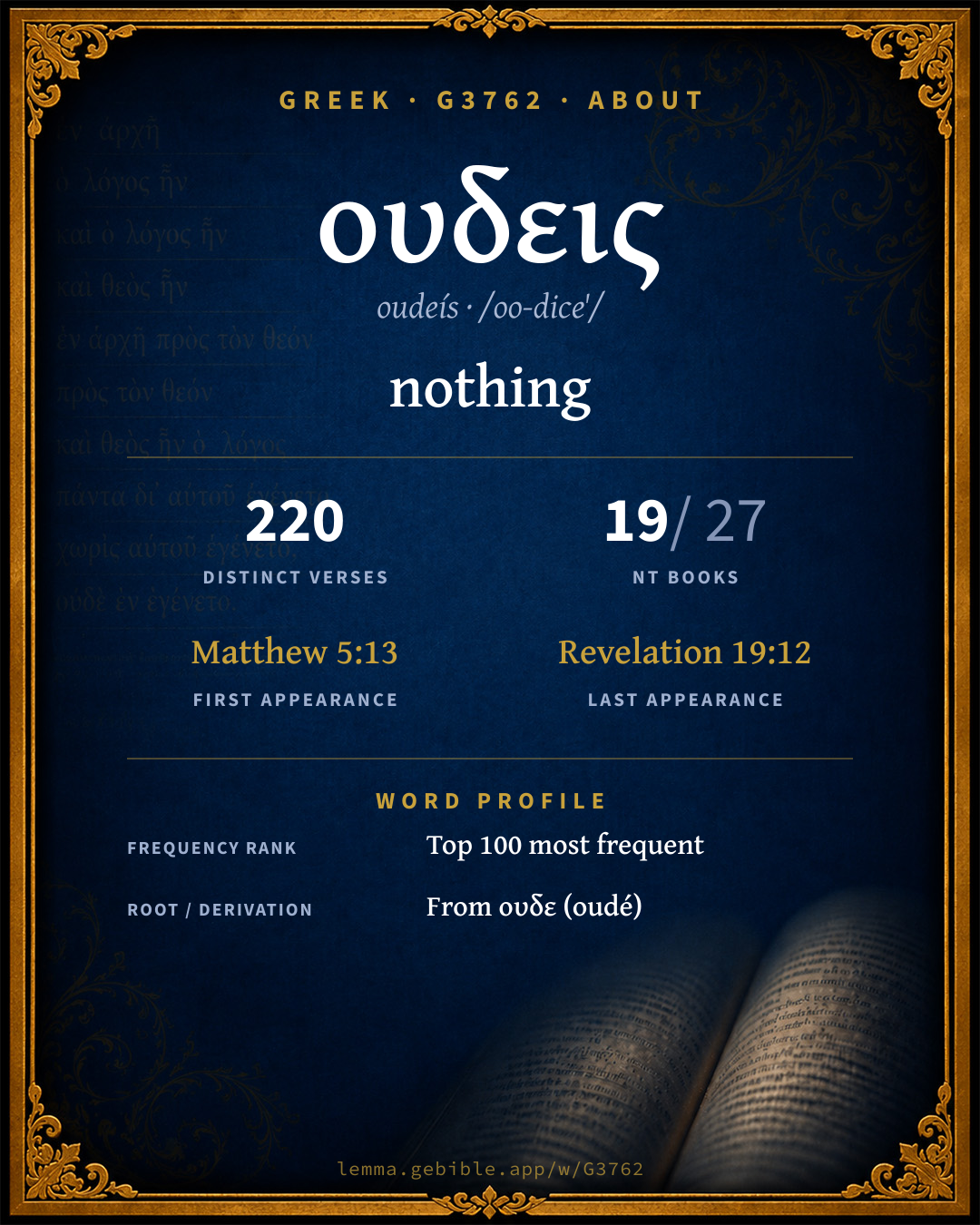
οὐδείς
nothing
Full lexicon entry — Thayer's Greek Lexicon
From Thayer's Greek Lexicon
Where this word appears
See every Nominative-case word in the Greek New Testament →
Grammar key — what these labels mean
Part of speech
- Adjective
- A word that describes or qualifies a noun.
Case
- Nominative
- The case of the subject (and the predicate nominative).
- Accusative
- The case of the direct object and of extent.
- Genitive
- The case of source, possession, or “of” — answers “whose / from what.”
- Dative
- The case of the indirect object, means, or location — “to / for / with / in.”
Gender
- Masculine
- Grammatically masculine.
- Neuter
- Grammatically neuter.
- Feminine
- Grammatically feminine.
Number
- Singular
- One.
Degree
- Negative
- Marks a negative form.
Grammatical forms 10 distinct
- Adjective, Nominative, Singular, Masculine, Negative 98 times (42%)
- Adjective, Accusative, Singular, Neuter, Negative 69 times (30%)
- Adjective, Nominative, Singular, Neuter, Negative 22 times (9%)
- Adjective, Accusative, Singular, Masculine, Negative 16 times (7%)
- Adjective, Genitive, Singular, Masculine, Negative 9 times (4%)
- Adjective, Accusative, Singular, Feminine, Negative 7 times (3%)
- Adjective, Dative, Singular, Masculine, Negative 5 times (2%)
- Adjective, Dative, Singular, Neuter, Negative 3 times (1%)
+2 more forms (4 occurrences)
Parsed forms decoded from the imported morphology (Robinson–Tischendorf, public domain), counted across 233 parsed occurrences — not distinct verses.
Page 1 of 2 — showing verses 1–200 of 220 distinct verses where G3762 appears, across 19 books. Click any verse to open its interlinear word-by-word view. Verse text shown in the World English Bible for context — . Each verse’s Greek form is shown with its reference; the English is not keyword-highlighted, since the data carries no word-level English alignment. Use “Compare translations” on any verse to read it across multiple English versions. This concordance covers the Greek New Testament; Septuagint (Greek Old Testament) occurrences of this word are not indexed here.
Matthew 18 verses
- Matthew 5:13 οὐδὲν adj acc sg neut neg "You are the salt of the earth, but if the salt has lost its flavor, with what will it be salted? It is then good for nothing, but to be cast out and trodden under the feet of men.
- Matthew 6:24 Οὐδεὶς adj nom sg masc neg "No one can serve two masters, for either he will hate the one and love the other; or else he will be devoted to one and despise the other. You can't serve both God and Mammon.
- Matthew 9:16 οὐδεὶς adj nom sg masc neg No one puts a piece of unshrunk cloth on an old garment; for the patch would tear away from the garment, and a worse hole is made.
- Matthew 10:26 οὐδὲν adj nom sg neut neg Therefore don't be afraid of them, for there is nothing covered that will not be revealed; and hidden that will not be known.
- Matthew 11:27 οὐδεὶς adj nom sg masc neg All things have been delivered to me by my Father. No one knows the Son, except the Father; neither does anyone know the Father, except the Son, and he to whom the Son desires to reveal him.
- Matthew 13:34 οὐδὲν adj acc sg neut neg Jesus spoke all these things in parables to the multitudes; and without a parable, he didn't speak to them,
- Matthew 17:8 οὐδένα adj acc sg masc neg Lifting up their eyes, they saw no one, except Jesus alone.
- Matthew 17:20 οὐδὲν adj nom sg neut neg He said to them, "Because of your unbelief. For most assuredly I tell you, if you have faith as a grain of mustard seed, you will tell this mountain, 'Move from here to there,' and it will move; and nothing will be impossible for you.
- Matthew 20:7 οὐδεὶς adj nom sg masc neg "They said to him, 'Because no one has hired us.' "He said to them, 'You also go into the vineyard, and you will receive whatever is right.'
- Matthew 21:19 οὐδὲν adj acc sg neut neg Seeing a fig tree by the road, he came to it, and found nothing on it but leaves. He said to it, "Let there be no fruit from you forever!" Immediately the fig tree withered away.
- Matthew 22:16 οὐδενός adj gen sg masc neg They sent their disciples to him, along with the Herodians, saying, "Teacher, we know that you are honest, and teach the way of God in truth, no matter who you teach, for you aren't partial to anyone.
- Matthew 22:46 οὐδεὶς adj nom sg masc neg No one was able to answer him a word, neither dared any man from that day forth ask him any more questions.
- Matthew 23:16 οὐδέν adj nom sg neut neg "Woe to you, you blind guides, who say, 'Whoever swears by the temple, it is nothing; but whoever swears by the gold of the temple, he is obligated.'
- Matthew 23:18 οὐδέν adj nom sg neut neg 'Whoever swears by the altar, it is nothing; but whoever swears by the gift that is on it, he is obligated.'
- Matthew 24:36 οὐδεὶς adj nom sg masc neg But no one knows of that day and hour, not even the angels of heaven, but my Father only.
- Matthew 26:62 οὐδὲν adj acc sg neut neg The high priest stood up, and said to him, "Have you no answer? What is this that these testify against you?"
- Matthew 27:12 οὐδὲν adj acc sg neut neg When he was accused by the chief priests and elders, he answered nothing.
- Matthew 27:24 οὐδὲν adj acc sg neut neg So when Pilate saw that nothing was being gained, but rather that a disturbance was starting, he took water, and washed his hands before the multitude, saying, "I am innocent of the blood of this righteous person. You see to it."
Mark 25 verses
- Mark 2:21 Οὐδεὶς adj nom sg masc neg No one sews a piece of unshrunk cloth on an old garment, or else the patch shrinks and the new tears away from the old, and a worse hole is made.
- Mark 2:22 οὐδεὶς adj nom sg masc neg No one puts new wine into old wineskins, or else the new wine will burst the skins, and the wine pours out, and the skins will be destroyed; but they put new wine into fresh wineskins."
- Mark 3:27 οὐδεὶς adj nom sg masc neg But no one can enter into the house of the strong man to plunder, unless he first binds the strong man; and then he will plunder his house.
- Mark 5:3 οὐδεὶς adj nom sg masc neg who had his dwelling in the tombs. Nobody could bind him any more, not even with chains,
- Mark 5:4 οὐδεὶς adj nom sg masc neg because he had been often bound with fetters and chains, and the chains had been torn apart by him, and the fetters broken in pieces. Nobody had the strength to tame him.
- Mark 5:37 οὐδένα adj acc sg masc neg He allowed no one to follow him, except Peter, James, and John the brother of James.
- Mark 6:5 οὐδεμίαν adj acc sg fem neg He could do no mighty work there, except that he laid his hands on a few sick people, and healed them.
- Mark 7:12 οὐδὲν adj acc sg neut neg then you no longer allow him to do anything for his father or his mother,
- Mark 7:15 οὐδέν adj nom sg neut neg There is nothing from outside of the man, that going into him can defile him; but the things which proceed out of the man are those that defile the man.
- Mark 7:24 οὐδένα adj acc sg masc neg From there he arose, and went away into the borders of Tyre and Sidon. He entered into a house, and didn't want anyone to know it, but he couldn't escape notice.
- Mark 9:8 οὐδένα adj acc sg masc neg Suddenly looking around, they saw no one with them any more, except Jesus only.
- Mark 9:29 οὐδενὶ adj dat sg neut neg He said to them, "This kind can come out by nothing, except by prayer and fasting."
- Mark 9:39 οὐδεὶς adj nom sg masc neg But Jesus said, "Don't forbid him, for there is no one who will do a mighty work in my name, and be able quickly to speak evil of me.
- Mark 10:18 οὐδεὶς adj nom sg masc neg Jesus said to him, "Why do you call me good? No one is good except one-- God.
- Mark 10:29 οὐδείς adj nom sg masc neg Jesus said, "Most assuredly I tell you, there is no one who has left house, or brothers, or sisters, or father, or mother, or wife, or children, or land, for my sake, and for the Gospel's sake,
- Mark 11:2 οὐδεὶς adj nom sg masc neg and said to them, "Go your way into the village that is opposite you. Immediately as you enter into it, you will find a young donkey tied, on which no one has sat. Untie him, and bring him.
- Mark 11:13 οὐδὲν adj acc sg neut neg Seeing a fig tree afar off having leaves, he came to see if perhaps he might find anything on it. When he came to it, he found nothing but leaves, for it was not the season for figs.
- Mark 12:14 οὐδενός adj gen sg masc neg When they had come, they asked him, "Teacher, we know that you are honest, and don't defer to anyone; for you aren't partial to anyone, but truly teach the way of God. Is it lawful to pay taxes to Caesar, or not?
- Mark 12:34 οὐδεὶς adj nom sg masc neg When Jesus saw that he answered wisely, he said to him, "You are not far from the Kingdom of God." No one dared ask him any question after that.
- Mark 13:32 οὐδεὶς adj nom sg masc neg But of that day or that hour no one knows, not even the angels in heaven, nor the Son, but only the Father.
- Mark 14:60 οὐδέν adj acc sg neut neg The high priest stood up in the midst, and asked Jesus, "Have you no answer? What is it which these testify against you?"
- Mark 14:61 οὐδέν adj acc sg neut neg But he stayed quiet, and answered nothing. Again the high priest asked him, "Are you the Christ, the Son of the Blessed?"
- Mark 15:4 οὐδέν adj acc sg neut neg Pilate again asked him, "Have you no answer? See how many things they testify against you!"
- Mark 15:5 οὐδὲν adj acc sg neut neg But Jesus made no further answer, so that Pilate marveled.
- Mark 16:8 οὐδενὶ οὐδὲν adj dat sg masc neg adj acc sg neut neg They went out, and fled from the tomb, for trembling and astonishment had come on them. They said nothing to anyone; for they were afraid.
Luke 34 verses
- Luke 1:61 οὐδείς adj nom sg masc neg They said to her, "There is no one among your relatives who is called by this name."
- Luke 4:2 οὐδὲν adj acc sg neut neg for forty days, being tempted by the devil. He ate nothing in those days. Afterward, when they were completed, he was hungry.
- Luke 4:24 οὐδεὶς adj nom sg masc neg He said, "Most assuredly I tell you, no prophet is acceptable in his hometown.
- Luke 4:26 οὐδεμίαν adj acc sg fem neg Elijah was sent to none of them, except to Zarephath, in the land of Sidon, to a woman who was a widow.
- Luke 4:27 οὐδεὶς adj nom sg masc neg There were many lepers in Israel in the time of Elisha the prophet, yet not one of them was cleansed, except Naaman, the Syrian."
- Luke 5:5 οὐδὲν adj acc sg neut neg Simon answered him, "Master, we worked all night, and took nothing; but at your word I will let down the net."
- Luke 5:36 οὐδεὶς adj nom sg masc neg He also told a parable to them. "No one puts a piece from a new garment on an old garment, or else he will tear the new, and also the piece from the new will not match the old.
- Luke 5:37 οὐδεὶς adj nom sg masc neg No one puts new wine into old wineskins, or else the new wine will burst the skins, and it will be spilled, and the skins will be destroyed.
- Luke 5:39 οὐδεὶς adj nom sg masc neg No man having drunk old wine immediately desires new, for he says, 'The old is better.'"
- Luke 7:28 οὐδείς adj nom sg masc neg "For I tell you, among those who are born of women there is not a greater prophet than John the Baptizer, yet he who is least in the Kingdom of God is greater than he."
- Luke 8:16 Οὐδεὶς adj nom sg masc neg "No one, when he has lit a lamp, covers it with a container, or puts it under a bed; but puts it on a stand, that those who enter in may see the light.
- Luke 8:43 οὐδενὸς adj gen sg masc neg A woman who had a flow of blood for twelve years, who had spent all her living on physicians, and could not be healed by any,
- Luke 9:36 οὐδενὶ οὐδὲν adj dat sg masc neg adj acc sg neut neg When the voice came, Jesus was found alone. They were silent, and told no one in those days any of the things which they had seen.
- Luke 9:62 οὐδεὶς adj nom sg masc neg But Jesus said to him, "No one, having put his hand to the plow, and looking back, is fit for the Kingdom of God."
- Luke 10:19 οὐδὲν adj acc sg neut neg Behold, I give you authority to tread on serpents and scorpions, and over all the power of the enemy. Nothing will in any way hurt you.
- Luke 10:22 οὐδεὶς adj nom sg masc neg Turning to the disciples, he said, "All things have been delivered to me by my Father. No one knows who the Son is, except the Father, and who the Father is, except the Son, and he to whomever the Son desires to reveal him."
- Luke 11:33 Οὐδεὶς adj nom sg masc neg "No man, when he has lit a lamp, puts it in a cellar, nor under a basket, but on a stand, that those who enter in may see the light.
- Luke 12:2 οὐδὲν adj nom sg neut neg But there is nothing covered up, that will not be revealed, nor hidden, that will not be known.
- Luke 14:24 οὐδεὶς adj nom sg masc neg For I tell you that none of those men who were invited will taste of my supper.'"
- Luke 15:16 οὐδεὶς adj nom sg masc neg He wanted to fill his belly with the husks that the pigs ate, but no one gave him any.
- Luke 16:13 οὐδεὶς adj nom sg masc neg No servant can serve two masters, for either he will hate the one, and love the other; or else he will hold to one, and despise the other. You aren't able to serve God and mammon."
- Luke 18:19 οὐδεὶς adj nom sg masc neg Jesus asked him, "Why do you call me good? No one is good, except one--God.
- Luke 18:29 οὐδείς adj nom sg masc neg He said to them, "Most assuredly I tell you, there is no one who has left house, or wife, or brothers, or parents, or children, for the Kingdom of God's sake,
- Luke 18:34 οὐδὲν adj acc sg neut neg They understood none of these things. This saying was hidden from them, and they didn't understand the things that were said.
- Luke 19:30 οὐδεὶς adj nom sg masc neg saying, "Go your way into the village on the other side, in which, as you enter, you will find a colt tied, whereon no man ever yet sat. Untie it, and bring it.
- Luke 20:40 οὐδέν adj acc sg neut neg They didn't dare to ask him any more questions.
- Luke 22:35 οὐθενός adj gen sg neut neg He said to them, "When I sent you out without purse, and wallet, and shoes, did you lack anything?" They said, "Nothing."
- Luke 23:4 οὐδὲν adj acc sg neut neg Pilate said to the chief priests and the multitudes, "I find no basis for a charge against this man."
- Luke 23:9 οὐδὲν adj acc sg neut neg He questioned him with many words, but he gave no answers.
- Luke 23:14 οὐθὲν adj acc sg neut neg and said to them, "You brought this man to me as one that perverts the people, and see, I have examined him before you, and found no basis for a charge against this man concerning those things of which you accuse him.
- Luke 23:15 οὐδὲν adj nom sg neut neg Neither has Herod, for I sent you to him, and see, nothing worthy of death has been done by him.
- Luke 23:22 οὐδὲν adj acc sg neut neg He said to them the third time, "Why? What evil has this man done? I have found no capital crime in him. I will therefore chastise him and release him."
- Luke 23:41 οὐδὲν adj acc sg neut neg And we indeed justly, for we receive the due reward for our deeds, but this man has done nothing wrong."
- Luke 23:53 οὐδεὶς adj nom sg masc neg He took it down, and wrapped it in a linen cloth, and laid him in a tomb that was cut in stone, where no one had ever been laid.
John 53 verses
- John 1:18 οὐδεὶς adj nom sg masc neg No one has seen God at any time. The one and only Son, who is in the bosom of the Father, he has declared him.
- John 3:2 οὐδεὶς adj nom sg masc neg The same came to him by night, and said to him, "Rabbi, we know that you are a teacher come from God, for no one can do these signs that you do, unless God is with him."
- John 3:13 οὐδεὶς adj nom sg masc neg No one has ascended into heaven, but he who descended out of heaven, the Son of Man, who is in heaven.
- John 3:27 οὐδέν adj acc sg neut neg John answered, "A man can receive nothing, unless it has been given him from heaven.
- John 3:32 οὐδεὶς adj nom sg masc neg What he has seen and heard, of that he testifies; and no one receives his witness.
- John 4:27 οὐδεὶς adj nom sg masc neg At this, his disciples came. They marveled that he was speaking with a woman; yet no one said, "What are you looking for?" or, "Why do you speak with her?"
- John 5:19 οὐδέν adj acc sg neut neg Jesus therefore answered them, "Most assuredly, I tell you, the Son can do nothing of himself, but what he sees the Father doing. For whatever things he does, these the Son also does likewise.
- John 5:22 οὐδένα adj acc sg masc neg For the Father judges no one, but he has given all judgment to the Son,
- John 5:30 οὐδέν adj acc sg neut neg I can of myself do nothing. As I hear, I judge, and my judgment is righteous; because I don't seek my own will, but the will of my Father who sent me.
- John 6:44 οὐδεὶς adj nom sg masc neg No one can come to me unless the Father who sent me draws him, and I will raise him up in the last day.
- John 6:63 οὐδέν adj acc sg neut neg It is the spirit who gives life. The flesh profits nothing. The words that I speak to you are spirit, and are life.
- John 6:65 οὐδεὶς adj nom sg masc neg He said, "For this cause have I said to you that no one can come to me, unless it is given to him by my Father."
- John 7:4 οὐδεὶς adj nom sg masc neg For no one does anything in secret, and himself seeks to be known openly. If you do these things, reveal yourself to the world."
- John 7:13 οὐδεὶς adj nom sg masc neg Yet no one spoke openly of him for fear of the Jews.
- John 7:19 οὐδεὶς adj nom sg masc neg Didn't Moses give you the law, and yet none of you keeps the law? Why do you seek to kill me?"
- John 7:26 οὐδὲν adj acc sg neut neg Behold, he speaks openly, and they say nothing to him. Can it be that the rulers indeed know that this is truly the Christ?
- John 7:27 οὐδεὶς adj nom sg masc neg However we know where this man comes from, but when the Christ comes, no one will know where he comes from."
- John 7:30 οὐδεὶς adj nom sg masc neg They sought therefore to take him; but no one laid a hand on him, because his hour had not yet come.
- John 7:44 οὐδεὶς adj nom sg masc neg Some of them would have arrested him, but no one laid hands on him.
- John 8:10 οὐδείς adj nom sg masc neg Jesus, standing up, saw her and said, "Woman, where are your accusers? Did no one condemn you?"
- John 8:11 οὐδείς adj nom sg masc neg She said, "No one, Lord." Jesus said, "Neither do I condemn you. Go your way. From now on, sin no more."
- John 8:15 οὐδένα adj acc sg masc neg You judge according to the flesh. I judge no one.
- John 8:20 οὐδεὶς adj nom sg masc neg Jesus spoke these words in the treasury, as he taught in the temple. Yet no one arrested him, because his hour had not yet come.
- John 8:28 οὐδέν adj acc sg neut neg Jesus therefore said to them, "When you have lifted up the Son of Man, then you will know that I am he, and I do nothing of myself, but as my Father taught me, I say these things.
- John 8:33 οὐδενὶ adj dat sg masc neg They answered him, "We are Abraham's seed, and have never been in bondage to anyone. How do you say, 'You will be made free?'"
- John 8:54 οὐδέν adj nom sg neut neg Jesus answered, "If I glorify myself, my glory is nothing. It is my Father who glorifies me, of whom you say that he is our God.
- John 9:4 οὐδεὶς adj nom sg masc neg I must work the works of him who sent me, while it is day. The night is coming, when no one can work.
- John 9:33 οὐδέν adj acc sg neut neg If this man were not from God, he could do nothing."
- John 10:18 οὐδεὶς adj nom sg masc neg No one takes it away from me, but I lay it down by myself. I have power to lay it down, and I have power to take it again. I received this commandment from my Father."
- John 10:29 οὐδεὶς adj nom sg masc neg My Father, who has given them to me, is greater than all. No one is able to snatch them out of my Father's hand.
- John 10:41 οὐδέν adj acc sg neut neg Many came to him. They said, "John indeed did no sign, but everything that John said about this man is true."
- John 11:49 οὐδέν adj acc sg neut neg But a certain one of them, Caiaphas, being high priest that year, said to them, "You know nothing at all,
- John 12:19 οὐδέν adj acc sg neut neg The Pharisees therefore said among themselves, "See how you accomplish nothing. Behold, the world has gone after him."
- John 13:28 οὐδεὶς adj nom sg masc neg Now no man at the table knew why he said this to him.
- John 14:6 οὐδεὶς adj nom sg masc neg Jesus said to him, "I am the way, the truth, and the life. No one comes to the Father, except through me.
- John 14:30 οὐδέν adj acc sg neut neg I will no more speak much with you, for the prince of the world comes, and he has nothing in me.
- John 15:5 οὐδέν adj acc sg neut neg I am the vine. You are the branches. He who remains in me, and I in him, the same bears much fruit, for apart from me you can do nothing.
- John 15:13 οὐδεὶς adj nom sg masc neg Greater love has no one than this, that someone lay down his life for his friends.
- John 15:24 οὐδεὶς adj nom sg masc neg If I hadn't done among them the works which no one else did, they wouldn't have had sin. But now have they seen and also hated both me and my Father.
- John 16:5 οὐδεὶς adj nom sg masc neg But now I am going to him who sent me, and none of you asks me, 'Where are you going?'
- John 16:22 οὐδεὶς adj nom sg masc neg Therefore you now have sorrow, but I will see you again, and your heart will rejoice, and no one will take your joy away from you.
- John 16:23 οὐδέν adj acc sg neut neg "In that day you will ask me no questions. Most assuredly I tell you, whatever you may ask of the Father in my name, he will give it to you.
- John 16:24 οὐδὲν adj acc sg neut neg Until now, you have asked nothing in my name. Ask, and you will receive, that your joy may be made full.
- John 16:29 οὐδεμίαν adj acc sg fem neg His disciples said to him, "Behold, now you speak plainly, and speak no figures of speech.
- John 17:12 οὐδεὶς adj nom sg masc neg While I was with them in the world, I kept them in your name. Those whom you have given me I have kept. None of them is lost, except the son of destruction, that the Scripture might be fulfilled.
- John 18:9 οὐδένα adj acc sg masc neg that the word might be fulfilled which he spoke, "Of those whom you have given me, I have lost none."
- John 18:20 οὐδέν adj acc sg neut neg Jesus answered him, "I spoke openly to the world. I always taught in synagogues, and in the temple, where the Jews always meet. I said nothing in secret.
- John 18:31 οὐδένα adj acc sg masc neg Pilate therefore said to them, "Take him yourselves, and judge him according to your law." Therefore the Jews said to him, "It is not lawful for us to put anyone to death,"
- John 18:38 οὐδεμίαν adj acc sg fem neg Pilate said to him, "What is truth?" When he had said this, he went out again to the Jews, and said to them, "I find no basis for a charge against him.
- John 19:11 οὐδεμίαν adj acc sg fem neg Jesus answered, "You would have no power at all against me, unless it were given to you from above. Therefore he who delivered me to you has greater sin."
- John 19:41 οὐδεὶς adj nom sg masc neg Now in the place where he was crucified there was a garden. In the garden a new tomb in which no man had ever yet been laid.
- John 21:3 οὐδέν adj acc sg neut neg Simon Peter said to them, "I'm going fishing." They told him, "We are also coming with you." They immediately went out, and entered into the boat. That night, they caught nothing.
- John 21:12 οὐδεὶς adj nom sg masc neg Jesus said to them, "Come and eat breakfast." None of the disciples dared inquire of him, "Who are you?" knowing that it was the Lord.
Acts 27 verses
- Acts 4:12 οὐδενὶ adj dat sg masc neg There is salvation in none other, for neither is there any other name under heaven, that is given among men, by which we must be saved!"
- Acts 4:14 οὐδὲν adj acc sg neut neg Seeing the man who was healed standing with them, they could say nothing against it.
- Acts 5:13 οὐδεὶς adj nom sg masc neg None of the rest dared to join them, however the people honored them.
- Acts 5:23 οὐδένα adj acc sg masc neg "We found the prison shut and locked, and the guards standing before the doors, but when we opened them, we found no one inside!"
- Acts 5:36 οὐδέν adj acc sg neut neg For before these days Theudas rose up, making himself out to be somebody; to whom a number of men, about four hundred, joined themselves: who was slain; and all, as many as obeyed him, were dispersed, and came to nothing.
- Acts 8:16 οὐδενὶ adj dat sg masc neg for as yet he had fallen on none of them. They had only been baptized in the name of Christ Jesus.
- Acts 9:8 οὐδὲν adj acc sg neut neg Saul arose from the ground, and when his eyes were opened, he saw no one. They led him by the hand, and brought him into Damascus.
- Acts 15:9 οὐθὲν adj acc sg neut neg He made no distinction between us and them, cleansing their hearts by faith.
- Acts 17:21 οὐδὲν adj acc sg neut neg Now all the Athenians and the strangers living there spent their time in nothing else, but either to tell or to hear some new thing.
- Acts 18:10 οὐδεὶς adj nom sg masc neg for I am with you, and no one will attack you to harm you, for I have many people in this city."
- Acts 18:17 οὐδὲν adj nom sg neut neg Then all the Greeks laid hold on Sosthenes, the ruler of the synagogue, and beat him before the judgment seat. Gallio didn't care about any of these things.
- Acts 19:27 οὐθὲν adj acc sg neut neg Not only is there danger that this our trade come into disrepute, but also that the temple of the great goddess Artemis will be counted as nothing, and her majesty destroyed, whom all Asia and the world worships."
- Acts 20:20 οὐδὲν adj acc sg neut neg how I didn't shrink from declaring to you anything that was profitable, teaching you publicly and from house to house,
- Acts 20:24 οὐδενὸς adj gen sg masc neg But these things don't count; nor do I hold my life dear to myself, so that I may finish my race with joy, and the ministry which I received from the Lord Jesus, to fully testify to the Gospel of the grace of God.
- Acts 20:33 οὐδενὸς adj gen sg masc neg I coveted no one's silver, or gold, or clothing.
- Acts 21:24 οὐδέν adj nom sg neut neg Take them, and purify yourself with them, and pay their expenses for them, that they may shave their heads. Then all will know that there is no truth in the things that they have been informed about you, but that you yourself also walk keeping the law.
- Acts 23:9 οὐδὲν adj acc sg neut neg A great clamor arose, and some of the scribes of the Pharisees part stood up, and contended, saying, "We find no evil in this man. But if a spirit or angel has spoken to him, let's not fight against God!"
- Acts 25:10 οὐδὲν adj acc sg neut neg But Paul said, "I am standing before Caesar's judgment seat, where I ought to be tried. I have done no wrong to the Jews, as you also know very well.
- Acts 25:11 οὐδέν οὐδείς adj nom sg neut neg adj nom sg masc neg For if I have done wrong, and have committed anything worthy of death, I don't refuse to die; but if none of those things is true that they accuse me of, no one can give me up to them. I appeal to Caesar!"
- Acts 25:18 οὐδεμίαν adj acc sg fem neg Concerning whom, when the accusers stood up, they brought no charge of such things as I supposed;
- Acts 26:22 οὐδὲν adj acc sg neut neg Having therefore obtained the help that is from God, I stand to this day testifying both to small and great, saying nothing but what the prophets and Moses said would happen,
- Acts 26:26 οὐθέν adj acc sg neut neg For the king knows of these things, to whom also I speak freely. For I am persuaded that none of these things is hidden from him, for this has not been done in a corner.
- Acts 26:31 οὐδὲν adj acc sg neut neg When they had withdrawn, they spoke one to another, saying, "This man does nothing worthy of death or of bonds."
- Acts 27:22 οὐδεμία adj nom sg fem neg Now I exhort you to cheer up, for there will be no loss of life among you, but only of the ship.
- Acts 27:34 οὐδενὸς adj gen sg masc neg Therefore I beg you to take some food, for this is for your safety; for not a hair will perish from any of your heads."
- Acts 28:5 οὐδὲν adj acc sg neut neg However he shook off the creature into the fire, and wasn't harmed.
- Acts 28:17 οὐδὲν adj acc sg neut neg It happened that after three days Paul called together those who were the leaders of the Jews. When they had come together, he said to them, "I, brothers, though I had done nothing against the people, or the customs of our fathers, still was delivered prisoner from Jerusalem into the hands of the Romans,
Romans 3 verses
- Romans 8:1 Οὐδὲν adj nom sg neut neg There is therefore now no condemnation to those who are in Christ Jesus, who don't walk according to the flesh, but according to the Spirit.
- Romans 14:7 οὐδεὶς οὐδεὶς adj nom sg masc neg adj nom sg masc neg For none of us lives to himself, and none dies to himself.
- Romans 14:14 οὐδὲν adj nom sg neut neg I know, and am persuaded in the Lord Jesus, that nothing is unclean of itself; except that to him who considers anything to be unclean, to him it is unclean.
1 Corinthians 15 verses
- 1 Corinthians 1:14 οὐδένα adj acc sg masc neg I thank God that I baptized none of you, except Crispus and Gaius,
- 1 Corinthians 2:8 οὐδεὶς adj nom sg masc neg which none of the rulers of this world has known. For had they known it, they wouldn't have crucified the Lord of glory.
- 1 Corinthians 2:11 οὐδεὶς adj nom sg masc neg For who among men knows the things of a man, except the spirit of the man, which is in him? Even so, no one knows the things of God, except God's Spirit.
- 1 Corinthians 2:15 οὐδενὸς adj gen sg masc neg But he who is spiritual discerns all things, and he himself is judged by no one.
- 1 Corinthians 3:11 οὐδεὶς adj nom sg masc neg For no one can lay any other foundation than that which has been laid, which is Jesus Christ.
- 1 Corinthians 4:4 οὐδὲν adj acc sg neut neg For I know nothing against myself. Yet I am not justified by this, but he who judges me is the Lord.
- 1 Corinthians 6:5 οὐδεὶς adj nom sg masc neg I say this to move you to shame. Isn't there even one wise man among you who would be able to decide between his brothers?
- 1 Corinthians 7:19 οὐδέν οὐδέν adj nom sg neut neg adj nom sg neut neg Circumcision is nothing, and uncircumcision is nothing, but the keeping of the commandments of God.
- 1 Corinthians 8:4 οὐδὲν οὐδεὶς adj nom sg neut neg adj nom sg masc neg Therefore concerning the eating of things sacrificed to idols, we know that no idol is anything in the world, and that there is no other God but one.
- 1 Corinthians 9:15 οὐδενὶ οὐδεὶς adj dat sg neut neg adj nom sg masc neg But I have used none of these things, and I don't write these things that it may be done so in my case; for I would rather die, than that anyone should make my boasting void.
- 1 Corinthians 12:3 οὐδεὶς οὐδεὶς adj nom sg masc neg adj nom sg masc neg Therefore I make known to you that no man speaking by God's Spirit says, "Jesus is accursed." No one can say, "Jesus is Lord," but by the Holy Spirit.
- 1 Corinthians 13:2 οὐθέν adj nom sg neut neg If I have the gift of prophecy, and know all mysteries and all knowledge; and if I have all faith, so as to remove mountains, but don't have love, I am nothing.
- 1 Corinthians 13:3 οὐθὲν adj acc sg neut neg If I dole out all my goods to feed the poor, and if I give my body to be burned, but don't have love, it profits me nothing.
- 1 Corinthians 14:2 οὐδεὶς adj nom sg masc neg For he who speaks in another language speaks not to men, but to God; for no one understands; but in the Spirit he speaks mysteries.
- 1 Corinthians 14:10 οὐδὲν adj nom sg neut neg There are, it may be, so many kinds of sounds in the world, and none of them is without meaning.
2 Corinthians 5 verses
- 2 Corinthians 5:16 οὐδένα adj acc sg masc neg Therefore we know no one after the flesh from now on. Even though we have known Christ after the flesh, yet now we know him so no more.
- 2 Corinthians 7:2 οὐδένα οὐδένα οὐδένα adj acc sg masc neg adj acc sg masc neg adj acc sg masc neg Open your hearts to us. We wronged no one. We corrupted no one. We took advantage of no one.
- 2 Corinthians 7:5 οὐδεμίαν adj acc sg fem neg For even when we had come into Macedonia, our flesh had no relief, but we were afflicted on every side. Fightings were outside. Fear was inside.
- 2 Corinthians 11:8 οὐθενός adj gen sg masc neg I robbed other assemblies, taking wages from them that I might serve you.
- 2 Corinthians 12:11 οὐδὲν οὐδέν adj acc sg neut neg adj nom sg neut neg I have become foolish in boasting. You compelled me, for I ought to have been commended by you, for in nothing was I inferior to the very best apostles, though I am nothing.
Galatians 7 verses
- Galatians 2:6 οὐδέν οὐδὲν adj nom sg neut neg adj acc sg neut neg But from those who were reputed to be important (whatever they were, it makes no difference to me; God doesn't show partiality to man)--they, I say, who were respected imparted nothing to me,
- Galatians 3:11 οὐδεὶς adj nom sg masc neg Now that no man is justified by the law before God is evident, for, "The righteous will live by faith."
- Galatians 3:15 οὐδεὶς adj nom sg masc neg Brothers, I speak like men. Though it is only a man's covenant, yet when it has been confirmed, no one makes it void, or adds to it.
- Galatians 4:1 οὐδὲν adj acc sg neut neg But I say that so long as the heir is a child, he is no different from a bondservant, though he is lord of all;
- Galatians 4:12 οὐδέν adj acc sg neut neg I beg you, brothers, become as I am, for I also have become as you are. You did me no wrong,
- Galatians 5:2 οὐδὲν adj acc sg neut neg Behold, I, Paul, tell you that if you receive circumcision, Christ will profit you nothing.
- Galatians 5:10 οὐδὲν adj acc sg neut neg I have confidence toward you in the Lord that you will think no other way. But he who troubles you will bear his judgment, whoever he is.
Ephesians 1 verse
Philippians 3 verses
- Philippians 1:20 οὐδενὶ adj dat sg neut neg according to my earnest expectation and hope, that I will in no way be disappointed, but with all boldness, as always, now also Christ will be magnified in my body, whether by life, or by death.
- Philippians 2:20 οὐδένα adj acc sg masc neg For I have no one else like-minded, who will truly care about you.
- Philippians 4:15 οὐδεμία adj nom sg fem neg You yourselves also know, you Philippians, that in the beginning of the Gospel, when I departed from Macedonia, no assembly shared with me in the matter of giving and receiving but you only.
1 Timothy 3 verses
- 1 Timothy 4:4 οὐδὲν adj nom sg neut neg For every creature of God is good, and nothing is to be rejected, if it is received with thanksgiving.
- 1 Timothy 6:7 οὐδὲν adj acc sg neut neg For we brought nothing into the world, and we certainly can't carry anything out.
- 1 Timothy 6:16 οὐδεὶς adj nom sg masc neg who alone has immortality, dwelling in unapproachable light; whom no man has seen, nor can see: to whom be honor and eternal power. Amen.
2 Timothy 3 verses
- 2 Timothy 2:4 οὐδεὶς adj nom sg masc neg No soldier on service entangles himself in the affairs of life, that he may please him who enrolled him as a soldier.
- 2 Timothy 2:14 οὐδὲν adj acc sg neut neg Remind them of these things, charging them in the sight of the Lord, that they don't argue about words, to no profit, to the subverting of those who hear.
- 2 Timothy 4:16 οὐδείς adj nom sg masc neg At my first defense, no one came to help me, but all left me. May it not be held against them.
Titus 1 verse
Philemon 1 verse
Hebrews 6 verses
About this entry
At a glance — auto-summarized from this page’s data, not written by a person. Every figure links to its source below. This summary describes the numbers; it doesn’t interpret them.
ουδεις (oudeís) is a Greek word most often rendered “nothing.” Translators differ — “man” in the King James Version, then “one” (Berean Standard Bible), as the renderings breakdown shows. It turns up in 220 verses across 19 books, a common footprint. It first appears in Matthew 5:13. From the same root come ουδε, ουδεποτε and ουδεπω. The sections below give every sense, occurrence, and version rendering.
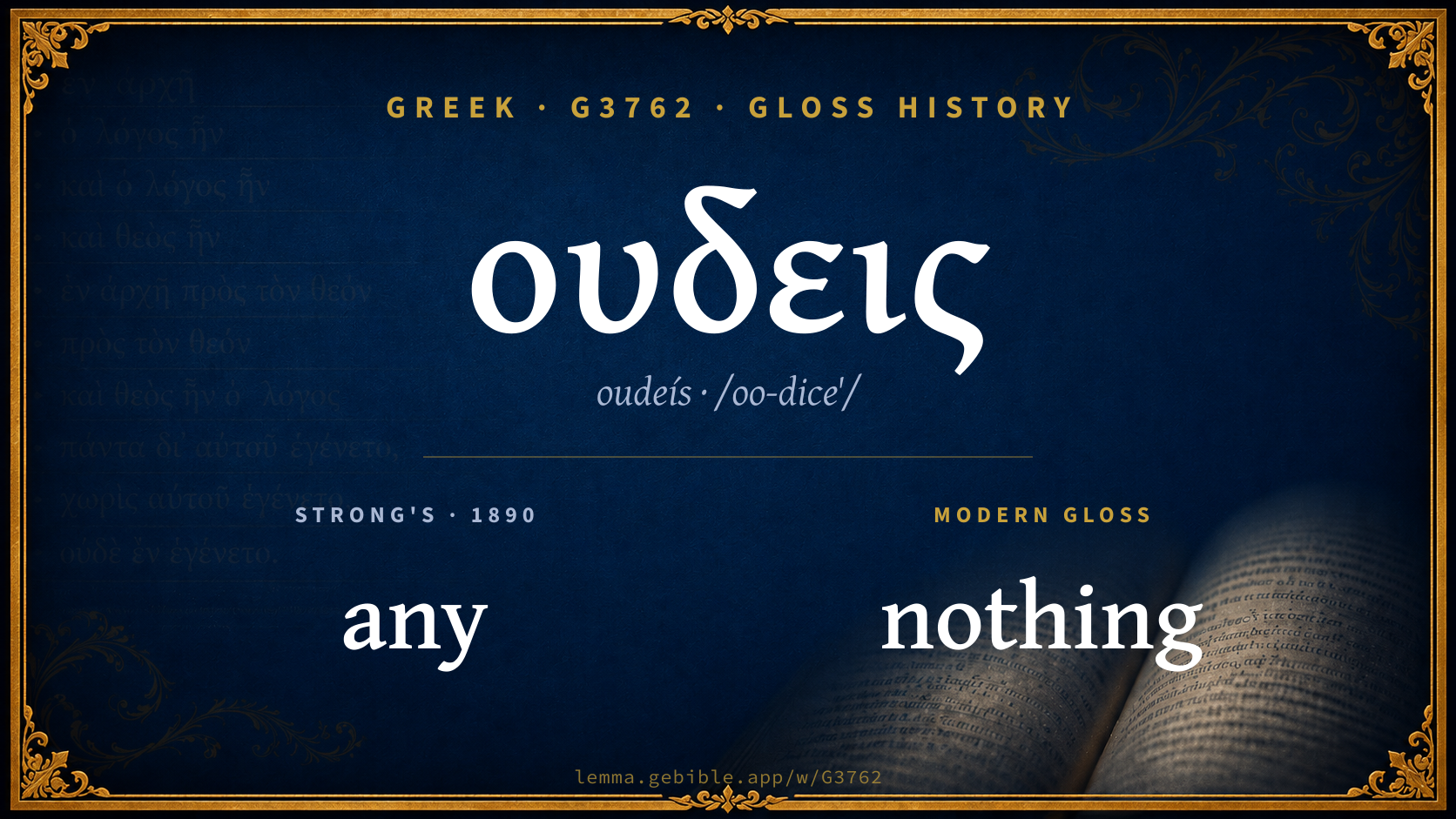
Gloss history
Strong's 1890 vs modern scholarship
About this word
Strong's G3762 catalogs a Greek word from the Greek New Testament.
These counts are not copied from any lexicon or concordance. They are computed here, from the morphology-tagged Greek New Testament. What Lemma adds →
- 220
- distinct verses
- The word appears in 220 distinct verses.
- 19 / 27
- NT books
- The word appears in 19 of 27 New Testament books.
- #68
- by frequency
- Top 100 most frequent Greek words (rank 68 of 5,347 Greek words by occurrence).
View all 220 occurrences in the concordance →
By section of the New Testament
By traditional corpus
Conventional, traditional groupings — biblical authorship is debated, so this is a traditional corpus grouping, not an authorship claim. Some books belong to more than one corpus (Luke is in both the Gospels and the Lukan corpus, and so on), so these shares overlap and need not total 100%. Each figure is a share of the word’s 220 distinct verses.
- Gospels 130 verses · 59%
- Johannine 66 verses · 30%
- Lukan (Luke–Acts) 61 verses · 28%
- Pauline corpus 42 verses · 19%
- Revelation 11 verses · 5%
- Hebrews 6 verses · 3%
- General (Catholic) Epistles 4 verses · 2%
How translations render this word
Counts come from each version’s own published word-to-Strong’s tagging or interlinear alignment — an approximate guide to how each version renders this word, not a word-level alignment the data otherwise carries. Because each total is that version’s own tagged count, the per-version totals vary from one another and need not match the appearance or distinct-verse counts above. These counts may also differ from a printed concordance because Lemma counts each distinctly tagged rendering and does not collapse phrase taggings into a single head-word total. This is a fixed set of word-tagged versions (KJV, ASV, BSB, ULT) and does not change with the reading translation you choose elsewhere. Each version’s license is shown beside its name below (and on Sources).
- King James Version: Man 90×, Nothing 58×, No 23×
- American Standard Version: Man 58×, Nothing 53×, No 30×
- Berean Standard Bible: One 95×, Nothing 42×, No 14×
- unfoldingWord Literal Text: One 97×, Nothing 66×, No 17×
King James Version Public Domain
Renders G3762 across 226 tagged occurrences — most commonly:
Plus 11 renderings that appear only once — usually multi-word phrases or single function words the recovered tagging swept in, not distinct renderings. Not rendered by a distinct English word in 11 further occurrences.
American Standard Version Public Domain
Renders G3762 across 221 tagged occurrences — most commonly:
Plus 19 renderings that appear only once — usually multi-word phrases or single function words the recovered tagging swept in, not distinct renderings.
Berean Standard Bible Public Domain
Renders G3762 across 181 tagged occurrences — most commonly:
Plus 16 renderings that appear only once — usually multi-word phrases or single function words the recovered tagging swept in, not distinct renderings. Not rendered by a distinct English word in 49 further occurrences.
unfoldingWord Literal Text CC BY-SA 4.0
Renders G3762 across 238 tagged occurrences — most commonly:
Plus 3 renderings that appear only once — usually multi-word phrases or single function words the recovered tagging swept in, not distinct renderings.
Senses in Thayer's
The 1 sense Thayer's distinguishes for this word, in lexicon order (not ranked by frequency or importance). The full entry — with sub-senses — is in the Lexicon Entry tab.
- no one, nothing
Word origin
Derived from ουδε (oudé) (G3761) — neither.
Including the feminine οὐδεμία oudemia oo-dem-ee'-ah and the neuter οὐδέν ouden oo-den' From G3761 and G1520 ; not even one (man woman or thing) that is none nobody nothing : - any (man) aught man neither any (thing) never (man) no (man) none (+ of these things) not (any at all -thing) nought.
— Strong’s Exhaustive Concordance (1890), public domain.
Forms in the corpus
The 15 distinct written forms G3762 takes in the Greek New Testament, most frequent first — each parse links to that case’s occurrences in the concordance.
Same root — word family
Other Thayer's entries built from the same root as G3762, grouped by Strong’s listed origin. These share a root / origin per the lexicon — not necessarily a shared meaning. Each links to that word’s own entry.
Derives from
Shares the same root
Derived from this word
Compare all same-root words → Showing 4 of 5 — not the complete family. They share a root, not necessarily a meaning.
Septuagint usage
The same Greek word ουδεις appears 166 times in the Greek Old Testament (Septuagint), across 156 verses in 26 books.
- 166
- LXX occurrences
- Tagged occurrences of this Greek word in the Septuagint.
- 156
- verses
- Distinct Septuagint verses containing this word.
- 26 / 39
- OT books
- The word appears in 26 of the 39 Old Testament books.
Sample Septuagint occurrences
- Genesis 19:31 οὐδείς
- Exodus 2:12 οὐδείς
- Leviticus 26:17 οὐδείς
- Numbers 11:6 οὐδείς
- Deuteronomy 7:24 οὐδείς
- Joshua 2:11 οὐδείς
- Judges 14:6 οὐδείς
- 1 Samuel 11:13 οὐδείς
- 2 Samuel 12:3 οὐδείς
- 1 Kings 3:18 οὐδείς
- 2 Kings 4:2 οὐδείς
- 2 Chronicles 9:20 οὐδείς
Septuagint occurrences (same lexeme)
Every verse where the same Strong’s number (G3762) appears in the Greek Septuagint — showing the first 50 of 156. Verse text shown in the World English Bible for context; the Greek form is the matched word — the English is not keyword-highlighted.
- Genesis 19:31 οὐδείς The firstborn said to the younger, "Our father is old, and there is not a man in the earth to come in to us after the manner of all the earth.
- Genesis 20:9 οὐδείς Then Abimelech called Abraham, and said to him, "What have you done to us? How have I sinned against you, that you have brought on me and on my kingdom a great sin? You have done deeds to me that ought not to be done!"
- Genesis 23:6 οὐδείς "Hear us, my lord. You are a prince of God among us. In the choice of our tombs bury your dead. None of us will withhold from you his tomb, but that you may bury your dead."
- Genesis 30:31 οὐδείς He said, "What shall I give you?" Jacob said, "You shall not give me anything. If you will do this thing for me, I will again feed your flock and keep it.
- Genesis 31:32 οὐδείς With whoever you find your gods, he shall not live. Before our relatives, discern what is yours with me, and take it." For Jacob didn't know that Rachel had stolen them.
- Genesis 31:44 οὐδείς Now come, let us make a covenant, you and I; and let it be for a witness between me and you."
- Genesis 31:50 οὐδείς If you will afflict my daughters, and if you will take wives besides my daughters, no man is with us; behold, God is witness between me and you."
- Genesis 37:4 οὐδείς His brothers saw that their father loved him more than all his brothers, and they hated him, and couldn't speak peaceably to him.
- Genesis 39:6 οὐδείς He left all that he had in Joseph's hand. He didn't concern himself with anything, except for the food which he ate. Joseph was well-built and handsome.
- Genesis 39:8 οὐδείς But he refused, and said to his master's wife, "Behold, my master doesn't know what is with me in the house, and he has put all that he has into my hand.
- Genesis 39:9 οὐδείς He isn't greater in this house than I, neither has he kept back anything from me but you, because you are his wife. How then can I do this great wickedness, and sin against God?"
- Genesis 39:11 οὐδείς It happened about this time, that he went into the house to do his work, and there were none of the men of the house inside.
- Genesis 39:23 οὐδείς The keeper of the prison didn't look after anything that was under his hand, because Yahweh was with him; and that which he did, Yahweh made it prosper.
- Genesis 40:15 οὐδείς For indeed, I was stolen away out of the land of the Hebrews, and here also have I done nothing that they should put me into the dungeon."
- Genesis 41:44 οὐδείς Pharaoh said to Joseph, "I am Pharaoh, and without you shall no man lift up his hand or his foot in all the land of Egypt."
- Genesis 45:1 οὐδείς Then Joseph couldn't control himself before all those who stood before him, and he cried, "Cause every man to go out from me!" There stood no man with him, while Joseph made himself known to his brothers.
- Exodus 2:12 οὐδείς He looked this way and that way, and when he saw that there was no one, he killed the Egyptian, and hid him in the sand.
- Exodus 5:8 οὐδείς The number of the bricks, which they made before, you require from them. You shall not diminish anything of it, for they are idle; therefore they cry, saying, 'Let us go and sacrifice to our God.'
- Exodus 5:11 οὐδείς Go yourselves, get straw where you can find it, for nothing of your work shall be diminished."
- Exodus 8:27 οὐδείς We will go three days' journey into the wilderness, and sacrifice to Yahweh our God, as he shall command us."
- Exodus 9:6 οὐδείς Yahweh did that thing on the next day; and all the cattle of Egypt died, but of the cattle of the children of Israel, not one died.
- Exodus 9:7 οὐδείς Pharaoh sent, and, behold, there was not so much as one of the cattle of the Israelites dead. But the heart of Pharaoh was stubborn, and he didn't let the people go.
- Exodus 10:15 οὐδείς For they covered the surface of the whole earth, so that the land was darkened, and they ate every herb of the land, and all the fruit of the trees which the hail had left. There remained nothing green, either tree or herb of the field, through all the land of Egypt.
- Exodus 10:23 οὐδείς They didn't see one another, neither did anyone rise from his place for three days; but all the children of Israel had light in their dwellings.
- Exodus 34:24 οὐδείς For I will drive out nations before you and enlarge your borders; neither shall any man desire your land when you go up to appear before Yahweh, your God, three times in the year.
- Leviticus 26:17 οὐδείς I will set my face against you, and you will be struck before your enemies. Those who hate you will rule over you; and you will flee when no one pursues you.
- Leviticus 26:36 οὐδείς "'As for those of you who are left, I will send a faintness into their hearts in the lands of their enemies: and the sound of a driven leaf will put them to flight; and they shall flee, as one flees from the sword; and they will fall when no one pursues.
- Leviticus 26:37 οὐδείς They will stumble over one another, as it were before the sword, when no one pursues: and you will have no power to stand before your enemies.
- Leviticus 27:26 οὐδείς "'Only the firstborn among animals, which is made a firstborn to Yahweh, no man may dedicate it; whether an ox or sheep, it is Yahweh's.
- Numbers 11:6 οὐδείς but now our soul is dried away; there is nothing at all save this manna to look on.
- Numbers 16:15 οὐδείς Moses was very angry, and said to Yahweh, "Don't respect their offering: I have not taken one donkey from them, neither have I hurt one of them."
- Numbers 20:19 οὐδείς The children of Israel said to him, We will go up by the highway; and if we drink of your water, I and my cattle, then will I give the price of it: let me only, without [doing] anything [else], pass through on my feet.
- Deuteronomy 7:24 οὐδείς He will deliver their kings into your hand, and you shall make their name to perish from under the sky: there shall no man be able to stand before you, until you have destroyed them.
- Deuteronomy 8:9 οὐδείς a land in which you shall eat bread without scarceness, you shall not lack anything in it; a land whose stones are iron, and out of whose hills you may dig copper.
- Deuteronomy 11:25 οὐδείς There shall no man be able to stand before you: Yahweh your God shall lay the fear of you and the dread of you on all the land that you shall tread on, as he has spoken to you.
- Deuteronomy 13:18 οὐδείς when you shall listen to the voice of Yahweh your God, to keep all his commandments which I command you this day, to do that which is right in the eyes of Yahweh your God.
- Deuteronomy 16:5 οὐδείς You may not sacrifice the Passover within any of your gates, which Yahweh your God gives you;
- Deuteronomy 22:26 οὐδείς but to the lady you shall do nothing; there is in the lady no sin worthy of death: for as when a man rises against his neighbor, and kills him, even so is this matter;
- Deuteronomy 24:5 οὐδείς When a man takes a new wife, he shall not go out in the host, neither shall he be charged with any business: he shall be free at home one year, and shall cheer his wife whom he has taken.
- Deuteronomy 34:6 οὐδείς He buried him in the valley in the land of Moab over against Beth Peor: but no man knows of his tomb to this day.
- Joshua 2:11 οὐδείς As soon as we had heard it, our hearts did melt, neither did there remain any more spirit in any man, because of you: for Yahweh your God, he is God in heaven above, and on earth beneath.
- Joshua 5:1 οὐδείς It happened, when all the kings of the Amorites, who were beyond the Jordan westward, and all the kings of the Canaanites, who were by the sea, heard how that Yahweh had dried up the waters of the Jordan from before the children of Israel, until we were passed over, that their heart melted, neither was there spirit in them any more, because of the children of Israel.
- Joshua 6:1 οὐδείς Now Jericho was tightly shut up because of the children of Israel: none went out, and none came in.
- Joshua 8:17 οὐδείς There was not a man left in Ai or Beth El, who didn't go out after Israel: and they left the city open, and pursued after Israel.
- Joshua 10:8 οὐδείς Yahweh said to Joshua, Don't fear them: for I have delivered them into your hands; there shall not a man of them stand before you.
- Joshua 10:21 οὐδείς that all the people returned to the camp to Joshua at Makkedah in peace: none moved his tongue against any of the children of Israel.
- Joshua 10:28 οὐδείς Joshua took Makkedah on that day, and struck it with the edge of the sword, and the king of it: he utterly destroyed them and all the souls who were therein; he left none remaining; and he did to the king of Makkedah as he had done to the king of Jericho.
- Joshua 10:39 οὐδείς and he took it, and the king of it, and all the cities of it; and they struck them with the edge of the sword, and utterly destroyed all the souls who were therein; he left none remaining: as he had done to Hebron, so he did to Debir, and to the king of it; as he had done also to Libnah, and to the king of it.
- Joshua 11:15 οὐδείς As Yahweh commanded Moses his servant, so did Moses command Joshua: and so did Joshua; he left nothing undone of all that Yahweh commanded Moses.
- Joshua 21:44 οὐδείς Yahweh gave them rest round about, according to all that he swore to their fathers: and there stood not a man of all their enemies before them; Yahweh delivered all their enemies into their hand.
These are occurrences of the same Greek lexeme (G3762) in the Septuagint — not a translation of any one Hebrew word. The store carries no word-level Hebrew↔Greek alignment, so no Hebrew original is asserted here. Counts come from the recovered LXX Strong's tagging — high-frequency vocabulary is well covered, while rare or late forms may be untagged — so they reflect tagged occurrences and may slightly undercount.