1 Timothy 6:7

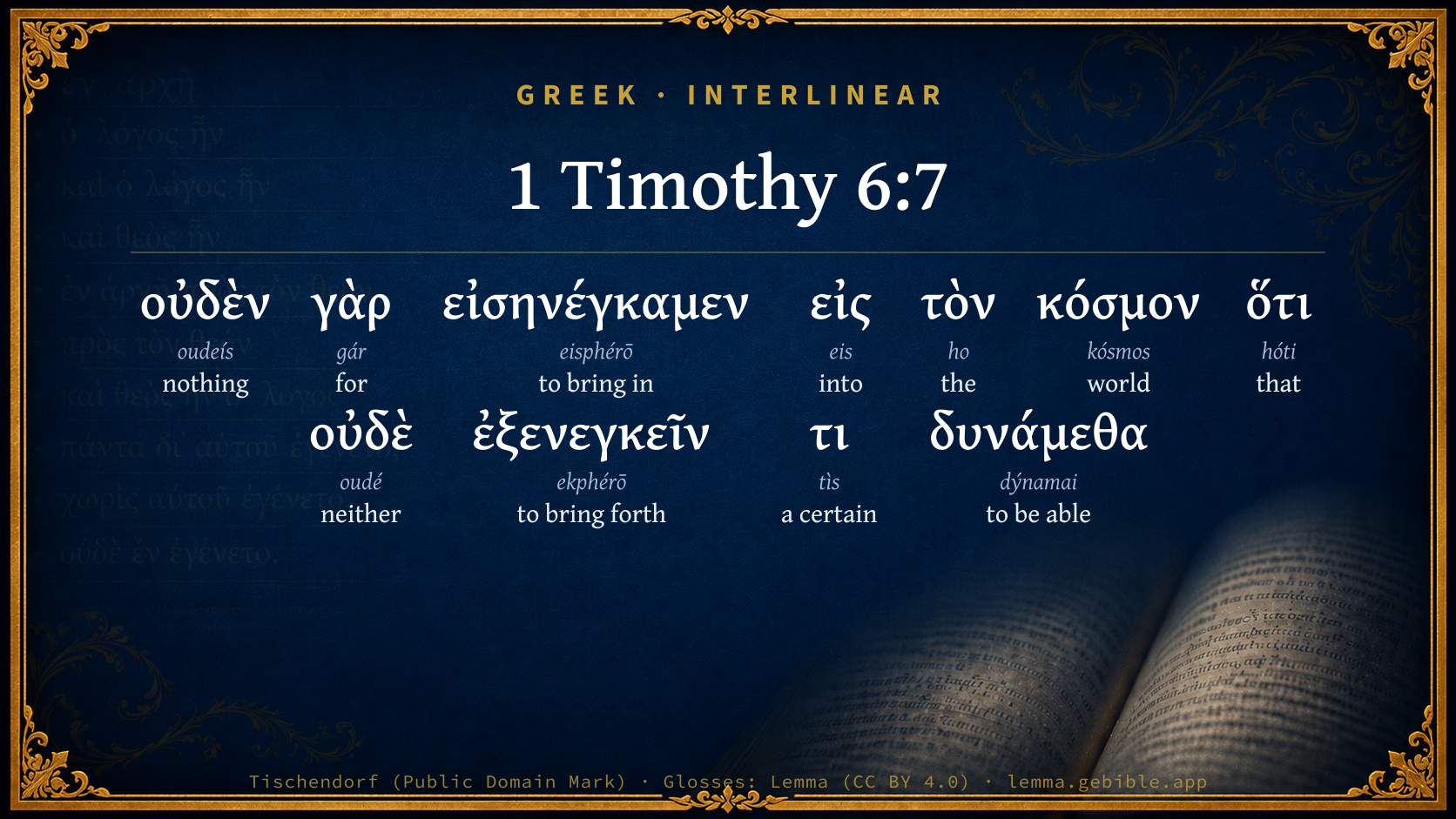
Greek (Tischendorf 8th ed.) 1 Timothy 6:7 appears in the Greek New Testament. The text above is from the Tischendorf 8th edition. Each word links to its Strong’s number and a concise gloss. Click any word for its full Thayer’s Greek Lexicon entry.
Download image
Cite this verse

1 Timothy 6:7 (World English Bible). Public Domain. Lemma interlinear Bible study tool, https://lemma.gebible.app/v/1-timothy/6/7.

Show BibTeX & RIS
BibTeX
RIS
English Translation
For we brought nothing into the world, and we certainly can't carry anything out.
World English Bible · Public Domain
Download a study sheet

One document with this verse’s original text, its word-by-word gloss line, the meaning frame, cross-references with their text, attributed commentary, and full source and license credits — printable, and it pastes into notes with its structure intact.

This verse Autodidact and up

Study sheet (.html) Plain text (.txt)

A passage Seminary Student

Up to 50 verses in one chapter. A passage sheet keeps up to 6 commentary sources and 12 cross-references per verse, in the order this page ranks them, and says so on the sheet whenever that leaves anything out. Ask for a single verse and you get the Autodidact verse sheet above.

Everything on this page stays free to read, with no account — the sheet is a download of what is already on screen, not access to it.

Want to remove ads? Support Godless Engineer
Compare translations 3

The same verse in 3 English versions, stacked beneath the original-language interlinear above. Click any original word for its lexicon entry.

Each is an independent rendering of the whole verse — the interlinear is not word-aligned to these translations.

Highlighted words mark where these versions differ — a whole-verse word diff, not a word-by-word alignment.

  • World English Bible Public Domain
    For we brought nothing into the world, and we certainly can't carry anything out.
  • King James Version Public Domain
    For we brought nothing into this world, and it is certain we can carry nothing out.
  • unfoldingWord Literal Text CC BY-SA 4.0
    For we brought nothing into the world, that neither are we able to take anything out.

unfoldingWord Literal Text — © unfoldingWord, licensed CC BY-SA 4.0. Word-aligned USFM3 via Door43 (git.door43.org/unfoldingWord/en_ult).

Versions to compare (up to 4)

3 of 4 selected

Show all 19 translations

Every available English version of this verse, each an independent rendering of the whole verse.

  • World English Bible Public Domain
    For we brought nothing into the world, and we certainly can't carry anything out.
  • Berean Standard Bible Public Domain
    For we brought nothing into the world, so we cannot carry anything out of it.
  • Majority Standard Bible Public Domain
    For we brought nothing into the world, so certainly we cannot carry anything out of it.
  • King James Version Public Domain
    For we brought nothing into this world, and it is certain we can carry nothing out.
  • American Standard Version (1901) Public Domain
    for we brought nothing into the world, for neither can we carry anything out;
  • Revised Version (1885) Public Domain
    for we brought nothing into the world, for neither can we carry anything out;
  • Geneva Bible (1599) Public Domain
    For we brought nothing into the world, and it is certaine, that we can carie nothing out.
  • Douay-Rheims (1899) Public Domain
    For we brought nothing into this world: and certainly we can carry nothing out.
  • Young's Literal Translation Public Domain
    for nothing did we bring into the world -- `it is' manifest that we are able to carry nothing out;
  • Literal Standard Version CC BY-SA 4.0
    for we brought nothing into the world—because neither are we able to carry out anything;
  • Unlocked Literal Bible CC BY-SA 4.0
    For we have brought nothing into the world. Neither are we able to take out anything.
  • unfoldingWord Literal Text CC BY-SA 4.0
    For we brought nothing into the world, that neither are we able to take anything out.
  • Darby Bible Public Domain
    For we have brought nothing into the world: [it is] [manifest] that neither can we carry anything out.
  • World Messianic Bible Public Domain
    For we brought nothing into the world, and we certainly can’t carry anything out.
  • Webster's Bible Public Domain
    For we brought nothing into this world, and it is certain we can carry nothing out.
  • Free Bible Version CC BY-SA 4.0
    For we didn't bring anything into the world, and we can't take anything out with us either.
  • Bible in Basic English Public Domain
    For we came into the world with nothing, and we are not able to take anything out;
  • Text-Critical English NT CC BY 4.0
    For we brought nothing into the world, and it is clear that we cannot bring anything out either,
  • Tyndale New Testament (1534) Public Domain
    For we brought nothynge into the worlde and it is a playne case that we can cary nothynge out.

Literal Standard Version (2020), Covenant Press — licensed CC BY-SA 4.0. Text via the HelloAO Bible API (eBible.org). Unlocked Literal Bible (unfoldingWord) — licensed CC BY-SA 4.0. Text via the HelloAO Bible API (eBible.org). unfoldingWord Literal Text — © unfoldingWord, licensed CC BY-SA 4.0. Word-aligned USFM3 via Door43 (git.door43.org/unfoldingWord/en_ult). Free Bible Version, Dr. Jonathan Gallagher — licensed CC BY-SA 4.0. Text via the HelloAO Bible API (eBible.org).

Word by word

More ways to search: Search by grammar → Find every occurrence → Compare this word →

Practice this passage: Drill this verse → Learn its vocabulary →

About this verse

These counts appear in no published source. They are computed here, from the morphology-tagged text and Lemma’s own curated glosses. What Lemma adds →

11
words
11
distinct lemmas
Pauline Epistles
section

Notable vocabulary

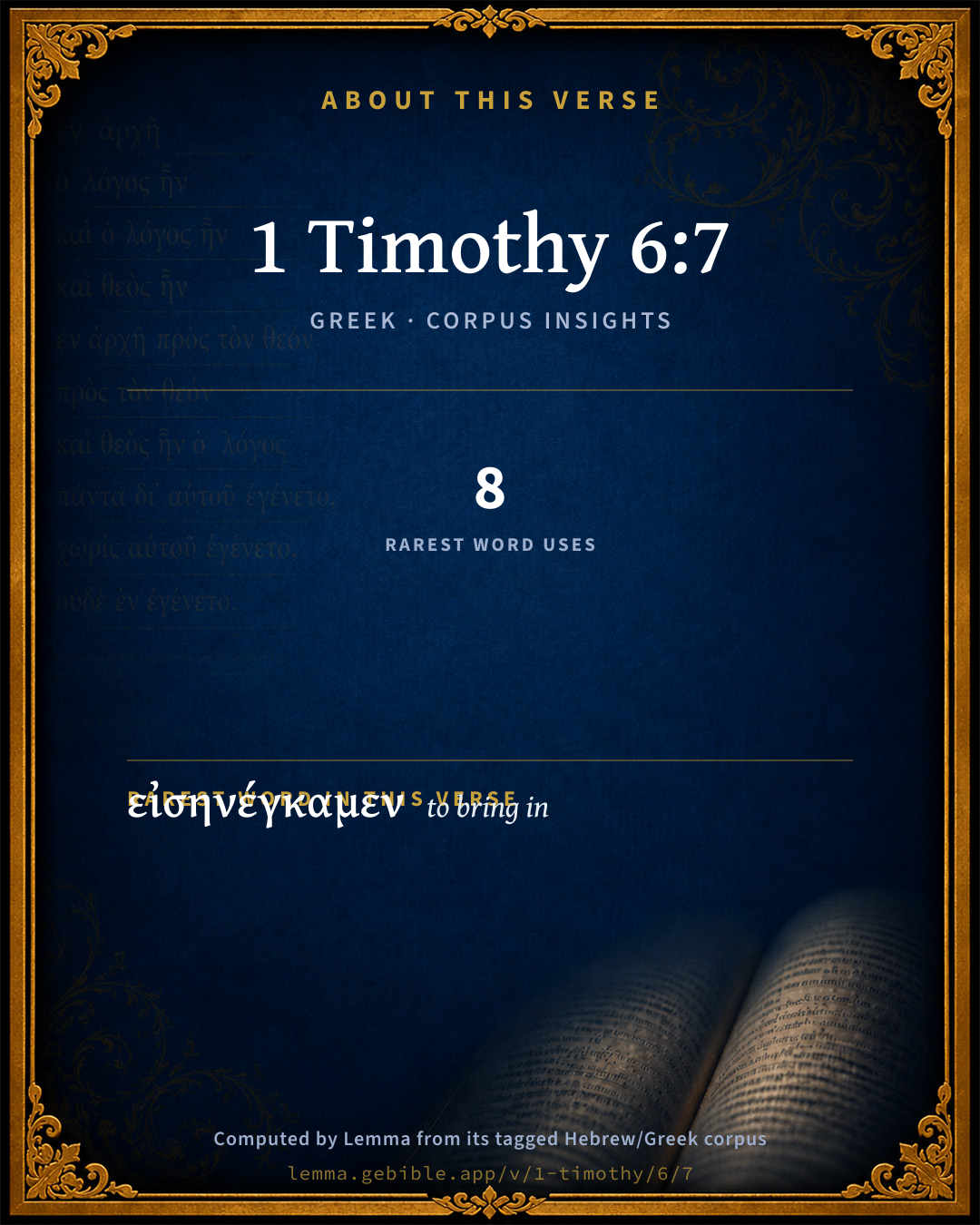
The rarest word here is εἰσηνέγκαμεν to bring in G1533 — appearing just 8 times in the whole Greek New Testament.

Shared distinctive vocabulary

εἰσηνέγκαμεν to bring in G1533 occurs in 8 verses of the Greek New Testament. Also found in:

Cross-references

6

Topical passages linked to 1 Timothy 6:7 in the Treasury of Scripture Knowledge — connected by theme and wording, ordered by reader-vote popularity; previews shown in the World English Bible.

  • Job 1:21 He said, "Naked I came out of my mother's womb, and naked shall I return there. Yahweh gave, and Yahweh has taken away. Blessed be the name of Yahweh."
  • Psalms 49:17 For when he dies he shall carry nothing away. His glory shall not descend after him.
  • Luke 12:20–21 "But God said to him, 'You foolish one, tonight your soul is required of you. The things which you have prepared--whose will they be?'
  • Ecclesiastes 5:15–16 As he came forth from his mother's womb, naked shall he go again as he came, and shall take nothing for his labor, which he may carry away in his hand.
  • Proverbs 27:24 For riches are not forever, Nor does even the crown endure to all generations.
  • Luke 16:22–23 It happened that the beggar died, and that he was carried away by the angels to Abraham's bosom. The rich man also died, and was buried.

Cross-references courtesy of OpenBible.info (CC BY 4.0).

Where the printed editions differ

1 variant

Places in this verse where the major printed Greek editions disagree on the wording in a way that affects the translation — a comparison of editions, not a manuscript-by-manuscript collation. The editions are the modern critical texts (Nestlé-Aland 28/27, SBL, Westcott-Hort, Tregelles, Tyndale House) and the traditional texts behind the KJV (the Textus Receptus and the Byzantine/Majority text). It is not a claim about which reading is original.

  1. Extra text
    δῆλον

    “evident”

    In TRByz Not in NA28NA27TynSBLWHTreg

    δῆλον (dēlon) 'evident' is only in traditional manuscripts (TR+Byz)

Textual data: Translators Amalgamated Greek New Testament (STEPBible TAGNT) · CC BY 4.0.

Commentary

Notes on 1 Timothy 6:7 from classic Christian and Jewish commentators (each source and its license shown beneath its notes). The classic Christian expositions comment on the surrounding passage and are grouped to its opening verse, so a note may address several verses; the Jewish commentaries on the Tanakh (Rashi and others) are per-verse, so they appear only where the commentator wrote on this verse.

Lemma curates 59 commentaries, every one of them public domain or Creative Commons licensed, each selected and text-cleaned for this edition rather than reprinted as found. About our sources →

Bengel's Gnomon

Johann Albrecht Bengel

1Ti 6:7. Οὐδὲν, nothing) A man, when he is born, consists of soul and body: all other things are to him foreign and external.—εἰσηνέγκαμεν, we have brought in) Supply, and yet we have obtained life (including a livelihood); see Mat 6:25.—δῆλον ὅτι) to wit [Engl. Vers. and it is certain that]; a form of declaring.—οὐδὲ ἐξενεγκεῖν, nor carry out) Why then do we heap up much wealth? The only object to be aimed at is that we may have πόρον, an unembarrassed journey, till we reach our true country.

Bengel's Gnomon of the New Testament — English translation (T&T Clark, Edinburgh, 1860) — public domain. Text from a community e-Sword module.

Meyer's Critical & Exegetical Commentary

Heinrich August Wilhelm Meyer

1Ti_6:7 begins the confirmation of the principle that godliness with contentment is a great πορισμός. The apostle here places two clauses together, each of which contains a well-known and undoubted truth: We brought nothing into the world, and We can take nothing out of it. (The same two thoughts are found elsewhere in collocation; so Job_1:21; Ecc_5:14; also in the profane writers, e.g. Seneca, Ep. 102: non licet plus efferre, quam intuleris. For the second thought, comp. Job_27:19; Psa_49:12.) The question is only, in what relation do they stand to one another? According to the common view, the first thought serves to confirm the second: As we brought nothing in, it is manifest that we will take nothing out. Against this, Hofmann maintains that the second thought is in no way a consequence of the first. He therefore takes δῆλον ὅτι as an adverbial: clearly, standing at the end of the sentence, but belonging to both clauses; and he explains: Clearly we have brought nothing in, and can also take nothing out. He is certainly right that the first does not strictly prove the second; but then the apostle did not intend that it should; he simply placed the two sentences together, the second corresponding to the first in such a way as to be confirmed by it in popular opinion. Hence it is not right to connectcontrary to the order of the words

δῆλον ὅτι with the first sentence. As to the lack of δῆλον before ὅτι (see the critical remarks), de Wette observes: that in popular logic the consequence is often quoted with ὅτι as the reason, e.g. Homer, Il. xvi. 35, Od. xxii. 36. This, however, is not to the point here; in the two passages quoted, ὅτι, simply denotes the logical ground of knowledge.

Meyer — Critical and Exegetical Commentary on the New Testament — English translation by Peter Christie, edited by Frederick Crombie (T&T Clark, 1880) — public domain. Text from a community e-Sword module.

Expositor's Greek Testament

ed. W. Robertson Nicoll

1Ti 6:7 . The reasoning of this clause depends on the evident truth that since a man comes naked into this world (Job 1:21 ), and when he leaves it can “take nothing for his labour, which he may carry away in his hand” (Ecc 5:15 ; Psa 49:17 ), nothing the world can give is any addition to the man himself. He is a complete man, though naked (Mat 6:25 ; Luk 12:15 ; Seneca, Ep. Mor . Lev 25 , “Non licet plus efferre quam intuleris”).

Field is right in supposing that if δῆλον , as read in the Received Text, is spurious, yet “there is an ellipsis of δῆλον , or that ὅτι is for δῆλον ὅτι . L. Bos adduces but one example of this ellipsis, 1Jn 3:20 : ὅτι ἐὰν καταγινώσκῃ ἡμῶν ἡ καρδία , ὅτι μείζων ἐστὶν ὁ θεὸς τῆς καρδίας ἡμῶν ; in which, if an ellipsis of δῆλον before the second ὅτι . were admissible, it would seem to offer an easy explanation of that difficult text.” Field adds two examples from St. Chrysostom. Hort’s conjecture that “ ὅτι is no more than an accidental repetition of the last two letters of κόσμον , ΟΝ being read as ΟΤΙ ” is almost certainly right.

The Expositor's Greek Testament, edited by W. Robertson Nicoll (1897–1910) — public domain. Text from a community e-Sword module.

Geneva Bible (1599)

Geneva Bible translators

He mocketh their folly, which do so greedily gape after frail things, that they can in no wise be satisfied, and yet notwithstanding they cannot enjoy that excess.

Geneva Bible (1599) marginal notes — public domain. Text via Bolls.life.

Jamieson, Fausset & Brown

Robert Jamieson, A. R. Fausset & David Brown

For--confirming the reasonableness of "contentment."

and it is certain--Vulgate and other old versions support this reading. The oldest manuscripts, however, omit "and it is certain"; then the translation will be, "We brought nothing into the world (to teach us to remember) that neither can we carry anything out" (Job 1:21; Ecc 5:15). Therefore, we should have no gain-seeking anxiety, the breeder of discontent (Mat 6:25).

Jamieson, Fausset & Brown — Commentary Critical and Explanatory on the Whole Bible (1871) — public domain (CC PDM 1.0). Text via the HelloAO Bible API.

Adam Clarke's Commentary

Verse 7. We brought nothing into this world] There are some sayings in Seneca which are almost verbatim with this of St. Paul: Nemo nascitur dives; quisquis exit in lucem jussus est lacte et panno esse contentus; Epist. xx, "No man is born rich; every one that comes into the world is commanded to be content with food and raiment." Excutit natura redeuntem, sicut intrantem; non licet plus auferre, quam intuleris; Epist., cap. ii. "Nature, in returning, shakes off all incumbrances as in entering; thou canst not carry back more than thou broughtest in." Seneca and St. Paul were contemporary; but all the Greek and Latin poets, and especially the stoic philosophers, are full of such sentiments. It is a self-evident truth; relative to it there can be no controversy.

Adam Clarke's Commentary on the Bible (1810–1826) — public domain. Text from a community e-Sword/MySword module.

John Calvin's Commentaries

7 For we brought nothing into the world., He adds this for the purpose of setting a limit to the sufficiency. Our covetousness is an insatiable gulf, if it be not restrained; and the best bridle is, when we desire nothing more than the necessity of this life demands; for the reason why we transgress the bounds, is, that our anxiety extends to a thousand lives which we falsely imagine. Nothing is more common, and indeed nothing is more generally acknowledged, than this statement of Paul; but as soon as all have acknowledged it, (as we see every day with our eyes,) every man swallows up with his wishes his vast possessions, in the same manner as if he had a belly able to contain half of the world. And this is what is said, that,

“although the folly of the fathers appears in hoping that they will dwell here for ever, nevertheless their posterity approve of their way.” (Psalm 49:13.)

In order, therefore, that we may be satisfied with a sufficiency, let us learn to have our heart so regulated, as to desire nothing but what is necessary for supporting life.

John Calvin's Commentaries (1540-1563) — public domain. Text from the Calvin Translation Society English edition (1840s-50s) via the Christian Classics Ethereal Library (ccel.org). Calvin's coverage is partial (roughly two-thirds of the Bible); uncommented books and verses are honest gaps, never fabricated. The 19th-century editor's footnotes and remarks are omitted so the notes are faithfully Calvin's own voice.

Ellicott's Commentary for English Readers

(7) For we brought nothing into this world, and it is certain we can carry nothing out.—(Comp. Job_1:21.) Every earthly possession is only meant for this life—for the period between the hour of birth and the hour of death; we entered this world with nothing, we shall leave the world again with nothing. If we could take anything with us when death parts soul and body there would at once be an end to the “contentment” (of 1Ti_6:6), for the future then would in some way be dependent on the present. This sentence is quoted by Polycarp, in his letter to the Philippians, written early in the second century. Such a reference shows that this Epistle was known and treasured in the Christian Church even at that early date.

A Bible Commentary for English Readers, edited by Charles John Ellicott (1878–1897) — public domain. Text from a community e-Sword module.

The Cambridge Bible for Schools and Colleges

gen. ed. J. J. S. Perowne

7. we brought nothing into this world] A further reason for contentment is drawn; ‘the nakedness of our birth and death.’ Exactly, into the world.

and it is certain] Editors are divided as to the authority for this word here: the Revisers and Westcott and Hort omit. Inclining to this view with Codex Sinaiticus, and on the ground that proclivi praestat ardua lectio, we have to render the connecting particle that remains ‘because;’ but need not adopt Alford’s strained explanation ‘we were appointed by God to come naked into the world, to teach us to remember that we must go naked out of it,’ which mars the simple sequence of thought (we should look rather to the looser usage of such particles already beginning to prevail): ‘because’ may be referred back to the contentment, and so introduce a parallel not a subordinate clause to ‘we brought,’ because too we cannot carry anything out. The verse is linked at the commencement of the Prayer-Book Burial Service with Job_1:21, ‘The Lord gave, and the Lord hath taken away; blessed be the name of the Lord,’ and so illustrates further the ‘godly content’ of the previous verse.

The Cambridge Bible for Schools and Colleges (gen. ed. J. J. S. Perowne; Cambridge University Press, 1878–1918) — public domain. Text from a community e-Sword module.

John Gill's Exposition

For we brought nothing into this world,.... Which is a reason both clearly showing that godliness is great gain, since those who have it brought nothing into the world with them but sin, and yet are now in such happy circumstances as before described; and that godly persons should be content with what they have, even of worldly things, seeing they are so much more than they had when they came into the world, into which they came naked; and which should be a quieting consideration under the most stripping providences; see Job 1:21

and it is certain we can carry nothing out: as men come into the world, so will they go out of it; nor will they need their worldly substance after death, any more than they did before they were born; and what they now have, and use not, will then be lost to them, whatever gain it may be to others: wherefore it becomes them cheerfully to use what they have, and be content therewith; see Ecc 5:15. The Jews have a saying like this (o), that

"as a man comes (into the world), "simply" or "nakedly", so he goes out in like manner.''

(o) Bereshit Rabba, sect. 42. fol. 36. 3.

John Gill's Exposition of the Whole Bible (1746–1763) — public domain (CC PDM 1.0). Text via the HelloAO Bible API.

Trapp's Complete Commentary

John Trapp

7 For we brought nothing into this world, and it is certain we can carry nothing out.

Ver. 7. We can carry nothing out] But a winding sheet, as Saladin’s shirt, which he commanded to be hung up at his burial, a bare priest going before the bier, and proclaiming, Saladin the mighty monarch of the East is gone, and hath taken no more with him than what you see. (Carlon. Chron.) Indeed I read of one that being ready to die, clapped a twenty shilling piece of gold into his mouth, and said, Some wiser than some; if I must leave all the rest, yet this I will take with me. (Mr Rogers’ Treatise of Love.) But this was none of the wisest men, you will say; as that great caliph {a} of Babylon was none of the happiest, that was starved to death by the great Cham of Cataia, amidst the infinite treasures of gold, silver, and precious stones that he and his predecessors had most covetously heaped together, whereof he willed him to eat, and make no spare. It is with us in the world (saith one) as it was in the Jewish fields and orchards; pluck and eat, they might, while there; not pocket, or put up. Or as boys that rob an orchard and meet with the owner at the door.

"- modo quem fortuna fovendo

Congestis opibus donisque refersit opimis,

Nudum tartarea portarit navita cymba."

De Annibale, Silius Ital.

{a} The title given in Muslim countries to the chief civil and religious ruler, as successor of Muhammad. ŒD

John Trapp, A Commentary or Exposition upon All the Books of the Old and New Testament (1647–1656) — public domain. Text from a community e-Sword module.

Albert Barnes' Notes on the Bible

For we brought nothing into this world ... - A sentiment very similar to this occurs in Job 1:21 - and it would seem probable that the apostle had that passage in his eye; see the notes on that passage. Numerous expressions of this kind occur in the classic writers; see Wetstein, in loc., and Pricaeus, in loc. in the Critici Sacri. Of the truth of what is here said, there can be nothing more obvious. It is apparent to all. We bring no property with us into the world - no clothing, no jewels, no gold - and it is equally clear that we can take nothing with us when we leave the earth. Our coming into the world introduces no additional property to that which the race before possessed, and our going from the world removes none that we may have helped the race to accumulate. This is said by the apostle as an obvious reason why we should be contented if our actual needs are supplied - for this is really all that we need, and all that the world is toiling for.

We can carry nothing out - compare Psa 49:17. “For when he - the rich man - dieth, he shall carry nothing away; his glory shall not descend after him.”

Albert Barnes' Notes on the Bible (1834–1885) — public domain. Text from a community e-Sword/MySword module.

Matthew Poole's English Annotations

This agreeth with Job 1:21, and with experience, and is a potent argument against immoderate desires of having much of this world’s goods, or using extravagant actions to obtain them; for when we have got all we can, we have got but a viaticum, something to serve us in our journey, which we must leave when we die, and whether to a wise man or a fool none knoweth, Ecc 2:19.

Matthew Poole's English Annotations on the Holy Bible (1683–1685) — public domain. Text from a community e-Sword/MySword module.

Whedon's Commentary on the Bible

Daniel D. Whedon

7. For—Reason why earthly gains should not be the supreme end of our godliness; it ends with this world, and reaches not eternity.

Nothing into… nothing out—We go into eternity as naked of this world’s goods as we came into the world.

Daniel D. Whedon (gen. ed.), Commentary on the Old and New Testaments (1874–1909) — public domain. Text from a community e-Sword module.

The Pulpit Commentary

The for this, A.V; for neither can we for and it is certain we can, A.V and T.R.; anything for nothing, A.V For neither, etc. The omission of dhlon in the R.T., though justified by many of the best manuscripts, makes it difficult to construe the sentence, unless, with Buttman, we consider oti as elliptical for dhlon oti, The R.V "for neither" seems to imply that the truth, "neither can we carry anything out," is a consequence of the previous truth that "we brought nothing into the world." which is not true. The two truths are parallel, and the sentence would be perfectly clear without either dhlon or oti.

The Pulpit Commentary (1880–1919), ed. H.D.M. Spence-Jones & Joseph S. Exell — public domain. Text from a community e-Sword module.

John Wesley's Explanatory Notes

Neither can we carry anything out - To what purpose, then, do we heap together so many things? O, give me one thing, - a safe and ready passage to my own country!

John Wesley, Explanatory Notes Upon the Whole Bible (1754–1765) — public domain. Text via the GEBible commentary corpus.

Fairbairn on Ezekiel, Jonah & the Pastoral Epistles

Patrick Fairbairn

Ver. 7. A reason is here given for the preceding statement, that the real good for man lies in what he is as a rational and moral being, not in the outward means and possessions he may gather into his lot: for we brought nothing into the world, because neither are we able to take anything out of it. Such seems to be the correct reading. The received text has δῆλον before ὅτι with mss. K, L; but the best authorities, א, A, F, G, want it, and it was in all probability inserted to soften the apparent hardness or difficulty of the connection between the two clauses, and render the import more perspicuous. Taking the passage as it stands in the best supported form, the apostle not merely says that we both enter and leave the world in a state of destitution as to worldly goods, but that the one is ordered with a certain respect to the other: we brought nothing with us of earthly treasure when we were ushered into life here, because neither could we take aught with us when we leave it; thus having a lesson embodied in our very birth, in order that we might keep in view the solemn exemplification it was to find at the hour of death. If we do so, we shall live in the habitual recollection that all we can accumulate of the things of earth during our sojourn in it, is adventitious merely—of the nature of a temporary appendage—and not, therefore, for a moment to be compared with the state of the soul itself in reference to God and righteousness. Here, and here alone, lie the essential elements of our well-being.

Patrick Fairbairn — An Exposition of Ezekiel (1851), Jonah (1849), and The Pastoral Epistles (1874) — public domain. Text from a community e-Sword module.

Godbey's Commentary on the New Testament

William B. Godbey

ARGUMENT 16

THE DANGER OF RICHES

7. “We brought nothing into the world, because we are not able to carry anything out.”

8. “Having food and raiment, we shall be content with these.” I am sorry for my rich friends. They are slaves to their possessions. O how free I am, possessing nothing!—still get as much as the rich. I am as sure of a coffin and shroud as they are.

9. “Those wishing to be rich fall into temptation and a snare, and many injurious and hurtful lusts, which drown people in destruction and perdition.” Could you uncap hell, and hear the mournful wails of the countless millions who have been drowned in the bottomless abyss of unquenchable fire through the allurements of riches, you would surrender forever your cherished aspirations after wealth. I knew a man, already rich, to kill his own dear brothers, and appropriate their part of the estate.

What will not fallen man do for money? Nothing but entire sanctification can make you as dead to money as to oyster shells. Hence, you are never safe without it. Satan is watching for a chance to throw the lasso of money love about your neck.

10. “For the love of money is a root to all evils.” “The root of all evil,” E.V., is not in harmony with the Greek, nor with the facts of universal observation. Many evils come from other sources than the love of money, and are really antagonistical to it; e.g., drunkenness and debauchery, which, instead of loving money, entail swift bankruptcy in earth and hell. “Which certain ones seeking after have erred from the faith, and pierced themselves through with many sorrows.” The love of money is a wooden horse carrying Satan’s Greeks into the Churches of the present day. Why all these projects, causing wholesale apostasy? It is to get money, scandalizing the Christian’s God as if he were poor, when he is so rich that he needs none of these things. Preachers and people thus backslide together, hunting money. It ruined poor Judas, and nearly ruined Jacob. Look out, preacher, lest you prove a follower of Judas. You do not need any of these money-raising fandangoes. God’s ravens are not all dead. God open your eyes to see your members going to hell in platoons! You need a revival, instead of a festival.

11. “O man of God, fly from these things!” What things? Doctrinal heresies—i.e., all anti-holiness teaching; for godliness is everything—and from the love of money. Be God’s freeman, and not man’s hireling. Good Lord, give us the spirit of Elijah, who stood alone for God! “Pursue righteousness, godliness, faith, Divine love, patience, and meekness.” Let us appropriate these beautiful graces in their perfection!

12. “Fight the good fight of faith, lay hold on eternal life.” When the sinner is not willing to be led captive by the devil at his will, he fights his own fight, and gets whipped all the time. When converted, it becomes a partnership fight between him and Jesus. But when he gets sanctified, then he fights the fight of faith alone, sweetly resting in the arms of Jesus, and shouting all the time over the victory which he receives by faith, even in anticipation; meanwhile Jesus does all the fighting for him, and gives him an everlasting victory. “Lay hold on eternal life.” Timothy was gloriously saved and sanctified long before this was written, and, of course, had the life of God in his soul. Yet he was still on probation, and liable to forfeit that life by apostasy; so Paul exhorts him to “lay hold on eternal life;” evidently, as we see from the context, referring to his admission into heaven at the end of probation. A man does not “lay hold on” what he already possesses. Hence, there was a sense in which Timothy did not then possess eternal life. What is that sense? Why, he did not at that time posses it in a non-forfeitable sense. There are no non-forfeitable blessings here. Let us take God’s Word as it is, and not trust to our creed, or trust that of another. This Scripture is decisive on this question. Lord, save us from controversy and creedism, make us to receive thy plain Word as the umpire in every case, and never bring our poor little ratiocinaton against thy ipse dixit!

William B. Godbey, Commentary on the New Testament (1896–1900) — public domain. Text from a community e-Sword module.

The People's New Testament

B. W. Johnson

7. For we brought nothing. See Job 1:21. Since we must leave the earth as we came into it, contentment and an immortal hope are better than earthly gains.

B. W. Johnson's The People's New Testament with Notes (1889–1891) — public domain. Electronic text from the Christian Classics Ethereal Library (CCEL) ThML edition.

Cambridge Greek Testament for Schools and Colleges

7. The reading in the text is that of א*AG 17 r, but (see note) is not without intrinsic difficulty. Before ὄτι אcD2bcKLP and most cursives insert δῆλον, while D2*m insert ἀληθές. Both additions have patristic support, but there can be little doubt that they are corrections of the primitive text. Hort suggested that ὄτι is only an accidental repetition of the last two letters of κόσμον, ON being read as OTI.

7. οὐδὲν γὰρ κ.τ.λ. For we brought nothing into the world, neither can we carry anything out. The construction (see crit. note) is difficult. If we read (as manuscript authority requires) ὅτι οὐδὲ ἐξενεγκεῖν, the meaning of ὄτι has been variously explained. (a) It has been taken as equivalent to quia, ‘because.’ The general sense then would be that the reason why we brought nothing into the world is because we can carry nothing out of it. But this seems an unnatural and farfetched sentiment, and we cannot accept such a rendering, if any other will fit the words. (b) The copyists who inserted δῆλον seem to have thought that there was an ellipse of δῆλον or some word like it. It is, however, hardly admissible to assume such an ellipse, unless it can be illustrated by a clear example. 1Jn 3:20 has been adduced, but (see Westcott in loc.) can be better explained otherwise. Field adduces an example from Chrysostom, but it is not conclusive. (c) It remains then to take ὅτι as resumptive: we brought nothing into the world; I say, that neither can we carry anything out; a somewhat irregular construction, but not impossible. The words (familiar to us from their place in the Burial Service) may be illustrated from writers of widely different schools. Comp. e.g. Job 1:21; Ecc 5:15; Hor. Odes II. 14. 21; Propert. IV. 4. 13; Seneca (Ep. 102) “excutit natura redeuntem sicut intrantem. Non licet plus auferre quam intuleris”; and (a close parallel in words as well as in thought) Philo de Sacrif. 6 τὸν μηδὲν εἰς κόσμον, ἀλλὰ μηδὲ σαυτὸν εἰσενηνοχότα; γυμνὸς μὲν γάρ, θαυμάσιε, ἦλθες, γυμνὸς πάλιν ἀπίῃς.

Cambridge Greek Testament for Schools and Colleges (Cambridge University Press, 1896; 21 vols, various authors incl. Carr, Maclear, Plummer, Farrar, Lumby, Moule, M. R. James, Simcox) — public domain. Text from a community e-Sword module.

Alford’s Greek Testament

Henry Alford

7.] Reason why this is so. For we brought nothing into the world, because neither can we carry any thing out (the insertion of δῆλον or ἀληθές, or substitution of ἀλλά or καί for ὅτι, betray themselves as having all sprung from the difficulty of the shorter and original construction. The meaning appears to be,—we were appointed by God to come naked into the world, to teach us to remember that we must go naked out of it. But this sense of ὅτι is not without difficulty. De W. cites Il. π. 35, γλαυκὴ δέ σε τίκτε θάλασσα, πέτραι τʼ ἠλίβατοι, ὅτι τοι νόος ἐστὶν ἀπηνής,—and Od. χ. 36, ὦ κύνες, οὔ μʼ ἔτʼ ἐφάσκεθʼ ὑπότροπον οἴκαδʼ ἱκέσθαι | δήμου ἄπο Τρώων, ὅτι μοι κατεκείρετε οἶκον, in both which it has nearly the sense required, of ‘seeing that.’ The sentiment is found in Job 1:21, Ecc 5:14: and in words remarkably similar, in Seneca, Ep. 102. 24, ‘non licet plus efferre, quam intuleris.’ See other examples in Wetst.):

Henry Alford, The Greek Testament (1849–1861) — public domain. Text from a community e-Sword module.

International Critical Commentary

7. Perhaps based on Job 1:21 Αὐτὸς γυμνὸς ἐξῆλθον ἐκ κοιλίας μητρός μου· γυμνὸς καὶ ἀπελεύσομαι ἐκεῖ: cf. Philo, de off. Vict., p. 256. 12, τὸν μηδὲν εἰς κόσμον ἀλλὰ μηδὲ σεαυτὸν εἰσενηνοχότα· γυμνὸς μὲν γὰρ ἦλθες, γυμνὸς πάλιν ἄπεις but it had become almost proverbial; cf. also Ecclus 5:14; Seneca, Ep. 102, “non licet plus efferre quam intuleris”; Ovid, Trist. v. 14. 12, “Nil feret ad manes divitis umbra suos” (Wetstein). ἐξενεγκεῖν Suggests “carrying out in burial,” Act 5:6.

ὅτι (if genuine, but cf. W.-H App. where H. suggests that it is an accidental repetition of “ον” in κόσμον), perhaps introducing the quotation “for the proverb says,” or implying the Divine ordering of birth as a preparation for the life of a stranger and sojourner on this earth who has to pass through death to his abiding city. Hillard treats ὅτι as neuter of ὅστις and translates “wherefore,” comparing Eur. Hec. 13, ὃ καί με γῆς ὑπεξέιπεμψεν: cf. αὐτὸ τοῦτο, 2Co 2:3, Gal 2:10. Parry, more probably, conjectures οὐδʼ ὅτι, “not to speak of being able to carry anything out;” cf. Introd. p. xxxvii.

International Critical Commentary — older volumes (1896–1929), various authors — public domain. Text from a community e-Sword module.

Vincent's Word Studies in the New Testament

Marvin R. Vincent

And it is certain we can carry, etc. Omit and and certain. Rend. oti because. The statement is : We brought nothing into the world because we can carry nothing out. The fact that we brought nothing into the world is shown by the impossibility of our taking with us anything out of it; since if anything belonging to us in our premundane state had been brought by us into the world, it would not be separated from us at our departure from the world. Comp. Job 1:21; Ecc 5:15; Psa 49:17.

Marvin R. Vincent, Word Studies in the New Testament (1887–1900) — public domain. Text from a community e-Sword/MySword module.

Lesson kit

Teaching starters — assembled from the data on this page, not authored interpretation. Every prompt links to the verse data it draws on. Edit before teaching.

1 Timothy, in the Pauline Epistles, opens this verse with 11 words (11 distinct Greek lemmas). Its most distinctive word is eisphérō (“to bring in”). A historical commentator’s framing appears above. Read the whole chapter for the surrounding context.

Discussion questions

  1. The word eisphérō carries the sense “to bring in.” How does it shape the verse?
  2. Matthew 6:13 shares the word «to bring in» with this verse. How do the two illuminate each other?
  3. The translations on this page render this verse differently — a whole-verse word diff, not a word-by-word alignment. What might account for the different wordings?
  4. Reading how Bengel's Gnomon and Meyer's Critical & Exegetical Commentary read this verse, where do the two commentators agree and where do they part?

Things to notice

Reading settings

Reading text

Shown beneath each verse's original-language words.

Old Testament
Old Testament edition

Read the OT as the Masoretic Hebrew (MT) or the Greek Septuagint (LXX).

English shown for the Greek Septuagint (in the Hebrew ↔ Greek comparison).

Comparing translations? Open the Compare panel on any verse page to stack up to four side by side.