1 Corinthians 1:14

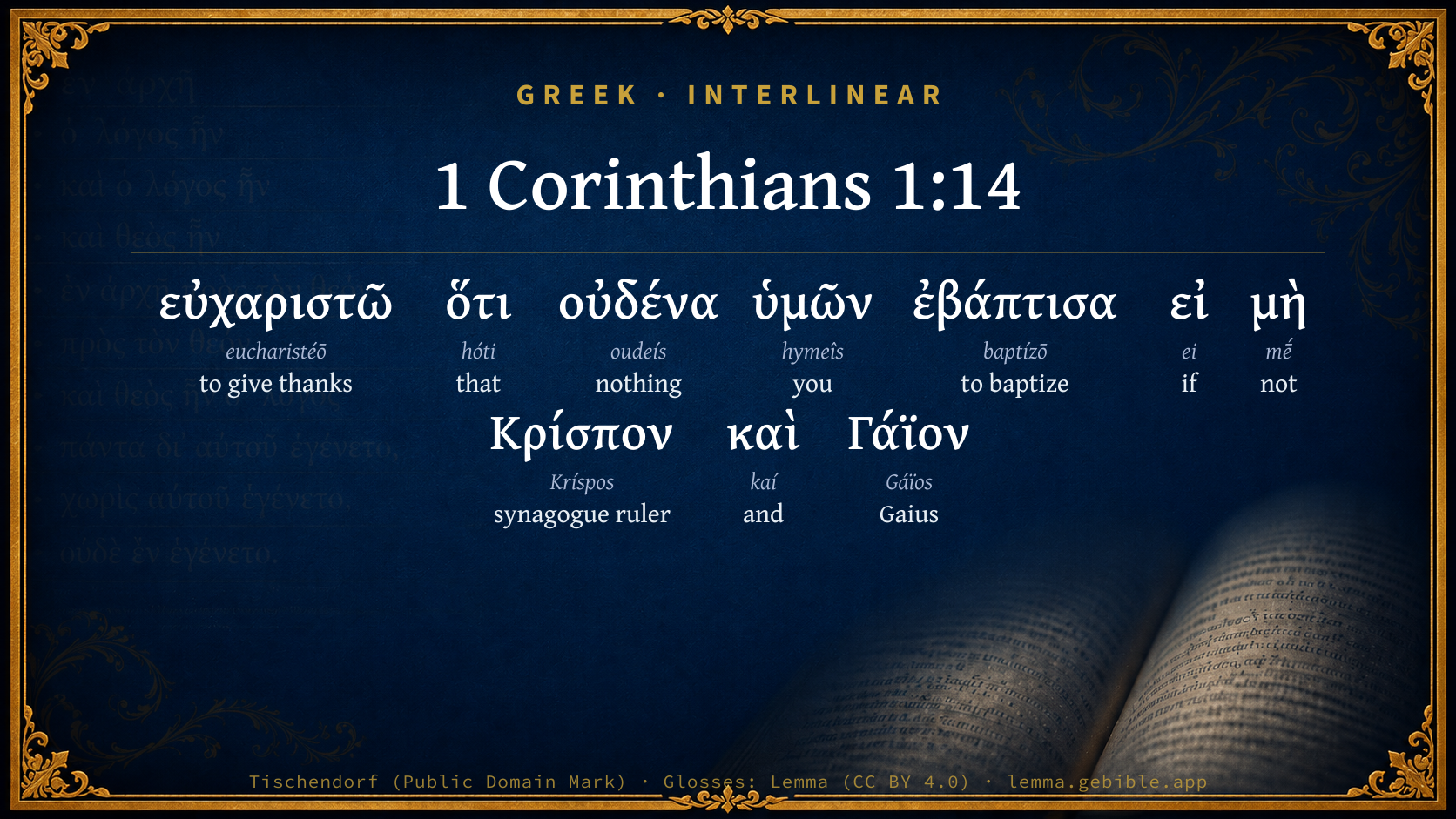
Greek (Tischendorf 8th ed.) 1 Corinthians 1:14 appears in the Greek New Testament. The text above is from the Tischendorf 8th edition. Each word links to its Strong’s number and a concise gloss. Click any word for its full Thayer’s Greek Lexicon entry.
Download image
Cite this verse

1 Corinthians 1:14 (World English Bible). Public Domain. Lemma interlinear Bible study tool, https://lemma.gebible.app/v/1-corinthians/1/14.

Show BibTeX & RIS
BibTeX
RIS
English Translation
I thank God that I baptized none of you, except Crispus and Gaius,
World English Bible · Public Domain
Download a study sheet

One document with this verse’s original text, its word-by-word gloss line, the meaning frame, cross-references with their text, attributed commentary, and full source and license credits — printable, and it pastes into notes with its structure intact.

This verse Autodidact and up

Study sheet (.html) Plain text (.txt)

A passage Seminary Student

Up to 50 verses in one chapter. A passage sheet keeps up to 6 commentary sources and 12 cross-references per verse, in the order this page ranks them, and says so on the sheet whenever that leaves anything out. Ask for a single verse and you get the Autodidact verse sheet above.

Everything on this page stays free to read, with no account — the sheet is a download of what is already on screen, not access to it.

Want to remove ads? Support Godless Engineer
Compare translations 3

The same verse in 3 English versions, stacked beneath the original-language interlinear above. Click any original word for its lexicon entry.

Each is an independent rendering of the whole verse — the interlinear is not word-aligned to these translations.

Highlighted words mark where these versions differ — a whole-verse word diff, not a word-by-word alignment.

  • World English Bible Public Domain
    I thank God that I baptized none of you, except Crispus and Gaius,
  • King James Version Public Domain
    I thank God that I baptized none of you, but Crispus and Gaius;
  • unfoldingWord Literal Text CC BY-SA 4.0
    I thank that I baptized none of you except Crispus and Gaius,

unfoldingWord Literal Text — © unfoldingWord, licensed CC BY-SA 4.0. Word-aligned USFM3 via Door43 (git.door43.org/unfoldingWord/en_ult).

Versions to compare (up to 4)

3 of 4 selected

Show all 19 translations

Every available English version of this verse, each an independent rendering of the whole verse.

  • World English Bible Public Domain
    I thank God that I baptized none of you, except Crispus and Gaius,
  • Berean Standard Bible Public Domain
    I thank God that I did not baptize any of you except Crispus and Gaius,
  • Majority Standard Bible Public Domain
    I thank God that I did not baptize any of you except Crispus and Gaius,
  • King James Version Public Domain
    I thank God that I baptized none of you, but Crispus and Gaius;
  • American Standard Version (1901) Public Domain
    I thank God that I baptized none of you, save Crispus and Gaius;
  • Revised Version (1885) Public Domain
    I thank God that I baptized none of you, save Crispus and Gaius;
  • Geneva Bible (1599) Public Domain
    I thanke God, that I baptized none of you, but Crispus, and Gaius,
  • Douay-Rheims (1899) Public Domain
    I give God thanks, that I baptized none of you but Crispus and Caius;
  • Young's Literal Translation Public Domain
    I give thanks to God that no one of you did I baptize, except Crispus and Gaius --
  • Literal Standard Version CC BY-SA 4.0
    I give thanks to God that I immersed no one of you, except Crispus and Gaius—
  • Unlocked Literal Bible CC BY-SA 4.0
    I thank God that I baptized none of you, except Crispus and Gaius.
  • unfoldingWord Literal Text CC BY-SA 4.0
    I thank that I baptized none of you except Crispus and Gaius,
  • Darby Bible Public Domain
    I thank God that I have baptised none of you, unless Crispus and Gaius,
  • World Messianic Bible Public Domain
    I thank God that I immersed none of you except Crispus and Gaius,
  • Webster's Bible Public Domain
    I thank God that I baptized none of you, but Crispus and Gaius;
  • Free Bible Version CC BY-SA 4.0
    I'm grateful to God that I didn't baptize any of you, except Crispus and Gaius,
  • Bible in Basic English Public Domain
    I give praise to God that not one of you had baptism from me, but Crispus and Gaius;
  • Text-Critical English NT CC BY 4.0
    I give thanks to God that I baptized none of you, except Crispus and Gaius,
  • Tyndale New Testament (1534) Public Domain
    I thanke God that I christened none of you but Crispus and Gayus

Literal Standard Version (2020), Covenant Press — licensed CC BY-SA 4.0. Text via the HelloAO Bible API (eBible.org). Unlocked Literal Bible (unfoldingWord) — licensed CC BY-SA 4.0. Text via the HelloAO Bible API (eBible.org). unfoldingWord Literal Text — © unfoldingWord, licensed CC BY-SA 4.0. Word-aligned USFM3 via Door43 (git.door43.org/unfoldingWord/en_ult). Free Bible Version, Dr. Jonathan Gallagher — licensed CC BY-SA 4.0. Text via the HelloAO Bible API (eBible.org).

Word by word

More ways to search: Search by grammar → Find every occurrence → Compare this word →

Practice this passage: Drill this verse → Learn its vocabulary →

About this verse

These counts appear in no published source. They are computed here, from the morphology-tagged text and Lemma’s own curated glosses. What Lemma adds →

10
words
10
distinct lemmas
Pauline Epistles
section

Notable vocabulary

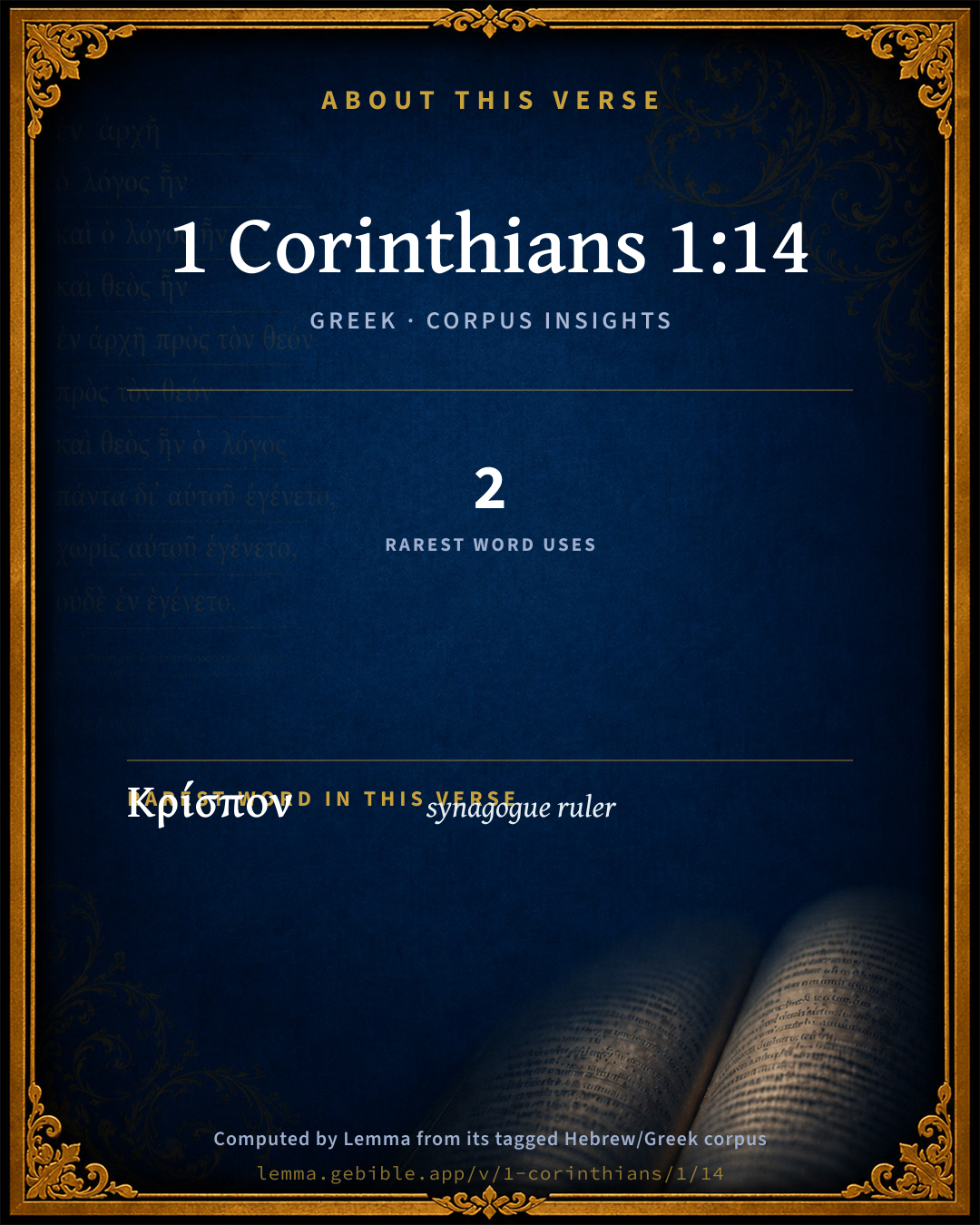
The rarest word here is Κρίσπον synagogue ruler G2921 — appearing just 2 times in the whole Greek New Testament.

Shared distinctive vocabulary

Κρίσπον synagogue ruler G2921 occurs in 2 verses of the Greek New Testament. Also found in:

Cross-references

10

Topical passages linked to 1 Corinthians 1:14 in the Treasury of Scripture Knowledge — connected by theme and wording, ordered by reader-vote popularity; previews shown in the World English Bible.

  • Acts 18:8 Crispus, the ruler of the synagogue, believed in the Lord with all his house. Many of the Corinthians, when they heard, believed and were baptized.
  • Romans 16:23 Gaius, my host and host of the whole assembly, greets you. Erastus, the treasurer of the city, greets you, as does Quartus, the brother.
  • 1 Corinthians 1:4 I always thank my God concerning you, for the grace of God which was given you in Christ Jesus;
  • 1 Corinthians 14:18 I thank my God, I speak with other languages more than you all.
  • 2 Corinthians 2:14 Now thanks be to God, who always leads us in triumph in Christ, and reveals through us the sweet aroma of his knowledge in every place.
  • Ephesians 5:20 giving thanks always concerning all things in the name of our Lord Jesus Christ, to God, even the Father;
  • Colossians 3:15 And let the peace of God rule in your hearts, to which also you were called in one body; and be thankful.
  • Colossians 3:17 Whatever you do, in word or in deed, do all in the name of the Lord Jesus, giving thanks to God the Father, through him.
  • 1 Thessalonians 5:18 In everything give thanks, for this is the will of God in Christ Jesus toward you.
  • 3 John 1:1–4 The elder to Gaius the beloved, whom I love in truth.

Cross-references courtesy of OpenBible.info (CC BY 4.0).

Commentary

Notes on 1 Corinthians 1:14 from classic Christian and Jewish commentators (each source and its license shown beneath its notes). The classic Christian expositions comment on the surrounding passage and are grouped to its opening verse, so a note may address several verses; the Jewish commentaries on the Tanakh (Rashi and others) are per-verse, so they appear only where the commentator wrote on this verse.

Lemma curates 59 commentaries, every one of them public domain or Creative Commons licensed, each selected and text-cleaned for this edition rather than reprinted as found. About our sources →

Tyndale Open Study Notes

Tyndale Open Resources

1:14 Crispus and Gaius were two of Paul’s earliest converts in Corinth. Crispus was a former leader of the synagogue in Corinth (see Acts 18:8), and Gaius later offered Paul the use of his home (see Rom 16:23). This might identify him with Titius Justus, an earlier convert to Judaism who lived next door to the synagogue (see Acts 18:7). His full Roman name would then be Gaius Titius Justus.

Tyndale Open Study Notes — © Tyndale Open Resources, licensed CC BY-SA 4.0. Text via the HelloAO Bible API.

Bengel's Gnomon

Johann Albrecht Bengel

1Co 1:14. Εὐχαριστῶ, I give thanks) The Providence of God reigns often in events, of which the reason is afterwards discovered. This is the language of a godly man, indicating the importance of the subject, instead of the common phrase, I rejoice.—Κρίσπον καὶ Γάϊον, Crispus and Gaius) He brings forward his witnesses. Paul baptized with his own hand, the most respectable persons, not many others; and not from ambition, but because they were among the first, who believed. The just estimation of his office is not pride, ch. 1Co 16:4. The administration of baptism was not so much the duty of the apostles, as of the deacons, Act 10:48; nor did that circumstance diminish the dignity of this ordinance.

Bengel's Gnomon of the New Testament — English translation (T&T Clark, Edinburgh, 1860) — public domain. Text from a community e-Sword module.

Meyer's Critical & Exegetical Commentary

Heinrich August Wilhelm Meyer

1Co_1:14-15. God be thanked, that I baptized only a very few among you! Accordingly no room has been left for the reproach being brought against me, as it might otherwise have been, that I had baptized into my own name! Providentia divina regnat saepe in rebus, quarum ratio postea cognoscitur (Bengel). Rückert finds fault with the weakness of this proof, since it was surely the same thing whether Paul had baptized personally or through his assistants. But unjustly. For, since Paul was not generally in the habit of baptizing in person, had he himself baptized many in Corinth, this might undoubtedly have been made use of afterwards by perverse minds for the possible slander that there was a specialty in the case, that he had baptized with his own hand in Corinth, because he did it into his own name,a purpose for which, of course, he could not have employed others. Hofmann suggests wrongly: they might have interpreted it, as though he had wished to place the persons concerned in a peculiar relation to himself. This imported indefiniteness is against the definite sense of the words. Just as he had said before, that it was not he who had been crucified for them in place of Christ, so he says further, that they had not been baptized into his name instead of the name of Christ. But the two points just show how wholly absurd the confession ἐγὼ μέν εἰμι Παύλου is, because it would have such absurd premisses.

Κρίσπον] See Act_18:8.

Γάϊον] See on Rom_16:23.

ἵνα μή] is never elsewhere, and is not here, to be taken as: so that not, but it denotes the design, arranged in the divine providential leading, of the οὐδένα ὑμ. ἐβάπτισα (comp 1Co_1:17; 2Co_1:9, al[200]).

[200] l. and others; and other passages; and other editions.

Meyer — Critical and Exegetical Commentary on the New Testament — English translation by Peter Christie, edited by Frederick Crombie (T&T Clark, 1880) — public domain. Text from a community e-Sword module.

Expositor's Greek Testament

ed. W. Robertson Nicoll

1Co 1:14-16 . In fact, P. had himself baptised very few of the Cor [181] He sees a providence in this; otherwise he might have seemed wishful to stamp his own name upon his converts, and some colour would have been lent to the action of the Paulinists “lest any one should say that you were baptised into my name”. For βαπτίζω εἰς τὸ ὄνομα , cf. Mat 28:19 and other parls.; also βαπτίζω εἰς , 1Co 10:2 ; it corresponds to πιστεύω εἰς , and has the like pregnant force. “The name” connotes the nature and authority of the bearer, and His relationship to those who speak of Him by it. Crispus and Gaius: both Roman names (see Introd. , p [182] 733); the former a cognomen ( Curly ), the latter an exceedingly common prænomen. These two were amongst Paul’s earliest converts (Act 18:8 , Rom 16:23 ), the former a Synagogue-ruler. On second thoughts (“he was reminded by his amanuensis,” Lt [183] ; or by Steph. himself), P. remembers that he had “baptised the house of Stephanas” (see 1Co 16:15 , and note), the first family here won to Christ. Στεφανᾶς (perhaps short for Στεφανηφόρος ), like Κηφᾶς , takes the Doric gen [184] in - ᾶ usual with proper names in - ᾶς , whether of native or foreign origin (see Bm [185] , p. 20). λοιπὸν οὐκ οἶδα εἴ τινα κ . τ . λ .: P. cannot recall any other instance of baptism by his own hands at Cor [186] ; this was a slight matter, which left no clear mark in his memory, λοιπόν (more regularly, τὸ λοιπόν ), “for the rest” in point of time (1Co 7:29 ), or number a somewhat frequent idiom with Paul ( cf. 1Co 4:2 ). In οὐκ οἶδα εἰ ( haud scio an ), the conjunction is indir [187] interr [188] , as in 1Co 7:16 .

[181] Corinth, Corinthian or Corinthians.

[182]. Paul.

[183] J. B. Lightfoot’s (posthumous) Notes on Epp. of St. Paul (1895).

[184] genitive case.

[185] A. Buttmann’s Grammar of the N.T. Greek (Eng. Trans., 1873).

[186] Corinth, Corinthian or Corinthians.

[187]ndir. indirect.

[188]nterr. interrogative.

The Expositor's Greek Testament, edited by W. Robertson Nicoll (1897–1910) — public domain. Text from a community e-Sword module.

Hodge's Commentary on Romans, Ephesians & First Corinthians

Charles Hodge

1Co_1:14, 1Co_1:15

I thank God that I baptized none of you, but Crispus and Gaius; lest any should say that I had baptized in mine own name.

Although it was the duty of the apostles to baptize, Mat_28:19 yet Paul rejoiced that it had so happened that he had administered that ordinance to only a few persons in Corinth, as thus all pretext that he was making disciples to himself, was taken away. Paul did not consider this a matter of chance, but of providential direction, and, therefore, a cause of gratitude. Crispus was the chief ruler of the synagogue in Corinth, whose conversion is recorded in Act_18:8. Gaius is mentioned in Rom_16:23 as the host of the apostle.

Charles Hodge — Commentary on Romans (1835), First Corinthians (1857), and Ephesians (1856) — public domain. Text from a community e-Sword module.

Geneva Bible (1599)

Geneva Bible translators

He protesteth that he speaketh so much the more boldly of these things, because that through God’s providence he is void of all suspicion of challenging disciples unto himself, and taking them from others. Whereby we may understand that not the scholars only, but the teachers also are here reprehended, which gathered themselves flocks apart.

Geneva Bible (1599) marginal notes — public domain. Text via Bolls.life.

Matthew Henry's Commentary

Here the apostle gives an account of his ministry among them. He thanks God he had baptized but a few among them, Crispus, who had been a ruler of a synagogue at Corinth (Act 18:8), Gaius, and the household of Stephanas, besides whom, he says, he did not remember that he had baptized any. But how was this a proper matter for thankfulness? Was it not a part of the apostolical commission to baptize all nations? And could Paul give thanks to God for his own neglect of duty? He is not to be understood in such a sense as if he were thankful for not having baptized at all, but for not having done it in present circumstances, lest it should have had this very bad construction put upon it - that he had baptized in his own name, made disciples for himself, or set himself up as the head of a sect. He left it to other ministers to baptize, while he set himself to more useful work, and filled up his time with preaching the gospel. This, he thought, was more his business, because the more important business of the two. He had assistants that could baptize, when none could discharge the other part of his office so well as himself. In this sense he says, Christ sent him not to baptize, but to preach the gospel - not so much to baptize as to preach. Note, Ministers should consider themselves sent and set apart more especially to that service in which Christ will be most honoured and the salvation of souls promoted, and for which they are best fitted, though no part of their duty is to be neglected. The principal business Paul did among them was to preach the gospel (Co1 1:17), the cross (Co1 1:18), Christ crucified, Co1 1:23. Ministers are the soldiers of Christ, and are to erect and display the banner of the cross. He did not preach his own fancy, but the gospel - the glad tidings of peace, and reconciliation to God, through the mediation of a crucified Redeemer. This is the sum and substance of the gospel. Christ crucified is the foundation of all our joys. By his death we live. This is what Paul preached, what all ministers should preach, and what all the saints live upon.

Matthew Henry's Commentary on the Whole Bible (1708–1710) — public domain (CC PDM 1.0). Text via the HelloAO Bible API.

Jamieson, Fausset & Brown

Robert Jamieson, A. R. Fausset & David Brown

I thank God's providence now, who so ordered it that I baptized none of you but Crispus (the former ruler of the synagogue, Act 18:8) and Gaius (written by the Romans Caius, the host of Paul at Corinth, and of the church, Rom 16:23; a person therefore in good circumstances). Baptizing was the office of the deacons (Act 10:48) rather than of the apostles, whose office was that of establishing and superintending generally the churches. The deacons had a better opportunity of giving the necessary course of instruction preparatory to baptism. Crispus and Gaius were probably among the first converts, and hence were baptized by Paul himself, who founded the church.

Jamieson, Fausset & Brown — Commentary Critical and Explanatory on the Whole Bible (1871) — public domain (CC PDM 1.0). Text via the HelloAO Bible API.

Adam Clarke's Commentary

Verse 14. I thank God that I baptized none of you] None of those who now live in Corinth, except Crispus, the ruler of the synagogue, Ac 18:8. And Gaius, the same person probably with whom Paul lodged, Ro 16:23, where see the notes. Dr. Lightfoot observes: "If this be Gaius, or Caius, to whom the third epistle of John was written, which is very probable when the first verse of that epistle is compared with Ro 16:23, 3Jo 1:1 then it will appear probable that John wrote his first epistle to the Corinthians. I wrote, says he, unto the Church-What Church? Certainly it must have been some particular Church which the apostle has in view, and the Church where Gaius himself resided. And if this be true, we may look for Diotrephes (3Jo 1:9) in the Corinthian Church; and the author of the schism of which the apostle complains. See the Introduction, sect. viii.

Adam Clarke's Commentary on the Bible (1810–1826) — public domain. Text from a community e-Sword/MySword module.

John Calvin's Commentaries

14. I thank my God. In these words he reproves very sharply the perversity of the Corinthians, which made it necessary for him to avoid, in a manner, a thing so sacred and honorable as that of the administration of baptism. Paul, indeed, would have acted with propriety, and in accordance with the nature of his office, though he had baptized ever so many. He rejoices, however, that it had happened otherwise, and acknowledges it as having been so ordered, in the providence of God, that they might not take occasion from that to glory in him, or that he might not bear any resemblance to those ambitious men who endeavored in this way to catch followers. But what if he had baptized many? There would have been no harm in it, but (as I have said) there is couched under this a heavy reproach against the Corinthians and their false apostles, inasmuch as a servant of the Lord found occasion to rejoice that he had refrained from a work, otherwise good and commendable, lest it should become an occasion of harm to them.

John Calvin's Commentaries (1540-1563) — public domain. Text from the Calvin Translation Society English edition (1840s-50s) via the Christian Classics Ethereal Library (ccel.org). Calvin's coverage is partial (roughly two-thirds of the Bible); uncommented books and verses are honest gaps, never fabricated. The 19th-century editor's footnotes and remarks are omitted so the notes are faithfully Calvin's own voice.

Ellicott's Commentary for English Readers

(14) I thank God.—“I am thankful to God that it was not so.” For if he had baptised a great many, some might have said he had created originally a party in his own name. Crispus (see Act_18:8), a “ruler of the synagogue,” Gaius (or Caius, his Roman name), “mine host, and of the whole Church” (Rom_16:23): the evident importance and position of these two, and that they were the first converts, may account for the Apostle having departed from his usual practice in baptising them.

A Bible Commentary for English Readers, edited by Charles John Ellicott (1878–1897) — public domain. Text from a community e-Sword module.

The Cambridge Bible for Schools and Colleges

gen. ed. J. J. S. Perowne

14. Crispus and Gaius] The special honour seems to have been accorded to Crispus of baptism by the hands of St Paul, because he was ‘the chief ruler of the synagogue’ (Act_18:8). Gaius, ‘mine host, and of the whole Church’ (Rom_16:23) must not be confounded with Gaius of Derbe (Act_20:4), nor with the Macedonian Gaius mentioned in Act_19:29. Gaius or Caius was a very common Roman name. The Epistle to the Romans was written at Corinth. Paley (Horae Paulinae, 1st Epistle to the Corinthians 8) remarks on the minute yet undesigned agreement between the Epistles and the Acts. We must not foil to notice also that the Corinthian Church was by no means an exclusively Gentile community. See Act_18:12-13.

The Cambridge Bible for Schools and Colleges (gen. ed. J. J. S. Perowne; Cambridge University Press, 1878–1918) — public domain. Text from a community e-Sword module.

John Gill's Exposition

I thank God that I baptized none of you,.... The Alexandrian copy and the Syriac version read, "I thank my God"; not that the apostle disliked the ordinance of baptism, or the administration of it; and much less that he thought it criminal, or an evil in him to perform it; nor was he at any time displeased at the numbers of persons who desired it of him; but on the contrary rejoiced where proper subjects of it were brought to a submission to it; but inasmuch as some persons in the church at Corinth made such an ill use of his having baptized them, he was greatly thankful that it was so ordered in providence, that the far greater part of them were baptized by other ministers, either by those who were with him, or came after him; and that he baptized none of them with his own hands,

but Crispus and Gaius. The former of these was the chief ruler of the Jewish synagogue at Corinth, who hearing the apostle, and believing in Christ, was baptized by him, Act 18:8 and the latter was a very liberal and hospitable man, and was the apostle's host, whilst he was at Corinth; see Rom 16:23.

John Gill's Exposition of the Whole Bible (1746–1763) — public domain (CC PDM 1.0). Text via the HelloAO Bible API.

Trapp's Complete Commentary

John Trapp

14 I thank God that I baptized none of you, but Crispus and Gaius;

Ver. 14. I thank God] He noteth and noticeth herein a sweet providence, beyond all that he then imagined, when he was at Corinth. God is to be seen in every special occurrence.

John Trapp, A Commentary or Exposition upon All the Books of the Old and New Testament (1647–1656) — public domain. Text from a community e-Sword module.

Albert Barnes' Notes on the Bible

I thank God ... - Why Paul did not himself baptize, see in 1Co 1:17. To him it was now a subject of grateful reflection that he had not done it. He had not given any occasion for the suspicion that he had intended to set himself up as a leader of a sect or party.

But Crispus - Crispus had been the chief ruler of the synagogue at Corinth; Act 18:8.

And Gaius - Gaius resided at Corinth, and at his house Paul resided when he wrote the Epistle to the Romans; Rom 16:23. It is also possible that the Third Epistle of John was directed to this man; see 3Jo 1:1. And if so, then probably Diotrephes 3Jo 1:9, who is mentioned as one who loved “to have the pre-eminence,” had been one cause of the difficulties at Corinth. The other persons at Corinth had been probably baptized by Silas and Timothy.

Albert Barnes' Notes on the Bible (1834–1885) — public domain. Text from a community e-Sword/MySword module.

Haydock's Catholic Bible Commentary

I give God thanks that I baptized none of you, but, &c. It is strange that Quakers should from hence pretend, that St. Paul condemned baptism, when he only tells them, he is glad they were baptized by some other, rather than by him, lest they should say, they were baptized in his name, or think that baptism had a greater virtue, when given by a minister of greater sanctity; whereas it is Christ only, who is the chief minister, who gives grace in baptism, and in the other sacraments. This makes him say, was Paul crucified for you, &c. He tells them the occasion why he baptized few, because he was sent chiefly to preach and to be their apostle, whereas other inferior ministers were employed in baptizing. (Witham)

George Leo Haydock (1774–1849), Haydock's Catholic Family Bible and Commentary, 1859 edition — public domain. Excludes Psalms (Douay-Rheims chapter numbering differs from Protestant) and Deuterocanonical books (Catholic canon only).

Matthew Poole's English Annotations

Concerning the apostle’s baptizing Crispus we read, Act 18:8; he was the chief ruler of the synagogue of the Jews: why Paul thanks God that he baptized not many, he tells us, 1Co 1:15.

Matthew Poole's English Annotations on the Holy Bible (1683–1685) — public domain. Text from a community e-Sword/MySword module.

Whedon's Commentary on the Bible

Daniel D. Whedon

14. I thank God—For the unexpected good result of our actions, we may thank not our own wisdom, but God’s. Some might have thought his omission to baptize a guilty neglect; others may have felt the not being baptized by him a slight; he sees in it a complete condemnation of their making him their master.

Baptized none of you—A remarkable fact that of so many converts of Paul, so few were baptized by him. A remarkable object of thanks. Baptism, solemn as is its import, being, nevertheless, more a performance of the hand than of brain or soul, is subordinate to preaching and government. At Corinth the rite was at first, doubtless, performed by Timothy and Silas, Paul’s attendants, and afterwards by elders and deacons ordained. Note, Act_10:48.

But Crispus—Note Act_18:8. The notability of Crispus, the chief ruler, being converted by Paul, induced his being baptized by him.

Gaius—At whose house probably he wrote the Epistle to the Romans. See our introduction to Romans, vol. iii, p. 286.

Daniel D. Whedon (gen. ed.), Commentary on the Old and New Testaments (1874–1909) — public domain. Text from a community e-Sword module.

The Pulpit Commentary

I thank God that I baptized none of you. St. Paul, in his characteristic manner, "goes off at the word" baptize. He thanked God, not by way of any disparagement to baptism, but because he had thus given no excuse to the undue exaltation of his own name. Compare the practice of our Lord himself, in leaving his disciples to baptize. (Joh_4:2) The apostles would not have approved the system of wholesale baptisms of the heathen which has prevailed in some Romanist missions. Save Crispus. The ruler of the synagogue. (Act_18:8) Doubtless there were some strong special reasons why, in these instances, St. Paul departed from his general rule of not personally baptizing his converts. And Gaius. Gaius of Corinth. (Rom_16:23) It was one of the commonest of names. There was another Gaius of Derbe, (Act_20:4) and another known to St. John. (3Jn_1:1)

Vers. 14-18.

Paul"s commission from Christ.

It did not concern baptism, but preaching. Rites are of value in relation to the Christian life and culture. But rites may be overvalued, and, instead of helping the apprehension of spiritual realities and duties, may be sought for their own sakes. This peril always lies in symbols. The commendation or the establishment of rites had no place in Paul"s mission. They would have confused his presentation of the doctrine of "Christian liberty" under Christ; though he himself observed rites; and we are able to see how sacrament and ceremonial may be in full harmony with our freedom in Christ. The expression "baptized into the Name" needs explanation. Here "baptism is the public act by which our discipleship to a person is declared. Illustrate by the branding of cattle or slaves, or by the public declaration of having adopted a child as son and heir. Baptism is a voluntary taking on ourselves of a Name; from it we are called "Christians; we bear on us the Name into which we were baptized, and are under pledge to live in the spirit worthy of that Name. With the administration of any rite Paul contrasts his call to preach the gospel. The nature of his call may be thus enlarged on. He wasI TO PREACH. A term used in the Acts as distinct from teach. "Daily ceased not to teach and preach Jesus Christ." The figure in the word is that of the herald, whose duty is to go from place to place, and announce, or declare, a message, or proclamation. John the Baptist preached as a herald. When our Lord sent the apostles forth on a trial mission, he would instruct them in their work as preachers, "As ye go say, Repent; for the kingdom of heaven is at hand." Press, that still preaching is the authoritative announcement of God"s mercy to men in Christ, and, the demand at once to accept that mercy.

II TO PREACH THE GOSPEL. The very essence of the gospel is given Joh_3:10. It has these pointsMan"s need and helplessness; God"s love and pity; the effective manifestation of that love in Christ; the requirement of faith in the Redeemer thus set forth. The power that lies in the simple announcement of the gospel may be illustrated by the familiar story of Kajarnak the Greenlander and the early Moravian missionaries.

III TO PREACH THE GOSPEL IN SIMPLICITY. Not with elaborations of "human wisdom," or as trusting to the artifices of "human rhetoric." Paul wanted no other power than that which lay in personal conviction and simple fulfilment of the duty imposed upon him. To him the persuasion and power of the gospel lay in its simplicity. He preached Christ, and strove to draw men to him in trust and love.

IV TO PREACH THE GOSPEL EVEN IN THE ASPECT THAT MEN WOULD RESIST. He was not to hold back the story of the cross, however Jew or Greek may seem to be offended at it; he was to declare the whole gospel he had received; and he was to be quite confident that God could and would make it power unto salvation. In this we have the very essence of missionary work in every age. A kind of work that has its spheres both at home and abroad; and finds its agents in all who, having received the gospel, find an inward impulse urging them to make that gospel known. R.T.

The Pulpit Commentary (1880–1919), ed. H.D.M. Spence-Jones & Joseph S. Exell — public domain. Text from a community e-Sword module.

John Wesley's Explanatory Notes

I thank God - (A pious phrase for the common one, "I rejoice,") that, in the course of his providence, I baptized none of you, but Crispus, once the ruler of the synagogue, and Caius.

John Wesley, Explanatory Notes Upon the Whole Bible (1754–1765) — public domain. Text via the GEBible commentary corpus.

Burkitt's Expository Notes on the New Testament

William Burkitt

Observe here, 1. That though baptizing were God’s ordinance, and St. Paul, as Christ’s minister, had commission and sufficient authority to baptize, yet the providence of God so ordered, that he baptized very few, lest any should say he baptized in his own name.

Observe, 2. That among those few he baptized, here is a whole household mentioned, The household of Stephanas.

Where learn, That as Abraham, and others under the Old Testament, were to bring their households into covenant with God by circumcision, so did those that had households under the New Testament endeavour to bring their whole families into God’s covenant by baptism. The gaoler and his house, Lydia and her house, Stephanas and his household, are all baptized.

Observe, 3. The comparison here made betwixt baptizing and preaching, and the preference given to the one before the other: Christ sent me not to baptize, but to preach; that is, rather to preach than to baptize: this was his great business, his principal work; though baptizing was within his commission, yet it was not that, but preaching the gospel to convert souls to Christ, that he was called after such a wonderful manner, and endued with such extraordinary gifts for the performance of. It is neither wise, nor safe, to cry up one ordinance of God above another, but to have them all in estimation, and none more than the preaching of the gospel, which is one principal part of our commission.

Observe, 4. The manner after which Christ sent St. Paul to preach the gospel: Not with wisdom of words, lest the cross of Christ should be made of no effect; that is, not attracting and drawing men to the faith by the power of human eloquence, lest the doctrine of Christ should be rendered suspected by such a pompous way of preaching.

Plain truths, without art and varnish, may be conveyed with more warmth and vigour to the conscience, than all the charms of human eloquence from the most fluent and popular tongue. The way and manner of St. Paul’s preaching was grave and serious, pious and ardent, plain and profitable. With what brevity, without darkness; with what gravity, without affectation; with what eloquence, without meretricious ornament, were St. Paul’s discourses! solidly instructing men in the great and necessary duties of the gospel, and furnishing them with arguments and motives to a good life, and this in such a plain and familiar manner, that the success and prevalency of his preaching appeared to be of God, and not of man.

William Burkitt's Expository Notes on the New Testament (1700–1703) — public domain. Text from a community e-Sword module.

McGarvey & Pendleton's Commentaries

J. W. McGarvey

I thank God [who, foreseeing the future, prevented him from making such a mistake] that I baptized none of you, save Crispus [the ruler of the synagogue-- Act_18:8 ] and Gaius [from whose house Paul wrote his Epistle to the Romans-- Rom_16:23 ];

J. W. McGarvey (with Philip Y. Pendleton), Commentaries on the New Testament (The Fourfold Gospel, 1914; Acts; and the epistles) — public domain. Text from a community e-Sword/MySword module.

The People's New Testament

B. W. Johnson

14. I thank God that I baptized none of you, etc. “The Corinthians hearing, believed and were baptized” (Acts 18:8), but the fellow-ministers of Paul usually administered the baptismal rite. Since some of the Corinthians were claiming to be of his party, he was glad that he had not personally baptized them, lest some of them should say he had baptized in his own name (verse 15). Crispus. Formerly chief ruler of the synagogue at Corinth (Acts 18:8). Gaius. See Romans 16:23. He was Paul's host at Corinth when the Epistle to the Romans was written.

B. W. Johnson's The People's New Testament with Notes (1889–1891) — public domain. Electronic text from the Christian Classics Ethereal Library (CCEL) ThML edition.

unfoldingWord translationNotes

Door43 World Missions Community

none of you, except

"only"

Crispus

He was a synagogue ruler who became a Christian. (See: How to Translate Names)

Gaius

He traveled with the Apostle Paul. (See: How to Translate Names)

This was so that no one would say that you were baptized into my name

Here "name" represents "authority." This means Paul did not baptize others because they may claim that they became Paul's disciples. This can be stated in active form. AT: "For some of you might have claimed that I baptized you to make you my disciples" (See: Metonymy and Active or Passive)

the household of Stephanas

This refers to the family members and slaves in the house where Stephanas, a man, was the head. (See: How to Translate Names)

translationWords

baptize

household

know

unfoldingWord translationNotes — © Distant Shores Media and the Door43 World Missions Community, licensed CC BY-SA 4.0. Source: git.door43.org/Door43/en_tn.

Cambridge Greek Testament for Schools and Colleges

14. Κρίσπον καὶ Γάϊον. The special honour of baptism by the hands of St Paul seems to have been accorded to Crispus, because he was ‘the chief ruler of the synagogue’ (Act 18:8). Gaius, ‘mine host, and of the whole Church’ (Rom 16:23), must not be confounded with Gaius of Derbe (Act 20:4), nor with the Macedonian Gaius mentioned in Act 19:29. Gaius or Caius was a very common Roman name. The Epistle to the Romans was written at Corinth. Paley (Horae Paulinae, 1st Epistle to the Corinthians 8) remarks on the minute yet undesigned agreement between the Epistles and the Acts. We must not fail to notice also that the Corinthian Church was by no means an exclusively Gentile community. See Act 18:12-13.

Cambridge Greek Testament for Schools and Colleges (Cambridge University Press, 1896; 21 vols, various authors incl. Carr, Maclear, Plummer, Farrar, Lumby, Moule, M. R. James, Simcox) — public domain. Text from a community e-Sword module.

Alford’s Greek Testament

Henry Alford

14.] Olsh. characterizes it as surprising that Paul should not have referred to the import of baptism itself as a reason to substantiate his argument. He does not this, but tacitly assumes, between ver. 13 and 14, the probability that his having baptized any considerable number among the Corinthians would naturally have led to the abuse against which he is arguing.

εὐχ. τ. θ.] ‘I am (now) thankful to God, who so ordered it that I did not,’ &c. Crispus, the former ruler of the synagogue, Act 18:8. Gaius, afterwards the host of the Apostle, and of the church, Rom 16:23.

Henry Alford, The Greek Testament (1849–1861) — public domain. Text from a community e-Sword module.

International Critical Commentary

14. εὐχαριστῶ. A quasi-ironical turn; ‘What difficulties I have unconsciously escaped.’

Κρίσπον. One of the first converts (Act 18:8).* Ruler of the synagogue.

Γαῖον. Probably the host of St Paul ‘and of the whole Church’ at Corinth (Rom 16:23), but probably not the hospitable Gaius of 3Jn 1:5, 3Jn 1:6. This common Roman praenomen belongs probably to five distinct persons in the N.T. The Greek preserves the correct Latin form, which is sometimes written Caius, because the same character originally stood in Latin for both G and C. Crispus, ‘curly,’ is a cognomen.

After εὐχαριστῶ, א3 A C D E F G L P, Vulg. add τῷ Θεῷ, while A 17, Syrr. Copt. Arm. add τῷ Θεῷ μου—a very natural gloss. א* B 67, Chrys. omit.

International Critical Commentary — older volumes (1896–1929), various authors — public domain. Text from a community e-Sword module.

Godet's Commentaries

Frédéric Louis Godet

Vv. 14-16. “I thank God that I baptized none of you but Crispus and Gaius, 15. lest any should say that ye were baptized in my name. 16. I baptized also the household of Stephanas; besides, I know not whether I baptized any other.”

Paul’s thanksgiving proves that there had been no calculation on his part, when, as a rule, he had abstained from baptizing. The real motive for the course he followed will be given in 1Co 1:17. This is why he is thankful for the way in which God has ordered things. Rückert objects to this reasoning, that if Paul had wished to form a party of his own, he might have done so by getting one of his friends to baptize in his name, as well as by baptizing himself. True; but would he easily have found any one to lend himself to such a procedure? What seems to me more difficult to explain is the supposition itself, on which this passage rests, of a baptism administered in another name than that of Jesus. This idea, which now seems to us absurd, might seem more admissible in the first times of the Church, especially in Greece. In the midst of the religious ferment which characterized that epoch, new systems and new worships were springing up everywhere; and in these circumstances the distance was not great between an eminent preacher like Paul, and the head of a school, teaching and labouring on his own account. The apostle of the Gentiles, no doubt, passed in the eyes of many as the true founder of the religion which he propagated; and the supposition which he here combats might thus have a certain degree of likelihood. There is no need, therefore, in accounting for this passage, either of Hofmann’s hypothesis, according to which there were people at Corinth who boasted of having received baptism at Jerusalem from Peter’s own hand,

Paul would thus congratulate himself on not having given occasion to such a superstition,—or for that of Keim and Heinrici, who ascribe a similar superstition to the Apollos-party (see above, p. 65).

The regimen τῷ θεῷ, to God, omitted by the Sinaït. and Vatic., is unnecessary; it has rather been interpolated than omitted.

Crispus, the ruler of the synagogue at the time of Paul’s arrival, had been one of his first converts (Act 18:8); Gaius, his host during one of the stays which followed (Rom 16:23), was also probably one of the first believers. Thus, probably, is explained why Paul had baptized them himself; his two assistants, Silas and Timothy, had not yet arrived from Macedonia, when they were received into the Church. It cannot be held with Beet that Paul deliberately made an exception in these two cases because of their importance: this idea would contradict the very drift of the whole passage. It matters little that in the account given in the Acts the order of events does not agree with what we say here.

Frédéric Louis Godet — Commentaries on Luke, John, Romans, and 1 Corinthians — English translation (T&T Clark, Edinburgh, 1870s–1890s) — public domain. Text from a community e-Sword module.

Lesson kit

Teaching starters — assembled from the data on this page, not authored interpretation. Every prompt links to the verse data it draws on. Edit before teaching.

1 Corinthians, in the Pauline Epistles, opens this verse with 10 words (10 distinct Greek lemmas). Its most distinctive word is Kríspos (“synagogue ruler”). A historical commentator’s framing appears above. Read the whole chapter for the surrounding context.

Discussion questions

  1. How does “synagogue ruler” (Kríspos) shape what this verse is saying?
  2. How does Acts 18:8, which shares the word «synagogue ruler», read alongside this verse?
  3. The translations on this page render this verse differently — a whole-verse word diff, not a word-by-word alignment. What might account for the different wordings?
  4. Compare how Tyndale Open Study Notes and Bengel's Gnomon read this verse. Where do they agree or differ?

Things to notice

Reading settings

Reading text

Shown beneath each verse's original-language words.

Old Testament
Old Testament edition

Read the OT as the Masoretic Hebrew (MT) or the Greek Septuagint (LXX).

English shown for the Greek Septuagint (in the Hebrew ↔ Greek comparison).

Comparing translations? Open the Compare panel on any verse page to stack up to four side by side.