Acts 25:10

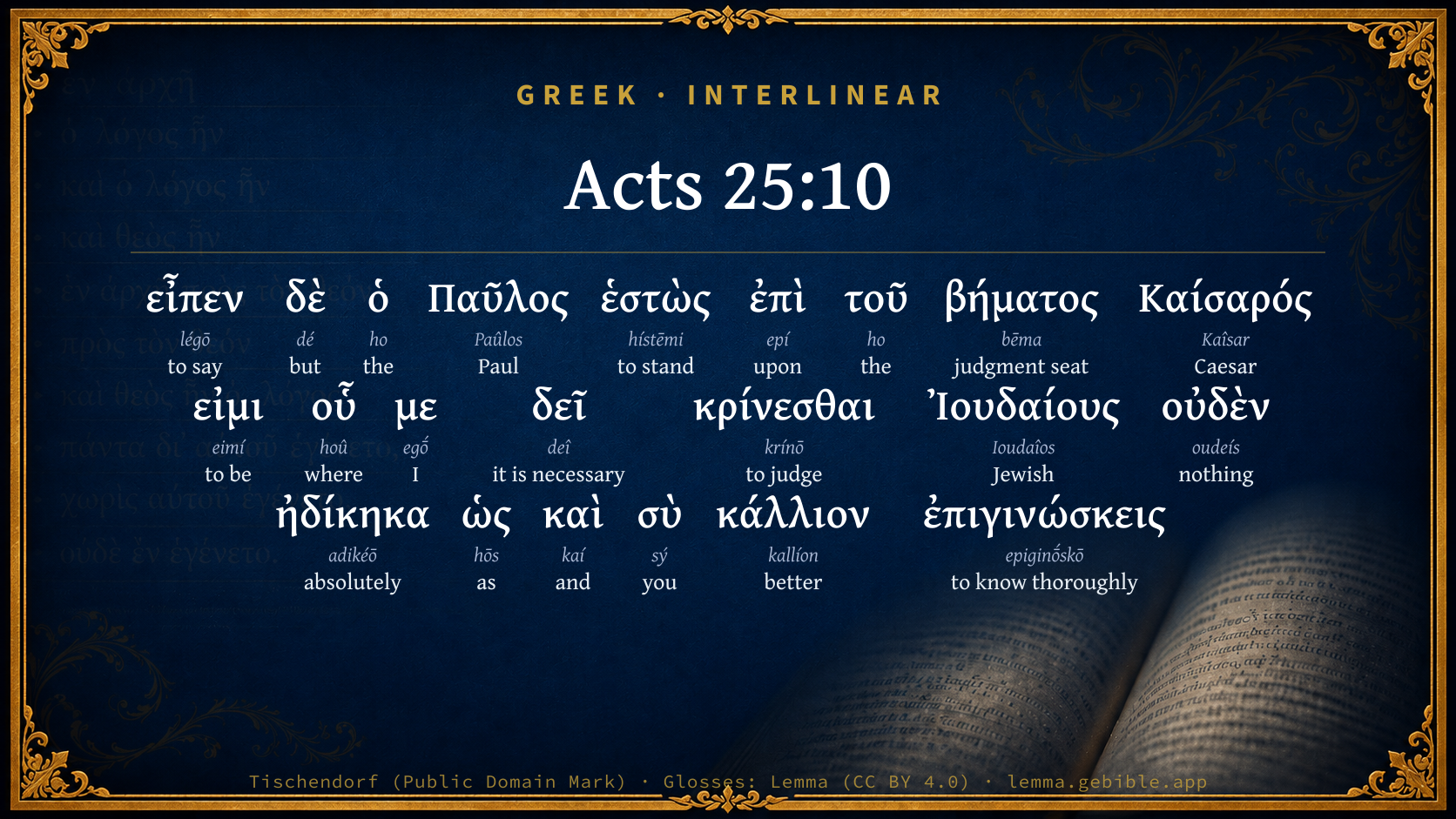
Greek (Tischendorf 8th ed.) Acts 25:10 appears in the Greek New Testament. The text above is from the Tischendorf 8th edition. Each word links to its Strong’s number and a concise gloss. Click any word for its full Thayer’s Greek Lexicon entry.
Download image
Cite this verse

Acts 25:10 (World English Bible). Public Domain. Lemma interlinear Bible study tool, https://lemma.gebible.app/v/acts/25/10.

Show BibTeX & RIS
BibTeX
RIS
English Translation
But Paul said, "I am standing before Caesar's judgment seat, where I ought to be tried. I have done no wrong to the Jews, as you also know very well.
World English Bible · Public Domain
Highlights
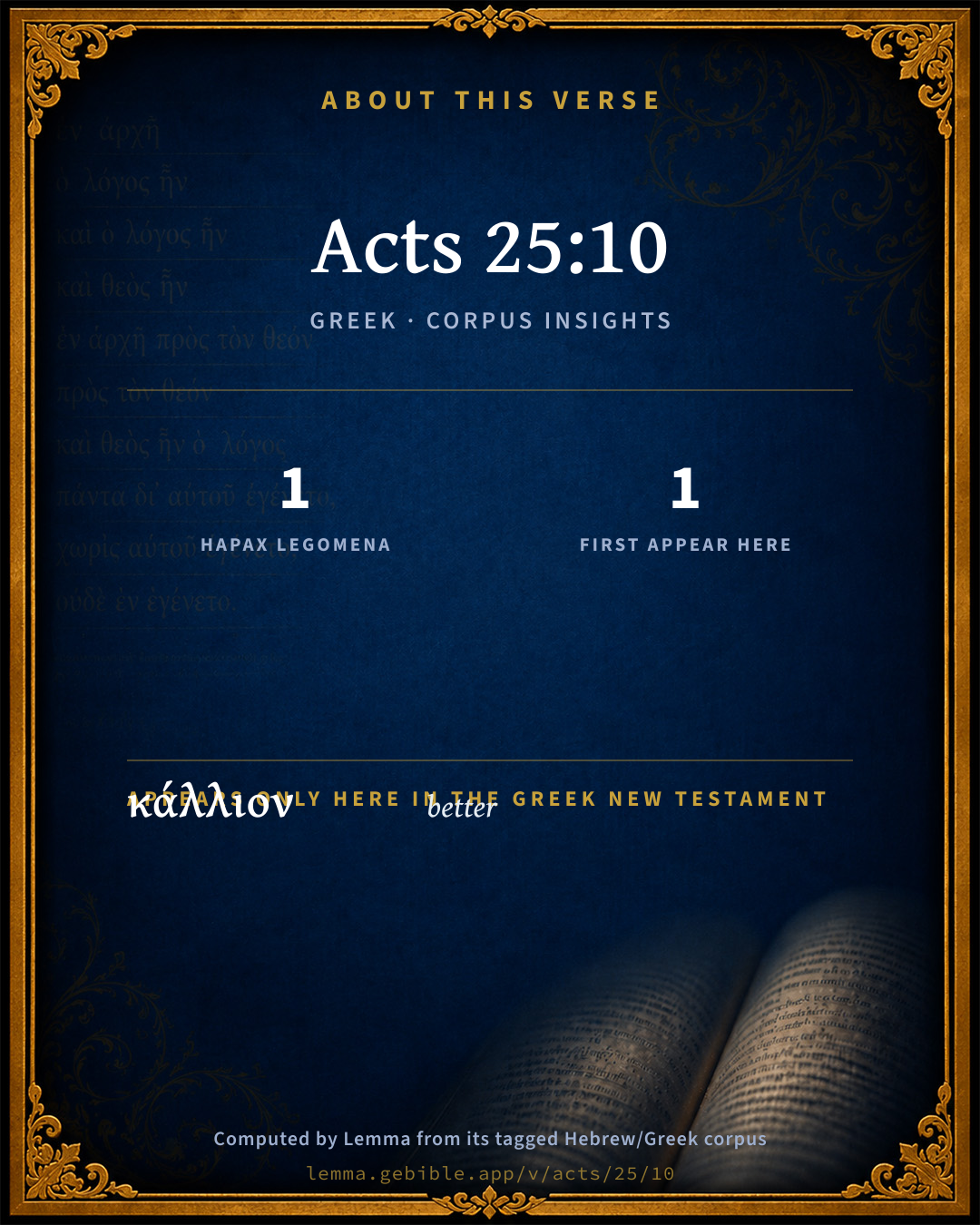
  • 1 hapax legomenon — only here in the Greek New Testament
  • 1 first appearance in the Greek New Testament
Full analysis ↓
Download a study sheet

One document with this verse’s original text, its word-by-word gloss line, the meaning frame, cross-references with their text, attributed commentary, and full source and license credits — printable, and it pastes into notes with its structure intact.

This verse Autodidact and up

Study sheet (.html) Plain text (.txt)

A passage Seminary Student

Up to 50 verses in one chapter. A passage sheet keeps up to 6 commentary sources and 12 cross-references per verse, in the order this page ranks them, and says so on the sheet whenever that leaves anything out. Ask for a single verse and you get the Autodidact verse sheet above.

Everything on this page stays free to read, with no account — the sheet is a download of what is already on screen, not access to it.

Want to remove ads? Support Godless Engineer
Compare translations 3

The same verse in 3 English versions, stacked beneath the original-language interlinear above. Click any original word for its lexicon entry.

Each is an independent rendering of the whole verse — the interlinear is not word-aligned to these translations.

Highlighted words mark where these versions differ — a whole-verse word diff, not a word-by-word alignment.

  • World English Bible Public Domain
    But Paul said, "I am standing before Caesar's judgment seat, where I ought to be tried. I have done no wrong to the Jews, as you also know very well.
  • King James Version Public Domain
    Then said Paul, I stand at Caesar's judgment seat, where I ought to be judged: to the Jews have I done no wrong, as thou very well knowest.
  • unfoldingWord Literal Text CC BY-SA 4.0
    But Paul said, “I am standing before the judgment seat of Caesar, where it is necessary for me to be judged. I have done no harm to the Jews, as you also know very well.

unfoldingWord Literal Text — © unfoldingWord, licensed CC BY-SA 4.0. Word-aligned USFM3 via Door43 (git.door43.org/unfoldingWord/en_ult).

Versions to compare (up to 4)

3 of 4 selected

Show all 19 translations

Every available English version of this verse, each an independent rendering of the whole verse.

  • World English Bible Public Domain
    But Paul said, "I am standing before Caesar's judgment seat, where I ought to be tried. I have done no wrong to the Jews, as you also know very well.
  • Berean Standard Bible Public Domain
    Paul replied, “I am standing before the judgment seat of Caesar, where I ought to be tried. I have done nothing wrong to the Jews, as you yourself know very well.
  • Majority Standard Bible Public Domain
    Paul replied, “I am standing before the judgment seat of Caesar, where I ought to be tried. I have done nothing wrong to the Jews, as you yourself know very well.
  • King James Version Public Domain
    Then said Paul, I stand at Caesar's judgment seat, where I ought to be judged: to the Jews have I done no wrong, as thou very well knowest.
  • American Standard Version (1901) Public Domain
    But Paul said, I am standing before Caesar's judgment-seat, where I ought to be judged: to the Jews have I done no wrong, as thou also very well knowest.
  • Revised Version (1885) Public Domain
    But Paul said, I am standing before Caesar’s judgment-seat, where I ought to be judged: to the Jews have I done no wrong, as thou also very well knowest.
  • Geneva Bible (1599) Public Domain
    Then said Paul, I stand at Caesars iudgment seate, where I ought to be iudged: to the Iewes I haue done no wrong, as thou very well knowest.
  • Douay-Rheims (1899) Public Domain
    Then Paul said: I stand at Caesar's judgment seat, where I ought to be judged. To the Jews I have done no injury, as thou very well knowest.
  • Young's Literal Translation Public Domain
    and Paul said, `At the tribunal of Caesar I am standing, where it behoveth me to be judged; to Jews I did no unrighteousness, as thou dost also very well know;
  • Literal Standard Version CC BY-SA 4.0
    And Paul said, “At the judgment seat of Caesar I am standing, where it is necessary for me to be judged; I did no unrighteousness to Jews, as you also very well know;
  • Unlocked Literal Bible CC BY-SA 4.0
    Paul said, “I stand before the judgment seat of Caesar where I must be judged. I have wronged no Jews, just as you also very well know.
  • unfoldingWord Literal Text CC BY-SA 4.0
    But Paul said, “I am standing before the judgment seat of Caesar, where it is necessary for me to be judged. I have done no harm to the Jews, as you also know very well.
  • Darby Bible Public Domain
    But Paul said, I am standing before the judgment-seat of Caesar, where I ought to be judged. To the Jews have I done no wrong, as *thou* also very well knowest.
  • World Messianic Bible Public Domain
    But Paul said, “I am standing before Caesar’s judgment seat, where I ought to be tried. I have done no wrong to the Judeans, as you also know very well.
  • Webster's Bible Public Domain
    Then said Paul, I stand at Cesar's tribunal, where I ought to be judged: to the Jews have I done no wrong, as thou very well knowest.
  • Free Bible Version CC BY-SA 4.0
    “I'm standing before Caesar's court to be tried, right where I should be,” Paul replied. “I have not done any wrong to the Jews, as you very well know.
  • Bible in Basic English Public Domain
    And Paul said, I am before the seat of Caesar's authority where it is right for me to be judged: I have done no wrong to the Jews, as you are well able to see.
  • Text-Critical English NT CC BY 4.0
    Paul said, “I am standing before the judgment seat of Caesar, where I ought to stand trial. I have done the Jews no wrong, as yoʋ yoʋrself know very well.
  • Tyndale New Testament (1534) Public Domain
    Then sayd Paul: I stonde at Cesars iudgement seate where I ought to be iudged. To the Iewes have I no harme done as thou verely well knowest.

Literal Standard Version (2020), Covenant Press — licensed CC BY-SA 4.0. Text via the HelloAO Bible API (eBible.org). Unlocked Literal Bible (unfoldingWord) — licensed CC BY-SA 4.0. Text via the HelloAO Bible API (eBible.org). unfoldingWord Literal Text — © unfoldingWord, licensed CC BY-SA 4.0. Word-aligned USFM3 via Door43 (git.door43.org/unfoldingWord/en_ult). Free Bible Version, Dr. Jonathan Gallagher — licensed CC BY-SA 4.0. Text via the HelloAO Bible API (eBible.org).

Word by word

More ways to search: Search by grammar → Find every occurrence → Compare this word →

Practice this passage: Drill this verse → Learn its vocabulary →

κάλλιον
kallíon
G2566
“better”
Adverb, Comparative
Part of Speech
Adverb
Degree
Comparative
Full Thayer's Definition

Origin: neuter of the (irregular) comparative of G2570

TDNT: None

1. better
  1. εἶπεν légō G3004 “to say” Verb, Aorist, Active, Indicative, 3rd person, Singular
  2. δὲ dé G1161 “but” Conjunction
  3. ὁ ho G3588 “the” Article, Nominative, Singular, Masculine
  4. Παῦλος Paûlos G3972 “Paul” Noun, Nominative, Singular, Masculine
  5. ἑστὼς hístēmi G2476 “to stand” Verb, Perfect, Active, Participle, Nominative, Singular, Masculine
  6. ἐπὶ epí G1909 “upon” Preposition
  7. τοῦ ho G3588 “the” Article, Genitive, Singular, Neuter
  8. βήματος bēma G968 “judgment seat” Noun, Genitive, Singular, Neuter
  9. Καίσαρός Kaîsar G2541 “Caesar” Noun, Genitive, Singular, Masculine
  10. εἰμι eimí G1510 “to be” Verb, Present, Active, Indicative, 1st person, Singular
  11. οὗ hoû G3757 “where” Adverb
  12. με egṓ G1473 “I” Personal pronoun, 1st person, Accusative, Singular
  13. δεῖ deî G1163 “it is necessary” Verb, Present, Active, Indicative, 3rd person, Singular
  14. κρίνεσθαι krínō G2919 “to judge” Verb, Present, Passive, Infinitive
  15. Ἰουδαίους Ioudaîos G2453 “Jewish” Adjective, Accusative, Plural, Masculine
  16. οὐδὲν oudeís G3762 “nothing” Adjective, Accusative, Singular, Neuter, Negative
  17. ἠδίκηκα adikéō G91 “absolutely” Verb, Perfect, Active, Indicative, 1st person, Singular
  18. ὡς hōs G5613 “as” Adverb
  19. καὶ kaí G2532 “and” Conjunction
  20. σὺ sý G4771 “you” Personal pronoun, 2nd person, Nominative, Singular
  21. ἐπιγινώσκεις epiginṓskō G1921 “to know thoroughly” Verb, Present, Active, Indicative, 2nd person, Singular

About this verse

These counts appear in no published source. They are computed here, from the morphology-tagged text and Lemma’s own curated glosses. What Lemma adds →

22
words
21
distinct lemmas
Acts
section

Notable vocabulary

1 hapax legomenon — a word that appears only here in the entire Greek New Testament:

  • κάλλιον better G2566

First appearance in Scripture

This word makes its first canonical appearance in the Greek New Testament here:

  • κάλλιον better G2566

Shared distinctive vocabulary

βήματος judgment seat G968 occurs in 12 verses of the Greek New Testament. Also found in:

Repetition

A word recurs within this verse:

Cross-references

11

Topical passages linked to Acts 25:10 in the Treasury of Scripture Knowledge — connected by theme and wording, ordered by reader-vote popularity; previews shown in the World English Bible.

  • Matthew 27:18 For he knew that because of envy they had delivered him up.
  • 2 Corinthians 4:2 But we have renounced the hidden things of shame, not walking in craftiness, nor handling the word of God deceitfully; but by the manifestation of the truth commending ourselves to every man's conscience in the sight of God.
  • Acts 25:25 But when I found that he had committed nothing worthy of death, and as he himself appealed to the emperor I determined to send him.
  • Acts 26:31 When they had withdrawn, they spoke one to another, saying, "This man does nothing worthy of death or of bonds."
  • Acts 28:18 who, when they had examined me, desired to set me free, because there was no cause of death in me.
  • Matthew 27:23–24 But the governor said, "Why? What evil has he done?" But they cried out exceedingly, saying, "Let him be crucified!"
  • Acts 16:37–38 But Paul said to them, "They have beaten us publicly, without a trial, men who are Romans, and have cast us into prison! Do they now release us secretly? No, most assuredly, but let them come themselves and bring us out!"
  • Acts 22:25–28 When they had tied him up with thongs, Paul asked the centurion who stood by, "Is it lawful for you to scourge a man who is a Roman, and not found guilty?"
  • Acts 23:29 I found him to be accused about questions of their law, but to have nothing laid to his charge worthy of death or of bonds.
  • Acts 25:6 When he had stayed among them more than ten days, he went down to Caesarea, and on the next day he sat on the judgment seat, and commanded Paul to be brought.
  • Acts 25:17 When therefore they had come together here, I didn't delay, but on the next day sat on the judgment seat, and commanded the man to be brought.

Cross-references courtesy of OpenBible.info (CC BY 4.0).

Commentary

Notes on Acts 25:10 from classic Christian and Jewish commentators (each source and its license shown beneath its notes). The classic Christian expositions comment on the surrounding passage and are grouped to its opening verse, so a note may address several verses; the Jewish commentaries on the Tanakh (Rashi and others) are per-verse, so they appear only where the commentator wrote on this verse.

Lemma curates 59 commentaries, every one of them public domain or Creative Commons licensed, each selected and text-cleaned for this edition rather than reprinted as found. About our sources →

Tyndale Open Study Notes

Tyndale Open Resources

25:10-11 Festus’s suggestion that Paul be tried in Jerusalem motivated the apostle’s appeal to Caesar. Paul was not afraid of death, but he objected to being turned over to a biased court intent on murder, not justice (25:7).

Tyndale Open Study Notes — © Tyndale Open Resources, licensed CC BY-SA 4.0. Text via the HelloAO Bible API.

Bengel's Gnomon

Johann Albrecht Bengel

Act 25:10. Ἑστώς εἰμι, I stand) viz. here at Cesarea.—κάλλιον) better than others [not as Engl. Vers. very well].—ἐπιγινώσκεις, thou knowest) He touches the conscience of Festus.

Bengel's Gnomon of the New Testament — English translation (T&T Clark, Edinburgh, 1860) — public domain. Text from a community e-Sword module.

Meyer's Critical & Exegetical Commentary

Heinrich August Wilhelm Meyer

Act_25:10. Paul gives a frank and firm refusal to that request, both positively (ἐπὶ τοῦ βήμ. Καίσ. κ.τ.λ.) and negatively (Ἰουδαίους οὐδὲν κ.τ.λ., to the Jews I have committed no offence).

ἐπὶ τ. βήμ. Καίσαρος] for quae acta gestaque sunt a procuratore Caesaris, sic ab eo comprobantur, atque si a Caesare ipso gesta sint, Ulpian. L. I. D. de offic. procuratoris.

κάλλιον] namely, than appears to follow from your question. Paul makes his judge feel that he ought not to have proposed that θέλεις κ.τ.λ. to him at all, as it could not but conflict with his own better conviction.

Meyer — Critical and Exegetical Commentary on the New Testament — English translation by Peter Christie, edited by Frederick Crombie (T&T Clark, 1880) — public domain. Text from a community e-Sword module.

Expositor's Greek Testament

ed. W. Robertson Nicoll

Act 25:10 . ἑστώς εἰμι : “I am standing,” used rhetorically, Blass, Gram. , p. 198; on the position of ἑστ . see critical note. Καίσαρος : because the procurator was the representative of Cæsar: “quæ acta gestaque sunt a procuratore Cæsaris sic ab eo comprobantur, atque si a Cæsare ipso gesta sint,” Ulpian, Digest. , i., 19, 1. δεῖ : because a Roman citizen, no need to suppose that the word has reference here to any divine intimation. Ἰουδ .…: “to Jews have I done no wrong,” the omission of the article in translation makes Paul’s denial more forcible and comprehensive; for ἀδικεῖν with οὐδέν and the double accusative cf. Luk 10:19 . ὡς καὶ σὺ κάλλιον ἐπιγ .: “as thou also art getting to know better,” Rendall (see also Page and Weiss): this rendering, it is said, saves us from the ungracious and unjust retort which A. and R.V. ascribe to Paul. But Act 25:18 seems to show us by the confession of Festus himself that the Apostle might fairly have imputed to him a keeping back of his better and fairer judgment, whilst in the expression χαρίσαθαι , Act 25:11 , there seems to be an intimation that the Apostle felt that Festus might make him a victim. Zöckler sees in the comparative “a gentle reproach,” as if St. Paul would intimate to Festus that he really knew better than his question (Act 25:9 ) would imply.

The Expositor's Greek Testament, edited by W. Robertson Nicoll (1897–1910) — public domain. Text from a community e-Sword module.

Jamieson, Fausset & Brown

Robert Jamieson, A. R. Fausset & David Brown

Then said Paul, I stand at Cæsar's judgment seat--that is, I am already before the proper tribunal. This seems to imply that he understood Festus to propose handing him over to the Sanhedrim for judgment (and see on Act 25:11), with a mere promise of protection from him. But from going to Jerusalem at all he was too well justified in shrinking, for there assassination had been quite recently planned against him.

to the Jews have I done no wrong, as thou knowest very well--literally, "better," that is, (perhaps), better than to press such a proposal.

if there be none of these things . . . no man may deliver me unto them--The word signifies to "surrender in order to gratify" another.

Jamieson, Fausset & Brown — Commentary Critical and Explanatory on the Whole Bible (1871) — public domain (CC PDM 1.0). Text via the HelloAO Bible API.

Adam Clarke's Commentary

Verse 10. I stand at Caesar's judgment seat] Every procurator represented the person of the emperor in the province over which he presided; and, as the seat of government was at Caesarea, and Paul was now before the tribunal on which the emperor's representative sat, he could say, with the strictest propriety, that he stood before Caesar's judgment seat, where, as a freeman of Rome, he should be tried.

As thou very well knowest.] The record of this trial before Felix was undoubtedly left for the inspection of Festus; for, as he left the prisoner to his successor, he must also leave the charges against him, and the trial which he had undergone. Besides, Festus must be assured of his innocence, from the trial through which he had just now passed.

Adam Clarke's Commentary on the Bible (1810–1826) — public domain. Text from a community e-Sword/MySword module.

John Calvin's Commentaries

10. I stand at Caesar’s judgment-seat. Because Paul seeth that he is betrayed into the hands of the Jews through the ambition of the governor, he objecteth the privilege of the city of Rome. He had submitted himself modestly, if he had commanded him to do that which was just and equal. Now, because the governor doth not his duty willingly, necessity compelleth the holy man to defend himself by law; and by this means the Lord delivereth him now again, even when he was almost given over into the hands of the enemies. And whereas he desireth to have his matter handled before Caesar’s judgment-seat, he doth not, therefore, make the doctrine of the gospel subject to the judgment of a profane and wicked man; but being ready to give an account of his faith everywhere, he appealeth from that court where he could no longer hope for equity. Furthermore, though the citizens of Rome did retain their privilege, yet the order was then altered, because the Caesars had taken into their own hands the judging of the people, as if they would be good maintainers and patrons of common liberty.

To the Jews have I done. Because those whose consciences do accuse them, and which mistrust their matter, fly unto certain odd excuses and exceptions, Paul turneth away from himself this opinion. And surely the ministers of Christ ought to have no less care to make their innocency known than to save their life. If Paul had flatly denied to answer for himself, the enemies would have triumphed, and the doubtfulness of an evil conscience should have been objected to him to the reproach of the gospel. But now when he citeth the governor himself to be a witness of his integrity, and doth refuse no punishment if he should be found guilty, he cutteth off all occasion of slanderous reports. Therefore, he showeth that he doth not seek to save himself by turning his back, but flyeth unto the fortress of a just defense, that he may there save himself from injury, seeing his adversaries have hitherto handled him unjustly; and now refusing to deal with him any longer by law, they go about to have him murdered. Neither doth Paul go behind the president’s back to tell him that he doth unjustly, in that he doth so dally with his accusers; and therewithal he doth, as it were, bridle his lust, so that he dare go no farther.

John Calvin's Commentaries (1540-1563) — public domain. Text from the Calvin Translation Society English edition (1840s-50s) via the Christian Classics Ethereal Library (ccel.org). Calvin's coverage is partial (roughly two-thirds of the Bible); uncommented books and verses are honest gaps, never fabricated. The 19th-century editor's footnotes and remarks are omitted so the notes are faithfully Calvin's own voice.

Ellicott's Commentary for English Readers

(10) I stand at Cæsar’s judgment seat.—The Greek verb is given in a peculiar form, which carries with it the meaning of, I am standing, and have stood all along . . . He, as a Roman citizen, claimed the right to be tried by a Roman court, and finding that the procurator had shown a bias which left little hope of a fair trial, exercised the right which attached to his citizenship, and appealed to the highest court of all, that of the emperor himself. This interpretation seems every way more rational than that which paraphrases St. Paul’s words thus: “I stand already in mind and purpose before the emperor’s court, for God has shown me by a special revelation that I am to preach the gospel at Rome, and my trial there is accordingly part of the divinely ordered course of things which cannot be altered.” Whatever influence the promise of Act_23:11 may have had on the Apostle’s conduct, it is scarcely probable that he would have referred to it in this way in giving his reason for appealing to Cæsar.

As thou very well knowest.—We have, as in Act_24:22, the comparative of the adverb. Festus knew this too well to need any further proof. He had heard the random charges, and had seen the worthlessness of the evidence.

A Bible Commentary for English Readers, edited by Charles John Ellicott (1878–1897) — public domain. Text from a community e-Sword module.

The Cambridge Bible for Schools and Colleges

gen. ed. J. J. S. Perowne

10. I stand at Cesar’s judgment seat] Better (with Rev. Ver.) “I am standing before Cæsar’s judgment seat.” This represents more nearly the sense of the original, which implies, “I have been and am standing.” The Roman authorities had taken charge of him and had kept him in custody for two years. Of this he reminds the governor, and refuses to be turned over to another tribunal, where he would have for judges, if he ever were allowed to live till his trial, those persons who had been cognizant of the plot to murder him.

where I ought to be judged] Because I am a Roman citizen.

as thou very well knowest] Rev. Ver. “as thou also, &c.” St Paul does not mean to say that Festus is to be blamed for his proposal. Probably he saw that the governor was acting with a view to conciliate the Jews. But he intends to say that after all that the governor has heard, any man would say at once that there was no case against the prisoner.

The Cambridge Bible for Schools and Colleges (gen. ed. J. J. S. Perowne; Cambridge University Press, 1878–1918) — public domain. Text from a community e-Sword module.

John Gill's Exposition

Then said Paul, I stand at Caesar's judgment seat,.... Not that here was a seat in the judgment hall built by Herod for Caesar himself to sit in, should he ever come there, as some have thought; but the seat on which Festus sat is called Caesar's judgment seat, because it was in a Raman court of judicature, and because Festus, who filled it, represented Caesar himself:

where I ought to be judged: being a Roman citizen, and not at Jerusalem by the sanhedrim of the Jews, who had nothing to do with him:

to the Jews have I done no wrong, as thou very well knowest; it may be by his predecessor Felix, who had informed him of this case; or by Lysias's letter, which might come to his hands; or by the apostle's answer and vindication of himself, which he now made.

have I done no wrong, as thou very well knowest; it may be by his predecessor Felix, who had informed him of this case; or by Lysias's letter, which might come to his hands; or by the apostle's answer and vindication of himself, which he now made.

John Gill's Exposition of the Whole Bible (1746–1763) — public domain (CC PDM 1.0). Text via the HelloAO Bible API.

Trapp's Complete Commentary

John Trapp

10 Then said Paul, I stand at Caesar’s judgment seat, where I ought to be judged: to the Jews have I done no wrong, as thou very well knowest.

Ver. 10. I stand at Coesar’s judgment seat] We may safely make our just defence when falsely accused, and take the benefit of the law. Ambrose would be judged at Milan, where he was known; and Athanasius refused to be censured by corrupt councils.

John Trapp, A Commentary or Exposition upon All the Books of the Old and New Testament (1647–1656) — public domain. Text from a community e-Sword module.

Albert Barnes' Notes on the Bible

Then said Paul ... - The reasons why Paul declined the proposal to be tried at Jerusalem are obvious. He had experienced so much violent persecution from his countrymen, and their minds were so full of prejudice, misconception, and enmity, that he had neither justice nor favor to hope at them hands. He knew, too, that they had formerly plotted against his life, and that he had been removed to Caesarea for the purpose of safety. It would be madness and folly to throw himself again into their hands, or to give them another opportunity to form a plan against his life. As he was, therefore, under no obligation to return to Jerusalem, and as Festus did not propose it because it could be supposed that justice would be promoted by it, but to gratify the Jews, Paul prudently declined the proposal, and appealed to the Roman emperor.

I stand at Caesar’s judgment seat - The Roman emperors after Julius Caesar were all called “Caesar”; thus, Augustus Caesar, Claudius Caesar, etc., as all the kings of Egypt were called “Pharaoh,” though they each had his proper name, as Pharaoh Necho, etc. The emperor at this time (60 a.d.) was Nero, one of the most cruel and impious men that ever sat on a throne. It was under him that Paul was afterward beheaded. When Paul says, “I stand at Caesar’s judgment seat,” he means to say that he regarded the tribunal before which he then stood, and on which Festus sat, as really the judgment seat of Caesar. The procurator, or governor, held his commission from the Roman emperor, and it was, in fact, his tribunal. The reason why Paul made this declaration may be thus expressed: “I am a Roman citizen. I have a right to justice. I am under no obligation to put myself again in the hands of the Jews. I have a right to a fair and impartial trial; and I claim the protection and privileges which all Roman citizens have before their tribunals - the right of a fair and just trial.” It was, therefore, a severe rebuke of Festus for proposing to depart from the known justice of the Roman laws, and, for the sake of popularity, proposing to him to put himself in the hands of his enemies.

Where I ought to be judged - Where I have a right to demand and expect justice. I have a right to be tried where courts are usually held, and according to all the forms of equity which are usually observed.

Have I done no wrong - I have not injured their persons, property, character, or religion. This was a bold appeal, which his consciousness of innocence and the whole course of proceedings enabled him to make without the possibility of their gainsaying it.

As thou very well knowest - Festus knew, probably, that Paul had been tried by Felix, and that nothing was proved against him. He had now seen the spirit of the Jews, and the cause why they arraigned him. He had given Paul a trial, and had called on the Jews to adduce their “able” men to accuse him, and after all nothing had been proved against him. Festus knew, therefore, that he was innocent. This abundantly appears also from his own confession, Act 25:18-19. As he knew this, and as Festus was proposing to depart from the regular course of justice for the sake of popularity, it was proper for Paul to use the strong language of rebuke, and to claim what he knew Festus did not dare to deny him, the protection of the Roman laws. Conscious innocence may be bold; and Christians have a right to insist on impartial justice and the protection of the laws. Alas! how many magistrates there have been like Festus, who, when Christians have been arraigned before them, have been fully satisfied of their innocence, but who, for the sake of popularity, have departed from all the rules of law and all the claims of justice.

Albert Barnes' Notes on the Bible (1834–1885) — public domain. Text from a community e-Sword/MySword module.

Haydock's Catholic Bible Commentary

St. Paul, seeing Festus only sought a plea to get rid of his cause, by putting it into the hands of the Sanhedrim, appeals to Cæsar. According to the ordinary rules of jurisprudence, appeals are only made after sentence is pronounced; but Roman citizens had a privilege of anticipating the sentence, when the judge did any thing contrary to justice; as Festus evidently did in this case, by wishing to deliver Paul, a Roman citizen, to the tribunal of his declared enemies, the Jews. The apostle knew he was secured by making this appeal: as the Roman law declared provincial governors violators of the public peace, who should either strike, or imprison, or put to death a Roman citizen, that appealed to the emperor. (Calmet) --- Hence Pliny sent some Christians to Rome for this same reason, as he writes himself in his epistles. (Lib. x. ep. 97.) Fuerunt alii similis amentiæ, quos, quia cives Romani erant, annotavi in urbem remittendos.

George Leo Haydock (1774–1849), Haydock's Catholic Family Bible and Commentary, 1859 edition — public domain. Excludes Psalms (Douay-Rheims chapter numbering differs from Protestant) and Deuterocanonical books (Catholic canon only).

Matthew Poole's English Annotations

Paul might justly suspect his judges, and the place where they would have him judged, and also his journey thither, knowing with what difficulty, and not without a great guard, he came from thence.

I stand at Caesar’s judgment seat; he was now before Caesar’s tribunal, whose vicegerent Festus was; and he only ought to judge a Roman citizen.

As thou very well knowest; Festus might know that Paul had done the Jews no wrong, from the relation Felix had made unto him, as also from such as were with Felix when Paul’s case was heard.

Matthew Poole's English Annotations on the Holy Bible (1683–1685) — public domain. Text from a community e-Sword/MySword module.

Whedon's Commentary on the Bible

Daniel D. Whedon

10. Cesar’s judgment seat—Every Roman bema, or tribunal, was Cesar’s judgment seat, including the court of Festus.

Where I ought to be judged—And not before a Jewish Sanhedrin.

Very well knowest—From their failure of proof on the present occasion. Such was Festus’ own statement, (Act_25:18.)

Daniel D. Whedon (gen. ed.), Commentary on the Old and New Testaments (1874–1909) — public domain. Text from a community e-Sword module.

The Pulpit Commentary

But Paul said for then said Paul, A.V.; I am standing for I stand, A.V.; before for at, A.V.; thou also for thou, A.V. I am standing before Caesar"s judgment-seat (eJstwv eijmi). The judgment-seat of the procurator, who ministered judgment in Caesar"s name and by his authority, was rightly called "Caesar"s judgment-seat." As a Roman citizen, Paul had a right to be tried there, and not before the Sanhedrim. The pretence that he had offended against the Jewish Law, and therefore ought to be tried by the Jewish court, was a false one, as Festus well knew; for he had the record of the preceding trial before him.

HOMILIES BY P.C. BARKER

Vers. 10, 11. Courage to live.

Paul knows that he is "standing" (see Revised Version) already at the bar of Caesar. There he elects still to stand. And his formal appeal to Caesar is but the public and legal registration of his deliberate and decisive choice to that effect. There were, no doubt, two sides to the question that had been before Paul, though it savored ever so little of the nature of a question with him. The two sides were these that justice was nearer him when he was before Caesar than when he might be before them of "Jerusalem;" and that nevertheless to consent to go, and to choose to go, to Caesar, to Rome, and to the likeliest prospect of justice, begged, in Paul"s special case and character, very real courage the courage to live. Notice, then, that the decision recorded in these verses was the decision of

I THE CONSCIOUSNESS OF INNOCENCE. It is not infrequently the case, in instances that do not touch the question of life, but do touch those of principle and duty, that even conscious innocence prefers the easier path of non-resistance and non-defense, when resistence and self-defense would be the right course. Nature, beyond a doubt, should often be mortified. But there is a nature also which should be observed and followed and obeyed. To stand up for one"s own innocence is sometimes to stand up for all innocence.

II CHRISTIAN PATIENCE. The Christian soldier, racer, workman, must fight to the end, must run to the goal, must labor till the nightfall. And this requires sometimes great patience. With Paul and others of the early Christians, whose names are now nowhere else but in that best place the book of life," this was true to such an extent, that a Divine maxim became formulated in Scripture for the behoove of it, and so it was written, For ye have need of patience, that, after ye have done the will of God, ye might receive the promise". (Heb_10:36) Paul must have often felt, what he once said, "To depart and be with Christ were far better." Many a craven spirit faints. Many fail long before they have "resisted unto blood.

III CHRISTIAN WISDOM. The true apostle, of whatever day, will consider many a question, not in its reference to his own individuality, but in its bearing upon the cause he has at heart. Many herein may err, therefore, "lacking wisdom." Paul saw that it was wisdom"s dictate not to allow himself and his cause to be baffled. Let alone other aspects of the case, it was policy, and a right and holy policy to appeal to Caesar.

IV CHRISTIAN DUTY. There yet awaited Paul some of the grandest opportunities of usefulness, all along the way to Rome and in Rome. His bonds were to be manifest "in the palace and in all other places". (Php_1:13) He was to gain many converts even "of Caesar"s household." A "great door and effectual" was yet to be opened before him and the gospel he preached and loved so well, so faithfully. So it was duty to stand to his colors, though men might possibly taunt him that he was rather standing for his life.

V THE SPIRIT"S OWN GUIDANCE. Already we have once heard that Paul was assured by the angel of the Lord, who stood by him at night, that "at Rome also" he should bear testimony to Jesus, as he had at Jerusalem. It is an infinite satisfaction to the heart"s uncertainty, to the occasional distrust that a conscience feels with regard to its own verdicts, when Heaven"s guidance is borne in upon one. This satisfaction Paul had. And though the vista which his own choice revealed to him terminated in a very arena of conflict most visible, but its severity, its amount, its terrors unseen, and not to be estimated, yet nor tongue nor heart falters. He appeals to Caesar, and "if he perish, he will perish" there. B.

The Pulpit Commentary (1880–1919), ed. H.D.M. Spence-Jones & Joseph S. Exell — public domain. Text from a community e-Sword module.

John Wesley's Explanatory Notes

I am standing at Caesar's judgment seat - For all the courts of the Roman governors were held in the name of the emperor, and by commission from him. No man can give me up - He expresses it modestly: the meaning is, Thou canst not. I appeal to Caesar - Which any Roman citizen might do before sentence was passed.

John Wesley, Explanatory Notes Upon the Whole Bible (1754–1765) — public domain. Text via the GEBible commentary corpus.

McGarvey & Pendleton's Commentaries

J. W. McGarvey

10, 11. The purpose of the Jews was well understood by Paul. He remembered the purpose of the similar request preferred before Claudius Lysias, and perceived that his only safety was in frustrating their present attempt. Fortunately, the very imprisonment which exposed him to danger also furnished the means of his safety. (10) " Then Paul said, I am standing at Cæsar's judgment-seat, where I ought to be judged. To the Jews I have done no wrong, as you yourself very well know. (11) If I am a wrong-doer, and have committed any thing worthy of death, I refuse not to die. But if there is nothing in these things of which they accuse me, no man is able to deliver me up to them. I APPEAL TO CÆSAR." This appeal every Roman citizen had the right to make, and it required a transfer of the case to the imperial court in Rome. The statement, "I stand at Cæsar's judgment-seat," was intended to justify him in refusing to be taken for trial away from Cæsarea, which was the appointed capital of the province where the courts were properly held.

His appeal to Cæsar, like his communication to Lysias, which secured his rescue in Jerusalem, is claimed as a sanction of military power. But, like that, it is only a demand made upon the military power which was holding him in unjust confinement, not to add to this injustice the crime of yielding him up to assassination. It is not an appeal from a free man to military power for protection; neither was there any necessity for the use of violence in granting his request on either occasion.

J. W. McGarvey (with Philip Y. Pendleton), Commentaries on the New Testament (The Fourfold Gospel, 1914; Acts; and the epistles) — public domain. Text from a community e-Sword/MySword module.

Cambridge Greek Testament for Schools and Colleges

10. ἐπὶ τοῦ βήματος Καίσαρος ἑστώς εἰμι, I am standing before Cæsar’s judgment seat. The Roman authorities had taken charge of him and had kept him in custody for two years. Of this he reminds the governor, and refuses to be turned over to another tribunal, where he would have for judges, if he ever were allowed to live till his trial, those persons who had been cognizant of the plot to murder him.

οὗ με δεῖ καίνεσθαι, where I ought to be judged, because I am a Roman citizen.

ὡς καὶ σὺ κάλλιον ἐπιγινώσκεις, as thou also very well knowest. St Paul does not mean to say that Festus is to be blamed for his proposal. Probably he saw that the governor was acting with a view to conciliate the Jews. But he intends to say that after all that the governor has heard, any man would say at once that there was no case against the prisoner.

The comparative force in κάλλιον may be brought out somewhat thus, ‘better than from your proposal to turn me over to Jews you would appear to know.’

Cambridge Greek Testament for Schools and Colleges (Cambridge University Press, 1896; 21 vols, various authors incl. Carr, Maclear, Plummer, Farrar, Lumby, Moule, M. R. James, Simcox) — public domain. Text from a community e-Sword module.

Alford’s Greek Testament

Henry Alford

10.] Paul’s refusal has a positive and a negative ground—1. ‘Cœsar’s tribunal is my proper place of judgment: 2. To the Jews I have done no harm, and they have therefore no claim to judge me’ (De W.).

ἐπ. τ. β. Καίς.] Meyer quotes from Ulpian, “Quæ acta gestaque sunt a procuratore Cæsaris sic ab eo comprobantur, atque si a Cæsare ipso gesta sint.” In οὗ με δεῖ κρίνεσθαι, Wordsworth has again fallen into the mistake of supposing με (and again in ver. 11) to be emphatic (see note, Mat 16:18), which it cannot possibly be under any circumstances. The form of the sentence which would express the sense built by him on this error, would be, οὗ δεῖ ἐμὲ κριθῆναι, or οὗ ἐμὲ δεῖ κριθῆναι. But the sense, when thus given, surely is wholly alien from the person speaking and from the situation: as is also the understanding δεῖ as alluding to divine intimation made to him. The δεῖ is simply of his right as a Roman citizen: the με simply enclitic, and of no rhetorical force at all.

κάλλιον] Not ‘for the superlative,’ here or any where else:—the comparative is elliptical, requiring ‘than …’ to be supplied by the hearer: so also in reff. Here, the ellipsis would be readily supplied from Festus’s own speech, which appeared to assume that there was some ground of trial before the Sanhedrim. κάλλιον will therefore mean, better than thou choosest to confess. We have an ellipsis of the same kind in our phrase ‘to know better.’ Or it may be in this case as in 2Ti 1:18, ‘better, than that I need say more on it:’ but I prefer the other interpretation.

Henry Alford, The Greek Testament (1849–1861) — public domain. Text from a community e-Sword module.

Vincent's Word Studies in the New Testament

Marvin R. Vincent

Very well [καλλιον] . The force of the comparative should be preserved : "thou knowest better than thy question implies."

Marvin R. Vincent, Word Studies in the New Testament (1887–1900) — public domain. Text from a community e-Sword/MySword module.

Lesson kit

Teaching starters — assembled from the data on this page, not authored interpretation. Every prompt links to the verse data it draws on. Edit before teaching.

Acts, in the Acts, opens this verse with 22 words (21 distinct Greek lemmas). Its most distinctive word is kallíon (“better”). A historical commentator’s framing appears above. Read the whole chapter for the surrounding context.

Discussion questions

  1. The word kallíon carries the sense “better.” How does it shape the verse?
  2. 1 word here appears nowhere else in the Greek New Testament. Why might the author reach for such rare wording?
  3. This is the first place “better” appears in Scripture (first appears here). What does its debut here establish?
  4. How does Matthew 27:19, which shares the word «judgment seat», read alongside this verse?
  5. What does the repetition of “the” (2× in this one verse) do in this verse?
  6. These translations render this verse differently. What is at stake in choosing one wording over another?
  7. Compare how Tyndale Open Study Notes and Bengel's Gnomon read this verse. Where do they agree or differ?

Things to notice

  • 1 word in this verse appears nowhere else in the Greek New Testament.
  • 1 word makes its first canonical appearance in Scripture here.
  • These translations choose different wording for 17 words in this verse.
  • “the” occurs 2× in this single verse.
  • 21 distinct Greek lemmas span 22 words in this verse.

Reading settings

Reading text

Shown beneath each verse's original-language words.

Old Testament
Old Testament edition

Read the OT as the Masoretic Hebrew (MT) or the Greek Septuagint (LXX).

English shown for the Greek Septuagint (in the Hebrew ↔ Greek comparison).

Comparing translations? Open the Compare panel on any verse page to stack up to four side by side.