
Philemon 1:14

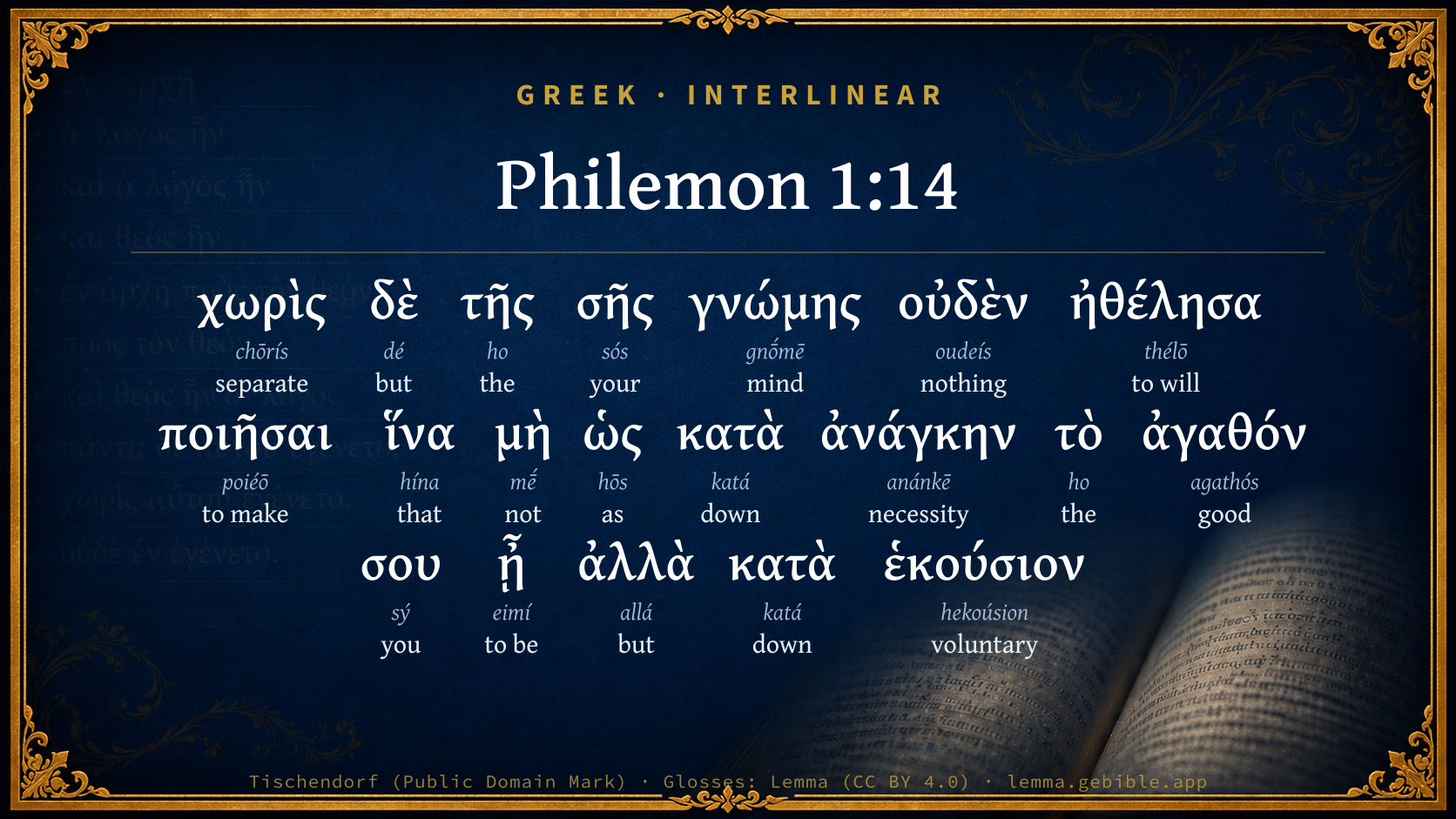
Greek (Tischendorf 8th ed.) Philemon 1:14 appears in the Greek New Testament. The text above is from the Tischendorf 8th edition. Each word links to its Strong’s number and a concise gloss. Click any word for its full Thayer’s Greek Lexicon entry.
Download image
Cite this verse

Philemon 1:14 (World English Bible). Public Domain. Lemma interlinear Bible study tool, https://lemma.gebible.app/v/philemon/1/14.

Show BibTeX & RIS
BibTeX
RIS
English Translation
But I was willing to do nothing without your consent, that your goodness would not be as of necessity, but of free will.
World English Bible · Public Domain
Highlights
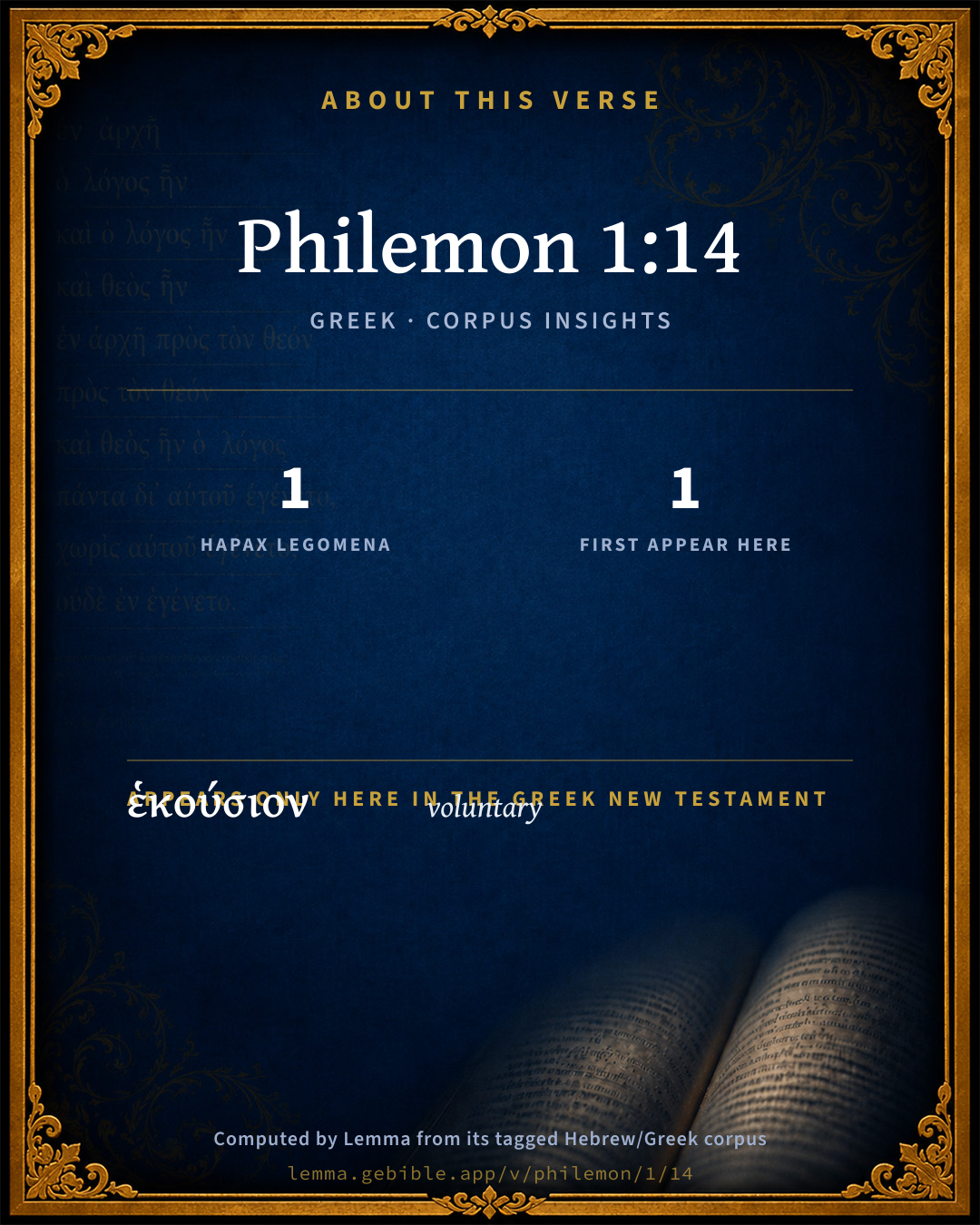
  • 1 hapax legomenon — only here in the Greek New Testament
  • 1 first appearance in the Greek New Testament
Full analysis ↓
Download a study sheet

One document with this verse’s original text, its word-by-word gloss line, the meaning frame, cross-references with their text, attributed commentary, and full source and license credits — printable, and it pastes into notes with its structure intact.

This verse Autodidact and up

Study sheet (.html) Plain text (.txt)

A passage Seminary Student

Up to 50 verses in one chapter. A passage sheet keeps up to 6 commentary sources and 12 cross-references per verse, in the order this page ranks them, and says so on the sheet whenever that leaves anything out. Ask for a single verse and you get the Autodidact verse sheet above.

Everything on this page stays free to read, with no account — the sheet is a download of what is already on screen, not access to it.

Want to remove ads? Support Godless Engineer
Compare translations 3

The same verse in 3 English versions, stacked beneath the original-language interlinear above. Click any original word for its lexicon entry.

Each is an independent rendering of the whole verse — the interlinear is not word-aligned to these translations.

Highlighted words mark where these versions differ — a whole-verse word diff, not a word-by-word alignment.

  • World English Bible Public Domain
    But I was willing to do nothing without your consent, that your goodness would not be as of necessity, but of free will.
  • King James Version Public Domain
    But without thy mind would I do nothing; that thy benefit should not be as it were of necessity, but willingly.
  • unfoldingWord Literal Text CC BY-SA 4.0
    But I did not want to do anything without your consent, so that your good might not be as according to compulsion but according to good will.

unfoldingWord Literal Text — © unfoldingWord, licensed CC BY-SA 4.0. Word-aligned USFM3 via Door43 (git.door43.org/unfoldingWord/en_ult).

Versions to compare (up to 4)

3 of 4 selected

Show all 19 translations

Every available English version of this verse, each an independent rendering of the whole verse.

  • World English Bible Public Domain
    But I was willing to do nothing without your consent, that your goodness would not be as of necessity, but of free will.
  • Berean Standard Bible Public Domain
    But I did not want to do anything without your consent, so that your goodness will not be out of compulsion, but by your own free will.
  • Majority Standard Bible Public Domain
    But I did not want to do anything without your consent, so that your goodness will not be out of compulsion, but by your own free will.
  • King James Version Public Domain
    But without thy mind would I do nothing; that thy benefit should not be as it were of necessity, but willingly.
  • American Standard Version (1901) Public Domain
    but without thy mind I would do nothing; that thy goodness should not be as of necessity, but of free will.
  • Revised Version (1885) Public Domain
    but without thy mind I would do nothing; that thy goodness should not be as of necessity, but of free will.
  • Geneva Bible (1599) Public Domain
    But without thy minde woulde I doe nothing, that thy benefite should not be as it were of necessitie, but willingly.
  • Douay-Rheims (1899) Public Domain
    But without thy counsel I would do nothing: that thy good deed might not be as it were of necessity, but voluntary.
  • Young's Literal Translation Public Domain
    and apart from thy mind I willed to do nothing, that as of necessity thy good deed may not be, but of willingness,
  • Literal Standard Version CC BY-SA 4.0
    but apart from your mind I willed to do nothing, so that your good deed may not be as of necessity, but of willingness,
  • Unlocked Literal Bible CC BY-SA 4.0
    But I did not want to do anything without your consent. I did not want your good deed to be from necessity but from good will.
  • unfoldingWord Literal Text CC BY-SA 4.0
    But I did not want to do anything without your consent, so that your good might not be as according to compulsion but according to good will.
  • Darby Bible Public Domain
    but I have wished to do nothing without thy mind, that thy good might not be as of necessity but of willingness:
  • World Messianic Bible Public Domain
    But I was willing to do nothing without your consent, that your goodness would not be as of necessity, but of free will.
  • Webster's Bible Public Domain
    But without thy mind I would do nothing; that thy benefit should not be as it were of necessity, but willingly.
  • Free Bible Version CC BY-SA 4.0
    But I decided not to do anything without your permission. I didn't want you to be forced to do good, but to do so willingly.
  • Bible in Basic English Public Domain
    But without your approval I would do nothing; so that your good works might not be forced, but done freely from your heart.
  • Text-Critical English NT CC BY 4.0
    But I did not want to do anything without yoʋr consent, so that yoʋr good deed would not be done out of compulsion, but of yoʋr own free will.
  • Tyndale New Testament (1534) Public Domain
    Neverthelesse without thy mynde wolde I doo nothinge that that good which springeth of the shuld not be as it were of necessitie but willingly.

Literal Standard Version (2020), Covenant Press — licensed CC BY-SA 4.0. Text via the HelloAO Bible API (eBible.org). Unlocked Literal Bible (unfoldingWord) — licensed CC BY-SA 4.0. Text via the HelloAO Bible API (eBible.org). unfoldingWord Literal Text — © unfoldingWord, licensed CC BY-SA 4.0. Word-aligned USFM3 via Door43 (git.door43.org/unfoldingWord/en_ult). Free Bible Version, Dr. Jonathan Gallagher — licensed CC BY-SA 4.0. Text via the HelloAO Bible API (eBible.org).

Word by word

More ways to search: Search by grammar → Find every occurrence → Compare this word →

Practice this passage: Drill this verse → Learn its vocabulary →

ἑκούσιον
hekoúsion
G1595
“voluntary”
Adjective, Accusative, Singular, Neuter
Part of Speech
Adjective
Case
Accusative
Number
Singular
Gender
Neuter
Full Thayer's Definition

Origin: neuter of a derivative from G1635

TDNT: 2:470,*

1. voluntary
  1. χωρὶς chōrís G5565 “separate” Adverb
  2. δὲ dé G1161 “but” Conjunction
  3. τῆς ho G3588 “the” Article, Genitive, Singular, Feminine
  4. σῆς sós G4674 “your” Possessive pronoun, 2nd person, Genitive, Singular, Feminine
  5. γνώμης gnṓmē G1106 “mind” Noun, Genitive, Singular, Feminine
  6. οὐδὲν oudeís G3762 “nothing” Adjective, Accusative, Singular, Neuter, Negative
  7. ἠθέλησα thélō G2309 “to will” Verb, Aorist, Active, Indicative, 1st person, Singular
  8. ποιῆσαι poiéō G4160 “to make” Verb, Aorist, Active, Infinitive
  9. ἵνα hína G2443 “that” Conjunction
  10. μὴ mḗ G3361 “not” Particle, Negative
  11. ὡς hōs G5613 “as” Adverb
  12. κατὰ katá G2596 “down” Preposition
  13. ἀνάγκην anánkē G318 “necessity” Noun, Accusative, Singular, Feminine
  14. τὸ ho G3588 “the” Article, Nominative, Singular, Neuter
  15. ἀγαθόν agathós G18 “good” Adjective, Nominative, Singular, Neuter
  16. σου sý G4771 “you” Personal pronoun, 2nd person, Genitive, Singular
  17. ᾖ eimí G1510 “to be” Verb, Present, Active, Subjunctive, 3rd person, Singular
  18. ἀλλὰ allá G235 “but” Conjunction
  19. κατὰ katá G2596 “down” Preposition

About this verse

These counts appear in no published source. They are computed here, from the morphology-tagged text and Lemma’s own curated glosses. What Lemma adds →

20
words
18
distinct lemmas
Pauline Epistles
section

Notable vocabulary

1 hapax legomenon — a word that appears only here in the entire Greek New Testament:

  • ἑκούσιον voluntary G1595

First appearance in Scripture

This word makes its first canonical appearance in the Greek New Testament here:

  • ἑκούσιον voluntary G1595

Shared distinctive vocabulary

γνώμης mind G1106 occurs in 8 verses of the Greek New Testament. Also found in:
Repetition

Words recur within this verse:

Cross-references

9

Topical passages linked to Philemon 1:14 in the Treasury of Scripture Knowledge — connected by theme and wording, ordered by reader-vote popularity; previews shown in the World English Bible.

  • 2 Corinthians 9:7 Let each man give according as he has determined in his heart; not grudgingly, or under compulsion; for God loves a cheerful giver.
  • 1 Chronicles 29:17 I know also, my God, that you try the heart, and have pleasure in uprightness. As for me, in the uprightness of my heart I have willingly offered all these things: and now have I seen with joy your people, that are present here, offer willingly to you.
  • 1 Peter 5:2–3 Shepherd the flock of God which is among you, exercising the oversight, not under compulsion, but voluntarily, not for dishonest gain, but willingly;
  • 1 Corinthians 9:17 For if I do this of my own will, I have a reward. But if not of my own will, I have a stewardship entrusted to me.
  • 2 Corinthians 8:12 For if the readiness is there, it is acceptable according to what you have, not according to what you don't have.
  • 2 Corinthians 9:5 I thought it necessary therefore to entreat the brothers that they would go before to you, and arrange ahead of time the generous gift that you promised before, that the same might be ready as a matter of generosity, and not of greediness.
  • Philemon 1:8–9 Therefore, though I have all boldness in Christ to command you that which is appropriate,
  • Psalms 110:3 Your people offer themselves willingly in the day of your power, in holy array. Out of the womb of the morning, you have the dew of your youth.
  • 2 Corinthians 1:24 Not that we have lordship over your faith, but are fellow workers with you for your joy. For you stand firm in faith.

Cross-references courtesy of OpenBible.info (CC BY 4.0).

Commentary

Notes on Philemon 1:14 from classic Christian and Jewish commentators (each source and its license shown beneath its notes). The classic Christian expositions comment on the surrounding passage and are grouped to its opening verse, so a note may address several verses; the Jewish commentaries on the Tanakh (Rashi and others) are per-verse, so they appear only where the commentator wrote on this verse.

Lemma curates 59 commentaries, every one of them public domain or Creative Commons licensed, each selected and text-cleaned for this edition rather than reprinted as found. About our sources →

The Biblical Illustrator

Joseph S. Exell

Phm_1:14

Without thy mind would I do nothing--This final resolution was, no doubt, the result of several motives.

1. To harbour and detain a slave, who applied to him to become a precator, beyond a limited period, would have been distinctly to violate the Roman law.

2. The apostle might have seemed to inflict a pecuniary loss upon Philemon by depriving him of a chattel personal, and morally constraining him to put up with the loss by imposing a severe strain upon the bonds of friendship.

3. Onesimus, in the depth and reality of his repentance, saw the duty of returning. What truer piece of restitution was ever made?

4. St. Paul was peculiarly sensitive as to the scandal which the Church might occasion, if slaves received encouragement to become fugitives. See Col_3:22; 1Ti_6:1. (Bp. Wm. Alexander.)

Servants not to be detained from their masters

Servants must not be detained without their masters liking. Eustathius, Bishop of Armenia, was deposed from his see because under a colour of piety he had taken servants from their masters. (W. Jones, D. D.)

Willingly--

Voluntary virtue

Jerome from this passage justly deduces as a conclusion that St. Paul held the principle that nothing in moral action is good which is not voluntary. He applies it to the solution of the question which has been so often asked--Why God did not make men absolutely good? God might have made man good without mans will. But, had He done so, the good would not have been voluntary, but necessary. But what is necessarily good is not good in the highest sense, and is even relatively and in another point of view evil. Therefore, in leaving us to our own free will, He made us more truly after His image and likeness.

Freedom essential to virtue

Freedom is essential to virtue. If a man could not help it there is neither praise nor blame due. That freedom Christianity honours and respects. So in reference to the offer of the gospel blessings, men are not forced to accept them, but appealed to, and can turn deaf ears to the pleading voice, Why will ye die? Sorrows and sins and miseries without end continue, and the gospel is rejected, and lives of wretched godlessness lived, and a dark future pulled down on the rejecters heads, and all because God knows that these things are better than that men should be forced into goodness, which indeed would cease to be goodness if they were. For nothing is good but the free turning of the will to goodness, and nothing bad but its aversion therefrom. The same solemn regard for the freedom of the individual and low estimate of the worth of constrained service influence the whole aspect of Christian ethics. Christ wants no pressed men in His army. Must is not in the Christian vocabulary, except as expressing the sweet constraint which bows the will of him who loves to harmony, which is joy, with the will of Him who is loved. Christ takes no offerings which the giver is not glad to render. (A. Maclaren, D. D.)

Voluntary goodness

It is a received axiom--That which is good of necessity, is not good, yet this is to be understood of a coacted necessity, not of a voluntary. God is necessarily, yet willingly, good. Death comes necessarily upon all; yet some die willingly. But the good which is done upon a constrained necessity, loses the name of good: patience perforce is no patience. A willing mind in a good action is all in all. If Solomon had not willingly built the temple, it had not been pleasing to God; if the centurion had not willingly set up the synagogue, God would not have respected it; if the woman of Shunem had not willingly entertained the prophet, it had been no good work in the sight of God; if Dorcas had not made the coats willingly, they had not been acceptable to God. (W. Jones, D. D.)

Spontaneity in goodness

I. A preference with respect to goodness. Paul was anxious not simply about the pardon of Onesimus, but as to--

1. The moral quality of the action of Philemon. Spontaneousness is an element of the highest goodness. The necessity which dictates to the Christian should be from within rather than from without.

2. The principle it was to illustrate. That Christianity is not a mere adjustment of external relations, but a spirit which interpenetrates and transfigures all.

3. Its spiritual effect upon the age. It has a greater effect upon the receiver, and upon onlookers, when a good deed is perceived to be spon taneous and not due to the influence of another.

II. A spirit of consideration for the freedom and individual responsibility of a fellow Christian. St. Pauls behaviour throughout this episode is an example to us all of the courtesies that ought to soften and dignify the general relations of life; but of greater value is its suggestiveness in the spiritual sphere. It teaches us--

1. To do justice to the spiritual life of others.

2. To respect the diverse operation of the One Spirit.

3. To maintain a confident faith in the promptings of Christian principle. (A. F. Muir, M. A.)

Willinghood in service

1. Seeing no man must perform any holy duty to God or man upon compulsion, or against his will, but with all his mind and might, we learn that every action or duty is accounted of by God, not according to the greatness of the worker, or outward show of the work, but according to the will and affection of the doer; it is the manner of doing that God more accepteth than the action or deed itself. A child in his obedience to his father is esteemed for his reverent, loving, obedient, and dutiful heart, and not for the greatness or worthiness of his work. For what can he do when he hath endeavoured to the utmost to pleasure his father? So it is with us, when we have done all that we can, we must confess we have been unprofitable servants, and therefore God more respecteth the intention than the action, the workman than the work, the affection than the effect.

2. Seeing only that duty which is done freely and not by compulsion deserveth due commendation, this reproveth all those things that are done upon wrong grounds and evil foundations. It is not enough to do a good thing, but we must do it well; it is not sufficient to do those things that are godly, but we must do them in a godly manner.

3. This confuteth those who ascribe all to the work done, and regard nothing at all either the mind of the doer or the manner of doing. Outward observations of religion will deceive us if we rest upon them and put our trust in them. If we perform a worship to God without the heart, we dishonour God, we deceive our own souls, and we increase our condemnation. We must make the house of God a paradise, or place of pleasure; we must make His word our meat and drink, and our continual hearing must be a daily refreshing unto our souls.

4. Seeing all Christian duties must be performed of us willingly, we are hereby guided and directed in our obedience, that we are not to hinder the necessary duties of Christianity belonging unto us by objecting fleshly reasons, as it were laying stumbling blocks in our own ways, to keep us back from a willing, free, and cheerful going forward in the works of our calling, and in the parts of Gods worship. (W. Attersoll.)

The Biblical Illustrator, edited by Joseph S. Exell (c. 1880s–1900s) — public domain. Text from a community e-Sword module.

Bengel's Gnomon

Johann Albrecht Bengel

Phm 1:14. Ὡς, as it were) A mitigating particle; for although Philemon had not been compelled, yet his willingness would not have so much appeared [had Paul kept Onesimus without formally asking Philemon’s leave].—ἀνάγκην, necessity) for Philemon could not have resisted.

Bengel's Gnomon of the New Testament — English translation (T&T Clark, Edinburgh, 1860) — public domain. Text from a community e-Sword module.

Expositor's Greek Testament

ed. W. Robertson Nicoll

Phm 1:14 . With the thought of this verse cf. 2Co 9:7 , 1Pe 5:2 . ὡς κατὰ ἀνάγκην : “St. Paul does not say κατὰ ἀνάγκην but ὡς κατὰ ἀνάγκην . He will not suppose that it would really be constraint; but it must not even wear the appearance ( ὡς ) of being so. cf. 2Co 11:17 , ὡς ἐν ἀφροσύνῃ ” (Lightfoot).

The Expositor's Greek Testament, edited by W. Robertson Nicoll (1897–1910) — public domain. Text from a community e-Sword module.

Geneva Bible (1599)

Geneva Bible translators

That thou mightest not seem to have lent me thy servant upon constraint, but willingly.

Geneva Bible (1599) marginal notes — public domain. Text via Bolls.life.

Jamieson, Fausset & Brown

Robert Jamieson, A. R. Fausset & David Brown

without thy mind--that is, consent.

should not be as--"should not appear as a matter of necessity, but of free will." Had Paul kept Onesimus, however willing to gratify Paul Philemon might be, he would have no opportunity given him of showing he was so, his leave not having been asked.

Jamieson, Fausset & Brown — Commentary Critical and Explanatory on the Whole Bible (1871) — public domain (CC PDM 1.0). Text via the HelloAO Bible API.

Adam Clarke's Commentary

Verse 14. That thy benefit should not be as it were of necessity] If the apostle had kept Onesimus in his service, and written to Philemon to forgive him and permit him to stay, to this it is probable he would have agreed; but the benefit thus conceded might have lost much of its real worth by the consideration that, had he been at Colosse, Philemon would not have sent him to Rome; but, being there and in the apostle's service, he could not with propriety order him home: thus the benefit to the apostle would have appeared to have been of necessity. The apostle, therefore, by sending him back again, gave Philemon the opportunity to do all as if self-moved to it. This is a very delicate touch.

Adam Clarke's Commentary on the Bible (1810–1826) — public domain. Text from a community e-Sword/MySword module.

John Calvin's Commentaries

14. That thy benefit might not be by constraint. This is drawn from the general rule, that no sacrifices are acceptable to God but those which are freely offered. Paul speaks of almsgiving in the same manner. (2 Corinthians 9:7.) Τό ἀγαθον is here put for “acts of kindness,” and willingness is contrasted with constraint, when there is no other opportunity of putting to the test a generous and cheerful act of the will; for that duty which is generously performed, and not through influence exercised by others, is alone entitled to full praise. It is also worthy of observation, that Paul, while he acknowledges that Onesimus was to blame in past time, affirms that he is changed; and lest Philemon should have any doubt that his slave returns to him with a new disposition and different conduct, Paul says that he has made full trial of his repentance by personal knowledge.

John Calvin's Commentaries (1540-1563) — public domain. Text from the Calvin Translation Society English edition (1840s-50s) via the Christian Classics Ethereal Library (ccel.org). Calvin's coverage is partial (roughly two-thirds of the Bible); uncommented books and verses are honest gaps, never fabricated. The 19th-century editor's footnotes and remarks are omitted so the notes are faithfully Calvin's own voice.

Ellicott's Commentary for English Readers

(14) That thy benefit should not be . . .—The benefit derived from the service of Onesimus St. Paul acknowledges as coming from Philemon, because given with his consent. He will not keep Onesimus and ask that consent by letter, lest it should be “as it were of necessity:” i.e., lest it should wear even the semblance of constraint.

A Bible Commentary for English Readers, edited by Charles John Ellicott (1878–1897) — public domain. Text from a community e-Sword module.

The Cambridge Bible for Schools and Colleges

gen. ed. J. J. S. Perowne

14. mind] Properly, “opinion,” decision. Latin Versions, consilium.

would I do nothing] Lit., “nothing I willed to do” The A. V. represents the idiom rightly.

that thy benefit] The primary reason, doubtless, was that it was Onesimus’ duty to return, and Paul’s to give him up. But this delicate subsidiary motive was not less real.

“Thy benefit”:—lit., “thy good,” thy kindness. The reference seems to be to Philemon’s general kindness to his friend, of which the permission to Onesimus to stay would have been an instance. So Ellicott.

not as it were of necessity, but willingly] It might seem that he almost suggests to Philemon to send Onesimus back to him. But this is not likely in itself, in view of the long and costly journey involved; and besides, he looks forward to visit Colossæ himself before long (Phm_1:22). What he means is that he sends back Onesimus, because to retain him would be to get a benefit from Philemon willing or not, and Philemon’s “good” had always been willingly given.

“As it were” softens the “of necessity”; Philemon might not be unwilling, but there would be the look of his being so.

The Cambridge Bible for Schools and Colleges (gen. ed. J. J. S. Perowne; Cambridge University Press, 1878–1918) — public domain. Text from a community e-Sword module.

John Gill's Exposition

But without thy mind would I do nothing,.... Which shows great modesty and humility in the apostle, that though as such he had an authority, which he could have used, as well as had understanding and judgment how to have used it without consulting Philemon, or having his sense of this affair, yet chose to consult him: and it also shows the strict regard the apostle had to equity and justice, that he would do nothing with another man's servant without his consent; he would not seem to alienate, or engross another man's right and property, whatever power he might have, as an apostle, to have retained Onesimus as a minister to him,

That thy benefit should not be as it were of necessity, but willingly; that is, that his goodness in forgiving his servant, and renouncing all claim and property in him, and admitting him to continue in the service of the apostle, might not look like a forced thing; but that it might appear to be a voluntary action, when he should of himself return him, after he had been thus sent to him, and received by him.

John Gill's Exposition of the Whole Bible (1746–1763) — public domain (CC PDM 1.0). Text via the HelloAO Bible API.

Trapp's Complete Commentary

John Trapp

14 But without thy mind would I do nothing; that thy benefit should not be as it were of necessity, but willingly.

Ver. 14. Would I do nothing] Posse et nolle nobile est. He that goes to the utmost of his chain may possibly break a link. Concedamus de iure ut careamus life. Part with somewhat for peace’ sake. (Augustine.)

John Trapp, A Commentary or Exposition upon All the Books of the Old and New Testament (1647–1656) — public domain. Text from a community e-Sword module.

Albert Barnes' Notes on the Bible

But without thy mind would I do nothing - Nothing in the matter referred to. He would not retain Onesimus in his service, much as he needed his assistance, without the cordial consent of Philemon. He would not give him occasion for hard feeling or complaint, as if Paul had induced him to leave his master, or as if he persuaded him to remain with him when he wished to return - or as if he kept him away from him when he owed him or had wronged him. All that is said here is entirely consistent with the supposition that Onesimus was disposed to return to his master, and with the supposition that Paul did not compel or urge him to do it. For it is probable that if Onesimus had proposed to return, it would have been easy for Paul to have retained him with him. He might have represented his own want of a friend. He might have appealed to his gratitude on account of his efforts for his conversion.

He might have shown him that he was under no moral obligation to go back. He might have refused to give him this letter, and might have so represented to him the dangers of the way, and the probability of a harsh reception, as effectually to have dissuaded him from such a purpose. But, in that case, it is clear that this might have caused hard feeling in the bosom of Philemon, and rather than do that he preferred to let him return to his master, and to plead for him that he might have a kind reception. It is, therefore, by no means necessary to suppose that Paul felt that Onesimus was under obligation to return, or that he was disposed to compel him, or that Onesimus was not inclined to return voluntarily; but all the cirumstances of the case are met by the supposition that, if Paul retained him, Philemon might conceive that he had injured him. Suppose, as seems to have been the case, that Onesimus “owed” Philemon Phm 1:18, and then suppose that Paul had chosen to retain him with himself, and had dissuaded him from returning to him, would not Philemon have had reason to complain of it?

There was, therefore, on every account, great propriety in his saying that he did not wish to use any influence over him to retain him with him when he purposed to return to Colosse, and that he felt that it would be wrong for him to keep him, much as he needed him, without the consent of Philemon. Nor is it necessary, by what is said here, to suppose that Onesimus was a slave, and that Paul believed that Philemon had a right to him and to his services as such. All that he says here would be met by the supposition that he was a hired servant, and would be in fact equally proper even on the supposition that he was an apprentice. In either case, he would feel that he gave just ground of complaint on the part of Philemon if, when Onesimus desired to return, he used any influence to dissuade him from it, and to retain him with himself. It would have been a violation of the rule requiring us to do to others as we would wish them to do unto us, and Paul therefore felt unwilling, much as he needed the services of Onesimus, to make use of any influence to retain him with him without the consent of his master.

That thy benefit - The favor which I might receive from thee by having the services of Onesimus. If Onesimus should remain with him and assist him, he would feel that the benefit which would be conferred by his services would be in fact bestowed by Philemon, for he had a right to the service of Onesimus, and, while Paul enjoyed it, he would be deprived of it. The word rendered “benefit” here - ἀγαθόν agathon - means good, and the sense is, “the good which you would do me;” to wit, by the service of Onesimus.

Should not be as it were of necessity - As it would be it Paul should detain Onesimus with him without affording Philemon an opportunity of expressing his assent. Paul would even then have felt that he was in fact receiving a “good” at the expense of Philemon, but it would not be a voluntary favor on his part.

But willingly - As it would be if he had given his consent that Onesimus should remain with him.

Albert Barnes' Notes on the Bible (1834–1885) — public domain. Text from a community e-Sword/MySword module.

Matthew Poole's English Annotations

But without thy mind would I do nothing; but he was thy servant, and I would not do it without thy knowledge and consent, that it might not be thought that thou hadst done me a kindness necessarily, but that thou mightest do it freely.

That thy benefit should not be as it were of necessity, but willingly: which seems to argue that St. Paul expected that he, being reconciled to Onesimus, should send him back to Paul; unless he means the benefit done to Onesimus, in not revenging the wrong he had done him, should not be of necessity, because he was out of his reach, but freely, having him first in his power.

Matthew Poole's English Annotations on the Holy Bible (1683–1685) — public domain. Text from a community e-Sword/MySword module.

Whedon's Commentary on the Bible

Daniel D. Whedon

14. Without thy mind… willingly—The same reserve as above, both as apostle and spiritual father, leaving to Philemon the chance of a free-will obedience.

Daniel D. Whedon (gen. ed.), Commentary on the Old and New Testaments (1874–1909) — public domain. Text from a community e-Sword module.

The Pulpit Commentary

But without thy mind I would do nothing. The "would" of Ver. 13 is eboulomhn ; the "would" here is hyelhsa . The former denoted natural but indeterminate impulse; the latter deliberate conclusion of the will. (cf. Rom_7:15, Rom_7:16) Mind; i.e. knowledge and decision. "Why was he unwilling? For many causes.

(1) Because grave penalties were denounced by Roman law upon those who received or retained fugitive slaves.

(2) That he might not seem to keep back something which was due to Philemon, perhaps to his injury; of which, perhaps, Philemon might have complained.

(3) Because Onesimus himself chose to go back, in order that he might show conclusively that he had net embraced the Christian religion that he might withdraw himself from the power of his lawful lord.

(4) That the gospel might not be by this means slandered, as if under the pretext of it slaves might withdraw themselves with impunity from their lords" (Estius and others). Thy benefit goodness (Revised Version)as it were of necessity, but willingly. Philemon would not really have had the choice of granting or refusing given to him, had St. Paul kept Onesimus still at Rome, and merely written to inform him of the fact. His consent might then fairly have been said to be extorted, not freely given. This latter word is an apax legomenon (unique phrase) so far as the New Testament is concerned, though it is found in Num_15:3 of the LXX, as in Xenophon and other classical writers. In Heb_10:26 and 1Pe_5:2 the adverb ekousiwv is found.

The Pulpit Commentary (1880–1919), ed. H.D.M. Spence-Jones & Joseph S. Exell — public domain. Text from a community e-Sword module.

John Wesley's Explanatory Notes

That thy benefit might not be by constraint - For Philemon could not have refused it.

John Wesley, Explanatory Notes Upon the Whole Bible (1754–1765) — public domain. Text via the GEBible commentary corpus.

Godbey's Commentary on the New Testament

William B. Godbey

14. “But without thy consent I did not wish to do anything, in order that thy benefaction may not be according to constraint, but willingly.” Onesimus, though when a sinner, doubtless a contrary and unprofitable servant in the house of Philemon, is now so gloriously saved that he is all right, either for manual labor, servile drudgery, or the soul-saving work in Paul’s city mission; yet the apostle, fully recognizing the claims of his master, sends him back to meet him face to face, rectify all past wrongs, and mutually participate the joy of the Lord in his conversion.

William B. Godbey, Commentary on the New Testament (1896–1900) — public domain. Text from a community e-Sword module.

unfoldingWord translationNotes

Door43 World Missions Community

But I did not want to do anything without your consent

Paul states a double negative to mean the opposite. AT: "But I wanted to keep him with me only if you approved" (See: Double Negatives)

I did not want your good deed to be from necessity but from good will

"I did not want you to do this good deed because I commanded you to do it, but because you wanted to do it"

but from good will

"but because you freely chose to do the right thing"

Perhaps for this he was separated from you for a time, so that

This can be stated in active form. AT: "Perhaps the reason God took Onesimus away from you for a time was so that" (See: Active or Passive)

for a time

"during this time"

better than a slave

"more valuable than a slave"

a beloved brother

"a dear brother" or "a precious brother in Christ"

much more so to you

"he means even more to you"

in both the flesh

"both as a man." Paul is referring to Onesimus' being a trustworthy servant. (See: Metaphor)

in the Lord

"as a brother in the Lord" or "because he belongs to the Lord"

translationWords

good

eternity

servant

beloved

brother

flesh

lord

unfoldingWord translationNotes — © Distant Shores Media and the Door43 World Missions Community, licensed CC BY-SA 4.0. Source: git.door43.org/Door43/en_tn.

Cambridge Greek Testament for Schools and Colleges

14. Χωρὶς δὲ τῆς σῆς γνώμης. “But apart from (Rom 10:14) thy judgment.” For γνώμη see esp. 1Co 1:10 with Lightfoot’s note there. σῆς (not τῆς γνώμης σου) for emphasis.

ἵνα μὴ ὡς κατὰ ἀνάγκην. For κατὰ ἀνάγκην† cf. 2Ma 15:2 τῶν δὲ κατὰ ἀνάγκην συνεπομένων αὐτῷ Ἰουδαίων. Cf. ἐξ ἀνάγκης 2Co 9:7; Heb 7:12†. ὡς that there might not be even an appearance of constraint.

τὸ ἀγαθόν σου ᾗ. (a) The usual meaning of ἀγαθόν is passive, an advantage or blessing received, cf. Phm 1:6. So also even Rom 14:6, where it = the blessing of Christian liberty. But here it would hardly be gracious of St Paul to refer again to ὑπὲρ σοῦ (Phm 1:13) and speak of the advantage that Philemon would have received through Onesimus. (b) Hence we must attribute to it an active sense, either (α) specifically, thy kind action in this case, or, and more probably, (β) generally “thy kindness.” It thus approaches the meaning of ἀγαθωσύνη, but perhaps is more abstract.

The exact direction in which the kindness is here supposed to be shown has been disputed. (1) Phm 1:15 suggests that it is his kindness towards Onesimus. For had St Paul retained him Philemon would have been compelled to recognise his Christian membership. Whereas now that he is returning to Colossae Philemon will be free to do as he likes. (2) But probably the thought of Phm 1:13 is continued, and St Paul means that he did not wish to compel Philemon to show to himself the kindness of ministry by means of Onesimus. Could St Paul have retained Onesimus’ services without this apparent constraint on Philemon he might indeed have done so. But he would not under the circumstances.

ἀλλὰ κατὰ ἑκούσιον†. Probably, “but as a freewill offering.”

So Num 15:3† μεγαλῦναι εὐχὴν ἢ καθʼ ἑκούσιον “to accomplish a vow, or as a freewill offering.” Similarly a Greek translator has for the same phrase (benedabah) εἰς ἑκούσιον in Lev 22:21, and ἑκούσιον for “freewill offering” alone (nedabah) in Phm 1:23. In Lev 7:6 (16), Lev 23:38; Num 29:39, the LXX. (cf. also Deu 12:6 A), and in Deu 23:24 (23) Aquila, Symmachus and Theodotion, translate nedabah sing. or plur. by ἑκούσιον, ἑκούσια (cf. Eze 46:12). No example seems to be forthcoming of its use merely in the sense of “willingly,” though we find καθʼ ἑκούσιον τρόπον (Porphyr. De Abst. I. 9) and καθʼ ἑκουσίαν (sc. γνώμην, Thuc. VIII. 27). Compare also ἑκουσίως 1Pe 5:2; Heb 10:26†.

Cambridge Greek Testament for Schools and Colleges (Cambridge University Press, 1896; 21 vols, various authors incl. Carr, Maclear, Plummer, Farrar, Lumby, Moule, M. R. James, Simcox) — public domain. Text from a community e-Sword module.

Alford’s Greek Testament

Henry Alford

14.] But without thy decision (= consent: so χωρὶς τῆς αὐτοῦ γνώμης, Polyb. iii. 21. 7; xxi. 8. 7: μετὰ τῆς τοῦ Δ. γνώμ., id. ii. 11. 5) I was willing (see above) to do nothing (general expression, but meant to apply only to the particular thing in hand; = ‘nothing in the matter’), that thy good (service towards me: but not in this particular only: the expression is general—the particular case would serve as an example of it) might be not as (appearing as if it were: ‘particula ὡς, substantivis, participiis, totisque enuntiationibus præposita, rei veritate sublata aliquid opinione, errore, simulatione niti declarat.’ Fritz. on Romans, 2. p. 360) of (after the fashion of, according to: ᾔδει ὅτι πάντες κατʼ ἀνάγκην αὐτῷ κοινωνήσουσι τῶν πραγμάτων, Polyb. iii. 67. 5) necessity, but of free will.

Henry Alford, The Greek Testament (1849–1861) — public domain. Text from a community e-Sword module.

International Critical Commentary

14. χωρὶς δὲ τῆς σῆς γνώμης: ‘but without thy judgment.’ ‘But,’ though I had the inclination. Χωρὶς, ‘apart from,’ in N.T. almost entirely supplements ἄνευ, ‘without,’ which occurs only three times, and not in Paul. (See Ellic. on Eph 2:12.) Γνώμης, not frequent in N.T. Primarily ‘a means of knowing’ (γινώσκειν): the organ by which one knows. Hence mind and its operations, thought, judgment, opinion. (See Act 20:3; 1Co 1:10, 1Co 1:7:25; 2Co 8:10; Rev 17:13, Rev 17:17.) ‘Mind’ or ‘judgment’ is the meaning throughout the N.T. Paul was unwilling to take any steps without having Philemon’s judgment as to what was right in the case.

ἠθέλησα: ‘I determined.’ Comp. the aor. with the imperf. ἐβουλόμην. I was deliberating and came to the decision.

ἵνα μὴ ὡς κατὰ ἀνάγκην τὸ ἀγαθόν σου ᾖ: ‘in order that thy benefit might not be as of necessity’; the benefit, namely, which Philemon would confer by allowing Onesimus to remain with Paul. Ἀγαθόν not in the sense of ‘morally good,’ but ‘kindly,’ ‘beneficent.’ (Comp. Rom 5:7, Rom 5:7:12; 1Th 3:6; Tit 2:5; 1Pe 2:18, and see Lightf. Notes on Eps. of St. P. from Unpublished Commentaries, pp. 45, 286, 303.)

The point made by Mey., Ellic., Beet, Alf., that τὸ ἀγαθόν is general— the category under which falls the special ἀγαθόν of Onesimus’ remaining —seems to be an over-refinement. The special reference to πρὸς ἐμαυτὸν κατέχειν (vs. 13) is not affected by the fact that Paul did not intend to keep Onesimus (Mey.). His intention was in abeyance for a time. He actually wished to keep him, and debated with himself whether he should not keep him, but he did not resolve to keep him. In that case Philemon would have served Paul, and Paul would have received a benefit from him without consulting him, which was what he did not wish.

ὡς κατὰ ἀνάγκην: ‘as of necessity’; ‘compulsion-wise’ (Ellic.). Ὡς, seeming as, wearing the appearance of. Introduced because Paul is satisfied that his retaining Onesimus would have been agreeable to Philemon; but he would not have it appear as if Philemon’s permission was constrained. Κατ. ἀνάγ., not = ἐξ ἀνάγκης (as Oltr.), which marks the origin of the action, but indicating that the action is performed according to a certain rule or model. (See Ellic. on Tit 3:5.) This particular phrase only here in N.T., but see κατὰ νόμον, φύσιν, ἀλήθειαν, σάρκα, πνεῦμα, ἐρίθειαν. LXX, only 2 Macc. 15:2.

κατὰ ἑκούσιον: ‘of free will’; ‘according to what is voluntary.’ Ἑκούσιος only here in N.T. (See LXX, Num 15:3.) For the same antithesis see 1Pe 5:2.

International Critical Commentary — older volumes (1896–1929), various authors — public domain. Text from a community e-Sword module.

Vincent's Word Studies in the New Testament

Marvin R. Vincent

I would [ηθελησα] . Compare I would, ver. 13. Here the aorist tense and the verb meaning to will denote a single, decisive resolution. As it were of necessity [ως κατα αναγκην] . Wv as it were, Rev., as, marks the appearance of necessity. Philemon's kindly reception of Onesimus must not even seem to be constrained.

Marvin R. Vincent, Word Studies in the New Testament (1887–1900) — public domain. Text from a community e-Sword/MySword module.

Lightfoot's Colossians and Philemon

J. B. Lightfoot

14. χωρὶς κ.τ.λ.] ‘without thy approval, consent’; Polyb. ii. 21. 1, 3, χωρὶς τῆς σφετέρας γνώμης, χωρὶς της αὐτοῦ γνώμης: similarly ἄνευ [τῆς] γνώμης, e.g. Polyb. xxi. 8. 7, Ign. Polyc. 4.

J. B. Lightfoot, St Paul's Epistles to the Colossians and Philemon: a revised text with introductions, notes and dissertations (London: Macmillan, 1875) — public domain. Electronic text from Project Gutenberg (ebook #50857). Covers Colossians and Philemon only (the verse-by-verse notes; introductions and dissertations are omitted); Lightfoot's companion Galatians and Philippians volumes are not included, as the available public-domain scans carry garbled Greek that cannot be faithfully reproduced.

Lesson kit

Teaching starters — assembled from the data on this page, not authored interpretation. Every prompt links to the verse data it draws on. Edit before teaching.

Philemon, in the Pauline Epistles, opens this verse with 20 words (18 distinct Greek lemmas). Its most distinctive word is hekoúsion (“voluntary”). A historical commentator’s framing appears above. Read the whole chapter for the surrounding context.

Discussion questions

  1. What does “voluntary” (hekoúsion) contribute to the verse as a whole?
  2. This verse holds 1 word here found nowhere else in the Greek New Testament. What might the rare word draw attention to?
  3. The word “voluntary” first appears here in Scripture. What is being introduced at this debut?
  4. Acts 20:3 shares the word «mind» with this verse. How do the two illuminate each other?
  5. “down” occurs 2× in this one verse. What is the effect of the repetition?
  6. These translations render this verse differently. What is at stake in choosing one wording over another?
  7. Reading how The Biblical Illustrator and Bengel's Gnomon read this verse, where do the two commentators agree and where do they part?

Things to notice

  • 1 word in this verse appears nowhere else in the Greek New Testament.
  • 1 word makes its first canonical appearance in Scripture here.
  • These translations choose different wording for 19 words in this verse.
  • “down” occurs 2× in this single verse.
  • 18 distinct Greek lemmas span 20 words in this verse.

Reading settings

Reading text

Shown beneath each verse's original-language words.

Old Testament
Old Testament edition

Read the OT as the Masoretic Hebrew (MT) or the Greek Septuagint (LXX).

English shown for the Greek Septuagint (in the Hebrew ↔ Greek comparison).

Comparing translations? Open the Compare panel on any verse page to stack up to four side by side.