Galatians 3:11

Greek (Tischendorf 8th ed.) Galatians 3:11 appears in the Greek New Testament. The text above is from the Tischendorf 8th edition. Each word links to its Strong’s number and a concise gloss. Click any word for its full Thayer’s Greek Lexicon entry.
Download image
Cite this verse

Galatians 3:11 (World English Bible). Public Domain. Lemma interlinear Bible study tool, https://lemma.gebible.app/v/galatians/3/11.

Show BibTeX & RIS
BibTeX
RIS
English Translation
Now that no man is justified by the law before God is evident, for, "The righteous will live by faith."
World English Bible · Public Domain
Download a study sheet

One document with this verse’s original text, its word-by-word gloss line, the meaning frame, cross-references with their text, attributed commentary, and full source and license credits — printable, and it pastes into notes with its structure intact.

This verse Autodidact and up

Study sheet (.html) Plain text (.txt)

A passage Seminary Student

Up to 50 verses in one chapter. A passage sheet keeps up to 6 commentary sources and 12 cross-references per verse, in the order this page ranks them, and says so on the sheet whenever that leaves anything out. Ask for a single verse and you get the Autodidact verse sheet above.

Everything on this page stays free to read, with no account — the sheet is a download of what is already on screen, not access to it.

Want to remove ads? Support Godless Engineer
Compare translations 3

The same verse in 3 English versions, stacked beneath the original-language interlinear above. Click any original word for its lexicon entry.

Each is an independent rendering of the whole verse — the interlinear is not word-aligned to these translations.

Highlighted words mark where these versions differ — a whole-verse word diff, not a word-by-word alignment.

  • World English Bible Public Domain
    Now that no man is justified by the law before God is evident, for, "The righteous will live by faith."
  • King James Version Public Domain
    But that no man is justified by the law in the sight of God, it is evident: for, The just shall live by faith.
  • unfoldingWord Literal Text CC BY-SA 4.0
    Now, that no one is justified before God by the law clear, because “The righteous will live by faith.”

unfoldingWord Literal Text — © unfoldingWord, licensed CC BY-SA 4.0. Word-aligned USFM3 via Door43 (git.door43.org/unfoldingWord/en_ult).

Versions to compare (up to 4)

3 of 4 selected

Show all 19 translations

Every available English version of this verse, each an independent rendering of the whole verse.

  • World English Bible Public Domain
    Now that no man is justified by the law before God is evident, for, "The righteous will live by faith."
  • Berean Standard Bible Public Domain
    Now it is clear that no one is justified before God by the law, because, “The righteous will live by faith.”
  • Majority Standard Bible Public Domain
    Now it is clear that no one is justified before God by the law, because, “The righteous will live by faith.”
  • King James Version Public Domain
    But that no man is justified by the law in the sight of God, it is evident: for, The just shall live by faith.
  • American Standard Version (1901) Public Domain
    Now that no man is justified by the law before God, is evident: for, The righteous shall live by faith;
  • Revised Version (1885) Public Domain
    Now that no man is justified by the law in the sight of God, is evident: for, The righteous shall live by faith;
  • Geneva Bible (1599) Public Domain
    And that no man is iustified by the Law in the sight of God, it is euident: for the iust shall liue by faith.
  • Douay-Rheims (1899) Public Domain
    But that in the law no man is justified with God, it is manifest: because the just man liveth by faith.
  • Young's Literal Translation Public Domain
    and that in law no one is declared righteous with God, is evident, because `The righteous by faith shall live;'
  • Literal Standard Version CC BY-SA 4.0
    and [it] is evident that in law no one is declared righteous with God, because “The righteous will live by faith”;
  • Unlocked Literal Bible CC BY-SA 4.0
    Now it is clear that no one is justified before God by the law, because “the righteous will live by faith.”
  • unfoldingWord Literal Text CC BY-SA 4.0
    Now, that no one is justified before God by the law clear, because “The righteous will live by faith.”
  • Darby Bible Public Domain
    but that by law no one is justified with God [is] evident, because The just shall live on the principle of faith;
  • World Messianic Bible Public Domain
    Now that no man is justified by the law before God is evident, for, “The righteous will live by faith.”
  • Webster's Bible Public Domain
    But that no man is justified by the law in the sight of God, is evident: for, The just shall live by faith.
  • Free Bible Version CC BY-SA 4.0
    Clearly nobody is made right with God by attempting to keep the law, for “Those who are made right will live by trusting God.”
  • Bible in Basic English Public Domain
    Now that no man gets righteousness by the law in the eyes of God, is clear; because, The upright will be living by faith.
  • Text-Critical English NT CC BY 4.0
    Now it is evident that no one is justified before God by the law, because “the righteous will live by faith.”
  • Tyndale New Testament (1534) Public Domain
    That no man is iustified by the lawe in the sight of God is evidet. For the iuste shall live by fayth.

Literal Standard Version (2020), Covenant Press — licensed CC BY-SA 4.0. Text via the HelloAO Bible API (eBible.org). Unlocked Literal Bible (unfoldingWord) — licensed CC BY-SA 4.0. Text via the HelloAO Bible API (eBible.org). unfoldingWord Literal Text — © unfoldingWord, licensed CC BY-SA 4.0. Word-aligned USFM3 via Door43 (git.door43.org/unfoldingWord/en_ult). Free Bible Version, Dr. Jonathan Gallagher — licensed CC BY-SA 4.0. Text via the HelloAO Bible API (eBible.org).

Word by word

More ways to search: Search by grammar → Find every occurrence → Compare this word →

Practice this passage: Drill this verse → Learn its vocabulary →

δῆλον
dēlos
G1212
“clear”
Adjective, Nominative, Singular, Neuter
Part of Speech
Adjective
Case
Nominative
Number
Singular
Gender
Neuter
Full Thayer's Definition

Origin: of uncertain derivation

TDNT: None

1. clear, evident, manifest
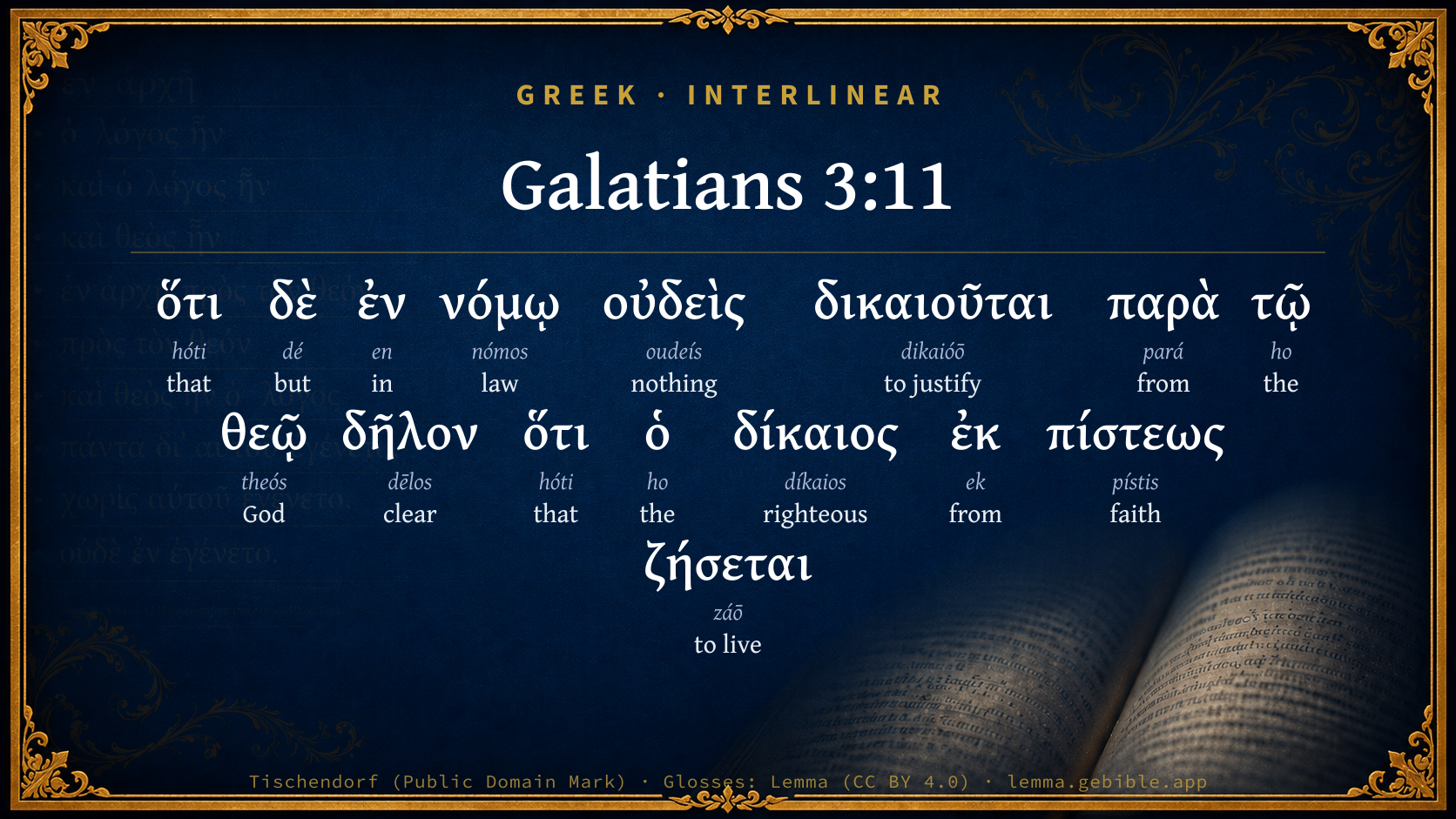
  1. ὅτι hóti G3754 “that” Conjunction
  2. δὲ dé G1161 “but” Conjunction
  3. ἐν en G1722 “in” Preposition
  4. νόμῳ nómos G3551 “law” Noun, Dative, Singular, Masculine
  5. οὐδεὶς oudeís G3762 “nothing” Adjective, Nominative, Singular, Masculine, Negative
  6. δικαιοῦται dikaióō G1344 “to justify” Verb, Present, Passive, Indicative, 3rd person, Singular
  7. παρὰ pará G3844 “from” Preposition
  8. τῷ ho G3588 “the” Article, Dative, Singular, Masculine
  9. θεῷ theós G2316 “God” Noun, Dative, Singular, Masculine
  10. ὅτι hóti G3754 “that” Conjunction
  11. ὁ ho G3588 “the” Article, Nominative, Singular, Masculine
  12. δίκαιος díkaios G1342 “righteous” Adjective, Nominative, Singular, Masculine
  13. ἐκ ek G1537 “from” Preposition
  14. πίστεως pístis G4102 “faith” Noun, Genitive, Singular, Feminine
  15. ζήσεται záō G2198 “to live” Verb, Future, Middle deponent, Indicative, 3rd person, Singular

About this verse

These counts appear in no published source. They are computed here, from the morphology-tagged text and Lemma’s own curated glosses. What Lemma adds →

16
words
14
distinct lemmas
Pauline Epistles
section

Notable vocabulary

The rarest word here is δῆλον clear G1212 — appearing just 3 times in the whole Greek New Testament.

Shared distinctive vocabulary

δῆλον clear G1212 occurs in 3 verses of the Greek New Testament. Also found in:

Repetition

Words recur within this verse:

Cross-references

19

Topical passages linked to Galatians 3:11 in the Treasury of Scripture Knowledge — connected by theme and wording, ordered by reader-vote popularity; previews shown in the World English Bible.

  • Habakkuk 2:4 Behold, his soul is puffed up. It is not upright in him, but the righteous will live by his faith.
  • Romans 1:17 For in it is revealed God's righteousness from faith to faith. As it is written, "But the righteous shall live by faith."
  • Hebrews 10:38 But the righteous will live by faith. If he shrinks back, my soul has no pleasure in him."
  • Galatians 2:16 yet knowing that a man is not justified by the works of the law but through the faith of Jesus Christ, even we believed in Christ Jesus, that we might be justified by faith in Christ, and not by the works of the law, because no flesh will be justified by the works of the law.
  • Psalms 130:3–4 If you, Yah, kept a record of sins, Lord, who could stand?
  • Ecclesiastes 7:20 Surely there is not a righteous man on earth, who does good and doesn't sin.
  • Isaiah 53:6 All we like sheep have gone astray; everyone has turned to his own way; and Yahweh has laid on him the iniquity of us all.
  • Job 42:6 Therefore I abhor myself, And repent in dust and ashes."
  • Revelation 5:9 They sang a new song, saying, "You are worthy to take the book, And to open its seals: For you were killed, And bought us for God with your blood, Out of every tribe, language, people, and nation,
  • Psalms 19:12 Who can discern his errors? Forgive me from hidden errors.
  • Isaiah 6:5 Then I said, "Woe is me! For I am undone, because I am a man of unclean lips, and I dwell in the midst of a people of unclean lips: for my eyes have seen the King, Yahweh of Hosts!"
  • Isaiah 64:6 For we are all become as one who is unclean, and all our righteousness are as a polluted garment: and we all do fade as a leaf; and our iniquities, like the wind, take us away.
  • 1 John 1:8–10 If we say that we have no sin, we deceive ourselves, and the truth is not in us.
  • 1 Kings 8:46 If they sin against you (for there is no man who doesn't sin), and you are angry with them, and deliver them to the enemy, so that they carry them away captive to the land of the enemy, far off or near;
  • Job 9:3 If he is pleased to contend with him, He can't answer him one time in a thousand.
  • Job 40:4 "Behold, I am of small account. What shall I answer you? I lay my hand on my mouth.
  • Psalms 143:2 Don't enter into judgment with your servant, For in your sight no man living is righteous.
  • James 3:2 For in many things we all stumble. If anyone doesn't stumble in word, the same is a perfect man, able to bridle the whole body also.
  • Revelation 7:14–15 I told him, "My lord, you know." He said to me, "These are those who came out of the great tribulation. They washed their robes, and made them white in the Lamb's blood.

Cross-references courtesy of OpenBible.info (CC BY 4.0).

Commentary

Notes on Galatians 3:11 from classic Christian and Jewish commentators (each source and its license shown beneath its notes). The classic Christian expositions comment on the surrounding passage and are grouped to its opening verse, so a note may address several verses; the Jewish commentaries on the Tanakh (Rashi and others) are per-verse, so they appear only where the commentator wrote on this verse.

Lemma curates 59 commentaries, every one of them public domain or Creative Commons licensed, each selected and text-cleaned for this edition rather than reprinted as found. About our sources →

The Biblical Illustrator

Joseph S. Exell

Gal_3:11

But that no man is Justified by the law in the sight of God, it is evident.

Justification not by the law but by faith in Christ

I. What is justification.

1. To be justified is to be brought into a right relation to law.

2. Justification is the bringing of a man into right relations with all law-loving and law-keeping beings.

3. When God justifies He brings us into a condition of potential righteousness.

II. Justification is impossible through the law.

1. Not ceremonial but moral law.

2. The Bible assumes

(1) that man has broken this law, and

(2) that no amount of obedience can restore him to his lost dignity.

III. Justification is possible through faith in Jesus Christ.

1. His atonement is the ground of it.

2. Faith in that atonement the means. (S. Pearson, M. A.)

The just shall live by faith

I. Life is received by the faith which makes a man just. A man begins to live--

1. By a full acquittal from condemnation and from penal death as soon as he believes in Christ.

2. As one raised out of spiritual death.

3. No form of works, or knowledge, or profession, or feeling, can prove him to be an absolved and quickened man; but faith does this.

II. Life is sustained by the faith which keeps a man just.

1. He who is forgiven and quickened lives ever afterwards as he began--by faith. Neither feelings, devotion, nor acquirements become his trust; he still looks out of himself to Jesus.

2. He lives by faith as to all the forms of his life.

(1) As a child and a servant.

(2) As a pilgrim progressing and a warrior contending.

(3) As a pensioner enjoying and a heir expecting.

3. He lives by faith in every condition.

(1) In joy and sorrow.

(2) In wealth and poverty.

(3) In strength and weakness.

(4) In labouring and languishing.

(5) In life and death.

4. He lives best when faith is at its best, even though in other respects he may be sorely put to it. (C. H. Spurgeon.)

I. The soul is the life of the body.

II. Faith is the life of the soul.

III. Christ is the life of faith. (Flavel.)

The impossibility of a legal and the certainty of a Christian justification

The law is like a noble vessel which man has damaged so that the waters flow through many a leak. As the waves rise higher and higher, and the prospects of destruction become more stern, and every effort is seen to be but wasted strength, these words come over the drowning soul, As many as are of the works of the law are under a curse. But Christ Jesus has come on to the sinking vessel, and, engulfed in the waves, has taken upon Him the effect of our folly and sin. And by His death the curse that rested upon us rests on Him. (S. Pearson, M. A.)

Faith: life

Faith engrafts us into Christ; by faith we are inserted lute the vine; but the plant that is engrafted, must also be fruitful, or else it shall be quite cut off from the root, and thrown into everlasting burning. And this is the full plain meaning of those words so often used for the magnification of faith, The just shall live by faith. (Jeremy Taylor.)

Living by faith requires effort

A schoolmaster teacheth a boy gratis, but the youth cannot possibly attain to learning unless he be industrious; but it doth not therefore cease to be free on the teachers part because the learners pains are required. (Arrowsmith.)

Life by faith

Men who are saved by faith become just. The operation of faith upon the human heart is to produce love, and through love, obedience, which is only another name for morality or holiness, the flower of the new nature. The Christian man should aim after the highest degree of spiritual culture and heavenly perfection; yet his salvation depends not on his attainments, but upon his faith in a crucified Redeemer. Faith is the fruitful root, the inward channel of sap, the great life-grace in every branch of the vine.

I. In the purest spiritual sense it is true that the just shall live by faith. Great saints must be great believers. Little-faith can never be a matured saint.

1. The nobility of the inner life depends upon faith. A man whose life is hid with Christ in God is one of the aristocrats of this world. In proportion as the spiritual life is developed, the man grows in dignity.

2. The energy of the spiritual life depends on faith. Wherever the spiritual life fairly pervades a man, it is a force which cannot be bound, fettered, or kept under; a holy fury, a sacred fire in the bones. But this energy can only be exerted under the power of faith.

3. Growth in the spiritual life depends upon our faith. Faith enriches the soil of the heart, fills our treasuries with the choicest gold, and loads our tables with the daintiest food for the soul.

II. Faith is operative in our daily life.

1. It sustains the just man under all his trials, difficulties, sufferings, or labours.

2. It has an effect upon the dispensations of Divine Providence.

III. This is also true in the history of the Christian Church as a whole.

1. The Church lives by faith, not speculation.

2. By faith, not retiring despondency.

3. By faith, not the proprieties. (C. H. Spurgeon.)

Life by faith

The Jews in the Talmud have the saying, The whole law was given to Moses at Sinai, in six hundred and thirteen precepts. David, in the fifteenth Psalm, brings them all within the compass of eleven. Isaiah brings them to six (Isa_33:15); Micah to three (Mic_6:8); Isaiah, again, to two (Isa_56:1-12.); Habakkuk to this one, The just shall live by faith (Hab_2:4). (Lightfoot.)

Hopeful endeavour the beginning of faith

See the spider casting out her film to the gale, she feels persuaded that somewhere or other it will adhere and form the commencement of her web. She commits the slender filament to the breeze, believing that there is a place provided for it to fix itself. In this fashion should we believingly cast forth our endeavours in this life, confident that God will find a place for us. He who bids us pray and work will aid our efforts and guide us in His Providence in a right way. Sit not still in despair, O son of toil, but again cast out the floating thread of hopeful endeavour, and the wind of love will bear it to its resting place. (C. H. Spurgeon.)

Justification by the law impossible

I. The requirements of the law.

1. Its authority. It was the Word of God.

2. In reference to its precepts, perfect obedience was required (Deu_33:2).

II. The penalty which the failure of obedience involved. Cursed is every one that continueth not, etc.

III. The ruin to which those are exposed who are seeking justification through the works of the law. As many as are of the works of the law are under the curse. Lesson--The folly of those who are seeking justification by works. To expect to be warmed by the keen northern blast, or to have our thirst quenched by a draught of liquid fire, were not more--were not so--incongruous. This were merely to expect that a positive appointment of God should be altered, which is not in the nature of things impossible--which in particular cases has actually taken place. That were, to expect a revolution to take place in the moral nature of Him with whom there is no variableness or shadow of turning. (R. Nicholls.)

Justification by law inconsistent with Scripture

I. The blessedness of the righteous is obtained by faith.

II. In contrast to faith, the law gives the promise of life only to him who worketh. The law says: The man that doeth them shall live in them. The law knows nothing of faith; it secures blessings only for those who obey its precepts.

III. Having proved that the blessedness of the righteous is obtained by faith, and that through the law there is a promise for the obedient only, the conclusion is obvious that no man is justified by the law in the sight of God. The man who seeks to establish his own righteousness may justify himself in his own estimation, or in that of his fellow-men, but he cannot make himself acceptable in the judgment of God. In the lower courts, where partial justice is administered, he may succeed in obtaining a favourable verdict, but, entering into the presence of God, he stands condemned. (R. Nicholls.)

The Biblical Illustrator, edited by Joseph S. Exell (c. 1880s–1900s) — public domain. Text from a community e-Sword module.

Joseph Benson's Commentary

Gal 3:11-12. That no man is justified by his obedience to the law in the sight of God — Whatever he may be in the sight of man; is further evident — From the words of Habakkuk, who hath said nothing of men’s being justified by works, but hath declared, The just shall live by faith — That is, the man who is accounted just or righteous before God, shall be made and continue such, and consequently shall live a spiritual life here, and receive eternal life hereafter, by faith. This is the way God hath chosen: see on Rom 1:17. And the law — Strictly considered; is not of faith — Doth not allow, or countenance, the seeking of salvation in such a way. In other words, the seeking justification, by keeping the law, whether moral or ceremonial, is quite a different thing from seeking it by faith. For the law saith not, Believe, but, Do, and live; its language is, The man that doeth them — Namely, the things commanded; shall live in, or by them — That is, he who perfectly and constantly conforms himself to these precepts, shall have a right to life and everlasting happiness, in consequence thereof; but he that breaks them must bear the penalty, without any further assistance from a law, which, being in one instance violated, must for ever condemn the transgressor. See on Lev 18:5.

Joseph Benson's Commentary on the Old and New Testaments (1811–1818) — public domain. Text from a community e-Sword module.

Tyndale Open Study Notes

Tyndale Open Resources

3:11 So it is clear from Scripture, even if it was not clear to the Galatians or the false teachers who were insisting on circumcision for Gentile believers. • “It is through faith that a righteous person has life”: Paul quotes Hab 2:4, in which the prophet was waiting in faith for God’s promise to be fulfilled.

Tyndale Open Study Notes — © Tyndale Open Resources, licensed CC BY-SA 4.0. Text via the HelloAO Bible API.

Bengel's Gnomon

Johann Albrecht Bengel

Gal 3:11. Ἐν νόμῳ, in the law) Paul somewhat eagerly urges this matter, lest any one should say, I acknowledge that righteousness is not by the works of the law, but yet it is by the law itself. Many depended on the law, although they did not keep it, Rom 2:17; Rom 2:23. He answers, it is of no advantage to them that do it not, Gal 3:12.—παρὰ τῷ Θεῷ, before God) whatever it may be before men, Rom 4:2.—δῆλον, ὅτι, it is evident, because [or that]) The phrase refers to what follows: 1Ti 6:7; 1Co 15:27. Δηλονότι is used by the Greeks as one word, corresponding to the Latin id est. As concerns the fact, that no one is justified in [by] the law before God, it is beyond all doubt true, that the just shall live by faith. The former is alleged [referred to] as if still open to doubt, but the latter is τὸ δῆλον, a thing quite manifest, by which even the former ought to be placed beyond a doubt.—ὁ δίκαιος ἐκ πίστεως, the just by faith [he who stands just by faith]) See Rom 1:17.—ζἠσεται, shall live) The same word is in the following verse.

Bengel's Gnomon of the New Testament — English translation (T&T Clark, Edinburgh, 1860) — public domain. Text from a community e-Sword module.

Meyer's Critical & Exegetical Commentary

Heinrich August Wilhelm Meyer

f

Gal_3:11 f. Δέ] carrying on the argument. After Paul in Gal_3:10 has proved the participation of believers in the blessing of Abraham by the argumentum e contrario, that those who are of the law are under curse, it is his object nowin order to complete the doctrinal explanation begun in Gal_3:6 on the basis of Scriptureto show, on the same basis, the only way of justification, and that (a) negatively: it is not by the way of the law that man becomes righteous (Gal_3:11-12), and (b) positively: Christ has made us free from the curse of the law (Gal_3:13). Observe (in opposition to Wieselers objection) that in δικαιοῦται παρὰ τ. Θεῷ, the being justified in spite of the curse, and consequently the becoming free from it, is clearly and necessarily implied by the context preceding (Gal_3:10) and following (Gal_3:13).

Gal_3:11-12 contain a complete syllogism; ὁ δίκαιος ἐκ πίστ. ζήσεται forming the major proposition, Gal_3:12 the minor, and ἐν νόμῳ οὐδεὶς δικαιοῦται παρὰ τῷ Θεῷ the conclusion. The subtle objections of Hofmann are refuted not only by the combination ὁ δίκαιος ἐκ πίστεως, but also by the necessary inner correlation of δικαιοσύνη and ζωή, which are put as reciprocal.

The first ὅτι is declaratory, and the second causal: but that through the law no one …, is evident, because, etc. Homberg and Flatt take them conversely: But because through the law no one …, it is evident that, etc. The circumstance that δῆλον ὅτι must mean it is evident, that (Flatt), comp. 1Co_15:27, is not to be adduced as favouring the latter view; for in our interpretation also it has this meaning, only ὅτι is made to precede (see Kühner, II. p. 626). Against it, on the other hand, we may urge, that Gal_3:12 would be quite superfluous and irrelevant to the argument, and also that ὁ δίκαιος ἐκ πίστεως ζήσεται, as a well-known aphorism, of Scripture, is far more fitly employed to prove than to be itself proved. Far better is the view of Bengel, who likewise is not inclined to separate δῆλον ὅτι: Quod attinet ad id (the former ὅτι thus being equivalent to εἰς ἐκεῖνο, ὅτι, 2Co_1:18; 2Co_11:10; Joh_2:18; Joh_9:17), quod in lege nemo justificetur coram Deo, id sane certum est, etc. The usual view is, however, more natural[125] and more emphatic. Hofmann, in loc. and Schriftbew. I. p. 615 f., wishes to take Gal_3:11-12 as protasis to Gal_3:13-14; according to his view, ὅτι specifies the cause, and δῆλον (or δηλονότι) only introduces the illustration of this cause. But we thus get a long parenthetically involved period, differing from the whole context, in which Paul expresses himself only in short sentences without periodic complication; moreover, the well-known use of δηλονότι as namely (see especially Buttmann, ad Plat. Crit. p. 106; Bast, Palaeogr. p. 804) does not occur elsewhere in the N.T., although the opportunities for its use were very frequent (1Co_15:27, 1Ti_6:7, are wrongly adduced); further, it is à priori very improbable that the two important quotations in Gal_3:11-12 should be destined merely for incidental illustration (comp. Rom_1:17); and lastly, there would result an awkward thought, as if, namely, Christ had been moved to His work of redemption, in the death on the cross, by the reflection contained in Gal_3:11-12 (comp., on the contrary, Gal_4:3-5; Rom_8:3; 2Co_5:21).

ἐν νόμῳ] not: by observance of the law, which would be ἐξ ἔργων νόμου (Erasmus, Koppe, Rosenmüller, and others), but: through the law, in so far, namely, as the law is an institution which does not cancel the curse so pronounced and procure justification; for otherwise faith must have been its principle, which is not the case (see the sequel). The law is consequently, in principle, not the means by the use of which a man can attain to justification. On this ἀδύνατον τοῦ νόμου (Rom_8:3), comp. Lipsius, Rechtfertigungsl. p. 68; Neander, II. p. 658 ff.; Weiss, bibl. Theol. p. 286 f. Χριστός in Gal_3:13 corresponds to the emphatically prefixed ἐν νόμῳ (what by the law is not done, Christ has effected); therefore ἐν is not to be understood (with Rückert, de Wette, and others) as: in, in the condition of Judaism, or in the sense of the rule (Wieseler), but as: through, by means of.

παρὰ τῷ Θεῷ] judice Deo, opposed to the judgment of men. Comp. Rom_2:13; Winer, p. 369 [E. T. 492],

ὁ δίκαιος ἐκ πίστεως ζήσεται] an aphorism of Scripture well known to the readers, which therefore did not need any formula of quotation (D* E F G, Syr. Erp. It., have γέγραπται γάρ before ὅτι, F G also omitting δῆλον). Comp. 1Co_15:27; Rom_9:7; and van Hengel in loc. The passage is from Hab_2:4, according to the LXX. (ὁ δὲ δίκαιος ἐκ πίστ. μου ζήσεται, or, according to A.: ὁ δὲ δίκ. μου ἐκ π. μ. ζ.), where it is said: The righteous (צַדִּיק) shall through his fidelity (towards God) become partaker of (theocratic) life-blessedness. The apostle, glancing back from the Messianic fulfilment of this sayingwhich he had everywhere in view, and experienced most deeply in his own consciousnessto the Messianic destination of it, recognises as its prophetic sense: He who is righteous through faith (in Christ) shall obtain (Messianic) life. Comp. on Rom_1:17. In so doing Paul, following the LXX., which very often renders אמונה by πίστις, had the more reason for retaining this word, because the faithful self-surrender to God (to His promise and grace) is the fundamental essence of faith in Christ; and he might join ἐκ πίστεως to ὁ δίκαιος, because the life ἘΚ ΠΊΣΤΕΩς presupposes no other righteousness than that ἐκ πίστεως. Here also, as in Rom. l.c. (otherwise in Heb_10:38), the words Ὁ ΔΊΚΑΙΟς ἘΚ ΠΊΣΤΕΩς are to be connected (Chrysostom, Cajetanus, Pareus, Bengel, Baumgarten, Zachariae, Michaelis, Semler, Morus, Griesbach, Knapp, Rückert, Winer, Gramm. p. 129 [E. T. 170], Hilgenfeld, Reithmayr, Hoelemann, and others), and not ἐκ πίστεως ζήσεται (so most of the older expositors, following Jerome and Augustine; also Borger, Winer, Matthies, Schott, de Wette, Wieseler, Ewald, Holsten, Hofmann, Matthias): for Paul desires to point out the cause of the righteousness, and not that of the life of the righteous, although this has the same cause; and in Gal_3:12, Ὁ ΠΟΙΉΣΑς ΑὐΤΆ stands in contrast not to Ὁ ΔΊΚΑΙΟς merely, but to Ὁ ΔΊΚΑΙΟς ἘΚ ΠΊΣΤΕΩς. Compare, besides, Hoelemann, l.c. p. 41 f. Paul, however, did not write ὁ ἐκ πίστεως δίκαιος or δίκαιος ὁ ἐκ πίστεως, because this important saying was well known and sanctioned by usage in the order of the words given by the LXX.; so that he involuntarily abstained from the freedom of dealing elsewhere manifested by him in quoting from Scripture. The grammatical correctness of the junction of ἘΚ ΠΊΣΤ. to ΔΊΚΑΙΟς is evident from the fact that the phrase ΔΙΚΑΙΟῦΣΘΑΙ ἘΚ ΠΊΣΤ. is used; comp. Gal_3:8.

[125] For if we take Bengels explanation, the δῆλον will not suit well the following words, because they form an utterance of Scripture. We should expect possibly γέγραπται, so that then the first ὅτι would have to be understood as: ἵνα εἰδῆτε, ὅτι (Fritzsche, Quaest. Luc. p. 59 ff.; Schaef. ad Dem. II. p. 71).

Meyer — Critical and Exegetical Commentary on the New Testament — English translation by Peter Christie, edited by Frederick Crombie (T&T Clark, 1880) — public domain. Text from a community e-Sword module.

Expositor's Greek Testament

ed. W. Robertson Nicoll

Gal 3:11-12 . The failure of the Law to justify is further established by a comparison of Hab 2:4 with Lev 18:5 : the latter embodies the spirit of the Law: for it demands obedience as a necessary condition antecedent to the gift of life from God ( cf. Rom 10:5 ). The prophet on the contrary makes life dependent upon faith. By thus substituting faith for obedience he virtually supersedes the existing Law, and establishes a new criterion, which takes account of the state of heart instead of the outward life ( cf. Rom 1:17 ). The same passage is adduced in Heb 10:38 in proof of the vital importance of faith. All three writers agree in basing true religion upon heartfelt trust in God: but whereas the Epistle to the Hebrews regards faith from the same standpoint as the Hebrew prophet, and identifies it with the steadfast loyalty to an unseen God which supports the believer under manifold trials, Paul here limits his view to the faith which prompts the convert to embrace Christ. Regarding it therefore from a purely Christian standpoint, he embodies in his conception the new revelation of the Father’s character made in Christ. The faith which he has in mind is justifying faith, the faith in God’s pitying love which assures a repentant sinner of forgiveness and merciful acceptance in spite of a guilty past.

The Expositor's Greek Testament, edited by W. Robertson Nicoll (1897–1910) — public domain. Text from a community e-Sword module.

Cambridge Greek Testament for Schools and Colleges

11. ὅτι δὲ. Adversative to the possibility of continuing in the things of the Law. The opposite is shown by the existence of another source of justification and consequent life, stated in Habakkuk. Weiss suggests that this begins the protasis of a sentence of which the apodosis is Gal 3:13, Gal 3:11 b (δηλονότι) to Gal 3:12 then being a parenthesis. But this is quite unnecessary.

ἐν νόμῳ. The Jewish Law, as throughout this Epistle, see Gal 2:16, note. The phrase is to be taken closely with δικαιοῦται, and signifies in the performance of the Law, not, as it is often misunderstood, in the statement of the Law, i.e. the Prophets. It takes the place of ἐξ ἕργων νόμου.

οὐδεὶς δικαιοῦται παρὰ τῷ θεῷ. For παρά cf. Rom 2:13.

δῆλον. With the preceding; the following ὅτι = because. Some join it with the following: “Now because no one (as is evident from Gal 3:10) is justified in (the) Law it is clear that the righteous shall live by faith.” But this form of reasoning is very un Pauline.

ὅτι. Proof: Faith (not works) justifies, and life ensues.

ὁ δίκαιος ἐκ πίστεως ζήσεται. So Rom 1:17. See also Heb 10:38. From Hab 2:4, where it is said that, in contrast to the Chaldaean invader whose soul is lifted up in pride, the righteous (though hemmed in by the wicked, Gal 1:4) shall live by his stedfastness, i.e. primarily his trustworthiness and faithfulness of principle. This, as the result of steady faith, is not unfairly understood as faith in the active sense by the N.T. writers, though probably not by the LXX. (see Driver, Minor Prophets, p. 63). The LXX. misreading “his” as “my” has in B ὁ δὲ δίκαιος ἐκ πίστεώς μου ζήσεται, which A modifies by inserting another μου after δίκαιός.

It is very difficult to decide whether St Paul intended the stress of ἐκ πίστεως to lie on ὁ δίκαιος or on ζήσεται. In favour of the latter is the almost certain construction of the Hebrew and of the quotation in Hebrews, and the ease with which St Paul could have modified the quotation to run ὁ ἐκ πίστεως δίκαιος. Yet the former is preferable here in view of the fact that up to this point he has been thinking of justification, and not of life (see especially Winer-Schmiedel, § 20. 5 d). How can men escape the curse (Gal 3:10), and be righteous? By faith.

Cambridge Greek Testament for Schools and Colleges (Cambridge University Press, 1896; 21 vols, various authors incl. Carr, Maclear, Plummer, Farrar, Lumby, Moule, M. R. James, Simcox) — public domain. Text from a community e-Sword module.

Geneva Bible (1599)

Geneva Bible translators

The second proposition with the conclusion: But no man fulfilleth the Law. Therefore no man is justified by the Law, or else, which seek righteousness by the works of the Law. And there is annexed also this manner of proof of the second proposition, to wit, Righteousness and life are attributed to faith, Therefore no man fulfilleth the Law.

Geneva Bible (1599) marginal notes — public domain. Text via Bolls.life.

Jamieson, Fausset & Brown

Robert Jamieson, A. R. Fausset & David Brown

by the law--Greek, "IN the law." Both in and by are included. The syllogism in this verse and Gal 3:12, is, according to Scripture, "The just shall live by faith." But the law is not of faith, but of doing, or works (that is, does not make faith, but works, the conditional ground of justifying). Therefore "in," or "by the law, no man is justified before God" (whatever the case may be before men, Rom 4:2) --not even if he could, which he cannot, keep the law, because the Scripture element and conditional mean of justification is faith.

The just shall live by faith-- (Rom 1:17; Hab 2:4). Not as BENGEL and ALFORD, "He who is just by faith shall live." The Greek supports English Version. Also the contrast is between "live by faith" (namely, as the ground and source of his justification), and "live in them," namely, in his doings or works (Gal 3:12), as the conditional element wherein he is justified.

Jamieson, Fausset & Brown — Commentary Critical and Explanatory on the Whole Bible (1871) — public domain (CC PDM 1.0). Text via the HelloAO Bible API.

Adam Clarke's Commentary

Verse 11. But that no man is justified by the law] By the observance of the law, suppose he had even continued in all things that are written in it to do them, is evident; for the Prophet Habakkuk, Hab 2:4, has declared, under the direct influence of the Spirit of God, The just shall live by faith; or, he who is just by faith shall live: therefore this justification comes not by works, or the observance of the law, but by faith.

Adam Clarke's Commentary on the Bible (1810–1826) — public domain. Text from a community e-Sword/MySword module.

John Calvin's Commentaries

11. But that no man, is justified by the law. He again argues from a comparison of contradictory schemes. “If we are justified by faith, it is not by the law: but we are justified by faith therefore it is not by the law.” The minor is proved by a passage from Habakkuk, which is also quoted in the Epistle to the Romans. (Habakkuk 2:4; Romans 1:17.) The major is proved by the difference in the methods of justification. The law justifies him who fulfils all its precepts, while faith justifies those who are destitute of the merit of works, and who rely on Christ alone. To be justified by our own merit, and to be justified by the grace of another, are two schemes which cannot be reconciled: one of them must be overturned by the other. Such is the amount of the argument: let us now attend to the separate clauses.

The just shall live by faith. As we had occasion to expound this passage where it occurs in the Epistle to the Romans, it will be unnecessary to repeat the exposition of it here. The prophet evidently describes a proud confidence in the flesh as contrasted with true faith. He declares, that “the just shall live;” by which he means, not that they are supported for a short period, and liable to be overwhelmed by an approaching storm; but that they shall continue to live, and that, even amidst the most imminent danger, their life shall be preserved. There is therefore no weight in the scornful reproaches of our adversaries, who allege that the prophet there employs the word Faith in a wider acceptation than Paul does in this passage. By Faith he evidently means the exercise of a calm, steady conscience, relying on God alone; so that Paul’s quotation is properly applied.

John Calvin's Commentaries (1540-1563) — public domain. Text from the Calvin Translation Society English edition (1840s-50s) via the Christian Classics Ethereal Library (ccel.org). Calvin's coverage is partial (roughly two-thirds of the Bible); uncommented books and verses are honest gaps, never fabricated. The 19th-century editor's footnotes and remarks are omitted so the notes are faithfully Calvin's own voice.

Ellicott's Commentary for English Readers

(11) In the sight of God.—Standing as a prisoner before His tribunal.

The just shall live by faith.—The stress is on the word “faith.” It is faith (not law) which gives life. In St. Paul’s application of the passage, the word “just” must be taken in what is technically termed a slightly proleptic sense. A man is not just before the exercise of faith, but he becomes just by the exercise of it; and, in another aspect, the state of righteousness upon which he then enters is also a state of life. Strictly speaking, the order is—faith, justification, life. It would be possible to take the Greek in such a way as to bring out this more distinctly: “The just by faith” (i.e., he whose righteousness is based on faith) “shall live.” Some good commentators take the passage thus, but a balance of considerations seems, on the whole, to be in favour of the sense adopted in the Authorised version.

The quotation is from Hab_2:4, where it refers to the preservation of the righteous Israelite amidst the general ruin caused by the Chaldean invasion. Though the wicked and proud shall be destroyed, the righteous man shall live “by his faith.” There is some division of opinion amongst commentators as to whether the word translated “faith” means, in the original, faith in the active sense or faith in the passive sense—“fidelity,” “faithfulness,” or “trust in God.” The sense in which the word is used by St Paul is most nearly related to the latter. It has the full-developed Christian meaning, which begins in belief, includes trust, and passes on to become an active energy of devotion. (Comp. the Note and Excursus on Rom_1:17, where the same quotation is made.)

(11, 12) The Law could not bring a blessing. It could not justify. For the condition of justification is faith; and the Law has nothing to do with faith. Its standpoint was entirely different—that of works.

A Bible Commentary for English Readers, edited by Charles John Ellicott (1878–1897) — public domain. Text from a community e-Sword module.

The Cambridge Bible for Schools and Colleges

gen. ed. J. J. S. Perowne

11. in the sight of God] Better, before God, i.e. at His bar. This forensic use of the preposition is common in Classical Greek. Comp. 2Th_1:6; Jas_1:27; 1Pe_2:20.

The just shall live by faith] The quotation from Hab_2:4, is also found, Rom_1:17; Heb_10:27. The literal rendering of the Hebrew, as given by Bp. Lightfoot, is, ‘Behold the proud man, his soul is not upright; but the just man shall live by his faith’. In the LXX. the verse runs, ‘If one draw back, my soul hath no pleasure in him; but the just shall live by faith in me (or, my faith)’. There is also a reading, ‘My just one shall live by faith’. Although the Hebrew word, which is rendered ‘faith’, elsewhere means ‘steadfastness’, there is really no violence done to the original by St Paul’s manner of quotation. The Greek versions support his rendering. And the expression ‘faith in me’, is equivalent to ‘steadfast confidence in me’: or if we adopt the other rendering ‘my faith = steadfastness’, we have that attribute of God ‘who cannot lie’, which is at once the correlative and ground of man’s trust in God. Comp. Isa_7:9, ‘If ye hold not fast, verily ye shall not stand fast’. Dr Cheyne.

11, 12. St Paul by reference to two other familiar passages of the O.T. confirms his assertion that justification cannot be by the Law. He has proved from Scripture that no man can be justified by a Law which pronounces a curse on all who fail to render a perfect obedience to its commands. He now from another Scripture shews that there is a way, opened by God Himself, in which sinners have found, and may find pardon and acceptance, yea, a perfect righteousness and the true life. The prophet Habakkuk declares, “The just shall live by faith”. This cannot apply to those who seek life in the Law; for its condition is, ‘Do this, and thou shalt live’. Entirely contrary and antagonistic is the condition of the Gospel, ‘Believe and live’. It is not a difference on which St Paul insists. It is opposition between faith and works, grace and merit, the Gospel and the Law. When God justifies a sinner through faith in the Lord Jesus Christ, there is no place left for human merit. If Christ’s merit, appropriated by faith, is not sufficient to justify us, we are lost. If it is sufficient, our imperfect, faltering, sin-stained obedience can add nothing to that sufficiency.

The Cambridge Bible for Schools and Colleges (gen. ed. J. J. S. Perowne; Cambridge University Press, 1878–1918) — public domain. Text from a community e-Sword module.

John Gill's Exposition

But that no man is justified,.... There are some that are justified, as all God's elect are, in his own mind and will from eternity; which will of his to justify them, upon the righteousness of his Son, undertook by him to bring in, is their justification in the court of heaven; and all that believe in Christ are openly and manifestly justified in the court of conscience, under the testimony of the Spirit of God: but no one is justified

by the law; it is in the Greek text, "in the law"; there were many justified before the law was given, as Noah, Job, Abraham, and all the Ante-Mosaic believers; and there were many justified "in", or under the legal dispensation; but none of them were justified by their obedience to the law, but by the righteousness they believed they had in the Lord: especially no man is justified

in the sight of God; who sees the heart, knows the spring of actions, and whose judgment is according to truth; that is, by the law and the deeds of it, however they may before men:

it is evident; it is a clear case, out of all dispute, as appears from Hab 2:4

for the just shall live by faith; which may be read either, "the just by faith, shall live": that is, the man who is just by faith, or justified by faith, not by it as a principle or act, or as the cause or matter of his justification, but by the object of his faith, Christ and his righteousness apprehended by faith, and so not just or justified by works; he shall live a life of justification, through that righteousness his faith receives; he shall live comfortably, with much peace and joy in the Holy Ghost, as the result of his being justified by faith; and shall live eternally, and never die the second death: or the "just shall live by faith"; he that is righteous, not by his own works, but by the obedience of Christ, shall live not upon faith, but by it on Christ, and his righteousness, which is revealed from faith to faith; and this makes it a clear point, that he is not justified by the law, for if he was, he would not live by faith on Christ, but in and by the deeds of the law.

John Gill's Exposition of the Whole Bible (1746–1763) — public domain (CC PDM 1.0). Text via the HelloAO Bible API.

Trapp's Complete Commentary

John Trapp

11 But that no man is justified by the law in the sight of God, it is evident: for, The just shall live by faith.

Ver. 11. Shall live by faith] As being justified by faith. {See Trapp on "Rom 1:17"}

John Trapp, A Commentary or Exposition upon All the Books of the Old and New Testament (1647–1656) — public domain. Text from a community e-Sword module.

Albert Barnes' Notes on the Bible

But that no man is justified ... - The argument which Paul has been pursuing he proceeds to confirm by an express declaration of the Bible. The argument is this: “It is impossible that a man should be justified by the Law, because God has appointed another way of justification.” But there cannot be two ways of obtaining life, and as he has appointed faith as the condition on which people shall live, he has precluded from them the possibility of obtaining salvation in any other mode.

For, The just shall live by faith - This is quoted from Hab 2:4. This passage is also quoted by Paul in Rom 1:17; see it explained in the note on that verse. The sense here is, that life is promised to man only in connection with faith. It is not by the works of the Law that it is done. The condition of life is faith: and he lives who believes. The meaning is not, I apprehend, that the man who is justified by faith shall live, but that life is promised and exists only in connection with faith, and that the just or righteous man obtains it only in this way. Of course it cannot be obtained by the observance of the Law, but must be by some other scheme.

Albert Barnes' Notes on the Bible (1834–1885) — public domain. Text from a community e-Sword/MySword module.

Matthew Poole's English Annotations

The apostle, by another argument, proveth that sinners are not justified by works. He grants, they may be justified by their good and blameless living before men, so as that they may have nothing to say against them, but he says they cannot, by such works, be justified in the sight of God. His argument is from the opposition that is between faith and works. He proveth, from Hab 2:4, that we are justified by faith; where the prophet saith, that the just (or righteous man) shall live by faith; fetch his life from faith, live his spiritual life by faith, and obtain eternal life by faith, the life of his righteousness shall be by faith.

Matthew Poole's English Annotations on the Holy Bible (1683–1685) — public domain. Text from a community e-Sword/MySword module.

Whedon's Commentary on the Bible

Daniel D. Whedon

11. In the sight of God—However it may be in the sight of man. Men can easily lower law for themselves and for each other. They can easily pardon themselves and each other for transgression of law. But how are law and pardon in the sight of God, is the great question. Note, Rom_4:2. The just… by faith. Note, Rom_1:17.

Daniel D. Whedon (gen. ed.), Commentary on the Old and New Testaments (1874–1909) — public domain. Text from a community e-Sword module.

The Pulpit Commentary

But that no man is justified by the Law in the sight of God, it is evident (oti demw oujdeiv dikaioutai para tw Qew); but that in the Law no man is justified with God, is evident. To "be justified" means to be brought out of a state of guiltiness and cursedness into a state of acceptance. The apostle, assuming that every one is guilty and under a curse, now shows that the Law offers no means of justification. "But." The apostle is meeting the notion that, though one who is of works of the Law is evermore threatened with a curse ready to light down upon him, and though the curse has been, as it cannot but have been, actually incurred, yet, by setting himself afresh to the endeavour and thenceforward continuing steadfast in all things written in the Law, he may thus win pardon and righteousness with God. To obviate this conception, without stopping to insist upon the fact that through indwelling sin no man possibly can continue in all the things written in the Law, he puts the notion aside by stating that this is not the method of justification which Scripture recognizes. This he shows by adducing that cardinal aphorism of Habakkuk, by which, as it should seem, the apostle was wont to substantiate the doctrine of justification by faith. (comp. Rom_1:17; Heb_10:38) The way in which the passage is here introduced, almost as an obiter dictum, and as if not needing a formal indication of its coming out of Scripture, suggests the feeling that the passage, as taken in the sense in which the apostle reads it, was one already familiar to his readers, no doubt through his own former teaching. When in the Acts (Act_13:39-41) we read that in the synagogue at the Pisidian Antioch, in close connection with the statement that through believing in Christ a man is justified, he cited another passage of Habakkuk, (Hab_1:5) denouncing unbelieving despisers, we cannot doubt that he had made good his statement about justification by alleging this same probative text. "In the Law;" that is, as being it. the sphere and domain of the Law. Compare the use of the same preposition: Rom_2:12, "As many as have sinned under Greek, "in" the Law;" Rom_3:19, "It saith to them that are under Greek, "in" the Law." An exactly parallel construction is found in Act_13:39, "From all things from which ye could not by Greek, "in" the Law be justified." They could not as being in the Law find therein any means of gaining acceptance. "Is justified with God;" comes to be accounted righteous with him. "With God;" not merely outwardly, Levitically, in the judgment of a Levitical priest but inwardly and in reality, in God"s estimation. The preposition "with" (para) is used similarly in Rom_2:13, "For not the hearers of the Law are righteous with God;" 1Co_2:1-9, "The wisdom of this world is foolishness with God." It is God himself that justifies the sinner; (Rom_3:30 Rom_4:5) but the apostle does not write "is justified by God," because he is confronting the notion so natural to man, and above all, to the Judaizing legalist, that a man is to make himself righteous by doings ceremonial or moral of his own. For, The just shall live by faith (oJ dikaiov ejk pistewv zhsetai); the righteous by faith shall live. The apostle is not weaving the prophet"s words into his own sentence simply as aptly expressing his own thought, but is citing them probatively as words of Scripture; as if he had said, "As Scripture saith, The righteous," etc. The same is the case with the words introduced in the next verse out of Leviticus; so Rom_9:7. in Rom_15:3 and 1Co_2:9 the apostle inserts, "according as it is written," as in parenthesis, before adding the words of Scripture in such a way as to form a continuation of his own sentence. "The righteous by faith shall live;" that is, the righteous man shall draw his life from his faith. It is generally agreed upon by Hebrew scholars that in the original passage (Hab_2:4) the words, "by his faith" (or possibly, adopting another reading of the Hebrew text, "by my faith," that is, by faith in me) belong to "shall live," rather than to "the righteous" (see on this point Delitzsch on Heb_10:38, and Canon Cook on Hab_2:4, in "Speaker"s Commentary") And that St. Paul so understood it is made probable by the contrasted citation of" shall live in them "in the next verse. With this conjunction of the words, the passage suits the apostle"s purpose perfecty; for if it is by or from his faith that the righteous man lives, then it is by or from his faith that he gets to be accepted by God as righteous. The "faith" spoken of is shown by the context in Habakkuk to mean such reliance upon God as is of a steadfast character, and not a mere fleeting or occasional acceptance of God"s promises as true. This is plainly the view of the passage which is taken by the Pauline writer of the Hebrews in Heb_10:38.

Vers. 11, 12.

Fourth argument the inconsistency of Law and faith.

that no man is justified in the Law in the sight of God, it is evident: for, The just shall live by faith. But the Law is not of faith: but, The man that hath done these things shall live in them.

I JUSTIFICATION IS OUT OF THE SPHERE OF LAW.

1. Not because a perfect obedience would not bring justification, for the fundamental principle of the Law is, "The man that hath done these things shall live in them". (Lev_18:5)

2. But because no one is able to obey the Law perfectly. Thus salvation becomes impossible on the principle of Law.

II SCRIPTURE ASSERTS THE CONNECTION OF JUSTIFICATION WITH FAITH, "The just shall live by faith." The apostle shows the Judaists how they misapprehended the doctrine of the old Testament; for, several hundred years before Christ, the Prophet Habakkuk connects life eternal with faith. "The Law is not of faith;" it does not find its starting-point in faith; doing, not believing, is the demand of the Law; and it is in no sense or manner connected with faith.

The Pulpit Commentary (1880–1919), ed. H.D.M. Spence-Jones & Joseph S. Exell — public domain. Text from a community e-Sword module.

John Wesley's Explanatory Notes

But that none is justified by his obedience to the law in the sight of God - Whatever may be done in the sight of man, is farther evident from the words of Habakkuk, The just shall live by faith - That is, the man who is accounted just or righteous before God, shall continue in a state of acceptance, life, and salvation, by faith. This is the way God hath chosen. Hab. ii, 4.

John Wesley, Explanatory Notes Upon the Whole Bible (1754–1765) — public domain. Text via the GEBible commentary corpus.

Luther on Galatians

Martin Luther

VERSE 11. But that no man is justified by the law in the sight of God, it is evident: for, The just shall live by faith.

The Apostle draws into his argument the testimony of the Prophet Habakkuk: "The just shall live by his faith." This passage carries much weight because it eliminates the Law and the deeds of the Law as factors in the process of our justification.

The scholastics misconstrue this passage by saying: "The just shall live by faith, if it is a working faith, or a faith formed and performed by charitable works." Their annotation is a forgery. To speak of formed or unformed faith, a sort of double faith, is contrary to the Scriptures. If charitable works can form and perfect faith I am forced to say eventually that charitable deeds constitute the essential factor in the Christian religion. Christ and His benefits would be lost to us.

Martin Luther — Commentary on the Epistle to the Galatians (1535), English translation by Theodore Graebner (Zondervan, 1939) — public domain (U.S. copyright not renewed). Text from a community e-Sword module.

Burkitt's Expository Notes on the New Testament

William Burkitt

A fourth argument is here produced to prove, that no sinner can be justified before God, by the works of the law, although before men he may. The argument is this, taken from The just shall live by faith Hab 2:4 : that is, live his spiritual life by faith, his life of justification and sanctification also: the life of his righteousness before God, of his holiness before men, and his life of glory with God in heaven, are all by faith. He adds, The law is not of faith; Gal 3:12 that is, the law says nothing of faith in a Mediator, or promises life to any person, save only to him who by a sinless obedience performs exactly what it prescribes: but the voice of the law is, Do, or die.

Learn hence, that the law and faith, that is, the law and the gospel, are not contrary to each other, but are mutually subservient one to another in many things; as thus, when the law makes known sin, the gospel holds forth the remedy for sin; the law discovers our need of Christ, the gospel makes an offer and gracious tender of Jesus Christ; the law makes known to us our entire duty, the gospel furnishes us with strength and ability to perform that duty.

Learn, 2. That though the law and faith, that is, the gospel, which is the doctrine of faith, be not contrary to each other, yet in point of justification they are mutually inconsistent one with another: So that if justification be by the works of the law, it cannot be had by faith: if it be had by faith, it cannot be attained by the works of the law. There can be no mixture of law and gospel, of faith and works, in this matter.

William Burkitt's Expository Notes on the New Testament (1700–1703) — public domain. Text from a community e-Sword module.

McGarvey & Pendleton's Commentaries

J. W. McGarvey

Now that no man is justified by the law before God, is evident: for, The righteous shall live by faith [ Hab_2:4 ; Rom_1:17 ]

J. W. McGarvey (with Philip Y. Pendleton), Commentaries on the New Testament (The Fourfold Gospel, 1914; Acts; and the epistles) — public domain. Text from a community e-Sword/MySword module.

The People's New Testament

B. W. Johnson

11. The just shall live by faith. To seek righteousness by the law is also contrary to the prophets, for Habakkuk 2:4 says that the just shall live by faith, not by the works of the law.

B. W. Johnson's The People's New Testament with Notes (1889–1891) — public domain. Electronic text from the Christian Classics Ethereal Library (CCEL) ThML edition.

International Critical Commentary

11. ὅτι δὲ ἐν νόμῳ οὐδεὶς δικαιοῦται παρὰ τῷ θεῷ δῆλον, “And that no one is justified in law before God is evident.” δέ introduces an additional argument for the position maintained in v. 10. νόμῳ is manifestly in the legalistic sense; on the force of ἐν, see on 2:17. παρὰ τῷ θεῷ is a most significant element of the sentence. By it the apostle makes clear that as over against the verdict of law set forth in the preceding sentence he is now speaking of the actual attitude of God. Cf. notes on v. 10.

That the clause preceding δῆλον is the subject of the proposition δῆλόν ἐστι, and the following clause the proof of it, rather than the reverse, which is grammatically possible, is proved by the fact that the following clause is a quotation from O. T., and, therefore, valuable for proof of the apostle’s assertion while not itself requiring to be proved.

ὅτι “Ὁ δίκαιος ἐκ πίστεω̣ς ζήσεται,” “because, The righteous man shall live by faith.” On the use of ὅτι, see on ὅτι … δῆλον above. In the quotation from Hab 2:4 the apostle finds an affirmation of his own doctrine of justification by faith. The particular sense which the words bore for Paul and which he intended them to convey to his readers is undoubtedly to be determined rather by Pauline usage in general, and by the part which the sentence plays in the apostle’s argument, than by the meaning which the original Heb. had for the prophet. By these considerations ὁ δίκαιος is shown to be a forensic rather than an ethical term, the man approved of God, rather than the morally righteous; πίστεως bears its usual active sense, required by the context, “faith.” ζήσεται, “shall live,” refers either to the obtaining of eternal life (cf. Rom 8:6, Rom 8:10, Rom 8:11, Rom 8:13) as the highest good and goal to which justification looks, or, by metonymy, to justification itself. It is justification, in any case, that is chiefly in mind. Cf. the other instances of quotation from O. T., in which the word occurs (v. 12, Rom 1:17, Rom 10:5). The terms δίκαιος and ζήσεται thus combine to express the idea of divine approval, and the sentence in effect means, “It is by faith that he who is approved of God is approved (and saved).” Cf. Rom 1:17, where the same passage is quoted and the context requires the same meaning. On the relation of this meaning to the original sense of Hab 2:4, see below.

For defence of the view that ξήσεται refers to “life,” but, as always when Paul speaks of life, to physical life, see Kabisch, Eschatologie des Paulus, pp. 52 ff.

The Hebrew of Hab 2:4 read: וְ֖צ֖דִּיק בּֽאֶמוּנָתֻוׄ יִחְֽיֶהֽ. The Lxx read: ὁ δὲ δίκαιος ἐκ πίστεώς μου ξήσεται. אֱמוּנָה signifies “faithfulness,” “steadfastness,” “integrity.” The prophet confronted by the apparent triumph of the wicked Babylonian nation over Israel affirms his conviction that in the end righteous Israel will for her steadfastness prosper. The use of the passage with the active sense of πίστις involves no radical perversion of its meaning, since faith in this sense might easily be conceived to be an ingredient or basis of faithfulness. Yet there is no definite evidence that Paul arrived at the active meaning by such an inferential process. It is, perhaps, quite as likely that he took the passage at what was for him the face value of the Lxx translation.

International Critical Commentary — older volumes (1896–1929), various authors — public domain. Text from a community e-Sword module.

Vincent's Word Studies in the New Testament

Marvin R. Vincent

But [δε] . Better, now. The de continues the argument, adding the scripture testimony.

By the law [εν νομω] . Rather, in the sphere of the law; thus corresponding with continueth in, verse 10.

The just shall live by faith [ο δικαιος εκ πιστεως ζησεται] . Better, the righteous. Quoted from Hab 2:4, and appears in Rom 1:17, and Heb 10:28. The LXX has mou my, either after dikaiov, "my righteous one shall live, etc.," or after pistewv, "by my faith or faithfulness." 60

Marvin R. Vincent, Word Studies in the New Testament (1887–1900) — public domain. Text from a community e-Sword/MySword module.

Lesson kit

Teaching starters — assembled from the data on this page, not authored interpretation. Every prompt links to the verse data it draws on. Edit before teaching.

Galatians, in the Pauline Epistles, opens this verse with 16 words (14 distinct Greek lemmas). Its most distinctive word is dēlos (“clear”). A historical commentator’s framing appears above. Read the whole chapter for the surrounding context.

Discussion questions

  1. How does “clear” (dēlos) shape what this verse is saying?
  2. How does Matthew 26:73, which shares the word «clear», read alongside this verse?
  3. What does the repetition of “that” (2× in this one verse) do in this verse?
  4. These translations render this verse differently. What is at stake in choosing one wording over another?
  5. Compare how The Biblical Illustrator and Joseph Benson's Commentary read this verse. Where do they agree or differ?

Things to notice

Reading settings

Reading text

Shown beneath each verse's original-language words.

Old Testament
Old Testament edition

Read the OT as the Masoretic Hebrew (MT) or the Greek Septuagint (LXX).

English shown for the Greek Septuagint (in the Hebrew ↔ Greek comparison).

Comparing translations? Open the Compare panel on any verse page to stack up to four side by side.