Leviticus 27:26

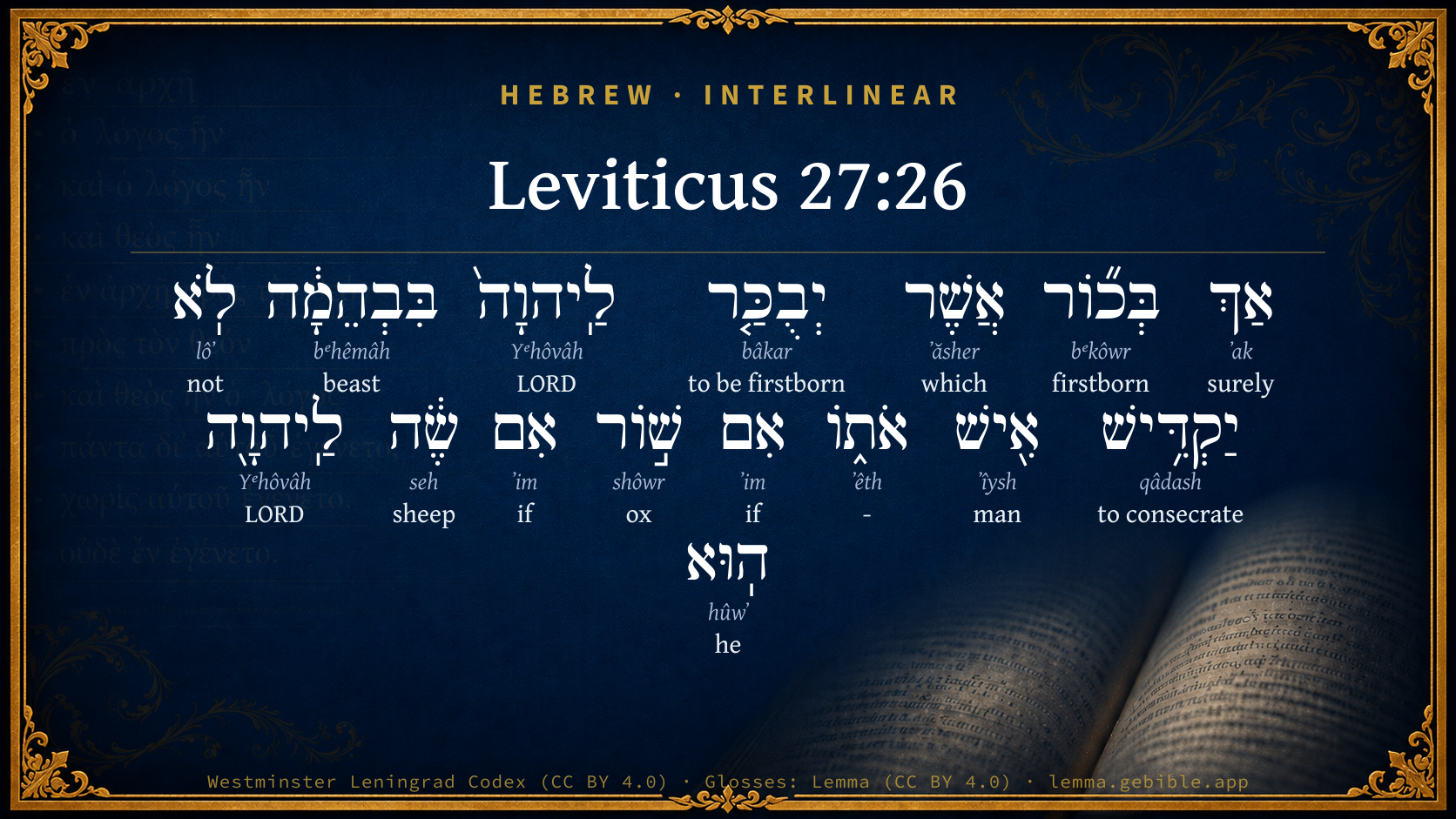
Hebrew (Westminster Leningrad Codex) Leviticus 27:26 appears in the Hebrew Old Testament. The text above is from the Westminster Leningrad Codex. Each word links to its Strong’s number, a concise gloss, and parsing drawn from the Open Scriptures Hebrew Bible morphology. Click any word for its full Brown-Driver-Briggs (BDB) entry.
Download image
Cite this verse

Leviticus 27:26 (World English Bible). Public Domain. Lemma interlinear Bible study tool, https://lemma.gebible.app/v/leviticus/27/26.

Show BibTeX & RIS
BibTeX
RIS
English Translation
"'Only the firstborn among animals, which is made a firstborn to Yahweh, no man may dedicate it; whether an ox or sheep, it is Yahweh's.
World English Bible · Public Domain
Highlights
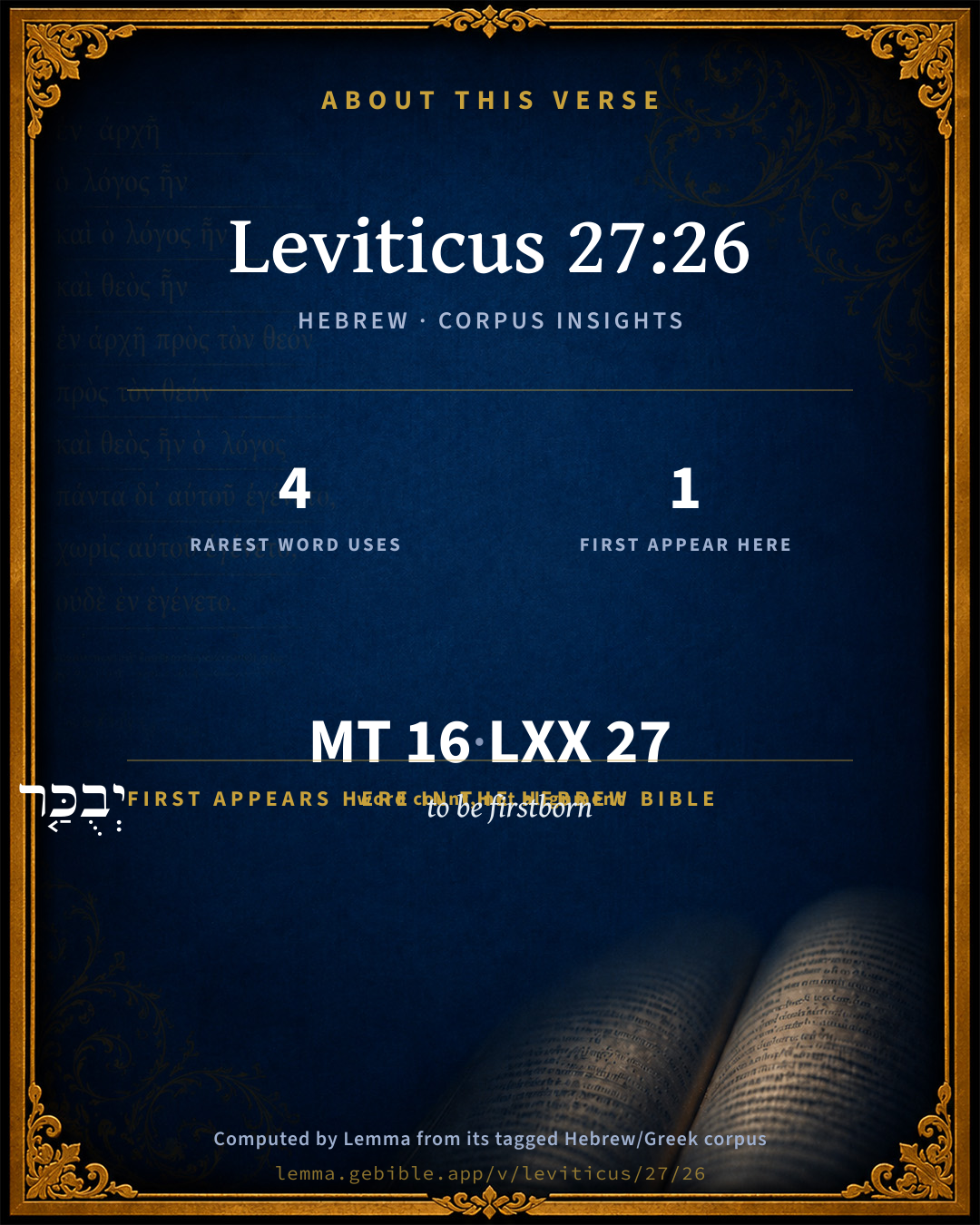
  • 1 first appearance in the Hebrew Bible
Full analysis ↓
Download a study sheet

One document with this verse’s original text, its word-by-word gloss line, the meaning frame, cross-references with their text, attributed commentary, and full source and license credits — printable, and it pastes into notes with its structure intact.

This verse Autodidact and up

Study sheet (.html) Plain text (.txt)

A passage Seminary Student

Up to 50 verses in one chapter. A passage sheet keeps up to 6 commentary sources and 12 cross-references per verse, in the order this page ranks them, and says so on the sheet whenever that leaves anything out. Ask for a single verse and you get the Autodidact verse sheet above.

Everything on this page stays free to read, with no account — the sheet is a download of what is already on screen, not access to it.

Want to remove ads? Support Godless Engineer
Compare translations 3

The same verse in 3 English versions, stacked beneath the original-language interlinear above. Click any original word for its lexicon entry.

Each is an independent rendering of the whole verse — the interlinear is not word-aligned to these translations.

Highlighted words mark where these versions differ — a whole-verse word diff, not a word-by-word alignment.

  • World English Bible Public Domain
    "'Only the firstborn among animals, which is made a firstborn to Yahweh, no man may dedicate it; whether an ox or sheep, it is Yahweh's.
  • King James Version Public Domain
    Only the firstling of the beasts, which should be the LORD's firstling, no man shall sanctify it; whether it be ox, or sheep: it is the LORD's.
  • unfoldingWord Literal Text CC BY-SA 4.0
    However, a firstborn (which firstborn to Yahweh) among animals, a man shall not consecrate it, whether ox or sheep, it to Yahweh.

unfoldingWord Literal Text — © unfoldingWord, licensed CC BY-SA 4.0. Word-aligned USFM3 via Door43 (git.door43.org/unfoldingWord/en_ult).

Versions to compare (up to 4)

3 of 4 selected

Show all 18 translations

Every available English version of this verse, each an independent rendering of the whole verse.

  • World English Bible Public Domain
    "'Only the firstborn among animals, which is made a firstborn to Yahweh, no man may dedicate it; whether an ox or sheep, it is Yahweh's.
  • Berean Standard Bible Public Domain
    But no one may consecrate a firstborn of the livestock, because a firstborn belongs to the LORD. Whether it is an ox or a sheep, it is the LORD’s.
  • Majority Standard Bible Public Domain
    But no one may consecrate a firstborn of the livestock, because a firstborn belongs to the LORD. Whether it is an ox or a sheep, it is the LORD’s.
  • King James Version Public Domain
    Only the firstling of the beasts, which should be the LORD's firstling, no man shall sanctify it; whether it be ox, or sheep: it is the LORD's.
  • American Standard Version (1901) Public Domain
    Only the firstling among beasts, which is made a firstling to Jehovah, no man shall sanctify it; whether it be ox or sheep, it is Jehovah's.
  • Revised Version (1885) Public Domain
    Only the firstling among beasts, which is made a firstling to the LORD, no man shall sanctify it; whether it be ox or sheep, it is the LORD’S.
  • Geneva Bible (1599) Public Domain
    Notwithstanding the first borne of the beastes, because it is the Lordes first borne, none shall dedicate such, be it bullocke, or sheepe; for it is the Lords.
  • Douay-Rheims (1899) Public Domain
    The firstborn, which belong to the Lord, no man may sanctify and vow: whether it be bullock, or sheep, they are the Lord's.
  • Young's Literal Translation Public Domain
    `Only, a firstling which is Jehovah's firstling among beasts -- no man doth sanctify it, whether ox or sheep; it `is' Jehovah's.
  • Literal Standard Version CC BY-SA 4.0
    Only, a firstling which is YHWH’s firstling among beasts—no man sanctifies it, whether ox or sheep; it [is] YHWH’s.
  • Unlocked Literal Bible CC BY-SA 4.0
    No one may set apart the firstborn among animals, since the firstborn already belongs to Yahweh; whether ox or sheep, it is Yahweh's.
  • unfoldingWord Literal Text CC BY-SA 4.0
    However, a firstborn (which firstborn to Yahweh) among animals, a man shall not consecrate it, whether ox or sheep, it to Yahweh.
  • Darby Bible Public Domain
    Only the firstling which is offered as firstling to Jehovah among the cattle, that shall no man hallow, whether it be ox or sheep; it is Jehovah's.
  • World Messianic Bible Public Domain
    “‘However the firstborn among animals, which belongs to the LORD as a firstborn, no man may dedicate, whether an ox or a sheep. It is the LORD’s.
  • Webster's Bible Public Domain
    Only the firstling of the beasts, which should be the LORD'S firstling, no man shall sanctify it; whether ox, or sheep: it is the LORD'S.
  • Free Bible Version CC BY-SA 4.0
    No one is allowed to dedicate the firstborn of the livestock, because the firstborn belongs to the Lord. Whether they are cattle, sheep, or goats, they are the Lord's.
  • Bible in Basic English Public Domain
    But a man may not give by oath to the Lord the first-fruits of cattle which are offered to the Lord: if it is an ox or a sheep it is the Lord's.
  • JPS Tanakh (1917) Public Domain
    Howbeit the firstling among beasts, which is born as a firstling to the LORD, no man shall sanctify it; whether it be ox or sheep, it is the LORD'S.

Literal Standard Version (2020), Covenant Press — licensed CC BY-SA 4.0. Text via the HelloAO Bible API (eBible.org). Unlocked Literal Bible (unfoldingWord) — licensed CC BY-SA 4.0. Text via the HelloAO Bible API (eBible.org). unfoldingWord Literal Text — © unfoldingWord, licensed CC BY-SA 4.0. Word-aligned USFM3 via Door43 (git.door43.org/unfoldingWord/en_ult). Free Bible Version, Dr. Jonathan Gallagher — licensed CC BY-SA 4.0. Text via the HelloAO Bible API (eBible.org).

Word by word

More ways to search: Search by grammar → Find every occurrence → Compare this word →

Practice this passage: Drill this verse → Learn its vocabulary →

יְבֻכַּ֤ר
bâkar
H1069
“to be firstborn”
Verb, Pual, Imperfect, 3rd Person, Masculine, Singular
Part of Speech
Verb
Stem
Pual
Form
Imperfect
Person
3rd Person
Gender
Masculine
Number
Singular
Full BDB Definition

Origin: a primitive root

TWOT: 244

to be born first - (Piel) - to bear early, new fruit - to give the right of the firstborn - to make as firstborn - to constitute as firstborn - (Pual) - to be born a firstling - to be made a firstling - (Hiphil) one bearing her first child
  1. אַךְ ʼak H389 “surely” Particle, Accusative
  2. בְּכ֞וֹר bᵉkôwr H1060 “firstborn” Noun, Common, Masculine, Singular, Absolute
  3. אֲשֶׁר ʼăsher H834 “which” Particle, Relative
  4. לַֽיהוָה֙ Yᵉhôvâh H3068 “to/for · LORD” Preposition + Noun, Proper
  5. בִּבְהֵמָ֔ה bᵉhêmâh H929 “in/at · beast” Preposition + Noun, Common, Feminine, Singular, Absolute
  6. לֹֽא lôʼ H3808 “not” Particle, Negative
  7. יַקְדִּ֥ישׁ qâdash H6942 “to consecrate” Verb, Hiphil, Imperfect, 3rd Person, Masculine, Singular
  8. אִ֖ישׁ ʼîysh H376 “man” Noun, Common, Masculine, Singular, Absolute
  9. אֹת֑וֹ ʼêth H853 “- · him” Particle, Direct Object + Suffix, Personal, 3rd Person, Masculine, Singular
  10. אִם ʼim H518 “if” Conjunction
  11. שׁ֣וֹר shôwr H7794 “ox” Noun, Common, Masculine, Singular, Absolute
  12. אִם ʼim H518 “if” Conjunction
  13. שֶׂ֔ה seh H7716 “sheep” Noun, Common, Both, Singular, Absolute
  14. לַֽיהוָ֖ה Yᵉhôvâh H3068 “to/for · LORD” Preposition + Noun, Proper
  15. הֽוּא hûwʼ H1931 “he” Pronoun, Personal, 3rd Person, Masculine, Singular

About this verse

These counts appear in no published source. They are computed here, from the morphology-tagged text and Lemma’s own curated glosses. What Lemma adds →

16
words
14
distinct lemmas
Pentateuch
section

Notable vocabulary

The rarest word here is יְבֻכַּ֤ר to be firstborn H1069 — appearing just 4 times in the whole Hebrew Bible.

First appearance in Scripture

This word makes its first canonical appearance in the Hebrew Bible here:

  • יְבֻכַּ֤ר to be firstborn H1069

Shared distinctive vocabulary

יְבֻכַּ֤ר to be firstborn H1069 occurs in 4 verses of the Hebrew Bible. Also found in:

Grammatical profile

  • 2 verbs
  • 7 nouns
  • 1 pronoun
  • 2 conjunctions
  • 4 particles

Verb forms

  • יְבֻכַּ֤ר Pual · Imperfect
  • יַקְדִּ֥ישׁ Hiphil · Imperfect

Repetition

Words recur within this verse — often emphatic in Hebrew:

  • לַֽיהוָה֙ LORD H3068 ×2
  • אִם if H518 ×2

Hebrew & Septuagint length

In English translation the verse runs 25 words from the Hebrew and 28 from the Septuagint (LXX English) — closely comparable.

A rough comparison of the two English renderings, which tokenize alike — not a word-level alignment.

Word counts can differ between the Hebrew and the Greek without any difference in meaning — e.g. the Hebrew direct-object marker אֵת has no separate Greek word, and Greek often adds the article ὁ.

In the original languages it is 16 Hebrew tokens and 27 Greek tokens — but the two are counted differently (Hebrew bundles its prefixes and suffixes into one token; the Greek is in lemma form), so that isn’t a like-for-like length.

Cross-references

5

Topical passages linked to Leviticus 27:26 in the Treasury of Scripture Knowledge — connected by theme and wording, ordered by reader-vote popularity; previews shown in the World English Bible.

  • Exodus 13:2 "Sanctify to me all of the firstborn, whatever opens the womb among the children of Israel, both of man and of animal. It is mine."
  • Exodus 13:12–13 that you shall set apart to Yahweh all that opens the womb, and every firstborn which you have that comes from an animal. The males shall be Yahweh's.
  • Exodus 22:30 You shall do likewise with your oxen and with your sheep. Seven days it shall be with its mother, then on the eighth day you shall give it me.
  • Numbers 18:17 But the firstborn of a cow, or the firstborn of a sheep, or the firstborn of a goat, you shall not redeem; they are holy: you shall sprinkle their blood on the altar, and shall burn their fat for an offering made by fire, for a sweet savor to Yahweh.
  • Deuteronomy 15:19 All the firstborn males that are born of your herd and of your flock you shall sanctify to Yahweh your God: you shall do no work with the firstborn of your herd, nor shear the firstborn of your flock.

Cross-references courtesy of OpenBible.info (CC BY 4.0).

Hebrew and Greek witnesses Masoretic Hebrew ↔ Greek Septuagint

The same verse in the two great witnesses to the Old Testament, shown verse-for-verse.

These are two independent witnesses, not word-aligned to each other, and the Septuagint is shown in lemma (dictionary) form.

Hebrew Leviticus 27:26 Masoretic · Westminster Leningrad Codex

אַךְ בְּכ֞וֹר אֲשֶׁר יְבֻכַּ֤ר לַֽיהוָה֙ בִּבְהֵמָ֔ה לֹֽא יַקְדִּ֥ישׁ אִ֖ישׁ אֹת֑וֹ אִם שׁ֣וֹר אִם שֶׂ֔ה לַֽיהוָ֖ה הֽוּא

"'Only the firstborn among animals, which is made a firstborn to Yahweh, no man may dedicate it; whether an ox or sheep, it is Yahweh's.

World English Bible · Public Domain

Greek LXX Leviticus 27:26 Septuagint · lemma form

καί πᾶς πρωτότοκος ὅς ἄν γίγνομαι ἐν ὁ κτῆνος σύ εἰμί ὁ κύριος καί οὐ καταἁγιάζω οὐδείς αὐτός ἐάν τε μόσχος ἐάν τε πρόβατον ὁ κύριος εἰμί

And every firstborn which shall be produced among your cattle shall be the Lord's, and no man shall sanctify it: whether calf or sheep, it is the Lord's.

LXX2012 (modern English Septuagint) · Public Domain

On this verse, Haydock's Catholic Bible Commentary discusses the Septuagint’s reading. Read the note in Commentary ↓

Hebrew: Westminster Leningrad Codex (CC BY 4.0). Greek: Septuagint (public domain); English from LXX2012 (modern English Septuagint) (Public Domain). How the Septuagint differs from the Hebrew →

Targum (Aramaic paraphrase)

2

The Targum is the ancient Jewish Aramaic paraphrase of the Hebrew Scriptures — an interpretive translation, not the Hebrew text itself. Onkelos (literal) and Pseudo-Jonathan (expansive) render the Torah, and Jonathan the Prophets. Coverage is partial: where no permissively-licensed English translation exists for a verse, only the Aramaic is shown. This is verse-level text, not a word-by-word alignment to the Hebrew.

  1. Targum Onkelos Torah (Genesis–Deuteronomy)
    בְּרַם בּוּכְרָא דִי יִתְבַּכַּר קֳדָם יְיָ בִּבְעִירָא לָא יַקְדֵשׁ גְבַר יָתֵהּ אִם תּוֹר אִם אִמַר דַיְיָ הוּא

    (no public-domain English translation for this verse)

    Targum Onkelos — Aramaic: “Onkelos Genesis” (public domain); “Onkelos Exodus” (public domain); “Onkelos Leviticus” (public domain); “Onkelos Numbers” (public domain); “Onkelos Deuteronomy” (public domain). English: “Sefaria Community Translation” (CC0 1.0 (public-domain dedication)); “J.W. Etheridge. The Targums of Onkelos and Jonathan Ben Uzziel on the Pentateuch. London: Longmans, Green, 1862” (public domain). Text via Sefaria.

  2. Targum Pseudo-Jonathan Torah (Genesis–Deuteronomy)
    בְּרַם בּוּכְרָא דְיִתְפְּרֵשׁ לִשְׁמָא דַייָ בִּבְעִירָא לֵית אֶפְשַׁר דְיַקְדִישׁ גְבַר יָתֵיהּ אִין תּוֹר אִין אִימַר לִשְׁמָא דַיְיָ דַיְיָ הוּא

    Moreover, the firstling among cattle which is separated to the Name of the Lord, whether ox or lamb, a man cannot separate (as a votive gift), because it (already belongeth) to the Name of the Lord.

    Targum Pseudo-Jonathan — Aramaic: “Targum Jonathan on Genesis” (public domain); “Targum Jonathan on Exodus” (public domain); “Targum Jonathan on Leviticus” (public domain); “Targum Jonathan on Numbers” (public domain); “Targum Jonathan on Deuteronomy” (public domain). English: “The Targum of Jonathan ben Uzziel, trans. J. W. Etheridge, London, 1862” (public domain). Text via Sefaria.

Commentary

Notes on Leviticus 27:26 from classic Christian and Jewish commentators (each source and its license shown beneath its notes). The classic Christian expositions comment on the surrounding passage and are grouped to its opening verse, so a note may address several verses; the Jewish commentaries on the Tanakh (Rashi and others) are per-verse, so they appear only where the commentator wrote on this verse.

Lemma curates 59 commentaries, every one of them public domain or Creative Commons licensed, each selected and text-cleaned for this edition rather than reprinted as found. About our sources →

Matthew Henry's Commentary

Here is, I. A caution given that no man should make such a jest of sanctifying things to the Lord as to sanctify any firstling to him, for that was his already by the law, Lev 27:26. Though the matter of a general vow be that which we were before obliged to, as of our sacramental covenant, yet a singular vow should be of that which we were not, in such circumstances and proportions, antecedently bound to. The law concerning the firstlings of unclean beasts (Lev 27:27) is the same with that before, Lev 27:11, Lev 27:12.

II. Things or persons devoted are here distinguished from things or persons that were only sanctified. 1. Devoted things were most holy to the Lord, and could neither revert nor be alienated, Lev 27:28. They were of the same nature with those sacrifices which were called most holy, which none might touch but only the priests themselves. The difference between these and other sanctified things arose from the different expression of the vow. If a man dedicated any thing to God, binding himself with a solemn curse never to alienate it to any other purpose, then it was a thing devoted. 2. Devoted persons were to be put to death, Lev 27:29. Not that it was in the power of any parent or master thus to devote a child or a servant to death; but it must be meant of the public enemies of Israel, who, either by the appointment of God or by the sentence of the congregation, were devoted, as the seven nations with which they must make no league. The city of Jericho in particular was thus devoted, Jos 6:17. The inhabitants of Jabesh-Gilead were put to death for violating the curse pronounced upon those who came not up to Mizpeh, Jdg 21:9, Jdg 21:10. Some think it was for want of being rightly informed of the true intent and meaning of this law that Jephtha sacrificed his daughter as one devoted, who might not be redeemed.

III. A law concerning tithes, which were paid for the service of God before the law, as appears by Abraham's payment of them, (Gen 14:20), and Jacob's promise of them, Gen 28:22. It is here appointed, 1. That they should pay tithe of all their increase, their corn, trees, and cattle, Lev 27:30, Lev 27:32. Whatsoever productions they had the benefit of God must be honoured with the tithe of, if it were titheable. Thus they acknowledged God to be the owner of their land, the giver of its fruits, and themselves to be his tenants, and dependents upon him. Thus they gave him thanks for the plenty they enjoyed, and supplicated his favour in the continuance of it. And we are taught in general to honour the Lord with our substance (Pro 3:9), and in particular to support and maintain his ministers, and to be ready to communicate to them, Gal 6:6; Co1 9:11. And how this may be done in a fitter and more equal proportion than that of the tenth, which God himself appointed of old, I cannot see. 2. That which was once marked for tithe should not be altered, no, not for a better (Lev 27:33), for Providence directed the rod that marked it. God would accept it though it were not the best, and they must not grudge it though it were, for it was what passed under the rod. 3. That it should not be redeemed, unless the owner would give a fifth part more for its ransom, Lev 27:31. If men had the curiosity to prefer what was marked for tithe before any other part of their increase, it was fit that they should pay for their curiosity.

IV. The last verse seems to have reference to this whole book of which it is the conclusion: These are the commandments which the Lord commanded Moses, for the children of Israel. Many of these commandments are moral, and of perpetual obligation; others of them, which were ceremonial and peculiar to the Jewish economy, have notwithstanding a spiritual significancy, and are instructive to us who are furnished with a key to let us into the mysteries contained in them; for unto us, by those institutions, is the gospel preached as well as unto them, Heb 4:2. Upon the whole matter, we may see cause to bless God that we have not come to mount Sinai, Heb 12:18. 1. That we are not under the dark shadows of the law, but enjoy the clear light of the gospel, which shows us Christ the end of the law for righteousness, Rom 10:4. The doctrine of our reconciliation to God by a Mediator is not clouded with the smoke of burning sacrifices, but cleared by the knowledge of Christ and him crucified. 2. That we are not under the heavy yoke of the law, and the carnal ordinances of it (as the apostle calls them, Heb 9:10), imposed till the time of reformation, a yoke which neither they nor their fathers were able to bear (Act 15:10), but under the sweet and easy institutions of the gospel, which pronounces those the true worshippers that worship the Father in spirit and truth, by Christ only, and in his name, who is our priest, temple, altar, sacrifice, purification, and all. Let us not therefore think that because we are not tied to the ceremonial cleansings, feasts, and oblations, a little care, time, and expense, will serve to honour God with. No, but rather have our hearts more enlarge with free-will offerings to his praise, more inflamed with holy love and joy, and more engaged in seriousness of thought and sincerity of intention. Having boldness to enter into the holiest by the blood of Jesus, let us draw near with a true heart, and full assurance of faith, worshipping God with so much the more cheerfulness and humble confidence, still saying, Blessed be God for Jesus Christ!

Matthew Henry's Commentary on the Whole Bible (1708–1710) — public domain (CC PDM 1.0). Text via the HelloAO Bible API.

Trapp's Complete Commentary

John Trapp

Lev 27:26 Only the firstling of the beasts, which should be the LORD’S firstling, no man shall sanctify it; whether [it be] ox, or sheep: it [is] the LORD’S.

Ver. 26. No man shall sanctify.] Because they were due unto the Lord before.

John Trapp, A Commentary or Exposition upon All the Books of the Old and New Testament (1647–1656) — public domain. Text from a community e-Sword module.

Joseph Benson's Commentary

Lev 27:26. No man shall sanctify it — By vow; because it is not his own, but the Lord’s already, and therefore to vow such a thing to God is a tacit derogation from, and a usurpation of, the Lord’s right, and a mocking of God by pretending to give what we cannot withhold from him. Ox or sheep — Under these two eminent kinds he comprehends all other beasts which might be sacrificed to God, the firstlings whereof could not be redeemed, but were to be sacrificed; whereas the firstlings of men were to be redeemed, and therefore were capable of being vowed, as we see, 1

Samuel Lev 1:11.

Joseph Benson's Commentary on the Old and New Testaments (1811–1818) — public domain. Text from a community e-Sword module.

Whedon's Commentary on the Bible

Daniel D. Whedon

FIRSTLINGS AND UNCLEAN BEASTS, Lev_27:26-27.

26, 27. The Lord’s firstling — This being already the Lord’s, since the first passover in Egypt could not be the object of a vow. Exo_13:1-2. This exemption from the vow did not include the firstlings of an unclean beast which, as it was not included in the law of the firstlings, might be specially devoted to Jehovah. Lev_27:11, note. Since it could not be used in sacrifice, it must be sold at the priest’s valuation or redeemed by adding a fifth. The valuation increased by a fifth would deter from rash vows and covetous redemptions.

Daniel D. Whedon (gen. ed.), Commentary on the Old and New Testaments (1874–1909) — public domain. Text from a community e-Sword module.

The Expositor's Bible

EXCLUSIONS FROM THE VOW

Lev_27:26-33

"Only the firstling among beasts, which is made a firstling to the Lord, no man shall sanctify it; whether it be ox or sheep, it is the Lords. And if it be of an unclean beast, then he shall ransom it according to thine estimation, and shall add unto it the fifth part thereof: or if it be not redeemed, then it shall be sold according to thy estimation. Notwithstanding, no devoted thing, that a man shall devote unto the Lord of all that he hath, whether of man or beast, or of the field of his possession shall be sold or redeemed i every devoted thing is most holy unto the Lord. None devoted, which shall be devoted of men shall he ransomed; he shall surely be put to death. And all the tithe of the land, whether of the seed of the land, or of the fruit of the tree, is the Lords: it is holy unto the Lord. And if a man will redeem aught of his tithe, he shall add unto it the fifth part thereof. And all the tithe of the herd or the flock, whatsoever passeth under the rod, the tenth shall be holy unto the Lord. He shall not search whether it he good or bad, neither shall he change it: and if he change it at all then both it and that for which it is changed shall be holy; it shall not be redeemed."

The remaining verses of this chapter specify three classes of property which could not be dedicated by a special vow, namely, "the firstling among beasts" (Lev_27:26); any "devoted thing" (Lev_27:28-29), i.e., anything which had been devoted to the Lord by the ban-as, e.g., all the persons and property in the city of Jericho by Joshua; {Jos_7:17} and, lastly, "the tithe of the land" (Lev_27:30). The reason for prohibiting the vowing of any of these is in every case one and the same; either by the law or by a previous personal act they already belonged to the Lord. To devote them in a vow would therefore be to vow to the Lord that over which one had no right. As for the firstborn, the Lord had declared His everlasting claim on these at the time of the Exodus; {Exo_13:12-15} to vow to give the Lord His own, had been absurd. To the law previously given, however, concerning the firstling of unclean beasts, {Exo_13:13} it is here added that, if a man wish to redeem such a firstling, the same law shall apply as in the redemption of what has been vowed; namely, the priest was to appraise it, and then the man whose it had been might redeem it by the payment of the amount thus fixed, increased by one fifth.

William Robertson Nicoll, ed., The Expositor's Bible (London: Hodder & Stoughton, 1887–1910) — public domain. 65 of 66 books (1 Corinthians is not separately keyed, as that volume carries no machine-parseable verse references); section-level commentary keyed to the opening verse. Introductory and overview sections not keyed to a specific passage are excluded.

Tyndale Open Study Notes

Tyndale Open Resources

27:26 You may not dedicate: Every firstborn male, be it man or animal, already belonged to God (Exod 13:2; 34:19-20). Therefore, dedicating a firstborn was a useless exercise. The priest clearly had a use for the firstborn of animals fit for food or sacrifice (clean animals). The firstborn of a ceremonially unclean animal such as a donkey could be redeemed for 20 percent more than its value. Human firstborns had to be redeemed (Exod 13:11-13).

Tyndale Open Study Notes — © Tyndale Open Resources, licensed CC BY-SA 4.0. Text via the HelloAO Bible API.

Geneva Bible (1599)

Geneva Bible translators

It was the Lord’s already.

Geneva Bible (1599) marginal notes — public domain. Text via Bolls.life.

Jamieson, Fausset & Brown

Robert Jamieson, A. R. Fausset & David Brown

Only the firstling of the beasts--These, in the case of clean beasts, being consecrated to God by a universal and standing law (Exo 13:12; Exo 34:19), could not be devoted; and in that of unclean beasts, were subject to the rule mentioned (Lev 27:11-12).

Jamieson, Fausset & Brown — Commentary Critical and Explanatory on the Whole Bible (1871) — public domain (CC PDM 1.0). Text via the HelloAO Bible API.

Ellicott's Commentary for English Readers

(26) Only the firstling of the beasts.—Better, nevertheless the firstlings, &c, as this rendering also suits Lev_27:28, which begins with the same particle, and which is translated in the Authorised Version, “not withstanding.” Having laid down the regulations about the four classes of objects which may be vowed to the Lord—viz.: 1, persons (Lev_27:2-8); 2, animals (Lev_27:9-13); 3, houses (Lev_27:14-15); and 4, lands (Lev_27:16-25)—the legislator concludes by pointing out two exceptions to the rules about votive offerings hitherto discussed. The two classes of objects which are forbidden to be vowed are (1) the firstlings of beasts and (2) devoted things. The firstlings belonged already to the Lord by an express statute (Exo_13:2). To vow, therefore, to the Lord that which was His own is a mockery.

Which should be the Lord’s firstling.—Rather, which is born as a firstling to the Lord, that is, one which, by virtue of its being a firstling, and by its very birth, is the property of the Lord.

A Bible Commentary for English Readers, edited by Charles John Ellicott (1878–1897) — public domain. Text from a community e-Sword module.

The Cambridge Bible for Schools and Colleges

gen. ed. J. J. S. Perowne

26, 29. Classes which may not be vowed

Firstlings are already the Lord’s (Exo_13:2). If the firstling is, that of an animal which is reckoned among the ‘unclean’ (according to the rule laid down, ch. Lev_11:3), it is to be valued and redeemed at 1 1/5 of its valuation. Driver, Exo_13:13 (J), points out that P’s law, as given here, is more favourable to the priests. In Exod. the redemption is to be made by a lamb, a less valuable animal.

The Cambridge Bible for Schools and Colleges (gen. ed. J. J. S. Perowne; Cambridge University Press, 1878–1918) — public domain. Text from a community e-Sword module.

John Gill's Exposition

And if it be of an unclean beast,.... This is to be understood, not of the firstling of unclean creatures in common, which were to be redeemed with a lamb, and not with money, according to the estimation of the priest, and a fifth part added to that; but of such as were sanctified, or vowed, for the reparation of the sanctuary, as Jarchi notes:

then he shall redeem it according to thine estimation; the price the priest should set upon it, how much it was worth in his judgment:

and shall add a fifth part of it thereto; to the price, set upon a fifth part of that over and above the sum; this the sanctifier, or he that made the vow, was obliged to pay, if he thought fit to redeem it:

or if it be not redeemed; by him, he does not choose to give the price, and the fifth part:

then it shall be sold according to thy estimation; to another man, without the fifth part, that chooses to purchase it, and then the purchase money was laid out for sacred uses.

John Gill's Exposition of the Whole Bible (1746–1763) — public domain (CC PDM 1.0). Text via the HelloAO Bible API.

Haydock's Catholic Bible Commentary

First-born. Septuagint add "a beasts." Men, though belonging to the Lord on that title already, (Exodus xiii. 2,) might still be more particularly consecrated to him by vow, as Samuel was. (Calmet) --- A vow must be concerning some greater good to which we are not otherwise bound. Such vows are agreeable to God, and can never be broken without sin. See Genesis xxxi. 13., and 1 Timothy v. 12. (Worthington)

George Leo Haydock (1774–1849), Haydock's Catholic Family Bible and Commentary, 1859 edition — public domain. Excludes Psalms (Douay-Rheims chapter numbering differs from Protestant) and Deuterocanonical books (Catholic canon only).

Matthew Poole's English Annotations

No man shall sanctify it, to wit, by vow; because it is not his own, but the Lord’s already, and therefore to vow such a thing to God is a tacit derogation from and a usurpation of the Lord’s right, and a mocking of God by pretending to give him what we cannot withhold from him.

Ox or sheep: under these two eminent kinds he comprehends all other beasts which might be sacrificed to God, the firstlings whereof could not be redeemed, but were to be sacrificed; whereas the firstlings of men were to be redeemed, and therefore were capable of being vowed, as we see 1Sa 1:11.

Matthew Poole's English Annotations on the Holy Bible (1683–1685) — public domain. Text from a community e-Sword/MySword module.

The Pulpit Commentary

Vers. 26-33. The law of vows and their commutation is further declared in four subjects:

(1) the firstborn of animals;

(2) things already devoted;

(3) tithes of the produce of the land;

(4) tithes of the produce of the cattle.

Vers. 26-28. The firstborn of animals were already the Lord"s, and they could not, therefore, be vowed to him afresh; the sacrificial animals were to be offered in sacrifice; (Exo_13:15) the ass was to be redeemed by a sheep or be put to death; (Exo_13:13 Exo_34:20) other unclean animals are to be either redeemed at the fixed price, plus one-fifth, or, if not redeemed, sold for the benefit of the sanctuary.

Vers. 26-34. Devoted things.

The earlier part of this chapter is mainly concerned with things sanctified to God by vows.

I DEVOTED THINGS DIFFER FROM THINGS SANCTIFIED.

1. In that they may not be redeemed.

(1) Things sanctified might be redeemed. The laws of estimation proceeded upon the recognition of this principle.

(2) But it is otherwise with things devoted (see verses 6, 21, 28). They are in the category of things "most holy," which only may be touched by the priests.

(3) Hence firstlings must not be sanctified (verse 26). The reason is that they are already the property of God. They can neither be given to him nor redeemed from him. They were types of Christ, who is therefore called the "Firstfruits of every creature the Antitype of all the firstfruits.

2. Persons when devoted were doomed to die.

(1) Such was the fate of the enemies of the Lord. The Canaanites as unfit to live were so devoted. (see Exo_22:19 Deu_25:19 Jos_6:17 1Sa_15:3 1Ki_20:42)

(2) Here is no reference to human sacrifices, as some have imagined. It is a question of justice and judgment upon the wicked.

(3) But by a rash vow the innocent may suffer. Thus through the adjuration of Saul Jonathan"s life was imperiled. (1Sa 14) Jephthah"s vow compromised the life of his daughter. (Jud_1:11:30, 31, 39) The reading in the margin (verse 31) is preferable. Jephthah could not make a burnt offering of anything unsuited to that purpose, and whatever else came forth he vowed not to sanctify but to devote.

(4) The severity of God upon those devoted for their wickedness should admonish sinners of the formidableness of his anger in the great day of his wrath.

II THE LAW CONCERNING TITHES.

1. These are now formally required.

(1) They were originally vowed to God. (see Gen_14:19 Gen_28:22)

(2) The acts of the patriarchs bound their posterity. Hence Levi paid tithes to Melchizedek, being yet ix the loins of Abraham. (Heb_7:9, Heb_7:10)

(3) Therefore God now claims them (verses 30, 32).

(4) The spirit of this law is still binding upon the spiritual seed of Abraham. (see 1Co_9:11 Gal_6:6)

2. Things marked as tithes must not be exchanged.

(1) The expression, "passeth under the rod," is thus explained by the rabbins: "When a man was to give the tithe of his sheep or calves to God, he was to shut up the whole flock in one fold, in which there was one narrow door capable of letting out one at a time. The owner stood by the door with a rod in his hand, the end of which was dipped in vermilion or red ochre. The mothers of those lambs or calves stood without, and as the young ones passed out, when the tenth came he touched it with the colour, and this was received as the legitimate tithe.

(2) Here note the vicarious principle. When the tenth was taken, nine went free. Christ is our Tenth. (see Isa_6:13)

(3) The tenth must not be exchanged for better or worse. Providence is presumed to have guided the rod. While Christ becomes the Substitute for mankind, no one can take his place. J.A.M.

The Pulpit Commentary (1880–1919), ed. H.D.M. Spence-Jones & Joseph S. Exell — public domain. Text from a community e-Sword module.

John Wesley's Explanatory Notes

No man shall sanctify it - By vow; because it is not his own, but the Lord's already, and therefore to vow such a thing to God is a tacit derogation from, and an usurpation of the Lord's right, and a mocking of God by pretending to give what we cannot withhold from him. Or ox or sheep - Under these two eminent kinds he comprehends all other beasts which might be sacrificed to God, the firstlings whereof could not be redeemed but were to be sacrificed; whereas the firstlings of men were to be redeemed, and therefore were capable of being vowed, as we see, 1 Sam. i, 11.

John Wesley, Explanatory Notes Upon the Whole Bible (1754–1765) — public domain. Text via the GEBible commentary corpus.

Keil & Delitzsch

C. F. Keil & F. Delitzsch

What belonged to the Lord by law could not be dedicated to Him by a vow, especially the first-born of clean cattle (cf. Exo 13:1-2). The first-born of unclean animals were to be redeemed according to the valuation of the priest, with the addition of a fifth; and if this was not done, it was to be sold at the estimated value. By this regulation the earlier law, which commanded that an ass should either be redeemed with a sheep or else be put to death (Exo 13:13; Exo 34:20), was modified in favour of the revenues of the sanctuary and its servants.

Keil & Delitzsch — Biblical Commentary on the Old Testament (1861–1891) — public domain (CC PDM 1.0). Text via the HelloAO Bible API. (Old Testament only.)

unfoldingWord translationNotes

Door43 World Missions Community

No one may set apart

"No one may set apart to Yahweh"

a fifth must be added to that value

This can be stated in active form. AT: "he must add a fifth to that value" (See: Active or Passive)

If the animal is not redeemed

This can be stated in active form. AT: "If the person does not buy back the animal" (See: Active or Passive)

it is to be sold at the set value

This can be stated in active form. AT: "the priest must sell it at the set value" (See: Active or Passive)

translationWords

firstborn

cow

ewe

clean

unfoldingWord translationNotes — © Distant Shores Media and the Door43 World Missions Community, licensed CC BY-SA 4.0. Source: git.door43.org/Door43/en_tn.

Rashi

Rabbi Shlomo Yitzchaki (Rashi)

לא יקדיש איש אתו [ONLY THE FIRSTBORN OF BEASTS…] NO MAN SHALL SANCTIFY IT for the purpose of (to become) a sacrifice of any other description, for it is not his, [being already holy to the Lord from birth] (cf. Arakhin 29a).

Rashi on the Tanakh — English translations: “The Judaica Press complete Tanach with Rashi, translated by A. J. Rosenberg” (CC BY 4.0); “Pentateuch with Rashi's commentary by M. Rosenbaum and A.M. Silbermann, 1929-1934” (public domain); “The Metsudah Tanach series, Lakewood, N.J” (CC BY 4.0); and “The Book of Joshua, Metsudah Publications, 1997” (CC BY 4.0). Text via Sefaria.

Ramban (Nachmanides)

Rabbi Moshe ben Nachman (Ramban / Nachmanides)

ONLY THE FIRSTBORN OF THE BEASTS … NO MAN SHALL SANCTIFY IT — “as a different offering, because it is not his.” Thus the language of Rashi. The correct interpretation is that He is saying: “there is no need to sanctify it [the firstling], for whether it be ox or sheep, it is the Eternal’s automatically.” The verse is thus [to be understood] as a negation. And in the Book of Deuteronomy He stated, All the firstling males that are born of thy herd and of thy flock thou shalt sanctify unto the Eternal thy G-d, meaning that it is holy and that you are to treat it with holiness, so that you are not to do work with it, nor shear it, and that you are to eat it before the Eternal, Verse 20. as He will explain.

Ramban (Nachmanides) on the Tanakh — English translation: “Commentary on the Torah by Ramban (Nachmanides). Translated and annotated by Charles B. Chavel. New York, Shilo Pub. House, 1971-1976” (CC BY 4.0). Text via Sefaria.

Lesson kit

Teaching starters — assembled from the data on this page, not authored interpretation. Every prompt links to the verse data it draws on. Edit before teaching.

Leviticus, in the Pentateuch, opens this verse with 16 words (14 distinct Hebrew lemmas). Its most distinctive word is bâkar (“to be firstborn”). A historical commentator’s framing appears above. Read the whole chapter for the surrounding context.

Discussion questions

  1. How does “to be firstborn” (bâkar) shape what this verse is saying?
  2. This is the first place “to be firstborn” appears in Scripture (first appears here). What does its debut here establish?
  3. How does Deuteronomy 21:16, which shares the word «to be firstborn», read alongside this verse?
  4. What does the repetition of “LORD” (2× in this one verse) do in this verse?
  5. The translations on this page render this verse differently — a whole-verse word diff, not a word-by-word alignment. What might account for the different wordings?
  6. «יְבֻכַּ֤ר» is a Pual Imperfect verb. How does that grammatical form shape the action described?
  7. Compare how Matthew Henry's Commentary and Trapp's Complete Commentary read this verse. Where do they agree or differ?

Things to notice

Reading settings

Reading text

Shown beneath each verse's original-language words.

Old Testament
Old Testament edition

Read the OT as the Masoretic Hebrew (MT) or the Greek Septuagint (LXX).

English shown for the Greek Septuagint (in the Hebrew ↔ Greek comparison).

Comparing translations? Open the Compare panel on any verse page to stack up to four side by side.