
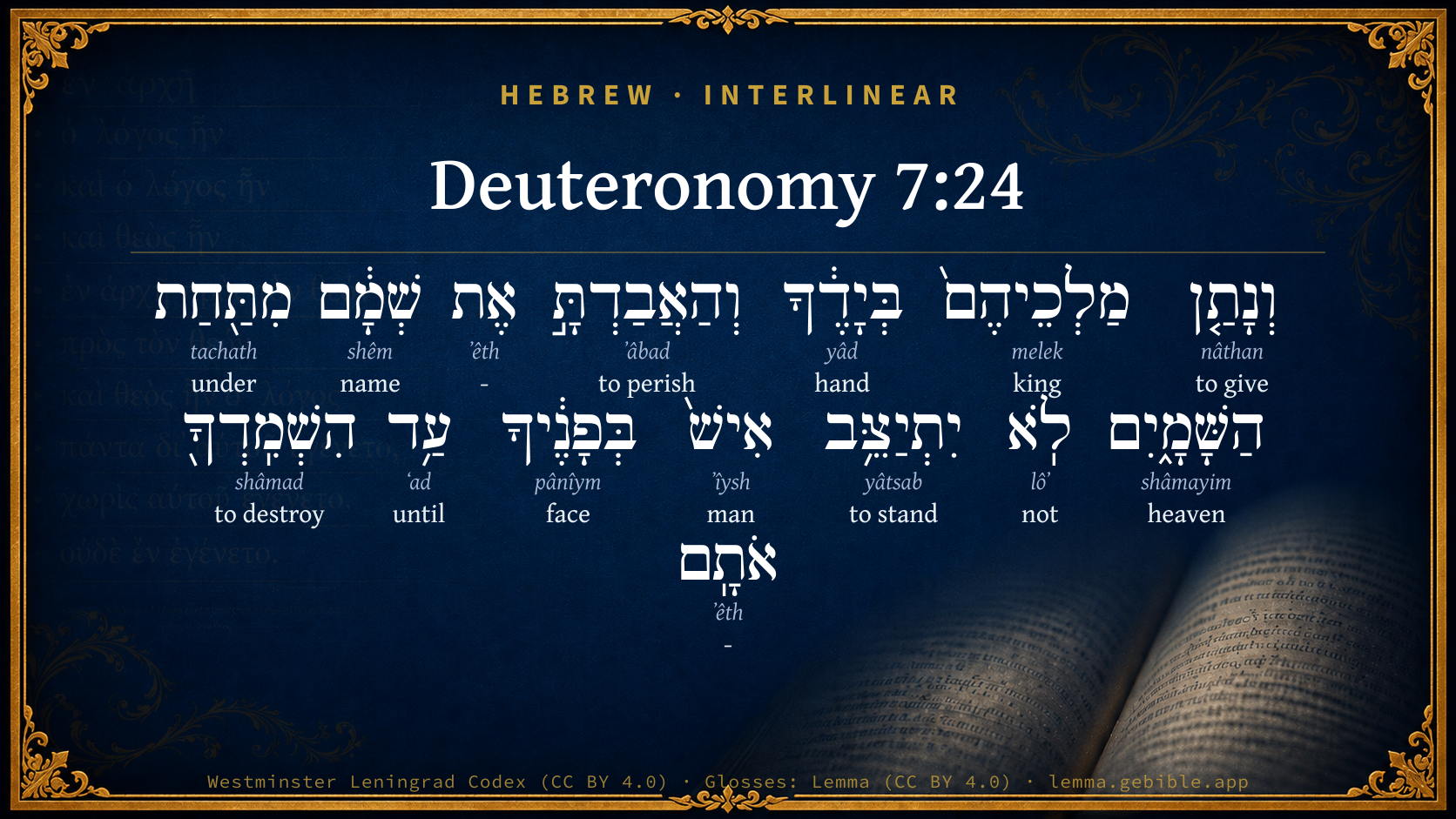
Deuteronomy 7:24

Hebrew (Westminster Leningrad Codex) Deuteronomy 7:24 appears in the Hebrew Old Testament. The text above is from the Westminster Leningrad Codex. Each word links to its Strong’s number, a concise gloss, and parsing drawn from the Open Scriptures Hebrew Bible morphology. Click any word for its full Brown-Driver-Briggs (BDB) entry.
Download image
Cite this verse

Deuteronomy 7:24 (World English Bible). Public Domain. Lemma interlinear Bible study tool, https://lemma.gebible.app/v/deuteronomy/7/24.

Show BibTeX & RIS
BibTeX
RIS
English Translation
He will deliver their kings into your hand, and you shall make their name to perish from under the sky: there shall no man be able to stand before you, until you have destroyed them.
World English Bible · Public Domain
Download a study sheet

One document with this verse’s original text, its word-by-word gloss line, the meaning frame, cross-references with their text, attributed commentary, and full source and license credits — printable, and it pastes into notes with its structure intact.

This verse Autodidact and up

Study sheet (.html) Plain text (.txt)

A passage Seminary Student

Up to 50 verses in one chapter. A passage sheet keeps up to 6 commentary sources and 12 cross-references per verse, in the order this page ranks them, and says so on the sheet whenever that leaves anything out. Ask for a single verse and you get the Autodidact verse sheet above.

Everything on this page stays free to read, with no account — the sheet is a download of what is already on screen, not access to it.

Want to remove ads? Support Godless Engineer
Compare translations 3

The same verse in 3 English versions, stacked beneath the original-language interlinear above. Click any original word for its lexicon entry.

Each is an independent rendering of the whole verse — the interlinear is not word-aligned to these translations.

Highlighted words mark where these versions differ — a whole-verse word diff, not a word-by-word alignment.

  • World English Bible Public Domain
    He will deliver their kings into your hand, and you shall make their name to perish from under the sky: there shall no man be able to stand before you, until you have destroyed them.
  • King James Version Public Domain
    And he shall deliver their kings into thine hand, and thou shalt destroy their name from under heaven: there shall no man be able to stand before thee, until thou have destroyed them.
  • unfoldingWord Literal Text CC BY-SA 4.0
    And he will give their kings into your hand, and you will cause their name to perish from under the heavens. No man will stand against your face, until you have destroyed them.

unfoldingWord Literal Text — © unfoldingWord, licensed CC BY-SA 4.0. Word-aligned USFM3 via Door43 (git.door43.org/unfoldingWord/en_ult).

Versions to compare (up to 4)

3 of 4 selected

Show all 18 translations

Every available English version of this verse, each an independent rendering of the whole verse.

  • World English Bible Public Domain
    He will deliver their kings into your hand, and you shall make their name to perish from under the sky: there shall no man be able to stand before you, until you have destroyed them.
  • Berean Standard Bible Public Domain
    He will hand their kings over to you, and you will wipe out their names from under heaven. No one will be able to stand against you; you will annihilate them.
  • Majority Standard Bible Public Domain
    He will hand their kings over to you, and you will wipe out their names from under heaven. No one will be able to stand against you; you will annihilate them.
  • King James Version Public Domain
    And he shall deliver their kings into thine hand, and thou shalt destroy their name from under heaven: there shall no man be able to stand before thee, until thou have destroyed them.
  • American Standard Version (1901) Public Domain
    And he will deliver their kings into thy hand, and thou shalt make their name to perish from under heaven: there shall no man be able to stand before thee, until thou have destroyed them.
  • Revised Version (1885) Public Domain
    And he shall deliver their kings into thine hand, and thou shalt make their name to perish from under heaven: there shall no man be able to stand before thee, until thou have destroyed them.
  • Geneva Bible (1599) Public Domain
    And he shall deliuer their Kings into thine hand, and thou shalt destroy their name from vnder heauen: there shall no man be able to stand before thee, vntill thou hast destroyed them.
  • Douay-Rheims (1899) Public Domain
    And he shall deliver their kings into thy hands, and thou shalt destroy their names from under Heaven: no man shall be able to resist thee, until thou destroy them.
  • Young's Literal Translation Public Domain
    and He hath given their kings into thy hand, and thou hast destroyed their name from under the heavens; no man doth station himself in thy presence till thou hast destroyed them.
  • Literal Standard Version CC BY-SA 4.0
    and He has given their kings into your hand, and you have destroyed their name from under the heavens; no man stations himself in your presence until you have destroyed them.
  • Unlocked Literal Bible CC BY-SA 4.0
    He will put their kings under your power, and you will make their name perish from under heaven. No one will be able to stand before you, until you have destroyed them.
  • unfoldingWord Literal Text CC BY-SA 4.0
    And he will give their kings into your hand, and you will cause their name to perish from under the heavens. No man will stand against your face, until you have destroyed them.
  • Darby Bible Public Domain
    And he will give their kings into thy hand, and thou shalt put out their name from under the heavens; no man shall stand before thee, until thou hast destroyed them.
  • World Messianic Bible Public Domain
    He will deliver their kings into your hand, and you shall make their name perish from under the sky. No one will be able to stand before you until you have destroyed them.
  • Webster's Bible Public Domain
    And he shall deliver their kings into thy hand, and thou shalt destroy their name from under heaven: there shall no man be able to stand before thee, until thou shalt have destroyed them.
  • Free Bible Version CC BY-SA 4.0
    He will give their defeated kings to you to be killed, and even their names will be forgotten. No one will be able to withstand you; you will completely destroy them.
  • Bible in Basic English Public Domain
    He will give their kings into your hands, and you will put their names out of existence under heaven; there is not one of them who will not give way before you, till their destruction is complete.
  • JPS Tanakh (1917) Public Domain
    And He shall deliver their kings into thy hand, and thou shalt make their name to perish from under heaven; there shall no man be able to stand against thee, until thou have destroyed them.

Literal Standard Version (2020), Covenant Press — licensed CC BY-SA 4.0. Text via the HelloAO Bible API (eBible.org). Unlocked Literal Bible (unfoldingWord) — licensed CC BY-SA 4.0. Text via the HelloAO Bible API (eBible.org). unfoldingWord Literal Text — © unfoldingWord, licensed CC BY-SA 4.0. Word-aligned USFM3 via Door43 (git.door43.org/unfoldingWord/en_ult). Free Bible Version, Dr. Jonathan Gallagher — licensed CC BY-SA 4.0. Text via the HelloAO Bible API (eBible.org).

Word by word

More ways to search: Search by grammar → Find every occurrence → Compare this word →

Practice this passage: Drill this verse → Learn its vocabulary →

יִתְיַצֵּ֥ב
yâtsab
H3320
“to stand”
Verb, Hithpael, Imperfect, 3rd Person, Masculine, Singular
Part of Speech
Verb
Stem
Hithpael
Form
Imperfect
Person
3rd Person
Gender
Masculine
Number
Singular
Full BDB Definition

Origin: a primitive root

TWOT: 894

to place, set, stand, set or station oneself, present oneself - (Hithpael) to station oneself, take one's stand, stand, present oneself, stand with someone
  1. וְנָתַ֤ן nâthan H5414 “and · to give” Conjunction + Verb, Qal, Sequential Perfect, 3rd Person, Masculine, Singular
  2. מַלְכֵיהֶם֙ melek H4428 “kings · their” Noun, Common, Masculine, Plural, Construct + Suffix, Personal, 3rd Person, Masculine, Plural
  3. בְּיָדֶ֔ךָ yâd H3027 “in/at · hand · your” Preposition + Noun, Common, Both, Singular, Construct + Suffix, Personal, 2nd Person, Masculine, Singular
  4. וְהַאֲבַדְתָּ֣ ʼâbad H6 “and · to perish” Conjunction + Verb, Hiphil, Sequential Perfect, 2nd Person, Masculine, Singular
  5. אֶת ʼêth H853 “-” Particle, Direct Object
  6. שְׁמָ֔ם shêm H8034 “name · their” Noun, Common, Masculine, Singular, Construct + Suffix, Personal, 3rd Person, Masculine, Plural
  7. מִתַּ֖חַת tachath H8478 “from · under” Preposition + Preposition
  8. הַשָּׁמָ֑יִם shâmayim H8064 “the · heaven(s)” Particle, Definite Article + Noun, Common, Masculine, Plural, Absolute
  9. לֹֽא lôʼ H3808 “not” Particle, Negative
  10. אִישׁ֙ ʼîysh H376 “man” Noun, Common, Masculine, Singular, Absolute
  11. בְּפָנֶ֔יךָ pânîym H6440 “in/at · face(s) · your” Preposition + Noun, Common, Both, Plural, Construct + Suffix, Personal, 2nd Person, Masculine, Singular
  12. עַ֥ד ʻad H5704 “until” Preposition
  13. הִשְׁמִֽדְךָ֖ shâmad H8045 “to destroy · you” Verb, Hiphil, Infinitive Construct + Suffix, Personal, 2nd Person, Masculine, Singular
  14. אֹתָֽם ʼêth H853 “- · them” Particle, Direct Object + Suffix, Personal, 3rd Person, Masculine, Plural

About this verse

These counts appear in no published source. They are computed here, from the morphology-tagged text and Lemma’s own curated glosses. What Lemma adds →

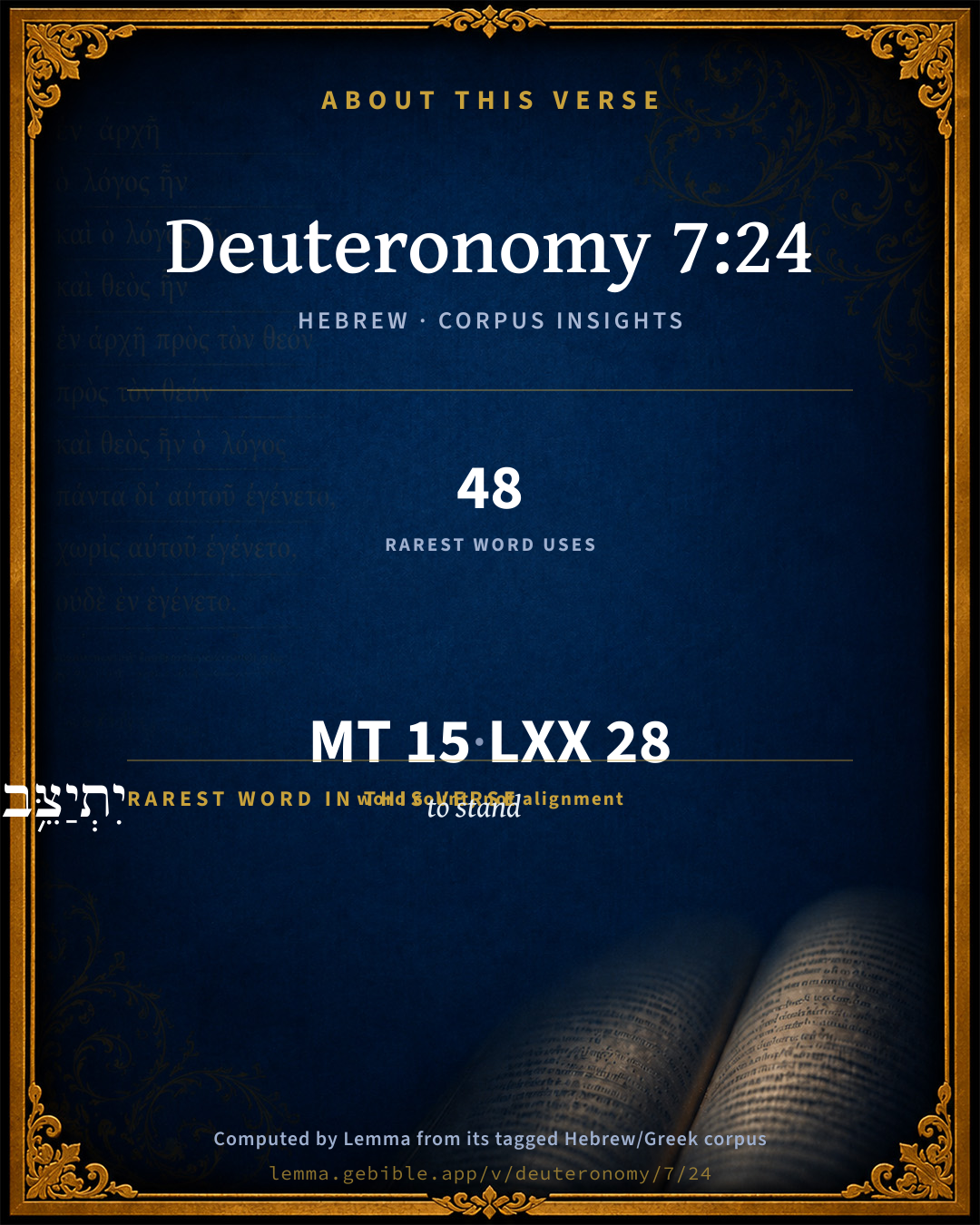
15
words
14
distinct lemmas
Pentateuch
section

Shared distinctive vocabulary

יִתְיַצֵּ֥ב to stand H3320 occurs in 45 verses of the Hebrew Bible. Also found in:

Grammatical profile

  • 4 verbs
  • 6 nouns
  • 2 prepositions
  • 3 particles

Verb forms

  • וְנָתַ֤ן Qal · Sequential Perfect
  • וְהַאֲבַדְתָּ֣ Hiphil · Sequential Perfect
  • יִתְיַצֵּ֥ב Hithpael · Imperfect
  • הִשְׁמִֽדְךָ֖ Hiphil · Infinitive Construct

Hebrew & Septuagint length

In English translation the verse runs 35 words from the Hebrew and 33 from the Septuagint (LXX English) — closely comparable.

A rough comparison of the two English renderings, which tokenize alike — not a word-level alignment.

Word counts can differ between the Hebrew and the Greek without any difference in meaning — e.g. the Hebrew direct-object marker אֵת has no separate Greek word, and Greek often adds the article ὁ.

In the original languages it is 15 Hebrew tokens and 28 Greek tokens — but the two are counted differently (Hebrew bundles its prefixes and suffixes into one token; the Greek is in lemma form), so that isn’t a like-for-like length.

Cross-references

18

Topical passages linked to Deuteronomy 7:24 in the Treasury of Scripture Knowledge — connected by theme and wording, ordered by reader-vote popularity; previews shown in the World English Bible.

  • Joshua 10:8 Yahweh said to Joshua, Don't fear them: for I have delivered them into your hands; there shall not a man of them stand before you.
  • Joshua 23:9 For Yahweh has driven out from before you great nations and strong: but as for you, no man has stood before you to this day.
  • Joshua 1:5 There shall not any man be able to stand before you all the days of your life. As I was with Moses, so I will be with you; I will not fail you, nor forsake you.
  • Joshua 10:42 All these kings and their land did Joshua take at one time, because Yahweh, the God of Israel, fought for Israel.
  • Deuteronomy 9:14 let me alone, that I may destroy them, and blot out their name from under the sky; and I will make of you a nation mightier and greater than they.
  • Deuteronomy 11:25 There shall no man be able to stand before you: Yahweh your God shall lay the fear of you and the dread of you on all the land that you shall tread on, as he has spoken to you.
  • Joshua 10:24–25 It happened, when they brought forth those kings to Joshua, that Joshua called for all the men of Israel, and said to the chiefs of the men of war who went with him, Come near, put your feet on the necks of these kings. They came near, and put their feet on the necks of them.
  • Isaiah 54:17 No weapon that is formed against you shall prosper; and every tongue that shall rise against you in judgment you shall condemn. This is the heritage of the servants of Yahweh, and their righteousness which is of me, says Yahweh.
  • Romans 8:37 No, in all these things, we are more than conquerors through him who loved us.
  • Exodus 17:14 Yahweh said to Moses, "Write this for a memorial in a book, and rehearse it in the ears of Joshua: that I will utterly blot out the memory of Amalek from under the sky."
  • Deuteronomy 25:19 Therefore it shall be, when Yahweh your God has given you rest from all your enemies round about, in the land which Yahweh your God gives you for an inheritance to possess it, that you shall blot out the memory of Amalek from under the sky; you shall not forget.
  • Deuteronomy 29:20 Yahweh will not pardon him, but then the anger of Yahweh and his jealousy will smoke against that man, and all the curse that is written in this book shall lie on him, and Yahweh will blot out his name from under the sky.
  • Joshua 12:1–6 Now these are the kings of the land, whom the children of Israel struck, and possessed their land beyond the Jordan toward the sunrise, from the valley of the Arnon to Mount Hermon, and all the Arabah eastward:
  • Psalms 9:5 You have rebuked the nations. You have destroyed the wicked. You have blotted out their name forever and ever.
  • Proverbs 10:7 The memory of the righteous is blessed, But the name of the wicked will rot.
  • Jeremiah 10:11 Thus shall you say to them, The gods that have not made the heavens and the earth, these shall perish from the earth, and from under the heavens.
  • Zephaniah 1:4 I will stretch out my hand against Judah, and against all the inhabitants of Jerusalem. I will cut off the remnant of Baal from this place: the name of the idolatrous and pagan priests,
  • 1 Corinthians 15:57 But thanks be to God, who gives us the victory through our Lord Jesus Christ.

Cross-references courtesy of OpenBible.info (CC BY 4.0).

Hebrew and Greek witnesses Masoretic Hebrew ↔ Greek Septuagint

The same verse in the two great witnesses to the Old Testament, shown verse-for-verse.

These are two independent witnesses, not word-aligned to each other, and the Septuagint is shown in lemma (dictionary) form.

Hebrew Deuteronomy 7:24 Masoretic · Westminster Leningrad Codex

וְנָתַ֤ן מַלְכֵיהֶם֙ בְּיָדֶ֔ךָ וְהַאֲבַדְתָּ֣ אֶת שְׁמָ֔ם מִתַּ֖חַת הַשָּׁמָ֑יִם לֹֽא יִתְיַצֵּ֥ב אִישׁ֙ בְּפָנֶ֔יךָ עַ֥ד הִשְׁמִֽדְךָ֖ אֹתָֽם

He will deliver their kings into your hand, and you shall make their name to perish from under the sky: there shall no man be able to stand before you, until you have destroyed them.

World English Bible · Public Domain

Greek LXX Deuteronomy 7:24 Septuagint · lemma form

καί παραδίδωμι ὁ βασιλεύς αὐτός εἰς ὁ χείρ σύ καί ἀποὀλλύω ὁ ὄνομα αὐτός ἐκ ὁ τόπος ἐκεῖνος οὐ ἀντιἵστημι οὐδείς κατά πρόσωπον σύ ἕως ἄν ἐκὀλεθρεύω αὐτός

And he shall deliver their kings into your hands, and you⌃ shall destroy their name from that place; none shall stand up in opposition before you, until you shall have utterly destroyed them.

LXX2012 (modern English Septuagint) · Public Domain

Hebrew: Westminster Leningrad Codex (CC BY 4.0). Greek: Septuagint (public domain); English from LXX2012 (modern English Septuagint) (Public Domain). How the Septuagint differs from the Hebrew →

Targum (Aramaic paraphrase)

2

The Targum is the ancient Jewish Aramaic paraphrase of the Hebrew Scriptures — an interpretive translation, not the Hebrew text itself. Onkelos (literal) and Pseudo-Jonathan (expansive) render the Torah, and Jonathan the Prophets. Coverage is partial: where no permissively-licensed English translation exists for a verse, only the Aramaic is shown. This is verse-level text, not a word-by-word alignment to the Hebrew.

  1. Targum Onkelos Torah (Genesis–Deuteronomy)
    וְיִמְסַר מַלְכֵיהוֹן בִּידָךְ וְתוֹבַד יָת שִׁמְהוֹן מִתְּחוֹת שְׁמַיָא לָא יִתְעַתַּד אֱנַשׁ קֳדָמָךְ עַד דִתְשֵׁיצֵי יָתְהוֹן

    (no public-domain English translation for this verse)

    Targum Onkelos — Aramaic: “Onkelos Genesis” (public domain); “Onkelos Exodus” (public domain); “Onkelos Leviticus” (public domain); “Onkelos Numbers” (public domain); “Onkelos Deuteronomy” (public domain). English: “Sefaria Community Translation” (CC0 1.0 (public-domain dedication)); “J.W. Etheridge. The Targums of Onkelos and Jonathan Ben Uzziel on the Pentateuch. London: Longmans, Green, 1862” (public domain). Text via Sefaria.

  2. Targum Pseudo-Jonathan Torah (Genesis–Deuteronomy)
    וְיִמְסוֹר מַלְכֵיהוֹן בְּיֶדְכוֹן וְתוֹבְדוּן יַת שׁוּמְהוֹן מִדּוּכְרָנָא תְּחוֹת כָּל שְׁמַיָא לָא יִתְעַתֵּד אֵינַשׁ קוֹמֵיכוֹן עַד דְּיִתְשֵׁיצֵי יַתְהוֹן

    And He will deliver their kings into your hands, and you shall destroy their names from remembrance under the whole heavens: not a man shall stand before you until you have destroyed them.

    Targum Pseudo-Jonathan — Aramaic: “Targum Jonathan on Genesis” (public domain); “Targum Jonathan on Exodus” (public domain); “Targum Jonathan on Leviticus” (public domain); “Targum Jonathan on Numbers” (public domain); “Targum Jonathan on Deuteronomy” (public domain). English: “The Targum of Jonathan ben Uzziel, trans. J. W. Etheridge, London, 1862” (public domain). Text via Sefaria.

Commentary

Notes on Deuteronomy 7:24 from classic Christian and Jewish commentators (each source and its license shown beneath its notes). The classic Christian expositions comment on the surrounding passage and are grouped to its opening verse, so a note may address several verses; the Jewish commentaries on the Tanakh (Rashi and others) are per-verse, so they appear only where the commentator wrote on this verse.

Lemma curates 59 commentaries, every one of them public domain or Creative Commons licensed, each selected and text-cleaned for this edition rather than reprinted as found. About our sources →

Trapp's Complete Commentary

John Trapp

Deu 7:24 And he shall deliver their kings into thine hand, and thou shalt destroy their name from under heaven: there shall no man be able to stand before thee, until thou have destroyed them.

Ver. 24. Thou shalt destroy their name.] It shall be either buried in oblivion, or if mentioned, it shall be but as the stirring of a sepulchre, which thereby stinketh the more. Solomon reckoneth it for a mercy to a wicked man, when he is buried, to be forgotten in his city. {Ecc 8:10}

John Trapp, A Commentary or Exposition upon All the Books of the Old and New Testament (1647–1656) — public domain. Text from a community e-Sword module.

Joseph Benson's Commentary

Deu 7:24. No man shall stand before thee — This promise was conditional; they were to be obedient and perform their duty, and then it would be fulfilled; but if they neglected to do this, they would justly lose the benefit of it.

Joseph Benson's Commentary on the Old and New Testaments (1811–1818) — public domain. Text from a community e-Sword module.

Tyndale Open Study Notes

Tyndale Open Resources

7:24 erase their names: An individual’s name represented that person’s existence as it would be carried into the future through generations of descendants. By destroying an entire nation, God cut off its line of descent and thus also its future. The Canaanites who suffered God’s war against them lost all their descendants and thus their existence and identity.

Tyndale Open Study Notes — © Tyndale Open Resources, licensed CC BY-SA 4.0. Text via the HelloAO Bible API.

Ellicott's Commentary for English Readers

(24) He shall deliver their kings into thine hand.—In the summary of Joshua’s conquest (Joshua 12) the kings are reckoned for the cities. Special mention is made of seven of them, who were hanged.

There shall no man be able to stand before thee.—A promise personally renewed to Joshua (Jos_1:5), and fulfilled to Israel under his command (Josh. 20:44).

A Bible Commentary for English Readers, edited by Charles John Ellicott (1878–1897) — public domain. Text from a community e-Sword module.

The Cambridge Bible for Schools and Colleges

gen. ed. J. J. S. Perowne

24. make their name to perish, etc.] Cp blot out, Deu_9:14, Deu_25:19, Deu_29:20.

stand before thee] Lit. keep himself standing to thy face, hold his post in face of thee: only here, Deu_9:2 Sg., Deu_11:25 Pl., in this sense.

The Cambridge Bible for Schools and Colleges (gen. ed. J. J. S. Perowne; Cambridge University Press, 1878–1918) — public domain. Text from a community e-Sword module.

John Gill's Exposition

The graven images of their gods shall ye burn with fire,.... Which is repeated from Deu 7:5, that it might be the more observed and strictly performed, and which unless done, they could not expect the utter destruction of their enemies, who were left in the land to try and prove them with respect to this very thing:

thou shall not desire the silver or gold that is on them: the raiment of gold or silver with which they were bedecked, or the plates of gold and silver with which they were covered, or any ornament about them, as chains and the like, that were of either of these metals; see Eze 16:16,

nor take it unto thee, lest thou be snared therein; nor take it into their possession, or bring it into their houses, as in the next verse, lest they should be under a temptation to worship it, or keep it as a superstitious relic:

for it is an abomination to the Lord thy God; not only the idol itself, being put in the place of God, and so derogatory to his honour and glory, but the gold and silver on it, being devoted to a superstitious and idolatrous use; and even the taking of it, and appropriating it to a man's own use, was an abomination, and resented by the Lord as such.

John Gill's Exposition of the Whole Bible (1746–1763) — public domain (CC PDM 1.0). Text via the HelloAO Bible API.

Matthew Poole's English Annotations

This promise is made upon condition of their performance of their duty, which they neglecting, they justly lose the benefit of it, as we see, Jdg 2:1-3.

Matthew Poole's English Annotations on the Holy Bible (1683–1685) — public domain. Text from a community e-Sword/MySword module.

The Pulpit Commentary

The kings also of these nations should they utterly destroy, so that their memory should perish from the earth.

The Pulpit Commentary (1880–1919), ed. H.D.M. Spence-Jones & Joseph S. Exell — public domain. Text from a community e-Sword module.

John Wesley's Explanatory Notes

No man shall stand - This promise is made upon condition of their performance of their duty, which they neglecting, justly lose the benefit of it.

John Wesley, Explanatory Notes Upon the Whole Bible (1754–1765) — public domain. Text via the GEBible commentary corpus.

Ramban (Nachmanides)

Rabbi Moshe ben Nachman (Ramban / Nachmanides)

AND HE SHALL DELIVER THEIR KINGS INTO THY HAND, AND THOU SHALT CAUSE THEIR NAME TO PERISH — until they shall have no name abroad — and the Israelites will destroy all who stand up to oppose them. This is similar to what is stated in the Book of Joshua, For it was of the Eternal to harden their hearts, to come against Israel in battle, that they might be utterly destroyed, and not a king was left to them [the Canaanites] in the Land as all their kings fell [in battle].And Rashi wrote: “Lest the beasts of the field increase upon thee. But is it not true that when they do His will [as the section begins: And it shall come to pass, because ye hearken to these ordinances etc.] they will have no fear of the beasts, as it is said, and the beasts of the field shall be at peace with thee? But [this assurance is stated because] it was manifest before Him that they were destined to sin.” These are the words of our Rabbis. 50, with many changes. Now, even though this section is stated as a promise [and any reference to future sin apparently contradicts the principle of man’s freedom of choice], I have already mentioned that, in the Book of Deuteronomy, Moses our teacher both assures and warns. He alludes to the fact that their merits will not be sufficient to destroy all the people at once and for Him to cause evil beasts to cease out of the Land as promised to them in the section If ye walk in My statutes., Verse 3. Instead it will be as he said [here] that they will, in the first stage [of the conquest], destroy most of them together with their kings, and, afterwards, they that are left will be destroyed.

Ramban (Nachmanides) on the Tanakh — English translation: “Commentary on the Torah by Ramban (Nachmanides). Translated and annotated by Charles B. Chavel. New York, Shilo Pub. House, 1971-1976” (CC BY 4.0). Text via Sefaria.

Lesson kit

Teaching starters — assembled from the data on this page, not authored interpretation. Every prompt links to the verse data it draws on. Edit before teaching.

Deuteronomy, in the Pentateuch, opens this verse with 15 words (14 distinct Hebrew lemmas). Its most distinctive word is yâtsab (“to stand”). A historical commentator’s framing appears above. Read the whole chapter for the surrounding context.

Discussion questions

  1. How does “to stand” (yâtsab) shape what this verse is saying?
  2. Exodus 2:4 shares the word «to stand» with this verse. How do the two illuminate each other?
  3. The translations on this page render this verse differently — a whole-verse word diff, not a word-by-word alignment. What might account for the different wordings?
  4. The verb «וְנָתַ֤ן» is Qal Sequential Perfect. How does its form color the action?
  5. Reading how Trapp's Complete Commentary and Joseph Benson's Commentary read this verse, where do the two commentators agree and where do they part?

Things to notice

Reading settings

Reading text

Shown beneath each verse's original-language words.

Old Testament
Old Testament edition

Read the OT as the Masoretic Hebrew (MT) or the Greek Septuagint (LXX).

English shown for the Greek Septuagint (in the Hebrew ↔ Greek comparison).

Comparing translations? Open the Compare panel on any verse page to stack up to four side by side.