
Luke 12:2

Greek (Tischendorf 8th ed.) Luke 12:2 appears in the Greek New Testament. The text above is from the Tischendorf 8th edition. Each word links to its Strong’s number and a concise gloss. Click any word for its full Thayer’s Greek Lexicon entry.
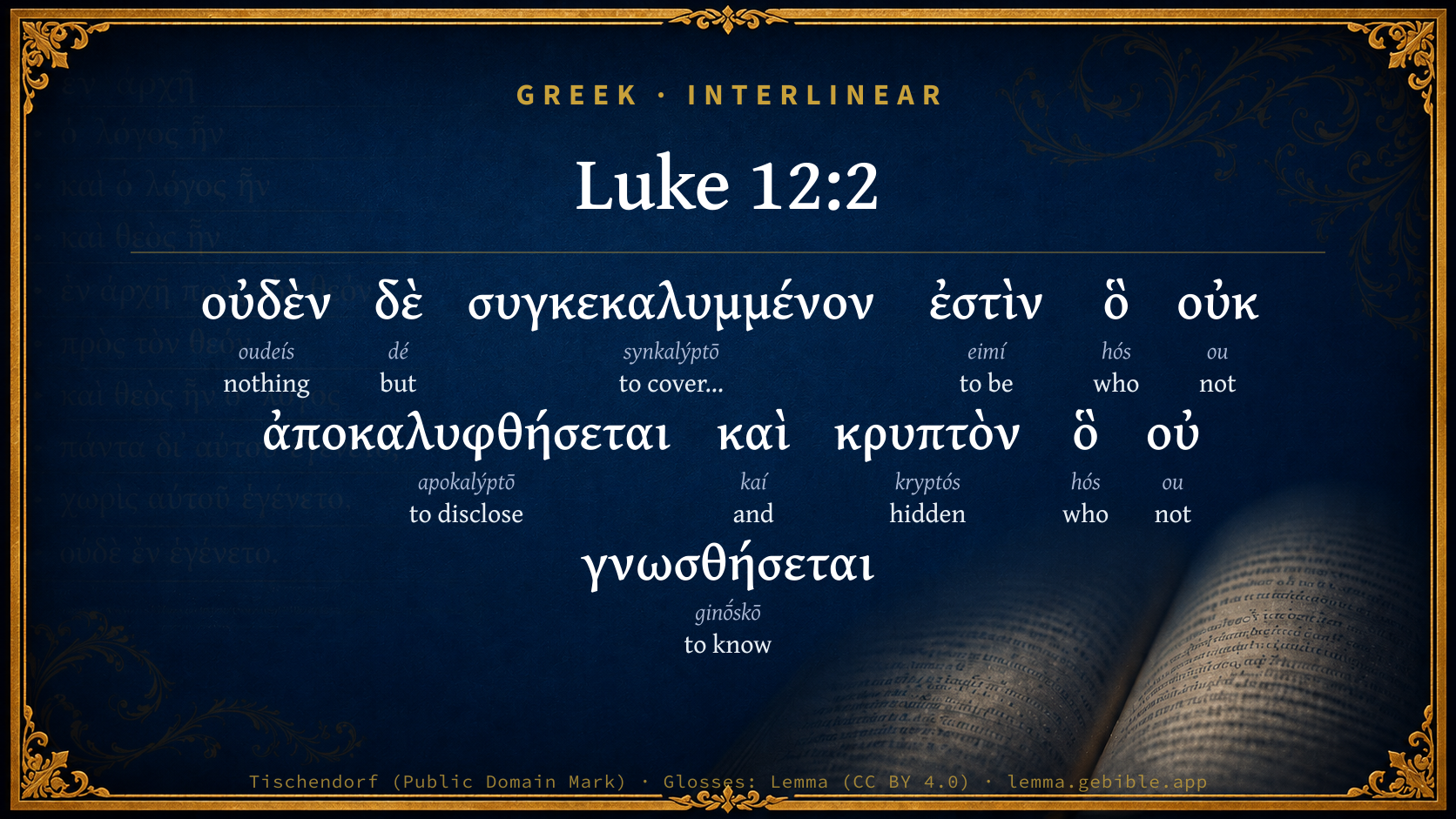
Download image
Cite this verse

Luke 12:2 (World English Bible). Public Domain. Lemma interlinear Bible study tool, https://lemma.gebible.app/v/luke/12/2.

Show BibTeX & RIS
BibTeX
RIS
English Translation
But there is nothing covered up, that will not be revealed, nor hidden, that will not be known.
World English Bible · Public Domain
Highlights
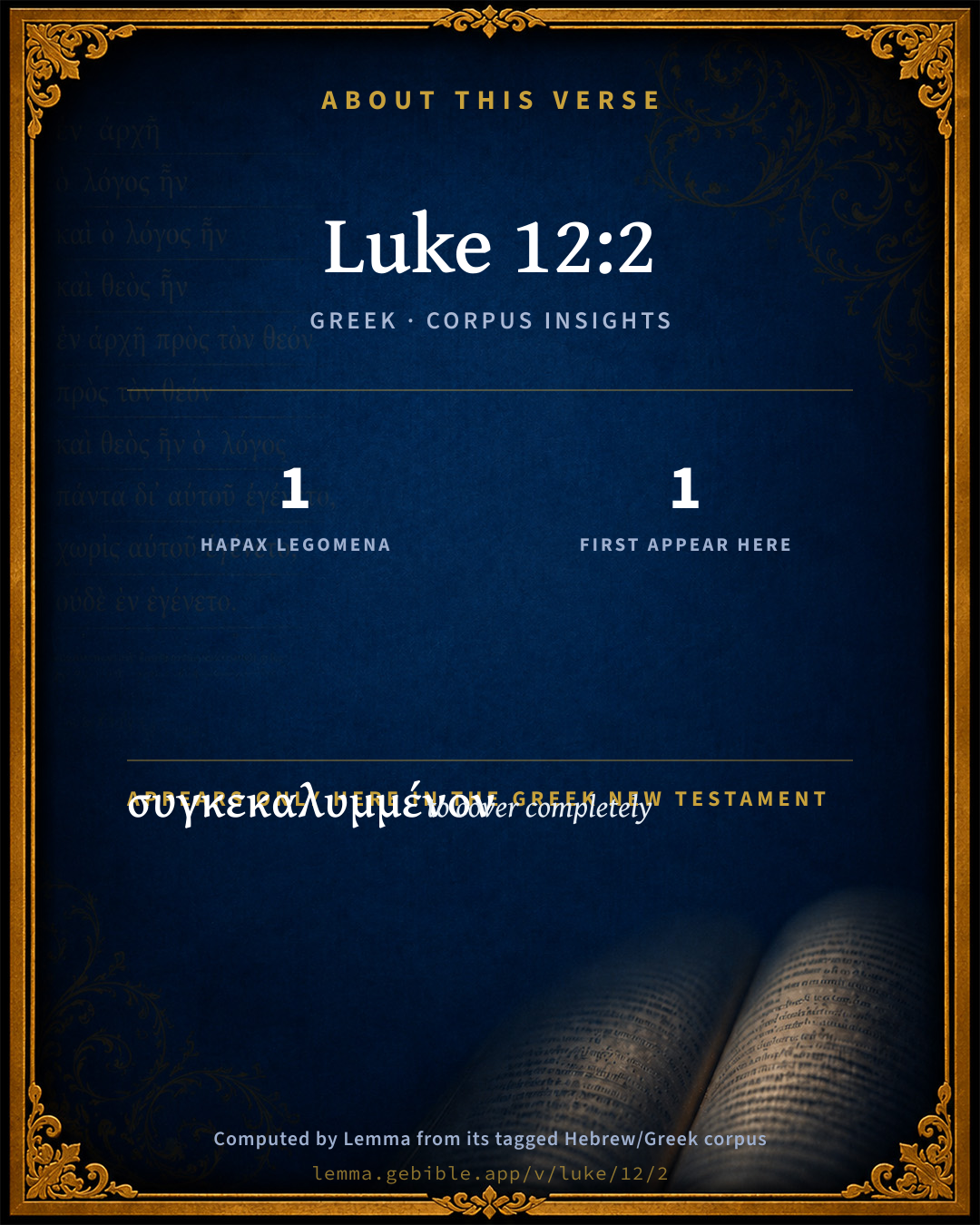
  • 1 hapax legomenon — only here in the Greek New Testament
  • 1 first appearance in the Greek New Testament
Full analysis ↓
Download a study sheet

One document with this verse’s original text, its word-by-word gloss line, the meaning frame, cross-references with their text, attributed commentary, and full source and license credits — printable, and it pastes into notes with its structure intact.

This verse Autodidact and up

Study sheet (.html) Plain text (.txt)

A passage Seminary Student

Up to 50 verses in one chapter. A passage sheet keeps up to 6 commentary sources and 12 cross-references per verse, in the order this page ranks them, and says so on the sheet whenever that leaves anything out. Ask for a single verse and you get the Autodidact verse sheet above.

Everything on this page stays free to read, with no account — the sheet is a download of what is already on screen, not access to it.

Want to remove ads? Support Godless Engineer
Compare translations 3

The same verse in 3 English versions, stacked beneath the original-language interlinear above. Click any original word for its lexicon entry.

Each is an independent rendering of the whole verse — the interlinear is not word-aligned to these translations.

Highlighted words mark where these versions differ — a whole-verse word diff, not a word-by-word alignment.

  • World English Bible Public Domain
    But there is nothing covered up, that will not be revealed, nor hidden, that will not be known.
  • King James Version Public Domain
    For there is nothing covered, that shall not be revealed; neither hid, that shall not be known.
  • unfoldingWord Literal Text CC BY-SA 4.0
    But nothing is concealed that will not be revealed, and hidden, that will not be known.

unfoldingWord Literal Text — © unfoldingWord, licensed CC BY-SA 4.0. Word-aligned USFM3 via Door43 (git.door43.org/unfoldingWord/en_ult).

Versions to compare (up to 4)

3 of 4 selected

Show all 19 translations

Every available English version of this verse, each an independent rendering of the whole verse.

  • World English Bible Public Domain
    But there is nothing covered up, that will not be revealed, nor hidden, that will not be known.
  • Berean Standard Bible Public Domain
    There is nothing concealed that will not be disclosed, and nothing hidden that will not be made known.
  • Majority Standard Bible Public Domain
    There is nothing concealed that will not be disclosed, and nothing hidden that will not be made known.
  • King James Version Public Domain
    For there is nothing covered, that shall not be revealed; neither hid, that shall not be known.
  • American Standard Version (1901) Public Domain
    But there is nothing covered up, that shall not be revealed; and hid, that shall not be known.
  • Revised Version (1885) Public Domain
    But there is nothing covered up, that shall not be revealed: and hid, that shall not be known.
  • Geneva Bible (1599) Public Domain
    For there is nothing couered, that shall not bee reueiled: neither hidde, that shall not be knowen.
  • Douay-Rheims (1899) Public Domain
    For there is nothing covered, that shall not be revealed: nor hidden, that shall not be known.
  • Young's Literal Translation Public Domain
    and there is nothing covered, that shall not be revealed; and hid, that shall not be known;
  • Literal Standard Version CC BY-SA 4.0
    and there is nothing covered that will not be revealed, and hid that will not be known;
  • Unlocked Literal Bible CC BY-SA 4.0
    But there is nothing concealed that will not be revealed, and nothing hidden that will not be known.
  • unfoldingWord Literal Text CC BY-SA 4.0
    But nothing is concealed that will not be revealed, and hidden, that will not be known.
  • Darby Bible Public Domain
    but there is nothing covered up which shall not be revealed, nor secret that shall not be known;
  • World Messianic Bible Public Domain
    But there is nothing covered up that will not be revealed, nor hidden that will not be known.
  • Webster's Bible Public Domain
    For there is nothing covered, that shall not be revealed; neither hid, that shall not be known.
  • Free Bible Version CC BY-SA 4.0
    For there's nothing hidden that won't be revealed, nothing secret that won't be made known.
  • Bible in Basic English Public Domain
    But nothing is covered up, which will not come to light, or secret, which will not be made clear.
  • Text-Critical English NT CC BY 4.0
    There is nothing covered up that will not be revealed, and nothing hidden that will not be made known.
  • Tyndale New Testament (1534) Public Domain
    For ther is no thinge covered that shall not be vncovered: nether hyd that shall not be knowen.

Literal Standard Version (2020), Covenant Press — licensed CC BY-SA 4.0. Text via the HelloAO Bible API (eBible.org). Unlocked Literal Bible (unfoldingWord) — licensed CC BY-SA 4.0. Text via the HelloAO Bible API (eBible.org). unfoldingWord Literal Text — © unfoldingWord, licensed CC BY-SA 4.0. Word-aligned USFM3 via Door43 (git.door43.org/unfoldingWord/en_ult). Free Bible Version, Dr. Jonathan Gallagher — licensed CC BY-SA 4.0. Text via the HelloAO Bible API (eBible.org).

Word by word

More ways to search: Search by grammar → Find every occurrence → Compare this word →

Practice this passage: Drill this verse → Learn its vocabulary →

συγκεκαλυμμένον
synkalýptō
G4780
“to cover completely”
Verb, Perfect, Passive, Participle, Nominative, Singular, Neuter
Part of Speech
Verb
Tense
Perfect
Voice
Passive
Mood
Participle
Case
Nominative
Number
Singular
Gender
Neuter
Full Thayer's Definition

Origin: from G4862 and G2572

TDNT: 19:23,1

1. to cover on all sides, to conceal entirely, to cover up completely
  1. οὐδὲν oudeís G3762 “nothing” Adjective, Nominative, Singular, Neuter, Negative
  2. δὲ dé G1161 “but” Conjunction
  3. ἐστὶν eimí G1510 “to be” Verb, Present, Active, Indicative, 3rd person, Singular
  4. ὃ hós G3739 “who” Relative pronoun, Nominative, Singular, Neuter
  5. οὐκ ou G3756 “not” Particle, Negative
  6. ἀποκαλυφθήσεται apokalýptō G601 “to disclose” Verb, Future, Passive, Indicative, 3rd person, Singular
  7. καὶ kaí G2532 “and” Conjunction
  8. κρυπτὸν kryptós G2927 “hidden” Adjective, Nominative, Singular, Neuter
  9. ὃ hós G3739 “who” Relative pronoun, Nominative, Singular, Neuter
  10. οὐ ou G3756 “not” Particle, Negative
  11. γνωσθήσεται ginṓskō G1097 “to know” Verb, Future, Passive, Indicative, 3rd person, Singular

About this verse

These counts appear in no published source. They are computed here, from the morphology-tagged text and Lemma’s own curated glosses. What Lemma adds →

12
words
10
distinct lemmas
Gospels
section

Notable vocabulary

1 hapax legomenon — a word that appears only here in the entire Greek New Testament:

  • συγκεκαλυμμένον to cover completely G4780

First appearance in Scripture

This word makes its first canonical appearance in the Greek New Testament here:

  • συγκεκαλυμμένον to cover completely G4780

Shared distinctive vocabulary

κρυπτὸν hidden G2927 occurs in 16 verses of the Greek New Testament. Also found in:
Repetition

Words recur within this verse:

Cross-references

8

Topical passages linked to Luke 12:2 in the Treasury of Scripture Knowledge — connected by theme and wording, ordered by reader-vote popularity; previews shown in the World English Bible.

  • Mark 4:22 For there is nothing hidden, except that it should be made known; neither was anything made secret, but that it should come to light.
  • Luke 8:17 For nothing is hidden, that will not be revealed; nor anything secret, that will not be known and come to light.
  • 2 Corinthians 5:10 For we must all be revealed before the judgment seat of Christ; that each one may receive the things in the body, according to what he has done, whether good or bad.
  • Ecclesiastes 12:14 For God will bring every work into judgment, with every hidden thing, whether it is good, or whether it is evil.
  • Matthew 10:26–33 Therefore don't be afraid of them, for there is nothing covered that will not be revealed; and hidden that will not be known.
  • Romans 2:16 in the day when God will judge the secrets of men, according to my Gospel, by Jesus Christ.
  • 1 Corinthians 4:5 Therefore judge nothing before the time, until the Lord comes, who will both bring to light the hidden things of darkness, and reveal the counsels of the hearts. Then each man will get his praise from God.
  • Revelation 20:11–12 I saw a great white throne, and him who sat on it, from whose face the earth and the heaven fled away. There was found no place for them.

Cross-references courtesy of OpenBible.info (CC BY 4.0).

Commentary

Notes on Luke 12:2 from classic Christian and Jewish commentators (each source and its license shown beneath its notes). The classic Christian expositions comment on the surrounding passage and are grouped to its opening verse, so a note may address several verses; the Jewish commentaries on the Tanakh (Rashi and others) are per-verse, so they appear only where the commentator wrote on this verse.

Lemma curates 59 commentaries, every one of them public domain or Creative Commons licensed, each selected and text-cleaned for this edition rather than reprinted as found. About our sources →

The Biblical Illustrator

Joseph S. Exell

Luk_12:2-3

Nothing covered, that shall not be revealed

The revealing process

There is a tendency in things everywhere to manifest their natures, and make themselves known.

Seeds that are buried, seek the light; shells deep in the sea grope their way to the shore; the processes of nature are to bring things to the surface. What is true in matter has certainly its counterpart in mind. Human character, notwithstanding all efforts to keep itself back, also tends to development; what is not seen at once is found out in a lifetime. The strong passions of the soul, like smothered fires or hidden springs, at last burst their way through, and become known. There is certainly going on around us in the operations of nature, and in the unfolding of events, a revealing process, as if creation and Providence had determined to let light into all dark places, and at last uncover human hearts. This, we suppose, is the general idea taught in the text.

I. THERE ARE REVEALING PROCESSES GOING ON IN THE WORLD AROUND US, AND UNDER CIRCUMSTANCES WHICH MAKE IT EXCEEDINGLY PROBABLE THAT, IN THE WORLD TO COME, THEY WILL CONTINUE TO GO ON WITH ACCELERATED AND OVERWHELMING POWER. One fact often discloses a great deal, when brought into connection with another fact, which, when it stood by itself, told nothing. The ancient kings of the East were aware of this, when they sent messages from one to another on business which they wished to be kept secret from all but themselves. The message was written upon a piece of parchment, but so written that it could not be deciphered unless first bound upon a staff, which contained a counterpart and key to that which was sent, and each king kept one of these staffs; hence, if the messenger should lose the scrip, the secret would not be divulged, because not intelligible, unless wrapped round the wood: the one was read by the help of the other, though each spoke nothing by itself. So with events in human life; they throw light on each other when brought together.

II. ALL THE HINDRANCES WHICH PREVENTED A PERFECT REVELATION OF THE CHARACTER IN THIS WORLD, WILL, IN THE NEXT, BE REMOVED. If even in such a world as this, where the body, and old associations, and friends, and forgetfulness, and ignorance of the consequences, contribute to quiet the goadings of conscience, men are still driven by remorse to give a detailed and minute account of the evil they have done, what may not be expected when, with conscience all alive, and memory quickened, the soul dismantled of its clay, stung by its sins, bereft of friends, and hindered by nothing, meets the eye of its Maker without a veil? Surely there is a provision in our nature, by reason of which every one shall give an account of himself unto God.

III. MUCH OF THE BIBLE IS WRITTEN, AND ALL PROBATION ARRANGED, WITH REFERENCE TO A JUDGMENT IN THE MIDST OF MINUTE AND AMAZING REVELATIONS. There is a foretokening all along our earthly way. If the wicked hear a dreadful sound, what does he hear? If he sees a hand others do not see, what is it that he sees? The fear of God is not before his eyes, and yet he is afraid. There was a sound, a rustle of a leaf, yet to him a sound that spoke of discovery--a whisper of betrayal and development; he sees things around him working to the surface. Even a stain upon his robe, a paler hue upon his cheek, may have a voice to some one; many things have come out in ways most unexpected and who shall say, after all, he may not have been observed! Perhaps the words of the aged preacher peal again upon his soul--Every work into judgment, with every secret thing, whether it be good or whether it be evil. For every idle word which men shall speak, shall they give account; Whatsoever ye have spoken in darkness shall be heard in the light; and The sea gave up the dead which were in it, and death and the grave the dead which were in them, and they were judged, every man according to his works, out of the things that were written in the books.

IV. IF THERE WERE NO BOOKS WITH MANS NEEDS RECORDED IN THEM, NO CONSCIENCE IN THE SOUL TO URGE THEM FORTH, NO WITNESSES TO TESTIFY, AND NO FORMAL SENTENCE TO BE PRONOUNCED AND VINDICATED, STILL THE FUTURE CONDITION OF THE SOUL WILL ITSELF POINT BACK TO SPECIFIC ACTS OF SIN OR UNRIGHTEOUSNESS ON EARTH, AS THE GROUND OF ITS PECULIAR DESTINY. (W. Neill.)

The inner world

I. Now, we believe that God has dealt with man according to his temperament. He knows us far better than we know ourselves; and He would therefore work upon us in a manner most likely to produce a good effect. It may be, indeed, that the abstract idea of the Lords coming to judgment, would have been in itself too lofty for a man fully to appreciate; so that in order to make man realize it, and thus to let it have a practical bearing upon our conduct, it has been necessary to enter into the detail, and describe one of the scenes connected with it. Or, to regard the subject in another light, it is noticeable that man feels no shame of Gods knowledge of sin. This may be proved from the fact that we are guilty, all of us, of many secret sins, which we should blush to own to our dearest friend, but which we are ready enough to acknowledge to God. On the other hand, we are not often content that our good deeds should be known to God alone, but the majority of persons would seem to wish that men should regard them also. These considerations may lead us to understand, that it was from a complete knowledge of human nature that Christ warned His disciples by the announcement of the truth--that all secrets would eventually be brought to light. Beware, He says, of the leaven of the Pharisees, which is hypocrisy. For there is nothing covered, that shall not be revealed; neither hid, that shall not be known.

II. By laying as de a 1 further reference to Gods perfect knowledge of human nature implied in the text, we would lead your minds to the doctrine which the text conveys--and, indeed, it is a most important one. Christ here speaks of the revealing at the last day, of all that we now hide in the closest secrecy. He tells us that there is nothing, hide it as we now may from the knowledge of others, which He will not reveal before the masses of the universe. The actions of a single day, who can number them? Go, examine your own hearts. Each man for himself must go down to the region of his own soul, and find out what is there going on. Thoughts and passions, motives and wishes, hopes and fears, hatred, lusts and affections, intentions of good, and designs of evil; these are the shadowy dwellers of that weed within, whose name is legion, for indeed they are many. At one time they prompt us to external deeds; at another time, our external deeds are only the cloak beneath which they disguise themselves, so that men perceive them not. Oh, who can turn the mental eye inwards, and not marvel at, and fear the secret world which toils and burns in the heart? Yet we see it not all. He knows all things now, and there shall come a day when they shall be known no longer to God alone, but they shall be all declared to the gathered masses of the universe; for Christ has told us, that there is nothing covered that shall not be revealed.

III. And if this be true, does it not especially behove us constantly to regard the state of that heart which God so closely inspects?

IV. And here we may notice a remarkable distinction between the judgment passed on our conduct by man on the one side, and by God on the other. Man takes into account our wicked actions only, while God often discerns matter of condemnation, long before the wicked action is committed. As viewed by an earthly tribunal, it is of little account what designs we may have had, if those designs have never been put into execution. If we are placed in positions where unavoidable circumstances really debar us often from those privileges which the gospel of Christ affords to man, we may safely commit ourselves to the hands of God; He knows our hearts; and the day will come when it will be proved that, although debarred from many privileges, it was not really our own fault; our inclinations were good, and these inclinations shall be openly declared; for there is nothing covered, no secret wish, no concealed desire, that shall not be revealed; there is nothing hid that shall not be known. (H. Palmer.)

Christians weighed in the balance

If we had eyes adapted to the sight, we should see, on looking into the smallest seed, the future flower or tree enclosed in it. God will look into our feelings and motives as into seeds; by those embryos of action He will infallibly determine what we are, and will show what we should have been, had there been scope and stage for their development and maturity. Nothing will be made light of. The very dust of the balances shall be taken into account. It is in the moral world as it is in the natural, where every substance weighs something; though we speak of imponderable bodies, yet nature knows nothing of positive levity: and were men possessed of the necessary scales, the requisite instrument, we should find the same holds true in the moral world. Nothing is insignificant on which sin has breathed the breath of hell: everything is important in which holiness has impressed itself in the painted characters. And accordingly There is nothing covered that shall not be revealed; and hid that shall not be known. However unimportant now, in the estimation of man, yet, when placed in the light of the Divine countenance, like the atom in the suns rays, it shall be deserving attention; and as the minutest molecule of matter contains all the primordial elements of a world, so the least atom of that mind shall be found to include in it the essential elements of heaven. (W. Harris.)

No secrecy for sin

A man broke into a small church in Scotland, with the sacrilegious intention of stealing the communion plate. Hearing steps outside the building, and expecting that he should be discovered, he hurried to the end of the church, where, seeing a long rope depending to the ground, he laid hold of it for the purpose of climbing out of sight. But it proved to be the bell rope, and his weight rang the bell, which attracted his pursuers immediately to the spot. The man, of course, was caught; and thus wittily addressed the unconscious cause of his detection:--If it had not been for thy long tongue and empty head I should not have been in my present predicament. This is the story as we get it from Mr. Gattys book upon the Bell; but it has its lesson. Those who sin are pretty sure, sooner or later, to turn kings-evidence against themselves. There is a voice in wrong-doing; its long tongue will not always be quiet. All unaware, the offender puts out his hand and pulls the bell which tells against himself and summons vengeance to overtake him. Let no man dream that he can secure secrecy for his wickedness. Every timber in floor or roof is really to cry out against him, and before he is aware of it, he will himself be ringing out his own infamy. What will be his dismay when he stands self-convicted before the assembled universe! (C. H. Spurgeon.)

Guilt strangely revealed

Once, in a certain part of Germany, a box of treasure that was being sent by railway was found to have been opened and emptied of its contents, and filled with stones and rubbish. The question was, Who was the robber? Some sand was found sticking to the box, and a clever mineralogist, having looked at the grains of sand through his microscope, said that there was only one station on the railway where there was that kind of sand. Then they knew that the box must have been taken out at that station, and so they found out who was the robber. The dust under his feet, where he had set down the box to open it, was a witness against him. (Clerical Library.)

The quickening of conscience

Just as the manipulations of the photographer in his dark chamber bring forth a picture which has been burnt into the plate by rays of light before, that when completed it may be brought to light again, and set before men that they may see what manner of persons they were; so, in the dark chambers of the dead, in the hidden spirit-world, there shall be a quickening of conscience. Many a dull picture, burnt into the mind amid the brightness of life shall be made terribly clear, the whole to be exposed as a finished view in the light of the judgment throne, and of Him who sits thereon. We are taught that we had better cultivate this photography of life ourselves. God has given to us the dark chambers of the night, no chambers of horror, but chambers in which, away from busy life, we may still be workers for Him, bringing forth the pictures of the day that are imprinted on conscience, and that may all be lost, unless we thus draw them forth.

Everything is recorded

It is related that, some time since, a gentleman visiting England called upon a gentleman there living in princely grandeur. After being passed from one liveried servant to another, with almost as much ceremony as if he were about to be brought into the presence of the Queen, he was shown into a large and elegantly furnished drawing-room, where he was received by the gentleman whom he sought. He saw that there were two other persons seated at a table in the room, but not being introduced to them, proceeded with his business. At the close of the interview, as he was about to leave, the gentleman remarked, I am accustomed to have conversations with me recorded, and, that there may be no misunderstanding, these my amanuenses will read to you what you have said. The visitor was thunderstruck. He little thought, while sitting there, that two pairs of ears were catching up every word he uttered, and two pairs of hands were putting it into a permanent record. So with many in this world. They seem not to know that there is a Being about their path who hears every syllable they utter, and who, when the books are opened, will bring everything to view. In a late work of fiction the Recording Angel is represented as dropping a tear, just as he enters the celestial gates, upon an oath uttered in haste by a favourite character, and blotting it out for ever. But that is fiction, and not truth. A greater than man declares that whatsoever is spoken in darkness shall be heard in the light, and that every idle word that men shall speak, they shall give account thereof in the day of judgment. (W. H. Baxendale.)

Eastern proclamations

Our Lord spent most of His life in villages; and, accordingly, the reference here is to a custom observed only in such places, never in cities. At the present day, writes Thompson, local governors in country districts cause their commands thus to be published. Their proclamations are generally made in the evening, after the people have returned from their labours in the field. The public crier ascends the highest roof at hand, and lifts up his voice in a long-drawn call upon all faithful subjects to give ear and obey. He then proceeds to announce, in a set form, the will of their master, and demands obedience thereto.

The Biblical Illustrator, edited by Joseph S. Exell (c. 1880s–1900s) — public domain. Text from a community e-Sword module.

Joseph Benson's Commentary

Luk 12:2-5. For there is nothing covered, &c. — All your actions shall be brought to light, either in this world or in the next. Wherefore take great care never to do any thing which cannot bear the light, but let the whole of your behaviour be fair, honest, and good. This argument against hypocrisy he proceeded to improve as a reason for their acquiring another quality, which would serve all the ends they could propose by their hypocrisy, and to much better purpose; an undaunted resolution in the performance of their duty, founded on faith in God, who now governs the world by a particular providence, and in the end will reward or punish every man according to his deeds. I say unto you, my friends — With all possible seriousness, and tender concern for your everlasting welfare; Be not afraid of them that kill the body — Let not the fear of man make you act the hypocrite, or conceal any thing which I have commissioned you to publish: and after that have no more that they can do — The immortal soul being entirely out of their reach. But I will forewarn you — Greek, υποδειξω υμιν, I will show you; whom you shall fear — Whose displeasure you shall be afraid to incur; fear him, which after he hath killed the body, hath power to cast into hell — Is able to torment the soul eternally, and whose displeasure, therefore, is infinitely to be dreaded. Yea, I say unto you, Fear him — And rather choose to venture on the greatest dangers, and to sacrifice your lives, than to do any thing which may offend his Divine Majesty. See on Mat 10:28. It is remarkable that Christ gives this direction even to his peculiar friends: therefore the fearing of God, as having power to cast into hell, is to be pressed even upon true believers.

Joseph Benson's Commentary on the Old and New Testaments (1811–1818) — public domain. Text from a community e-Sword module.

Tyndale Open Study Notes

Tyndale Open Resources

12:2-3 These verses are a warning against hypocrisy. All thoughts will be revealed by God, who knows all things and will judge every human being (Job 10:4-7; 11:11; Pss 11:4; 33:15; 139:12; Prov 15:3).

Tyndale Open Study Notes — © Tyndale Open Resources, licensed CC BY-SA 4.0. Text via the HelloAO Bible API.

Bengel's Gnomon

Johann Albrecht Bengel

Luk 12:2. Οὐδὲν δἐ, [for, Engl. Vers.] but nothing) All things, both bad and good, shall be revealed: and they who reveal the truth, are removed (shrink) from hypocrisy.—συγκεκαλυμμένον, covered all over) removed from the eyes of men: so, in darkness (ἐν τῇ σκοτίᾳ), Luk 12:3.—κρυπτὸν, hidden) removed also from the knowledge of men: so, to the ear (πρὸς τὸ οὖς), Luk 12:3.

Bengel's Gnomon of the New Testament — English translation (T&T Clark, Edinburgh, 1860) — public domain. Text from a community e-Sword module.

Meyer's Critical & Exegetical Commentary

Heinrich August Wilhelm Meyer

Luk_12:2-10. See on Mat_10:26-33. The connection is indicated by means of the continuative δέ: Ye must the more, however, be on your guard against this hypocritical ζύμη, since your teaching is destined to the greatest publicity for the future. Comp. Mar_4:22. Publicity which lies open to the worlds judgment, and hypocritical character which must shun disclosure, are irreconcilable. If you would not dread the former, the latter must remain far from you. According to Weiss, Luke has given to the whole saying only the meaning, that everything concealed by hypocrisy nevertheless one day comes to light, and therefore, even every word, however secretly it is spoken, shall come one day to publicity. But this supposition, without any ground for it, attributes to Luke a complete misapprehension of the meaning.

Luk_12:3. ἀνθʼ ὧν] quare, wherefore. See Hermann, ad Viger. p. 710; Schaefer, Appar. Dem. I. p. 846.

ὅσα ἐν τῇ σκοτίᾳ κ.τ.λ.] Everything which (in dread of persecutions) ye shall have spoken in the darkness, i.e. shall have taught in secret, shall (in the triumph of my cause) be heard in the clear daylight, i.e. shall be known in full publicity by your preaching and the preaching of others. The expression ἐν τῇ σκοτίᾳ used of the apostolic agency is not inappropriate (de Wette), since it characterizes it not in general, but only under certain circumstances (Luk_12:4). But certainly the original form of the saying is found in Mat_10:27, while in Luke it was altered to suit the apostolic experiences after these had often enough proved the necessity of teaching in secret what at a later period came to be publicly proclaimed before the whole world,[153] when the gospel, as in Lukes time, was triumphantly spread abroad.

ἐν τῷ φωτί] in the clear day; Hom. Od. xxi. 429; Xen. Cyr. iv. 2. 26; Wis_18:4.

Luk_12:4. If Jesus reminded His disciples by ἐν τῇ σκοτίᾳ and πρὸς τὸ οὖς … ἐν τ. ταμείοις, Luk_12:3, of the impending pressure of persecutions, He now exhorts them to fearlessness in presence of their persecutors.

τοῖς φίλοις μου] for as such they were the object of persecution.

μετὰ ταῦτα] μετὰ τὸ ἀποκτεῖναι. The plural depends on the idea of being put to death, comprising all the modes of taking away life. See Kühner, II. p. 423.

Luk_12:5 f. Observe the marked emphasis on the φοβήθητε.

Luk_12:8-10. Not an admonition for the disciples to remain faithful, for Luk_12:10 would not be appropriate to that, inasmuch as there was no occasion to be anxious at all about their speaking against the Son of man, and it would have been even inappropriate to bid them beware of the blasphemy against the Holy Ghost;[154] but Jesus adds to the previous encouragements a new one (λέγω δὲ ὑμῖν, comp. Luk_12:4), saying to them how momentous for the eternal destiny of men is the apostolic work conducted by the Holy Spirit, how even the decision of the judgment on men would be given in accordance with the result of the work of the apostles among them. Hence, Luk_12:10 has been wrongly regarded as not pertinent to this (Kuinoel, de Wette); while, on the other hand, Schleiermacher considers the arrangement of Matthew 12 as less appropriate, in that he introduces a contrast of the present time (in which the Son is resisted) with the future (when the more rapid and mighty agency of the Spirit is blasphemed). In itself the saying is appropriate in both places, nay, it may have been uttered more than once; but in Matthew and Mark we have its closest historical connection and position.

As to the blasphemy against the Holy Spirit, see on Mat_12:31 f.

[153] According to Hilgenfeld, Evang. p. 192 (comp. his Zeitschrift, 1865, p. 192), and Köstlin, p. 147, this publicity is regarded as having been meant as a contrast to the ministry of the Twelve, because they had chiefly limited themselves to the circle of Judaism. It is not indeed in agreement with this that that which is secret should so purposely be made prominent. The Twelve neither limited their ministry merely to Judaism, nor did they minister among the Jews in quietness and secrecy like preachers in a corner.

[154] Hofmann, Sehriftbew. II. 2, p. 342, insists on regarding the blasphemy against the Spirit in this place as not distinct from the denial of Jesus. He says that this denial, in the case of those, namely, who had not only had the earthly human manifestation of Jesus before them, but had received the Holy Spirit, is blasphemy against the Spirit. But it is very arbitrary to assume, in contradiction to Mat_12:31, Mar_3:29, that the blasphemy against the Holy Spirit presupposes that the Spirit has already been received. The blasphemers of the Spirit are malevolently conscious and hardened opposers of Christ. They may certainly have already had the Spirit and have apostatized and become such opposers (Heb_10:29); but if such people were to be understood in this passage, some clearer indication should have been given. Still, how far from the Lord must even the mere thought have been, that the disciples, His friends, ver. 4, could ever change into such malignant blasphemers!

Meyer — Critical and Exegetical Commentary on the New Testament — English translation by Peter Christie, edited by Frederick Crombie (T&T Clark, 1880) — public domain. Text from a community e-Sword module.

Expositor's Greek Testament

ed. W. Robertson Nicoll

Luk 12:2 = Mat 10:26 , there connected with a counsel not to fear men addressed to persons whose vocation imposes the obligation to speak out. Here = dissimulation, concealment of your faith, is vain; the truth will out sooner or later.

The Expositor's Greek Testament, edited by W. Robertson Nicoll (1897–1910) — public domain. Text from a community e-Sword module.

Jamieson, Fausset & Brown

Robert Jamieson, A. R. Fausset & David Brown

hid--from knowledge. "Tis no use concealing anything, for all will one day come out. Give free and fearless utterance then to all the truth." (Compare Co1 4:3, Co1 4:5).

Jamieson, Fausset & Brown — Commentary Critical and Explanatory on the Whole Bible (1871) — public domain (CC PDM 1.0). Text via the HelloAO Bible API.

Adam Clarke's Commentary

Verse 2. There is nothing covered] See the notes on Mt 5:15; Mt 10:26, Mt 10:27; Mr 4:22.

Adam Clarke's Commentary on the Bible (1810–1826) — public domain. Text from a community e-Sword/MySword module.

Ellicott's Commentary for English Readers

(2) For there is nothing covered.—More accurately, but there is nothing . . . The Greek conjunction cannot possibly have the meaning of “for,” and the latter word suggests a logical connection which is different from that of the original. What our Lord seems to say is, “Beware ye of . . . hypocrisy . . .; but, whether ye beware or not, know that all that is now secret will one day be manifested.” On the verse itself, see Note on Mat_11:25. The connection in the two passages is, however, very different. There the underlying thought of a future day of revelation (see 1Co_4:5) is made a motive to courage in proclaiming truths that had been received in secret; here as a motive to caution, lest we should be trusting in the counterfeits of truth and holiness. The force of the two Greek words would, perhaps, be better expressed by, There is nothing veiled that shall not be unveiled.

A Bible Commentary for English Readers, edited by Charles John Ellicott (1878–1897) — public domain. Text from a community e-Sword module.

The Cambridge Bible for Schools and Colleges

gen. ed. J. J. S. Perowne

2. For there is nothing covered, that shall not be revealed] Rather, But (unless with א we omit the δὲ altogether). This whole discourse, in its vividness and compression, and the apparent abruptness of some of its causal connexions, indicates the tumult of emotion through which our Lord had been passing in the last trying scene. The line of thought is—‘Hypocrisy aims at concealment; but, &c.’ Hypocrisy is not only sinful but useless.

covered—revealed] Literally, “veiled over—unveiled.” You will be made responsible for any part of my teaching which you conceal or keep back.

The Cambridge Bible for Schools and Colleges (gen. ed. J. J. S. Perowne; Cambridge University Press, 1878–1918) — public domain. Text from a community e-Sword module.

John Gill's Exposition

For there is nothing covered that shall not be revealed,.... No sin, be it ever so secret or privately done, as nothing is more covered than hypocrisy, but what shall be detected sooner or later; if not in this world, which is often the case, yet the last judgment, and in the world to come:

neither hid, that shall not be known; for how careful soever men may be to hide their vices from others, they are known to God; who will bring every thing into judgment, and make manifest the secrets of all hearts. These were general sentences, which were used by Christ at different times, upon different occasions, and applied to particular cases; See Gill on Mat 10:26.

John Gill's Exposition of the Whole Bible (1746–1763) — public domain (CC PDM 1.0). Text via the HelloAO Bible API.

Trapp's Complete Commentary

John Trapp

2 For there is nothing covered, that shall not be revealed; neither hid, that shall not be known.

Ver. 2. {See Trapp on "Mat 10:26"}

John Trapp, A Commentary or Exposition upon All the Books of the Old and New Testament (1647–1656) — public domain. Text from a community e-Sword module.

Albert Barnes' Notes on the Bible

Nothing covered - See the notes at Mat 10:26-32.

Luk 12:3

Shall be proclaimed upon the housetops - See the notes at Mat 10:27. The custom of making proclamation from the tops or roofs of houses still prevails in the East. Dr. Thomson (“The Land and the Book,” vol. i. p. 51, 52) says: “At the present day, local governors in country districts cause their commands thus to be published. Their proclamations are generally made in the evening, after the people have returned from their labors in the field. The public crier ascends the highest roof at hand, and lifts up his voice in a long-drawn call upon all faithful subjects to give ear and obey. He then proceeds to announce, in a set form, the will of their master, and demand obedience thereto.”

Albert Barnes' Notes on the Bible (1834–1885) — public domain. Text from a community e-Sword/MySword module.

Matthew Poole's English Annotations

It is a proverbial expression: those, and parabolical expressions, may be applied in several cases, and to several subjects: we have met with this before variously applied, Mat 10:26; Mar 4:22; and in this Gospel, Luk 8:17. Here it is applied as an argument against hypocrisy, or the concealing of naughty and corrupt hearts under the vizor and disguise of demure looks, or fair conversation. In the day of judgment sinners shall walk naked, and men shall see their shame; God will in that day make known all the secrets of men’s hearts, to be sure the secrets of all their hearts, whose iniquities are not forgiven, and whose sins are not covered.

Matthew Poole's English Annotations on the Holy Bible (1683–1685) — public domain. Text from a community e-Sword/MySword module.

Whedon's Commentary on the Bible

Daniel D. Whedon

2. Covered… revealed… hid… known—For the day shall declare it. Profound as are the concealments of the dissembling hierarchy, the great day of analysis will disclose it.

Daniel D. Whedon (gen. ed.), Commentary on the Old and New Testaments (1874–1909) — public domain. Text from a community e-Sword module.

The Pulpit Commentary

Vers. 2, 3. For there is nothing covered, that shall not he revealed; neither hid, that shall not be known Therefore whatsoever ye have spoken in darkness shall be heard in the light. The day would come when his estimate of this now popular teaching of the Pharisees would be found to have been correct. Its real nature, now hid, would be revealed and fully known and discredited; while, on the other hand, the words and teaching of his disciples, now listened to but by few, and those of seemingly little account, would become widely and generally known and listened to. Upon the housetops. These were flat, terrace-like roofs, and, the houses generally being low, one who spoke from them would easily be heard in the street beneath. "These words have a strong Syrian colouring. The Syrian house-top (in Mat_10:27 and here) presents an image which has no sense in Asia Minor, or Greece, or Italy, or even at Antioch. The fiat roofs cease at the mouth of the Orontes; Antioch itself has sloping roofs" (Renan, "Les Evangiles," p. 262, note 1).

HOMILIES BY W. CLARKSON Vers. 2, 3. Hidden things.

Our Lord"s affirmation implies that there is a great deal which has been long beneath the surface, and we naturally ask Does God hide? And the answer is Yes, truly, "thou art a God that hidest thyself." He hides his own glory, that we may not be dazzled thereby; he hides the bliss of the beatified, that we may not be discontented thereby. Like as a father hides from his children many things which they will better learn a little later on, or had better make out for themselves, so God hides many things from us for the very same reasons. But he has so hidden treasures of truth and wisdom from us, that we have every possible inducement to search for them, and fall capacity to find them.

I THE PROVISION MADE FOR OUR TEMPORAL WELFARE. Did he not hide the coal, the copper, the iron, the lead, the silver, the gold, that we might discover, might raise, might refine, might shape them to our use? And the corn which he gives us to eat, the raiment to wear, the music to enjoy, these are only to be had by searching, by inquiry, by study, by endeavor. The powers of steam, of electricity, were long hidden from the knowledge of mankind, but they, with the other secrets of the world, are being known.

II HIS SAVING AND SANCTIFYING TRUTH. Paul speaks much of "the mystery hidden from the generations," i.e. God"s great purpose to redeem, not a nation from political bondage, but the whole human race from spiritual servitude and degradation; his purpose to accomplish this by coming to the world in the Person of his Son Jesus Christ. This was hidden in Old Testament promises, and in the Law given by Moses; it was there, undiscovered by any but a few discerning souls; and it was not revealed unto the sons of men" until, enlightened by the Spirit of God, the apostles made known the riches of his grace. There are still some things in connection with Christian doctrine which may be said to be hidden, but which sooner or later will be revealed and known.

III HUMAN CHARACTER AND HUMAN LIFE. There are depths of secrecy in these human hearts of ours. Evil thoughts may hide there unknown to any but to those that entertain them; nay, may lurk and work within the soul unsuspected even by that soul itself. For men are both better and worse than they know themselves to be. What purity and gentleness and self-sacrificing love may steal silently through life, and may pass and be forgotten! what deeds of truest heroism may be wrought which no pen records and no tongue recites. Yet the wrong shall be exposed, and the right be understood and honored; human character shall be read in the light of truth; the guilty shall be humbled and the upright be exalted "in that day.

1. Our duty. It is that of:

(1) Exposure. Tear the mask from the hypocrite; let the covering be torn off the false man, the charlatan, the betrayer of the soul, with a firm and fearless hand; make him stand out before his fellows stripped of his pretences; make it true that "there is nothing covered," etc.

(2) Disclosure. Live to teach, to enlighten, to enlarge. Let the secret of health, of wisdom, of usefulness, be published on every hand. Tell all you can reach the children in the school, the sick by the bedside, the loiterers by the wayside, the congregation in the cottage, or the hall, or the church the secret of pure and lasting joy, of real and true success.

2. Our danger. Since God will cause the hidden things to be known, since he will "bring to light the hidden things of darkness, and make manifest the counsels of all hearts," since he "will judge the secrets of men," well may the guilty shudder, well may we all ask Who shall abide that solemn hour? But there is an alternative. "The blood of Jesus Christ cleanses from all sin." True penitence and genuine faith will secure for us such a covering that nothing shall be revealed. There is a Divine forgiveness which swallows up and hides for ever the wrong that we have done.

3. Our hope. "And then at that day every man have praise of God;" i.e. every man who is, in the true sense, praiseworthy; every man to whom Christ will be free to say, "I was hungry, and ye gave me meat; for inasmuch," etc. He who does good "to be seen of men" has his reward now; his recompense is exhausted here. But he who works for Christ and for men in the spirit of his Master has not his reward now; he has only a foretaste of it. The best of it has yet to come. And it will come; for there is nothing hidden that shall not be revealed. Blessed is the quiet, humble life of unpretending goodness, which is like the silent spring that makes the meadows green; from such lives as these come deeds of loveliness and usefulness to be made mention of by the lips of the Lord himself, when the things that are covered now shall be revealed, and the things which man overlooks God will own and honor. C.

The Pulpit Commentary (1880–1919), ed. H.D.M. Spence-Jones & Joseph S. Exell — public domain. Text from a community e-Sword module.

unfoldingWord translationNotes

Door43 World Missions Community

But there is

The word "But" connects this verse to the previous verse about the hypocrisy of the Pharisees. (See: Connecting Words)

there is nothing concealed that will not be revealed

"everything that is hidden will be shown." This can be stated in active form. AT: "people will find out about everything that people do secretly" (See: Active or Passive)

nothing hidden that will not be known

This means the same thing as the first part of the sentence in order to emphasize its truth. It can also be stated in active form. AT: "people will learn about everything that others try to hide" (See: Parallelism and Active or Passive)

whatever you have said in the darkness will be heard in the light

Here "darkness" is a metonym for "night" which is a metonym for "private. And "light" is a metonym for "day" which is a metonym for "public. The phrase "will be heard" can be stated in active form. AT: "whatever you have said privately at night, people will hear it in the daylight" (See: Metonymy and Active or Passive)

spoken in the ear

This can be stated in active form. AT: "whispered to another person" (See: Synecdoche)

in the inner rooms

"in a closed room." This refers to private speech. AT: "in privacy" or "secretly"

will be proclaimed

"will be shouted loudly." This can be stated in active form. AT: "people will proclaim" (See: Active or Passive)

upon the housetops

Houses in Israel had flat roofs, so people could go up and stand on top of them. If readers would be distracted trying to imagine how people would get up on the house tops, this could also be translated with a more general expression, such as "from a high place so that everyone will be able to hear."

translationWords

reveal

preach

unfoldingWord translationNotes — © Distant Shores Media and the Door43 World Missions Community, licensed CC BY-SA 4.0. Source: git.door43.org/Door43/en_tn.

Cambridge Greek Testament for Schools and Colleges

2. οὐδὲν δέ. Not “for nothing” as in A. V[261]; ‘but’ (unless with א we omit the δὲ altogether). This whole discourse, in its vividness and compression, and the apparent abruptness of some of its causal connexions indicates the tumult of emotion through which our Lord had been passing in the last trying scene. The line of thought is—‘Hypocrisy aims at concealment; but,’ &c. Hypocrisy is not only sinful but useless.

[261] A. V. Authorised Version.

συγκεκαλυμμένον … ἀποκαλυφθήσεται. Literally, ‘veiled over … unveiled.’ You will be made responsible for any part of my teaching which you conceal or keep back.

Cambridge Greek Testament for Schools and Colleges (Cambridge University Press, 1896; 21 vols, various authors incl. Carr, Maclear, Plummer, Farrar, Lumby, Moule, M. R. James, Simcox) — public domain. Text from a community e-Sword module.

Alford’s Greek Testament

Henry Alford

2-9.] See on Mat 10:26-33.

Henry Alford, The Greek Testament (1849–1861) — public domain. Text from a community e-Sword module.

International Critical Commentary

2. Οὐδὲν δὲ συγκεκαλυμμένον ἐστιν. “But there is nothing covered up, which shall not,” etc. Hypocrisy is useless, for one day there will be a merciless exposure. It is not only wicked, but senseless.

2. τοὺς καρπούς μου.

(δ) 1. τὰ γενήματά μου καὶ τὰ ἀγαθά μου.

2. τὸν σῖτόν μου καὶ τὰ γενήματά μου

The common reading (δ. 1) is a conflation of β, 1 and α,

International Critical Commentary — older volumes (1896–1929), various authors — public domain. Text from a community e-Sword module.

Vincent's Word Studies in the New Testament

Marvin R. Vincent

Covered up [συγκεκαλυμμενον] . Only here in New Testament : implying close concealment.

Marvin R. Vincent, Word Studies in the New Testament (1887–1900) — public domain. Text from a community e-Sword/MySword module.

Lesson kit

Teaching starters — assembled from the data on this page, not authored interpretation. Every prompt links to the verse data it draws on. Edit before teaching.

Luke, in the Gospels, opens this verse with 12 words (10 distinct Greek lemmas). Its most distinctive word is synkalýptō (“to cover completely”). A historical commentator’s framing appears above. Read the whole chapter for the surrounding context.

Discussion questions

  1. What does “to cover completely” (synkalýptō) contribute to the verse as a whole?
  2. This verse holds 1 word here found nowhere else in the Greek New Testament. What might the rare word draw attention to?
  3. The word “to cover completely” first appears here in Scripture. What is being introduced at this debut?
  4. Matthew 6:4 shares the word «hidden» with this verse. How do the two illuminate each other?
  5. “who” occurs 2× in this one verse. What is the effect of the repetition?
  6. These translations render this verse differently; the difference is in the English rendering, not the original. What questions does that raise?
  7. Reading how The Biblical Illustrator and Joseph Benson's Commentary read this verse, where do the two commentators agree and where do they part?

Things to notice

  • 1 word in this verse appears nowhere else in the Greek New Testament.
  • 1 word makes its first canonical appearance in Scripture here.
  • These translations choose different wording for 9 words in this verse.
  • “who” occurs 2× in this single verse.
  • 10 distinct Greek lemmas span 12 words in this verse.

Reading settings

Reading text

Shown beneath each verse's original-language words.

Old Testament
Old Testament edition

Read the OT as the Masoretic Hebrew (MT) or the Greek Septuagint (LXX).

English shown for the Greek Septuagint (in the Hebrew ↔ Greek comparison).

Comparing translations? Open the Compare panel on any verse page to stack up to four side by side.