Mark 11:2

Greek (Tischendorf 8th ed.) Mark 11:2 appears in the Greek New Testament. The text above is from the Tischendorf 8th edition. Each word links to its Strong’s number and a concise gloss. Click any word for its full Thayer’s Greek Lexicon entry.
Download image
Cite this verse

Mark 11:2 (World English Bible). Public Domain. Lemma interlinear Bible study tool, https://lemma.gebible.app/v/mark/11/2.

Show BibTeX & RIS
BibTeX
RIS
English Translation
and said to them, "Go your way into the village that is opposite you. Immediately as you enter into it, you will find a young donkey tied, on which no one has sat. Untie him, and bring him.
World English Bible · Public Domain
Download a study sheet

One document with this verse’s original text, its word-by-word gloss line, the meaning frame, cross-references with their text, attributed commentary, and full source and license credits — printable, and it pastes into notes with its structure intact.

This verse Autodidact and up

Study sheet (.html) Plain text (.txt)

A passage Seminary Student

Up to 50 verses in one chapter. A passage sheet keeps up to 6 commentary sources and 12 cross-references per verse, in the order this page ranks them, and says so on the sheet whenever that leaves anything out. Ask for a single verse and you get the Autodidact verse sheet above.

Everything on this page stays free to read, with no account — the sheet is a download of what is already on screen, not access to it.

Want to remove ads? Support Godless Engineer
Compare translations 3

The same verse in 3 English versions, stacked beneath the original-language interlinear above. Click any original word for its lexicon entry.

Each is an independent rendering of the whole verse — the interlinear is not word-aligned to these translations.

Highlighted words mark where these versions differ — a whole-verse word diff, not a word-by-word alignment.

  • World English Bible Public Domain
    and said to them, "Go your way into the village that is opposite you. Immediately as you enter into it, you will find a young donkey tied, on which no one has sat. Untie him, and bring him.
  • King James Version Public Domain
    And saith unto them, Go your way into the village over against you: and as soon as ye be entered into it, ye shall find a colt tied, whereon never man sat; loose him, and bring him.
  • unfoldingWord Literal Text CC BY-SA 4.0
    and says to them, “Go into the village opposite you, and immediately, entering into it, you will find a colt tied up, on which no one of men has yet sat. Untie it and bring it.

unfoldingWord Literal Text — © unfoldingWord, licensed CC BY-SA 4.0. Word-aligned USFM3 via Door43 (git.door43.org/unfoldingWord/en_ult).

Versions to compare (up to 4)

3 of 4 selected

Show all 19 translations

Every available English version of this verse, each an independent rendering of the whole verse.

  • World English Bible Public Domain
    and said to them, "Go your way into the village that is opposite you. Immediately as you enter into it, you will find a young donkey tied, on which no one has sat. Untie him, and bring him.
  • Berean Standard Bible Public Domain
    and said to them, “Go into the village ahead of you, and as soon as you enter it, you will find a colt tied there, on which no one has ever sat. Untie it and bring it here.
  • Majority Standard Bible Public Domain
    and said to them, “Go into the village ahead of you, and as soon as you enter it, you will find a colt tied there, on which no one has sat. Untie it and bring it here.
  • King James Version Public Domain
    And saith unto them, Go your way into the village over against you: and as soon as ye be entered into it, ye shall find a colt tied, whereon never man sat; loose him, and bring him.
  • American Standard Version (1901) Public Domain
    and saith unto them, Go your way into the village that is over against you: and straightway as ye enter into it, ye shall find a colt tied, whereon no man ever yet sat; loose him, and bring him.
  • Revised Version (1885) Public Domain
    and saith unto them, Go your way into the village that is over against you: and straightway as ye enter into it, ye shall find a colt tied, whereon no man ever yet sat; loose him, and bring him.
  • Geneva Bible (1599) Public Domain
    And sayd vnto them, Goe your wayes into that towne that is ouer against you, and assoone as ye shall enter into it, ye shall finde a colte tied, whereon neuer man sate: loose him, and bring him.
  • Douay-Rheims (1899) Public Domain
    And saith to them: Go into the village that is over against you, and immediately at your coming in thither, you shall find a colt tied, upon which no man yet hath sat: loose him, and bring him.
  • Young's Literal Translation Public Domain
    and saith to them, `Go away to the village that is over-against you, and immediately, entering into it, ye shall find a colt tied, on which no one of men hath sat, having loosed it, bring `it':
  • Literal Standard Version CC BY-SA 4.0
    and says to them, “Go away into the village that is in front of you, and immediately, entering into it, you will find a colt tied, on which no one of men has sat, having loosed it, bring [it]:
  • Unlocked Literal Bible CC BY-SA 4.0
    and said to them, “Go into the village opposite us. As soon as you enter it, you will find a colt that has never been ridden. Untie it and bring it to me.
  • unfoldingWord Literal Text CC BY-SA 4.0
    and says to them, “Go into the village opposite you, and immediately, entering into it, you will find a colt tied up, on which no one of men has yet sat. Untie it and bring it.
  • Darby Bible Public Domain
    and says to them, Go into the village which is over against you, and immediately on entering into it ye will find a colt tied, upon which no [child] of man has ever sat: loose it and lead it [here].
  • World Messianic Bible Public Domain
    and said to them, “Go your way into the village that is opposite you. Immediately as you enter into it, you will find a young donkey tied, on which no one has sat. Untie him and bring him.
  • Webster's Bible Public Domain
    And saith to them, Go into the village over against you: and as soon as ye have entered into it, ye shall find a colt tied, on which never man sat; loose him, and bring him.
  • Free Bible Version CC BY-SA 4.0
    He told them, “Go into the village ahead of you, and as soon as you enter, you'll find a colt tied up that no one has ever ridden before. Untie it and bring it here.
  • Bible in Basic English Public Domain
    And said to them, Go into the little town opposite: and when you come to it, you will see a young ass with a cord round his neck, on which no man has ever been seated; let him loose, and come back with him.
  • Text-Critical English NT CC BY 4.0
    and said to them, “Go into the village ahead of you, and immediately as you enter it you will find a colt tied there, on which no one has sat. Untie it and bring it here.
  • Tyndale New Testament (1534) Public Domain
    and sayde vnto the: Goo youre wayes into the toune that is over agaynst you. And assone as ye be entred into it ye shall fynde a coolte bounde wheron never man sate: loose him and bringe him.

Literal Standard Version (2020), Covenant Press — licensed CC BY-SA 4.0. Text via the HelloAO Bible API (eBible.org). Unlocked Literal Bible (unfoldingWord) — licensed CC BY-SA 4.0. Text via the HelloAO Bible API (eBible.org). unfoldingWord Literal Text — © unfoldingWord, licensed CC BY-SA 4.0. Word-aligned USFM3 via Door43 (git.door43.org/unfoldingWord/en_ult). Free Bible Version, Dr. Jonathan Gallagher — licensed CC BY-SA 4.0. Text via the HelloAO Bible API (eBible.org).

Word by word

More ways to search: Search by grammar → Find every occurrence → Compare this word →

Practice this passage: Drill this verse → Learn its vocabulary →

κατέναντι
katénanti
G2713
“opposite”
Adverb
Part of Speech
Adverb
Full Thayer's Definition

Origin: from G2596 and G1725

TDNT: None

1. over against, opposite before 2. metaph. before one i.e. he being judge
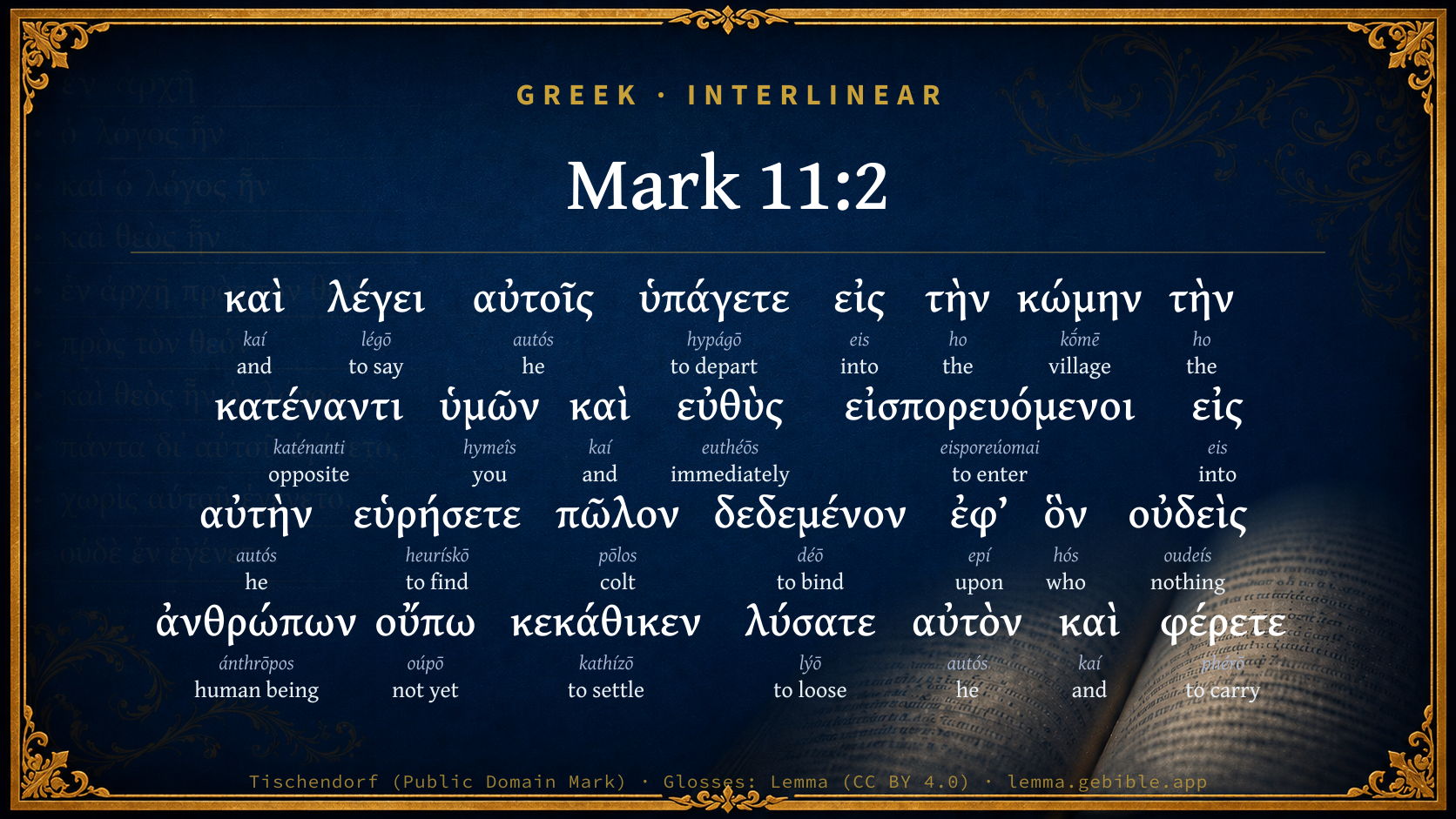
  1. καὶ kaí G2532 “and” Conjunction
  2. λέγει légō G3004 “to say” Verb, Present, Active, Indicative, 3rd person, Singular
  3. αὐτοῖς autós G846 “he” Personal pronoun, Dative, Plural, Masculine
  4. ὑπάγετε hypágō G5217 “to depart” Verb, Present, Active, Imperative, 2nd person, Plural
  5. εἰς eis G1519 “into” Preposition
  6. τὴν ho G3588 “the” Article, Accusative, Singular, Feminine
  7. κώμην kṓmē G2968 “village” Noun, Accusative, Singular, Feminine
  8. τὴν ho G3588 “the” Article, Accusative, Singular, Feminine
  9. ὑμῶν hymeîs G5210 “you” Personal pronoun, 2nd person, Genitive, Plural
  10. καὶ kaí G2532 “and” Conjunction
  11. εὐθὺς euthéōs G2112 “immediately” Adverb
  12. εἰσπορευόμενοι eisporeúomai G1531 “to enter” Verb, Present, Middle or Passive deponent, Participle, Nominative, Plural, Masculine
  13. εἰς eis G1519 “into” Preposition
  14. αὐτὴν autós G846 “he” Personal pronoun, Accusative, Singular, Feminine
  15. εὑρήσετε heurískō G2147 “to find” Verb, Future, Active, Indicative, 2nd person, Plural
  16. πῶλον pōlos G4454 “colt” Noun, Accusative, Singular, Masculine
  17. δεδεμένον déō G1210 “to bind” Verb, Perfect, Passive, Participle, Accusative, Singular, Masculine
  18. ἐφ’ epí G1909 “upon” Preposition
  19. ὃν hós G3739 “who” Relative pronoun, Accusative, Singular, Masculine
  20. οὐδεὶς oudeís G3762 “nothing” Adjective, Nominative, Singular, Masculine, Negative
  21. ἀνθρώπων ánthrōpos G444 “human being” Noun, Genitive, Plural, Masculine
  22. οὔπω oúpō G3768 “not yet” Adverb, Negative
  23. κεκάθικεν kathízō G2523 “to settle” Verb, Perfect, Active, Indicative, 3rd person, Singular
  24. λύσατε lýō G3089 “to loose” Verb, Aorist, Active, Imperative, 2nd person, Plural
  25. αὐτὸν autós G846 “he” Personal pronoun, Accusative, Singular, Masculine
  26. καὶ kaí G2532 “and” Conjunction
  27. φέρετε phérō G5342 “to carry” Verb, Present, Active, Imperative, 2nd person, Plural

About this verse

These counts appear in no published source. They are computed here, from the morphology-tagged text and Lemma’s own curated glosses. What Lemma adds →

28
words
22
distinct lemmas
Gospels
section

Notable vocabulary

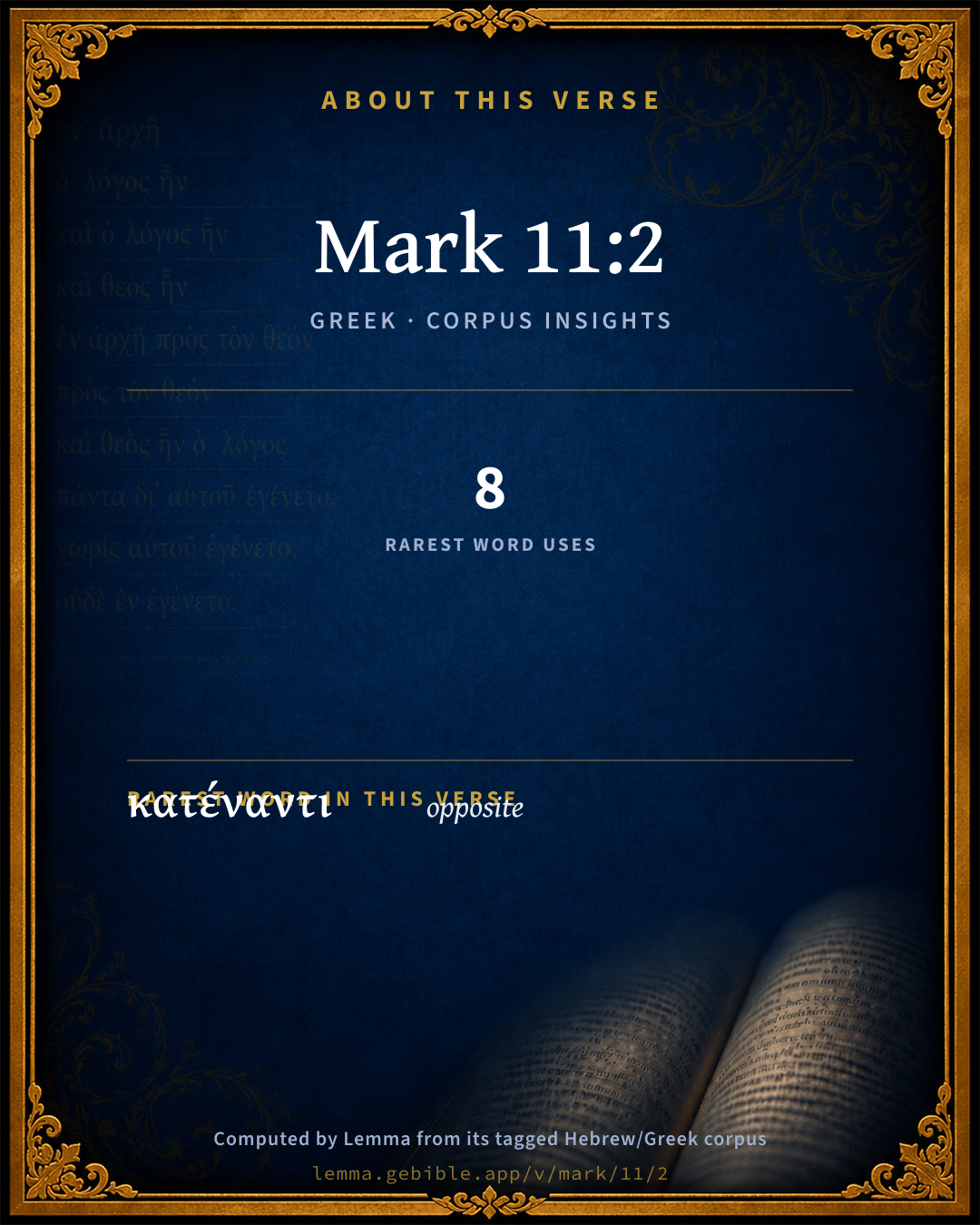
The rarest word here is κατέναντι opposite G2713 — appearing just 8 times in the whole Greek New Testament.

Shared distinctive vocabulary

κατέναντι opposite G2713 occurs in 8 verses of the Greek New Testament. Also found in:

Repetition

Words recur within this verse:

  • εἰς into G1519 ×2
  • καὶ and G2532 ×3
  • αὐτοῖς he G846 ×3
  • τὴν the G3588 ×2

Cross-references

2

Topical passages linked to Mark 11:2 in the Treasury of Scripture Knowledge — connected by theme and wording, ordered by reader-vote popularity; previews shown in the World English Bible.

  • Matthew 21:2–3 saying to them, "Go into the village that is opposite you, and immediately you will find a donkey tied, and a colt with her. Untie them, and bring them to me.
  • Luke 19:30–31 saying, "Go your way into the village on the other side, in which, as you enter, you will find a colt tied, whereon no man ever yet sat. Untie it, and bring it.

Cross-references courtesy of OpenBible.info (CC BY 4.0).

Where the printed editions differ

1 variant

Places in this verse where the major printed Greek editions disagree on the wording in a way that affects the translation — a comparison of editions, not a manuscript-by-manuscript collation. The editions are the modern critical texts (Nestlé-Aland 28/27, SBL, Westcott-Hort, Tregelles, Tyndale House) and the traditional texts behind the KJV (the Textus Receptus and the Byzantine/Majority text). It is not a claim about which reading is original.

  1. Extra text
    οὔπω

    “not yet”

    In NA28NA27TynSBLWHTreg Not in TRByz

    οὔπω (oupō) 'not yet' is only in older manuscripts (NA28+NA27+Tyn+SBL+WH+Treg)

Textual data: Translators Amalgamated Greek New Testament (STEPBible TAGNT) · CC BY 4.0.

Commentary

Notes on Mark 11:2 from classic Christian and Jewish commentators (each source and its license shown beneath its notes). The classic Christian expositions comment on the surrounding passage and are grouped to its opening verse, so a note may address several verses; the Jewish commentaries on the Tanakh (Rashi and others) are per-verse, so they appear only where the commentator wrote on this verse.

Lemma curates 59 commentaries, every one of them public domain or Creative Commons licensed, each selected and text-cleaned for this edition rather than reprinted as found. About our sources →

MacLaren's Expositions of Holy Scripture

Alexander MacLaren

Mark

A ROYAL PROGRESS

Mar 11:2.

Two considerations help us to appreciate this remarkable incident of our Lord’s triumphal entry into Jerusalem. The first of these is its date. It apparently occurred on the Sunday of the Passion Week. The Friday saw the crosses on Calvary. The night before, Jesus had sat at the modest feast that was prepared in Bethany, where Lazarus was one of the guests, Martha was the busy servant, and Mary poured out the lavish treasures of her love upon His feet. The resurrection of Lazarus had created great popular excitement; and that excitement is the second consideration which throws light upon this incident. The people had rallied round Christ, and, consequently, the hatred of the official and ecclesiastical class had been raised to boiling-point. It was at that time that our Lord deliberately presented Himself before the nation as the Messiah, and stirred up still more this popular enthusiasm. Now, if we keep these two things in view, I think we shall be at the right point from which to consider the whole incident. To it, and not merely to the words which I have chosen as our starting-point, I wish to draw attention now. I am mistaken if there are not in it very important and practical lessons for ourselves.

I. First, note that deliberate assumption by Christ of royal authority.

I shall have a good deal to say presently about the main fact which bears upon that, but in the meantime I would note, in passing, a subsidiary illustration of it, in the errand on which He sent these messengers to the little ‘village over against’ them; and in the words which He put into their mouths. They were to go, and, without a word, to loose and bring away the colt fastened at a door, where it was evidently waiting the convenience of its owner to mount it. If, as was natural, any objection or question was raised, they were to answer exactly as servants of a king would do, if he sent them to make requisition on the property of his subjects, ‘The Lord hath need of him.’

I do not dwell on our Lord’s supernatural knowledge as coming out here; nor on the fact that the owner of the colt was probably a partial disciple, perhaps a secret one-ready to recognise the claim that was made. But I ask you to notice here the assertion, in act and word, of absolute authority, to which all private convenience and rights of possession are to give way unconditionally. The Sovereign’s need is a sovereign reason. What He requires He has a right to take. Well for us, brethren, if we yield as glad, as swift, and as unquestioning obedience to His claims upon us, and upon our possessions, as that poor peasant of Bethphage gave in the incident before us! But there is not only the assertion, here, of absolute authority, but note how, side by side with this royal style, there goes the acknowledgment of poverty. Here is a pauper King, who having nothing yet possesses all things. ‘The Lord’-that is a great title-’hath need of him’-that is a strange verb to go with such a nominative. But this little sentence, in its two halves of authority and of dependence, puts into four words the whole blessed paradox of the life of Jesus Christ upon earth. ‘Though He was rich, yet for our sakes He became poor’; and being Lord and Owner of all things, yet owed His daily bread to ministering women, borrowed a boat to preach from, a house wherein to lay His head, a shroud and a winding-sheet to enfold His corpse, a grave in which to lie, and from which to rise, ‘the Lord of the dead and of the living.’

Not only so, but there is another thought suggested by these words. The accurate, or, at least, the probable reading, of one part of the third verse is given in the Revised Version, ‘Say ye that the Lord hath need of him, and straightway he will send him back hither.’ That is to say, these last words are not Christ’s assurance to His two messengers that their embassy would succeed, but part of the message which He sends by them to the owner of the colt, telling him that it was only a loan which was to be returned. Jesus Christ is debtor to no man. Anything given to Him comes back again. Possessions yielded to that Lord are recompensed a hundredfold in this life, if in nothing else in that there is a far greater sweetness in that which still remains. ‘What I gave I have,’ said the wise old epitaph. It is always true. Do you not think that the owner of the patient beast, on which Christ placidly paced into Jerusalem on His peaceful triumph, would be proud all his days of the use to which his animal had been put, and would count it as a treasure for the rest of its life? If you and I will yield our gifts to Him, and lay them upon His altar, be sure of this, that the altar will ennoble and will sanctify all that is laid upon it. All that we have rendered to Him gains fragrance from His touch, and comes back to us tenfold more precious because He has condescended to use it.

So, brethren, He still moves amongst us, asking for our surrender of ourselves and of our possessions to Him, and pledging Himself that we shall lose nothing by what we give to Him, but shall be infinitely gainers by our surrender. He still needs us. Ah! if He is ever to march in triumph through the world, and be hailed by the hosannas of all the tribes of the earth, it is requisite for that triumph that His children should surrender first themselves, and then all that they are, and all that they have, to Him. To us there comes the message, ‘The Lord hath need of you.’ Let us see that we answer as becomes us.

But then, more important is the other instance here of this assertion of royal authority. I have already said that we shall not rightly understand it unless we take into full account the state of popular feeling at the time. We find in John’s Gospel great stress laid on the movement of curiosity and half-belief which followed on the resurrection of Lazarus. He tells us that crowds came out from Jerusalem the night before to gaze upon the Lifebringer and the quickened man. He also tells us that another enthusiastic crowd flocked out of Jerusalem before Jesus sent for the colt to the neighbouring village. We are to keep in mind, therefore, that what He did here was done in the midst of a great outburst of popular enthusiasm. We are to keep in mind, too, the season of Passover, when religion and patriotism, which were so closely intertwined in the life of the Jews, were in full vigorous exercise. It was always a time of anxiety to the Roman authorities, lest this fiery people should break out into insurrection. Jerusalem at the Passover was like a great magazine of combustibles, and into it Jesus flung a lighted brand amongst the inflammable substances that were gathered there. We have to remember, too, that all His life long He had gone exactly on the opposite tack. Remember how He betook Himself to the mountain solitudes when they wanted to make Him a king. Remember how He was always damping down Messianic enthusiasm. But here, all at once, He reverses His whole conduct, and deliberately sets Himself to make the most public and the most exciting possible demonstration that He was ‘King of Israel.’

For what was it that He did? Our Evangelist here does not quote the prophecy from Zechariah, but two other Evangelists do. Our Lord then deliberately dressed Himself by the mirror of prophecy, and assumed the very characteristics which the prophet had given long ago as the mark of the coming King of Zion. If He had wanted to excite a popular commotion, that is what He would have done.

Why did He act thus? He was under no illusion as to what would follow. For the night before He had said: ‘She hath come beforehand to anoint My body for the burial.’ He knew what was close before Him in the future. And, because He knew that the end was at hand, He felt that, once at least, it was needful that He should present Himself solemnly, publicly, I may almost say ostentatiously, before the gathered nation, as being of a truth the Fulfiller and the fulfilment of all the prophecies and the hopes built upon them that had burned in Israel, with a smoky flame indeed, but for so many ages. He also wanted to bring the rulers to a point. I dare not say that He precipitated His death, or provoked a conflict, but I do say that deliberately, and with a clear understanding of what He was doing, He took a step which forced them to show their hand. For after such a public avowal of who He was, and such public hosannas surging round His meek feet as He rode into the city, there were but two courses open for the official class: either to acknowledge Him, or to murder Him. Therefore He reversed His usual action, and deliberately posed, by His own act, as claiming to be the Messiah long prophesied and long expected.

Now, what do you think of the man that did that? If He did it, then either He is what the rulers called Him, a ‘deceiver,’ swollen with inordinate vanity and unfit to be a teacher, or else we must fall at His feet and say ‘Rabbi! Thou art the Son of God; Thou art the King of Israel.’ I venture to believe that to extol Him and to deny the validity of His claims is in flagrant contradiction to the facts of His life, and is an unreasonable and untenable position.

II. Notice the revelation of a new kind of King and Kingdom.

Our Evangelist, from whom my text is taken, has nothing to say about Zechariah’s prophecy which our Lord set Himself to fulfil. He only dwells on the pathetic poverty of the pomp of the procession. But other Evangelists bring into view the deeper meaning of the incident. The centre-point of the prophecy, and of Christ’s intentional fulfilment of it, lies in the symbol of the meek and patient animal which He bestrode. The ass was, indeed, used sometimes in old days by rulers and judges in Israel, but the symbol was chosen by the prophet simply to bring out the peacefulness and the gentleness inherent in the Kingdom, and the King who thus advanced into His city. If you want to understand the meaning of the prophet’s emblem, you have only to remember the sculptured slabs of Assyria and Babylon, or the paintings on the walls of Egyptian temples and tombs, where Sennacherib or Rameses ride hurtling in triumph in their chariots, over the bodies of prostrate foes; and then to set by the side of these, ‘Rejoice! O daughter of Zion; thy King cometh unto thee riding upon an ass, and upon a colt the foal of an ass.’ If we want to understand the significance of this sweet emblem, we need only, further, remember the psalm that, with poetic fervour, invokes the King: ‘Gird Thy sword upon Thy thigh, O Most Mighty, and in Thy majesty ride prosperously . . . and Thy right hand shall teach thee terrible things. Thine arrows are sharp in the heart of the King’s enemies; the people fall under Thee.’ That is all that that ancient singer could conceive of the triumphant King of the world, the Messiah; a conqueror, enthroned in His chariot, and the twanging bowstring, drawn by His strong hand, impelling the arrow that lodged in the heart of His foes. And here is the fulfilment. ‘Go ye into the village over against you, and ye shall find a colt tied . . . And they set Him thereon.’ Christ’s kingdom, like its King, has no power but gentleness and the omnipotence of patient love.

If ‘Christian’ nations, as they are called, and Churches had kept the significance of that emblem in mind, do you think that their hosannas would have gone up so often for conquerors on the battlefields; or that Christian communities would have been in complicity with war and the glorifying thereof, as they have been? And, if Christian churches had remembered and laid to heart the meaning of this triumphal entry, and its demonstration of where the power of the Master lay, would they have struck up such alliances with worldly powers and forms of force as, alas! have weakened and corrupted the Church for hundreds of years? Surely, surely, there is no more manifest condemnation of war and the warlike spirit, and of the spirit which finds the strength of Christ’s Church in anything material and violent, than is that solitary instance of His assumption of royal state when thus He entered into His city. I need not say a word, brethren, about the nature of Christ’s kingdom as embodied in His subjects, as represented in that shouting multitude that marched around Him. How Caesar in his golden house in Rome would have sneered and smiled at the Jewish peasant, on the colt, and surrounded by poor men, who had no banners but the leafy branches from the trees, and no pomp to strew in his way but their own worn garments! And yet these were stronger in their devotion, in their enthusiastic conviction that He was the King of Israel and of the whole earth, than Caesar, with all his treasures and with all his legions and their sharp swords. Christ accepts poor homage because He looks for hearts; and whatever the heart renders is sweet to Him. He passes on through the world, hailed by the acclamations of grateful hearts, needing no bodyguard but those that love Him; and they need to bear no weapons in their hands, but their mission is to proclaim with glad hearts hosannas to the King that ‘cometh in the name of the Lord.’

There is one more point that I may note. Another of the Evangelists tells us that it was when the humble cortège swept round the shoulder of Olivet, and caught sight of the city gleaming in the sunshine, across the Kedron valley, that they broke into the most rapturous of their hosannas, as if they would call to the city that came in view to rejoice and welcome its King. And what was the King doing when that sight burst upon Him, and while the acclamations eddied round Him? His thoughts were far away. His eyes with divine prescience looked on to the impending end, and then they dimmed, and filled with tears; and He wept over the city.

That is our King; a pauper King, a meek and patient King, a King that delights in the reverent love of hearts, a King whose armies have no swords, a King whose eyes fill with tears as He thinks of men’s woes and cries. Blessed be such a King!

III. Lastly, we have the Royal visitation of the Temple.

Our Evangelist has no word to speak about the march of the procession down into the valley, and up on the other side, and through the gate, and into the narrow streets of the city that was ‘moved’ as they passed through it. His language sounds as if he considered that our Lord’s object in entering Jerusalem at all was principally to enter the Temple. He ‘looked round on all things’ that were there. Can we fancy the keen observance, the recognition of the hidden bad and good, the blazing indignation, and yet dewy pity, in those eyes? His visitation of the Temple was its inspection by its Lord. And it was an inspection in order to cleanse. To-day He looked; to-morrow He wielded the whip of small cords. His chastisement is never precipitate. Perfect knowledge wields His scourge, and pronounces condemnation.

Brethren, Jesus Christ comes to us as a congregation, to the church to which we belong, and to us individually, with the same inspection. He whose eyes are a flame of fire, says to His churches to-day, ‘I know thy works.’ What would He think if He came to us and tested us?

In the incident of my text He was fulfilling another ancient prophecy, which says, ‘The Lord shall suddenly come to His Temple, and . . . sit as a refiner of silver . . . like a refiner’s fire and as fuller’s soap . . . and He shall purify the sons of Levi. . .. Then shall the offering of Jerusalem be pleasant, as in the days of old.’

We need nothing more, we should desire nothing more earnestly, than that He would come to us: ‘Search me, O Christ, and know me. And see if there be any wicked way in me, and lead me in the way everlasting.’ Jesus Christ is the King of England as truly as of Zion; and He is your King and mine. He comes to each of us, patient, meek, loving; ready to bless and to cleanse. Dear brother, do you open your heart to Him? Do you acknowledge Him as your King? Do you count it your highest honour if He will use you and your possessions, and condescend to say that He has need of such poor creatures as we are? Do you cast your garments in the way, and say: ‘Ride on, great Prince’? Do you submit yourself to His inspection, to His cleansing? Remember, He came once on ‘a colt, the foal of an ass, meek, and having salvation.’ He will come ‘on the white horse, in righteousness to judge and to make war’ and with power to destroy.

Oh! I beseech you, welcome Him as He comes in gentle love, that when He comes in judicial majesty you may be among the ‘armies of heaven that follow after,’ and from immortal tongues utter rapturous and undying hosannas.

Alexander MacLaren, Expositions of Holy Scripture (1904–1910) — public domain. Text from a community e-Sword module.

Tyndale Open Study Notes

Tyndale Open Resources

11:2-3 There have already been numerous examples of Jesus’ supernatural knowledge (2:8; 3:5; 5:30, 32; 8:17, 31), but the people’s acceptance of the reply that the Lord needs it (11:3, 6) suggests that Jesus had prearranged it (cp. 14:13-16). Jesus had intentionally planned to enter Jerusalem in fulfillment of Zech 9:9.

Tyndale Open Study Notes — © Tyndale Open Resources, licensed CC BY-SA 4.0. Text via the HelloAO Bible API.

Bengel's Gnomon

Johann Albrecht Bengel

Mar 11:2. Κώμην, village) Bethphage.—ἐφʼ ὃν οὐδεὶς,[24] upon which no man) Not readily would there be found such a colt at one and the same time and place; this one, therefore, was reserved for the Lord. Those creatures or things which are to serve Christ, must be free from all pollutions of sinful bodies; see Mat 27:60. This colt, though untamed, yet bare Him as a sitter.

[24] The reading οὔπω οὐδεὶς, which had been deemed not worthy of approval in the marg. of the larger Ed., is judged equal to that of the text in Ed. 2, and is even approved by Vers. Germ.—E. B. Lachm. also so reads with BLΔ, Orig., and after ἀνθρώπων C, πώποτε A, b Vulg. “nemo ad huc.” Tisch. omits οὔπω with Dac. πωποτε evidently is an interpolation of Harmonists from Luk 19:30.—ED. and TRANSL.

Bengel's Gnomon of the New Testament — English translation (T&T Clark, Edinburgh, 1860) — public domain. Text from a community e-Sword module.

Expositor's Greek Testament

ed. W. Robertson Nicoll

Mar 11:2 . κατέναντι ὑ ., opposite you. This adverb (from κατά ἔναντι ) is not found in Greek authors, but occurs frequently in Sept [100] ἐφʼ ὃν οὐδεὶς οὔπ . ἀν . ἐκάθισεν : this point, that the colt had never been used, would seem of vital importance afterhand, from the Christian point of view, and one cannot wonder that it took a sure place in the tradition, as evinced by the narrative in Mk. followed by Lk. But it is permissible to regard this as an expansion of what Jesus actually said. The idea underlying is that for sacred purposes only unused animals may be employed ( vide Num 19:2 , 1Sa 6:7 ). λύσατε , φέρετε : aorist and present; the former denoting a momentary act, the latter a process.

[100]Septuagint.

The Expositor's Greek Testament, edited by W. Robertson Nicoll (1897–1910) — public domain. Text from a community e-Sword module.

Adam Clarke's Commentary

Verse 2. Whereon never man sat] No animal was allowed to be employed in sacred uses, even among the heathen, that had previously been used for any domestic or agricultural purpose; and those which had never been yoked were considered as sacred. See several proofs of this in the note on Nu 19:2, and add this from Ovid: -

Bos tibi, Phoebus ait, solis occurret in arvis,

Nullum passa jugum curvique immunis aratri.

Met. lib. iii. v. 10.

The Delphic oracles this answer give: -

Behold among the fields a lonely cow,

Unworn with yokes, unbroken to the plough.

Adam Clarke's Commentary on the Bible (1810–1826) — public domain. Text from a community e-Sword/MySword module.

Ellicott's Commentary for English Readers

(2) A colt tied.—St. Mark, with St. Luke and St. John, omits the mention of the “she-ass” bound with the colt, on which St. Matthew lays stress as a literal fulfilment of Zec_9:9.

Whereon never man sat.—The fact is mentioned by St. Mark and St. Luke only.

A Bible Commentary for English Readers, edited by Charles John Ellicott (1878–1897) — public domain. Text from a community e-Sword module.

The Cambridge Bible for Schools and Colleges

gen. ed. J. J. S. Perowne

2. into the village over against you] Either Bethphage or an adjoining hamlet.

a colt tied] “In the East the ass is in high esteem. Statelier, livelier, swifter than with us, it vies with the horse in favour. Among the Jews it was equally valued as a beast of burden, for work in the field or at the mill, and for riding. In contrast to the horse, which had been introduced by Solomon from Egypt, and was used especially for war, it was the symbol of peace. To the Jew it was peculiarly national, for had not Moses led his wife, seated on an ass, to Egypt; had not the Judges ridden on white asses; and was not the ass of Abraham, the friend of God, noted in Scripture? Every Jew, moreover, expected, from the words of one of the prophets (Zec_9:9), that the Messiah would enter Jerusalem riding on an ass. No act could be more perfectly in keeping with the conception of a king of Israel, and no word could express more plainly that the king proclaimed Himself the Messiah.” Geikie, ii. p. 395.

whereon never man sat] This agrees with St Matthew’s account of the she-ass (Mat_21:2) and her colt with her. The colt would not have been used, so long as it was running with the mother. Unused animals were put to sacred purposes. See Num_19:2; Deu_21:3; 1Sa_6:7.

The Cambridge Bible for Schools and Colleges (gen. ed. J. J. S. Perowne; Cambridge University Press, 1878–1918) — public domain. Text from a community e-Sword module.

John Gill's Exposition

And saith unto them, go your way into the village,.... Either of Bethany or of Nob. The Ethiopic version renders it "the city", and so reads a copy of Stephens's: some have thought the city of Jerusalem is intended, but without any reason; See Gill on Mat 21:9;

over against you. The Syriac and Persic versions read, "over against us": the sense is the same; for Christ and his disciples were together: this suits with either of the above mentioned places:

and as soon as ye be entered into it; are come to the town's end, and to one of the first houses in it,

ye shall find a colt tied: Matthew says, "an ass tied, and a colt with her", Mat 21:2; both no doubt true:

whereon never man sat; which had never been backed and broke, and which makes it the more wonderful, that Christ should choose to ride upon it, and that that should quietly carry him:

loose him, and bring him; that is, away to me.

John Gill's Exposition of the Whole Bible (1746–1763) — public domain (CC PDM 1.0). Text via the HelloAO Bible API.

Trapp's Complete Commentary

John Trapp

2 And saith unto them, Go your way into the village over against you: and as soon as ye be entered into it, ye shall find a colt tied, whereon never man sat; loose him, and bring him.

Ver. 2. Whereon never man sat] As if it had been done on set purpose. Here was a wheel within a wheel, Eze 1:10, the better to convince the stubborn Jews of his kingly office.

John Trapp, A Commentary or Exposition upon All the Books of the Old and New Testament (1647–1656) — public domain. Text from a community e-Sword module.

Haydock's Catholic Bible Commentary

This order of Jesus Christ shews his omniscience and supreme dominion. By the former, he informs his two disciples that in Bethphage they would find a colt tied; and by the latter, he assures them that the master, on learning that the Lord hath need of the colt, will immediately let him go. (Haydock)

George Leo Haydock (1774–1849), Haydock's Catholic Family Bible and Commentary, 1859 edition — public domain. Excludes Psalms (Douay-Rheims chapter numbering differs from Protestant) and Deuterocanonical books (Catholic canon only).

Matthew Poole's English Annotations

Matthew saith an ass and a colt. The other evangelists speak only of the colt. The heathens, by a light of nature showing them there was a reverence and honour due to the Divine Being, were wont, in the use they made of creatures for any Divine service, to use such as they had not before used for common uses: the Philistines, 1Sa 6:7, sending home the ark, set it on a new cart, and took two milch kine on which there never came yoke. But our Saviour probably made choice of such a colt for the further notice of the miracle, (colts being when first backed more unruly), or for some other wise end which we know not.

Matthew Poole's English Annotations on the Holy Bible (1683–1685) — public domain. Text from a community e-Sword/MySword module.

Whedon's Commentary on the Bible

Daniel D. Whedon

2. A colt tied — Matthew has it, “an ass tied, and a colt with her.” This is variation but not contradiction. It is the purpose of Matthew to show the accordance of our Lord’s conveyance into Jerusalem with the predictions of prophecy, which required the mention of the ass and her foal. It is Mark’s purpose simply to narrate that our Lord rode triumphantly into Jerusalem, without dwelling specially upon the animal he rode.

Daniel D. Whedon (gen. ed.), Commentary on the Old and New Testaments (1874–1909) — public domain. Text from a community e-Sword module.

The Pulpit Commentary

Go your way into the village that is over against you. The village over against them would most likely be Beth-phage, towards which they were then approaching. Straightway as ye enter into it, ye shall find a colt tied, whereon no man ever yet sat. St. Mark mentions only the colt. St. Matthew mentions the ass and the colt. But St. Mark singles out the colt as that which our Lord specially needed; the mother of the animal accompanying it as a sumpter. Animals which had never before been used were alone admissible for sacred purposes. We read in Numbers (Num_19:2) of "the heifer on which never came yoke." Our Lord here beholds things absent and out of sight, as though they were present. So that he revealed this to his disciples by the gift of prophecy which his divinity added to his humanity. Here, therefore, is a manifest proof of his divinity. It was by the same Divine power that he revealed to Nathanael what had taken place under the fig tree.

The Pulpit Commentary (1880–1919), ed. H.D.M. Spence-Jones & Joseph S. Exell — public domain. Text from a community e-Sword module.

Cambridge Greek Testament for Schools and Colleges

2. οὐδεὶς οὔπω ἀνθρώπων ([2450][2451][2452][2453]) rather than οὐδεὶς ἀνθρώπων ([2454][2455][2456]); [2457][2458] have οὐδ. ἀνθρ. οὔπω, [2459][2460] have οὔπω οὐδ. ἀνθρ.

[2450] Codex Vaticanus. 4th cent., but perhaps a little later than א. In the Vatican Library almost since its foundation by Pope Nicolas V., and one of its greatest treasures. The whole Gospel, ending at Mar 16:8. Photographic facsimile, 1889.

[2451] Codex Regius. 8th cent. An important witness. At Paris. Contains Mar 1:1 to Mar 10:15; Mar 10:30 to Mar 15:1; Mar 15:20 to Mar 16:20, but the shorter ending is inserted between Mar 16:8 and Mar 16:9, showing that the scribe preferred it to the longer one.

[2452] Codex Sangallensis. 9th or 10th cent. Contains the Gospels nearly complete, with an interlinear Latin translation. The text of Mark is specially good, agreeing often with CL. At St Gall.

[2453] Codex Athous Laurae. 8th cent. Like N and Σ, it is written in silver letters on purple vellum. Contains Mar 9:5 to Mar 16:20, and, as in L, the shorter ending is inserted between Mar 16:8 and Mar 16:9. As in Δ, the text of Mark is specially good.

[2454] Codex Bezae. 6th cent. Has a Latin translation (d) side by side with the Greek text, and the two do not quite always agree. Presented by Beza to the University Library of Cambridge in 1581. Remarkable for its frequent divergences from other texts. Contains Mark, except Mar 16:15-20, which has been added by a later hand. Photographic facsimile, 1899.

[2455] Codex Monacensis. 10th cent. Contains Mar 6:47 to Mar 16:20. Many verses in 14, 15, 16 are defective.

[2456] Codex Oxoniensis. 9th cent. Contains Mark, except Mar 3:35 to Mar 6:20.

[2457] Codex Sinaiticus. 4th cent. Discovered by Tischendorf in 1859 at the Monastery of St Katharine on Mount Sinai. Now at St Petersburg. The whole Gospel, ending at Mar 16:8. Photographic facsimile, 1911.

[2458] Codex Ephraemi. 5th cent. A palimpsest: the original writing has been partially rubbed out, and the works of Ephraem the Syrian have been written over it; but a great deal of the original writing has been recovered; of Mark we have Mar 1:17 to Mar 6:31, Mar 8:5 to Mar 12:29, Mar 13:19 to Mar 16:20. In the National Library at Paris.

[2459] Codex Cyprius. 9th cent. One of the seven uncials which have the Gospels complete, the others being אBMSUΩ. At Paris.

[2460] Codex Petropolitanus. 9th cent. Gospels almost complete. Mar 16:18-20 is in a later hand.

2. Ὑπάγετε. So also Lk., while Mt. has his favourite πορεύεσθε.

τὴν κατέναντι. We have no means of knowing whether this was Bethany or Bethphage or another village. The two messengers could see it and there was no need to name it. The compound prep is not classical, but it is freq. in Bibl. Grk.

πῶλον. The young of horse, ass, elephant, dog, and even of man; in the last case it is usually fem., “a filly.” The word is in all three and nowhere else in N.T. In LXX. it is usually a young ass; Gen 32:15; Gen 49:11; Jdg 10:4; Jdg 12:14; Zec 9:9. Cf. pullus, which is also elastic in meaning, but is commonly used of birds. Vulg. has pullum here. Mk evidently regards as supernatural Christ’s knowledge of what would happen; cf. Mar 14:13; Joh 1:48; Joh 4:50; Joh 11:11; Joh 11:14. We may adopt other possibilities, but they receive no support from the Evangelists.

οὐδεὶς οὔπω. See crit. note and on Mar 1:14. The animal is required for a solemn and sacred purpose. The Virgin Birth and the new tomb harmonize with this idea, which is natural and widespread; Num 19:2; Deu 15:19; Deu 21:3; Jdg 16:11; 1Sa 6:7; 2Sa 6:3; Ovid, Metam. iii. 11; Virg. Geor. iv. 540. See Wetstein ad loc. and Orelli on Hor. Epod. ix. 22.

λύσατε καὶ φέρετε. The change from aor. to pres. is accurate; cf. Act 12:8, and contrast Joh 11:44 (both aor. imper.) and Jas 2:12 (both pres. imper.).

Cambridge Greek Testament for Schools and Colleges (Cambridge University Press, 1896; 21 vols, various authors incl. Carr, Maclear, Plummer, Farrar, Lumby, Moule, M. R. James, Simcox) — public domain. Text from a community e-Sword module.

Alford’s Greek Testament

Henry Alford

2.] As far as εὑρήσετε, the agreement in Matt., Mark, and Luke is nearly verbal; after that Mark and Luke only mention the foal, and add, on which never man sat. Compare with this Luk 23:53. Our Lord’s birth, triumph, and burial were to be, in this, alike. ‘A later tradition, sprung from the sacred destination of the beast (for beasts never yet worked were used for sacred purposes, Num 19:2: Deu 21:3: 1Sa 6:7).’ Meyer. But does it never strike such annotators, that this very usage would lead not only to the narrative being so constructed, but to the command itself having been so given?

Henry Alford, The Greek Testament (1849–1861) — public domain. Text from a community e-Sword module.

International Critical Commentary

2. τὴν κώμην τὴν κατέναντι1 ὑμῶν—the village that is over against you. Bethany is the village meant here, as Bethphage is the one designated in Mat 21:1. In both cases, the village named is the only one mentioned. The implication evidently is that the road did not pass through the village, but was off one side. πῶλον—a colt. Mt. specifies a she-ass and its colt, and as the ass was the more common beast used for domestic purposes, there is no doubt that the colt here was an ass’s colt.2 ἐφʼ ὅν οὐδεὶς οὔπω ἀνθρώπων ἐκάθισεν—on which no one of men yet sat. Lk. also has these words. But they are extremely improbable in the mouth of Jesus. They evidently belong to the narrator, who very likely took a fact that he had discovered about the colt, and which had an undesigned significance, and made it a part of Jesus’ design, an intentional effect in the pageant. There is no indication that Jesus cared for the ceremonious trappings of an event. Such care belongs to homage, not to the person receiving it. On this demand of newness for sacred purposes, see Num 19:2, Deu 21:3, 2Sa 6:3. It is evidently the intention of the writers of the Gospels here to imply a supernatural knowledge on the part of Jesus.

Insert οὔπω before ἀνθρώπων Treg. WH. RV. ABL Δ mss. Lat. Vet. Vulg. After ἀνθρώπων, Tisch. א C 13, 69, Egyptt. (Pesh.). ἐκάθισεν, instead of κεκάθικε, Treg. marg. WH. RV. א BCL Δ λύσατε αὐτὸν καὶ, instead of λύσαντες αὐτὸν, Tisch. Treg. WH. RV. א BCDL Latt. Egyptt. (Syrr.). φέρετε, instead of ἀγάγετε, Tisch. Treg. WH. RV. א BCDL Latt. Egyptt. (Syrr.).

International Critical Commentary — older volumes (1896–1929), various authors — public domain. Text from a community e-Sword module.

Vincent's Word Studies in the New Testament

Marvin R. Vincent

Colt. Only Matthew adds the ass. Mark and Luke have colt only.

Marvin R. Vincent, Word Studies in the New Testament (1887–1900) — public domain. Text from a community e-Sword/MySword module.

Lesson kit

Teaching starters — assembled from the data on this page, not authored interpretation. Every prompt links to the verse data it draws on. Edit before teaching.

Mark, in the Gospels, opens this verse with 28 words (22 distinct Greek lemmas). Its most distinctive word is katénanti (“opposite”). A historical commentator’s framing appears above. Read the whole chapter for the surrounding context.

Discussion questions

  1. What does “opposite” (katénanti) contribute to the verse as a whole?
  2. How does Matthew 21:2, which shares the word «opposite», read alongside this verse?
  3. What does the repetition of “into” (2× in this one verse) do in this verse?
  4. These translations render this verse differently. What is at stake in choosing one wording over another?
  5. Compare how MacLaren's Expositions of Holy Scripture and Tyndale Open Study Notes read this verse. Where do they agree or differ?

Things to notice

Reading settings

Reading text

Shown beneath each verse's original-language words.

Old Testament
Old Testament edition

Read the OT as the Masoretic Hebrew (MT) or the Greek Septuagint (LXX).

English shown for the Greek Septuagint (in the Hebrew ↔ Greek comparison).

Comparing translations? Open the Compare panel on any verse page to stack up to four side by side.