
1 Timothy 6:16

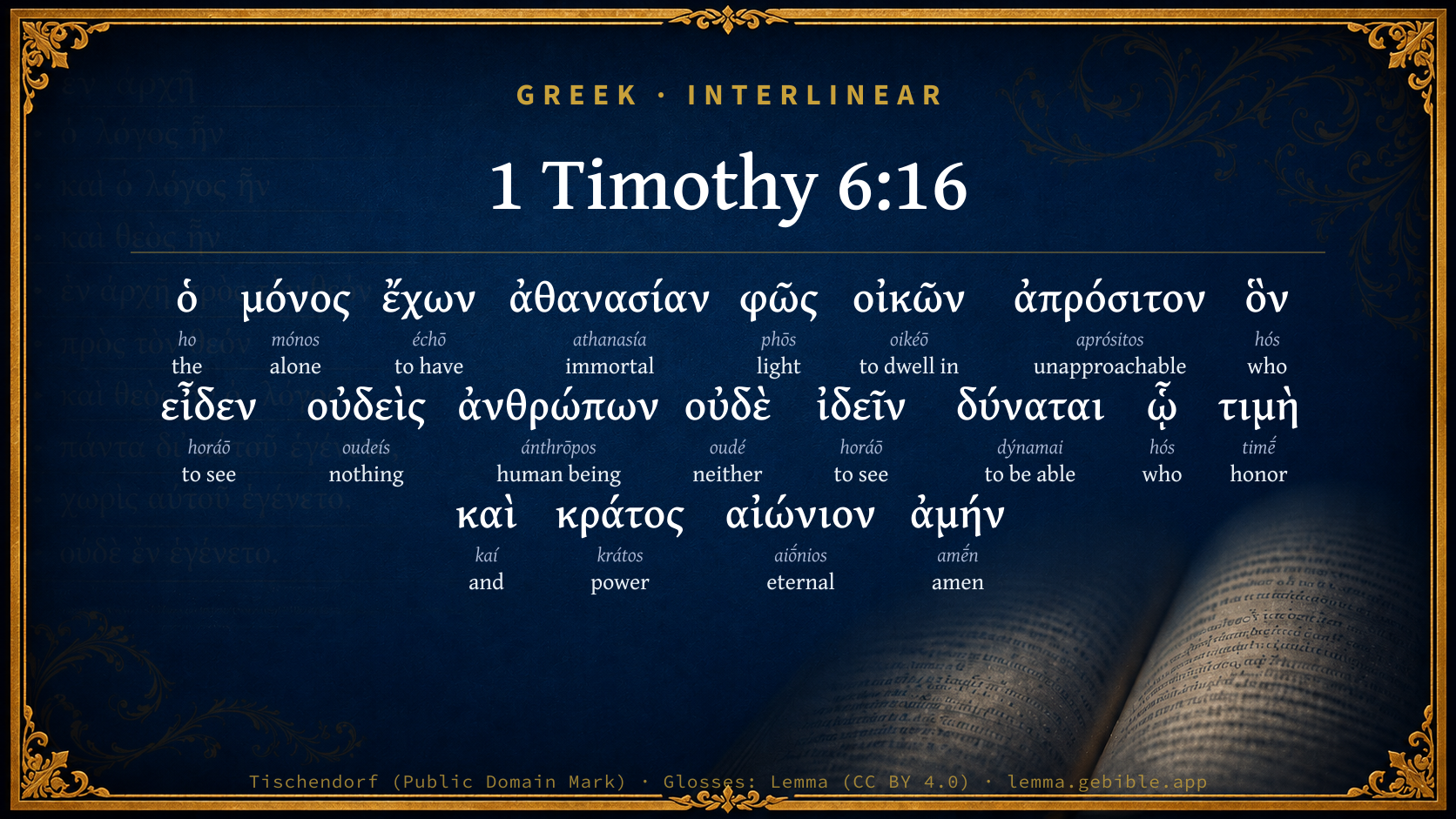
Greek (Tischendorf 8th ed.) 1 Timothy 6:16 appears in the Greek New Testament. The text above is from the Tischendorf 8th edition. Each word links to its Strong’s number and a concise gloss. Click any word for its full Thayer’s Greek Lexicon entry.
Download image
Cite this verse

1 Timothy 6:16 (World English Bible). Public Domain. Lemma interlinear Bible study tool, https://lemma.gebible.app/v/1-timothy/6/16.

Show BibTeX & RIS
BibTeX
RIS
English Translation
who alone has immortality, dwelling in unapproachable light; whom no man has seen, nor can see: to whom be honor and eternal power. Amen.
World English Bible · Public Domain
Highlights
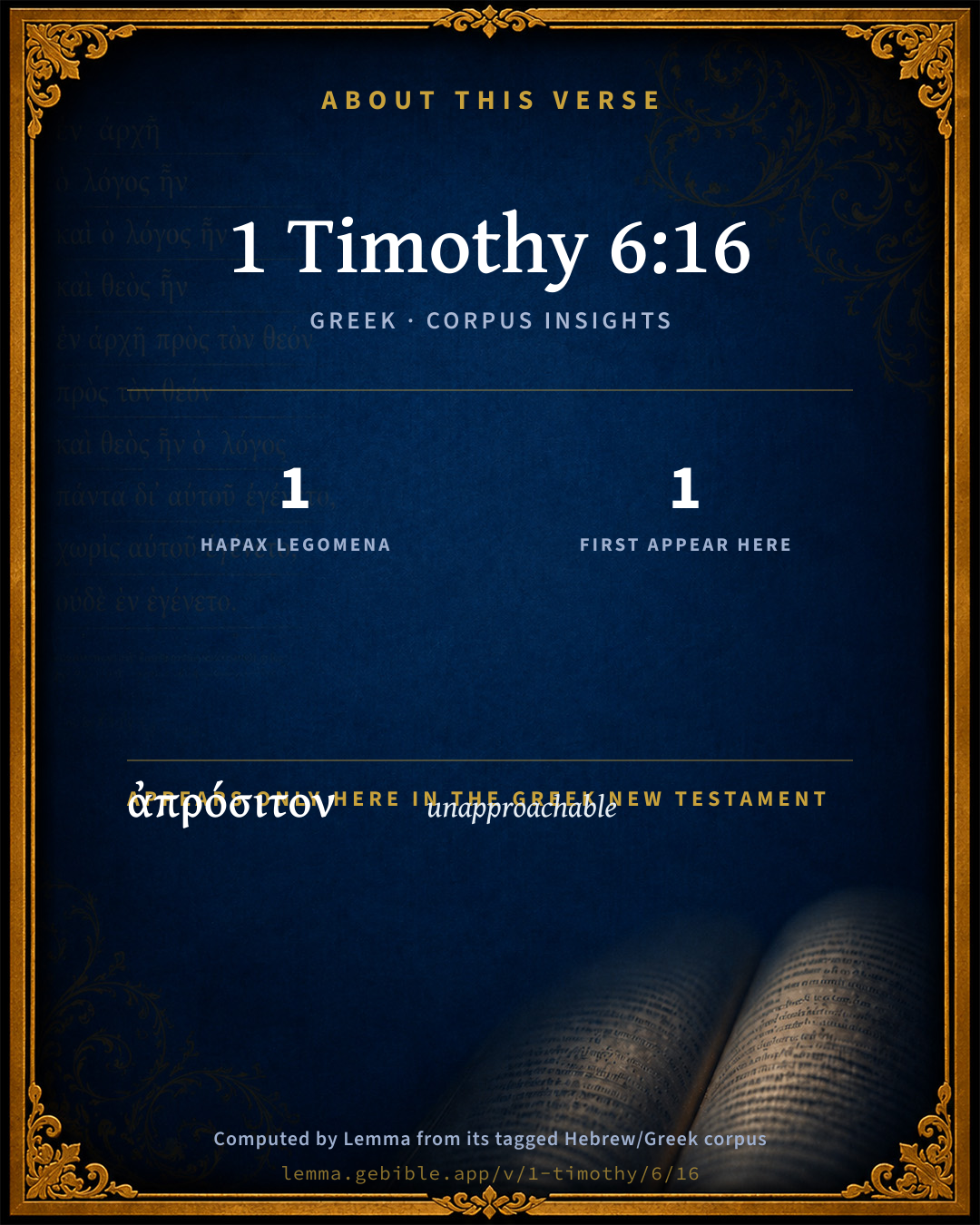
  • 1 hapax legomenon — only here in the Greek New Testament
  • 1 first appearance in the Greek New Testament
Full analysis ↓
Download a study sheet

One document with this verse’s original text, its word-by-word gloss line, the meaning frame, cross-references with their text, attributed commentary, and full source and license credits — printable, and it pastes into notes with its structure intact.

This verse Autodidact and up

Study sheet (.html) Plain text (.txt)

A passage Seminary Student

Up to 50 verses in one chapter. A passage sheet keeps up to 6 commentary sources and 12 cross-references per verse, in the order this page ranks them, and says so on the sheet whenever that leaves anything out. Ask for a single verse and you get the Autodidact verse sheet above.

Everything on this page stays free to read, with no account — the sheet is a download of what is already on screen, not access to it.

Want to remove ads? Support Godless Engineer
Compare translations 3

The same verse in 3 English versions, stacked beneath the original-language interlinear above. Click any original word for its lexicon entry.

Each is an independent rendering of the whole verse — the interlinear is not word-aligned to these translations.

Highlighted words mark where these versions differ — a whole-verse word diff, not a word-by-word alignment.

  • World English Bible Public Domain
    who alone has immortality, dwelling in unapproachable light; whom no man has seen, nor can see: to whom be honor and eternal power. Amen.
  • King James Version Public Domain
    Who only hath immortality, dwelling in the light which no man can approach unto; whom no man hath seen, nor can see: to whom be honour and power everlasting. Amen.
  • unfoldingWord Literal Text CC BY-SA 4.0
    the only One having immortality, dwelling unapproachable light, whom no one of men has seen, nor is able to see, to whom honor and eternal power. Amen.

unfoldingWord Literal Text — © unfoldingWord, licensed CC BY-SA 4.0. Word-aligned USFM3 via Door43 (git.door43.org/unfoldingWord/en_ult).

Versions to compare (up to 4)

3 of 4 selected

Show all 19 translations

Every available English version of this verse, each an independent rendering of the whole verse.

  • World English Bible Public Domain
    who alone has immortality, dwelling in unapproachable light; whom no man has seen, nor can see: to whom be honor and eternal power. Amen.
  • Berean Standard Bible Public Domain
    He alone is immortal and dwells in unapproachable light. No one has ever seen Him, nor can anyone see Him. To Him be honor and eternal dominion! Amen.
  • Majority Standard Bible Public Domain
    He alone is immortal and dwells in unapproachable light. No one has ever seen Him, nor can anyone see Him. To Him be honor and eternal dominion! Amen.
  • King James Version Public Domain
    Who only hath immortality, dwelling in the light which no man can approach unto; whom no man hath seen, nor can see: to whom be honour and power everlasting. Amen.
  • American Standard Version (1901) Public Domain
    who only hath immortality, dwelling in light unapproachable; whom no man hath seen, nor can see: to whom `be' honor and power eternal. Amen.
  • Revised Version (1885) Public Domain
    who only hath immortality, dwelling in light unapproachable; whom no man hath seen, nor can see: to whom be honour and power eternal. Amen.
  • Geneva Bible (1599) Public Domain
    Who onely hath immortalitie, and dwelleth in the light that none can attaine vnto, whom neuer man sawe, neither can see, vnto whome bee honour and power euerlasting, Amen.
  • Douay-Rheims (1899) Public Domain
    Who only hath immortality, and inhabiteth light inaccessible, whom no man hath seen, nor can see: to whom be honour and empire everlasting. Amen.
  • Young's Literal Translation Public Domain
    who only is having immortality, dwelling in light unapproachable, whom no one of men did see, nor is able to see, to whom `is' honour and might age-during! Amen.
  • Literal Standard Version CC BY-SA 4.0
    having immortality alone, dwelling in unapproachable light, whom no one of men saw, nor is able to see, to whom [is] honor and perpetual might! Amen.
  • Unlocked Literal Bible CC BY-SA 4.0
    Only he has immortality and dwells in inapproachable light. No man sees him or is able to view him. To him be honor and eternal power. Amen.
  • unfoldingWord Literal Text CC BY-SA 4.0
    the only One having immortality, dwelling unapproachable light, whom no one of men has seen, nor is able to see, to whom honor and eternal power. Amen.
  • Darby Bible Public Domain
    who only has immortality, dwelling in unapproachable light; whom no man has seen, nor is able to see; to whom [be] honour and eternal might. Amen.
  • World Messianic Bible Public Domain
    He alone has immortality, dwelling in unapproachable light, whom no man has seen nor can see, to whom be honor and eternal power. Amen.
  • Webster's Bible Public Domain
    Who only hath immortality, dwelling in the light which no man can approach; whom no man hath seen, nor can see: to whom be honor and power everlasting. Amen.
  • Free Bible Version CC BY-SA 4.0
    He is the only one who is immortal, and lives in unapproachable light. No one has seen him or can see him—honor and eternal power is his! Amen.
  • Bible in Basic English Public Domain
    Who only has life for ever, living in light to which no man may come near; whom no man has seen or is able to see: to whom be honour and power for ever. So be it.
  • Text-Critical English NT CC BY 4.0
    who alone has immortality, dwelling in unapproachable light, whom no man has ever seen or is able to see. To him be honor and eternal power. Amen.
  • Tyndale New Testament (1534) Public Domain
    which only hath immortalite and dwelleth in light that no man can attayne whom never man sawe nether can se: vnto whom be honoure and rule everlastynge. Amen.

Literal Standard Version (2020), Covenant Press — licensed CC BY-SA 4.0. Text via the HelloAO Bible API (eBible.org). Unlocked Literal Bible (unfoldingWord) — licensed CC BY-SA 4.0. Text via the HelloAO Bible API (eBible.org). unfoldingWord Literal Text — © unfoldingWord, licensed CC BY-SA 4.0. Word-aligned USFM3 via Door43 (git.door43.org/unfoldingWord/en_ult). Free Bible Version, Dr. Jonathan Gallagher — licensed CC BY-SA 4.0. Text via the HelloAO Bible API (eBible.org).

Word by word

More ways to search: Search by grammar → Find every occurrence → Compare this word →

Practice this passage: Drill this verse → Learn its vocabulary →

ἀπρόσιτον
aprósitos
G676
“unapproachable”
Adjective, Accusative, Singular, Neuter
Part of Speech
Adjective
Case
Accusative
Number
Singular
Gender
Neuter
Full Thayer's Definition

Origin: from G1 (as a negative particle) and a derivative of a comparative of G4314 and eimi (to go)

TDNT: None

1. unapproachable, inaccessible
  1. ὁ ho G3588 “the” Article, Nominative, Singular, Masculine
  2. μόνος mónos G3441 “alone” Adjective, Nominative, Singular, Masculine
  3. ἔχων échō G2192 “to have” Verb, Present, Active, Participle, Nominative, Singular, Masculine
  4. ἀθανασίαν athanasía G110 “immortal” Noun, Accusative, Singular, Feminine
  5. φῶς phōs G5457 “light” Noun, Accusative, Singular, Neuter
  6. οἰκῶν oikéō G3611 “to dwell in” Verb, Present, Active, Participle, Nominative, Singular, Masculine
  7. ὃν hós G3739 “who” Relative pronoun, Accusative, Singular, Masculine
  8. εἶδεν horáō G3708 “to see” Verb, Aorist, Active, Indicative, 3rd person, Singular
  9. οὐδεὶς oudeís G3762 “nothing” Adjective, Nominative, Singular, Masculine, Negative
  10. ἀνθρώπων ánthrōpos G444 “human being” Noun, Genitive, Plural, Masculine
  11. οὐδὲ oudé G3761 “neither” Conjunction, Negative
  12. ἰδεῖν horáō G3708 “to see” Verb, Aorist, Active, Infinitive
  13. δύναται dýnamai G1410 “to be able” Verb, Present, Middle or Passive deponent, Indicative, 3rd person, Singular
  14. ᾧ hós G3739 “who” Relative pronoun, Dative, Singular, Masculine
  15. τιμὴ timḗ G5092 “honor” Noun, Nominative, Singular, Feminine
  16. καὶ kaí G2532 “and” Conjunction
  17. κράτος krátos G2904 “power” Noun, Nominative, Singular, Neuter
  18. αἰώνιον aiṓnios G166 “eternal” Adjective, Nominative, Singular, Neuter
  19. ἀμήν amḗn G281 “amen” Hebrew transliteration

About this verse

These counts appear in no published source. They are computed here, from the morphology-tagged text and Lemma’s own curated glosses. What Lemma adds →

20
words
18
distinct lemmas
Pauline Epistles
section

Notable vocabulary

1 hapax legomenon — a word that appears only here in the entire Greek New Testament:

  • ἀπρόσιτον unapproachable G676

First appearance in Scripture

This word makes its first canonical appearance in the Greek New Testament here:

  • ἀπρόσιτον unapproachable G676

Shared distinctive vocabulary

ἀθανασίαν immortal G110 occurs in 3 verses of the Greek New Testament. Also found in:
Repetition

Words recur within this verse:

  • εἶδεν to see G3708 ×2
  • ὃν who G3739 ×2

Cross-references

26

Topical passages linked to 1 Timothy 6:16 in the Treasury of Scripture Knowledge — connected by theme and wording, ordered by reader-vote popularity; previews shown in the World English Bible.

  • 1 Timothy 1:17 Now to the King eternal, immortal, invisible, to God who alone is wise, be honor and glory forever and ever. Amen.
  • John 1:18 No one has seen God at any time. The one and only Son, who is in the bosom of the Father, he has declared him.
  • 1 John 1:5 This is the message which we have heard from him and announce to you, that God is light, and in him is no darkness at all.
  • Colossians 1:15 who is the image of the invisible God, the firstborn of all creation.
  • Psalms 90:2 Before the mountains were brought forth, Or ever you had formed the earth and the world, Even from everlasting to everlasting, you are God.
  • John 6:46 Not that anyone has seen the Father, except he who is from God. He has seen the Father.
  • Exodus 3:14 God said to Moses, "I AM WHO I AM," and he said, "You shall tell the children of Israel this: "I AM has sent me to you."
  • Psalms 104:2 He covers himself with light as with a garment. He stretches out the heavens like a curtain.
  • Isaiah 57:15 For thus says the high and lofty One who inhabits eternity, whose name is Holy: I dwell in the high and holy place, with him also who is of a contrite and humble spirit, to revive the spirit of the humble, and to revive the heart of the contrite.
  • Revelation 22:5 There will be no night, and they need no lamp light; for the Lord God will illuminate them. They will reign forever and ever.
  • Habakkuk 3:4 His splendor is like the sunrise. Rays shine from his hand, where his power is hidden.
  • Ephesians 3:21 to him be the glory in the assembly and in Christ Jesus to all generations forever and ever. Amen.
  • Jude 1:25 to God our Savior, who alone is wise, be glory and majesty, dominion and power, both now and forever. Amen.
  • Revelation 1:6 and he made us to be a Kingdom, priests to his God and Father; to him be the glory and the dominion forever and ever. Amen.
  • Revelation 4:11 "Worthy are you, our Lord and God, the Holy One, to receive the glory, the honor, and the power, for you created all things, and because of your desire they existed, and were created!"
  • Exodus 33:20 He said, "You cannot see my face, for man may not see me and live."
  • Hebrews 13:8 Jesus Christ is the same yesterday, today, and forever.
  • Revelation 1:16–18 He had seven stars in his right hand. Out of his mouth proceeded a sharp two-edged sword. His face was like the sun shining at its brightest.
  • Revelation 7:12 saying, "Amen! Blessing, glory, wisdom, thanksgiving, honor, power, and might, be to our God forever and ever! Amen."
  • Romans 16:25–27
  • Revelation 21:3 I heard a loud voice out of heaven saying, "Behold, God's dwelling is with people, and he will dwell with them, and they will be his people, and God himself will be with them as their God.
  • John 14:9 Jesus said to him, "Have I been with you such a long time, and do you not know me, Philip? He who has seen me has seen the Father. How do you say, 'Show us the Father?'
  • Revelation 1:8 "I am the Alpha and the Omega," says the Lord God, "who is and who was and who is to come, the Almighty."
  • John 8:58 Jesus said to them, "Most assuredly, I tell you, before Abraham came into existence, I AM."

Cross-references courtesy of OpenBible.info (CC BY 4.0).

Commentary

Notes on 1 Timothy 6:16 from classic Christian and Jewish commentators (each source and its license shown beneath its notes). The classic Christian expositions comment on the surrounding passage and are grouped to its opening verse, so a note may address several verses; the Jewish commentaries on the Tanakh (Rashi and others) are per-verse, so they appear only where the commentator wrote on this verse.

Lemma curates 59 commentaries, every one of them public domain or Creative Commons licensed, each selected and text-cleaned for this edition rather than reprinted as found. About our sources →

Bengel's Gnomon

Johann Albrecht Bengel

1Ti 6:16. Μόνος, only) This word only was properly put off in being treated of till now, because another similar phrase follows, “Whom no man hath seen, nor can see.”—ἔχων) having, and therefore about to give to us.—ἀθανασίαν, immortality) The adjective ἀθάνατος, immortal, is not found in the New Testament, but ἄφθαρτος, incorruptible. The LXX. has neither ἀθάνατος nor ἀθανασία. The Book of Wisdom, which never existed but in Greek, has both.—φῶς, light) After life, mention is immediately made of light.—ἀπρόσιτον) inaccessible to creatures, unless in as far as they are both admitted by Him and He goes forth to them.—οὐδεὶς ἀνθρώπων, no man) So Exo 33:20: That which is denied to mere men, Joh 1:18; 1Jn 4:12, will be vouchsafed to the saints; Mat 5:8; 1Co 13:12; 1Jn 3:2; Rev 22:4.

Bengel's Gnomon of the New Testament — English translation (T&T Clark, Edinburgh, 1860) — public domain. Text from a community e-Sword module.

Expositor's Greek Testament

ed. W. Robertson Nicoll

1Ti 6:16 . ὁ μόνος ἔχων ἀθανασίαν : God the Father is the subject of this whole attribution; and it is the Catholic doctrine that He alone has endless existence as His essential property, ( οὐσίᾳ ἀθάνατος οὐ μετουσίᾳ , Theod. Dial . iii. p. 145, quoted by Ell.). God the Son and God the Holy Spirit are co-eternal with the Father; but Their life is derived from and dependent on His. This is expressly declared by Christ of Himself, “As the Father hath life in himself, even so gave he to the Son also to have life in himself” (Joh 5:26 ). On this Westcott notes: “The Son has not life only as given, but life in Himself as being a spring of life.… The tense ( gave ) carries us back beyond time”. Accordingly, the creed of Cæsarea, which formed the basis of that adopted at Nicea, spoke of the Son as Ζωὴν ἐκ Ζωὴς ; a doctrine sufficiently expressed in the other phrase, φῶς ἐκ φωτός , which has survived.

φῶς οἰκῶν ἀπρόσιτον : This is a grander conception than that in Psa 104:2 , “Who coverest thyself with light as with a garment”. Here, if one may venture so to express it, the Person of God is wholly concealed by His dwelling, which is light; and this dwelling is itself unapproachable. Josephus, Ant . iii. 5. 1, says that God was thought to dwell in Mount Sinai, φοβερὸν καὶ ἀπρόσιτον . (See also Philo, de Vita Mosis , ii. [iii.] 2 cited by Dean Bernard).

ὃν εἶδεν οὐδεὶς ἀνθρώπων : None of men ; only the Son (Joh 1:18 ; Mat 11:27 , etc.).

κράτος : For this word in doxologies see reff.

The Expositor's Greek Testament, edited by W. Robertson Nicoll (1897–1910) — public domain. Text from a community e-Sword module.

Jamieson, Fausset & Brown

Robert Jamieson, A. R. Fausset & David Brown

Who only hath immortality--in His own essence, not merely at the will of another, as all other immortal beings [JUSTIN MARTYR, Quæst. ad Orthod., 61]. As He hath immortality, so will He give it to us who believe; to be out of Him is death. It is mere heathen philosophy that attributes to the soul indestructibility in itself, which is to be attributed solely to God's gift. As He hath life in Himself, so hath He given to the Son to have life in Himself (Joh 5:26). The term used in the New Testament for "immortal," which does not occur, is "incorruptible." "Immortality" is found in Co1 15:53-54.

dwelling in the light which no man can approach unto--After life comes mention of light, as in Joh 1:4. That light is unapproachable to creatures, except in so far as they are admitted by Him, and as He goes forth to them [BENGEL]. It is unapproachable on account of its exceeding brightness [THEOPHYLACT]. If one cannot gaze steadfastly at the sun, which is but a small part of creation, by reason of its exceeding heat and power, how much less can mortal man gaze at the inexpressible glory of God [THEOPHYLACT, To Autolycus] (Psa 104:2; Jo1 1:5).

no man hath seen-- (Exo 23:20; Joh 1:18; Col 1:15; Heb 11:27; Jo1 4:12). Perhaps even in the perfect state no creature shall fully see God. Still the saints shall, in some sense, have the blessedness of seeing Him, which is denied to mere man (Mat 5:8; Co1 13:12; Jo1 3:2; Rev 22:4).

Jamieson, Fausset & Brown — Commentary Critical and Explanatory on the Whole Bible (1871) — public domain (CC PDM 1.0). Text via the HelloAO Bible API.

Adam Clarke's Commentary

Verse 16. Who only hath immortality] All beings that are not eternal must be mutable; but there can be only one eternal Being, that is God; and he only can have immortality.

Dwelling in the light which no man can approach unto] All this is said by the apostle in three words φως οικων απροσιτον, inhabiting unapproachable light. Such is the excessive glory of God, that neither angel nor man can approach it. It is indeed equally unapproachable to all created beings.

Whom no man hath seen, nor can see] Moses himself could only see the symbol of the Divine presence; but the face of God no man could ever see. Because he is infinite and eternal, therefore he is incomprehensible; and if incomprehensible to the mind, consequently invisible to the eye.

To whom] As the author of being, and the dispenser of all good, be ascribed honour and power-the sole authority of all-pervading, all-superintending, all-preserving, and everlasting might.

The words of St. Paul are inimitably sublime. It is a doubt whether human language can be carried much higher, even under the influence of inspiration, in a description of the supreme Being. It is well known that St. Paul had read the Greek poets. He quotes Aratus, Epimenides, and Menander; this is allowed on all hands. But does he not quote, or refer to, AEschylus and Sophocles too? Scarcely any person suspects this; and yet there is such a complete similarity between the following quotations from the above poets and the apostle's words, that we are almost persuaded he had them in his eye. But if so, he extends the thought infinitely higher, by language incomparably more exalted. I shall introduce and compare with the text the passages I refer to.

Ver. 16. Ὁ μονος εχων αθανασιαν, φως οικων απροσιτον.

In the Antigone of SOPHOCLES there is a sublime address to Jove, of which the following is an extract:

Αγηρως χρονῳ Δυναστας,

Κατεχεις Ολυμπου

Μαρμαροεσσαν αιγλαν.

Ver. 608. Edit. Brunk.

"But thou, an ever-during Potentate, dost inhabit the refulgent splendour of Olympus!"

This passage is grand and noble; but how insignificant does it appear when contrasted with the superior sublimity of the inspired writer! The deity of Sophocles dwells in the dazzling splendour of heaven; but the God of Paul inhabits light so dazzling and so resplendent that it is perfectly unapproachable!

Synesius, in his third hymn, has a fine idea on the mode of God's existence, which very probably he borrowed from St. Paul:-

Κεκαλυμμενε νου

Ιδιαις αυγαις.

"O intellectual Being! veiled in thine own effulgence!"

And a few lines after, he says,-

Συ το κρυπτομενον

Ιδιαις αυγαις.

"Thou art He who art concealed by thy splendours."

All these are excellent, but they are stars of the twelfth magnitude before the apostolic SUN.

See a quotation from Euripides, 2Ti 4:8.

Adam Clarke's Commentary on the Bible (1810–1826) — public domain. Text from a community e-Sword/MySword module.

John Calvin's Commentaries

16 Who alone hath immortality Paul labors to demonstrate that there is no happiness, no dignity or excellence, no life, out of God. Accordingly, he now says that God alone is immortal, in order to inform us, that we and all the creatures do not, strictly speaking, live, but only borrow life from Him. Hence it follows that, when we look up to God as the fountain of immortal life, we should reckon this present life as of no value.

But it is objected, that the human soul and angels have their immortality, and therefore this cannot be truly affirmed of God alone. I reply, when it is said, that God alone possesses immortality, it is not here denied that he bestows it, as he pleases, on any of his creatures. The meaning is the same as if Paul had said that God alone is immortal from himself and from his own nature, but has immortality in his power; so that it does not belong to creatures, except so far as he imparts to them power and vigor; for if you take away the power of God which is communicated to the soul of man, it will instantly fade away; and the same thing may be said about angels. Strictly speaking, therefore, immortality does not subsist in the nature of souls or of angels, but comes from another source, namely, from the secret inspiration of God, agreeably to that saying,

“In him we live, and move, and are.” (Acts 17:28.)

If any one wish to have a larger and more acute discussion of this subject, let him consult the twelfth book of Augustine “On the City of God.”

Who inhabiteth unapproachable light He means two things, that God is concealed from us, and yet that the cause of obscurity is not in himself, as if he were hidden in darkness, but in ourselves, who, on account of the weak vision, or rather the dullness of our understanding, cannot approach to his light. We must understand that the light of God is unapproachable, if any one endeavor to approach to it in his own strength; for, if God did not open up the entrance to us by his grace, the prophet would not say:

“They who draw near to him are enlightened.” (Psalm 34:5.)

Yet it is true that, while we are surrounded by this mortal flesh, we never penetrate so far into the deepest secrets of God as to have nothing hidden from us; for

“we know in part, and we see as by a mirror, and in a riddle.” (1 Corinthians 13:9-12.)

By faith, therefore, we enter into the light of God, but only in part. Still it is true, that it is a “light unapproachable” by man.

Whom no man hath seen or can see This is added for the sake of additional explanation, that men may learn to look by faith to him, whom they cannot see with the bodily eyes, or even with the powers of their understanding; for I view this as referring not only to the bodily eyes, but also to the faculties of the soul. We must always consider what is the Apostle’s design. It is difficult for us to overlook and disregard all those things of which we have immediate vision, that we may endeavor to come to God, who is nowhere to be seen. For this thought always comes into our mind: “How knowest thou if there is a God, seeing that thou only hearest that he is, and dost not see him?” The Apostle fortifies us against this danger, by affirming that it ought not to be judged according to our senses, because it exceeds our capacity; for the reason why we do not see is, that our sight is not so keen as to ascend to so great a height.

There is a long dispute in Augustine on this point, because it appears to contradict what is said, in the first Epistle,

“Then shall we see him as he is, because we shall be like him.” (1 John 3:2.)

While he reasons on this subject in many passages, there appears to me to be none in which he explains it more clearly than in the letter which he writes to the widow Paulina.

So far as relates to the meaning of the present passage, the answer is easy, that we cannot see God in this nature, as it is said elsewhere,

“Flesh and blood shall not possess the kingdom of God.” (1 Corinthians 15:50.)

We must be renewed, that we may be like God, before it be granted to us to see him. And that our curiosity may not be beyond measure, let us always remember, that the manner of living is of more importance in this inquiry than the manner of speaking. At the same time, let us remember the judicious caution which Augustine gives us, to be on our guard lest, while we are keenly disputing how God can be seen, we lose both peace and sanctification, without which no man can ever see God.

John Calvin's Commentaries (1540-1563) — public domain. Text from the Calvin Translation Society English edition (1840s-50s) via the Christian Classics Ethereal Library (ccel.org). Calvin's coverage is partial (roughly two-thirds of the Bible); uncommented books and verses are honest gaps, never fabricated. The 19th-century editor's footnotes and remarks are omitted so the notes are faithfully Calvin's own voice.

Ellicott's Commentary for English Readers

(16) Who only hath immortality.—The holy angels—the souls of men—are immortal. “But one alone, ‘God,’ can be said to have immortality,” because He, unlike other immortal beings who enjoy their immortality through the will of another, derives it from His own essence.

Dwelling in the light which no man can approach unto.—This should be rendered, dwelling in light unapproachable. The Eternal is here pictured as dwelling in an atmosphere of light too glorious for any created beings (not only men) to approach. (See Psa_104:2, where the Eternal is addressed as covering himself with light as with a garment; see too Dan_2:22, where light is spoken of as dwelling with God.) The symbolism of the old covenant teaches the same truth, the unapproachable glories in which God dwells; for instance, the guarding of the bounds of Sinai in the giving of the Law; the covering of the faces of the Seraphim in the year that King Uzziah died, when Isaiah saw the divine vision; the veiled darkness of the Holy of holies in the Tabernacle and the Temple, where ever and anon the visible glory dwelt.

Whom no man hath seen, nor can see.—The Old Testament teaches the same mysterious truth—“For there shall no man see me, and live” (Exo_33:20, and also Deu_4:12). Joh_1:18 repeats this in very plain words—“No man hath seen God at any time.” The Greek word here includes all created beings. The English translation, “no man,” utterly fails to reproduce the meaning of the original. (See also 1Jn_4:12.)

These last words seem to preclude the interpretation which applies the foregoing description to the Son. We have above referred this glorious doxology to the Father, as the one who, in His own times, should reveal the Lord Jesus returning to judgment.

It is, however, very noteworthy that the loftiest, the sublimest, epithets the inspired pen of Paul could frame to dignify his description of the First Person of the ever-blessed Trinity, God the Father, are used again of the Son. “The Lamb shall overcome them: for he is Lord of lords, and King of kings” (Rev_17:14; Rev_19:16; and see too Rev_1:5).

A Bible Commentary for English Readers, edited by Charles John Ellicott (1878–1897) — public domain. Text from a community e-Sword module.

The Cambridge Bible for Schools and Colleges

gen. ed. J. J. S. Perowne

16. whom no man hath seen] ‘These words as compared with Joh_1:18 seem to prove decisively that the whole description applies to the Fath the Son.’ Alford. Between this verse and Mat_5:8 there is no opposition, the former referring to man with his present bodily powers and iniquities, the latter referring to the ‘Beatific Vision’ as it has been thence called, the vision of heavenly glory, which was vouchsafed to St Paul, when translated into ‘the third heaven’ (2Co_12:2), and which will be the portion of the saints perfected and clothed upon with their spiritual bodies, after the rest of Paradise.

1Ti_6:15-16 have been thought to be part of an early rhythmical Doxology.

The Cambridge Bible for Schools and Colleges (gen. ed. J. J. S. Perowne; Cambridge University Press, 1878–1918) — public domain. Text from a community e-Sword module.

John Gill's Exposition

Who only hath immortality,.... Angels are immortal, and so are the souls of men, and so will be the bodies of men after the resurrection; but then neither of these have immortality of themselves, they have it from God; who only has it, of himself, originally, essentially, and inderivatively.

Dwelling in that light which no man can approach unto; in this present, frail, and mortal state; yea, angels themselves cannot bear the lustre of it, but cover their faces with their wings; for God is light itself, as well as clothes himself with light, as with a garment; and is the Father and fountain of lights to all his creatures.

Whom no man hath seen, nor can see: nowhere but in Christ, at least spiritually and savingly; and that but very imperfectly in the present state: the sin, frailty, and mortality of human nature must be taken away, in order to inherit the kingdom of God, and enjoy the beatific vision of him; which saints in heaven have, who see him as he is, and in such sort as no man now does, or can see him:

to whom be honour and power everlasting, Amen. Which may be considered either as a wish, that such honour, power, and glory might be ascribed unto him, as we supply it; or as an assertion that it is given to him, as it is by the angels, and by the saints in heaven and in earth.

John Gill's Exposition of the Whole Bible (1746–1763) — public domain (CC PDM 1.0). Text via the HelloAO Bible API.

Trapp's Complete Commentary

John Trapp

16 Who only hath immortality, dwelling in the light which no man can approach unto; whom no man hath seen, nor can see: to whom be honour and power everlasting. Amen.

Ver. 16. Dwelling in the light] So that the seraphims in their addresses to him, clap their wings on their faces, Isa 6:2, as men are wont to do their hands when the lightning flasheth in their eyes.

Nor can see] We can see but God’s back parts and live: we need see no more that we may live for ever.

John Trapp, A Commentary or Exposition upon All the Books of the Old and New Testament (1647–1656) — public domain. Text from a community e-Sword module.

Albert Barnes' Notes on the Bible

Who only hath immortality - The word here - ἀθανασία athanasia - properly means “exemption from death,” and seems to mean that God, in his own nature, enjoys a perfect and certain exemption from death. Creatures have immortality only as they derive it from him, and of course are dependent on him for it. He has it by his very nature, and it is in his case underived, and he cannot be deprived of it. It is one of the essential attributes of his being, that he will always exist, and that death cannot reach him; compare the expression in Joh 5:26, “The Father hath life in himself,” and the notes on that passage.

Dwelling in the light which no man can approach unto - Greek, “Inhabiting inapproachable light.” The light where he dwells is so brilliant and dazzling that mortal eyes could not endure it. This is a very common representation of the dwelling place of God. See examples quoted in Pricaeus, in loc. Heaven is constantly represented as a place of the most pure and brilliant light, needing not the light of the sun, or the moon, or the stars Rev 21:23-24; Rev 22:5, and God is represented as dwelling in that light, surrounded by amazing and inapproachable glory compare Rev 4:6; Eze 1:4; Heb 1:3.

Whom no man hath seen nor can see - notes on Joh 1:18.

To whom be honour and power everlasting. Amen - see the notes on Rom 11:36.

Albert Barnes' Notes on the Bible (1834–1885) — public domain. Text from a community e-Sword/MySword module.

Haydock's Catholic Bible Commentary

Who only hath immortality; i.e. is immortal of himself, and by his own nature. --- Light inaccessible; to human eyes or understandings. (Witham)

George Leo Haydock (1774–1849), Haydock's Catholic Family Bible and Commentary, 1859 edition — public domain. Excludes Psalms (Douay-Rheims chapter numbering differs from Protestant) and Deuterocanonical books (Catholic canon only).

Matthew Poole's English Annotations

Who only hath immortality; of himself; our souls and angels are immortal from the gift of God: or immortality signifies here the same with eternity, or immutability.

Dwelling in the light; continually encompassed with a glory that is unspeakable, 1Jo 1:5.

Which no man can approach unto; to which no man can in this life come nigh.

Whom no man hath seen; nor did Moses, or Stephen, or any other, ever see his glory so as to comprehend it, or in the full perfection of it.

Nor can see; nor can the sons of men see him with their bodily eyes, or so as to comprehend him in his perfection, though some have with their bodily eyes seen his back parts and appearances, and with their souls have, through his grace, been enabled spiritually to behold him.

To whom be honour and power everlasting. Amen: to which immortal, glorious, invisible God belongs, and let there for ever be given, honour and power.

Matthew Poole's English Annotations on the Holy Bible (1683–1685) — public domain. Text from a community e-Sword/MySword module.

Whedon's Commentary on the Bible

Daniel D. Whedon

16. Only hath immortality—So Justin Martyr says: “God is said alone to have immortality, because he has it, not from another’s will, as all other immortals have, but from his own essence.” All other substances disintegrate; all other beings decay and die; it is only as God holds them together, and pours vitality into them, that they are kept in being and life. And we must acknowledge the same dependence upon God for continued existence in a thinking substance, unless we maintain that brutes and insects are immortal. And so from him comes the power of consciousness in a thinking intelligence; unless we maintain that our souls are still conscious, not only in sleep, but in a swoon.

Light… approach unto— Inhabiting inapproachable light—A sphere of living light, too intense and dazzling for finite mind to face and approach.

No man… can see—He is so intensely luminous as to be to us a darkness; “dark with excess of light.”

A modern philosopher doubts of God because he is a vast incomprehensibility. He should also doubt of light, for the luminiferous ether is at once too vast for our mind to grasp, and too subtle, if not too luminous, for our eyes to see. He should doubt of gravitation; for he can never see it, (but by its efforts;) he can neither imagine its immensity, nor draw around it limitations; yet he knows its existence, and that it rules with its forces every particle of our bodies, every moment of our lives.

Honour and power—Greek, κρατος, force. God is the author and controller of all forces. Note 1Ti_1:17.

Daniel D. Whedon (gen. ed.), Commentary on the Old and New Testaments (1874–1909) — public domain. Text from a community e-Sword module.

The Pulpit Commentary

Light unapproachable for the light which no man can approach unto, A.V; eternal for everlasting, A.V Unapproachable (ajprositon); only here in the New Testament, but found occasionally in. the later classics, corresponding to the more common abatov. Whom no man hath seen, nor can see (comp. 1Ti_1:17 where see note Exo_33:20-23) The appearance of the "God of Israel" to Moses and Aaron, Nadab and Abihu, and seventy of the elders of Israel, related in Exo_34:9-11, was that of the Son in anticipation of the Incarnation. The invisibility of the essential Godhead is also predicated in our Lord"s saying, "God is a Spirit". (Joh_4:24) This whole passage is a magnificent embodiment of the attributes of the living God, supreme blessedness and almighty power, universal dominion, and unchangeable being, inscrutable majesty, radiant holiness, anti glory inaccessible and unapproachable by his creatures, save through the mediation of his only begotten Son.

The Pulpit Commentary (1880–1919), ed. H.D.M. Spence-Jones & Joseph S. Exell — public domain. Text from a community e-Sword module.

John Wesley's Explanatory Notes

Who only hath underived, independent immortality. Dwelling in light unapproachable - To the highest angel. Whom no man hath seen, or can see - With bodily eyes. Yet "we shall see him as he is."

John Wesley, Explanatory Notes Upon the Whole Bible (1754–1765) — public domain. Text via the GEBible commentary corpus.

Scofield Reference Notes

C. I. Scofield

whom no man

Cf. (See Scofield "Joh 1:18") .

The Scofield Reference Bible (1917 edition), notes by C. I. Scofield — public domain. Text from a community e-Sword module.

The People's New Testament

B. W. Johnson

16. Who only hath immortality. See John 5:26. He is the source from whence there comes to man eternal life. Dwelling in light. Surrounded by the divine splendors which no mortal can gaze upon.

B. W. Johnson's The People's New Testament with Notes (1889–1891) — public domain. Electronic text from the Christian Classics Ethereal Library (CCEL) ThML edition.

Cambridge Greek Testament for Schools and Colleges

16. ὁ μόνος ἔχων ἀθανασίαν, a fuller statement than the ἀφθάρτῳ of 1Ti 1:17, inasmuch as ἀθανασία (seemingly not distinguished from ἀφθαρσία in St Paul’s phraseology; see 1Co 15:53-54) is here declared to be the essential property of God alone. Cp. Wis 15:3, εἰδέναι σου τὸ κράτος ῥίζα ἀθανασίας.

φῶς οἰκῶν, dwelling in light. God’s dwelling is light (cp. Psa 104:2 ἀναβαλλόμενος φῶς ὡς ἰμάτιον) even as He Himself is Light (1Jn 1:5), and His messengers are ‘angels of light’ (2Co 11:14).

ἀπρόσιτον. This light is unapproachable. The word ἀπρόσιτος does not occur elsewhere in the Greek Bible, but it is found in Philo (de vita Mosis iii. 2) who uses it of the Mount to which Moses could not approach for the glory of Jehovah (Exo 33:17-23). It is this latter passage from Exodus which is behind St Paul’s language here, esp.: οὐ γὰρ μὴ ἴδη ἄνθρωπος τὸ πρόσωπόν μου καὶ ζήσεται (Exo 33:20). Josephus also (Ant. III. 5. 1) applies ἀπρόσιτος to God.

ὃν εἶδεν οὐδεὶς ἀνθρώπων οὐδὲ ἰδεῖν δύναται, an expansion of the epithet ἀόρατος in 1Ti 1:17; cp. Deu 4:12; Joh 1:18; 1Jn 4:12. We walk by faith not by sight (2Co 5:7), though the Vision of God is promised to the pure in heart (Mat 5:6; cp. Heb 12:14).

ᾦ τιμὴ καὶ κράτος αἰώνιον. Cp. 1Pe 4:11; 1Pe 5:11; it is just possible that κράτος has been here suggested by the epithet δυνάστης in the preceding verse. But it is, in any case, common in ascriptions.

The interjection, as it were, of a doxology in the middle of an argument or discussion is quite in St Paul’s manner; see e.g. Rom 1:25; Rom 11:36; Rom 1:17 above.

Cambridge Greek Testament for Schools and Colleges (Cambridge University Press, 1896; 21 vols, various authors incl. Carr, Maclear, Plummer, Farrar, Lumby, Moule, M. R. James, Simcox) — public domain. Text from a community e-Sword module.

Alford’s Greek Testament

Henry Alford

16.] which in His own times (reff.: τουτέστι τοῖς προσήκουσι, τοῖς ὀφειλομένοις, Chrys. “Numerus pluralis observandus, brevitatem temporum non valde coarctans;” Bengel) He shall manifest (make visible, cause to appear; “display,” Ellic.) (who is) the blessed (ἡ αὐτομακαριότης, Chrys.) and only Potentate (Baur, al., believe the polytheism or dualism of the Gnostics to be hinted at in μόνος: but this is very unlikely. The passage is not polemical: and cf. the same μόνος in Joh 17:3), the King of kings and Lord of lords (this seems the place,—on account of this same designation occurring in reff. Rev. applied to our Lord,—to enquire whether these verses 15, 16 are said of the Father or of the Son. Chrys. holds very strongly the latter view: but surely the καιροῖς ἰδίοις, compared with καιρούς, οὓς ὁ πατὴρ ἔθετο ἐν τῇ ἰδίᾳ ἐξουσίᾳ, Act 1:7, determines for the former: so also does ὃν εἶδεν οὐδεὶς κ.τ.λ. verse 16, which Chrys. leaves untouched), who only has immortality (Huther quotes (Ps-) Justin M., quæst. ad Orthod. 61, p. 464: μόνος ἔχων τὴν ἀθανασίαν λέγεται ὁ θεός, ὅτι οὐκ ἐκ θελήματος ἄλλου ταύτην ἔχει, καθάπερ οἱ λοιποὶ πάντες ἀθάνατοι, ἀλλʼ ἐκ τῆς οἰκείας οὐσίας. Bengel remarks: ‘Adjectivum immortalis non exstat in N. T. sed ἄφθαρτος, incorruptibilis: neque ἀθάνατος aut ἀθανασία habent LXX. Utrumque habet Sapientiæ liber qui semper Græcus fuit’), dwelling in light unapproachable (ἄλλο τὸ φῶς αὐτὸς καὶ ἄλλο ὃ οἰκεῖ; οὐκοῦν καὶ τόπῳ ἐμπεριείληπται; ἄπαγε· οὐχ ἵνα τοῦτο νοήσωμεν, ἀλλʼ ἵνα τὸ ἀκατάληπτον τῆς θείας φύσεως παραστήσῃ, φῶς οἰκεῖν αὐτὸν εἶπεν ἀπρόσιτον, οὕτω θεολογήσας ὡς ἦν αὐτῷ δυνατόν. Chrys.), whom no one of men (ever) saw, nor can see (the Commentators quote Theophilus ad Autol., i. 5, p. 341: εἰ τῷ ἡλίῳ ἐλαχίστῳ ὄντι στοιχείῳ οὐ δύναται ἄνθρωπος ἀτενίσαι διὰ τὴν ὑπερβάλλουσαν θέρμην καὶ δύναμιν, πῶς οὐχὶ μᾶλλον τῇ τοῦ θεοῦ δόξῃ ἀνεκφράστῳ οὔσῃ ἄνθρωπος θνητὸς οὐ δύναται ἀντωπῆσαι; These words, as compared with Joh 1:18, seem to prove decisively that the whole description applies to the Father, not to the Son), to whom be honour and power everlasting, Amen (see ch. 1:17, where a similar ascription occurs). Some of the Commentators (Mack, Schleierm.) think that verses 15, 16 are taken from an ecclesiastical hymn: and Mack has even arranged it metrically. See ch. 3:16, 2Ti 2:11 ff., notes.

Henry Alford, The Greek Testament (1849–1861) — public domain. Text from a community e-Sword module.

International Critical Commentary

16. ὁ μόνος ἔχων ἀθανασίαν] cf. 1:17; Philo, de sacrif. Abelis, c. 30, περὶ θεοῦ τοῦ ἀγενήτου καὶ ἀφθαρτου καὶ ἀτρέπτου καὶ ἁγίου καὶ μόνου μακαρίου (Bernard); cf. Wisd 15:3 εἰδέναι σου τὸ κράτος ῥίζα ἀθανασίας: Deissmann, B.S., p. 293.

φῶς οἰκῶν] based on Exo 33:17-23. ἀπρόσιτον, used by Philo of Mount Sinai, ὄρος . . . ὅπερ ἀπρόσιτον καὶ ἄβατον ἦν, de vita Mosis, iii. 2.

ὅν εἶδεν] cf. Exo 33:20, Joh 1:18.

ᾧ … ἀμήν] cf. 1:17. The thought of the First and of the Second Advent alike suggests a doxology to his mind.

International Critical Commentary — older volumes (1896–1929), various authors — public domain. Text from a community e-Sword module.

Vincent's Word Studies in the New Testament

Marvin R. Vincent

Who only hath immortality [ο μονος εχων αθανασιαν] . Comp. ajfqartw incorruptible, ch. 1 17. It has been suggested that there is here a possible allusion to the practice of deifying the woman emperors, with an implied protest against paying them divine honors. In the Asian provinces generally, this imperial cultus was organised as the highest and most authoritative religion. Domitian (8196 A. D.) assumed the titles of "Lord" and "God," and insisted on being addressed as Dominus et Deus noster in all communications to himself. Trajan (98 - 117 A. D.) forbade his subjects to address him as "Lord" and "God," but Pliny (112 A. D.) required the citizens of Bithynia to pay divine honors to Trajan's statue. Hadrian (117 - 138 A. D.) allowed the worship of his statues. 129 In light. Comp. Psa 103:2; 1Jo 1:5, 7; Jas 1:17.

Which no man can approach unto [απροσιτον] . More simply, unapproachable. N. T. o. o LXX

Marvin R. Vincent, Word Studies in the New Testament (1887–1900) — public domain. Text from a community e-Sword/MySword module.

Lesson kit

Teaching starters — assembled from the data on this page, not authored interpretation. Every prompt links to the verse data it draws on. Edit before teaching.

1 Timothy, in the Pauline Epistles, opens this verse with 20 words (18 distinct Greek lemmas). Its most distinctive word is aprósitos (“unapproachable”). A historical commentator’s framing appears above. Read the whole chapter for the surrounding context.

Discussion questions

  1. How does “unapproachable” (aprósitos) shape what this verse is saying?
  2. This verse holds 1 word here found nowhere else in the Greek New Testament. What might the rare word draw attention to?
  3. The word “unapproachable” first appears here in Scripture. What is being introduced at this debut?
  4. 1 Corinthians 15:53 shares the word «immortal» with this verse. How do the two illuminate each other?
  5. “to see” occurs 2× in this one verse. What is the effect of the repetition?
  6. These translations render this verse differently; the difference is in the English rendering, not the original. What questions does that raise?
  7. Reading how Bengel's Gnomon and Expositor's Greek Testament read this verse, where do the two commentators agree and where do they part?

Things to notice

  • 1 word in this verse appears nowhere else in the Greek New Testament.
  • 1 word makes its first canonical appearance in Scripture here.
  • These translations choose different wording for 17 words in this verse.
  • “to see” occurs 2× in this single verse.
  • 18 distinct Greek lemmas span 20 words in this verse.

Reading settings

Reading text

Shown beneath each verse's original-language words.

Old Testament
Old Testament edition

Read the OT as the Masoretic Hebrew (MT) or the Greek Septuagint (LXX).

English shown for the Greek Septuagint (in the Hebrew ↔ Greek comparison).

Comparing translations? Open the Compare panel on any verse page to stack up to four side by side.