John 8:15

Greek (Tischendorf 8th ed.) John 8:15 appears in the Greek New Testament. The text above is from the Tischendorf 8th edition. Each word links to its Strong’s number and a concise gloss. Click any word for its full Thayer’s Greek Lexicon entry.
Download image
Cite this verse

John 8:15 (World English Bible). Public Domain. Lemma interlinear Bible study tool, https://lemma.gebible.app/v/john/8/15.

Show BibTeX & RIS
BibTeX
RIS
English Translation
You judge according to the flesh. I judge no one.
World English Bible · Public Domain
Download a study sheet

One document with this verse’s original text, its word-by-word gloss line, the meaning frame, cross-references with their text, attributed commentary, and full source and license credits — printable, and it pastes into notes with its structure intact.

This verse Autodidact and up

Study sheet (.html) Plain text (.txt)

A passage Seminary Student

Up to 50 verses in one chapter. A passage sheet keeps up to 6 commentary sources and 12 cross-references per verse, in the order this page ranks them, and says so on the sheet whenever that leaves anything out. Ask for a single verse and you get the Autodidact verse sheet above.

Everything on this page stays free to read, with no account — the sheet is a download of what is already on screen, not access to it.

Want to remove ads? Support Godless Engineer
Compare translations 3

The same verse in 3 English versions, stacked beneath the original-language interlinear above. Click any original word for its lexicon entry.

Each is an independent rendering of the whole verse — the interlinear is not word-aligned to these translations.

Highlighted words mark where these versions differ — a whole-verse word diff, not a word-by-word alignment.

  • World English Bible Public Domain
    You judge according to the flesh. I judge no one.
  • King James Version Public Domain
    Ye judge after the flesh; I judge no man.
  • unfoldingWord Literal Text CC BY-SA 4.0
    You judge according to the flesh; I do not judge anyone.

unfoldingWord Literal Text — © unfoldingWord, licensed CC BY-SA 4.0. Word-aligned USFM3 via Door43 (git.door43.org/unfoldingWord/en_ult).

Versions to compare (up to 4)

3 of 4 selected

Show all 19 translations

Every available English version of this verse, each an independent rendering of the whole verse.

  • World English Bible Public Domain
    You judge according to the flesh. I judge no one.
  • Berean Standard Bible Public Domain
    You judge according to the flesh; I judge no one.
  • Majority Standard Bible Public Domain
    You judge according to the flesh; I judge no one.
  • King James Version Public Domain
    Ye judge after the flesh; I judge no man.
  • American Standard Version (1901) Public Domain
    Ye judge after the flesh; I judge no man.
  • Revised Version (1885) Public Domain
    Ye judge after the flesh; I judge no man.
  • Geneva Bible (1599) Public Domain
    Ye iudge after the flesh: I iudge no man.
  • Douay-Rheims (1899) Public Domain
    You judge according to the flesh: I judge not any man.
  • Young's Literal Translation Public Domain
    `Ye according to the flesh do judge; I do not judge any one,
  • Literal Standard Version CC BY-SA 4.0
    You judge according to the flesh; I do not judge anyone,
  • Unlocked Literal Bible CC BY-SA 4.0
    You judge according the flesh; I judge no one.
  • unfoldingWord Literal Text CC BY-SA 4.0
    You judge according to the flesh; I do not judge anyone.
  • Darby Bible Public Domain
    Ye judge according to the flesh, I judge no one.
  • World Messianic Bible Public Domain
    You judge according to the flesh. I judge no one.
  • Webster's Bible Public Domain
    Ye judge after the flesh, I judge no man.
  • Free Bible Version CC BY-SA 4.0
    You judge in a typically human way, but I don't judge anyone.
  • Bible in Basic English Public Domain
    You are judging from what you see; I am judging no man.
  • Text-Critical English NT CC BY 4.0
    You judge according to the flesh, but I judge no one.
  • Tyndale New Testament (1534) Public Domain
    Ye iudge after the flesshe. I iudge no man though I iudge yet is my iudgmet true. For I am not alone: but I and the father that sent me.

Literal Standard Version (2020), Covenant Press — licensed CC BY-SA 4.0. Text via the HelloAO Bible API (eBible.org). Unlocked Literal Bible (unfoldingWord) — licensed CC BY-SA 4.0. Text via the HelloAO Bible API (eBible.org). unfoldingWord Literal Text — © unfoldingWord, licensed CC BY-SA 4.0. Word-aligned USFM3 via Door43 (git.door43.org/unfoldingWord/en_ult). Free Bible Version, Dr. Jonathan Gallagher — licensed CC BY-SA 4.0. Text via the HelloAO Bible API (eBible.org).

Word by word

More ways to search: Search by grammar → Find every occurrence → Compare this word →

Practice this passage: Drill this verse → Learn its vocabulary →

κρίνετε
krínō
G2919
“to judge”
Verb, Present, Active, Indicative, 2nd person, Plural
Part of Speech
Verb
Tense
Present
Voice
Active
Mood
Indicative
Person
2nd person
Number
Plural
Full Thayer's Definition

Origin: perhaps a primitive word

TDNT: 18:21,5

1. to separate, put asunder, to pick out, select, choose 2. to approve, esteem, to prefer 3. to be of opinion, deem, think, to be of opinion 4. to determine, resolve, decree 5. to judge a. to pronounce an opinion concerning right and wrong 1. to be judged, i.e. summoned to trial that one's case may be examined and judgment passed upon it b. to pronounce judgment, to subject to censure 1. of those who act the part of judges or arbiters in matters of common life, or pass judgment on the deeds and words of others 6. to rule, govern a. to preside over with the power of giving judicial decisions, because it was the prerogative of kings and rulers to pass judgment 7. to contend together, of warriors and combatants a. to dispute b. in a forensic sense 1. to go to law, have suit at law
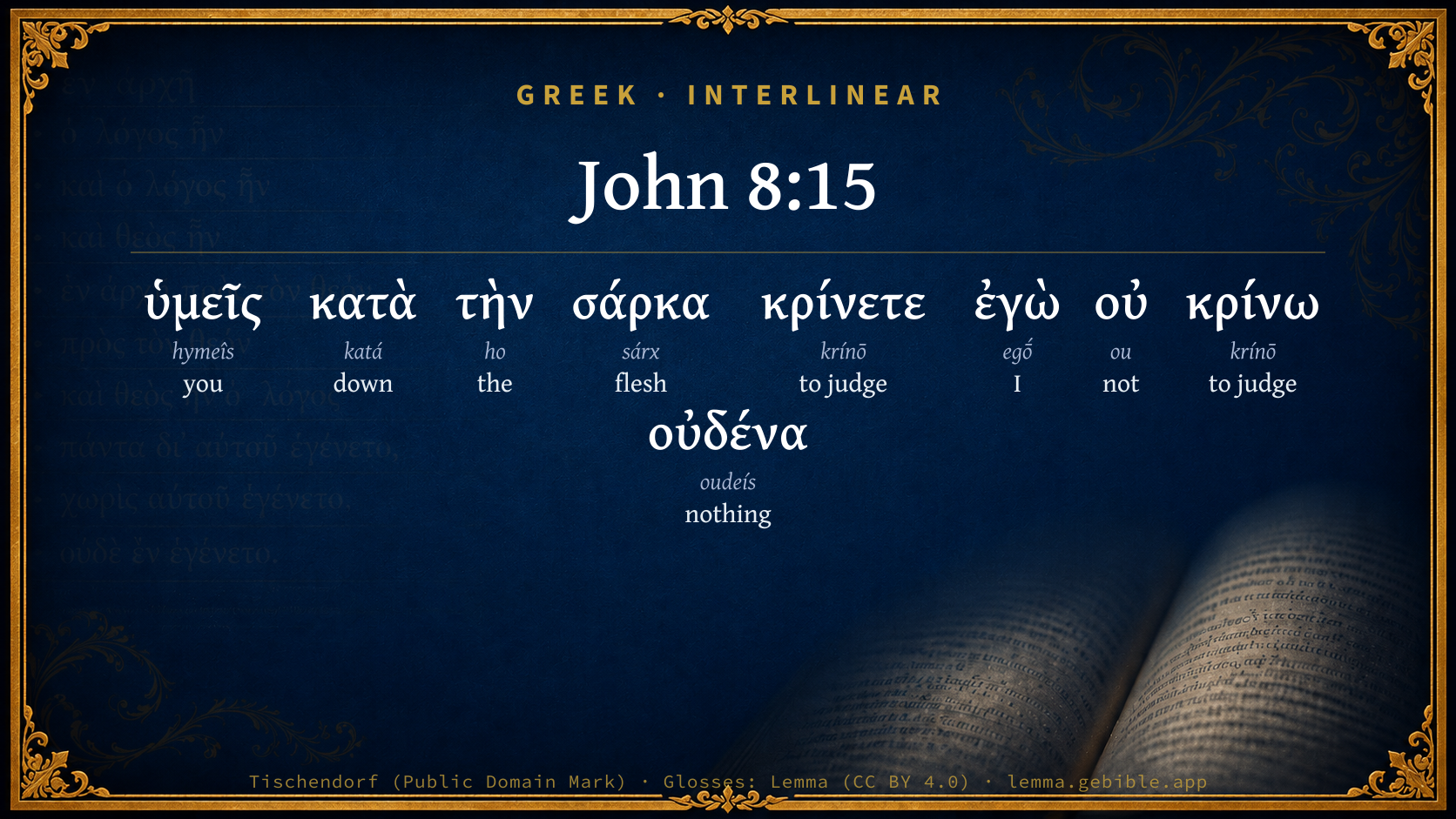
  1. ὑμεῖς hymeîs G5210 “you” Personal pronoun, 2nd person, Nominative, Plural
  2. κατὰ katá G2596 “down” Preposition
  3. τὴν ho G3588 “the” Article, Accusative, Singular, Feminine
  4. σάρκα sárx G4561 “flesh” Noun, Accusative, Singular, Feminine
  5. ἐγὼ egṓ G1473 “I” Personal pronoun, 1st person, Nominative, Singular
  6. οὐ ou G3756 “not” Particle, Negative
  7. κρίνω krínō G2919 “to judge” Verb, Present, Active, Indicative, 1st person, Singular
  8. οὐδένα oudeís G3762 “nothing” Adjective, Accusative, Singular, Masculine, Negative

About this verse

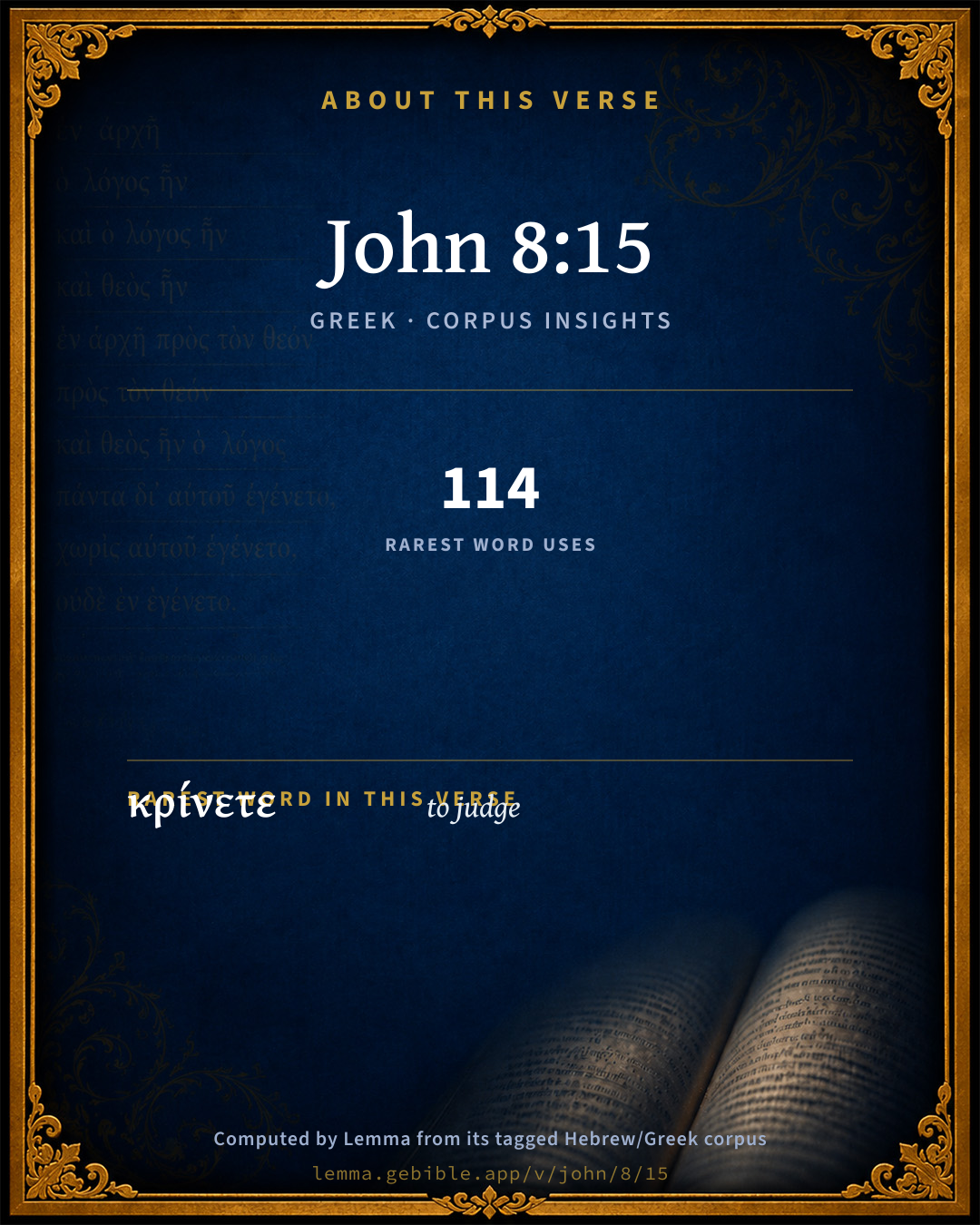
These counts appear in no published source. They are computed here, from the morphology-tagged text and Lemma’s own curated glosses. What Lemma adds →

9
words
8
distinct lemmas
Gospels
section

Repetition

A word recurs within this verse:

  • κρίνετε to judge G2919 ×2

Cross-references

16

Topical passages linked to John 8:15 in the Treasury of Scripture Knowledge — connected by theme and wording, ordered by reader-vote popularity; previews shown in the World English Bible.

  • 1 Samuel 16:7 But Yahweh said to Samuel, "Don't look on his face, or on the height of his stature; because I have rejected him: for [Yahweh sees] not as man sees; for man looks at the outward appearance, but Yahweh looks at the heart."
  • John 7:24 Don't judge according to appearance, but judge righteous judgment."
  • John 12:47 If anyone listens to my sayings, and doesn't believe, I don't judge him. For I came not to judge the world, but to save the world.
  • John 3:17 For God didn't send his Son into the world to judge the world, but that the world should be saved through him.
  • John 18:36 Jesus answered, "My Kingdom is not of this world. If my Kingdom were of this world, then my servants would fight, that I wouldn't be delivered to the Jews. But now my Kingdom is not from here."
  • Romans 2:1 Therefore you are without excuse, O man, whoever you are who judge. For in that which you judge another, you condemn yourself. For you who judge practice the same things.
  • Psalms 94:20–21 Shall the throne of wickedness have fellowship with you, Which brings about mischief by statute?
  • Amos 5:7 You who turn justice to wormwood, And cast down righteousness to the earth:
  • John 8:11 She said, "No one, Lord." Jesus said, "Neither do I condemn you. Go your way. From now on, sin no more."
  • 1 Corinthians 2:15 But he who is spiritual discerns all things, and he himself is judged by no one.
  • 1 Corinthians 4:3–5 But with me it is a very small thing that I should be judged by you, or by man's judgment. Yes, I don't judge my own self.
  • Psalms 58:1–2 Do you indeed speak righteousness, silent ones? Do you judge blamelessly, you sons of men?
  • Amos 6:12 Do horses run on the rocky crags? Does one plow there with oxen? But you have turned justice into poison, And the fruit of righteousness into bitterness;
  • Habakkuk 1:4 Therefore the law is paralyzed, and justice never goes forth; for the wicked surround the righteous; therefore justice goes forth perverted.
  • Luke 12:14 But he said to him, "Man, who made me a judge or an arbitrator over you?"
  • James 2:4 haven't you shown partiality among yourselves, and become judges with evil thoughts?

Cross-references courtesy of OpenBible.info (CC BY 4.0).

Commentary

Notes on John 8:15 from classic Christian and Jewish commentators (each source and its license shown beneath its notes). The classic Christian expositions comment on the surrounding passage and are grouped to its opening verse, so a note may address several verses; the Jewish commentaries on the Tanakh (Rashi and others) are per-verse, so they appear only where the commentator wrote on this verse.

Lemma curates 59 commentaries, every one of them public domain or Creative Commons licensed, each selected and text-cleaned for this edition rather than reprinted as found. About our sources →

Joseph Benson's Commentary

Joh 8:15-19. Ye judge after the flesh — As the flesh, that is, corrupt nature, dictates. The same carnal prejudices still prevail in the minds of the Jews, and prevent their reception of Christ; they laying it down as a first principle, that he is to be a great temporal prince and deliverer. And the admission of false principles, which are constantly taken for granted, and never examined, will, it is to be feared, be attended with fatal consequences to thousands more. I judge no man — Not thus; not now; not at my first coming. Dr. Macknight paraphrases the verse thus: “Ye judge of me according to outward appearances, and condemn me for this, among other things, that I judge no man. You think that I cannot be the Messiah, because I do not destroy those who oppose me, as you imagine the Messiah will do; but in this you are altogether mistaken, for the design of the Messiah’s coming is not to destroy, but to save mankind.” And yet if I judge, my judgment is true — That is, just, equitable: for I am not alone, &c. — If I should condemn any person for disbelieving my divine mission and rejecting me, the condemnation of such a one would be just, because my mission is true, being confirmed, not by my own testimony only, but by the Father’s also; and because every sentence of that kind, which I should pass, would be pronounced by the authority, and agreeable to the will of my Father. The Son is not alone in judging, any more than in testifying; for the Father is in him, and he in the Father, Joh 14:10-11. It is written in your law — For which you profess to have so great and sacred a regard; that the testimony of two men is true — That is, to be admitted as true; and that matters of the greatest consequence are, without scruple, to be determined by it. See the margin. As if he said, You could not justly complain if I should punish you for your unbelief in such a case as this, since your own law directs you to believe every matter that is confirmed by the concurring testimony of two witnesses, as my mission evidently is. For I am one that bear witness of myself — Not by words only, but by all the actions of my life, which are agreeable to the character of a messenger from heaven; and the Father, that sent me, beareth witness of me — By the miracles which he enables me to perform, (see Joh 5:32; Joh 5:36,) so that you are altogether culpable in rejecting me. Then said they, Where is thy Father — The other witness to whom thou so frequently appealest? Mention him plainly, that we may know how far he is to be regarded, and produce him as a witness. Jesus answered — Showing the perverseness of their question; Ye neither know me nor my Father — As plainly appears by your conduct. If ye had known me, ye should have known my Father also — If ye had properly understood who I am, and had formed a right judgment of my person, character, and mission, and regarded me as you ought to have done, you would also, long before this time, have known who and what my Father is, in another manner than you now do; for I bear his complete resemblance, and it is my great business to reveal him to those who submit to my instructions. Our Lord here plainly intimates, that the Father and he were distinct persons, as they were two witnesses; and yet one in essence, as the knowledge of him includes the knowledge of the Father.

Joseph Benson's Commentary on the Old and New Testaments (1811–1818) — public domain. Text from a community e-Sword module.

Bengel's Gnomon

Johann Albrecht Bengel

Joh 8:15. Κατὰ τὴν σάρκα, according to the flesh) and so, according to the appearance, ch. Joh 7:24, “Judge not according to appearance, but judge righteous judgment.” [In antithesis to “from above,” Joh 8:23, “Ye are from beneath, I am from above.”—V. g.]—οὐ κρίνω, I do not judge) Comp. Joh 8:11, “Neither do I condemn thee.”

Bengel's Gnomon of the New Testament — English translation (T&T Clark, Edinburgh, 1860) — public domain. Text from a community e-Sword module.

Meyer's Critical & Exegetical Commentary

Heinrich August Wilhelm Meyer

Joh_8:15-16. The course of thought repeated with some minuteness (Tholuck), but similarly to Joh_7:24. The rejection of His testimony by the Pharisees in Joh_8:13, was an act of judgment on their part which, inasmuch as they were unacquainted with His higher position as an ambassador of God, had been determined merely by His cutward sensuous appearance, by His servants form (εἰσορόωντες ἐμὴν βροτοειδέα μορφήν, Nonnus), as to which He seemed to them to be an ordinary man. This Jesus tells them, and adds, how very differently He proceeds in this respect.[10] Κρίνειν receives through the context the condemnatory sense, and κατὰ τὴν σάρκα is not to be understood of the subjective norm (Chrysostom: ἀπὸ ἀνθρωπίνης διανοίας … ἀδίκως; De Wette: in a carnal, selfish manner; comp. B. Crusius), but of the objective norm (comp. κατʼ ὄψιν, Joh_7:24; Euth. Zigabenus: πρὸς μόνον τὸ φαινόμενον βλέποντες, καὶ μηδὲν ὑψηλότερον καὶ πνευματικὸν ἐννοοῦντες). Comp. 2Co_5:16.

ἐγὼ οὐ κρίνω οὐδένα] I condemn no one. There is no need, however, for supplying in thought κατὰ τ. σάρκα, as even Augustine proposed, and after Cyrils example many modern writers (also Kuinoel, Paulus); to the same thing comes Lückes supplement: as you do. This is decidedly to be rejected, partly for the general reason that the proper point would have to be supplied in thought, and partly because, in Joh_8:16, καὶ ἐὰν κρίνω cannot be taken otherwise than absolutely, and without supplement. For these reasons every kind of supplement must be rejected, whether by the insertion of νῦν, which would point to the future judgment (Augustine, Chrysostom, Euth. Zigabenus, Erasmus, and several), or of μόνος (Storr, Godet), as though John had written αὐτὸς ἐγώ. Jesus rather gives utterance to His maxim in the consciousness of having come, not κρίνειν, but to save and bless (comp. on Joh_8:11), which is what He carried out principaliter; but this principle was, that He refrained from all condemnation of others, knowing as He did that κρίνειν was neither the end (Brückner) nor the sphere of His life (Hengstenberg). This principle, however, did not exclude necessary cases of an opposite kind; and of such cases Joh_8:16 supplies the necessary explanation. Luther aptly remarks: He herewith clothes Himself with His office; but an antithesis to teaching (Calvin, Beza) is foreign to the verse; and the interpretation: I have no pleasure in judging (De Wette), imports into the words what they do not contain.[11]

Joh_8:16. καὶ ἐὰν κρίνω δὲ ἐγώ] καὶ δέ here and in Joh_8:17, atque etiam, see on Joh_6:51. The thought is: and even if a κρίνειν on my part should take place, etc. Notwithstanding His maxim, not to judge, such cases bad actually occurred in the exercise of His vocation, and, indeed, just for the purpose of attaining its higher objectas was, moreover, inevitable with His antagonism to sin and the κόσμος. Comp. Luther: If thou wilt not have our Lord God, then keep the devil; and the office which otherwise is not set for judgment, but for help and consolation, is compelled to assume the function of condemnation. Luthardt: But my witness becomes a judgment through unbelief. This, however, is not in the passage; and Jesus was often enough forced into actual, direct κρίνειν, Joh_8:26.

δέ] occupies the fourth place, because the preceding words are connected with each other, as in Joh_8:17; Joh_6:51; 1Jn_1:3; Mat_10:18, al.

According to the reading ἀληθινή (see the critical notes), the meaning of the second clause is: my condemnation is a genuine one, answering to the idea, as it ought to benot equivalent to ἀληθής (B. Crusius). Comp. on Joh_7:28. Reason: For it is not (like an ordinary human personality, restricted to myself) I alone (who condemn), but I and the Father that hath sent me (are the κρίνοντες), which fellowship (ὅπερ ἐγὼ κρίνω, τοῦτο καὶ ὁ πατήρ, Euth. Zigabenus) naturally excludes everything that could prevent the κρίσις from being ἀληθινή. Comp. Joh_5:30.

[10] Hilgenfeld, Evang. p. 286, ought therefore not to have concluded that the words, I judge no man, presuppose the history of the woman taken in adultery.

[11] Among the meanings imported into the passage may be reckoned Langes fanciful notion (L. J. II. p. 958), that Jesus can never regard the real essence of man as worthy of rejection (but merely the caricature which man has made of his own nature by sin). Where is there anything in the passage about the real essence of man?

Meyer — Critical and Exegetical Commentary on the New Testament — English translation by Peter Christie, edited by Frederick Crombie (T&T Clark, 1880) — public domain. Text from a community e-Sword module.

Godet's Commentaries

Frédéric Louis Godet

Vv. 15, 16. “You judge according to the flesh; I judge no one; 16 and if I judge, my judgment is true,because I am not alone, but I and the Father that sent me.”

The objection of the Pharisees, Joh 8:13, contained a judgment respecting Jesus. They treated Him as an ordinary man, as a sinner, like themselves. They accused Him of overrating Himself in the testimonies which He bore to Himself. It is to this that the charge refers: “You judge according to the flesh.” We must not confound κατὰ τὴν σάρκα, “according to the flesh,” with κατὰ σάρκα, in a fleshly way. The flesh here is not the veil extended before the eyes of the one who judges falsely (the carnal spirit or mind); it is rather, according to the article τήν, the appearance marked by weakness of the one who is the object of judgment, by reason of which, at first sight, he is not at all distinguished from other men. The first sense, however, is included in the second, for with a less carnal heart the Jews would have discerned in Jesus, under the covering of the flesh, a being of a higher nature and would have accorded to Him, in the midst of mankind, a place by Himself. This superficial estimate of which Jesus sees Himself to be the object on their part, awakens in Him the feeling of a contrast. While these blind persons allow themselves to make their estimate of Him, with a perfect confidence in their own light, He, the incarnate light, judges no one. Thus, those who are ignorant allow themselves to judge, while He who knows denies Himself this right. And yet, it cannot be denied, Jesus judges also; He Himself declares it in Joh 8:16.

Writers have put themselves to great pains to explain this contradiction. The word no one has been paraphrased in this way: “No one, according to the outward appearances” (the flesh); so Cyril. Or, what amounts to nearly the same thing: “No one... as you judge me” (Lucke). Or again: “No one now, in contrast with the judgment to come” (Augustine, Chrysostom). But according to these views, there is an addition of what is not said. Or, without an ellipsis and in the sense of Joh 3:17 : “The principal aim of my coming, is to save; and if in exceptional cases I judge, it is only with reference to those who will not allow themselves to be saved” (Calvin, Meyer, Astie, Luthardt, Weiss, Keil, Westcott, with different shades of explanation). But the idea of these exceptional judgments is definitely excluded by the οὐδένα, no one, of Joh 8:15. Reuss makes Joh 3:18 apply here: “No one, because those who are judged have judged themselves.” But how then are we to explain the words: And if I judge? To all these opinions I should prefer that of Storr, who translates ἐγώ, I, in the sense of I alone. Comp. Joh 8:26.

What Jesus charges upon the Jews is that they think themselves competent to judge Him by themselves and according to their own light (ὑμεῖς,you). “As for me,” Jesus means to say, “in so far as I am left to myself, reduced to my own human individuality, I do not allow myself anything of the kind; as such I judge no one.” It is the same thought, in a negative form, as that of Joh 5:30 in an affirmative form: “As I hear, I judge.” The emphasis would thus be upon the pronoun ἐγώ, I, which its position in the sentence, indeed, makes prominent. And Jesus could thus add, without contradicting Himself, Joh 8:16 : “And yet if I judge.” For then, it is not really He who judges, since He does nothing but pronounce the sentences which He has heard from His Father. This is the sense which I formerly adopted. On weighing well the import of the word οὐδένα, no one, however, I ask myself whether Jesus did not mean that He judges no individual, in the sense that He pronounces on no one a final sentence; and if He judges the moral stateof the people and the character of the acts of which He is a witness, these sentences which He pronounces are dictated to Him by His Father. Wecome back thus to the preceding sense, indeed, but by another path (the contrast of the individual with the people and with things). The received reading ἀληθής, worthy of faith, is more appropriate to this context then the variant of some Alexandrian and Greco-Latin authorities, ἀληθινή . Jesus does not intend to say that, in these cases, the sentence which He gives is a real sentence, but that it is a true sentence, to which one can trust. Thereby He returns to the idea from which He started, the truth of His testimony concerning Himself, and to the question of form which had been proposed to Him. He confirms the answer which He has just given by an article of the code:

Frédéric Louis Godet — Commentaries on Luke, John, Romans, and 1 Corinthians — English translation (T&T Clark, Edinburgh, 1870s–1890s) — public domain. Text from a community e-Sword module.

Geneva Bible (1599)

Geneva Bible translators

I do now only teach you, I condemn no man: but yet if I list to do it, I might lawfully do it, for I am not alone, but my Father is with me.

Geneva Bible (1599) marginal notes — public domain. Text via Bolls.life.

Jamieson, Fausset & Brown

Robert Jamieson, A. R. Fausset & David Brown

Ye judge after the flesh--with no spiritual apprehension.

I judge no man.

Jamieson, Fausset & Brown — Commentary Critical and Explanatory on the Whole Bible (1871) — public domain (CC PDM 1.0). Text via the HelloAO Bible API.

Adam Clarke's Commentary

Verse 15. Ye judge after the flesh] Because I appear in the form of man, judging from this appearance, ye think I am but a mere man-pay attention to my teaching and miracles, and ye shall then see that nothing less than infinite wisdom and unlimited power could teach and do what I have taught and performed. Our Lord speaks here exactly in the character of an ambassador. Such a person does not bring a second with him to vouch his truth; his credentials from his king ascertain his character: he represents the king's person. So our Lord represents the Father as bearing witness with him. The miracles which he wrought were the proof from heaven that he was the promised Messiah: these were the great seal of all his pretensions.

Adam Clarke's Commentary on the Bible (1810–1826) — public domain. Text from a community e-Sword/MySword module.

John Calvin's Commentaries

15. You judge according to the flesh. This may be explained in two ways; either that they judge according to the wicked views of the flesh, or that they judge according to the appearance of the person. For the flesh sometimes denotes the outward appearance of a man; and both meanings agree well with this passage, since wherever either the feelings of the flesh prevail, or a regard to the person regulates the judgment, neither truth nor justice dwells. But I think that the meaning will be more certain, if you contrast the flesh with the Spirit, understanding his meaning to be, that they are not lawful and competent judges, because they have not the Spirit for their guide.

I judge no man. Here, too, commentators differ. Some distinguish it thus, that he does not judge as man. Others refer it to the time, that while he was on earth, he did not undertake the office of a Judge Augustine gives both expositions, but does not decide between them. But the former distinction cannot at all apply. For this sentence contains two clauses, that Christ does not judge, and that if he judge, his judgment is solid and just, because it is divine. As to the former clause, therefore, in which he says that he does not judge, I confine it to what belongs peculiarly to this passage. For in order the more fully to convict his enemies of pride, he employs this comparison, that they unjustly assume the liberty to judge, and yet cannot condemn him, while he merely teaches and abstains from performing the office of a judge.

John Calvin's Commentaries (1540-1563) — public domain. Text from the Calvin Translation Society English edition (1840s-50s) via the Christian Classics Ethereal Library (ccel.org). Calvin's coverage is partial (roughly two-thirds of the Bible); uncommented books and verses are honest gaps, never fabricated. The 19th-century editor's footnotes and remarks are omitted so the notes are faithfully Calvin's own voice.

Ellicott's Commentary for English Readers

(15) Ye judge after the flesh; I judge no man.—The pronouns are placed in emphatic contrast. “You on your part . . . I for My part.” We must beware of the common mistake of finding the origin of this thought of judgment in Joh_8:10-11, which as we have seen do not belong to this context. It arises rather from Joh_8:13. The statement of the Pharisees, “Thou art bearing witness concerning Thyself; Thy witness is not true,” was a condemnatory judgment based upon appearances. (Comp. Note on Joh_7:24.) They allowed these appearances to carry them away from a righteous judgment. They looked at the form of human flesh, and declared His witness false. Had they listened to the words He spoke, and judged according to their spiritual meaning, they would have heard the voice of the Messiah and have seen the Light of the world.

This thought of the Pharisees, in their ignorance judging that which they knew not, suggests by contrast the thought that He. in perfect knowledge judges no one. (Comp. Joh_3:17.)

A Bible Commentary for English Readers, edited by Charles John Ellicott (1878–1897) — public domain. Text from a community e-Sword module.

The Cambridge Bible for Schools and Colleges

gen. ed. J. J. S. Perowne

15. Ye judge after the flesh] According to His outward form, the form of a servant: comp. Joh_7:24. From the context ‘judge’ here acquires an adverse sense, and virtually means ‘condemn:’ comp. Joh_3:17-18, Joh_7:51. Judging Him to be a mere man they had condemned His testimony respecting Himself as invalid. ‘Ye’ and ‘I’ are in emphatic opposition.

I judge no man] Neither ‘after the flesh,’ nor ‘as ye do,’ nor anything else is to be supplied. No such addition can be made in Joh_8:16, and therefore cannot be made here. The words are best taken quite simply and literally. ‘My mission is not to condemn, but to save and to bless.’ Comp. Joh_12:47.

The Cambridge Bible for Schools and Colleges (gen. ed. J. J. S. Perowne; Cambridge University Press, 1878–1918) — public domain. Text from a community e-Sword module.

John Gill's Exposition

It is also written in your law,.... The law of Moses, which was given unto them, and they boasted of; the passage referred to is in Deu 19:15; see also Deu 17:6; where though what follows is not to be found in so many words, yet the sense is there expressed:

that the testimony of two men is true: concerning which the Jewish writers say (y),

"they used not to determine any judiciary matter by the mouth of one witness, neither pecuniary causes, nor causes of life and death, as it is said, Deu 17:6. It is asked (z) in their oral law, if the testimony of two men stand, why does the Scripture particularly mention three? (for no other reason) but to compare or equal three with two, that as three convict two of a falsehood, two may also convict three.''

On which one of their commentators (a) has this observation, taking notice of Deu 19:18, which speaks of a single witness;

"Mar (a doctor) says, wherever it is said a "witness", it is to be understood of two, unless the Scripture particularly specifies one.''

In the case of a wife suspected of adultery, and in the business of striking off the neck of the heifer in case of murder, they admitted of one witness (b).

(y) Maimon. Hilchot Eduth. c. 5. sect. 1. (z) Misn. Maccot. c. 1. sect. 7. (a) Bartenora in ib. (b) Maimon. Hilchot Eduth, ib. sect. 2.

John Gill's Exposition of the Whole Bible (1746–1763) — public domain (CC PDM 1.0). Text via the HelloAO Bible API.

Trapp's Complete Commentary

John Trapp

15 Ye judge after the flesh; I judge no man.

Ver. 15. I judge no man] viz. after the flesh, as ye do. Christians are diametrically opposite to the world; yea, they have their feet there where other men’s heads are; they go not only another, but an upper way to work, Pro 15:24. Like eagles, they delight in high flying.

John Trapp, A Commentary or Exposition upon All the Books of the Old and New Testament (1647–1656) — public domain. Text from a community e-Sword module.

Albert Barnes' Notes on the Bible

After the flesh - According to appearance; according to your carnal and corrupt mode; not according to the spiritual nature of the doctrines. By your preconceived opinions and prejudices you are determined not to believe that I am the Messiah.

I judge no man - Jesus came not to condemn the world, Joh 3:17. They were in the habit of judging rashly and harshly of all; but this was not the purpose or disposition of the Saviour. This expression is to be understood as meaning that he judged no one after their manner; he did not come to censure and condemn men after the appearance, or in a harsh, biased, and unkind manner.

Albert Barnes' Notes on the Bible (1834–1885) — public domain. Text from a community e-Sword/MySword module.

Haydock's Catholic Bible Commentary

You judge, and also bear testimony concerning other men, according to the flesh, and according to outward shew and appearances only. I judge no one in this manner. And whatever judgment I pass, or if I give testimony, my testimony is true, as coming also from the Father, with whom I am one in nature, though a distinct person: and two, according to the law, are enough to give evidence. (Witham) --- You judge according to the flesh, &c. Because you do not understand the ways of God, and think you only see in me the person of man; therefore I seem to you to be arrogant, bearing witness of myself. Man indeed, who wishes alone to bear testimony of himself, is arrogant, and not to be believed, because all men are frail and liable to be deceived; but light and truth itself can neither deceive nor be deceived. (St. Augustine)

George Leo Haydock (1774–1849), Haydock's Catholic Family Bible and Commentary, 1859 edition — public domain. Excludes Psalms (Douay-Rheims chapter numbering differs from Protestant) and Deuterocanonical books (Catholic canon only).

Matthew Poole's English Annotations

According to my outward appearance to you, so you judge of me; or, according to your own passions, and corrupt affections. I judge no man in that manner; or, I judge no man alone, as it followeth in the next verse.

Matthew Poole's English Annotations on the Holy Bible (1683–1685) — public domain. Text from a community e-Sword/MySword module.

Whedon's Commentary on the Bible

Daniel D. Whedon

15. After the flesh—Ye judge me according to your own depraved natures, (note on Joh_3:6,) instead of accepting me after a holy manner and disposition.

I judge no man—I descend not to the low level of human judgments, of man upon man.

Daniel D. Whedon (gen. ed.), Commentary on the Old and New Testaments (1874–1909) — public domain. Text from a community e-Sword module.

The Pulpit Commentary

You judgei.e. you condemn me, you repudiate my claim to be the "Living Water" and the "Light of the worldafter the flesh (kata thrka), according to the outward appearance; you look at my mere humanity. Our Lord did not accuse them of the fleshly, blinded, unjust judgments of unregenerate men. The article thn , and not the well known formula kata sarka , prevents such an interpretation. He rather reasons and pleads with them. He suggests that they might, if they would, look below the surface of his flesh. Tim evangelist, who reports the substance of this discussion, has written. "The Word was made flesh." So if the incarnate Word had always been judged "after the flesh," we should never have seen his glory, nor recognized the nobler part of his Personality. I judge no man. Numerous efforts have been made to find the underlying modification of this assertion. Augustine, Chrysostom, Cyril, and many moderns add, "after the flesh," or "as you do" (the latter is the suggestion of Lucke, which, as Meyer says, comes to the same thing), or "now," pointing on to the actual assumption of his judiciary powers at the consummation of all things, and contrasting his earthly ministry of mercy with the ultimate majesty of his judgment throne (Westcott). Storr, Moulton, Godet. suggest "I by myself I alone, independently of the Father, judge no man. Meyer rejects all these attempts to add to the text, and maintains that our Lord is claiming the lofty position of Saviour rather than Judge. He came with that as his primary aim, purpose, intent; to heal, not to wound; to save, not to destroy; to give time for repentance, not to hurry sinners to their doom; to illumine, not to cover with darkness. Yet even Meyer admits a practical exception of great importance to be involved in the next clause, which does not differ from Westcott"s interpretation.

The Pulpit Commentary (1880–1919), ed. H.D.M. Spence-Jones & Joseph S. Exell — public domain. Text from a community e-Sword module.

John Wesley's Explanatory Notes

Ye judge after the flesh - As the flesh, that is, corrupt nature dictates. I judge no man - Not thus; not now; not at my first coming.

John Wesley, Explanatory Notes Upon the Whole Bible (1754–1765) — public domain. Text via the GEBible commentary corpus.

The People's New Testament

B. W. Johnson

15. Ye judge after the flesh. According to appearances. I judge no man. He lets their lives and consciences judge them.

B. W. Johnson's The People's New Testament with Notes (1889–1891) — public domain. Electronic text from the Christian Classics Ethereal Library (CCEL) ThML edition.

Cambridge Greek Testament for Schools and Colleges

15. κατὰ τ. σάρκα. According to His humanity, the form of a servant: comp. Joh 7:24; Joh 6:63. Treating Him as a mere man they had condemned His witness concerning Himself as invalid. Κρίνω acquires an adverse sense from the context: comp. Joh 3:17-18, Joh 7:51.

οὐ κρ. οὐδένα. Neither κατὰ τ. σάρκα nor anything else is to be supplied. No such addition can be made in Joh 8:16, and therefore cannot be made here. The words are best taken quite literally. ‘My mission is not to condemn, but to save and bless.’ Comp. Joh 12:47; Joh 3:17.

Cambridge Greek Testament for Schools and Colleges (Cambridge University Press, 1896; 21 vols, various authors incl. Carr, Maclear, Plummer, Farrar, Lumby, Moule, M. R. James, Simcox) — public domain. Text from a community e-Sword module.

International Critical Commentary

15. The Pharisees had complained that the self-witness of Jesus was unsupported and therefore untrustworthy (v. 13). In v. 14 Jesus has answered that their objection, however sound if applied to a mere man, fails in His case: they do not know His origin or His home. He now adds that their judgment is superficial because of this ignorance of His true being.

ὑμεῖς κατὰ τὴν σάρκα κρίνετε, “you judge superficially”; cf. for κατὰ τὴν σάρκα, 1Co 1:26, 2Co 5:16. The Pharisees had done just what He had previously warned them not to do, when He said μὴ κρίνετε κατʼ ὄψιν (7:24).

ἐγὼ οὐ κρίνω οὐδένα. The ultimate purpose of His coming into the world was to save it, not to judge it (3:17); and if an individual man would not obey His word, Jesus did not judge him then: the spoken word would judge him at the Last Day (12:48). At that Great Assize, the Son of Man will be the Judge (see on 3:17, 5:22, and Introd., p. clviii). But the saying ἐγὼ οὐ κρίνω οὐδένα refers to the action of Jesus during His public mission on earth, and not to the future judgment of the world. There is a sense in which He did judge, or discriminate between one man and another, during His earthly ministry (see vv. 16, 26); but ἐγὼ οὐ κρίνω οὐδένα expresses not only that this was not the purpose of His mission (see 3:17), but that it was not His habit. It was a charge made against Him that He did not discriminate sufficiently, that He consorted with publicans and sinners (Mar 2:16, Luk 15:2), that He did not repel the sinful woman at the Pharisee’s house (Luk 7:39). Even in the case of the adulteress whose guilt was proved, when judgment must have been condemnation, He said οὐδὲ ἐγώ σε κατακρίνω [8:11]. His example was consonant to His own precept μὴ κρίνετε (Mat 7:1).

This saying of Christ ἐγὼ οὐ κρίνω οὐδένα is found only in Jn., but its genuineness becomes the more apparent the more closely it is examined. It is a paradox, for it is seemingly contradicted in the next verse, but it is one of those terse, pregnant paradoxes of which the Synoptists have preserved many examples.1

International Critical Commentary — older volumes (1896–1929), various authors — public domain. Text from a community e-Sword module.

Lesson kit

Teaching starters — assembled from the data on this page, not authored interpretation. Every prompt links to the verse data it draws on. Edit before teaching.

John, in the Gospels, opens this verse with 9 words (8 distinct Greek lemmas). Its most distinctive word is krínō (“to judge”). A historical commentator’s framing appears above. Read the whole chapter for the surrounding context.

Discussion questions

  1. The word krínō carries the sense “to judge.” How does it shape the verse?
  2. How does 1 Samuel 16:7, which shares this passage’s theme, read alongside this verse?
  3. What does the repetition of “to judge” (2× in this one verse) do in this verse?
  4. These translations render this verse differently; the difference is in the English rendering, not the original. What questions does that raise?
  5. Compare how Joseph Benson's Commentary and Bengel's Gnomon read this verse. Where do they agree or differ?

Things to notice

  • These translations choose different wording for 7 words in this verse.
  • “to judge” occurs 2× in this single verse.
  • 8 distinct Greek lemmas span 9 words in this verse.

Reading settings

Reading text

Shown beneath each verse's original-language words.

Old Testament
Old Testament edition

Read the OT as the Masoretic Hebrew (MT) or the Greek Septuagint (LXX).

English shown for the Greek Septuagint (in the Hebrew ↔ Greek comparison).

Comparing translations? Open the Compare panel on any verse page to stack up to four side by side.