
Acts 19:27

Greek (Tischendorf 8th ed.) Acts 19:27 appears in the Greek New Testament. The text above is from the Tischendorf 8th edition. Each word links to its Strong’s number and a concise gloss. Click any word for its full Thayer’s Greek Lexicon entry.
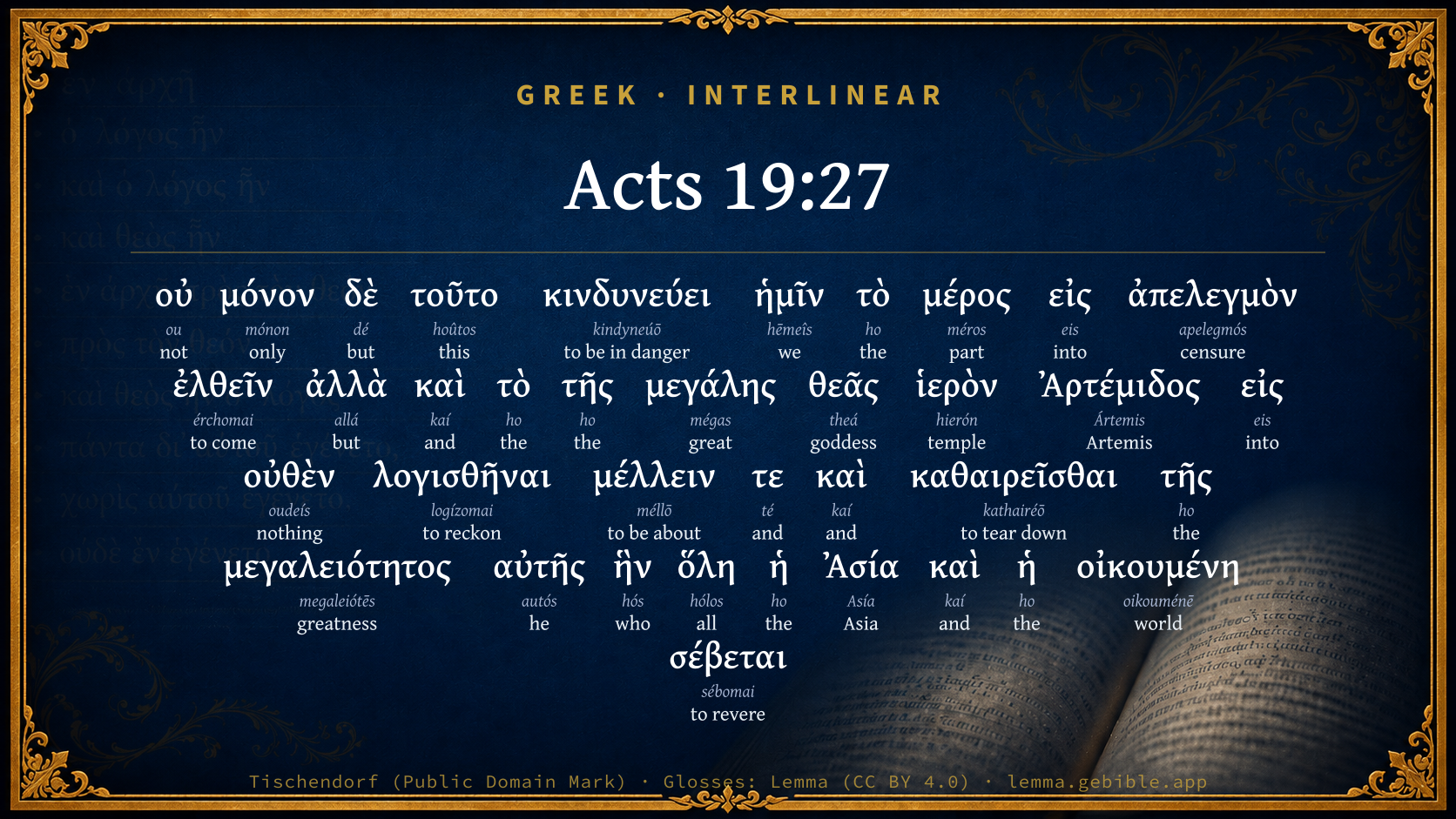
Download image
Cite this verse

Acts 19:27 (World English Bible). Public Domain. Lemma interlinear Bible study tool, https://lemma.gebible.app/v/acts/19/27.

Show BibTeX & RIS
BibTeX
RIS
English Translation
Not only is there danger that this our trade come into disrepute, but also that the temple of the great goddess Artemis will be counted as nothing, and her majesty destroyed, whom all Asia and the world worships."
World English Bible · Public Domain
Highlights
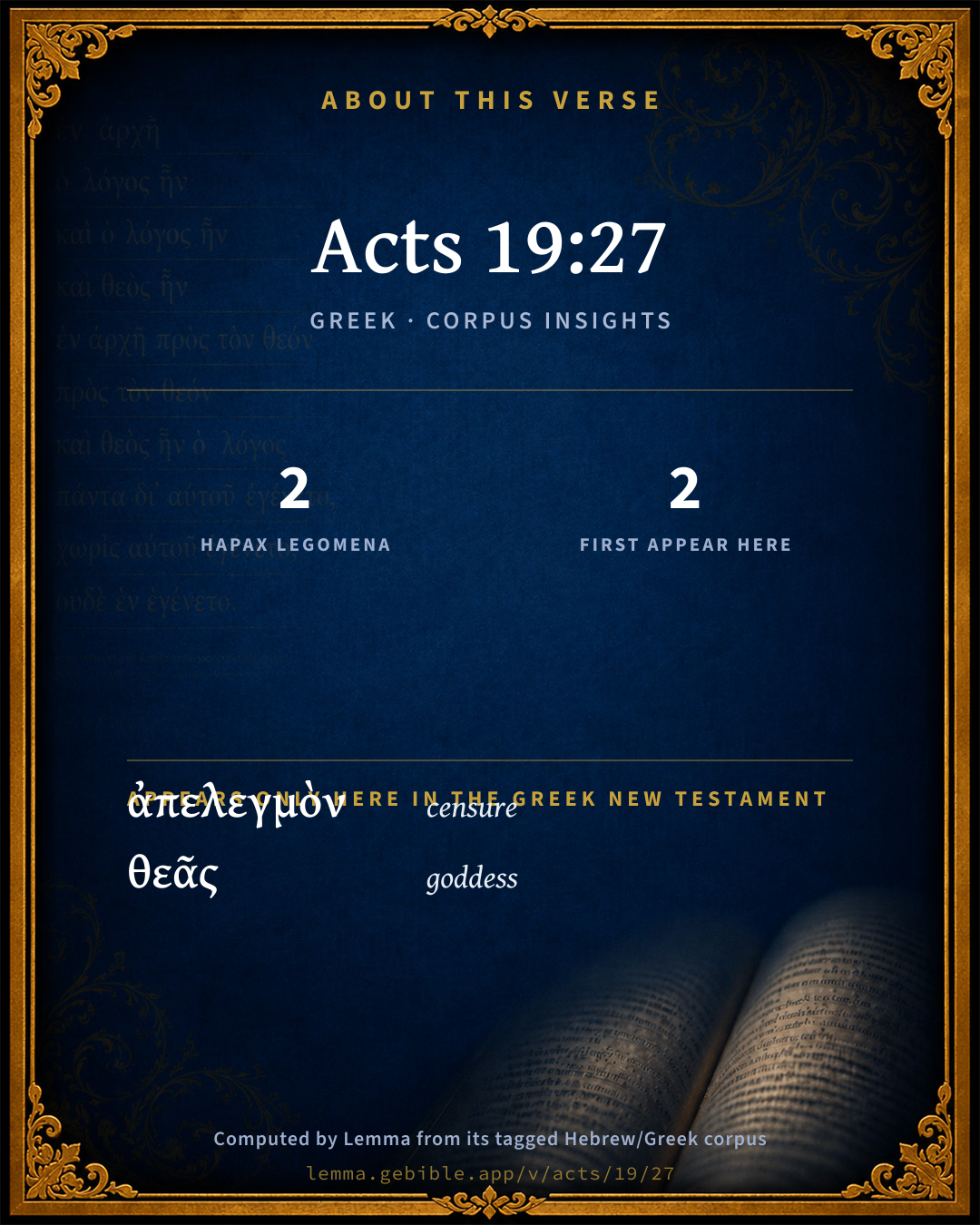
  • 2 hapax legomena — only here in the Greek New Testament
  • 2 first appearances in the Greek New Testament
Full analysis ↓
Download a study sheet

One document with this verse’s original text, its word-by-word gloss line, the meaning frame, cross-references with their text, attributed commentary, and full source and license credits — printable, and it pastes into notes with its structure intact.

This verse Autodidact and up

Study sheet (.html) Plain text (.txt)

A passage Seminary Student

Up to 50 verses in one chapter. A passage sheet keeps up to 6 commentary sources and 12 cross-references per verse, in the order this page ranks them, and says so on the sheet whenever that leaves anything out. Ask for a single verse and you get the Autodidact verse sheet above.

Everything on this page stays free to read, with no account — the sheet is a download of what is already on screen, not access to it.

Want to remove ads? Support Godless Engineer
Compare translations 3

The same verse in 3 English versions, stacked beneath the original-language interlinear above. Click any original word for its lexicon entry.

Each is an independent rendering of the whole verse — the interlinear is not word-aligned to these translations.

Highlighted words mark where these versions differ — a whole-verse word diff, not a word-by-word alignment.

  • World English Bible Public Domain
    Not only is there danger that this our trade come into disrepute, but also that the temple of the great goddess Artemis will be counted as nothing, and her majesty destroyed, whom all Asia and the world worships."
  • King James Version Public Domain
    So that not only this our craft is in danger to be set at nought; but also that the temple of the great goddess Diana should be despised, and her magnificence should be destroyed, whom all Asia and the world worshippeth.
  • unfoldingWord Literal Text CC BY-SA 4.0
    And not only is this in peril, our trade to come to disrepute, but even the temple of the great goddess Artemis to be considered as nothing. And indeed, her majesty is about to be destroyed, whom all Asia, indeed the world, worships.”

unfoldingWord Literal Text — © unfoldingWord, licensed CC BY-SA 4.0. Word-aligned USFM3 via Door43 (git.door43.org/unfoldingWord/en_ult).

Versions to compare (up to 4)

3 of 4 selected

Show all 19 translations

Every available English version of this verse, each an independent rendering of the whole verse.

  • World English Bible Public Domain
    Not only is there danger that this our trade come into disrepute, but also that the temple of the great goddess Artemis will be counted as nothing, and her majesty destroyed, whom all Asia and the world worships."
  • Berean Standard Bible Public Domain
    There is danger not only that our business will fall into disrepute, but also that the temple of the great goddess Artemis will be discredited and her majesty deposed—she who is worshiped by all the province of Asia and the whole world.”
  • Majority Standard Bible Public Domain
    There is danger not only that our business will fall into disrepute, but also that the temple of the great goddess Artemis will be discredited and her majesty deposed—she who is worshiped by all the province of Asia and the whole world.”
  • King James Version Public Domain
    So that not only this our craft is in danger to be set at nought; but also that the temple of the great goddess Diana should be despised, and her magnificence should be destroyed, whom all Asia and the world worshippeth.
  • American Standard Version (1901) Public Domain
    and not only is there danger that this our trade come into disrepute; but also that the temple of the great goddess Diana be made of no account, and that she should even be deposed from her magnificence whom all Asia and the world worshippeth.
  • Revised Version (1885) Public Domain
    and not only is there danger that this our trade come into disrepute; but also that the temple of the great goddess Diana be made of no account, and that she should even be deposed from her magnificence, whom all Asia and the world worshippeth.
  • Geneva Bible (1599) Public Domain
    So that not onely this thing is dangerous vnto vs, that this our portion shall be reproued, but also that the temple of the great goddesse Diana should be nothing esteemed, and that it would come to passe that her magnificence, which all Asia and the world worshippeth, should be destroyed.
  • Douay-Rheims (1899) Public Domain
    So that not only this our craft is in danger to be set at nought, but also the temple of great Diana shall be reputed for nothing; yea, and her majesty shall begin to be destroyed, whom all Asia and the world worshippeth.
  • Young's Literal Translation Public Domain
    and not only is this department in danger for us of coming into disregard, but also, that of the great goddess Artemis the temple is to be reckoned for nothing, and also her greatness is about to be brought down, whom all Asia and the world doth worship.'
  • Literal Standard Version CC BY-SA 4.0
    and not only is this department in danger for us of coming into disregard, but also, that of the great goddess Artemis, the temple is to be reckoned for nothing, and also her greatness is about to be brought down, whom all Asia and the world worships.”
  • Unlocked Literal Bible CC BY-SA 4.0
    Not only is there danger that our trade will no longer be needed, but also that the temple of the great goddess Artemis may be considered worthless. Then she would even lose her greatness, she whom all Asia and the world worships.”
  • unfoldingWord Literal Text CC BY-SA 4.0
    And not only is this in peril, our trade to come to disrepute, but even the temple of the great goddess Artemis to be considered as nothing. And indeed, her majesty is about to be destroyed, whom all Asia, indeed the world, worships.”
  • Darby Bible Public Domain
    Now not only there is danger for us that our business come into discredit, but also that the temple of the great goddess Artemis be counted for nothing, and that her greatness should be destroyed whom the whole of Asia and the world reveres.
  • World Messianic Bible Public Domain
    Not only is there danger that this our trade come into disrepute, but also that the temple of the great goddess Artemis will be counted as nothing and her majesty destroyed, whom all Asia and the world worships.”
  • Webster's Bible Public Domain
    So that not only this our craft is in danger to be set at naught; but also that the temple of the great goddess Diana should be despised, and her magnificence should be destroyed, whom all Asia, and the world worshipeth.
  • Free Bible Version CC BY-SA 4.0
    It's not just a question that our business will be in danger of losing respect, but that the temple of the great goddess Artemis will be considered worthless. Artemis herself would be dethroned from her high position as the one whom everyone in Asia and the whole world worships.”
  • Bible in Basic English Public Domain
    And there is danger, not only that our trade may be damaged in the opinion of men, but that the holy place of the great goddess Diana may be no longer honoured, and that she to whom all Asia and the world give worship, will be put down from her high position.
  • Text-Critical English NT CC BY 4.0
    Not only is there the danger that this trade of ours might come into disrepute, but also that the temple of the great goddess Artemis might be regarded as nothing, and that her magnificence might be brought down, whom all Asia and the world worship.”
  • Tyndale New Testament (1534) Public Domain
    So that not only this oure crafte cometh into parell to be set at nought: but also that the temple of the greate goddas Diana shuld be despysed and her magnificence shuld be destroyed which all Asia and the worlde worshippeth.

Literal Standard Version (2020), Covenant Press — licensed CC BY-SA 4.0. Text via the HelloAO Bible API (eBible.org). Unlocked Literal Bible (unfoldingWord) — licensed CC BY-SA 4.0. Text via the HelloAO Bible API (eBible.org). unfoldingWord Literal Text — © unfoldingWord, licensed CC BY-SA 4.0. Word-aligned USFM3 via Door43 (git.door43.org/unfoldingWord/en_ult). Free Bible Version, Dr. Jonathan Gallagher — licensed CC BY-SA 4.0. Text via the HelloAO Bible API (eBible.org).

Word by word

More ways to search: Search by grammar → Find every occurrence → Compare this word →

Practice this passage: Drill this verse → Learn its vocabulary →

ἀπελεγμὸν
apelegmós
G557
“censure”
Noun, Accusative, Singular, Masculine
Part of Speech
Noun
Case
Accusative
Number
Singular
Gender
Masculine
Full Thayer's Definition

Origin: from a compound of G575 and G1651

TDNT: None

1. censure, repudiation of a thing shown to be worthless
  1. οὐ ou G3756 “not” Particle, Negative
  2. μόνον mónon G3440 “only” Adverb
  3. δὲ dé G1161 “but” Conjunction
  4. τοῦτο hoûtos G3778 “this” Demonstrative pronoun, Nominative, Singular, Neuter
  5. κινδυνεύει kindyneúō G2793 “to be in danger” Verb, Present, Active, Indicative, 3rd person, Singular
  6. ἡμῖν hēmeîs G2249 “we” Personal pronoun, 1st person, Dative, Plural
  7. τὸ ho G3588 “the” Article, Accusative, Singular, Neuter
  8. μέρος méros G3313 “part” Noun, Accusative, Singular, Neuter
  9. εἰς eis G1519 “into” Preposition
  10. ἐλθεῖν érchomai G2064 “to come” Verb, Aorist, Active, Infinitive
  11. ἀλλὰ allá G235 “but” Conjunction
  12. καὶ kaí G2532 “and” Conjunction
  13. τὸ ho G3588 “the” Article, Accusative, Singular, Neuter
  14. τῆς ho G3588 “the” Article, Genitive, Singular, Feminine
  15. μεγάλης mégas G3173 “great” Adjective, Genitive, Singular, Feminine
  16. θεᾶς theá G2299 “goddess” Noun, Genitive, Singular, Feminine
  17. ἱερὸν hierón G2411 “temple” Noun, Accusative, Singular, Neuter
  18. Ἀρτέμιδος Ártemis G735 “Artemis” Noun, Genitive, Singular, Feminine
  19. εἰς eis G1519 “into” Preposition
  20. οὐθὲν oudeís G3762 “nothing” Adjective, Accusative, Singular, Neuter, Negative
  21. λογισθῆναι logízomai G3049 “to reckon” Verb, Aorist, Passive, Infinitive
  22. μέλλειν méllō G3195 “to be about” Verb, Present, Active, Infinitive
  23. τε té G5037 “and” Particle
  24. καὶ kaí G2532 “and” Conjunction
  25. καθαιρεῖσθαι kathairéō G2507 “to tear down” Verb, Present, Passive, Infinitive
  26. τῆς ho G3588 “the” Article, Genitive, Singular, Feminine
  27. μεγαλειότητος megaleiótēs G3168 “greatness” Noun, Genitive, Singular, Feminine
  28. αὐτῆς autós G846 “he” Personal pronoun, Genitive, Singular, Feminine
  29. ἣν hós G3739 “who” Relative pronoun, Accusative, Singular, Feminine
  30. ὅλη hólos G3650 “all” Adjective, Nominative, Singular, Feminine
  31. ἡ ho G3588 “the” Article, Nominative, Singular, Feminine
  32. Ἀσία Asía G773 “Asia” Noun, Nominative, Singular, Feminine
  33. καὶ kaí G2532 “and” Conjunction
  34. ἡ ho G3588 “the” Article, Nominative, Singular, Feminine
  35. οἰκουμένη oikouménē G3625 “world” Noun, Nominative, Singular, Feminine
  36. σέβεται sébomai G4576 “to revere” Verb, Present, Middle or Passive deponent, Indicative, 3rd person, Singular

About this verse

These counts appear in no published source. They are computed here, from the morphology-tagged text and Lemma’s own curated glosses. What Lemma adds →

37
words
29
distinct lemmas
Acts
section

Notable vocabulary

2 hapax legomena — words that appear only here in the entire Greek New Testament:

  • ἀπελεγμὸν censure G557
  • θεᾶς goddess G2299

First appearance in Scripture

These words make their first canonical appearance in the Greek New Testament here:

  • ἀπελεγμὸν censure G557
  • θεᾶς goddess G2299

Shared distinctive vocabulary

μεγαλειότητος greatness G3168 occurs in 3 verses of the Greek New Testament. Also found in:
Repetition

Words recur within this verse:

Cross-references

7

Topical passages linked to Acts 19:27 in the Treasury of Scripture Knowledge — connected by theme and wording, ordered by reader-vote popularity; previews shown in the World English Bible.

  • Zephaniah 2:11 Yahweh will be awesome to them, for he will famish all the gods of the land. Men will worship him, everyone from his place, even all the shores of the nations.
  • 1 Timothy 6:5 constant friction of people of corrupt minds and destitute of the truth, who suppose that godliness is a means of gain. Withdraw yourself from such.
  • Matthew 23:13 "Woe to you, scribes and Pharisees, hypocrites! For you devour widows' houses, and as a pretense you make long prayers. Therefore you will receive greater condemnation.
  • Acts 19:21 Now after these things had ended, Paul determined in the spirit, when he had passed through Macedonia and Achaia, to go to Jerusalem, saying, "After I have been there, I must also see Rome."
  • 1 John 5:19 We know that we are of God, and the whole world lies in the power of the evil one.
  • Revelation 13:3 One of his heads looked like it had been wounded fatally. His fatal wound was healed, and the whole earth marveled at the beast.
  • Revelation 13:8 All who dwell on the earth will worship him, everyone whose name has not been written from the foundation of the world in the book of life of the Lamb who has been killed.

Cross-references courtesy of OpenBible.info (CC BY 4.0).

Commentary

Notes on Acts 19:27 from classic Christian and Jewish commentators (each source and its license shown beneath its notes). The classic Christian expositions comment on the surrounding passage and are grouped to its opening verse, so a note may address several verses; the Jewish commentaries on the Tanakh (Rashi and others) are per-verse, so they appear only where the commentator wrote on this verse.

Lemma curates 59 commentaries, every one of them public domain or Creative Commons licensed, each selected and text-cleaned for this edition rather than reprinted as found. About our sources →

Tyndale Open Study Notes

Tyndale Open Resources

19:27 all around the world: The ancient geographer Strabo reports that temples dedicated to Artemis existed in cities from Asia Minor (now Turkey) to what is now France and Spain (Strabo, Geography 3.4.8; 4.1.4).

Tyndale Open Study Notes — © Tyndale Open Resources, licensed CC BY-SA 4.0. Text via the HelloAO Bible API.

Bengel's Gnomon

Johann Albrecht Bengel

Act 19:27. Ἡμῖν, for us) The dative of profit or loss.—ἀλλὰ καὶ, but also) An effective speech, which is whetted by personal interest and by superstition.—μεγάλης, of the great) A solemn and customary epithet of Diana. Hence presently, μεγαλειότητα, her magnificence, or majesty; comp. Act 19:28; Act 19:34-35. Hiller’s Onom., pp. 795, 634, 625, shows that also the names Ἄρτεμις and Diana denote greatness.—εἰς οὐδὲν λογισθῆναι) So the LXX., 1Sa 1:13, ἐλογίσατο αὐτην εἰς μεθύουσαν, he counted her as drunken.—καθαιρεῖσθαι, to he destroyed) Wretched majesty, which is thus destroyed.—αὐτῆς) her.—ὅλη, the whole) The multitude (great number) of those in error does not make error into truth.

Bengel's Gnomon of the New Testament — English translation (T&T Clark, Edinburgh, 1860) — public domain. Text from a community e-Sword module.

Meyer's Critical & Exegetical Commentary

Heinrich August Wilhelm Meyer

Act_19:27. And not only this matter (μέρος, see on Col_2:16), this point, namely, our lucrative trade, is in danger for us of coming into contempt, but also[99] the temple of the great goddess Artemis (is in danger) of being regarded as nothing, and there will also (he added) be brought down the majesty of her, whom, etc.

ἡμῖν] dative of reference, i.e. here incommodi.

εἰς ἀπελ. ἐλθ.] i.e. to come into discredit; ἀπελεγμός is not preserved elsewhere; but comp. ἐλεγμός, frequent in the LXX. and Apocr.

τῆς μεγάλης] a habitually employed epithet, as of other gods, so particularly of the Ephesian Artemis. Xen. Eph. i. 11; Alberti, Obss. p. 259.

With μέλλειν the oratio recta passes into the oratio obliqua;[100] see Buttmann, neut. Gr. p. 330 [E. T. 385].

τέ is and, simply annexing; καί is also, climactic: destructum que etiam iri majestatem, etc. Comp. Act_21:28; Buttmann, p. 309 [E. T. 360].

τῆς μεγαλειότητος (see the critical remarks) is to be taken partitively (as if τί stood with it); there will be brought down something of her majesty. Comp. Xen. Hellen. iv. 4. 13 : τῶν τειχῶν καθελεῖν, also ii. 2. 11. Nothing of this magnificence will they sacrifice. On καθαιρεῖν of the lowering of the honour of one, comp. Herodian. iii. 3. 4, vii. 9. 24. ἣν … σέβεται] again the direct form of address. See on such mixing of direct and indirect elements, Kühner, ad Xen. Anab. i. 3. 14; Dissen, ad Dem. de cor. p. 203. The relative applies to αὐτῆς.

[99] Efficax sermo, quem utilitas et superstitio acuit, Bengel. Comp. Act_16:19.

[100] Still μέλλειν may also be governed by κινδυν. ἡμῖν. But in that case μέλλειν would itself simply appear very unnecessary, and the passage would more fittingly after the preceding be continued: καθαιρεῖσθαί τε καὶ κ.τ.λ.

Meyer — Critical and Exegetical Commentary on the New Testament — English translation by Peter Christie, edited by Frederick Crombie (T&T Clark, 1880) — public domain. Text from a community e-Sword module.

Expositor's Greek Testament

ed. W. Robertson Nicoll

Act 19:27 . τοῦτο … τὸ μέρος , sc. , τῆς ἐργασίας ἡμῶν , Act 19:25 , Grimm-Thayer this branch of their trade, which was concerned with the making of the shrines. Others take μέρος = trade , the part assigned to one. κινδυνεύει : “the most sensitive part of ‘civilised’ man is his pocket,” Ramsay, St. Paul , p. 277, and the opposition thus naturally came not from the priests as instigators of the riot against Paul, but from the fact that trade connected with the Artemis-worship was endangered; so at Philippi, “when the masters saw that the hope of this was gone,” Act 16:19 ; see Ramsay, Church in the Roman Empire , p. 129 ff., as against Hicks. “See how wherever there is idolatry, in every case we find money at the bottom of it, both in the former instance it was for money, and in the case of this man for money; it was not for their religion, because they thought that in danger; no, it was for their lucrative craft, that it would have nothing to work upon,” Chrys., Hom. , xlii., εἰς ἀπελεγμὸν ἐλθεῖν : noun, not found either in classical Greek or in the LXX; the verb ἀπελέγχειν is found in Mal 2:11Mal 2:11 ( cf. Symm., Psa 119:118 ), and ἐλεγμός is not uncommon in LXX, confutatio, repudiatio (for the phrase cf. Mar 5:26 ), in contemptum venire , Wetstein; but in redargutionem venire , Vulgate. ἀλλὰ καὶ : the utilitarian aspect of the appeal stands first, but speciously seconded by an appeal to religious feelings (“non tam pro aris ipsos quam pro focis pugnare,” Calvin). τῆς μεγ . θεᾶς Ἀ .: St. Luke appears to have retained the precise title of the goddess, according to the witness of the inscription; “Diana” (Ramsay), Hastings’ B.D., p. 605, so Blass, in loco. τὸ … ἱερὸν : the Temple of Artemis was burnt to the ground by the fanatic Herostratus in B.C. 356 on the night of the birth of Alexander the Great, but its restoration was effected with great magnificence, and it was regarded as one of the seven wonders of the world. Its dimensions are given by Pliny, xxxvi., 95. For references, and a description of its worship, see C. and H., p. 422, small edition; Renan, Saint Paul , p. 427; Ramsay, “Diana,” u. s.; Wood’s Ephesus , pp. 4 45; Greek Inscrip. at British Museum , iii., 1890, and for a complete account of the temple, its structure, and literature relating to its history and site, B.D. 2 , “Ephesus”. So sumptuous was the magnificence of this sanctuary that it could be said ὁ τῆς Ἀρτέμιδος ναὸς ἐν Ἐφέσῳ μόνος ἐστὶ θεῶν οἶκος , Philo Byz., Spect. Mund. , 7, and the sun, so the saying ran, saw nothing in his course more magnificent than Diana’s temple. εἰς οὐδὲν λογ ., cf. for a similar phrase LXX, Isa 40:17 , Wis 3:17 ; Wis 9:6 ( εἰς om. 1 ), and Dan. Theod., iv., 32. The verb λογίζομαι is also frequent in St. Paul with εἰς and the accusative. τε καὶ , cf. Act 21:28 , not correlative, but: “ and that she should even ,” etc., Simcox, Language of the New Testament , p. 163. τὴν μεγαλειότητα , see critical note, if we read the genitive, “and that she should even be deposed from her magnificence,” R.V., cf. Winer-Schmiedel, xxx., 6. Grimm-Thayer regards the genitive as partitive, aliquid de majestate ejus , as if it was inconceivable that all her magnificence should be lost: so Meyer, Zöckler, Weiss, cf. Xen., Hellen. , iv., 4, 13; Diod. Sic., iv., 8. But Wendt (as against Meyer) regards τὸ ἱερόν as the subject; cf. 1Ti 6:5 . The word is used, Luk 9:43 , of the majesty of God, cf. 2Pe 1:16 (Friedrich, p. 30); in LXX, Jer 40 (33):9; Est 1:5Est 1:5 ; 1Es 4:40 , Dan 7:27 . ὅλη ἡ Ἀσία : “multitudo errantium non efficit veritatem”: Bengel. The temple was built by contributions from the whole of Asia, tota Asia exstruente , Pliny, Nat. Hist. , xvi., 40, so that the goddess was evidently held in veneration by the whole province, cf. ibid. , 36:21; Liv., i., 45. According to the testimony of Pausanias, iv., 31, 8; cf. Xen., Anab. , v., 3, 4, no deity was more widely worshipped by private persons (Wetstein, Ramsay, Blass), see also Apuleius , 2, quoted by Mr. Page from Wordsworth. For the way in which the imperial government allied itself with the Artemis worship and the revival of paganism in the second century, and the universal honour paid to Artemis by Greek and barbarian alike, cf. Greek Inscriptions of the British Museum (Hicks), iii., pp. 135, 145. οἰκουμένη , see above on Act 11:28 . Plumptre points out that the language is almost identical with that of Apuleius (perhaps from this passage): “Diana Ephesia cujus nomen unicum … totus veneratur orbis”.

The Expositor's Greek Testament, edited by W. Robertson Nicoll (1897–1910) — public domain. Text from a community e-Sword module.

Geneva Bible (1599)

Geneva Bible translators

As if he said, If Paul go on thus as he hath begun to confute the opinion which men have of Diana’s image, all this our gain will come to nought.

Geneva Bible (1599) marginal notes — public domain. Text via Bolls.life.

Jamieson, Fausset & Brown

Robert Jamieson, A. R. Fausset & David Brown

So that not only this our craft is in danger . . . but, &c.--that is, "that indeed is a small matter; but there is something far worse." So the masters of the poor Pythoness put forward the religious revolution which Paul was attempting to effect at Philippi, as the sole cause of their zealous alarm, to cloak the self-interest which they felt to be touched by his success (Act 16:19-21). In both cases religious zeal was the hypocritical pretext; self-interest, the real moving cause of the opposition made.

also the temple of the great goddess Diana . . . despised, and her magnificence . . . destroyed, whom all Asia and the world worshippeth--It was reckoned one of the wonders of the world. It was built about 550 B.C., of pure white marble, and though burned by a fanatic on the night of the birth of Alexander the Great, 356 B.C., was rebuilt with more splendor than before. It was four hundred twenty-five feet long by two hundred twenty broad, and the columns, one hundred twenty-seven in number, were sixty feet in height, each of them the gift of a king, and thirty-six of them enriched with ornament and color. It was constantly receiving new decorations and additional buildings, statues, and pictures by the most celebrated artists, and kindled unparalleled admiration, enthusiasm, and superstition. Its very site is now a matter of uncertainty. The little wooden image of Diana was as primitive and rude as its shrine was sumptuous; not like the Greek Diana, in the form of an imposing huntress, but quite Asiatic, in the form of a many-breasted female (emblematic of the manifold ministrations of Nature to man), terminating in a shapeless block. Like some other far-famed idols, it was believed to have fallen from heaven (Act 19:35), and models of it were not only sold in immense numbers to private persons, but set up for worship in other cities [HOWSON]. What power must have attended the preaching of that one man by whom the death blow was felt to be given to their gigantic and witching superstition!

Jamieson, Fausset & Brown — Commentary Critical and Explanatory on the Whole Bible (1871) — public domain (CC PDM 1.0). Text via the HelloAO Bible API.

Adam Clarke's Commentary

Verse 27. The temple of the great goddess Diana] From a number of representations of the Ephesian goddess Diana, which still remain, we find that she was widely different from Diana the huntress. She is represented in some statues all covered over with breasts, from the shoulders down to the feet; in others she is thus represented, from the breast to the bottom of the abdomen, the thighs and legs being covered with the heads of different animals. From this it is evident that, under this name and form, nature, the nourisher and supporter of all things, was worshipped: the sun and moon, being grand agents, in all natural productions, were properly introduced as her attributes or symbols. Because she was the representative of universal nature, she was called, in opposition to Diana the huntress and goddess of chastity, the GREAT goddess Diana; not only worshipped in Asia, but throughout the whole world; both the Greeks and the Romans unanimously conjoining in her worship.

Several statues of this Ephesian Diana still remain; and some beautiful ones are represented by Montfaucon, in his Antig. Expliq. vol. i. book iii. cap. 15, plates 46, 47, 48. From this father of antiquaries, much information on this subject may be derived. He observes that the original statue of Diana of Ephesus, which was in that noble temple, esteemed one of the wonders of the world, was made of ivory, as Pliny says; but Vitruvius says it was made of cedar; and others, of the wood of the vine. The images of this goddess are divided into several bands, or compartments; so that they appear swathed from the breasts to the feet. On the head is generally represented a large tower, two stories high. A kind of festoon of flowers and fruit descends from her shoulders; in the void places of the festoon a crab is often represented, and sometimes crowned by two genii or victories. The arms are generally extended, or stretched a little out from the sides; and on each one or two lions. Below the festoon, between the two first bands, there are a great number of paps: hence she has been styled by some of the ancients, Multimammia, and πολυμαστος, the goddess with the multitude of paps: on one figure I count nineteen. Between the second and third bands, birds are represented; between the third and fourth, a human head with tritons; between the fourth and fifth, heads of oxen. Most of the images of this goddess are represented as swathed nearly to the ancles, about which the folds of her robe appear. Though there is a general resemblance in all the images of the Ephesian Diana, yet some have more figures or symbols, some less: these symbols are generally paps, human figures, oxen, lions, stags, griffins, sphinxes, reptiles, bees, branches of trees, and roses.

That nature is intended by this goddess is evident from the inscription on two of those represented by Montfaucon: παναιολος φυσις παντων μητηρ, Nature, full of varied creatures, and mother of all things. It is evident that this Diana was a composition of several deities: her crown of turrets belongs to Cybele, the mother of the gods; the lions were sacred to her also; the fruits and oxen are symbols of Ceres; the griffins were sacred to Apollo; and the deer or stags to Diana. The crab being placed within the festoon of flowers evidently refers to the northern tropic Cancer; and the crab being crowned in that quarter may refer to the sun having accomplished his course, and begun to return with an increase of light, heat, c: The paps, or breasts, as has already been observed, show her to be the nurse of all things and the different animals and vegetables represented on those images point out nature as the supporter of the animal and vegetable world: the moon and tritons show her influence on the sea; and the sun her influence on the earth. All these things considered, it is no wonder that this goddess was called at Ephesus the Great Diana, and that she was worshipped, not only in that city, but in all the world. In the worship of this deity, and in the construction of her images, the heathens seem to have consulted common sense and reason in rather an unusual manner. But we must observe, also, that among the Greeks and Romans they had two classes of deities: the Dii Majores, and the Dii Minores: the great gods, and the minor gods. The latter were innumerable; but the former; among whom was Diana, were only twelve-Jupiter, Neptune, Apollo, Mars, Mercury, and Vulcan; Juno, Vesta, Ceres, Diana, Venus, and Minerva. These twelve were adored through the whole Gentile world, under a variety of names.

Adam Clarke's Commentary on the Bible (1810–1826) — public domain. Text from a community e-Sword/MySword module.

John Calvin's Commentaries

27. Not only this part. This is first disorderly handled in that Demetrius is careful for religion after other things; because nothing is more absurd than to prefer the belly before the goddess; but even this is also vain, in that he pretendeth that the worship of Diana is in hazard. For if he had suffered no loss by Paul’s doctrine, he would have sat quietly at home; he would neither have taken thought for the worship of Diana, neither would he have troubled others. What is the cause, then, he is so diligent and so earnest in his business? even this, because he was plagued at home; and because he saw that he and his copartners had no honest or probable cause to make any stir, he goeth about to color [gloss] the matter with some other color. Therefore, to the end he may cover the shame of his wicked fact, he cloaketh it with the title of religion, which is plausible. So that the wicked, howsoever they strive frowardly against God, yet they gather here and there honest excuses impudently; but God doth not suffer himself to be mocked, but doth rather pull them out of their starting-holes [subterfuges]. There needeth no other witness to refute Demetrius’ hypocrisy, because he cutteth his own throat with his own words, when he betrayeth the sorrow which he had conceived, because of the loss which he sustained. In like state do the Papists stand at this day; they boast with full mouth that they be patrons of the Catholic faith and of the holy mother the Church, but when they have spoken thus touching their zeal, in the very handling of the cause they breathe out with open throat the smell of their kitchens. But if we have a desire to handle the cause of godliness purely and in earnest, let us forget our commodities, that the glory of God may have the chief place. For the show of profit doth so tie all our senses with enticements, that though we wander through all manner of wickedness, yet do we flatter ourselves so long as we be determined to provide for our own commodity.

Whom all Asia and the world doth worship. It seemeth to Demetrius an unmeet thing that Diana her majesty should be brought to naught, which all the world doth reverence and worship, and this is a common starting-hole [subterfuge] for all superstitious persons, to pretend the consent of the multitude. But true religion requireth a more steadfast stay than in the will and pleasure of men. There is nothing which at this day doth more keep back the simple and unskillful than that they dare not cast from them (such ancient) errors as are commonly received everywhere. Because they feign and imagine that that which pleased many, though foolishly and rashly, is to be counted lawful. For which cause they be not afraid boldly to set the very name of custom against God himself. But the Lord doth prescribe to us another manner of rule, to wit, that being content with his authority alone, we do not pass either for the opinion of men, nor for our own commodity, nor for the custom of many nations.

John Calvin's Commentaries (1540-1563) — public domain. Text from the Calvin Translation Society English edition (1840s-50s) via the Christian Classics Ethereal Library (ccel.org). Calvin's coverage is partial (roughly two-thirds of the Bible); uncommented books and verses are honest gaps, never fabricated. The 19th-century editor's footnotes and remarks are omitted so the notes are faithfully Calvin's own voice.

Ellicott's Commentary for English Readers

(27) Not only this our craft.—The English word conveys, perhaps, too much the idea of art. Our business, or our interests, would be a somewhat better equivalent. The Greek word is not the same as that so translated in Act_19:25.

The temple of the great goddess Diana.—The adjective was one specially appropriated to the Artemis of Ephesus, and appears on many of the coins and medals of the city.

Should be despised.—Literally, should come to an exposure—i.e., should become a laughing-stock and a by-word. Panic is sometimes clear-sighted in its previsions, and the coppersmith of Ephesus becomes an unconscious prophet of the future.

And her magnificence should be destroyed.—The connection between the substantive and the received epithet is closer in the Greek than in the English. The great goddess was in danger of being robbed of her attribute of greatness.

Whom all Asia and the world worshippeth.—Asia is, of course, the proconsular province, and the “world” is used conventionally, as in Luk_2:1, for the Roman empire. Apuleius uses language almost identical with that of Demetrius, “Diana Ephesia cujus nomen unicum . . . totus veneratur orbis.”

A Bible Commentary for English Readers, edited by Charles John Ellicott (1878–1897) — public domain. Text from a community e-Sword module.

The Cambridge Bible for Schools and Colleges

gen. ed. J. J. S. Perowne

27. so that not only this our craft is in danger to be set at nought] This is an instance where the Rev. Ver., though more literal, gains nothing in force, and loses in diction. “And not only is there danger that this our trade come into disrepute.” The requirements of the connexion would be sufficiently met by, “and not only is this, &c.”

The word for “craft” means literally our “interest,” our “share” (i.e. in the profits of trade).

but also that the temple of the great goddess Diana] This was one of the wonders of the ancient world, and the glory and pride of all the Ephesians, and the recent explorations of Mr Wood (see Wood’s Ephesus) have made us aware of the grandeur of the edifice and the consequent reason for this pride. Even the fragments of the architecture in the British Museum make it plain that the whole temple must have been a work of unsurpassed magnificence. No expense had been spared on its building, and the munificence of worshippers maintained it in full splendour. It was also used as a divinely-secured treasure-house, and those who made use of it in this way no doubt paid liberally for the protection. Tradition said, as it said of many another heathen idol, that the image in the shrine fell down from heaven. The description of this image (see Act_19:24) is taken from coins which were current at the date when the Acts of the Apostles was written.

should be despised] More literally (as Rev. Ver.) “be made of no account.” As would be the case if men began to think that they were no gods which were made with hands. In his eagerness to save the trade, Demetrius forgets to put forward what the townclerk mentions afterwards (Act_19:35), that the image was held to have come down from heaven. He is only interested in the support of what supplied his wealth.

and her magnificence should be destroyed] According to the best supported reading: and that she should even be deposed from her magnificence. The Greek word rendered “magnificence” is not unfrequently used to express the “majesty” of God.

whom all Asia and the world worshippeth] For wealth from the East, as well as from Greece, was bestowed on this gorgeous shrine.

The Cambridge Bible for Schools and Colleges (gen. ed. J. J. S. Perowne; Cambridge University Press, 1878–1918) — public domain. Text from a community e-Sword module.

John Gill's Exposition

And certain of the chief of Asia,.... Or the Asiarchs; these were not princes of Asia, rulers or governors of provinces, or cities, or civil magistrates; but priests who presided over the games and diversions at the theatre, and had the management and command of things there. Such an one was Philip the Asiarch, the church of Smyrna makes mention of in their account of the sufferings and martyrdom of Polycarp (z), whom the people entreated that he would send out the lion to Polycarp; that is, out of the theatre which he had the command of; but he replied he could not do it, because he had finished the theatrical exercises: from whence it appears that he was the governor of the theatre, and had his title of Asiarch from thence, as these men had, wherefore this word should not be rendered, the "princes of Asia", as by the Vulgate Latin; nor the "chief of Asia", as by the Syriac and Arabic versions, and by ours, but rather the "Asian priests". The Ethiopic version not knowing who should be meant by them, only reads, "and some of Asia".

Which were his friends; they had a good opinion of the apostle, and a good liking of his doctrines, and wished well to his person, and were concerned for his safety; though they might not have been really converted, and truly disciples, as those in the preceding verse; for otherwise one would think they would have relinquished their office and place. These

sent unto him, messengers or letters,

desiring him that he would not adventure himself into the theatre; they observed to him the danger he would expose himself to, and entreated he would show a greater regard to his life than to risk it in such a manner, a life might be so useful to many; and though they were the governors at the theatre, yet such was the rage and fury of the mob, that it was not in their power to restrain them from doing mischief, till such time as they were appeased.

(z) Apud Euseb. Eccl, Hist. l. 4. c. 15.

John Gill's Exposition of the Whole Bible (1746–1763) — public domain (CC PDM 1.0). Text via the HelloAO Bible API.

Trapp's Complete Commentary

John Trapp

27 So that not only this our craft is in danger to be set at nought; but also that the temple of the great goddess Diana should be despised, and her magnificence should be destroyed, whom all Asia and the world worshippeth.

Ver. 27. This our craft] Whereof they had the patent, the monopoly, το μερος. Dictio est mercimoniorum et negotiorum, in genere significans illud quod in divisione obvenit, saith Lorinus. Istud quod nobis est peculiare. So Beza renders it.

To be set at nought] Gr. εις απελεγμον ελθειν. To be refuted, disgraced, decried, and we greatly damnified. Nobis refutatum intercidat. (Beza.) This was the Diana they strove for, and about which they raised all this uproar. So the poor Waldenses were persecuted, not for detestation of their tenets, but out of a jealousy lest these men’s plain dealing should discover their drifts and mar their markets.

And her magnificence should be destroyed] Her majesty, μεγαλειοτητα. Utinam aeque saltem reverenter de Dei nomine hodie homines loquerentur, saith Malcolm. I would men would but use like reverence in speaking of the true God.

John Trapp, A Commentary or Exposition upon All the Books of the Old and New Testament (1647–1656) — public domain. Text from a community e-Sword module.

Albert Barnes' Notes on the Bible

So that not only ... - The grounds of the charge which Demetrius made against Paul were two: first, that the business of the craftsmen would be destroyed usually the first thing that strikes the mind of a sinner who is influenced By self-interest alone; and, second, that the worship of Diana would cease if Paul and his fellow-laborers were suffered to continue their efforts.

This our craft - This business in which we are engaged, and on which we are dependent. Greek: this part τὸ μέρος to meros which pertains to us.

To be set at nought - To be brought into contempt. It will become so much an object of ridicule and contempt that we shall have no further employment. Greek: “Is in danger of coming into refutation” εἰς ἀπελεγμὸν eis apelegmon. Since what is refuted by argument is deemed useless, so the word comes also to signify what is useless, or which is an object of contempt or ridicule. We may here remark:

(1) That the extensive prevalence of the Christian religion would destroy many kinds of business in which people now engage. It would put an end to all that now ministers to the pride, vanity, luxury, vice, and ambition of people. Let religion prevail, and wars would cease, and all the preparations for war which now employ so many hearts and hands would be useless. Let religion prevail, and temperance would prevail also; and consequently all the capital and labor now employed in distilling and vending ardent spirits would be withdrawn, and the business be broken up. Let religion prevail, and licentiousness would cease, and all the arts which minister to it would be useless. Let Christianity prevail, and all that goes now to minister to idolatry, and the corrupt passions of people, would be destroyed. No small part of the talent, also, that is now worse than wasted in corrupting others by ballads and songs, by fiction and licentious tales, would be withdrawn. A vast amount of capital and talent would thus be at once set at liberty, to be employed in nobler and better purposes.

(2) The effect of religion is often to bring the employments of people into shame and contempt. A revival of religion often makes the business of distilling an object of abhorrence. It pours shame on those who are engaged in ministering to the vices and luxuries of the world. Religion reveals the evil of such a course of life, and those vices are banished by the mere prevalence of better principles. Yet,

(3) The talent and capital thins disengaged is not rendered useless. It may be directed to other channels and other employment. Religion does not make people idle. It leads people to devote their talents to useful employments, and opens fields in which all may toil usefully to themselves and to their fellow-men. If all the capital, the genius, and the learning which are now wasted, and worse than wasted, were to be at once withdrawn from their present pursuits, they might be profitably employed. There is not now a useless man who might, not be useful; there is not a cent wasted which might not be employed to advantage in the great work of making the world better and happier.

But also that the temple of the great goddess Diana should be despised - This temple, so celebrated, was regarded as one of the seven wonders of the world. It was 220 years in building before it was brought to perfection. It was built at the expense of all Asia Minor. The original object of worship among the Ephesians was a small statue of Diana, made of wood, but of what kind of wood is unknown. Pliny says that the temple was made of cedar, but that it was doubtful of what kind of wood the image was made. Some have said that it was of ebony. Mucian, who was three times consul, says that the Image was made of vine, and was never changed, though the temple was rebuilt seven times (Pliny, 16:79). See Vitruvius, ii. 9. It was merely an Egyptian hieroglyphic, with many breasts, representing the goddess of Nature - under which idea Diana was probably worshipped at Ephesus. Since the original figure became decayed by age, it was propped up by two rods of iron like spits, which were carefully copied in the image which was afterward made in imitation of the first.

A temple, most magnificent in structure, was built to contain the image of Diana, which was several times built and rebuilt. The first is said to have been completed in the reign of Servius Tullius, at least 570 b.c. Another temple is mentioned as having been designed by Ctesiphon, 540 years before the Christian era, and which was completed by Daphnis of Miletus and a citizen of Ephesus. This temple was partially destroyed by fire on the very day on which Socrates was poisoned, in 400 b.c., and again in 356 b.c., by the philosopher Herostratus, on the day on which Alexander the Great was born. He confessed, upon being put to the torture, that the only motive he had was to immortalize his name. The four walls, and a few columns only, escaped the flames. The temple was repaired, and restored to more than its former magnificence, in which, says Pliny (lib. xxxvi. c. 14), 220 years were required to bring it to completion.

It was 425 feet in length, 220 in breadth, and was supported by 127 pillars of Parian marble, each of which was 60 feet high. These pillars were furnished by as many princes, and 36 of them were curiously carved, and the rest were finely polished. Each pillar, it is supposed, with its base, contained 150 tons of marble. The doors and panelling were made of cypress wood, the roof of cedar, and the interior was rendered splendid by decorations of gold, and by the finest productions of ancient artists. This celebrated edifice, after suffering various partial demolitions, was finally burned by the Goths, in their third naval invasion, in 260 a.d. Travelers are now left to conjecture where its site was. Amidst the confused ruins of ancient Ephesus, it is now impossible to tell where this celebrated temple was, once one of the wonders of the world. “So passes away the glory of this world.” See the Edinburgh Encyclopedia’s “Ephesus” also Anacharsis’ Travels, vol. vi. p. 188; Ancient Universal Hist., vol. vii. p. 416; and Pococke’s Travels.

And her magnificence - Her majesty and glory; that is, the splendor of her temple and her worship.

Whom all Asia - All Asia Minor.

And the world - Other parts of the world. The temple had been built by contributions from a great number of princes, and doubtless multitudes from all parts of the earth came to Ephesus to pay their homage to Diana.

Albert Barnes' Notes on the Bible (1834–1885) — public domain. Text from a community e-Sword/MySword module.

Haydock's Catholic Bible Commentary

In danger of being vilified, and Diana of losing her reputation. They ought to have reflected, says St. John Chrysostom, (hom. xlii.) that if such a poor man, as Paul, could destroy the worship, and the majesty of this great goddess, whom, as they say, all the world adored, how much greater and worthy of adoration must the God be, by whose power Paul could do this? (Witham)

George Leo Haydock (1774–1849), Haydock's Catholic Family Bible and Commentary, 1859 edition — public domain. Excludes Psalms (Douay-Rheims chapter numbering differs from Protestant) and Deuterocanonical books (Catholic canon only).

Matthew Poole's English Annotations

Not only this our craft is in danger to be set at nought; not only that we shall have no more to do, and be without work; but that it will be a reproach unto us to have had such an employment.

But also that the temple of the great goddess Diana should be despised; this is made an aggravation to the loss of their all, that religion should suffer too. How much more ought it to concern those who have a sure foundation for what they do profess!

All Asia; this temple is said to have been burnt down the same day that Alexander was born, and that it was two hundred and twenty years in rebuilding, at the charge of all Asia.

The world worshippeth; though the Romans might worship any god (of those multitudes) which they allowed, yet they might leave their estates only to a very few amongst them; but Diana of the Ephesians was one of those few; as also one of those twelve whom they accounted dii or deae majorum gentium, gods and goddesses of the highest quality, or first rank.

Matthew Poole's English Annotations on the Holy Bible (1683–1685) — public domain. Text from a community e-Sword/MySword module.

Whedon's Commentary on the Bible

Daniel D. Whedon

27. Our craft—Literally, our part; that is, our branch or share in the common interests concerned.

Temple—With a fine show of religious public spirit Demetrius assumes, in words, that our share of interests is altogether subordinate to the great point of the honour and universal worship of the great Artemis. Our impoverishment is rather an evil; but it is horrible to think of our dishonoured religion!

This temple of Artemis (Diana) was indeed reckoned one of the seven wonders of the world. Central within the whole structure was a small roofed chapel or cella containing the sacred image. The temple itself enclosing the chapel was an immense oblong four hundred and twenty-five feet in length and two hundred and twenty feet in breadth. The whole was without roof, being in fact rows of columns, colonnades, surmounted by a horizontal entablature. The whole was simply an honorary open columnar structure, enclosing the cell that enclosed the goddess.

Daniel D. Whedon (gen. ed.), Commentary on the Old and New Testaments (1874–1909) — public domain. Text from a community e-Sword module.

The Pulpit Commentary

And not only is there danger that this our trade come into disrepute for so that not only this our craft is in danger to be set at naught, A.V.; be made of no account for should be despised, A.V.; that she should even be deposed from her magnificence for her magnificence should be destroyed, A.V. and T.R. Is there danger. There is no example in St. Luke"s writings, or in the New Testament, or in the LXX, of kinduneuei, being taken impersonally, as it is sometimes, though rarely, in Greek authors. The subject, therefore, of this sentence is torov (the portion, part, or business), and Touto kinduneuei hJmin torov k.t.l., must be construed together, "This trade is in danger for us to come into disrepute," or, put into English, "This our trade is in danger," etc. Come into disrepute; eijv ajpelegmon, only found here in the New Testament; literally, into refutation; hence into disrepute, or into reproach, i. e. be a ground of reproach to us who practice it. The great goddess. An epithet especially applied to the Ephesian Diana (comp. the megaleiothta at the end of the verse, and the cry, vers. 28 and 34). Lewin (vol. 1. p. 412, note) quotes jOmnuw thn jEfesiwn Artemin in the Ephesian Xenophon Thv megalhv Qeav jArtemidov, in an inscription at Ephesus; Artemiv hJ megalh qeov (Achill. Tat.). Add from Pausanias, 4, 31, 8, All men hold the Ephesian Diana in the greatest honor." From her magnificence. The R.T. reads thv megaleiothtov instead of ththta in the T.R. But Meyer, while he accepts the R.T., construes it "and some of her magnificence," etc.; and rightly, because the genitive after kaqairein should be preceded by ajpo, as Act_13:29; Jos_8:29 Jos_10:27 (LXX), and the word kaqairein is also specially used of lowering the honor of any one. All Asia and the world. This is scarcely a hyperbole, the worship of the Ephesian Diana, and of her image reported to have fallen down from heaven, was so very widely diffused.

The Pulpit Commentary (1880–1919), ed. H.D.M. Spence-Jones & Joseph S. Exell — public domain. Text from a community e-Sword module.

John Wesley's Explanatory Notes

There is danger, not only that this our craft [trade] should come into disgrace, but also that the temple of the great goddess Diana should be despised - No wonder a discourse should make so deep an impression, which was edged both by interest and superstition. The great goddess was one of the standing titles of Diana. Her majesty destroyed - Miserable majesty, which was capable of being thus destroyed! Whom all Asia and the world - That is, the Roman empire, worshippeth - Although under a great variety of titles and characters. But the multitude of those that err does not turn error into truth.

John Wesley, Explanatory Notes Upon the Whole Bible (1754–1765) — public domain. Text via the GEBible commentary corpus.

Scofield Reference Notes

C. I. Scofield

world

"oikoumene" = inhabited earth. (See Scofield "Luk 2:1").

The Scofield Reference Bible (1917 edition), notes by C. I. Scofield — public domain. Text from a community e-Sword module.

McGarvey & Pendleton's Commentaries

J. W. McGarvey

See notes on verse 23

J. W. McGarvey (with Philip Y. Pendleton), Commentaries on the New Testament (The Fourfold Gospel, 1914; Acts; and the epistles) — public domain. Text from a community e-Sword/MySword module.

Cambridge Greek Testament for Schools and Colleges

27. οὐ μόνον δὲ τοῦτο κινδυνεύει ἡμῖν τὸ μέρος εἰς ἀπελεγμὸν ἐλθεῖν, and not only is this our craft in danger to be set at nought, τὸ μέρος = the portion or share which we make by our trade. ἀπελεμός seems to be found only here. The simpler form ἐλεγμός, in the sense of rebuke, is not uncommon in the LXX.

On this Chrysostom comments thus: ὅρα παρ’ ἐχθρῶν τὰς μαρτυρίας τοῖς ἀποστόλοις γινομένας. ἐκεῖ μὲν ἔλεγον, ἰδοὺ πεπληρώκατε τὴν Ἱερουσαλήμ τῆς διδαχῆς ὑμῶν. ἐνταῦθα ὅτι μέλλει καθαιρεῖσθαι τῆς Ἀρτέμιδος ἡ μεγαλειότης. τότε οἱ τὴν οἰκουμένην ἀναστατώσαντες ἤκουον, ὅτο οὗτοι καὶ ἐνθάδε πάρεισι, νῖν ὅτι κινδυνεύει ἡμῖν τοῦτο τὸ μέρος εἰς ἀπελεγμὸν ἐλθεῖν. οὕτω καὶ Ἰουδαῖοι ἐπὶ τοῦ Χριστοῦ ἔλεγον. ὅρατε ὅτι ὁ κόσμος ὀπίσω αὐτοῦ ὑπάγει.

τὸ τῆς μεγάλης θεᾶς ἱερὸν Ἀρτέμιδος, the temple of the great goddess Diana (Artemis). This was one of the wonders of the ancient world, and the glory and pride of all the Ephesians, and the recent explorations of Mr Wood (see Wood’s Ephesus) have made us aware of the grandeur of the edifice and the consequent reason for this pride. Even the fragments of the architecture in the British Museum make it plain that the whole temple must have been a work of unsurpassed magnificence. No expense had been spared on its building, and the munificence of worshippers maintained it in full splendour. It was also used as a divinely-secured treasure-house, and those who made use of it in this way no doubt paid liberally for the protection. Tradition said, as it said of many another heathen idol, that the image in the shrine fell down from heaven. The description of this image (see Act 19:24) is taken from coins which were current at the date when the Acts of the Apostles was written.

εἰς οὐθὲν λογισθῆναι, should be made of no account, as would be the case if men began to think that they were no gods which were made with hands. In his eagerness to save the trade, Demetrius forgets to put forward what the townclerk mentions afterwards (Act 19:35), that the image was held to have come down from heaven. He is only interested in the support of what supplied his wealth.

καὶ καθαιρεῖσθαι τῆς μεγαλειότητος αὐτῆς, should even be deposed from her magnificence. μεγαλειότης is sometimes used for the ‘mighty power’ of God, cf. Luk 9:43, and the ‘majesty’ of Christ, cf. 2Pe 1:16.

The collocation in the same clause of τε καί here and in Act 21:28 in the sense of and even is very unusual, and not found in classical Greek, where these particles unite different clauses as both … and. See Winer-Moulton, p. 548.

ἣν ὅλη ἡ Ἀσία καὶ ἡ οἰκουμένη σέβεται, whom all Asia and the world worshippeth; for wealth from the East as well as from Greece and Rome was bestowed at this gorgeous shrine.

Cambridge Greek Testament for Schools and Colleges (Cambridge University Press, 1896; 21 vols, various authors incl. Carr, Maclear, Plummer, Farrar, Lumby, Moule, M. R. James, Simcox) — public domain. Text from a community e-Sword module.

Alford’s Greek Testament

Henry Alford

27.] ἡμῖν is best taken as the dativus incommodi, not for ἡμῶν, nor with τὸ μέρος, but with κινδυνεύει.

μέρος, as we say, department.

ἀλλὰ καί] but that eventually even the temple itself of the great goddess Artemis will be counted for nothing. μεγάλη was the usual epithet of the Ephesian Artemis: Xen. Ephes. i. p. 15: ὀμνύω τε τὴν πάτριον ἡμῖν θεόν, τὴν μεγάλην Ἐφεσίων Ἄρτεμιν. There is an inscription in Boeckh, 2963 c, containing the words της μεγαλης θεας αρτεμιδος προ πολεως. The same inscription also mentions γραμματεύς and ἀνθυπατος. C. and H. ii. 98.

The temple of Artemis at Ephesus, having been burnt to the ground by Herostratus on the night of the birth of Alexander the Great (b.c. 355), was restored with increased magnificence, and accounted one of the wonders of the ancient world. Its dimensions were 425 X 220 feet, and it was surrounded by 127 columns, 60 feet high. It was standing in all its grandeur at this time. See C. and H. ch. 16 vol. ii. pp. 84 ff.

τῆς μεγαλειότητος is the more difficult and probably original reading: and that she should be deposed from her greatness, whom &c.

Henry Alford, The Greek Testament (1849–1861) — public domain. Text from a community e-Sword module.

Vincent's Word Studies in the New Testament

Marvin R. Vincent

Craft [μερος] . Lit., part or department of trade.

To be set at nought [εις απελεγμον ελθειν] . Lit., to come into refutation or exposure; hence, disrepute, as Rev. Compare ch. 18 28, and see note there. 'Apelegmov, refutation, occurs only here in New Testament.

Diana. Or Artemis. We must distinguish between the Greek Artemis, known to the Romans as Diana, and the Ephesian goddess. The former, according to the legend, was the daughter of Zeus (Jove), and the sister of Apollo. She was the patroness of the chase, the huntress among the immortals, represented with bow, quiver, and spear, clad in hunting - habit, and attended by dogs and stags. She was both a destroyer and a preserver, sending forth her arrows of death, especially against women, but also acting as a healer, and as the special protectress of women in childbirth. She was also the goddess of the moon. She was a maiden divinity, whose ministers were vowed to chastity.

The Ephesian Artemis is totally distinct from the Greek, partaking of the Asiatic character; and of the attributes of the Lydian Cybele, the great mother of the gods. Her worship near Ephesus appears to have existed among the native Asiatic population before the foundation of the city, and to have been adopted by the Greek immigrants, who gradually transferred to her features peculiar to the Grecian goddess. She was the personification of the fructifying and nourishing, powers of nature, and her image, as represented on current coins of the time, is that of a swathed figure, covered with breasts, and holding in one hand a trident, and in the other a club. This uncouth figure, clad in a robe covered with mystic devices, stood in the shrine of the great temple, hidden by a purple curtain, and was believed to have fallen down from heaven (ver. 35). In her worship the oriental influence was predominant. The priests were eunuchs, and with them was associated a body of virgin priestesses and a number of slaves, the lowest of whom were known as neocori, or temple - sweepers (ver. 35). "Many a time must Paul have heard from the Jewish quarter the piercing shrillness of their flutes, and the harsh jangling of testable dances and Corybantic processions, as, with streaming hair, and wild cries, and shaken torches of pine, they strove to madden the multitudes into sympathy with that orgiastic worship which was but too closely connected with the vilest debaucheries" (Farrar, " Life and Work of Paul ").

Magnificence. See on 2Pe 1:16.

Marvin R. Vincent, Word Studies in the New Testament (1887–1900) — public domain. Text from a community e-Sword/MySword module.

Lesson kit

Teaching starters — assembled from the data on this page, not authored interpretation. Every prompt links to the verse data it draws on. Edit before teaching.

Acts, in the Acts, opens this verse with 37 words (29 distinct Greek lemmas). Its most distinctive word is apelegmós (“censure”). A historical commentator’s framing appears above. Read the whole chapter for the surrounding context.

Discussion questions

  1. How does “censure” (apelegmós) shape what this verse is saying?
  2. This verse holds 2 words here found nowhere else in the Greek New Testament. What might the rare words draw attention to?
  3. 2 words here appear for the first time in Scripture. What is being introduced at this debut?
  4. Luke 9:43 shares the word «greatness» with this verse. How do the two illuminate each other?
  5. “into” occurs 2× in this one verse. What is the effect of the repetition?
  6. These translations render this verse differently. What is at stake in choosing one wording over another?
  7. Reading how Tyndale Open Study Notes and Bengel's Gnomon read this verse, where do the two commentators agree and where do they part?

Things to notice

  • 2 words in this verse appear nowhere else in the Greek New Testament.
  • 2 words make their first canonical appearance in Scripture here.
  • These translations choose different wording for 26 words in this verse.
  • “into” occurs 2× in this single verse.
  • 29 distinct Greek lemmas span 37 words in this verse.

Reading settings

Reading text

Shown beneath each verse's original-language words.

Old Testament
Old Testament edition

Read the OT as the Masoretic Hebrew (MT) or the Greek Septuagint (LXX).

English shown for the Greek Septuagint (in the Hebrew ↔ Greek comparison).

Comparing translations? Open the Compare panel on any verse page to stack up to four side by side.