
Luke 23:9

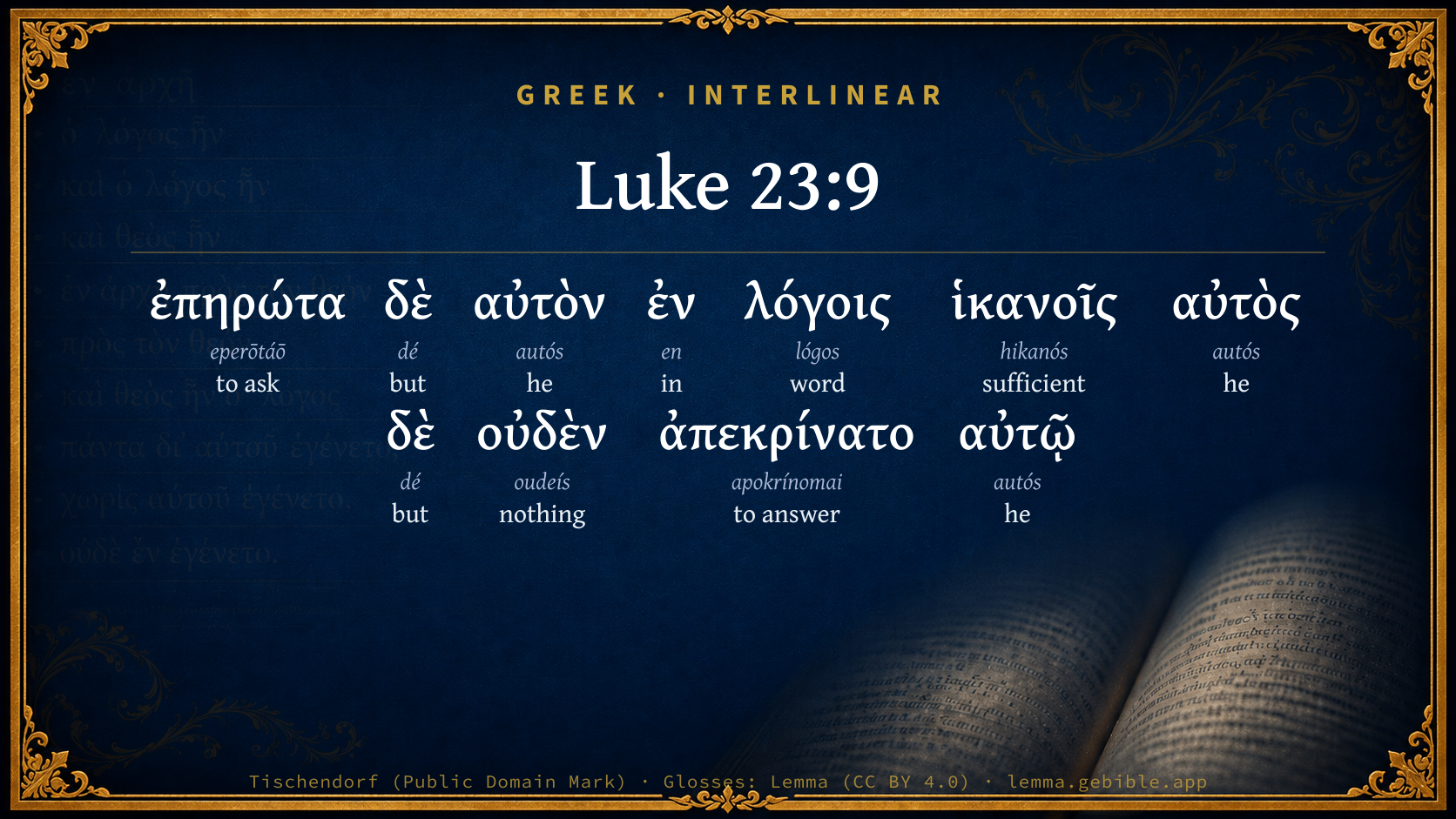
Greek (Tischendorf 8th ed.) Luke 23:9 appears in the Greek New Testament. The text above is from the Tischendorf 8th edition. Each word links to its Strong’s number and a concise gloss. Click any word for its full Thayer’s Greek Lexicon entry.
Download image
Cite this verse

Luke 23:9 (World English Bible). Public Domain. Lemma interlinear Bible study tool, https://lemma.gebible.app/v/luke/23/9.

Show BibTeX & RIS
BibTeX
RIS
English Translation
He questioned him with many words, but he gave no answers.
World English Bible · Public Domain
Download a study sheet

One document with this verse’s original text, its word-by-word gloss line, the meaning frame, cross-references with their text, attributed commentary, and full source and license credits — printable, and it pastes into notes with its structure intact.

This verse Autodidact and up

Study sheet (.html) Plain text (.txt)

A passage Seminary Student

Up to 50 verses in one chapter. A passage sheet keeps up to 6 commentary sources and 12 cross-references per verse, in the order this page ranks them, and says so on the sheet whenever that leaves anything out. Ask for a single verse and you get the Autodidact verse sheet above.

Everything on this page stays free to read, with no account — the sheet is a download of what is already on screen, not access to it.

Want to remove ads? Support Godless Engineer
Compare translations 3

The same verse in 3 English versions, stacked beneath the original-language interlinear above. Click any original word for its lexicon entry.

Each is an independent rendering of the whole verse — the interlinear is not word-aligned to these translations.

Highlighted words mark where these versions differ — a whole-verse word diff, not a word-by-word alignment.

  • World English Bible Public Domain
    He questioned him with many words, but he gave no answers.
  • King James Version Public Domain
    Then he questioned with him in many words; but he answered him nothing.
  • unfoldingWord Literal Text CC BY-SA 4.0
    Then he questioned him in many words, but he answered him nothing.

unfoldingWord Literal Text — © unfoldingWord, licensed CC BY-SA 4.0. Word-aligned USFM3 via Door43 (git.door43.org/unfoldingWord/en_ult).

Versions to compare (up to 4)

3 of 4 selected

Show all 19 translations

Every available English version of this verse, each an independent rendering of the whole verse.

  • World English Bible Public Domain
    He questioned him with many words, but he gave no answers.
  • Berean Standard Bible Public Domain
    Herod questioned Jesus at great length, but He gave no answer.
  • Majority Standard Bible Public Domain
    Herod questioned Jesus at great length, but He gave no answer.
  • King James Version Public Domain
    Then he questioned with him in many words; but he answered him nothing.
  • American Standard Version (1901) Public Domain
    And he questioned him in many words; but he answered him nothing.
  • Revised Version (1885) Public Domain
    And he questioned him in many words; but he answered him nothing.
  • Geneva Bible (1599) Public Domain
    Then questioned hee with him of many things: but he answered him nothing.
  • Douay-Rheims (1899) Public Domain
    And he questioned him in many words. But he answered him nothing.
  • Young's Literal Translation Public Domain
    and was questioning him in many words, and he answered him nothing.
  • Literal Standard Version CC BY-SA 4.0
    and was questioning Him in many words, and He answered him nothing.
  • Unlocked Literal Bible CC BY-SA 4.0
    Herod questioned Jesus in many words, but Jesus answered him nothing.
  • unfoldingWord Literal Text CC BY-SA 4.0
    Then he questioned him in many words, but he answered him nothing.
  • Darby Bible Public Domain
    and he questioned him in many words, but *he* answered him nothing.
  • World Messianic Bible Public Domain
    He questioned him with many words, but he gave no answers.
  • Webster's Bible Public Domain
    Then he questioned with him in many words; but he answered him nothing.
  • Free Bible Version CC BY-SA 4.0
    He asked Jesus many questions, but Jesus did not answer him at all.
  • Bible in Basic English Public Domain
    And he put a great number of questions to him, but he said nothing.
  • Text-Critical English NT CC BY 4.0
    So he questioned him at great length, but Jesus gave him no answer.
  • Tyndale New Testament (1534) Public Domain
    Then questeoned he with him of many thinges. But he answered him not one worde.

Literal Standard Version (2020), Covenant Press — licensed CC BY-SA 4.0. Text via the HelloAO Bible API (eBible.org). Unlocked Literal Bible (unfoldingWord) — licensed CC BY-SA 4.0. Text via the HelloAO Bible API (eBible.org). unfoldingWord Literal Text — © unfoldingWord, licensed CC BY-SA 4.0. Word-aligned USFM3 via Door43 (git.door43.org/unfoldingWord/en_ult). Free Bible Version, Dr. Jonathan Gallagher — licensed CC BY-SA 4.0. Text via the HelloAO Bible API (eBible.org).

Word by word

More ways to search: Search by grammar → Find every occurrence → Compare this word →

Practice this passage: Drill this verse → Learn its vocabulary →

About this verse

These counts appear in no published source. They are computed here, from the morphology-tagged text and Lemma’s own curated glosses. What Lemma adds →

11
words
8
distinct lemmas
Gospels
section

Shared distinctive vocabulary

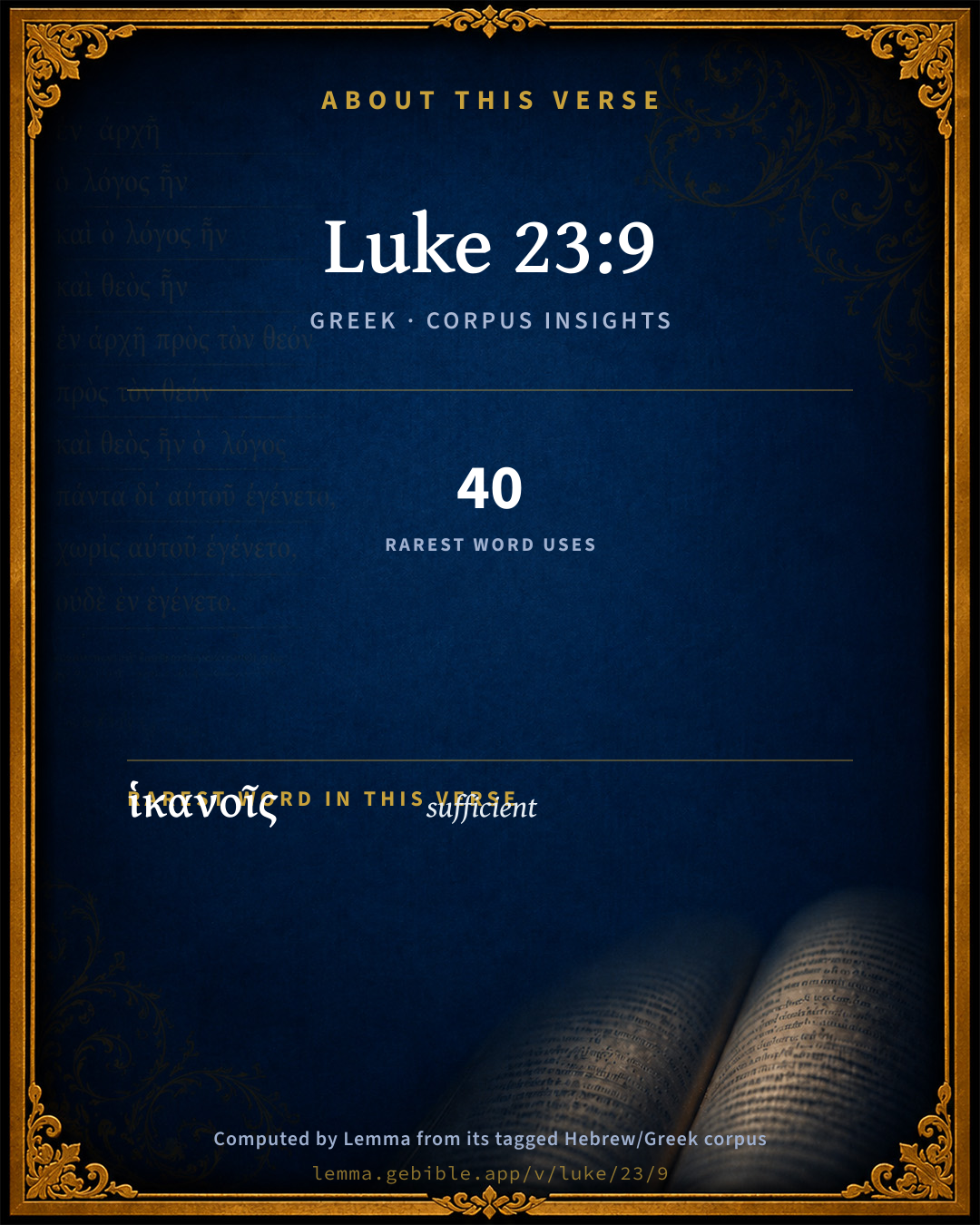
ἱκανοῖς sufficient G2425 occurs in 40 verses of the Greek New Testament. Also found in:
Repetition

Words recur within this verse:

  • αὐτὸν he G846 ×3
  • δὲ but G1161 ×2

Cross-references

9

Topical passages linked to Luke 23:9 in the Treasury of Scripture Knowledge — connected by theme and wording, ordered by reader-vote popularity; previews shown in the World English Bible.

  • Matthew 27:14 He gave him no answer, not even one word, so that the governor marveled greatly.
  • Psalms 38:13–14 But I, as a deaf man, don't hear. I am as a mute man who doesn't open his mouth.
  • Psalms 39:1–2 I said, "I will watch my ways, so that I don't sin with my tongue. I will keep my mouth with a bridle while the wicked is before me."
  • Psalms 39:9 I was mute. I didn't open my mouth, Because you did it.
  • Isaiah 53:7 He was oppressed, yet when he was afflicted he didn't open his mouth; as a lamb that is led to the slaughter, and as a sheep that before its shearers is mute, so he didn't open his mouth.
  • Matthew 7:6 "Don't give that which is holy to the dogs, neither throw your pearls before the pigs, lest perhaps they trample them under their feet, and turn and tear you to pieces.
  • Luke 13:32 He said to them, "Go and tell that fox, 'Behold, I cast out demons and perform cures today and tomorrow, and the third day I complete my mission.
  • Acts 8:32 Now the passage of the Scripture which he was reading was this, "He was led as a sheep to the slaughter. As a lamb before his shearer is silent, So he doesn't open his mouth.
  • 1 Peter 2:23 Who, when he was cursed, didn't curse back. When he suffered, didn't threaten, but committed himself to him who judges righteously;

Cross-references courtesy of OpenBible.info (CC BY 4.0).

Commentary

Notes on Luke 23:9 from classic Christian and Jewish commentators (each source and its license shown beneath its notes). The classic Christian expositions comment on the surrounding passage and are grouped to its opening verse, so a note may address several verses; the Jewish commentaries on the Tanakh (Rashi and others) are per-verse, so they appear only where the commentator wrote on this verse.

Lemma curates 59 commentaries, every one of them public domain or Creative Commons licensed, each selected and text-cleaned for this edition rather than reprinted as found. About our sources →

MacLaren's Expositions of Holy Scripture

Alexander MacLaren

Luke

‘THE RULERS TAKE COUNSEL TOGETHER’

A SOUL’S TRAGEDY

Luk 23:9.

Four Herods play their parts in the New Testament story. The first of them is the grim old tiger who slew the infants at Bethlehem, and soon after died. This Herod is the second-a cub of the litter, with his father’s ferocity and lust, but without his force. The third is the Herod of the earlier part of the Acts of the Apostles, a grandson of the old man, who dipped his hands in the blood of one Apostle, and would fain have slain another. And the last is Herod Agrippa, a son of the third, who is only remembered because he once came across Paul’s path, and thought it such a good jest that anything should be supposed capable of making a Christian out of him.

There is a singular family likeness in the whole of them, and a very ugly likeness it is. This one was sensual, cruel, cunning, infirm of purpose, capricious like a child or a savage. Roman policy amused him with letting him play at being a ruler, but kept him well in hand. And I suppose he was made a worse man by the difficulties of his position as a subject-prince.

Now I wish to put together the various incidents in this man’s life recorded in the Gospels, and try to gather some lessons from them for you.

I. First, I take him as an example of half-and-half convictions, and of the inner discord that comes from these.

I do not need to remind you of the shameful story of his repudiation of his own wife, and of his disgusting alliance with the wife of his half-brother, who was herself his niece. She was the stronger spirit, a Biblical Lady Macbeth, the Jezebel to this Ahab; and, to complete the parallel, Elijah was not far away. John the Baptist’s outspoken remonstrances of course made an implacable enemy of Herodias, who did all she could to compass his death, but was unable to manage that, though she secured his imprisonment. The reason for her inability is given by the Evangelist Mark, in words which are very inadequately rendered by our Authorised Version, but may be found more correctly translated in the Revised Version. It is there said that King ‘Herod feared John’-the gaoler afraid of his prisoner!-’knowing that he was a just man and a holy’-goodness is awful. The worst men know it, and it extorts respect. ‘And kept him safe’-from Herodias, that is. ‘And when he heard him he was perplexed’-drawn this way and that way by these two magnets, alternately veering to lust and to purity, hesitating between the kisses of the beautiful temptress at his side and the words of the prophet. And yet, with strange inconsistency, in all his vacillations ‘he heard him gladly’; for his better part approved the nobler voice. And so he staggered on, having religion enough to spoil some of his sinful delights, but not enough to shake them off.

That is a picture for which in its essence many a man and woman among us might have sat. For I suppose that there is nothing more common than these half-and-half convictions which, like inefficient bullets, get part way through the armoured shell of a ship, and there stick harmless. Many of us have the clearest convictions in our understandings, which have never penetrated to that innermost chamber of all, where the will sits sovereign. It is so about little things, it is so about great ones. Nothing is more common than that a man shall know perfectly well that some possibly trivial habit stands in the way of something that it is his interest or his duty to pursue; but the knowledge lies inoperative in the outermost part of him. It is so in regard to graver things. The majority of the slaves of any vice whatsoever know perfectly well that they ought to give it up, and yet nothing comes of the conviction.

‘He was much perplexed.’ What a picture that is of the state of unrest and conflict into which such half-and-half impressions of duty cast a man. Such a one is like a vessel with its head now East, now West, because there is some weak or ignorant steersman at the helm. I know nothing more sure to produce inward unrest and disturbance and desolation than that a man’s knowledge of duty should be clear, and his obedience to that knowledge partial. If we have John down in the dungeon, if conscience is not allowed to be master, there may be feasting and revelry going on above, but the stern voice will come up through the grating now and then, and that will spoil all the laughter. ‘When he heard him, he was much perplexed.’

The reason for these imperfect convictions is generally found, as Herod shows us, in the unwillingness to get rid of something which has fastened its claws around us, and which we love too well, although we know it is a serpent, to shake off. If Herod had once been man enough to screw himself up, and say to Herodias, ‘Now you pack, and go about your business!’ everything else would have come right in time. But he could not make up his mind to sacrifice the honeyed poison, and so everything went wrong in time. My friend, how many of us are prevented from following out our clearest convictions because they demand a sacrifice? ‘If thine eye cause thee to stumble, pluck it out, and cast it from thee. It is better for thee.’

And then, further, note that these irresolute convictions and shirking of plain duty are not atoned for by, though they are often accompanied with, a strange acquiescence in, and approval of, God’s truth. Herod fancied, inconsistently enough, that he was making some kind of compensation for disobedience to the message, by liking to listen to the messenger. And there are a great many of us, all whose Christianity consists in giving ear to the words which we never think of obeying. I wonder how many of you there are who fancy that you have no more concern with this sermon of mine than approving or disapproving of it, as the case may be; and how many of us there are who, all our lives long, have substituted criticism of the Gospel as ministered by us poor preachers-be it approving or disapproving criticism-for obedience to the Christ and acceptance of His salvation.

II. We see in Herod an example of the utter powerlessness of such partial convictions and reformation.

I am not going to tell over again the ghastly story of John’s death, which no other words than the Evangelist’s can tell half so powerfully. I need only remind you of the degradation of the poor child Salome to the position of a dancing girl, the half-tipsy generosity of the excited monarch, the grim request from lips so young and still reddened by the excitement of the dance, Herod’s unavailing sorrow, his fantastic sense of honour which scrupled to break a wicked promise, but did not scruple to kill a righteous man, and the ghastly picture of the girl carrying a bleeding head-such a gift!-to her mother.

But out of that jumble of lust and blood I desire to gather one lesson. There you have-in an extreme form, it is true-a tremendous illustration of what half-and-half convictions may come to. Whether or no we ever get anything like as far on the road as this man did matters very little. The process which brought him there is the thing that I seek to point to. It was because he had so long tampered with the voice of his conscience that it was lulled into silence at that last critical moment. And this is always the case, that if a man is false to the feeblest conviction that he has in regard to the smallest duty, he is a worse man all over ever after. We cannot neglect any conviction of what we ought to do, without lowering the whole tone of our characters and laying ourselves open to assaults of evil from which we would once have turned shuddering and disgusted. A partial thaw is generally followed by intenser frost. An abortive insurrection is sure to issue in a more grinding tyranny. A soul half melted and then cooled off is less easy to melt than it was before. And so, dear brethren, remember this, that if you do not swiftly and fully carry out in life and conduct whatsoever you know you ought to be or do, you cannot set a limit to what, some time or other, if a strong and sudden temptation is sprung upon you, you may become. ‘Is thy servant a dog that he should do this thing?’ Yes! But he did it. No mortal reaches the extreme of evil all at once, says the wise old proverb; and the path by which a man is let down into depths that he never thought it was possible that he should traverse is by the continual neglect of the small admonitions of conscience. Neglected convictions mean, sooner or later, an outburst of evil.

John’s murder may illustrate another thing too-viz. how simple, facile weakness of character may be the parent of all enormities. Herod did not want to kill John. He very much wanted to keep him alive. But he was not man enough to put his foot down, and say, ‘There! I have said it; and there is to be no more talk about slaying this prophet of God.’ So the continual drop, drop, drop, of Herodias’ suggestions and wishes wore a hole, in the loose-textured stone at last; and he did the thing that he hated to do and had long fought against. Why? Because he was a poor weak creature.

The lesson from this is one that I would urge upon all you young people especially, that in a world like this, where there are so many more voices soliciting us to evil than inviting us to good, to be weak is, in the long run, to be wicked. So do you cultivate the wholesome habit of saying ‘No,’ and do not be afraid of anything but of hurting your conscience and sinning against God.

III. Once more, we have in Herod an example of the awakening of conscience.

When Jesus began to be talked about beyond the narrow limits of the shores of the Sea of Galilee, and especially when He began to organise the Apostolate, and His name was spread abroad, some rumours reached even the court, and there were divergent opinions about Him. One man said, It is Elias; and another said, It is a prophet, ‘and Herod said, It is John, whom I beheaded. He has risen from the dead, and therefore mighty works do show forth themselves in him.’

Ah, brethren! when a man has, away back in the chambers of his memory, some wrong thing, be it great or be it little, he is at the mercy of any chance or accident to have it revived in all its vividness. It is an awful thing to walk this world with a whole magazine of combustibles in our memories, on which any spark may fall and light lurid and sulphurous flames. A chance thing may do it, a scent, a look upon a face, a sound, or any trifle may bring all at once before the wrongdoer that ancient evil. And no lapse of time makes it less dreadful when it is unveiled. The chance thrust of a boat-hook that gets tangled in the grey hairs of a corpse, brings it up grim to the surface. Press a button, by accident, upon a wall in some old castle, and a door flies open that leads away down into black depths. You and I have depths of that sort in our hearts. Then there are no more illusions about whose fault the deed was. When Herod killed John, he said, ‘Oh! It is not I! It is Herodias. It is Salome. It is my oath. It is the respect I bear to the people who heard me swear. I must do it, but I am not responsible.’ But when, in ‘the sessions of silent thought,’ the deed came back to him, Salome and Herodias, the oath, and the company were all out of sight, and he said, ‘I! I did it.’

That is what we all shall have to do some day, in this world possibly, in the next certainly. Men sophisticate themselves with talk about palliations, and excuses, and temptations, and companions and the like. And philosophers sophisticate themselves nowadays with a great many learned explanations, which tend to show that a man is not to blame for the wrong things he does. But all that rubbish gets burned up when conscience wakes, and the doer says, ‘Whom I beheaded.’

Brethren, unless we take refuge in the great sacrifice for the sins of the world which Jesus Christ has made, we shall, possibly in this life, and certainly hereafter, be surrounded by a company of our own evil deeds risen from the dead, and every one of them will shake its gory locks at us, and say, ‘Thou didst it.’

IV. The last lesson that I gather from this man’s life is the final insensibility which these half-and-half convictions tend to produce.

Jesus Christ was sent by Pilate to Herod as a kind of peace-offering. The two had been squabbling about some question of jurisdiction; and so, partly to escape from the embarrassment of having to deal with this enigmatical Prisoner, and partly out of a piece of politic politeness, Pilate sends Jesus to Herod, because He was in his jurisdiction. Think of the Lord of men and angels being handed about from one to the other of these two scoundrels, as a piece of politeness!

When Christ stands before Herod, note that all its former convictions, partial or entire, and all its terrors superficial or deep, have faded clean away from this frivolous soul. All that he feels now is a childish delight in having this well-known Man before him, and a hope that, for his delectation, Jesus will work a miracle; much as he might expect a conjurer to do one of his tricks! That is what killing John came to-an incapacity to see anything in Jesus.

‘And he asked Him many questions, and Jesus answered him nothing.’ He locked His lips. Why? He was doing what He Himself enjoined: ‘Give not that which is holy to the dogs. Cast not your pearls before swine.’ He said nothing, because He knew it was useless to say anything. So the Incarnate Word, whose very nature and property it is to speak, was silent before the frivolous curiosity of the man that had been false to his deepest convictions.

It is a parable, brother, of what is being repeated over and over again amongst us. I dare not say that Jesus Christ is ever absolutely dumb to any man on this side of the grave; but I dare not refrain from saying that this condition of insensibility to His words is one that we may indefinitely approach, and that the surest way to approach it and to reach it is to fight down, or to neglect, the convictions that lead up to Him. John was the forerunner of Christ, and if Herod had listened to John, to him John would have said: ‘Behold the Lamb of God!’ To you I say it, and beseech you to take that Lamb of God as the Sacrifice for your sins, for the Healer and Cleanser of your memories and your consciences, for the Helper who will enable you joyfully to make all sacrifices to duty, and to carry into effect every conviction which His own merciful hand writes upon your hearts. And oh, dear friends, many of you strangers to me, to whom my voice seldom comes, let me plead with you not to be content with ‘hearing’ any of us ‘gladly,’ but to do what our words point to, and to follow Christ the Saviour. If you hear the Gospel, however imperfectly, as you are hearing it proclaimed now, and if you neglect it as-must I say?-you are doing now, you will bring another film over your eyes which may grow thick enough to shut out all the light; you will wind another fold about your hearts which may prove impenetrable to the sword of the Spirit; you will put another plug in your ears which may make them deaf to the music of Christ’s voice. Do what you know you ought to do, yield yourselves to Jesus Christ. And do it now, whilst impressions are being made, lest, if you let them sleep, they may never return. Felix trembled when Paul reasoned; but he waved away the messenger and the message, and though he sent for Paul often, and communed with him, he never trembled any more.

‘There is a tide in the affairs of men

Which, taken at the flood,’

would lead us into the haven of rest in Christ; and, if allowed to pass, may leave us, stranded and shipwrecked, among the rocks.

Alexander MacLaren, Expositions of Holy Scripture (1904–1910) — public domain. Text from a community e-Sword module.

Tyndale Open Study Notes

Tyndale Open Resources

23:9 Jesus refused to answer: See Isa 53:7.

Tyndale Open Study Notes — © Tyndale Open Resources, licensed CC BY-SA 4.0. Text via the HelloAO Bible API.

Expositor's Greek Testament

ed. W. Robertson Nicoll

Luk 23:9 . ἐν λόγοις ἱκανοῖς : suggesting the idea of a desultory conversation, in which the king introduced topic after topic in a random, incoherent manner, showing no serious interest in any of his questions. οὐδὲν ἀπεκρίνατο , answered nothing, which would greatly astonish and pique this kingling, accustomed to courtier-servility. The fact that Jesus said nothing, and that nothing of importance came out of the appearance before Herod, may explain its omission by the other evangelists.

The Expositor's Greek Testament, edited by W. Robertson Nicoll (1897–1910) — public domain. Text from a community e-Sword module.

Jamieson, Fausset & Brown

Robert Jamieson, A. R. Fausset & David Brown

answered . . . nothing--(See Mat 7:6).

Jamieson, Fausset & Brown — Commentary Critical and Explanatory on the Whole Bible (1871) — public domain (CC PDM 1.0). Text via the HelloAO Bible API.

Ellicott's Commentary for English Readers

(9) He answered him nothing.—We can hardly help asking ourselves what were likely to have been among Herod’s questions. Did the Prisoner who stood before him really claim to be a King? Did He proclaim Himself as the Christ? Was He John the Baptist, risen from the dead? If not, who and what were his earthly parents? The unbroken silence of the Accused must have been strangely impressive at the time, and is singularly suggestive when we remember how He had answered Caiaphas when He had been adjured in the name of the living God. He had spoken to Pilate in the tones of a sad gentleness (Joh_19:33-37). To Herod alone, the incestuous adulterer, the murderer of the Forerunner, He does not vouchsafe, from first to last, to utter a single syllable.

A Bible Commentary for English Readers, edited by Charles John Ellicott (1878–1897) — public domain. Text from a community e-Sword module.

The Cambridge Bible for Schools and Colleges

gen. ed. J. J. S. Perowne

9. he answered him nothing] Isa_53:7. A murderer of the Prophets, who was living in open and flagrant incest, and who had no higher motive than mean curiosity, deserved no answer. Our Lord used of Antipas the only purely contemptuous word which He is ever recorded to have uttered (Luk_13:32).

The Cambridge Bible for Schools and Colleges (gen. ed. J. J. S. Perowne; Cambridge University Press, 1878–1918) — public domain. Text from a community e-Sword module.

John Gill's Exposition

Then he questioned with him in many words,.... Or talked very much to him, inquiring who he was, whether John the Baptist, or no; whether it was true that he had wrought such miracles he had heard of, and how he wrought them, and by what power he performed them, and how he came by it; and used many arguments to persuade him to work a miracle at that time:

but he answered him nothing; would not give him one word in return to his many words, nor work any miracle in his presence; he answered him neither by words nor deeds; he would not indulge his curiosity, though he might have obtained his liberty by it.

John Gill's Exposition of the Whole Bible (1746–1763) — public domain (CC PDM 1.0). Text via the HelloAO Bible API.

Trapp's Complete Commentary

John Trapp

9 Then he questioned with him in many words; but he answered him nothing.

Ver. 9. But he answered him nothing] Princes use to correct the indecencies of ambassadors by denying them audience, as if silence were the way royal to revenge a wrong. Christ spoke not a word to Herod (saith one), because Herod had taken away his voice by beheading the Baptist, who was vox clamantis a shouting voice.

John Trapp, A Commentary or Exposition upon All the Books of the Old and New Testament (1647–1656) — public domain. Text from a community e-Sword module.

Whedon's Commentary on the Bible

Daniel D. Whedon

9. In many words—It was an extended examination, conducted probably before the tetrarch’s courtiers, with many a cross question and device to draw out the wonder-worker.

Nothing—The questions were in many words, the answer was a suitable nothing. For of what answer was the insulting curiosity of this regal trifler worthy but a most solemn and rebuking silence from the Son of God?

Daniel D. Whedon (gen. ed.), Commentary on the Old and New Testaments (1874–1909) — public domain. Text from a community e-Sword module.

John Wesley's Explanatory Notes

He questioned him - Probably concerning the miracles which were reported to have been wrought by him.

John Wesley, Explanatory Notes Upon the Whole Bible (1754–1765) — public domain. Text via the GEBible commentary corpus.

Cambridge Greek Testament for Schools and Colleges

9. οὐδὲν ἀπεκρίνατο. Isa 53:7. A murderer of the Prophets, who was living in open and flagrant incest, and who had no higher motive than mean curiosity, deserved no answer. Our Lord used of Antipas the only purely contemptuous word which He is ever recorded to have uttered (Luk 13:32). “Devant cet être, composé monstrueux de sanglante légèreté et de sombre superstition il se renferma dans un silence que les accusations mêmes du Sanhédrin (Luk 23:10) ne purent le porter à rompre.” Godet.

Cambridge Greek Testament for Schools and Colleges (Cambridge University Press, 1896; 21 vols, various authors incl. Carr, Maclear, Plummer, Farrar, Lumby, Moule, M. R. James, Simcox) — public domain. Text from a community e-Sword module.

Alford’s Greek Testament

Henry Alford

9.] The reason of our Lord’s silence is sufficiently shewn, in the account of Herod’s feelings at seeing Him. “Noluit Christus miraculis et sermonibus, ut non ad auditorum curiositatem aut propriam jactantiam, ita nec ad suam ipsius a morte liberationem uti.” Drusius.

Henry Alford, The Greek Testament (1849–1861) — public domain. Text from a community e-Sword module.

International Critical Commentary

9. αὐτὸς δὲ οὐδὲν ἀπεκρίνατο αὐτῷ. “But He on His part answered him nothing.” The language and tone of Antipas showed that he was in no condition to profit by anything that Jesus might say: see on 3:1. “He regarded Jesus as a sight.” For ἀπεκρίνατο comp. 3:16.

Cod. Colb. adds quasi non audiens: and Syr-Cur. has the more remarkable quasi non ibi erat. This may have suggested the possibly Docetic touch in the Gospel of Peter, “He held is peace as in no wise feeling pain.” Both Syr-Cur. Syr-Sin. for ἐν λόγοις ἱκανοῖς have “in cunning words.” Syr-Sin. omits vv. 10, 11, 12.

International Critical Commentary — older volumes (1896–1929), various authors — public domain. Text from a community e-Sword module.

Vincent's Word Studies in the New Testament

Marvin R. Vincent

Many [ικανοις] . Compare long, ver. 8.

Marvin R. Vincent, Word Studies in the New Testament (1887–1900) — public domain. Text from a community e-Sword/MySword module.

Lesson kit

Teaching starters — assembled from the data on this page, not authored interpretation. Every prompt links to the verse data it draws on. Edit before teaching.

Luke, in the Gospels, opens this verse with 11 words (8 distinct Greek lemmas). Its most distinctive word is hikanós (“sufficient”). A historical commentator’s framing appears above. Read the whole chapter for the surrounding context.

Discussion questions

  1. The word hikanós carries the sense “sufficient.” How does it shape the verse?
  2. How does Matthew 3:11, which shares the word «sufficient», read alongside this verse?
  3. What does the repetition of “he” (3× in this one verse) do in this verse?
  4. These translations render this verse differently. What is at stake in choosing one wording over another?
  5. Compare how MacLaren's Expositions of Holy Scripture and Tyndale Open Study Notes read this verse. Where do they agree or differ?

Things to notice

  • These translations choose different wording for 4 words in this verse.
  • “he” occurs 3× in this single verse.
  • 8 distinct Greek lemmas span 11 words in this verse.

Reading settings

Reading text

Shown beneath each verse's original-language words.

Old Testament
Old Testament edition

Read the OT as the Masoretic Hebrew (MT) or the Greek Septuagint (LXX).

English shown for the Greek Septuagint (in the Hebrew ↔ Greek comparison).

Comparing translations? Open the Compare panel on any verse page to stack up to four side by side.