Galatians 4:12

Greek (Tischendorf 8th ed.) Galatians 4:12 appears in the Greek New Testament. The text above is from the Tischendorf 8th edition. Each word links to its Strong’s number and a concise gloss. Click any word for its full Thayer’s Greek Lexicon entry.
Download image
Cite this verse

Galatians 4:12 (World English Bible). Public Domain. Lemma interlinear Bible study tool, https://lemma.gebible.app/v/galatians/4/12.

Show BibTeX & RIS
BibTeX
RIS
English Translation
I beg you, brothers, become as I am, for I also have become as you are. You did me no wrong,
World English Bible · Public Domain
Download a study sheet

One document with this verse’s original text, its word-by-word gloss line, the meaning frame, cross-references with their text, attributed commentary, and full source and license credits — printable, and it pastes into notes with its structure intact.

This verse Autodidact and up

Study sheet (.html) Plain text (.txt)

A passage Seminary Student

Up to 50 verses in one chapter. A passage sheet keeps up to 6 commentary sources and 12 cross-references per verse, in the order this page ranks them, and says so on the sheet whenever that leaves anything out. Ask for a single verse and you get the Autodidact verse sheet above.

Everything on this page stays free to read, with no account — the sheet is a download of what is already on screen, not access to it.

Want to remove ads? Support Godless Engineer
Compare translations 3

The same verse in 3 English versions, stacked beneath the original-language interlinear above. Click any original word for its lexicon entry.

Each is an independent rendering of the whole verse — the interlinear is not word-aligned to these translations.

Highlighted words mark where these versions differ — a whole-verse word diff, not a word-by-word alignment.

  • World English Bible Public Domain
    I beg you, brothers, become as I am, for I also have become as you are. You did me no wrong,
  • King James Version Public Domain
    Brethren, I beseech you, be as I am; for I am as ye are: ye have not injured me at all.
  • unfoldingWord Literal Text CC BY-SA 4.0
    I beg you, brothers, become as I am, because I also as you. You did me no harm.

unfoldingWord Literal Text — © unfoldingWord, licensed CC BY-SA 4.0. Word-aligned USFM3 via Door43 (git.door43.org/unfoldingWord/en_ult).

Versions to compare (up to 4)

3 of 4 selected

Show all 19 translations

Every available English version of this verse, each an independent rendering of the whole verse.

  • World English Bible Public Domain
    I beg you, brothers, become as I am, for I also have become as you are. You did me no wrong,
  • Berean Standard Bible Public Domain
    I beg you, brothers, become like me, for I became like you. You have done me no wrong.
  • Majority Standard Bible Public Domain
    I beg you, brothers, become like me, for I became like you. You have done me no wrong.
  • King James Version Public Domain
    Brethren, I beseech you, be as I am; for I am as ye are: ye have not injured me at all.
  • American Standard Version (1901) Public Domain
    I beseech you, brethren, become as I `am', for I also `am become' as ye `are'. Ye did me no wrong:
  • Revised Version (1885) Public Domain
    I beseech you, brethren, be as I am, for I am as ye are. Ye did me no wrong:
  • Geneva Bible (1599) Public Domain
    Be ye as I (for I am euen as you) brethren, I beseech you: ye haue not hurt me at all.
  • Douay-Rheims (1899) Public Domain
    Be ye as I, because I also am as you: brethren, I beseech you: you have not injured me at all.
  • Young's Literal Translation Public Domain
    Become as I `am' -- because I also `am' as ye brethren, I beseech you; to me ye did no hurt,
  • Literal Standard Version CC BY-SA 4.0
    I implore you, brothers, become as I [am]—because I also [am] as you; you did not hurt me;
  • Unlocked Literal Bible CC BY-SA 4.0
    I beg you, brothers, become like me, for I also have become like you. You did me no wrong.
  • unfoldingWord Literal Text CC BY-SA 4.0
    I beg you, brothers, become as I am, because I also as you. You did me no harm.
  • Darby Bible Public Domain
    Be as *I* [am], for *I* also [am] as *ye*, brethren, I beseech you: ye have not at all wronged me.
  • World Messianic Bible Public Domain
    I beg you, brothers, become as I am, for I also have become as you are. You did me no wrong,
  • Webster's Bible Public Domain
    Brethren, I beseech you, be as I am; for I am as ye are: ye have not injured me at all.
  • Free Bible Version CC BY-SA 4.0
    I'm pleading with you, my friends: be like me, because I became like you. You've never treated me badly.
  • Bible in Basic English Public Domain
    My desire for you, brothers, is that you may be as I am, because I am as you are. You have done me no wrong;
  • Text-Critical English NT CC BY 4.0
    I plead with you, brothers: Become as I am, because I also have become as you are. You did me no wrong.
  • Tyndale New Testament (1534) Public Domain
    Brethern I besech you be ye as I am: for I am as ye are. Ye have not hurte me at all.

Literal Standard Version (2020), Covenant Press — licensed CC BY-SA 4.0. Text via the HelloAO Bible API (eBible.org). Unlocked Literal Bible (unfoldingWord) — licensed CC BY-SA 4.0. Text via the HelloAO Bible API (eBible.org). unfoldingWord Literal Text — © unfoldingWord, licensed CC BY-SA 4.0. Word-aligned USFM3 via Door43 (git.door43.org/unfoldingWord/en_ult). Free Bible Version, Dr. Jonathan Gallagher — licensed CC BY-SA 4.0. Text via the HelloAO Bible API (eBible.org).

Word by word

More ways to search: Search by grammar → Find every occurrence → Compare this word →

Practice this passage: Drill this verse → Learn its vocabulary →

δέομαι
déomai
G1189
“to ask”
Verb, Present, Middle or Passive deponent, Indicative, 1st person, Singular
Part of Speech
Verb
Tense
Present
Voice
Middle or Passive deponent
Mood
Indicative
Person
1st person
Number
Singular
Full Thayer's Definition

Origin: middle voice of G1210

TDNT: 02:40,1

1. to want, lack 2. to desire, long for 3. to ask, beg a. the thing asked for b. to pray, make supplications
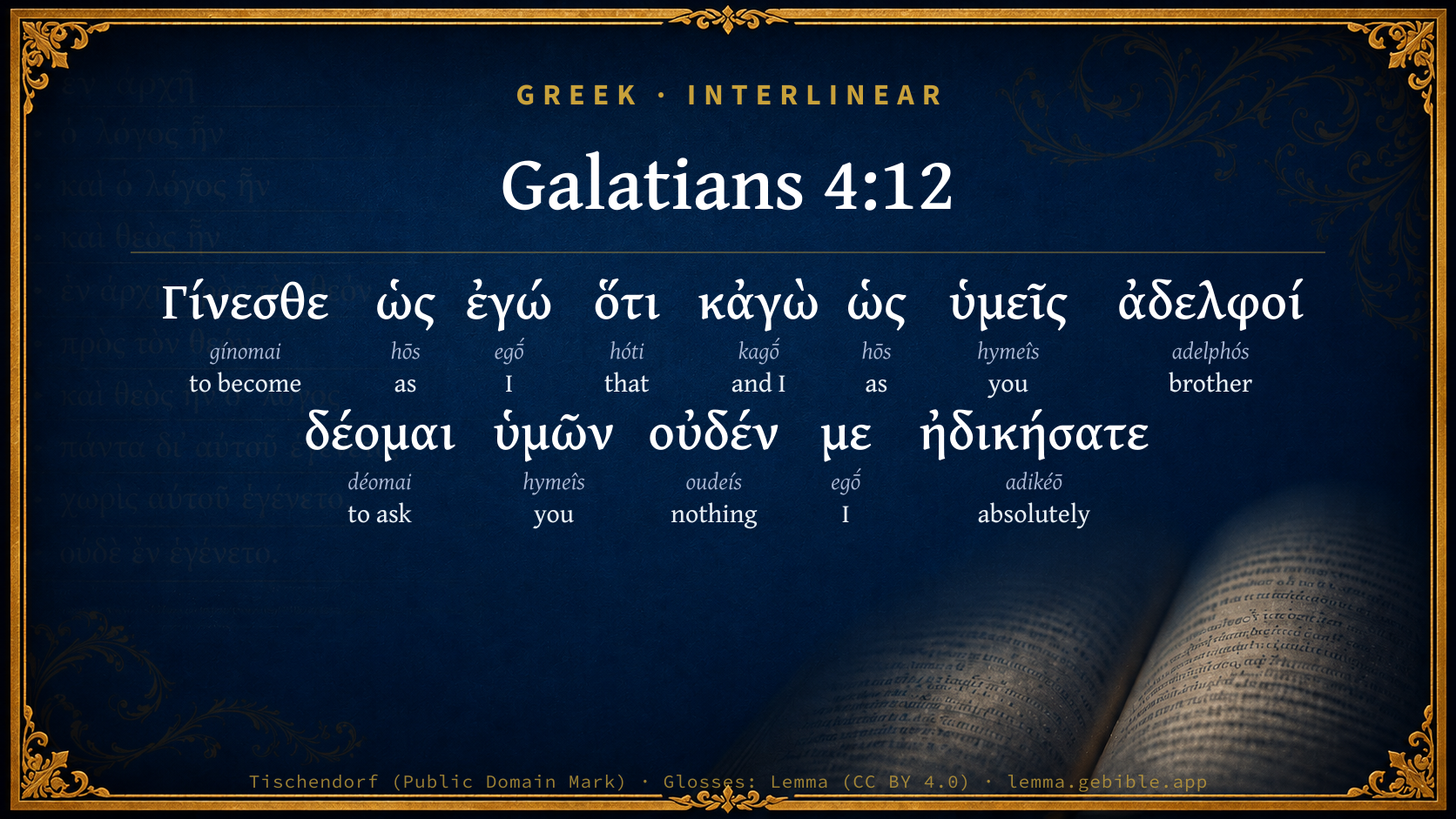
  1. Γίνεσθε gínomai G1096 “to become” Verb, Present, Middle or Passive deponent, Imperative, 2nd person, Plural
  2. ὡς hōs G5613 “as” Adverb
  3. ἐγώ egṓ G1473 “I” Personal pronoun, 1st person, Nominative, Singular
  4. ὅτι hóti G3754 “that” Conjunction
  5. κἀγὼ kagṓ G2504 “and I” Personal pronoun, 1st person, Nominative, Singular, Aramaic form
  6. ὡς hōs G5613 “as” Adverb
  7. ὑμεῖς hymeîs G5210 “you” Personal pronoun, 2nd person, Nominative, Plural
  8. ἀδελφοί adelphós G80 “brother” Noun, Vocative, Plural, Masculine
  9. ὑμῶν hymeîs G5210 “you” Personal pronoun, 2nd person, Genitive, Plural
  10. οὐδέν oudeís G3762 “nothing” Adjective, Accusative, Singular, Neuter, Negative
  11. με egṓ G1473 “I” Personal pronoun, 1st person, Accusative, Singular
  12. ἠδικήσατε adikéō G91 “absolutely” Verb, Aorist, Active, Indicative, 2nd person, Plural

About this verse

These counts appear in no published source. They are computed here, from the morphology-tagged text and Lemma’s own curated glosses. What Lemma adds →

13
words
10
distinct lemmas
Pauline Epistles
section

Notable vocabulary

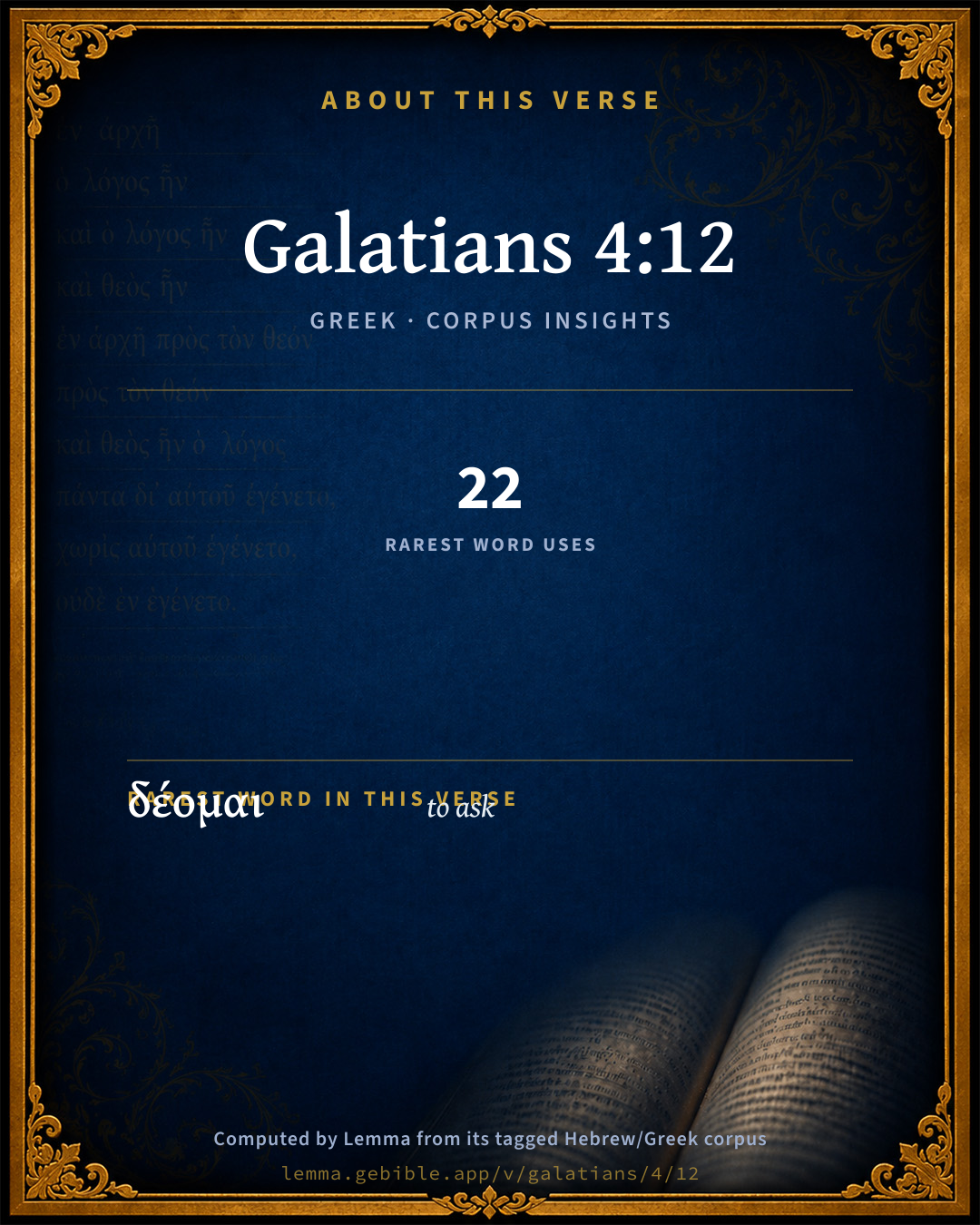
The rarest word here is δέομαι to ask G1189 — appearing just 22 times in the whole Greek New Testament.

Shared distinctive vocabulary

δέομαι to ask G1189 occurs in 22 verses of the Greek New Testament. Also found in:

Repetition

Words recur within this verse:

Cross-references

10

Topical passages linked to Galatians 4:12 in the Treasury of Scripture Knowledge — connected by theme and wording, ordered by reader-vote popularity; previews shown in the World English Bible.

  • 2 Corinthians 2:5 But if any has caused sorrow, he has caused sorrow, not to me, but in part (that I not press too heavily) to you all.
  • 1 Kings 22:4 He said to Jehoshaphat, Will you go with me to battle to Ramoth-gilead? Jehoshaphat said to the king of Israel, I am as you are, my people as your people, my horses as your horses.
  • Genesis 34:15 Only on this condition will we consent to you. If you will be as we are, that every male of you be circumcised;
  • 1 Corinthians 9:20–23 To the Jews I became as a Jew, that I might gain Jews; to those who are under the law, as under the law, that I might gain those who are under the law;
  • Acts 21:21 They have been informed about you, that you teach all the Jews who are among the Gentiles to forsake Moses, telling them not to circumcise their children neither to walk after the customs.
  • 2 Corinthians 6:13 Now in return, I speak as to my children, you also be open wide.
  • Galatians 2:14 But when I saw that they didn't walk uprightly according to the truth of the Gospel, I said to Peter before them all, "If you, being a Jew, live as the Gentiles do, and not as the Jews do, why do you compel the Gentiles to live as the Jews do?
  • Galatians 6:14 But far be it from me to boast, except in the cross of our Lord Jesus Christ, through which the world has been crucified to me, and I to the world.
  • Philippians 3:7–8 However, what things were gain to me, these have I counted loss for Christ.
  • Galatians 6:18 The grace of our Lord Jesus Christ be with your spirit, brothers. Amen.

Cross-references courtesy of OpenBible.info (CC BY 4.0).

Commentary

Notes on Galatians 4:12 from classic Christian and Jewish commentators (each source and its license shown beneath its notes). The classic Christian expositions comment on the surrounding passage and are grouped to its opening verse, so a note may address several verses; the Jewish commentaries on the Tanakh (Rashi and others) are per-verse, so they appear only where the commentator wrote on this verse.

Lemma curates 59 commentaries, every one of them public domain or Creative Commons licensed, each selected and text-cleaned for this edition rather than reprinted as found. About our sources →

The Biblical Illustrator

Joseph S. Exell

Gal_4:12

Brethren, I beseech you, be as I am.

The call to Christian liberty

I. The call is based on personal example. I am. Paul, an exemplification of Christian liberty. He could afford to contrast himself with the Judaisers in point of piety, labour, and Divine blessing on his work. Christian liberty stood approved of God in his person and ministry. There was no risk to run, he himself being witness, in this glorious liberty. A grand thing when a teacher can make such an appeal on the ground of his own character.

II. The call is founded on self-abnegation. Paul renounced all his Jewish rights and privileges, and became as without law to them that were without law, that he might liberate the Gentiles and keep them free. Will you abandon me, when I have abandoned all for you? The teacher must stoop to conquer, and place himself in the position of the taught.

III. The call is based on the past relationship of the two. Ye have not injured me at all; you never disobeyed me; dont do so now. Happy the teacher who has such a ground of appeal.

IV. The call is based on its own merits. There was no personal ground of complaint. Any grief the apostle might have had for the wreck of his own work was altogether subordinate to the thought of spiritual disaster. In the last resort every appeal must rest here. Other grounds are helpful, but gospel freedom must win its way on its own merits. The spirit of liberty is not merely a jealousy of our own particular rights, but a respect for the rights of others, and an unwillingness that any man, whether high or low, should be trampled under foot. (Channing.)

Liberty

is the souls right to breathe, and when it cannot take a long breath, laws are girded too tight. Without liberty man is in a syncope. (H. W. Beecher.)

A ministers appeal to his people

What motives, what insinuations, what reasons, what wise pre-oecupations and preventions, what art, what humility, what love is here! Brethren, I beseech you, etc. We have

1. a loving compellation--Brethren.

2. A submissive address by way of comprecation--I beseech you.

3. A request most reasonable--Be you as I am; for I am as ye are.

4. A wise and prudent preoccupation or prevention, which removes all obstructions, and forestalls those jealousies, those surmises and groundless suspicions, which are the bane of charity, and the greatest enemies to peace--Ye have not injured me at all. Of these the request is the main. We shall at this time speak only of the first part, that adducing, persuading, powerful name of brethren.

I. Nature herself hath made all men brethren. Have we not all one Father? Hath not one God created us? (Mal_2:10). There is great difference indeed in other respects. Some are high, others low; some fair, others foul; some learned, others unlearned; some rich, others poor. But in respect of original and extraction there is no difference at all: we are all branches of the same root, all hewn out of one rock, all digged out of one pit.

1. And therefore, to make some use of that which we have learnt concerning our brotherhood by nature, this may serve, in the first place, to condemn all those who look upon men under other consideration than as men, or view them in any other shape than that of brethren. And the very name of man and of brother should be an amulet for all mankind against the venom of iniquity and injustice.

2. Therefore, in the second place, by this light of nature we may condemn ourselves when any bitterness towards our brother riseth in our hearts and allay or rather root it out with this consideration, that it is inhuman and most unnatural; that we cannot nourish it in our breasts, and not fall from our creation, and leave off to be men.

II. And further we carry not this consideration, but pass now to view the Galatians as brethren in that other capacity, as they were Christians, professing the same faith: which our apostle in this place might more particularly and especially mean. There is such a relation, such a brotherhood, betwixt all those who profess the same faith, that neither error, nor sin, nor injury can break and dissolve it. For if any or all of these had been of force enough to do it, then certainly our apostle would never have been so free as to have called the Galatians brethren.

1. And, first, to error: though it have a foul aspect, and bear a distasteful and loathed name, yet it carrieth no such monstrosity, no such terror with it, as to fright brethren so far asunder as not to behold one another in that relation, not to keep the unity of the Spirit in the bond of peace (Eph_4:3).

2. But, in the next place, if error cannot break and dissolve this relation of brotherhood which is amongst Christians, being of itself venial and easy to be pardoned, especially of those who are subject to error themselves; yet sin hath a foul aspect, and is of the most ugly and deformed appearance of anything in the world. We should never ask this question, if we would distinguish (which is easy to be done) between the nature of our brother and his fault; between that which he received from God, and that evil affection [which] he hath from himself; between that which is from heaven, heavenly, and that which is from the earth, nay, from the lowest pit of hell; if we would consider him in his rational nature, the image of God; and in that other capacity, as he is one for whom Christ died, and so capable of eternal life; and that though he seemed dead, yet his life may nevertheless be hidden with Christ in God (Col_3:3). For why judgest thou thy brother? (Mat_7:1-3). Judgment is the Lords (Deu_1:17), who seeth things that are not as if they were (Rom_4:17). Look not upon thy brethren as grasshoppers, and upon thyself as a strong and perfect man in Christ; as if thou weft spiritual, heavenly, impeccable, and as far removed from sin as God Himself. But rather, as St. Paul was made a Jew to the Jew (1Co_9:20), so be thou as a sick man ministering to the sick, handling another with the same compassion thou wouldst have extended to thyself, if thou thyself shouldst be in his case. If thou despise and reproach him, I am sure thou art in a far worse.

3. So, then, neither error nor sin can untie this knot, can dissolve and break this relation of brethren. I named a third, but I am well-near ashamed to name it again, or bring it in competition with error or sin; because an offence against God should more provoke us than any injury done to ourselves: which our apostle here sets so light by, that although the Galatians had even questioned his apostleship, and preferred Peter and James and John before him, yet he passeth it by as not worth the taking notice of; like Socrates, who, being overcome in judgment, professed he had no reason to be angry with his enemies, unless it were for this, that they conceived and believed they had hurt him. And here St. Paul saith, Ye have not hurt me at all. And indeed no injury can be done by a brother to a brother. For the injury is properly done to God, who made them brethren and fellow-servants, and who reserves all power of revenge unto Himself, who is their common Master and the God of revenge. Bat we shall no further prosecute this, because it will fall in with our last part. We will rather, having, as ye have read, secured and fortified the brethren, walk about yet a while longer, and tell the towers and bulwarks which the God of love hath raised and set up to uphold them. And they are--

1. Pleasure, excessive pleasure.

2. Profit, great profit.

3. Necessity, extreme necessity. All these serve to maintain and uphold this brotherhood.

For brotherly love is--

1. Pleasant and delightful.

2. Profitable and advantageous.

3. So necessary, that it had been better for us never to have been than not to love the brethren. (A. Farindon, D. D.)

Live above injuries

When an inconsiderate fellow had stricken Cato in the path, and afterwards cried him mercy, he replied, I remember not that thou didst strike me. One having made a long and idle discourse before Aristotle concluded it thus: I doubt I have been too tedious to you, sir, with my many words. Indeed, said Aristotle, you have not been tedious to me, for I gave no heed to anything you said. Momus in Lucian tells Jupiter, It is in thy power whether any one shall vex or wrong thee. St. Paul here shakes all the affronts offered to him with as much ease as he did the viper. (Trapp.)

Forget injuries

It was a noble testimony borne to Henry

VI. that he never forgot anything but injuries; and even still nobler to Cranmer, To get a favour, do him wrong.

The noblest worship of the Power above

Is to extol and imitate His love;

Not to forgive our enemies alone,

But use our bounty that they may be won.

(Waller.)

The Biblical Illustrator, edited by Joseph S. Exell (c. 1880s–1900s) — public domain. Text from a community e-Sword module.

Joseph Benson's Commentary

Gal 4:12-14. I beseech you, be as I am — Follow my example in laying aside your opinion of the necessity of the law; for I am — Or rather, I was; as ye are — That is, I was once as zealous of the law as you are; but by the grace of God I am now of another mind: be you so too. See Php 3:7-8. Or, as some understand the verse, I beseech you to maintain the same affectionate regard for me as I bear toward you, and candidly to receive those sentiments which I, to whose authority in the church ye can be no strangers, have been inculcating upon you. Ye have not injured me at all — As if he had said, What I have spoken proceeds purely out of love, and not from any anger or ill-will, for which indeed you have given me no occasion, as I have received no personal injury from you. “The apostle having sharply rebuked the Galatians for their attachment to Judaism, checks himself, and turns his discourse into the most affectionate entreaties and expostulations, in which he shows himself to have had a great knowledge of human nature. For he mentions such things as must have deeply affected the Galatians, especially as he expressed them in a simplicity and energy of language which is inimitable.” — Macknight. Ye know how through, or in, infirmity of the flesh — That is, in great bodily weakness, and under great disadvantage from the despicableness of my outward appearance; I preached the gospel to you at the first. And my temptation, which was in my flesh — The peculiar trial wherewith I was exercised, namely, my thorn in the flesh, see on 2Co 12:7; ye despised not — Ye did not slight, or disdain me; nor rejected my person or ministry on account of it; but received me as an angel of God — As though I had been a superior being come down from heaven; even as Christ Jesus — With as much affection and submission as it can be supposed you would have shown to Christ himself, if, instead of sending me as his messenger, he had visited you in person. The veneration with which the Galatians regarded the apostle at his first coming among them, cannot be more strongly painted than by these expressions.

Joseph Benson's Commentary on the Old and New Testaments (1811–1818) — public domain. Text from a community e-Sword module.

Whedon's Commentary on the Bible

Daniel D. Whedon

a. Earnest expostulation in view of his and their past mutual history and the conduct of his opponents, Gal_4:12-20.

Paul tenderly reminds the Galatians of their cordial reception of his first preaching, 12-16; hints the selfishness of their seducers, 17, 18; and makes appeal to their sympathetic emotions, Gal_4:19-20.

12. Brethren—Beginning, as at Gal_3:15, a new and gentler strain. Be— Omitting the interpolated italic words, we render, Become as I, because I as you. The meaning is, become as I became when I left Judaism and rejected these beggarly elements; because I became as you then were, when you, as Gentiles, rejected them. Let us agree as we agreed when I first preached the gospel to you.

Ye have—The Greek aorist omits the have. Render, Ye did not wrong me at all; that is, when I first preached to you. So, Gal_4:14, ye despised not… but received.

Daniel D. Whedon (gen. ed.), Commentary on the Old and New Testaments (1874–1909) — public domain. Text from a community e-Sword module.

The Preacher's Complete Homiletical Commentary

Joseph S. Exell (gen. ed.)

CRITICAL AND EXPLANATORY NOTES

Gal_4:12. Be as I am, for I am as ye are.—Paul had become as a Gentile, though he was once a passionate Jew. Their natural leanings towards Judaism they ought to sacrifice as well as he.

Gal_4:13. Ye know how through infirmity of flesh I preached.—The weakness may have been general debility, resulting from great anxieties and toils. It has been supposed that Paul was feeble-eyed, or blear-eyed (Act_22:6), and that this special weakness had been aggravated at the time now in question.

Gal_4:17. They zealously affect you, but not well.—They keenly court you, but not honourably. They would exclude you—from everything and every one whose influence would tend to bring the Galatians back to loyalty to the gospel.

Gal_4:20. I desire to be present with you, and to change my voice.—To speak not with the stern tones of warning, but with tender entreaties. I stand in doubt of you.—I am sorely perplexed, nonplussed, bewildered, as if not knowing how to proceed.

MAIN HOMILETICS OF THE PARAGRAPH.—Gal_4:12-20

The Pleadings of an Anxious Teacher with his Pupils in Peril.

I. He reminds them of the enthusiastic attachment of former days.—

1. Urges them to exercise the same freedom as he himself claimed. “Be as I am; for I am as ye are” (Gal_4:12). Though himself a Jew, Paul had assumed no airs of superiority, and did not separate himself from his Gentile brethren; he became as one of them. He asks them to exercise a similar liberty; and lest they should fear he would have a grudge against them because of their relapse, he hastens to assure them, “Ye have not injured [wronged] me at all” (Gal_4:12).

2. Recalls their extravagant expression of admiration on their first reception of his teaching.—“Ye know how through infirmity I preached at the first. My temptation ye despised not; but received me as an angel of God.… Ye would have plucked out your own eyes, and have given them to me” (Gal_4:13-15). His physical weakness, which might have moved the contempt of others, elicited the sympathy of the warm-hearted Galatians. They listened with eagerness and wonder to the gospel he preached. The man, with his humiliating infirmity, was lost in the charm of his message. They were thankful that, though his sickness was the reason of his being detained among them, it was the opportunity of their hearing the gospel. Had he been an angel from heaven, or Jesus Christ Himself, they could not have welcomed him more rapturously. They would have made any sacrifice to assure him of their regard and affection.

3. Shows he was not less their friend because he rebuked them.—“Am I therefore become your enemy, because I tell you the truth?” (Gal_4:16). And now they rush, with Gallic-like fickleness, to the opposite extreme. Because he attacks the new fancies with which they have become enamoured, and probes them with some wholesome and unwelcome truths, they imagine he has become their enemy. Not so; he is but using the privilege of a true and faithful friend.

II. He warns them against the seductive tactics of false teachers.—

1. Their zealous flattery was full of danger. “They zealously affect you, but not well; they would exclude you” (Gal_4:17). They are courting you, these present suitors for your regard, dishonourably; they want to shut us out and have you to themselves, that you may pay court to them. They pretend to be zealous for your interests; but it is their own they seek. They would exclude you from all opportunities of salvation—yea, from Christ Himself. The flatterer should be always suspected. The turning away from sound doctrine goes hand in hand with a predilection for such teachers as tickle the car, while they teach only such things as correspond to the sinful inclinations of the hearers.

2. Though genuine zeal is commendable.—“It is good to be zealously affected always in a good thing” (Gal_4:18). Christian zeal must be seen not only to correspond and to be adapted to the intellect, but must also be in harmony with the highest and profoundest sentiments of our nature. It must not be exhibited in the dry, pedantic divisions of a scholastic theology; nor must it be set forth and tricked out in the light drapery of an artificial rhetoric, in prettiness of style, in measured sentences, with an insipid floridness, and in the form of elegantly feeble essays. No; it must come from the soul in the language of earnest conviction and strong feeling.

III. He pleads with the tender solicitude of a spiritual parent.—“My little children, of whom I travail in birth again, … I desire to be present with you, and to change my voice; for I stand in doubt of you” (Gal_4:19-20). As a mother, fearful of losing the affection of her children for whom she has suffered so much, the apostle appeals to his converts in tones of pathetic persuasion. His heart is wrung with anguish as he sees the peril of his spiritual children, and he breaks out into tender and impassioned entreaty. And yet he is perplexed by the attitude they have taken, and as if uncertain of the result of his earnest expostulations. The preacher has to learn to be patient as well as zealous.

Lessons.—

1. Strong emotions and warm affections are no guarantee for the permanence of religious life.

2. How prone are those who have put themselves in the wrong to fix the blame on others.

3. Men of the Galatian type are the natural prey of self-seeking agitators.

GERM NOTES ON THE VERSES

Gal_4:12. Christian Brotherhood.—Here is.

1. A loving compellation—“Brethren.”

2. A submissive address by way of comprecation—“I beseech you.”

3. A request most reasonable—“Be ye as I am; for I am as ye are.”

4. A wise and prudent preoccupation or prevention which removes all obstructions and forestalls those jealousies, those surmises and groundless suspicions, which are the bane of charity and the greatest enemies to peace. “Ye have not injured me at all.”

I. Nature herself hath made all men brethren.—

1. This may serve to condemn all those who look upon men under other consideration than as men, or view them in any other shape than as brethren. And the very name of man and of brother should be an amulet for all mankind against the venom of iniquity and injustice.

2. By this light of nature we may condemn ourselves when any bitterness towards our brother riseth in our hearts, and allay or rather root it out as inhuman and unnatural. None can dishonour us more than ourselves do, when one man hath trodden down another as the clay in the streets, when we think ourselves great men by making our brethren little, when we contemn and despise, hate and persecute them.

II. Brethren as Christians professing the same faith.—There is such a brotherhood that neither error nor sin nor injury can break and dissolve it.

1. Men may err and yet be brethren.—We may be divided in opinion and yet united in charity. Consider the difficulty of finding out truth in all things and avoiding error, that our brother may err rather from want of light than out of malice and wilfully, and conceive it possible we may err as foully as others.

2. Men may sin and yet be brethren.—Charity, because she may err, nay, because she must err, looks upon every Christian as a brother. If he err, she is a guide to him; if he sin, she is a physician; if he fall, she strives to lift him up, being a light to the blind and a staff to the weak.

3. Men may injure each other and yet be brethren.—Socrates, being overcome in judgment, professed he had no reason to be angry with his enemies unless it were for this, that they conceived and believed they had hurt him. Indeed, no injury can be done by a brother to a brother. The injury is properly done to God, who reserves all power of revenge to Himself. “If a brother strike us,” said Chrysostom, “kiss his hand; if he would destroy us, our revenge should be to save him.” Nazianzen said to the young man who was suborned to kill him, “Christ forgive thee, who hath also forgiven me and died to save me.”

Lessons.—

1. Brotherly love is pleasant and delightful.

2. Profitable and advantageous.

3. So necessary that it had been better for us never to have been than not to love the brethren.—A. Farindon.

Gal_4:13-15. Love for the Preacher—

I. Notwithstanding the physical infirmity of the messenger (Gal_4:13).

II. Generates the loftiest esteem for his character and abilities (Gal_4:14).

III. Is often expressed in exaggerated terms (Gal_4:15).

Gal_4:14. The Authority of the Messenger of God.

I. He is to be heard even as Christ Himself, because in preaching he is the mouth of God.

II. Here we see the goodness of God, who does not speak to us in His majesty, but appoints men in His stead, who are His ambassadors.

III. There must be fidelity in teachers.—They stand in the stead of Christ, and must deliver only that which they know to be the will of Christ.

IV. They must have especial care of holiness of life.

V. The people are to hear their teachers with reverence, as if they would hear the angels or Christ Himself.

VI. The comfort of the ministry is as sure as if an angel came down from heaven, or Christ Himself, to comfort us.—Perkins.

Gal_4:16. The Right Mode of giving and receiving Reproof.—Should it be esteemed the part of a friend faithfully to tell men the truth? and should the suppression of truth and the substitution of its opposite be hold to mark the character of an enemy? How often has the amicable state of feeling been broken up by telling the truth, even when done in a proper spirit and manner!

I. What would you wish your friend to be?—

1. Sincere.

2. That he should take a very general interest in my welfare and be desirous to promote it.

3. A person of clear, sound, discriminating judgment, and with a decided preference in all things.

4. That he should not be a man full of self-complacency, a self-idolater, but observant and severe towards his own errors and defects.

5. A man who would include me expressly in his petitions, praying that I may be delivered from those evils which he perceives in me, and God far more clearly.

6. Such that, as the last result of my communications with him, a great deal of what may be defective and wrong in me shall have been disciplined away.

II. Why do we regard a friend as an enemy because he tells us the truth?—

1. Because plain truth, by whatever voice, must say many things that are displeasing.

2. Because there is a want of the real earnest desire to be in all things set right.

3. Because there is pride, reacting against a fellow-mortal and fellow-sinner.

4. Because there is not seldom a real difference of judgment on the matters in question.

5. Because there is an unfavourable opinion or surmise as to the motives of the teller of truth.

III. How should reproof be administered?—

1. Those who do this should well exercise themselves to understand what they speak of.

2. It should be the instructor’s aim that the authority may be conveyed in the truth itself, and not seem to be assumed by him as the speaker of it.

3. He should watch to select favourable times and occasions.

IV. How should reproof be received?—

1. By cultivating a disposition of mind which earnestly desires the truth, in whatever manner it may come to us.

2. There have been instances in which a friend, silent when he should have spoken, has himself afterwards received the reproof for not having done so from the person whom he declined to admonish.

3. If there be those so painfully and irritably susceptible as to be unwilling to hear corrective truth from others, how strong is the obligation that they should look so much the more severely to themselves.—John Foster.

Gal_4:18. Zeal.

I. Various kinds of zeal.—

1. There is a zeal of God which is not according to knowledge.

2. There is a mistaken zeal for the glory of God.

(1) When that is opposed which is right, under a false notion of its being contrary to the glory of God.

(2) When ways and methods improper are taken to defend and promote the glory of God.

(3) There is a superstitious zeal, such as was in Baal’s worshippers, who cut themselves with knives and lancets; particularly in the Athenians, who were wholly given to idolatry; and the Jews, who were zealous of the traditions of the fathers.

(4) There is a persecuting zeal, under a pretence of the glory of God.

(5) There is a hypocritical zeal for God, as in the Pharisees, who made a show of great zeal for piety, by their long prayers, when they only sought to destroy widows’ houses by that means.

(6) There is a contentious zeal, which often gives great trouble to Christian communities.

(7) True zeal is no other than a fervent, ardent love to God and Christ, and a warm concern for their honour and glory.

II. The objects of zeal.—

1. The object of it is God. The worship of God, who must be known, or He cannot be worshipped aright.

2. The cause of Christ is another object of zeal. The gospel of Christ; great reason there is to be zealous for that, since it is the gospel of the grace of God.

3. The ordinances of Christ, which every true Christian should be zealous for, that they be kept as they were first delivered, without any innovation or corruption.

4. The discipline of Christ’s house should be the object of our zeal.

5. True zeal is concerned in all the duties of religion and shows itself in them.

III. Motives exciting to the exercise of true zeal.—

1. The example of Christ.

2. True zeal answers a principal end of the redemption of Christ.

3. It is good, the apostle says, to be zealously affected in and for that which is good.

4. A lukewarm temper, which is the opposite to zeal, seems not consistent with true religion, which has always life and heat in it.

5. The zeal of persons shown in a false way should stimulate the professors of the true religion to show at least an equal zeal.—Pulpit Assistant.

Christian Zeal—

I. Implies unwavering steadfastness of purpose.

II. Universal and hearty obedience to God’s commands in all things, small as well as great.

III. Supreme devotion of heart and life to Christ.

IV. Should be exercised in a good thing.—True zeal seeks benevolent ends by lawful means, else it is fanaticism. It seeks practical ends by wise means, else it is enthusiasm. Zeal should be shown in active and useful devotion to the cause of religion, rather than in excitement and warm devotional exercise.

V. Should be uniform, not periodical.—It should not depend upon the fluctuations of feeling, but should act upon principle. Periodical fervours are deceitful, dangerous, injurious, dishonourable to religion. They are commonly a proof of superficial piety, or of none at all.—Stephen Olin.

Godly Zeal and its Counterfeits.

I. Let us distinguish between mere natural zeal and spiritual ardour.—

1. There is a zeal of sympathy which is awakened by the zeal of others with whom we associate. It is only that of the soldier who, though himself a coward, is urged on to battle by the example of those around him.

2. There is constitutional zeal, a warmth, an ardour, which enters into all we say or do, which pervades all our actions and animates all our services. This is not strictly religious but animal excitement, and is no more allied to our soul-life than our arms or our feet.

3. There is a zeal which is merely sentimental. It throws a romantic glamour over our objects; but its exercises are too occasional, too random, to produce much effect.

4. There is a zeal of affectation like that of Jehu (2Ki_10:16). This is religious foppery and hypocritical vanity.

5. Christian zeal is a fair demonstration of what is felt within. It seeks not the eye of man, but acts under the conviction of God’s omniscience.

II. Consider the objects to which Christian zeal should be directed.—This “good thing” may be taken as including all true religion, and embracing:

1. The promotion of God’s glory.

2. The extension of Christ’s kingdom.

3. The salvation of men.

4. The conversion of the world.

III. The good that results from the exercise of Christian zeal to the persons that possess it.—

1. It renders them more Christ-like.

2. It furthers the divine designs in the most effective way.

3. We become worthy followers of the great heroes of faith in the past ages.—The Preacher’s Magazine.

True Christian Zeal.

I. The Christian convert is zealously affected in a good thing.—

1. All the teachings of Christianity are good. They enlighten, guide, and sanctify. They are peculiar, harmonious, infallible, divine. Their morality is sublime, their spirit heavenly, their effect glorious.

2. The influence of Christianity is good.—It has created the sweet charities of national and domestic life, sanctified advancing civilisation, softened the fierceness of war, stimulated science, prompted justice and liberty. Sceptics have admitted this.

3. All that Christianity accomplishes for man is good.—It saves him from sin, from the stings of guilt, from the eternal consequences of wrong-doing.

II. The zeal of the Christian convert is to be steady and continuous.—There should be no diminution nor fluctuation in our zeal.

1. Because no reason can be assigned why we should not be as zealous at any after-hour as at the hour of our conversion.

2. Because it is only by steady and continuous zeal that a proper measure of Christian influence can be exerted.

3. Because only by steady and continuous zeal can Christian character be matured.

4. Because only thus can success in Christian enterprises be attained.

5. Because steady and continuous zeal will alone bring divine approval.

III. The zeal of the Christian convert is not to be unduly influenced by the presence of others.—While Paul was with the Churches in Galatia they were zealous, but after his departure their zeal ceased. To lose our zeal because we have lost the influence of another is to show:

1. That we never possessed true Christian motives.

2. That our supposed attachment to Christ and His cause was delusive.

3. That our zeal had merely been an effort to please men, not God.—The Lay Preacher.

Gal_4:19. The Christmas of the Soul.—The apostle refers to the spiritual birth. The soul then rises into a consciousness of its infinite importance; its thoughts, sympathies, and purposes become Christ-like, and Christ is manifested in the life. The soul-birth were impossible if Christ had not been born in Bethlehem. That was an era in the world’s history, this in the individual life; that was brought about by the Holy Spirit, this is effected by the same divine Agent; that was followed by the antagonism of the world, this is succeeded by the opposition of evil, both within and without; that was the manifestation of God in the flesh, this is the renewing of man’s nature in the image of God; that came to pass without man’s choice, this requires man’s seeking. Has this spiritual birth taken place in you? If so, you have a right to the enjoyment of a happy Christmas. Keep the feast as a new man in Christ Jesus.—Homiletic Monthly.

Gal_4:20. A Preacher’s Perplexity—

I. Occasioned by the defection of his converts.—“I stand in doubt of you.”

II. As to what method he should adopt to restore them.—“And to change my voice.”

III. Increased by the difficulty of effecting a personal interview.—“I desire to be present with you now.”

“I stand in doubt of you.” Doubtful Christians.

I. Persons whose religion is liable to suspicion.—

1. Those who have long attended the means of grace, and are very defective in knowledge.

2. Who possess much knowledge, and are puffed up with it.

3. Who contend for doctrinal religion rather than for that which is practical and experimental.

4. Who waver in their attachment to the fundamental principles of the gospel.

5. Who neglect the ordinances of God’s house.

6. Who neglect devotional exercises.

7. Who co-operate not with the Church to advance the kingdom of Christ in the world.

II. The improvement to be made of the subject.—

1. Should lead to self-examination.

2. Shows the loss and danger of persons so characterised.

3. Should lead to repentance and faith.

4. While exercising a godly jealousy over others, let Christians watch with greater jealousy over themselves.—Helps.

The Preacher's Complete Homiletical Commentary (gen. ed. Joseph S. Exell; Funk & Wagnalls, c. 1892) — public domain (pre-1929). A full-Bible homiletical/sermon-outline anthology covering 65 of 66 books (2 John is absent from the source module). Text from a community e-Sword module.

The Expositor's Bible

Chapter 18

PAULS ENTREATY.

Gal_4:12-20

THE reproof of the last paragraph ended in a sigh. To see Christs freemen relapsing into bondage, and exchanging their Divine birthright for childish toys of ceremonial, what can be more saddening and disappointing than this? Their own experience of salvation, the Apostles prayers and toils on their behalf, are, to all appearance, wasted on these foolish Galatians. One resource is still left him. He has refuted and anathematised the "other gospel." He has done what explanation and argument can do to set himself right with his readers, and to destroy the web of sophistry in which their minds had been entangled. He will now try to win them by a gentler persuasion. If reason and authority fail, "for loves sake he will rather beseech" them.

He had reminded them of their former idolatry; and this calls up to the Apostles mind the circumstances of his first ministry in Galatia. He sees himself once more a stranger amongst this strange people, a traveller fallen sick and dependent on their hospitality, preaching a gospel with nothing to recommend it in the appearance of its advocate, and which the sickness delaying his journey had compelled him, contrary to his intention, to proclaim amongst them. Yet with what ready and generous hospitality they had received the infirm Apostle! Had he been an angel from heaven-nay, the Lord Jesus Himself, they could scarcely have shown him more attention than they did. His physical weakness, which would have moved the contempt of others, called forth their sympathies. However severely he may be compelled to censure them, however much their feelings toward him have changed, he will never forget the kindness he then received. Surely they cannot think him their enemy, or allow him to be supplanted by the unworthy rivals who are seeking their regard. So Paul pleads with his old friends, and seeks to win for his arguments a way to their hearts through the affection for himself which he fain hopes is still lingering there.

Hoc prudentis est pastoris, Calvin aptly says. But there is more in this entreaty than a calculated prudence. It is a cry of the heart. Pauls soul is in the pangs of travail (Gal_4:19). We have seen the sternness of his face relax while he pursues his mighty argument. As he surveys the working of Gods counsel in past ages, the promise given to Abraham for all nations, the intervening legal discipline, the coming of Christ in the fulness of time, the bursting of the ancient bonds, the sending forth of the Spirit of adoption-and all this for the sake of these Galatian Gentiles, and then thinks how they are after all declining from grace and renouncing their Divine inheritance, the Apostles heart aches with grief. Foolish, fickle as they have proved, they are his children. He will "travail over them in birth a second time," if "Christ may yet be formed in them." Perhaps he has written too harshly. He half repents of his severity. Comp. 2Co_2:4; 2Co_7:8. Fain would he "change his voice." If he could only "be with them," and see them face to face, haply his tears, his entreaties, would win them back. A rush of tender emotion wells up in Pauls soul. All his relentings are stirred. He is no longer the master in Christ rebuking unfaithful disciples; he is the mother weeping over her misguided sons.

There are considerable difficulties in the exegesis of this passage. We note them in succession as they arise:-

(1) In Gal_4:12 we prefer, with Meyer and Lightfoot, to read, "Be as I, for I became (rather than am) as you-brethren, I beseech you." The verses preceding and following both suggest the past tense in the ellipsis. Pauls memory is busy. He appeals to the "auld lang syne." He reminds the Galatians of what he "had been amongst them for their sake," {Comp. 1Th_1:5; 1Th_2:7-8} how he then behaved in regard to the matters in dispute. He assumed no airs of Jewish superiority. He did not separate himself from his Gentile brethren by any practice in which they could not join. He "became as they," placing himself by their side on the ground of a common Christian faith. He asks for reciprocity, for a recompense in like kind 2Co_6:13. Are they going to set themselves above their Apostle, to take their stand on that very ground of Mosaic privilege which he had abandoned for their sake? He implores them not to do this thing. The beseechment, in the proper order of the words, comes in at the close of the sentence, with a pathetic emphasis. He makes himself a suppliant. "I beg you," he says, "by our old affection, by our brotherhood in Christ, not to desert me thus."

(2) Suddenly Paul turns to another point, according to his wont in this emotional mood: "There is nothing in which you have wronged me." Is he contradicting some allegation which had helped to estrange the Galatians? Had some one been saying that Paul was affronted by their conduct, and was actuated by personal resentment? In that case we should have looked for a specific explanation and rebutment of the charge. Rather he is anticipating the thought that would naturally arise in the minds of his readers at this point. "Paul is asking us," they would say, to let bygones be bygones, to give up this Judaistic attachment for his sake, and to meet him frankly on the old footing. But supposing we try to do so, he is very angry with us, as this letter shows; he thinks we have treated him badly; he will always have a grudge against us. Things can never be again as they were between ourselves and him.

Such feelings often arise upon the breach of an old friendship, to prevent the offending party from accepting the proffered hand of reconciliation. Pauls protest removes this hindrance. He replies, "I have no sense of injury, no personal grievance against you. It is impossible I should cherish ill-will toward you. You know how handsomely you treated me when I first came amongst you. Nothing can efface from my heart the recollection of that time. You must not think that I hate you, because I tell you the truth" (Gal_4:16).

(3) "Because of an infirmity of the flesh" (physical weakness), is the truer rendering of Gal_4:13; and "your temptation in my flesh" the genuine reading of Gal_4:14, restored by the Revisers. Sickness had arrested the Apostles course during his second missionary tour, and detained him in the Galatic country. So that he had not only "been with" the Galatians "in weakness," as afterwards when during the same journey he preached at Corinth; {1Co_2:3} but actually "because of weakness." His infirmities gave him occasion to minister there, when he had intended to pass them by.

Paul had no thought of evangelising Galatia; another goal was in view. It was patent to them-indeed he confessed as much at the time-that if he had been able to proceed, he would not have lingered in their country. This was certainly an unpromising introduction. And the Apostles state of health made it at that time a trial for any one to listen to him. There was something in the nature of his malady to excite contempt, even loathing for his person. "That which tried you in my flesh ye did not despise, nor spit out": such is Pauls vivid phrase. How few men would have humility enough to refer to a circumstance of this kind; or could do so without loss of dignity. He felt that the condition of the messenger might well have moved this Galatian people to derision, rather than to reverence for his message.

At the best Pauls appearance and address were none of the most prepossessing. {1Co_2:3; 2Co_4:7; 2Co_10:1; 2Co_10:10; 2Co_11:6} The "ugly little Jew" M. Renan calls him, repeating the taunts of his Corinthian contemners. His sickness in Galatia, connected, it would appear, with some constitutional weakness, from which he suffered greatly during his second and third missionary tours, assumed a humiliating as well as a painful form. Yet this "thorn in the flesh," a bitter trial assuredly to himself had proved at once a trial and a blessing to his unintended hearers in Galatia.

(4) So far from taking offence at Pauls unfortunate condition, they welcomed him with enthusiasm. They "blessed themselves" that he had come (Gal_4:15). They said one to another, "How fortunate we are in having this good man amongst us! What a happy thing for us that Pauls sickness obliged him to stay and give us the opportunity of hearing his good news!" Such was their former "gratulation." The regard they conceived for the sick Apostle was unbounded. "For I bear you witness," he says, "that if possible, you would have dug out your eyes and given them me!"

Is this no more than a strong hyperbole, describing the almost extravagant devotion which the Galatians expressed to the Apostle? Or are we to read the terms more literally? So it has been sometimes supposed. In this expression some critics have discovered a clue to the nature of Pauls malady. The Galatians, as they read the sentence, wish they could have taken out their own eyes and given them to Paul, in place of his disabled ones. This hypothesis, it is argued, agrees with other circumstances of the ease and gives shape to a number of scattered intimations touching the same subject. Infirmity of the eyes would explain the "large characters" of Pauls handwriting {Gal_6:11} and his habit of using an amanuensis. It would account for his ignorance of the person of the High Priest at his trial in Jerusalem. {Act_23:2-5} The blindness that struck him on the way to Damascus may have laid the foundation of a chronic affection of this kind, afterwards developed and aggravated by the hardships of his missionary life. And such an affliction would correspond to what is said respecting the "thorn" of 2Co_12:7, and the "temptation" of this passage. For it would be excessively painful, and at the same time disabling and disfiguring in its effects.

This conjecture has much to recommend it. But it finds a very precarious support in the text. Paul does not say, "You would have plucked out your own (A.V) eyes and given them me," as though he were thinking of an exchange of eyes; but, "You would have plucked out your eyes and given them me"-as much as to say, "You would have done anything in the world for me then, -even taken out your eyes and given them to me." {Mat_18:9} In the phrase "dug out" we may detect a touch of irony. This was the genuine Galatian style. The Celtic temperament loves to launch itself out in vehemencies and flourishes of this sort. These ardent Gauls had been perfectly enraptured with Paul. They lavished upon him their most exuberant metaphors. They said these things in all sincerity; he "bears them record" to this. However cool they have become since, they were gushing enough and to spare in their affection towards him then. And now have they "so quickly" turned against him? Because he crosses their new fancies and tells them unwelcome truths, they rush to the opposite extreme and even think him their enemy!

(5) Suddenly the Apostle turns upon his opposers (Gal_4:17). The Judaisers had disturbed his happy relations with his Galatian flock; they had made them half believe that he was their enemy. The Galatians must choose between Paul and his traducers. Let them scrutinise the motives of these new teachers. Let them call to mind the claims of their father in Christ. "They are courting you," he says, -"these present suitors for your regard - dishonourably; they want to shut you out and have you to themselves, that you may pay court to them." They pretend to be zealous for your interests; but it is their own they seek. {Gal_6:12}

So far the Apostles meaning is tolerably clear. But Gal_4:18 is obscure. It may be construed in either of two ways, as Paul or the Galatians are taken for the subject glanced at in the verb to be courted in its first clause: "But it is honourable to be courted always in an honourable way, and not only when I am present with you." Does Paul mean that he has no objection to the Galatians making other friends in his absence? or, that he thinks they ought not to forget him in his absence? The latter, as we think. The Apostle complains of their inconstancy towards himself. This is a text for friends and lovers. Where attachment is honourable, it should be lasting. "Set me as a seal upon thine heart," says the Bride of the Song of Songs. With the Galatians it seemed to be, "Out of sight, out of mind." They allowed Paul to be pushed out by scheming rivals. He was far away; they were on the spot. He told them the truth; the Judaisers flattered them. So their foolish heads were turned. They were positively "bewitched" by these new admirers; and preferred their sinister and designing compliments to Pauls sterling honour and proved fidelity.

The connection of Gal_4:17-18 turns on the words honourable and court, each of which is thrice repeated. There is a kind of play on the verb ζηλοω. In ver. 18 it implies a true, in Gal_4:17 a counterfeit affection (an affectation). Paul might have said, "It is good one should be loved, followed with affection, always, " but for the sake of the verbal antithesis. In ver. 17 he taxes his opponents with unworthily courting the favour of the Galatians; in Gal_4:18 he intimates his grief that he himself in his absence is no longer courted by them.

(6) In the next verse this grief of wounded affection, checked at first by a certain reserve, breaks out uncontrollably: "My children, for whom again I am in travail, till Christ be formed in you!" This outcry is a pathetic continuance of his expostulation. He cannot bear the thought of losing these children of his heart. He stretches out his arms to them. Tears stream from his eyes. He had been speaking in measured, almost playful terms, in comparing himself with his supplanters. But the possibility of their success, the thought of the mischief going on in Galatia and of the little power he has to prevent it, wrings his very soul. He feels a mothers pangs for his imperilled children, as he writes these distressful words.

There is nothing gained by substituting "little children" (Johns phrase) for "children," everywhere else used by Paul, and attested here by the best witnesses. The sentiment is that of 1Th_2:7-8; 1Co_4:14-16. The Apostle is not thinking of the littleness or feebleness of the Galatians, but simply of their relation to himself. His sorrow is the sorrow of bereavement. "You have not many mothers, " he seems to say: "I have travailed over you in birth, and now a second time you bring on me a mothers pains, which I must endure until Christ is formed in you and His image is renewed in your souls."

Paul stands before us as an injured friend, a faithful minister of Christ robbed of his peoples love. He is wounded in his tenderest affections. For the sake of the Gentile Churches he had given up everything in life that he prized; {Gal_4:12; 1Co_9:20} he had exposed himself to the contempt and hatred of his fellow-countrymen-and this is his reward, "to be loved the less, the more abundantly he loves"! {2Co_12:15}

But if he is grieved at this defection, he is equally perplexed. He cannot tell what to make of the Galatians, or in what tone to address them. He has warned, denounced, argued, protested, pleaded as a mother with her children; still he doubts whether he will prevail. If he could only see them and meet them as in former days, laying aside the distance, the sternness of authority which he has been forced to assume, he might yet reach their hearts. At least he would know how matters really stand, and in what language he ought to speak. So his entreaty ends: "I wish I could only be present with you now, and speak in some different voice. For I am at a loss to know how to deal with you."

This picture of estrangement and reproach tells its own tale, when its lines have once been clearly marked. We may dwell, however, a little longer on some of the lessons which it teaches:-

I. In the first place, it is evident that strong emotions and warm affections are no guarantee for the permanence of religious life.

The Galatians resembled the "stony ground" hearers of our Lords parable, -"such as hear the word, and immediately with joy receive it; but they have no root in themselves; they believe for a time." It was not "persecution" indeed that "offended" them; but flattery proved equally effectual. They were of the same fervid temper as Peter on the night of the Passion, when he said, "Though I should die with Thee, yet will I not deny Thee in anywise,"-within a few hours thrice denying his Master, with "oaths and curses." They lacked seriousness and depth. They had fine susceptibilities and a large fund of enthusiasm; they were full of eloquent protestations; and under excitement were capable of great efforts and sacrifices. But there was a flaw in their nature. They were creatures of impulse-soon hot, soon cold. One cannot help liking such people-but as for trusting them, that is a different matter.

Nothing could be more delightful or promising than the appearance these Churches presented in the early days of their conversion. They heard the Apostles message with rapt attention; they felt its Divine power, so strangely contrasting with his physical feebleness. They were amazingly wrought upon. The new life in Christ kindled all the fervour of their passionate nature. How they triumphed in Christ! How they blessed the day when the gospel visited their land! They almost worshipped the Apostle. They could not do enough for him. Their hearts bled for his sufferings. Where are all these transports now? Paul is far away. Other teachers have come, with "another gospel." And the cross is already forgotten! They are contemplating circumcision; they are busy studying the Jewish ritual, making arrangements for feast-days and "functions," eagerly discussing points of ceremony. Their minds are poisoned with mistrust of their own Apostle, whose heart is ready to break over their folly and frivolity. All this for the want of a little reflection, for want of the steadiness of purpose without which the most genial disposition and the most ardent emotions inevitably run to waste. Their faith had been too much a matter of feeling, too little of principle.

II. Further, we observe how prone are those who have put themselves in the wrong to fix the blame on others.

The Apostle was compelled in fidelity to truth to say hard things to his Galatian disciples. He had previously, on his last visit, given them a solemn warning on account of their Judaic proclivities. {Gal_1:9} In this Epistle he censures them roundly. He wonders at them; he calls them "senseless Galatians"; he tells them they are within a step of being cut off from Christ. {Gal_5:4} And now they cry out, "Paul is our enemy! If he cared for ms, how could he write so cruelly! We were excessively fond of him once, we could not do too much for him; but that is all over now. If we had inflicted on him some great injury, he could scarcely treat us more roughly." Thoughtless and excitable people commonly reason in this way. Personalities with them take the place of argument and principle. The severity of a holy zeal for truth is a thing they can never understand. If you disagree with them and oppose them, they put it down to some petty animosity. They credit you with a private grudge against them; and straightway enrol you in the number of their enemies, though you may be in reality their best friend. Flatter them, humour their vanity, and you have them at your bidding. Such men it is the hardest thing in the world honestly to serve. They will always prefer "the kisses of an enemy" to the faithful "wounds of a friend."

III. Men of the Galatian type are the natural prey of self-seeking agitators. However sound the principles in which they were trained, however true the friendships they have enjoyed, they must have change. The accustomed palls upon them. Giddy Athenians, they love nothing so much as "to hear and tell some new thing." They ostracise Aristides, simply because they are "tired of hearing him always called the Just." To hear "the same things," however "safe" it may be, even from an Apostles lips is to them intolerably "grievous." They never think earnestly and patiently enough to find the deeper springs, the fresh delight and satisfaction lying hidden in the great unchanging truths. These are they who are "carried about with divers and strange doctrines," who run after the newest thing in ritualistic art, or sensational evangelism, or well-spiced heterodoxy. Truth and plain dealing, apostolic holiness and godly sincerity, are outmatched in dealing with them by the craft of worldly wisdom. A little judicious flattery, something to please the eye and catch the fancy-and they are persuaded to believe almost anything, or to deny what they have most earnestly believed.

What had the legalists to offer compared with the gifts bestowed on these Churches through Paul? What was there that could make them rivals to him in character or spiritual power? And yet the Galatians flock around the Judaist teachers, and accept without inquiry their slanders and perversions of the gospel; while the Apostle, their true friend and father, too true to spare their faults, stands suspected, almost deserted. He must forsooth implore them to come down from the heights of their would-be legal superiority, and to meet him on the common ground of grace and saving faith. The sheep will not hear their shepherds voice; they follow strangers, though they be thieves and hirelings. "O foolish Galatians!"

Whether the Apostles entreaty prevailed to recall them or did not, we cannot tell. From the silence with which these Churches are passed over in the Acts of the Apostles, and the little that is heard of them afterwards, an unfavourable inference appears probable. The Judaistic leaven, it is to be feared, went far to leaven the whole lump. Pauls apprehensions were only too well-grounded. And these hopeful converts who had once "run well," were fatally "hindered" and fell far behind in the Christian race. Such, in all likelihood, was the result of the departure from the truth of the gospel into which the Galatians allowed themselves to be drawn.

Whatever was the sequel to this story, Pauls protest remains to witness to the sincerity and tenderness of the great Apostles soul, and to the disastrous issues of the levity of character which distinguished his Galatian disciples.

William Robertson Nicoll, ed., The Expositor's Bible (London: Hodder & Stoughton, 1887–1910) — public domain. 65 of 66 books (1 Corinthians is not separately keyed, as that volume carries no machine-parseable verse references); section-level commentary keyed to the opening verse. Introductory and overview sections not keyed to a specific passage are excluded.

Tyndale Open Study Notes

Tyndale Open Resources

4:12-20 Turning aside from scriptural arguments, Paul appeals personally to the Galatians by reminding them of their close relationship with him.

4:12 live as I do: Paul, the scrupulous Jew, abandoned his own efforts at righteousness and received the free grace of God in Christ. Now he calls these Gentiles to adopt his position rather than take on the practices he had abandoned. Paul’s exhortations throughout the rest of the letter (4:12–6:10) grow out of this single command. • You did not mistreat me: Likewise, the Galatians should not mistreat Paul now but should continue in their warm acceptance of his ministry and message.

Tyndale Open Study Notes — © Tyndale Open Resources, licensed CC BY-SA 4.0. Text via the HelloAO Bible API.

Bengel's Gnomon

Johann Albrecht Bengel

Gal 4:12. Γίνεσθε, be ye) He suddenly lays aside τοὺς λόγους, the arguments suited for instruction, and has recourse to ἤθη καὶ πάθη, arguments that are calculated to conciliate and move, Gal 4:11-20: of which whoever has not the ready command (and no carnal man has it), is not a perfect teacher. It is in this respect especially that the tenderest affection of the apostle humbly bent itself to the Galatians.—ὡς ἐγὼ, as I) Brotherly (referring to ‘Brethren’) harmony of minds has the effect of causing the things which are taught to be the more readily received; 2Co 6:13. He says therefore, “Join yourselves with me in my feeling towards Christ.” The particle ὡς, as, denotes the closest union, 1Ki 22:4.—κᾳγὼ, I also) viz. am.—ὡς ὑμεῖς, as you) I consider your loss as my own.—δέομαι ὑμῶν) I beseech you, that you may think as I do.—οὐδέν με ἠδικήσατε, ye have injured me in nothing) He who offends another, or thinks that he is offended, stands aloof from him; but this is not your case. Some will say, Had they not offended Paul, by rendering his labour among them almost vain? Gal 4:11. Paul answers: I have pardoned this, I do not recall it to my mind. There is at the same time a Meiosis [or Litotes, less expressed than is intended to be understood], i.e. you have embraced me with the kindest affection, Gal 4:14-15.

Bengel's Gnomon of the New Testament — English translation (T&T Clark, Edinburgh, 1860) — public domain. Text from a community e-Sword module.

Meyer's Critical & Exegetical Commentary

Heinrich August Wilhelm Meyer

Gal_4:12.[191] After this expression of anxiety, now follows the exhortation to return, and with what cordiality of affection! Subito … ἤθη καὶ πάθη, argumenta conciliantia et moventia admovet, Bengel.

γίνεσθε ὡς ἐγὼ, ὅτι κἀγὼ ὡς ὑμεῖς] is explained in two ways,either as a summons to give up Judaistic habits, or as a summons to love. The correct interpretation is: Become as I, become free from Judaism as I am, for I also have become as you; for I also, when I abandoned Judaism, thereby became as a Gentile (Gal_2:14; Php_3:7 f.), and placed myself on the same footing with you who were then Gentiles, by non-subjection to the Mosaic law. Now render to me the reciprocum, to which love has a claim. So Koppe, Winer, Usteri, Neander, Fritzsche, de Wette, Hilgenfeld. This interpretation is not only in the highest degree suitable to the thoughtful delicacy of the apostlewho might justly (in opposition to Wieselers objection) represent his former secession from Judaism as a service rendered to his readers (as Gentiles), because he had in fact seceded to be a converter of the Gentilesbut is the only explanation in harmony with the words and the context. Ἐγενόμην must be supplied in the second clause, and to take it from γίνεσθε is just as allowable as in 1Co_11:1 (in opposition to Hofmann). Comp. Php_2:5; and see generally, Krüger, § lxii. 4. 1; Winer, p. 541 f. [E. T. 728]; Xen. Anab. vii. 7. 13: προερῶν ἅπερ αὐτῷ. As to κἀγώ, comp. on 1Co_11:1. Following Chrysostom, Theodoret and Theophylact, Erasmus (in his Paraphrase), Vatablus, Semler, and others, also Matthies, interpret: Become as I, abandon Judaism; for I also was once a zealous adherent of it like you, but have undergone a change. But as ἐγενόμην is the only supplement which suggests itself in harmony with the context, Paul must have written the ἤμην, which on this view requires to be supplied (as Justin. ad Graec. ii. p. 400. ed. Col. γίνεσθε ὡς ἐγὼ, ὅτι κἀγὼ ἤμην ὡς ὑμεῖς), and this ἤμην would in that case have conveyed the main element of the motive (fui, nec amplius sum). But as Paul has written, the point of the passage lies in his desire that his readers should become like unto him, as he also had become like to the readers. Schott (comp. Rosenmüller and Flatt) correctly supplies ἐγενόμην, but he again supplies ἐγενέσθε with ὑμεῖς: siquidem ego quoque factus sum, quales vos facti estis, cum Jesu Christo nomen daretis, abjeci studia pristina Judaismi pariter atque vos olim abjecistis. Incorrectly, because this would presuppose that Paul was speaking to Jewish Christians, and because the motive, thus understood, could only have been of real avail as a motive in the event of Paul having been converted later than the Galatians. Jerome, Erasmus (in his Annotationes), Cornelius a Lapide, Estius, Michaelis, Rückert, interpret: Become as I, lay aside Judaism, for I also have lovingly accommodated myself to you; comp. Wieseler: Because I also, when I brought the gospel to you, from, a loving regard toward you Gentiles put aside Jewish habits (Gal_2:14; 1Co_9:21). So also in substance Olshausen, Ellicott, Reithmayr, and others; similarly also Hofmann.[192] Against this view it may be urged, that, in Pauls working as an apostle to the Gentiles, his non-Judaistic attitude was a matter of principle, and not a matter of considerate accommodation, and that long before he preached to the Galatians. Besides, the result would be a dissimilar relation between the two members; for Paul cannot require the putting away of Jewish habits as a matter of affectionate consideration, but only as a Christian necessity. The reciprocity of what is to be done under this aspect is the point of the demand. According to Ewald, Paul says, As Christians, follow ye entirely my example, because I too am a simple Christian and, strictly speaking, not more than you. But thus the very idea that was most essential (a simple Christian) would not be expressed. Others, including Luther, Beza, Calvin, Grotius, Calovius, Wolf, Bengel, Zachariae, and Morus, find the sense: Love me, as I love you. But how could the reader discover this in the words, since Paul has not yet said a word as to any deficiency of love to him? Beza and Grotius wrongly appeal to the mode of designating one who is beloved as an alter ego, an idea which ὡς ἐγώ and ὡς ὑμεῖς do not at all convey.

ἀδελφοὶ, δέομαι ὑμῶν] The language of softened and deeply moved love. The words are to be referred not to the sequel (Luther, Zeger, Koppe, and others), in which there is nothing besought, but to the previous summons, with which he beseeches them to comply.

οὐδέν με ἠδικήσατε] suggests a motive for granting his entreaty γίνεσθε ὡς ἐγώ, by recalling their relation to him, as it had stood at the time when he first preached the gospel to them: How should ye not grant me this entreaty, since ye have done no injury to me (and certainly therefore in this point just asked for, will not vex me by non-compliance); but ye know, etc. According to Chrysostom, Theophylact, Augustine, Pelagius, Luther, Calvin, Estius, Windischmann, and others, including Winer, the words are intended to give an assurance that the previous severe language had not flowed from displeasure and irritation against his readers. But Paul has in fact already changed, immediately before, to the tone of love; hence such an assurance here would come in too late and inappropriately. Nor would the οὐδέν με ἠδικήσατε, which on account of the connection with Gal_4:13 evidently applies to the period of his first visit, necessarily exclude a subsequent offence; so that the igitur non habui, quod vobis irascerer (Winer), which has been discovered in these words, is not necessarily implied in them. The temporal reference of the οὐδέν με ἠδικήσατε, which is definitely and necessarily given by Gal_4:13, excludes also the view of Beza, Bengel, Rückert, Ewald, and others, that Paul represents the vexation occasioned to him by the relapse of his readers as having not occurred (all was forgotten and forgiven, Ewald), in order to encourage them by this meiosis to a compliance with the γίνεσθε ὡς ἐγώ. Lastly, those interpretations are incorrect, which, in spite of the enclitic με, lay an antithetic emphasis on the latter; as that of Grotius (me privatim), that of Rettig in the Stud. u. Krit. 1830, p. 109 (not me, but God and Christ), and that of Schott (nihil mihi nocuistis, vobis tantum). Nor is Hofmanns view more correct: that Paul, taking occasion by a passage in the (alleged) epistle of his readers, desired only to say to them that the οὐδέν με ἠδικήσ. was not enough; instead of having merely experienced nothing unbecoming from them, he could not but expect more at their hands, for which reason they ought to recall what their attitude to him had been at his first visit to them. In this view what is supposed to form the train of thought is a purely gratuitous importation, with the fiction of a letter written by the Galatians superadded; and the assumed strong contrast to the sequel must have been marked by a μέν after οὐδέν (as to Plat. Rep. p. 398 A, Hartung, Partik. I. p. 163, forms a right judgment), or by ἀλλά instead of δέ, in order to be intelligible.

On ἀδικεῖν with accusative of the person and of the thing, comp. Act_25:10; Phm_1:18; Wolf, Lept. p. 343; Kühner, ad Xen. Anab. i. 6. 7.

[191] As to vv. 1220, see C. F. A. Fritzsche, in Fritzschior. Opusc. p. 231 ff.

[192] According to Hofmann, Paul says of himself that he places himself on an equality with his Gentile readers (inasmuch as, where his vocation requires it, he lives among the Gentiles as if he were not a Jew), and, on the other hand, requires of them that they shall place themselves on an equality with him (and therefore shall not live after the Jewish manner, but shall share his freedom from the law, after he has accommodated himself to their position aloof from the law). Hofmann insists, namely, on the supplying of γίνομαι (present), which, as well as γίνεσθε, he understands in the sense of behaving and conducting themselves. This sense, however, is not suitable, since the readers are really to become different, and not merely to accommodate themselves to another line of conduct; the γίνεσθαι would not therefore retain the same sense in the two halves of the verse. See also, in opposition to this view, Möller on de Wette. The use of γίνεσθαι in the sense of se praestare is, however, in itself linguistically admissible (see Kühner, ad Xen. Anab. i. 7. 4), but not in conformity with the proofs adduced by Hofmann; as to which Dissen, ad Dem. d. Cor. p. 239 f., takes the correct view.

Meyer — Critical and Exegetical Commentary on the New Testament — English translation by Peter Christie, edited by Frederick Crombie (T&T Clark, 1880) — public domain. Text from a community e-Sword module.

Expositor's Greek Testament

ed. W. Robertson Nicoll

Gal 4:12 . Our versions abruptly sever the connection of this verse with the previous context, and do great violence to the Greek text in both clauses. They transpose the words ἀδελφοὶ δέομαι ὑμῶν from their true place at the end of the verse to the beginning, and render γίνεσθε ὡς ἐγώ , Be ye as I am . But this makes it = γίνεσθε ὁποῖος ἐγώ εἰμι ( cf. Act 26:29 ), though it is impossible to understand εἰμι in the Greek text after γίνεσθε . The context points distinctly to ἐγενόμην as the proper supplement after ὡς ἐγώ . The last verse has carried back the author’s thoughts to his original ministry, and he proceeds to revive the remembrance of that period. “Act as I did (he exclaims); deal with me as I dealt with you.” Instead of a mere vague admonition to imitate his character he is holding up his actual conduct for an example to them, and proceeds to specify the particular occasion to which he refers. ὅτι κἀγὼ …: For I too beseech you as you, brethren, besought me . It is an obvious error to detach κἀγώ from the following verb δέομαι and supply εἰμι , as is done in our versions. The Greek requires a verb to be supplied after ὑμεῖς corresponding to κἀγὼ δέομαι ὑμῶν , and I understand accordingly ἐδεήθητέ μου .

The Galatians could not fail to recollect the occasion to which these words refer; for it was the true birthday of their Church, the memorable crisis when at the close of Paul’s address the Jews departed from the synagogue, but the Gentiles besought him to repeat to them the words of life on the following Sabbath; after which many Jews and proselytes followed Paul and Barnabas persuading them to abide by the doctrine of the grace of God. (See Act 13:42-43 . In the Greek text it is clear that the persuasion proceeded from them, and not from Paul and Barnabas.) The Galatians had then been suitors to Paul to maintain the freedom of the Gospel, he was now a suitor to them in his turn for its maintenance. οὐδέν με ἠδικήσατε : Ye had done me no wrong . The force of this clause appears from what follows: Paul is dwelling on the mutual relations between him and the Galatians at the time of that memorable petition. They on their side had done him no wrong, they had not driven him away by persecution or illtreatment, yet up to that time ( τὸ πρότερον ) he had only been induced by illness to preach to them. The Galatians had, in short, given him no excuse for passing them by, as he intended to do, until he was attacked by an illness which left him no option.

The Expositor's Greek Testament, edited by W. Robertson Nicoll (1897–1910) — public domain. Text from a community e-Sword module.

Cambridge Greek Testament for Schools and Colleges

12–20. A further appeal, based on his own behaviour among them, and their treatment of him

(Gal 4:12) Become, as I became, free from the Law, like you Gentiles, as you saw me when I was among you first. I plead this, brethren, for I never had ought but kindness at your hands. (Gal 4:13) Far from it. When because of illness I preached the Gospel to you at my first visit, (Gal 4:14) you did not despise my illness which must have been a trial to you, but ye received me as though I had been an angel sent from God, yea, even as Christ Himself. (Gal 4:15) Where now therefore is your congratulation of yourselves? For I gladly bear my testimony to the sincerity of your love then. You would have plucked out your very eyes and given them to me to help me in my illness! (Gal 4:16) So that (for there must be some reason) am I to say that it is my faithful speech to you that has made me your enemy? (Gal 4:17) The false teachers are not so conscientious. They pay court to you indeed, but not honourably. They wish to prove you shut out from salvation, that you may pay court to them! (Gal 4:18) But it is good to be paid court to in a good cause, always, and not only when I am present with you (to exert my influence upon you, so that you may deserve to be paid court to by all), (Gal 4:19) my little children, with whom I am once more undergoing the pangs of motherhood, until Christ be formed in you. (Gal 4:20) But I would I were (as I said) present with you, and so speak not in severity but praise—because, as things are, I am at a loss about you.

12. γίνεσθε ὡς ἐγώ, i.e. in my freedom from the Law. St Paul is addressing Gentile Christians, as the majority of the Galatian converts undoubtedly were. Quite improbable is the explanation: Resemble me in affection; I love you, therefore do ye love me.

ὅτι κἀγὼ ὡς ὑμεῖς. For I was, or became, like you, i.e. a Gentile in my ways. St Paul probably has in his mind especially his first entrance among them and his disregard of Jewish conventionalities, in order that he might win them to Christ, 1Co 9:21.

ἀδελφοί (Gal 1:11 note), δέομαι ὑμῶν. For the urgency of the entreaty suggested by δέομαι see 2Co 5:20; 2Co 8:4.

οὐδέν με ἠδικήσατε. The connexion of thought is difficult. (1) Perhaps the simplest is the best. I am encouraged to plead with you, for I never received ought but kindness at your hands, least of all when I came first among you.

(2) Ramsay (Gal. pp. 428 sq.) connects the words only with the following verses. He emphasises the aorist in contrast with their present behaviour, and also thinks that the words are an adaptation of a phrase used by the Galatians. “You say with truth in your letter that ‘you do not wrong me.’ … I bear witness that you did not … But you are doing so now (Gal 4:16): you are troubling me (Gal 6:17).”

Cambridge Greek Testament for Schools and Colleges (Cambridge University Press, 1896; 21 vols, various authors incl. Carr, Maclear, Plummer, Farrar, Lumby, Moule, M. R. James, Simcox) — public domain. Text from a community e-Sword module.

Geneva Bible (1599)

Geneva Bible translators

He mitigateth and qualifieth those things wherein he might have seemed to have spoken somewhat sharply, very artificially and divinely, declaring his good will towards them in such sort, that the Galatians could not but either be utterly desperate when they read these things, or acknowledge their own lightness with tears, and desire pardon.

Geneva Bible (1599) marginal notes — public domain. Text via Bolls.life.

Matthew Henry's Commentary

That these Christians might be the more ashamed of their defection from the truth of the gospel which Paul had preached to them, he here reminds them of the great affection they formerly had for him and his ministry, and puts them upon considering how very unsuitable their present behaviour was to what they then professed. And here we may observe,

I. How affectionately he addresses himself to them. He styles them brethren, though he knew their hearts were in a great measure alienated from him. He desires that all resentments might be laid aside, and that they would bear the same temper of mind towards him which he did to them; he would have them to be as he was, for he was as they were, and moreover tells them that they had not injured him at all. He had no quarrel with them upon his own account. Though, in blaming their conduct, he had expressed himself with some warmth and concern of mind he assured them that it was not owing to any sense of personal injury or affront (as they might be ready to think), but proceeded wholly from a zeal for the truth and purity of the gospel, and their welfare and happiness. Thus he endeavours to mollify their spirits towards him, that so they might be the better disposed to receive the admonitions he was giving them. Hereby he teaches us that in reproving others we should take care to convince them that our reproofs do not proceed from any private pique or resentment, but from a sincere regard to the honour of God and religion and their truest welfare; for they are then likely to be most successful when they appear to be most disinterested.

II. How he magnifies their former affection to him, that hereby they might be the more ashamed of their present behaviour towards him. To this purpose, 1. He puts them in mind of the difficulty under which he laboured when he came first among them: I knew, says he, how, through infirmity of the flesh, I preached the gospel unto you at the first. What this infirmity of the flesh was, which in the following words he expresses by his temptation that was in his flesh (though, no doubt, it was well known to those Christians to whom he wrote), we can now have no certain knowledge of: some take it to have been the persecutions which he suffered for the gospel's sake; others, to have been something in his person, or manner of speaking, which might render his ministry less grateful and acceptable, referring to Co2 10:10, and to Co2 12:7-10. But, whatever it was, it seems it made no impression on them to his disadvantage. For, 2. He takes notice that, notwithstanding this his infirmity (which might possibly lessen him in the esteem of some others), they did not despise nor reject him on the account of it, but, on the contrary, received him as an angel of God, even as Christ Jesus. They showed a great deal of respect to him, he was a welcome messenger to them, even as though an angel of God or Jesus Christ himself had preached to them; yea, so great was their esteem of him, that, if it would have been any advantage to him, they could have plucked out their own eyes, and have given them to him. Note, How uncertain the respects of people are, how apt they are to change their minds, and how easily they are drawn into contempt of those for whom they once had the greatest esteem and affection, so that they are ready to pluck out the eyes of those for whom they would before have plucked out their own! We should therefore labour to be accepted of God, for it is a small thing to be judged of man's judgment, Co1 4:3.

III. How earnestly he expostulates with them hereupon: Where is then, says he, the blessedness you spoke of? As if he had said, "Time was when you expressed the greatest joy and satisfaction in the glad tidings of the gospel, and were very forward in pouring out your blessings upon me as the publisher of them; whence is it that you are now so much altered, that you have so little relish of them or respect for me? You once thought yourselves happy in receiving the gospel; have you now any reason to think otherwise?" Note, Those who have left their first love would do well to consider, Where is now the blessedness they once spoke of? What has become of that pleasure they used to take in communion with God, and in the company of his servants? The more to impress upon them a just shame of their present conduct, he again asks (Gal 4:16), "Am I become your enemy, because I tell you the truth? How is it that I, who was heretofore your favourite, am now accounted your enemy? Can you pretend any other reason for it than that I have told you the truth, endeavoured to acquaint you with, and to confirm you in, the truth of the gospel? And, if not, how unreasonable must your disaffection be!" Note, 1. It is no uncommon thing for men to account those their enemies who are really their best friends; for so, undoubtedly, those are, whether ministers or others, who tell them the truth, and deal freely and faithfully with them in matters relating to their eternal salvation, as the apostle now did with these Christians. 2. Ministers may sometimes create enemies to themselves by the faithful discharge of their duty; for this was the case of Paul, he was accounted their enemy for telling them the truth. 3. Yet ministers must not forbear speaking the truth, for fear of offending others and drawing their displeasure upon them. 4. They may be easy in their own minds, when they are conscious to themselves that, if others have become their enemies, it is only for telling them the truth.

Matthew Henry's Commentary on the Whole Bible (1708–1710) — public domain (CC PDM 1.0). Text via the HelloAO Bible API.

Jamieson, Fausset & Brown

Robert Jamieson, A. R. Fausset & David Brown

be as I am--"As I have in my life among you cast off Jewish habits, so do ye; for I am become as ye are," namely, in the non-observance of legal ordinances. "The fact of my laying them aside among Gentiles, shows that I regard them as not at all contributing to justification or sanctification. Do you regard them in the same light, and act accordingly." His observing the law among the Jews was not inconsistent with this, for he did so only in order to win them, without compromising principle. On the other hand, the Galatian Gentiles, by adopting legal ordinances, showed that they regarded them as needful for salvation. This Paul combats.

ye have not injured me at all--namely, at the period when I first preached the Gospel among you, and when I made myself as you are, namely, living as a Gentile, not as a Jew. You at that time did me no wrong; "ye did not despise my temptation in the flesh" (Gal 4:14): nay, you "received me as an angel of God." Then in Gal 4:16, he asks, "Have I then, since that time, become your enemy by telling you the truth?"

Jamieson, Fausset & Brown — Commentary Critical and Explanatory on the Whole Bible (1871) — public domain (CC PDM 1.0). Text via the HelloAO Bible API.

Adam Clarke's Commentary

Verse 12. Be as I am] Thoroughly addicted to the Christian faith and worship, from the deepest conviction of its truth.

For I am as ye are] I was formerly a Jew, and as zealously addicted to the rites and ceremonies of Judaism as ye are, but I am saved from that mean and unprofitable dependence: "Be therefore as I am now; who was once as you now are." Others think the sense to be this: "Be as affectionate to me as I am to you; for ye were once as loving to me as I am now to you."

Ye have not injured me at all.] I do not thus earnestly entreat you to return to your Christian profession because your perversion has been any loss to me, nor because your conversion can be to me any gain: ye have not injured me at all, ye only injure yourselves; and I entreat you, through the intense love I bear to you, as my once beloved brethren in Christ Jesus, to return to him from whom ye have revolted.

Adam Clarke's Commentary on the Bible (1810–1826) — public domain. Text from a community e-Sword/MySword module.

John Calvin's Commentaries

12. Be as I am. Having till now spoken roughly, he begins to adopt a milder strain. The former harshness had been more than justified by the heinousness of the offense; but as he wished to do good, he resolves to adopt a style of conciliation. It is the part of a wise pastor to consider, not what those who have wandered may justly deserve, but what may be the likeliest method of bringing them back to the right path. He must “be instant in season, out of season; reprove, rebuke, exhort, with all long-suffering and doctrine.” (2 Timothy 4:2.) Following the method which he had recommended to Timothy, he leaves off chiding, and begins to use entreaties. I beseech you, he says, and calls them brethren, to assure them that no bitterness had mingled with his reproofs.

The words, be as I am, refer to the affection of the mind. As he endeavors to accommodate himself to them, so he wishes that they would do the like by him in return. For I am as ye are. “As I have no other object in view than to promote your benefit, so it is proper that you should be prevailed on to adopt moderate views, and to lend a willing, obedient ear to my instructions.” And here again pastors are reminded of their duty to come down, as far as they can, to the people, and to study the various dispositions of those with whom they have to deal, if they wish to obtain compliance with their message. The proverb still holds: “to be loved, you must be lovely.”

Ye have not injured me at all. This is intended to remove the suspicion which might have rendered his former reproofs more disagreeable. If we think that a person is speaking under a sense of injury, or revenging a private quarrel, we turn away our minds from him entirely, and are sure to torture whatever he says into an unfavourable interpretation. Paul therefore meets the rising prejudice by saying, “So far as respects myself, I have no cause to complain of you. It is not on my own account, nor from any hostility to you, that I feel warmly; and therefore, if I use strong language, it must arise from some other cause than hatred or anger.”

John Calvin's Commentaries (1540-1563) — public domain. Text from the Calvin Translation Society English edition (1840s-50s) via the Christian Classics Ethereal Library (ccel.org). Calvin's coverage is partial (roughly two-thirds of the Bible); uncommented books and verses are honest gaps, never fabricated. The 19th-century editor's footnotes and remarks are omitted so the notes are faithfully Calvin's own voice.

Ellicott's Commentary for English Readers

(12) Be as I am.—Use the same Christian freedom that I use.

For I am as ye are.—I lay no stress on my pure Jewish descent. I claim no privileges because I was circumcised the eighth day. I do not count myself holier than you because I belonged to the strictest of all sects, the Pharisees. I stripped myself of all this, and became a Gentile among Gentiles.

Ye have not injured me at all.—Ye did me no wrong. There is a transition of subject at this clause. The Apostle goes back in thought to his first visit to Galatia. He had no complaint to make of the Galatians then. They did him no injury, showed him no unkindness, but, on the contrary, received him gladly.

(12-16) Let me beg of you: cast off the bondage of Judaism as I have done, just as I gave p its privileges to place myself on a level with you. I have no complaint to make against you. You remember the illness which detained me among you, and led me first to preach to you the gospel. You received me kindly and warmly enough then, though my bodily infirmities might well have tempted you to despise me. You treated me as if I had been a messenger direct from heaven. You thought yourselves “blest” by my teaching. You would have done anything for me; you would have given me even your eyes. What has become of all this now? Why do you consider yourselves “blest” no more? Why do you treat me as an enemy, merely for telling you the truth?

A Bible Commentary for English Readers, edited by Charles John Ellicott (1878–1897) — public domain. Text from a community e-Sword module.

The Cambridge Bible for Schools and Colleges

gen. ed. J. J. S. Perowne

12–20. Personal Appeal

The Apostle now makes a personal appeal, marked by deep affection and earnestness. “Brethren, I beseech you, become as I am, free yourselves from the trammels of the ceremonial law and of the Judaizing teachers, for I became as you were. To you who were Gentiles and ‘without law, I became as without law’ (1Co_9:21) that I might gain you to Christ. Copy then my example”.

for I am] Better, I became as you. I gave up much that was dear to me for your sake.

ye have not injured me at all] The exact meaning of these words is doubtful. Perhaps we should refer them to what immediately precedes. ‘I ask you now to make a return for my self-sacrifice. I am not complaining of your conduct in past time. That was deserving of praise, not of reproach’.

The Cambridge Bible for Schools and Colleges (gen. ed. J. J. S. Perowne; Cambridge University Press, 1878–1918) — public domain. Text from a community e-Sword module.

John Gill's Exposition

Ye know how, through infirmity of the flesh,.... Meaning either their infirmity, to which the apostle accommodated himself in preaching the Gospel to them, delivering it in such a manner as suited with their capacities, feeding them with milk, and not with strong meat; or his own infirmity, respecting either some particular bodily infirmity and disorder, as the headache, with which he is said to be greatly troubled; or the weakness of his bodily presence, the mean outward appearance he made, the contemptibleness of his voice, and the great humility with which he behaved; or rather the many reproaches, afflictions, and persecutions which attended him, when, says he,

I preached the Gospel unto you at the first; not the law, but the Gospel; and this he did at his first entrance among them, and was the first that preached it to them, and was the means of their conversion; and therefore, being their spiritual Father, they ought to be as he was, and follow him as they had him for an example.

John Gill's Exposition of the Whole Bible (1746–1763) — public domain (CC PDM 1.0). Text via the HelloAO Bible API.

Trapp's Complete Commentary

John Trapp

12 Brethren, I beseech you, be as I am; for I am as ye are: ye have not injured me at all.

Ver. 12. Be as I am] No longer a legalist, as once, Php 3:5; Php 3:8.

Ye have not injured me at all] He was above their buffooneries and indignities. When an inconsiderate fellow had stricken Cato in the bath, and afterwards cried him mercy, he replied, I remember not that thou didst strike me. (Seneca.) Tu linguae, ego aurium dominus, said one to another that railed on him. I cannot be master of thy tongue, but I will be master of mine own ears. (Tacit.) One having made a long and idle discourse before Aristotle concluded it thus, I doubt I have been too tedious to you, sir philosopher, with my many words. In good sooth, said Aristotle, you have not been tedious to me, for I gave no heed to anything you said. {a} Momus in Lucian tells Jupiter, It is in thy power whether any one shall vex or wrong thee. St Paul here shakes off the affronts and injuries offered unto him with as much ease as once he did the viper, Act 28:5. Some would have swelled, and almost died at the sight of such a thing; he only shook it off, and there was no hurt done.

{a} Plutar. de Garralit. ουδεν πασχεις κακον, δν μη προσποιης.

John Trapp, A Commentary or Exposition upon All the Books of the Old and New Testament (1647–1656) — public domain. Text from a community e-Sword module.

Albert Barnes' Notes on the Bible

Brethren, I beseech you, be as I am ... - There is great brevity in this passage, and no little obscurity, and a great many different interpretations have been given of it by commentators. The various views expressed may be seen in Bloomfield’s Crit. Dig. Locke renders it, “Let you and I be as if we were all one, Think yourselves to be very me; as I in my own mind put no difference at all between you and myself.” Koppe explains it thus: Imitate my example; for I, though a Jew by birth, care no more for Jewish rites than you.” Rosenmuller explains it, “Imitate my manner of life in rejecting the Jewish rites; as I, having renounced the Jewish rites, was much like you when I preached the gospel to you.” Other interpretations may be seen in Chandler, Doddridge, Calvin, etc. In our version there seems to be an impropriety of expression; for if he was as they were it would seem to be a matter of course that they would be like him, or would resemble him. The sense of the passage, however, it seems to me cannot be difficult. The reference is doubtless to the Jewish rites and customs, and to the question whether they were binding on Christians. Paul’s object is to persuade them to abandon them. He appeals to them, therefore, by his own example. And it means evidently, “Imitate me in this thing. Follow my example, and yield no conformity to those rites and customs.” The ground on which he asks them to imitate him may be either:

That he had abandoned them or, Because he asks them to yield a point to him.

He had done so in many instances for their welfare, and had made many sacrifices for their salvation, and he now asks them to yield this one point, and to become as he was, and to cease these Jewish observances, as he had done.

For I am as ye are - Greek “For I as ye.” This means, I suppose, “For I have conformed to your customs in many things. I have abandoned my own peculiarities; given up my customs as far as possible; conformed to you as Gentiles as far as I could do, in order to benefit and save you. I have laid aside the uniqueness of the Jew on the principle of becoming all things to all men (Notes, 1Co 9:20-22), in order that I might save you. I ask in return only the slight sacrifice that you will now become like me in the matter under consideration.”

Ye have not injured me at all - “It is not a personal matter. I have no cause of complaint. You have done me no personal wrong. There is no variance between us; no unkind feeling; no injury done as individuals. I may, therefore, with the more freedom, ask you to yield this point, when I assure you that I do not feel personally injured. I have no wrong to complain of, and I ask it on higher grounds than would be an individual request: it is for your good, and the good of the great cause.” When Christians turn away from the truth, and disregard the instructions and exhortations of pastors, and become conformed to the world, it is not a personal matter, or a matter of personal offence to them, painful as it may be to them. They have no special reason to say that they are personally injured. It is a higher matter. The cause suffers. The interests of religion are injured. The church at large is offended, and the Saviour is “wounded in the house of his friends.” Conformity to the world, or a lapse into some sin, is a public offence, and should be regarded as an injury done to the cause of the Redeemer. It shows the magnanimity of Paul, that though they had abandoned his doctrines, and forgotten his love and his toils in their welfare, he did not regard it as a personal offence, and did not consider himself personally injured. An ambitious man or an impostor would have made that the main, if not the only thing.

Albert Barnes' Notes on the Bible (1834–1885) — public domain. Text from a community e-Sword/MySword module.

Haydock's Catholic Bible Commentary

Be ye as I, for I also am as you. I add no word in the translation, because it is uncertain what is to be understood: some give this construction, be you as I am, because I also was, as you now are; and they expound them thus: lay aside your zeal for the Jewish ceremonies as I have done, who was once as zealous for them as you seem now to be. Others would have the construction and sense to be: be you as I am, because I am as you; that is, be affected to me, and love me, as I have still a true affection and love for you, which is agreeable to what follows, you have not offended me at all. (Witham)

George Leo Haydock (1774–1849), Haydock's Catholic Family Bible and Commentary, 1859 edition — public domain. Excludes Psalms (Douay-Rheims chapter numbering differs from Protestant) and Deuterocanonical books (Catholic canon only).

Matthew Poole's English Annotations

Be as I am; for I am as ye are; be as friendly to me as I am to you: see the like phrase, 1Ki 22:4. But how doth the apostle say they had not injured him at all, when it is manifest they had defamed him?

Answer. He had forgiven, or was ready to forgive, this to them; he had no desire or design to be revenged on them. Or in this particular thing of Judaizing, for which he had been reflecting upon them, they had done him no personal injury; it was only his care for and love to their souls, which had drawn out this discourse from him; not any particular prejudice to them, or any desire he had to take any revenge upon them, for any personal injury done to himself.

Matthew Poole's English Annotations on the Holy Bible (1683–1685) — public domain. Text from a community e-Sword/MySword module.

The Pulpit Commentary

Brethren, I beseech you, be as I am; for I am as ye are (ginesqe wJv ejgw oti kajgw deomai; be ye as I; because I on my part an as ye; brethren, I entreat. We may compare 1Co_11:1, "Be imitators of me, even as on my part I am of Christ (mimhtai) mou ginesqe kaqwv kajgw Cristou)." There is no need in respect to ginesqe to accentuate the notion of change this verb often means simply "show one"s self, act as;" as e.g. nesqe 1Co_14:20, Mha gi taiv de fresileioi ginesqe: 1Co_15:58, and often. "Be as I;" to wit, rejoicing in Christ Jesus as our sole and all-sufficing Righteousness before God, and in that faith letting go all care about rites and ceremonies of the Law of Moses, or indeed ceremonialism of any kind, as if such things mattered at all here, in the business of being well-pleasing to God, whether done or forborne. "Because I on my part am as ye." I, a born Jew, once a zealous worker out of legal ceremonial righteousness, have put that aside, and have placed myself on the footing of a mere Gentile, content to live like a Gentile, (ejqnikwv kai oujk jIoudaikwv Gal_2:14) trusting in Christ like as any Gentile has to de who was bare alike of Jewish prerogative and of ceremonial righteousness. This "for" or "because" is an appeal to them for loving sympathy and fellow-working. What was to become of him if Gentiles withheld from him their practical sympathy with his religious life? To what other quarter could he look for it? From Jewish sympathy he was an utter outcast. The ajdelfoi deomai, "brethren, I entreat," comes in here as a breathing forth of intense imploring. And a remarkable instance is here afforded of that abrupt, instantaneous transition in the expression of feeling which is one great characteristic of St. Paul when writing in one of his more passionate moods. Compare for this the flexure of passionate feeling prevailing through the tenth and three following chapters of the Second Epistle to the Corinthians. Just before, in this chapter, vers. 8-11, the language has been that of stern upbraiding, and, indeed, as if de haut en bas; as from one who from the high level of Israelite pre-eminence was addressing those who quite recently were mere outcast heathens. But here he seems suddenly caught and carried away by a flood of passionate emotion of another kind. The remembrance comes to his soul of his own former sorrows, when he suffered the less of all things," as he so pathetically tells the Philippians; (Php_3:4-14) when in the working out of his own salvation, and that of the Gentiles to whom he had been appointed to minister, he had cut himself off from all that he had once prized, and from all the attachments of kindred and party and nation. A terrible rending had it been for him when he had ceased to be a Jew; his flesh still quivered at the recollection, though his spirit rejoiced in Christ Jesus. And now this mood of feeling prompts him to cast himself almost as it were at the feet of these Gentile converts, adjuring them not to turn away from him, not to bereave him of their fellowship and sympathy. Ye have not injured me at all (oujden me hjdikhsate); no wrong have ye done me. This commences a new sentence, which runs on through the next three verses. The apostle is anxious to remove from their minds the apprehension that he was offended with them on the ground of unkindness shown by them towards himself. It was true that he had been writing to them in strong terms of displeasure and indignation; but this was altogether on account of their behaviour towards the gospel, not at all on account of any injury that he had himself to complain of. He is well aware of the virulent operation of the sentiment expressed by the old maxim, "Odimus quos laesimus;" and is therefore eager and anxious to take its sting out of the mutual relations between himself and them. When the apostle is writing under strong emotion, the connecting links of thought are frequently difficult to discover; and this is the case here. But this seems to be the thread of connection: the Galatian Christians would not be ready to accord him any sympathetic compliance with his entreaty that they would be as he was," if they thought he entertained towards them sentiments of soreness or resentment on personal grounds. There was no reason, he tells them, why they should; they had done him no wrong. There is no reason for supposing that the time of the action referred to in oujden me hjdikhsate is identical with that indicated by the aorists of the two next verses. From the words, toteron, "the first time," in ver. 13, it is clear, as critics have generally felt, that there had been a second visit after that one. If so, a disclaimer of offence taken during the first visit would not have obviated the suspicion of offence taken during a later one. The aorist of hjdikhsate must, therefore, cover the whole period of intercourse. Perhaps thus: whatever wrong you may suspect me of charging you with, be assured I do not charge you with it; there was no personal affront then offered me. In what follows, it is true, he dwells exclusively upon the enthusiastic demonstration which they made of their personal attachment to him when he first visited them; but though the assertion here made is not to its full extent proved good by the particulars given in vers. 13 and 14, and though the enthusiasm of personal kindness there described must, under the circumstances, have very considerably abated; yet, very supposably, nothing may have occurred since then nothing, for example, during his second visit which would show that they now disowned those feelings of love and respect. At all events, he refuses to allow that there had. No personal affront had he to complain of; while, on the other hand, their former intense kindness had laid up as it were a fund of responsive affection and gratitude in his bosom which could not be soon exhausted.

An affectionate call to liberty.

I beseech you as if he would redouble his tenderness to converts so dearly loved stand in your true Christian liberty apart from the weak and beggarly elements of Judaism.

I HE ASKS THEM TO STAND ON THE SAME PLATFORM OF LIBERTY WITH HIMSELF. "Become ye as I am free yourself from the bondage of ordinances as I have done" for I also have become as ye are," standing in your Gentile freedom, that I might preach the gospel to you Gentiles. I became "as without Law to them that were without Law, that I might save them that were without Law". (1Co_9:21) He had abandoned the legal ground of righteousness as well as the ceremonial formalism of the Jews, and he now invites the Gentiles to stand beside him in this position of freedom and privilege.

II THE QUESTION BETWEEN HIM AND THEM HAS NO PERSONAL ELEMENT WHATEVER. "Ye did me no wrong." Though they were led to deny or doubt his apostleship, he had no personal ground of complaint against them. The interest at stake was far deeper.

Vers. 12-20.

The appeal of the suffering apostle.

To render Paul"s appeal more emphatic, he proceeds next to remind them of the tender relations in which he had stood to them when he preached the gospel to them the first time. He had been suffering from the thorn in the flesh; he was consequently a very weak specimen when as a preacher he stood before them; but the message was so emancipating to their souls that they would have done anything for him in their gratitude. They would have even plucked out their own eyes and have given them to him. Why, then, should they turn against him when he seeks to tell them the truth? It is consequently the pathetic appeal of the apostle to those who had once been so interested in him.

I PAUL"S EXAMPLE OF CHRISTIAN LIBERTY. (Ver. 12.) He wants the Galatians to be as he is, for he is as the Gentiles are so far as legalism is concerned. How did Paul act among the Gentiles? Not certainly as Peter had done at Antioch, in a vacillating spirit. He sat down deliberately at the tables of the heathen and carried no Jewish scruples into Gentile society. The ceremonial Law did not bind him to keep his converts at arm"s length or to insist on their submission to Jewish scruples. He felt that Jesus had fulfilled for him all righteousness, and that he was consequently free from the ceremonial yoke. Hence with the greatest breadth of view and consistency, Paul acted the free and social part among the heathen.

II PAUL"S APPEAL FOR SOMETHING LIKE THE OLD SYMPATHY. (Vers. 13-15.) He had appeared among them in a suffering condition. The "thorn in the flesh," which bad been sent to buffet him and keep him humble, had manifested itself in full force. There is every reason to believe that it consisted in weak eyes, which never recovered the shock on the way to Damascus. But the weak-eyed, despicable-looking preacher (2Co_10:10) had got an admirable reception in Galatia. His hearers so sympathized with his message as to forget his outward weakness, nay, rather to so sympathize with him in it as to be ready to pluck out their own eyes and give them to him, if it had been possible. The poor preacher was in their estimation an angel of God, and was received with the same consideration as they would have extended to Christ Jesus himself. This was admirable. And Paul wishes them to revive this sympathy for him and lead them along the path of liberty he himself is treading. How deep and pathetic the true sympathy between pastor and people ought to be I

III THE UNREASONABLE CHARACTER OF THEIR PRESENT ANTIPATHY. (Ver. 16.) Because of Paul"s faithfulness they are inclined to resent his interference with their legalism as a hostile act. But he would have them to analyze their antipathy fairly and to own how unreasonable it is. And yet this has been the fate of faithful men in all ages. They are hated because they tell the truth. The unreasonableness of antipathy to a man who tells us God"s truth may be seen in at least three particulars.

1. Because the truth sanctifies. (Joh_17:19)

2. Because the truth makes men free. (Joh_8:32)

3. Because the truth saves. (1Ti_2:4)

IV ATTENTION MAY BE MISINTERPRETED, (Vers. 17, 18.) The false teachers were assiduous in their attentions to Paul"s converts. They could not make enough of them. But Paul saw through their designs. Hence he declares, "They zealously seek you in no good way; nay, they desire to shut you out, that ye may seek them" (Revised Version). It was a zeal to get the Galatians under their power; it was to make them ritualists of the Jewish type, and so amenable to their Jewish authority and direction. Young converts require warning against the designs of zealots whose prerogative it is to curtail Christian liberty and put the simple under bondage. Now, Paul had paid all sorts of attention to the Galatians. He compares himself to a mother who had travailed with them and would consequently nurse them with the utmost tenderness. He courts comparison between his attentions and those of the false teachers. He more than insinuates that they are receiving different treatment at their hands than they did when he was present with them. It is only fair and right that attention should be weighed in the balances carefully, and a selfish fuss not be confounded with an unselfish and disinterested enthusiasm.

V A PASTOR"S SPIRITUAL ANXIETIES ABOUT HIS PEOPLE. (Vers. 19, 20.) Paul had been in agony for their conversion when in Galatia. But their legalism has thrown him into perplexity about them. His agony, like a woman"s travail, has to be repeated. He will not be content till Christ is formed within them as their true Hope of glory. He wishes he were present with them once again and were able by tender, maternal tones to convince them of the unselfish interest he has in them. The whole case is instructive as showing how painful is the interest of a true pastor in his flock and to what straits their waywardness may reduce him. A mother"s anxieties should summon a pastor to an enthusiasm of affection for those committed to his charge. R.M.E.

Vers. 12-20.

Personal appeal.

I HE ASKS RECIPROCITY. "I beseech you, brethren, be as I am, for I am as ye are." Born a Jew, in accommodation to them he had taken up the Gentile position, i.e. in respect of freedom from Jewish ordinances. Let them, as brethren, show reciprocity. Let them give up their adopted Jewish practices and occupy the Gentile position along with him.

II HE RECALLS WITH PLEASURE THEIR RECEPTION OF HIM.

1. Negatively. "Ye did me no wrong." He was free to confess that he had no ground of personal complaint against them.

2. Positively.

(1) It was an infirmity of the flesh that was the occasion of the first of his two visits to them. "But ye know that because of an infirmity of the flesh I preached the gospel unto you the first time." This infirmity of the flesh is not mentioned by name, and has given rise to conjecture, with which subjective feeling has mingled. When the Church was persecuted, it was supposed to be persecution. The monks supposed it to be carnal thoughts.

Luther supposed it to be a temptation of the devil. The language plainly points to a bodily malady. Regarding the first visit of Paul to Galatia we read, "And they went through the region of Phrygia and Galatia, having been forbidden of the Holy Ghost to speak the Word in Asia." It may be understood that it was by means of the bodily malady that the Holy Ghost forbade his preaching in Asia and at the same time directed his way into Galatia. And it was while detained by the malady that he preached the gospel to the Galatians.

(2) His infirmity proved no hindrance to them. "And that which was a temptation to you in my flesh ye despised not, nor rejected; but ye received me as an angel of God, even as Christ Jesus." That which was in his flesh was a temptation to them. It was something which made trial of them. While it did not wholly silence him, it interfered with him as a public speaker. It might have led him to be despised or rejected (the latter word, literally "spit out," pointing to a more active form of contempt). It is a wrong thing to despise any one because of what God has made him; but want of good feeling might have led them to turn his infirmity into ridicule; or their ignorance as barbarians might have led them to think that he was spurned of the gods, and therefore to be spurned of them. Instead of yielding to the temptation, however, and throwing contempt upon him because of his infirmity, they received him as though he had been an angel sent to them from heaven; nay, they received him as though he had been Christ himself. Their Celtic emotionalism came out in the reception they gave him. It gave, as we have seen, a peculiar vividness to the message. It was as though Christ had been actually crucified before their eyes. So it threw a peculiar halo round the preacher. They warmed toward him and heaped kindnesses on him, as though it had been the Master himself.

III HE CONTRASTS THEIR PRESENT WITH THEIR PAST FEELING TOWARD HIM. "Where then is that gratulation of yourselves? for I bear you witness, that, if possible, ye would have plucked out your eyes and given them to me." There was no more gratulation of themselves because by a singular providence Paul had found his way among them with the gospel. Their Celtic realism was gone. That realism had gone to a great length. If it had been possible they would have plucked out their eyes to have given them to Paul. This language seems to point to an affection of the eyes as the malady from which Paul suffered. This supposition agrees with the conditions. It was just such a malady as would interfere with his comfort and effectiveness as a speaker, while not reducing him to silence. It was just such an occasion as the Celtic nature would seize and work upon. To make the gospel messenger freer for his work, they would gladly have parted with their very eyes, to make up for his deficiencies. And it was only the impossibility of thus serving Paul that kept them back from the sacrifice. The thorn in the flesh, as following upon Paul being in the third heavens, and as pointing to something acute, agrees with the supposition of his being a sufferer from an affection of the eyes. Whether we interpret the words here as deriving point from a weakness of Paul"s eyes or not, they are manifestly expressive of a very warm feeling toward him, which now seems to him to have fled.

IV HE CONTRASTS HIS CONDUCT AND THAT OF THE FALSE TEACHERS TOWARD THEM.

1. His fidelity. "So then am I become your enemy, because I toll you the truth?" He had told them the truth on the occasion of his second visit. He had also been telling them the truth, with a certain sharpness, in this letter. That showed that he was no flatterer of them to gain his own ends. He did not believe in friendly relations being maintained unless on a basis of reality. Was it, then, a reasonable thing that he should be regarded by them as their enemy, as standing between them and their good, because he expressed himself according to the demands and under the restraints of truth? Was there any ground which could be stated for their change of feeling?

2. The dishonourableness of the Judaizing teachers. "They zealously seek you in no good way; nay, they desire to shut you out, that ye may seek them." He refers to the false teachers, whom, with a certain feeling of dignity, he does not name. They made the Galatians the objects of their zealous attentions. But they did not do this in a disinterested manner. Their object was to shut the Galatians out, i.e. to isolate them from Paul and the Christian circle, so as to become themselves the exclusive objects of the zealous attentions of the Galatians. They were thus mere flatterers, to gain their own ends. Instead of placing themselves under the restraints of truth, they gave themselves the licence of error. While condemning them on this ground, the apostle makes a twofold reservation.

(1) He is not to be condemned who makes others the objects of his zealous attentions in a good matter. "But it is good to be zealously sought in a good matter." We condemn those who would compass sea and land to make one proselyte. But it is to be borne in mind that the zeal is a good thing in itself. What is to be condemned is misdirected zeal. And what is to be commended is, not the want of zeal, but zeal intelligently directed toward the good, especially the highest good, of others. Let the soul be on fire with a desire to do good. Let there be a compassing sea and land, not to make proselytes, but to bring souls to Christ. And we are not certainly to resent, but to welcome, the zealous attentions of others in the matter of our salvation. We ought to be thankful that we are not let alone, but that there are those who care for our souls.

(2) He did not lay any claim to exclude others from seeking the good of the Galatians. "At all times, and not only when I am present with you." If others sought the real good of the Galatians in his absence, he had no feeling of jealousy toward them. On the contrary, he would bid them Godspeed.

V HE EXPRESSES A DESIRE TO BE PRESENT WITH THEM.

1. Affectionate address. "My little children, of whom I am again in travail until Christ be formed in you." He addresses them, not as children, but, more tenderly, as little children, after the manner of John. He was not as a father to them (according to the conception here), but, more tenderly, as a mother. He had endured much in prayer and thought and service on their account. And he had thought that his motherly endurance had been rewarded in their spiritual birth. But it was as if he had been disappointed in them. And there was the recurrence of the same motherly endurance on their account. The object for which he endured was their spiritual birth. This is not thought of as the development of self, even of their true self. Nor is it thought of as a Pauline development, the accepting of a Pauline doctrine, the being recipient of Pauline influences. But it is thought of as the development of the Christ within them. Christians are those who have Christ as the Germ and Norm of their development.

2. Reason for his presence. "Yea, I could wish to be present with you now, and to change my voice; for I am perplexed about you." He wished to be present with them, in the hope that he would be able to bring back the old relations between them. In that case he would be able to change his voice, to adopt a gentler tone, which was more congenial to him and would be more pleasant to them. Meantime, he could not be all gentleness, for his information led him to be perplexed about them. tie had not given up all hope of them, but the fears he had sometimes made his voice to grate on them, as it was not pleasant to himself. R.F.

The Pulpit Commentary (1880–1919), ed. H.D.M. Spence-Jones & Joseph S. Exell — public domain. Text from a community e-Sword module.

John Wesley's Explanatory Notes

Brethren, I beseech you, be as I am - Meet me in mutual love. For I am as ye were - I still love you as affectionately as ye once loved me. Why should I not? Ye have not injured me at all - I have received no personal injury from you.

John Wesley, Explanatory Notes Upon the Whole Bible (1754–1765) — public domain. Text via the GEBible commentary corpus.

Luther on Galatians

Martin Luther

VERSE 12. Be as I am; for I am as ye are.

Up to this point Paul has been occupied with the doctrinal aspect of the apostasy of the Galatians. He did not conceal his disappointment at their lack of stability. He had rebuked them. He had called them fools, crucifiers of Christ, etc. Now that the more important part of his Epistle has been finished, he realizes that he has handled the Galatians too roughly. Anxious lest he should do more harm than good, he is careful to let them see that his criticism proceeds from affection and a true apostolic concern for their welfare. He is eager to mitigate his sharp words with gentle sentiments in order to win them again.

Like Paul, all pastors and ministers ought to have much sympathy for their poor straying sheep, and instruct them in the spirit of meekness. They cannot be straightened out in any other way. Oversharp criticism provokes anger and despair, but no repentance. And here let us note, by the way, that true doctrine always produces concord. When men embrace errors, the tie of Christian love is broken.

At the beginning of the Reformation we were honored as the true ministers of Christ. Suddenly certain false brethren began to hate us. We had given them no offense, no occasion to hate us. They knew then as they know now that ours is the singular desire to publish the Gospel of Christ everywhere. What changed their attitude toward us? False doctrine. Seduced into error by the false apostles, the Galatians refused to acknowledge St. Paul as their pastor. The name and doctrine of Paul became obnoxious to them. I fear this Epistle recalled very few from their error.

Paul knew that the false apostles would misconstrue his censure of the Galatians to their own advantage and say: "So this is your Paul whom you praise so much. What sweet names he is calling you in his letter. When he was with you he acted like a father, but now he acts like a dictator." Paul knew what to expect of the false apostles and therefore he is worried. He does not know what to say. It is hard for a man to defend his cause at a distance, especially when he has reason to think that he personally has fallen into disfavor.

VERSE 12. Be as I am; for I am as ye are.

In beseeching the Galatians to be as he is, Paul expresses the hope that they might hold the same affection for him that he holds for them. "Perhaps I have been a little hard with you. Forgive it. Do not judge my heart according to my words."

We request the same consideration for ourselves. Our way of writing is incisive and straightforward. But there is no bitterness in our heart. We seek the honor of Christ and the welfare of men. We do not hate the Pope as to wish him ill. We do not desire the death of our false brethren. We desire that they may turn from their evil ways to Christ and be saved with us. A teacher chastises the pupil to reform him. The rod hurts, but correction is necessary. A father punishes his son because he loves his son. If he did not love the lad he would not punish him but let him have his own way in everything until he comes to harm. Paul beseeches the Galatians to look upon his correction as a sign that he really cared for them. "Now no chastening for the present seemeth to be joyous, but grievous; nevertheless, afterward it yieldeth the peaceable fruit of righteousness unto them which are exercised thereby." (Heb 12:11.)

Although Paul seeks to soften the effect of his reproachful words, he does not take them back. When a physician administers a bitter potion to a patient, he does it to cure the patient. The fact that the medicine is bitter is no fault of the physician. The malady calls for a bitter medicine. Paul wants the Galatians to judge his words according to the situation that made them necessary.

VERSE 12. Brethren, I beseech you ... Ye have not injured me at all.

Would you call it beseeching the Galatians to call them "bewitched," "disobedient," "crucifiers of Christ"? The Apostle calls it an earnest beseeching. And so it is. When a father corrects his son it means as if he were saying, "My son, I beseech you, be a good boy."

VERSE 12. Ye have not injured me at all.

"I am not angry with you," says Paul. "Why should I be angry with you, since you have done me no injury at all?"

To this the Galatians reply: "Why, then, do you say that we are perverted, that we have forsaken the true doctrine, that we are foolish, bewitched, etc., if you are not angry? We must have offended you somehow."

Paul answers: "You Galatians have not injured me. You have injured yourselves. I chide you not because I wish you ill. I have no reason to wish you ill. God is my witness, you have done me no wrong. On the contrary, you have been very good to me. The reason I write to you is because I love you."

The bitter potion must be sweetened with honey and sugar to make it palatable. When parents have punished their children they give them apples, pears, and other good things to show them that they mean well.

Martin Luther — Commentary on the Epistle to the Galatians (1535), English translation by Theodore Graebner (Zondervan, 1939) — public domain (U.S. copyright not renewed). Text from a community e-Sword module.

Kretzmann's Popular Commentary

Paul E. Kretzmann

A personal appeal for the truth against the false teachers:

v. 12. Brethren, I beseech you, be as I am; for I am as ye are; ye have not injured me at all.

v. 13. Ye know how through infirmity of the flesh I preached the Gospel unto you at the first.

v. 14. And my temptation which was in my flesh ye despised not, nor rejected, but received me as an angel of God, even as Christ Jesus.

v. 15. Where is, then, the blessedness ye spake of? For I bear you record that, if it had been possible, ye would have plucked out your own eyes and have given them to me.

v. 16. Am I, therefore, become your enemy because I tell you the truth?

v. 17. They zealously affect you, but not well; yea, they would exclude you that ye might affect them.

v. 18. But it is good to be zealously affected always in a good thing, and not only when I am present with you.

Having struck a personal note, the apostle here continues in the same strain, with all the eager kindness of his loving heart: Deal with me as I dealt with you, brethren, I beg of you. He holds up his conduct as an example to them, and refers to particular occasions when the relation between them was one of unstudied cordiality. They should put themselves in his place for a moment, and try to feel as he did when he became all things to all men in order to gain them for the Gospel. Incidentally he implies that they should try to understand his position as their teacher, knowing from past experience that his instruction had always been for their benefit. He wants them to do this without the least hesitation; for, as he assures them: In nothing have you injured me. They had, on the contrary, received the Gospel message with all eagerness. The situation had been so: You know that on account of infirmity of the flesh I preached the Gospel to you at first. It seems that some sort of illness or weakness prevented Paul from continuing his journey as he may have intended, when he came to the regions of Galatia; so he remained there for a time and was prevailed upon to perform the work of his ministerial calling in these cities.

At that time the attachment of the Galatians to the apostle had been intimate and sincere: And your test in my flesh you did not despise nor spurn, but as an angel of God you accepted me, as Christ Jesus. On account of Paul’s bodily infirmity, on account of the fact that he was severely handicapped in his evangelical activity, the Galatians were put to the test as to whether they would think unfavorably of their teacher. But there had not been the slightest indication of rejecting him, of spurning his person and his message, there had been no show of contempt or disgust on account of his diseased state. Overlooking or tactfully ignoring his infirmity, they had rather accepted him with every mark of esteem, as an angel of God, as Christ Himself. Could it be possible that their behavior at that time had been a mere passing fancy? Paul asks: Where is the happiness which you exhibited at that time? What has become of that feeling now? For I bear witness concerning you that, if it had been possible, you would have torn out your very eyes and given them to me. So great had been their loving affection for their teacher that they would have been willing to sacrifice the most indispensable organs of their body, if by so doing they could have brought him relief. Note: This is a splendid example of the love which a Christian congregation should show towards its pastor in case he becomes afflicted with bodily infirmity or illness when engaged in serving them.

The apostle now brings out the contrast as indicated by their apparent estrangement: Pour enemy have I thus become by my telling you the truth? In some way and at some time, probably at his last visit or through reports which had reached him, Paul had found out about the estrangement, the coldness, which was gradually taking the place of their fervent affection towards him. Upon the occasion of his last visit and probably before, he had told them the truth with all frankness; he had rebuked their errors and shortcomings; he had warned them against Jewish leaven. And these warnings had now been so manipulated by the Judaizing teachers as to argue enmity on his part and to turn the Galatians from him. But Paul analyzes the situation frankly: They take an active interest in you in no honest way, but they desire to estrange you, that you should show affectionate zeal for them. The false teachers were affecting a loving interest in the Galatians with only one object in mind, to alienate their affections from Paul and his sound Gospel-teaching and to win them for their own side. Here all personal courting, all sycophancy between preachers and hearers is condemned, and rightly so, since the desire to serve the Lord with sound Gospel-preaching, on the one hand, and the simple acceptance of the truth, on the other, should characterize the relation between pastor and parishioner. In that sense Paul writes: It is a good thing that zeal be shown in a good thing at all times, and not only when I am present with you. To be filled with zeal and eagerness for the cause of Christ and the Gospel, for the growth of the kingdom of God, is a fine and laudable thing. Under such circumstances the zeal will not relax in the absence of any particular persons, no matter how important their contributions may have been in the first place. Paul does not want his person exalted, but desires only that the honor of Christ and of the Gospel be secure.

Paul E. Kretzmann, Popular Commentary of the Bible (1921–1924) — public domain. Text from a community e-Sword module.

Burkitt's Expository Notes on the New Testament

William Burkitt

Observe here, the holy wisdom of our apostle, in tempering his former reproofs with great mildness and gentleness; I beseech you, brethren. He well knew that these Galatians were alienated in their affections from him; and fearing lest from his present severity and sharpness towards them, they should apprehend that he was alienated from them also, he thus lovingly bespeaks them, "I pray you be affected towards me as I stand affected towards you: Count me not your enemy, because I tell you the truth; for I am the same to you that ever I was: my love is not alienated from you, for any wrong or injury done to me by you: For, alas! it is yourselves, and not me, that you injure, by bringing yourselves into this bondage to the ceremonial law, to the loss of your Christian liberty: Be as I am; for I am as ye are; ye have not injured me at all."

Learn from St. Paul’s example, that though the ministers of Christ may, and sometimes must, use severity and sharpness in the rebukes and reproofs which they give for sin, yet must they temper severity with gentleness; and insinuations of kindness and affection must be mingled with rebukes; as looking not so much at what their sin deserveth, as what is most convenient for bringing them to repentance: Brethren, I beseech you, be as I am.

Learn, 2. That when the ministers of God, from a true zeal for the glory of God, do rebuke sin, and reprove sinners, the people are too apt to apprehend that our zeal flows from a private spirit of revenge, as if we had some particular displeasure against their persons for some personal injury done unto ourselves; all which groundless suspicions it is our duty to labour to wipe off: So did our apostle here; Ye have not injured me at all, says he.

William Burkitt's Expository Notes on the New Testament (1700–1703) — public domain. Text from a community e-Sword module.

McGarvey & Pendleton's Commentaries

J. W. McGarvey

I beseech you, brethren, become as I am, for I also am become as ye are. Ye did me no wrong

J. W. McGarvey (with Philip Y. Pendleton), Commentaries on the New Testament (The Fourfold Gospel, 1914; Acts; and the epistles) — public domain. Text from a community e-Sword/MySword module.

The People's New Testament

B. W. Johnson

12–16. Brethren, I beseech you, be as I am. Literally, “Become as I am.” Come to my ground. For I am as ye are. Rather, I become as ye are. I gave up my bondage to Judaism, the religion of my fathers, and made myself as a Gentile to Gentiles. Ye did me no wrong. My complaint against you is not on personal grounds. You have not wronged me.

B. W. Johnson's The People's New Testament with Notes (1889–1891) — public domain. Electronic text from the Christian Classics Ethereal Library (CCEL) ThML edition.

unfoldingWord translationNotes

Door43 World Missions Community

Connecting Statement:

Paul reminds the Galatian believers how kindly they treated him when he was with them, and he encourages them to continue to trust him while he is not there with them.

beg

Here this means to ask or urge strongly. This is not the word used to ask for money or food or physical objects.

brothers

See how you translated this in Galatians 1:2.

You did me no wrong

This can be stated in positive form. AT: "You treated me well" or "You treated me as you should have"

Though my physical condition put you to the test

"Though it was difficult for you to see me so physically ill"

despise

hate very much

translationWords

brother

preach

good news

reject

receive

angel

God

Jesus

unfoldingWord translationNotes — © Distant Shores Media and the Door43 World Missions Community, licensed CC BY-SA 4.0. Source: git.door43.org/Door43/en_tn.

Alford’s Greek Testament

Henry Alford

12-16.] Appeal to them to imitate him, on the ground of their former love and veneration for him.

12.] This has been variously understood. But the only rendering which seems to answer the requirements of the construction and the context, is that which understands εἰμι or γέγονα after ἐγώ, and refers it to the Apostle having in his own practice cast off Jewish habits and become as the Galatians: i.e. a Gentile: see 1Co 9:20, 1Co 9:21. And so Winer, Neander, Fritz., De W., Meyer, Jowett (alt.), &c. (2) Chrys., Thdrt., Thl., Erasm.-par., al., regard it as said to Jewish believers, and explain,—τοῦτον εἷχον πάλαι τὸν ζῆλον· σφόδρα τὸν νόμον ἐπόθουν· ἀλλʼ ὁρᾶτε πῶς μεταβέβλημαι. ταύτην τοίνυν καὶ ὑμεῖς ζηλώσατε τὴν μεταβολήν (Thdrt.). But to this Meyer rightly objects, that ἤμην, which would in this case have to be supplied, must have been expressed, as being emphatic, and cites from Justin ad Græcos, c. 2, where however I cannot find it, γίνεσθε ὡς ἐγώ, ὅτι κἀγὼ ἤμην ὡς ὑμεῖς. (3) Jerome, Erasm.-not., Corn.-a-lap., Estius, Michaelis, Rückert, Olsh., ‘… as also I have accommodated myself to you.’ But thus the second member of the sentence will not answer to the first. (4) Luther, Beza, Calvin, Grot., Bengel, Morus, Peile, al., would understand it, ‘love me, as I love you’ (“accipite hanc meam objurgationem eo animo quo vos objurgavi: … sit in vobis is affectus erga me, qui est in me erga vos,” Luth.). But nothing has been said of a want of love: and certainly had this been meant, it would have been more plainly expressed. The words ἀδελφοί, δέομαι ὑμῶν are by Chrys., Thdrt., al., Luther, Koppe, al., joined to the following: but wrongly, for there is no δέησις in what follows.

οὐδέν με ἠδικήσατε] The key to rightly understanding these words is, their apposition with ἐξουθενήσατε, … ἐξεπτύσατε … ἐδέξασθε below. To that period they refer: viz. to the time when he first preached the Gospel among them, and the first introduction of this period seems to be in the words, ὅτι κἀγὼ ὡς ὑμεῖς. Then I became as you: and at that time you did me no wrong, but on the contrary shewed me all sympathy and reverence. Then comes in the inference, put in the form of a question, at ver. 16,—I must then have since become your enemy by telling you the truth. The other explanations seem all more or less beside the purpose: δηλῶν ὅτι οὐ μίσους, οὐδὲ ἔχθρας ἦν τὰ εἰρημένα … Chrys., and similarly Thl., Aug., Pel., Luth., Calv. (‘non excandesco mea causa, nec quod vobis sim infensus’), Estius, Winer, al., which would be irrelevant, and indeed preposterous without some introduction after the affection of the foregoing words: ‘ye have done me no wrong,’ i.e. ‘ex animo omnia condonabat si resipiscerentur,’ Beza: so Bengel, Rückert, al.,—which is refuted by the aorist ἠδικήσατε, of some definite time. The same is true of ‘ye have wronged not me but yourselves’ (Ambr., Corn.-a-lap., Schött.),—‘… not me, but God, or Christ’ (Grot. al.).

Henry Alford, The Greek Testament (1849–1861) — public domain. Text from a community e-Sword module.

International Critical Commentary

12. Γίνεσθε ὡς ἐγώ, ὅτι κἀγὼ ὡς ὑμεῖς, ἀδελφοί, δέομαι ὑμῶν. “Become as I am (or have become), because I am as ye are, I beseech you, brethren.” With this sentence the apostle, under the influence, probably, of the fear expressed in v. 11, turns from argument to entreaty and appeals to the feelings of the Galatians. Cf. the similar manner of approach in 3:1-3, and notice here the affectionate ἀδελφοί (cf. on 1:11) and the use of δέομαι, “I entreat.” The entreaty itself is enigmatical and paradoxical. Yet its meaning can scarcely be doubtful. The apostle desires the Galatians to emancipate themselves from bondage to law, as he had done, and appeals to them to do this on the ground that he, who possessed the advantages of the law, had foregone them and put himself on the same level, in relation to law, with them. Thus while γίνεσθε ὡς ἐγώ addresses them as subject to law, or on the point of becoming so, ὡς ὑμεῖς looks at them as Gentiles without the advantages of law. A similar thought is expressed less enigmatically in 2:15, 16 (cf. v. 9) and in Php 3:4ff., esp. v. 8. Cf. also 1Co 9:21.

It affects the sense but little whether with κἀγώ we supply εἰμί or γέγονα (or ἐγενόμην); γέγονα corresponds best with γίνεσθε and the actual facts, since the apostle’s freedom from law was the result of a becoming, a change of relations. On the other hand, εἰμί corresponds best with εστέ, which must be supplied with ὑμεῖς and better fits the parallelism, which is evidently intended to be paradoxical. The interpretation of Chrys. et al., according to which ἤμην is supplied after κἀγώ, giving the meaning, “because I was formerly under law as ye now are,” is open to the two objections: (a) that, the reference to past time being essential to the thought, ἤμην could hardly have been left to be supplied, and (b) that the appeal, to be effective, must be not simply to the apostle’s former state, which he has now abandoned, but to his present state or his abandonment of the former state.

οὐδέν με ἠδικήσατε· 13. οἴδατε δὲ ὅτι διʼ ἀσθένειαν τῆς σαρκὸς εὐηγγελισάμην ὑμῖν τὸ πρότερον, “Ye did me no wrong, but ye know that because of an infirmity of the flesh I preached the gospel to you on that former occasion.” οὐδέν με ἠδικήσατε is in all probability an allusion to an assertion of the Galatians that they had done the apostle no wrong, it being equally their right to accept his message when he came and that of the later Christian teachers when they came; to which the apostle adroitly replies conceding that they did him no wrong in the first instance, and going on to remind them of their former generous and affectionate treatment of him. In v. 16 he follows this up with the intimation that they are now doing him a wrong in counting him their enemy. The reference to the bodily weakness which was the occasion of his preaching to them had for its purpose in Paul’s mind to remind them of their affectionate attitude towards him and to renew it. For the modern reader it has the added value of furnishing an interesting and valuable detail concerning the circumstances under which Paul first preached in Galatia. On this aspect of the matter, see the Introd., p. xxix. On the nature of the illness, see fine print below. Whether τὸ πρότερον referred to the former of two occasions on which he had preached the gospel to them orally, hence of two visits to Galatia, was, of course, perfectly clear to the Galatians. For the modern reader this can only be definitely decided by proving, if it can be done, from sources outside this passage whether Paul had already been in Galatia once or twice. See below on τὸ πρότερον.

Οὐδέν με ἠδικήσατε is open to several interpretations according as (a) ἠδικήσατε is taken in the sense (i) “to wrong,” “to do injustice to one,” or (ii) “to harm,” “to injure”; (b) the aorist is understood to refer to a distinctly past time, in contrast with the recent past or present, equivalent to the English past, or as covering the period up to the present, and so equivalent to the English perfect; (c) μέ is understood to be emphatic or not, and if emphatic, as standing in implied antithesis, e. g., to ὑμᾶς or Χριστόν; (d) according as the sentence is or is not supposed to refer to a claim of the Galatians to the effect that they had not wronged or harmed him. Of the different views thus resulting, those that are at all probable may be stated as follows: (1) Ye did me (at that time) no injustice; it is now that you are unjust in regarding me as your enemy (cf. v. 16). The occasion of the statement is in this case not in anything that the Galatians have said, but in the apostle’s own sense of having been wronged. (2) I grant that ye did me (at that time) no injustice. In this you are right. I can not grant that ye are not now wronging me in regarding me as your enemy. (3) Ye have not wronged me; it is Christ that ye have wronged. (4) Ye have not harmed me; it is yourselves that ye have harmed. Of these several views the second best accords with the context, and best accounts for the introduction of these otherwise enigmatic words. The context says nothing of their wronging Christ or injuring themselves, but does imply that they are now regarding Paul as their enemy, which would, of course, be felt by Paul as an injustice. The sentence is, moreover, more likely to have found its occasion in some word of theirs than to have originated with Paul himself. Had the latter been the case, he would probably have added some adverb or phrase of past time (cf. v. 3); δέ is slightly adversative: Ye did me no wrong, but rather when I preached, etc., ye received me, etc.

Διʼ ἀσθένειαν (cf. οὐ δυνάμενος διʼ ἀσθένειαν πλεῦσαι, quoted by M. and M. Voc. s. v., from a papyrus of 135 A. D.) expresses the occasioning cause of the εὐηγγελισάμην, not the means (διʼ ἀσθενείας) or limiting condition (ἐν ἀσθενείᾳ). It was a bodily weakness that gave occasion to his preaching to the Galatians, either by detaining him in Galatia longer than he had intended, or by leading him to go there contrary to his previous plan. Both here and in v. 14 σάρξ is obviously to be taken in its physical sense, equivalent to σῶμα; see on 3:3, and detached note on Πνεῦμα and Σάρξ, II 2, p. 492. Other senses of the word are plainly inappropriate to the context. The factors to be taken into account in considering what was the nature of the weakness are: (a) the phrase πειρασμὸν ὑμῖν ἐν τῇ σαρκί μου (see below), which undoubtedly refers to the same thing here designated as ἀσθένειαν τῆς σαρκός, tends to show that the latter was in some way offensive to the Galatians or calculated to lead to the rejection of his message. (b) v. 15 suggests that Paul’s sickness was a disease of the eyes, obstructing his sight. (c) 2Co 12:7, ἐδόθη μοι σκόλοψ τῇ σαρκί, may not improbably be understood to refer to the same fact. But neither of these latter identifications are certain. Of the many explanations proposed, persecution, temptation to sensuality, spiritual trials, such as temptation to despair and doubt, wholly fail to meet the conditions. The language can refer only to some physical ailment hard to bear, and calculated to keep him humble and, in some measure, to repel those to whom he preached. Ltft. Lip. Dib. Gwt. pp. 46 ff., et al., favour epilepsy, Rückert et al. some affection of the eyes; Ramsay, reviving in part an ancient opinion, thinks it was fever with accompanying severe headache (St. Paul, pp. 94 ff., and Com. on Gal., pp. 422 ff.). For fuller list of conjectures, see Ltft. pp. 186 ff., Stanley, Com. on Cor., pp. 547 ff. Ramsay’s view could be sustained only by showing that fever was, in Galatia, regarded as an infliction of the gods, showing the sufferers to be under their special disapprobation. But that this was in any peculiar sense true of fevers is scarcely shown by anything that Ramsay advances. Cf. ut supra. The reference to a disease of the eyes, though favoured by v. 15, is weakened by the lack of any emphasis upon ὑμῶν indicated by position or otherwise. Epilepsy fulfils the conditions, but no better, perhaps, than many other diseases. The precise nature of the apostle’s suffering must be left undecided. No decisive inference can be drawn from this illness concerning the location of the Galatian churches. εὐηγγελισάμην is used here, as everywhere else in the epistle (1:8, 9, 11, 16, 23) in the specific sense, to preach the gospel, to bring the good news of salvation in Christ.

Πρότερος is a comparative adjective in frequent use from Homer down. πρότερον is employed as a temporal adverb from Pindar and, with the article, from Herodotus down. In the latter use it is usually the case that an event having happened twice (e. g., a place visited or a battle fought) or two periods of time being brought into comparison, and the latter having been specifically mentioned, τὸ πρότερον designates the earlier one. The two occasions or periods may both be in the past: Hdt. 2:144; Thuc. 1. 59:2, 3. 87:2, 116, 5. 65:5; Xen. Mem. 3. 8:1; Hell. 5. 3:15; Isoc. 59c (4:91), 151 d (7:53); Gen 13:3, Gen 28:19, Deu 9:18, Jos 10:14, Jos 10:11:10, 1Ki 13:6, Dan 3:22, Dan 3:1 Mac. 3:46, 4:60, 5:1, 6:7. Or one may be past and the other present: Thuc. 6. 86:1; Plato, Crat. 436 E; Rep. 522 A; Dem. 43:7, 33, 42, 47 48:29; Deu 2:20, Jos 14:15, Jos 15:15, Jdg 1:10, Jdg 18:29. Or one may be past and the other future: Isa 1:26, Jer_37 (30):20, 40 (33):7, 11, 1 Mac. 6:59. Occasionally the two events are not similar but contrasted. See exx. of this usage in Xen. An. 4. 4:14; Neh 13:5, Job 42:5, 1Ti 1:13. πρότερον without the article signifies in enumerations “first,” implying also a second in the series (Heb 7:27); or “on a former occasion,” without implying either repetition or contrast, though the context sometimes suggests that what was πρότερον, “formerly,” no longer existed at the time denoted by the principal verb. Isa 41:22, Joh 7:50, 2Co 1:15, Heb 4:6. In a few cases τὸ πρότερον seems also to be employed in this way: Isoc. 70 (15:113), 354 c (16:27); Isa 52:4; Sus. 52; Joh 6:62, Joh 9:5. It is important to notice that when τὸ πρότερον designates the former of two occasions or periods, the later one is always one which is distinctly referred to or implied in the context, never, so far at least as the above examples or any others that have been cited show, one which is itself implied only in that an earlier one is called τὸ πρότερον, the former. In other words, in observed instances it implies no duality except that of an occasion mentioned in the context (which may be past, present, or future), and of the event to which τὸ πρότερον itself applies. Yet it is obvious that the knowledge of the readers might supply what is lacking in the context. While, therefore, τὸ πρότερον in this passage does not imply two previous visits, it does not exclude the possibility of them, despite the fact that we have no extant example of πρότερον referring to the former of two occasions neither of which is otherwise referred to in the context. To this should be added the evidence of vv. 16 and 20 (q. v.), slightly confirmed by 1:9, that between his first visit to Galatia and the writing of the present letter Paul had communicated with the Galatians, either in person or by letter. There are, accordingly, three possibilities: (a) τὸ πρότερον implies no comparison of occasions of preaching, but means simply “formerly.” Against this is the apparent needlessness of the phrase, if this is all that it means. It is so self-evident that his preaching in Galatia was formerly, that the inclusion of the word in this sense is seemingly motiveless. (b) The apostle regarded the present letter as a reiteration of the gospel in its distinctive features, and referred to the one and only oral proclamation of the gospel as on the former occasion, as compared with the letter. Against this is the fact that on the hypothesis that this letter is considered a preaching of the gospel, and in view of the evidence of an intervening communication cited above, the present preaching was the third, which renders it improbable that the first would be said to be τὸ πρότερον. Against it is also the fact that Paul and N. T. writers generally use εὐαγγελίζομαι of oral preaching only. Yet there is nothing in the word itself to exclude a reference to publication in writing, and ἡ γραψὴ … προευηγγελίσατο of 3:8 is perhaps some evidence that Paul might use the simple verb in the same way. (c) It being known to the Galatians that Paul had preached to them orally twice, τὸ πρότερον self-evidently meant for them on the former of these two occasions. This takes the verb and τὸ πρότερον in their usual sense, and though involving a use of τὸ πρότερον with reference to the former of two events, knowledge of the second of which is supplied by the readers, not by the context—a usage which is without observed parallel—is, on the whole, the most probable. Parallels would in the nature of the case be difficult to discover, since they could be recognised only by evidence not furnished in the context. It remains, however, that the significance of τὸ πρότερον depends on the question of fact whether Paul had actually preached twice in Galatia before writing this letter; τὸ πρότερον itself does not prove him to have done so. See further in Introd. p. xlv.

That τὸ πρότερον implies two visits to Galatia is the view of Alf. Ltft. Sief. (Zahn, two or more) Bous., and many other modern interpreters from Luther down. Sief. quotes Grot. and Keil for the second of the views stated above. Vernon Bartlet, in Expositor, Series V, vol. 10 (1899), p. 275, explains τὸ πρότερον as meaning “at the beginning,” in the earlier part of his evangelising visit, and as suggesting that it was only the initiation of his work that was occasioned by his illness, the continuance of it being for other reasons. He supports this view by the contention that εὐαγγελίζομαι refers to the presentation of the gospel to a people who have not received it, and, therefore, can not be used to cover two visits (a statement sufficiently refuted by Rom 1:15, Rom 15:20). No instances of τὸ πρότερον in this sense are cited, nor does it seem to be justified by usage. The view of McGiffert, Apostolic Age, p. 228, that τὸ πρότερον refers to the eastward journey from Antioch to Derbe, the later, implied, journey being the return westward, does less violence to the usage of τὸ πρότερον and εὐαγγελίζομαι. But inasmuch as the letter is addressed to all the churches of the group, and the most eastern would on this theory have been visited but once, it is improbable that the apostle would have spoken of the journey up and back as involving two evangelisations of them.

International Critical Commentary — older volumes (1896–1929), various authors — public domain. Text from a community e-Sword module.

Vincent's Word Studies in the New Testament

Marvin R. Vincent

Be as I am [γινεσθε ως εγω] . Better, become as I am; free from the bondage of Jewish ordinances.

I am as ye are [καγω ως εγω] . Rather, I became. Supply ejgenomhn or gegona. Become as I am, for I became a Gentile like you. Comp.

Phi 3:7, 8. For the phrase ginesqai wJv to become as, see Mt 6:16; Rom 9:29; 1Co 4:13; 1Co 9:20 - 22.

Ye have not injured me at all [ουδεν με ηδικησατε] . This translation misses the force of the aorist, and conveys a wrong impression, that Paul, up to this time, had received no wrong at the hands of the Galatians. This was not true. The reference is to his earlier relations with the Galatians, and is explained by vv. 13, 14. Rend. ye did not injure me at all. Ye did not injure me then, do not do so now.

Marvin R. Vincent, Word Studies in the New Testament (1887–1900) — public domain. Text from a community e-Sword/MySword module.

Lesson kit

Teaching starters — assembled from the data on this page, not authored interpretation. Every prompt links to the verse data it draws on. Edit before teaching.

Galatians, in the Pauline Epistles, opens this verse with 13 words (10 distinct Greek lemmas). Its most distinctive word is déomai (“to ask”). A historical commentator’s framing appears above. Read the whole chapter for the surrounding context.

Discussion questions

  1. How does “to ask” (déomai) shape what this verse is saying?
  2. How does Matthew 9:38, which shares the word «to ask», read alongside this verse?
  3. What does the repetition of “as” (2× in this one verse) do in this verse?
  4. These translations render this verse differently; the difference is in the English rendering, not the original. What questions does that raise?
  5. Compare how The Biblical Illustrator and Joseph Benson's Commentary read this verse. Where do they agree or differ?

Things to notice

Reading settings

Reading text

Shown beneath each verse's original-language words.

Old Testament
Old Testament edition

Read the OT as the Masoretic Hebrew (MT) or the Greek Septuagint (LXX).

English shown for the Greek Septuagint (in the Hebrew ↔ Greek comparison).

Comparing translations? Open the Compare panel on any verse page to stack up to four side by side.