
Matthew 26:62

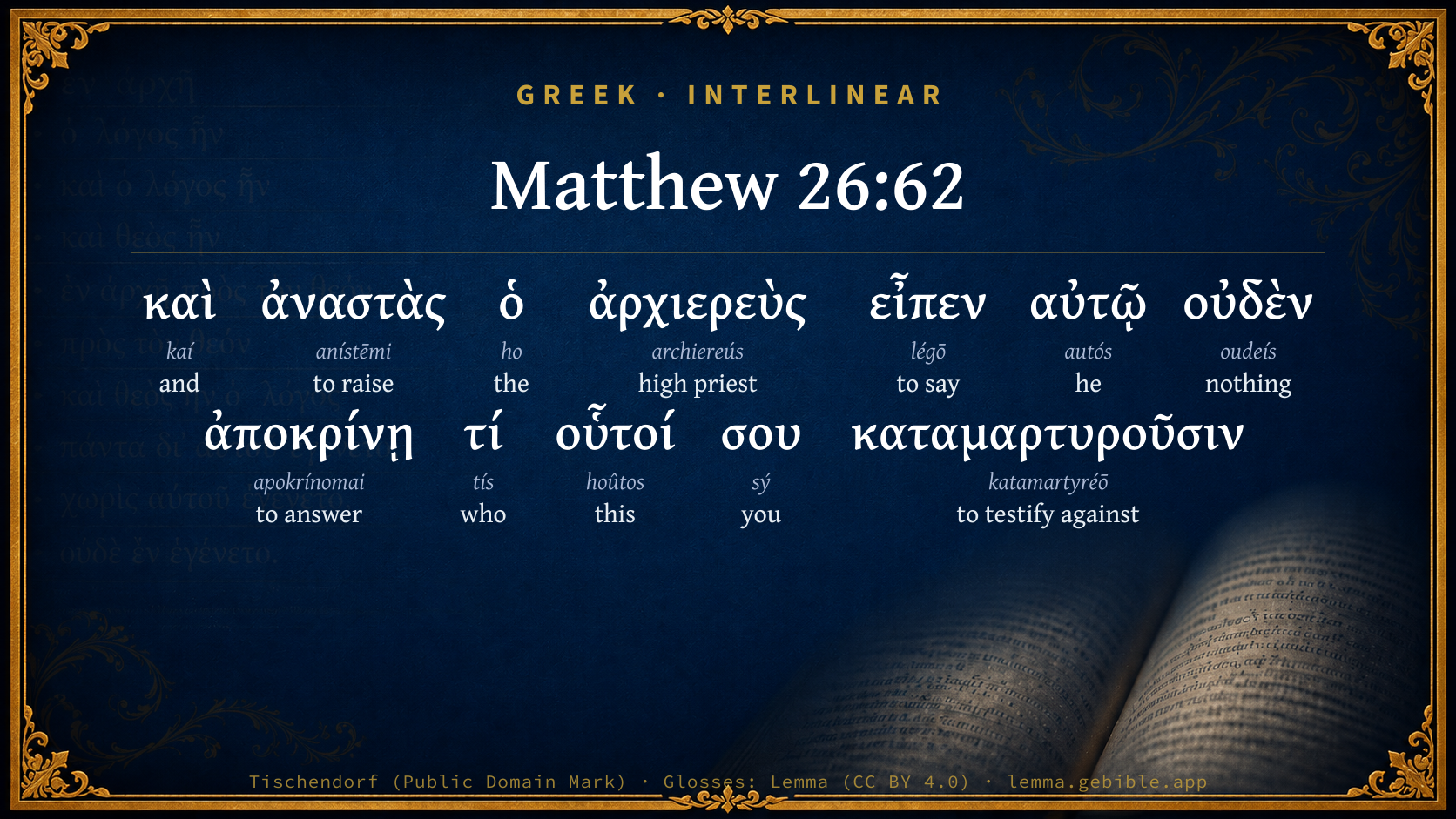
Greek (Tischendorf 8th ed.) Matthew 26:62 appears in the Greek New Testament. The text above is from the Tischendorf 8th edition. Each word links to its Strong’s number and a concise gloss. Click any word for its full Thayer’s Greek Lexicon entry.
Download image
Cite this verse

Matthew 26:62 (World English Bible). Public Domain. Lemma interlinear Bible study tool, https://lemma.gebible.app/v/matthew/26/62.

Show BibTeX & RIS
BibTeX
RIS
English Translation
The high priest stood up, and said to him, "Have you no answer? What is this that these testify against you?"
World English Bible · Public Domain
Highlights
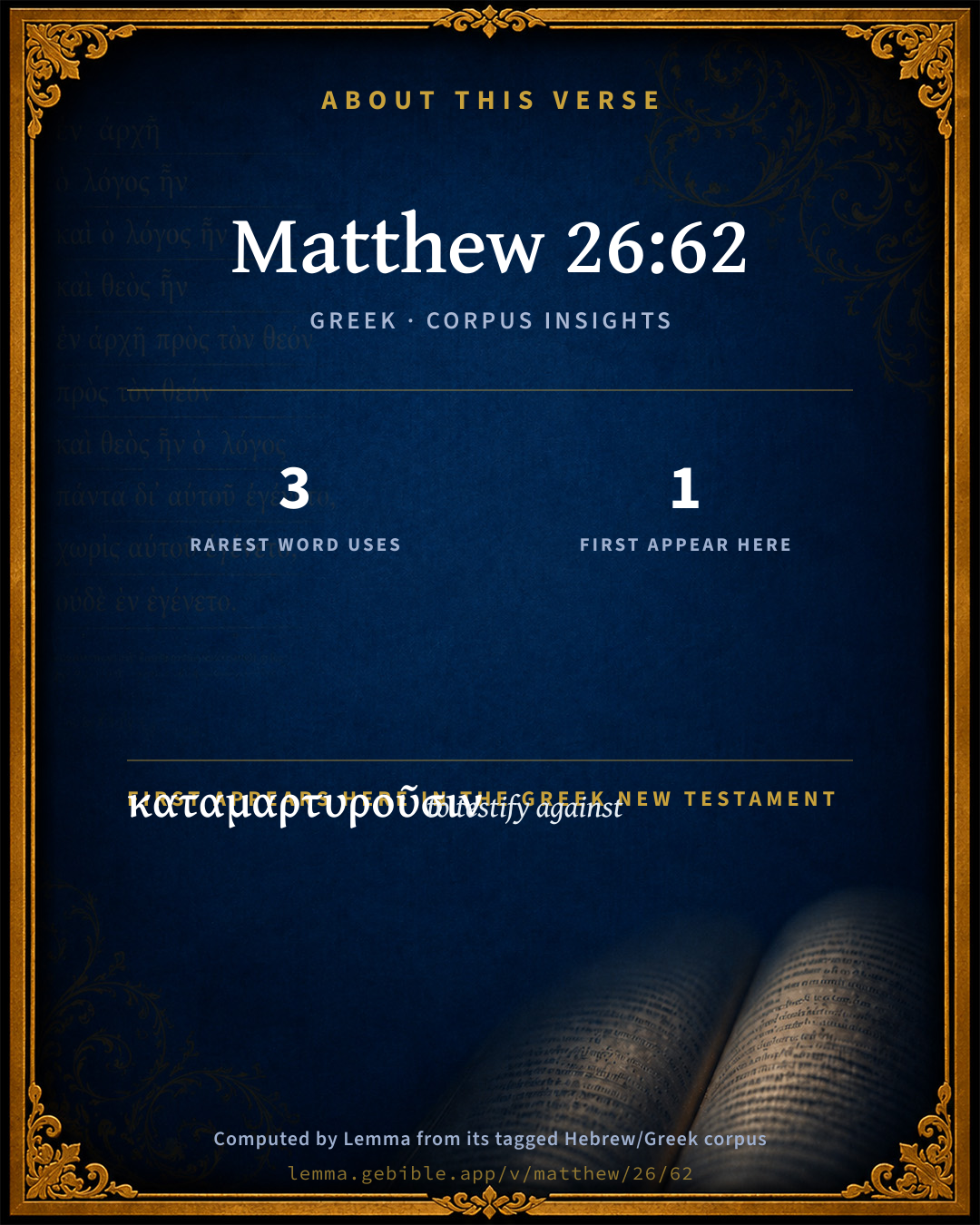
  • 1 first appearance in the Greek New Testament
Full analysis ↓
Download a study sheet

One document with this verse’s original text, its word-by-word gloss line, the meaning frame, cross-references with their text, attributed commentary, and full source and license credits — printable, and it pastes into notes with its structure intact.

This verse Autodidact and up

Study sheet (.html) Plain text (.txt)

A passage Seminary Student

Up to 50 verses in one chapter. A passage sheet keeps up to 6 commentary sources and 12 cross-references per verse, in the order this page ranks them, and says so on the sheet whenever that leaves anything out. Ask for a single verse and you get the Autodidact verse sheet above.

Everything on this page stays free to read, with no account — the sheet is a download of what is already on screen, not access to it.

Want to remove ads? Support Godless Engineer
Compare translations 3

The same verse in 3 English versions, stacked beneath the original-language interlinear above. Click any original word for its lexicon entry.

Each is an independent rendering of the whole verse — the interlinear is not word-aligned to these translations.

Highlighted words mark where these versions differ — a whole-verse word diff, not a word-by-word alignment.

  • World English Bible Public Domain
    The high priest stood up, and said to him, "Have you no answer? What is this that these testify against you?"
  • King James Version Public Domain
    And the high priest arose, and said unto him, Answerest thou nothing? what is it which these witness against thee?
  • unfoldingWord Literal Text CC BY-SA 4.0
    And having stood up, the high priest said to him, “Do you answer nothing? What are these testifying against you?”

unfoldingWord Literal Text — © unfoldingWord, licensed CC BY-SA 4.0. Word-aligned USFM3 via Door43 (git.door43.org/unfoldingWord/en_ult).

Versions to compare (up to 4)

3 of 4 selected

Show all 19 translations

Every available English version of this verse, each an independent rendering of the whole verse.

  • World English Bible Public Domain
    The high priest stood up, and said to him, "Have you no answer? What is this that these testify against you?"
  • Berean Standard Bible Public Domain
    So the high priest stood up and asked Him, “Have You no answer? What are these men testifying against You?”
  • Majority Standard Bible Public Domain
    So the high priest stood up and asked Him, “Have You no answer? What are these men testifying against You?”
  • King James Version Public Domain
    And the high priest arose, and said unto him, Answerest thou nothing? what is it which these witness against thee?
  • American Standard Version (1901) Public Domain
    And the high priest stood up, and said unto him, Answerest thou nothing? what is it which these witness against thee?
  • Revised Version (1885) Public Domain
    And the high priest stood up, and said unto him, Answerest thou nothing? what is it which these witness against thee?
  • Geneva Bible (1599) Public Domain
    Then the chiefe Priest arose, and sayde to him, Answerest thou nothing? What is the matter that these men witnesse against thee?
  • Douay-Rheims (1899) Public Domain
    And the high priest rising up, said to him: Answerest thou nothing to the things which these witness against thee?
  • Young's Literal Translation Public Domain
    And the chief priest having stood up, said to him, `Nothing thou dost answer! what do these witness against thee?
  • Literal Standard Version CC BY-SA 4.0
    And the chief priest having stood up, said to Him, “Nothing You answer? What do these witness against You?”
  • Unlocked Literal Bible CC BY-SA 4.0
    The high priest stood up and said to him, “Do you have no answer? What is it that they are testifying against you?”
  • unfoldingWord Literal Text CC BY-SA 4.0
    And having stood up, the high priest said to him, “Do you answer nothing? What are these testifying against you?”
  • Darby Bible Public Domain
    And the high priest standing up said to him, Answerest thou nothing? What do these witness against thee?
  • World Messianic Bible Public Domain
    The high priest stood up and said to him, “Have you no answer? What is this that these testify against you?”
  • Webster's Bible Public Domain
    And the high priest arose, and said to him, Answerest thou nothing, what is it which these testify against thee?
  • Free Bible Version CC BY-SA 4.0
    The high priest stood up and asked Jesus, “Have you no answer? What do you have to say in your defense?”
  • Bible in Basic English Public Domain
    And the high priest got up and said to him, Have you no answer? what is it which these say against you?
  • Text-Critical English NT CC BY 4.0
    So the high priest stood up and said to him, “Do yoʋ make no answer? What are these men testifying against yoʋ?”
  • Tyndale New Testament (1534) Public Domain
    And the chefe preste arose and sayde to him: answerest thou nothinge? How is it that these beare witnes ageynst the?

Literal Standard Version (2020), Covenant Press — licensed CC BY-SA 4.0. Text via the HelloAO Bible API (eBible.org). Unlocked Literal Bible (unfoldingWord) — licensed CC BY-SA 4.0. Text via the HelloAO Bible API (eBible.org). unfoldingWord Literal Text — © unfoldingWord, licensed CC BY-SA 4.0. Word-aligned USFM3 via Door43 (git.door43.org/unfoldingWord/en_ult). Free Bible Version, Dr. Jonathan Gallagher — licensed CC BY-SA 4.0. Text via the HelloAO Bible API (eBible.org).

Word by word

More ways to search: Search by grammar → Find every occurrence → Compare this word →

Practice this passage: Drill this verse → Learn its vocabulary →

καταμαρτυροῦσιν
katamartyréō
G2649
“to testify against”
Verb, Present, Active, Indicative, 3rd person, Plural
Part of Speech
Verb
Tense
Present
Voice
Active
Mood
Indicative
Person
3rd person
Number
Plural
Full Thayer's Definition

Origin: from G2596 and G3140

TDNT: 12:28,6

1. to bear witness against, to testify against one
  1. καὶ kaí G2532 “and” Conjunction
  2. ἀναστὰς anístēmi G450 “to raise” Verb, Aorist, Active, Participle, Nominative, Singular, Masculine
  3. ὁ ho G3588 “the” Article, Nominative, Singular, Masculine
  4. ἀρχιερεὺς archiereús G749 “high priest” Noun, Nominative, Singular, Masculine
  5. εἶπεν légō G3004 “to say” Verb, Aorist, Active, Indicative, 3rd person, Singular
  6. αὐτῷ autós G846 “he” Personal pronoun, Dative, Singular, Masculine
  7. οὐδὲν oudeís G3762 “nothing” Adjective, Accusative, Singular, Neuter, Negative
  8. ἀποκρίνῃ apokrínomai G611 “to answer” Verb, Present, Middle or Passive deponent, Indicative, 2nd person, Singular
  9. τί tís G5101 “who” Interrogative pronoun, Accusative, Singular, Neuter
  10. οὗτοί hoûtos G3778 “this” Demonstrative pronoun, Nominative, Plural, Masculine
  11. σου sý G4771 “you” Personal pronoun, 2nd person, Genitive, Singular

About this verse

These counts appear in no published source. They are computed here, from the morphology-tagged text and Lemma’s own curated glosses. What Lemma adds →

12
words
12
distinct lemmas
Gospels
section

Notable vocabulary

The rarest word here is καταμαρτυροῦσιν to testify against G2649 — appearing just 3 times in the whole Greek New Testament.

First appearance in Scripture

This word makes its first canonical appearance in the Greek New Testament here:

  • καταμαρτυροῦσιν to testify against G2649

Shared distinctive vocabulary

καταμαρτυροῦσιν to testify against G2649 occurs in 3 verses of the Greek New Testament. Also found in:
Cross-references

5

Topical passages linked to Matthew 26:62 in the Treasury of Scripture Knowledge — connected by theme and wording, ordered by reader-vote popularity; previews shown in the World English Bible.

  • John 18:19–24 The high priest therefore asked Jesus about his disciples, and about his teaching.
  • John 19:9–11 He entered into the Praetorium again, and said to Jesus, "Where are you from?" But Jesus gave him no answer.
  • Matthew 27:12–14 When he was accused by the chief priests and elders, he answered nothing.
  • Mark 14:60 The high priest stood up in the midst, and asked Jesus, "Have you no answer? What is it which these testify against you?"
  • Luke 23:9 He questioned him with many words, but he gave no answers.

Cross-references courtesy of OpenBible.info (CC BY 4.0).

Commentary

Notes on Matthew 26:62 from classic Christian and Jewish commentators (each source and its license shown beneath its notes). The classic Christian expositions comment on the surrounding passage and are grouped to its opening verse, so a note may address several verses; the Jewish commentaries on the Tanakh (Rashi and others) are per-verse, so they appear only where the commentator wrote on this verse.

Lemma curates 59 commentaries, every one of them public domain or Creative Commons licensed, each selected and text-cleaned for this edition rather than reprinted as found. About our sources →

Joseph Benson's Commentary

Mat 26:62-64. And the high-priest arose, (Mark, stood up in the midst,) and said, Answerest thou nothing? — When the high-priest found that Jesus took little notice of the things which the witnesses alleged against him, he rose from his seat in a passion, supposing that our Lord intended to put an affront upon the council, and desired him to give the reason of his conduct. But finding this in vain, in order to cut the trial short and insnare him, he adjured him, or required him to answer upon oath, whether or not he was the Christ. I adjure thee — Εξορκιζω σε. “This appears to have been the Jewish manner of administering an oath. The Hebrews השׂכיע, which in the Old Testament is commonly, by our interpreters, rendered, to make one swear, is justly translated by the LXX. ορκιζω, or εξορκιζω. Thus, Gen 24:3, where we have an account of the oath administered by Abraham to his steward, which is rendered in our Bible, I will make thee swear by the Lord, the God of heaven, &c., is thus expressed in the LXX., εξορκιω σε Κυριον τον Θεον του ουρανου, &c. I adjure thee by Jehovah, the God of heaven and earth. After such adjuration by a magistrate, or lawful superior, the answer returned by the person adjured was an answer upon oath: a false answer was perjury; and even the silence of the person adjured was not deemed innocent.” He was under the necessity of giving an explicit answer, and of speaking the whole truth without disguise. Compare Exo 22:11; Lev 5:1; and Pro 29:24. See Campbell. “The craft of the question lay in this, that if Jesus answered it in the affirmative, they were ready to condemn him as a blasphemer; but if in the negative they proposed to punish him as an impostor, who, by accepting the honours and titles of the Messiah from the people, had deceived them.” Jesus saith, Thou hast said, that is, as Mark expresses it, I am. Being put upon oath, or, according to Jewish customs, adjured by the magistrate, he no longer declines answering. And he adds, Nevertheless, Gr. πλην, moreover, I say unto you, Hereafter shall ye see the Son of man — He speaks in the third person, modestly, yet plainly: sitting on the right hand of power — That is, of God: and coming in the clouds of heaven — As he is represented by Dan 7:13-14. Our Lord looked very unlike that person now! But nothing could be more awful, more majestic, and becoming, than such an admonition in such circumstances! The sending down of the Holy Ghost, the wonderful progress of the gospel, the destruction of Jerusalem, of the temple, and of the Jewish state, were unquestionable proofs and demonstrations shown forth by Jesus Christ of the infinite power wherewith he was invested at the right hand of God.

Joseph Benson's Commentary on the Old and New Testaments (1811–1818) — public domain. Text from a community e-Sword module.

Bengel's Gnomon

Johann Albrecht Bengel

Mat 26:62. Τί, κ.τ.λ., what etc.?) A separate interrogation.

Bengel's Gnomon of the New Testament — English translation (T&T Clark, Edinburgh, 1860) — public domain. Text from a community e-Sword module.

Meyer's Critical & Exegetical Commentary

Heinrich August Wilhelm Meyer

Mat_26:62. With the sublime calm of one who is conscious of his own superior worth, Jesus meekly abstains from uttering a single word before this contemptible tribunal in the way of self-vindication, εἰδὼς δὲ καὶ, ὅτι μάτην ἀποκρινεῖται παρὰ τοιούτοις, Euthymius Zigabenus; whereas the high priest who finds, and that with considerable gratification, that the charge of being a Messianic pretender is now fully substantiated by the language of Jesus just deponed to (see Mat_26:63), quite forgets himself, and breaks out into a passion.

The breaking up of the following utterance into two questions: answerest thou not? what (i.e. how heinous a matter) do these witness against thee? is, so far as the latter question is concerned, neither feeble (de Wette) nor unnatural (Weiss), but entirely in keeping with the passionate haste of the speaker. This being the case, the two clauses should not be run into one. We should neither, on the one hand, following Erasmus, with Fritzsche, take τί in the sense of cur, or (ad Marc. p. 650) the whole sentence as equivalent to τί τοῦτό ἐστιν, ὃ οὗτοί σου καταμαρτυροῦσιν; nor, on the other, with the Vulgate, Luther, de Wette, Ewald, Bleek, Keim, Weiss, should we adopt the rendering: nihil respondes ad ea, quae isti adversum te testificantur? This latter, however, would not be inconsistent with the strict meaning of the terms employed, for it is quite permissible to use ἀποκρίνεσθαί τι in the sense of: to reply to anything (see Ast, Lex. Plat. I. p. 239), and to take τί as equivalent to ὅ, τι (Buttmann, Neut. Gr. p. 216 [E. T. 251], who supposes hörend (hearing) to be understood before τί).

Meyer — Critical and Exegetical Commentary on the New Testament — English translation by Peter Christie, edited by Frederick Crombie (T&T Clark, 1880) — public domain. Text from a community e-Sword module.

Expositor's Greek Testament

ed. W. Robertson Nicoll

Mat 26:62 . ἀναστὰς ὁ ἀρ .: the high priest rose up not because he felt the evidence just led to be very serious, rather in irritation because the most damaging statements amounted to nothing more serious. A man could not be sentenced to death for a boastful word (Grotius). οὐδὲν ἀποκρίνῃ … καταμαρτυροῦσιν : either one question as in Vulg [143] : “nihil respondes ad ea quae isti adversum te testificantur?” or two as in A. V [144] and R. V [145] , so also Weizsäcker: answerest Thou nothing? what do these witness against Thee? It is an attempt of a baffled man to draw Jesus into explanations about the saying which will make it more damaging as evidence against Him. What about this pretentious word of yours; is it true that you said it, and what does it mean?

[143] Vulgate (Jerome’s revision of old Latin version).

[144] Authorised Version.

[145] Revised Version.

The Expositor's Greek Testament, edited by W. Robertson Nicoll (1897–1910) — public domain. Text from a community e-Sword module.

Geneva Bible (1599)

Geneva Bible translators

How cometh it to pass that these men witness against thee?

Geneva Bible (1599) marginal notes — public domain. Text via Bolls.life.

Adam Clarke's Commentary

Verse 62. Answerest thou nothing?] The accusation was so completely frivolous that it merited no notice: besides, Jesus knew that they were determined to put him to death, and that his hour was come; and that therefore remonstrance or defence would be of no use: he had often before borne sufficient testimony to the truth.

Adam Clarke's Commentary on the Bible (1810–1826) — public domain. Text from a community e-Sword/MySword module.

Ellicott's Commentary for English Readers

(62) Answerest thou nothing?—A different punctuation gives, Answerest Thou nothing to what these witness against Thee? as one question. The question implies a long-continued silence, while witness after witness were uttering their clumsy falsehoods, the effect of which it is not easy to realise without a more than common exercise of what may be called dramatic imagination. I remember hearing from a distinguished scholar who had seen the Ammergau Passion-mystery, that, as represented there, it came upon him with a force which he had never felt before. In the silence itself we may perhaps trace a deliberate fulfilment of the prophecy of Isa_53:7. In 1Pe_2:23 we find a record of the impression which that fulfilment made on the disciples.

What is it . . .?—The question was clearly put, as it had been before Annas (Joh_18:19), with the intention of drawing out something that would ensure condemnation.

A Bible Commentary for English Readers, edited by Charles John Ellicott (1878–1897) — public domain. Text from a community e-Sword module.

John Gill's Exposition

But Jesus held his peace,.... Knowing it would signify nothing, whatever he should say, they being set upon his death, the time of which was now come; and therefore he quietly submits, and says nothing in his own defence to prevent it. To be silent in a court of judicature, Apollonius Tyanaeus (c) says, is the fourth virtue; this Christ had, and all others:

and the high priest answered and said unto him; though Christ had said nothing, a way of speaking very frequent among the Jews, and in the sacred writings:

I adjure thee by the living God, that thou tell us whether thou be the Christ, the Son of God; the Christ; the anointed, that David speaks of in the second Psalm, and who is there said to be the Son of God, Psa 2:2, to which the high priest seems to have respect; since there is no other passage, in which both these characters meet; and which was understood by the ancient Jews of the Messiah, as is owned by modern ones (d). Jesus was given out to be the Messiah, and his disciples believed him to be the Son of God, and he had affirmed himself to be so; wherefore the high priest, exerting his priestly power and authority, puts him upon his oath; or at least with an oath made by the living God, charges him to tell the truth, and which when ever any heard the voice of swearing, he was obliged to do, Lev 5:1.

(c) Philostrat. Vita Apollouii, l. 8. c. 1. (d) Jarchi & Aben Ezra in Psal. ii. 1. & Kimchi in ver. 12.

John Gill's Exposition of the Whole Bible (1746–1763) — public domain (CC PDM 1.0). Text via the HelloAO Bible API.

Trapp's Complete Commentary

John Trapp

62 And the high priest arose, and said unto him, Answerest thou nothing? what is it which these witness against thee?

Ver. 62. Answerest thou nothing?] No, nothing, unless it had been to better purpose; for σιγαν χρη, η κρεισσονα σιγης λεγειν, saith the wise heathen. Either hold thy peace or say something that is worth hearing. And, πασιν απολογεισθαι θεραπευτικον. (Plato.) To answer every slight accusation is servile. Some are so thin they may be seen through, others so gross that they need no refutation. {a} These hypocrites were not worthy of an answer from our Saviour, who knew also that now was the time not of apologizing, but of suffering; therefore "as a sheep before her shearers is dumb, so he opened not his mouth," Isa 53:7. Besides, he saw that his enemies were resolved to have his blood, and therefore held it more glorious, τη σιωπη το ονειδος πνιγειν, as Basil hath it, to choke their spite with silence, et iniuriam tacendo fugere, potius quam respondendo superare, as another saith, to set them down by saying nothing.

{a} Tenue mendacium pellucet. Sen.

John Trapp, A Commentary or Exposition upon All the Books of the Old and New Testament (1647–1656) — public domain. Text from a community e-Sword module.

Albert Barnes' Notes on the Bible

Jesus held his peace - Was silent. He knew that the evidence did not even appear to amount to anything worth a reply. He knew that they were aware of that, and that feeling that, the high priest attempted to draw something from him on which they could condemn him.

I adjure thee by the living God - I put thee upon thy oath before God. This was the usual form of putting an oath among the Jews. It implies calling God to witness the truth of what was said. The law respecting witnesses also made it a violation of an oath to conceal any part of the truth; and though our Saviour might have felt that such a question, put in such a manner, was very improper or was unlawful, yet he also knew that to be silent would be construed into a denial of his being the Christ. The question was probably put in auger. They had utterly failed in their proof. They had no way left to accomplish their purpose of condemning him but to draw it from his own lips. This cunning question was therefore proposed. The difficulty of the question consisted in this: If he confessed that he was the Son of God, they stood ready to condemn him for “blasphemy;” if he denied it, they were prepared to condemn him for being an impostor, and for deluding the people under the pretence of being the Messiah.

The living God - Yahweh is called the living God in opposition to idols, which were without life.

The Christ - The Messiah, the Anointed. See the notes at Mat 1:1.

The Son of God - The Jews uniformly expected that the Messiah would be the Son of God. In their view it denoted, also, that he would be “divine,” or equal to the Father, Joh 10:31-36. To claim that title was therefore, in their view, “blasphemy;” and as they had determined beforehand in their own minds that he was not the Messiah, they were ready at once to accuse him of blasphemy.

Albert Barnes' Notes on the Bible (1834–1885) — public domain. Text from a community e-Sword/MySword module.

Matthew Poole's English Annotations

Mark speaks to the same purpose, Mar 14:60,61. The high priest expected a long defence, and so to have had matter of accusation against him out of his own mouth. Christ disappointeth him, saying nothing at all, either out of modesty, or not thinking what they said of any moment, or worthy of any reply, or perhaps seeing that they could not agree in their tale, so as what they said was of no force against him. The high priest therefore comes at last to examine him, ex officio. Mark saith, Mar 14:61, Again the high priest asked him, and said unto him, Art thou the Christ, the Son of the Blessed. Luke, to give us the story of Peter, from his first coming into the high priest’s hall to his going out, entire, interrupts himself a little in his relation of their dealings with Christ, and then relates some indignities offered him which the other evangelists do not mention; which seem to have been offered him where the soldiers and the rabble had been before he appeared in the council: Luk 22:63-67, And the men that held Jesus mocked him, and smote him. And when they had blindfolded him, they struck him on the face, and asked him, saying, Prophesy, who is it that smote thee? And many other things blasphemously spake they against him. And as soon as it was day, the elders of the people, and the chief priests, and the scribes came together, and led him into their council. Then he mentions nothing of what the witnesses said, possibly because it was nothing of moment, nothing upon which they proceeded against our Saviour for his life, but goes on, saying, Art thou the Christ? tell us. Matthew saith, Art thou the Christ, the Son of the living God? Mark, the Son of the Blessed. It is plain both from this text, and from Joh 1:49, that the Jews did expect a Messiah who should be the Son of the ever living and blessed God; but whether they understood that he should be the Son of God by nature and eternal generation, or only by a more special adoption, than the whole Jewish nation was, (to whom the apostle saith belonged the adoption), I cannot say.

I adjure thee that thou tell us, that is, as some say, I charge thee upon thy oath to tell me; but it doth not appear that they had given any such oath to him, the guilty person was not wont to be forced by an oath to accuse himself, neither is it very probable that our Saviour would have taken such an oath. The sense therefore seemeth to be rather, I command, or require, or charge thee, as solemnly as if thou hadst taken an oath, (as in the presence of God), to tell us. Or, I charge thee with a terrible imprecation on thee, if thou speakest falsely, or wilt be silent, to declare if thou be the Christ, the Son of the living God.

Matthew Poole's English Annotations on the Holy Bible (1683–1685) — public domain. Text from a community e-Sword/MySword module.

Whedon's Commentary on the Bible

Daniel D. Whedon

62. Answerest thou nothing? — Our Lord was most wisely silent; for what was there in his words, thus given in evidence, to answer? The high priest here behaves most unbecomingly in endeavouring to give importance to what he must have been conscious was nothing.

Daniel D. Whedon (gen. ed.), Commentary on the Old and New Testaments (1874–1909) — public domain. Text from a community e-Sword module.

The Pulpit Commentary

The high priest Caiaphas arose. As if in indignation at the outrage offered by this vaunt to Jehovah and the sanctuary. But the indignation was assumed and theatrical; for even this charge had broken down, owing to the disagreement of the two witnesses. (Mar_14:59) Something more definite must be secured before any formal appeal could be made to the Sanhedrin or the procurator. Answerest thou nothing? The angry president endeavours to browbeat the Prisoner, and to make him criminate himself by intemperate language or indiscreet admission. What is it which these witness against thee? The Received Text (followed here by Westcott and Hort) divides the high priest"s words into two questions, as in the Authorized Version. The Vulgate unites the two into one, Nihil respondes ad ea quae isti adversum te testificantur? Alford, Tischendorf, etc., print, Oudenh ti outoi sou katamarturousin ; "Answerest thou not what it is which these witness against thee?" Caiaphas professes a desire to hear Christ"s explanation of the words just alleged against him.

The Pulpit Commentary (1880–1919), ed. H.D.M. Spence-Jones & Joseph S. Exell — public domain. Text from a community e-Sword module.

The People's New Testament

B. W. Johnson

62, 63. Answerest thou nothing? Under the false charges Jesus maintained an impressive silence. “As a sheep before the shearers is dumb, so he opened not his mouth.”

I adjure thee, etc. This was the formula for an oath. The High Priest, contrary to the principle of law which forbids that a prisoner shall be compelled to criminate himself, called on Jesus to be a witness against himself. To answer yes, or no, to such a question, was to answer under oath.

B. W. Johnson's The People's New Testament with Notes (1889–1891) — public domain. Electronic text from the Christian Classics Ethereal Library (CCEL) ThML edition.

unfoldingWord translationNotes

Door43 World Missions Community

What is it that they are testifying against you?

The chief priest is not asking Jesus for information about what the witnesses said. He is asking Jesus to prove what the witnesses said is wrong. AT: "What is your response to what the witnesses are testifying against you?"

Son of God

This is an important title that describes the relationship between the Christ and God. (See: Translating Son and Father)

the living God

Here "living" contrasts the God of Israel to all the false gods and idols that people worshiped. Only the God of Israel is alive and has power to act. See how you translated this in Matthew 16:16.

You have said it yourself

This is an idiom that Jesus uses to mean "yes" without being completely clear about what he means. AT: "You are saying it" or "You are admitting it" (See: Idiom)

But I tell you, from now on you

Here "you" is plural. Jesus is speaking to the high priest and to the other persons there. (See: Forms of You)

from now on you will see the Son of Man

Possible meanings are 1) the phrase "from now on" is an idiom that means they will see the Son of Man in his power at some time in the future or 2) the phrase "from now on" means that from the time of Jesus' trial and onward, Jesus is showing himself to be the Messiah who is powerful and victorious.

the Son of Man

Jesus is speaking about himself in third person. (See: First, Second, or Third Person)

sitting at the right hand of Power

Here "Power" is metonym that represents God. To sit at the "right hand of God" is a symbolic action of receiving great honor and authority from God. AT: "sitting in the place of honor beside the all-powerful God" (See: Metonymy and Symbolic Action)

coming on the clouds of heaven

"riding to earth on the clouds of heaven"

translationWords

high priest

command

life

God

Christ

Son of God

Son of Man

right hand

power

heaven

unfoldingWord translationNotes — © Distant Shores Media and the Door43 World Missions Community, licensed CC BY-SA 4.0. Source: git.door43.org/Door43/en_tn.

Alford’s Greek Testament

Henry Alford

62.] Dost thou not answer what it is which these testify against thee? i.e. wilt Thou give no explanation of the words alleged to have been used by Thee? Our Lord was silent; for in answering He must have opened to them the meaning of these his words, which was not the work of this His hour, nor fitting for that audience. It is not easy to say whether this sentence ought to be taken as one question or two. Meyer, in his former editions, maintained the latter, on the ground that ἀποκρίνῃ would require πρός after it. But he has now discovered in his fourth edition that ἀποκρίνεσθαι may be constructed with an accusative simply, and that τί may be equivalent to ὅτι. So that there is no serious objection remaining to the usual way of construction.

Henry Alford, The Greek Testament (1849–1861) — public domain. Text from a community e-Sword module.

International Critical Commentary

(M) 62. And the high priest rose up, and said to Him, Dost Thou answer nothing? what do these witness against Thee?] Mk. has: “And the high priest rose up into the midst, and asked Jesus, saying, Dost Thou not answer anything? what do these witness against Thee?” Mt. omits Mk.’s οὐκ; see on 27:14.

International Critical Commentary — older volumes (1896–1929), various authors — public domain. Text from a community e-Sword module.

Lesson kit

Teaching starters — assembled from the data on this page, not authored interpretation. Every prompt links to the verse data it draws on. Edit before teaching.

Matthew, in the Gospels, opens this verse with 12 words (12 distinct Greek lemmas). Its most distinctive word is katamartyréō (“to testify against”). A historical commentator’s framing appears above. Read the whole chapter for the surrounding context.

Discussion questions

  1. What does “to testify against” (katamartyréō) contribute to the verse as a whole?
  2. The word “to testify against” first appears here in Scripture. What is being introduced at this debut?
  3. Matthew 27:13 shares the word «to testify against» with this verse. How do the two illuminate each other?
  4. The translations on this page render this verse differently — a whole-verse word diff, not a word-by-word alignment. What might account for the different wordings?
  5. Reading how Joseph Benson's Commentary and Bengel's Gnomon read this verse, where do the two commentators agree and where do they part?

Things to notice

  • 1 word makes its first canonical appearance in Scripture here.
  • These translations choose different wording for 14 words in this verse.
  • 12 distinct Greek lemmas span 12 words in this verse.

Reading settings

Reading text

Shown beneath each verse's original-language words.

Old Testament
Old Testament edition

Read the OT as the Masoretic Hebrew (MT) or the Greek Septuagint (LXX).

English shown for the Greek Septuagint (in the Hebrew ↔ Greek comparison).

Comparing translations? Open the Compare panel on any verse page to stack up to four side by side.