
Luke 8:16

Greek (Tischendorf 8th ed.) Luke 8:16 appears in the Greek New Testament. The text above is from the Tischendorf 8th edition. Each word links to its Strong’s number and a concise gloss. Click any word for its full Thayer’s Greek Lexicon entry.
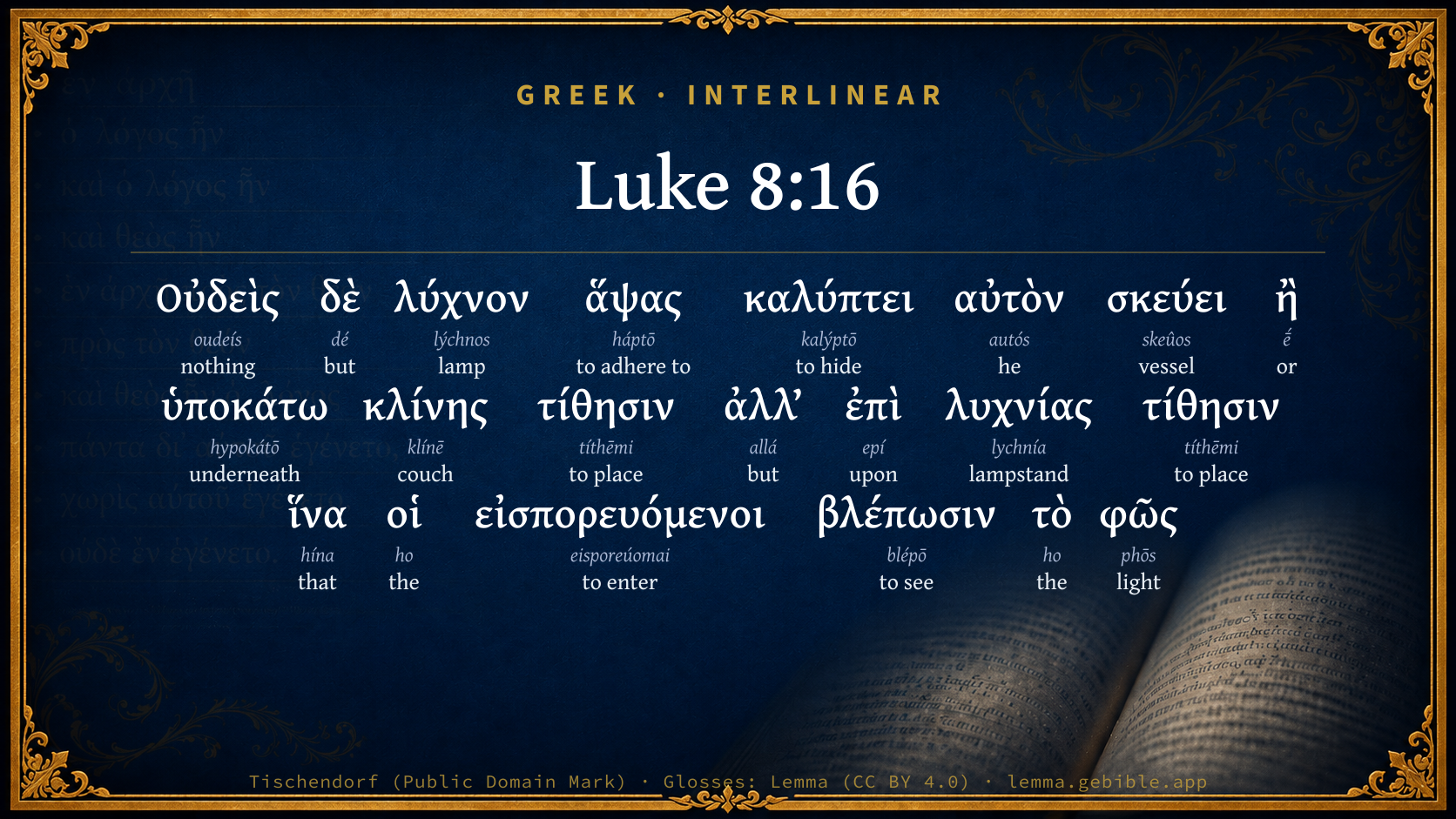
Download image
Cite this verse

Luke 8:16 (World English Bible). Public Domain. Lemma interlinear Bible study tool, https://lemma.gebible.app/v/luke/8/16.

Show BibTeX & RIS
BibTeX
RIS
English Translation
"No one, when he has lit a lamp, covers it with a container, or puts it under a bed; but puts it on a stand, that those who enter in may see the light.
World English Bible · Public Domain
Highlights
  • 1 first appearance in the Greek New Testament
Full analysis ↓
Download a study sheet

One document with this verse’s original text, its word-by-word gloss line, the meaning frame, cross-references with their text, attributed commentary, and full source and license credits — printable, and it pastes into notes with its structure intact.

This verse Autodidact and up

Study sheet (.html) Plain text (.txt)

A passage Seminary Student

Up to 50 verses in one chapter. A passage sheet keeps up to 6 commentary sources and 12 cross-references per verse, in the order this page ranks them, and says so on the sheet whenever that leaves anything out. Ask for a single verse and you get the Autodidact verse sheet above.

Everything on this page stays free to read, with no account — the sheet is a download of what is already on screen, not access to it.

Want to remove ads? Support Godless Engineer
Compare translations 3

The same verse in 3 English versions, stacked beneath the original-language interlinear above. Click any original word for its lexicon entry.

Each is an independent rendering of the whole verse — the interlinear is not word-aligned to these translations.

Highlighted words mark where these versions differ — a whole-verse word diff, not a word-by-word alignment.

  • World English Bible Public Domain
    "No one, when he has lit a lamp, covers it with a container, or puts it under a bed; but puts it on a stand, that those who enter in may see the light.
  • King James Version Public Domain
    No man, when he hath lighted a candle, covereth it with a vessel, or putteth it under a bed; but setteth it on a candlestick, that they which enter in may see the light.
  • unfoldingWord Literal Text CC BY-SA 4.0
    And no one, having lit a lamp, covers it with a bowl or puts under a bed. Rather, he puts on a lampstand so that those who enter may see the light.

unfoldingWord Literal Text — © unfoldingWord, licensed CC BY-SA 4.0. Word-aligned USFM3 via Door43 (git.door43.org/unfoldingWord/en_ult).

Versions to compare (up to 4)

3 of 4 selected

Show all 19 translations

Every available English version of this verse, each an independent rendering of the whole verse.

  • World English Bible Public Domain
    "No one, when he has lit a lamp, covers it with a container, or puts it under a bed; but puts it on a stand, that those who enter in may see the light.
  • Berean Standard Bible Public Domain
    No one lights a lamp and covers it with a jar or puts it under a bed. Instead, he sets it on a stand, so those who enter can see the light.
  • Majority Standard Bible Public Domain
    No one lights a lamp and covers it with a jar or puts it under a bed. Instead, he sets it on a stand, so those who enter can see the light.
  • King James Version Public Domain
    No man, when he hath lighted a candle, covereth it with a vessel, or putteth it under a bed; but setteth it on a candlestick, that they which enter in may see the light.
  • American Standard Version (1901) Public Domain
    And no man, when he hath lighted a lamp, covereth it with a vessel, or putteth it under a bed; but putteth it on a stand, that they that enter in may see the light.
  • Revised Version (1885) Public Domain
    And no man, when he hath lighted a lamp, covereth it with a vessel, or putteth it under a bed; but putteth it on a stand, that they which enter in may see the light.
  • Geneva Bible (1599) Public Domain
    No man when he hath lighted a candle, couereth it vnder a vessell, neither putteth it vnder the bed, but setteth it on a candlesticke, that they that enter in, may see the light.
  • Douay-Rheims (1899) Public Domain
    Now no man lighting a candle covereth it with a vessel, or putteth it under a bed; but setteth it upon a candlestick, that they who come in may see the light.
  • Young's Literal Translation Public Domain
    `And no one having lighted a lamp doth cover it with a vessel, or under a couch doth put `it'; but upon a lamp-stand he doth put `it', that those coming in may see the light,
  • Literal Standard Version CC BY-SA 4.0
    And no one having lighted a lamp covers it with a vessel, or puts [it] under a bed; but he puts [it] on a lampstand, that those coming in may see the light,
  • Unlocked Literal Bible CC BY-SA 4.0
    No one lights a lamp and covers it with a bowl or puts it under a bed. Rather, he puts it on a lampstand so that everyone who enters may see the light.
  • unfoldingWord Literal Text CC BY-SA 4.0
    And no one, having lit a lamp, covers it with a bowl or puts under a bed. Rather, he puts on a lampstand so that those who enter may see the light.
  • Darby Bible Public Domain
    And no one having lighted a lamp covers it with a vessel or puts it under a couch, but sets it on a lamp-stand, that they who enter in may see the light.
  • World Messianic Bible Public Domain
    “No one, when he has lit a lamp, covers it with a container or puts it under a bed; but puts it on a stand, that those who enter in may see the light.
  • Webster's Bible Public Domain
    No man, when he hath lighted a candle, covereth it with a vessel, or putteth it under a bed; but setteth it on a candlestick, that they who enter in may see the light.
  • Free Bible Version CC BY-SA 4.0
    You don't light a lamp and then cover it with a bucket, or hide it under a bed. No, you put it on a stand, so that anyone who comes in can see the light.
  • Bible in Basic English Public Domain
    No man, when the light is lighted, puts a cover over it, or puts it under a bed, but he puts it on its table, so that those who come in may see the light.
  • Text-Critical English NT CC BY 4.0
    “No one lights a lamp and covers it with a container or puts it under a bed. Instead, it is put on a lampstand, so that those who come in can see its light.
  • Tyndale New Testament (1534) Public Domain
    No man lyghteth a candell and covereth it vnder a vessell nether putteth it vnder the table: but setteth it on a candelsticke that they that enter in maye se the lyght.

Literal Standard Version (2020), Covenant Press — licensed CC BY-SA 4.0. Text via the HelloAO Bible API (eBible.org). Unlocked Literal Bible (unfoldingWord) — licensed CC BY-SA 4.0. Text via the HelloAO Bible API (eBible.org). unfoldingWord Literal Text — © unfoldingWord, licensed CC BY-SA 4.0. Word-aligned USFM3 via Door43 (git.door43.org/unfoldingWord/en_ult). Free Bible Version, Dr. Jonathan Gallagher — licensed CC BY-SA 4.0. Text via the HelloAO Bible API (eBible.org).

Word by word

More ways to search: Search by grammar → Find every occurrence → Compare this word →

Practice this passage: Drill this verse → Learn its vocabulary →

ἅψας
háptō
G681
“to adhere to”
Verb, Aorist, Active, Participle, Nominative, Singular, Masculine
Part of Speech
Verb
Tense
Aorist
Voice
Active
Mood
Participle
Case
Nominative
Number
Singular
Gender
Masculine
Full Thayer's Definition

Origin: a primary word

TDNT: None

1. to fasten to, adhere to a. to fasten fire to a thing, kindle, set of fire
  1. Οὐδεὶς oudeís G3762 “nothing” Adjective, Nominative, Singular, Masculine, Negative
  2. δὲ dé G1161 “but” Conjunction
  3. λύχνον lýchnos G3088 “lamp” Noun, Accusative, Singular, Masculine
  4. καλύπτει kalýptō G2572 “to hide” Verb, Present, Active, Indicative, 3rd person, Singular
  5. αὐτὸν autós G846 “he” Personal pronoun, Accusative, Singular, Masculine
  6. σκεύει skeûos G4632 “vessel” Noun, Dative, Singular, Neuter
  7. ἢ ḗ G2228 “or” Particle
  8. ὑποκάτω hypokátō G5270 “underneath” Adverb
  9. κλίνης klínē G2825 “couch” Noun, Genitive, Singular, Feminine
  10. τίθησιν títhēmi G5087 “to place” Verb, Present, Active, Indicative, 3rd person, Singular
  11. ἀλλ’ allá G235 “but” Conjunction
  12. ἐπὶ epí G1909 “upon” Preposition
  13. λυχνίας lychnía G3087 “lampstand” Noun, Genitive, Singular, Feminine
  14. τίθησιν títhēmi G5087 “to place” Verb, Present, Active, Indicative, 3rd person, Singular
  15. ἵνα hína G2443 “that” Conjunction
  16. οἱ ho G3588 “the” Article, Nominative, Plural, Masculine
  17. εἰσπορευόμενοι eisporeúomai G1531 “to enter” Verb, Present, Middle or Passive deponent, Participle, Nominative, Plural, Masculine
  18. βλέπωσιν blépō G991 “to see” Verb, Present, Active, Subjunctive, 3rd person, Plural
  19. τὸ ho G3588 “the” Article, Accusative, Singular, Neuter
  20. φῶς phōs G5457 “light” Noun, Accusative, Singular, Neuter

About this verse

These counts appear in no published source. They are computed here, from the morphology-tagged text and Lemma’s own curated glosses. What Lemma adds →

21
words
19
distinct lemmas
Gospels
section

Notable vocabulary

The rarest word here is ἅψας to adhere to G681 — appearing just 5 times in the whole Greek New Testament.

First appearance in Scripture

This word makes its first canonical appearance in the Greek New Testament here:

  • ἅψας to adhere to G681

Shared distinctive vocabulary

ἅψας to adhere to G681 occurs in 5 verses of the Greek New Testament. Also found in:
Repetition

Words recur within this verse:

  • τίθησιν to place G5087 ×2
  • οἱ the G3588 ×2

Cross-references

7

Topical passages linked to Luke 8:16 in the Treasury of Scripture Knowledge — connected by theme and wording, ordered by reader-vote popularity; previews shown in the World English Bible.

  • Luke 11:33 "No man, when he has lit a lamp, puts it in a cellar, nor under a basket, but on a stand, that those who enter in may see the light.
  • Matthew 5:15–16 Neither do you light a lamp, and put it under a measuring basket, but on a stand; and it shines to all who are in the house.
  • Mark 4:21–22 He said to them, "Is the lamp brought to be put under a basket or under a bed? Isn't it put on a lampstand?
  • Acts 26:18 to open their eyes, that they may turn from darkness to light and from the power of Satan to God, that they may receive remission of sins and an inheritance among those who are sanctified by faith in me.'
  • Philippians 2:15–16 that you may become blameless and harmless, children of God without blemish in the midst of a crooked and perverse generation, among whom you are seen as lights in the world,
  • Revelation 1:20–2:1 the mystery of the seven stars which you saw in my right hand, and the seven golden lampstands. The seven stars are the angels of the seven assemblies. The seven lampstands are seven assemblies.
  • Revelation 11:4 These are the two olive trees and the two lampstands, standing before the Lord of the earth.

Cross-references courtesy of OpenBible.info (CC BY 4.0).

Commentary

Notes on Luke 8:16 from classic Christian and Jewish commentators (each source and its license shown beneath its notes). The classic Christian expositions comment on the surrounding passage and are grouped to its opening verse, so a note may address several verses; the Jewish commentaries on the Tanakh (Rashi and others) are per-verse, so they appear only where the commentator wrote on this verse.

Lemma curates 59 commentaries, every one of them public domain or Creative Commons licensed, each selected and text-cleaned for this edition rather than reprinted as found. About our sources →

The Biblical Illustrator

Joseph S. Exell

Luk_8:16

No man, when he hath lighted a candle

The lighted lamp

The truth symbolized by this imagery is the self-revealing character of the real disciple of Christ.

His teaching is reproductive as the seed corn, it is diffusive as the light. The lamp is lighted to fill the room with light, and for no other purpose. Similarly all Christian truth which comes to the individual is intended to be diffused in a manner calculated to strike the attention of all who come from darkness into this marvellous light. If we compare the analogous expressions in Matthew, we see how naturally our Lords teaching glided off from this point into exhortations to transparent sincerity. For as the best lamp is one which gives most light, and casts the smallest shade, the best Christian is he who reflects most of Christ and least of self. (F. E. Toyne.)

The place and function of the lamp

We see at a glance that this parable throws some light on the social customs of the age and land in which it was spoken. It reminds us, for instance, that in Palestine, as indeed in ancient Greece and Rome, when the darkness fell, little lamps, containing oil and a wick, were brought into the rooms of all classes of the people and placed on slender stands, commonly some two or three feet high, to give light to all who were in the house. Our Lord uttered this parable to teach us that no man is illuminated for his own sake, just as no lamp is lit for its own sake. Just as the lamp is lit that it may shine, so we are taught that we may teach. No truth is a private possession, just as no truth is of any private interpretation.

Heaven doth with us as we with torches do,

Not light them for themselves; for if our virtues

Did not go forth of us, twere all alike,

As if we had them not.

No truth is, or can be, dangerous. All that we can learn, we may learn. All that we have learned we are bound to teach; all that we have received we are bound to give. To conceal from others any truth which we ourselves have been taught of God is to hide the lamp that has come to us under a bushel or under a couch, instead of setting it under a lampstand. (S. Cox, D. D.)

Difference between this and other versions of the parable

Whereas St. Mark, who wrote mainly for the Romans, speaks of a Roman measure, the modius, St. Luke, who wrote for the whole Gentile world, speaks simply of a vessel, any vessel or measure used throughout the habitable globe. And whereas St. Matthew, writing mainly for Jews, speaks of the lamp as kindled that it may give light unto all that are in the house, St. Luke speaks of it as kindled in order that they who enter into the house may see the light. For St. Matthew was himself a Jew, and wrote for those who, like himself, were already in the household of God; but St. Luke was a Gentile, and wrote for those who, like himself, had a great desire to enter into Gods house and find themselves at home in it. He and they had, so to speak, long stood outside the Fathers house, seeing and desiring the light that shone through its windows; but now Christ had called them into the house, had bidden them enter, had assured them that the house was built and the lamp lit for them as for the Jews, for all who would come into it, as well as for all who are already in it. (S. Cox, D. D. )

The good done by being good

It is somewhat remarkable, and worthy of being remembered, of the late Dr. Charles Hodge, that the closing sentence of an unfinished autobiography--perhaps the last words which he wrote--speaking of a purpose which he formed to hold up a godly companion whom he greatly loved to his students as an example, he wrote I wanted to show them how much good could be done by simply being good.

Hiding the light

A young lady in a fashionable home had been brought to Christ, and had been enabled for some years, amid much opposition, to faithfully witness for Him. The attention she attracted was often painful to her; and once, when repulsed and wounded in an effort of this kind, she for a time lost heart, and felt she should have to give up being a consecrated Christian. Just at this time she was invited to visit friends whelm she had never seen, and who knew but little of her; and she resolved, that while there she would not openly speak of her Saviour, or put herself in a position to be noticed as peculiarly religious. Her visit passed away; and not happily to herself, she was enabled to keep her resolution. Upon the day of her leaving for home, a most attractive and accomplished lady, a fashionable woman of society, while walking alone with her, suddenly asked her, Where is your sister, and why did she not come here? I mean your religious sister, the one who is known as the religious Miss J. It was because I heard that she was to be here that I, too, accepted an invitation to come and spend the holiday. I am tired of the empty, unsatisfying life I am leading, and have longed to talk with a real Christian. With shame and confusion the faithless witness was obliged to confess that she had no sister; that she was the one who had been sometimes called the religious Miss J., and that shame of the badge, that should have been borne gladly for her Saviour, had kept her silent. A precious opportunity to lead a weary soul to the Master had been lost. (D. W.Whittles Life, Warfare, and Victory.)

The Biblical Illustrator, edited by Joseph S. Exell (c. 1880s–1900s) — public domain. Text from a community e-Sword module.

Joseph Benson's Commentary

Luk 8:16-18. No man, when he hath lighted a candle, &c. — See on Mat 5:15; and Mar 4:21. Nothing is secret, &c. — See on Mat 10:26. Take heed, therefore, how ye hear. In Mar 4:24, it is, Take heed what you hear. As it is the indispensable duty of all ministers of the Word to take heed what they preach, 1st, That their doctrine be true, that they may not deceive their hearers. 2d, That it be important, that they may not trifle with them: and, 3d, That it be suitable to their state and character; that they rightly divide the word of truth, and give to every description of hearers their portion of meat in due season; so it concerns all hearers to take heed what they hear. They must not take it for granted that what they hear is true, important, and suited to their state and character: but must bring it to the test of the Holy Scriptures, and examine it thereby; and for that purpose, must endeavour to make themselves well acquainted with the Scriptures: and if they find that, according to the divine oracles, the doctrine which they hear answers the above description, they must so take heed what they hear, as to attend to, and consider it well, that they may thoroughly understand and lay it to heart, and that it may have its designed effect upon their spirit and conduct.

But, according to Luke here, our Lord’s caution, inferred from the preceding parable, implied another thing equally important, Take heed how ye hear — 1st, That you do not hear so inattentively, and in such a prayerless state of mind, as not to understand, nor afterward meditate on what your hear, and so receive the seed as by the way-side. See on Mat 13:19. 2d, That having heard, and understood in a measure what you heard, and being affected thereby, you do not rest in any ineffectual and transient impressions made on your mind, and therefore be offended and fall away in time of trial and temptation; but that the truth may take deep root in your mind, and that you may have root in yourself. See on Mat 13:20-21. Take heed, 3d, That you guard against the cares of the world, the love of deceitful riches, the vain pleasures of life, and desires after other things; those pernicious weeds, which in so many choke the springing blade, or forming ear, so that no fruit is brought forth to perfection. See on Mat 13:22. But hear, 1st, In simplicity of intention, with a single eye to the glory of God and your own salvation, present and eternal. 2d, In sincerity of heart, truly and earnestly desiring to discover and put away every error and every sin, and to know and do the whole will of God. 3d, In humility, conscious that you are unworthy to know the great and important things revealed in the gospel, the will of God, and the way of salvation from such great misery to such great happiness, unworthy that God should speak to you by his Son, and his inspired prophets, apostles, and evangelists. 4th, With reverence, remembering it is God’s word, and you are in God’s presence and under God’s eye. 5th, With seriousness, persuaded the truth you hear is no light matter, but for your life, your better and everlasting life. Would you not hear with seriousness the advice of a skilful physician respecting your health, or of a lawyer concerning your property? And will you not hear with equal, nay, with greater seriousness what concerns you infinitely more? 6th, With deep attention: let no sentence, or even word, that is uttered escape you, and fail not afterward seriously to consider what you have heard, and to examine yourself thereby. 7th, With prayer, while hearing, and before and after you hear, for the spirit of wisdom and revelation, Eph 1:17 : persuaded the things of God knoweth no man but by the Spirit of God, 2Co 2:11; 2Co 2:14. 8th, Hear with faith, firmly believing the certainty and importance of what is taught you from the oracles of God, always remembering the word preached does not profit those who hear it, in whom it is not mixed with faith, Heb 4:2. 9th, In love to the truth, though searching and cutting, though disagreeable to your mind, like a bitter medicine to your taste, or giving pain, like a lance which opens an imposthume. 10th, With meekness, with a calm, unruffled, peaceful mind, that what you hear may prove an ingrafted word able to save your soul, Jas 1:21. Above all, 11th, Hear with a fixed resolution, formed in the strength of grace, to be a doer of the word, and not a hearer only, to practise all you hear as far as you see it to be agreeable to the word and will of God. For whosoever hath, to him shall be given. See note on Mat 13:12; and Mar 4:25.

Joseph Benson's Commentary on the Old and New Testaments (1811–1818) — public domain. Text from a community e-Sword module.

Tyndale Open Study Notes

Tyndale Open Resources

8:16-17 A small clay lamp was filled with olive oil and set in a wall alcove. Jesus’ message provides light for those who listen, and it reveals their heart attitudes.

Tyndale Open Study Notes — © Tyndale Open Resources, licensed CC BY-SA 4.0. Text via the HelloAO Bible API.

Bengel's Gnomon

Johann Albrecht Bengel

Luk 8:16. Τὸ φῶς) the light, not the candlestick [or lamp which holds the light, λύχνον]. Man’s nature no more has light of itself [derived from itself], than the material of the candlestick has it. For this light is added from without, that is, by Divine agency, through the word. Therefore the candlestick does not seek to be beheld, as far as itself is concerned, but serves that the light may be beheld: and the good hearer, like the candlestick, always hears in such a way as that he may be of use to as many as possible by his shining: and he himself, in turn, day by day increases in the brightness of his shining.

Bengel's Gnomon of the New Testament — English translation (T&T Clark, Edinburgh, 1860) — public domain. Text from a community e-Sword module.

Meyer's Critical & Exegetical Commentary

Heinrich August Wilhelm Meyer

Luk_8:16-18. See on Mar_4:21-25; Mat_5:15; Mat_10:26; Mat_13:12. The connection in Luke is substantially the same as in Mark: But if by such explanations as I have now given upon your question (Luk_8:9) I kindle a light for you, you must also let the same shine further, etc. (see on Mar_4:21), and thence follows your obligation (βλέπετε οὖν, Luk_8:18) to listen aright to my teaching. On the repeated occurrence of this saying the remark of Euthymius Zigabenus is sufficient: εἰκὸς δὲ, κατὰ διαφόρους καιροὺς τὰ τοιαῦτα τὸν Χριστὸν εἰπεῖν.

Luk_8:17. καὶ εἰς φαν. ἔλθῃ] a change in the idea. By the future γνωσθήσεται that which is to come is simply asserted as coming to pass; but by the subjunctive (ἔλθῃ) it is in such a way asserted that it leads one to expect it out of the present, and that without ἄν, because it is not conceived of as dependent on a conditioning circumstance (Klotz, ad Devar. p. 158 f.): There is nothing hidden which shall not be known and is not bound to come to publicity. Comp. on the latter clause, Plato, Gorgias, p. 480 C: εἰς τὸ φανερὸν ἄγειν τὸ ἀδίκημα; Thucyd. i. 6. 3, 23. 5.

Luk_8:18. πῶς] χρὴ γὰρ σπουδαίως κ. ἐπιμελῶς … ἀκροᾶσθαι, Euthymius Zigabenus.

ὃς γὰρ ἄν ἔχῃ κ.τ.λ.] a ground of encouragement. The meaning of the proverbial sayings in this connection is as in Mar_4:25, not as in Mat_13:12.

ὃ δοκεῖ ἔχειν] even what he fancies he possesses: it is not the liability to loss, but the self-delusion about possession, the fanciful presumption of possession, that is expressed; the μὴ ἔχειν, in fact, occurs when the knowledge has not actually been made a mans own; a man believes he has it, and the slight insight which he regards as its possession is again lost. It is not reproach against the apostles (Baur, Hilgenfeld), but warning that is conveyed in the form of a general principle. In Luk_19:26 the expression with δοκεῖ would have been inappropriate. But even here the mere ὃ ἔχει, as in Mar_4:25, would have been not only allowable, but even more significant. The δοκεῖ κ.τ.λ. already shows the influence of later reflection.

Meyer — Critical and Exegetical Commentary on the New Testament — English translation by Peter Christie, edited by Frederick Crombie (T&T Clark, 1880) — public domain. Text from a community e-Sword module.

Expositor's Greek Testament

ed. W. Robertson Nicoll

Luk 8:16-18 . Those who have light must let it shine (Mat 5:15 ; Mat 10:26 , Mar 4:21-25 ). Lk. here seems to follow Mk., who brings in at the same point the parable of the lamp, setting forth the duty of those who are initiated into the mysteries of the kingdom to diffuse their light. A most important complement to the doctrine set forth in Luk 8:10 , that parables were meant to veil the mysteries of the kingdom.

Luk 8:16 . ἅψας : Mt. has καίουσιν . ἅπτειν is the more classical word. σκεύει : any hollow vessel instead of the more definite but less familiar μόδιον in Mt. and Mk. κλίνης , bed or couch, as in Mt. and Mk. Nobody puts the lamp under a vessel or a couch, as a rule ; it may be done occasionally when the light, which burns night and day in an eastern cottage, for any reason needs to be obscured for a while. ἵνα οἱ εἰσπορευόμενοι , etc., that those entering in may see the light. The light is rather for the benefit of those who are within ( τοῖς ἐν τῇ οἰκίᾳ , Mat 5:15 ), the inmates. Is Lk. thinking of the Gentiles coming into the church?

The Expositor's Greek Testament, edited by W. Robertson Nicoll (1897–1910) — public domain. Text from a community e-Sword module.

Godet's Commentaries

Frédéric Louis Godet

4 th. Luk 8:16-18. Practical Conclusion.—“No man, when he hath lighted a candle, covereth it with a vessel, or putteth it under a bed; but setteth it on a candlestick, that they which enter in may see the light. 17. For nothing is secret that shall not be made manifest; neither anything hid that shall not be known and come abroad. 18. Take heed therefore how ye hear; for whosoever hath, to him shall be given; and whosoever hath not, from him shall be taken even that which he seemeth to have.”

Bleek can perceive no connection between these reflections and the preceding parable. But they are closely connected with the similar reflections in Luk 8:9-10. There is even a designed antithesis between the growth of the light (Luk 8:16-17) and the increase of the darkness (Luk 8:10). Jesus is speaking to the disciples. The word which is translated candle denotes simply a lamp, just a saucer filled with oil in which a wick is placed—the mode of lighting most used in the East. It may therefore be placed without any danger under such a vessel as a bushel, which serves at once for measure, table, and dish amongst the poor, or under the divan (κλίνη), a bench furnished with cushions and raised from the floor from one to three feet, on which it is customary to rest while engaged in conversation or at meals. Beds properly so called are not used in the East; they generally lie on the ground, on wraps and carpets. The lighted lamp might denote the apostles, whom Jesus enlightens with a view to make them the teachers of the world. Covering their light would be not putting them into a position of sufficient influence in regard to other men; and setting it on a candlestick would signify, conferring on them the apostolic office, in virtue of which they will become the light of the world. Those who see the light on entering the house would be their converts from the Jews and heathen. Luk 8:17 would be an allusion, as in Luk 12:3, to that law according to which truth is to be fully revealed to the world by the apostolic preaching. Lastly, the 18th verse would refer to that growth of inward light which is the recompense of the preacher for the faithfulness of his labours. But it is just this last verse which upsets the whole of this interpretation. For, 1. With this meaning, Jesus ought to have said, not: Take heed how ye hear, but, how ye preach. 2. To have, in the sense of the 18th verse, is not certainly to produce fruits in others, but to possess the truth oneself. We must therefore regard the term λύχνος, the lamp, as denoting the truth concerning the kingdom of God which Jesus unveils to the apostles in His parables. If He clothes the truth in sensible images, it is not to render it unintelligible (to put it under a bushel); on the contrary, in explaining it to them, as He has just done, He places it on the candlestick; and they are the persons who are illuminated on entering into the house. All will gradually become clear to them. Whilst the night thickens over Israel on account of its unbelief, the disciples will advance into even fuller light, until there is nothing left in the plan of God (His mysteries, Luk 8:11) which is obscure or hidden (Luk 8:17). The heart of Jesus is lifted up at this prospect. This accounts for the poetical rhythm which always appears at such moments. Here we see why it behoves the disciples to hear with the greatest care; it is in order that they may really hold what He gives them, like the good soil which receives and fertilizes the seed (Luk 8:18). He alone who assimilates His teaching by an act of living comprehension, who really hath (the opposite of seeing without seeing, Luk 8:10), can receive continually more. Acquisitions are made only by means of, and in proportion to, what is already possessed. The Spirit Himself only makes clear what has been kept (Joh 14:26). If, therefore, any one amongst them contents Himself with hearing truth without appropriating it, by and by he will obtain nothing, and at last even lose everything. Mark (Mar 4:21-25) says: that which he hath; Luke: that which he thinketh he hath. It comes to the same thing; for, as to what is heard without comprehending it, it is equally true to say that he hath (in a purely external sense), or that he thinks he hath (in the real sense of the word have). Comp. Luk 19:26. This very apophthegm is found several times in Matthew. It expresses one of the profoundest laws of the moral world.

Baur and Hilgenfeld thought they found in the word δοκεῖ, thinks he hath, a censure of Luke on the haughty pretensions of the Twelve! Our evangelists could never have anticipated that they would ever have such perverse interpreters.

Nothing could more effectually allay any undue elation which the sight of these multitudes might excite in the minds of the disciples, than their being reminded in this way of their responsibility. The similar reflections in Mark (Mar 4:25) are too different in form to have been drawn from the same source.

Mark goes on to narrate the parable of the ear of corn, which he alone records. In Matthew there are six parables respecting the kingdom of God given along with that of the sower. They form an admirable whole. After the foundation of the kingdom described in the parable of the sower, there follows the mode of its development in that of the tares; then its power, presented under two aspects (extension and transformation)—in those of the grain of mustard seed and the leaven; next, its incomparable value in the parables of the treasure and the pearl; lastly, its consummation in that of the net. Is this systematic plan to be attributed to Jesus? I think not. He was too good a teacher to relate in this way seven parables all in a breath. On the other hand, did He only utter on this occasion the parable of the sower? Certainly not, for Matthew says respecting this very time (Luk 13:3): “And He spake many things unto them in parables,” and Mark (Mar 4:2): “He taught them many things in parables.” Probably, therefore, Jesus spoke on this day, besides the parable of the sower, that of the tares (Matthew), and that of the ear of corn (Mark), the images of which are all taken from the same sphere, and which immediately follow the first, the one in one Gospel, the other in the other. As to the other parables, Matthew has united them with the preceding, in accordance with his constant method of grouping the sayings of our Lord around a given subject. Such different arrangements do not appear compatible with the use of the same written document.

Frédéric Louis Godet — Commentaries on Luke, John, Romans, and 1 Corinthians — English translation (T&T Clark, Edinburgh, 1870s–1890s) — public domain. Text from a community e-Sword module.

Geneva Bible (1599)

Geneva Bible translators

That that every man hath received in private, he ought to bestow to the use and profit of all men.

Geneva Bible (1599) marginal notes — public domain. Text via Bolls.life.

Jamieson, Fausset & Brown

Robert Jamieson, A. R. Fausset & David Brown

PARABLE OF THE SOWER. (Luk 8:4-18)

No man, &c.--(see on Mat 5:15, of which this is nearly a repetition).

Jamieson, Fausset & Brown — Commentary Critical and Explanatory on the Whole Bible (1871) — public domain (CC PDM 1.0). Text via the HelloAO Bible API.

Adam Clarke's Commentary

Verse 16. Lighted a candle] This is a repetition of a part of our Lord's sermon on the mount. See the notes on Mt 5:15; Mt 10:26; and on Mr 4:21, Mr 4:22.

Adam Clarke's Commentary on the Bible (1810–1826) — public domain. Text from a community e-Sword/MySword module.

Ellicott's Commentary for English Readers

(16) No man, when he hath lighted a candle.—Better, a lamp; and for “a candlestick,” the lampstand. See Notes on Mat_5:15; Mar_4:21. In St. Matthew the proverb comes into the Sermon on the Mount; in St. Mark it occupies a position analogous to that in which it stands here, and this agreement favours the view that it was actually spoken in connection with the interpretation of the parable, as a special application of what had before been stated generally.

Note St. Luke’s more general term, “a vessel,” instead of “the bushel,” as in St. Matthew and St. Mark, and the somewhat wider range of the lamp’s illumining power, not only to those who are “in the house,” but to those also who are in the act of “entering” into it. We may, perhaps, venture to connect the choice of the latter phrase with St. Luke’s personal experience as a convert from heathenism. As such, he had been among those that entered into the house; and as he did so, he had seen the light of the lamp which the Apostles of Christ had lighted.

A Bible Commentary for English Readers, edited by Charles John Ellicott (1878–1897) — public domain. Text from a community e-Sword module.

The Cambridge Bible for Schools and Colleges

gen. ed. J. J. S. Perowne

16-18. How TO USE THE LIGHT.

16. a candle] Rather, a lamp.

with a vessel] S.t Luke uses this word as more intelligible to his Gentile readers than “bushel.”

under a bed] Rather, under a couch. The ancient Jews had nothing resembling our bed. They slept on divans, or on mats laid upon the floor, as is still the case in the East. The best comment on this verse is Mat_5:14; Mat_5:16, “Ye are the light of the world....Let your light so shine before men, &c.” John the Baptist is compared to ‘a lamp kindled and shining,’ and here the disciples are compared to it. Christ lighted the flame in their souls to be a beacon to all the world.

setteth it on a candlestick] Rather, places it on a lamp-stand.

The Cambridge Bible for Schools and Colleges (gen. ed. J. J. S. Perowne; Cambridge University Press, 1878–1918) — public domain. Text from a community e-Sword module.

John Gill's Exposition

For nothing is secret that shall not be made manifest,.... Meaning, whatever was then wrapped up in parables and dark sayings, or was secretly, and in a private manner, committed to them, should be made manifest by them to others hereafter:

neither any thing hid, that shall not be made known, and come abroad; for what had been whispered to them, in the most secret and silent manner, was to come abroad not only in Judea, but in all the world, and to be published upon the house tops; See Gill on Mat 10:26, Mat 10:27

John Gill's Exposition of the Whole Bible (1746–1763) — public domain (CC PDM 1.0). Text via the HelloAO Bible API.

Trapp's Complete Commentary

John Trapp

16 No man, when he hath lighted a candle, covereth it with a vessel, or putteth it under a bed; but setteth it on a candlestick, that they which enter in may see the light.

Ver. 16. No man, when he hath lighted, &c.] q.d. Though to you it is given to know mysteries, &c., as Luk 8:10, yet not for your own use only, but that your light may shine before men.

John Trapp, A Commentary or Exposition upon All the Books of the Old and New Testament (1647–1656) — public domain. Text from a community e-Sword module.

Albert Barnes' Notes on the Bible

See the notes at Mar 4:21-25.

Albert Barnes' Notes on the Bible (1834–1885) — public domain. Text from a community e-Sword/MySword module.

Haydock's Catholic Bible Commentary

Our Lord calls himself the lighted candle, placed in the middle of the world. Christ was by nature God, and by dispensation man: and thus, not unlike a torch placed in the middle of a house, does our Lord, seated in the soul of man, illumine all around him. But by the candlestick, is understood the Church, which he illuminates by the refulgent rays of his divine word. (St. Maximus.) --- By these expressions, Jesus induces his audience to be very diligent, and quite alive in the momentous affair of salvation; informing them that they are placed in the public view of the whole world. (St. John Chrysostom, hom. xv. in Matt.)

George Leo Haydock (1774–1849), Haydock's Catholic Family Bible and Commentary, 1859 edition — public domain. Excludes Psalms (Douay-Rheims chapter numbering differs from Protestant) and Deuterocanonical books (Catholic canon only).

Matthew Poole's English Annotations

See Poole on "Mat 5:15", See Poole on "Mar 4:21".

Matthew Poole's English Annotations on the Holy Bible (1683–1685) — public domain. Text from a community e-Sword/MySword module.

Whedon's Commentary on the Bible

Daniel D. Whedon

16-18. Similar words were used in the Sermon on the Mount. They were appropriate on both occasions.

Daniel D. Whedon (gen. ed.), Commentary on the Old and New Testaments (1874–1909) — public domain. Text from a community e-Sword module.

The Pulpit Commentary

Vers. 16-18. A solemn conclusion of the Lord"s to his exposition of his first great parable.

No man, when he hath lighted a candle, covereth it with a vessel, or putteth it under a bed; but setteth it on a candlestick, that they which enter in may see the light. The meaning of the Lord"s saying here is the disciples must not look on this parable-method of teaching, which from henceforth he purposed frequently to adopt, as mysterious, or as containing anything beyond ordinary human comprehension. The explanation of "the sower," which he had just given them, showed them how really simple and adapted to everyday life his teaching was. "No man," said the Lord, "when he hath lighted the candle of the true knowledge, really wishes to hide it he rather displays it that men may see the light; and that is what I have been doing for you in my careful explanation of my story.

Covered character.

If we have a large object immediately before us in the daytime, and yet are unable to see it, we are driven to the conclusion that, if we are not blind, there must be something opaque between the object and our eye. Now:

1. There is much of solid goodness in Christian men. All who name the name of Christ are under bond to depart from all iniquity; their life is a life of holy endeavour after the character of their Lord; they are seeking daily the aid and inspiration of the Divine Spirit; they must be wiser and worthier than those who are living for themselves.

2. This light of Christian character is shining straight before the eyes of unholy men. In the great field of the human world the wheat and the tares grow together. Here we meet together, good and bad, the irreverent and the profane, under the same roof, at the same table and hearth, in the same shop and warehouse. We witness one another"s lives. Christian character is near enough to be seen by all.

3. We are sometimes asked to be shown the light of Christian worth. Mensay, "Where is this excellency, this supposed superiority of spirit and conduct, these fruits? we should like to see them." What shall we say to this challenge? That they who thus complain do not see what they look for because there is something the matter with their vision, because it is distorted by prejudice? Or shall we say that where no goodness is seen it is because there is none to see; that piety, being popular, is simulated, and they are looking at those who are only pretending to be Christian men, and that godliness is no more accountable for hypocrisy than the good coin is answerable for the counterfeit? We might often make one of these two replies, with right and reason on our side. But that would not meet the case; it would leave the question partially unanswered. The fact is that goodness is often unseen in consequence of the intervening of some surface faults which hide it from view. There is

I THE COVERING OF RETICENCE. Many a man is right at heart, sound in faith, well fitted by his knowledge and intelligence to render essential service; but he is so reserved, so self-contained, so inaccessible, lives so much in the inner circle of his own familiar friends, that he is far less forcible and influential than he is capable of being; he is hiding the light of his character under the covering of reserve, instead of setting it on the candlestick of open-heartedness and expressiveness.

II THE COVERING OF RESENTFULNESS. Other men are warmhearted, good-natured, diligent, and devoted in every good work, capable of rendering admirable service; but they are quick-tempered, irascible, ready to take offence; so hasty and resentful that they are shunned when they would otherwise be approached; they hide the light of their character under the vessel of ill temper.

III THE COVERING OF SELF-ASSERTION. Some men are upright, honourable, zealous, resolute, forcible, well fitted to effect great things, but they hide their light under the bushel of self-assertion; they insist on everything being done in the way they prefer; they make co-operation impossible; they cut their influence in twain by their want of conciliation and concession.

IV THE COVERING OF DISCOURTESY. There are those who are honest, and even earnest and hardworking Christian men, acting along the lines of holy usefulness; but they cover their character with the vessel of bluntness, or ignorance, or positive rudeness, instead of putting the light of piety and zeal on the candlestick of courtesy.

Now, it has to be remembered that our children and our neighbours, all with whom we have to do, judge of our character not only by its solid and essential elements, but also (and rather) by its superficial features; they will be affected and influenced, not more by that in us which is deep and decisive than by those outside qualities which are visible to them just because they are outside. Hence, if we care, as we are bound to do, that our character should be telling on those with whom we are connected, and for whom we are responsible, we shall strive and pray to be not only pure and just and true, but also frank and amiable and courteous. If we would not go through our life with our Christian character covered over and lost by some superficial failing, if we would have it fixed on the candlestick on which it will "give light to all that are in the house, we must not only think on the things which are true, honest, just, and pure, but also on those things which are "lovely and of good report; C,

The Pulpit Commentary (1880–1919), ed. H.D.M. Spence-Jones & Joseph S. Exell — public domain. Text from a community e-Sword module.

John Wesley's Explanatory Notes

No man having lighted a candle - As if he had said, And let your good fruit appear openly. Matt. v, 15; Mark iv, 21; Chap. xi, 33.

John Wesley, Explanatory Notes Upon the Whole Bible (1754–1765) — public domain. Text via the GEBible commentary corpus.

Kretzmann's Popular Commentary

Paul E. Kretzmann

Other parabolic sayings:

v. 16. No man, when he hath lighted a candle, covereth it with a vessel, or putteth it under a bed, but setteth it on a candlestick, that they which enter in may see the light.

v. 17. For nothing is secret that shall not be made manifest, neither anything hid that shall not be known and come abroad.

v. 18. Take heed, therefore, how ye hear; for whosoever hath, to him shall be given; and whosoever hath not, from, him shall be taken even that which he seemeth to have.

These words seem to have been a favorite saying of Jesus, for He repeats them on various occasions, Mat 5:15; Mar 4:21; Luk 11:33. "For anyone to light a lamp and then hide it under some hollow vessel or place it under a bed or couch, when it is intended for a light to all that are in the house, would be foolish. It must rather be placed in a holder, on a candlestick; then all that come in may see the light, and it will serve its purpose. Even so people that have received Christianity into their hearts, that have the light of the Gospel shining in them, that have been given this light in order that its radiance may be shed also on others, must hide neither the light of their individual godliness nor that of the pure Gospel-preaching in such a way that no man can find out about it, not even if he inquired about it. There is a grave responsibility resting upon the believers of the pure Gospel in these last days of the world. For there is nothing hidden which shall not be revealed, nor is there anything covered over which is not bound to become known and be exhibited. The very object in hiding something precious is to bring it forth at some convenient time. And so Christianity and the Christian doctrine is a treasure which we should guard most carefully lest it be taken from us; but incidentally, we uncover this treasure at every opportunity and permit others to share in the wonderful riches of God’s grace and mercy in Christ Jesus. From this fact arises the duty of Christians to be careful hearers. The responsibility is for them really to know, and not merely have a knowledge about, the light of the Gospel, the treasure of salvation. To the one that has Christian knowledge the Lord adds thereto, with compound interest reckoned daily; the constant study of the Word of the Gospel enriches the hearer and reader in a manner beyond the comprehension of even the well-grounded Christian. But if one is careless about his growth in Christian knowledge, then even that little which he foolishly believes himself to be possessing will be taken from him. A check in the growth of Christian faith amounts to the same thing as a frost in early fall: the plant is definitely harmed by the misfortune.

Paul E. Kretzmann, Popular Commentary of the Bible (1921–1924) — public domain. Text from a community e-Sword module.

Burkitt's Expository Notes on the New Testament

William Burkitt

In these words Christ declares his end and design in revealing unto his disciples the foregoing parable, and why he communicated to them the light of scripture knowledge and gospel mysteries, namely, that they may communicate it to others; and not keep it close unto themselves; even as the candle in a house diffuses and disperses its light to all that come within the reach of it. Such as are enlightened by God in any measure, with the knowledge and understanding of his word, ought not to conceal and hide this knowledge within themselves, but communicate it to others, and improve it for the good and benefit of others.

Observe also, the argument which our Saviour makes use of to quicken his disciples to communicate their knowledge, and improve the grace they had received for the good and advantage of others. To him that hath shall be given, that is, such as improve their spiritual gifts, shall have them increased; such as improve them not shall have them blasted.

Learn hence, that there is no such way to thrive in grace, and increase in gifts, as to exercise and improve them; he that hides his talent, forfeits it, is in danger of losing it, and also of being punished for not improving it.

Observe, lastly, how our Lord shuts up this parable of the sower and the seed, with a cautionary direction to all his auditors, to take heed how they hear the word: Take heed therefore how ye hear. Such as would profit by hearing the word must diligently attend to the matter of the doctrine which they hear, and also to the manner how they hear.

Such is the majesty and authority of the person who speaks to us in the word, such is the sublimity and spirituality of the matter, and so great is our danger if we miscarry under the word, that it nearly concerns us to take heed both what we hear, whom we hear, and how we hear.

William Burkitt's Expository Notes on the New Testament (1700–1703) — public domain. Text from a community e-Sword module.

The People's New Testament

B. W. Johnson

16–18. When he hath lighted a candle. See notes on Matt. 5:15 and Mark 4:21–25. Mark says, “Take heed what you hear;” Luke, “how you hear.” What we hear depends on how we hear; i. e., our attention and honesty.

B. W. Johnson's The People's New Testament with Notes (1889–1891) — public domain. Electronic text from the Christian Classics Ethereal Library (CCEL) ThML edition.

unfoldingWord translationNotes

Door43 World Missions Community

Connecting Statement:

Jesus continues with another parable then he finishes speaking to his disciples as he emphasizes the role of his family in his work.

No one

This marks the beginning of another parable. (See: Parables)

nothing is hidden that will not be made known

This double negative can be written as a positive statement. AT: "everything that is hidden will be made known" (See: Double Negatives)

nor is anything secret that will not be known and come into the light

This double negative can be written as a positive statement. AT: "and everything that is secret will be made known and will come into the light" (See: Double Negatives)

to the one who has, more will be given to him

It is clear from the context that Jesus is talking about understanding and believing. This can be stated clearly and changed to active form. AT: "whoever has understanding will be given more understanding" or "God will enable those who believe the truth to understand even more" (See: Ellipsis and Active or Passive)

the one who does not have ... will be taken away from him

It is clear from the context that Jesus is talking about understanding and believing. This can be stated clearly and changed to active form. AT: "But whoever does not have understanding will lose even what understanding he thinks he has" or "But God will cause those who do not believe the truth not to understand even the little that they think they have understood" (See: Ellipsis and Active or Passive)

translationWords

lamp

lampstand

know

unfoldingWord translationNotes — © Distant Shores Media and the Door43 World Missions Community, licensed CC BY-SA 4.0. Source: git.door43.org/Door43/en_tn.

Cambridge Greek Testament for Schools and Colleges

16–18. HOW TO USE THE LIGHT WHICH CHRIST HAS THUS KINDLED

16. λύχνον. “A lamp.” The connexion lies partly in the antithesis between penal obscurity and the dissemination of added light.

σκεύει. St Luke uses the word as more intelligible to his Gentile readers than “bushel.”

ὑποκάτω κλίνης. ‘Under a couch.’ The ancient Jews had nothing resembling our bed. They slept on divans, or on mats laid upon the floor, as is still the case in the East. The best comment on this verse is Mat 5:14; Mat 5:16, “Ye are the light of the world.… Let your light so shine before men, &c.” John the Baptist is compared to ‘a lamp kindled and shining,’ and here the disciples are compared to it. Christ lighted the flame in their souls to be a beacon to all the world.

ἐπὶ λυχνίας τίθησιν. ‘Places it on a lamp-stand.’

Cambridge Greek Testament for Schools and Colleges (Cambridge University Press, 1896; 21 vols, various authors incl. Carr, Maclear, Plummer, Farrar, Lumby, Moule, M. R. James, Simcox) — public domain. Text from a community e-Sword module.

Alford’s Greek Testament

Henry Alford

16-18.] Mar 4:21-25, where see notes. The sayings occur in several parts of Matt. (5:15; 10:26; 13:12), but in other connexions. Euthym. remarks well, εἰκὸς δὲ κατὰ διαφόρους καιροὺς τὰ τοιαῦτα τὸν χριστὸν εἰπεῖν. On the meaning of the separate sayings, see notes on the passages in Matt. Observe that ver. 18, πῶς ἀκούετε = τί ἀκούετε Mark, and δοκεῖ ἔχειν = ἔχει Mark.

Henry Alford, The Greek Testament (1849–1861) — public domain. Text from a community e-Sword module.

International Critical Commentary

16-18. Practical Inference. The connexion with what precedes need not be doubted. By answering the question of the, disciples (ver. 9) and explaining the parable to them, Jesus had kindled a light within them. They must not hide it, but must see that it spreads to others. Here we have the opposite of what was noticed in the Sermon on the Mount. Here Lk. has, gathered into one, sayings which Mt. has, scattered in three different places (5:15, 10:26, 13:12: comp. 13:12, 25:29). Mk. and Lk. are here very similar and consecutive. Comp. 11:33-36.

16. λύχνον ἄψας καλύπτει αὐτὸν σκεύει. “Having lighted a lamp,” rather than “a candle.” Trench, Syn. xlvi.; Becker, Charicles, iii. 86, Eng. tr. p. 130; Gallus, ii. 398, Eng. tr. p.308. For ἄψας see on 15:8: it occurs again 11:33, but not in the parallels Mat 5:15; Mar 4:21. Instead of σκεύει Mt. and Mk. have the more definite ὑπὸ τὸν μόδιον, which Lk. has 11:33. As λύχνος is a “lamp,” λυχνία is a “lamp-stand,” on which several λύχνοι might be placed or hung: for, whereas the λαμπτήρ was fixed, the λύχνος was portable. Other forms of λυχνία are λυχνίον and λυχνεῖον (Kennedy, Sources of .N.T. Grk. p. 40) Comp. the very similar passage 11:33. In both passages of οἱ εἰσπορευόμενοι, the Gentiles, are mentioned instead of οἱ ἐν τῇ οἰκίᾳ, the Jews (Mat 5:15).

International Critical Commentary — older volumes (1896–1929), various authors — public domain. Text from a community e-Sword module.

Vincent's Word Studies in the New Testament

Marvin R. Vincent

Candle [λυχνον] . Rev., properly, lamp. See on Mr 4:21.

Candlestick [λυχνιας] . Correctly, as Rev., a stand. See on Mt 5:15.

Marvin R. Vincent, Word Studies in the New Testament (1887–1900) — public domain. Text from a community e-Sword/MySword module.

Lesson kit

Teaching starters — assembled from the data on this page, not authored interpretation. Every prompt links to the verse data it draws on. Edit before teaching.

Luke, in the Gospels, opens this verse with 21 words (19 distinct Greek lemmas). Its most distinctive word is háptō (“to adhere to”). A historical commentator’s framing appears above. Read the whole chapter for the surrounding context.

Discussion questions

  1. What does “to adhere to” (háptō) contribute to the verse as a whole?
  2. The word “to adhere to” first appears here in Scripture. What is being introduced at this debut?
  3. Luke 11:33 shares the word «to adhere to» with this verse. How do the two illuminate each other?
  4. “to place” occurs 2× in this one verse. What is the effect of the repetition?
  5. These translations render this verse differently. What is at stake in choosing one wording over another?
  6. Reading how The Biblical Illustrator and Joseph Benson's Commentary read this verse, where do the two commentators agree and where do they part?

Things to notice

  • 1 word makes its first canonical appearance in Scripture here.
  • These translations choose different wording for 23 words in this verse.
  • “to place” occurs 2× in this single verse.
  • 19 distinct Greek lemmas span 21 words in this verse.

Reading settings

Reading text

Shown beneath each verse's original-language words.

Old Testament
Old Testament edition

Read the OT as the Masoretic Hebrew (MT) or the Greek Septuagint (LXX).

English shown for the Greek Septuagint (in the Hebrew ↔ Greek comparison).

Comparing translations? Open the Compare panel on any verse page to stack up to four side by side.