Philippians 1:20

Greek (Tischendorf 8th ed.) Philippians 1:20 appears in the Greek New Testament. The text above is from the Tischendorf 8th edition. Each word links to its Strong’s number and a concise gloss. Click any word for its full Thayer’s Greek Lexicon entry.
Download image
Cite this verse

Philippians 1:20 (World English Bible). Public Domain. Lemma interlinear Bible study tool, https://lemma.gebible.app/v/philippians/1/20.

Show BibTeX & RIS
BibTeX
RIS
English Translation
according to my earnest expectation and hope, that I will in no way be disappointed, but with all boldness, as always, now also Christ will be magnified in my body, whether by life, or by death.
World English Bible · Public Domain
Download a study sheet

One document with this verse’s original text, its word-by-word gloss line, the meaning frame, cross-references with their text, attributed commentary, and full source and license credits — printable, and it pastes into notes with its structure intact.

This verse Autodidact and up

Study sheet (.html) Plain text (.txt)

A passage Seminary Student

Up to 50 verses in one chapter. A passage sheet keeps up to 6 commentary sources and 12 cross-references per verse, in the order this page ranks them, and says so on the sheet whenever that leaves anything out. Ask for a single verse and you get the Autodidact verse sheet above.

Everything on this page stays free to read, with no account — the sheet is a download of what is already on screen, not access to it.

Want to remove ads? Support Godless Engineer
Compare translations 3

The same verse in 3 English versions, stacked beneath the original-language interlinear above. Click any original word for its lexicon entry.

Each is an independent rendering of the whole verse — the interlinear is not word-aligned to these translations.

Highlighted words mark where these versions differ — a whole-verse word diff, not a word-by-word alignment.

  • World English Bible Public Domain
    according to my earnest expectation and hope, that I will in no way be disappointed, but with all boldness, as always, now also Christ will be magnified in my body, whether by life, or by death.
  • King James Version Public Domain
    According to my earnest expectation and my hope, that in nothing I shall be ashamed, but that with all boldness, as always, so now also Christ shall be magnified in my body, whether it be by life, or by death.
  • unfoldingWord Literal Text CC BY-SA 4.0
    according to my eager expectation and hope that I will in nothing be ashamed, but in everything have boldness, and that now, as always, Christ will be exalted in my body, whether through life or through death.

unfoldingWord Literal Text — © unfoldingWord, licensed CC BY-SA 4.0. Word-aligned USFM3 via Door43 (git.door43.org/unfoldingWord/en_ult).

Versions to compare (up to 4)

3 of 4 selected

Show all 19 translations

Every available English version of this verse, each an independent rendering of the whole verse.

  • World English Bible Public Domain
    according to my earnest expectation and hope, that I will in no way be disappointed, but with all boldness, as always, now also Christ will be magnified in my body, whether by life, or by death.
  • Berean Standard Bible Public Domain
    I eagerly expect and hope that I will in no way be ashamed, but will have complete boldness so that now as always Christ will be exalted in my body, whether by life or by death.
  • Majority Standard Bible Public Domain
    I eagerly expect and hope that I will in no way be ashamed, but will have complete boldness so that now as always Christ will be exalted in my body, whether by life or by death.
  • King James Version Public Domain
    According to my earnest expectation and my hope, that in nothing I shall be ashamed, but that with all boldness, as always, so now also Christ shall be magnified in my body, whether it be by life, or by death.
  • American Standard Version (1901) Public Domain
    according to my earnest expectation and hope, that in nothing shall I be put to shame, but `that' with all boldness, as always, `so' now also Christ shall be magnified in my body, whether by life, or by death.
  • Revised Version (1885) Public Domain
    according to my earnest expectation and hope, that in nothing shall I be put to shame, but that with all boldness, as always, so now also Christ shall be magnified in my body, whether by life, or by death.
  • Geneva Bible (1599) Public Domain
    As I feruently looke for, and hope, that in nothing I shalbe ashamed, but that with all confidence, as alwayes, so nowe Christ shalbe magnified in my body, whether it be by life or by death.
  • Douay-Rheims (1899) Public Domain
    According to my expectation and hope; that in nothing I shall be confounded, but with all confidence, as always, so now also shall Christ be magnified in my body, wither it be by life, or by death.
  • Young's Literal Translation Public Domain
    according to my earnest expectation and hope, that in nothing I shall be ashamed, and in all freedom, as always, also now Christ shall be magnified in my body, whether through life or through death,
  • Literal Standard Version CC BY-SA 4.0
    according to my earnest expectation and hope, that I will be ashamed in nothing, and in all freedom, as always, also Christ will now be magnified in my body, whether through life or through death,
  • Unlocked Literal Bible CC BY-SA 4.0
    It is my eager expectation and certain hope that I will in no way be ashamed, but that I will have complete boldness, so that now as always, Christ will be exalted in my body, whether by life or by death.
  • unfoldingWord Literal Text CC BY-SA 4.0
    according to my eager expectation and hope that I will in nothing be ashamed, but in everything have boldness, and that now, as always, Christ will be exalted in my body, whether through life or through death.
  • Darby Bible Public Domain
    according to my earnest expectation and hope, that in nothing I shall be ashamed, but in all boldness, as always, now also Christ shall be magnified in my body whether by life or by death.
  • World Messianic Bible Public Domain
    according to my earnest expectation and hope, that I will in no way be disappointed, but with all boldness, as always, now also Messiah will be magnified in my body, whether by life or by death.
  • Webster's Bible Public Domain
    According to my earnest expectation and hope, that in nothing I shall be ashamed, but that with all boldness, as always, so now also, Christ will be magnified in my body, whether by life, or by death.
  • Free Bible Version CC BY-SA 4.0
    For it's my strongest hope and expectation not to do anything of which I would be ashamed. Instead it's my bold hope, as always, that even now Christ will be greatly honored through me, whether I live or die.
  • Bible in Basic English Public Domain
    In the measure of my strong hope and belief that in nothing will I be put to shame, but that without fear, as at all times, so now will Christ have glory in my body, by life or by death.
  • Text-Critical English NT CC BY 4.0
    My eager expectation and hope is that I will not be put to shame in anything, but will speak with complete boldness so that now, as always, Christ will be magnified in my body, whether I live or die.
  • Tyndale New Testament (1534) Public Domain
    as I hertely loke for and hope that in nothinge I shalbe ashamed: but that with all confidence as all wayes in tymes past even so now Christ shalbe magnified in my body whether it be thorowe lyfe or els deeth.

Literal Standard Version (2020), Covenant Press — licensed CC BY-SA 4.0. Text via the HelloAO Bible API (eBible.org). Unlocked Literal Bible (unfoldingWord) — licensed CC BY-SA 4.0. Text via the HelloAO Bible API (eBible.org). unfoldingWord Literal Text — © unfoldingWord, licensed CC BY-SA 4.0. Word-aligned USFM3 via Door43 (git.door43.org/unfoldingWord/en_ult). Free Bible Version, Dr. Jonathan Gallagher — licensed CC BY-SA 4.0. Text via the HelloAO Bible API (eBible.org).

Word by word

More ways to search: Search by grammar → Find every occurrence → Compare this word →

Practice this passage: Drill this verse → Learn its vocabulary →

ἀποκαραδοκίαν
apokaradokía
G603
“expectation”
Noun, Accusative, Singular, Feminine
Part of Speech
Noun
Case
Accusative
Number
Singular
Gender
Feminine
Full Thayer's Definition

Origin: from a comparative of G575 and a compound of kara (the head) and G1380 (in the sense of watching)

TDNT: 07:33,7

1. anxious and persistent expectation
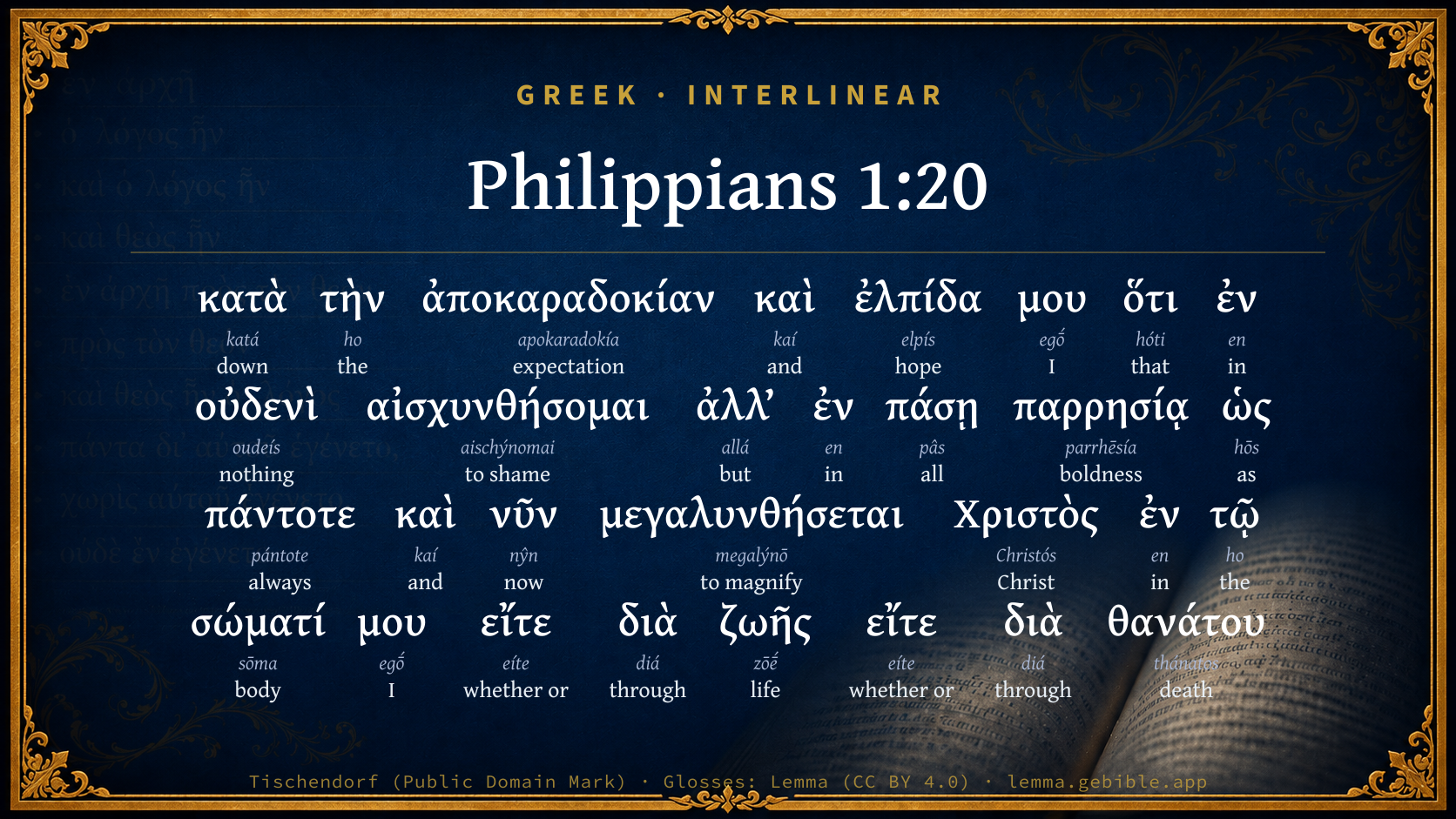
  1. κατὰ katá G2596 “down” Preposition
  2. τὴν ho G3588 “the” Article, Accusative, Singular, Feminine
  3. καὶ kaí G2532 “and” Conjunction
  4. ἐλπίδα elpís G1680 “hope” Noun, Accusative, Singular, Feminine
  5. μου egṓ G1473 “I” Personal pronoun, 1st person, Genitive, Singular
  6. ὅτι hóti G3754 “that” Conjunction
  7. ἐν en G1722 “in” Preposition
  8. οὐδενὶ oudeís G3762 “nothing” Adjective, Dative, Singular, Neuter, Negative
  9. αἰσχυνθήσομαι aischýnomai G153 “to shame” Verb, Future, Passive, Indicative, 1st person, Singular
  10. ἀλλ’ allá G235 “but” Conjunction
  11. ἐν en G1722 “in” Preposition
  12. πάσῃ pâs G3956 “all” Adjective, Dative, Singular, Feminine
  13. παρρησίᾳ parrhēsía G3954 “boldness” Noun, Dative, Singular, Feminine
  14. ὡς hōs G5613 “as” Adverb
  15. πάντοτε pántote G3842 “always” Adverb
  16. καὶ kaí G2532 “and” Conjunction
  17. νῦν nŷn G3568 “now” Adverb
  18. μεγαλυνθήσεται megalýnō G3170 “to magnify” Verb, Future, Passive, Indicative, 3rd person, Singular
  19. Χριστὸς Christós G5547 “Christ” Noun, Nominative, Singular, Masculine
  20. ἐν en G1722 “in” Preposition
  21. τῷ ho G3588 “the” Article, Dative, Singular, Neuter
  22. σώματί sōma G4983 “body” Noun, Dative, Singular, Neuter
  23. μου egṓ G1473 “I” Personal pronoun, 1st person, Genitive, Singular
  24. εἴτε eíte G1535 “whether or” Conjunction
  25. διὰ diá G1223 “through” Preposition
  26. ζωῆς zōḗ G2222 “life” Noun, Genitive, Singular, Feminine
  27. εἴτε eíte G1535 “whether or” Conjunction
  28. διὰ diá G1223 “through” Preposition
  29. θανάτου thánatos G2288 “death” Noun, Genitive, Singular, Masculine

About this verse

These counts appear in no published source. They are computed here, from the morphology-tagged text and Lemma’s own curated glosses. What Lemma adds →

30
words
23
distinct lemmas
Pauline Epistles
section

Notable vocabulary

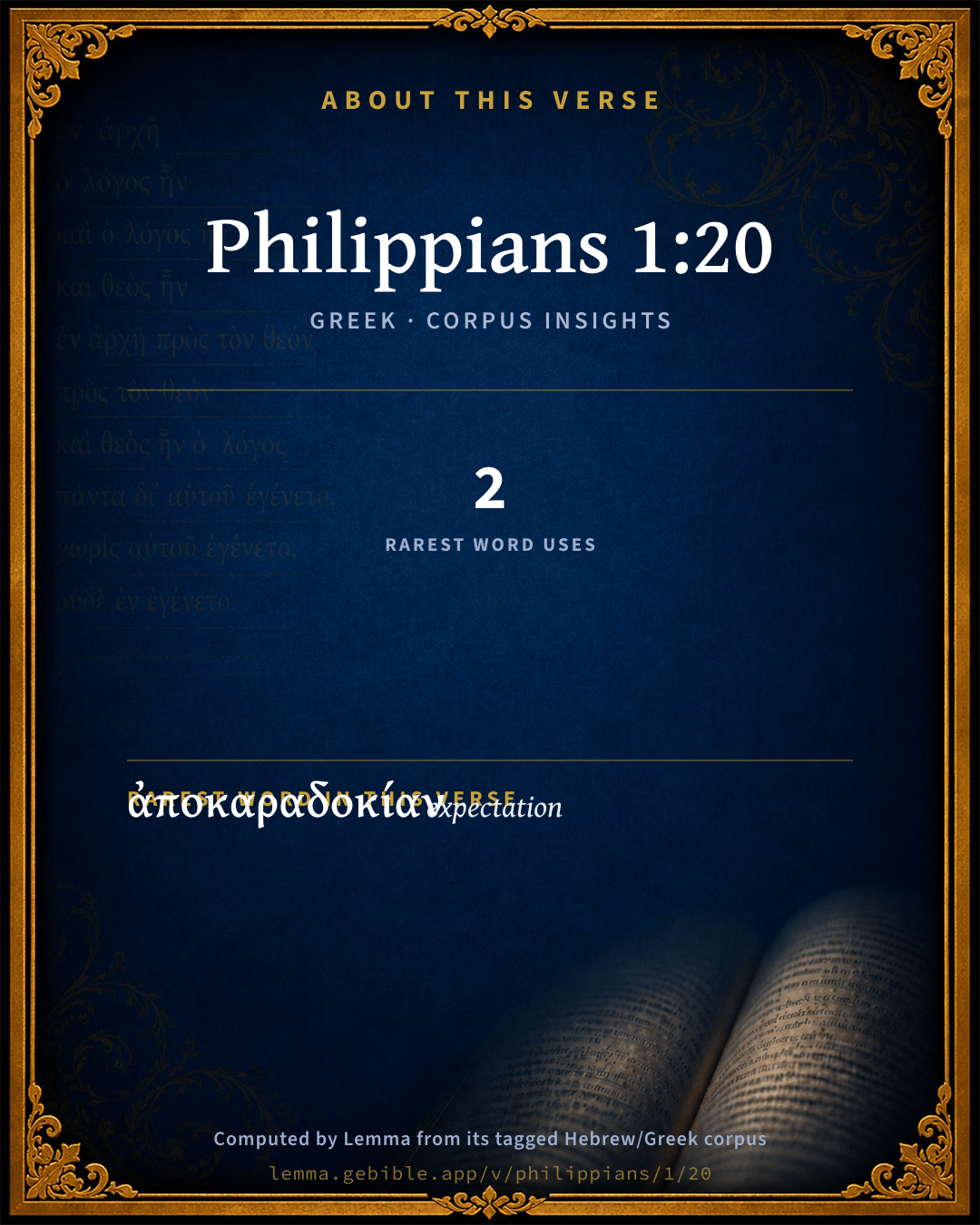
The rarest word here is ἀποκαραδοκίαν expectation G603 — appearing just 2 times in the whole Greek New Testament.

Shared distinctive vocabulary

ἀποκαραδοκίαν expectation G603 occurs in 2 verses of the Greek New Testament. Also found in:

Repetition

Words recur within this verse:

Cross-references

38

Topical passages linked to Philippians 1:20 in the Treasury of Scripture Knowledge — connected by theme and wording, ordered by reader-vote popularity; previews shown in the World English Bible.

  • 1 Peter 4:16 But if one of you suffers for being a Christian, let him not be ashamed; but let him glorify God in this matter.
  • 1 Corinthians 6:20 for you were bought with a price. Therefore glorify God in your body and in your spirit, which are God's.
  • Isaiah 54:4 Don't be afraid; for you shall not be ashamed: neither be confounded; for you shall not be disappointed: for you shall forget the shame of your youth; and the reproach of your widowhood shall you remember no more.
  • 1 Thessalonians 5:23 May the God of peace himself sanctify you completely. May your whole spirit, soul, and body be preserved blameless at the coming of our Lord Jesus Christ.
  • Ephesians 6:19–20 on my behalf, that utterance may be given to me in opening my mouth, to make known with boldness the mystery of the Gospel,
  • 1 John 2:28 Now, little children, remain in him, that when he appears, we may have boldness, and not be ashamed before him at his coming.
  • Romans 8:19 For the creation waits with eager expectation for the children of God to be revealed.
  • 2 Corinthians 4:10 always carrying in the body the putting to death of the Lord Jesus, that the life of Jesus may also be revealed in our body.
  • Philippians 2:17 Yes, and if I am poured out on the sacrifice and service of your faith, I rejoice, and rejoice with you all.
  • 2 Timothy 4:6–7 For I am already being offered, and the time of my departure has come.
  • Psalms 119:116 Uphold me according to your word, that I may live. Let me not be ashamed of my hope.
  • Isaiah 50:7 For the Lord Yahweh will help me; therefore I have not been confounded: therefore have I set my face like a flint, and I know that I shall not be disappointed.
  • Romans 14:7–9 For none of us lives to himself, and none dies to himself.
  • 1 Corinthians 7:34 There is also a difference between a wife and a virgin. The unmarried woman cares about the things of the Lord, that she may be holy both in body and in spirit. But she who is married cares about the things of the world--how she may please her husband.
  • 2 Corinthians 10:8 For though I should boast somewhat abundantly concerning our authority, (which the Lord gave for building you up, and not for casting you down) I will not be disappointed,
  • Isaiah 45:17 [But] Israel shall be saved by Yahweh with an everlasting salvation: you shall not be disappointed nor confounded world without end.
  • Romans 5:5 and hope doesn't disappoint us, because God's love has been poured out into our hearts through the Holy Spirit who was given to us.
  • Romans 12:1 Therefore I urge you, brothers, by the mercies of God, to present your bodies a living sacrifice, holy, acceptable to God, which is your spiritual service.
  • Philippians 1:23–24 But I am in a dilemma between the two, having the desire to depart and be with Christ, which is far better.
  • Colossians 1:24 Now I rejoice in my sufferings for your sake, and fill up on my part that which is lacking of the afflictions of Christ in my flesh for his body's sake, which is the assembly;
  • 2 Peter 1:12–15 Therefore I will not be negligent to remind you of these things, though you know them, and are established in the present truth.
  • Psalms 62:5 My soul, wait in silence for God alone, For my expectation is from him.
  • Psalms 119:80 Let my heart be blameless toward your decrees, That I may not be disappointed.
  • Proverbs 10:28 The prospect of the righteous is joy, But the hope of the wicked will perish.
  • Proverbs 23:18 Indeed surely there is a future hope, And your hope will not be cut off.
  • John 12:27–28 "Now my soul is troubled. What shall I say? 'Father, save me from this time?' But for this cause I came to this time.
  • John 21:19 Now he said this, signifying by what kind of death he would glorify God. When he had said this, he said to him, "Follow me."
  • Acts 20:24 But these things don't count; nor do I hold my life dear to myself, so that I may finish my race with joy, and the ministry which I received from the Lord Jesus, to fully testify to the Gospel of the grace of God.
  • Acts 21:13 Then Paul answered, "What are you doing, weeping and breaking my heart? For I am ready not only to be bound, but also to die at Jerusalem for the name of the Lord Jesus."
  • Romans 6:13 Neither present your members to sin as instruments of unrighteousness, but present yourselves to God, as alive from the dead, and your members as instruments of righteousness to God.
  • Romans 6:19 I speak in human terms because of the weakness of your flesh, for as you presented your members as servants to uncleanness and to wickedness upon wickedness, even so now present your members as servants to righteousness for sanctification.
  • Romans 9:33 even as it is written, "Behold, I lay in Zion a stumbling stone and a rock of offense; And no one who believes in him will be disappointed."
  • 1 Corinthians 15:31 I affirm, by the boasting in you which I have in Christ Jesus our Lord, I die daily.
  • 2 Corinthians 2:14–16 Now thanks be to God, who always leads us in triumph in Christ, and reveals through us the sweet aroma of his knowledge in every place.
  • 2 Corinthians 5:15 He died for all, that those who live should no longer live to themselves, but to him who for their sakes died and rose again.
  • 2 Corinthians 7:14 For if in anything I have boasted to him on your behalf, I was not disappointed. But as we spoke all things to you in truth, so our glorying also which I made before Titus was found to be truth.
  • Philippians 1:14 and that most of the brothers in the Lord, being confident through my bonds, are more abundantly bold to speak the word of God without fear.
  • Psalms 25:2 My God, I have trusted in you, Don't let me be shamed. Don't let my enemies triumph over me.

Cross-references courtesy of OpenBible.info (CC BY 4.0).

Commentary

Notes on Philippians 1:20 from classic Christian and Jewish commentators (each source and its license shown beneath its notes). The classic Christian expositions comment on the surrounding passage and are grouped to its opening verse, so a note may address several verses; the Jewish commentaries on the Tanakh (Rashi and others) are per-verse, so they appear only where the commentator wrote on this verse.

Lemma curates 59 commentaries, every one of them public domain or Creative Commons licensed, each selected and text-cleaned for this edition rather than reprinted as found. About our sources →

The Biblical Illustrator

Joseph S. Exell

Php_1:20

According to my earnest expectation and my hope

Pauls expectation

I.

Paul had as expectation.

1. This seems natural if we regard his character and temper.

(1) He was a warm-hearted man, an intellectual man, a man, moreover, whose natural gifts had not been cramped but had a healthy development, and who had healthy cravings. While he did not think more highly of himself than he ought, neither did he think more meanly.

(2) He was a born leader, not fitted for service so much as for rule: finding few or none with dignity enough to compel his homage. A man of ambition, with a splendid secular career before him.

2. When Jesus spoke to him Paul found a Master, and at once a new object of expectation and hope was found.

II. The expectation was that Christ would be magnified in him.

1. Notice the change of self-estimate. Had Paul joined some secular cause he would have regarded himself as conferring a favour: but when he joined the Church he only congratulated himself on finding mercy. This self-abnegation was because he found Christ all in all.

2. He expected that Christ would be magnified in his body: it seems more natural for us to think his spirit. But the body is the manifestation of the spirit. In the spirit Christ is felt, in the body He is seen. If the life is degraded Christ is not in the spirit.

3. He expected that Christ would be magnified in his body irrespective of time or circumstance, life or death. Christs grace is sufficient for this.

III. Of this expectation he was not ashamed but entertained it boldly.

1. Some Christians feel ashamed of a bold, vigorous magnification of Christ. What will the world say?

2. Some Christians feel afraid to magnify Christ. What will the world do? (A. J. Bamford, B. A.)

Pauls Expectation

I. Expectation and hope are words which connect the heart with the future.

II. No power can so light up the future and throw over it the hues of immortal beauty as childlike trust in God.

III. The unexpectant and hopeless man is living only half a life; but he who is living on false hopes and expectations is wasting life.

IV. It is right that the body should be turned to moral account. Christ purchased the whole man. The passions are not to have their own wild way. The blood is not to be the master of the man.

V. The possibility of being ready for life or death. (J. Parker, D. D.)

Christ magnified

I. Every bad man is an injury to creation. God may, it is true, overrule this for the general good. If an unholy man has been of any service he has been made so in spite of himself; he never designed it or desired it. If he has, like a lighthouse, served as a warning to others, that is Gods work. Every good man is useful and aims to be. But how is a good man to be useful.

I. By magnifying Christ.

1. Christ is the most splendid object in existence.

(1) He is highly thought of in heaven. There He is seen as He is.

(2) He is highly thought of in hell. The destruction of the lost comes from His presence and glory.

(3) But while heaven and hell in different ways acknowledge the greatness of Christ there are men on earth who entertain the lowest thoughts of Him, although it was on earth that He displayed His love. But there is a rapidly increasing number who count all things loss for the excellency of the knowledge of Him.

2. While speaking of magnifying Christ it is proper to be reminded that there are some who do all they can to diminish Him.

(1) Such are they who deny him.

(2) But there are some who injure Christ though they deny Him not. They lessen Him as to the Divine dignity of His person, the magnitude of His work, the merits of His sacrifice.

(3) There are those who magnify themselves under the pretence of magnifying Christ.

3. But while some dishonour Christ there are others who magnify Him. How?

(1) Not by making Christ appear greater than He is--that is impossible. The highest created mind has never set conceived that He is so great as He is.

(2) Not by a thoughtless chiming upon His name or by the use of a few phraseologies; but--

(3) By receiving in the letter the truths respecting His incarnation, teaching, death, etc., and the spirit of those truths which give brightness to the intellect, love of righteousness to the heart, vigour and grace to the character, and bind the soul to the Infinite.

4. It was thus that Paul magnified Christ. Not only was the Christian system as a whole confirmed in Him, but its distinguishing doctrines.

(1) That God is willing to pardon the chief of sinners.

(2) That the power of God can make the greatest sinner ask for mercy.

(3) That by the grace of God the greatest sinner may find mercy and be transformed into the greatest saint, apostle, missionary.

II. In order to magnify Christ all the circumstances of our life must be subservient to that end.

1. Our active services.

2. Our afflictions.

3. Our life and conduct.

4. Our death. (Caleb Morris.)

The Savior magnified in His people

I. How Christ is magnified in the Christians life. To magnify is to make great, or to celebrate existing greatness. In the second sense only can Christ be magnified. Christ is magnified--

1. In the conversion of His people.

2. In their sanctification.

3. In their devoted labours in His cause.

4. In their trials and sufferings.

5. In the abiding results which their services secure.

II. How Christ is magnified in the Christians death.

1. By raising his soul above the dread which it naturally inspires.

2. By abiding hopes and consolations in his death.

3. Through the influence which his death exerts on those who survive.

Conclusion: Our theme ought to lead us--

1. To see the power and glory of the Saviour.

2. The characters to whom only the text applies.

3. The grand aim of the Christian ministry.

4. That the Christian need not be painfully anxious about the events, of life. (J. Burns, D. D.)

Christ made great

I. How is this principle manifested. As God of course He cannot be made great; only in His mediatorial character. In this He is made great.

1. By God the Father (Php_2:10).

2. By the angels. They did so when He was on earth. They do so in heaven.

3. By every individual partaker of His great salvation; by Paul and us.

(1) In our firm belief of His vicarious sacrifice.

(2) In our self humility.

(3) In unshaken confidence.

4. In earnest evangelism.

5. In hopeful death.

II. In what does its excellency appear.

1. This is all mens moral obligation.

2. The God greatest moral excellence.

3. The only right principle of action.

4. Because always honours it. (N. M. Harry.)

Earnest expectation

Found only here and in Rom_8:19. It means the waiting with the head raised, and the eye fixed on that point of the horizon from which the expected object is to come. What a plastic representation! An artist might make a statue of hope out of this Greek term. (J. Hutchison, D. D.)

The Biblical Illustrator, edited by Joseph S. Exell (c. 1880s–1900s) — public domain. Text from a community e-Sword module.

Bengel's Gnomon

Johann Albrecht Bengel

Php 1:20. Ἐν οὐδενὶ αἰσχυνθήσομαι, ἀλλʼ ἐν πάσῃ παῤῥησίᾳ μεγαλυνθήσεται Χριστὸς, in nothing shall I be ashamed, but in all boldness Christ shall be magnified) He removes the ignominy from himself: he ascribes the boldness to himself, the glory to Christ.—σώματι, in my body) in bonds.—εἴτε διὰ ζωῆς, εἴτε διὰ θανάτου, whether by life or by death) The disjunction follows, Php 1:21-22. In what way soever it shall fall out, says he, it will be well. I cannot lose. Paul himself was ignorant what would be the issue; for the apostles were not omniscient, but rather in what referred to themselves they were exercised [disciplined] by faith and patience.

Bengel's Gnomon of the New Testament — English translation (T&T Clark, Edinburgh, 1860) — public domain. Text from a community e-Sword module.

Meyer's Critical & Exegetical Commentary

Heinrich August Wilhelm Meyer

Php_1:20. It will prove salutary for me in conformity with my earnest expectation (see, regarding ἀποκαραδοκία, on Rom_8:19) and my hope, that I, etc. (object of the earnest expectation and hope). Others take ὅτι as argumentative (Vatablus, Estius, Matthies); but by this interpretation the κατὰ τ. ἀποκ. κ. ἐλπ. μ. seems, after the οἶδα already expressed, to be an addition for which there is no motive, and the flow of the discourse is interrupted. No, when Paul says with ὅτι κ.τ.λ. what it is that he earnestly expects and hopes (comp. Rom_8:20 f.), he thereby supplies the precise definition of the former merely general expression εἰς σωτηρίαν.

This is neither clumsy nor unsuited to the meaning of ἀποκαραδ., as Hofmann thinks, who goes back with ὅτι to the far distant οἶδα, and finds it convenient to co-ordinate it with the first ὅτι. Paul would have made this alleged conjunction convenient and at the same time intelligible, only in the event of his having written καὶ ὅτι.

ἐν οὐδενὶ αἰσχυνθήσομαι] that I shall in no point (2Co_6:3; 2Co_7:9; Jam_1:4), in no respect, be put to shame; that is, in no respect will a result ensue tending to my shame,a result which would expose me to the reproach of having failed to accomplish my destiny (comp. the sequel). Comp. on σἰσχύνεσθαι, 2Co_10:8, 1Jn_2:28, and the passages of the LXX. in Schleusner, I. p. 98 f.; also Xen. Cyr. vi. 4. 6; Plut. Mor. p. 1118 E. Matthies understands it differently: in nothing shall I show myself shamefaced and fearful; comp. van Hengel: pudore confusus ab officio deflectam. But the context, in which Paul desires to explain more in detail (comp. Php_1:21) the words μοι ἀποβήσεται εἰς σωτηρίαν, Php_1:19, will not harmonize with any other than the above-named purely passive interpretation; not even with the sense that Paul would not stand disgraced (Weiss, comp. Huther), that is, be found unfaithful to his office, or deficient in the discharge of its duties to the glorifying of Christ. The connection requires a description, not of Pauls behaviour, but of the fate in which the τοῦτο of Php_1:19 would issue for him. Hoelemann takes ἐν οὐδενί as masculine, of the preachers described in Php_1:15 ff., who in their ministry, though actuated by such various motives, ita esse versaturos, ut inde non oriatur, de quo erubescat et doleat quum ipse, tum etiam in re sua quasi Christus. This interpretation is opposed both by the context, which from Php_1:18 onwards brings forward no persons at all; and also by the sense itself, because Paul, thus understood, would be made to express a confidence in the labours of those teachers which, as regards the malicious portion of them (Php_1:17, comp. Php_1:15), would not be befitting. The σἰσχύνεσθαι of the apostle was indeed the very object which they had in view; but, he means to say, οὐκ αἰσχύνομαι, τουτέστιν οὐ περιέσονται, Chrysostom.

ἀλλʼ ἐν πάσῃ παῤῥησίᾳ κ.τ.λ.] the contrast to ἐν οὐδενὶ αἰσχυνθήσομαι; for the apostle can receive no greater honour and triumph (the opposite to the αἰσχύνεσθαι) than to be made the instrument of glorifying Christ (Php_3:7 f.): but with all freeness, as always, so also now, Christ will be magnified in my body.

ἐν πάσῃ παῤῥησ.] ἐν πάσῃ corresponds to the previous ἐν οὐδενί, so that every kind of freeness, which is no way restrained or limited (comp Act_4:29; Act_28:31; 2Co_3:12), is meant, which amounts substantially to the idea, une pleine liberté (Rilliet and older expositors); comp. Wunder, ad Soph. Phil. 141 f. The subject of the freeness is Paul himself, inasmuch as it was in his body that the fearless glorifying of Christ was to be manifested (see below); but he expresses himself in the passive (μεγαλυνθήσεται) and not in the active, because, in the feeling of his being the organ of divine working, the μοι ἀποβήσεται εἰς σωτηρίαν (Php_1:19) governs his conceptions and determines his expression. Hofmanns view, that ἐν π. παῤῥησ. means in full publicity, as an unmistakeable fact before the eyes of all, is linguistically erroneous. See, in opposition to it, on Col_2:15.

ὡς πάντοτε καὶ νῦν] so that the present circumstances, however inimical they are in part towards me (Php_1:15-18), will therefore bring about no other result than this most happy one for me, which has always taken place.

ἐν τῷ σώματί μου] instead of saying: ἐν ἐμοί, he says: in my body, because the decision was now close at hand, whether his body should remain alive or be put to death. But whichever of these possible alternatives should come to pass, he earnestly expected and hoped that the glory of Christ would be thereby secured (εἴτε διὰ ζωῆς εἴτε διὰ θανάτου), in so far, namely, as through his remaining in the body his apostolic labours would be continued to the glory of Christ, and by the slaying of his body there would take place, not the mere closing of his witness for Christ, as Hofmann, in opposition to the text (Php_1:21-23), refines away this point, but his union with Christ. Thus, therefore, he will not be put to shame even by his death; but, on the contrary, Christ will be freely glorified by it, namely, practically glorified, inasmuch as Paul, conscious of the great gain which he shall acquire through death (Php_1:21), will with unwavering joyfulnesswith the frank joyful courage of the martyr who is being perfecteddie to the glorifying of Christ. Comp. Joh_21:19. In any case, accordingly, the result must ensue, that in his body, just as it has always hitherto been the living personal instrument of Christs glory, now also the free glorification of Christ shall be made manifest, whether this result be secured through its being preserved alive or being slain; nam et corpus loquitur et corpus moritur, Grotius. Hoelemann erroneously refers ἐν πάσῃ παῤῥ. to the bold preaching of the various teachers described in Php_1:15-18, from which now, as always, the glory of Christ shall result; and that indeed, through the influence which such a fearless working would have on the fate of the apostle, in his body, whether Christ grant to him a longer course of life or death, in either of which cases the Lord will manifest Himself to him as augustissimum auxiliatorem. But against this view it may be urged, that ἐν οὐδενί does not refer to the teachers (see above); that παῤῥησίᾳ is the contrast to αἰσχυνθήσομαι, so that the subject of the latter must be also the subject of the former; and lastly, that Paul would thus be made to say that the fearless working of others had always shown forth Christs honour in his body,an expression which, as regards the last point, might be suited to the present position of the apostle, but not to the ὡς πάντοτε. Rilliet takes μεγαλυνθήσεται not in the sense of praising (Luk_1:46; Act_5:13; Act_10:46; Act_19:17; Thuc. viii. 81; Xen. Hell. vii. 1. 13), but in the material signification of grandir (Mat_23:5; Luk_1:58; 2Co_10:15), making it apply to the mental indwelling of Christ (Gal_2:20; Rom_8:10; Gal_4:19); so that Paul is made to hope that Christ may grow ever more and more in him, that is, may more and more reveal Himself as the principle of his life, and that this growth will be perfected whether he himself live or die. But ἐν πάσῃ παῤῥησίᾳ would be an inappropriate definition of this idea; and ἐν τῷ σώματί μου would also be inappropriate, as if Christ would have, even by the apostles death, to grow in his body; lastly, neither the foregoing nor the subsequent context points to the peculiar mystical idea of a growth of Christ in the human body; while the similar idea in Gal_4:19 is there very peculiarly and clearly suggested by the context.

Meyer — Critical and Exegetical Commentary on the New Testament — English translation by Peter Christie, edited by Frederick Crombie (T&T Clark, 1880) — public domain. Text from a community e-Sword module.

Expositor's Greek Testament

ed. W. Robertson Nicoll

Phi 1:20 . ἀποκαραδ . The concentrated intense hope which ignores other interests ( ἀπό ), and strains forward as with outstretched head ( κάρα , δοκεῖν ). Cf. Rom 8:19 , ἡ γὰρ ἀποκαραδοκία τῆς κτίσεως τὴν ἀποκάλυψιν τῶν υἱῶν τοῦ Θεοῦ ἀπεκδέχεται . The verb ἀποκαραδοκεῖν is found in Polyb., Plut., Joseph., Aquila. αἰσχυνθ . very probably refers, in the main, to his own conduct, the danger of denying his Lord under stress of hardships, but there is also involved the thought of Christ’s treatment of him. This gives the true antithesis to μεγαλυνθ . παρρησίᾳ . We are inclined to believe that π . has its literal meaning, boldness of speech, for he has before him the danger of denying Christ. Of course there is implied the idea of courage in his whole bearing. The word is typical of the attitude of the early Christians. καὶ νῦν . His trial is in process. μεγαλ .… θανάτου . There is some force in Meyer’s suggestion that passive verbs are used here because Paul feels himself the organ of Divine working. ἐν τῷ σώμ . “In my person.” σ . in Paul is always a colourless word, the organ of the ψυχή or the πνεῦμα , and taking its character from its constituting principle. If he lives, it will be for the service of Christ, which is the highest honour he can pay his Lord. If he has to die, then his readiness to endure death and his calm courage in enduring will be the most eloquent testimony to the worth of his Lord.

The Expositor's Greek Testament, edited by W. Robertson Nicoll (1897–1910) — public domain. Text from a community e-Sword module.

Geneva Bible (1599)

Geneva Bible translators

We must continue even to the end, with great confidence, having nothing before our eyes but Christ’s glory only, whether we live or die.

Geneva Bible (1599) marginal notes — public domain. Text via Bolls.life.

Jamieson, Fausset & Brown

Robert Jamieson, A. R. Fausset & David Brown

According to my earnest expectation--The Greek expresses, "expectation with uplifted head (Luk 21:28) and outstretched neck." Rom 8:19 is the only other place in the New Testament that the word occurs. TITTMANN says, in both places it implies not mere expectation, but the anxious desire of an anticipated prosperous issue in afflictive circumstances. The subject of his earnest expectation which follows, answers to "my salvation" (Phi 1:19).

in nothing I shall be ashamed--in nothing have reason to be ashamed of "my work for God, or His work in me" [ALFORD]. Or, "in nothing be disappointed in my hope, but that I may fully obtain it" [ESTIUS]. So "ashamed" is used in Rom 9:33.

all boldness--"all" is opposed to "in nothing," as "boldness" is the opposite to "ashamed."

so now also--when "my body" is "in bonds" (Phi 1:17).

Christ--not Paul, "shall be magnified."

life, or by death--Whatever be the issue, I cannot lose; I must be the gainer by the event. Paul was not omniscient; in the issue of things pertaining to themselves, the apostles underwent the same probation of faith and patience as we.

Jamieson, Fausset & Brown — Commentary Critical and Explanatory on the Whole Bible (1871) — public domain (CC PDM 1.0). Text via the HelloAO Bible API.

Adam Clarke's Commentary

Verse 20. Earnest expectation] He had the most confident expectation that God would stand by him, so that he should be enabled, with the utmost liberty of speech, εν πασῃ παρῥησια, to testify the Gospel of the grace of God; and, should he have the liberty of doing so, he was utterly regardless what the issue might be relative to himself. Whether life or death, was to him perfectly equal, and perfectly indifferent, providing Christ were magnified - his person, nature, doctrine, &c., shown to be, what they really are, most noble, most excellent, most necessary, and most glorious.

Adam Clarke's Commentary on the Bible (1810–1826) — public domain. Text from a community e-Sword/MySword module.

John Calvin's Commentaries

20 According to my expectation. Should any one object, “From what do you derive that knowledge?” he answers, “From hope.” For as it is certain that God does not by any means design to frustrate our hope, hope itself ought not to be wavering. Let then the pious reader carefully observe this adverb secundum, (according to,) that he may be fully assured in his own mind, that it is impossible but that the Lord will fulfill our expectation, inasmuch as it is founded on his own word. Now, he has promised that he will never be wanting to us even in the midst of all tortures, if we are at any time called to make confession of his name. Let, therefore, all the pious entertain hope after Paul’s example, and they will not be put to shame.

With all confidence We see that, in cherishing hope, he does not give indulgence to carnal desires, but places his hope in subjection to the promise of God. “Christ,” says he, “will be magnified in my body, whether by life or by death ” By making express mention, however, of the body, he intimates that, amongst the conflicts of the present life, he is in no degree doubtful as to the issue, for we are assured as to this by God. If, accordingly, giving ourselves up to the good pleasure of God, and having in our life the same object in view as Paul had, we expect, in whatever way it may be, a prosperous issue, we shall no longer have occasion to fear lest any adversity should befall us; for if we live and die to him, we are his in life and in death. (Romans 14:8.) He expresses the way in which Christ will be magnified — by full assurance. Hence it follows, that through our fault he is cast down and lowered, so far as it is in our power to do so, when we give way through fear. Do not those then feel ashamed who reckon it a light offense to tremble, when called to make confession of the truth? But how much ashamed ought those to feel, who are so shamelessly impudent as to have the hardihood even to excuse renunciation?

He adds, as always, that they may confirm their faith from past experience of the grace of God. Thus, in Romans 5:4, he says, Experience begets hope.

John Calvin's Commentaries (1540-1563) — public domain. Text from the Calvin Translation Society English edition (1840s-50s) via the Christian Classics Ethereal Library (ccel.org). Calvin's coverage is partial (roughly two-thirds of the Bible); uncommented books and verses are honest gaps, never fabricated. The 19th-century editor's footnotes and remarks are omitted so the notes are faithfully Calvin's own voice.

Ellicott's Commentary for English Readers

(20) My earnest expectation.—The word is only found here and in Rom_8:19 (where see Note). It implies an intense and almost painful longing for some crisis, a dulness of suspense lighted up with hope. The phrase is one of the many indications that the joyful and confident tone so often noticed in this Epistle came not from the absence of yearning for the freedom and activity of apostolic life, but from the victory over such longings through faith. Whatever the crisis might be, St. Paul looked eagerly for it.

In nothing I shall be ashamed.—The phrase is elsewhere used by St. Paul with especial reference to the shame which comes from hopes disappointed and professions unfulfilled. (See 2Co_7:14; 2Co_9:4; 2Co_10:8. Compare also the quotation from Isa_28:16 in Rom_9:33; 1Pe_2:6.) For (he says) “hope (fulfilled) maketh not ashamed” (Rom_5:5). So probably here; he trusts that in the hour of trial the confidence which he has felt and professed of being “able to do all things through Christ who strengthenth him” (see Php_4:13) may not come to shameful failure, but may “magnify Christ in all boldness of speech.” There is a subtle touch of true Christian feeling in the fact that, when he speaks of the chance of failure, he uses the first person: “I shall be ashamed;” but when of triumph, it is “Christ shall be magnified” in me. If he fails, it must be through his own fault; if he triumphs, it will be through his Master’s strength.

In my body, whether it be by life, or by death.—“In my body:” The phrase is, no doubt, suggested mainly by the idea of death—the death of a martyr in bodily torture or shame. There is the same connection of idea in 2Co_4:10 : “always bearing about in the body the dying of the Lord Jesus, so that the life also of Jesus may be made manifest in our body.” But while the word “flesh” is used in the New Testament in a bad sense, the “body” is always regarded as that in which we may “glorify God” (1Co_6:20) by word and deed. It is not merely a vesture of the soul, but a part of the true man (1Th_5:23), having membership of Christ, and being the temple of the Holy Ghost (1Co_6:15-19). In this passage the whole idea is of Christ in him; hence his body is spoken of as simply the tabernacle of the indwelling presence of Christ, and devoted only to “magnify” Him.

A Bible Commentary for English Readers, edited by Charles John Ellicott (1878–1897) — public domain. Text from a community e-Sword module.

The Cambridge Bible for Schools and Colleges

gen. ed. J. J. S. Perowne

20. According to] He describes this “supply of the Spirit” by its longed for and expected results, which would thus prove the test “according to” which it would be known as present.

earnest expectation] Lit., “waiting with outstretched head”; one forcible word in the Greek. It occurs here and Rom_8:19.

ashamed] I.e. practically, disappointed; as often in Scripture language. See Psa_25:3; Zec_9:5; Rom_5:5; Rom_9:33; 2Ti_1:12.

boldness] More precisely, boldness of speech. See Eph_3:12; Eph_6:19, and notes in this Series. He looks to “the supply of the Spirit” to maintain in him an unwavering testimony to the Lord and His truth. Cp. Joe_2:28 with Act_2:17-18; 1Co_12:3.—Such testimony might or might not be literally verbal; but it would be utterance, whether in speech or act.

in my body] The body is the spirit’s vehicle and implement in action upon others. See Rom_12:1, and note in this Series; and cp. 2Co_4:10. The impression made on others, the “magnification” of Christ in the view of others, “whether by means of life or by means of death,” would have to be effected through bodily doing or suffering.

by life, or by death] We gather hence, and from Php_2:23, that the Epistle was written at a time of special suspense and uncertainty, humanly speaking, regarding the issue of the Apostle’s trial. See further just below.

The Cambridge Bible for Schools and Colleges (gen. ed. J. J. S. Perowne; Cambridge University Press, 1878–1918) — public domain. Text from a community e-Sword module.

John Gill's Exposition

According to my earnest expectation and my hope,.... These words are so placed as that they may refer both to what goes before and what follows after; and the sense be either that the apostle had earnest expectation and hope, even a strong confidence of his salvation, or deliverance from his confinement; and also of his having an interest in the prayers of the saints, and that hereby a supply of the Spirit would be given him; for as he knew and was sure that his God would supply the wants of others, he had great reason to believe he would supply his own; and especially since he had been told by Christ that his grace was sufficient for him: or as in connection with what follows; he had a full persuasion that he should not be put to shame on any account,

that in nothing I shall be ashamed; not of his hope, neither the grace of hope, which makes not ashamed; nor the object of hope, Christ Jesus; nor the thing hoped for, eternal life and happiness, or any of the above things about which this grace was conversant; nor of his reproaches and sufferings for the sake of Christ and his Gospel, which he esteemed as an honour to him, as jewels in his crown, as chains of gold about his neck, and as great riches; nor of the Gospel which he preached, so as to retract and deny it, drop the whole, or conceal any part of it, lay down his profession of it, or cease to preach it: "but" his earnest desire and his firm hope and faith were,

that with all boldness, as always; that as he had, so he should continue to use boldness in the exercise of faith at the throne of grace, come with freedom thither, and stand before God with intrepidity, through the blood and righteousness of his Son; and that as he had met with afflictions and sufferings for Christ's sake, with cheerfulness and an undaunted spirit, none of these things had moved him, so he believed he never should; and that as he had all along, throughout the whole course of his ministry, preached the Gospel with plainness, openness, and freedom, without any guise or reserve, and that with an holy courage and boldness in the face of all opposition,

so now also Christ shall be magnified in my body; for this being Christ's, his great concern was to glorify him in it; and though it was a poor, weak, and crazy body, yet rich treasure being put into this earthen vessel, Christ had been greatly magnified, extolled, and made very high in it; never was there, as the apostle, such a magnifier of Christ, by preaching him in the transcendent glories of his person as the Son of God, in the riches of his grace as Mediator, in all his offices of prophet, priest, and King; and particularly in the justification and salvation of men, where he made him to be all in all. Christ was also magnified by him, by his life and conversation, which influenced by his grace, was in obedience to his will, was directed to his glory, was as became his Gospel, and what adorned his doctrine in all things; and also by enduring such hardships and so great sufferings on his account; the power of Christ was greatly magnified in supporting him under them, and carrying him through them; and as this had been the case ever since he was in the ministry, it being the main thing he had in view, he had a well grounded hope and confidence, that it would ever be so:

whether it be by life or by death; that is, should he live longer, should he be delivered from his present confinement, and be spared a little longer among men, he comfortably assured Christ would be magnified by him in his body, and as long as he was in it; for his determination was to preach him and him only, to spend his life in his service, and to seek not his own things, but the things of Christ; or should he be put to death quickly by the order of Nero, he doubted not but Christ would have some glory thereby; he should die calling upon his name with fervency, professing his constant and unshaken faith in him, and sealing the Gospel by his blood, with the greatest cheerfulness.

John Gill's Exposition of the Whole Bible (1746–1763) — public domain (CC PDM 1.0). Text via the HelloAO Bible API.

Trapp's Complete Commentary

John Trapp

20 According to my earnest expectation and my hope, that in nothing I shall be ashamed, but that with all boldness, as always, so now also Christ shall be magnified in my body, whether it be by life, or by death.

Ver. 20. According to my earnest] αποκαραδοκια, St Paul stood as it were on tiptoes to see which way he might best glorify God by life or by death.

John Trapp, A Commentary or Exposition upon All the Books of the Old and New Testament (1647–1656) — public domain. Text from a community e-Sword module.

Albert Barnes' Notes on the Bible

According to my earnest expectation - The word used here occurs but in one other place in the New Testament; see it explained in the notes at Rom 8:19. The earnest desire and hope which Paul had was not, primarily, that he might be released; but it was that, in all circumstances, he might be able to honor the gospel, living or dying. To that he looked as a much more important matter than to save his life. Life with him was the secondary consideration; the main thing was, to stand up everywhere as the advocate of the gospel, to maintain its truth, and to exhibit its spirit.

That in nothing I shall be ashamed - That I shall do nothing of which I shall have occasion to be ashamed. That in these heavy trials, I may not be left to deny the truth of the Christian religion; that, even before the emperor, I may maintain its principles; and that the dread of death may not lead me to do a dishonorable thing, or in any way so to shrink from an avowal of my belief, as to give me or my friends occasion of regret.

But that with all boldness - By my speaking the truth, and maintaining my principles with all boldness; see the 2Co 7:4 note; Eph 6:19-20 notes.

Christ shall be magnified - Shall be held up to the view of man as the true and only Saviour, whatever becomes of me.

Whether it be by life - If I am permitted to live. He was not yet certain how the case would terminate with him. He had not been put on his trial, and, whether that trial would result in his acquittal or not, he could not certainly know. But he felt assured that, if he was acquitted, the effect would be to honor Christ. He would ascribe his deliverance to his gracious interposition; he would devote himself with new ardor to his service; and he felt assured, from his past efforts, that he would be able to do something that would “magnify” Christ in the estimation of mankind.

Or by death - If my trial shall result in my death. Then, he believed he would be able to show such a spirit as to do honor to Christ and his cause. He was not afraid to die, and he was persuaded that he would be enabled to bear the pains of death in such a manner as to show the sustaining power of religion, and the value of Christianity. Christ is magnified in the death of Christians, when his gospel is seen to sustain them; when, supported by its promises, they are enabled to go calmly into the dark valley; and when, in the departing moments, they confidently commit their eternal all into his hands. The effect of this state of feeling on the mind of Paul must have been most happy. In whatever way his trial terminated, he felt assured that the great object for which he lived would be promoted. Christ would be honored, perhaps, as much by his dying as a martyr, as by his living yet many years to proclaim his gospel. He was, therefore, reconciled to his lot. He had no anxiety. Come what might, the purpose which he had most at heart would be secured, and the name of the Saviour would be honored.

Albert Barnes' Notes on the Bible (1834–1885) — public domain. Text from a community e-Sword/MySword module.

Haydock's Catholic Bible Commentary

Whether it be by life, or by death. To live longer, if God pleaseth, or to suffer death at this time, he shews himself resigned to either. (Witham)

George Leo Haydock (1774–1849), Haydock's Catholic Family Bible and Commentary, 1859 edition — public domain. Excludes Psalms (Douay-Rheims chapter numbering differs from Protestant) and Deuterocanonical books (Catholic canon only).

Matthew Poole's English Annotations

According to my earnest expectation and my hope; he allegeth and explaineth the ground and certainty of his knowledge and persuasion of his enemies’ disappointment, and all succeeding well with him, trusting

in the living God, 1Ti 4:10, who in all death-threatening afflictions hath upon his word engaged himself to support all those that hope in his mercies, Psa 33:18,19; 37:7,9; Psa 147:11. Then be sure, when his sincere servants, assisted by his Spirit, wait for his deliverance with their necks stretched out, (as the word here notes), being raised from past experience, intensely and wistly looking for his appearance, shall be able each to say as the apostle intimates.

That in nothing I shall be ashamed; negatively, he shall not be left to do any thing which may justly bring him under reproach. His well-grounded hope would not make him ashamed. Rom 5:5, with Rom 8:25; but upon this account he shall have wherewith to answer him that should reproach him, Psa 119:41,42,46; Lu 9:26; 2Ti 1:12.

But that with all boldness; positively, that he should continue constant in a courageous owning of the truth, and acknowledging of his Lord every way, whether he was delivered from or to death.

As always, so now also Christ shall be magnified in my body, whether it be by life, or by death; as in the former years of his ministry he had been supported, yea, and victorious, in freely speaking for Christ, preaching and defending of his gospel, Act 9:27; Act 14:3, with as much courage as any other, Act 4:13,29,31, with 2Co 11:21; Gal 6:17; so now he was humbly confident, in his present sad circnmstances, Christ should be magnified, (not that himself can become greater), i.e. before men, his glory should be rendered greater and more illustrious, and acknowledged with praise, whether he lived or died, Rom 14:8; yea, in the earthen vessel of his body, 2Co 4:11, (about which he was not solicitous, having resigned it entirely to Christ), either in his enlargement and preaching of the doctrine of Christ, or in his being offered up and sealing it by his martyrdom.

Matthew Poole's English Annotations on the Holy Bible (1683–1685) — public domain. Text from a community e-Sword/MySword module.

Whedon's Commentary on the Bible

Daniel D. Whedon

20. According—Confidently looking out upon the future, the apostle expects, just as he hopes, that in nothing—in no point or thing to which his life has been devoted—shall he be ashamed; brought to shame through any failure on his part. Its opposite is, Christ shall be magnified in my body, to which he will contribute by all boldness of speech and conduct. His opponents could not prevent that in his body, in one way or the other, either by his life or his death, would the kingdom of Christ among men be advanced, and so could not destroy his joy or defeat his salvation. To magnify Christ had always, hitherto, been the grand purpose of his life, and so now also, in the present crisis, in a closer imprisonment, under the detractions of brethren, and in the growing savageness of the emperor Nero, when perils are thickening around him, does he hope to magnify him in his body, whether by life, or by death: if by life, through preaching; if by death, through an impressive martyrdom.

Daniel D. Whedon (gen. ed.), Commentary on the Old and New Testaments (1874–1909) — public domain. Text from a community e-Sword module.

The Pulpit Commentary

According to my earnest expectation and my hope, that in nothing I shall be ashamed. The Greek word for "earnest expectation," which occurs also in Rom_8:19, means literally, a watching with outstretched head, with the attention concentrated on one object, and turned away from all others. Neither his sufferings nor the opposition of the Judaizers will put him to shame. But that with all boldness, as always, so now also Christ shall be magnified in my body, whether it be by life, or by death. After boldness" (literally, boldness of speech) we should expect the active form, "I shall magnify." St. Paul, in his humility, prefers the pasture, "Christ shall be magnified." Boldness of speech was to be his part, the glory should be Christ"s. Whatever the issue might be, whether a life of Christian labor or a martyr"s death, it would be well. The apostles were not omniscient, says Bengel, in relation to their own future lot; they lived in faith and hope.

The Pulpit Commentary (1880–1919), ed. H.D.M. Spence-Jones & Joseph S. Exell — public domain. Text from a community e-Sword module.

John Wesley's Explanatory Notes

As always - Since my call to the apostleship. In my body - however it may be disposed of. How that might be, he did not yet know. For the apostles did not know all things; particularly in things pertaining to themselves, they had room to exercise faith and patience.

John Wesley, Explanatory Notes Upon the Whole Bible (1754–1765) — public domain. Text via the GEBible commentary corpus.

The People's New Testament

B. W. Johnson

20. That in nothing shall I be ashamed. Whatever may come, whether his bonds lead to death or life, his trust is that the Spirit will give him such boldness that Christ shall be magnified. There is no anxiety about himself, only that he may glorify Christ.

B. W. Johnson's The People's New Testament with Notes (1889–1891) — public domain. Electronic text from the Christian Classics Ethereal Library (CCEL) ThML edition.

unfoldingWord translationNotes

Door43 World Missions Community

It is my eager expectation and certain hope

Here the word "expectation" and the phrase "certain hope" mean basically the same thing. Paul uses them together to emphasize how strong his expectation is. AT: "I eagerly and confidently hope" (See: Doublet)

but that I will have complete boldness

This is part of Paul's expectation and hope. AT: "but that I will be very bold"

Christ will be exalted in my body

The phrase "my body" is a metonym for what Paul does with his body. This can be stated in active form. Possible meanings are 1) "I will honor Christ by what I do" or 2) "people will praise Christ because of what I do" (See: Metonymy and Active or Passive)

whether by life or by death

"whether I live or die" or "if I go on living or if I die"

For to me

These words are emphatic. They indicate that this is Paul's personal experience.

to live is Christ

Here pleasing and serving Christ is spoken of as Paul's only purpose for living. AT: "to go on living is an opportunity to please Christ" (See: Metaphor)

to die is gain

Here death is spoken of as "gain." Possible meanings for "gain" are 1) Paul's death will help spread the message of the gospel or 2) Paul will be in a better situation. (See: Metaphor)

translationWords

Christ

unfoldingWord translationNotes — © Distant Shores Media and the Door43 World Missions Community, licensed CC BY-SA 4.0. Source: git.door43.org/Door43/en_tn.

Cambridge Greek Testament for Schools and Colleges

20. κατὰ τὴν κτλ. “The supply of the Spirit” will evidence itself in the “magnification of Christ in his body.” That the Lord will be so “magnified” is his eager expectation. Thus, the “supply of the Spirit” will be “according to,” correspondent to, that expectation.

ἀποκαρᾱδοκία. “Longing expectation”; the outstretched head of the watcher is almost visible in the word. It is not classical, and occurs elsewhere in N. T. only Rom 8:19. Ἀποκαραδοκεῖν occurs in Polybius (cent. iii–ii. B.C.), and in Aquila’s version (circ. A.D. 150) of Psalms 37 (LXX., Psa 36:7).—The hope of bringing glory to Christ was to the Apostle the possessing and animating interest of life.

αἰσχυνθήσομαι. i.e. practically, “I shall be disappointed,” as one who has reckoned badly, to his own shame. See Psalms 25 (LXX., 24):3, πάντες οἱ ὑπομένοντές σε οὐ μὴ καταισχυνθῶσι: Rom 5:5; 2Ti 1:12.

ἐν … παρρησίᾳ. Ἐν here, as very frequently in N. T., indicates accompaniment, as of a condition (so here) or of a means; representing thus the Hebrew bêth as a prepositional prefix. Such (classically) unlikely phrases as ἐν σάλπιγγι (1Th 4:16), ἐν μαχαίρᾳ (Mat 26:52), fall under this description.—Παρρησία. The word here naturally keeps its literal meaning, boldness of speech, for he is thinking of his testimony to his Lord. It sometimes glides into the meaning of more general security, confidence, openness; e.g. Joh 7:4; Heb 10:19; Heb 10:35.

ὡς πάντοτε καὶ νῦν. “As always, so now”; with an emphasis on “now.” Cp. 1Jn 2:18, καὶ νῦν ἀντίχριστοι πολλαὶ γεγόνασιν.

μεγαλυνθήσεται. i.e. practically, “shall be glorified,” shall be so manifested as to be praised. He will be enabled to make his Lord bright and great to eyes which otherwise would see little of Him.

ἐν τῷ σώματί μου. Because the body is the soul’s necessary vehicle for all action on others. Through the body alone could others “see” how the man had peace and power in his Master, living or dying; through the words of his lips, the looks of his face, the action or patience of his limbs. Cp. Rom 12:1, and 2Co 4:10.

εἴτε διὰ ζωῆς εἴτε κτλ. We gather that he wrote at a time of suspense regarding the issue of his trial. Wonderfully did his relation to Christ, ὡς πάντοτε καὶ νῦν, make the suspense itself an occasion of peace and joy. See just below.

Cambridge Greek Testament for Schools and Colleges (Cambridge University Press, 1896; 21 vols, various authors incl. Carr, Maclear, Plummer, Farrar, Lumby, Moule, M. R. James, Simcox) — public domain. Text from a community e-Sword module.

Alford’s Greek Testament

Henry Alford

20.] according to (for it is ‘our confidence, which hath great recompense of reward,’ Heb 10:35 f.) my expectation (not, ‘earnest expectation,’ which never seems to be the sense of ἀπό in composition: still less is ἀπό superfluous: but καραδοκεῖν signifies to ‘attend,’ ‘look out’—(παρὰ τὴν κάραν ὅλην δοκεῖν (‘observare’), Thl. ad loc.); and ἀπό adds the signification of ‘from a particular position,’ or better still that of exhaustion, ‘look out until it be fulfilled,’—as in ‘expectare,’ ἀπεκδέχιμαι, ἀπέχω, &c. See the word thoroughly discussed the Fritzschiorum Opuscula, p. 150 ff.) and hope that (Est., al., take ὅτι argumentatively, because: but thus the expectation and hope will have no explanation, and the flow of the sentence will be broken) in nothing (in no point, no particular, see ref. It should be kept quite indefinite, not specified as Chrys. (κἂν ὁτιοῦν γένηται). ‘In none’ (of those to whom the Gospel is preached) as Hoelemann, is beside the purpose—no persons are adduced, but only the most general considerations) I shall be ashamed (general: have reason to take shame for my work for God, or His work in me), but (on the contrary: but perhaps after the ἐν οὐδενί this need not be pressed) in all (as contrasted with ἐν οὐδενί above) boldness (contrast to shame:—boldness on my part, seeing that life or death are both alike glorious for me—and thus I, my body, the passive instrument in which Christ is glorified, shall any-how be bold and of good cheer in this His glorification of Himself in me) as always, now also (that I am in the situation described above, ver. 17) Christ shall be magnified (δειχθήσεται ὅς ἐστι, Thdrt.: by His Kingdom being spread among men. So Ellicott, saying rightly that it is more than ‘praised,’ as in my earlier editions) in my body (my body being the subject of life or death,—in the occurrence of either of which he would not be ashamed, the one bringing active service for Christ, the other union with Him in heaven, ver. 21 ff.), either by (means of) life or by (means of) death.

Henry Alford, The Greek Testament (1849–1861) — public domain. Text from a community e-Sword module.

International Critical Commentary

20. κατὰ τὴν ἀποκαραδοκίαν καὶ ἐλπίδα μου: Connect with ἀποβήσεται (vs. 19). This shall turn out to my salvation as I am expecting and hoping.

ἀποκαραδοκίαν: Only here and Rom 8:19. A picturesque word: ἀπὸ, ‘away’; κάρα, ‘the head’; δοκεῖν (Ion.), ‘to watch.’ Watching something with the head turned away from other objects; hence intent watching. So Chrys. ἡ μεγάλη καὶ ἐπιτετάμενη προσδοκία. Seldom in patristic Greek. Καραδοκεῖν occurs in class. Gk. (Hdt. vii. 163; Xen. Mem. iii. 5, 6; Aristoph. Knights, 663, etc.), but not the compound ἀποκαρ., which, however, is found in later Gk., as Polybius and Plutarch. Lightf.’s ref. to Josephus, B.J. iii. 7, 26, is felicitous. See also Philo, De Jos. 527 D.

Others, however, give ἀπο a local sense—the place from which (Ellic., Ead.); others an intensive sense, ‘to wait to the end; wait it out’ (Mey. on Rom 8:19. See also Crem. and Thay. Lexs.).

ἐλπίδα: The inward attitude, while ἀποκαρ. represents the outward attitude. Ἐλπὶς sometimes in N.T. as the object of hope: the thing hoped for. (See Gal 5:5; Col 1:5; Heb 6:18; Tit 2:13.) This can hardly be the meaning here.

ὅτι: ‘that’; not ‘because.’ It denotes the object of the hope, supplying the specific definition of the more general εἰς σωτηρίαν (vs. 19).

ἐν οὐδενὶ, ‘in nothing’: in no point or respect. Not ‘by no one,’ since no persons are brought forward in what follows.

αἰσχυνθήσομαι: ‘shall I be put to shame.’ Rare in N.T., and only twice in Paul. Frequent in LXX, as Psa_35(34):4, 26; 70(69):2. (Comp. 2Co 10:8.) He will not be brought into disgrace by the frustration of his efforts and the disappointment of his hopes. He will not be shown to be a deluded enthusiast, a fanatic, a preacher of a fancied and impossible good. On the contrary,—

μεγαλυνθήσεται Χριστὸς ἐν τῷ σώματί μου:

Μεγαλυνθήσεται=‘shall be glorified’; lit. ‘enlarged.’ Often in LXX for הִגְדִּיל. (See 2Sa 7:26; 1Ch 17:24; Psa_34(33):3, 35[34]:27.)

ἐν τῷ σώματί μου: Instead of the simple ἐμοί; because the question of bodily life or death was imminent. In his afflicted, imprisoned body Christ will be magnified. (Comp. 2Co 4:10; Gal 6:17.)

The force of this positive and general statement, ‘Christ shall be magnified in my body,’ is heightened by three incidental clauses, which are to the following effect: 1. Christ will be magnified, though Paul shall refuse to modify his preaching and shall continue to proclaim the gospel with all boldness. 2. Christ’s being magnified in spite of opposition will be nothing new. It has always been so. 3. The result will be the same whether Paul shall live or die.

ἐν πάσῃ παρρησίᾳ: in contrast with αἰσχυνθήσομαι, as 1Jn 2:28; LXX, Pro 13:5. The primary meaning of παρρησία is ‘free and bold speaking’; speaking out every word (πᾶν, ῥῆμα). The verb παρρησιάζεσθαι always in N.T. in connection with speaking. The dominant idea of παρρησία is boldness, confidence. (See 2Co 3:12, 2Co 3:7:4; Eph 6:19; 1Th 2:2; Phm 1:8; and Lightf. on Col 2:15.) It is opposed to fear (Joh 7:13), and to ambiguity or reserve (Joh 11:14). The idea of publicity sometimes attaches to it, but as secondary (Joh 7:4). Πάσῃ, the direct opposite of οὐδενὶ; every way in which boldness can manifest itself. (Comp. Eph 6:18.) Christ will be magnified in his bold and uncompromising preaching of the unpalatable truth.

ὡς πάντοτε καὶ νῦν: ‘As always, so now.’ Καὶ in the apodosis answers to ὡς in the protasis. (See Mat 6:10; Joh 6:57; Gal 1:9; 1Jn 2:18; Win. liii. 5.) It is the testimony of history that Christ has always been magnified in spite of opposition. As Paul’s imprisonment has, up to this time, ministered to the progress of the gospel (vs. 12), he is no less confident of the same result now that his fate is hanging in the balance.

εἴτε διὰ ζωῆς εἴτε διὰ θανάτου: “Inimicis suis insultat, quod ei nocere non valeant. Si enim eum occiderint, martyrio coronabitur. Si servaverint ad Christum annunciandum, plurimum facient fructum” (Jer.).

The last words lead him to speak of his own feelings respecting the possible issue of his trial.

International Critical Commentary — older volumes (1896–1929), various authors — public domain. Text from a community e-Sword module.

Vincent's Word Studies in the New Testament

Marvin R. Vincent

Earnest expectation [αποκαραδοκιαν] . Only here and Rom 8:19, on which see note.

Shall be ashamed [αισχυνθησομαι] . Rev., better, giving the force of the passive, shall be put to shame.

Boldness. See on Phl 1:8.

Shall be magnified in my body. Through my bodily sufferings Christ shall appear more glorious, and that even if I die.

Marvin R. Vincent, Word Studies in the New Testament (1887–1900) — public domain. Text from a community e-Sword/MySword module.

Lesson kit

Teaching starters — assembled from the data on this page, not authored interpretation. Every prompt links to the verse data it draws on. Edit before teaching.

Philippians, in the Pauline Epistles, opens this verse with 30 words (23 distinct Greek lemmas). Its most distinctive word is apokaradokía (“expectation”). A historical commentator’s framing appears above. Read the whole chapter for the surrounding context.

Discussion questions

  1. What does “expectation” (apokaradokía) contribute to the verse as a whole?
  2. Romans 8:19 shares the word «expectation» with this verse. How do the two illuminate each other?
  3. “whether or” occurs 2× in this one verse. What is the effect of the repetition?
  4. The translations on this page render this verse differently — a whole-verse word diff, not a word-by-word alignment. What might account for the different wordings?
  5. Reading how The Biblical Illustrator and Bengel's Gnomon read this verse, where do the two commentators agree and where do they part?

Things to notice

  • These translations choose different wording for 15 words in this verse.
  • “whether or” occurs 2× in this single verse.
  • 23 distinct Greek lemmas span 30 words in this verse.

Reading settings

Reading text

Shown beneath each verse's original-language words.

Old Testament
Old Testament edition

Read the OT as the Masoretic Hebrew (MT) or the Greek Septuagint (LXX).

English shown for the Greek Septuagint (in the Hebrew ↔ Greek comparison).

Comparing translations? Open the Compare panel on any verse page to stack up to four side by side.