Matthew 27:12

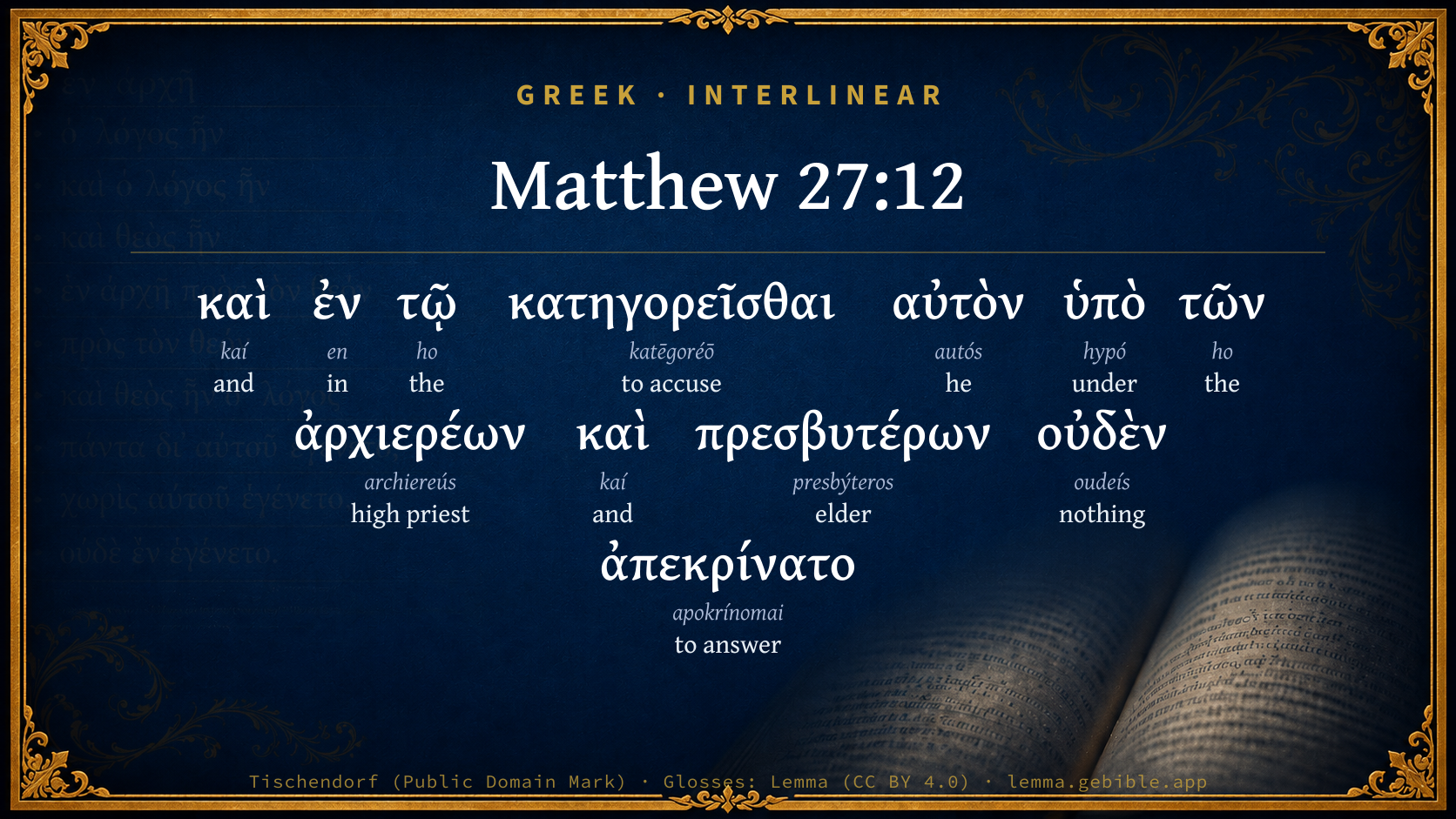
Greek (Tischendorf 8th ed.) Matthew 27:12 appears in the Greek New Testament. The text above is from the Tischendorf 8th edition. Each word links to its Strong’s number and a concise gloss. Click any word for its full Thayer’s Greek Lexicon entry.
Download image
Cite this verse

Matthew 27:12 (World English Bible). Public Domain. Lemma interlinear Bible study tool, https://lemma.gebible.app/v/matthew/27/12.

Show BibTeX & RIS
BibTeX
RIS
English Translation
When he was accused by the chief priests and elders, he answered nothing.
World English Bible · Public Domain
Download a study sheet

One document with this verse’s original text, its word-by-word gloss line, the meaning frame, cross-references with their text, attributed commentary, and full source and license credits — printable, and it pastes into notes with its structure intact.

This verse Autodidact and up

Study sheet (.html) Plain text (.txt)

A passage Seminary Student

Up to 50 verses in one chapter. A passage sheet keeps up to 6 commentary sources and 12 cross-references per verse, in the order this page ranks them, and says so on the sheet whenever that leaves anything out. Ask for a single verse and you get the Autodidact verse sheet above.

Everything on this page stays free to read, with no account — the sheet is a download of what is already on screen, not access to it.

Want to remove ads? Support Godless Engineer
Compare translations 3

The same verse in 3 English versions, stacked beneath the original-language interlinear above. Click any original word for its lexicon entry.

Each is an independent rendering of the whole verse — the interlinear is not word-aligned to these translations.

Highlighted words mark where these versions differ — a whole-verse word diff, not a word-by-word alignment.

  • World English Bible Public Domain
    When he was accused by the chief priests and elders, he answered nothing.
  • King James Version Public Domain
    And when he was accused of the chief priests and elders, he answered nothing.
  • unfoldingWord Literal Text CC BY-SA 4.0
    And when he was accused by the chief priests and the elders, he answered nothing.

unfoldingWord Literal Text — © unfoldingWord, licensed CC BY-SA 4.0. Word-aligned USFM3 via Door43 (git.door43.org/unfoldingWord/en_ult).

Versions to compare (up to 4)

3 of 4 selected

Show all 19 translations

Every available English version of this verse, each an independent rendering of the whole verse.

  • World English Bible Public Domain
    When he was accused by the chief priests and elders, he answered nothing.
  • Berean Standard Bible Public Domain
    And when He was accused by the chief priests and elders, He gave no answer.
  • Majority Standard Bible Public Domain
    And when He was accused by the chief priests and elders, He gave no answer.
  • King James Version Public Domain
    And when he was accused of the chief priests and elders, he answered nothing.
  • American Standard Version (1901) Public Domain
    And when he was accused by the chief priests and elders, he answered nothing.
  • Revised Version (1885) Public Domain
    And when he was accused by the chief priests and elders, he answered nothing.
  • Geneva Bible (1599) Public Domain
    And when he was accused of the chiefe Priestes, and Elders, he answered nothing.
  • Douay-Rheims (1899) Public Domain
    And when he was accused by the chief priests and ancients, he answered nothing.
  • Young's Literal Translation Public Domain
    And in his being accused by the chief priests and the elders, he did not answer any thing,
  • Literal Standard Version CC BY-SA 4.0
    And in His being accused by the chief priests and the elders, He did not answer anything;
  • Unlocked Literal Bible CC BY-SA 4.0
    But when he was accused by the chief priests and elders, he answered nothing.
  • unfoldingWord Literal Text CC BY-SA 4.0
    And when he was accused by the chief priests and the elders, he answered nothing.
  • Darby Bible Public Domain
    And when he was accused of the chief priests and the elders, he answered nothing.
  • World Messianic Bible Public Domain
    When he was accused by the chief priests and elders, he answered nothing.
  • Webster's Bible Public Domain
    And when he was accused by the chief priests and elders, he answered nothing.
  • Free Bible Version CC BY-SA 4.0
    But when the chief priests and elders brought charges against him, Jesus did not answer.
  • Bible in Basic English Public Domain
    But when the chief priests and those in authority made statements against him, he gave no answer.
  • Text-Critical English NT CC BY 4.0
    But when he was accused by the chief priests and the elders, he gave no answer.
  • Tyndale New Testament (1534) Public Domain
    and when he was accused of the chefe prestes and elders he answered nothinge.

Literal Standard Version (2020), Covenant Press — licensed CC BY-SA 4.0. Text via the HelloAO Bible API (eBible.org). Unlocked Literal Bible (unfoldingWord) — licensed CC BY-SA 4.0. Text via the HelloAO Bible API (eBible.org). unfoldingWord Literal Text — © unfoldingWord, licensed CC BY-SA 4.0. Word-aligned USFM3 via Door43 (git.door43.org/unfoldingWord/en_ult). Free Bible Version, Dr. Jonathan Gallagher — licensed CC BY-SA 4.0. Text via the HelloAO Bible API (eBible.org).

Word by word

More ways to search: Search by grammar → Find every occurrence → Compare this word →

Practice this passage: Drill this verse → Learn its vocabulary →

About this verse

These counts appear in no published source. They are computed here, from the morphology-tagged text and Lemma’s own curated glosses. What Lemma adds →

12
words
10
distinct lemmas
Gospels
section

Notable vocabulary

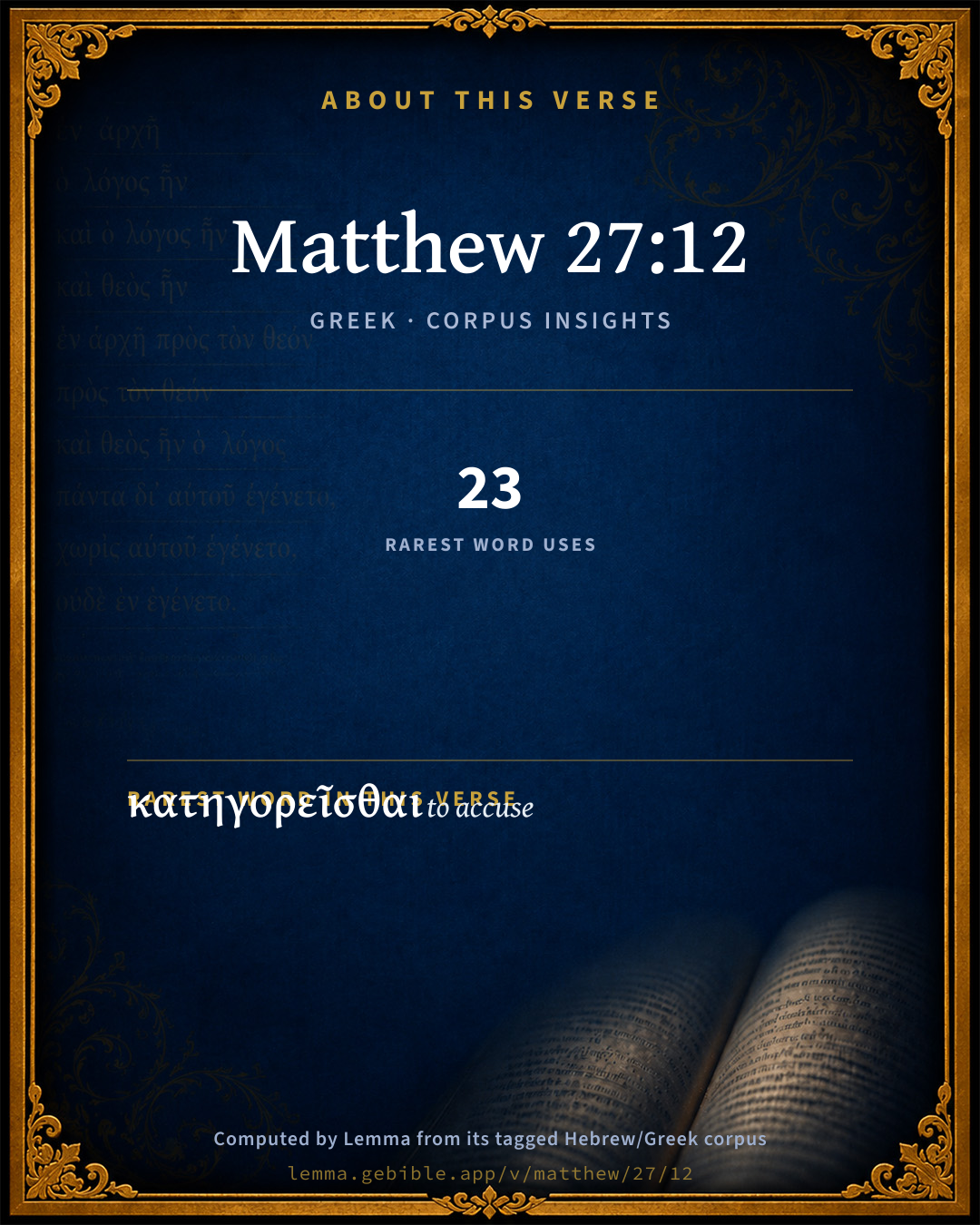
The rarest word here is κατηγορεῖσθαι to accuse G2723 — appearing just 23 times in the whole Greek New Testament.

Shared distinctive vocabulary

κατηγορεῖσθαι to accuse G2723 occurs in 22 verses of the Greek New Testament. Also found in:

Repetition

Words recur within this verse:

Cross-references

8

Topical passages linked to Matthew 27:12 in the Treasury of Scripture Knowledge — connected by theme and wording, ordered by reader-vote popularity; previews shown in the World English Bible.

  • Matthew 26:63 But Jesus held his peace. The high priest answered him, "I adjure you by the living God, that you tell us whether you are the Christ, the Son of God."
  • Isaiah 53:7 He was oppressed, yet when he was afflicted he didn't open his mouth; as a lamb that is led to the slaughter, and as a sheep that before its shearers is mute, so he didn't open his mouth.
  • Matthew 27:14 He gave him no answer, not even one word, so that the governor marveled greatly.
  • Mark 15:3–5 The chief priests accused him of many things.
  • John 19:9–11 He entered into the Praetorium again, and said to Jesus, "Where are you from?" But Jesus gave him no answer.
  • Acts 8:32 Now the passage of the Scripture which he was reading was this, "He was led as a sheep to the slaughter. As a lamb before his shearer is silent, So he doesn't open his mouth.
  • 1 Peter 2:23 Who, when he was cursed, didn't curse back. When he suffered, didn't threaten, but committed himself to him who judges righteously;
  • Psalms 38:13–14 But I, as a deaf man, don't hear. I am as a mute man who doesn't open his mouth.

Cross-references courtesy of OpenBible.info (CC BY 4.0).

Commentary

Notes on Matthew 27:12 from classic Christian and Jewish commentators (each source and its license shown beneath its notes). The classic Christian expositions comment on the surrounding passage and are grouped to its opening verse, so a note may address several verses; the Jewish commentaries on the Tanakh (Rashi and others) are per-verse, so they appear only where the commentator wrote on this verse.

Lemma curates 59 commentaries, every one of them public domain or Creative Commons licensed, each selected and text-cleaned for this edition rather than reprinted as found. About our sources →

Joseph Benson's Commentary

Mat 27:12-14. When he was accused of the chief priests, &c., he answered nothing — In consequence of the conversation that took place between Jesus and Pilate, referred to in the preceding note, Pilate was inclined to acquit Jesus, declaring he found in him no fault at all; but the priests were not disconcerted, nor abashed by the public declaration which the governor, in obedience to conscience and truth, made of the prisoner’s innocence; for they persisted in their accusations with more vehemence than before, affirming that he had attempted to raise a sedition in Galilee; see Luk 23:5. To this heavy charge Jesus answered nothing. Nay, he continued mute, notwithstanding the governor expressly desired him to speak in his own defence, saying, Hearest thou not how many things they witness against thee? — Yes, he did hear, and still hears all that is witnessed unjustly against his truth and ways; but he keeps silence because it is the day of his patience, and does not answer as he shortly will, Psa 50:3. In answering nothing to the accusations of the witnesses, Jesus fulfilled the prophecy of Isaiah, chap. Isa 53:7. But a conduct so extraordinary, in such circumstances, astonished Pilate exceedingly, for he had good reason to be persuaded of Christ’s innocence. Indeed, his humble appearance was a sufficient refutation of the charge which the Jews brought against him, and his silence served instead of the most elaborate defence; and possibly he might decline making any public defence, lest the common people, moved by what he must have said, should have asked his release, and prevented his death; in which respect he showed his followers a noble example of courage and submission to the divine will. Besides, the gross falsehood of the accusation, known to the chief priests themselves, and to all the inhabitants of Galilee, rendered any reply needless.

Joseph Benson's Commentary on the Old and New Testaments (1811–1818) — public domain. Text from a community e-Sword module.

Expositor's Greek Testament

ed. W. Robertson Nicoll

Mat 27:12 . he accusations here referred to appear to have been made on the back of Pilate’s first question and Christ’s answer. Mark indicates that they were copious. In Luke the charge is formulated before Pilate begins to interrogate (Mat 23:2 ). The purpose of their statements would be to substantiate the main charge that Jesus claimed to be King of the Jews in a sense hostile to Roman supremacy. What were the materials of proof? Possibly perverse construction of the healing ministry, of the consequent popularity, of Christ’s brusquely independent attitude towards Rabbinism, suggesting a defiant spirit generally. οὐδὲν ἀπεκρίνατο (note use of 1st aorist middle instead of the more usual ἀπεκρίθη ). Jesus made no reply to these plausible mendacities, defence vain in such a case.

The Expositor's Greek Testament, edited by W. Robertson Nicoll (1897–1910) — public domain. Text from a community e-Sword module.

Adam Clarke's Commentary

Verse 12. He answered nothing.] An answer to such accusations was not necessary: they sufficiently confuted themselves.

Adam Clarke's Commentary on the Bible (1810–1826) — public domain. Text from a community e-Sword/MySword module.

Ellicott's Commentary for English Readers

(12) He answered nothing.—Here, as before in Mat_26:63, we have to realise the contrast between the vehement clamour of the accusers, the calm, imperturbable, patient silence of the accused, and the wonder of the judge at what was so different from anything that had previously come within the range of his experience.

A Bible Commentary for English Readers, edited by Charles John Ellicott (1878–1897) — public domain. Text from a community e-Sword module.

John Gill's Exposition

And when he was accused of the chief priests and elders,.... As that he was a perverter of the people, a stirrer of sedition, discord, and rebellion among them; that he taught them not to give tribute to Caesar, and set up himself for a king; all which he had done not in one place only, but throughout all the land of Judea, from Galilee to Jerusalem; see Luk 23:2,

he answered nothing; the things laid to his charge being notoriously false, and known to be so by all the people; and the evidence with which they were supported being so slender, the judge could never receive it; he therefore judged it unnecessary, and not worth a while to return an answer to them: besides, he knew they were bent upon his death, and that, should he set aside these charges, as he easily could, they would invent new ones, and so increase their sin, and their condemnation: but the chief reason of all, of his silence, was, he had the sins of his people to answer for, and the time of his dying for them was now come, and for which he was ready; and therefore would say nothing to remove these false charges, and retard his death.

John Gill's Exposition of the Whole Bible (1746–1763) — public domain (CC PDM 1.0). Text via the HelloAO Bible API.

Trapp's Complete Commentary

John Trapp

12 And when he was accused of the chief priests and elders, he answered nothing.

Ver. 12. He answered nothing] Here the nimble lawyer would have presently argued, as the pope’s legate did at the meeting of the princes at Smalcaldia in Germany. He brought letters from the pope to the elector of Saxony; and because the elector gave him not a present answer, he inferred, Qui tacet consentire videtur. Melancthon being by, made answer, Hoc est sophisticum; est regula iuris, sed non valet inconiecturalibus. Nam dicit, videtur, et argumentum videtur; solvitur per non videtur. {a} Christ therefore answered nothing, because they alleged nothing but notorious lies, and such as he saw well the governor himself saw through, and therefore tried so many policies to set him free.

{a} Joh. Manl. loc. com. p. 406.

John Trapp, A Commentary or Exposition upon All the Books of the Old and New Testament (1647–1656) — public domain. Text from a community e-Sword module.

Albert Barnes' Notes on the Bible

When he was accused ... - To wit, of perverting the nation, and of forbidding to give tribute to Caesar, Luk 23:2, Luk 23:5. Probably this was done in a tumultuous manner and in every variety of form.

He answered nothing - He was conscious of his innocence. He knew that they could not prove these charges. They offered no testimony to prove them, and, in conscious innocence, he was silent.

Albert Barnes' Notes on the Bible (1834–1885) — public domain. Text from a community e-Sword/MySword module.

Matthew Poole's English Annotations

Mark saith much the same, Mar 15:3-5. These things were before Pilate went out to the people, and told them that he found no fault in him at all, and offered to release Barabbas unto them. Then seemeth to me to follow in order what we have in Luk 23:5-17, in these words: And they were the more fierce, saying, He stirreth up the people, teaching throughout all Jewry, beginning from Galilee to this place. The constant charge which, we shall observe, was laid upon all the ministers of the gospel from Christ’s time. Tertullus the Roman advocate thus charged Paul, &c. When Pilate heard of Galilee, he asked whether the man were a Galilean. And as soon as he knew that he belonged to Herod’s jurisdiction, he sent him to Herod, who himself also was at Jerusalem at that time. After the death of Herod the Great, who died soon after our Saviour was born, (as we heard before), the sceptre departed from Judah, there were no more kings. The government of Jewry was turned into a tetrarchy, divided into four provinces, each of which had a governor, who was called the tetrarch of that province. You have the division and the names of the tetrarchs, Luk 3:1, where you will find that Herod was tetrarch of Galilee. Our Saviour being taken within the jurisdiction of Pilate, it seemeth not to have been necessary for Pilate to have sent him to Herod, but a compliment to satisfy his curiosity. For, saith Luke, when Herod saw Jesus, he was exceeding glad: for he was desirous to see him of a long season, because he had heard many things of him; and he hoped to have seen some miracle done by him. Then he questioned with him in many words; but he answered him nothing. And the chief priests and scribes stood and vehemently accused him. And Herod with his men of war set him at nought, and mocked him, and arrayed him in a gorgeous robe, and sent him again to Pilate. And the same day Pilate and Herod were made friends together: for before they were at enmity between themselves. This is now all historical, and hath in it nothing difficult. Christ had spent most of his time in Galilee, (which was Herod’s tetrarchy), though Herod had not seen him, yet he had heard much of him, and had the curiosity to desire to see him, hoping that our Saviour would have wrought some miracle before him. But he failed in his expectation. He propounds several questions to him. Our Saviour being not before a proper judge, answereth him nothing. So as there was nothing done, only the chief priests and scribes followed him with incessant clamours. Herod and his guard vilify and mock him, put him on a gorgeous robe, and send him back to Pilate. All the effect of this was, Herod was pleased with Pilate’s compliment, and from that day was reconciled to Pilate, though there had been a former enmity betwixt them; only, as we shall hear hereafter, Herod decreeing nothing against Christ, Pilate made some use of it, in his endeavours to have delivered our Saviour.

Matthew Poole's English Annotations on the Holy Bible (1683–1685) — public domain. Text from a community e-Sword/MySword module.

The Pulpit Commentary

When Pilate went forth again to the door of the judgment hall, he was met by a storm of accusations from the chief priests and elders, who, seeing the impression produced on him by Christ"s bearing, vied with each other in vociferating charges against the meek Prisoner. He answered nothing. With Divine patience he bore it all; he would not defend himself before people who cared nothing for truth and justice, and wanted only to secure condemnation and death. As for Pilate, he had told him expressly that his kingdom was spiritual and not of this world, and therefore his claims did not interfere with the sovereignty of Rome. To him and to the rest there was nothing more to be said.

The silence of innocence.

"He answered nothing." "We have to realize the contrast between the vehement clamour of the accusers, the calm, imperturbable, patient silence of the Accused, and the wonder of the judge at what was so different from anything that had previously come within the range of his experience" (Plumptre). Attention may be given to the silences of Jesus during his trials. They are at least as striking and as remarkable as his speeches. Look especially at these.

1. His silence before the high priest. False witnesses, bribed witnesses, made an accusation, by twisting one of his figurative sentences. The high priest was prepared to twist any reply that Jesus might make. "But he held his peace." And the silence made the consciences of his judges speak out, and accuse them of unscrupulous and malicious wickedness.

2. His silence before Herod. "Herod poured out a flood of rambling remarks, but Jesus did not vouchsafe him one word. He felt that Herod should have been ashamed to look the Baptist"s Friend in the face. He would not stoop even to speak to a man who could treat him as a mere wonder worker who might purchase his judge"s favour by exhibiting his skill. But Herod was utterly incapable of feeling the annihilating force of such silent disdain.

3. His silence before Pilate (as in text). It does not seem that our Lord was silent to Pilate. It was when the clamour of the priest party arose, interrupting the trial, that Jesus preserved silence. Observe the very important distinction between the silence of moodiness and sulkiness and the silence of conscious innocence. Only the latter silence has the true, reproachful, conscience-quickening power. "A silent lamb amidst his foes." The lamb is the type of innocence. Christianity has glorified the silent endurance of wrong, and has made such "silent endurance" one of the most masterful forces that sway humanity. Illustrate these points.

I INNOCENCE CAN AFFORD TO BE SILENT.

1. Because it sufficiently speaks in attitude and in countenance.

2. Because God is always on its side.

3. Because time works its vindication.

II INNOCENCE CONVICTS THE INJURER BY SILENCE.

1. It takes away all possibility of contention.

2. It prevents the injurer keeping up the excitement of rage and malice.

3. It compels the injurer to question his own doings.

4. It takes away all the pleasure of the injurer, when a man bears the injury meekly and silently.

The silence of Jesus searches priest party, Herod, and Pilate. R.T.

The Pulpit Commentary (1880–1919), ed. H.D.M. Spence-Jones & Joseph S. Exell — public domain. Text from a community e-Sword module.

The People's New Testament

B. W. Johnson

12. He answered nothing. He made no defence, just as he had done when before Caiaphas.

B. W. Johnson's The People's New Testament with Notes (1889–1891) — public domain. Electronic text from the Christian Classics Ethereal Library (CCEL) ThML edition.

Cambridge Greek Testament for Schools and Colleges

12. ἀπεκρίνατο. 1 aor. mid. for the more usual 1 aor. passive. Of this form four instances occur in the Synoptic gospels, three in the parallel accounts of the Passion, the fourth Luk 3:16.

Cambridge Greek Testament for Schools and Colleges (Cambridge University Press, 1896; 21 vols, various authors incl. Carr, Maclear, Plummer, Farrar, Lumby, Moule, M. R. James, Simcox) — public domain. Text from a community e-Sword module.

Alford’s Greek Testament

Henry Alford

12-14.] This part of the narrative occurs only in Mark besides, but is explained by Luke, ver. 5. The charges were, of exciting the people from Galilee to Jerusalem. On the mention of Galilee, Pilate sent Him to Herod, Luke, vv. 6-12.

Henry Alford, The Greek Testament (1849–1861) — public domain. Text from a community e-Sword module.

International Critical Commentary

(M) 12. And when He was accused by the chief priests and elders, He answered nothing.] Mk. has: “And the chief priests were accusing Him much.” Mt. avoids, as often, Mk.’s imperf. and the adverbial πολλά.—ἀπεκρίνατο] The classical middle is rare in the N.T. It occurs only once in Mar 14:61, where Mt. omitted it, and in Mt. only here, where it seems, therefore, to be a reminiscence of the clause omitted from Mar 14:61; but Mt., as usual, has only a single negative; see on 27:14. On ἀπεκρίνατο, see Abbott, Johannine Grammar, 2537.

International Critical Commentary — older volumes (1896–1929), various authors — public domain. Text from a community e-Sword module.

Lesson kit

Teaching starters — assembled from the data on this page, not authored interpretation. Every prompt links to the verse data it draws on. Edit before teaching.

Matthew, in the Gospels, opens this verse with 12 words (10 distinct Greek lemmas). Its most distinctive word is katēgoréō (“to accuse”). A historical commentator’s framing appears above. Read the whole chapter for the surrounding context.

Discussion questions

  1. What does “to accuse” (katēgoréō) contribute to the verse as a whole?
  2. Matthew 12:10 shares the word «to accuse» with this verse. How do the two illuminate each other?
  3. “and” occurs 2× in this one verse. What is the effect of the repetition?
  4. Reading how Joseph Benson's Commentary and Expositor's Greek Testament read this verse, where do the two commentators agree and where do they part?

Things to notice

Reading settings

Reading text

Shown beneath each verse's original-language words.

Old Testament
Old Testament edition

Read the OT as the Masoretic Hebrew (MT) or the Greek Septuagint (LXX).

English shown for the Greek Septuagint (in the Hebrew ↔ Greek comparison).

Comparing translations? Open the Compare panel on any verse page to stack up to four side by side.