John 8:33

Greek (Tischendorf 8th ed.) John 8:33 appears in the Greek New Testament. The text above is from the Tischendorf 8th edition. Each word links to its Strong’s number and a concise gloss. Click any word for its full Thayer’s Greek Lexicon entry.
Download image
Cite this verse

John 8:33 (World English Bible). Public Domain. Lemma interlinear Bible study tool, https://lemma.gebible.app/v/john/8/33.

Show BibTeX & RIS
BibTeX
RIS
English Translation
They answered him, "We are Abraham's seed, and have never been in bondage to anyone. How do you say, 'You will be made free?'"
World English Bible · Public Domain
Download a study sheet

One document with this verse’s original text, its word-by-word gloss line, the meaning frame, cross-references with their text, attributed commentary, and full source and license credits — printable, and it pastes into notes with its structure intact.

This verse Autodidact and up

Study sheet (.html) Plain text (.txt)

A passage Seminary Student

Up to 50 verses in one chapter. A passage sheet keeps up to 6 commentary sources and 12 cross-references per verse, in the order this page ranks them, and says so on the sheet whenever that leaves anything out. Ask for a single verse and you get the Autodidact verse sheet above.

Everything on this page stays free to read, with no account — the sheet is a download of what is already on screen, not access to it.

Want to remove ads? Support Godless Engineer
Compare translations 3

The same verse in 3 English versions, stacked beneath the original-language interlinear above. Click any original word for its lexicon entry.

Each is an independent rendering of the whole verse — the interlinear is not word-aligned to these translations.

Highlighted words mark where these versions differ — a whole-verse word diff, not a word-by-word alignment.

  • World English Bible Public Domain
    They answered him, "We are Abraham's seed, and have never been in bondage to anyone. How do you say, 'You will be made free?'"
  • King James Version Public Domain
    They answered him, We be Abraham's seed, and were never in bondage to any man: how sayest thou, Ye shall be made free?
  • unfoldingWord Literal Text CC BY-SA 4.0
    They replied to him, “We are the seed of Abraham and have never been slaves to anyone; how can you say, ‘You will be free’?”

unfoldingWord Literal Text — © unfoldingWord, licensed CC BY-SA 4.0. Word-aligned USFM3 via Door43 (git.door43.org/unfoldingWord/en_ult).

Versions to compare (up to 4)

3 of 4 selected

Show all 19 translations

Every available English version of this verse, each an independent rendering of the whole verse.

  • World English Bible Public Domain
    They answered him, "We are Abraham's seed, and have never been in bondage to anyone. How do you say, 'You will be made free?'"
  • Berean Standard Bible Public Domain
    “We are Abraham’s descendants,” they answered. “We have never been slaves to anyone. How can You say we will be set free?”
  • Majority Standard Bible Public Domain
    “We are Abraham’s descendants,” they answered. “We have never been slaves to anyone. How can You say we will be set free?”
  • King James Version Public Domain
    They answered him, We be Abraham's seed, and were never in bondage to any man: how sayest thou, Ye shall be made free?
  • American Standard Version (1901) Public Domain
    They answered unto him, We are Abraham's seed, and have never yet been in bondage to any man: how sayest thou, Ye shall be made free?
  • Revised Version (1885) Public Domain
    They answered unto him, We be Abraham’s seed, and have never yet been in bondage to any man: how sayest thou, Ye shall be made free?
  • Geneva Bible (1599) Public Domain
    They answered him, Wee be Abrahams seede, and were neuer bonde to any man: why sayest thou then, Ye shalbe made free?
  • Douay-Rheims (1899) Public Domain
    They answered him: We are the seed of Abraham, and we have never been slaves to any man: how sayest thou: you shall be free
  • Young's Literal Translation Public Domain
    They answered him, `Seed of Abraham we are; and to no one have we been servants at any time; how dost thou say -- Ye shall become free?'
  • Literal Standard Version CC BY-SA 4.0
    They answered Him, “We are seed of Abraham; and we have been servants to no one at any time; how do You say—You will become free?”
  • Unlocked Literal Bible CC BY-SA 4.0
    They answered him, “We are descendants of Abraham and have never been slaves of anyone; how can you say, 'You will be set free'?”
  • unfoldingWord Literal Text CC BY-SA 4.0
    They replied to him, “We are the seed of Abraham and have never been slaves to anyone; how can you say, ‘You will be free’?”
  • Darby Bible Public Domain
    They answered him, We are Abraham's seed, and have never been under bondage to any one; how sayest thou, Ye shall become free?
  • World Messianic Bible Public Domain
    They answered him, “We are Abraham’s offspring, and have never been in bondage to anyone. How do you say, ‘You will be made free’?”
  • Webster's Bible Public Domain
    They answered him, We are Abraham's offspring, and were never in bondage to any man: how sayest thou, Ye shall be made free?
  • Free Bible Version CC BY-SA 4.0
    “We're descendants of Abraham! We've never been anyone's slaves,” they answered. “How can you say that we'll be set free?”
  • Bible in Basic English Public Domain
    They said to him in answer, We are Abraham's seed and have never been any man's servant: why do you say, You will become free?
  • Text-Critical English NT CC BY 4.0
    They answered him, “We are descendants of Abraham, and we have never been enslaved to anyone. How then can yoʋ say, ‘You will be set free’?”
  • Tyndale New Testament (1534) Public Domain
    Iesus answered them: verely verely I saye vnto you that whosoever committeth synne is the servaunt of synne.

Literal Standard Version (2020), Covenant Press — licensed CC BY-SA 4.0. Text via the HelloAO Bible API (eBible.org). Unlocked Literal Bible (unfoldingWord) — licensed CC BY-SA 4.0. Text via the HelloAO Bible API (eBible.org). unfoldingWord Literal Text — © unfoldingWord, licensed CC BY-SA 4.0. Word-aligned USFM3 via Door43 (git.door43.org/unfoldingWord/en_ult). Free Bible Version, Dr. Jonathan Gallagher — licensed CC BY-SA 4.0. Text via the HelloAO Bible API (eBible.org).

Word by word

More ways to search: Search by grammar → Find every occurrence → Compare this word →

Practice this passage: Drill this verse → Learn its vocabulary →

πώποτε
pṓpote
G4455
“ever”
Adverb
Part of Speech
Adverb
Full Thayer's Definition

Origin: from G4452 and G4218

TDNT: None

1. ever, at any time
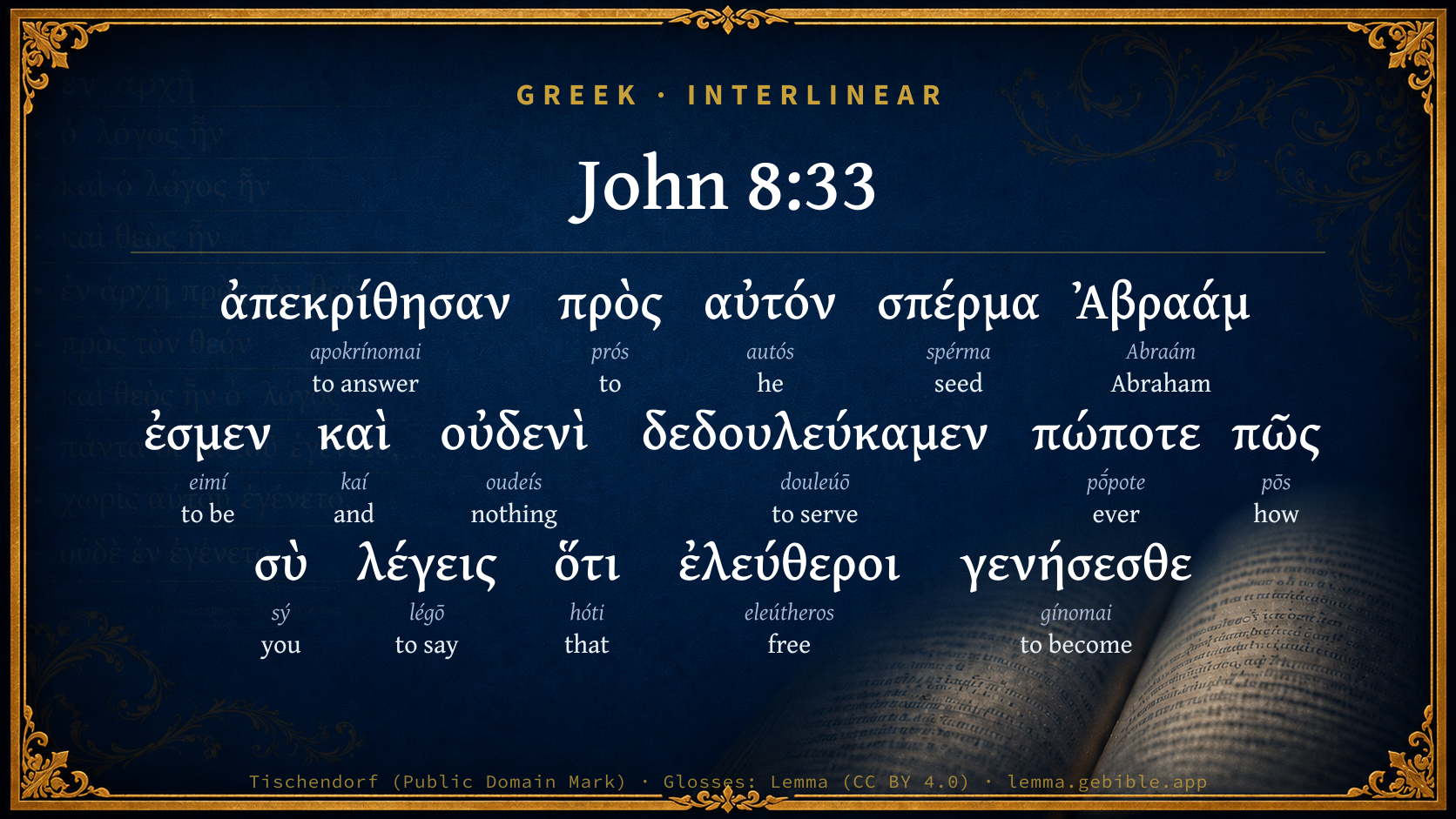
  1. ἀπεκρίθησαν apokrínomai G611 “to answer” Verb, Aorist, Middle deponent, Indicative, 3rd person, Plural
  2. πρὸς prós G4314 “to” Preposition
  3. αὐτόν autós G846 “he” Personal pronoun, Accusative, Singular, Masculine
  4. σπέρμα spérma G4690 “seed” Noun, Nominative, Singular, Neuter
  5. Ἀβραάμ Abraám G11 “Abraham” Noun, Proper, indeclinable
  6. ἐσμεν eimí G1510 “to be” Verb, Present, Active, Indicative, 1st person, Plural
  7. καὶ kaí G2532 “and” Conjunction
  8. οὐδενὶ oudeís G3762 “nothing” Adjective, Dative, Singular, Masculine, Negative
  9. δεδουλεύκαμεν douleúō G1398 “to serve” Verb, Perfect, Active, Indicative, 1st person, Plural
  10. πῶς pōs G4459 “how” Adverb, Interrogative
  11. σὺ sý G4771 “you” Personal pronoun, 2nd person, Nominative, Singular
  12. λέγεις légō G3004 “to say” Verb, Present, Active, Indicative, 2nd person, Singular
  13. ὅτι hóti G3754 “that” Conjunction
  14. ἐλεύθεροι eleútheros G1658 “free” Adjective, Nominative, Plural, Masculine
  15. γενήσεσθε gínomai G1096 “to become” Verb, Future, Middle deponent, Indicative, 2nd person, Plural

About this verse

These counts appear in no published source. They are computed here, from the morphology-tagged text and Lemma’s own curated glosses. What Lemma adds →

16
words
16
distinct lemmas
Gospels
section

Notable vocabulary

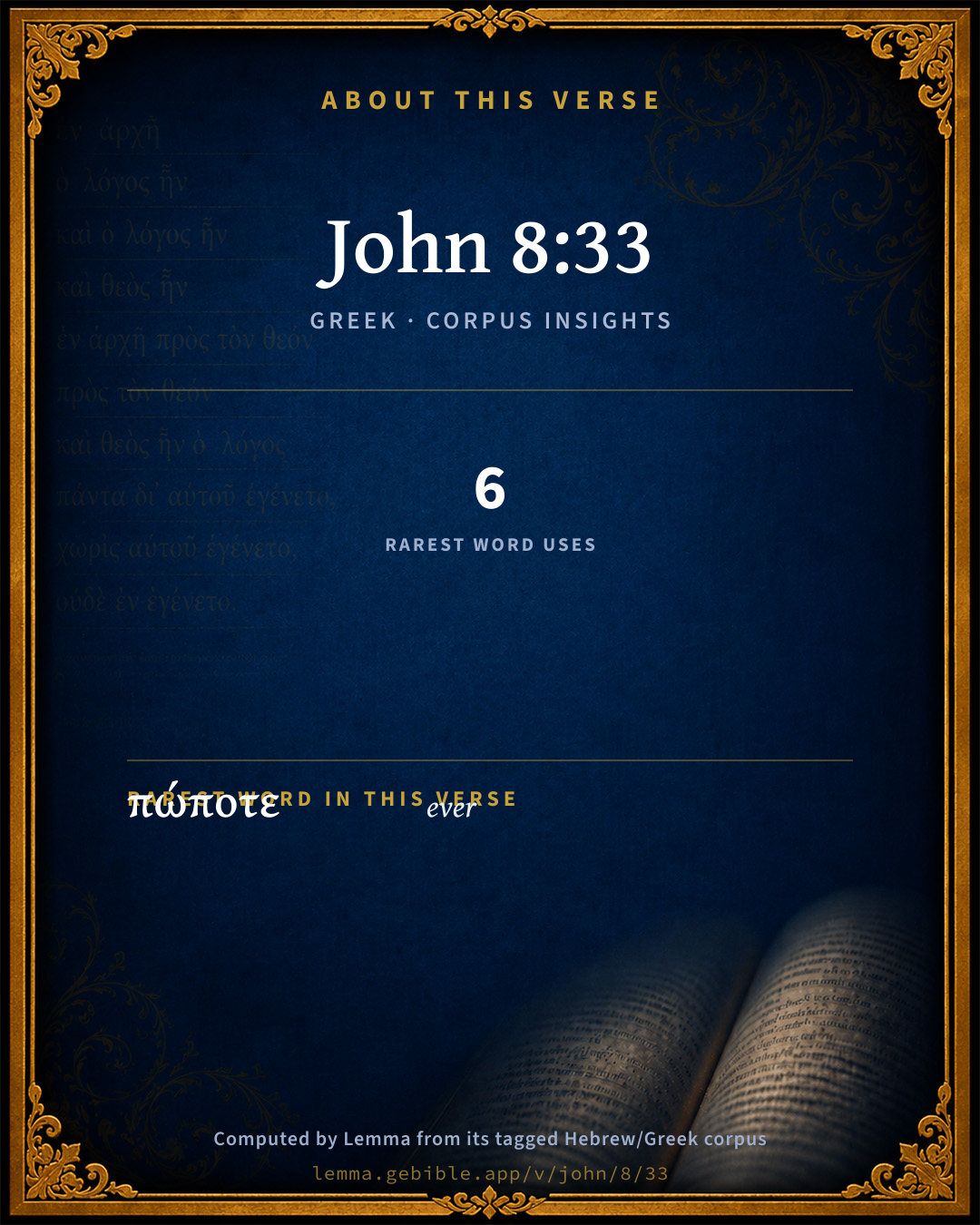
The rarest word here is πώποτε ever G4455 — appearing just 6 times in the whole Greek New Testament.

Shared distinctive vocabulary

πώποτε ever G4455 occurs in 6 verses of the Greek New Testament. Also found in:

Cross-references

15

Topical passages linked to John 8:33 in the Treasury of Scripture Knowledge — connected by theme and wording, ordered by reader-vote popularity; previews shown in the World English Bible.

  • Matthew 3:9 Don't think to yourselves, 'We have Abraham for our father,' for I tell you that God is able to raise up children to Abraham from these stones.
  • John 8:39 They answered him, "Our father is Abraham." Jesus said to them, "If you were Abraham's children, you would do the works of Abraham.
  • Genesis 15:13 He said to Abram, "Know for sure that your seed will live as foreigners in a land that is not theirs, and will serve them. They will afflict them four hundred years.
  • Nehemiah 5:4–8 There were also that said, We have borrowed money for the king's tribute [on] our fields and our vineyards.
  • Nehemiah 9:27–28 Therefore you delivered them into the hand of their adversaries, who distressed them: and in the time of their trouble, when they cried to you, you heard from heaven; and according to your manifold mercies you gave them saviors who saved them out of the hand of their adversaries.
  • John 8:37 I know that you are Abraham's seed, yet you seek to kill me, because my word finds no place in you.
  • Exodus 1:13–14 The Egyptians ruthlessly made the children of Israel serve,
  • Leviticus 25:42 For they are my servants, whom I brought forth out of the land of Egypt. They shall not be sold as slaves.
  • Judges 2:18 When Yahweh raised them up judges, then Yahweh was with the judge, and saved them out of the hand of their enemies all the days of the judge: for it repented Yahweh because of their groaning by reason of those who oppressed them and vexed them.
  • Judges 3:8 Therefore the anger of Yahweh was kindled against Israel, and he sold them into the hand of Cushan Rishathaim king of Mesopotamia: and the children of Israel served Cushan Rishathaim eight years.
  • Ezra 9:9 For we are bondservants; yet our God has not forsaken us in our bondage, but has extended loving kindness to us in the sight of the kings of Persia, to give us a reviving, to set up the house of our God, and to repair the ruins of it, and to give us a wall in Judah and in Jerusalem.
  • Nehemiah 9:36–37 Behold, we are servants this day, and as for the land that you gave to our fathers to eat the fruit of it and the good of it, behold, we are servants in it.
  • Luke 16:24–26 He cried and said, 'Father Abraham, have mercy on me, and send Lazarus, that he may dip the tip of his finger in water, and cool my tongue! For I am in anguish in this flame.'
  • John 19:25 But there were standing by the cross of Jesus his mother, and his mother's sister, Mary the wife of Clopas, and Mary Magdalene.
  • Judges 4:3 The children of Israel cried to Yahweh: for he had nine hundred chariots of iron; and twenty years he mightily oppressed the children of Israel.

Cross-references courtesy of OpenBible.info (CC BY 4.0).

Commentary

Notes on John 8:33 from classic Christian and Jewish commentators (each source and its license shown beneath its notes). The classic Christian expositions comment on the surrounding passage and are grouped to its opening verse, so a note may address several verses; the Jewish commentaries on the Tanakh (Rashi and others) are per-verse, so they appear only where the commentator wrote on this verse.

Lemma curates 59 commentaries, every one of them public domain or Creative Commons licensed, each selected and text-cleaned for this edition rather than reprinted as found. About our sources →

Joseph Benson's Commentary

Joh 8:33-36. They answered him — Namely, the other Jews that were present, not those that believed, as appears by the whole tenor of the conversation; We be Abraham’s seed — A person always free, and a peculiar favourite of Heaven; and were never in bondage to any man — A bold, notorious untruth. At that very time they were in bondage to the Romans, and their ancestors had been slaves, first in Egypt, and afterward in Assyria and Babylon. How sayest thou, Ye shall be made free — Upon becoming thy disciples? Jesus answered, Whosoever committeth sin — Greek, ποιων αμαρτιαν, worketh, or acteth known sin; is the servant — Δουλος, the slave; of sin — Namely, as far as he knowingly commits it. And the servant — Or slave; abideth not in the house for ever — That is, as a person who is only a slave in a family, does not abide always in the house of his master, but is liable to be dismissed at his lord’s pleasure, or transferred to another; much less can you, who are the servants, not of God, but of sin, promise yourselves, that ye shall still, on account of your descent from Abraham, continue in the possession of those privileges, which, by undeserved mercy, you hitherto enjoy; but the Son abideth ever — The eldest son and heir of the family continually abides in his Father’s house: and his power and influence there are always increasing. The casting out of Ishmael, though a son of Abraham by the bond-woman, beautifully illustrates this exposition of the passage, and the connection. Dr. Macknight paraphrases the verse thus: “As a slave cannot be so assured of his master’s favour as to depend upon it, that he shall never be turned out of the family, since it is always his master’s right, and in his power, to sell or keep him, as he shall think fit, so my Father can, when he pleases, turn you, who are habitual sinners, out of his family, and deprive you of the outward economy of religion, in which you glory, because through sin you have made yourselves bondmen to his justice. Whereas, if you will become God’s children, you shall be sure of remaining in his family for ever. And the only way to arrive at the blessed relation, is to submit to the authority of his Son, in which case the Son will adopt you as co-heirs with himself.” If, therefore, I, who am the only-begotten Son of God, and the heir of all things, and who have power of receiving whom I will into the family, shall make you free — You, claiming in virtue of my right and authority, will be free indeed — Free from the slavery of sin, the tyranny of Satan, and the bondage of corruption; free to do good, free in respect of your right to the inheritance, and free in your possession of present privileges, remaining in the house of God without danger of being ever thrust out. Archbishop Tillotson is of opinion, that this alludes to a custom in some of the cities of Greece, and elsewhere, whereby the son and heir had the liberty to adopt brethren, and give them the privileges of the family. “But I rather imagine,” says Dr. Macknight, “that the allusion is to something more generally known. For, as in all countries the sons succeed their fathers in the possession of their estates, such slaves as gained the good-will of the son by their obliging behaviour during his minority, were sure to be well treated by him when he came to his estate; perhaps might in time obtain their freedom, and even some small share of the inheritance itself.”

Joseph Benson's Commentary on the Old and New Testaments (1811–1818) — public domain. Text from a community e-Sword module.

MacLaren's Expositions of Holy Scripture

Alexander MacLaren

John

‘NEVER IN BONDAGE’

Joh 8:33.

‘Never in bondage to any man’? Then what about Egypt, Babylon, Persia, Syria? Was there not a Roman garrison looking down from the castle into the very Temple courts where this boastful falsehood was uttered? It required some hardihood to say, ‘Never in bondage to any man,’ in the face of such a history, and such a present. But was it not just an instance of the strange power which we all have and exercise, of ignoring disagreeable facts, and by ingenious manipulation taking the wrinkles out of the photograph? The Jews were perhaps not misunderstanding Jesus Christ quite so much as these words may suggest. If He had been promising, as they chose to assume, political and external liberty, I fancy they would have risen to the bait a little more eagerly than they did to His words.

But be that as it may, this strange answer of theirs suggests that power of ignoring what we do not want to see, not only in the way in which I have suggested, but also in another. For if they had any inkling of what Jesus meant by slavery and freedom, they, by such words as these, put away from themselves the thought that they were, in any deep and inward sense, bondsmen, and that a message of liberty had any application to them. Ah, dear friends! there was a great deal of human nature in these men, who thus put up a screen between them and the penetrating words of our Lord. Were they not doing just what many of us-all of us to some extent-do: ignoring the facts of their own necessities, of their own spiritual condition, denying the plain lessons of experience? Like them, are not we too often refusing to look in the face the fact that we all, apart from Him, are really in bondage? Because we do not realise the slavery, are we not indifferent to the offer of freedom? ‘We were never in bondage’; consequently we add, ‘How sayest Thou, Ye shall be made free?’ So then, my text brings us to think of three things: our bondage, our ignorance of our bondage, our consequent indifference to Christ’s offer of liberty. Let me say a word or two about each of these.

First as to-

I. Our bondage.

Christ follows the vain boast in the text, with the calm, grave, profound explanation of what He meant: ‘Whoso committeth sin is the slave of sin.’ That is true in two ways. By the act of sinning a man shows that he is the slave of an alien power that has captured him; and in the act of sinning, he rivets the chains and increases the tyranny. He is a slave, or he would not obey sin. He is more a slave because he has again obeyed it. Now, do not let us run away with the idea that when Jesus speaks of sin and its bondage, He is thinking only, or mainly, of gross outrages and contradictions of the plain law of morality and decency, that He is thinking only of external acts which all men brand as being wrong, or of those which law qualifies as crimes. We have to go far deeper than that, and into a far more inward region of life than that, before we come to apprehend the inwardness and the depth of the Christian conception of what sin is. We have to bring our whole life close up against God, and then to judge its deeds thereby. Therefore, though I know I am speaking to a mass of respectable, law-abiding people, very few of you having any knowledge of the grosser and uglier forms of transgression, and I dare say none of you having any experience of what it is to sin against human law, though I do not charge you-God forbid!-with vices, and still less with crimes, I bring to each man’s conscience a far more searching word than either of these two, when I say, ‘We all have sinned and come short of the glory of God.’ This declaration of the universality and reality of the bondage of sin is only the turning into plain words of a fact which is of universal experience, though it may be of a very much less universal consciousness. We may not be aware of the fact, because, as I have to show you, we do not direct our attention to it. But there it is; and the truth is that every man, however noble his aspirations sometimes, however pure and high his convictions, and however honest in the main may be his attempts to do what is right, when he deals honestly with himself, becomes more or less conscious of just that experience which a great expert in soul analysis and self-examination made: ‘I find a law’-an influence working upon my heart with the inevitableness and certainty of law-’that when I would do good, evil is present with me.’

We all know that, whether we regard it as we ought or no. We all say Amen to that, when it is forced upon our attention. There is something in us that thwarts aspiration towards good, and inclines to evil.

‘What will but felt the fleshly screen?’

And it is not only a screen. It not only prevents us from rising as high as we would, but it sinks us so low as to do deeds that something within us recoils from and brands as evil. Jesus teaches us that he who commits sin is the slave of sin; that is to say, that an alien power has captured and is coercing the wrongdoer. That teaching does not destroy responsibility, but it kindles hope. A foreign foe, who has invaded the land, may be driven out of the land, and all his prisoners set free, if a stronger than he comes against him. Christianity is called gloomy and stern, because it preaches the corruption of man’s heart. Is it not a gospel to draw a distinction between the evil that a man does, and the self that a man may be? Is it not better, more hopeful, more of a true evangel, to say to a man, ‘Sin dwelleth in you,’ than to say, ‘What is called sin is only the necessary action of human nature’? To believe that their present condition is not slavery makes men hopeless of ever gaining freedom, and the true gospel of the emancipation of humanity rests on the Christian doctrine of the bondage of sin.

Let me remind you that freedom consists not in the absence of external constraints, but in the animal in us being governed by the will, for when the flesh is free the man is a slave. And it means that the will should be governed by the conscience; and it means that the conscience should be governed by God. These are the stages. Men are built in three stories, so to speak. Down at the bottom, and to be kept there, are inclinations, passions, lust, desires, all which are but blind aimings after their appropriate satisfaction, without any question as to whether the satisfaction is right or wrong; and above that a dominant will which is meant to control, and above that a conscience. That is the public men are more and more abasing themselves to the degradation of ministering to the supposed wishes instead of cutting dead against the grain of the wishes, if necessary, in order to meet the true wants, of the people. Wherever some one strong man stands up to oppose the wild current of popular desires, he may make up his mind that the charge of being ‘a bad citizen, unpatriotic, a lover of the enemies of the people,’ will be flung at him. You Christian men and women have to face the same calumnies as your Master had. The rotten eggs flung at the objects of popular execration-if I might use a somewhat violent figure-turn to roses in their flight. The praises of good men and the scoffs of loose-living and godless ones are equally valuable certificates of character. The Church which does not earn the same sort of opprobrium which attended its Master has probably failed of its duty. It is good to be called ‘gloomy’ and ‘sour-visaged’ by those whose only notion of pleasure is effervescent immorality; and it is good to be called intolerant by the crowd that desires us to be tolerant of vice. So, my friends, I want you to understand that you, too, have to tread in the Master’s steps. The ‘imitation of Jesus’ does not consist merely in the sanctities and secrecies of communion, and the blessings of a meek and quiet heart, but includes standing where He stood, in avowed and active opposition to widespread evils, and, if need be, in the protesting opposition to popular error. And if you are called nicknames, never mind! Remember what the Master said, ‘They shall bring you before kings and magistrates’-the tribunal of the many-headed is a more formidable judgment-bench than that of any king-’and it shall turn to a testimony for you.’

II. Now, secondly, this name is the witness to what I venture to call, for want of a better term, the originality of Jesus Christ.

It bears witness to the dim feeling which onlookers had that in Him was a new phenomenon, not to be accounted for by birth and descent, by training and education, or by the whole of what people nowadays call environment. He did not come out of these circumstances. This is not a regulation pattern type of Jew. He is ‘a Samaritan.’ That is to say, He is unlike the people among whom He dwells; and betrays that other influences than those which shaped them have gone to the making of Him.

That is one of the most marked, outstanding, and important features in the teaching and in the character of Jesus Christ, that it is absolutely independent of, and incapable of being accounted for by, anything that He derived from the circumstances in which He lived. He was a Jew, and yet He was not a Jew. He was not a Samaritan, and yet He was a Samaritan. He was not a Greek, and yet He was one. He was not a Roman, nor an Englishman, nor a Hindoo, nor an Asiatic, nor an African; and yet He had all the characteristics of these races within Himself, and held them all in the ample sweep of His perfect Manhood.

If we turn to His teaching we find that, whilst no doubt to some extent it is influenced in its forms by the necessities of its adaptation to the first listeners, there is a certain element in it far beyond anything that came from Rabbis, or even from prophets and psalmists. Modern Christian scholarship has busied itself very much in these days with studying Jewish literature, so far as it is available, in order to ascertain how far it formed the teaching, or mind, of Jesus the Carpenter of Nazareth. There is a likeness, but the likeness only serves to make the unlikeness more conspicuous. And I, for my part, venture to assert that, whilst the form of our Lord’s teaching may largely be traced to the influences under which He was brought up, and whilst the substance of some parts of it may have been anticipated by earlier Rabbis of His nation, the crowd that listened to Him on the mountain top had laid their fingers upon the more important fact when they ‘wondered at His teaching,’ and found the characteristic difference between it, and that of the men to whom they had listened, in the note of authority with which He spoke. Jesus never argues, He asserts; He claims; and in lieu of all arguments He gives you His own ‘Verily! verily! I say unto you.’

Thus not only in its form, but in its substance, in its lofty morality, in its spiritual religion, in its revelation of the Father and the Fatherhood for all men, Christ’s teaching as teaching stands absolutely alone.

If we turn to His character, the one thing that strikes us is that about it there is nothing of the limitations of time or race which stamp all other men. He is not good after the fashion of His age, or of any other age; He is simply embodied and perfect Goodness. This Tree has shot up high above the fences that enclose the grove in which it grows, and its leaf lasts for ever.

Run over, in your mind, other great names of heroes, saints, thinkers, poets; they all bear the stamp of their age and circumstances, and the type of goodness or the manner of thought which belonged to these. Jesus Christ alone stands before men absolutely free from any of the limitations which are essential in the case of every human excellence and teacher. And so He comes to us with a strange freshness, with a strange closeness; and nineteen centuries have not made Him fit less accurately to our needs than He did to those of the generation amidst which He condescended to live. Thickening mists of oblivion wrap all other great names as they recede into the past; and about the loftiest of them we have to say, ‘This man, having served his generation, fell on sleep, and saw corruption.’ But Jesus Christ lasts, because there is nothing local or temporary about His teaching or His character.

Now this peculiar originality, as I venture to call it, of Christ’s character is a very strong argument for the truthful accuracy of the picture drawn of Him in these four Gospels. Where did these four men get their Christ? Was it from imagination? Was it from myth? Was it from the accidental confluence of a multitude of traditions? There is an old story about a painter who, in despair of producing a certain effect of storm upon the sea, at last flung his wet sponge at the canvas, and to his astonishment found that it had done the very thing he wanted. But wet sponges cannot draw likenesses; and to allege that these four men drew such a picture, in such compass, without anybody sitting for it, seems to me about the most desperate hypothesis that ever was invented. If there were no Christ, or if the Christ that was, was not like what the Gospels paint Him as being, then the authors of these little booklets are consummate geniuses, and their works stand at the very top of the imaginative literature of the world. It is more difficult to account for the Gospels, if they are not histories, than it is to account for the Christ whom they tell us of if they are.

And then, further, there is only one key to the mystery of this originality. Christ is perfect man, high above limitations, and owing nothing to environment, because He is the Son of God. I would as soon believe that grass roots, which for years, in some meadow, had brought forth, season after season, nothing but humble green blades, shot up suddenly into a palm tree, as I would believe that simple natural descent brought all at once into the middle of the dull succession of commonplace and sinful men this radiant and unique Figure. Account for Christ, all you unbelievers! The question of to-day, round which all the battle is being fought, is the person of Jesus Christ. If He be what the Gospels tell us that He is, there is nothing left for the unbeliever worth a struggle. ‘What think ye of Christ? Whose Son is He?’ The Jews said, ‘Thou art a Samaritan!’ We say, ‘Thou art the Christ; the Son of the living God!’

III. Lastly, the name bears witness to Christ’s universality.

I presume that, in addition to what seemed His hostility to what was taken to be true Judaism, another set of facts underlay the name-viz. those which indicated His kindly relations with the people whom it was every good Jew’s pleasant duty to hate with all his heart. The story of the Samaritan woman in John’s Gospel, the parable of the good Samaritan, the incident of the grateful leper, who was a Samaritan, the refusal to allow the eager Apostles to bring down fire from heaven to consume inhospitable churls in a Samaritan village, were but outstanding specimens of what must have been a characteristic of His whole career not unknown to His enemies. So they argued, ‘If you love our enemies you must hate us; and you must be one of them,’ thereby distorting, but yet presenting, what is the great glory of Christ’s Gospel, and of Christ Himself, that He belongs to the world; and that His salvation, the sweep of His love, and the power of His Cross, are meant for all mankind.

That universality largely arises from the absence of the limitations of which I have already spoken sufficiently. Because He belongs to no one period as regards His character, He is available for all periods as regards His efficacy. Because His teaching is not dyed in the hues of any school or of any age or of any cast of thought, it suits for all mankind. This water comes clear from the eternal rock, and has no taint of any soil through which it has flowed. Therefore the thirsty lips of a world may be glued to it, and drink and be satisfied. His one sacrifice avails for the whole world.

But let me remind you that universality means also individuality, and that Jesus Christ is the Christ for all men because He is each man’s Christ. The tree of life stands in the middle of the garden that all may have equal access to it. Is this universal Christ yours; thine? That is the question. Make Him so by putting out your hand and claiming your share in Him, by casting your soul upon Him, by trusting your all to Him, by listening to His word, by obeying His commands, by drinking in the fulness of His blessing. You can do so if you will. If you do not, the universal Christ is nothing to you. Make Him thine, and be sure that the sweep of His love and the efficacy of His sacrifice embrace and include thee. He is the universal Christ; therefore He is the only Christ; ‘neither is there salvation in any other.’ Through Him all men, each man, thou, must be saved. Without Him all men, every man, thou, can not be saved. Take Him for yours, and you will find that each who possesses Him, possesses Him altogether, and none hinders the other in his full enjoyment of ‘the bread of God which came down from heaven.’

Alexander MacLaren, Expositions of Holy Scripture (1904–1910) — public domain. Text from a community e-Sword module.

Tyndale Open Study Notes

Tyndale Open Resources

8:33 Jesus challenged a widely held assumption about Israel’s status as God’s chosen people. Their heritage as descendants of Abraham had inspired feelings of privilege and immunity rather than obligation and responsibility (cp. Amos 3:1-15). • The people misunderstood what it meant to be set free. Jesus was not referring to freedom from human slavery; he meant release from spiritual bondage to sin (John 8:34). Truth, not their religious heritage, would free them (8:32; Rom 6:17; 8:2; 1 Jn 3:4, 8, 9).

Tyndale Open Study Notes — © Tyndale Open Resources, licensed CC BY-SA 4.0. Text via the HelloAO Bible API.

Bengel's Gnomon

Johann Albrecht Bengel

Joh 8:33. Αβραάμ, of Abraham) They appeal to Him afresh at Joh 8:52, “Abraham is dead and the prophets; and Thou sayest,” etc.—οὐδενὶ δεδουλέυκαμεν, we were in bondage to no man) They speak of their own age and generation; for their forefathers had been in bondage to the kings of Egypt, and of Babylon.—ἐλευθεροί, free) They lay hold of this one expression: they make no objection as to the truth making free. So also at Joh 8:22, they mutilated the preceding words of Jesus [taking no notice of the rest of His words, “Ye shall seek Me, and shall die in your sins;” they fastened only on, “Whither I go, ye cannot come.” It was a mixed crowd. Some of them were of a mind inclined towards Jesus; others were of an inimical feeling. Some of them, moved by His preceding words concerning faith, had begun to aspire after faith, but at this turning point drew back.

Bengel's Gnomon of the New Testament — English translation (T&T Clark, Edinburgh, 1860) — public domain. Text from a community e-Sword module.

Meyer's Critical & Exegetical Commentary

Heinrich August Wilhelm Meyer

Joh_8:33. Ἀπεκρίθησαν] No others can be the subject, but the πεπιστενκότες αὐτῷ Ἰουδαῖοι, Joh_8:31. So correctly, Melancthon (offensi resiliunt), Maldonatus, Bengel, Olshausen, Kling, B. Crusius, Hilgenfeld, Lange, Ewald, and several others, after the example of Chrysostom, who aptly observes: κατέπεσεν εὐθέως αὐτῶν ἡ διάνοια· τοῦτο δὲ γέγονεν ἀπὸ τοῦ πρὸς τὸ κοσμικὰ ἐπτοῆσθαι. John himself has precluded us from supposing any other to be intended, by expressly referring (Joh_8:31) to those Jews among the πολλοί (Joh_8:30) who had believed, and emphatically marking them as the persons who conduct the following conversation. To them the last word of Jesus proved at once a stone of stumbling. Hence we must not suppose that Jews are referred to who had remained unbelieving and hostile (as do Augustine, Calvin, Lampe, Kuinoel, De Wette, Tholuck, Lücke, Maier, Hengstenberg), and different from those who were mentioned in Joh_8:31 (ἀπεκρ. they, indef.); nor do the words ζητεῖτέ με ἀποκτ. in Joh_8:37 necessitate this supposition, inasmuch as those πεπιστευκότες might have at once veered round and returned again to the ranks of the opposition, owing to the offence given to their national pride by the words in Joh_8:32. Accordingly, there is no warrant for saying with Luthardt that the reply came primarily from opponents, but that some of those who believed also chimed in from want of understanding. The text speaks exclusively of πεπιστευκότες.

σπέρμα Ἀβρ. ἐσμ.] to which, as being destined to become a blessing to, and to have dominion over, the world (comp. Gen_22:17 f., Joh_17:16), a state of bondage is something completely foreign. As every Hebrew servant was a son of Abraham, this major premiss of their argument shows that they had in view, not their individual or civil (Grotius, Lücke, Godet), but their national liberty. At the same time, in their passion they leave out of consideration the Egyptian and Babylonian history of their nation, and look solely at the present generation, which the Romans had, in accordance with their prudent policy, left in possession of the semblance of political independence (Joseph. Bell. vi. 6. 2). This, according to circumstances, as in the present case, they were able to class at all events in the category of non-bondage. Hence there is no need even for the distinction between dominion de facto and de jure, the latter of which the Jews deny (Lange, Tholuck). Selden had already distinguished between servitus extrinseca and intrinseca (the latter of which would be denied by the Jews). On the passionate pride taken by the Jews in their freedom, and the ruinous consequences it brought upon them, sea Lightfoot, p. 1045. According to Luthardt, they protest against spiritual dependence, not indeed as regards the disposition (B. Crusius), but as regards their religions position, in virtue of which all other nations are dependent on them, the privileged people of God, for their attainment of redemption. But the coarser misunderstanding of national freedom is more in keeping with other misapprehensions of the more spiritual meaning of Jesus found in John (comp. Nicodemus, the Woman of Samaria, the discourse about the Bread of Life); and what was likely to be more readily suggested to the proud minds of these sons of Abraham than the thought of the κληρονομία τοῦ κόσμου (comp. Rom_4:13), which in their imaginations excluded every sort of national bondage? Because they were Abrahams seed, they felt themselves as αἷμα φέροντες ἀδέσποτον (Nonnus).

Meyer — Critical and Exegetical Commentary on the New Testament — English translation by Peter Christie, edited by Frederick Crombie (T&T Clark, 1880) — public domain. Text from a community e-Sword module.

Expositor's Greek Testament

ed. W. Robertson Nicoll

Joh 8:33 . But this announcement, instead of seeming to the Jews the culmination of all bliss, provokes even in the πεπιστευκότες (Joh 8:31 ) a blind, carping criticism: Σπέρμα … γενήσεσθε ; we are the seed of Abraham, called by God to rule all peoples, and to none have we ever been slaves. “The episodes of Egyptian, Babylonian, Syrian, and Roman conquests were treated as mere transitory accidents, not touching the real life of the people, who had never accepted the dominion of their conquerors of coalesced with them,” Westcott. Sayings such as “All Israel are the children of kings” were current among the people. How then could emancipation be spoken of as yet to be given them?

The Expositor's Greek Testament, edited by W. Robertson Nicoll (1897–1910) — public domain. Text from a community e-Sword module.

Godet's Commentaries

Frédéric Louis Godet

Vv. 33, 34. “They answered him, We are Abraham’s seed, and have never been slaves of any one; how sayest thou: you shall become free? 34. Jesus answered them, Verily, verily I say to you that whosoever commits sin is a slave [ of sin ].”

According to some modern interpreters, those who thus answer Jesus cannot be the believing Jews of Joh 8:30, the more since Jesus charges them in Joh 8:37 with seeking to put Him to death, and, subsequently, calls them children of the devil. Lucke therefore regards Joh 8:30-32 as a parenthesis, and connects Joh 8:33 with the preceding conversation (Joh 8:29). Luthardt thinks that in the midst of the group of well-disposed persons who surrounded Jesus, there were also adversaries, and that it was these latter who at this moment began to speak. Others give to the verb an indefinite subject: “They answered Him.” But, on all these views, the narrative of John would be singularly incorrect. In reading Joh 8:33, we can only think of the believers of Joh 8:30-32. We shall see that the last words of Joh 8:37, also, do not allow any other application. It was not for no purpose that the evangelist had formed so marvelous a union of words in our Gospel as that of believing Jews. In these persons there were two men: the nascent believer—it was to him that Jesus addressed the promise Joh 8:31-32—and the old Jew still living: it is the latter who feels himself offended, and who answers with pride (Joh 8:33).

There was in fact a humiliating side in this word: will make you free. It was to say to them: you are not so. Making this step backward, they fell back into solidarity with their nation from which they had only superficially and temporarily separated themselves. The key of this entire passage is found already in these words, Joh 2:23-24 : “And many in Jerusalem believed on His name...; but Jesus did not intrust Himself to them.” Under their faith He discerned the old Jewish foundation not yet shattered and transformed. In order that the promise of Joh 8:31-32 should have been able to make a chord vibrate in their heart, they must have known experiences like those which St. Paul describes in Romans 7 : the distress of an earnest, but impotent, struggle with sin. Jesus discerned this clearly, and for this reason He spoke to them, in Joh 8:31, of abiding, that is to say, of persevering in submission to His word. There is no confusion in John’s narrative; we must rather admire its sacred delicacy.

The slavery which the hearers of Jesus deny cannot be of a political nature. Had not their fathers been slaves in the land of Egypt, in bondage, in the times of the Judges, to all kinds of nations, then subjected to the dominion of the Chaldeans and Persians? Were they not themselves under the yoke of the Romans? It is impossible to suppose them so far blinded by national pride as to forget facts which were so patent, as de Wette, Meyer, Reuss, etc., suppose; the last writer says: “They place themselves at the point of view, not of material facts, but of theory...There was submission to the Roman dominion...., but under protest.” But the words: we were never, do not allow this explanation. Hengstenberg, Luthardt, Keil, give to this expression a purely spiritual import; they apply it to thereligious preponderance which the Jews claimed for themselves in comparison with all other nations. This is still more forced. The hearers of Jesus cannot express themselves in this way except from the view-point of the civil individual liberty, which they enjoyed as Jews. Hence the connection between the two assertions: “We are Abraham’s seed; we were never in bondage.” With a single exception, which was specially foreseen, the law forbade the condition of bondage for all the members of the Israelitish community (Leviticus 25). The dignity of a free man shone on the brow of every one who bore the name of child of Abraham, a fact which assuredly did not prevent the possibil ity that Jewish prisoners should be sold into slavery among the Gentiles (in answer to Keil). The question here is of inhabitants of Palestine such as those who were in conversation with Jesus. These Jews, when hearing that it was the truth taught by Jesus which should put an end to their bondage, could not have supposed that this declaration applied to emancipation from the Roman power. Now as, along with this national dependence, they knew no other servitude than civil or personal slavery, they protested, alleging that, while promising them liberty, Jesus made them slaves. They changed the most magnificent promise into an insult; “and,” as Stier says, “thus they are already at the end of their faith.” We can see whether Jesus was wrong in not trusting to this faith.

Frédéric Louis Godet — Commentaries on Luke, John, Romans, and 1 Corinthians — English translation (T&T Clark, Edinburgh, 1870s–1890s) — public domain. Text from a community e-Sword module.

Geneva Bible (1599)

Geneva Bible translators

Some of the multitude, not they that believed: for this is not the speech of men that consent unto him but of men that are against him.

Born and begotten of Abraham.

Geneva Bible (1599) marginal notes — public domain. Text via Bolls.life.

Jamieson, Fausset & Brown

Robert Jamieson, A. R. Fausset & David Brown

They answered him, We be Abraham's seed, and were never in bondage to any man, &c.--Who said this? Not surely the very class just spoken of as won over by His divine words, and exhorted to continue in them. Most interpreters seem to think so; but it is hard to ascribe such a petulant speech to the newly gained disciples, even in the lowest sense, much less persons so gained as they were. It came, probably, from persons mixed up with them in the same part of the crowd, but of a very different spirit. The pride of the Jewish nation, even now after centuries of humiliation, is the most striking feature of their character. "Talk of freedom to us? Pray when or to whom were we ever in bondage?" This bluster sounds almost ludicrous from such a nation. Had they forgotten their long and bitter bondage in Egypt? their dreary captivity in Babylon? their present bondage to the Roman yoke, and their restless eagerness to throw it off? But probably they saw that our Lord pointed to something else--freedom, perhaps, from the leaders of sects or parties--and were not willing to allow their subjection even to these. Our Lord, therefore, though He knew what slaves they were in this sense, drives the ploughshare somewhat deeper than this, to a bondage they little dreamt of.

Jamieson, Fausset & Brown — Commentary Critical and Explanatory on the Whole Bible (1871) — public domain (CC PDM 1.0). Text via the HelloAO Bible API.

Adam Clarke's Commentary

Verse 33. They answered] That is, the other Jews who had not believed-the carping, cavilling Pharisees already mentioned; for the words cannot be spoken of the simple people who had already believed. See Joh 8:30.

Were never in bondage to any man] This assertion was not only false, but it was ridiculous in the extreme; seeing their whole history, sacred and profane, is full of recitals of their servitude in Egypt, in Chaldea, under the Persians, under the Macedonians, and under the Romans. But those who are not under the influence of the truth of God will speak and act according to the influence of the spirit of falsehood and error. If the words are to be restrained to themselves alone, they may be understood thus: We are Abraham's seed: and we were never in bondage. Both these propositions had a faint shadow of truth.

Adam Clarke's Commentary on the Bible (1810–1826) — public domain. Text from a community e-Sword/MySword module.

John Calvin's Commentaries

33. We are Abraham’s seed. It is uncertain if the Evangelist here introduces the same persons who formerly spoke, or others. My opinion is, that they replied to Christ in a confused manner, as usually happens in a promiscuous crowd; and that this reply was made rather by despisers than by those who believed. It is a mode of expression very customary in Scripture, whenever the body of a people is mentioned, to ascribe generally to all what belongs only to a part.

Those who object that they are Abraham’s seed, and have always been free, easily inferred from the words of Christ that freedom was promised to them as to people who were slaves But they cannot endure to have it said that they, who are a holy and elect people, are reduced to slavery For of what avail was the adoption and the covenant, (Romans 9:4,) by which they were separated from other nations, but because they were accounted the children of God? They think, therefore, that they are insulted, when freedom is exhibited to them as a blessing which they do not yet possess. But it might be thought strange that they should maintain that they never were enslaved, since they had been so frequently oppressed by various tyrants, and at that time were subjected to the Roman yoke, and groaned under the heaviest burden of slavery; and hence it may be easily seen how foolish was their boasting.

Yet they had this plausible excuse, that the unjust sway of their enemies did not hinder them from continuing to be free by right. But they erred, first, in this respect, that they did not consider that the right of adoption was founded on the Mediator alone; for how comes it that Abraham’s seed is free, but because, by the extraordinary grace of the Redeemer, it is exempted from the general bondage of the human race? But there was another error less tolerable than the former, that, though they were altogether degenerate, yet they wished to be reckoned among the children of Abraham, and did not consider that it is nothing else than the regeneration of the Spirit that makes them lawful children of Abraham And indeed, it has been too common a vice in almost all ages, to refer to the origin of the flesh the extraordinary gifts of God, and to ascribe to nature those remedies which Christ bestows for correcting nature. Meanwhile, we see how all who, swelled with false confidence, flatter themselves on their condition drive away from them the grace of Christ. And yet this pride is spread over the whole world, so that there is scarcely one person in a hundred who feels that he needs the grace of God.

John Calvin's Commentaries (1540-1563) — public domain. Text from the Calvin Translation Society English edition (1840s-50s) via the Christian Classics Ethereal Library (ccel.org). Calvin's coverage is partial (roughly two-thirds of the Bible); uncommented books and verses are honest gaps, never fabricated. The 19th-century editor's footnotes and remarks are omitted so the notes are faithfully Calvin's own voice.

Ellicott's Commentary for English Readers

(33) They answered him—i.e., the Jews who had believed in Him (Joh_8:31). There is no indication that this answer was made by others standing near, nor would this supposition have been made but for the difficulty of applying some of the words which follow (Joh_8:40; Joh_8:44) to those who had ever professedly been believers; but the explanation is to be found in our Lord’s own warning words in Joh_8:31. He has tested their faith, and they fail in the first steps of discipleship.

We be Abraham’s seed, and were never in bondage to any man.—Their pride misinterprets His words, and expresses itself in a boast which passes the limits of historical truth. It had been promised to Abraham, “I will multiply thy seed as the stars of the heaven, and as the sand which is upon the sea shore; and thy seed shall possess the gate of his enemies” (Gen_22:17). This seed they were. This promise they interpret of national prosperity. Abraham’s seed in bondage! the thought is impossible. As in other cases (comp. Joh_7:52), they forget part of the facts of history, for they have never learned their lessons. The Egyptian slavery and Babylonian captivity are passed over. That very generation witnessed around them the insignia of Rome, paid taxes to Rome, used the coin of Rome, but it was the policy of the empire to leave to the subject provinces a nominal freedom; and it may be that stress is laid on the words “been in bondage,” which occur nowhere else in the Gospels. Those then living may have said with truth that they had never been in actual bondage, and the current expectation of the Messiah at that time may have led them to interpret the promise to Abraham specially of themselves.

A Bible Commentary for English Readers, edited by Charles John Ellicott (1878–1897) — public domain. Text from a community e-Sword module.

The Cambridge Bible for Schools and Colleges

gen. ed. J. J. S. Perowne

33. They answered him] Or, unto Him, according to the best MSS. ‘They’ must mean ‘the Jews who had believed Him’ (Joh_8:31): it is quite arbitrary to suppose any one else. The severe words which follow (Joh_8:44) are addressed to them, for turning back, after their momentary belief, as well as to those who had never believed at all.

Abraham’s seed] Comp. ‘kings of peoples shall be of her’ (Sarah), and ‘thy seed shall possess the gate of his enemies’ (Gen_17:16; Gen_22:17). On texts like these they build the proud belief that Jews have never yet been in bondage to any man. But passion once more blinds them to historical facts (see on Joh_7:52). The bondage in Egypt, the oppressions in the times of the Judges, the captivity in Babylon, and the Roman yoke, are all forgotten. Some, who think such forgetfulness incredible, interpret ‘we have never been lawfully in bondage.’ ‘The Truth’ would not free them from enforced slavery. It might free them from voluntary slavery, by teaching them that it was unlawful for them to be slaves. ‘But we know that already.’ This, however, is somewhat subtle, and the more literal interpretation is not incredible. The power which the human mind possesses of keeping inconvenient facts out of sight is very considerable. In either case we have another instance of gross inability to perceive the spiritual meaning of Christ’s words. Comp. Joh_3:4, Joh_4:15, Joh_6:34.

The Cambridge Bible for Schools and Colleges (gen. ed. J. J. S. Perowne; Cambridge University Press, 1878–1918) — public domain. Text from a community e-Sword module.

John Gill's Exposition

If the Son therefore shall make you free,.... Alluding to the custom of adoption by the sons or brethren in the family, which obtained in Greece, called "the adoption of brethren", as Grotius, and others have observed; or rather to a custom among the Romans, of a son's making free after his Father's death, such as were born slaves in his house. Such a case as this is supposed (h);

"a man having a son or a daughter by his maidservant, that which is born of her, since of a servant, is without doubt a servant: wherefore if he (the son) should say, this is my natural brother or my natural sister; for since my father had children by his maidservant, "whom he did not make free"; and he dying the law has made me lord of these, , "I have made these free", because of their natural kindred.''

This is allowed to be a just and good reason of manumission. Now this answers very much to the case in hand. Men are home born slaves; the chosen people of God are such by nature; they are born in sin, and are the servants of it; Christ the Son makes them free; and then they are no more foreigners and strangers, but fellow citizens with the saints, and of the household of God. This suggests, that true freedom is by Jesus Christ, the Son of God; see Gal 5:1. He it is that makes the saints free from sin; not from the being of it in this life, but from the bondage and servitude of it, from its power and dominion, and from its guilt and liableness to punishment for it, by procuring the pardon of their sins through his blood, and justifying their persons by his righteousness: he also makes them free, or delivers them from the captivity of Satan, by ransoming them out of his hands, taking the prey from the mighty, binding the strong man armed, and delivering them from him, and from the power of darkness, and putting them into his own kingdom; he does not indeed free them altogether from his temptations, but he preserves them by his power from being hurt and destroyed by him: he likewise makes his people free from the law, not only the ceremonial law, which is abolished by him, but from the moral law; not from obedience to it, as it is in his hands, and a rule of walk and conversation to them, but as in the hands of Moses, and as a covenant of works, and from the rigorous exaction of it, and from seeking justification and life by it, and from its curse and condemnation: and he gives them freedom of access to God, as their Father, through his blood and by his Spirit; and admits them to all the privileges and immunities of the church below; and gives them a right to, faith in, and an expectation of the glorious liberty of the children of God hereafter; and such are truly Christ's freemen:

ye shall be free indeed; this is true freedom; what the Jews boasted of, supposing what they said was right, was but a shadow of freedom in comparison of this; and that liberty which sinful men promise themselves in sin, is all deceit; there is no true, solid, substantial freedom but what is by Christ, the Son of God. Even that freedom which the children of God had under the legal dispensation, was a servitude, in comparison of that which the saints enjoy by Christ under the Gospel dispensation; though they were sons and heirs, yet being in bondage, differed nothing from servants, being under tutors and governors, in bondage under the elements of the world, and under the influence of a spirit of bondage unto fear; see Gal 4:1; but such that have received the spirit of adoption from Christ, they are really free: they have not only the name of children, and of freemen, but they are truly such, and wholly so; perhaps there may be some reference had to such sort of persons among the Jews, who were partly servants, and partly free: so it is said (i),

, "he who is half a servant", or partly a servant, and partly free, shall serve his master one day, and himself another.''

And such an one, as the commentators (k) say, is one who is a servant of two partners, and is made free by one of them; or who has paid half his price to his master (for his freedom), but the other half is still due: and of one in such circumstances it is said (l), that

"he that is partly a servant, and partly free, may not eat of his master's (lamb at the passover):''

but now those who are made free by Christ the Son of God, they are not in part only, but are wholly free, and have a right to all the privileges of his house, to the supper of the Lord, and to every other immunity.

(h) Theophili Antecensor. Institut. Imperat. Justinian. l. 1. tit. 6. sect. 5. p. 38. (i) Misn. Gittin, c. 4. sect. 5. & Ediot, c. 1. sect. 13. (k) Maimonides, Jarchi, & Bartenora in ib. (l) Misn. Pesachim, c. 8. sect. 1.

John Gill's Exposition of the Whole Bible (1746–1763) — public domain (CC PDM 1.0). Text via the HelloAO Bible API.

Trapp's Complete Commentary

John Trapp

33 They answered him, We be Abraham’s seed, and were never in bondage to any man: how sayest thou, Ye shall be made free?

Ver. 33. Were never in bondage] When yet they were scarcely ever out of bondage to one enemy or another. At this time they were vassals to the Romans. But brag is a good dog. Pride will bud, Eze 7:10. Spaniards are said to be impudent braggers and extremely proud, in the lowest ebb of fortune. There is not a more vain glorious people this day under heaven than the Jews (saith Alsted). Antiquum obtinent, old stubborn men, they are no changelings, they fill up the measure of their fathers’ sins.

John Trapp, A Commentary or Exposition upon All the Books of the Old and New Testament (1647–1656) — public domain. Text from a community e-Sword module.

Albert Barnes' Notes on the Bible

They answered him - Not those who believed on him, but some who stood by and heard him.

We be Abraham’s seed - We are the children or descendants of Abraham. Abraham was not a slave, and they pretended that they were his real descendants, inheriting his freedom as well as his spirit. They meant that they were the direct descendants of Abraham by Isaac, his heir. Ishmael, also Abraham’s son, was the son of a bondwoman Gal 4:21-23, but they were descended in a direct line from the acknowledged heir of Abraham.

Were never in bondage to any, man - This is a most remarkable declaration, and one evidently false. Their fathers had been slaves in Egypt; their nation had been enslaved in Babylon; it had repeatedly been subject to the Assyrians; it was enslaved by Herod the Great; and was, at the very time they spoke, groaning under the grievous and insupportable bondage of the Romans. But we see here:

That Jesus was right when he said Joh 8:44, “Ye are of your father the devil; he is a liar, and the father of it.” People will say anything, however false or ridiculous, to avoid and oppose the truth. People groaning under the most oppressive bondage are often unwilling to acknowledge it in any manner, and are indignant at being charged with it. This is the case with all sinners. Sin, and the bondage to sin, produces passion, irritation, and a troubled soul; and a person under the influence of passion regards little what he says, and is often a liar. There is need of the gospel. That only can make people free, calm, collected, meek, and lovers of truth; and since every person is by nature the servant of sin, he should without delay seek an interest in that gospel which can alone make him free.

Albert Barnes' Notes on the Bible (1834–1885) — public domain. Text from a community e-Sword/MySword module.

Matthew Poole's English Annotations

How carnally doth a carnal heart understand spiritual mysteries! Thus Nicodemus, hearing of being born again, grossly dreamed of entering into his mother’s womb, and being born again. The woman of Samaria, hearing of living water, dreamed of water that should so satisfy her thirst, as that she should never come again to the well to draw. The Jews here hearing of being made free, dream of a freedom from human bondage and slavery. To what our Saviour had said, that if they knew the truth, the truth should make them free; they reply,

We are Abraham’s seed, and were never in bondage to any. Admitting that they were Abraham’s seed, that is, Jews, were not the Jews in bondage, first to Pharaoh, king of Egypt; then to Nebuchadnezzar, king of Babylon? They were now in bondage to the Romans. They must either understand it of their own persons, though they were tributaries they were no slaves; or else concerning their right, they had a right to liberty though they were under an extrinsic servitude to their conquerors. This made them angry, that Christ should speak of their being

made free; for those that are free are not in a capacity to be made free. The Jews were a people very tenacious of their liberty, and gloried much in the right they had to it.

Matthew Poole's English Annotations on the Holy Bible (1683–1685) — public domain. Text from a community e-Sword/MySword module.

Whedon's Commentary on the Bible

Daniel D. Whedon

33. They answered—Many commentators refer this they, not to the many who believed, but to the Jews; the they and them in 14-28. The little episode of 30-32 is thus held as a pleasant parenthesis, and the believers are allowed to be genuine and, perhaps, permanent. But if the they refer to the many, they were already disgusted with his freedom by

truth. Never in bondage—The Jewish nation was then in bondage to the Roman power. The freedom of which they speak must have been an ideal freedom, ignoring all acknowledgment of the iron fact of Roman domination. Otherwise, they must mean that they have never been slaves or personal serfs to any slaveholder.

Daniel D. Whedon (gen. ed.), Commentary on the Old and New Testaments (1874–1909) — public domain. Text from a community e-Sword module.

The Pulpit Commentary

Vers. 33-46. (5) The offer of spiritual freedom to the seed of Abraham provoked bitter hostility and misapprehens ion.

They answered him, We be Abraham"s seed taking the highest position of national grandeur and racial pride. Vast were the pretensions which the Jews often assumed from this lofty ancestry. "They were all children of kings;" "Solomon"s feast was not too good for them;" "He was heir of the world;" "They were the inheritors in him of all the nations." They had rung this cry into the ears of John the Baptist, when this last prophet had called upon them for repentance. Their following boast is difficult to understand: We have never yet been enslaved to anyone; and great difference of opinion has prevailed over the meaning of. these words. It is incredible that John should represent: the Jews as ignorant of their national political history. The first word of their Decalogue included a reference to the "house of bondage" from which Jehovah had delivered the seed of Abraham. Moreover, their political humiliation at the hand of the border kingdoms of Assyria, Babylon, and Syria was the perpetual theme of prophet and psalmist.

The terrible reverses that they had subsequently experienced at the hand of Antiochus and of the Roman power, and the galling submission to Rome which at the moment was rousing their fiercest passion, would render any such boast simply preposterous. Godet"s suggestion, that they were making a boast of their personal civil freedom, that Abraham"s seed were not sold into positive slavery, however mortifying their political servitude had proved, is far fetched and too far away from the facts of the case; neither does it harmonize with the character of this angry retort. Probably a reference is made to the ideal freedom from slavery and from dependence which they had, in their hour of deepest depression from all and every form of tyranny whatsoever, religiously maintained. They did, as their wonderful psalter shows, cherish a conviction that David"s throne and Abraham"s inheritance ideally stood through all the ages, lustrous and magnificent to the eye of faith. When the holy and beautiful house was burned with fire, when their exile was complete, they still saw all visible things, even "heaven and earth," departing or rolled up like a scroll, while their Creator and redeeming King was seated still on his eternal throne. From St. Paul"s Epistle to the Romans, they clearly held that the mere possession of the Law, whether they kept it or not, was their much-prized pledge of independence from all other authority or servitude. If so, they may have been on this occasion boasting of their ideal freedom in virtue of their he reditary privileges, and forgetful of the lessons even of the agelong story of Ishmael and Esau, and the deportation and abolition of Israel as a nation. One can scarcely refrain a momentary thrill of admiration at the hardihood of their eager faith, and the overwhelming strength of confidence they manifested in their destiny as a people. All the spiritual salvation and ideal freedom which they desired they possessed as children of Abraham. How sayest thou what possible principle dost thou promise to us that which we already are proud of possessing, viz. glorious liberty?" Is it from the emancipating power of truth? We have the truth; we are the depositaries of infallible truth. We already possess as our birthright what thou art offering to us as the full result of discipleship. How sayest thou, Ye shall be made free?

Vers. 33-36. Misapprehension of the disciples corrected.

I THEIR STRANGE MISCONCEPTION. "They answered him, We be Abraham"s seed, and were never in bondage to any man: how sayest thou, Ye shall be made free?

1. We cannot imagine the speakers to be capable of the absurdity of making a historical misstatement. The facts of Jewish history were universally known at Jerusalem. The Jews could not deny the Egyptian, Babylonian, Syrian, and Roman conquests. They either referred to the civil liberty which they had long enjoyed, or they meant to assert that they had never recognized their conquerors or acquiesced in their dominion.

2. Yet there was a serious misunderstanding springing from their prevailingly carnal tone. They seemed as yet unable to recognize the inner bondage of soul which is dissolved by grace.

II OUR LORD"S ELUCIDATION OF THE MYSTERY. "Whosoever committeth sin is the slave of sin.

1. He refers to the habitual sinner, not to the man who commits an individual act of transgression. Such a man gives himself to sin, sells himself to work wickedness, and takes pleasure in sin.

2. Every sinner has a master, who has dominion over him, and gives wages to his servants. "The wages of sin is death", (Rom_6:22) because he obeys it in the lusts thereof.

3. Perfect freedom is only to be enjoyed in perfect harmony with the Divine will, inasmuch as slavery to sin implies a false relationship to God.

4. Mark the contrasted situations of the servant and the Son. "And the servant abideth not in the house forever: the Son abideth ever.

(1) As Abraham"s seed, the Jews would remember how Isaac, the son of the free woman, remained in the house as the heir of promise, while

Ishmael, as the son of the bondwoman, was cast out. Our Lord adheres to the lines of ancient history, so as to mark the distinction between Jews who failed to recognize the privilege of sons, and those who were as sons introduced into the true spiritual freedom of Abraham"s seed.

(2) Yet he points to himself as the true Enfranchiser of the slave. "If the Son therefore shall make you free, ye shall be free indeed." He only could place the slave on a new footing in the household. It is Christ who gives us true freedom. (Gal_5:1) It is true freedom, because it is freedom

(a) from guilt and condemnation;

(b) from the dominion of sin;

(c) from the accusing voice of the Law;

(d) from the darkness of ignorance and error;

(e) it is freedom of access to God at all times; (Eph_2:18)

(f) it holds out the expectation of the glorious liberty of sons of God hereafter. (Rom_8:21)

Vers. 33-36. True freedom.

I TRUE FREEDOM INVOLVES THAT OF THE SOUL.

1. A man may be physically free without being free indeed.

2. A man may be socially free without being free indeed. He may be in the full enjoyment of social and political privileges and yet a captive.

3. A man may be mentally free without being free indeed. His intellect may be sound and grasping, his mental vision clear and far reaching, and still be a prisoner.

4. True freedom involves that of the soul. For:

(1) The soul is the highest part of man that which makes him a moral being and immortal, and connects him immediately with God and his government, and with spiritual existence generally.

(2) His highest nature must be free ere he can be free indeed. He may be physically bound and be really free, but if the soul, the spiritual nature, be in bondage, it affects his whole being.

II TRUE FREEDOM INVOLVES THAT OF THE SOUL FROM SIN.

1. Sin makes the soul captive to the Divine Law. Sin is a transgression of Divine Law, and must be punished. "The wages of sin is death." The sinful soul is under the just condemnation of the Law and the displeasure of the Lawgiver, a prisoner of the Law and justice.

2. Sin makes the soul captive to itself. "Whosoever committeth sin," etc. In the degree a man is under the control of sin, he is its slave. Sin enslaves the soul.

(1) It dims its spiritual vision. Cannot see into the invisible and eternal.

(2) It vitiates its spiritual taste. Cannot relish spiritual food.

(3) It cramps and destroys its spiritual aspirations and capacities. Its wings are clipped by sin so that it cannot and will not fly aloft into its native air.

(4) It debars the soul from its spiritual rights and privileges. The peace and friendship of God, and the society of the good and pure.

3. All souls by nature are in the bondage of sin.

(1) Some are unconscious of it, like these Jews a sad condition.

(2) Some are conscious of it a more hopeful state.

(3) Whether conscious or unconscious of it, the fact remains. The soul by nature is the slave of sin and in the bondage of corruption.

4. In order to be truly free, the soul must be liberated from sin. A state of wilful sin is a Stats of willing captivity, and deliverance from it is essential to true freedom.

III TRUE FREEDOM OF THE SOUL FROM SIN IS EFFECTED BY CHRIST.

1. He can liberate.the soul from sin.

(1) He has power to pardon sin, Without this the soul cannot be made free. The sense of past guilt must be effaced, and a way of escape must be opened. This has been done by Christ in his self-sacrificing and vicarious life and death. In him Divine forgiveness is a glorious fact, and "he has power on earth," etc.

(2) He has power to separate the soul from sin. This is done by the creation of a new life spiritual and Divine life. Christ by faith lives in the soul, so that the believer is made like Christ, the Son of God, and between him and sin there is an ever-widening gulf. He is in a new world the world of love and purity, the world of spiritual joy and freedom.

(3) Christ alone has power to do this. He alone is free from sin, and he alone can make the soul free from it. He alone is divinely commissioned to do this; he is the only spiritual Liberator of the human race.

2. The freedom effected by Christ is most real.

(1) It is effected by the highest authority. By the eternal Son. From him there is no court of appeal; his decision is final. "If God be for us," etc.; "if the Son shall make you free," etc.

(2) The freedom is effected in the most satisfactory manner. If God is satisfied and man willingly consents, this is enough. No consideration nor apology is due to Satan; he is a tyrant, a usurper, and a thief, and has no right to the property. Let the Divine government be satisfied in the soul"s freedom, and it is real. In Christ this is gloriously the case. "God is just, and Justifier," etc.

(3) The freedom is most thorough and comprehensive. It is spiritual, the freedom of the soul from all evil and its admission to all good, "from the kingdom of darkness into the kingdom," etc. It involves the restoration of the soul into its original state and right, and is no more in harmony with God"s wilt than with the sours true nature and aspirations, and is well calculated to promote its highest development and eternal happiness.

(4) This freedom is permanent. No freedom that is temporary is true. The servants of sin are only tolerated; they must be excluded from the Father"s house and its privileges sooner or later. But the freedom effected by Christ is that of sonship. All made free by Christ become the sons of God, and like Christ are entitled to remain in the house forever. Their freedom is as permanent as the soul, as the existence of the great Liberator, and between them and captivity there will ever be a progressively holy nature and the infinite power of the eternal Son.

LESSONS.

1. The importance of having right views of freedom. False views on this subject are so prevalent; we are so prone to make mistakes on this. They are so dangerous.

2. The importance of having right views of the enslaving influence of sin. Without this we cannot obtain true liberty. So important is this that Christ calls special attention to it: "Verily, verily," etc.

3. The importance of obtaining true freedom. Man is so prone to be satisfied with false freedom, to be self-deceived. True freedom is the only one worth having.

4. The importance of being made free by Christ. He alone can make us free.

5. The duty of gratitude to him. He is the great Liberator of humanity. Those who are made free indeed should be indeed thankful. A view of Christ as the Liberator will make heaven all ablaze with gratitude ought to make earth. B.T.

The Pulpit Commentary (1880–1919), ed. H.D.M. Spence-Jones & Joseph S. Exell — public domain. Text from a community e-Sword module.

John Wesley's Explanatory Notes

They - The other Jews that were by, (not those that believed,) as appears by the whole tenor of the conversation. We were never enslaved to any man - A bold, notorious untruth. At that very time they were enslaved to the Romans.

John Wesley, Explanatory Notes Upon the Whole Bible (1754–1765) — public domain. Text via the GEBible commentary corpus.

Burkitt's Expository Notes on the New Testament

William Burkitt

Observe here, How these carnal Jews understand all that our Saviour said, to be spoken in and after a carnal manner; when he spoke to them before, of eating his flesh and drinking his blood, they understood it grossly of his natural body.

When he speaks to them here of a spiritual freedom from sin, they understand it of a civil freedom from servile bondage and subjection: alledging, They were Abraham’s seed, and never in bondage to any man: which was a manifest untruth, having been in bondage, in their ancestors, to the Egyptians and Babylonians: and in their own persons to the Romans.

But this was not the bondage that Christ meant: but a spiritual slavery and thraldom under the dominion of sin, and power of Satan; for he that committed sin, is the servant of sin: that is, whosoever doth habitually, willfully, deliberately, and constantly, allow and tolerate himself in a sinful course, he is under the servitude and thraldom of sin. Every sinner is a bond-slave; and to live in sin is to live in slavery. And this every man doth till the Son makes him free; then, and not till then, is he freed indeed.

Learn hence, That interest in Christ, and continuance in his doctrine, sets the souls at liberty from all that bondage whereunto it was subject in its natural and sinful state.

O happy exchange, from being the devil’s slaves, to become Christ’s freemen! and also freed from the rigorous exactions and terrible maledictions of the law.

William Burkitt's Expository Notes on the New Testament (1700–1703) — public domain. Text from a community e-Sword module.

The People's New Testament

B. W. Johnson

33. We be Abraham's seed, and were never in bondage. They trusted in their blood, rather than in obedience to the God of Abraham. Their proud language was false. Their nation had been in bondage for over six hundred years to Babylon, to Persia, to Macedon, to Syria, to Rome. They were also in bondage to sin.

B. W. Johnson's The People's New Testament with Notes (1889–1891) — public domain. Electronic text from the Christian Classics Ethereal Library (CCEL) ThML edition.

Cambridge Greek Testament for Schools and Colleges

33. ἀπεκρίθησαν πρὸς αὐ. They answered unto Him. The subject is οἱ πεπιστευκότες αὐτῷ Ἰ. (Joh 8:31): it is quite arbitrary to suppose any one else. The severe words which follow (Joh 8:44) are addressed to them, for turning back, after their momentary belief, as well as to those who had never believed at all.

σπέρμα Ἀβρ. Comp. ‘kings of peoples shall be of her’ (Sarah), and ‘thy seed shall possess the gate of his enemies’ (Gen 17:16; Gen 22:17). On texts like these they build the proud belief that Jews have never yet been in bondage to any man. But passion once more blinds them to historical facts (see on Joh 7:52). The bondage in Egypt, the oppressions in the times of the Judges, the captivity in Babylon, and the Roman yoke, are all forgotten. “They have an immovable love of liberty, and maintain that God is their only ruler and master” (Josephus, Ant. XVIII. i. 6). Some, who think such forgetfulness incredible, interpret ‘we have never been lawfully in bondage.’ ‘The Truth’ would not free them from enforced slavery. It might free them from voluntary slavery, by teaching them that it was unlawful for them to be slaves. ‘But we know that already.’ This, however, is somewhat subtle, and the more literal interpretation is not incredible. The power which the human mind possesses of keeping inconvenient facts out of sight is very considerable. In either case we have another instance of gross inability to perceive the spiritual meaning of Christ’s words. Comp. Joh 3:4, Joh 4:15, Joh 6:34.

Cambridge Greek Testament for Schools and Colleges (Cambridge University Press, 1896; 21 vols, various authors incl. Carr, Maclear, Plummer, Farrar, Lumby, Moule, M. R. James, Simcox) — public domain. Text from a community e-Sword module.

Alford’s Greek Testament

Henry Alford

33.] The answerers are the πεπιστευκότες, not some others among the hearers, as many Commentators (Lampe, Kuinoel, De Wette, Lücke, edn. 3) have maintained;—see, as a proof of this, ver. 36, addressed to these same persons. They had not yet become ἀληθῶς μαθηταί, were not yet distinct from the mass of the unbelieving; and therefore, in speaking to them, He ascribes to them the sins of their race, and addresses them as part of that race.

σπέρμα Ἀβ. ἐσμ.] See Mat 3:9. The assertion οὐδενὶ δεδ. πώπ. was so contrary to historical truth, that we must suppose some technical meaning to have been attached to δεδουλεύκαμεν, in which it may have been correct. The words cannot be meant of that generation only, for πώποτε connects with σπέρμα Ἀβ. ἐσ., and generalizes the assertion.

As usual (see ch. 3:4; 4:11; 6:52), they take the words of our Lord in their outward literal sense. Perhaps this was not always an unintentional misunderstanding.

Henry Alford, The Greek Testament (1849–1861) — public domain. Text from a community e-Sword module.

International Critical Commentary

33. ἀπεκρίθησαν πρὸς αὐτόν. So אBDLWΘ 33 (see for the constr. on 2:3); but NΓΔ have ἀπεκρ. αὐτῷ. Those who made the answer which follows were not the Jews who “believed Him” (v. 31), but the Jewish objectors, with whom throughout the rest of this chapter Jesus is engaged in controversy. He could not have charged “the Jews who believed Him” with seeking His life (vv. 37, 39).

Σπέρμα Ἀβραάμ ἐσμεν (cf. Psa 105:6, Isa 41:8). This was the proudest boast of the Jews, that they were the heirs of the covenant with Abraham, because of their direct descent from him. Cf. Gen 22:17, Luk 1:55.

καὶ οὐδενὶ δεδολεύκαμεν πώποτε. This was, of course, not true. The captivity in Babylon was only one instance of the contrary; and they were under the yoke of Rome even while they were speaking. But they would not admit, even to themselves, that they were not a free people. They were not bondslaves (ο͂εδουλεύκαμεν), indeed, but Jesus had not used the word δοῦλος yet. Their petulant retort really marked the uneasy consciousness that they were not as free as they would like to be: “How sayest thou, Ye shall become free men?”

International Critical Commentary — older volumes (1896–1929), various authors — public domain. Text from a community e-Sword module.

Vincent's Word Studies in the New Testament

Marvin R. Vincent

Were never in bondage [δεδουλευκαμεν πωποτε] . Rev., better, have never yet been in bondage; thus giving the force of the perfect tense, never up to this time, and of the pw, yet. In the light of the promises given to Abraham, Gen 17:16; Gen 22:17, 18, the Jews claimed not only freedom, but dominion over the nations. In their reply to Jesus they ignore alike the Egyptian, Babylonian, and Syrian bondage, through which the nation had successively passed, as well as their present subjection to Rome, treating these merely as bondage which, though a fact, was not bondage by right, or bondage to which they had ever willingly submitted, and, therefore, not bondage in any real sense. Beside the fact that their words were the utterance of strong passion, it is to be remembered that the Romans, from motives of policy, had left them the semblance of political independence. As in so many other cases, they overlook the higher significance of Jesus ' words, and base their reply on a technicality. These are the very Jews who believed Him (ver. 31). Stier remarks : "These poor believers soon come to the end of their faith." The hint of the possible inconstancy of their faith, conveyed in the Lord 's words if ye abide in my word, is thus justified.

Marvin R. Vincent, Word Studies in the New Testament (1887–1900) — public domain. Text from a community e-Sword/MySword module.

Lesson kit

Teaching starters — assembled from the data on this page, not authored interpretation. Every prompt links to the verse data it draws on. Edit before teaching.

John, in the Gospels, opens this verse with 16 words (16 distinct Greek lemmas). Its most distinctive word is pṓpote (“ever”). A historical commentator’s framing appears above. Read the whole chapter for the surrounding context.

Discussion questions

  1. What does “ever” (pṓpote) contribute to the verse as a whole?
  2. How does Luke 19:30, which shares the word «ever», read alongside this verse?
  3. The translations on this page render this verse differently — a whole-verse word diff, not a word-by-word alignment. What might account for the different wordings?
  4. Compare how Joseph Benson's Commentary and MacLaren's Expositions of Holy Scripture read this verse. Where do they agree or differ?

Things to notice

Reading settings

Reading text

Shown beneath each verse's original-language words.

Old Testament
Old Testament edition

Read the OT as the Masoretic Hebrew (MT) or the Greek Septuagint (LXX).

English shown for the Greek Septuagint (in the Hebrew ↔ Greek comparison).

Comparing translations? Open the Compare panel on any verse page to stack up to four side by side.