John 21:12

Greek (Tischendorf 8th ed.) John 21:12 appears in the Greek New Testament. The text above is from the Tischendorf 8th edition. Each word links to its Strong’s number and a concise gloss. Click any word for its full Thayer’s Greek Lexicon entry.
Download image
Cite this verse

John 21:12 (World English Bible). Public Domain. Lemma interlinear Bible study tool, https://lemma.gebible.app/v/john/21/12.

Show BibTeX & RIS
BibTeX
RIS
English Translation
Jesus said to them, "Come and eat breakfast." None of the disciples dared inquire of him, "Who are you?" knowing that it was the Lord.
World English Bible · Public Domain
Download a study sheet

One document with this verse’s original text, its word-by-word gloss line, the meaning frame, cross-references with their text, attributed commentary, and full source and license credits — printable, and it pastes into notes with its structure intact.

This verse Autodidact and up

Study sheet (.html) Plain text (.txt)

A passage Seminary Student

Up to 50 verses in one chapter. A passage sheet keeps up to 6 commentary sources and 12 cross-references per verse, in the order this page ranks them, and says so on the sheet whenever that leaves anything out. Ask for a single verse and you get the Autodidact verse sheet above.

Everything on this page stays free to read, with no account — the sheet is a download of what is already on screen, not access to it.

Want to remove ads? Support Godless Engineer
Compare translations 3

The same verse in 3 English versions, stacked beneath the original-language interlinear above. Click any original word for its lexicon entry.

Each is an independent rendering of the whole verse — the interlinear is not word-aligned to these translations.

Highlighted words mark where these versions differ — a whole-verse word diff, not a word-by-word alignment.

  • World English Bible Public Domain
    Jesus said to them, "Come and eat breakfast." None of the disciples dared inquire of him, "Who are you?" knowing that it was the Lord.
  • King James Version Public Domain
    Jesus saith unto them, Come and dine. And none of the disciples durst ask him, Who art thou? knowing that it was the Lord.
  • unfoldingWord Literal Text CC BY-SA 4.0
    Jesus says to them, “Come, eat breakfast.” But none of the disciples dared to ask him, “Who are you?” They knew that it is the Lord.

unfoldingWord Literal Text — © unfoldingWord, licensed CC BY-SA 4.0. Word-aligned USFM3 via Door43 (git.door43.org/unfoldingWord/en_ult).

Versions to compare (up to 4)

3 of 4 selected

Show all 19 translations

Every available English version of this verse, each an independent rendering of the whole verse.

  • World English Bible Public Domain
    Jesus said to them, "Come and eat breakfast." None of the disciples dared inquire of him, "Who are you?" knowing that it was the Lord.
  • Berean Standard Bible Public Domain
    “Come, have breakfast,” Jesus said to them. None of the disciples dared to ask Him, “Who are You?” They knew it was the Lord.
  • Majority Standard Bible Public Domain
    “Come, have breakfast,” Jesus said to them. None of the disciples dared to ask Him, “Who are You?” They knew it was the Lord.
  • King James Version Public Domain
    Jesus saith unto them, Come and dine. And none of the disciples durst ask him, Who art thou? knowing that it was the Lord.
  • American Standard Version (1901) Public Domain
    Jesus saith unto them, Come `and' break your fast. And none of the disciples durst inquire of him, Who art thou? knowing that it was the Lord.
  • Revised Version (1885) Public Domain
    Jesus saith unto them, Come and break your fast. And none of the disciples durst inquire of him, Who art thou? knowing that it was the Lord.
  • Geneva Bible (1599) Public Domain
    Iesus saide vnto them, Come, and dine. And none of the disciples durst aske him, Who art thou? seeing they knewe that he was the Lord.
  • Douay-Rheims (1899) Public Domain
    Jesus saith to them: Come, and dine. And none of them who were at meat, durst ask him: Who art thou knowing that it was the Lord.
  • Young's Literal Translation Public Domain
    Jesus saith to them, `Come ye, dine;' and none of the disciples was venturing to inquire of him, `Who art thou?' knowing that it is the Lord;
  • Literal Standard Version CC BY-SA 4.0
    Jesus says to them, “Come, dine”; and none of the disciples were venturing to inquire of Him, “Who are You?” Knowing that it is the LORD;
  • Unlocked Literal Bible CC BY-SA 4.0
    Jesus said to them, “Come and eat breakfast.” None of the disciples dared ask him, “Who are you?” They knew it was the Lord.
  • unfoldingWord Literal Text CC BY-SA 4.0
    Jesus says to them, “Come, eat breakfast.” But none of the disciples dared to ask him, “Who are you?” They knew that it is the Lord.
  • Darby Bible Public Domain
    Jesus says to them, Come [and] dine. But none of the disciples dared inquire of him, Who art thou? knowing that it was the Lord.
  • World Messianic Bible Public Domain
    Yeshua said to them, “Come and eat breakfast!” None of the disciples dared inquire of him, “Who are you?” knowing that it was the Lord.
  • Webster's Bible Public Domain
    Jesus saith to them, Come and dine. And none of the disciples durst ask him, Who art thou? knowing that it was the Lord.
  • Free Bible Version CC BY-SA 4.0
    “Come and eat some breakfast,” Jesus said to them. None of the disciples was brave enough to ask him, “Who are you?” They knew it was the Lord.
  • Bible in Basic English Public Domain
    Jesus said to them, Come and take some food. And all the disciples were in fear of putting the question, Who are you? being conscious that it was the Lord.
  • Text-Critical English NT CC BY 4.0
    Then Jesus said to them, “Come eat breakfast.” Now none of the disciples dared to ask him, “Who are yoʋ?” because they knew it was the Lord.
  • Tyndale New Testament (1534) Public Domain
    Iesus sayde vnto them: come and dyne. And none of the disciples durste axe him: what arte thou? For they knewe that it was the lorde.

Literal Standard Version (2020), Covenant Press — licensed CC BY-SA 4.0. Text via the HelloAO Bible API (eBible.org). Unlocked Literal Bible (unfoldingWord) — licensed CC BY-SA 4.0. Text via the HelloAO Bible API (eBible.org). unfoldingWord Literal Text — © unfoldingWord, licensed CC BY-SA 4.0. Word-aligned USFM3 via Door43 (git.door43.org/unfoldingWord/en_ult). Free Bible Version, Dr. Jonathan Gallagher — licensed CC BY-SA 4.0. Text via the HelloAO Bible API (eBible.org).

Word by word

More ways to search: Search by grammar → Find every occurrence → Compare this word →

Practice this passage: Drill this verse → Learn its vocabulary →

ἀριστήσατε
aristáō
G709
“to breakfast”
Verb, Aorist, Active, Imperative, 2nd person, Plural
Part of Speech
Verb
Tense
Aorist
Voice
Active
Mood
Imperative
Person
2nd person
Number
Plural
Full Thayer's Definition

Origin: from G712

TDNT: None

1. to breakfast 2. by later usage, to dine
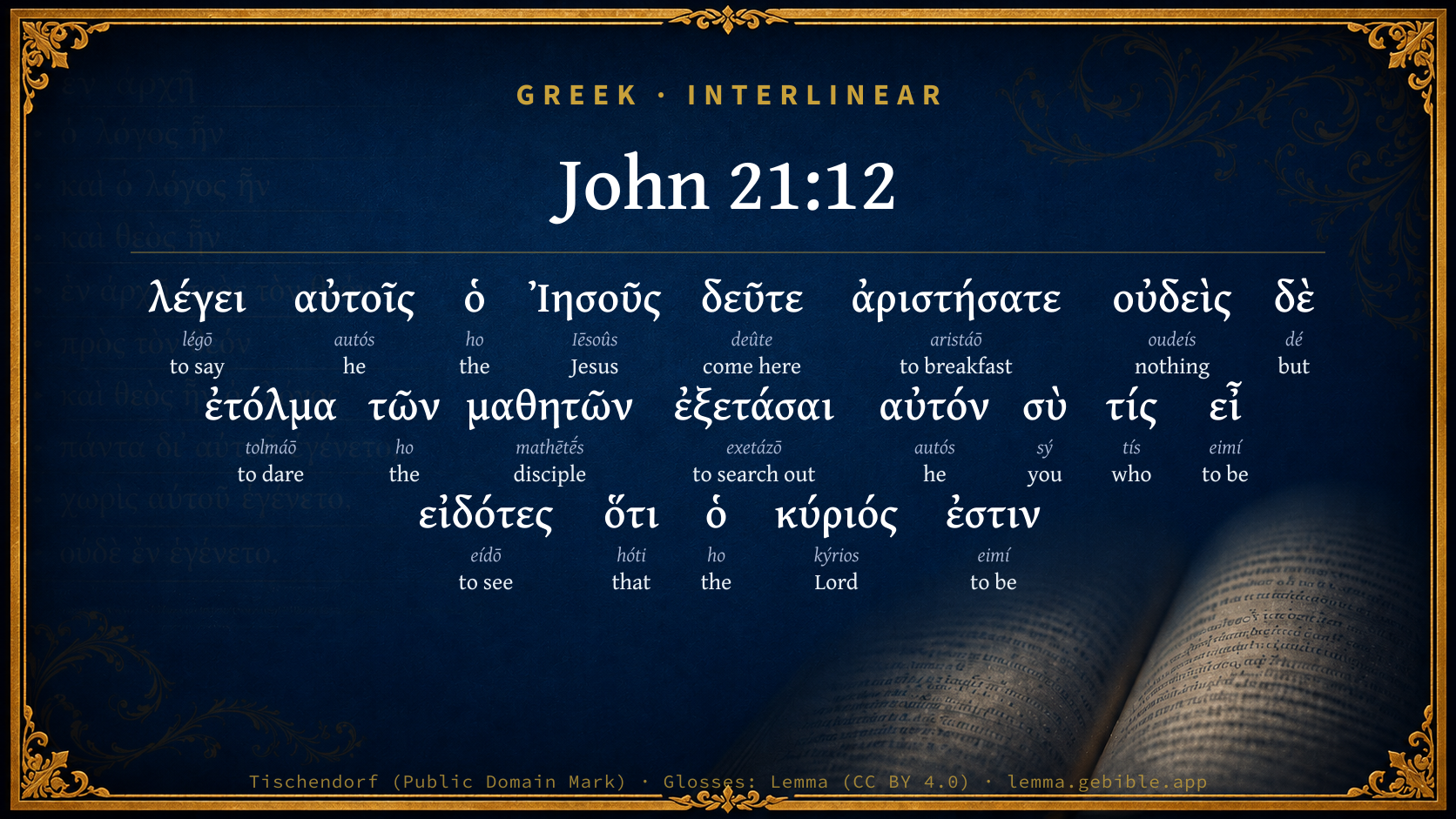
  1. λέγει légō G3004 “to say” Verb, Present, Active, Indicative, 3rd person, Singular
  2. αὐτοῖς autós G846 “he” Personal pronoun, Dative, Plural, Masculine
  3. ὁ ho G3588 “the” Article, Nominative, Singular, Masculine
  4. Ἰησοῦς Iēsoûs G2424 “Jesus” Noun, Nominative, Singular, Masculine
  5. δεῦτε deûte G1205 “come here” Verb, Present, Active, Imperative, 2nd person, Plural
  6. οὐδεὶς oudeís G3762 “nothing” Adjective, Nominative, Singular, Masculine, Negative
  7. δὲ dé G1161 “but” Conjunction
  8. ἐτόλμα tolmáō G5111 “to dare” Verb, Imperfect, Active, Indicative, 3rd person, Singular
  9. τῶν ho G3588 “the” Article, Genitive, Plural, Masculine
  10. μαθητῶν mathētḗs G3101 “disciple” Noun, Genitive, Plural, Masculine
  11. ἐξετάσαι exetázō G1833 “to search out” Verb, Aorist, Active, Infinitive
  12. αὐτόν autós G846 “he” Personal pronoun, Accusative, Singular, Masculine
  13. σὺ sý G4771 “you” Personal pronoun, 2nd person, Nominative, Singular
  14. τίς tís G5101 “who” Interrogative pronoun, Nominative, Singular, Masculine
  15. εἶ eimí G1510 “to be” Verb, Present, Active, Indicative, 2nd person, Singular
  16. εἰδότες eídō G1492 “to see” Verb, Perfect, Active, Participle, Nominative, Plural, Masculine
  17. ὅτι hóti G3754 “that” Conjunction
  18. ὁ ho G3588 “the” Article, Nominative, Singular, Masculine
  19. κύριός kýrios G2962 “Lord” Noun, Nominative, Singular, Masculine
  20. ἐστιν eimí G1510 “to be” Verb, Present, Active, Indicative, 3rd person, Singular

About this verse

These counts appear in no published source. They are computed here, from the morphology-tagged text and Lemma’s own curated glosses. What Lemma adds →

21
words
17
distinct lemmas
Gospels
section

Notable vocabulary

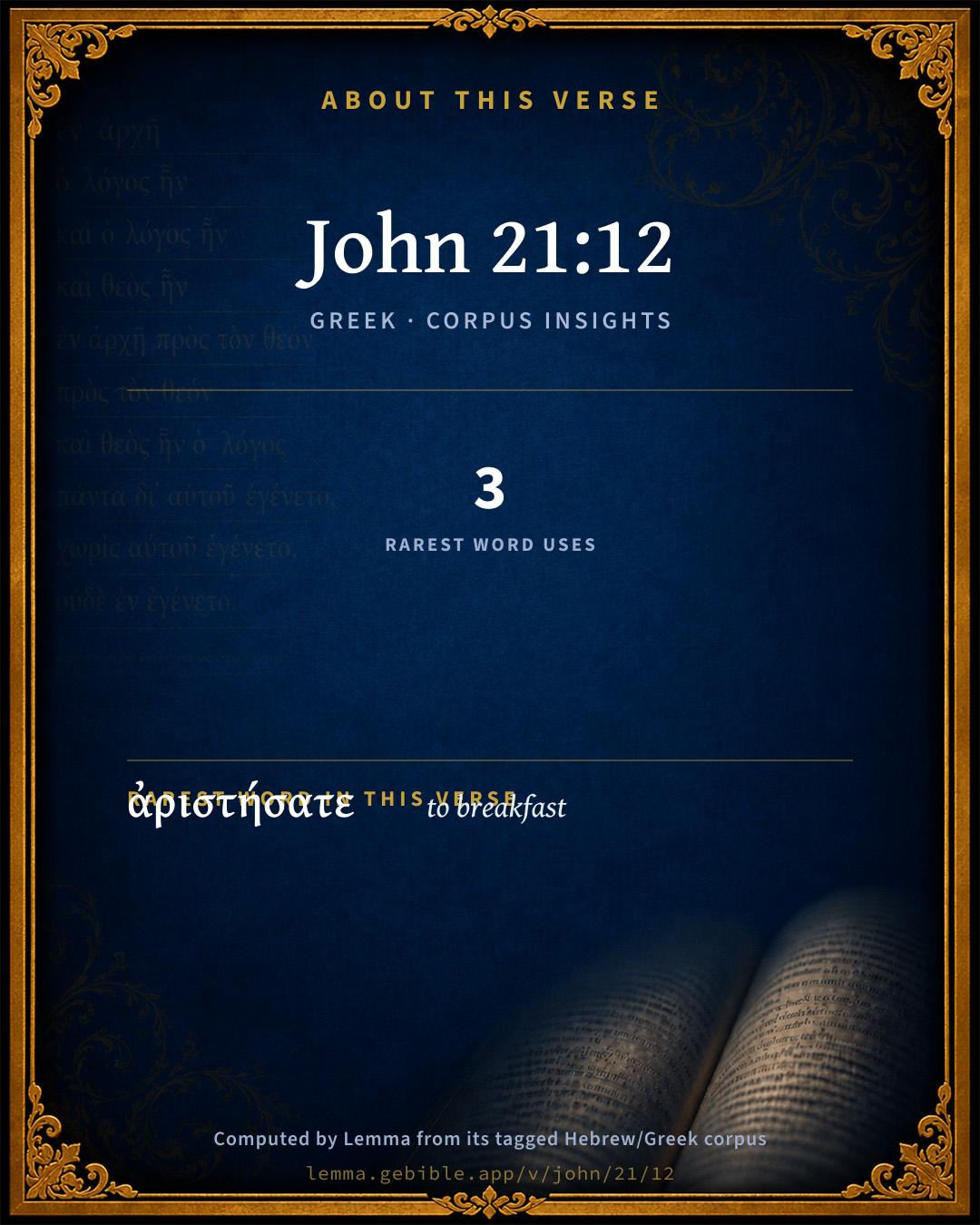
The rarest word here is ἀριστήσατε to breakfast G709 — appearing just 3 times in the whole Greek New Testament.

Shared distinctive vocabulary

ἀριστήσατε to breakfast G709 occurs in 3 verses of the Greek New Testament. Also found in:

Repetition

Words recur within this verse:

Cross-references

7

Topical passages linked to John 21:12 in the Treasury of Scripture Knowledge — connected by theme and wording, ordered by reader-vote popularity; previews shown in the World English Bible.

  • Acts 10:41 not to all the people, but to witnesses who were chosen before by God, to us, who ate and drank with him after he rose from the dead.
  • Luke 9:45 But they didn't understand this saying. It was concealed from them, that they should not perceive it, and they were afraid to ask him about this saying.
  • John 16:19 Therefore Jesus perceived that they wanted to ask him, and he said to them, "Do you inquire among yourselves concerning this, that I said, 'A little while, and you won't see me, and again a little while, and you will see me?'
  • Genesis 32:29–30 Jacob asked him, "Please tell me your name." He said, "Why is it that you ask what my name is?" He blessed him there.
  • Mark 9:32 But they didn't understand the saying, and were afraid to ask him.
  • John 4:27 At this, his disciples came. They marveled that he was speaking with a woman; yet no one said, "What are you looking for?" or, "Why do you speak with her?"
  • John 21:15 So when they had eaten their breakfast, Jesus said to Simon Peter, "Simon, son of Jonah, do you love me more than these?" He said to him, "Yes, Lord; you know that I have affection for you." He said to him, "Feed my lambs."

Cross-references courtesy of OpenBible.info (CC BY 4.0).

Commentary

Notes on John 21:12 from classic Christian and Jewish commentators (each source and its license shown beneath its notes). The classic Christian expositions comment on the surrounding passage and are grouped to its opening verse, so a note may address several verses; the Jewish commentaries on the Tanakh (Rashi and others) are per-verse, so they appear only where the commentator wrote on this verse.

Lemma curates 59 commentaries, every one of them public domain or Creative Commons licensed, each selected and text-cleaned for this edition rather than reprinted as found. About our sources →

The Biblical Illustrator

Joseph S. Exell

Joh_21:12-13

Jesus saith unto them, Come and dine

Loving invitation

(cf.

Joh_1:39):--Here is

I. NEARNESS familiar and domestic. While we are sinners faith brings us into a justified state by simply looking to Christ; but after believing faith then assists us to enjoy Christ. Some expect to enjoy Christ first and believe Him afterwards; but you must take Gods mercies in their order. You will not find Come and dine in the first chapter of John--there it is, Come and see. Believe Jesus first, and you shall feed on Him afterwards. Come and see gives peace, but Come and dine gives heaven, for it gives Christ.

II. UNION WITH JESUS, because the only meat that we can eat when we dine with Christ is Himself. We do not provide the supper. Christ found the fish, the fire, and the bread, and then said, Come and dine. The fire that warms our heart when we have fellowship with Him comes from Himself, and the fish that we eat is His own, and the wine that we drink flows from His own heart. Oh, what union is this!

III. FELLOWSHIP WITH THE SAINTS. You are not to eat your morsel alone, but in company. We sit down in heaven with Abraham, Isaac, and Jacob, at the marriage supper of the Lamb, and no small part of the hereafter bliss is connected with the fellowship of the saints. So here we enjoy the company as well as the feast. The Supper of the Lord is the table of communion, not only with the Master, but also with all who love Him. Hungry men are sure to be quarrelsome, but if you would have sweetest fellowship with each other, live on Christ. We do not expect to see all Christians agreeing, but we are sure that one of the most likely plans for cultivating a brotherly spirit is to listen to Christs words, Come and dine.

IV. THE SOURCE OF STRENGTH FOR EVERY CHRISTIAN. To look at Christ is to live, but for strength to serve Him you must come and dine. We need as much food for the soul as for the body, and unless we eat we shall be fainting by the way. If you want to be as Mr. Feeblemind, take only a small modicum of spiritual food in your closets; neglect family prayer; never attend a prayer-meeting; on no account speak about religious matters during the week; go late to the house of God, and fall asleep when you get there; as soon as you leave the place of worship talk about the weather. All your strength depends upon union with Christ. Away from Him you must wither as a branch severed from the vine. Feeding on Him you will be like the branch which is drinking up the sap from the parent stem; you will be strong enough to bring forth fruit.

V. GROWTH AND PROGRESS IN SPIRITUAL THINGS. To see Christ is to begin the Christians life, but to grow in grace we must come and dine. The early history of the first disciples is by no means satisfactory. They were evidently only babes in spiritual things. They had seen Jesus, and loved Him, and followed Him, but they were far from possessing the Spirit of Christ. Now after they had reached this stage of living on Christ they became new men. It is no longer mere sight, but an inward appropriation, and the consequences are manifest. Many Christians remain stunted and dwarfed. They exist but do not grow. The reason is evident, they are not taking of Christ, and they neglect to appropriate to themselves the blessing which He is waiting to bestow.

VI. PREPARATION FOR SERVICE. Before the feast is concluded, Christ says to Peter, Feed My lambs; Feed My sheep; Follow Me. All the strength supplied by Christ is for service. Some Christians are for living on Christ, but are not so anxious to live for Christ. Heaven is the place where saints feast most and work most. Now, earth should be a preparation for heaven; come and dine, and then go and labour. Freely ye receive, freely give; gather up all the fragments of your feast, and carry the loaves and fishes to others, as did the disciples. We are not to hold the precious grains of truth like a mummy does the wheat, for ages, without giving it a chance of growing. No, feed yourself, and then go forth and bid others come and eat and drink. Why does the Lord send down the rain upon the thirsty earth, and give the sunshine and the genial refreshing breeze? (C. H.Spurgeon.)

The dinner on the Galilean shore an emblem of redemption

I. THE TIME WAS OPPORTUNE. The disciples had tried all their resources for means of a livelihood that night and had failed. They were no doubt tired, hungry, and dejected. The dinner came just at the right time. It is just so with the redemptive system. After the world had tried everything for its salvation--poetry, philosophy, religion, civilization--and grew worse, Christ came in the fulness of time.

II. THE PROVISIONS WERE DESIRABLE. The fish they caught they had been toiling all night to obtain. They were craving for such food. The provisions of the gospel are both suited to mans needs and urgently required. They are

1. Renovating.

2. Cleansing.

3. Developing.

4. Harmonizing.

5. Perfecting. Isa_25:6 we have a description of the great Spiritual banquet.How rich, varied, abundant the viands!

III. THE HOST WAS CONDESCENDING. What a sight!--the Son of God preparing a feast for poor fishermen, and dining with them. Thus He has done in redemption. He descended into the lowest parts of the earth, unto the lowest grades; made Himself of no reputation. (D. Thomas, D. D.)

A feast with Jesus

1. Our Lord is careful of bodily wants. Twice in the days of His flesh He fed the people with bread and fish, and now He has risen He still thinks of the hungering bodies of the disciples. This may be a warrant to the churches to feed, not to try and proselytize.

2. If any of you are needy catch at this. He who said to the seven, Come and break your fast, will not forget you. I cannot tell how the fire was lighted, &c., but some way or other you will be fed.

3. If Jesus is thus careful of bodily wants, much more will He be careful of your souls. After He had supplied the one He proceeds to Supply the other.

I. THE IMPORTANCE OF A FEAST WITH JESUS. It was important to these men

1. For they were wet and cold; so a fire was provided where they could dry their jerseys and warm their hands. They were hungry too, and here is the old food, light and easy of digestion. Christ does not like to see us wet, and cold, and hungry, because it is not good for us. If, therefore, you feel uncomfortable and unhappy Jesus does not want you to be so. Many a battle has been lost because the soldiers were not in good condition.

2. They were weary with the nights fruitless toil; and when Christs modern workers feel discouraged He invites them to come and break their fast with Him.

3. They were likely to forget their bodily wants in their sudden success. It is hungry work now to live on catching and counting. Successful workers are prone to forget their own spiritual wants.

4. Christ was about to overhaul them. It is needful that Christ should feed us before He searches us.

5. They were about to receive a commission. Christ does not send people to feed His sheep and lambs without feeding them first.

6. They were about to enter on a perilous path. Wonder not that you are called to endure fiery trials, but see that you are first fed on heavenly bread.

II. JESUS ACTING AS HOST. IS not this wonderful? Jesus communing with Thomas, who doubted Him, and Peter, who denied Him. Notice Jesus our Host

1. Preparing the feast. It was an act of creative power. Your soul can ever feed on what Christ creates, but on nothing else.

2. Waiting on the feasters. Sometimes a host will say, Help yourselves, but we cannot help ourselves; so Jesus cometh and taketh bread and giveth them. There is good spiritual food in the Word, but sometimes we cannot get at it; so Jesus puts it into our hearts.

3. Showing Himself. Giving them food was the most effective manner of doing this. When the Word nourishes most, then is the time of the clearest vision of Christ; and that vision is the most satisfying thing on earth or in heaven.

III. THE PROVISIONS.

1. What He had mysteriously prepared. Feed now on the mysteries of

(1) Everlasting love.

(2) The covenant of grace.

(3) The brotherhood of Christ.

(4) Atoning efficacy.

2. What He had graciously given. Gods mercies are like the hundred and fifty and three--an odd number, but very exact. Has not your net, too, been full of answers to prayer?

IV. HOW THE GUESTS BEHAVED THEMSELVES.

1. They only spoke one word--No; which betrayed the emptiness and hunger of their souls. You may say to your Lord, I am a negative, nobody and nowhere without Thee. The devotion which shows itself by bawling may be genuine, but it is very superficial. Deep waters are still. It takes a wise man to hold his tongue.

2. They asked Christ no questions. People who have no religion are fond of religious questions. But when you get near Christ there is no questioning. We believe in the Bible because we know the Author, and are therefore not troubled with sceptical doubts. They were lost in wonder at His amazing condescension, and His majestic presence. What could they do but hold their tongues? (C. H. Spurgeon.)

Communion with Christ

This chapter has a sacramental character, and the words, Come and dine, are a summons to communion. Note

I. THE ENTERTAINMENT.

1. There is already fish prepared when Jesus says, Bring of the fish now caught. Host and guest must each contribute. If any man will hear My voice and open the door, I will come in and sup with him and he with Me, i.e., I with him as his Guest, and he with Me as Mine. It is so here. Communion implies reciprocity. When Christ meets His people at the holy feast He is there as the Host who furnishes the fire and the fish, the bread and the wine, the supplies of grace and of the Spirit. But He is also the Guest. We partake of Him, but He looks to partake of us, though we know that He can find nothing that can give Him pleasure till He puts it there. This fish which we must bring He guided into the net. Christ having first given the grace comes to receive of it. He is spiritually present to receive as well as communicate that highest joy which is the interchange of conscious feeling and trusted love, to partake of us as we of Him.

2. If this be the case can we come thoughtlessly, with defiled hands, or with self-righteousness to offer ourselves for Christs participation? Nay, but let us come with what He craves, the love on receiving which here or anywhere He sees of the travail of His soul and is satisfied.

II. THE FEELING. None durst ask Him. Why should they if they knew? The saying expresses that almost new converse with which the disciples after the Resurrection regarded their Lord. One there had previously presumed to question, Be it far from Thee, Lord. It was not so now. Think with what instinctive awe we should regard a similar manifestation of Christ now. Questioning would have been impertinent. They must wait for Him to speak now. It would also have been mistrusting. Well enough did they know it was the Lord, notwithstanding the changes which the three days had wrought. There is a familiarity in words, hymns, meditations, in these times which befits not our intercourse with the Risen. Let the feeling which reigns around the Lords table be one of reverence. This is not dread, distance, bondage, but adoring love.

III. THE CONVERSATION. Some have found it difficult to maintain a spirit of prolonged communion at the Lords table; but let them learn from this to commune about

1. Their sins. Who can doubt that Peters three denials were uppermost in his heart? Yet you will note that there was no remorse for an irrevocable past, and no excuses for inexcusable guilt. Be guided by this in your communion, and this one topic will provide enough for an hours profitable discourse.

2. Their work. This communion brought reinstatement for Peter in his apostolate, and a particular designation to his future employment. Converse, then, about thy work, its past deficiencies, and thy need of present and future strength to do it.

3. Their future. Peters was here revealed, and if thine is not in such particularity, yet the words, Follow Me, will hearten thee to meet it, whatever it may be.

4. Their friends, What shall this man do? (Dean Vaughan.)

The Biblical Illustrator, edited by Joseph S. Exell (c. 1880s–1900s) — public domain. Text from a community e-Sword module.

Tyndale Open Study Notes

Tyndale Open Resources

21:12-13 None of the disciples dared to ask him, “Who are you?” Jesus’ resurrected appearance was different. His offer of fish and bread removed all uncertainties (cp. 6:11; Luke 24:30).

Tyndale Open Study Notes — © Tyndale Open Resources, licensed CC BY-SA 4.0. Text via the HelloAO Bible API.

Bengel's Gnomon

Johann Albrecht Bengel

Joh 21:12. Δεῦτε, come) The Lord receives His disciples at the banquet. In Joh 21:9 there is mentioned the preparation for dinner (or rather luncheon, or breakfast, ἄριστον, the early meal).—ἀριστήσατε, breakfast or dine) viz. ye. Jesus had no necessity to eat. From the mention of breakfast or luncheon (the morning meal), with which comp. Joh 21:4, “the morning,” it is evident the manifestation (Joh 21:1) of Him lasted many hours.—οὐδεὶς, none) Implying the great solemnity of this feast.—εἰδότες, knowing) Syllepsis.[403]

[403] The sense being regarded in the construction more than the words. The participle plural agreeing with μαθηταὶ understood, taken out of οὐδεὶς μαθητῶν.—E. and T.

Bengel's Gnomon of the New Testament — English translation (T&T Clark, Edinburgh, 1860) — public domain. Text from a community e-Sword module.

Meyer's Critical & Exegetical Commentary

Heinrich August Wilhelm Meyer

Joh_21:12-13. Ἄριστον is, as little as in Mat_22:4, Luk_11:38, the principal meal, which, in spite of Joh_21:4, Hengstenberg suggests in the interest of allegorical interpretation, but breakfast.

ἐτόλμα] dared, presumed. Although, that is, it had been possible for them, in respect of the external appearance, to doubt whether He was the Lord, they were nevertheless convinced of His identity, and hence dared not to ask Him: Who art thou? Reverential awe (comp. already Joh_4:27), in presence of the marvellous appearance of the Risen One, deprived them of the courage to do so. According to Augustine, Beda, Jansen, and several others, they dared not doubt, which however, is not expressed. Chrysostom aptly remarks: οὐκέτι γὰρ τὴν αὐτὴν παῤῥησίαν εἶχον· … τὴν δὲ μορφὴν ἀλλοιοτέραν ὁρῶντες καὶ πολλῆς ἐκπλήξεως γέμουσαν, σφόδρα ἦσαν καταπεπληγμένοι, καὶ ἐβούλοντο τι περὶ αὐτῆς ἐρωτᾶν· ἀλλὰ τὸ δέος καὶ τὸ εἰδέναι αὐτοὺς, ὅτι οὐχ ἕτερός τις ἦν, ἀλλʼ αὐτὸς, ἐπεῖχον τὴν ἐρώτησιν.

ἐξετάσαι] to explore (Mat_2:8; Mat_10:11; Sir_11:7; Sir_13:11, frequently in the classics), sciscitari; strong expression from the point of view from which the respectful timidity of the disciples regarded the daring nature of the question.

εἰδότες] Constructio κατὰ σύνεσιν. See Kühner, II. § 419a; Krüger, § 58. 4. 5.

Joh_21:13. ἔρχεται] The δεῦτε, Joh_21:12, has summoned the disciples to the place of the meal where the fire of coals was; Jesus Himself, who had therefore stood at some distance therefrom, now steps forward, in order to distribute the breakfast.

τὸν ἄρτον] points back to Joh_21:9, but τὸ ὀψάριον to Joh_21:9-10 : the bread lying there, etc. Both are again collective. It is not merely one loaf and one fish which Jesus distributes, as Hengstenberg, for the purpose of symbolically interpreting it of a heavenly reward of toil, assumes; see Joh_21:10.

A thanksgiving before the δίδωσιν is not related, not as though Jesus omitted τὰ ἀνθρώπινα (Euth. Zigabenus); nor as though He did not desire positively to offer Himself to their recognition (Lange, in opposition to Joh_21:12); nor, again, as though the meal was to be a silent[281] one (Luthardt, who adds: for such is the table fellowship of Jesus and His own in the present aeon); nor, again, because the meal represented future blessings (Hengstenberg),but because here it is not a question of any proper meal, as in Luk_24:20, but rather only of a breakfast, of a morning meal, partaken of only while standing (there is no mention, moreover, of a lying down), which also was not to have, like that early meal of Paul, Act_27:35, a character of solemnity. It was not this breakfast in itself, which Christ prepared for the disciples, but that which preceded (the draught of fishes) and succeeded (Joh_21:15 ff.), which was the object for which the Risen One here appeared.

[281] That the meal passed generally in entire silence, as also Hengstenberg suggests, as little appears from the text as that Jesus did not Himself partake of it (Hengstenberg). In favour of a symbolical interpretation of details, a dismal and extravagant character is given to the incident. But the text breaks off with the distribution of the bread and of the mess of fish, and it says nothing of the progress of the breakfast.

Meyer — Critical and Exegetical Commentary on the New Testament — English translation by Peter Christie, edited by Frederick Crombie (T&T Clark, 1880) — public domain. Text from a community e-Sword module.

Expositor's Greek Testament

ed. W. Robertson Nicoll

Joh 21:12 . λέγει … ἀριστήσατε , Jesus takes the place of host and says, “Come, breakfast,” make your morning meal. οὐδεὶς … Κύριός ἐστιν , not one of the disciples ventured to interrogate Him; ἐξετάσαι is “to examine by questioning”. Each man felt convinced it was the Lord, and a new reverence prevented them from questioning Him.

The Expositor's Greek Testament, edited by W. Robertson Nicoll (1897–1910) — public domain. Text from a community e-Sword module.

Jamieson, Fausset & Brown

Robert Jamieson, A. R. Fausset & David Brown

none . . . durst ask him, Who art thou, knowing it was the Lord--implying that they would have liked Him just to say, "It is I"; but having such convincing evidence they were afraid of being "upbraided for their unbelief and hardness of heart" if they ventured to put the question.

Jamieson, Fausset & Brown — Commentary Critical and Explanatory on the Whole Bible (1871) — public domain (CC PDM 1.0). Text via the HelloAO Bible API.

Adam Clarke's Commentary

Verse 12. Come and dine.] δευτε αριστησατε. Though this is the literal translation of the word, yet it must be observed that it was not dinner time, being as yet early in the morning, Joh 21:4; but Kypke has largely shown that the original word is used by Homer, Xenophon, and Plutarch, to signify breakfast, or any early meal, as well as what we term dinner. It might perhaps appear singular, otherwise it would be as agreeable to the use of the Greek word, to have translated it, come and breakfast.

Durst ask him] Ever since the confession of Thomas, a proper awe of the Deity of Christ had possessed their minds.

Adam Clarke's Commentary on the Bible (1810–1826) — public domain. Text from a community e-Sword/MySword module.

John Calvin's Commentaries

12. And not one of his disciples dared to ask him. It may be inquired, What hindered them? Was it shame arising from reverence, or was it any thing else? But if Christ saw that they were in a state of uncertainty, he ought to remove their doubt, as he had done on many other occasions. I reply, there was no other reason for shame, but because they were not sufficiently certain that he was the Christ; for it is not usual with us to inquire about matters that are doubtful and obscure. The Evangelist, therefore, means that the disciples did not ask Christ, because they were afraid of doing him wrong; so plain and manifest were the signs by which he had made himself known to them.

John Calvin's Commentaries (1540-1563) — public domain. Text from the Calvin Translation Society English edition (1840s-50s) via the Christian Classics Ethereal Library (ccel.org). Calvin's coverage is partial (roughly two-thirds of the Bible); uncommented books and verses are honest gaps, never fabricated. The 19th-century editor's footnotes and remarks are omitted so the notes are faithfully Calvin's own voice.

Ellicott's Commentary for English Readers

(12) Jesus saith unto them, Come and dine.—Comp. Note on Joh_21:15 and Luk_11:37, which are the only other instances of the verb in the New Testament. The meal referred to was the early morning meal which we call breakfast (Joh_21:4).

And none of the disciples durst ask him . . .—Comp. Joh_4:27. They approach Him in reverent silence. Knowing it is the Lord, they yet desire the assurance in His own words, and still they do not dare to ask, “Who art thou?” The Greek word rendered “ask” means to “prove” “inquire.” It is found elsewhere in the New Testament in Mat_2:8; Mat_10:11 only. The word rendered “durst,” is also not found again in St. John, but its use in the Gospels is—except in the instance of Nicodemus, “who went in boldly unto Pilate” (Mar_15:43)—confined to the expression of the reverence which dared not question our Lord. (Comp. Mat_22:46; Mar_12:34; Luk_20:40.) In all these instances it is used with a negative, and with a verb of inquiry, as here.

A Bible Commentary for English Readers, edited by Charles John Ellicott (1878–1897) — public domain. Text from a community e-Sword module.

The Cambridge Bible for Schools and Colleges

gen. ed. J. J. S. Perowne

12. Come and dine] The meal indicated is not the principal meal of the day (deipnon) which was taken in the afternoon, but the morning meal (ariston) or breakfast. See on Luk_11:37.

And none] Omit ‘and.’ There is a solemn simplicity in the narrative. The sentences from Joh_21:10 to Joh_21:14 have no connecting particles: comp. chap. 15 and Joh_20:13-19.

none durst ask … knowing] A mixture of perplexity, awe, and conviction. They are convinced that He is the Lord, yet feel that He is changed, and reverence restrains them from curious questions. Comp. Mat_2:8; Mat_10:11. The writer knows the inmost feelings of Apostles (comp. Joh_2:11; Joh_2:17; Joh_2:22, Joh_4:27; Joh_4:33, Joh_6:21, Joh_9:2, Joh_20:20) [11].

The Cambridge Bible for Schools and Colleges (gen. ed. J. J. S. Perowne; Cambridge University Press, 1878–1918) — public domain. Text from a community e-Sword module.

John Gill's Exposition

Jesus saith unto them, come and dine,.... One would think it should rather have been said, come and take a breakfast than a dinner, since it was so early in the morning: but Grotius has observed, out of Homer, that is used for food taken in a morning; so that it may signify here, not what we properly call dining, but eating a morning's meal; and may be an emblem of that spiritual refreshment believers enjoy with Christ in his house and ordinances now, and of those everlasting pleasures they will partake with him in the resurrection morn: and it is to be observed, that he does not say go and dine, but come and dine; that is, along with himself: he does not send his disciples elsewhere for food, but invites them to come to him, to hear his word, which is food for faith, to wait in his house, where plenty of provision is made, and to attend on his ordinances, and in all to feed upon himself, and to feed with him; to all which they are heartily welcome.

And none of the disciples durst ask him, who art thou? knowing that it was the Lord: to ask such a question was altogether unnecessary, and would have been impertinent, and they might justly have been upbraided and rebuked for it: it would have looked like insolence, or unbelief, or both, and that greatly aggravated, when it was so clear a case that it was the Lord; who might be known by his voice and person, especially when they came near to him, and also by the miracles which he wrought: so at the last day, when every eye shall see him coming in the clouds of heaven, none will ask who he is; all will know him.

John Gill's Exposition of the Whole Bible (1746–1763) — public domain (CC PDM 1.0). Text via the HelloAO Bible API.

Trapp's Complete Commentary

John Trapp

12 Jesus saith unto them, Come and dine. And none of the disciples durst ask him, Who art thou? knowing that it was the Lord.

Ver. 12. None of the disciples durst ask him] They were ashamed to move further question in that which was to them all so evident. Neither yet may we imagine that they sat silent all dinner while in their Master’s presence, as monks and Turks use to do; {a} but that, although they were abashed to ask him who he was, yet they both asked and answered many other more profitable questions. Our Saviour never came to any man’s table, but he besprinkled the dishes with the salt of savoury discourse; so should we, but so (alas) we do not. Plato and Xenophon thought it fit and profitable that men’s speeches at meals should be written. And if Christians should so do, what kind of books would they be?

{a} Turcae perpetuum silentium teneat, ut muti. Cusp. de Caesario.

John Trapp, A Commentary or Exposition upon All the Books of the Old and New Testament (1647–1656) — public domain. Text from a community e-Sword module.

Albert Barnes' Notes on the Bible

Come and dine - The word in the original means the meal which is taken in the morning, or breakfast.

Albert Barnes' Notes on the Bible (1834–1885) — public domain. Text from a community e-Sword/MySword module.

Haydock's Catholic Bible Commentary

And none of them who were at meat, durst ask him, who art thou? knowing that it was the Lord. It is likely he appeared to them with a countenance different, and brighter than before his death; yet they were presently so convinced it was Jesus, that they were ashamed to ask or doubt of it. (Witham)

George Leo Haydock (1774–1849), Haydock's Catholic Family Bible and Commentary, 1859 edition — public domain. Excludes Psalms (Douay-Rheims chapter numbering differs from Protestant) and Deuterocanonical books (Catholic canon only).

Matthew Poole's English Annotations

It was in the morning, and may as well be translated, Come and break your fasts, as

Come and dine. They now knew it was the Lord, if not by his face and voice, yet by this miracle; therefore they durst not ask him, for fear of a sharp reproof, after he had by such a miraculous operation made himself known to them.

Matthew Poole's English Annotations on the Holy Bible (1683–1685) — public domain. Text from a community e-Sword/MySword module.

Whedon's Commentary on the Bible

Daniel D. Whedon

12. Come and dine—Or, as it was the morning meal, it might better be rendered,

Come and breakfast. Durst ask… knowing—The meal was taken in silent awe. Though there was a mystery about him which prompted the question Who art thou? yet there was such a consciousness of his divine person as both convinced them that it was he and awed their questions into silence.

Daniel D. Whedon (gen. ed.), Commentary on the Old and New Testaments (1874–1909) — public domain. Text from a community e-Sword module.

The Pulpit Commentary

Jesus saith to them, Come and break your fast. A Word is used which does not denote the principal meal of the day (not deipnew , but aristaw , from ariston), but a slight refreshment that was taken in early morning, or at least before noon, and answers to our breakfast at the dawning of the day. He calls them to the repast. He becomes once more their Host and their Minister. Even still, metaphorically, he washes their feet. He attends to their requirements. He feeds them from this strangely bestowed supply. He joins them in their hunger for souls. He inspires their methods. He shares in their victory, after painful fruitless toil. Nownot onei.e. not even Thomasof the disciples durst inquire of him put to him the interrogatoryWho art thou? knowing, each one of them that it was the Lord. The use of exetasai instead of erwthsai , John"s own word, is not to be wondered at, as he does not think of a simple inquiry, but of such an examination as would furnish them with facts. These they possessed. A feeling of awe and reverence possessed them. They were of one mind about the marvelous revelation of himself to them. Some strange emotion sealed their lips. He had not manifested himself to the world, but to his disciples, and to them by "the interpretations they were putting upon their own experience" (Westcott). They knew it was the Lord. They looked into that other world. They were lost in silent amaze, and received the revelation once more of their risen Master and Lord.

The diffidence of reverent hearts.

It does at first sight seem strange that when John had exclaimed, "It is the Lord!" when Peter had plunged into the lake to swim to the shore where Jesus stood, when all the little company had indubitable evidence that Jesus was indeed with them, there should still have been this reticence, this diffidence, this awe. Yet such conduct is not inconsistent with human nature; and its analogue is still to be discerned in human experience.

I THE SOUL RECOGNIZES CHRIST BY HIS DIVINE DEMEANOR AND LANGUAGE. The authority and the considerateness with which Jesus addressed the disciples, and the provision which he made for their wants, were to them an assurance that they were not mistaken in their conviction that they were in the presence of their Lord. Only let the heart be open to the manifestations of the spiritual presence of the Divine Lord and Savior of men, in his Word and in human society, and the conclusion will be reached speedily and certainly that the work witnesses to the Worker; that the light and heat are an index to the presence of the sun. The correspondence between human need on the one hand and Divine provision on the other is so marked and so perfect as to suggest, and indeed to require, belief in the authoritative mission of Christ, and in his eternal presence in human society.

II THE SOUL MAY BE DETERRED BY ITS VERY REVERENCE FROM INTELLECTUAL INQUIRY INTO CHRIST"S CREDENTIALS. No doubt there are those who believe as they have been taught and trained to believe, and whose belief is simply the reflection of that of others. Yet there are natures, refined and sensitive, who are so perfectly convinced of our Lord"s Deity and mission, that to doubt of, and even to inquire into, this matter seems almost like a scrutiny into a mother"s virtue or a father"s integrity. They have the witness within themselves. For some, evidences and investigation and criticism may be necessary; but for these reverent souls is no such need. Knowing "it is the Lord," they dare not ask him, "Who art thou?

III SUCH FAITH IS SUFFICIENT FOR HIM WHO EXERCISES IT, AND IS ACCEPTABLE TO THE LORD HIMSELF. Men may reason and argue and dispute, and yet never come to faith, whilst there are believing souls who are altogether indifferent to logical processes and insusceptible to critical doubt. The heart may be peaceful and strong in fellowship with the Savior who has revealed himself to it. And he whose claims will endure all scrutiny, and whose right transcends all debate, is yet willing to accept the homage of the child-like, and the devotion of the congenial and the pure. T.

The Pulpit Commentary (1880–1919), ed. H.D.M. Spence-Jones & Joseph S. Exell — public domain. Text from a community e-Sword module.

John Wesley's Explanatory Notes

Come ye and dine - Our Lord needed not food. And none presumed - To ask a needless question.

John Wesley, Explanatory Notes Upon the Whole Bible (1754–1765) — public domain. Text via the GEBible commentary corpus.

Scofield Reference Notes

C. I. Scofield

dine

Lit. break your fast.

The Scofield Reference Bible (1917 edition), notes by C. I. Scofield — public domain. Text from a community e-Sword module.

Burkitt's Expository Notes on the New Testament

William Burkitt

A two-fold reason may be assigned why Christ did at this time invite and call his disciples to dine with him: the first and more principal reason was, to evidence to them the reality of his resurrection, and to assure them of the truth of his manhood, that they might not think it was an apparition only. By the miracle in catching the fishes, he proved himself to be God; by his present eating of the fish, he evidenced himself to be man, and consequently teaches us that our exalted High Priest continues our kinsman in heaven. He is still bone of our bone, and flesh of our flesh; he has taken possession of heaven in our nature, sitting there in our glorified humaninty united to the glorious Deity, clothed with that body which hung in its blood and gore upon the cross, but now shining brighter than ten thousand suns. The second and less principal reason why Christ called his disciples to dine with him, was this, to show his tender care over the bodies of his dear disciples, as being the tabernacles of his own Spirit, the temples of the Holy Ghost; therefore Christ encourages, though not to the pampering, yet to the refreshing of them: Jesus said unto them, Come and dine. And he would not confer with them till they had dined; as the next verse shows.

William Burkitt's Expository Notes on the New Testament (1700–1703) — public domain. Text from a community e-Sword module.

The People's New Testament

B. W. Johnson

12, 13. And none … durst ask him, Who art thou? The disciples knew that it was the Lord, but there was something in his mien, his majesty, his altered appearance, that amazed them, filled them with awe, and prevented them from asking questions that they were curious to know.

B. W. Johnson's The People's New Testament with Notes (1889–1891) — public domain. Electronic text from the Christian Classics Ethereal Library (CCEL) ThML edition.

unfoldingWord translationNotes

Door43 World Missions Community

breakfast

the morning meal

the third time

You can translate this ordinal term "third" as "time number 3." (See: Ordinal Numbers)

translationWords

Jesus

disciple

bread

raise

die

unfoldingWord translationNotes — © Distant Shores Media and the Door43 World Missions Community, licensed CC BY-SA 4.0. Source: git.door43.org/Door43/en_tn.

Cambridge Greek Testament for Schools and Colleges

12. ἀριστήσατε. Not the afternoon or evening δεῖπνον (Joh 12:2, Joh 13:2), but the morning ἄριστον, which could be rejected before going to one’s day’s work (Mat 22:4), is intended: see on Luk 11:37. Here the Apostles listen to the invitation with mingled perplexity, awe, and conviction. They know that He is the Lord, but feel that He is changed, and reverence restrains them from curious questions (comp. Joh 4:27). Thus the writer shews knowledge of the inmost feelings of Apostles: Joh 2:11; Joh 2:17; Joh 2:22, Joh 4:27; Joh 4:33, Joh 6:21, Joh 9:2, Joh 20:20 [19].

Cambridge Greek Testament for Schools and Colleges (Cambridge University Press, 1896; 21 vols, various authors incl. Carr, Maclear, Plummer, Farrar, Lumby, Moule, M. R. James, Simcox) — public domain. Text from a community e-Sword module.

Alford’s Greek Testament

Henry Alford

12. ἀριστ.] Hereby is implied the morning meal: see vv. 3, 4.

οὐδεὶς ἐτ.] I take these words to imply that they sat down to the meal in silence,—wondering at, while at the same time they well knew, Him who was thus their Host. Chrys. says, οὐκέτι γὰρ τὴν αὐτὴν παῤῥησίαν εἶχον … ἀλλὰ μετὰ σιγῆς καὶ δεοῦς πολλοῦ καὶ αἰδοῦς ἐκαθέζοντο προσέχοντες πρὸς αὐτόν, … τὴν δὲ μορφὴν ἀλλοιοτέραν ὁρῶντες καὶ πολλῆς ἐκπλήξεως γέμουσαν, σφόδρα ἦσαν καταπεπληγμένοι, καὶ ἐβούλοντό τι περὶ αὐτῆς ἐρωτᾶν· ἀλλὰ τὸ δέος καὶ τὸ εἰδέναι αὐτοὺς ὅτι οὐχ ἕτερός τις ἦν ἀλλʼ αὐτός, ἐπεῖχον τὴν ἐρώτησιν. Hom. in Joann. lxxxvii. 2.

τολμᾶν and ἐξετάζειν are not elsewhere in John.

ἐξετάσαι, more than ‘ask:’ to question or prove Him.

ἐστίν again, after ἐτόλμα, in John’s manner.

Henry Alford, The Greek Testament (1849–1861) — public domain. Text from a community e-Sword module.

International Critical Commentary

12. Jesus calls to the disciples, Δεῦτε ἀριστήσατε, “Come and break your fast” (cf. for the constr. δεῦτε, ἴδετε κτλ., 4:29). ἄριστον was the morning meal (Mat 22:4, Luk 11:38, Luk 14:12); the verb ἀριστᾶν occurs again in N.T. only at Luk 11:37 Nothing is said of the cooking of any of the fish that had been caught, but the command of v. 10 suggests that it was thus that the disciples’ breakfast was provided.

οὐδεὶς ἐτόλμα κτλ. The intimate familiarity of the old days had passed; they knew that it was Jesus who was speaking to them, but they did not dare to question Him as to His identity (cf. 4:27). Chrysostom says that they sat down for the meal in silence and trepidation, which may be implied.

οὐδεὶς … τῶν μαθητῶν. For this constr., without ἐκ before the gen. plural, as usual in Jn. (see on 1:40, 7:19), cf. 13:28. On μαθηταί, see 2:2.

εἰδότες ὅτι ὁ κύριός ἐστιν. It was not as at the Emmaus supper, where He was not recognised until He blessed and broke the bread (Luk 24:30); here He was recognised before the meal began.

τολμᾶν and ἐξετάζειν do not occur in the body of the Gospel. For ἐξετάζειν, “to cross-examine,” cf. Mat 2:8, Ecclus. 11:7; it is a natural word to use in this context.

International Critical Commentary — older volumes (1896–1929), various authors — public domain. Text from a community e-Sword module.

Vincent's Word Studies in the New Testament

Marvin R. Vincent

Dine [αριστησατε] . Rather, breakfast. In Attic Greek ariston signified the mid - day meal; the evening meal being known as deipnon. The regular hour for the ariston cannot be fixed with precision. The drift of authority among Greek writers seems to be in favor of noon. The meal described here, however, evidently took place at an earlier hour, and would seem to have answered more nearly to the ajkratisma, or breakfast of the Greeks, which was taken directly upon rising. Plutarch, however, expressly states that both names were applied to the morning meal, and says of Alexander, "He was accustomed to breakfast [ηριστα] at early dawn, sitting, and to sup [εδειπνει] late in the evening." In Mt 22:4, it is an ariston to which the king's wedding - guests are invited. Ask [εξετα. σαι] . Rev., inquire. Implying careful and precise inquiry. It occurs only three times in the New Testament; of Herod 's command to search diligently for the infant Christ (Mt 2:8), and of the apostles ' inquiring out the worthy members of a household (Mt 10:11).

Marvin R. Vincent, Word Studies in the New Testament (1887–1900) — public domain. Text from a community e-Sword/MySword module.

Godet's Commentaries

Frédéric Louis Godet

Vv. 12-14. “Jesus says to them, Come, and breakfast. But none of the disciples dared to ask him, Who art thou? knowing that it was the Lord. 13. Jesus comes near and takes the bread and gives it to them, and the fish likewise. 14. This was now the third time that Jesus manifested himself to his disciples after he had risen from the dead.”

Jesus takes the part of host. He was standing at a little distance, but now He comes forward. A feeling of respectful fear prevents the disciples from approaching this mysterious person. Jesus invites them to eat; but even then they do not dare to address Him. It is no longer the familiar relation of former days. Nothing is more natural than the apparent contradiction between know (to surmise) and not dare to interrogate. The terms τολμᾶν and ἐξετάζεινare not used elsewhere in John.

The indication given at Joh 21:14 divides the narrative into two parts. The beginning of Joh 21:15, however: When therefore they had breakfasted, connects the following conversation with the scene of the meal, Joh 21:13. The author desired to separate what in this appearance had an ordinary character and was related to the work of evangelization represented by the disciples in general who were present, from that which specially concerned the part and the destiny in the future of the two principal apostles, Peter and John.

The expression τοῦτο ἤδη τρίτον, this was already the third time, contains one of those niceties which we have noticed in several instances in the course of this Gospel. It recalls the forms already explained in Joh 2:11 : ταύτην ἐποίησε τὴν ἀρχήν, and Joh 4:54 : τοῦτο πάλιν δεύτερον σημεῖον ἐποίησεν . Like these, it has as its aim to correct tacitly the Synoptic narrative. According to Matthew (and Mark?) the first appearance of Jesus to the disciples seemed to have taken place in Galilee, not in Judea. By no means, says our author: when He appeared to them in Galilee, it was already the third time that He showed Himself to them as having risen from the dead. The two preceding appearances to which he alludes are evidently the last two of ch. Joh 20:19 ff., vv. Joh 20:26 ff. He does not count the one to Mary Magdalene, because, as he expressly says, it is of appearances to the disciples that he wishes to speak. Reuss objects that the disciples present were only seven in number. What matter? It was a considerable group of them, and it was led by Peter. In the appearance Joh 20:19 ff. they were not, any more than here, all together.

As to the appearances to the two from Emmaus and to Peter (Luke, Paul), they belong to another category; they are appearances to certain individuals, not to the disciples. The word alreadyallows us to suppose other subsequent appearances; they are those of Matthew 28, and of 1Co 15:7, and Acts 1.

Frédéric Louis Godet — Commentaries on Luke, John, Romans, and 1 Corinthians — English translation (T&T Clark, Edinburgh, 1870s–1890s) — public domain. Text from a community e-Sword module.

Lesson kit

Teaching starters — assembled from the data on this page, not authored interpretation. Every prompt links to the verse data it draws on. Edit before teaching.

John, in the Gospels, opens this verse with 21 words (17 distinct Greek lemmas). Its most distinctive word is aristáō (“to breakfast”). A historical commentator’s framing appears above. Read the whole chapter for the surrounding context.

Discussion questions

  1. The word aristáō carries the sense “to breakfast.” How does it shape the verse?
  2. How does Luke 11:37, which shares the word «to breakfast», read alongside this verse?
  3. What does the repetition of “to be” (2× in this one verse) do in this verse?
  4. The translations on this page render this verse differently — a whole-verse word diff, not a word-by-word alignment. What might account for the different wordings?
  5. Compare how The Biblical Illustrator and Tyndale Open Study Notes read this verse. Where do they agree or differ?

Things to notice

Reading settings

Reading text

Shown beneath each verse's original-language words.

Old Testament
Old Testament edition

Read the OT as the Masoretic Hebrew (MT) or the Greek Septuagint (LXX).

English shown for the Greek Septuagint (in the Hebrew ↔ Greek comparison).

Comparing translations? Open the Compare panel on any verse page to stack up to four side by side.