1 Corinthians 9:15

Greek (Tischendorf 8th ed.) 1 Corinthians 9:15 appears in the Greek New Testament. The text above is from the Tischendorf 8th edition. Each word links to its Strong’s number and a concise gloss. Click any word for its full Thayer’s Greek Lexicon entry.
Download image
Cite this verse

1 Corinthians 9:15 (World English Bible). Public Domain. Lemma interlinear Bible study tool, https://lemma.gebible.app/v/1-corinthians/9/15.

Show BibTeX & RIS
BibTeX
RIS
English Translation
But I have used none of these things, and I don't write these things that it may be done so in my case; for I would rather die, than that anyone should make my boasting void.
World English Bible · Public Domain
Download a study sheet

One document with this verse’s original text, its word-by-word gloss line, the meaning frame, cross-references with their text, attributed commentary, and full source and license credits — printable, and it pastes into notes with its structure intact.

This verse Autodidact and up

Study sheet (.html) Plain text (.txt)

A passage Seminary Student

Up to 50 verses in one chapter. A passage sheet keeps up to 6 commentary sources and 12 cross-references per verse, in the order this page ranks them, and says so on the sheet whenever that leaves anything out. Ask for a single verse and you get the Autodidact verse sheet above.

Everything on this page stays free to read, with no account — the sheet is a download of what is already on screen, not access to it.

Want to remove ads? Support Godless Engineer
Compare translations 3

The same verse in 3 English versions, stacked beneath the original-language interlinear above. Click any original word for its lexicon entry.

Each is an independent rendering of the whole verse — the interlinear is not word-aligned to these translations.

Highlighted words mark where these versions differ — a whole-verse word diff, not a word-by-word alignment.

  • World English Bible Public Domain
    But I have used none of these things, and I don't write these things that it may be done so in my case; for I would rather die, than that anyone should make my boasting void.
  • King James Version Public Domain
    But I have used none of these things: neither have I written these things, that it should be so done unto me: for it were better for me to die, than that any man should make my glorying void.
  • unfoldingWord Literal Text CC BY-SA 4.0
    But I have not taken advantage of of these things. Now I do not write these things so that thus it might be done for me, for better for me to die rather than will make my boast empty.

unfoldingWord Literal Text — © unfoldingWord, licensed CC BY-SA 4.0. Word-aligned USFM3 via Door43 (git.door43.org/unfoldingWord/en_ult).

Versions to compare (up to 4)

3 of 4 selected

Show all 19 translations

Every available English version of this verse, each an independent rendering of the whole verse.

  • World English Bible Public Domain
    But I have used none of these things, and I don't write these things that it may be done so in my case; for I would rather die, than that anyone should make my boasting void.
  • Berean Standard Bible Public Domain
    But I have not used any of these rights. And I am not writing this to suggest that something be done for me. Indeed, I would rather die than let anyone nullify my boast.
  • Majority Standard Bible Public Domain
    But I have not used any of these rights. And I am not writing this to suggest that something be done for me. Indeed, I would rather die than let anyone nullify my boast.
  • King James Version Public Domain
    But I have used none of these things: neither have I written these things, that it should be so done unto me: for it were better for me to die, than that any man should make my glorying void.
  • American Standard Version (1901) Public Domain
    But I have used none of these things: and I write not these things that it may be so done in my case; for `it were' good for me rather to die, than that any man should make my glorifying void.
  • Revised Version (1885) Public Domain
    But I have used none of these things: and I write not these things that it may be so done in my case: for it were good for me rather to die, than that any man should make my glorying void.
  • Geneva Bible (1599) Public Domain
    But I haue vsed none of these things: neither wrote I these things, that it should be so done vnto me: for it were better for me to die, then that any man should make my reioycing vaine.
  • Douay-Rheims (1899) Public Domain
    But I have used none of these things. Neither have I written these things, that they should be so done unto me: for it is good for me to die, rather than that any man should make my glory void.
  • Young's Literal Translation Public Domain
    And I have used none of these things; neither did I write these things that it may be so done in my case, for `it is' good for me rather to die, than that any one may make my glorying void;
  • Literal Standard Version CC BY-SA 4.0
    And I have used none of these things; neither did I write these things that it may be so done in my case, for [it is] good for me rather to die, than that anyone may make my glorying void;
  • Unlocked Literal Bible CC BY-SA 4.0
    But I have not claimed any of these rights. And I do not write this so something might be done for me. I would rather die than anyone deprive me of this boast.
  • unfoldingWord Literal Text CC BY-SA 4.0
    But I have not taken advantage of of these things. Now I do not write these things so that thus it might be done for me, for better for me to die rather than will make my boast empty.
  • Darby Bible Public Domain
    But *I* have used none of these things. Now I have not written these things that it should be thus in my case; for [it were] good for me rather to die than that any one should make vain my boast.
  • World Messianic Bible Public Domain
    But I have used none of these things, and I don’t write these things that it may be done so in my case; for I would rather die, than that anyone should make my boasting void.
  • Webster's Bible Public Domain
    But I have used none of these things: neither have I written these things, that it should be so done to me: for it were better for me to die, than that any man should make my glorying void.
  • Free Bible Version CC BY-SA 4.0
    But I have not made use of any of these provisions, and I'm not writing about this to suggest it should be done in my case. I'd rather die than to have anyone take away my pride in not having received any benefit.
  • Bible in Basic English Public Domain
    But I have not made use of any of these things: and I am not writing this in the hope that it may be so for me: for it would be better for me to undergo death, than for any man to make this pride of mine of no effect.
  • Text-Critical English NT CC BY 4.0
    But I have not used any of these rights, and I am not writing this so that such may be done in my case. For I would rather die than have anyone deprive me of my reason for boasting.
  • Tyndale New Testament (1534) Public Domain
    But I have vsed none of these thinges. Nether wrote I these thinges that it shuld be so done vnto me. For it were better for me to dye the that eny man should take this reioysinge from me.

Literal Standard Version (2020), Covenant Press — licensed CC BY-SA 4.0. Text via the HelloAO Bible API (eBible.org). Unlocked Literal Bible (unfoldingWord) — licensed CC BY-SA 4.0. Text via the HelloAO Bible API (eBible.org). unfoldingWord Literal Text — © unfoldingWord, licensed CC BY-SA 4.0. Word-aligned USFM3 via Door43 (git.door43.org/unfoldingWord/en_ult). Free Bible Version, Dr. Jonathan Gallagher — licensed CC BY-SA 4.0. Text via the HelloAO Bible API (eBible.org).

Word by word

More ways to search: Search by grammar → Find every occurrence → Compare this word →

Practice this passage: Drill this verse → Learn its vocabulary →

κενώσει
kenóō
G2758
“to empty”
Verb, Future, Active, Indicative, 3rd person, Singular
Part of Speech
Verb
Tense
Future
Voice
Active
Mood
Indicative
Person
3rd person
Number
Singular
Full Thayer's Definition

Origin: from G2756

TDNT: 14:01,4

1. to empty, make empty a. of Christ, he laid aside equality with or the form of God 2. to make void a. deprive of force, render vain, useless, of no effect 3. to make void a. cause a thing to be seen to be empty, hollow, false
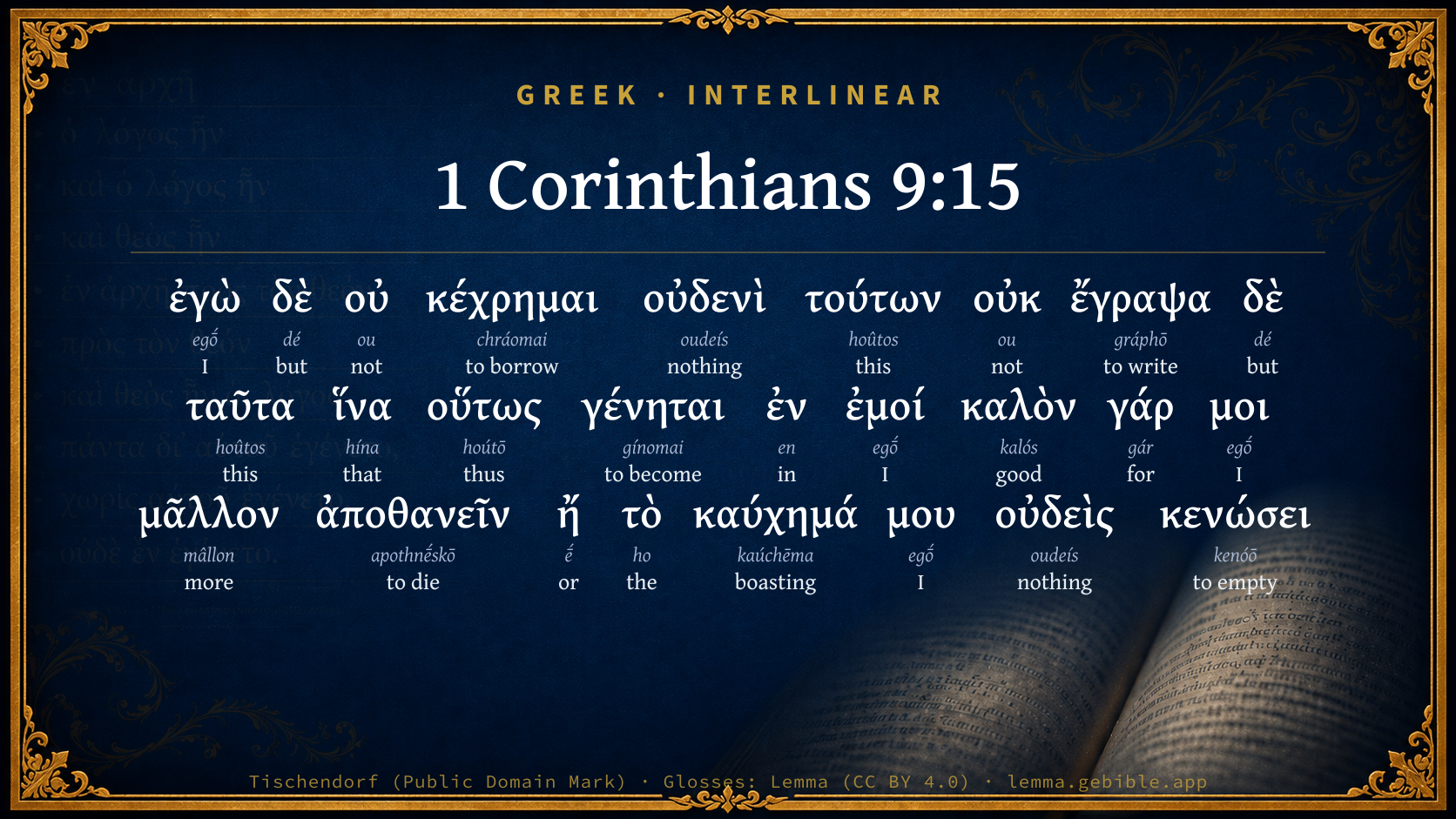
  1. ἐγὼ egṓ G1473 “I” Personal pronoun, 1st person, Nominative, Singular
  2. δὲ dé G1161 “but” Conjunction
  3. οὐ ou G3756 “not” Particle, Negative
  4. κέχρημαι chráomai G5530 “to borrow” Verb, Perfect, Middle or Passive deponent, Indicative, 1st person, Singular
  5. οὐδενὶ oudeís G3762 “nothing” Adjective, Dative, Singular, Neuter, Negative
  6. τούτων hoûtos G3778 “this” Demonstrative pronoun, Genitive, Plural, Neuter
  7. οὐκ ou G3756 “not” Particle, Negative
  8. ἔγραψα gráphō G1125 “to write” Verb, Aorist, Active, Indicative, 1st person, Singular
  9. δὲ dé G1161 “but” Conjunction
  10. ταῦτα hoûtos G3778 “this” Demonstrative pronoun, Accusative, Plural, Neuter
  11. ἵνα hína G2443 “that” Conjunction
  12. οὕτως hoútō G3779 “thus” Adverb
  13. γένηται gínomai G1096 “to become” Verb, Aorist, Middle deponent, Subjunctive, 3rd person, Singular
  14. ἐν en G1722 “in” Preposition
  15. ἐμοί egṓ G1473 “I” Personal pronoun, 1st person, Dative, Singular
  16. καλὸν kalós G2570 “good” Adjective, Nominative, Singular, Neuter
  17. γάρ gár G1063 “for” Conjunction
  18. μοι egṓ G1473 “I” Personal pronoun, 1st person, Dative, Singular
  19. μᾶλλον mâllon G3123 “more” Adverb
  20. ἀποθανεῖν apothnḗskō G599 “to die” Verb, Aorist, Active, Infinitive
  21. ἤ ḗ G2228 “or” Particle
  22. τὸ ho G3588 “the” Article, Accusative, Singular, Neuter
  23. καύχημά kaúchēma G2745 “boasting” Noun, Accusative, Singular, Neuter
  24. μου egṓ G1473 “I” Personal pronoun, 1st person, Genitive, Singular
  25. οὐδεὶς oudeís G3762 “nothing” Adjective, Nominative, Singular, Masculine, Negative

About this verse

These counts appear in no published source. They are computed here, from the morphology-tagged text and Lemma’s own curated glosses. What Lemma adds →

26
words
19
distinct lemmas
Pauline Epistles
section

Notable vocabulary

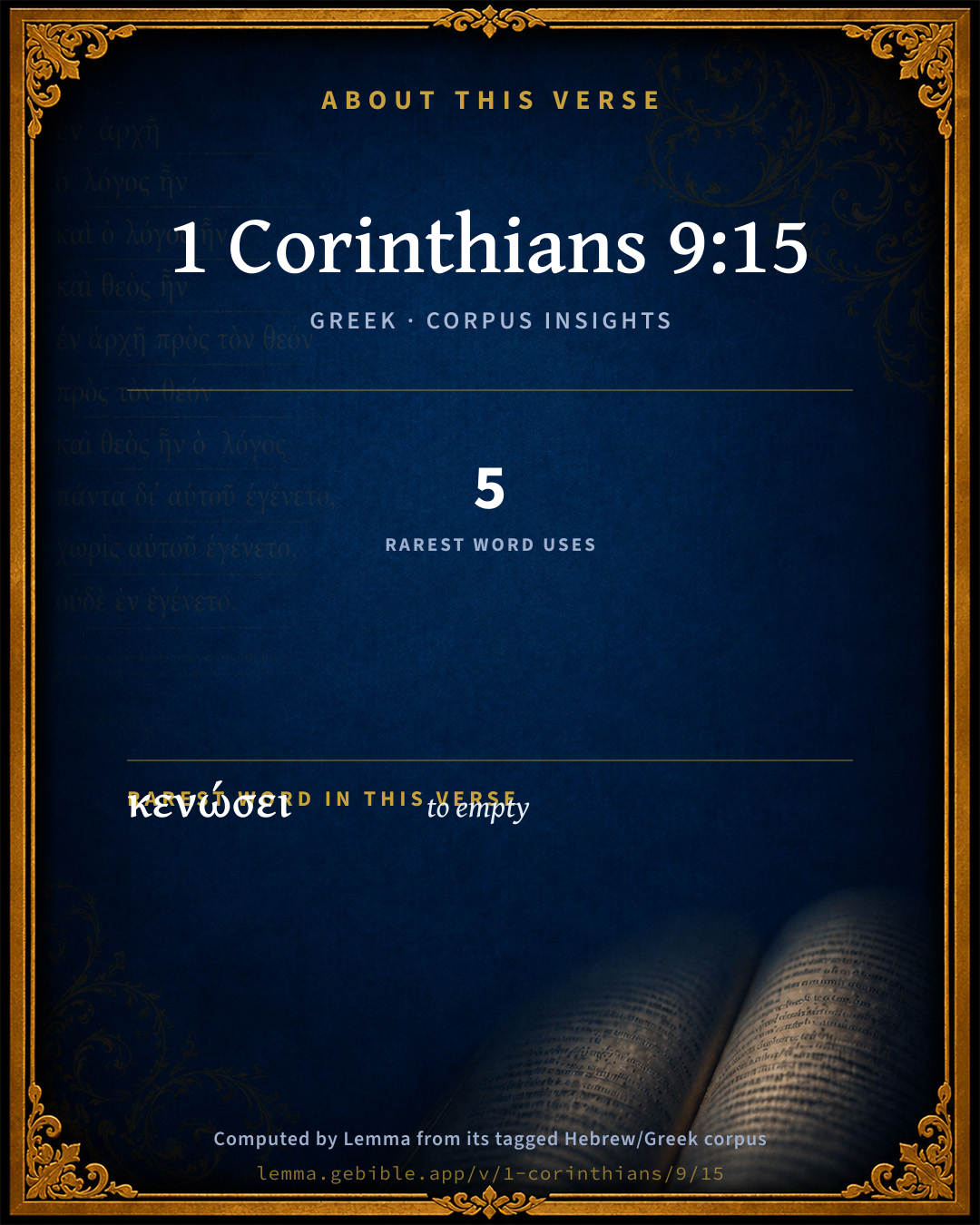
The rarest word here is κενώσει to empty G2758 — appearing just 5 times in the whole Greek New Testament.

Shared distinctive vocabulary

κενώσει to empty G2758 occurs in 5 verses of the Greek New Testament. Also found in:

Repetition

Words recur within this verse:

Cross-references

12

Topical passages linked to 1 Corinthians 9:15 in the Treasury of Scripture Knowledge — connected by theme and wording, ordered by reader-vote popularity; previews shown in the World English Bible.

  • 1 Thessalonians 2:9 For you remember, brothers, our labor and travail; for working night and day, that we might not burden any of you, we preached to you the Gospel of God.
  • 2 Thessalonians 3:8 neither did we eat bread from anyone's hand without paying for it, but in labor and travail worked night and day, that we might not burden any of you;
  • 1 Corinthians 9:12 If others partake of this right over you, don't we yet more? Nevertheless we did not use this right, but we bear all things, that we may cause no hindrance to the Gospel of Christ.
  • Acts 18:3 and because he practiced the same trade, he lived with them and worked, for by trade they were tent makers.
  • Acts 20:24 But these things don't count; nor do I hold my life dear to myself, so that I may finish my race with joy, and the ministry which I received from the Lord Jesus, to fully testify to the Gospel of the grace of God.
  • Acts 20:34 You yourselves know that these hands ministered to my necessities, and to those who were with me.
  • 2 Corinthians 11:9–12 When I was present with you and was in need, I wasn't a burden on anyone, for the brothers, when they came from Macedonia, supplied the measure of my need. In everything I kept myself from being burdensome to you, and I will continue to do so.
  • Matthew 18:6 but whoever causes one of these little ones who believe in me to stumble, it would be better for him that a huge millstone should be hung around his neck, and that he should be sunk in the depths of the sea.
  • Acts 8:3 But Saul ravaged the assembly, entering into every house, and dragged both men and women off to prison.
  • 1 Corinthians 4:12 We toil, working with our own hands. When people curse us, we bless. Being persecuted, we endure.
  • 2 Corinthians 12:13–18 For what is there in which you were made inferior to the rest of the assemblies, unless it is that I myself was not a burden to you? Forgive me this wrong.
  • Philippians 1:20–23 according to my earnest expectation and hope, that I will in no way be disappointed, but with all boldness, as always, now also Christ will be magnified in my body, whether by life, or by death.

Cross-references courtesy of OpenBible.info (CC BY 4.0).

Where the printed editions differ

1 variant

Places in this verse where the major printed Greek editions disagree on the wording in a way that affects the translation — a comparison of editions, not a manuscript-by-manuscript collation. The editions are the modern critical texts (Nestlé-Aland 28/27, SBL, Westcott-Hort, Tregelles, Tyndale House) and the traditional texts behind the KJV (the Textus Receptus and the Byzantine/Majority text). It is not a claim about which reading is original.

  1. Extra text
    ἵνα

    “so that”

    In TRByz Not in NA28NA27TynSBLWHTreg

    ἵνα (ina) 'so that' is only in traditional manuscripts (TR+Byz)

Textual data: Translators Amalgamated Greek New Testament (STEPBible TAGNT) · CC BY 4.0.

Commentary

Notes on 1 Corinthians 9:15 from classic Christian and Jewish commentators (each source and its license shown beneath its notes). The classic Christian expositions comment on the surrounding passage and are grouped to its opening verse, so a note may address several verses; the Jewish commentaries on the Tanakh (Rashi and others) are per-verse, so they appear only where the commentator wrote on this verse.

Lemma curates 59 commentaries, every one of them public domain or Creative Commons licensed, each selected and text-cleaned for this edition rather than reprinted as found. About our sources →

Matthew Henry's Commentary

Here he tells them that he had, notwithstanding, waived his privilege, and lays down his reason for doing it.

I. He tells them that he had neglected to claim his right in times past: I have used none of these things, Co1 9:15. He neither ate nor drank himself at their cost, nor led about a wife to be maintained by them, nor forbore working to maintain himself. From others he received a maintenance, but not from them, for some special reasons. Nor did he write this to make his claim now. Though he here asserts his right, yet he does not claim his due; but denies himself for their sakes, and the gospel.

II. We have the reason assigned of his exercising this self-denial. He would not have his glorying made void: It were better for his to die than that any man should make his glorying void, Co1 9:15. This glorying did imply nothing in it of boasting, or self-conceit, or catching at applause, but a high degree of satisfaction and comfort. It was a singular pleasure to him to preach the gospel without making it burdensome; and he was resolved that among them he would not lose this satisfaction. His advantages for promoting the gospel were his glory, and he valued them above his rights, or his very life: Better were it for him to die than to have his glorying made void, than to have it justly said that he preferred his wages to his work. No, he was ready to deny himself for the sake of the gospel. Note, It is the glory of a minister to prefer the success of his ministry to his interest, and deny himself, that he may serve Christ, and save souls. Not that in so doing he does more than he ought; he is still acting within the bounds of the law of charity. But he acts upon truly noble principles, he brings much honour to God in so doing; and those that honour him he will honour. It is what God will approve and commend, what a man may value himself for and take comfort in, though he cannot make a merit of it before God.

III. He shows that this self-denial was more honourable in itself, and yielded him much more content and comfort, than his preaching did: "Though I preach the gospel, I have nothing whereof to glory; for necessity is laid upon me; yea, woe is unto me, if I preach not the gospel, Co1 9:16. It is my charge, my business; it is the work for which I am constituted an apostle, Co1 1:17. This is a duty expressly bound upon me. It is not in any degree a matter of liberty. Necessity is upon me. I am false and unfaithful to my trust, I break a plain and express command, and woe be to me, if I do not preach the gospel." Those who are set apart to the office of the ministry have it in charge to preach the gospel. Woe be to them if they do not. From this none is excepted. But it is not given in charge to all, nor any preacher of the gospel, to do his work gratis, to preach and have no maintenance out of it. It is not said, "Woe be to him if he do not preach the gospel, and yet maintain himself." In this point he is more at liberty. It may be his duty to preach at some seasons, and under some circumstances, without receiving a maintenance for it; but he has, in the general, a right to it, and may expect it from those among whom he labours. When he renounces this right for the sake of the gospel and the souls of men, though he does not supererogate, yet he denies himself, waives his privilege and right; he does more than his charge and office in general, and at all times, obliges him to. Woe be to him if he do not preach the gospel; but it may sometimes be his duty to insist on his maintenance for so doing, and whenever he forbears to claim it he parts with his right, though a man may sometimes be bound to do so by the general duties of love to God and charity to men. Note, It is a high attainment in religion to renounce our own rights for the good of others; this will entitle to a peculiar reward from God. For,

IV. The apostle here informs us that doing our duty with a willing mind will meet with a gracious recompence from God: If I do this thing, that is, either preach the gospel or take no maintenance, willingly, I have a reward. Indeed, it is willing service only that is capable of reward from God. It is not the bare doing of any duty, but the doing of it heartily (that is, willingly and cheerfully) that God has promised to reward. Leave the heart out of our duties, and God abhors them: they are but the carcasses, without the life and spirit, of religion. Those must preach willingly who would be accepted of God in this duty. They must make their business a pleasure, and not esteem it a drudgery. And those who, out of regard to the honour of God or good of souls, give up their claim to a maintenance, should do this duty willingly, if they would be accepted in it or rewarded for it. But whether the duty of the office be done willingly or with reluctance, whether the heart be in it or averse from it, all in office have a trust and charge from God, for which they must be accountable. Ministers have a dispensation of the gospel, or stewardship - oikonomia (Luk 16:2), committed to them. Note, Christ's willing servants shall not fail of a recompence, and that proportioned to their fidelity, zeal, and diligence; and his slothful and unwilling servants shall all be called to an account. Taking his name, and professing to do his business, will make men accountable at his bar. And how sad an account have slothful servants to give!

V. The apostle sums up the argument, by laying before them the encouraging hope he had of a large recompence for his remarkable self-denial: What is my reward then? Co1 9:18. What is it I expect a recompence from God for? That when I preach the gospel I may make it without charge, that I abuse not my power in the gospel. Or, "not so to claim my rights as to make them destroy the great intentions and ends of my office, but renounce them for the sake of these." It is an abuse of power to employ it against the very ends for which it is given. And the apostle would never use his power, or privilege of being maintained by his ministry, so as to frustrate the ends of it, but would willingly and cheerfully deny himself for the honour of Christ and the interest of souls. That ministers who follows his example may have cheerful expectations of a full recompence.

Matthew Henry's Commentary on the Whole Bible (1708–1710) — public domain (CC PDM 1.0). Text via the HelloAO Bible API.

The Biblical Illustrator

Joseph S. Exell

1Co_9:15-16

But I have used none of these things.

Pauls conduct

I. Does not establish a general rule. Because--

1. He maintains his right.

2. Voluntarily concedes it.

3. Under particular circumstances.

II. Commends disinterested effort. The desire of personal advantage--

1. Should never be the motive of Christian effort.

2. Is unworthy of the Christian character.

3. Robs us of our true glory. (J. Lyth, D. D.)

Professional Minister

The man who has adopted the Church as a profession, as other men adopt the law, the army, or the navy, and goes through the routine of its duties with the coldness of a mere official--filled by him, the pulpit seems filled by the ghastly form of a skeleton that, in its cold and bony fingers, holds a burning lamp. (T. Guthrie, D. D.)

For though I preach the gospel, I have nothing to glory of; for necessity is laid upon me.--

Preaching the gospel

is to preach Christ in His fulness, in His attributes, in His relations to men; is to preach His life as the pattern of Christian morals; His atonement as the substance of Christian doctrine; His resurrection as the source of Christian assurance; and His coming again as the fountain of hope and joy. (Bp. Thorold.)

Preach the gospel

I. What is it to preach the gospel?

1. To state every doctrine contained in Gods Word, and to give every truth its proper prominence. Men may preach a part of the gospel. I would not say that a man did not preach the gospel if he did but maintain the doctrine of justification by faith, but he would not preach the whole gospel. No man can be said to do that who leaves out one single truth. Some men purposely confine themselves to four or five topics and make an iron ring of their doctrines, and he who dares to step beyond that narrow circle is not reckoned orthodox. God bless heretics, then, and send us more of them!

2. To exalt Jesus Christ. A great many preachers tell poor convinced sinners, You must go home and pray and read the Scriptures; you must attend the ministry, and so on. I would not direct to prayer, &c., but simply to faith. Not that I despise prayer, &c.

that must come after faith. None of those things are the way of salvation.

3. To give every class of character his due. He who preaches solely to saints, or solely to the sinner, does not preach the whole of the gospel. We have amalgamation here. We have the saint who is full of assurance and strong; we have the saint who is weak and low in faith; we have the young convert; we have the man halting between two opinions; we have the moral man; we have the sinner; we have the reprobate; we have the outcast. Let each have a word.

4. Not to preach certain truths about the gospel, not to preach about the people, but to preach to the people. To preach the gospel is to preach it into the heart, not by your own might, but by the influence of the Holy Ghost.

II. How is it that ministers are not allowed to glory? Because--

1. They are conscious of their own imperfections.

2. All their gifts are borrowed. The life, the voice, the talent are the gift of God; and he who has the greatest gifts must feel that unto God belongs the glory.

3. They are absolutely dependent on the Holy Ghost.

III. What is that necessity which is laid upon us to preach the gospel?

1. The call itself. If a man be truly called of God to the ministry, I will defy him to withhold himself from it. He must preach.

2. The sad destitution of this poor fallen world. (C. H. Spurgeon.)

Every Christian a preacher

Mark--

I. The obligation of speech. No doubt the apostle had, in a special sense, a necessity laid upon him. But though he differs from us in his direct supernatural commission, in the width of his sphere and in the splendour of his gifts, he does not differ from us in the reality of the obligation. The commission does not depend upon apostolic dignity. Christ said, Go ye into all the world, &c., to all generations of His Church.

1. That commandment is permanent, it is exactly contemporaneous with the duration of the promise which is appended to it. Nay, the promise is made conditional upon the discharge of the duty.

2. Just because this commission is given to the whole Church it is binding on every individual member of the Church. The whole Church is nothing more than the sum total of all its members, and nothing is incumbent upon it which is not incumbent upon each of them. You cannot buy yourselves out of the ranks, as they used to be able to do out of the militia, by paying for a substitute. We all, if we know anything of Christ and His love and His power, are bound to tell it to those whom we can reach. You cannot all stand up and preach in the sense in which I do it. But the word does not imply a pulpit, a set discourse, a gathered multitude; it simply implies a heralds task of proclaiming. Everybody who has found Christ can say, I have found the Messias, and everybody who knows Him can say, Come and hear, and I will tell what the Lord hath done for my soul. No man can force you. But if Christ says to me, Go! and I say, I had rather not, Christ and I have to settle accounts between us.

3. This command makes very short work of a number of excuses.

(1) There is a great deal in the tone of this generation which tends to chill the missionary spirit. We know more about the heathen, and familiarity diminishes horror. We have taken up, many of us, milder ideas about the condition of those who die without knowing the name of Christ. We have taken to the study of comparative religion, forgetting sometimes that the thing that we are studying as a science is spreading a dark cloud of ignorance and apathy over millions of men. And all these reasons somewhat sap the strength and cool the fervour of a good many Christian people nowadays. Jesus Christs commandment remains just as it was.

(2) Then some of us say, I prefer working at home! Well, if you are doing all that you can there, the great principle of division of labour comes in to warrant your not entering upon other fields; but unless you are, there is no reason why you should do nothing in the other direction. Jesus Christ still says, Go ye into all the world.

(3) Then some of you say, Well, I do not much believe in your missionary societies. There is a great deal of waste of money about them. I have heard stories about missionaries taking too much pay, and doing too little work. Be that as it may, does that indictment draw a wet sponge across the commandment of Jesus Christ?

4. I sometimes venture to think that the day will come when the condition of being received into and retained in the Church will be obedience to that commandment. Why, even bees have the sense at a given time of the year to turn the drones out of the hives. Whether it is a condition of Church membership or not, sure I am that it is a condition of fellowship with Christ, and a condition, therefore, of health in the Christian life.

II. The penalty of silence. Woe is me if I preach not the gospel.

1. If you are a dumb and idle professor of Christs truth, depend upon it that your dumb idleness will rob you of much communion with Christ. There are many Christians who would be ever so much happier and more assured if they would go and talk about Christ to other people. Like the mist, which will be blown away with the least puff of fresh air, there lie doleful dampnesses, in their sooty folds, over many a Christian heart, shutting out the sun, and a little whiff of wholesome activity in Christs cause would clear them all away, and the sun would shine again.

2. The woe of the loss of sympathies, and the gain of all the discomforts and miseries of a self absorbed life.

3. The woe of the loss of one of the best ways of confirming ones own faith in the truth--viz., that of seeking to impart it to others. If you want to learn a thing, teach it.

4. The woe of having none that can look to you and say, I owe myself to thee.

5. Aye! but that is not all. There is a future to be taken into account. Though we know, and therefore dare say, little about that future, take this to heart, that he who there can stand before God, and say, Behold! I and the children whom God hath given me will wear a crown brighter than the starless ones of those who saved themselves and have brought none with them.

III. The glad obedience which transcends the limits of obligation. If I do this thing willingly I have a reward. Paul desired to bring a little more than was required, in token of his love to his Master and of his thankful acceptance of the obligation. The artist who loves his work will put more work into his picture than is absolutely needed, and will linger over it, lavishing diligence and care upon it, because he is in love with his task. The servant that seeks to do as little as he can scrape through with without rebuke is actuated by no high motives. The trader that barely puts as much into the scale as will balance the weight in the other is grudging in his dealings; but he who, with liberal hand, gives shaken down, pressed together, and running over measure, gives because he delights in the giving. And so it is in the Christian life. There are many of us whose question seems to be, How little can I get off with? And what does that mean? It means that we are slaves. It means that if we durst we would give nothing and do nothing. And what does that mean? It means that we do not care for the Lord, and have no joy in oar work. And what does that mean? It means that our work deserves no praise, and will get no reward. If we love Christ we shall be anxious, if it were possible, to do more than He commands us. Of course He has the right to all our work; but yet there are heights of Christian consecration and self-sacrifice which a man will not be blamed if he has not climbed, and will be praised if he has. What we want is extravagances of service. Judas may say, To what purpose is this waste? but Jesus will say, He hath wrought a good work on Me. And the fragrance of the ointment will smell sweet through the centuries. (A. Maclaren, D. D.)

The true pulpit

From this verse we infer that the true preacher--

I. Preaches the gospel as his grand mission. The essence of this good news is that God loves man, though a sinner, and that Christ is the demonstration and medium of this love. This is the heart of the gospel, and to preach this is the grand mission of the true preacher.

1. In contradistinction to natural religion. Natural religion does not reveal Divine love for sinners. The volume was written before sin existed.

2. In contradistinction to human theologies. Neither Calvinism, Arminianism, nor any other ism, constitute the gospel.

3. In contradistinction to legal maledictions. A terrible condemnation, it is true, hangs over the sinner, but the terrors of the judgment, &c., are not gospel.

II. Disclaims all praise in the discharge of his mission. Though I preach the gospel, I have nothing to glory of.

1. There is everything in the nature of the subjects to prevent self-glory. It is--

(1) Undiscoverable by human reason.

(2) Declaratory of human degradation.

(3) Demonstrative of infinite condescension.

2. There is everything in the nature of the work to prevent self-glory. Every true preacher must feel a consciousness--

(1) Of unworthiness for such a high honour. Unto me, who am least of all saints, &c.

(2) Of incompetency for such a work. Who is sufficient for these things? &c.

(3) Of utter inability to realise success. Whatever he does, however well he preaches, he cannot guarantee efficiency. Paul plants, and Apollos waters, &c.

3. There is everything in the nature of his inspiration to prevent self-glory. What was the feeling that prompted him to undertake it? The love of Christ that constrained him. It was scarcely optional with him. He was drawn to it by this new and heavenly afflatus. Man cannot praise himself for loving. Does a mother take credit for loving her child? &c.

III. Is impelled by an inward necessity in the prosecution of his mission. Necessity is laid upon me, &c. This necessity was a force working from within, not a pressure from without. It was the force--

1. Of ingratitude. Christ had appeared to him, rescued his soul from hell, and given him a commission. Gratitude bound him to the service of such a deliverer.

2. Of justice. The gospel had been given to him in trust. He was a steward. It was given to him not to monopolise, but to communicate. He was a debtor, &c.

3. Of compassion. He knew that souls were dying, and he had the panacea in the gospel. Such were the necessities that bound him to his work. He felt he could not but do it; felt a horrid woe over him if he dared neglect it. (D. Thomas, D. D.)

The ministry and its responsibilities

We have here--

I. A declaration of an existing office--to preach the gospel.

1. The gospel is a simple statement of glad tidings to a perishing world. To speak merely of the nature of moral duties, to discuss the various attributes of God, to describe Christian virtues, to speak of a future state and its retributions, is very well in its place, but it is not the gospel. If there be not warm statements of the atonement then there is a blank in the counsel of God!

2. With regard to the manner in which we are to discharge our duty. These principles are to be made known to all within our reach. The minister of Christ is to allow no limitations or restrictions to his message. He must warn every man, and teach every man, &c.

3. This gospel must be a savour of life unto life, or of death unto death, to those who hear it.

II. The renouncement of all right to self-exaltation on account of that office, Though I preach the gospel, I have nothing to glory of: for necessity is laid upon me. There is in man a powerful tendency to self-exaltation. The same principle would fain accompany us in our Work of preaching the gospel; but ministers have nothing to boast of.

1. Because we are under the bond of absolute necessity. For the apostle says, Necessity is laid upon me. There is--

(1) The positive command of God: Go ye into all the world and preach the gospel to every creature.

(2) The constraining influence of love to the Redeemer.

(3) A sense of the necessities of men around us.

2. Because, whatever talents we possess, they are given us entirely by God.

3. Because all our success is entirely from the agency of Heaven. The preacher remembers to have been told, My son, beware of the bribe of talent; this was understood--Beware of the bribe of applause, and this was understood. But then there was another caution, which was a secret--Beware of the bribe of usefulness; this could not be understood. We are apt to say, My success! My usefulness! and so Satan overcomes us. Now, the gospel goes to destroy this tendency. It says, Not by might, &c.

III. A sense of certain consequences resulting from infidelity in this cause. Woe is unto me if I preach not the gospel.

1. Why should he have this woe?

(1) Because it is an intrusion upon an office which God would have occupied only by His own servants.

(2) Because it is an act of absolute wickedness to undertake so important an office and not perform it.

(3) Because it is an attempt to sustain the weight of immortal souls without being able to bear it.

2. What is this woe?

(1) We should encounter the censure of all good men.

(2) Our death-beds can else be nothing but desertion and misery.

(3) The contemplation of condemnation on the judgment-day. (J. Parsons.)

The burden of the ministry

I. What is it to preach the gospel? The gospel is the revelation of Gods mercy to mankind, disclosing the Divinely-appointed method whereby a lost and degenerate race may be restored to the favour of their Creator. Consequently it cannot be rightly understood, or fully preached, until there be a distinct exhibition of man--

1. As fallen in Adam.

2. As renewed in Christ.

II. Why woe is unto the minister, if he preach not the gospel.

1. Professing that he thinks himself moved by the Holy Ghost to undertake the solemn office of clergyman; and having bound his soul by the most awful vows; if he deliver a false message, and inculcate a strange worship, then he violates, with flagrant audacity, the most sacred of all obligations, and is a thousand times a fouler traitor than if sent on an embassage by his earthly monarch, he had sold that monarch or bartered his honour.

2. Woe is unto him who preaches not the gospel, because he deludes into error the souls of his hearers; and at his hands shall their blood be required. (H. Melvill, D. D.)

The watchword of the true minister

I. The function of the true minister is to preach the gospel. Paul was not a politician, to turn the church into a party club, and the pulpit into a hustings--not a mere orator, to give his hearers an hours entertainment; not a devotee of science; not a philologist, to spread out before immortal souls scholastic criticisms; not a mere moralist, to discourse of flowers that never grew around the Cross. No! his was a nobler and more difficult work, viz., to preach the gospel! To do this is--

1. To proclaim all the precious doctrines, promises, precepts, and duties recorded in the Scriptures. Some confine themselves to a few favourite topics. They are afraid to preach the whole gospel, lest its truths contradict each other. Away with such idle fears! One truth can no more clash with another truth than one sunbeam can quench another sunbeam.

2. To preach Christ crucified. Some excuse their non-preaching of Christ on the ground that He is not in the text. I should not like to live in a village from which there was not a road to London; and I should not take a text from which there was not a way to Christ.

3. To preach to all. A deacon once said to a minister, If you go into that pulpit, you are only to preach to Gods dear people. The minister replied, Have you marked them all on the back, so that I may know them? The gospel is a boon to a lost world, and I dare not monopolise it.

II. The true minister is impelled to his holy vocation. Paul did not preach the gospel on the ground of expediency, or to gain human applause, but because of an irresistible inspiration, a celestial impulse. No minister is now called in the miraculous way Paul was, but every true minister feels the same necessity. John Newton was summoned from the deck of the slave ship to the pulpit. Thomas Scott threw aside his shepherds frock to put on the mantle of the prophet. The true minister cannot help preaching. If I were out of prison to-day, said Bunyan, I would preach the gospel again to-morrow, by the help of God. You might as well try to uproot the mountains, roll back the rivers, tame the wild ocean, or arrest the stars, as attempt to silence the man whose mouth God has opened. It is said that ministers are all hypocrites; and when a specious professor stands unmasked the cry is raised, They are all the same. Are they? Nay, there are thousands who would march bravely to the stake to-morrow, if it were necessary.

III. The true minister is miserable if unengaged in his sacred calling. To an unselfish mind personal security is not always perfect felicity. The apostle stood on the serene elevation of personal assurance. I am persuaded that nothing can separate me from the love of Christ; but oh! this great heaviness for Israel--my kinsmen! The man who would go to heaven alone shall never get there. Paul longed and laboured to save others. He thought on the multitudes that were dying in their sins. Christ bled for sinners--shall I not labour for them? He lived and died for me--shall I do nothing for Him? Perish the thought! (W. Anderson.)

Necessity is laid upon me

We need not ministers that may or will, but that must preach, and members not that may or will, but that must live, the gospel. Consider--

I. The work: what they do. They preach the gospel. The terms point to the public ministry of the word; but it is as certainly applicable to every Christian. Responsibility is diversified not in kind, but only in degree. By two short links every believer is bound to minister for the Lord. Let him that heareth say, Come. We have heard the word of life, and therefore we should speak it. Freely ye have received, freely give. Without opening his lips to teach, every one who bears Christs name may help the gospel--

1. By his spirit and his life. As we thread lifes promiscuous throng we are touching right and left immortal beings, giving them a bias by the contact to the right or the left.

2. By word and work. The methods and opportunities are manifold. She hath done what she could is the standard of measurement.

(1) The more obvious methods are--a Sabbath-school, a mission or tract district.

(2) Private doors are also open. You might make yourself useful in a time of distress; and your word would then go deeper than in the public assembly. As to work for the Lord, the rule is the same as in getting from the Lord: Seek, and ye shall find.

(3) But a sphere lies open to those who shrink from even the most private walks. If you cannot make up to other people, you may have your hands filled with remunerative labour at home. If you are bashful in presence of others, you may surely be bold in dealing with yourself. Here is an opportunity of doing mission-work. The kingdom of God is within you: go work in that vineyard. If that field become ripe, seed from it will be carried away on the wings of the wind to make the desert fruitful.

II. The motive: what compels them to do it. Necessity is laid upon me, &c. The apostle confesses frankly he was kept at his work as a slave is by the sound of the whip. Is any one startled at this representation? See if it be not Gods way of keeping His servants to their work, and if His way be not very good? The pain of a wound is our Makers messenger to send us forth quickly in search of a cure; the pain of thirst, His messenger to send us forth quickly in search of water. So it is consonant with Gods ways to keep His creature busy with useful work by pressing him with pain if he indolently or ignorantly cease. By the secret line fixed in the conscience, which God in heaven holds in His own hand, many a man is compelled to run errands of benevolence who otherwise would sit at home in indolent ease. I knew a boy once who was asked for an alms by a passing beggar. The boy refused; the beggar passed, piercing the youth by a look from a pale face and a drooping eye. The youth continued his work mechanically, scarcely knowing what he did. Woe, woe was upon his soul, because he had not given the beggar a penny. This woe increased and accumulated until it became unbearable. The boy threw his instrument on the ground, and ran after the wearied beggar, and silently placed the penny in the beggars hand, and ran home again to his work. The woe lashed him to duty, and then left him light of heart as the birds that sang beside him on the tree. Look to some of the particular forces which press a human soul to diligence in the work of the Lord.

1. The constraining love of Christ. Paul could not help going forward through every difficulty and danger, any more than a ship can help going forward through the billows when its sails are full and its helm held aright. His affections rose from earth to heaven, because a pressure was upon his heart, as great as the pressure that compels the waters of the sea to rise and constitute the clouds.

2. The new appetite of the new creature. The Lord Himself was borne forward in this manner, and owned it. My meat is to do the will of Him that sent me, and to finish His work.

3. The need of a sinning, suffering world. A brother ready to perish lies heavier than lead upon a loyal, loving heart, and produces that haste to the rescue at which the giddy world, ignorant of the moving power, gazes as an inexplicable phenomenon. Ah, if the secret machinery of the Christian life within us were well oiled and free of rust, we should move quickly in these days; for the appropriate kind of power is playing on us in a mighty volume all the day long. (W. Arnot, D. D.)

A passion for preaching

Dr. Parker, in an address to local preachers, City Temple, June 1,1885, said: A lady asked me the other day, What is your hobby? Said I, Preaching. But apart from that? said she. There is nothing apart from that, I replied. All poetry, all beauty, all nature, all love, all history, the whole future are included in preaching. The preacher should never be away from his work, and never can be if his spirit is what it ought to be. Unless you make this preaching the very crown of your lives you will be very poor preachers.

Constrained to preach

In lecturing one day to the students of his college--by no means the least important monument of his sanctified genius, enterprise, and industry--Mr. Spurgeon said: If any student in this room could be content to be a newspaper editor, or a grocer, or a farmer, or a doctor, or a lawyer, or a senator, or a king, in the name of heaven and earth let him go his way. No doubt it has always been more or less true, though never more so than in these days of earnest faith and equally pertinacious scepticism, that the preacher, or Christian worker of any kind, whose heart does not feel the fire of spiritual earnestness, who has no enthusiastic love for his work, will soon succumb, and either leave the unavailing drudgery or move on in sullen discontent, burdened with a monotony as tiresome as that of a blind horse on a farmyard saw-mill. Beneath and behind all high and fruitful exertion of the human soul there must be moral earnestness. Horace, in his Ars Poetics, tells the poet that if he wants the people to weep over his poetry, he must weep with them. And the coldest, hardest, most self-contained pleader at the bar knows he must have his heart in his ease if he is to convince the jury. One of the greatest of actors laid bare the whole secret of his power in a tragic part he was accustomed to play with incomparable success by saying that through force of imagination he did actually tremble under the terror which he excited in the audience. To young versifiers who had scored some success in poetry and asked his opinion as to the advisability of devoting their time and energies to poetry, Ruskin was accustomed to say, Dont if you can help it.

Woe is unto me if I preach not the gospel.--

The responsibility of gospel preaching

1. There are some with whom an exclamation of this kind is almost conventional, with whom it implies nothing more than annoyance. But this is not the case with the deeply serious apostle. The exclamation which occurs nowhere else in his writings has a history. Under its cover the prophets called down penal suffering upon opponents of Gods will. And our Lord invoked it upon the scribes and Pharisees, &c. The word does not change its character when it is invoked by a psalmist, prophet, or apostle, upon himself. St. Paul, then, is employing an expression of acknowledged solemnity, which for him had not lost its freshness.

2. But is not the apostle exaggerating somewhat? It was a grand thing to preach the gospel as he did. But supposing that he had settled down quietly as a private Christian, why should he think that any great harm would happen to him? There are multitudes with natural capacity for this or that kind of work, who, somehow or other, never come to undertake it. It is a misfortune, no doubt, but if we were to hear a man say, Woe is me if I do not practise medicine; if I do not plead at the bar, &c., we should say to him, It is a pity you are not making the best of yourself; but there are other things besides that on which you have set your heart, and it is better to take a quieter view of your case. Now why may not something of this kind be said of St. Paul? Ah! why? Because St. Paul felt that if he were not to preach the gospel he would--

I. Do a violence to his sense of justice. The gospel was not his in such a sense that he had any right to keep it to himself.

1. The word implied that man was in a bad case, and needed something to reassure and to help him; that mankind was ill at ease, and was looking out for a deliverer. We often know that we are ill without knowing precisely what is the matter with us, and this was the case with the pre-Christian world. And, therefore, God opened the eyes of men to see what their case really was. Nature and conscience did something in this way for the heathen nations; the law of Moses did a great deal more for the Jews. But mans misery was only made more intense by becoming intelligent. And then came the real cure, God so loved the world that He gave His Son to save it.

2. Now this is the essence of the gospel, and clearly such a gospel was not meant for a company of men, or for a favoured nation, but for the race. Like the natural sun in the heavens the incarnate Sun of Righteousness is the property of all men. And not to preach the gospel, to treat it as if it were the luxury of a small clique, was to offend against the sense of natural justice; it was to incur the woe which, as Nature herself whispers, is sooner or later inseparable from doing this.

II. Sin against the law of gratitude. That which strikes St. Paul in the redemption, and makes his heart captive, is the extraordinary generosity of the Divine Redeemer. What was there in the race, in the single sinner, in himself, to invite such an effusion of Divine love? Even the heathen counted the obligations of gratitude as imperative; and the lower animals make practical acknowledgment of kindnesses received at the hand of man. And such a sentence as While we were yet sinners Christ died for us measures St. Pauls sense of his obligation to his Saviour; and if this sense is to take a practical form, it could only be by his extending among men the knowledge and the love of the redemption.

III. Be false to the imperious commands of truth. The gospel came to St. Paul as it comes to all of us, as a body of truth which could only be really held on condition of its being propagated. Not to do something towards this is already not to believe it; it is to treat the gospel as at best only partially true; and the gospel is nothing if it is not the universal religion. It is different with false religions, with human views. To hold them is one thing, to make efforts to disseminate them is quite another; to believe the gospel and to do nothing for its acceptance among men is a contradiction in terms. Unless you can separate, in fact as well as in idea, the convex and concave sides of a circular vase, you must, when you believe a religion which, being absolutely true, is also, and therefore, the universal religion, do what you may to induce others to believe it also. Conclusion: This surely is a motto for every member of the Church of Christ. Not seldom in her history has she been tempted to proclaim something other or less than the gospel.

1. There were clever and accomplished Greeks at Corinth, feeling much sympathy with many sides of Christianity, but withheld from conversion by what seemed to them to be the strange and repulsive doctrine of Christ crucified. And what was St. Pauls reply? We preach Christ crucified, to the Greeks, &c. (1Co_1:23). He could say nothing else. Woe to him had he preached not the gospel! And so it was again in the fourth century. Arianism tempted the Church to say something less on the subject of our Lords adorable person than she had said and had believed since Pentecost. And what was her reply? It was the famous sentence which we repeat in the Nicene Creed … I believe in one Lord Jesus Christ, &c. She could have said nothing else, nothing less. Woe to her had she not preached the gospel!

2. And so it was in the fifteenth century. The old literature of Greece and Rome had been just rediscovered, and Christians actually professed themselves ashamed of the jargon of St. Paul, and unable to express even their religious ideas excepting in the phrases of Cicero and of Plato. The Church was bidden by the Renaissance to refashion herself upon the model of Paganism which, a thousand years before, she had conquered by suffering. The reply of Christendom took different forms, but its spirit was substantially Woe is me if I preach not the gospel.

3. And in our own day the old temptation presents itself, but in an altered form. There is much good still in Christianity--so we are told; but if it is to keep on good terms with the modern world, Christians must give up the supernatural--they must be content with a Christ who is perfect, if you will, but simply human, with a Calvary that is the scene of a self-sacrifice, but not a world-redeeming atonement, &c. And what are we to say to all this? Ah! what but that which the apostle said eighteen hundred years ago? (Canon Liddon.)

The preacher and his mission

Simple as the words appear, the exact meaning of the passage in which our text occurs is not easy to determine. One thing is clear, viz., that the idea of glory or glorying which is brought out in the 15th verse is the key with which the passage must be opened, but even then the manner of using this key remains to be discovered. What is there that we can conceive of Paul as glorying in to such an extent that he says with impassioned vehemence: It is good for me rather to die than that any man should make my glorying void? Surely he would not use such language about some little question of independence that lay on the fringe of his life; most certainly he would not use it in opposition to the grand compelling power which he was conscious of in his Christ-begotten life. Nay, rather, it was in this very compelling power, and in this alone that Paul felt the true glory of his life to consist. This was his one glory which he would rather die than lose, that God had imposed upon him a sacred stewardship. All else must be subservient to the fulfilment of that.

I. The gospel of the true preacher. In the impassioned assertion: Woe is unto me if I preach not the gospel, the gospel is intimately and intensely related to Pauls inner self. Truth is not an external label to be affixed to a glass case to mark a fossil inside, but a living movement in a living man, God ever revealing Himself in clearer and clearer forms to the soul that seeks Him. It will go hard at any rate if he be not superior to an embalmed and preserved mummy. There is no doubt that the reassertion of the subjectivity of truth has given new freshness, beauty, and unity to the history of the world, and to the place of revelation in that history. It has united the old and new dispensations in a living embrace, it has connected us by closer links with prophet and apostle, and revealed that all the world in all ages has been held in the grasp of one great Divine movement. But we must remember that this assertion of subjectivity is also one-sided, and, as in all eases of reaction there is a danger of swinging back to the other extreme, so there is certainly a tendency in much that is written and spoken now, to advocate a doctrine of extreme subjectivity which contains far greater peril for the truth than the most dogmatic applications of credal orthodoxy. The gospel must be a system of objective truth, and my gospel, if it is to be a gospel at all, must not be in opposition to that, but must rather be that very gospel, or a portion of it, having passed through the crucible of my life. The Jesus that was revealed to Paul was revealed also in him.

II. The egotism of the true preacher. What does the apostle mean by saying, Woe is unto me if I preach not the gospel? There is one answer that will be ready on all your lips, and as far as it goes it is perfectly true. He meant that there was a Divine impulse within him that he could not resist. The fire that blazed within would have burnt deep scars upon his heart if his mouth had kept silence. The burden of the Lord would have grown too heavy to be borne if it had not been imparted to the people. And I believe that this is substantially true of all that have really a prophetic mission for their generation. But Pauls impassioned words quiver with a yet deeper meaning, and it is to this that we apply par excellence the phrase. The egotism of the true preacher. To Pauls eye the fiery hieroglyphics of Gods moral government, of the great over-arching heaven of eternal righteousness, contained primarily a message for himself. It was not merely that he would feel inward pain if he refused to preach the gospel, but he felt the universe to be in battle-array against him if he gave no voice to his great mission. Herein lies the prophets power and authority that he utters the mandate of creation--the mandate of God--that he feels the full tides of the universal roll through his soul, and must move with them or perish. But, further, this intense spiritual consciousness of the true preacher not only causes him most emphatically to relate himself to the universal government of God, but also to fling all his energies into the heart of human life. In this respect also the self of the preacher must be large: it must be profoundly related to universal humanity. He must be a microcosm--a miniature of the great macrocosm of human joy and sorrow. He must know himself a debtor to all sorts and conditions of men, by feeling the surging tides of the worlds needs and aspirations rush through his own life, and by thus knowing that he must find his life by giving it up to the larger life of the world. The prophet of the age is the man that can speak the thought, the passion, the aspiration of the people, and give them their Divinest setting. He must have the subtle sympathy and the Pentecostal tongue of flame that can speak to the people in their native language--the language of their hearts. Him will the people hear; for they are part of his life, and he is part of theirs.

III. The deep-seated faith of the true preacher. To say that Woe is unto me if I preach not the gospel is to recognise the gospel as eternally victorious. For nothing can be really a woe to me except my being out of harmony with those forces that are to be eternally triumphant. Only the truth itself can revenge the insult which I offer it by rejecting it. The qualifications of the true preacher consist, therefore, in a profound faith in the Divineness of the gospel, in the heart-recognition of it as the eternal truth of God. These two things, then, are necessary to enable us to enter into the fellowship of the apostles words. We must be under the absolute sway of the gospel of Christ, and we must identify this rule with the eternal government of God. (John Thomas, M. A.)

The Biblical Illustrator, edited by Joseph S. Exell (c. 1880s–1900s) — public domain. Text from a community e-Sword module.

Joseph Benson's Commentary

1Co 9:15-18. But — Though my right to a maintenance, as an apostle, be established by the precepts both of the law and of the gospel; I have used none of those things — During my abode among you, as you well know; neither have I written these things that — If, according to my purpose, I should ever visit you again; it should be so done unto me — But only to teach you how to use your Christian liberty. For it were better for me to die — To suffer the greatest want, even to starving; than that any man should make my glorying — That I have preached the gospel freely; void — By drawing me to require a maintenance. In other words, to give occasion to them that seek occasion against me. For, though I preach the gospel — And that ever so clearly and fully, faithfully and diligently; I have nothing to glory of — Being, after all, but an unprofitable servant, and having done no more than was my duty to do, Luk 17:10; for necessity is laid upon me — By Christ’s appearing to me, and commanding me to preach, and I must either preach it or perish: and to preach it merely to escape damnation, is surely not matter of glorying. Yea, wo is unto me if I preach not the gospel — For me to decline a work assigned me by so condescending an appearance of Christ, when, with the most malicious rage, I was persecuting and endeavouring to destroy his church, would be an instance of ingratitude and obstinacy deserving the most dreadful and insupportable punishment. For if — Or rather, if indeed, I do this thing — Namely, preach the gospel; willingly — Without reluctance, and from an obedient mind. In preaching the gospel willingly, the apostle evidently included his preaching it from such a conviction of its truth and importance, and from such a principle of love to God and regard for his glory, and love to mankind and concern for their salvation, as enabled him to do it with cheerfulness, alacrity, and joy. I have a reward — Prepared for me according to my labour; that is, I shall obtain that distinguished reward, which, in the life to come, will be bestowed on them who turn many to righteousness, and who in that work undergo great hardships. This was Paul’s case, who, in his voyages and journeys among the Jews and Gentiles, exposed himself to innumerable dangers and sufferings, with much bodily fatigue. But if against my will — As I said before; a dispensation is committed unto me — And I must of necessity fulfil it. What then is my reward — What is that circumstance in my conduct for which I expect a peculiar reward from my great Master? — Verily — Surely this; that when I preach I may make the gospel without charge — May communicate it to my hearers free of expense; that I abuse not — To any low and secular purpose; my power in the gospel — Or carry it beyond its due bounds.

Joseph Benson's Commentary on the Old and New Testaments (1811–1818) — public domain. Text from a community e-Sword module.

Whedon's Commentary on the Bible

Daniel D. Whedon

3. Reason why Paul renounced his right of Church maintenance— because his glory and pay was a gratis gospel, 1Co_9:15-22.

15. But I—Omitting all others, Paul drops his we and comes down to his own personal I.

So done—That I might be maintained by the Church.

Better… die… than… glorying void—Since that glorying is the salvation of souls and the honour of Christ.

Daniel D. Whedon (gen. ed.), Commentary on the Old and New Testaments (1874–1909) — public domain. Text from a community e-Sword module.

The Preacher's Complete Homiletical Commentary

Joseph S. Exell (gen. ed.)

CRITICAL NOTES

1Co_9:15. Used.—As in 1Co_9:12. “Have not availed myself of my right, nor urged upon you the Law of Moses and the Lord Christ’s command.” For Paul’s sensitiveness about being misunderstood, sec Php_4:11; Php_4:17. Glorying.—“Boasting.” Twenty-nine times occurring in a few chapters of these two Epistles (especially in 2 Corinthians 10, 11, 12), and only twenty-six times in all his other writings. (Farrar; who compares the “puffed up” of 1 Cor. passim, elsewhere only Col_2:18.)

1Co_9:16. Though.—Better “if” (R.V.).

1Co_9:17.—Choose between two slightly divergent lines of interpretation:

(1) In so far as I act voluntarily in foregoing my right to maintenance, I have my reward; in so far as I act without my choice, but under compulsion of the “woe,” I am only His servant, His steward but His bondslave, whose whole service is duty, and needs no thanks; and what then is my reward, that I should thus preach gratuitously? Why, the ability to appeal to men with the more effect, because I am independent (as in 1Co_9:19-20). My concessions to them have greater force of appeal.

(2) More usually, the “reward” is taken simply to mean (as 1Co_9:18) the privilege, and the satisfaction to himself, of preaching gratuitously. But this would have no self-centering value to Paul, and only would be to him desirable as giving him the vantage-ground for 1Co_9:19-20. Evans (in Speaker) thinks that 1Co_9:19-20 formally specify the “reward”; most find it in 1Co_9:18. The “reward” is hardly one given by God. If it be, yet the act rewarded is done in strength which is entirely grace. There is no such independent worthiness in the man as to claim reward as a right; yet it is fitting that the right act should have its recognition from God. Stanley, happily, says: “This contradiction [i.e. of 1Co_9:16 to 1Co_9:15] is … specially characteristic of the Apostle’s style when he speaks, as here, of ‘boasting.’ He can hardly mention a ‘boast’ without instantly recalling it.” He adds: “In one sense he clings to his boast, in another sense the necessity of preaching the Gospel sweeps it away. And thus the construction of 1Co_9:17 was probably meant to be, ‘Whether willingly or unwillingly, I have a stewardship entrusted to me.’ ” But (he proceeds to suggest) probably as in 2Co_5:13, with a sudden change of conception (cf. 1Co_8:3) an intrusive thought gets into the former clause.

1Co_9:19.—Well expounded in Gal_5:13, compared with 1Co_9:1.

1Co_9:20.—Keeping the great feasts and observing vows, circumcising Timothy, [but not Titus].

1Co_9:21.—“Under law” in both cases. Too absolute to say that without the article “law” in general, and with the article, the Mosaic law, are meant. Truer statement in Cremer, Lexicon: “The article is usually wanting where stress is laid not upon its historical impress and outward form, but upon the conception itself; not upon the law which God gave, but upon lam as given by God, and as, therefore, the only one that is or can be. So especially in passages where the article is alternately found and omitted, Rom_2:14-15, etc. But that νόμος without the article also means the law which was given to Israel, is clear most manifestly from Rom_5:13” (pp. 430, 431). Augustine’s “law” for a Christian life, “Dilige, et quod vis fac,” is not practically enough. Christian liberty is within the bounds of the will of another—Christ “the Lord.” And this is now the great law of “God”: “Be ye under the law and will of The Son, Christ.” (Cf. Joh_4:29.)

1Co_9:22. All … all … all … some.—If only he could have said “all” in the fourth instance! But some will “perish for whom Christ died” (1Co_8:11); no great wonder, then, if some are not saved for whom Paul preached, and used this holy, self-sacrificing versatility, but all in vain! Obviously “all things” has its limits. “To do wrong can save no one” (Beet).

1Co_9:23.—“That I may obtain, in company with these whom I hope to save, the blessings promised in the Gospel” (Beet). Good exposition in 1Ti_4:16.

HOMILETIC ANALYSIS.—1Co_9:15-23

Subject: The Independence of the Minister. The central word of this section is “Free” (1Co_9:19).

I. Free from all men.

II. Free, yet under compulsion to preach.

III. Free, yet under willing bondage to men’s weakness and ignorance.

I. [Sufficient said, in Critical Notes and in Analysis of preceding section, as to the literal, special sense in which Paul used the word and asserted his “freedom.” But the freedom, and the independence it gave him, as well as the ground of appeal with which it “rewarded” him in his approach to men of all classes, coming to them, as he did, a man under obligation to no man,—all these points have their widely applicable analogies in the relations between minister and people still.]

1. If he is to be faithful, he must be free. His people, if they know their own interests, need that he shall be faithful; they should therefore carefully, for their own sakes, if for nothing else, guard against anything which would even appear to put constraint upon him, or limit his freedom of judgment or action. [E.g. the rich man should, with even “gentlemanly” feeling, and much more with a fine sense of Christian propriety, carefully abstain from doing or saying what might seem to “put the screw on,” and the more so if the minister lives very much upon supplies drawn from his pocket. The strong politicians in the Church should let the minister’s politics alone. And so on.] If they want a “man of God” amongst them, who will lift them out of the secular round to a higher level with its larger life, let them give him all freedom to say out all that God gives him to speak. [A Homiletical Commentary of the character of this is not the place in which to deal with the question of the degree of liberty in doctrinal teaching a Church should permit or prescribe to their minister.] Let the congregation, or the meeting, or the council which may be its official representative, for their own good jealously guard their minister’s fullest liberty for feeding and ruling the flock as their pastor.

2. His independence will not be a thing to be obtruded in every face, or a banner to be flung out ostentatiously in every petty skirmish or bit of friction. There are boasters of their “independence” who are simply offensively discourteous in speech; their “freedom” of tongue is only the expression of coarseness of feeling and of mere vulgar pride and self-assertion, in season and out of season. [So Robertson, Expos. Lectures, in loco: “Even the bold unpopularity that cares not whom it offends may be, and often is, merely the result of a contentious, warlike spirit, defiant of all around, and proud in a fancied superiority.”] This “free” Paul can say, “Ourselves your servants,—your bondservants, your slaves,—for Jesus’ sake”; and that to these very Corinthians (2Co_4:5). The verbal, surface discrepancy runs down to a very real agreement and unity of conception and feeling beneath. The “freest” and most “independent” man is the one who can best concede something, and abridge his liberty “for the Gospel’s sake” (1Co_9:23). He may give up something of his liberty (say) for peace’ sake; but the Church should not ask it; they have no right to demand it. The loving, wise, patient, diligent, faithful minister in the Church will usually get all the honour he can wisely desire, and all the “freedom” he can wisely use.

II. Free, looking manward, Paul is yet under most urgent compulsion, looking Christward. (See “constraineth,” in the Notes on 2Co_5:14.)

1. No worthy heart can look unmoved upon need or misery, and know and possess the remedy; no worthy heart can refuse the “constraint” so put upon it. The beggars of the street stand silent, simply exhibiting their sightless eyes, or crippled hands, or mutilated members; they know they need say nothing to move really compassionate hearts; their needs have “poor dumb mouths” which “speak for them”; their very necessity is a plea which the tender-hearted patron will not, cannot, resist. [So may we say that, if in our ignorance or weakness we “cannot pray,” if we are brought so low, physically, mentally, spiritually; then if we can only lie helpless before God, exhibiting ourselves in our need, to Him, it will be a most effectual appeal to His heart, a prayer He cannot but hear. He cannot sit upon His throne, and see, and know, and do nothing (Exo_3:7-8).]

2. The man, who is himself saved, and then for the first time, by contrast and by new insight, understands in any real sense what peril and misery it is to be “lost,” who is daily walking in the blessedness of “salvation” and of fellowship with God in Christ, cannot selfishly keep locked up within his own bosom the news, the secret, of the new possibilities for sinners through the Gospel. He must be an evangelist, telling out the good news; he must be missionary in instinctive impulse, in motive and activity. “Necessity is laid upon him.” And no man will ever be of use as a minister of Christ in whose soul this inward, urgent necessity is not continually present. He should jealously watch against the first beginnings of its decline; he should mourn before Christ over its absence; he should guard it as a most precious possession.

3. But Paul lies under the (almost) coercion of a more mighty impulse still. “Woe is unto him if he preach not.” (See Separate Homily, 1Co_9:16.) The first, original “call to the ministry” is the Master’s call. And that call is a “claim” which it were rebellion—sin—to ignore, or refuse, or resist. The Church in its “calling” is only the organ of the Spirit of the Master, and has no power, or function, beyond that of ascertaining, so far as man may, who are the men called by Christ. Above all:

III. This “free” Apostle is under willing bondage to the prejudices, the imperfectly enlightened conscience, the liabilities consequent or weakness of principle or character in those whom he approaches.

1. His Divine Master, to save him, “humbled Himself,” “emptied Himself,” and, Lord of all as He was, “became obedient,” the servant of His Father’s will, and that even to the length of “dying,” and that dying a death upon a cross (Php_2:8). His Master had “stuck at nothing,” of self-surrender and self-sacrifice, when it was a question of saving him and his fellow-sinners. Nothing was too much to do, to suffer, to give up, if only men might be saved. And Paul is His Master over again in this. The Jew found him ready to concede all that involved no unfaithfulness to Christ, and was not inconsistent with the very meaning and raison d’être of the Gospel,—ready to accommodate himself in all really indifferent points to the prejudices of a Jew’s education and lifelong habits of feeling and practice. Within the same—happily broad—limits the Gentile, “without the law,” found this Jew, “born, made, under the law” (Gal_4:4), ready to meet him, to lay aside any Jewish habit or practice, which would stand in the way of their getting perfectly into that touch and that sympathetic understanding of each other without which Paul could do nothing to help him; indeed, a Gentile found no more resolute and steadfast champion of Gentile freedom from the Mosaic ritual law than this ex-Pharisee Paul. Paul would walk with shortened steps by the side of the weakest, that he might lead them to his Christ; keeping to their pace “with equal steps,” lest, by insisting on their moving onward at his own pace, he should leave them behind, fallen out, unable to follow, to become a prey to the Enemy of souls. Anything of innocent concession, of innocent accommodation, to any man, if by any means he might save him.

2. What a model of method and of aim for a minister! Anybody can drive away or cut off a troublesome, obstinate, stupid, prejudiced member from a Church. The business of a shepherd is to keep all his sheep. His aim is to save them,—all. It is too much the inclination of the natural heart to grow impatient with the slow-paced, the mentally sluggish or warped; the men tied hand and foot with what we see to be needless, morbid scrupulosities about trivial points of teaching or practice; too easy to say, “Let them go. We cannot be troubled with such weaklings. We cannot narrow our action, or check our advance in the development of the congregational life, by waiting till these get to see what every man of sense sees already.” But the Church and the minister exist to save even the “weak”; the prejudiced, narrow Jew, the half-instructed, “lawless” Gentile. “If by any means I may save some.” Even one soul is too precious to be neglected, or left behind, or cast over.

3. No pains are too great to find out how to approach a soul, in order to save it. Sympathy means “feeling with.” It means laying oneself alongside of the man; projecting ourselves into his position; getting to his standpoint; trying to understand and see what he sees, as if with his eyes; contracting ourselves to his measure, that we may understand his deepest life; endeavouring to make our heart beat pulse and pulse with his, that then we may understand his difficulties and remove them, and may lead him up and out with us into our higher and larger knowledge and enjoyment and life. [See how Elisha (2Ki_4:34) applied himself to the body of the child of the Shunammite, mouth and mouth, eyes and eyes, hands and hands, till his own warm life made the cold body beneath him warm again into readiness for life. How every teacher, even on secular subjects, especially in dealing with the young, finds the urgent necessity of sympathetically understanding the pupil’s mind, and entering into his position, if he is to teach, and to give what himself knows.] He who would teach and help and save must begin by serving.

4. The unsympathetic observer cries, “Mr. Pliable!” The honestly narrow Jew says, “What shocking lawlessness! Why, the man makes into matters indifferent some of the most explicit and long-binding laws of Moses! Rank Antinomianism! Rank infidelity!” “No,” Paul would reply, “I am not lawless. I am under law, [and in a very real sense “under The Law”] to my Master, Christ.” If principle were touched, or any point which concerned the honour of His Lord, then no one could be more rigidly uncompromising than Paul. Circumcise Titus? When that meant, either that the Christ was no Saviour, and that the Circumcision must save, or at least that salvation depended upon Christ and Circumcision, Christ being no complete Saviour; then, “No, not for an hour!” (Gal_2:5). Concede to a Gentile inquirer, or Gentile convert, any liberty in (say) the matter of sexual license? No; such a one “shall God destroy” (1Co_3:7). Paul is “free” again in an instant, and with all the independence of his freedom—he is no man’s servant to say “yes” and “no” as his master calls for “yes” and “no”—he speaks his mind. Nay, he is the minister of Christ, and independent, first to be loyal to his Master, and next “to save, by all means, some” souls.

SEPARATE HOMILIES

1Co_9:21. The Principle of Law under the Gospel Order.

I. “Under law” or “under the Law,” which?—(For a lexical decision, see extract from Cremer in Critical Notes.) A “burning question” to the Hebrew Christian community, the members of which stood, historically and personally, on the line of the “meeting-place of the ages” (Heb_9:26). The fire of that day is for all practical purposes extinct in ours. [The council of Acts 15 met on account of this difficulty of practical action. The conflict of Paul’s middle life with the Judaisers shows the urgency then of a decision.] We, standing clear of the temporary controversy, can see that the Law of God is one and continuous through all the dispensations, and as truly extant and binding outside Judaism as within it. If God once speak, His word is man’s law. By His expressed will every man, of every age and race, is bound to shape his life. For a special purpose, arising out of local and national emergency, “The Law” was a thing interjected [between Abraham and Christ], a remarkable historical incident and episode in God’s whole government and ordering of the religious history of the world, and particularly of the covenant people, one in Abraham and Christ. [Two passages are the key to this: Gal_3:19; Rom_5:20.] But it was only a passing, temporary embodiment of permanent principles. Even the Decalogue has local colouring in four of its enactments. Part of God’s expressed will toward mankind is His judgment of and against sin, and the plan on which alone He will be approached by a sinner. These had a local, temporary expression given to them in the ritual law, with its defilements and purifications, and with its sacrifices of atonement, of consecration, of fellowship [sin, burnt, peace offerings respectively]. Detached from [do not say “purified” from] the temporary, national, theocratic accompaniment; stripped of the dispensational, and (e.g. 1Co_9:9) very temporary enswathement; all local, Jewish colour washed out; the “law” in “The Law” has come forward into Christianity, which is the newer, world-wide, race-suiting form of the one continuous government of the world by the God of Redemption. Every principle of man’s relation to God, or to man, which can be proved to underlie the enactments—even the “trivial ones”—of the Mosaic code and ritual, is in full validity under Christianity. “God is one” (Gal_3:19) in all the dispensations, and His law is one. The Christian is, e.g., “under the law” about “not muzzling the ox,” “unto Christ,” as a matter of loyal obedience to God in Christ. The “law” in “the Law” of the Passover is still a fully valid part of the Christian scheme (1Co_5:8). “The eternal morals of the old economy are rewritten in the pages of the New Testament, as the standard of requirement, the condition of the charter of privileges, and a testimony against those who offend” (Pope, Theol, iii. 173).

II. The Gospel still employs the principle of a law external to the man.—No doubt an ideal Christian “perfection” requires no code. All the old statute-book is consolidated and codified into one law, “Love.” All obedience lies in germ in the service of Love. A perfectly instructed Love would enact, from instance to instance, a perfect law for the individual. On the basis of the grace of the Gospel, the man whose status before God is that of a sinner accepted for the sake of, and in, Christ, finds the law and the obedience prescribed and secured by even an imperfectly instructed Love, accepted by God. Love is the ideally sufficient motive and force for all obedience. Ideally the life springing from a perfect and perfectly instructed Love coincides with the whole requirement of a perfect Law. The external code says no more, asks no more, than Love teaches and enacts and secures. Very glorious approximation to all this is the privilege of all in Christ, and very glorious embodiments of the possibility and privilege are found in every Church, in every century. But “no code, no law, but that of love,” can only be acted upon simpliciter as between one soul and its God, alone together. God’s law and His government need not only adapting to an individual case, but to men in associated life. The enlightenment of conscience and of love varies as between individual and individual, and between stage and stage of the spiritual growth of the same man. A merely subjective law would be one of continually varying interpretation, and of often mistaken interpretation. Even the greatly advanced Christian man is often in need of an external, objective, absolute, standard. His newborn instinct of love will often be the best, or only, expositor to himself of the external commandment; but, on the other hand, he will often need this to interpret and correct the dim, or hesitant, or biassed verdict or direction given by Love within. “The best Christians need a remembrancer: they obey the law within, but are not always independent of the teaching of the law without.” The law without is the safeguard, and the trainer, and the instructor, of the instinct of obedience within. [So an inborn taste for music, or drawing, or poetry, needs the discipline, and the check, and the help of a constant reference to the best models. A Mozart makes laws in music for others, not without first giving a thorough study and obedience to the laws of his predecessors] And much more does the man who has not yet even the new directing principle of the new, and specifically Christian, life within him, need the external law. It is the straight-edge which convicts of sad irregularity the best line traced by his life. [Kingsley, At Last, chap, i., says all this well, with special reference to the Fourth Commandment: “It would be wiser to consider whether the first step in religious training must not be obedience to some such external positive law; whether the savage must not be taught that there are certain things he ought not to do, by being taught that there is one day at least on which he shall not do them. How else is man to learn that the laws of Right and Wrong, like the laws of the physical world, are entirely independent of him, his likes or dislikes, knowledge or ignorance of them; that by Law he is environed from his cradle to his grave, and that it is at his own peril that he disobeys the Law? A higher religion may, and ought to, follow; one in which the Law becomes a Law of Liberty, and a Gospel, because it is loved and obeyed for its own sake; but even he who has attained to this must be reminded again and again, alas! that the Law which he loves does not depend for its sanction upon his love of it, on his passing fancies and feelings; but is as awfully independent of him as it is of the veriest heathen.…” And the supreme Lawgiver is not even the tenderest and most enlightened Conscience, but Christ. Indeed, the tenderness and the enlightenment are all His grace at work. His own Pattern is the one absolute all-comprising standard of human life in its perfectness. His teachings—and not least those embodied in His acts—are abiding Law for His people. All the express directions of the Epistles are the legislation of Christ for “the kingdom of heaven,” given by the Inspiring Spirit through the Apostolic writers. The Inner Light needs interpreting by, whilst in turn it flashes its own illuminative interpretation upon, the Word without. Under the Gospel Love fulfils the Law,—in principle, perfectly, from the first,—but it needs the support, the defence of itself against its own weakness or ignorance, the education, of an external standard and Law. Gospel Ethics ought to be the noblest and most perfect in practical embodiment, as the result of this co-operation of the internal and the external methods of regulation of a Christian life.

III. The text holds the safe middle between two extremes found practically perilous.—A sentence of “Rabbi” Duncan (Colloquia Perip., 109) thus states them: “Ethics without law is as bad in theology as law without ethics.” (He has some pregnant sentences re the former peril (pp. 42–44).] In the one direction tends [or from that quarter comes] all theology which minimises the expiatory, reconciling, atoning element in the death of Christ; which eviscerates the force of the phrases, “forgiveness of sins,” or “the wrath of God,” or which practically leaves out of its scheme any true “anger” in Him; which makes the death only the culminating point of the example, or of the appeal of the love of God to the alienated heart of man. In the revolt from (say) the hard, formal “governmental expedient” theory, and of the “compact” scheme between an angry Father and a loving Son; in the desire to find in theology a worthier and truer place and expression for the love of God toward even those who are alienated from Him and from goodness; there would seem a real danger lest due recognition should not be given to the universal sense of guilt, nor to the way in which even the crudest and least carefully stated formulations of the principle of “satisfaction to Divine justice” have always met and satisfied the demands of the awakened heart and conscience. And this means a defective recognition of the element of law in the relations of God in Christ towards redeemed man. The liability is towards a pattern of life marked by a sentimental goodness rather than Sanctification, and towards a view of Sin which makes it only the fall of the weak child who has not yet learned to walk; or ignorance which misunderstands God; or the limitation of the finite creature. [Teachers and taught, needless to say, are nearly always better, and their lives nobler, than their theory.]

The other peril is Antinomianism, “the Heresy of the Christian Church,” the peril of all communities; the shame of all Churches, and creeds, and confessions. It may be the coarse type of Gal_5:13, or Rom_6:1, which took advantage of the freeness with which pardon may be, even repeatedly, sought and found through Christ, and which dared to live in sin, even gross and sensual sin, presuming on the abounding grace of God. More often—though constantly tending to this uttermost practical licence—it has based itself upon theologies which stated unguardedly such truths as “dead to the law through the body of Christ” (Rom_7:4), “Christ is the end of the law for righteousness,” etc. (Rom_10:4), “Ye are not under law, but under grace” (Gal_5:18); theologies of “imputation of the righteousness of Christ to the believer.” [“Putting a surplice over a sweep, without first washing him,” was hardly a caricature of some extreme forms of this.] The “Antinomian” regards the requirement of perfect holiness as so fully met by Christ that he needs not measure his conduct by any law. Obedience is to him expedient, proper, perhaps rewardable; disobedience may be chastened by a Father, not eternally punished by a Judge. Obedience is to him not a condition of acceptance as to the past or negative salvation, neither is it a condition of acceptance as to the future or positive salvation. But the whole and balanced Gospel knows of no salvation which does not mean holiness of heart and life. It knows of no faith which does not work by love, in all its practical exhibition towards God and man. [The old Jewish desire of a “glorious kingdom of God” for all Israelites, apart from any question of their personal character, reappears in the tendency of every heart to desire heaven, without the trouble of holiness; to make Christ and His cross a convenient help from a deathbed into heaven, although the life may have been spent over self, the world, or in plain sin.] The most conspicuous honour ever done to the supremacy of moral law was seen where Christ hung upon the cross of Calvary. Law is so sacred a thing, Sin that violates it is so terrible a thing, that He who is no sinner, but only the representative of the race of sinners, died, not merely an example, but a “curse” under “the curse of the law.”] [It were strange, if in days when “law” is more completely than ever seen to hold in its grip Creation and God’s order in it, the New Creation should not be thought to run on analogous lines. There is no possibility of trifling with natural law with impunity. In the moral world we should expect it to be as certain that punishment must light—the curse must “come to roost”—somewhere, where law has been broken.]

1Co_9:16. “Woe … if I preach not the Gospel.”—Do not think the ministry “an honourable profession” for your sons before whom nothing else seems definitely to open, or for yourself—perhaps not exactly successful at anything else; “good pay, good social status, not too much work.” Think of its responsibility; you understand in business what it is to pay for responsibility as well as for ability in employés: for how much pay will a man undertake to answer for immortal souls?

I. A great task—“to preach the Gospel.”—Not to be too narrowly conceived and interpreted. [Even John Wesley complains (Works, xii. 130): “Of all preaching, what is usually called Gospel preaching is the most useless, if not the most mischievous: A dull, yea, or lively, harangue, on the sufferings of Christ, or salvation by faith, without strongly inculcating holiness. I see, more and more, that this naturally tends to drive holiness out of the world.”]

1. A complete Gospel should be preached.

(1) The sanctions of the Law of God, the threatenings of the Word of God, are an integral part of the Gospel. [No teacher speaks, e.g., of “fire” so often or so explicitly as Christ.] It is “good news” to know the dangers of disobedience or neglect, as certainly as to know the possibilities of forgiveness and of help toward obedience. A complete human nature includes fear. The whole message of God to men does not disregard this motive. Men need awakening, as well as directing to Christ. “Mere promise-mongers are no Gospel ministers” (Wesley).

(2) The Ethics of the Gospel should be preached. To preach a crude, hard, unguarded “Election” led to Antinomianism (“What does it matter how we live, if we are elect?”). So to preach an unguarded “free grace” leads to Antinomianism (“Let us continue in sin; grace will abound; pardon may always be had!”). “The Gospel” is good living as well as good news. St. James’s teaching is as really a part of God’s whole revealed will as is St. Paul’s. Holiness on earth, as well as heaven after earth, is contemplated by the Gospel. It knows of no peace which is not connected with righteousness. “We are created in Christ Jesus unto good works” (Eph_2:10). [For a young tradesman to go on year by year contentedly losing money, because his kind, wealthy father year by year clears off his balance for him, “is not business.” So for a “Christian” to be less careful about falling into sin because the forgiving mercy of God is so free, and so constantly cancels “the debt,” “is not Gospel.”

2. Yet the Ethics should be Gospel ethics, distinctively. Christian morals all converge upon Christ. Love to Him is the summary of all motive, the one master-impulse. What He would have done, or been, in our circumstances is often a compendious, but sufficient, rule of action and standard of character. He is Himself the Mercy and the Morality of the Gospel, embodied. Natural systems of morals appeal to the sinner’s own force of character, to his own strength of will, to his self-respect, his self-interest, to some recuperative force within the man himself. In Sin they see only failure because of inexperience or weakness; or the finite, because of its limitations, missing, coming short of ideal obedience; they know nothing of guilt, guilty shame, guilty fears. The motives and the power of obedience, of moral elevation, of growth, are all posited within the man, and are his own. Gospel Morals transfer the centre to God. The whole power is that of the Holy Spirit; man cannot raise himself, or obey of himself. All moral power is grace, a gift, is ab extra, and gratuitous mercy for Christ’s sake. [Every topic of the “Gospel preacher” should be exhibited in its close, direct relation to Christ and to God’s purpose in Christ.]

3. Thus treated—exhibited in relation to Christ—every style of preaching, the utterance of every cast of mind, may be made really “preaching of the Gospel.” The preacher of doctrine, dogma, theology, may be of course only an utterer of theses, mere scientific, professional prelections or disquisitions on Scripture topics; but he may be as really a Gospel preacher—laying the foundation of correct, clear thought, and of intelligent experience, in his hearers—as the fervent evangelist, full of illustration, poetry, wit, pathos, and appealing mainly to the emotions. Theology is the Science underlying the preacher’s Art. The Old Testament may yield up Gospel teaching to a student as really, if not as clearly, as the New. Some men will preach from the Proverbs; others from St. John’s writings. But no style of talent, no method of treating Scripture topics, no special class of topic, must be narrowly excluded as not compatible with “preaching the Gospel.”

II. No matter of self-glorification to or by the preacher.—

1. As Christ is central in the matter of the Gospel, so He must be in the preacher’s manner and thought about, and during, and after, his work. Christ must be to the front, the preacher hidden behind Him. Attention must be made to centre upon the theme, not upon the speaker. [“He shall glorify Me” (Joh_16:14; but not “of Himself,” 1Co_9:13; quite another thought). The Holy Spirit is the model preacher of Christ and His Gospel. How, in 1Co_9:9-11, all His “convincing” work moves toward and centres in Christ!]

2. All success is traced up to His power, and must be laid at His feet. [1Co_2:5; Php_2:17, a believing people is brought by Paul and laid upon the altar before Christ, and then his own life is poured out as a libation over the offering.]

3. The preacher is not the discoverer of the Gospel he preaches. It is no credit to him to have such a message to deliver. He can claim none of the deserved plaudits which greet and reward a scientific discoverer or a successful inventor on announcing his new thing. He is barely, only, a reporter. “Ye shall be witnesses—no more—unto Me” (Act_1:8).

4. He is himself only a sinner whom the Gospel has saved. His whole status before God rests, and will eternally rest, upon God’s mercy to him for the sake of another—Christ. It is an honour which is mercy, as well as responsibility, that he is “put in trust with the Gospel” (1Th_2:4). He is only the “earthen vessel”—the crock of common pottery—that holds the golden treasure (2Co_4:7). An ambassador who was once an enemy, sent to his fellow-rebels. Not a source, but a channel, for the water of life. The honour of his office is not personal, but is reflected from his King.

5. He is unworthy to fulfil such an honourable function; he is, in himself, quite unable to fulfil it aright, or worthily of its tremendous issues.

6. Do not praise the preacher, or congratulate him on his success. His zeal, his skill, his success, are all from the outside, from Christ. Above all:

III. He has no choice; he dare not but preach.—[Yet this is constraint, not compulsion. Like Jonah or Balaam, men may refuse the commission of God, or only half discharge it; and must take the “woe” which is the consequence. The model of the spirit of the preacher, called to be the servant of Christ in this work, is, in its culminating example (cf. Psa_40:6-8, not merely “targumed,” but authoritatively applied to, and expounded of, Christ, Heb_10:5-7), Christ Himself, in His voluntary, self-devoting (Joh_17:19, “I sanctify Myself”) acceptance of the call.] He feels the compulsion of (a) gratitude; (b) compassion for men’s need, and consideration of their danger (perhaps, here, “knowing the terror of the Lord,” 2Co_5:11; but this not certain); (c) a sense of right; he ought to tell what has been such a blessing to himself; (d) above all, and this here, he dares do nothing else. “Free” as regards man’s power and payment (1Co_9:1), but bound as to God’s call. [An old missionary, in his journal (penes me), speaking of his “call” to the ministry, writes: “When I am at my best religiously, the impression is the most powerful and persistent. The everlasting salvation of my soul is intimately, if not inseparably, connected with my obedience in this respect.”] No question whether he shall “choose the ministry.” He is “called” to it. God designed him for it “from his mother’s womb.” Pity the man who gets into the work without this call and commission, and who finds it out in later life, when perhaps too late to retrace his steps and undo the past. But “woe” to the man who, being called, will not hear; who ought to preach the Gospel, but who chooses some easier, or more lucrative, or more congenial, line of life! What sin is there like it, to refuse the honour of being an ambassador who may save souls? [Yet how patient God is with reluctant Moses, who is almost petulant and rebellious in his urgent protest against going to Egypt (Exo_3:11; Exo_3:13; Exo_4:1; Exo_4:10), excuse after excuse, until finally, 1Co_9:13, “Here am I, but do not send me; choose, and send somebody else.”] Do not envy the “preacher of the Gospel,” even if he be very successful. “Brethren, pray for us.”

HOMILETIC SUGGESTIONS

1Co_9:15; 1Co_9:23. Paul an Example of—

I. Self-denial.

II. Humility.

III. Disinterestedness.

IV. Affability.

V. High motive.—[J. L.]

1Co_9:16.

I. What to preach: “The Gospel.”

II. How to preach: “Without glory to self in any way.”

III. Why preach? “Woe.”—[J. L.]

The Preacher's Complete Homiletical Commentary (gen. ed. Joseph S. Exell; Funk & Wagnalls, c. 1892) — public domain (pre-1929). A full-Bible homiletical/sermon-outline anthology covering 65 of 66 books (2 John is absent from the source module). Text from a community e-Sword module.

Tyndale Open Study Notes

Tyndale Open Resources

9:15 Paul had never pressed his rights, nor was he now seeking to do so. Rather, he was illustrating the importance of giving up one’s rights for the sake of others (cp. 8:13).

Tyndale Open Study Notes — © Tyndale Open Resources, licensed CC BY-SA 4.0. Text via the HelloAO Bible API.

Bengel's Gnomon

Johann Albrecht Bengel

1Co 9:15. Ἔγραψα, I have written) lately.—μᾶλλον, rather) construed with die. The reason of such a solemn affirmation is explained at 2Co 11:7, etc.—τὶς, any man) who should either give me a livelihood by the Gospel, or should declare that I thus gained my living.

Bengel's Gnomon of the New Testament — English translation (T&T Clark, Edinburgh, 1860) — public domain. Text from a community e-Sword module.

Meyer's Critical & Exegetical Commentary

Heinrich August Wilhelm Meyer

1Co_9:15. Ἐγὼ δέ] Paul now reverts to the individual way of expressing himself (1Co_9:3), effecting thereby a lively climax in the representation. From this point onward to the end of the chapter we have a growing torrent of animated appeal; and in what the apostle now says regarding his mode of acting, his desire is that he alone should stand prominent, without concerning himself about others, and how they might act and appear in these respects.

οὐδενὶ τούτων] none of these things; Oecumenius, Theophylact, Estius, Rückert, al[1454], make this refer to the grounds of the ἐξουσία in question which have been hitherto adduced. But there is no reason why we should not refer it simply to the immediately preceding statement as to the ordinance of Christ regarding the ἘΚ ΤΟῦ ΕὐΑΓΓΕΛΊΟΥ ΖῇΝ. Of what belongs to that ordinance (food, drink, money, clothing, etc., see Act_20:33)of none of these things (ΤΟΎΤΩΝ) had Paul availed himself. How common it is for Greek writers also to use ΤΑῦΤΑ of a single thing, when considered in its different component elements, may be seen in Kühner, § 423, note; Stallbaum, a[1455] Plat. Apol. Soc. p. 19 D. Hofmann holds that the facts from the history of redemption, cited in 1Co_9:13-14, are meant. But οὐδενί implies that what is referred to is a multitude of things, which is summed up in τούτων.

Observe the use of the perfect κέχρημ. to describe a continuous course of action. It is different with ἘΧΡΗΣΆΜ. in 1Co_9:12.

A full stop should be put after τούτων; for with ΟὐΚ ἜΓΡΑΨΑ ΔῈ ΤΑῦΤΑ (all from 1Co_9:4 to 1Co_9:15) there begins a new section in the apostles address.

ἽΝΑ ΟὝΤΩ Κ.Τ.Λ[1456]] in order that (for the future) the like (according to what I have written, namely, that the preachers of the gospel should be supported by the churches) should be done in my case (comp Luk_23:31; Mat_17:12).

μᾶλλον] potius, namely, than let myself he supported (not magis, Vulgate).

ἢ τὸ καύχημα μοῦ οὐδεὶς κενώσει] (see the critical remarks) expresses what is to take place, if the ἀποθανεῖν does not ensue. That is to say, the ἤ cannot here be the than of comparison,[1458] as it would be were we to adopt the Recept[1459], which in fact has just arisen from men failing rightly to understand this Ἤ. It means aut, or otherwise (comp 1Co_7:11; Act_24:20), equivalent to ΕἸ ΔῈ ΜΉ, and so specifying what will take place, if the thing before named does not happen (Baeumlein, Partik. p. 126), so that it is equivalent in sense to alioquin. See Ast, Lex. Plat. II. p. 12; Kühner, a[1461] Xen. Andb. i. 4. 16; Ellendt, Lex. Soph. I. p. 750 f.; Baeumlein, l.c[1462] What Paul says is: Rather is it good for me to die, i.e. rather is death beneficial for me, or otherwise, if this ἀποθανεῖν is not to ensue and I therefore am to remain alive, no one is to make my glory void. Comp as to this asseveration, 2Co_11:10.

ΤῸ ΚΑΎΧΗΜΆ ΜΟΥ Κ.Τ.Λ[1464]] i.e. No man will ever bring me to give up my principle of preaching without receiving anything in return, so as to produce the result that I can no longer have ground for glorying (καύχημα here too means materies gloriandi, as in 1Co_5:6 and always). Lachmanns conjecture (Stud. u. Krit. 1830, p. 839, and Praef. p. xii.), which is adopted by Billroth: νὴ τὸ καύχημά μου· οὐδεὶς κενώσει (comp 1Co_15:31), breaks up the passage unnecessarily; and the same meaning would be arrived at more easily and simply, were we merely to write ἦ with the circumflex, in the sense of sane, which is so common in the classics (Baeumlein, Partik. p. 119 f.): in truth, no one will make my glory void. But this use of ἦ does not occur in the N. T. Rückerts opinion is, that what we find in the old MSS. gives no sense at all;[1466] we cannot tell what Paul actually wrote; but that the hest [how far?] of what we have to choose from is the Recept[1467]. Ewald, too, and Hofmann, follow the latter.

It does not follow from 1Co_9:14 that by ἀποθανεῖν we are to understand precisely death by famine (so Billroth, with Theophylact, Erasmus, Piscator, al[1468]); but the thought is generally to this effect: so far from letting myself be supported by the churches, I will rather be kept by death from this disgrace, by which, while I live, I shall let no one rob me of my glory. The idea is that of ἀντὶ τοῦ ζῇν ἀποθνήσκειν εὐκλεῶς, Isocr. Evag. 1. The apostles καύχημα would have been made empty (κενώσει), if he had been brought to a course of action whereby that in which he gloried would have appeared to be without reality. Comp 2Co_9:3. He would thus have been shown to be κενεαυχής (Homer, Il. viii. 230).

[1454] l. and others; and other passages; and other editions.

[1455] d refers to the note of the commentator or editor named on the particular passage.

[1456] .τ.λ. καὶ τὰ λοιπά.

[1458] My own former view (ed. 2) was to this effect, that instead of saying: Better for me to die than to take recompense, Paul made an aposiopesis at ἤ, breaking off there to exclaim with triumphant certainty: My καύχημα no man will make void! According to this, we should have to supply a dash after ἤ, and take what follows independently. I now regard this interpretationalthough approved by Winer, p. 532 [E. T. 715]as too bold, being without analogy in the N. T., in which, as with classical writers, the suppression of the apodosis occurs only after conditional clauses (comp. Rom_9:22 f.). Maier has followed this view; as does Neander, on the supposition that Lachmanns reading were to be adopted.

[1459] ecepta Textus receptus, or lectio recepta (Elzevir).

[1461] d refers to the note of the commentator or editor named on the particular passage.

[1462] .c. loco citato or laudato.

[1464] .τ.λ. καὶ τὰ λοιπά.

[1466] The readings of B D* א* and A give the above sense; F G again, with their τις κενώσει, in which it is simplest to take the τις as an interrogative (comp. Boerner: quis evacuat), give the plain and good sense: for it is better for me to die (than that such a thing should happen in my case); or who will bring my glory to nought?

[1467] ecepta Textus receptus, or lectio recepta (Elzevir).

[1468] l. and others; and other passages; and other editions.

Meyer — Critical and Exegetical Commentary on the New Testament — English translation by Peter Christie, edited by Frederick Crombie (T&T Clark, 1880) — public domain. Text from a community e-Sword module.

Expositor's Greek Testament

ed. W. Robertson Nicoll

1Co 9:15-23 . § 29. PAUL’S RENOUNCEMENT OF RIGHT FOR THE GOSPEL’S SAKE. The Ap. has been insisting all this time on the right of Christ’s ministers to material support from those they serve, in order that for his own part he may explicitly renounce it. This renunciation is his “boast,” and his “reward”; of his office he cannot boast, nor seek reward for it, since it was imposed upon him (1Co 9:15-18 ). In this abnegation P. finds his freedom, which he uses to make himself impartially the slave of all; untrammelled by any particular ties, he is able to adapt himself to every condition and class of men, and thus to win for the Gospel larger gains (1Co 9:19-22 ). For himself, his best hope is to partake in its salvation with those he strives to save (1Co 9:23 ).

1Co 9:15 a . “But for my part, I have used none of these things:” does Paul mean “none of the privileges” included in the above ἐξουσία ? or “none of the reasons” by which they have been enforced (so Hf [1335] , Hn [1336] , the former with exclusive ref [1337] to 13 f.)? The parl [1338] sentence of 1Co 9:12 , and the οὕτως γένηται of the next clause, are decisive for the former view. “The authority” in question included a number of rights (1Co 9:4 ff.), all of which P. has foregone. ἐγὼ emphasises, in preparation for the sequel, and in distinction from the broader statement of 1Co 9:12 , etc., Paul’s individual position in the matter; and the pf. κέχρημαι (replacing the historical aor [1339] of 12) affirms a settled position; the refusal has become a rule. From this point to the end of the ch. the Ap. writes in the 1st sing [1340] , revealing his inner thoughts respecting the conduct of his own ministry.

[1335] J. C. K. von Hofmann’s Die heilige Schrift N.T. untersucht , ii. 2 (2te Auflage, 1874).

[1336] C. F. G. Heinrici’s Erklärung der Korintherbriefe (1880), or 1 Korinther in Meyer’s krit.-exegetisches Kommentar (1896).

[1337] reference.

[1338] parallel.

[1339] aorist tense.

[1340]ing. singular number.

1Co 9:15 b . “Now I have not written this 4 14) in order that it should be so done ( viz ., provision made for ‘living of the gospel’) in my case.” The epistolary ἔγραψα may refer either to a whole letter now completed (Rom 15:15 ), or to words just written (Wr [1341] , p. 347; cf. 1Co 5:11 ). ἐν ἐμοί (the sphere of application), “in the range of my work and responsibility,” not “to me” (dat [1342] of person advantaged, as in 1Co 9:20 ff.); cf. 1Co 4:2 ; 1Co 4:6 . On the best-attested reading, καλὸν γάρ μοι μᾶλλον ἀποθανεῖν ἤ τὸ καύχημά μου οὐδεὶς κενώσει , the sentence is interrupted at ἤ : “For it is well for me rather to die than” P. breaks off, impatient of the very thought of pecuniary dependence ( cf. 2Co 11:10 ), and instead of completing the comparison by the words “that any one should make void my boast,” he exclaims vehemently, “My boast no one shall make void!” (so Al [1343] , Ed [1344] ). μᾶλλον ἢ qualifies the whole clause, not καλὸν alone. This anacoluthon, or aposiopesis, if it has no exact parl [1345] in the N.T., is only an extreme instance of Pauline oratio variata (such as appears, e.g ., in Gal 2:4 f. and again in 1Co 9:6 , and in Rom 5:12-15 ), where an extended sentence forgets its beginning, throwing itself suddenly into a new shape; this occurred in a smaller way in 1Co 7:37 above. Strong feeling ( cf. 2Co 11:9 ff., on the same point) is apt to disorder Paul’s grammar in this way. He began to say that he would rather die than be dependent on Cor [1346] pay; he ends by saying, absolutely, he will never be so dependent . The T.R. attempts to patch the rent. Other explanations of the older txt. are given: ( a ) Lachmann puts a stop after καύχ . μου “Better for me to die than my boast; no one shall make it void!” ( b ) Mr [1347] and Bt [1348] make ἢ disjunctive, despite the μᾶλλον : “Better for me to die or ( sc . if I live) no one shall make void my boast!” ( c ) Ev [1349] and El [1350] read οὐδεὶς κενώσει as equivalent to ἵνα τις κενώσει , supposing ἵνα to be understood and the οὐ to be pleonastic expedients for which there is a precarious grammatical analogy. ( d ) Lachmann also conjectured ἀποθανεῖν νὴ for ἀποθανεῖν ἤ , Michelsen and Baljon adding the easy insertion of ὃ before οὐδείς : “It is good for me rather to die! Yea, by my glorying ( cf. 1Co 15:31 ), which no one shall make void.” ( e ) Hf [1351] , Gd [1352] , and others, in despair fall back on the T.R.

[1341] Winer-Moulton’s Grammar of N.T. Greek (8th ed., 1877).

[1342] dative case.

[1343] Alford’s Greek Testament .

[1344] T. C. Edwards’ Commentary on the First Ep. to the Corinthians . 2

[1345] parallel.

[1346] Corinth, Corinthian or Corinthians.

[1347] Meyer’s Critical and Exegetical Commentary (Eng. Trans.).

[1348] J. A. Beet’s St. Paul’s Epp. to the Corinthians (1882).

[1349] T. S. Evans in Speaker’s Commentary .

[1350] C. J. Ellicott’s St. Paul’s First Epistle to the Corinthians .

[1351] J. C. K. von Hofmann’s Die heilige Schrift N.T. untersucht , ii. 2 (2te Auflage, 1874).

[1352] F. Godet’s Commentaire sur la prem. Ép. aux Corinthiens (Eng. Trans.).

The Expositor's Greek Testament, edited by W. Robertson Nicoll (1897–1910) — public domain. Text from a community e-Sword module.

Hodge's Commentary on Romans, Ephesians & First Corinthians

Charles Hodge

1Co_9:15

But I have used none of these things: neither have I written these things, that it should be so done unto me: for (it were) better for me to die, than that any man should make my glorying void.

None of these things, may refer to the various arguments above mentioned. I have availed myself of none of these arguments; or, it may refer to the right itself, which was manifold, the right of a recompense for labor, 1Co_9:7; the right to an equivalent for benefits conferred, 1Co_9:11; the right to be treated as other ministers were, 1Co_9:12; the right to be dealt with according to the law of God in the Old Testament, and of Christ in the New. I have used none of these rights. Neither have I written these things that it should (in future) be so done (i.e. according to what I have written) unto me (ἐν ἐμοί), in my case. Paul had no intention of changing his course in this matter. The reason for this determination he immediately assigns. For it were better for me to die than that any man should make my glorying void, that is, deprive me of my ground of glorying. What enabled Paul to face his enemies with joyful confidence, was his disinterested self-denial in preaching the gospel without reward. And this he calls his (καύχημα), or ground of boasting. That this, and not merely preaching the gospel, was the proof of his integrity to which he could confidently refer, he shows in the following verses.

Charles Hodge — Commentary on Romans (1835), First Corinthians (1857), and Ephesians (1856) — public domain. Text from a community e-Sword module.

Geneva Bible (1599)

Geneva Bible translators

He taketh away occasion of suspicion by the way, that it might not be thought that he wrote this as though he challenged his wages that was not paid him. Nay saith him, I had rather die, than not continue in this purpose to preach the Gospel freely. For I am bound to preach the Gospel, seeing that the Lord hath enjoined me this office: but unless I do it willingly and for the love of God, nothing is to be allowed that I do. If I had rather that the Gospel should be evil spoken of, than that I should not require my wages, then would it appear that I took these pains not so much for the Gospel’s sake, as for my gains and advantages. But I say, this were not to use, but abuse my right and liberty. Therefore not only in this thing, but also in all others (as much as I could) I am made all things to all men, that I might win them to Christ, and might together with them be won to Christ.

Geneva Bible (1599) marginal notes — public domain. Text via Bolls.life.

Jamieson, Fausset & Brown

Robert Jamieson, A. R. Fausset & David Brown

Paul's special gift of continency, which enabled him to abstain from marriage, and his ability to maintain himself without interrupting seriously his ministry, made that expedient to him which is ordinarily inexpedient; namely, that the ministry should not be supported by the people. What to him was a duty, would be the opposite to one, for instance, to whom God had committed a family, without other means of support.

I have used none of these things--none of these "powers" or rights which I might have used (Co1 9:4-6, Co1 9:12).

neither--rather, "Yet I have not written."

so done unto me--literally, "in my case": as is done in the case of a soldier, a planter, a shepherd, a ploughman, and a sacrificing priest (Co1 9:7, Co1 9:10, Co1 9:13).

make my glorying void--deprive me of my privilege of preaching the Gospel without remuneration (Co2 11:7-10). Rather than hinder the progress of the Gospel by giving any pretext for a charge of interested motives (Co2 12:17-18), Paul would "die" of hunger. Compare Abraham's similar disinterestedness (Gen 14:22-23).

Jamieson, Fausset & Brown — Commentary Critical and Explanatory on the Whole Bible (1871) — public domain (CC PDM 1.0). Text via the HelloAO Bible API.

Adam Clarke's Commentary

Verse 15. Neither have I written, c.] Though I might plead the authority of God in the law, of Christ in the Gospel, the common consent of our own doctors, and the usages of civil society, yet I have not availed myself of my privileges nor do I now write with the intention to lay in my claims.

Adam Clarke's Commentary on the Bible (1810–1826) — public domain. Text from a community e-Sword/MySword module.

John Calvin's Commentaries

15. Nor have I written these things As he might seem to be making it his aim, that in future a remuneration should be given him by the Corinthians, he removes that suspicion, and declares that, so far from this being his desire, he would rather die than give occasion for his being deprived of this ground of glorying — that he bestowed labor upon the Corinthians without any reward. Nor is it to be wondered that he set so high a value upon this glorying, inasmuch as he saw that the authority of the gospel in some degree depended upon it. For he would in this way have given a handle to the false apostles to triumph over him. Hence there was a danger, lest the Corinthians, despising him, should receive them with great applause. So much did he prefer, even before his own life, the power of advancing the gospel.

John Calvin's Commentaries (1540-1563) — public domain. Text from the Calvin Translation Society English edition (1840s-50s) via the Christian Classics Ethereal Library (ccel.org). Calvin's coverage is partial (roughly two-thirds of the Bible); uncommented books and verses are honest gaps, never fabricated. The 19th-century editor's footnotes and remarks are omitted so the notes are faithfully Calvin's own voice.

Ellicott's Commentary for English Readers

(15) But I.—Again, after the assertion of the right, we have the statement that though he had vindicated the right by the highest and unquestionable authority of Christ Himself, the Apostle had not seen fit to avail himself of it.

Neither have I written these things.—Better, neither am I writing. The Apostle in these words carefully guards against the possibility of their taking these arguments used here as an indication of any intention on his part to give up now the independent position which he had hitherto assumed.

It were better for me to die.—The meaning of these words is evidently that the Apostle would rather die than make void his right to boast or glory in his unremunerated work in the Church—which would be the case if he now or ever condescended to receive, as others did, any support from them. There is, however, a great variety of readings as to the actual mode of expression of this thought. One suggestion is that the words may read thus:—“It were better for me to die than (receive reward from you); no man shall make my ground of boasting void.” Another is; “It were better for me to die, rather than any one should make my ground of boasting void.” There is great weight in favour of both of these readings. The following have also been suggested as possible readings of the passage:—“It were better for me to die than that my ground of boasting should die; no one shall make it void;” and “It were better for me to die than that my ground of boasting ——; no man shall make it void.” In this last case the Apostle pauses in the middle of his impassioned declaration, and leaves the sentence unfinished, as he flings aside the thought that his ground of boasting could be removed, and exclaims earnestly and emphatically, “No man shall make it void.” Perhaps, on the whole, especially having regard to the character of the writer, this last rendering is most likely to be the true one. In any case, the general drift and meaning of the passage is the same. The Apostle would rather die than lose his ground of boasting, and he boldly asserts his determination to let no one deprive him of it.

A Bible Commentary for English Readers, edited by Charles John Ellicott (1878–1897) — public domain. Text from a community e-Sword module.

The Cambridge Bible for Schools and Colleges

gen. ed. J. J. S. Perowne

15–23. St Paul’s use of his Christian liberty is restrained by the thought of the needs of others

15. But I have used none of these things] Having disposed of the objections against his claims to Apostleship, he proceeds to the instance he had been intending to give of his voluntary abandonment of his rights as a Christian for the sake of others. Thus he vindicates his own consistency, shewing that the doctrine he laid down in ch. 1Co_6:12, and which he again asserts in 1Co_9:19 of this chapter, is a yoke which he not only imposes upon others, but willingly bears himself.

than that any man should make my glorying void] A remarkable inversion in the order of the Greek here has led some editors to prefer a different reading, which is found in some MSS., and which may be thus rendered: (1) It were better for me to die than my ground of boasting—no one shall make (it) void; or (2) It were better for me to die than—no one shall make my ground of boasting void. But the latter introduces an unfinished construction more harsh than is usual in St Paul’s Epistles. The word here translated glorying is translated in the next verse ‘a thing to glory of.’ See note on the same word in ch. 1Co_5:6.

The Cambridge Bible for Schools and Colleges (gen. ed. J. J. S. Perowne; Cambridge University Press, 1878–1918) — public domain. Text from a community e-Sword module.

John Gill's Exposition

For though I preach the Gospel, I have nothing to glory of,.... The sense is not, that if he preached the Gospel in order for a livelihood, and to serve his private advantage, he should have no room for glorying; since, if this was the case, he should be obliged to do it, or perish for want: but his meaning is, that though he preached the Gospel ever so well, or ever so freely, and might glory before men, and against the false teachers, who insulted him in his character and office; yet not before God, from whom he received all his gifts, abilities, and qualifications, to preach the Gospel; all his light and knowledge in it; all his enlargements in meditation, and liberty in expression; all his faithfulness and integrity, courage and intrepidity, in the discharge and performance of his work, were by divine grace and assistance; and his success in it owing to the power and Spirit of God, so that he had nothing to glory of on any of these accounts: hence these words are a correction, or rather an explanation of the preceding:

for necessity is laid upon me; not of getting a livelihood by preaching, for he could have got, and did get this another way, even by labouring with his hands; nor of force and compulsion, for no one more readily engaged in it, or more cheerfully performed it; but of obligation from the divine call to this work, and from his own conscience, in which he knew it to be an heavenly one, and from the nature of the trust committed to him, and because of the good of immortal souls, and the honour of Christ; all which lay with weight upon him, and obliged him in duty, love, and gratitude, to attend to it:

yea, woe is unto me, if I preach not the Gospel; which is to be understood, not of any temporal affliction, as reproach, persecution, famine, nakedness, sword, &c. for such sort of woes frequently attend those that do preach the Gospel; but of the wounding of his conscience, and exposing himself, through the neglect of his calling, and contempt of the divine will, to the wrath and curse of God for ever; not that the apostle feared this would be his case, or that it possibly could be; but he thus speaks, to show what he or any other minister of the Gospel would deserve, at the hand of God, who having abilities to preach, should not make use of them; or should preach, but not the Gospel; or only a part of it, and not the whole; or should entirely desist from it, through self-interest, or the fear of man, or through being ashamed of Christ and his Gospel, or as not able to bear the reproach and persecution attending it.

John Gill's Exposition of the Whole Bible (1746–1763) — public domain (CC PDM 1.0). Text via the HelloAO Bible API.

Trapp's Complete Commentary

John Trapp

15 But I have used none of these things: neither have I written these things, that it should be so done unto me: for it were better for me to die, than that any man should make my glorying void.

Ver. 15. Better for me to die] To be hunger starved than to do anything to the prejudice of the gospel. Affliction is to be chosen rather than sin, Job 36:21. Quas non oportet mortes praeeligere, saith Zuinglius, Epist. 3. What death should not a man choose, nay, what hell, rather than to sin against his conscience? Daniel chose rather to be cast into the lions’ den than to bear about that lion in his own bosom. The primitive Christians thought it far better to be thrown to lions without, than to be left to lusts within. Ad leonem magis quam lenonem. (Tertul.) Potius in ardentem rogum insiluero, quam ullum peccatum in Deum commisero, said a good man once. I will rather leap into a bonfire than wilfully commit any wickedness. The mouse of Armenia will rather die than be defiled with any filth. If her hole be besmeared with dirt, she will rather choose to perish with hunger than be polluted. Such was Paul here, and such we ought all to be.

John Trapp, A Commentary or Exposition upon All the Books of the Old and New Testament (1647–1656) — public domain. Text from a community e-Sword module.

Albert Barnes' Notes on the Bible

But I have used none of these things - I have not urged and enforced this right. I have chosen to support myself by the labor of my own hands. This had been objected to him as a reason why he could not be an apostle. He here shows that that was not the reason why he had not; urged this claim; but that it was because in this way he could do most to honor the gospel and save the souls of people; compare Act 20:33; 2Th 3:8. The sense is, “Though my right to a support is established, in common with others, both by reason, the nature of the case, the examples in the law, and the command of the Lord Jesus, yet there are reasons why I have not chosen to avail myself of this right, and why I have not urged these claims.”

Neither have I written these things ... - “I have not presented this argument now in order to induce you to provide for me. I do not intend now to ask or receive a support from you. I urge it to show that I feel that I have a right to it; that my conduct is not an argument that I am conscious I am not an apostle; and that I might urge it were there not strong reasons which determine me not to do it. I neither ask you to send me now a support, nor, if I visit you again, do I expect you will contribute to my maintenance.”

For it were better for me to die ... - There are advantages growing out of my not urging this claim which are of more importance to me than life. Rather than forego these advantages, it would be better for me - it would be a thing which I would prefer - to pine in poverty and want; to be exposed to peril, and cold, and storms, until life should close. I esteem my “glorying,” the advantages of my course, to be of more value than life itself.

Than that any man should make my glorying void - His glorying, or boasting, or “joying,” as it may be more properly rendered τὸ καύχημά μου to kauchēma mou; compare Phi 1:26; Heb 3:6), was:

(1) That he had preached the gospel without expense to anybody, and had thus prevented the charge of avarice 1Co 9:18; and,

(2) That he had been able to keep his body under, and pursue a course of self-denial that would result in his happiness and glory in heaven, 1Co 9:23-27. “Any man” would have made that “void,” if he had supported Paul; had prevented the necessity of his labor, and had thus exposed him to the charge of having preached the gospel for the sake of gain.

Albert Barnes' Notes on the Bible (1834–1885) — public domain. Text from a community e-Sword/MySword module.

Matthew Poole's English Annotations

Though I have such a liberty to marry as well as others, and a liberty to demand a maintenance of those to whom I preach the gospel, yet I have done neither. Nor do I now write to that purpose, that I would now impose a burden upon you to raise me a maintenance. I know I am calumniated by some, as if by preaching the gospel I only sought my own profit and advantage: I have gloried in the contrary, Act 20:33,34; so 1Co 9:18; and I look upon it as my great honour, that I can preach the gospel freely, and I had rather die by starving than lose this advantage of glorying. And if I for your profit, and for the advantage of the gospel, abate of my liberty, should not you abate of yours, to keep your weak brethren from destroying their souls by sinning against God?

Matthew Poole's English Annotations on the Holy Bible (1683–1685) — public domain. Text from a community e-Sword/MySword module.

The Pulpit Commentary

Vers. 15-23. Self denying ordinance of St. Paul.

I have used none of these things. None of the forms of right which I might claim from these many sanctions. He is appealing to his own abandonment of a right to encourage them to waive, if need required, the claims of their Christian liberty. His object in waiving his plain right was that he might give no handle to any who might desire to accuse him of interested motives. (1Co_9:4; Gal_6:6, etc.) Have I written; rather, do I write; the epistolary aorist. That it should be so done unto me. Do not take my argument as a hint to you that you have neglected your duty of maintaining me, and have even seen me suffer without offering me your assistance. Better for me to die. Not "to die of hunger," as Chrysostom supposes, but generally, "I should prefer death to the loss of my independence of attitude towards my converts." Than that any man should make my glorying void. The Greek is remarkable. Literally it is, than my ground of boasting that any one should render it void. Another reading is, better for me to die than no one shall render void my ground of boasting.

Vers. 15-23.

Reasons for this self denial.

The rights had been resigned, the power to use his privileges had been unused, and the obligation, self assumed, was to be perpetual. Did any one suspect otherwise? "Better for me to die" than this matter of boasting should be taken from me. No ground for boasting existed in the mere preaching of the gospel; but he could claim and did claim that, in renouncing his right to a support and making other exceptional sacrifices, he was entitled to the boast of preaching a free gospel. A woe is upon him if he preach not the gospel, a necessity he cannot evade while true to his moral nature, and yet a necessity which he will transmute and glorify by his magnanimity in serving without remuneration. Rights; what were they? Where there was such an overpowering sense of the goodness of God and the grace of Christ as had been manifested in his personal salvation and in conferring upon him the apostleship, "better die" than measure duty by mere equivalence of action. Out of the depths of gratitude the man rises, not to the attitude of an apostle, but an apostle who felt with the utmost intensity the obligations of sentiment no less than those of principle. Freely had he received, and freely would he give, so freely indeed as to part with a portion of freedom and to gain by his loss; and in this and by means of this he had his reward. Relinquishing his rights and descending to the condition of a slave, he accommodated himself to the infirmities and prejudices of others so as to save the greater number. Whenever he could evince his regard for the Jewish nation and conform to its customs and usages without compromising Christianity, he became "as a Jew unto the Jews." Nor did he limit his concessions to his own countrymen, but he became "all things to all men," never yielding the truth, never compromising a principle, never making conscience subservient to prudence, never finding the supreme law of action in any utility, and always resolute to concede points only indifferent and equally resolute to maintain that things indifferent involved no moral obligation. And why all this? There were two reasons for it: one was for the good of the large number, "gain the more;" and the other was the benefit to himself a follow "partaker with you" in the blessings of the gospel. "Up to this point he has been speaking of his self denial for the sake of others; here he begins to speak of it for his own sake. It is no longer "that I may save some," but "that I may be a partaker of the gospel with you (Stanley). L.

Vers. 15-23.

St. Paul an exception.

He wishes it to be understood that he does precisely what he thinks to be right, but does not wish the peculiarity of his conduct to be made a model for others. There are things in life concerning which each man must make his own individual stand, upon which he may find himself compelled to take an individual and exceptional line. And he may do this without opposition to others, without making himself in any way objectionable. St. Paul found sufficient reason for the adoption of a singular course of conduct in relation to his apostleship or ministry. He would receive nothing in a way of payment or reward from the Churches among whom he laboured. His reasons probably were:

1. That the older apostles never quite approved of his work, and he found it better to act in an independent way, and make no one responsible for his modes of work, or the advanced truths which were given him to teach.

2. That he was, throughout his missionary labours, keenly watched by active and bitter enemies, who were ever ready to misrepresent his conduct, and fashion accusations against him. He well knew how promptly they would seize on his receiving payments, and declare that he was mercenary, and only preached for selfish ends.

3. That he had, in his hands, a kind of skill that of tent making which he could readily turn to account wherever he went. Probably it was the second of these reasons that more particularly influenced him. It was most important that he should give his enemies no opportunities or advantages against him; and he would even refuse some of his rights and privileges, if the assertion of them could be made into a hindrance of his work. The point to be considered from his exceptional conduct is the force of the double law that must rule a Christian life. We must ask both what is lawful and what is expedient, both what is necessary and what is becoming. We must beware of forcing our rights, as they may stand by the rule and by the law; and we should see that our personal and individual conduct must be ordered so that the impressions which others receive from it shall be helpful to them and to the Church. We must watch against even unintentionally causing offence and hindering Christ"s work. R.T.

The Pulpit Commentary (1880–1919), ed. H.D.M. Spence-Jones & Joseph S. Exell — public domain. Text from a community e-Sword module.

John Wesley's Explanatory Notes

It were better for me to die than - To give occasion to them that seek occasion against me, 2 Cor. xi, 12.

John Wesley, Explanatory Notes Upon the Whole Bible (1754–1765) — public domain. Text via the GEBible commentary corpus.

Burkitt's Expository Notes on the New Testament

William Burkitt

The apostle having thus asserted his liberty, now shows his great moderation in the use of it: although he had a liberty to marry, and to demand maintenance for his ministry as well as others, yet he denied himself in both.

The apostle was charged by false teachers, that he preached the gospel for his profit and advantage; whereas he gloried in the contrary, that he made the gospel without charge; looking upon it as his great honour, that he could and did preach the gospel freely, for sincere ends, and not out of sinister respects; and professes he had rather die by starving, than lose his advantage of glorying.

Now the inference which St. Paul draws from all this discourse, of his declining the use of his lawful liberty, is this: If I your minister, for your profit, and the advantage of the gospel, abate of my own just right and unquestionable liberty, why should not you abate of yours, in the case of eating things offered unto idols, to keep your weak brother from destroying his soul by sinning against God?"

William Burkitt's Expository Notes on the New Testament (1700–1703) — public domain. Text from a community e-Sword module.

Godbey's Commentary on the New Testament

William B. Godbey

15. Here the apostle certifies that he has not availed himself of his rights and privileges to receive temporal support; of course the non-existence and the infancy of the church at Corinth at the time of his ministry constituted an apology for their delinquency in temporal support.

William B. Godbey, Commentary on the New Testament (1896–1900) — public domain. Text from a community e-Sword module.

McGarvey & Pendleton's Commentaries

J. W. McGarvey

But I have used none of these things [i. e., these rights]: and I write not these things that it may be so done in my case [Paul had a right to receive wages for his labor, and this right was guaranteed both by the customs of the people and the law of Moses; he also had a right to some recompense as an equivalent for the blessings which he bestowed. Moreover, he had a right to receive as fair treatment as that bestowed upon others. Again, he had a right as a man engaged in sacred affairs to be paid by those who enjoyed his services, and lastly as a minister of Christ, the law of Christ, demanded that he be supported. Paul had urged none of these rights, nor did he now assert them that he might shame the Corinthians for their neglect or prepare them to change their conduct toward him when he visited them as he intended]; for it were good for me rather to die, than that any man should make my glorying void . [So far from desiring pay from the Corinthians, he preferred to die rather than receive it, for to do so would deprive him of the glory and joy of preaching the gospel without earthly reward. By denying himself wages, Paul obtained free access to all men, and could found new churches. He gloried in the salvation of souls and in the honoring of Christ.]

J. W. McGarvey (with Philip Y. Pendleton), Commentaries on the New Testament (The Fourfold Gospel, 1914; Acts; and the epistles) — public domain. Text from a community e-Sword/MySword module.

The People's New Testament

B. W. Johnson

15–18. But I have used none of these things. They had neither sustained him, nor did he now write to them to have them do so. Nay, he was fully resolved not to change his course. It were even better for him to die than to do so.

B. W. Johnson's The People's New Testament with Notes (1889–1891) — public domain. Electronic text from the Christian Classics Ethereal Library (CCEL) ThML edition.

unfoldingWord translationNotes

Door43 World Missions Community

these rights

"these things that I deserve"

so something might be done for me

This can be stated in active form. AT: "so you will do something for me" (See: Active or Passive)

deprive me of this boast

"take away this opportunity I have to boast"

I must do this

"I must preach the gospel"

woe be to me if

"may I suffer misfortune if"

translationWords

die

boast

preach

good news

woe

unfoldingWord translationNotes — © Distant Shores Media and the Door43 World Missions Community, licensed CC BY-SA 4.0. Source: git.door43.org/Door43/en_tn.

Cambridge Greek Testament for Schools and Colleges

15–23. ST PAUL’S USE OF HIS CHRISTIAN LIBERTY IS RESTRAINED BY THE THOUGHT OF THE NEEDS OF OTHERS

15. οὐ κέχρημαι οὐδενί אABCDEFG. οὐδενὶ ἐχρησάμην rec.

οὐδεὶς κενώσει. κενώσει is read by אABCDEFG, οὐδείς by אBD Vetus Lat. A reads οὐθεὶς μή. FG read τις. The rec. ἵνα τις is supported by C and probably E. The text is supported by the authority of Tertullian, and the Old Latin version has quam gloriam meam nemo exinaniet (Tert. inaniet). On the whole it seems probable that ἵνα τις was the original text, and that οὐδείς was introduced from the practice of paraphrasing the passage as Tertullian does. For quis is found in Vulg. and in some MSS. of the Vetus Lat.

15. κέχρημαι. This is stronger than the ἐχρησάμεθα of 1Co 9:12, and implies more of a settled habit or purpose. The rec. ἐχρησάμην is no doubt introduced from 1Co 9:12. The first person here introduces St Paul’s own personal practice, as distinct from that of Barnabas and other missionaries to the Gentiles.

οὐδενὶ τούτων. Having disposed of the objections against his claims to Apostleship, he proceeds to the instance he had been intending to give of his voluntary abandonment of his rights as a Christian for the sake of others. Thus he vindicates his own consistency, shewing that the doctrine he laid down in ch. 1Co 6:12, and which he again asserts in 1Co 9:19 of this chapter, is a yoke which he not only imposes upon others, but willingly bears himself.

οὐδεὶς κενώσει. The only possible interpretation of these words is that St Paul eagerly breaks off in the midst of a sentence to express himself as forcibly as possible ‘It were well for me to die than that my boast—no man shall make (that) void,’ or ‘It were well for me to die than—no one shall make my boast void.’ But there seems good ground for supposing (see Critical Note) that οὐδείς has crept very early into the text from some paraphrase. For καύχημα see ch. 1Co 5:6.

Cambridge Greek Testament for Schools and Colleges (Cambridge University Press, 1896; 21 vols, various authors incl. Carr, Maclear, Plummer, Farrar, Lumby, Moule, M. R. James, Simcox) — public domain. Text from a community e-Sword module.

Alford’s Greek Testament

Henry Alford

15.] οὐδενὶ τούτων is best explained of the different forms of ἐξουσία,—not, with Chrys. al., τῶν πολλῶν παραδειγμάτων—πολλῶν γάρ μοι παρεχόντων ἐξουσίαν, τοῦ στρατιώτου, τοῦ γεωργοῦ, τοῦ ποιμένος, τῶν ἀποστόλων, τοῦ νόμου, τῶν παρʼ ἡμῶν εἰς ὑμᾶς γενομένων, τῶν παρʼ ὑμῶν εἰς τοὺς ἄλλους, τῶν ἱερέων, τοῦ προστάγματος τοῦ χριστοῦ, οὐδενὶ τούτων ἐπείσθην εἰς τὸ καταλῦσαι τὸν ἐμαυτοῦ νόμον, καὶ λαβεῖν. Hom. xxii. p. 193. True, that each of these examples pointed to a form of ἐξουσία, and none of these forms had he made use of. See ref. on ch. 7:21.

ἔγραψα is the epistolary aorist—I wrote (write) not these things however, that it may be thus (viz. after the examples which I have alleged) done to me (in my case, see reff.):—for it were good (reff.) for me rather to die (or, better for me to die, see ref. Mark) than that any one should make void (the remarkable reading of the great mss. appears to have arisen from the unnatural look of the future with ἵνα. It can only be explained by supposing an aposiopesis; the Apostle breaking off at ἤ, and exclaiming with fervour, τὸ καύχημά μου οὐδεὶς κενώσει) my (matter of) boasting. To understand ἀποθανεῖν as Chrys., Theophyl., Œ, Estius, Billroth, al., ἀποθ. λιμῷ, seems quite unnecessary. Further on, Chrys. himself expresses the true sense: οὕτω καὶ ζωῆς αὐτῷ γλυκύτερον ἦν τὸ γινόμενον:—and Calvin, “tantum Evangelii promovendi facultatem nimirum propriæ vitæ præferebat.”

16 ff.] The reason why he made so much of this materies gloriandi: viz. that his mission itself gave him no advantage this way, being an office entrusted to him, and for which he was solemnly accountable: but in this thing only had he an advantage so as to be able to boast of it, that he preached the gospel without charge.

οὐαὶ γάρ—explains the ἀνάγκη. On οὐαί ἐστιν, see ref. Hos.

Henry Alford, The Greek Testament (1849–1861) — public domain. Text from a community e-Sword module.

International Critical Commentary

15. οὐ κέχρημαι οὐδενὶ τούτων. He repeats, in a stronger form, the statement of v. 12. The change of tense brings it down to the present moment: ‘I did not avail myself,’ οὐκ ἐχρησάμην, and ‘I have not availed myself,’ οὐ κέχρημαι. Moreover the addition of the pronoun makes the statement more emphatic; ‘I, however, have not availed myself of any of these advantages.’ Others may have done so, but he has not. He now thinks no longer of Silvanus and Timothy, who were perhaps included in οὐκ ἐχρησάμεθα. (v. 12), and speaks only of himself. Even the close analogy of the maintenance of the priests has not induced him to do that. He has now completely justified the plea that he is not asking them to forego more than he foregoes himself. Si ego propter aliorum salutem a debitis sumptibus abstinui, saltem vos ab immolatis carnibus abstinete, ne multos fratrum praecipitetis in interitum (Herv.). But v. 13 may possibly have been introduced for the sake of another parallel. ‘Like the priests who partake of what has been sacrificed, I have a right to partake of offerings, but for the sake of others I forbear. Then may I not ask you, although you have a right to partake of what has been sacrificed, for the sake of others to forbear?’

Having emphatically reminded them of his practice in the past, he now declares that he means to make no change. All this argument is not a prelude to requiring maintenance from them in future.

οὐκ ἔγραψα δὲ ταῦτα. ‘Now I did not write all this,’ viz. all the pleas which he has been urging (vv. 4-14). Or δέ may be ‘yet,’ ‘however,’ and ἒγραψα may be the epistolary aorist, like ἡγησάμην and ἒπεμψα (Php 2:25, Php 2:28), ἀνέπεμψα and ἒγραψα (Phm 1:11, Phm 1:19, Phm 1:21); ‘Yet I am not writing all this’ Winer, P. 347. Deissmann gives examples from papyri, Light, pp. 157, 164.

ἵνα οὕτως γένηται ἐν ἐμοί. ‘That it may be so done (for the future) in my case’: not ‘unto me’ as A.V. Vulg. has in me rightly, and in eo, Mat 17:12, where both AV. and RV. have ‘unto him.’

καλὸν γάρ μοι … οὐδεὶς κενώσει. Both reading and construction are doubtful. WH. make a rather violent aposiopesis after μᾶλλον ἀποθανεῖν ἢ: ‘For a happy thing (it were) for me rather to die than—No one shall make void my glorying,’ i.e. his repeated declaration that he has never used his privilege of free maintenance. Lachmann’s punctuation is still more violent; ‘For a happy thing it were for me rather to die than that my glorying should do so: no one shall make it void.’* The alternative is mentally to supply ἵνα, which with the fut. indic. is unusual, but not impossible (see v. 18). This difficulty led to the reading ἵνα τις κενώσῃ. It is impossible to get a satisfactory construction out of what seems to be the true text.

οὐ κέχρημαι οὐδενί (א* A B C D* E F G P 17) may safely be adopted: other texts vary the order, and some have ἑχρησάμην from v. 12. And οὐδεις κενώσει (א* B D* 17) is to be preferred to ἵνα τις κενώσῃ or κενώσει (א 3 C D 2 K L P). But whatever text or construction we adopt the sense remains the same; ‘I would rather die than be deprived of my independence.’ But ‘rather die of hunger than accept food’ is not the meaning. For καλὸν … ἤ see Swete on Mar 9:43; Winer, p. 302: the construction is not rare in LXX.

International Critical Commentary — older volumes (1896–1929), various authors — public domain. Text from a community e-Sword module.

Godet's Commentaries

Frédéric Louis Godet

Vv. 15. “But I have used none of these things: neither have I written these things, that it should be so done unto me: for it were better for me to die, than that any man should make my glorying void.”

Paul contrasts the sacrifice which he has made of his right, and consequently of his well-being and ease, with the selfishness of those of the Corinthians who, without any self-restraint, used their liberty in regard to sacrificed meats.

The aorist ἐχρησάμην, in the T. R., would refer to the initial act of renunciation; the perfect κέχρημαι, in almost all the Mjj., denotes the permanent state of privation founded on the act. This reading is preferable.

The expression: these things, may refer to the manifold rights which are comprehended in that of being supported (comp. 1Co 9:4-5), or to all the numerous reasons alleged, from 1Co 9:4 onwards, to justify this right. “I have used none of them,” signifies in this second case: “I have not made them good.” After such an enumeration, the second meaning is more natural.

It is remarkable that Paul, after speaking in the first person plural, 1Co 9:4-6, here passes to the first person singular. This is because in what follows, the matter in question, as we shall see, is a fact absolutely personal, the consequences of which do not concern the others except as his fellow-labourers in the work of the apostleship among the Gentiles.

But Paul will not have it supposed that he has written all this long demonstration, that in the future a different treatment should be observed toward him than that which has hitherto prevailed. The word οὕτω, so, signifies in the context: “As I might be entitled to require, and as in fact is done for others;” comp. the similar elliptical οὕτω, 1Co 7:26; 1Co 7:40. The ἐν ἐμοί here signifies, as often: in regard to me (Mat 17:12). It is so far from being the desire of the apostle to induce the Church to make a change in this respect, that he would rather be deprived of his ministry by death, than discharge it on any other condition than its being gratuitous. The reading of the T. R. is simple, provided we allow a very common inversion in the words τὸ καύχημά μου, which belong to the proposition of ἵνα; comp. 1Co 3:5, and 2Co 2:4. Thus the meaning is: “Than the fact that as to my cause of glorying, any one should deprive me of it.” This cause of glorying is certainly the fact of preaching the gospel gratuitously. “I should like rather to be taken from my work by death, than to do it without having this cause of glorying.” But there exist two readings different from this; and first that of the two ancient Alex. (Vatic. and Sinaït.) and of the Cantabr.; see the critical note. Those who bind themselves to the readings of these MSS. are greatly embarrassed by such a text. Meyer, in his second edition, explained the ἤ in the sense of than, and held an aposiopesis: “Than this that as to my cause of glorying....No! no man shall make it void.” This construction is excessively forced. Edwards, without being disposed to justify it, accepts it from want of having anything better to propose. Meyer himself, since the date of his fourth edition, no longer gives to the ἤ the sense of than, but that of or, and he thus explains: “It is better for me to die (than to preach the gospel without having this ground of boasting); or, if I must still live, no one shall make void my ground of glorying (by preventing me from continuing to act as I have hitherto done).” Every one must feel how wire-drawn this meaning is in comparison with the simple sense expressed by the received reading; and in any case, after the comparative μᾶλλον, rather, it is unnatural to give to the conjunction ἤ any other meaning than that of than. The other divergent reading from that of the T. R. is that of the two Greco-Lats., F G: “Or, as to my ground of glorying, who shall be able to make it void?” But this question does not logically agree either with the preceding or the following sentence; then the order of the words would be far from natural in this sense; finally, the ἤ ought after μᾶλλον to signify than, rather than or. Lachmann puts a period after ἀποθανεῖν, as Ambrosiaster had already done:...magis mori. Nemo gloriam meam evacuabit. Then, himself perceiving the impossibility of this interpretation, he proposes to read νή, instead of ἤ, in the sense of a solemn affirmation: “By my ground of glorying, no one will make it void,” a sense more impossible still. Holsten, after proposing some conjectures (κενῶσαι or ἐξουδενῶσαι), despairs of restoring the authentic text. Rückert likewise concludes his excellent discussion by saying: “The result to which I come, therefore, is that we do not know what Paul himself wrote, but that of all proposed to us, the best is the received reading.” Klosterman (Probleme im Aposteltexte, 1883) concludes for the meaning of the text F G, but by putting the following verse in the mouth of one who he supposes attempts to make void the apostle’s ground of glorying by alleging that he preaches, not from moral motives, but from constraint. Such interpretations do not call for discussion. In my view, it was evidently the Greco-Latin documents which in 1Co 9:10 had preserved the true reading, and it is no less clear that here it is the Byzantines (supported in this case by Cod. Ephrem and by the Peschito) which we ought to follow. There is nothing impossible in admitting the required inversion. Only it is better to read the future κενώσει, shall make void, than the subjunctive κενώσῃ. The copyists finding that the indicative did not agree with the ἵνα, replaced this conjunction either by the interrogative pronoun τίς (F G) or by the pronoun οὐδείς (Alex.). Others (Byz.) transformed the indicative into the subjunctive. As to the ἵνα, in order that, it does not lose its signification of an end to be reached. This end is, making void the subject of Paul’s glorying, an end which he ascribes to the man who should wish to induce him to accept a salary.

And why would the apostle prefer no longer to preach at all, and even to die, to exercising a paid ministry of the gospel? It is because the act of preaching in itself contains nothing which furnishes him with a ground of glorying. For to fill this office is with him a matter of necessity; it is an: I must!

Frédéric Louis Godet — Commentaries on Luke, John, Romans, and 1 Corinthians — English translation (T&T Clark, Edinburgh, 1870s–1890s) — public domain. Text from a community e-Sword module.

Lesson kit

Teaching starters — assembled from the data on this page, not authored interpretation. Every prompt links to the verse data it draws on. Edit before teaching.

1 Corinthians, in the Pauline Epistles, opens this verse with 26 words (19 distinct Greek lemmas). Its most distinctive word is kenóō (“to empty”). A historical commentator’s framing appears above. Read the whole chapter for the surrounding context.

Discussion questions

  1. What does “to empty” (kenóō) contribute to the verse as a whole?
  2. Romans 4:14 shares the word «to empty» with this verse. How do the two illuminate each other?
  3. “nothing” occurs 2× in this one verse. What is the effect of the repetition?
  4. These translations render this verse differently. What is at stake in choosing one wording over another?
  5. Reading how Matthew Henry's Commentary and The Biblical Illustrator read this verse, where do the two commentators agree and where do they part?

Things to notice

Reading settings

Reading text

Shown beneath each verse's original-language words.

Old Testament
Old Testament edition

Read the OT as the Masoretic Hebrew (MT) or the Greek Septuagint (LXX).

English shown for the Greek Septuagint (in the Hebrew ↔ Greek comparison).

Comparing translations? Open the Compare panel on any verse page to stack up to four side by side.