1 Samuel 11:13

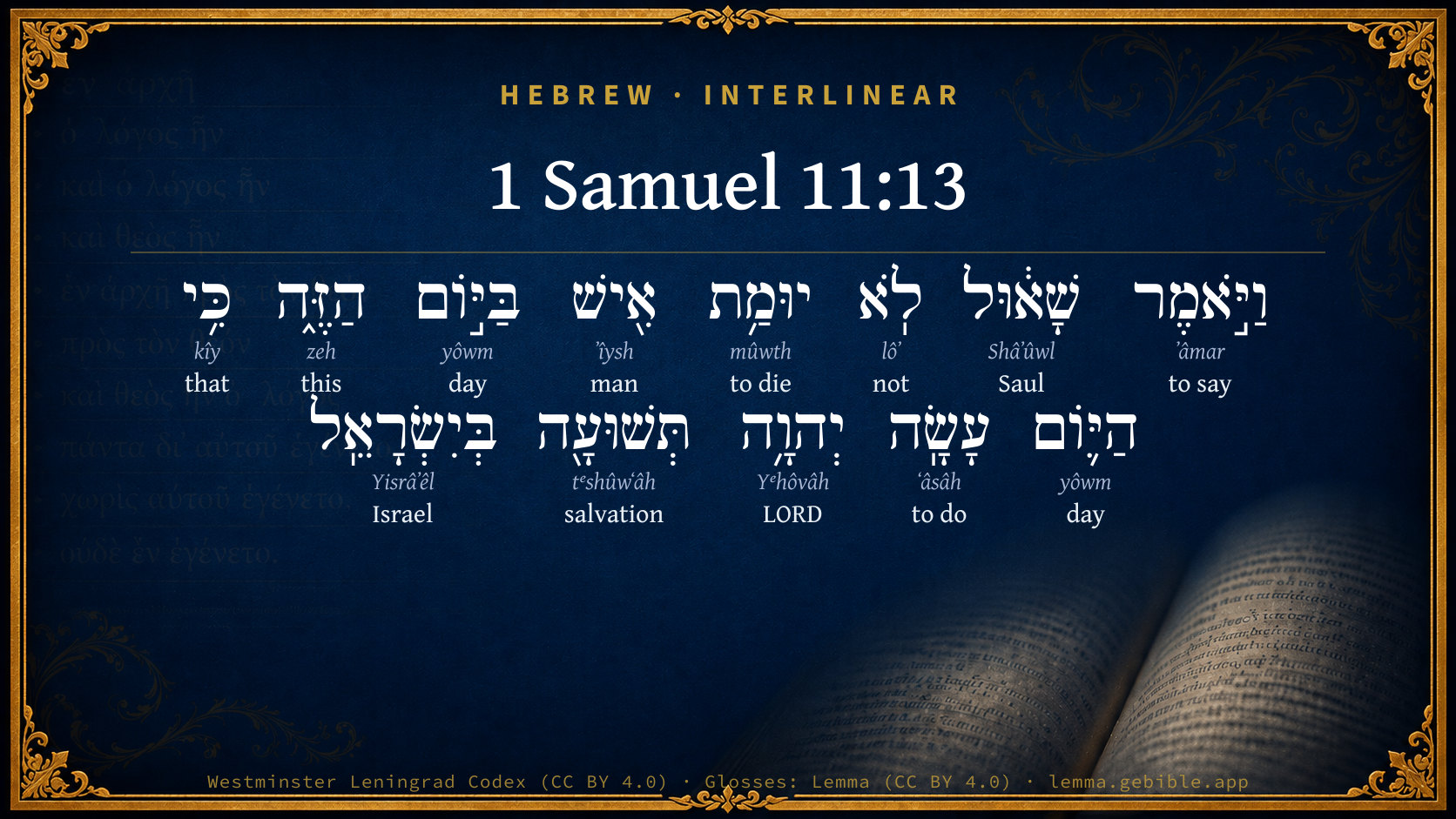
Hebrew (Westminster Leningrad Codex) 1 Samuel 11:13 appears in the Hebrew Old Testament. The text above is from the Westminster Leningrad Codex. Each word links to its Strong’s number, a concise gloss, and parsing drawn from the Open Scriptures Hebrew Bible morphology. Click any word for its full Brown-Driver-Briggs (BDB) entry.
Download image
Cite this verse

1 Samuel 11:13 (World English Bible). Public Domain. Lemma interlinear Bible study tool, https://lemma.gebible.app/v/1-samuel/11/13.

Show BibTeX & RIS
BibTeX
RIS
English Translation
Saul said, There shall not a man be put to death this day; for today Yahweh has worked deliverance in Israel.
World English Bible · Public Domain
Download a study sheet

One document with this verse’s original text, its word-by-word gloss line, the meaning frame, cross-references with their text, attributed commentary, and full source and license credits — printable, and it pastes into notes with its structure intact.

This verse Autodidact and up

Study sheet (.html) Plain text (.txt)

A passage Seminary Student

Up to 50 verses in one chapter. A passage sheet keeps up to 6 commentary sources and 12 cross-references per verse, in the order this page ranks them, and says so on the sheet whenever that leaves anything out. Ask for a single verse and you get the Autodidact verse sheet above.

Everything on this page stays free to read, with no account — the sheet is a download of what is already on screen, not access to it.

Want to remove ads? Support Godless Engineer
Compare translations 3

The same verse in 3 English versions, stacked beneath the original-language interlinear above. Click any original word for its lexicon entry.

Each is an independent rendering of the whole verse — the interlinear is not word-aligned to these translations.

Highlighted words mark where these versions differ — a whole-verse word diff, not a word-by-word alignment.

  • World English Bible Public Domain
    Saul said, There shall not a man be put to death this day; for today Yahweh has worked deliverance in Israel.
  • King James Version Public Domain
    And Saul said, There shall not a man be put to death this day: for to day the LORD hath wrought salvation in Israel.
  • unfoldingWord Literal Text CC BY-SA 4.0
    But Saul said, “A man shall not be made to die on this day. For today Yahweh has done deliverance in Israel.”

unfoldingWord Literal Text — © unfoldingWord, licensed CC BY-SA 4.0. Word-aligned USFM3 via Door43 (git.door43.org/unfoldingWord/en_ult).

Versions to compare (up to 4)

3 of 4 selected

Show all 18 translations

Every available English version of this verse, each an independent rendering of the whole verse.

  • World English Bible Public Domain
    Saul said, There shall not a man be put to death this day; for today Yahweh has worked deliverance in Israel.
  • Berean Standard Bible Public Domain
    But Saul ordered, “No one shall be put to death this day, for today the LORD has worked salvation in Israel.”
  • Majority Standard Bible Public Domain
    But Saul ordered, “No one shall be put to death this day, for today the LORD has worked salvation in Israel.”
  • King James Version Public Domain
    And Saul said, There shall not a man be put to death this day: for to day the LORD hath wrought salvation in Israel.
  • American Standard Version (1901) Public Domain
    And Saul said, There shall not a man be put to death this day; for to-day Jehovah hath wrought deliverance in Israel.
  • Revised Version (1885) Public Domain
    And Saul said, There shall not a man be put to death this day: for today the LORD hath wrought deliverance in Israel.
  • Geneva Bible (1599) Public Domain
    But Saul said, There shall no man die this day: for to day the Lord hath saued Israel.
  • Douay-Rheims (1899) Public Domain
    And Saul said: No man shall be killed this day, because the Lord this day hath wrought salvation in Israel:
  • Young's Literal Translation Public Domain
    And Saul saith, `There is no man put to death on this day, for to-day hath Jehovah wrought salvation in Israel.'
  • Literal Standard Version CC BY-SA 4.0
    And Saul says, “There is no man put to death on this day, for today YHWH has worked salvation in Israel.”
  • Unlocked Literal Bible CC BY-SA 4.0
    But Saul said, “No one must be put to death this day, because today Yahweh has rescued Israel.”
  • unfoldingWord Literal Text CC BY-SA 4.0
    But Saul said, “A man shall not be made to die on this day. For today Yahweh has done deliverance in Israel.”
  • Darby Bible Public Domain
    But Saul said, There shall not a man be put to death this day; for to-day Jehovah has wrought deliverance in Israel.
  • World Messianic Bible Public Domain
    Saul said, “No man shall be put to death today; for today the LORD has rescued Israel.”
  • Webster's Bible Public Domain
    And Saul said, There shall not a man be put to death this day: for to-day the LORD hath wrought salvation in Israel.
  • Free Bible Version CC BY-SA 4.0
    But Saul replied, “No one's going to be executed today, for this is the day that the Lord saved Israel.”
  • Bible in Basic English Public Domain
    And Saul said, Not a man is to be put to death today: for today the Lord has made Israel safe.
  • JPS Tanakh (1917) Public Domain
    And Saul said: 'There shall not a man be put to death this day; for to-day the LORD hath wrought deliverance in Israel.'

Literal Standard Version (2020), Covenant Press — licensed CC BY-SA 4.0. Text via the HelloAO Bible API (eBible.org). Unlocked Literal Bible (unfoldingWord) — licensed CC BY-SA 4.0. Text via the HelloAO Bible API (eBible.org). unfoldingWord Literal Text — © unfoldingWord, licensed CC BY-SA 4.0. Word-aligned USFM3 via Door43 (git.door43.org/unfoldingWord/en_ult). Free Bible Version, Dr. Jonathan Gallagher — licensed CC BY-SA 4.0. Text via the HelloAO Bible API (eBible.org).

Word by word

More ways to search: Search by grammar → Find every occurrence → Compare this word →

Practice this passage: Drill this verse → Learn its vocabulary →

תְּשׁוּעָ֖ה
tᵉshûwʻâh
H8668
“salvation”
Noun, Common, Feminine, Singular, Absolute
Part of Speech
Noun
Type
Common
Gender
Feminine
Number
Singular
State
Absolute
Full BDB Definition

Origin: from H7768 in the sense of H3467

TWOT: 929e

salvation, deliverance - deliverance (usually by God through human agency) - salvation (spiritual in sense)
  1. וַיֹּ֣אמֶר ʼâmar H559 “and · to say” Conjunction + Verb, Qal, Sequential Imperfect, 3rd Person, Masculine, Singular
  2. שָׁא֔וּל Shâʼûwl H7586 “Saul” Noun, Proper
  3. לֹֽא lôʼ H3808 “not” Particle, Negative
  4. יוּמַ֥ת mûwth H4191 “to die” Verb, Hophal, Imperfect, 3rd Person, Masculine, Singular
  5. אִ֖ישׁ ʼîysh H376 “man” Noun, Common, Masculine, Singular, Absolute
  6. בַּיּ֣וֹם yôwm H3117 “in/at the · day” Preposition, Determined + Noun, Common, Masculine, Singular, Absolute
  7. הַזֶּ֑ה zeh H2088 “the · this” Particle, Definite Article + Pronoun, Demonstrative, Masculine, Singular
  8. כִּ֥י kîy H3588 “that” Conjunction
  9. הַיּ֛וֹם yôwm H3117 “the · day” Particle, Definite Article + Noun, Common, Masculine, Singular, Absolute
  10. עָשָֽׂה ʻâsâh H6213 “to do” Verb, Qal, Perfect, 3rd Person, Masculine, Singular
  11. יְהוָ֥ה Yᵉhôvâh H3068 “LORD” Noun, Proper
  12. בְּיִשְׂרָאֵֽל Yisrâʼêl H3478 “in/at · Israel” Preposition + Noun, Proper

About this verse

These counts appear in no published source. They are computed here, from the morphology-tagged text and Lemma’s own curated glosses. What Lemma adds →

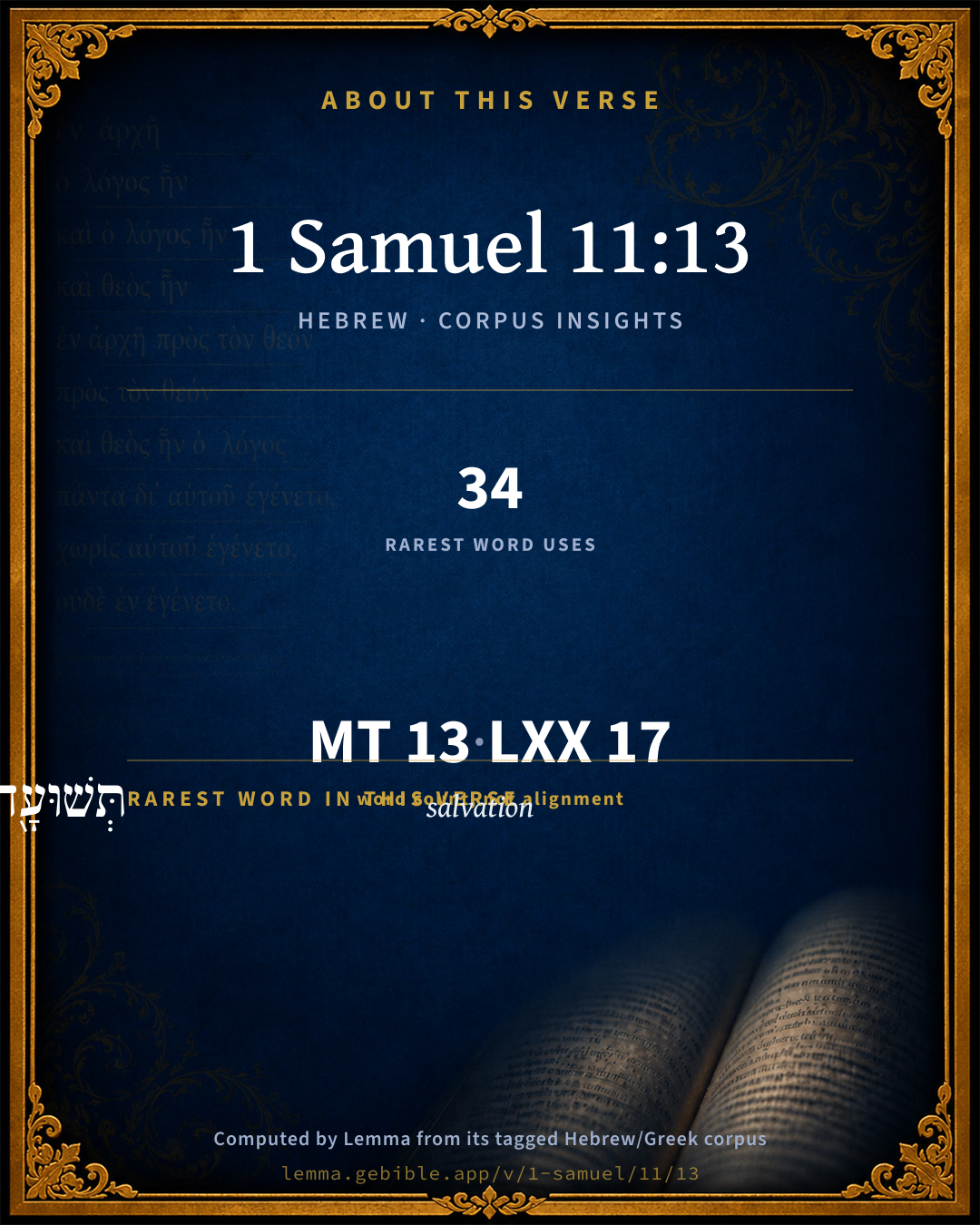
13
words
12
distinct lemmas
Historical
section

Shared distinctive vocabulary

תְּשׁוּעָ֖ה salvation H8668 occurs in 32 verses of the Hebrew Bible. Also found in:

Grammatical profile

  • 3 verbs
  • 7 nouns
  • 1 pronoun
  • 1 conjunction
  • 1 particle

Verb forms

  • וַיֹּ֣אמֶר Qal · Sequential Imperfect
  • יוּמַ֥ת Hophal · Imperfect
  • עָשָֽׂה Qal · Perfect

Repetition

A word recurs within this verse — often emphatic in Hebrew:

  • בַּיּ֣וֹם day H3117 ×2

Hebrew & Septuagint length

In English translation the verse runs 21 words from the Hebrew and 18 from the Septuagint (LXX English) — closely comparable.

A rough comparison of the two English renderings, which tokenize alike — not a word-level alignment.

Word counts can differ between the Hebrew and the Greek without any difference in meaning — e.g. the Hebrew direct-object marker אֵת has no separate Greek word, and Greek often adds the article ὁ.

In the original languages it is 13 Hebrew tokens and 17 Greek tokens — but the two are counted differently (Hebrew bundles its prefixes and suffixes into one token; the Greek is in lemma form), so that isn’t a like-for-like length.

Cross-references

8

Topical passages linked to 1 Samuel 11:13 in the Treasury of Scripture Knowledge — connected by theme and wording, ordered by reader-vote popularity; previews shown in the World English Bible.

  • Exodus 14:13 Moses said to the people, "Don't be afraid. Stand still, and see the salvation of Yahweh, which he will work for you today: for the Egyptians whom you have seen today, you shall never see them again.
  • 1 Samuel 19:5 for he put his life in his hand, and struck the Philistine, and Yahweh worked a great victory for all Israel: you saw it, and did rejoice; why then will you sin against innocent blood, to kill David without a cause?
  • 2 Samuel 19:22 David said, What have I to do with you, you sons of Zeruiah, that you should this day be adversaries to me? shall there any man be put to death this day in Israel? for don't I know that I am this day king over Israel?
  • Exodus 14:30 Thus Yahweh saved Israel that day out of the hand of the Egyptians; and Israel saw the Egyptians dead on the seashore.
  • 1 Samuel 14:45 The people said to Saul, Shall Jonathan die, who has worked this great salvation in Israel? Far from it: as Yahweh lives, there shall not one hair of his head fall to the ground; for he has worked with God this day. So the people rescued Jonathan, that he didn't die.
  • Psalms 44:4–8 You are my King, God. Command victories for Jacob!
  • Isaiah 59:16 He saw that there was no man, and wondered that there was no intercessor: therefore his own arm brought salvation to him; and his righteousness, it upheld him.
  • 1 Corinthians 15:10 But by the grace of God I am what I am. His grace which was bestowed on me was not futile, but I worked more than all of them; yet not I, but the grace of God which was with me.

Cross-references courtesy of OpenBible.info (CC BY 4.0).

Hebrew and Greek witnesses Masoretic Hebrew ↔ Greek Septuagint

The same verse in the two great witnesses to the Old Testament, shown verse-for-verse.

These are two independent witnesses, not word-aligned to each other, and the Septuagint is shown in lemma (dictionary) form.

Hebrew 1 Samuel 11:13 Masoretic · Westminster Leningrad Codex

וַיֹּ֣אמֶר שָׁא֔וּל לֹֽא יוּמַ֥ת אִ֖ישׁ בַּיּ֣וֹם הַזֶּ֑ה כִּ֥י הַיּ֛וֹם עָשָֽׂה יְהוָ֥ה תְּשׁוּעָ֖ה בְּיִשְׂרָאֵֽל

Saul said, There shall not a man be put to death this day; for today Yahweh has worked deliverance in Israel.

World English Bible · Public Domain

Greek LXX 1 Samuel 11:13 Septuagint · lemma form

καί εἶπον σαούλ οὐ ἀποθνήσκω οὐδείς ἐν ὁ ἡμέρα οὗτος ὅτι σήμερον κύριος ποιέω σωτηρία ἐν ἰσραήλ

And Saul said, No man shall die this day, for today the Lord has wrought deliverance in Israel.

LXX2012 (modern English Septuagint) · Public Domain

Hebrew: Westminster Leningrad Codex (CC BY 4.0). Greek: Septuagint (public domain); English from LXX2012 (modern English Septuagint) (Public Domain). How the Septuagint differs from the Hebrew →

Targum (Aramaic paraphrase)

1

The Targum is the ancient Jewish Aramaic paraphrase of the Hebrew Scriptures — an interpretive translation, not the Hebrew text itself. Onkelos (literal) and Pseudo-Jonathan (expansive) render the Torah, and Jonathan the Prophets. Coverage is partial: where no permissively-licensed English translation exists for a verse, only the Aramaic is shown. This is verse-level text, not a word-by-word alignment to the Hebrew.

  1. Targum Jonathan Prophets (Joshua–Malachi)
    וַאֲמַר שָׁאוּל לָא יִתְקְטֵיל גַבְרָא בְּיוֹמָא הָדֵין אֲרֵי יוֹמָא דֵין עֲבַד יְיָ פּוּרְקָנָא בְּיִשְׂרָאֵל:

    (no public-domain English translation for this verse)

    Targum Jonathan — Aramaic: “Mikraot Gedolot” (public domain). English: “Sefaria Community Translation” (CC0 1.0 (public-domain dedication)); “London "Chaldee Paraphrase," 1871” (public domain). Text via Sefaria.

Commentary

Notes on 1 Samuel 11:13 from classic Christian and Jewish commentators (each source and its license shown beneath its notes). The classic Christian expositions comment on the surrounding passage and are grouped to its opening verse, so a note may address several verses; the Jewish commentaries on the Tanakh (Rashi and others) are per-verse, so they appear only where the commentator wrote on this verse.

Lemma curates 59 commentaries, every one of them public domain or Creative Commons licensed, each selected and text-cleaned for this edition rather than reprinted as found. About our sources →

Trapp's Complete Commentary

John Trapp

1Sa 11:13 And Saul said, There shall not a man be put to death this day: for to day the LORD hath wrought salvation in Israel.

Ver. 13. There shall not a man be put to death this day.] Mitisima sors est Regnorum sub Rege novo. {a} But this held not long with Saul; witness his dealing with David, Jonathan, the Lord’s priests, &c. He was never right.

For today the Lord hath wrought, &c.] Therefore this day shall not be obscured or fouled with shedding of blood. So the citizens of Berne, for joy of the reformation there wrought, pardoned a couple of traitors, and gave liberty to all their exiles to return home again. {b}

{a} Claudian.

{b} Scultet., Annal.

John Trapp, A Commentary or Exposition upon All the Books of the Old and New Testament (1647–1656) — public domain. Text from a community e-Sword module.

The Biblical Illustrator

Joseph S. Exell

1Sa_11:13

There shall not a man be put to death this day.

A magnanimous king

Louis XII of France is known in history as a most magnanimous prince towards his enemies. On his accession he caused a list of these to be drawn up, and marked against each name a black cross. This was looked upon by them that they were singled out for punishment, and they accordingly fled. When Louis heard of it, he had them called into his presence and assured them that they had no cause for alarm, since the reason why he had placed the cross against their names was to keep him in mind of the Cross that brings pardon to all. Among those who sought his pardon at this time were the magistrates of Orleans, who had subjected him to such indignities while he was detained as a prisoner in their city. Their deputation he dismissed courteously with the generous reply that it did not, become the King of France to resent the injuries of the Duke of Orleans. Of a like spirit was Lord Nelson, who penned in his cabin on the morning of the battle of Trafalgar: May humanity after victory be the predominant feature in the British fleet. (Charles Deal.)

The best way to conquer an enemy

Henry IV of France was wont to say that he was able to conquer all his enemies, by treating them with such clemency and kindness when they were in his power that they were changed into loyal subjects.

The Biblical Illustrator, edited by Joseph S. Exell (c. 1880s–1900s) — public domain. Text from a community e-Sword module.

Tyndale Open Study Notes

Tyndale Open Resources

11:13 No one will be executed: This was a time for rejoicing, not revenge.

Tyndale Open Study Notes — © Tyndale Open Resources, licensed CC BY-SA 4.0. Text via the HelloAO Bible API.

Geneva Bible (1599)

Geneva Bible translators

By showing mercy he thought to overcome their malice.

Geneva Bible (1599) marginal notes — public domain. Text via Bolls.life.

Adam Clarke's Commentary

Verse 13. There shall not a man be put to death] This was as much to Saul's credit as the lately proposed measure was to the discredit of his soldiers.

Adam Clarke's Commentary on the Bible (1810–1826) — public domain. Text from a community e-Sword/MySword module.

Ellicott's Commentary for English Readers

(13) And Saul said, There shall not a man be put to death this day.—A wise, as well as a generous, decision; anything like a bloody vengeance would have been the commencement of future feuds and bitter heart-burnings between the new king and the powerful families of the other tribes, who misliked and opposed his election. Saul began his reign with wise discretion, as well as with heroic valour. By this determined refusal to avenge the cruel affront showed to him, he taught “kings to be” how truly a royal virtue was forgiveness of all past wrongs.

For to day the Lord hath wrought salvation in Israel.—And as yet unspoiled, the king’s heart was full of humble reverent piety. By this first public act of pardon, he “not only signified that the public rejoicing should not be interrupted, but reminded them of the clemency of God, and urged that since Jehovah had shown such clemency upon that day, that He overlooked their sins, and had given them a glorious victory. it was only right they should follow His example, and forgive their neighbours’ sins without bloodshed.” (Seb. Schmidt, quoted by Keil and Delitsch.)

A Bible Commentary for English Readers, edited by Charles John Ellicott (1878–1897) — public domain. Text from a community e-Sword module.

The Cambridge Bible for Schools and Colleges

gen. ed. J. J. S. Perowne

12–15. Confirmation of Saul as King

13. There shall not a man be put to death this day] The execution even of malcontents would have clouded the general rejoicing: and Saul’s best hope of uniting the kingdom under his rule lay in a policy of conciliation. Cp. 1Sa_10:27; 2Sa_19:22.

salvation] Deliverance. See note on 1Sa_11:9.

The Cambridge Bible for Schools and Colleges (gen. ed. J. J. S. Perowne; Cambridge University Press, 1878–1918) — public domain. Text from a community e-Sword module.

John Gill's Exposition

Then said Samuel to the people,.... Agreeing to what Saul had said, and in order to put them off from demanding the lives of the offenders, and willing to take them while they were in a good disposition:

come, and let us go to Gilgal; which was the nearest place to them, on the other side Jordan, from which they now were, and where the children of Israel first encamped when they passed over Jordan, where the tabernacle and ark first were, and an altar was built, and where meetings used to be held on certain occasions; all which might be reasons why Samuel proposed to go to this place. According to Bunting (d), this place was thirty six miles from Jabeshgilead:

and renew the kingdom there; that is, recognize Saul, own and declare him king of Israel.

(d) Ut supra. (Travels of the Patriarchs, &c. p. 126.)

John Gill's Exposition of the Whole Bible (1746–1763) — public domain (CC PDM 1.0). Text via the HelloAO Bible API.

Albert Barnes' Notes on the Bible

There shall not a man ... - An instance of great moderation, as well as good policy, on the part of Saul. Compare David’s conduct (marginal reference).

Albert Barnes' Notes on the Bible (1834–1885) — public domain. Text from a community e-Sword/MySword module.

Matthew Poole's English Annotations

I will not destroy any of those whom God hath so graciously preserved; nor sully the mirth of this glorious and comfortable day with the slaughter of any of my subjects; and therefore I freely forgive them. Wherein Saul showed his policy as well as his clemency, this being the most likely way to gain his enemies, and secure his friends, and stablish his throne in the hearts of his people.

Matthew Poole's English Annotations on the Holy Bible (1683–1685) — public domain. Text from a community e-Sword/MySword module.

Lesson kit

Teaching starters — assembled from the data on this page, not authored interpretation. Every prompt links to the verse data it draws on. Edit before teaching.

1 Samuel, in the Historical, opens this verse with 13 words (12 distinct Hebrew lemmas). Its most distinctive word is tᵉshûwʻâh (“salvation”). A historical commentator’s framing appears above. Read the whole chapter for the surrounding context.

Discussion questions

  1. The word tᵉshûwʻâh carries the sense “salvation.” How does it shape the verse?
  2. Judges 15:18 shares the word «salvation» with this verse. How do the two illuminate each other?
  3. “day” occurs 2× in this one verse. What is the effect of the repetition?
  4. These translations render this verse differently. What is at stake in choosing one wording over another?
  5. The verb «וַיֹּ֣אמֶר» is Qal Sequential Imperfect. How does its form color the action?
  6. Reading how Trapp's Complete Commentary and The Biblical Illustrator read this verse, where do the two commentators agree and where do they part?

Things to notice

Reading settings

Reading text

Shown beneath each verse's original-language words.

Old Testament
Old Testament edition

Read the OT as the Masoretic Hebrew (MT) or the Greek Septuagint (LXX).

English shown for the Greek Septuagint (in the Hebrew ↔ Greek comparison).

Comparing translations? Open the Compare panel on any verse page to stack up to four side by side.