

2 Corinthians 7:2
Greek (Tischendorf 8th ed.) 2 Corinthians 7:2 appears in the Greek New Testament. The text above is from the Tischendorf 8th edition. Each word links to its Strong’s number and a concise gloss. Click any word for its full Thayer’s Greek Lexicon entry.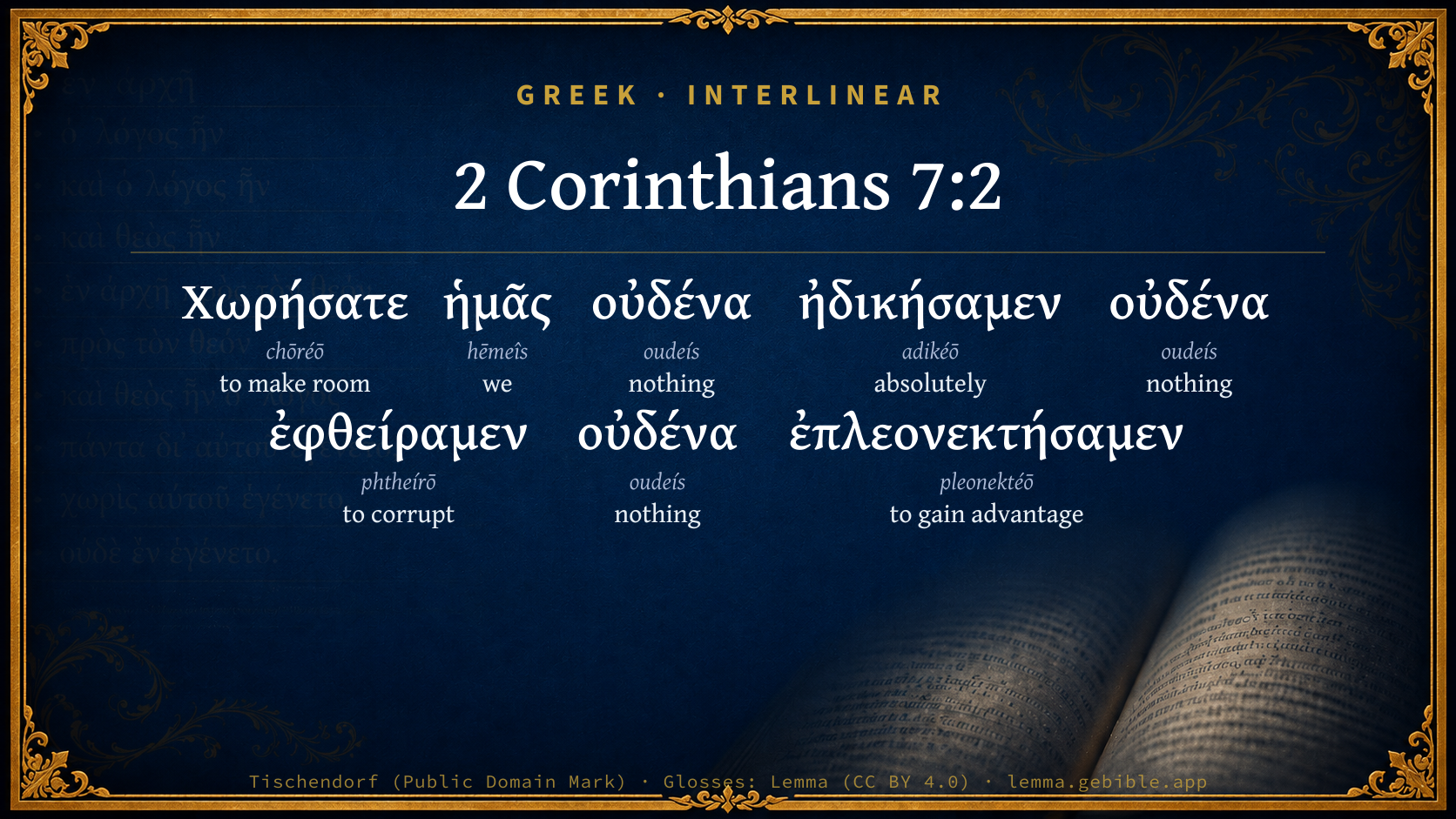
Open your hearts to us. We wronged no one. We corrupted no one. We took advantage of no one.
Download a study sheet
One document with this verse’s original text, its word-by-word gloss line, the meaning frame, cross-references with their text, attributed commentary, and full source and license credits — printable, and it pastes into notes with its structure intact.
This verse Autodidact and up
A passage Seminary Student
Up to 50 verses in one chapter. A passage sheet keeps up to 6 commentary sources and 12 cross-references per verse, in the order this page ranks them, and says so on the sheet whenever that leaves anything out. Ask for a single verse and you get the Autodidact verse sheet above.
Everything on this page stays free to read, with no account — the sheet is a download of what is already on screen, not access to it.
Compare translations 3
The same verse in 3 English versions, stacked beneath the original-language interlinear above. Click any original word for its lexicon entry.
Each is an independent rendering of the whole verse — the interlinear is not word-aligned to these translations.
Highlighted words mark where these versions differ — a whole-verse word diff, not a word-by-word alignment.
-
World English Bible Public Domain
Open your hearts to us. We wronged no one. We corrupted no one. We took advantage of no one.
-
King James Version Public Domain
Receive us; we have wronged no man, we have corrupted no man, we have defrauded no man.
-
unfoldingWord Literal Text CC BY-SA 4.0
Make room for us! We wronged no one; we ruined no one; we took advantage of no one.
unfoldingWord Literal Text — © unfoldingWord, licensed CC BY-SA 4.0. Word-aligned USFM3 via Door43 (git.door43.org/unfoldingWord/en_ult).
Show all 19 translations
Every available English version of this verse, each an independent rendering of the whole verse.
-
World English Bible Public Domain
Open your hearts to us. We wronged no one. We corrupted no one. We took advantage of no one.
-
Berean Standard Bible Public Domain
Make room for us in your hearts. We have wronged no one, we have corrupted no one, we have exploited no one.
-
Majority Standard Bible Public Domain
Make room for us in your hearts. We have wronged no one, we have corrupted no one, we have exploited no one.
-
King James Version Public Domain
Receive us; we have wronged no man, we have corrupted no man, we have defrauded no man.
-
American Standard Version (1901) Public Domain
Open your hearts to us: we wronged no man, we corrupted no man, we took advantage of no man.
-
Revised Version (1885) Public Domain
Open your hearts to us: we wronged no man, we corrupted no man, we took advantage of no man.
-
Geneva Bible (1599) Public Domain
Receiue vs: we haue done wrong to no man: we haue corrupted no man: we haue defrauded no man.
-
Douay-Rheims (1899) Public Domain
Receive us. We have injured no man, we have corrupted no man, we have overreached no man.
-
Young's Literal Translation Public Domain
receive us; no one did we wrong; no one did we waste; no one did we defraud;
-
Literal Standard Version CC BY-SA 4.0
receive us; no one did we wrong; no one did we ruin; no one did we defraud;
-
Unlocked Literal Bible CC BY-SA 4.0
Make room for us! We have not wronged anyone. We have not harmed anyone or taken advantage of anyone.
-
unfoldingWord Literal Text CC BY-SA 4.0
Make room for us! We wronged no one; we ruined no one; we took advantage of no one.
-
Darby Bible Public Domain
Receive us: we have injured no one, we have ruined no one, we have made gain of no one.
-
World Messianic Bible Public Domain
Open your hearts to us. We wronged no one. We corrupted no one. We took advantage of no one.
-
Webster's Bible Public Domain
Receive us; we have wronged no man, we have corrupted no man, we have defrauded no man.
-
Free Bible Version CC BY-SA 4.0
Please accept us as your friends! We haven't done anyone wrong, we haven't corrupted anyone, and we haven't taken advantage of anyone.
-
Bible in Basic English Public Domain
Let your hearts be open to us: we have done no man wrong, no man has been damaged by us, we have made no profit out of any man,
-
Text-Critical English NT CC BY 4.0
Make room for us in your hearts. We have wronged no one, we have corrupted no one, we have taken advantage of no one.
-
Tyndale New Testament (1534) Public Domain
Vnderstonde vs. we have hurte no man: we have corrupte no man: we have defrauded no man.
Literal Standard Version (2020), Covenant Press — licensed CC BY-SA 4.0. Text via the HelloAO Bible API (eBible.org). Unlocked Literal Bible (unfoldingWord) — licensed CC BY-SA 4.0. Text via the HelloAO Bible API (eBible.org). unfoldingWord Literal Text — © unfoldingWord, licensed CC BY-SA 4.0. Word-aligned USFM3 via Door43 (git.door43.org/unfoldingWord/en_ult). Free Bible Version, Dr. Jonathan Gallagher — licensed CC BY-SA 4.0. Text via the HelloAO Bible API (eBible.org).
Word by word
More ways to search: Search by grammar → Find every occurrence → Compare this word →
Practice this passage: Drill this verse → Learn its vocabulary →
- Appears 5× in the Greek New Testament
- First appears at 2 Corinthians 2:11
- Part of Speech
- Verb
- Tense
- Aorist
- Voice
- Active
- Mood
- Indicative
- Person
- 1st person
- Number
- Plural
Full Thayer's Definition
- Χωρήσατε chōréō G5562 “to make room” Verb, Aorist, Active, Imperative, 2nd person, Plural
- ἡμᾶς hēmeîs G2249 “we” Personal pronoun, 1st person, Accusative, Plural
- οὐδένα oudeís G3762 “nothing” Adjective, Accusative, Singular, Masculine, Negative
- ἠδικήσαμεν adikéō G91 “absolutely” Verb, Aorist, Active, Indicative, 1st person, Plural
- οὐδένα oudeís G3762 “nothing” Adjective, Accusative, Singular, Masculine, Negative
- ἐφθείραμεν phtheírō G5351 “to corrupt” Verb, Aorist, Active, Indicative, 1st person, Plural
- οὐδένα oudeís G3762 “nothing” Adjective, Accusative, Singular, Masculine, Negative
- ἐπλεονεκτήσαμεν pleonektéō G4122 “to gain advantage” Verb, Aorist, Active, Indicative, 1st person, Plural
About this verse
These counts appear in no published source. They are computed here, from the morphology-tagged text and Lemma’s own curated glosses. What Lemma adds →
- 8
- words
- 6
- distinct lemmas
- Pauline Epistles
- section
Notable vocabulary
The rarest word here is ἐπλεονεκτήσαμεν to gain advantage G4122 — appearing just 5 times in the whole Greek New Testament.
Shared distinctive vocabulary
ἐπλεονεκτήσαμεν to gain advantage G4122 occurs in 5 verses of the Greek New Testament. Also found in:
Repetition
A word recurs within this verse:
- οὐδένα nothing G3762 ×3
Cross-references
23Topical passages linked to 2 Corinthians 7:2 in the Treasury of Scripture Knowledge — connected by theme and wording, ordered by reader-vote popularity; previews shown in the World English Bible.
- Acts 20:33 I coveted no one's silver, or gold, or clothing.
- 2 Corinthians 6:12–13 You are not restricted by us, but you are restricted by your own affections.
- 2 Corinthians 11:9 When I was present with you and was in need, I wasn't a burden on anyone, for the brothers, when they came from Macedonia, supplied the measure of my need. In everything I kept myself from being burdensome to you, and I will continue to do so.
- Numbers 16:15 Moses was very angry, and said to Yahweh, "Don't respect their offering: I have not taken one donkey from them, neither have I hurt one of them."
- 1 Samuel 12:3–4 Here I am: witness against me before Yahweh, and before his anointed: whose ox have I taken? or whose donkey have I taken? or whom have I defrauded? whom have I oppressed? or of whose hand have I taken a ransom to blind my eyes therewith? and I will restore it you.
- Matthew 10:14 Whoever doesn't receive you, nor hear your words, as you go out of that house or that city, shake off the dust from your feet.
- Matthew 10:40 He who receives you receives me, and he who receives me receives him who sent me.
- Romans 16:18 For those who are such don't serve our Lord, Jesus Christ, but their own belly; and by their smooth and flattering speech, they deceive the hearts of the innocent.
- 2 Corinthians 1:12 For our boasting is this: the testimony of our conscience, that in holiness and sincerity of God, not in fleshly wisdom but in the grace of God we behaved ourselves in the world, and more abundantly toward you.
- 2 Corinthians 12:14–18 Behold, this is the third time I am ready to come to you, and I will not be a burden to you; for I seek not your possessions, but you. For the children ought not to save up for the parents, but the parents for the children.
- 1 Thessalonians 2:3–6 For our exhortation is not of error, nor of uncleanness, nor in deception.
- 1 Thessalonians 2:10 You are witnesses with God, how holy, righteously, and blamelessly we behaved ourselves toward you who believe.
- 2 Thessalonians 3:7–9 For you know how you ought to imitate us. For we didn't behave ourselves rebelliously among you,
- 2 John 1:10 If anyone comes to you, and doesn't bring this teaching, don't receive him into your house, and don't welcome him,
- Luke 10:8 Into whatever city you enter, and they receive you, eat the things that are set before you.
- 2 Corinthians 4:2 But we have renounced the hidden things of shame, not walking in craftiness, nor handling the word of God deceitfully; but by the manifestation of the truth commending ourselves to every man's conscience in the sight of God.
- 2 Corinthians 6:3–7 We give no occasion of stumbling in anything, that our service may not be blamed,
- 2 Corinthians 11:16 I say again, let no one think me foolish. But if so, yet receive me as foolish, that I also may boast a little.
- Philippians 2:29 Receive him therefore in the Lord with all joy, and hold such in honor,
- Colossians 4:10 Aristarchus, my fellow prisoner greets you, and Mark, the cousin of Barnabas (concerning whom you received commandments, "if he comes to you, receive him"),
- Philemon 1:12 I am sending him back. Therefore receive him, that is, my own heart,
- Philemon 1:17 If then you count me a partner, receive him as you would receive me.
- 3 John 1:8–10 We therefore ought to receive such, that we may be fellow workers for the truth.
Cross-references courtesy of OpenBible.info (CC BY 4.0).
Lesson kit
Teaching starters — assembled from the data on this page, not authored interpretation. Every prompt links to the verse data it draws on. Edit before teaching.
2 Corinthians, in the Pauline Epistles, opens this verse with 8 words (6 distinct Greek lemmas). Its most distinctive word is pleonektéō (“to gain advantage”). A historical commentator’s framing appears above. Read the whole chapter for the surrounding context.
Discussion questions
- The word pleonektéō carries the sense “to gain advantage.” How does it shape the verse?
- How does 2 Corinthians 2:11, which shares the word «to gain advantage», read alongside this verse?
- What does the repetition of “nothing” (3× in this one verse) do in this verse?
- These translations render this verse differently; the difference is in the English rendering, not the original. What questions does that raise?
- Compare how The Biblical Illustrator and Joseph Benson's Commentary read this verse. Where do they agree or differ?
Things to notice
- These translations choose different wording for 13 words in this verse.
- “nothing” occurs 3× in this single verse.
- 6 distinct Greek lemmas span 8 words in this verse.
Commentary
Notes on 2 Corinthians 7:2 from classic Christian and Jewish commentators (each source and its license shown beneath its notes). The classic Christian expositions comment on the surrounding passage and are grouped to its opening verse, so a note may address several verses; the Jewish commentaries on the Tanakh (Rashi and others) are per-verse, so they appear only where the commentator wrote on this verse.
Lemma curates 59 commentaries, every one of them public domain or Creative Commons licensed, each selected and text-cleaned for this edition rather than reprinted as found. About our sources →
The Biblical Illustrator
Joseph S. Exell
The Biblical Illustrator, edited by Joseph S. Exell (c. 1880s–1900s) — public domain. Text from a community e-Sword module.
Joseph Benson's Commentary
Joseph Benson's Commentary on the Old and New Testaments (1811–1818) — public domain. Text from a community e-Sword module.
Whedon's Commentary on the Bible
Daniel D. Whedon
Daniel D. Whedon (gen. ed.), Commentary on the Old and New Testaments (1874–1909) — public domain. Text from a community e-Sword module.
Lange's Commentary on the Holy Scriptures
Lange's Commentary on the Holy Scriptures (Critical, Doctrinal, and Homiletical), ed. John Peter Lange, English translation edited by Philip Schaff (1864–1880) — public domain. Text from a community e-Sword module.
The Expositor's Bible
William Robertson Nicoll, ed., The Expositor's Bible (London: Hodder & Stoughton, 1887–1910) — public domain. 65 of 66 books (1 Corinthians is not separately keyed, as that volume carries no machine-parseable verse references); section-level commentary keyed to the opening verse. Introductory and overview sections not keyed to a specific passage are excluded.
Tyndale Open Study Notes
Tyndale Open Resources
Tyndale Open Study Notes — © Tyndale Open Resources, licensed CC BY-SA 4.0. Text via the HelloAO Bible API.
Bengel's Gnomon
Johann Albrecht Bengel
Bengel's Gnomon of the New Testament — English translation (T&T Clark, Edinburgh, 1860) — public domain. Text from a community e-Sword module.
Meyer's Critical & Exegetical Commentary
Heinrich August Wilhelm Meyer
Meyer — Critical and Exegetical Commentary on the New Testament — English translation by Peter Christie, edited by Frederick Crombie (T&T Clark, 1880) — public domain. Text from a community e-Sword module.
Expositor's Greek Testament
ed. W. Robertson Nicoll
The Expositor's Greek Testament, edited by W. Robertson Nicoll (1897–1910) — public domain. Text from a community e-Sword module.
Geneva Bible (1599)
Geneva Bible translators
Geneva Bible (1599) marginal notes — public domain. Text via Bolls.life.
Jamieson, Fausset & Brown
Robert Jamieson, A. R. Fausset & David Brown
Jamieson, Fausset & Brown — Commentary Critical and Explanatory on the Whole Bible (1871) — public domain (CC PDM 1.0). Text via the HelloAO Bible API.
Adam Clarke's Commentary
Adam Clarke's Commentary on the Bible (1810–1826) — public domain. Text from a community e-Sword/MySword module.
John Calvin's Commentaries
John Calvin's Commentaries (1540-1563) — public domain. Text from the Calvin Translation Society English edition (1840s-50s) via the Christian Classics Ethereal Library (ccel.org). Calvin's coverage is partial (roughly two-thirds of the Bible); uncommented books and verses are honest gaps, never fabricated. The 19th-century editor's footnotes and remarks are omitted so the notes are faithfully Calvin's own voice.
Ellicott's Commentary for English Readers
A Bible Commentary for English Readers, edited by Charles John Ellicott (1878–1897) — public domain. Text from a community e-Sword module.
The Cambridge Bible for Schools and Colleges
gen. ed. J. J. S. Perowne
The Cambridge Bible for Schools and Colleges (gen. ed. J. J. S. Perowne; Cambridge University Press, 1878–1918) — public domain. Text from a community e-Sword module.
John Gill's Exposition
John Gill's Exposition of the Whole Bible (1746–1763) — public domain (CC PDM 1.0). Text via the HelloAO Bible API.
Trapp's Complete Commentary
John Trapp
John Trapp, A Commentary or Exposition upon All the Books of the Old and New Testament (1647–1656) — public domain. Text from a community e-Sword module.
Albert Barnes' Notes on the Bible
Albert Barnes' Notes on the Bible (1834–1885) — public domain. Text from a community e-Sword/MySword module.
Haydock's Catholic Bible Commentary
George Leo Haydock (1774–1849), Haydock's Catholic Family Bible and Commentary, 1859 edition — public domain. Excludes Psalms (Douay-Rheims chapter numbering differs from Protestant) and Deuterocanonical books (Catholic canon only).
Matthew Poole's English Annotations
Matthew Poole's English Annotations on the Holy Bible (1683–1685) — public domain. Text from a community e-Sword/MySword module.
The Pulpit Commentary
The Pulpit Commentary (1880–1919), ed. H.D.M. Spence-Jones & Joseph S. Exell — public domain. Text from a community e-Sword module.
John Wesley's Explanatory Notes
John Wesley, Explanatory Notes Upon the Whole Bible (1754–1765) — public domain. Text via the GEBible commentary corpus.
Burkitt's Expository Notes on the New Testament
William Burkitt
William Burkitt's Expository Notes on the New Testament (1700–1703) — public domain. Text from a community e-Sword module.
Godbey's Commentary on the New Testament
William B. Godbey
William B. Godbey, Commentary on the New Testament (1896–1900) — public domain. Text from a community e-Sword module.
McGarvey & Pendleton's Commentaries
J. W. McGarvey
J. W. McGarvey (with Philip Y. Pendleton), Commentaries on the New Testament (The Fourfold Gospel, 1914; Acts; and the epistles) — public domain. Text from a community e-Sword/MySword module.
The People's New Testament
B. W. Johnson
B. W. Johnson's The People's New Testament with Notes (1889–1891) — public domain. Electronic text from the Christian Classics Ethereal Library (CCEL) ThML edition.
unfoldingWord translationNotes
Door43 World Missions Community
unfoldingWord translationNotes — © Distant Shores Media and the Door43 World Missions Community, licensed CC BY-SA 4.0. Source: git.door43.org/Door43/en_tn.
Cambridge Greek Testament for Schools and Colleges
Cambridge Greek Testament for Schools and Colleges (Cambridge University Press, 1896; 21 vols, various authors incl. Carr, Maclear, Plummer, Farrar, Lumby, Moule, M. R. James, Simcox) — public domain. Text from a community e-Sword module.
Alford’s Greek Testament
Henry Alford
Henry Alford, The Greek Testament (1849–1861) — public domain. Text from a community e-Sword module.
International Critical Commentary
International Critical Commentary — older volumes (1896–1929), various authors — public domain. Text from a community e-Sword module.
Vincent's Word Studies in the New Testament
Marvin R. Vincent
Marvin R. Vincent, Word Studies in the New Testament (1887–1900) — public domain. Text from a community e-Sword/MySword module.