Exodus 8:27

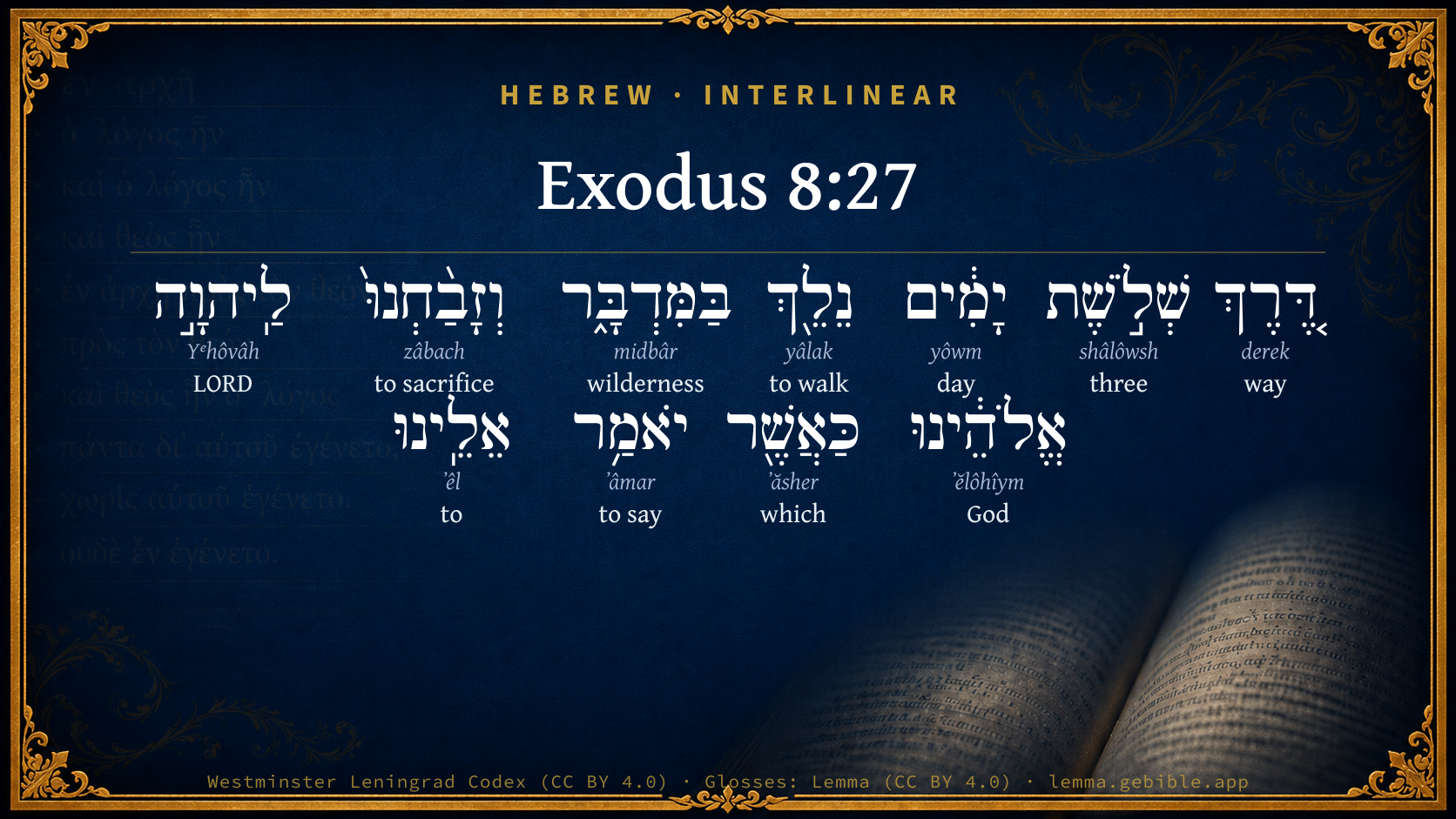
Hebrew (Westminster Leningrad Codex) Exodus 8:27 appears in the Hebrew Old Testament. The text above is from the Westminster Leningrad Codex. Each word links to its Strong’s number, a concise gloss, and parsing drawn from the Open Scriptures Hebrew Bible morphology. Click any word for its full Brown-Driver-Briggs (BDB) entry.
Download image
Cite this verse

Exodus 8:27 (World English Bible). Public Domain. Lemma interlinear Bible study tool, https://lemma.gebible.app/v/exodus/8/27.

Show BibTeX & RIS
BibTeX
RIS
English Translation
We will go three days' journey into the wilderness, and sacrifice to Yahweh our God, as he shall command us."
World English Bible · Public Domain
Download a study sheet

One document with this verse’s original text, its word-by-word gloss line, the meaning frame, cross-references with their text, attributed commentary, and full source and license credits — printable, and it pastes into notes with its structure intact.

This verse Autodidact and up

Study sheet (.html) Plain text (.txt)

A passage Seminary Student

Up to 50 verses in one chapter. A passage sheet keeps up to 6 commentary sources and 12 cross-references per verse, in the order this page ranks them, and says so on the sheet whenever that leaves anything out. Ask for a single verse and you get the Autodidact verse sheet above.

Everything on this page stays free to read, with no account — the sheet is a download of what is already on screen, not access to it.

Want to remove ads? Support Godless Engineer
Compare translations 3

The same verse in 3 English versions, stacked beneath the original-language interlinear above. Click any original word for its lexicon entry.

Each is an independent rendering of the whole verse — the interlinear is not word-aligned to these translations.

Highlighted words mark where these versions differ — a whole-verse word diff, not a word-by-word alignment.

  • World English Bible Public Domain
    We will go three days' journey into the wilderness, and sacrifice to Yahweh our God, as he shall command us."
  • King James Version Public Domain
    We will go three days' journey into the wilderness, and sacrifice to the LORD our God, as he shall command us.
  • unfoldingWord Literal Text CC BY-SA 4.0
    We must travel a journey of three days into the wilderness, and we will sacrifice to Yahweh our God, just as he is saying to us.”

unfoldingWord Literal Text — © unfoldingWord, licensed CC BY-SA 4.0. Word-aligned USFM3 via Door43 (git.door43.org/unfoldingWord/en_ult).

Versions to compare (up to 4)

3 of 4 selected

Show all 18 translations

Every available English version of this verse, each an independent rendering of the whole verse.

  • World English Bible Public Domain
    We will go three days' journey into the wilderness, and sacrifice to Yahweh our God, as he shall command us."
  • Berean Standard Bible Public Domain
    We must make a three-day journey into the wilderness and sacrifice to the LORD our God as He commands us.”
  • Majority Standard Bible Public Domain
    We must make a three-day journey into the wilderness and sacrifice to the LORD our God as He commands us.”
  • King James Version Public Domain
    We will go three days' journey into the wilderness, and sacrifice to the LORD our God, as he shall command us.
  • American Standard Version (1901) Public Domain
    We will go three days' journey into the wilderness, and sacrifice to Jehovah our God, as he shall command us.
  • Revised Version (1885) Public Domain
    We will go three days’ journey into the wilderness, and sacrifice to the LORD our God, as he shall command us.
  • Geneva Bible (1599) Public Domain
    Let vs go three dayes iourney in the desert, and sacrifice vnto the Lord our God, as he hath commanded vs.
  • Douay-Rheims (1899) Public Domain
    We will go three days' journey into the wilderness: and we will sacrifice to the Lord our God, as he hath commanded us.
  • Young's Literal Translation Public Domain
    A journey of three days we go into the wilderness, and have sacrificed to Jehovah our God, as He saith unto us.'
  • Literal Standard Version CC BY-SA 4.0
    We go a journey of three days into the wilderness and have sacrificed to our God YHWH as He says to us.”
  • Unlocked Literal Bible CC BY-SA 4.0
    No, it is a three days' journey into the wilderness that we must make, in order to sacrifice to Yahweh our God, as he commands us.”
  • unfoldingWord Literal Text CC BY-SA 4.0
    We must travel a journey of three days into the wilderness, and we will sacrifice to Yahweh our God, just as he is saying to us.”
  • Darby Bible Public Domain
    We will go three days' journey into the wilderness, and sacrifice to Jehovah our God, as he shall command us.
  • World Messianic Bible Public Domain
    We will go three days’ journey into the wilderness, and sacrifice to the LORD our God, as he shall command us.”
  • Webster's Bible Public Domain
    We will go three days' journey into the wilderness, and sacrifice to the LORD our God as he shall command us.
  • Free Bible Version CC BY-SA 4.0
    We must make a three-day journey into the wilderness and offer sacrifices there to the Lord our God as he has told us.”
  • Bible in Basic English Public Domain
    But we will go three days' journey into the waste land and make an offering to the Lord our God as he may give us orders.
  • JPS Tanakh (1917) Public Domain
    (8-23) We will go three days' journey into the wilderness, and sacrifice to the LORD our God, as He shall command us.'

Literal Standard Version (2020), Covenant Press — licensed CC BY-SA 4.0. Text via the HelloAO Bible API (eBible.org). Unlocked Literal Bible (unfoldingWord) — licensed CC BY-SA 4.0. Text via the HelloAO Bible API (eBible.org). unfoldingWord Literal Text — © unfoldingWord, licensed CC BY-SA 4.0. Word-aligned USFM3 via Door43 (git.door43.org/unfoldingWord/en_ult). Free Bible Version, Dr. Jonathan Gallagher — licensed CC BY-SA 4.0. Text via the HelloAO Bible API (eBible.org).

Word by word

More ways to search: Search by grammar → Find every occurrence → Compare this word →

Practice this passage: Drill this verse → Learn its vocabulary →

וְזָבַ֨חְנוּ֙
zâbach
H2076
“and · to sacrifice”
Conjunction + Verb, Qal, Sequential Perfect, 1st Person, Common, Plural
Part of Speech
Conjunction + Verb
Stem
Qal
Form
Sequential Perfect
Person
1st Person
Gender
Common
Number
Plural
Full BDB Definition

Origin: a primitive root

TWOT: 525

to slaughter, kill, sacrifice, slaughter for sacrifice - (Qal) - to slaughter for sacrifice - to slaughter for eating - to slaughter in divine judgment - (Piel) to sacrifice, offer sacrifice
  1. דֶּ֚רֶךְ derek H1870 “way of” Noun, Common, Both, Singular, Construct
  2. שְׁלֹ֣שֶׁת shâlôwsh H7969 “three” Adjective, Cardinal number, Masculine, Singular, Construct
  3. יָמִ֔ים yôwm H3117 “days” Noun, Common, Masculine, Plural, Absolute
  4. נֵלֵ֖ךְ yâlak H3212 “to walk” Verb, Qal, Imperfect, 1st Person, Common, Plural
  5. בַּמִּדְבָּ֑ר midbâr H4057 “in/at the · wilderness” Preposition, Determined + Noun, Common, Masculine, Singular, Absolute
  6. לַֽיהוָ֣ה Yᵉhôvâh H3068 “to/for · LORD” Preposition + Noun, Proper
  7. אֱלֹהֵ֔ינוּ ʼĕlôhîym H430 “God(s) · our” Noun, Common, Masculine, Plural, Construct + Suffix, Personal, 1st Person, Common, Plural
  8. כַּאֲשֶׁ֖ר ʼăsher H834 “like/as · which” Preposition + Particle, Relative
  9. יֹאמַ֥ר ʼâmar H559 “to say” Verb, Qal, Imperfect, 3rd Person, Masculine, Singular
  10. אֵלֵֽינוּ ʼêl H413 “to · us” Preposition + Suffix, Personal, 1st Person, Common, Plural

About this verse

These counts appear in no published source. They are computed here, from the morphology-tagged text and Lemma’s own curated glosses. What Lemma adds →

11
words
11
distinct lemmas
Pentateuch
section

Grammatical profile

  • 3 verbs
  • 5 nouns
  • 1 adjective
  • 1 preposition
  • 1 particle

Verb forms

  • נֵלֵ֖ךְ Qal · Imperfect
  • וְזָבַ֨חְנוּ֙ Qal · Sequential Perfect
  • יֹאמַ֥ר Qal · Imperfect

Hebrew & Septuagint length

In English translation the verse runs 20 words from the Hebrew and 26 from the Septuagint (LXX English) — closely comparable.

A rough comparison of the two English renderings, which tokenize alike — not a word-level alignment.

Word counts can differ between the Hebrew and the Greek without any difference in meaning — e.g. the Hebrew direct-object marker אֵת has no separate Greek word, and Greek often adds the article ὁ.

Cross-references

7

Topical passages linked to Exodus 8:27 in the Treasury of Scripture Knowledge — connected by theme and wording, ordered by reader-vote popularity; previews shown in the World English Bible.

  • Exodus 3:18 They will listen to your voice, and you shall come, you and the elders of Israel, to the king of Egypt, and you shall tell him, 'Yahweh, the God of the Hebrews, has met with us. Now please let us go three days' journey into the wilderness, that we may sacrifice to Yahweh, our God.'
  • Exodus 3:12 He said, "Certainly I will be with you. This will be the token to you, that I have sent you: when you have brought forth the people out of Egypt, you shall serve God on this mountain."
  • Exodus 5:1 Afterward Moses and Aaron came, and said to Pharaoh, "This is what Yahweh, the God of Israel, says, 'Let my people go, that they may hold a feast to me in the wilderness.'"
  • Exodus 10:26 Our cattle also shall go with us. There shall not a hoof be left behind, for of it we must take to serve Yahweh our God; and we don't know with what we must serve Yahweh, until we come there."
  • Exodus 34:11 Observe that which I command you this day. Behold, I drive out before you the Amorite, the Canaanite, the Hittite, the Perizzite, the Hivite, and the Jebusite.
  • Leviticus 10:1 Nadab and Abihu, the sons of Aaron, each took his censer, and put fire in it, and laid incense on it, and offered strange fire before Yahweh, which he had not commanded them.
  • Matthew 28:20 teaching them to observe all things that I commanded you. Behold, I am with you always, even to the end of the age." Amen.

Cross-references courtesy of OpenBible.info (CC BY 4.0).

Hebrew and Greek witnesses Masoretic Hebrew ↔ Greek Septuagint

The same verse in the two great witnesses to the Old Testament, shown verse-for-verse.

These are two independent witnesses, not word-aligned to each other, and the Septuagint is shown in lemma (dictionary) form.

Hebrew Exodus 8:27 Masoretic · Westminster Leningrad Codex

דֶּ֚רֶךְ שְׁלֹ֣שֶׁת יָמִ֔ים נֵלֵ֖ךְ בַּמִּדְבָּ֑ר וְזָבַ֨חְנוּ֙ לַֽיהוָ֣ה אֱלֹהֵ֔ינוּ כַּאֲשֶׁ֖ר יֹאמַ֥ר אֵלֵֽינוּ

We will go three days' journey into the wilderness, and sacrifice to Yahweh our God, as he shall command us."

World English Bible · Public Domain

Greek LXX Exodus 8:27 Septuagint · lemma form

ποιέω δέ κύριος καθάπερ εἶπον μωυσῆς καί περιαἱρέω ὁ κυνόμυια ἀπό φαραώ καί ὁ θεράπων αὐτός καί ὁ λαός αὐτός καί οὐ καταλείπω οὐδείς

We will go a journey of three days into the wilderness, and we will sacrifice to the Lord our God, as the Lord said to us.

LXX2012 (modern English Septuagint) · Public Domain

Hebrew: Westminster Leningrad Codex (CC BY 4.0). Greek: Septuagint (public domain); English from LXX2012 (modern English Septuagint) (Public Domain). How the Septuagint differs from the Hebrew →

Targum (Aramaic paraphrase)

2

The Targum is the ancient Jewish Aramaic paraphrase of the Hebrew Scriptures — an interpretive translation, not the Hebrew text itself. Onkelos (literal) and Pseudo-Jonathan (expansive) render the Torah, and Jonathan the Prophets. Coverage is partial: where no permissively-licensed English translation exists for a verse, only the Aramaic is shown. This is verse-level text, not a word-by-word alignment to the Hebrew.

  1. Targum Onkelos Torah (Genesis–Deuteronomy)
    וַעֲבַד יְיָ כְּפִתְגָמָא דְמשֶׁה וְאַעְדִי עָרוֹבָא מִפַּרְעֹה מֵעַבְדוֹהִי וּמֵעַמֵהּ לָא אִשְׁתָּאַר חָד:

    (no public-domain English translation for this verse)

    Targum Onkelos — Aramaic: “Onkelos Genesis” (public domain); “Onkelos Exodus” (public domain); “Onkelos Leviticus” (public domain); “Onkelos Numbers” (public domain); “Onkelos Deuteronomy” (public domain). English: “Sefaria Community Translation” (CC0 1.0 (public-domain dedication)); “J.W. Etheridge. The Targums of Onkelos and Jonathan Ben Uzziel on the Pentateuch. London: Longmans, Green, 1862” (public domain). Text via Sefaria.

  2. Targum Pseudo-Jonathan Torah (Genesis–Deuteronomy)
    וַעֲבַד יְיָ כְּפִתְגַם בְּעוּתָא דְמשֶׁה וְאַעֲדֵי עִירְבּוּב חֵיוַת בָּרָא מִפַּרְעה וּמֵעַבְדוֹי וּמֵעַמֵיהּ לָא אִשְׁתְּאַר חָד

    and the Lord did according to the word of the prayer of Mosheh, and removed the swarm of wild beasts from Pharoh, and from his servants, and from his people; not one was left.

    Targum Pseudo-Jonathan — Aramaic: “Targum Jonathan on Genesis” (public domain); “Targum Jonathan on Exodus” (public domain); “Targum Jonathan on Leviticus” (public domain); “Targum Jonathan on Numbers” (public domain); “Targum Jonathan on Deuteronomy” (public domain). English: “The Targum of Jonathan ben Uzziel, trans. J. W. Etheridge, London, 1862” (public domain). Text via Sefaria.

Commentary

Notes on Exodus 8:27 from classic Christian and Jewish commentators (each source and its license shown beneath its notes). The classic Christian expositions comment on the surrounding passage and are grouped to its opening verse, so a note may address several verses; the Jewish commentaries on the Tanakh (Rashi and others) are per-verse, so they appear only where the commentator wrote on this verse.

Lemma curates 59 commentaries, every one of them public domain or Creative Commons licensed, each selected and text-cleaned for this edition rather than reprinted as found. About our sources →

Trapp's Complete Commentary

John Trapp

Exo 8:27 We will go three days’ journey into the wilderness, and sacrifice to the LORD our God, as he shall command us.

Ver. 27. As he shall command us.] Manner as well as matter, circumstance as well as substance, to be heeded in God’s service; else there may be malum opus in bona materia, as one saith, - an evil work in a good matter.

John Trapp, A Commentary or Exposition upon All the Books of the Old and New Testament (1647–1656) — public domain. Text from a community e-Sword module.

Joseph Benson's Commentary

Exo 8:27-29. As he shall command us — For he has not yet told us what sacrifices to offer. Ye shall not go very far away — Not so far but that he might fetch them back again. It is likely he suspected that if once they left Egypt they would never come back; and therefore when he is forced to consent that they shall go, yet he is not willing they should go out of his reach. See how ready God is to accept sinners’ submissions: Pharaoh only says, Entreat for me — Moses promises immediately; I will entreat the Lord — For thee; and that he might see what the design of the plague was, not to bring him to ruin but to repentance.

Joseph Benson's Commentary on the Old and New Testaments (1811–1818) — public domain. Text from a community e-Sword module.

Adam Clarke's Commentary

Verse 27. And sacrifice to the Lord - as he shall command us.] It is very likely that neither Moses nor Aaron knew as yet in what manner God would be worshipped; and they expected to receive a direct revelation from him relative to this subject, when they should come into the wilderness.

Adam Clarke's Commentary on the Bible (1810–1826) — public domain. Text from a community e-Sword/MySword module.

Ellicott's Commentary for English Readers

(27) As he shall command us.—Comp. Exo_10:26—“We know not with what we must serve the Lord, until we come thither.”

A Bible Commentary for English Readers, edited by Charles John Ellicott (1878–1897) — public domain. Text from a community e-Sword module.

The Cambridge Bible for Schools and Colleges

gen. ed. J. J. S. Perowne

27. three days’ journey] as Exo_3:18, Exo_5:3.

The Cambridge Bible for Schools and Colleges (gen. ed. J. J. S. Perowne; Cambridge University Press, 1878–1918) — public domain. Text from a community e-Sword module.

John Gill's Exposition

And Pharaoh said, I will let you go, that ye may sacrifice to the Lord your God in the wilderness,.... He does not say three days, though as he allowed them to go into the wilderness and sacrifice, they could not go and come again in less time; nor would Moses have accepted of the grant, as it seems by what follows he had, if he had obliged them to less time:

only you shall not go very far away; his meaning is, as Aben Ezra observes, that they should go no further than three days' journey; he was jealous that this was only an excuse to get entirely out of his dominions, and never return more. He might have heard of their claim to the land of Canaan, and of their talk, and hope, and expectation, of going and settling there; and so understood this motion of theirs, to have leave to go into the wilderness for three days, to sacrifice to the Lord, was only a pretence; that their real intention was to proceed on in their journey to Canaan; however, being in this great distress, he made as if he was willing to grant what they desired, and very importunately urged they would pray he might be delivered from this plague:

entreat for me; the words seem to be spoken in haste, and with great eagerness and vehemence.

John Gill's Exposition of the Whole Bible (1746–1763) — public domain (CC PDM 1.0). Text via the HelloAO Bible API.

Albert Barnes' Notes on the Bible

Three days’ journey - See the Exo 3:18 note.

Albert Barnes' Notes on the Bible (1834–1885) — public domain. Text from a community e-Sword/MySword module.

Matthew Poole's English Annotations

For we know not what kind or number of sacrifices to offer to him till we come thither.

Matthew Poole's English Annotations on the Holy Bible (1683–1685) — public domain. Text from a community e-Sword/MySword module.

The Pulpit Commentary

Three days" journey into the wilderness. This was the demand made from the first (Exo_5:3) by Divine direction. (Exo_3:18) Its object was to secure the absence of Egyptians as witnesses. As he shall command us. Compare Exo_10:26, where Moses observes know not with what we must serve the Lord until we come thither." Divine directions were expected as to the number and the selection of the victims.

The Pulpit Commentary (1880–1919), ed. H.D.M. Spence-Jones & Joseph S. Exell — public domain. Text from a community e-Sword module.

John Wesley's Explanatory Notes

As he shall command us - For he has not yet told us what sacrifices to offer.

John Wesley, Explanatory Notes Upon the Whole Bible (1754–1765) — public domain. Text via the GEBible commentary corpus.

Rashi

Rabbi Shlomo Yitzchaki (Rashi)

ויסר הערב AND HE REMOVED THE SWARM OF ANIMALS — He merely removed them and they did not die as the frogs had died; for had they died, they (the Egyptians) could have made some use of their skins (Exodus Rabbah 11:3).

Rashi on the Tanakh — English translations: “The Judaica Press complete Tanach with Rashi, translated by A. J. Rosenberg” (CC BY 4.0); “Pentateuch with Rashi's commentary by M. Rosenbaum and A.M. Silbermann, 1929-1934” (public domain); “The Metsudah Tanach series, Lakewood, N.J” (CC BY 4.0); and “The Book of Joshua, Metsudah Publications, 1997” (CC BY 4.0). Text via Sefaria.

Lesson kit

Teaching starters — assembled from the data on this page, not authored interpretation. Every prompt links to the verse data it draws on. Edit before teaching.

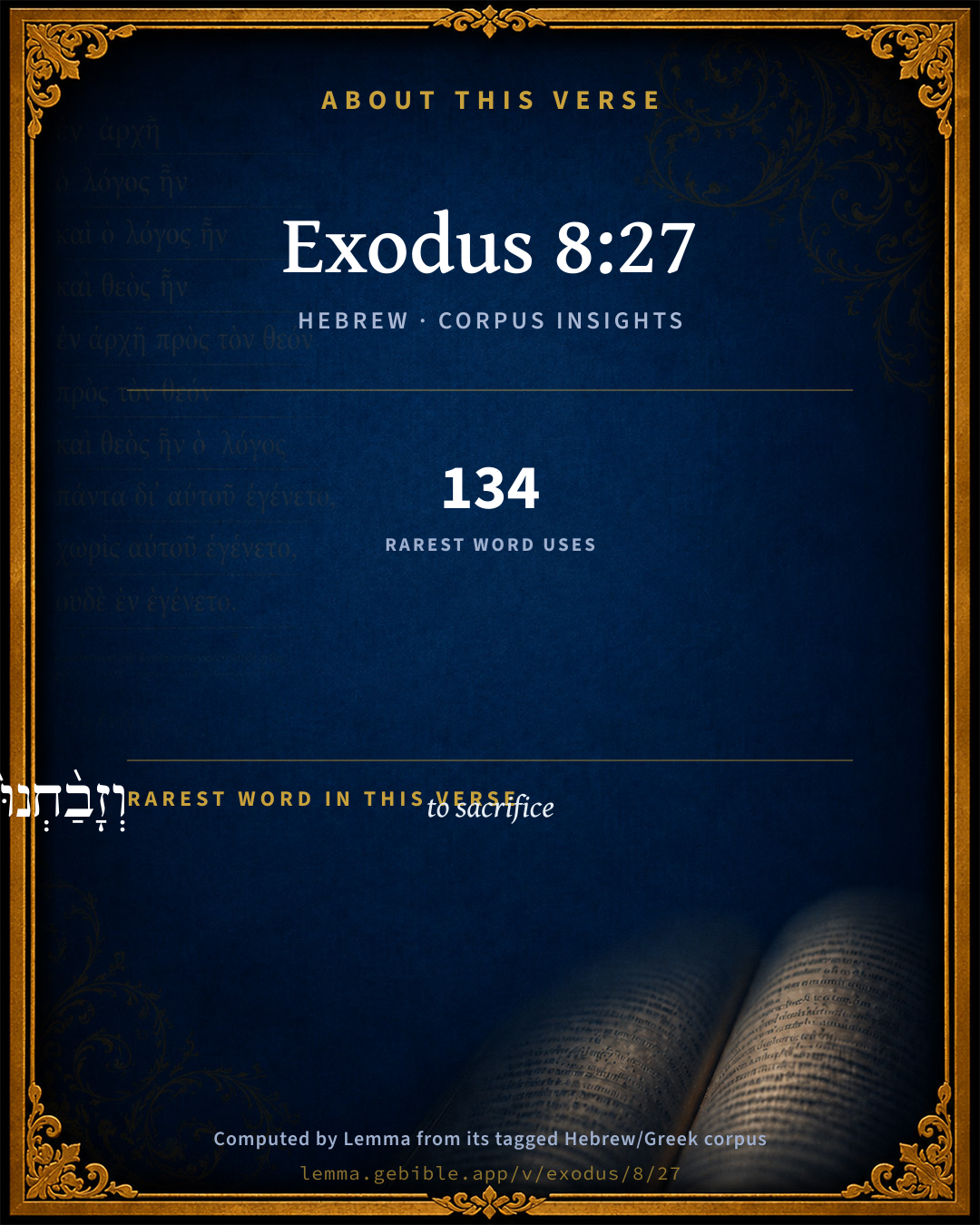
Exodus, in the Pentateuch, opens this verse with 11 words (11 distinct Hebrew lemmas). Its most distinctive word is zâbach (“to sacrifice”). A historical commentator’s framing appears above. Read the whole chapter for the surrounding context.

Discussion questions

  1. How does “to sacrifice” (zâbach) shape what this verse is saying?
  2. How does Exodus 3:18, which shares this passage’s theme, read alongside this verse?
  3. These translations render this verse differently. What is at stake in choosing one wording over another?
  4. «נֵלֵ֖ךְ» is a Qal Imperfect verb. How does that grammatical form shape the action described?
  5. Compare how Trapp's Complete Commentary and Joseph Benson's Commentary read this verse. Where do they agree or differ?

Things to notice

Reading settings

Reading text

Shown beneath each verse's original-language words.

Old Testament
Old Testament edition

Read the OT as the Masoretic Hebrew (MT) or the Greek Septuagint (LXX).

English shown for the Greek Septuagint (in the Hebrew ↔ Greek comparison).

Comparing translations? Open the Compare panel on any verse page to stack up to four side by side.