

Acts 21:24
Greek (Tischendorf 8th ed.) Acts 21:24 appears in the Greek New Testament. The text above is from the Tischendorf 8th edition. Each word links to its Strong’s number and a concise gloss. Click any word for its full Thayer’s Greek Lexicon entry.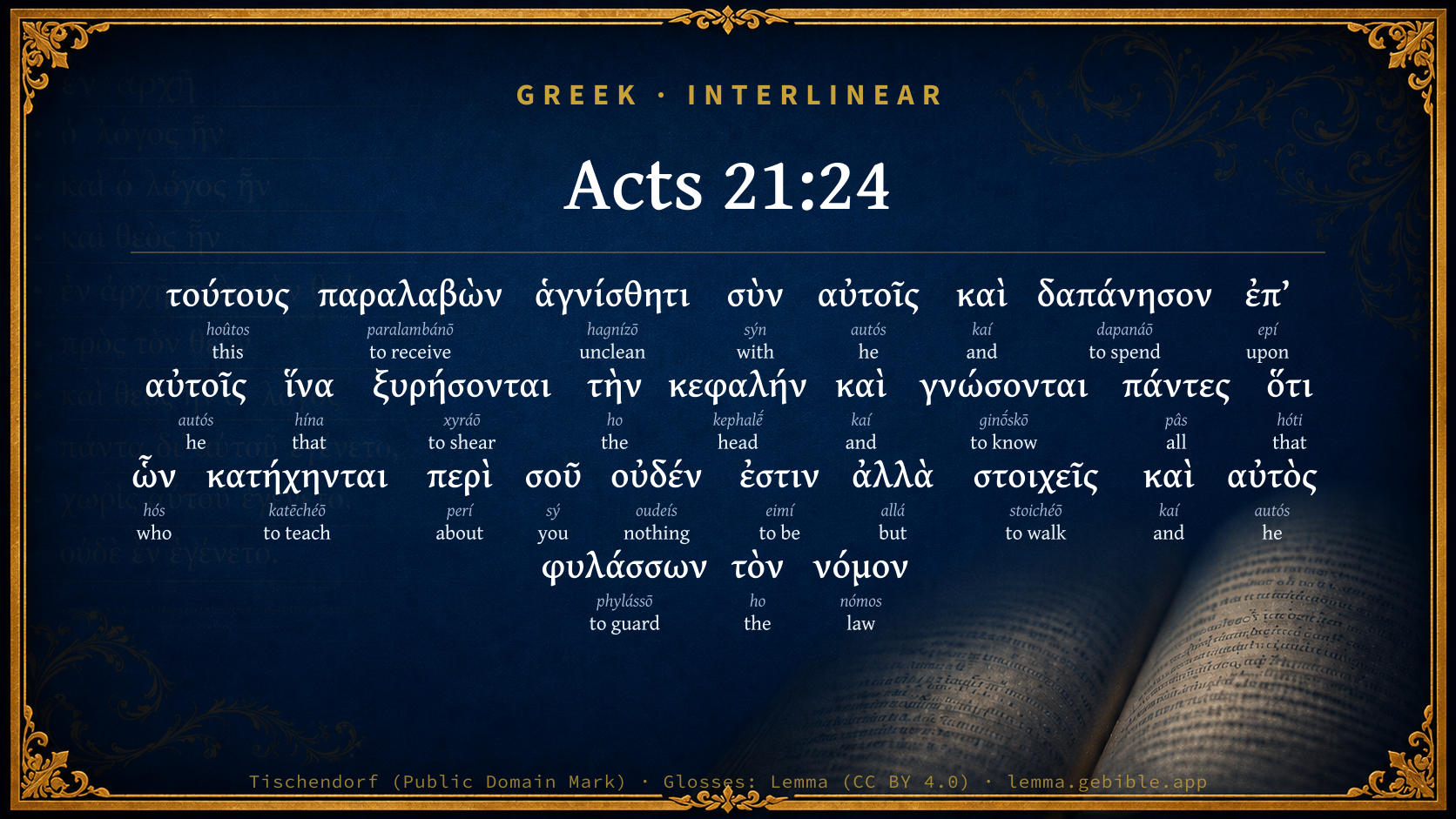
Take them, and purify yourself with them, and pay their expenses for them, that they may shave their heads. Then all will know that there is no truth in the things that they have been informed about you, but that you yourself also walk keeping the law.
Download a study sheet
One document with this verse’s original text, its word-by-word gloss line, the meaning frame, cross-references with their text, attributed commentary, and full source and license credits — printable, and it pastes into notes with its structure intact.
This verse Autodidact and up
A passage Seminary Student
Up to 50 verses in one chapter. A passage sheet keeps up to 6 commentary sources and 12 cross-references per verse, in the order this page ranks them, and says so on the sheet whenever that leaves anything out. Ask for a single verse and you get the Autodidact verse sheet above.
Everything on this page stays free to read, with no account — the sheet is a download of what is already on screen, not access to it.
Compare translations 3
The same verse in 3 English versions, stacked beneath the original-language interlinear above. Click any original word for its lexicon entry.
Each is an independent rendering of the whole verse — the interlinear is not word-aligned to these translations.
Highlighted words mark where these versions differ — a whole-verse word diff, not a word-by-word alignment.
-
World English Bible Public Domain
Take them, and purify yourself with them, and pay their expenses for them, that they may shave their heads. Then all will know that there is no truth in the things that they have been informed about you, but that you yourself also walk keeping the law.
-
King James Version Public Domain
Them take, and purify thyself with them, and be at charges with them, that they may shave their heads: and all may know that those things, whereof they were informed concerning thee, are nothing; but that thou thyself also walkest orderly, and keepest the law.
-
unfoldingWord Literal Text CC BY-SA 4.0
Taking these men, be purified with them and pay the expenses for them, so that they will shear heads, and then everyone will know that there is nothing in the things they have been told about you, but that you conform, also keeping the law yourself.
unfoldingWord Literal Text — © unfoldingWord, licensed CC BY-SA 4.0. Word-aligned USFM3 via Door43 (git.door43.org/unfoldingWord/en_ult).
Show all 19 translations
Every available English version of this verse, each an independent rendering of the whole verse.
-
World English Bible Public Domain
Take them, and purify yourself with them, and pay their expenses for them, that they may shave their heads. Then all will know that there is no truth in the things that they have been informed about you, but that you yourself also walk keeping the law.
-
Berean Standard Bible Public Domain
Take these men, purify yourself along with them, and pay their expenses so they can have their heads shaved. Then everyone will know that there is no truth to these rumors about you, but that you also live in obedience to the law.
-
Majority Standard Bible Public Domain
Take these men, purify yourself along with them, and pay their expenses so they can have their heads shaved. Then everyone will know that there is no truth to these rumors about you, but that you also live in obedience to the law.
-
King James Version Public Domain
Them take, and purify thyself with them, and be at charges with them, that they may shave their heads: and all may know that those things, whereof they were informed concerning thee, are nothing; but that thou thyself also walkest orderly, and keepest the law.
-
American Standard Version (1901) Public Domain
these take, and purify thyself with them, and be at charges for them, that they may shave their heads: and all shall know that there is no truth in the things whereof they have been informed concerning thee; but that thou thyself also walkest orderly, keeping the law.
-
Revised Version (1885) Public Domain
these take, and purify thyself with them, and be at charges for them, that they may shave their heads: and all shall know that there is no truth in the things whereof they have been informed concerning thee; but that thou thyself also walkest orderly, keeping the law.
-
Geneva Bible (1599) Public Domain
Them take, and purifie thy selfe with them, and contribute with them, that they may shaue their heads: and all shall knowe, that those things, whereof they haue bene informed concerning thee, are nothing, but that thou thy selfe also walkest and keepest the Lawe.
-
Douay-Rheims (1899) Public Domain
Take these, and sanctify thyself with them: and bestow on them, that they may shave their heads: and all will know that the things which they have heard of thee, are false; but that thou thyself also walkest keeping the law.
-
Young's Literal Translation Public Domain
these having taken, be purified with them, and be at expence with them, that they may shave the head, and all may know that the things of which they have been instructed concerning thee are nothing, but thou dost walk -- thyself also -- the law keeping.
-
Literal Standard Version CC BY-SA 4.0
having taken these, be purified with them, and be at expense with them, that they may shave the head, and all may know that the things of which they have been instructed concerning you are nothing, but you walk—yourself also—keeping the Law.
-
Unlocked Literal Bible CC BY-SA 4.0
Take these men and purify yourself with them, and pay their expenses for them, so that they may shave their heads. So everyone will know that the things they have been told about you are false. They will learn that you also follow the law.
-
unfoldingWord Literal Text CC BY-SA 4.0
Taking these men, be purified with them and pay the expenses for them, so that they will shear heads, and then everyone will know that there is nothing in the things they have been told about you, but that you conform, also keeping the law yourself.
-
Darby Bible Public Domain
take these and be purified with them, and pay their expenses, that they may have their heads shaved; and all will know that [of those things] of which they have been informed about thee nothing is [true]; but that thou thyself also walkest orderly, keeping the law.
-
World Messianic Bible Public Domain
Take them and purify yourself with them, and pay their expenses for them, that they may shave their heads. Then all will know that there is no truth in the things that they have been informed about you, but that you yourself also walk keeping the Torah.
-
Webster's Bible Public Domain
Take them, and purify thyself with them, and be at charges with them, that they may shave their heads: and all may know that those things of which they were informed concerning thee, are nothing; but that thou thyself also walkest orderly, and keepest the law.
-
Free Bible Version CC BY-SA 4.0
Go with them and perform the purification rituals with them, paying for them to have their heads shaved. That way everyone will know there's no truth to the rumors they've heard about you, but that you yourself observe the Law in the way that you live.
-
Bible in Basic English Public Domain
Go with these, and make yourself clean with them, and make the necessary payments for them, so that they may be free from their oath: and everyone will see that the statements made about you are not true, but that you put yourself under rule, and keep the law.
-
Text-Critical English NT CC BY 4.0
Take these men and purify yoʋrself along with them and pay their expenses, so that they may shave their heads. Then everyone will know that there is no truth to what they have been told about yoʋ, but that yoʋ yoʋrself also walk in an orderly manner, keeping the law.
-
Tyndale New Testament (1534) Public Domain
Them take and purifye thy selfe with them and do cost on them that they maye shave their heeddes and all shall knowe that tho thinges which they have hearde concerninge the are nothinge: but that thou thy selfe also walkest and kepest the lawe.
Literal Standard Version (2020), Covenant Press — licensed CC BY-SA 4.0. Text via the HelloAO Bible API (eBible.org). Unlocked Literal Bible (unfoldingWord) — licensed CC BY-SA 4.0. Text via the HelloAO Bible API (eBible.org). unfoldingWord Literal Text — © unfoldingWord, licensed CC BY-SA 4.0. Word-aligned USFM3 via Door43 (git.door43.org/unfoldingWord/en_ult). Free Bible Version, Dr. Jonathan Gallagher — licensed CC BY-SA 4.0. Text via the HelloAO Bible API (eBible.org).
Word by word
More ways to search: Search by grammar → Find every occurrence → Compare this word →
Practice this passage: Drill this verse → Learn its vocabulary →
- Appears 3× in the Greek New Testament
- First appears here
- Part of Speech
- Verb
- Tense
- Future
- Voice
- Middle deponent
- Mood
- Indicative
- Person
- 3rd person
- Number
- Plural
Full Thayer's Definition
- τούτους hoûtos G3778 “this” Demonstrative pronoun, Accusative, Plural, Masculine
- παραλαβὼν paralambánō G3880 “to receive” Verb, Aorist, Active, Participle, Nominative, Singular, Masculine
- ἁγνίσθητι hagnízō G48 “unclean” Verb, Aorist, Passive, Imperative, 2nd person, Singular
- σὺν sýn G4862 “with” Preposition
- αὐτοῖς autós G846 “he” Personal pronoun, Dative, Plural, Masculine
- καὶ kaí G2532 “and” Conjunction
- δαπάνησον dapanáō G1159 “to spend” Verb, Aorist, Active, Imperative, 2nd person, Singular
- ἐπ’ epí G1909 “upon” Preposition
- αὐτοῖς autós G846 “he” Personal pronoun, Dative, Plural, Masculine
- ἵνα hína G2443 “that” Conjunction
- ξυρήσονται xyráō G3587 “to shear” Verb, Future, Middle deponent, Indicative, 3rd person, Plural
- τὴν ho G3588 “the” Article, Accusative, Singular, Feminine
- κεφαλήν kephalḗ G2776 “head” Noun, Accusative, Singular, Feminine
- καὶ kaí G2532 “and” Conjunction
- γνώσονται ginṓskō G1097 “to know” Verb, Future, Middle deponent, Indicative, 3rd person, Plural
- πάντες pâs G3956 “all” Adjective, Nominative, Plural, Masculine
- ὅτι hóti G3754 “that” Conjunction
- ὧν hós G3739 “who” Relative pronoun, Genitive, Plural, Neuter
- κατήχηνται katēchéō G2727 “to teach” Verb, Perfect, Passive, Indicative, 3rd person, Plural
- περὶ perí G4012 “about” Preposition
- σοῦ sý G4771 “you” Personal pronoun, 2nd person, Genitive, Singular
- οὐδέν oudeís G3762 “nothing” Adjective, Nominative, Singular, Neuter, Negative
- ἐστιν eimí G1510 “to be” Verb, Present, Active, Indicative, 3rd person, Singular
- ἀλλὰ allá G235 “but” Conjunction
- στοιχεῖς stoichéō G4748 “to walk” Verb, Present, Active, Indicative, 2nd person, Singular
- καὶ kaí G2532 “and” Conjunction
- αὐτὸς autós G846 “he” Personal pronoun, Nominative, Singular, Masculine
- φυλάσσων phylássō G5442 “to guard” Verb, Present, Active, Participle, Nominative, Singular, Masculine
- τὸν ho G3588 “the” Article, Accusative, Singular, Masculine
- νόμον nómos G3551 “law” Noun, Accusative, Singular, Masculine
About this verse
These counts appear in no published source. They are computed here, from the morphology-tagged text and Lemma’s own curated glosses. What Lemma adds →
- 30
- words
- 25
- distinct lemmas
- Acts
- section
Notable vocabulary
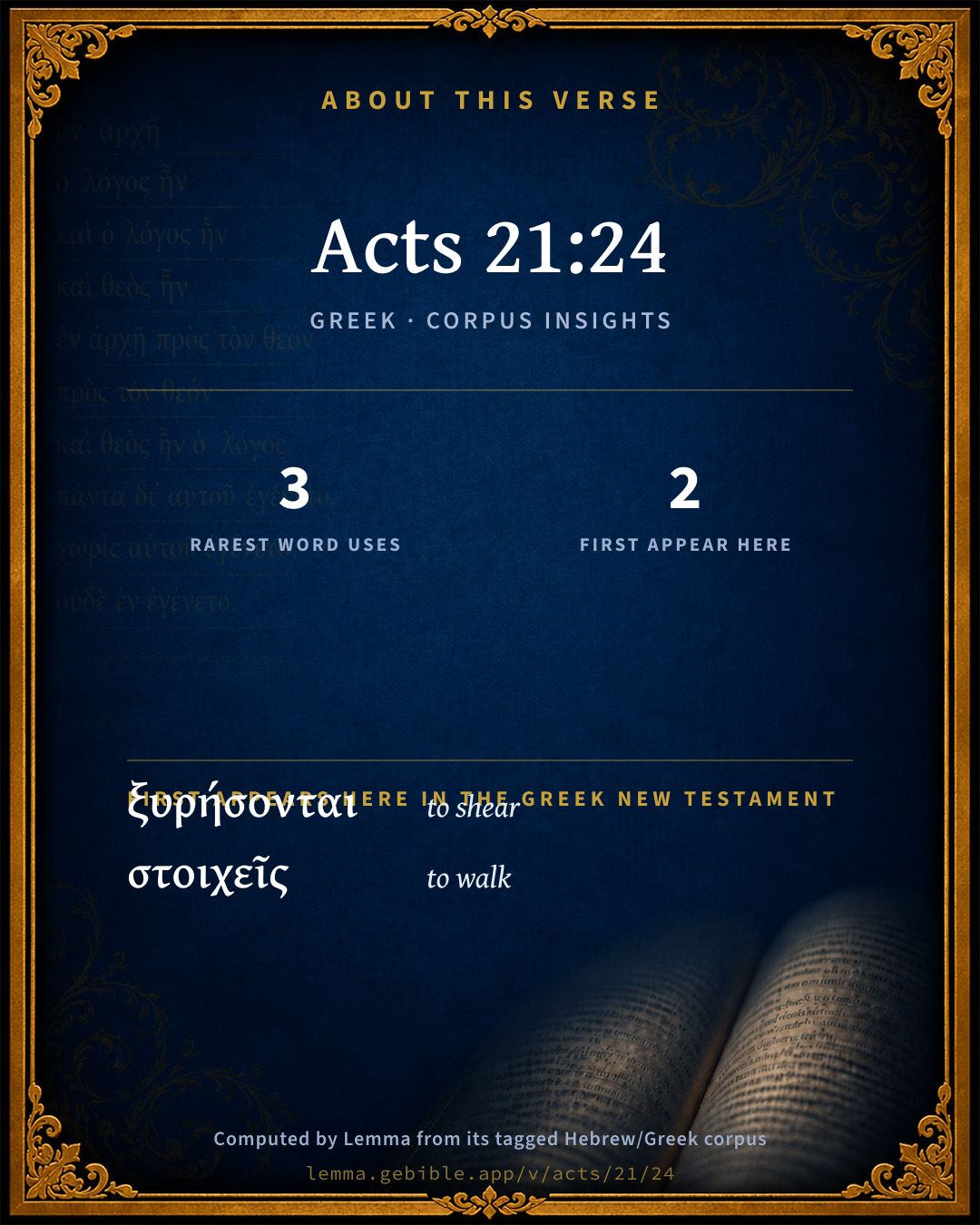
The rarest word here is ξυρήσονται to shear G3587 — appearing just 3 times in the whole Greek New Testament.
First appearance in Scripture
These words make their first canonical appearance in the Greek New Testament here:
Shared distinctive vocabulary
ξυρήσονται to shear G3587 occurs in 3 verses of the Greek New Testament. Also found in:
Cross-references
20Topical passages linked to Acts 21:24 in the Treasury of Scripture Knowledge — connected by theme and wording, ordered by reader-vote popularity; previews shown in the World English Bible.
- Acts 21:26 Then Paul took the men, and the next day, purified himself and went with them into the temple, declaring the fulfillment of the days of purification, until the offering was offered for every one of them.
- Acts 18:18 Paul, having stayed after this many more days, took his leave of the brothers, and sailed from there for Syria, together with Priscilla and Aquila. He shaved his head in Cenchreae, for he had a vow.
- Acts 24:18 amid which certain Jews from Asia found me purified in the temple, not with a mob, nor with turmoil.
- Exodus 19:14 Moses went down from the mountain to the people, and sanctified the people; and they washed their clothes.
- 1 Corinthians 9:20 To the Jews I became as a Jew, that I might gain Jews; to those who are under the law, as under the law, that I might gain those who are under the law;
- Judges 16:17–19 He told her all his heart, and said to her, "No razor has ever come on my head; for I have been a Nazirite to God from my mother's womb. If I am shaved, then my strength will go from me, and I will become weak, and be like any other man."
- 2 Chronicles 30:18–19 For a multitude of the people, even many of Ephraim and Manasseh, Issachar and Zebulun, had not cleansed themselves, yet did they eat the Passover otherwise than it is written. For Hezekiah had prayed for them, saying, The good Yahweh pardon everyone
- Job 1:5 It was so, when the days of their feasting had run their course, that Job sent and sanctified them, and rose up early in the morning, and offered burnt offerings according to the number of them all. For Job said, "It may be that my sons have sinned, and renounced God in their hearts." Thus did Job continually.
- Job 41:25 When he raises himself up, the mighty are afraid. They retreat before his thrashing.
- John 3:25 There arose therefore a questioning on the part of John's disciples with some Jews about purification.
- John 11:55 Now the Passover of the Jews was at hand. Many went up from the country to Jerusalem before the Passover, to purify themselves.
- Galatians 2:12 For before some people came from James, he ate with the Gentiles. But when they came, he drew back and separated himself, fearing those who were of the circumcision.
- Hebrews 9:10–14 being only (with meats and drinks and various washings) fleshly ordinances, imposed until a time of reformation.
- Exodus 19:10 Yahweh said to Moses, "Go to the people, and sanctify them today and tomorrow, and let them wash their garments,
- Numbers 6:5 "All the days of his vow of separation there shall no razor come on his head, until the days are fulfilled, in which he separates himself to Yahweh. He shall be holy. He shall let the locks of the hair of his head grow long.
- Numbers 6:9 "If any man dies very suddenly beside him, and he defiles the head of his separation; then he shall shave his head in the day of his cleansing. On the seventh day he shall shave it.
- Numbers 6:13 "This is the law of the Nazirite: when the days of his separation are fulfilled, he shall be brought to the door of the Tent of Meeting,
- Numbers 6:18 The Nazirite shall shave the head of his separation at the door of the Tent of Meeting, and shall take the hair of the head of his separation, and put it on the fire which is under the sacrifice of peace offerings.
- Numbers 19:17–22 For the unclean they shall take of the ashes of the burning of the sin-offering; and running water shall be put thereto in a vessel:
- Judges 13:5 for, behold, you shall conceive, and bear a son; and no razor shall come on his head; for the child shall be a Nazirite to God from the womb: and he shall begin to save Israel out of the hand of the Philistines.
Cross-references courtesy of OpenBible.info (CC BY 4.0).
Lesson kit
Teaching starters — assembled from the data on this page, not authored interpretation. Every prompt links to the verse data it draws on. Edit before teaching.
Acts, in the Acts, opens this verse with 30 words (25 distinct Greek lemmas). Its most distinctive word is xyráō (“to shear”). A historical commentator’s framing appears above. Read the whole chapter for the surrounding context.
Discussion questions
- What does “to shear” (xyráō) contribute to the verse as a whole?
- 2 words here appear for the first time in Scripture. What is being introduced at this debut?
- 1 Corinthians 11:5 shares the word «to shear» with this verse. How do the two illuminate each other?
- “he” occurs 3× in this one verse. What is the effect of the repetition?
- These translations render this verse differently. What is at stake in choosing one wording over another?
- Reading how Bengel's Gnomon and Meyer's Critical & Exegetical Commentary read this verse, where do the two commentators agree and where do they part?
Things to notice
- 2 words make their first canonical appearance in Scripture here.
- These translations choose different wording for 33 words in this verse.
- “he” occurs 3× in this single verse.
- 25 distinct Greek lemmas span 30 words in this verse.
Commentary
Notes on Acts 21:24 from classic Christian and Jewish commentators (each source and its license shown beneath its notes). The classic Christian expositions comment on the surrounding passage and are grouped to its opening verse, so a note may address several verses; the Jewish commentaries on the Tanakh (Rashi and others) are per-verse, so they appear only where the commentator wrote on this verse.
Lemma curates 59 commentaries, every one of them public domain or Creative Commons licensed, each selected and text-cleaned for this edition rather than reprinted as found. About our sources →
Bengel's Gnomon
Johann Albrecht Bengel
Bengel's Gnomon of the New Testament — English translation (T&T Clark, Edinburgh, 1860) — public domain. Text from a community e-Sword module.
Meyer's Critical & Exegetical Commentary
Heinrich August Wilhelm Meyer
Meyer — Critical and Exegetical Commentary on the New Testament — English translation by Peter Christie, edited by Frederick Crombie (T&T Clark, 1880) — public domain. Text from a community e-Sword module.
Expositor's Greek Testament
ed. W. Robertson Nicoll
The Expositor's Greek Testament, edited by W. Robertson Nicoll (1897–1910) — public domain. Text from a community e-Sword module.
Geneva Bible (1599)
Geneva Bible translators
Geneva Bible (1599) marginal notes — public domain. Text via Bolls.life.
Jamieson, Fausset & Brown
Robert Jamieson, A. R. Fausset & David Brown
Jamieson, Fausset & Brown — Commentary Critical and Explanatory on the Whole Bible (1871) — public domain (CC PDM 1.0). Text via the HelloAO Bible API.
Adam Clarke's Commentary
Adam Clarke's Commentary on the Bible (1810–1826) — public domain. Text from a community e-Sword/MySword module.
John Calvin's Commentaries
John Calvin's Commentaries (1540-1563) — public domain. Text from the Calvin Translation Society English edition (1840s-50s) via the Christian Classics Ethereal Library (ccel.org). Calvin's coverage is partial (roughly two-thirds of the Bible); uncommented books and verses are honest gaps, never fabricated. The 19th-century editor's footnotes and remarks are omitted so the notes are faithfully Calvin's own voice.
Ellicott's Commentary for English Readers
A Bible Commentary for English Readers, edited by Charles John Ellicott (1878–1897) — public domain. Text from a community e-Sword module.
The Cambridge Bible for Schools and Colleges
gen. ed. J. J. S. Perowne
The Cambridge Bible for Schools and Colleges (gen. ed. J. J. S. Perowne; Cambridge University Press, 1878–1918) — public domain. Text from a community e-Sword module.
John Gill's Exposition
John Gill's Exposition of the Whole Bible (1746–1763) — public domain (CC PDM 1.0). Text via the HelloAO Bible API.
Trapp's Complete Commentary
John Trapp
John Trapp, A Commentary or Exposition upon All the Books of the Old and New Testament (1647–1656) — public domain. Text from a community e-Sword module.
Albert Barnes' Notes on the Bible
Albert Barnes' Notes on the Bible (1834–1885) — public domain. Text from a community e-Sword/MySword module.
Haydock's Catholic Bible Commentary
George Leo Haydock (1774–1849), Haydock's Catholic Family Bible and Commentary, 1859 edition — public domain. Excludes Psalms (Douay-Rheims chapter numbering differs from Protestant) and Deuterocanonical books (Catholic canon only).
Matthew Poole's English Annotations
Matthew Poole's English Annotations on the Holy Bible (1683–1685) — public domain. Text from a community e-Sword/MySword module.
Whedon's Commentary on the Bible
Daniel D. Whedon
Daniel D. Whedon (gen. ed.), Commentary on the Old and New Testaments (1874–1909) — public domain. Text from a community e-Sword module.
The Pulpit Commentary
The Pulpit Commentary (1880–1919), ed. H.D.M. Spence-Jones & Joseph S. Exell — public domain. Text from a community e-Sword module.
John Wesley's Explanatory Notes
John Wesley, Explanatory Notes Upon the Whole Bible (1754–1765) — public domain. Text via the GEBible commentary corpus.
Scofield Reference Notes
C. I. Scofield
The Scofield Reference Bible (1917 edition), notes by C. I. Scofield — public domain. Text from a community e-Sword module.
McGarvey & Pendleton's Commentaries
J. W. McGarvey
J. W. McGarvey (with Philip Y. Pendleton), Commentaries on the New Testament (The Fourfold Gospel, 1914; Acts; and the epistles) — public domain. Text from a community e-Sword/MySword module.
Cambridge Greek Testament for Schools and Colleges
Cambridge Greek Testament for Schools and Colleges (Cambridge University Press, 1896; 21 vols, various authors incl. Carr, Maclear, Plummer, Farrar, Lumby, Moule, M. R. James, Simcox) — public domain. Text from a community e-Sword module.
Alford’s Greek Testament
Henry Alford
Henry Alford, The Greek Testament (1849–1861) — public domain. Text from a community e-Sword module.
Vincent's Word Studies in the New Testament
Marvin R. Vincent
Marvin R. Vincent, Word Studies in the New Testament (1887–1900) — public domain. Text from a community e-Sword/MySword module.