Luke 5:36

Greek (Tischendorf 8th ed.) Luke 5:36 appears in the Greek New Testament. The text above is from the Tischendorf 8th edition. Each word links to its Strong’s number and a concise gloss. Click any word for its full Thayer’s Greek Lexicon entry.
Download image
Cite this verse

Luke 5:36 (World English Bible). Public Domain. Lemma interlinear Bible study tool, https://lemma.gebible.app/v/luke/5/36.

Show BibTeX & RIS
BibTeX
RIS
English Translation
He also told a parable to them. "No one puts a piece from a new garment on an old garment, or else he will tear the new, and also the piece from the new will not match the old.
World English Bible · Public Domain
Download a study sheet

One document with this verse’s original text, its word-by-word gloss line, the meaning frame, cross-references with their text, attributed commentary, and full source and license credits — printable, and it pastes into notes with its structure intact.

This verse Autodidact and up

Study sheet (.html) Plain text (.txt)

A passage Seminary Student

Up to 50 verses in one chapter. A passage sheet keeps up to 6 commentary sources and 12 cross-references per verse, in the order this page ranks them, and says so on the sheet whenever that leaves anything out. Ask for a single verse and you get the Autodidact verse sheet above.

Everything on this page stays free to read, with no account — the sheet is a download of what is already on screen, not access to it.

Want to remove ads? Support Godless Engineer
Compare translations 3

The same verse in 3 English versions, stacked beneath the original-language interlinear above. Click any original word for its lexicon entry.

Each is an independent rendering of the whole verse — the interlinear is not word-aligned to these translations.

Highlighted words mark where these versions differ — a whole-verse word diff, not a word-by-word alignment.

  • World English Bible Public Domain
    He also told a parable to them. "No one puts a piece from a new garment on an old garment, or else he will tear the new, and also the piece from the new will not match the old.
  • King James Version Public Domain
    And he spake also a parable unto them; No man putteth a piece of a new garment upon an old; if otherwise, then both the new maketh a rent, and the piece that was taken out of the new agreeth not with the old.
  • unfoldingWord Literal Text CC BY-SA 4.0
    Then he also spoke a parable to them. “No one, having torn a piece of cloth from a new garment, puts it onto an old garment. But if not, the new will tear, and the old will not match the piece that is from the new.

unfoldingWord Literal Text — © unfoldingWord, licensed CC BY-SA 4.0. Word-aligned USFM3 via Door43 (git.door43.org/unfoldingWord/en_ult).

Versions to compare (up to 4)

3 of 4 selected

Show all 19 translations

Every available English version of this verse, each an independent rendering of the whole verse.

  • World English Bible Public Domain
    He also told a parable to them. "No one puts a piece from a new garment on an old garment, or else he will tear the new, and also the piece from the new will not match the old.
  • Berean Standard Bible Public Domain
    He also told them a parable: “No one tears a piece of cloth from a new garment and sews it on an old one. If he does, he will tear the new garment as well, and the patch from the new will not match the old.
  • Majority Standard Bible Public Domain
    He also told them a parable: “No one sews a piece of cloth from a new garment onto an old one. If he does, he will tear the new garment as well, and the patch from the new will not match the old.
  • King James Version Public Domain
    And he spake also a parable unto them; No man putteth a piece of a new garment upon an old; if otherwise, then both the new maketh a rent, and the piece that was taken out of the new agreeth not with the old.
  • American Standard Version (1901) Public Domain
    And he spake also a parable unto them: No man rendeth a piece from a new garment and putteth it upon an old garment; else he will rend the new, and also the piece from the new will not agree with the old.
  • Revised Version (1885) Public Domain
    And he spake also a parable unto them; No man rendeth a piece from a new garment and putteth it upon an old garment; else he will rend the new, and also the piece from the new will not agree with the old.
  • Geneva Bible (1599) Public Domain
    Againe he spake also vnto them a parable, No man putteth a piece of a newe garment into an olde vesture: for then the newe renteth it, and the piece taken out of the newe, agreeth not with the olde.
  • Douay-Rheims (1899) Public Domain
    And he spoke also a similitude to them: That no man putteth a piece from a new garment upon an old garment; otherwise he both rendeth the new, and the piece taken from the new agreeth not with the old.
  • Young's Literal Translation Public Domain
    And he spake also a simile unto them -- `No one a patch of new clothing doth put on old clothing, and if otherwise, the new also doth make a rent, and with the old the patch doth not agree, that `is' from the new.
  • Literal Standard Version CC BY-SA 4.0
    And He spoke also an allegory to them: “No one puts a patch of new clothing on old clothing, and if otherwise, the new also makes a split, and with the old the patch does not agree, that [is] from the new.
  • Unlocked Literal Bible CC BY-SA 4.0
    Then Jesus also spoke a parable to them. “No one tears a piece of cloth from a new garment and uses it to mend an old garment. If he did that, he would tear the new garment, and the piece of cloth from the new garment would not fit with the cloth of the old garment.
  • unfoldingWord Literal Text CC BY-SA 4.0
    Then he also spoke a parable to them. “No one, having torn a piece of cloth from a new garment, puts it onto an old garment. But if not, the new will tear, and the old will not match the piece that is from the new.
  • Darby Bible Public Domain
    And he spoke also a parable to them: No one puts a piece of a new garment upon an old garment, otherwise he will both rend the new, and the piece which is from the new will not suit with the old.
  • World Messianic Bible Public Domain
    He also told a parable to them. “No one puts a piece from a new garment on an old garment, or else he will tear the new, and also the piece from the new will not match the old.
  • Webster's Bible Public Domain
    And he spoke also a parable to them: No man putteth a piece of a new garment upon an old: if otherwise, then both the new maketh a rent, and the piece that was taken out of the new, agreeth not with the old.
  • Free Bible Version CC BY-SA 4.0
    Then he gave them an illustration: “You don't tear out a patch from new clothes to mend old clothes. Otherwise you'd ruin new clothes, and the patch from the new wouldn't match the old.
  • Bible in Basic English Public Domain
    And he said to them, in a story, No man takes a bit of cloth from a new coat and puts it on to an old coat, for so the new coat would be damaged and the bit from the new would not go well with the old.
  • Text-Critical English NT CC BY 4.0
    He also told them a parable: “No one puts a patch from a new garment on an old garment. For not only would he tear the new garment, but the patch from the new garment would not match the old garment.
  • Tyndale New Testament (1534) Public Domain
    Then he spake vnto them in a similitude: No man putteth a pece of a newe garment in to an olde vesture: for yf he do: then breaketh he the newe and the pece that was taken out of the newe agreeth not with the olde.

Literal Standard Version (2020), Covenant Press — licensed CC BY-SA 4.0. Text via the HelloAO Bible API (eBible.org). Unlocked Literal Bible (unfoldingWord) — licensed CC BY-SA 4.0. Text via the HelloAO Bible API (eBible.org). unfoldingWord Literal Text — © unfoldingWord, licensed CC BY-SA 4.0. Word-aligned USFM3 via Door43 (git.door43.org/unfoldingWord/en_ult). Free Bible Version, Dr. Jonathan Gallagher — licensed CC BY-SA 4.0. Text via the HelloAO Bible API (eBible.org).

Word by word

More ways to search: Search by grammar → Find every occurrence → Compare this word →

Practice this passage: Drill this verse → Learn its vocabulary →

ἐπίβλημα
epíblēma
G1915
“that which is added”
Noun, Accusative, Singular, Neuter
Part of Speech
Noun
Case
Accusative
Number
Singular
Gender
Neuter
Full Thayer's Definition

Origin: from G1911

TDNT: None

1. that which is thrown or put upon a thing, or that which is added to it a. an addition b. that which is sewed on to cover a rent, a patch
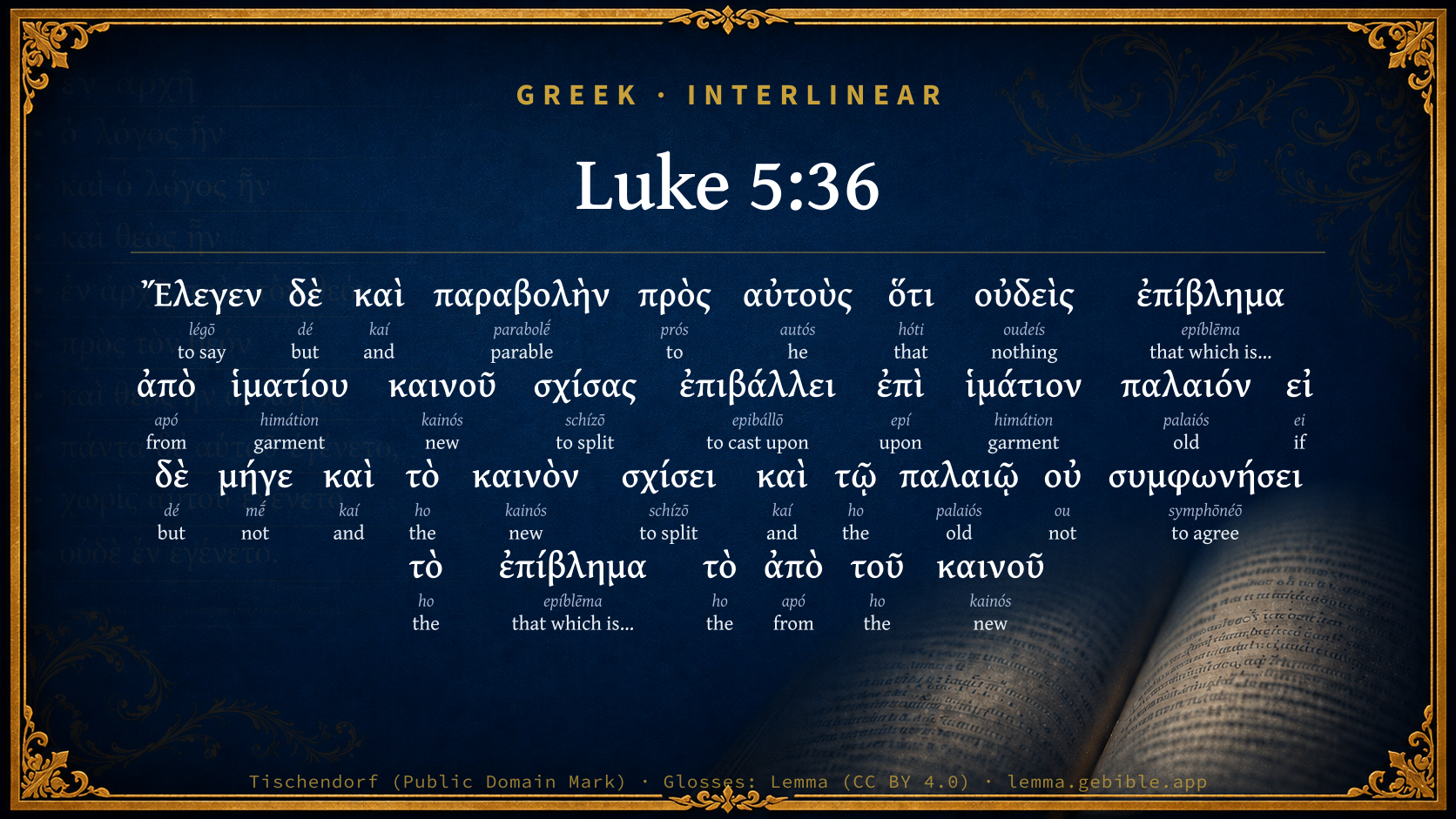
  1. Ἔλεγεν légō G3004 “to say” Verb, Imperfect, Active, Indicative, 3rd person, Singular
  2. δὲ dé G1161 “but” Conjunction
  3. καὶ kaí G2532 “and” Conjunction
  4. παραβολὴν parabolḗ G3850 “parable” Noun, Accusative, Singular, Feminine
  5. πρὸς prós G4314 “to” Preposition
  6. αὐτοὺς autós G846 “he” Personal pronoun, Accusative, Plural, Masculine
  7. ὅτι hóti G3754 “that” Conjunction
  8. οὐδεὶς oudeís G3762 “nothing” Adjective, Nominative, Singular, Masculine, Negative
  9. ἀπὸ apó G575 “from” Preposition
  10. ἱματίου himátion G2440 “garment” Noun, Genitive, Singular, Neuter
  11. καινοῦ kainós G2537 “new” Adjective, Genitive, Singular, Neuter
  12. σχίσας schízō G4977 “to split” Verb, Aorist, Active, Participle, Nominative, Singular, Masculine
  13. ἐπιβάλλει epibállō G1911 “to cast upon” Verb, Present, Active, Indicative, 3rd person, Singular
  14. ἐπὶ epí G1909 “upon” Preposition
  15. ἱμάτιον himátion G2440 “garment” Noun, Accusative, Singular, Neuter
  16. παλαιόν palaiós G3820 “old” Adjective, Accusative, Singular, Neuter
  17. εἰ ei G1487 “if” Conditional
  18. δὲ dé G1161 “but” Conjunction
  19. μήγε mḗ G3361 “not” Particle, Negative
  20. καὶ kaí G2532 “and” Conjunction
  21. τὸ ho G3588 “the” Article, Accusative, Singular, Neuter
  22. καινὸν kainós G2537 “new” Adjective, Accusative, Singular, Neuter
  23. σχίσει schízō G4977 “to split” Verb, Future, Active, Indicative, 3rd person, Singular
  24. καὶ kaí G2532 “and” Conjunction
  25. τῷ ho G3588 “the” Article, Dative, Singular, Neuter
  26. παλαιῷ palaiós G3820 “old” Adjective, Dative, Singular, Neuter
  27. οὐ ou G3756 “not” Particle, Negative
  28. συμφωνήσει symphōnéō G4856 “to agree” Verb, Future, Active, Indicative, 3rd person, Singular
  29. τὸ ho G3588 “the” Article, Nominative, Singular, Neuter
  30. ἐπίβλημα epíblēma G1915 “that which is added” Noun, Nominative, Singular, Neuter
  31. τὸ ho G3588 “the” Article, Nominative, Singular, Neuter
  32. ἀπὸ apó G575 “from” Preposition
  33. τοῦ ho G3588 “the” Article, Genitive, Singular, Neuter
  34. καινοῦ kainós G2537 “new” Adjective, Genitive, Singular, Neuter

About this verse

These counts appear in no published source. They are computed here, from the morphology-tagged text and Lemma’s own curated glosses. What Lemma adds →

35
words
21
distinct lemmas
Gospels
section

Notable vocabulary

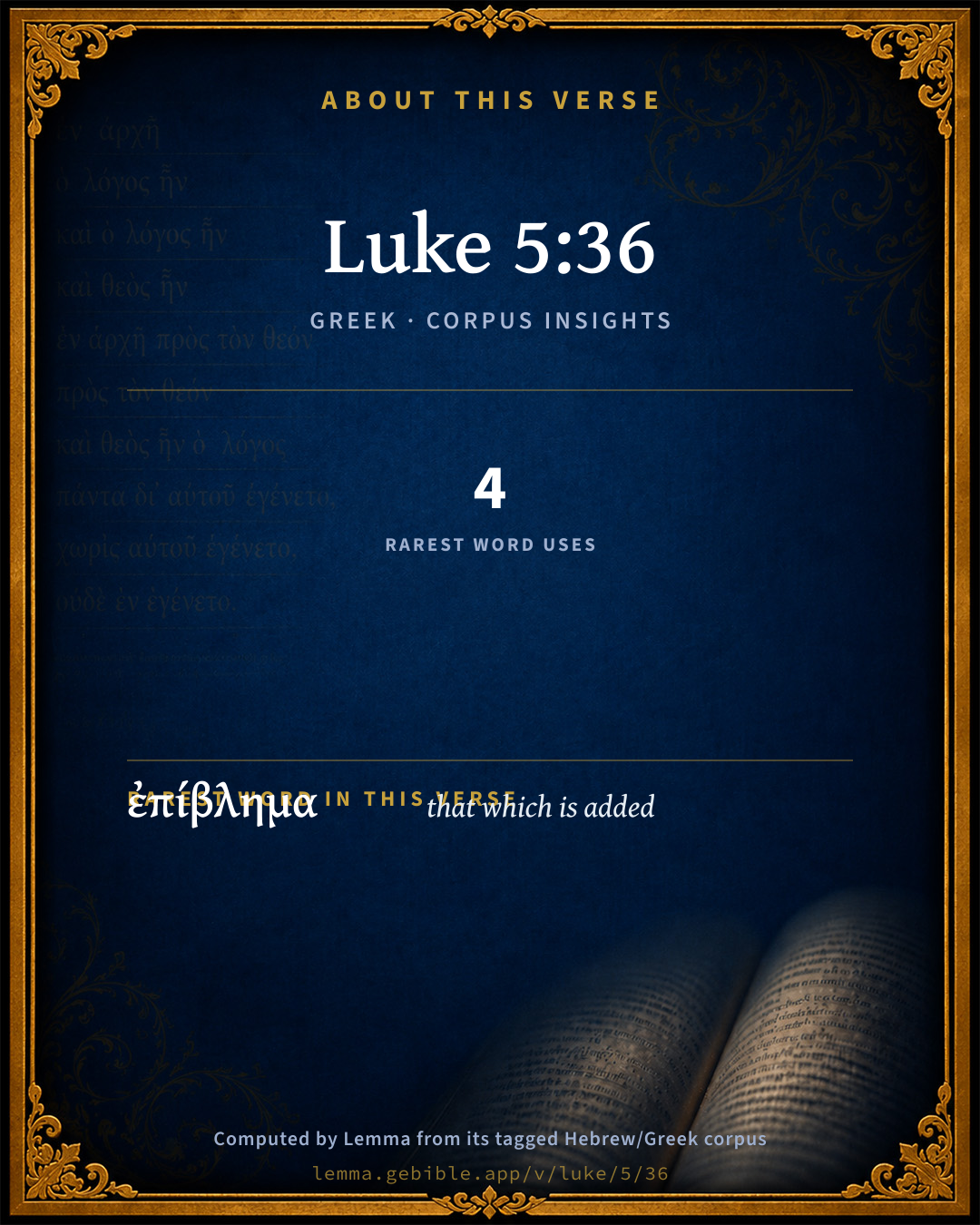
The rarest word here is ἐπίβλημα that which is added G1915 — appearing just 4 times in the whole Greek New Testament.

Shared distinctive vocabulary

ἐπίβλημα that which is added G1915 occurs in 3 verses of the Greek New Testament. Also found in:

Repetition

Words recur within this verse:

  • καινοῦ new G2537 ×3
  • ἐπίβλημα that which is added G1915 ×2
  • ἱματίου garment G2440 ×2
  • σχίσας to split G4977 ×2
  • παλαιόν old G3820 ×2
  • τὸ the G3588 ×5
  • καὶ and G2532 ×3
  • δὲ but G1161 ×2
  • ἀπὸ from G575 ×2

Cross-references

5

Topical passages linked to Luke 5:36 in the Treasury of Scripture Knowledge — connected by theme and wording, ordered by reader-vote popularity; previews shown in the World English Bible.

  • Matthew 9:16–17 No one puts a piece of unshrunk cloth on an old garment; for the patch would tear away from the garment, and a worse hole is made.
  • Mark 2:21–22 No one sews a piece of unshrunk cloth on an old garment, or else the patch shrinks and the new tears away from the old, and a worse hole is made.
  • 2 Corinthians 6:16 What agreement has a temple of God with idols? For you are a temple of the living God. Even as God said, "I will dwell in them, and walk in them; and I will be their God, and they will be my people."
  • Leviticus 19:19 "'You shall keep my statutes. "'You shall not crossbreed different kinds of animals. "'you shall not sow your field with two kinds of seed; "'neither shall there come upon on you a garment made of two kinds of material.
  • Deuteronomy 22:11 You shall not wear a mixed stuff, wool and linen together.

Cross-references courtesy of OpenBible.info (CC BY 4.0).

Where the printed editions differ

1 variant

Places in this verse where the major printed Greek editions disagree on the wording in a way that affects the translation — a comparison of editions, not a manuscript-by-manuscript collation. The editions are the modern critical texts (Nestlé-Aland 28/27, SBL, Westcott-Hort, Tregelles, Tyndale House) and the traditional texts behind the KJV (the Textus Receptus and the Byzantine/Majority text). It is not a claim about which reading is original.

  1. Extra text
    σχίσας

    “having torn”

    In NA28NA27TynSBLWHTreg Not in TRByz

    σχίσας (schisas) 'having torn' is only in older manuscripts (NA28+NA27+Tyn+SBL+WH+Treg)

Textual data: Translators Amalgamated Greek New Testament (STEPBible TAGNT) · CC BY 4.0.

Commentary

Notes on Luke 5:36 from classic Christian and Jewish commentators (each source and its license shown beneath its notes). The classic Christian expositions comment on the surrounding passage and are grouped to its opening verse, so a note may address several verses; the Jewish commentaries on the Tanakh (Rashi and others) are per-verse, so they appear only where the commentator wrote on this verse.

Lemma curates 59 commentaries, every one of them public domain or Creative Commons licensed, each selected and text-cleaned for this edition rather than reprinted as found. About our sources →

Tyndale Open Study Notes

Tyndale Open Resources

5:36-38 a new garment . . . new wine: New cloth shrinks when washed and so tears the old; new wine expands with fermentation and breaks brittle old wineskins. In either case, both old and new are ruined. Both illustrations make the point that the old is incompatible with the new. Jesus did not come to patch up the old covenant, but to establish a new one. The Kingdom of God brings a whole new orientation to thinking and living.

Tyndale Open Study Notes — © Tyndale Open Resources, licensed CC BY-SA 4.0. Text via the HelloAO Bible API.

Bengel's Gnomon

Johann Albrecht Bengel

Luk 5:36. Παραβολὴν, a parable) From a garment, and from wine: a kind of parable especially appropriate at a banquet [Luk 5:29]: comp. ch. Luk 14:7.—τὸ καινὸν) new.[57]

[57] In the sense, not worn out by use, different from the old worn-out garments: but νέον applied to the wine, new, in the sense of fresh, recent, opposed to wine mellowed by age; νέος is lately originated, as opposed to that originated some time back; καινὸς, not yet used, new, and different, as opposed to that which was formerly: hence Jesus does not say νέους ἀσκούς, nor ἱμάτιον νέον, nor οἶνον καινόν, but καινοὺς ἀσκούς, ἵματιον καινόν, and οἶνον νέον. See Tittm. Syn.—ED. and TRANSL.

Bengel's Gnomon of the New Testament — English translation (T&T Clark, Edinburgh, 1860) — public domain. Text from a community e-Sword module.

Expositor's Greek Testament

ed. W. Robertson Nicoll

Luk 5:36-39 . Relative parabolic Logia . ἔλεγε … ὅτι : an editorial introduction to the parabolic sayings. The first of these, as given by Lk., varies in form from the version in the parallels, suggests somewhat different ideas, and is in itself by no means clear. Much depends on whether we omit or retain σχίσας in the first clause. If, with [52] [53] [54] [55] , we retain it, the case put is: a piece cut out of a new garment to patch an old one, the evil results being: the new spoiled, and the old patched with the new piece presenting an incongruous appearance ( οὐ συμφωνήσει ). If, with [56] [57] , etc., we omit σχίσας , the case put may be: a new piece not cut out of a new garment, but a remnant (Hahn) used to patch an old, this new piece making a rent in the old garment; τὸ καινὸν in second clause not object of, but nominative to, σχίσει , and the contrast between the new patch and old garment presenting a grotesque appearance. The objection to this latter view is that there is no reason in the case supposed why the new patch should make a rent. In Mt. and Mk. the patch is made with unfulled cloth, which will contract. But the remnant of cloth with which a new garment is made would not be unfulled, and it would not contract. The sole evil in that case would be a piebald appearance. On the whole it seems best to retain σχίσας , and to render τὸ καινὸν σχίσει , he (the man who does so foolish a thing) will rend the new. Kypke suggests as an alternative rendering: the new is rent, taking σχίζει intransitively, of which use he cites an instance from the Testament of the twelve patriarchs. The sense on this rendering remains the same.

[52] Codex Sinaiticus (sæc. iv.), now at St. Petersburg, published in facsimile type by its discoverer, Tischendorf, in 1862.

[53] Codex Vaticanus (sæc. iv.), published in photographic facsimile in 1889 under the care of the Abbate Cozza-Luzi.

[54] Codex Bezae

[55] Codex Regius--eighth century, represents an ancient text, and is often in agreement with א and B.

[56] Codex Alexandrinus of the fifth century, a chief representative of the “Syrian” text, that is, the revised text formed by judicious eclectic use of all existing texts, and meant to be the authoritative New Testament.

[57] Codex Ephraemi

The Expositor's Greek Testament, edited by W. Robertson Nicoll (1897–1910) — public domain. Text from a community e-Sword module.

Ellicott's Commentary for English Readers

(36) And he spake also a parable unto them.—The illustration that follows is common to all three reports, but St. Luke only describes it as a parable, the others apparently confining that term to something that took the form of an actual narrative.

No man putteth.—The better MSS. give, No man having rent a piece from a new garment putteth it upon an old. The form which the illustration thus assumes gives it obviously a greater vividness. What folly could be greater than the act described?

Both the new maketh a rent.—Better, as agreeing with the reading just given, he will both rend the new, and the patch from the new will not agree with the old.

A Bible Commentary for English Readers, edited by Charles John Ellicott (1878–1897) — public domain. Text from a community e-Sword module.

The Cambridge Bible for Schools and Colleges

gen. ed. J. J. S. Perowne

36. a piece of a new garment upon an old] Rather, no one rending a patch from a new garment putteth it upon an old garment. The word σχίσας ‘rending’ though omitted in our version is found in א, A, B, D, L. Our Lord delighted in using these homely metaphors which brought the truth within the comprehension of his humblest hearers. St Matthew (Mat_9:16) has ‘a patch of unteazled cloth.’

both the new maketh a rent] Rather, with the best uncials, he will both rend the new. The inferior readings adopted by the E. V. make us lose sight of the fact that there is a treble mischief implied, namely, (1) the rending of the new to patch the old; (2) the incongruity of the mixture; (3) the increase of the rent of the old. The latter is mentioned only by St Matthew, but is implied by the bursten skins of the next similitude. Our Lord is referring to the proposal to enforce the ascetic leanings of the forerunner, and the Pharisaic regulations which had become a parasitic growth on the old dispensation, upon the glad simplicity of the new dispensation. To act thus, was much the same thing as using the Gospel by way of a mere adjunct to—a mere purple patch upon—the old garment of the Law. The teaching of Christ was a new and seamless robe which would only be spoilt by being rent. It was impossible to tear a few doctrines and precepts from Christianity, and use them as ornaments and improvements of Mosaism. If this were attempted (1) the Gospel would be maimed by the rending from its entirety; (2) the contrast between the new and the old system would be made more glaring; (3) the decay of the evanescent institutions would only be violently accelerated. Notice how distinctly these comparisons imply the ultimate abrogation of the Law.

agreeth not] Rather, will not agree (sumphonesei).

The Cambridge Bible for Schools and Colleges (gen. ed. J. J. S. Perowne; Cambridge University Press, 1878–1918) — public domain. Text from a community e-Sword module.

John Gill's Exposition

And no man putteth new wine into old bottles,.... To which the Scribes and Pharisees are here compared, into whose hearts the new wine of Gospel grace was not put; or to whom was not made known the love of God Comparable to new wine; nor the blessings of the new covenant of grace, now exhibited; nor the truths of the Gospel now more clearly and newly revealed.

Else the new wine will burst the bottles, and be spilled; they not being able to receive and bear these things, no, not the relation of them: these were hard sayings to them, of which they said, who can hear them? they could not hear them with patience, much less receive them in the love of them; but were at once filled with wrath and indignation, and rejected them.

And the bottles shall perish; their condemnation shall be the greater.

John Gill's Exposition of the Whole Bible (1746–1763) — public domain (CC PDM 1.0). Text via the HelloAO Bible API.

The Pulpit Commentary

And he spake also a parable unto them; No man putteth a piece of a new garment upon an old; if otherwise, then both the new maketh a rent, and the piece that was taken out of the new agreeth not with the old. Oriental teaching has ever delighted in using these vivid and picturesque metaphors and parables taken from the everyday life of the people; here the reference is, of course, to the question put by the. Pharisees and John"s disciples respecting fasting. This and the following little parable, and the curious simile which he added directly after, is part of the Lord"s answer to his questioners. They charged him in their query with throwing (by the neglect of fasting) a slur on the time-honoured practices and observances of the most religious men of Israel. His reply acknowledged that, as far as he was concerned, they were right. He had quietly put aside the rigidly appointed fasts and other ceremonial rites by means of which the great Jewish teachers to use their own expression had put a hedge about the Law. They were right, too, in the conclusion they had come to, implied but not expressed, in their evidently hostile questioning. His was a totally new form of the old Hebrew" religion new altogether in the grandeur of its conception and in the breadth of its influence. His was a totally new garment that he was about to offer to the people; now to patch up the beautiful new work with the old one would be surely to mar both. In the older authorities the text is slightly longer and more vivid than the text from which our own more corrupt Authorized Version was translated. It would run thus: "No one rending a patch from a new garment putteth it upon an old garment."

The Pulpit Commentary (1880–1919), ed. H.D.M. Spence-Jones & Joseph S. Exell — public domain. Text from a community e-Sword module.

John Wesley's Explanatory Notes

He spake also a parable - Taken from clothes and wine; therefore peculiarly proper at a feast.

John Wesley, Explanatory Notes Upon the Whole Bible (1754–1765) — public domain. Text via the GEBible commentary corpus.

Kretzmann's Popular Commentary

Paul E. Kretzmann

Proverbial sayings:

v. 36. And He spake also a parable unto them: No man putteth a piece of a new garment upon an old; if otherwise, then both the new maketh a rent, and the piece that was taken out of the. new agreeth not with the old.

v. 37. And no man putteth new wine into old bottles; else the new wine will burst the bottles and be spilled, and the bottles shall perish.

v. 38. But new wine must be put into new bottles, and both are preserved.

v. 39. No man also, having drunk old wine, straightway desireth new; for he saith, The old is better.

Here are three parabolic or proverbial sayings by which the Lord intends to teach the Pharisees a much-needed lesson. It is foolish to take a patch of a new dress and attempt to make it hold a rent in an old dress. This effort only makes matters worse; for the new cloth, in shrinking, and in accommodating itself to the fit of the dress, draws the threads of the rotten, weak part of the garment, and the matter is made far worse. Besides, the new patch, with its clear colors, stands out too prominently from the old dress, making the patch all the more conspicuous. To put new wine, that has not yet stopped fermenting, into old skins, that have lost the power to stretch, is equally foolish, since the new wine will only tear the bottles. Therefore the new wine is properly put only into new bottles, or skins. The old dress is the righteousness of works, in which the Pharisees believed, the new patch the free grace of Jesus. The piety and self-righteousness of the Pharisees and the doctrine which Jesus proclaimed, the doctrine of the free grace of God in the Savior, do not agree and will never fit in the same person’s life and behavior. If anyone trusts in his own works, and then intends to put a patch of the Gospel upon this self-righteousness, or wants to cover the one or the other transgression with the work and merit of Christ, he will soon find out that this comfort is not reliable. Such a person in the depths of his heart still trusts in his own merit and will be condemned with this unstable comfort. And the new wine is the sweet Gospel of the forgiveness of sins, of the grace of God. This glorious news does not fit into carnal, Pharisaic hearts; if the Gospel is preached to such as still depend upon their own works, it is wasted, for they cannot and will not understand it rightly and receive no benefit from the Gospel. The Gospel requires all hearts to deny all their own righteousness and believe simply in the merits of Jesus the Savior. And finally: A man that has drunk old wine knows its richness and mellowness and therefore does not desire to change for the new, which may be sharper, less agreeable. So dearly did the Pharisees and the disciples of John love their old, accustomed ways that they did not want to change, although the offering of the new doctrine of the Gospel was salvation full and free.

Summary.Jesus causes the miraculous draught of fishes, calls Simon and his companions, heals a leper, cures a paralytic, calls Levi, and defends Himself and His disciples against Jewish attacks.

Paul E. Kretzmann, Popular Commentary of the Bible (1921–1924) — public domain. Text from a community e-Sword module.

unfoldingWord translationNotes

Door43 World Missions Community

General Information:

Jesus tells a story to the scribes and pharisees who were at Levi's house. (See: Parables)

No one tears ... uses it ... he ... he

"No one rips ... uses it ... he ... he" or "People never tear ... use it ... they ... they"

mend

repair

If he did that

This hypothetical statement explains the reason why a person would not actually mend a garment in that way. (See: Hypothetical Situations)

would not fit with

"would not match" or "would not be the same as"

translationWords

parable

unfoldingWord translationNotes — © Distant Shores Media and the Door43 World Missions Community, licensed CC BY-SA 4.0. Source: git.door43.org/Door43/en_tn.

Cambridge Greek Testament for Schools and Colleges

36. ἀπὸ ἱματ. καιν. σχίσας. אBDL, Ti[114] W.H[115] &c. σχίσει אBCDL. συμφωνήσει אABC.

[114] Ti. Tischendorf.

[115] W.H. Westcott and Hort.

36. ἔλεγεν δὲ καί. St Luke uses the phrase to introduce some fresh development or illustration of the subject. See Lev 13:54; Lev 14:12; Lev 16:1; Lev 18:1. Here our Lord’s remarks bear on the question just discussed, Moses had only appointed one annual fast—the Great Day of Atonement. The two weekly fasts of the Pharisees were mere ceremonial surplusage, belonging to their “hedge around the law.”

οὐδεὶς ἐπίβλημα ἀπὸ ἱματίου καινοῦ σχίσας. ‘No one rending a patch from a new garment putteth it upon an old garment.’ The word σχίσας ‘rending’ though omitted in our version is found in אABDL. Our Lord delighted in using these homely metaphors which brought the truth within the comprehension of His humblest hearers. St Matthew (Mat 9:16) has ‘a patch of unteazled cloth.’ To tear a piece out of a new garment in order to patch an old one is a folly never committed literally, but a very common religious and theological process.

ἱμάτιον παλαιόν. The Levitic dispensation which was already παλαιούμενον καὶ γηράσκον (Heb 8:13). The old garment of externalism could not be patched up by tearing pieces out of the new garment of spiritual service.

εἰ δὲ μήγε. This collocation occurs five times in this Gospel, and in Mat 6:1; 2Co 11:16.

καὶ τὸ καινὸν σχίσει. ‘He will both rend the new.’ The inferior readings adopted by the E. V. make us lose sight of the fact that there is a treble mischief implied, namely, (1) the rending of the new to patch the old; (2) the incongruity of the mixture; (3) the increase of the rent of the old. The latter is mentioned only by St Matthew, but is implied by the bursten skins of the next similitude. Our Lord is referring to the proposal to enforce the ascetic leanings of the forerunner, and the Pharisaic regulations which had become a parasitic growth on the old dispensation, upon the glad simplicity of the new dispensation. To act thus, was much the same thing as using the Gospel by way of a mere adjunct to—a mere purple patch upon—the old garment of the Law. The teaching of Christ was a new and seamless robe which would only be spoilt by being rent. It was impossible to tear a few doctrines and precepts from Christianity, and use them as ornaments and improvements of Mosaism. If this were attempted (1) the Gospel would be maimed by the rending from its entirety; (2) the contrast between the new and the old system would be made more glaring; (3) the decay of the evanescent institutions would only be violently accelerated. Notice how distinctly these comparisons imply the ultimate abrogation of the Law.

οὐ συμφωνήσει. ‘Will not agree.’

Cambridge Greek Testament for Schools and Colleges (Cambridge University Press, 1896; 21 vols, various authors incl. Carr, Maclear, Plummer, Farrar, Lumby, Moule, M. R. James, Simcox) — public domain. Text from a community e-Sword module.

Alford’s Greek Testament

Henry Alford

36.] The latter part of this verse is peculiar, and is to be thus understood: ‘if he does, he both will rend the new garment’ (by taking out of it the ἐπίβλημα), ‘and the piece from the new garment will not agree with the old.’ The common interpretation (which makes τὸ καινόν the nom. to σχίσει, and understands τὸ παλαιόν as its accus.) is inconsistent with the construction, in which τὸ καινόν is to be coupled with ἱμάτιον, not with ἐπίβλημα. In Matt. and Mark the mischief done is differently expressed. Our text is very significant, and represents to us the spoiling of both systems by an attempt to engraft the new upon the old:—the new loses its completeness; the old, its consistency.

Henry Alford, The Greek Testament (1849–1861) — public domain. Text from a community e-Sword module.

International Critical Commentary

36. Ἔλεγεν δὲ καὶ παραβολὴν πρὸς αὐτούς. These introductory words are peculiar to Lk., and the phrase λέγειν παραβολήν is used by no one else (12:41, 13:6, 14:7, 18:1, 20:9). For the characteristic δὲ καί see small print on 3:9, and for λέγειν πρός see on 1:13. For pairs of parables see on ver. 37 and 13:18.

ἀπὸ ἱματίου καινοῦ σχίσας. This also is peculiar to Lk.’s narrative, and it heightens the effect of the parable. Both Mt. and Mk represent the patch as coming from an unused piece of cloth. To tear it from a new garment is an aggravation of the folly. A good garment is ruined in order to mend, and that very ineffectually, an old one. In all three we have ἐπίβλημα for patch; in Mt. and Mk. πλήρωμα also; and Mk. for ἐπιβάλλει has ἐπιράπτει. In Plutarch and Arrian ἐπίβλημα means “tapestry” for hangings. In the sense of “patch” it seems to occur only in Jos 9:11 (5) The Latin translations of ἐπἵβλημα vary: commissura (Vulg.), insumentum (a), immissura (d).

εἰ δὲ μήγε (εἰ δὲ μὴ γε, Lach. Treg.). “But if he acts otherwise,” i.e. if he commits this folly. Ni caveat errorem (Grotius). The formula is freq. in Lk. (ver. 37, 10:6, 13:9, 14:32), who never uses εἰ δὲ μή. Εἰ δὲ μή γε is stronger than εἰ δὲ μή, and follows both negative (14:32; Mat 9:17; 2Co 11:16) and affirmative sentences (10:6, 13:9, Mat 6:1). It is found in Plato (Rep. iv. 425 E): comp. Hdt. iv. 120. 4. See Fritzsche on Mat 6:1 and Meyer on 2Co 11:16.

καὶ τὸ καινὸν σχίσει. “Both he will rend the new garment”.—in tearing the patch from it. AV. here goes wrong, although (except as regards the tense) all previous English Versions were right. Reading σχίζει with A and Vulg. rumpit, Wic. Tyn. Cran. and Rhem. have “He breaketh the new,” while Cov. has “He renteth the new.” Beza has “the old breaketh the new.” Luther and AV. seem to be alone in taking τὸ καινόν as the nom., “Both the new maketh a rent.” With σχίσει, comp. Joh 19:24; Isa 37:1.

καὶ τὸ καινὸν … καὶ τῶς παλαιῶς. The double καί marks the double folly. RV. avoids the awkwardness of “Both he will rend … and the piece,” etc., by rendering, “He will rend … and also the piece,” etc. The combination with καὶ τῶς παλαιῶς shows that τὸ καινόν is object and not subject.

As to the precise meaning, interpreters are not agreed, beyond the general truth that a new spirit requires a new form. But the piece torn from the new garment is probably exemption from fasting. To deprive Christ’s disciples of this freedom, while He is with them, would be to spoil the system in which they are being trained. And to impose this exemption upon the disciples of John and the Pharisees, would also spoil the system in which they have been trained. In the one case fasting, in the other non-fasting, was the natural outcome of the environment. For a variety of interpretations see Godet, who in his third ed. has changed his own (1888).

International Critical Commentary — older volumes (1896–1929), various authors — public domain. Text from a community e-Sword module.

Vincent's Word Studies in the New Testament

Marvin R. Vincent

A parable. "From a garment and from wine, especially appropriate at a banquet" (Bengel).

Putteth a piece of a new garment upon an old [επι βλημα ιματιου καινου επιβαλλει επι ιματιον παλαιον] . The best texts, however, insert scisav, having rent, which directly governs ejpiblhma, piece; so that the rendering is, No man having rent a piece from a new garment, putteth it, etc. So Rev., No man rendeth a piece and putteth. Both Matthew and Mark have cloth instead of garment, by the use of which latter term "the incongruity of the proceeding comes more strongly into prominence" (Meyer). jEpiblhma, a piece, is literally, a patch, from ejpi, upon, and ballw, to throw : something clapped on. Compare the kindred verb here, ejpiballei, putteth upon.

The new maketh a rent [το καινον σχιζει] . The best texts read scisei, will rend, governing the new instead of being used intransitively. Render, as Rev., He will rend the new.

Agreeth not [ου συμφωνει] . The best texts read sumfwnhsei, the future; will not agree. So Rev.

In Matthew and Mark there is only a single damage, that, namely, to the old garment, the rent in which is enlarged. In Luke the damage is twofold; first, in injuring thenew garment by cutting out a piece; and second, in making the old garment appear patched, instead of widening the rent, as in Matthew and Mark.

Bottles [ασκους] . Rev., wine skins. See on Mt 9:17.

Marvin R. Vincent, Word Studies in the New Testament (1887–1900) — public domain. Text from a community e-Sword/MySword module.

Godet's Commentaries

Frédéric Louis Godet

Vers. 36-39. Here we have the second part of the conversation. The expression ἔλεγε δὲ καί, and He said also, indicates its range. This expression, which occurs so frequently in Luke, always indicates the point at which Jesus, after having treated of the particular subject before Him, rises to a more general view which commands the whole question. Thus, from this moment He makes the particular difference respecting fasting subordinate to the general opposition between the old and new order of things,—an idea which carries Him back to the occasion of the scene, the call of a publican.

Ver. 36. First Parable.

The T. R. says: “No man putteth a piece of new cloth unto an old garment.” The Alex. var. has this: “No man, rending a piece from a new garment, putteth it to an old garment.” In Matthew and Mark the new piece is taken from any piece of cloth; in Luke, according to two readings, it is cut out of a whole garment; the Alex. reading only puts this in a somewhat stronger form.

The verb σχίζει, rends (Alex. σχίσει, will rend), in the second proposition, might have the intransitive sense: “Otherwise the new [piece] maketh a rent [in the old],” which would come to the same meaning as the passage has in Matthew and Mark: “The new piece taketh away a part of the old, and the rent is made worse.” But in Luke the context requires the active sense: “Otherwise it [the piece used to patch with] rendeth the new [garment].” This is the only sense admissible in the Alex. reading, after the partic. σχίσας, rending, in the preceding proposition. The received reading equally requires it: for, 1 st. The second inconvenience indicated, “the new agreeth not with the old,” would be too slight to be placed after that of the enlargement of the rent. 2 d. The evident correlation between the two καί, both...and..., contains the following idea: the two garments, both the new and the old, are spoiled together; the new, because it has been rent to patch the old; the old, because it is disfigured by a piece of different cloth. Certainly it would still be possible to refer the expression, not agree, not to the incongruity in appearance of the two cloths, but to the stronger and more resisting quality of the new cloth,—an inequality which would have the effect of increasing the rent. This would be the untoward result intended in Matthew and Mark. But the term συμφονεῖν, to harmonize, refers much more naturally to a contrast in appearance between the two cloths.

The futures, will rend, will agree, in the Alex. reading, may be defended; but are they not a correction proceeding from the use of the future in the second parable (will break, will be spilled, will perish, Luk 5:37)? The corrector, in this case, could not have remembered that, in the case of the wine and the leathern bottles, the damage is only produced after a time, whilst in the garment it is immediate. To sum up: in Matthew and Mark there is only a single damage, that which befalls the old garment, the rent of which is enlarged; in Luke the damage is twofold: in one case affecting the new garment, which is cut into to patch the other; in the other, affecting the old garment, as in Matthew and Mark, but consisting in the patchwork appearance of the cloths, and not in the enlargement of the rent.

In the application it is impossible not to connect this image of the piece of new cloth with the subject of the previous conversation, the rite of fasting, while we admit that Jesus generalizes the question. Moses had nowhere prescribed monthly or weekly fasts. The only periodical fast commanded in the law was annual—that on the day of atonement. The regular fasts, such as those which the adversaries of Jesus would have had Him impose on His disciples, were one of those pharisaical inventions which the Jews called a hedge about the law, and by which they sought to complete and maintain the legal system. John the Baptist himself had been unable to do anything better than attach himself to this method. This is the patching-up process which is indicated in Matthew and Mark, and which is opposed to the mode of action adopted by Jesus—the total substitution of a new for an old garment. In Luke the image is still more full of meaning: Jesus, alluding to that new, unconstrained, evangelical fasting, of which He has spoken in Luk 5:34, and which He cannot at present require of His disciples, makes the general declaration that it is necessary to wait for the new life before creating its forms; it is impossible to anticipate it by attempting to adapt to the legal system, under which His disciples are as yet living, the elements of the new state which He promises them. His mission is not to labour to repair and maintain an educational institution, now decaying and waxing old (παλαιούμενον καὶ γηράσκον). He is not a patcher, as the Pharisees were, nor a reformer, like John the Baptist. Opus majus! It is a new garment that He brings. To mix up the old work with the new, would be to spoil the latter without preserving the former. It would be a violation of the unity of the spiritualism which He was about to inaugurate, and to introduce into the legal system an offensive medley. Would not the least particle of evangelical freedom suffice to make every legal observance fall into disuse? Better then let the old garment remain as it is, until the time comes to substitute the new for it altogether, than try to patch it up with strips taken from the latter! As Lange says (Leben Jesu, ii. p. 680): “The work of Jesus is too good to use it in repairing the worn garment of pharisaical Judaism, which could never thereby be made into anything better than the assumed garb of a beggar.” This profound idea of the mingling of the new holiness with the ancient legalism comes out more clearly from Luke’s simile, and cannot have been introduced into the words of Jesus by him.

Neander thinks that the old garment must be regarded as the image of the old unregenerate nature of the disciples, on which Jesus could not impose the forms of the new life. But the moral nature of man cannot be compared to a garment; it is the man himself.

Gess applies the image of the piece of new cloth to the asceticism of John the Baptist. This meaning might suffice for the form of it in Matthew and Mark; but it leaves Luke’s form of it (a piece of the new garment) unexplained.

What a view of His mission this word of Jesus reveals! What a lofty conception of the work He came to accomplish! From what a height He looks down, not only on the Pharisees, but on John himself, the great representative of the old covenant, the greatest of those born of women! And all this is expressed in the simplest, homeliest manner, thrown off with the greatest facility! He speaks as a being to whom nothing is so natural as the sublime. All that has been called the system of Paul, all that this apostle himself designates his gospel,—the decisive contrast between the two covenants, the mutual exclusiveness of the systems of law and grace, of the oldness of the letter and the newness of the spirit (Rom 7:6), this inexorable dilemma: “If by grace, then is it no more of works; if it be of works, then is it no more grace” (Rom 11:6), which constitutes the substance of the Epistles to the Romans and the Galatians,—all is contained in this homely figure of a garment patched with a piece of cloth, or with part of a new garment! How can any one, after this, maintain that Jesus was not conscious from the beginning of the bearing of His work, as well of the task He had to accomplish in regard to the law, as of His Messianic dignity? How can any one contend that the Twelve, to whom we owe the preservation of this parable, were only narrow Jewish Christians, as prejudiced in favour of their law as the most extreme men of the party? If they perceived the meaning of this saying alone, the part attributed to them becomes impossible. And if they had no comprehension of it, how was it that they thought it worthy of a place in the teaching of Jesus, which they handed down with such care to the Church?

Often, after having presented an idea by means of a parable, from a feeling that the figure employed fails to represent it completely, Jesus immediately adds a second parable, designed to set forth another aspect of the same idea. In this way are formed what may be called the pairs of parables, which are so often met with in the Gospels (the grain of mustard seed and the leaven; the treasure and the pearl; the unwise builder and the imprudent warrior; the sower and the tares). Following the same method, Jesus here adds to the parable of the piece of cloth that of the leathern bottles.

Frédéric Louis Godet — Commentaries on Luke, John, Romans, and 1 Corinthians — English translation (T&T Clark, Edinburgh, 1870s–1890s) — public domain. Text from a community e-Sword module.

Lesson kit

Teaching starters — assembled from the data on this page, not authored interpretation. Every prompt links to the verse data it draws on. Edit before teaching.

Luke, in the Gospels, opens this verse with 35 words (21 distinct Greek lemmas). Its most distinctive word is epíblēma (“that which is added”). A historical commentator’s framing appears above. Read the whole chapter for the surrounding context.

Discussion questions

  1. What does “that which is added” (epíblēma) contribute to the verse as a whole?
  2. How does Matthew 9:16, which shares the word «that which is added», read alongside this verse?
  3. What does the repetition of “new” (3× in this one verse) do in this verse?
  4. These translations render this verse differently; the difference is in the English rendering, not the original. What questions does that raise?
  5. Compare how Tyndale Open Study Notes and Bengel's Gnomon read this verse. Where do they agree or differ?

Things to notice

Reading settings

Reading text

Shown beneath each verse's original-language words.

Old Testament
Old Testament edition

Read the OT as the Masoretic Hebrew (MT) or the Greek Septuagint (LXX).

English shown for the Greek Septuagint (in the Hebrew ↔ Greek comparison).

Comparing translations? Open the Compare panel on any verse page to stack up to four side by side.