Acts 25:11

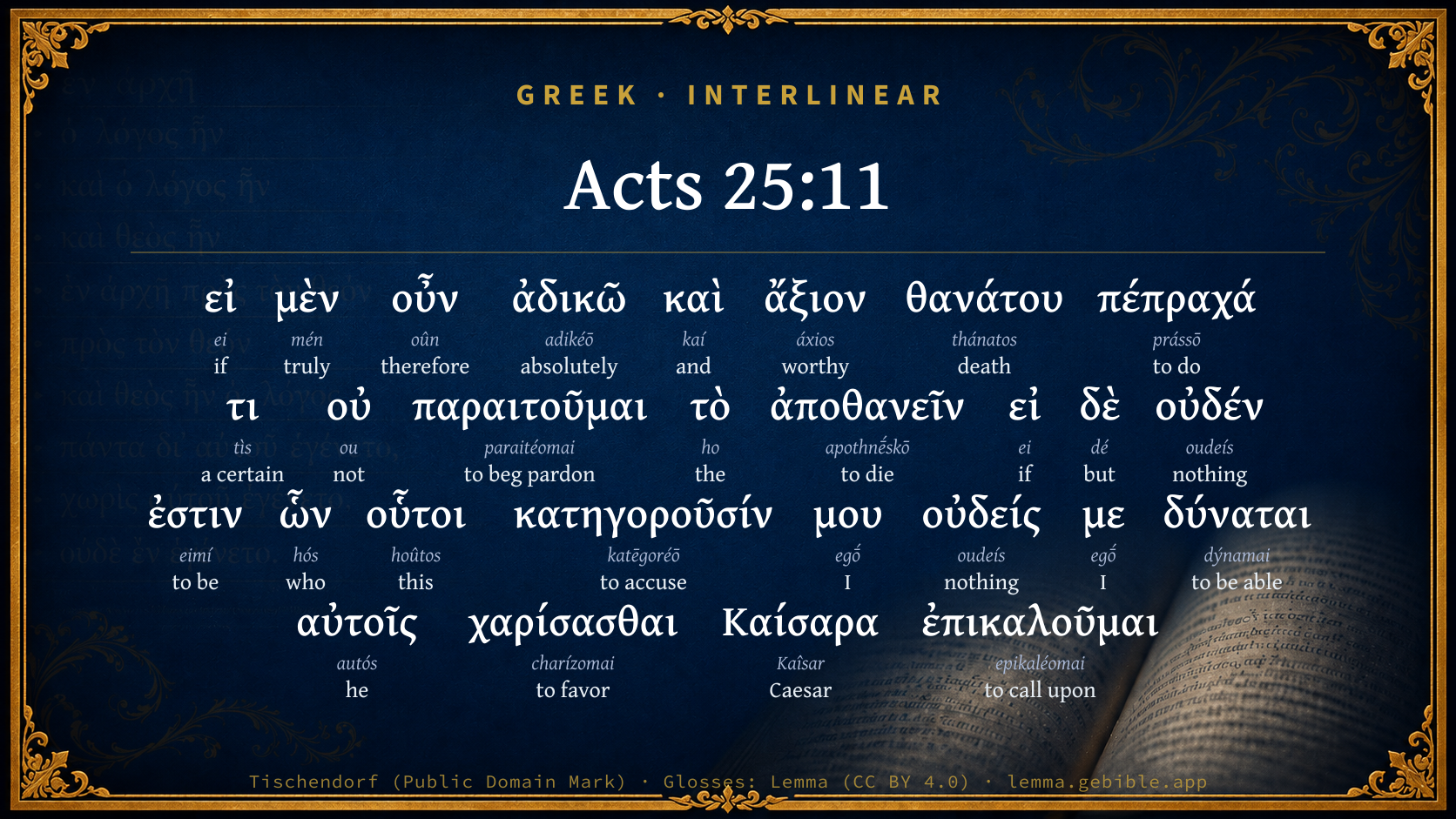
Greek (Tischendorf 8th ed.) Acts 25:11 appears in the Greek New Testament. The text above is from the Tischendorf 8th edition. Each word links to its Strong’s number and a concise gloss. Click any word for its full Thayer’s Greek Lexicon entry.
Download image
Cite this verse

Acts 25:11 (World English Bible). Public Domain. Lemma interlinear Bible study tool, https://lemma.gebible.app/v/acts/25/11.

Show BibTeX & RIS
BibTeX
RIS
English Translation
For if I have done wrong, and have committed anything worthy of death, I don't refuse to die; but if none of those things is true that they accuse me of, no one can give me up to them. I appeal to Caesar!"
World English Bible · Public Domain
Download a study sheet

One document with this verse’s original text, its word-by-word gloss line, the meaning frame, cross-references with their text, attributed commentary, and full source and license credits — printable, and it pastes into notes with its structure intact.

This verse Autodidact and up

Study sheet (.html) Plain text (.txt)

A passage Seminary Student

Up to 50 verses in one chapter. A passage sheet keeps up to 6 commentary sources and 12 cross-references per verse, in the order this page ranks them, and says so on the sheet whenever that leaves anything out. Ask for a single verse and you get the Autodidact verse sheet above.

Everything on this page stays free to read, with no account — the sheet is a download of what is already on screen, not access to it.

Want to remove ads? Support Godless Engineer
Compare translations 3

The same verse in 3 English versions, stacked beneath the original-language interlinear above. Click any original word for its lexicon entry.

Each is an independent rendering of the whole verse — the interlinear is not word-aligned to these translations.

Highlighted words mark where these versions differ — a whole-verse word diff, not a word-by-word alignment.

  • World English Bible Public Domain
    For if I have done wrong, and have committed anything worthy of death, I don't refuse to die; but if none of those things is true that they accuse me of, no one can give me up to them. I appeal to Caesar!"
  • King James Version Public Domain
    For if I be an offender, or have committed any thing worthy of death, I refuse not to die: but if there be none of these things whereof these accuse me, no man may deliver me unto them. I appeal unto Caesar.
  • unfoldingWord Literal Text CC BY-SA 4.0
    Therefore, if I am doing harm and have done something worthy of death, I do not refuse to die. But if of which they are accusing me are nothing, no one is able to give me to them as a favor. I appeal to Caesar!”

unfoldingWord Literal Text — © unfoldingWord, licensed CC BY-SA 4.0. Word-aligned USFM3 via Door43 (git.door43.org/unfoldingWord/en_ult).

Versions to compare (up to 4)

3 of 4 selected

Show all 19 translations

Every available English version of this verse, each an independent rendering of the whole verse.

  • World English Bible Public Domain
    For if I have done wrong, and have committed anything worthy of death, I don't refuse to die; but if none of those things is true that they accuse me of, no one can give me up to them. I appeal to Caesar!"
  • Berean Standard Bible Public Domain
    If, however, I am guilty of anything worthy of death, I do not refuse to die. But if there is no truth to their accusations against me, no one has the right to hand me over to them. I appeal to Caesar!”
  • Majority Standard Bible Public Domain
    If, however, I am guilty of anything worthy of death, I do not refuse to die. But if there is no truth to their accusations against me, no one has the right to hand me over to them. I appeal to Caesar!”
  • King James Version Public Domain
    For if I be an offender, or have committed any thing worthy of death, I refuse not to die: but if there be none of these things whereof these accuse me, no man may deliver me unto them. I appeal unto Caesar.
  • American Standard Version (1901) Public Domain
    If then I am a wrong-doer, and have committed anything worthy of death, I refuse not to die; but if none of those things is `true' whereof these accuse me, no man can give me up unto them. I appeal unto Caesar.
  • Revised Version (1885) Public Domain
    If then I am a wrong-doer, and have committed anything worthy of death, I refuse not to die: but if none of those things is true, whereof these accuse me, no man can give me up unto them. I appeal unto Caesar.
  • Geneva Bible (1599) Public Domain
    For if I haue done wrong, or committed any thing worthie of death, I refuse not to die: but if there be none of these things whereof they accuse me, no man, to pleasure them, can deliuer me to them: I appeale vnto Caesar.
  • Douay-Rheims (1899) Public Domain
    For if I have injured them, or have committed any thing worthy of death, I refuse not to die. But if there be none of these things whereof they accuse me, no man may deliver me to them: I appeal to Caesar.
  • Young's Literal Translation Public Domain
    for if indeed I am unrighteous, and anything worthy of death have done, I deprecate not to die; and if there is none of the things of which these accuse me, no one is able to make a favour of me to them; to Caesar I appeal!'
  • Literal Standard Version CC BY-SA 4.0
    for if I am indeed unrighteous, and have done anything worthy of death, I do not deprecate to die; and if there is none of the things of which these accuse me, no one is able to make a favor of me to them; I appeal to Caesar!”
  • Unlocked Literal Bible CC BY-SA 4.0
    Though if I have done wrong and if I have done what is worthy of death, I do not refuse to die. But if their accusations are nothing, no one may hand me over to them. I appeal to Caesar.”
  • unfoldingWord Literal Text CC BY-SA 4.0
    Therefore, if I am doing harm and have done something worthy of death, I do not refuse to die. But if of which they are accusing me are nothing, no one is able to give me to them as a favor. I appeal to Caesar!”
  • Darby Bible Public Domain
    If then I have done any wrong and committed anything worthy of death, I do not deprecate dying; but if there is nothing of those things of which they accuse me, no man can give me up to them. I appeal to Caesar.
  • World Messianic Bible Public Domain
    For if I have done wrong and have committed anything worthy of death, I don’t refuse to die; but if none of those things is true that they accuse me of, no one can give me up to them. I appeal to Caesar!”
  • Webster's Bible Public Domain
    For if I am an offender, or have committed any thing worthy of death, I refuse not to die: but if there is none of these things of which these accuse me, no man may deliver me to them. I appeal to Cesar.
  • Free Bible Version CC BY-SA 4.0
    If I've committed a crime and have done something that deserves death, I do not ask to be pardoned from a death sentence. But if there's no substance to these accusations they're making against me, then nobody has the right to hand me over to them. I appeal to Caesar!”
  • Bible in Basic English Public Domain
    If, then, I am a wrongdoer and there is a cause of death in me, I am ready for death: if it is not as they say against me, no man may give me up to them. Let my cause come before Caesar.
  • Text-Critical English NT CC BY 4.0
    If I am in the wrong and have done something that deserves death, I do not seek to escape death. But if none of the things these men accuse me of is true, no one can hand me over to them. I appeal to Caesar.”
  • Tyndale New Testament (1534) Public Domain
    If I have hurte them or committed eny thinge worthy of deeth I refuse not to dye. If none of these thinges are where of they accuse me no man owght to delyver me to them. I appeale vnto Cesar.

Literal Standard Version (2020), Covenant Press — licensed CC BY-SA 4.0. Text via the HelloAO Bible API (eBible.org). Unlocked Literal Bible (unfoldingWord) — licensed CC BY-SA 4.0. Text via the HelloAO Bible API (eBible.org). unfoldingWord Literal Text — © unfoldingWord, licensed CC BY-SA 4.0. Word-aligned USFM3 via Door43 (git.door43.org/unfoldingWord/en_ult). Free Bible Version, Dr. Jonathan Gallagher — licensed CC BY-SA 4.0. Text via the HelloAO Bible API (eBible.org).

Word by word

More ways to search: Search by grammar → Find every occurrence → Compare this word →

Practice this passage: Drill this verse → Learn its vocabulary →

παραιτοῦμαι
paraitéomai
G3868
“to beg pardon”
Verb, Present, Middle or Passive deponent, Indicative, 1st person, Singular
Part of Speech
Verb
Tense
Present
Voice
Middle or Passive deponent
Mood
Indicative
Person
1st person
Number
Singular
Full Thayer's Definition

Origin: from G3844 and the middle voice of G154

TDNT: 04:15,3

1. to ask along side, beg to have near one a. to obtain by entreaty b. to beg from, to ask for, supplicate 2. to avert by entreaty or seek to avert, to deprecate a. to entreat that ... not b. to refuse, decline c. to shun, avoid d. to avert displeasure by entreaty 1. to beg pardon, crave indulgence, to excuse 2. of one excusing himself for not accepting a wedding invitation to a feast
  1. εἰ ei G1487 “if” Conditional
  2. μὲν mén G3303 “truly” Particle
  3. οὖν oûn G3767 “therefore” Conjunction
  4. ἀδικῶ adikéō G91 “absolutely” Verb, Present, Active, Indicative, 1st person, Singular
  5. καὶ kaí G2532 “and” Conjunction
  6. ἄξιον áxios G514 “worthy” Adjective, Accusative, Singular, Neuter
  7. θανάτου thánatos G2288 “death” Noun, Genitive, Singular, Masculine
  8. πέπραχά prássō G4238 “to do” Verb, Perfect, Active, Indicative, 1st person, Singular
  9. τι tìs G5100 “a certain” Indefinite pronoun, Accusative, Singular, Neuter
  10. οὐ ou G3756 “not” Particle, Negative
  11. τὸ ho G3588 “the” Article, Accusative, Singular, Neuter
  12. ἀποθανεῖν apothnḗskō G599 “to die” Verb, Aorist, Active, Infinitive
  13. εἰ ei G1487 “if” Conditional
  14. δὲ dé G1161 “but” Conjunction
  15. οὐδέν oudeís G3762 “nothing” Adjective, Nominative, Singular, Neuter, Negative
  16. ἐστιν eimí G1510 “to be” Verb, Present, Active, Indicative, 3rd person, Singular
  17. ὧν hós G3739 “who” Relative pronoun, Genitive, Plural, Neuter
  18. οὗτοι hoûtos G3778 “this” Demonstrative pronoun, Nominative, Plural, Masculine
  19. κατηγοροῦσίν katēgoréō G2723 “to accuse” Verb, Present, Active, Indicative, 3rd person, Plural
  20. μου egṓ G1473 “I” Personal pronoun, 1st person, Genitive, Singular
  21. οὐδείς oudeís G3762 “nothing” Adjective, Nominative, Singular, Masculine, Negative
  22. με egṓ G1473 “I” Personal pronoun, 1st person, Accusative, Singular
  23. δύναται dýnamai G1410 “to be able” Verb, Present, Middle or Passive deponent, Indicative, 3rd person, Singular
  24. αὐτοῖς autós G846 “he” Personal pronoun, Dative, Plural, Masculine
  25. χαρίσασθαι charízomai G5483 “to favor” Verb, Aorist, Middle deponent, Infinitive
  26. Καίσαρα Kaîsar G2541 “Caesar” Noun, Accusative, Singular, Masculine
  27. ἐπικαλοῦμαι epikaléomai G1941 “to call upon” Verb, Present, Middle, Indicative, 1st person, Singular

About this verse

These counts appear in no published source. They are computed here, from the morphology-tagged text and Lemma’s own curated glosses. What Lemma adds →

28
words
25
distinct lemmas
Acts
section

Notable vocabulary

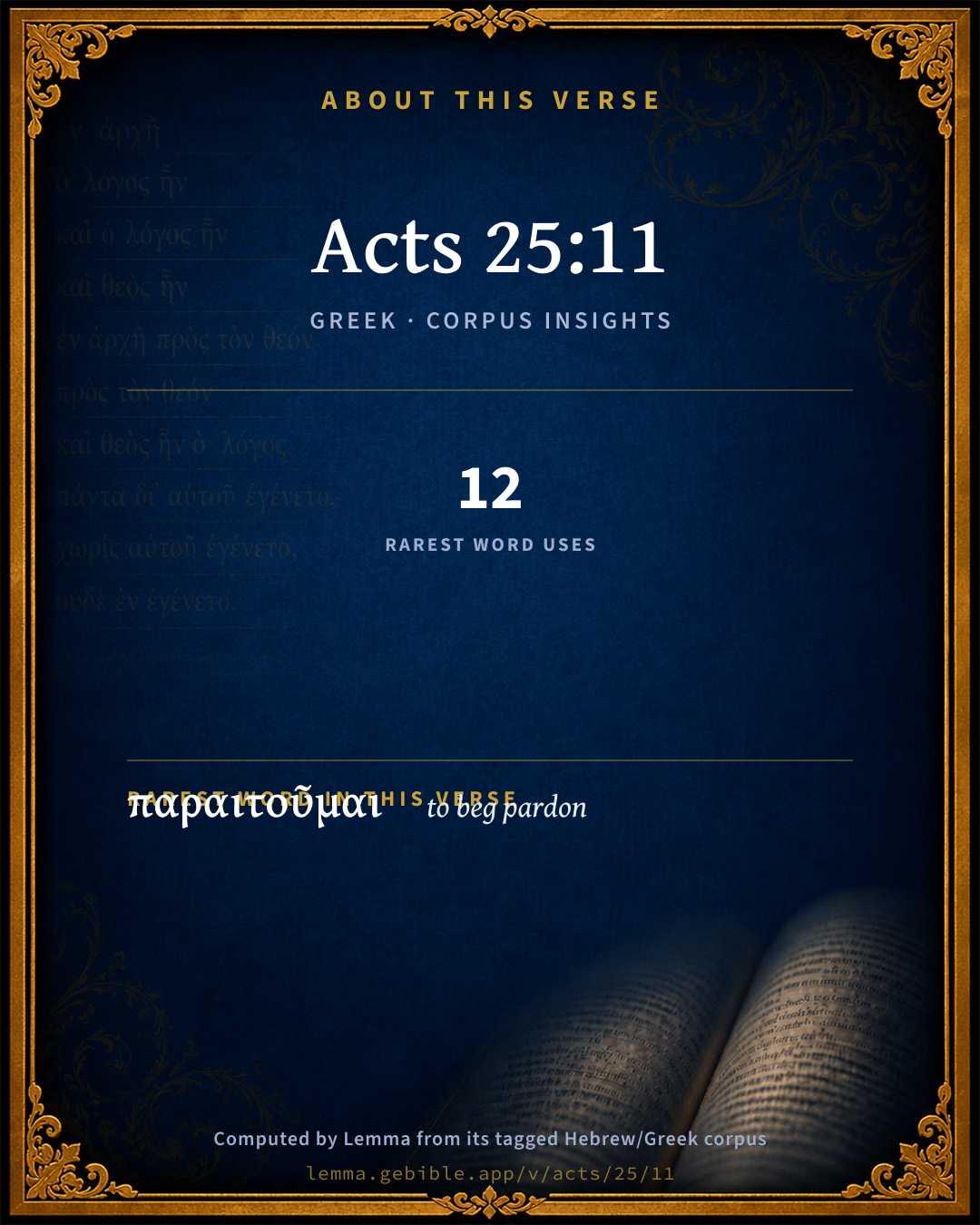
The rarest word here is παραιτοῦμαι to beg pardon G3868 — appearing just 12 times in the whole Greek New Testament.

Shared distinctive vocabulary

παραιτοῦμαι to beg pardon G3868 occurs in 10 verses of the Greek New Testament. Also found in:

Repetition

Words recur within this verse:

Cross-references

15

Topical passages linked to Acts 25:11 in the Treasury of Scripture Knowledge — connected by theme and wording, ordered by reader-vote popularity; previews shown in the World English Bible.

  • Acts 28:19 But when the Jews spoke against it, I was constrained to appeal to Caesar, not that I had anything about which to accuse my nation.
  • Acts 26:32 Agrippa said to Festus, "This man might have been set free if he had not appealed to Caesar."
  • Psalms 7:3–5 Yahweh, my God, if I have done this, If there is iniquity in my hands,
  • Acts 25:25 But when I found that he had committed nothing worthy of death, and as he himself appealed to the emperor I determined to send him.
  • Acts 25:21 But when Paul had appealed to be kept for the decision of the emperor, I commanded him to be kept until I could send him to Caesar."
  • Joshua 22:22 The Mighty One, God, Yahweh, the Mighty One, God, Yahweh, he knows; and Israel he shall know: if it be in rebellion, or if in trespass against Yahweh (don't save us this day),
  • 1 Samuel 12:3–5 Here I am: witness against me before Yahweh, and before his anointed: whose ox have I taken? or whose donkey have I taken? or whom have I defrauded? whom have I oppressed? or of whose hand have I taken a ransom to blind my eyes therewith? and I will restore it you.
  • 1 Samuel 27:1 David said in his heart, I shall now perish one day by the hand of Saul: there is nothing better for me than that I should escape into the land of the Philistines; and Saul will despair of me, to seek me any more in all the borders of Israel: so shall I escape out of his hand.
  • Job 31:21 If I have lifted up my hand against the fatherless, Because I saw my help in the gate:
  • Job 31:38–40 If my land cries out against me, And the furrows of it weep together;
  • Acts 16:37 But Paul said to them, "They have beaten us publicly, without a trial, men who are Romans, and have cast us into prison! Do they now release us secretly? No, most assuredly, but let them come themselves and bring us out!"
  • Acts 18:14 But when Paul was about to open his mouth, Gallio said to the Jews, "If indeed it were a matter of wrong or of wicked crime, you Jews, it would be reasonable that I should bear with you;
  • Acts 22:25 When they had tied him up with thongs, Paul asked the centurion who stood by, "Is it lawful for you to scourge a man who is a Roman, and not found guilty?"
  • Acts 25:10 But Paul said, "I am standing before Caesar's judgment seat, where I ought to be tried. I have done no wrong to the Jews, as you also know very well.
  • 1 Thessalonians 2:15 who killed both the Lord Jesus and their own prophets, and drove us out, and didn't please God, and are contrary to all men;

Cross-references courtesy of OpenBible.info (CC BY 4.0).

Commentary

Notes on Acts 25:11 from classic Christian and Jewish commentators (each source and its license shown beneath its notes). The classic Christian expositions comment on the surrounding passage and are grouped to its opening verse, so a note may address several verses; the Jewish commentaries on the Tanakh (Rashi and others) are per-verse, so they appear only where the commentator wrote on this verse.

Lemma curates 59 commentaries, every one of them public domain or Creative Commons licensed, each selected and text-cleaned for this edition rather than reprinted as found. About our sources →

Bengel's Gnomon

Johann Albrecht Bengel

Act 25:11. Ἀδικῶ) The present absolute (as in Col 3:25, ὁ ἀδικῶν), in which the preterite is involved, as in Chrys. de Sacerd. sect. 55, at the end, οὐχ ἀδικῶ. Comp. ch. Act 26:31, πράσσει.—τὸ ἀποθανεῖν) That this was the issue at stake, is denoted by the article.—οὐδεὶς, no man) Modestly expressed; i.e. thou canst not.—ἐπικαλοῦμαι, I appeal) Sometimes we may employ legal remedies in the cause of GOD. Paul lays hold of a help towards his going to Rome, according to what was the will of God expressed in the vision, ch. Act 23:11.

Bengel's Gnomon of the New Testament — English translation (T&T Clark, Edinburgh, 1860) — public domain. Text from a community e-Sword module.

Meyer's Critical & Exegetical Commentary

Heinrich August Wilhelm Meyer

Act_25:11. From his preceding declaration that he must be judged before the imperial tribunal, and not by Jews, Paul now reasons (οὖν, as the correct reading instead of γάρ, see the critical remarks) that he accordingly by no means refuses to die, if, namely, he is in the wrong; but in the opposite case, etc. In other words: Accordingly, I submit myself to the penalty of the Roman law, if I am guilty; but if, etc. And, in order to be sure of the protection of Roman law, amidst the inclination of Festus to please the Jews, he immediately adds the appeal to the Emperor.

εἰ … ἀδικῶ] If I am at fault. See Krüger, Index. Xen. Anab.; Jacobitz, ad Luc. Tim. 25, p. 25 f.; Heind. ad Plat. Protag. § 4, p. 463 f. The idea of the word presupposes the having done wrong (Kühner, ad Xen. Anab. i. 5. 12), therefore the added καὶ ἄξιον θαν. πέπρ. contains a more precise definition of ἀδικῶ, and that according to the degree.

οὐ παραιτοῦμαι κ.τ.λ.] non deprecor. Comp. Joseph. Vit. 29; Herod. i. 24 : ψυχὴν δὲ παραιτεόμενον. Lys. adv. Sim. § Acts 4 : ἀξιῶ δὲ … εἰ μὲν ἀδικῷ, μηδεμιο͂ς συγγνώμης τυγχάνειν.

τὸ ἀποθανεῖν] id ipsum agi, notat articulus, Bengel. Comp. Buttmann, neut. Gr. p. 226[E. T. 262].

εἰ δὲ οὐδέν ἐστιν ὧν] but if there exists nothing of that, of which they, etc. ὧν is by attraction for τούτων ἅ. Comp. Act_24:8; Luk_23:14.

δύναται] namely, according to the possibility conditioned by the subsisting legal relations.

αὐτοῖς χαρίσασθαι] to surrender me to them out of complaisance. See on Act_3:14.

Καίσαρα ἐπικαλ.] I appeal to the Emperor. See examples from Plutarch of ἐπικαλ. in Wetstein; also Plut. Graech. 16; in Dem. and others: ἐφιέναι. Certainly the revelation, Act_23:11, contributed to Pauls embracing this privilege of his citizenship (see Grotius in loc.; Krebs, de provocat. Pauli ad Caes. in his Opusc. p. 143 ff.). Non vitae suae, quam ecclesiae consulens, Augustine accordingly says, Ephesians 2.

Meyer — Critical and Exegetical Commentary on the New Testament — English translation by Peter Christie, edited by Frederick Crombie (T&T Clark, 1880) — public domain. Text from a community e-Sword module.

Expositor's Greek Testament

ed. W. Robertson Nicoll

Act 25:11 . εἰ μὲν γὰρ , see critical note, “if then ( οὗν ) I am a wrongdoer,” referring to his standing before Cæsar’s judgment-seat, and not to the ἠδίκησα in Act 25:10 . ἀδικεῖν : only here absolutely in N.T.; the verb occurs five times in Acts, once in Luke’s Gospel, and once in St. Matthew, but not elsewhere in the Gospels (Friedrich, p. 23). ἄξιον θαν ., i.e. , according to Roman law. οὐ παραιτοῦμαι τὸ ἀποθανεῖν : non recuso , Vulgate, so Blass; the verb is only used here in Acts, but it occurs three times in St. Luke’s Gospel, three times in Hebrews, once in Mar 15:6 , W.H [392] In the present passage, and in 1Ti 4:7 ; 1Ti 5:11 , 2Ti 2:23 , Tit 3:10 , Heb 12:25 (twice), the word is rendered “refuse,” R.V. text; but in Luk 14:18-19 , the word is rendered “to make excuse”; “excused”: Jos., Ant. , vii., 8, 2; but in each case the Greek verb literally means “to beg off from,” and the Latin deprecor might well express the verb both here and in Luk 14 , l.c., cf. Est 4:8 in the sense of supplicating, and for the sense as above 2Ma 2:31 , 3Ma 6:27 ; see also Grimm sub v. for different shades of meaning. In Jos., Vita , 29, we have the phrase θανεῖνοὐ παραιτοῦμαι : upon which Krenkel insists as an instance of dependence upon Josephus, but not only is the phrase here somewhat different verbally, οὐ παραι . τὸ ἀποθ ., the article expressing more emphatically, as Bengel says, id ipsum agi; but cf. the instances quoted by Wetstein of the use of similar phrases in Greek, and of the Latin deprecor, e.g. , Dion. Hal., A.V. , 29. τὸν μὲγ οὖν θάνατον … οὐ παραιτοῦμαι . See further Introd. , p. 31. χαρίσασθαι : “to grant me by favour,” R.V. margin, cf. Act 3:14 , Act 25:16 , Act 27:24 (Phm 1:22 ), only in Luke and Paul in N.T.; see on its importance as marking the “We” section, Act 27:24 , and other parts of Acts, Zeller, Acts , ii., 318, E.T. Paul must have known what this “giving up” to the Jews would involve. Καίσαρα ἐπικ .: Appello: provoco ad Cæsarem: “Si apud acta quis appellaverit, satis erit si dicat: Appello.” Digest. , xlix., 1, 2, except in the case of notorious robbers and agitators whose guilt was clear, ibid. , 16. But we must distinguish between an appeal against a sentence already pronounced, and a claim at the commencement of a process that the whole matter should be referred to the emperor. It would appear from this passage, cf. Act 27:21 ; Act 27:26 ; Act 27:32 , that Roman citizens charged with capital offences could make this kind of appeal, for the whole narrative is based upon the fact that Paul had not yet been tried, and that he was to be kept for a thorough inquiry by the emperor, and to be brought to Rome for this purpose, cf. Pliny, Epist. , x., 97, quoted by Schürer, Alford, and others, and similar instances in Renan, Saint Paul , p. 543, Schürer, Jewish People , div. 1., vol. ii., p. 59, and div. ii., vol. ii., p. 278, E.T., and also “Appeal,” Hastings’ B.D., and below, p. 514. This step of St. Paul’s was very natural. During his imprisonment under Felix he had hoped against hope that he might have been released, but although the character of Festus might have given him a more reasonable anticipation of justice, he had seen enough of the procurator to detect the vacillation which led him also to curry favour with the Jews. From some points of view his position under Festus was more dangerous than under Felix: if he accepted the suggestion that he should go up to Jerusalem and be tried before the Sanhedrim, he could not doubt that his judges would find him guilty; if he declined, and Festus became the judge, there was still the manifest danger that the better judgment of the magistrate would be warped by the selfishness of the politician. Moreover, he may well have thought that at a distant court, where there might be difficulty in collecting evidence against him, he would fare better in spite of the danger and expense of the appeal. But whilst we may thus base St. Paul’s action upon probable human motives, his own keen and long desire to see Rome, Act 19:21 , and his Lord’s promise of the fulfilment of that desire, Act 23:11 , could not have been without influence upon his decision, although other motives need not be altogether excluded, as St. Chrysostom, Ewald, Neander and Meyer (see Nösgen, 435). It has been maintained that there was every reason to suppose that St. Paul would have obtained his acquittal at the hands of the Roman authorities, especially after Agrippa’s declaration of his innocence, Act 26:32 . But St. Paul’s appeal had been already made before Agrippa had heard him, and he may well have come to the conclusion that the best he could hope for from Festus was a further period of imprisonment, whilst his release would only expose him to the bitter and relentless animosity of the Jews. Two years of enforced imprisonment had been patiently borne, and the Apostle would be eager (can we doubt it?) to bear further witness before Gentiles and kings of his belief in Jesus as the Christ, and of repentance and faith towards God.

[392] Westcott and Hort’s The New Testament in Greek: Critical Text and Notes.

The Expositor's Greek Testament, edited by W. Robertson Nicoll (1897–1910) — public domain. Text from a community e-Sword module.

Jamieson, Fausset & Brown

Robert Jamieson, A. R. Fausset & David Brown

I appeal to Cæsar--The right of appeal to the supreme power, in case of life and death, was secured by an ancient law to every Roman citizen, and continued under the empire. Had Festus shown any disposition to pronounce final judgment, Paul, strong in the consciousness of his innocence and the justice of a Roman tribunal, would not have made this appeal. But when the only other alternative offered him was to give his own consent to be transferred to the great hotbed of plots against his life, and to a tribunal of unscrupulous and bloodthirsty ecclesiastics whose vociferous cries for his death had scarcely subsided, no other course was open to him.

Jamieson, Fausset & Brown — Commentary Critical and Explanatory on the Whole Bible (1871) — public domain (CC PDM 1.0). Text via the HelloAO Bible API.

Adam Clarke's Commentary

Verse 11. For if I be an offender] If it can be proved that I have broken the laws, so as to expose me to capital punishment, I do not wish to save my life by subterfuges; I am before the only competent tribunal; here my business should be ultimately decided.

No man may deliver me unto them] The words of the apostle are very strong and appropriate. The Jews asked as a favour, χαριν, from Festus, that he would send Paul to Jerusalem, Ac 25:3. Festus, willing to do the Jews χαριν, this favour, asked Paul if he would go to Jerusalem, and there be judged, Ac 25:9. Paul says, I have done nothing amiss, either against the Jews or against Caesar; therefore no man με δυναται αυτοις χαρισασθαι, can make a PRESENT of me to them; that is, favour them so far as to put my life into their hands, and thus gratify them by my death. Festus, in his address to Agrippa, Ac 25:16, admits this, and uses the same form of speech: It is not the custom of the Romans, χαριζεσθαι, gratuitously to give up any one, c. Much of the beauty of this passage is lost by not attending to the original words. See Clarke on Ac 25:16.

I appeal unto Caesar.] A freeman of Rome, who had been tried for a crime, and sentence passed on him, had a right to appeal to the emperor, if he conceived the sentence to be unjust but, even before the sentence was pronounced, he had the privilege of an appeal, in criminal cases, if he conceived that the judge was doing any thing contrary to the laws. ANTE sententiam appellari potest in criminali negotio, si judex contra leges hoc faciat.-GROTIUS.

An appeal to the emperor was highly respected. The Julian law condemned those magistrates, and others having authority, as violaters of the public peace, who had put to death, tortured, scourged, imprisoned, or condemned any Roman citizen who had appealed to Caesar. Lege Julia de vi publica damnatur, qui aliqua potestate praeditus, Civem Romanum ad Imperatorem appellantem necarit, necarive jusserit, torserit, verberauerit, condemnaverit, in publica vincula duci jusserit. Pauli Recept. Sent. lib. v. t. 26.

This law was so very sacred and imperative, that, in the persecution under Trajan, Pliny would not attempt to put to death Roman citizens who were proved to have turned Christians; hence, in his letter to Trajan, lib. x. Ep. 97, he says, Fuerunt alii similis amentiae, quos, quia cives Romani erant, annotavi in urbem remittendos. 'There were others guilty of similar folly, whom, finding them to be Roman citizens, I have determined to send to the city." Very likely these had appealed to Caesar.

Adam Clarke's Commentary on the Bible (1810–1826) — public domain. Text from a community e-Sword/MySword module.

John Calvin's Commentaries

11. I appeal unto Caesar. After that he hath professed that he doth not refuse to die if he be found guilty, he freely useth such helps as he could find at the hands of men. Wherefore, if we be at any time brought into like straits, we must not be superstitious, but we may crave help of the laws and politic order. Because it is written, that magistrates are made and appointed by God to the praise of the godly (Romans 13:3; and 1 Peter 2:13). Neither was Paul afraid to go to law under an unbelieving judge; for he which appealeth commenceth a new action.

Therefore, let us know that God, who hath appointed judgment-seats, doth also grant liberty to his to use the same lawfully. Therefore, those mistake Paul who think that he doth flatly condemn the Corinthians, (1 Corinthians 6:1) because they require help of the magistrate for defense of their right, seeing he reproveth in that place a manifest fault, to wit, because they could suffer no wrong, and because they were too much set upon suing one another, whereby they caused the gospel to be evil spoken of.

John Calvin's Commentaries (1540-1563) — public domain. Text from the Calvin Translation Society English edition (1840s-50s) via the Christian Classics Ethereal Library (ccel.org). Calvin's coverage is partial (roughly two-thirds of the Bible); uncommented books and verses are honest gaps, never fabricated. The 19th-century editor's footnotes and remarks are omitted so the notes are faithfully Calvin's own voice.

Ellicott's Commentary for English Readers

(11) No man may deliver me unto them.—Literally, no man may give me up to them as a favour. The words show that he saw through the simulated fairness of the procurator, and did not shrink from showing that he did so.

I appeal unto Cæsar.—The history of this right of appeal affords a singular illustration of the manner in which the republic had been transformed into a despotic monarchy. Theoretically the emperor was but the imperator, or commander-in-chief of the armies of the state, appointed by the senate, and acting under its direction. Consuls were still elected every year, and went through the shadowy functions of their office. Many of the provinces (see Notes on Act_13:7; Act_18:12), were directly under the control of the senate, and were accordingly governed by proconsuls. But Augustus had contrived to concentrate in himself all the powers that in the days of the republic had checked and balanced the exercise of individual authority. He was supreme pontiff, and as such regulated the religion of the state; permanent censor, and as such could give or recall the privileges of citizenship at his pleasure. The Tribunicia potestas, which had originally been conferred on the tribunes of the plebs so that they might protect members of their order who appealed to them against the injustice of patrician magistrates, was attached to his office. As such he became the final Court of Appeal from all subordinate tribunals, and so, by a subtle artifice, what had been intended as a safeguard to freedom became the instrument of a centralised tyranny. With this aspect of the matter St. Paul had, of course, nothing to do. It was enough for him that by this appeal he delivered himself from the injustice of a weak and temporising judge, and made his long-delayed journey to Rome a matter of moral certainty.

A Bible Commentary for English Readers, edited by Charles John Ellicott (1878–1897) — public domain. Text from a community e-Sword module.

The Cambridge Bible for Schools and Colleges

gen. ed. J. J. S. Perowne

11. For if I be an offender] The best MSS. have not “For.” Read, with Rev. Ver., “If then I am a wrong-doer.” He has asserted that he was innocent so far as the Jews are concerned. If there be anything against him, it is for the civil jurisdiction of Rome, not for the religious tribunal at Jerusalem, to decide upon.

no man may deliver me unto them] The full idea of the verb is expressed by the margin of the Rev. Ver., “no man may grant me by favour.” The use of this word confirms the notion that St Paul saw through what the governor was doing. The word “may” represents the Greek “is able,” and therefore the “can” of the Rev. Ver. is to be approved. There is no power anywhere which can give me up to them.

I appeal unto Cesar] The final tribunal being the hearing of the Emperor himself.

The Cambridge Bible for Schools and Colleges (gen. ed. J. J. S. Perowne; Cambridge University Press, 1878–1918) — public domain. Text from a community e-Sword module.

John Gill's Exposition

For if I be an offender,.... Against the law of Moses, or the temple at Jerusalem, or Caesar the Roman emperor:

or have committed anything worthy of death; by the laws of the Romans, as sedition, murder, &c.

I refuse not to die; signifying that he did not decline going to Jerusalem, either through any consciousness of guilt, or fear of death; for if anything could be proved against him, that was of a capital nature, he did not desire to escape death; he was ready to die for it; this was no subterfuge, or shift, to evade or defer justice:

but if there be none of these things; to be found, or proved, and made to appear:

whereof these accuse me; pointing to the Jews, that came down to be his accusers, and had laid many and grievous charges against him:

no man may deliver me unto them; not justly, or according to the Roman laws; suggesting that Festus himself could not do it legally;

I appeal unto Caesar; to this the apostle was induced, partly by the conduct of the governor, who seemed inclined to favour the Jews; and partly by the knowledge he might have of their intention to lie in wait for him, should he go up to Jerusalem; and chiefly by the vision he had had, which assured him that he must bear witness of Christ at Rome, Act 23:11.

John Gill's Exposition of the Whole Bible (1746–1763) — public domain (CC PDM 1.0). Text via the HelloAO Bible API.

Trapp's Complete Commentary

John Trapp

11 For if I be an offender, or have committed any thing worthy of death, I refuse not to die: but if there be none of these things whereof these accuse me, no man may deliver me unto them. I appeal unto Caesar.

Ver. 11. I appeal to Coesar] Who though a lion, 2Ti 4:17, yet I hope to be tutus sub umbra leonis, against a manifest violence of a corrupt judge, notoriously forestalled and preoccupated. Iudex, locusta civitatis est, malus. (Scaliger.)

John Trapp, A Commentary or Exposition upon All the Books of the Old and New Testament (1647–1656) — public domain. Text from a community e-Sword module.

Albert Barnes' Notes on the Bible

For if I be an offender - If I have injured the Jews so as to deserve death. If it can be proved that I have done injury to anyone.

I refuse not to die - I have no wish to escape justice. I do not wish to evade the laws, or to take advantage of any circumstances to screen me from just punishment. Paul’s whole course showed that this was the noble spirit which actuated him. No true Christian wishes to escape from the laws. He will honor them, and not seek to evade them. But, like other people, he has rights; and he may and should insist that justice should be done.

No man may deliver me unto them - No man shall be allowed to do it. This bold and confident declaration Paul could make, because he knew what the law required, and he knew that Festus would not dare to deliver him up contrary to the law. Boldness is not incompatible with Christianity; and innocence, when its rights are invaded, is always bold. Jesus firmly asserted his rights when on trial Joh 18:23, and no man is under obligation to submit to be trampled on by an unjust tribunal in violation of the laws.

I appeal unto Caesar - I appeal to the man emperor, and carry my cause directly before him. By the Valerian, Porcian, and Sempronian laws, it had been enacted that if any magistrate should be about to beat, or to put to death any Roman citizen, the accused could appeal to the Roman people, and this appeal carried the cause to Rome. The law was so far changed under the emperors that the cause should be carried before the emperor instead of the people. Every citizen had the right of this appeal; and when it was made, the accused was sent to Rome for trial. Thus, Pliny Eph. 10, 97 says that those Christians who were accused, and who, being Roman citizens, appealed to Caesar, he sent to Rome to be tried. The reason why Paul made this appeal was that he saw that justice would not be done him by the Roman governor. He had been tried by Felix, and justice had been denied him, and he was detained a prisoner in violation of law, to gratify the Jews; he had now been tried by Festus, and saw that he was pursuing the same course; and he resolved, therefore, to assert his rights, and remove the cause far from Jerusalem, and from the prejudiced people in that city, at once to Rome. It was in this mysterious way that Paul’s long-cherished desire to see the Roman church, and to preach the gospel there, was to be gratified. Compare notes on Rom 1:9-11. For this he had prayed long Rom 1:10; Rom 15:23-24, and now at length this purpose was to be fulfilled. God answers prayer, but it is often in a way which we little anticipate. He so orders the train of events; he so places us amidst a pressure of circumstances, that the desire is granted in a way Which we could never have anticipated, but which shows in the best manner that he is a hearer of prayer.

Albert Barnes' Notes on the Bible (1834–1885) — public domain. Text from a community e-Sword/MySword module.

Matthew Poole's English Annotations

If I be an offender; if I have injured the Jews, and my fault be worthy of death, such as by law deserves death, I beg no favour.

No man may deliver me unto them; according to law, (which the Romans did punctually observe), before sentence was passed.

I appeal unto Caesar: it was lawful for any that had that privilege of the Roman citizens, to appeal; neither might they be tried against their wills in any province out of Rome. Now Paul might appeal unto Caesar:

1. To make Caesar more favourable unto himself, and to other Christians.

2. Because he thought it more safe for himself and for the church.

3. He was in part admonished to do it by Christ himself, who had told him that he must bear witness of him at Rome, Act 23:11.

Matthew Poole's English Annotations on the Holy Bible (1683–1685) — public domain. Text from a community e-Sword/MySword module.

Whedon's Commentary on the Bible

Daniel D. Whedon

11. Refuse not to die—I accept the penalty which the law of the empire decides.

Deliver me—Make a gracious present of me. He insists upon Roman law and justice instead of being bandied about by the favour of one party to another.

Appeal unto Cesar—By this memorable sentence the apostle irrevocably transfers himself to Rome.

Daniel D. Whedon (gen. ed.), Commentary on the Old and New Testaments (1874–1909) — public domain. Text from a community e-Sword module.

The Pulpit Commentary

If then I am a wrong, doer for for if I be an offender, A.V. and T.R.; and for or, A.V.; if none of those things is true for if there be none of these things, A.V.; can give me up for may deliver me, A.V. I refuse not; ouj paraitoumai. Here only in the Acts, and three times in Luke 14. Elsewhere, four times in the pastoral Epistles, and twice in Hebrews. Frequent in classical Greek. No man can give me up (carisasqai); as ver. 16, "to hand over as a matter of complaisance." St. Paul saw at once the danger he was in from Festus"s inclination to curry favor with the Jews. With his usual fearlessness, therefore, and perhaps with the same quickness of temper which made him call Ananias "a whited wall," he said, "No man (not even the mighty Roman governor) may make me over to them at their request, to please them," and with the ready wit which characterized him, and with a knowledge of the rights which the Lex Julia, in addition to other laws, conferred on him as a Roman citizen, he immediately added, I appeal unto Caesar.

Appeal to Caesar.

In introducing this subject, the difficulty in which Festus was placed should be shown. His predecessor had just been recalled, through the opposition of these very Jews who were now seeking a favor from him, and to resist them in their first request would be sure to excite a strong prejudice against him. So even Festus attempted the weakness of a compromise. He saw that the matter was not one with which a Roman tribunal could concern itself. It was really a locally religious dispute. So he thought he could meet the case by persuading Paul to go to Jerusalem to be tried, under the security of his protection. But the apostle knew the Jews much better than Festus did. Perhaps he was quite wearied out with these vain trials and this prolonged uncertainty. It seems that he suddenly made up his mind to claim his right of appeal as a Roman citizen, which would secure him from the machinations of his Jewish enemies. There are times when Christians may appeal to their citizen rights in their defense. This may be illustrated from such a case as that of the Salvation Army, and their right of procession through the streets. In times of religious persecution men have properly found defense and shelter in a demand for legal and political justice. Their hope has often lain in having their cases removed from the heated passionate atmospheres of religious courts to the calm atmospheres of strictly legal ones, though even our law-courts do not always keep due calmness when questions related to religion are brought before them. In this incident we may notice

I ST. PAUL"S SAFETY AS A ROMAN. Explain the privileges of Roman citizenship. No governor could give him up to the Jews apart from his own consent (ver. 16). Recall the circumstances under which Paul"s citizenship had proved his defense.

II ST. PAUL"S RIGHT AS A ROMAN PRISONER. A right of appeal from any inferior to the supreme court at Rome over which the emperor presided. Theoretically, this was a safeguard to justice, but in practice it proved rather a furtherance of injustice. The apostle was not likely to know all that was involved in his appeal. "There is obviously something like a sneer in the procurator"s acceptance of St. Paul"s decision. He knew, it may be, better than the apostle to what kind of judge the latter was appealing, what long delays there would be before the cause was heard, how little chance there was of a righteous judgment at last." The appeal must have been a surprise to all who heard it.

(1) To Paul"s friends, who lost the last hope of having him released to them.

(2) To Paul"s enemies, who knew that he was now altogether beyond their reach. And

(3) to Festus, who felt that the prisoner recognized his inability to follow out what he knew to be the right, and who could not help being ashamed of his suggested weak compromise. Still, in this we may feel that the apostle was divinely directed, according to the promise, It shall be given you in that hour what ye shall speak." Through this appeal Providence opened the way for what seemed to be an unlikely, and indeed almost an impossible, thing, that St. Paul should see Rome, and even dwell there as a Christian teacher. We are often showing that circumstances work out Divine providences; we need also to see that the free actions of men, freely taken, work out the Divine providences quite as certainly. R.T.

The Pulpit Commentary (1880–1919), ed. H.D.M. Spence-Jones & Joseph S. Exell — public domain. Text from a community e-Sword module.

McGarvey & Pendleton's Commentaries

J. W. McGarvey

See notes on verse 10

J. W. McGarvey (with Philip Y. Pendleton), Commentaries on the New Testament (The Fourfold Gospel, 1914; Acts; and the epistles) — public domain. Text from a community e-Sword/MySword module.

unfoldingWord translationNotes

Door43 World Missions Community

Though if I have done wrong ... no one may hand me over to them

Paul is stating a hypothetical situation. If he were guilty, he would accept the punishment, but he knows that he is not guilty. (See: Hypothetical Situations)

if I have done what is worthy of death

"if I have done some wrong that deserves the death penalty"

if their accusations are nothing

"if the charges against me are not true"

no one may hand me over to them

Possible meanings are 1) Festus does not have the legal authority to hand Paul over to these false accusers or 2) Paul was saying that if he has done nothing wrong, the governor should not give into the request of the Jews.

I appeal to Caesar

"I ask that I go before Caesar so he can judge me"

with the council

This is not the Sanhedrin that is referred to as "council" throughout Acts. This is a political council in the Roman government. AT: "with his own government advisors"

translationWords

die

accuse

hand

Caesar

council

unfoldingWord translationNotes — © Distant Shores Media and the Door43 World Missions Community, licensed CC BY-SA 4.0. Source: git.door43.org/Door43/en_tn.

Cambridge Greek Testament for Schools and Colleges

11. εἰ μὲν οὖν ἀδικῶ, if then I am a wrong-doer. He has asserted that he was innocent so far as the Jews are concerned. If there be anything against him, it is for the civil jurisdiction of Rome, not for the religious tribunal at Jerusalem, to decide upon.

εἰ δὲ οὐδέν ἐστιν ὦν, but if there be none of these things whereof, i.e. if they be all nothing, all without truth; cf. on οὐδέν ἐστιν, chap. Act 21:24 above.

οὐδείς με δύναται αὐτοῖς χαρίσασθαι, no man can deliver me unto them, i.e. there is no authority or power by which I may be given into their hands.

χαρίσασθαι properly signifies ‘to grant us a favour,’ and the use of it by St Paul seems to shew that he saw through all that Festus was doing, and how he was seeking (Act 25:9) to ingratiate himself with the Jews. For other instances of this verb, cf. 2Ma 3:31; 2Ma 3:33, and in the signification of ‘to make a present,’ 2Ma 4:32.

Καίσαρα ἐπικαλοῦμαι, I appeal unto Cæsar, the final tribunal for a Roman citizen being the hearing of the Emperor himself.

On St Paul’s appeal Chrysostom says: ἀλλ’ εἴποι ἄν τις ἐνταῦθα καὶ τίνος ἕνεκεν ἀκούσας ὅτι καὶ ἐν Ῥώμῃ σε δεῖ μαρτυρῆσαι τὰ περὶ ἐμοῦ, ὡς ἀπιστῶν ταῦτα ἐποίει; μὴ γένοιτο, ἀλλὰ καὶ σφόδρα πιστεύων. μᾶλλον οὖν πειράζοντος ἦν τὸ θαῤῥεῖν ἐκείνῃ τῇ ἀποφάσει, καὶ εἰς μυρίους ἑαυτὸν ἐμβάλλειν κινδύνους, καὶ λέγειν, ἴδωμεν εἰ δύναται ὁ θεὸς καὶ οὕτως ἐξελέσθαι με. ἀλλ’ οὐ ποιεῖ τοῦτο Παῦλος ἀλλὰ τὰ καθ’ ἑαυτὸν πάντα εἰσφέρει τὸ πᾶν ἐπιτρέπων τῷ θεῷ.

Cambridge Greek Testament for Schools and Colleges (Cambridge University Press, 1896; 21 vols, various authors incl. Carr, Maclear, Plummer, Farrar, Lumby, Moule, M. R. James, Simcox) — public domain. Text from a community e-Sword module.

Alford’s Greek Testament

Henry Alford

11.] Both readings, εἰ μὲν γάρ, and εἰ μὲν οὖν, will suit the sense. In the former case, it is, ‘For if I am an offender, …:’ in the latter, If, now, I am an offender …,—taking up the supposition generally, after having denied the particular case of his having offended the Jews. Meyer and De Wette are at issue about the internal probability of these readings: I am disposed to agree with Meyer that a difficulty was felt in the οὖν (no expression is more frequently misunderstood and altered than μὲν οὖν) and it was corrected into γάρ. This εἰ assumes the conviction after proof; as the following εἰ does the acquittal.

οὐ. με δύν.] Said of legal possibility: ‘non fas est aliquem.…’ The dilemma here put by Paul is, “If I am guilty, it is not by them, but by Cœsar, that I must be (and am willing to be) tried, sentenced, and punished. If I am innocent, and Cœsar acquits me, then clearly none will be empowered to give me up to them: therefore, at all events, guilty or innocent, I am not to be made their victim.”

Καίς. ἐπικαλ.] I call upon, i.e. appeal to (provoco ad) Cæsar. This power (of ‘provocatio ad populum’) having existed in very early times (e.g. the case of Horatius, Livy i. 26), was ensured to Roman citizens by the Lex Valeria (see Livy ii. 8, u.c. 245), suspended by the Decemviri, but solemnly re-established after their deposition (Liv. iii. 55, u.c. 305), when it was decreed that it should be unlawful to make any magistrate from whom there did not lie an appeal. When the emperors absorbed the power of the populus and the tribunitial veto in themselves, the ‘provocatio ad populum’ and ‘appellatio ad tribunos’ were both made to the princeps. See Smith’s Dict. of Antt. art. Appellatio. In Pliny’s celebrated Epistle respecting the Bithynian Christians (x. 97), we read, “Fuerunt alii similis amentiæ: quos, quia cives Romani erant, adnotavi in urbem remittendos.”

Henry Alford, The Greek Testament (1849–1861) — public domain. Text from a community e-Sword module.

Vincent's Word Studies in the New Testament

Marvin R. Vincent

Deliver [χαρισασθαι] . With an underlying sense of giving him up as a favor to the Jews.

I appeal [επικαλουμαι] . The technical phrase for lodging an appeal. The Greek rendering of the Latin formula appello.

Marvin R. Vincent, Word Studies in the New Testament (1887–1900) — public domain. Text from a community e-Sword/MySword module.

Lesson kit

Teaching starters — assembled from the data on this page, not authored interpretation. Every prompt links to the verse data it draws on. Edit before teaching.

Acts, in the Acts, opens this verse with 28 words (25 distinct Greek lemmas). Its most distinctive word is paraitéomai (“to beg pardon”). A historical commentator’s framing appears above. Read the whole chapter for the surrounding context.

Discussion questions

  1. The word paraitéomai carries the sense “to beg pardon.” How does it shape the verse?
  2. Mark 15:6 shares the word «to beg pardon» with this verse. How do the two illuminate each other?
  3. “nothing” occurs 2× in this one verse. What is the effect of the repetition?
  4. These translations render this verse differently. What is at stake in choosing one wording over another?
  5. Reading how Bengel's Gnomon and Meyer's Critical & Exegetical Commentary read this verse, where do the two commentators agree and where do they part?

Things to notice

Reading settings

Reading text

Shown beneath each verse's original-language words.

Old Testament
Old Testament edition

Read the OT as the Masoretic Hebrew (MT) or the Greek Septuagint (LXX).

English shown for the Greek Septuagint (in the Hebrew ↔ Greek comparison).

Comparing translations? Open the Compare panel on any verse page to stack up to four side by side.