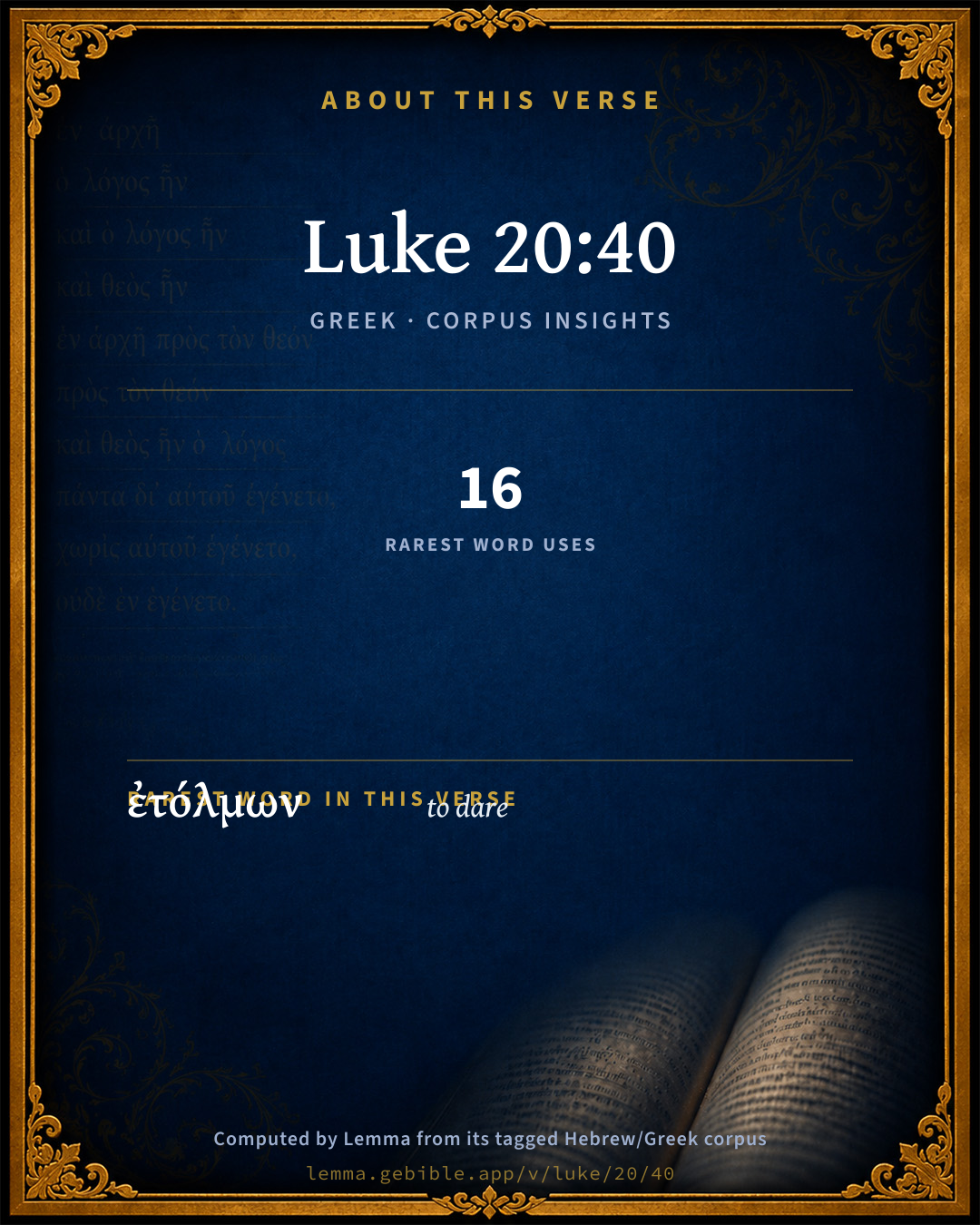
Luke 20:40

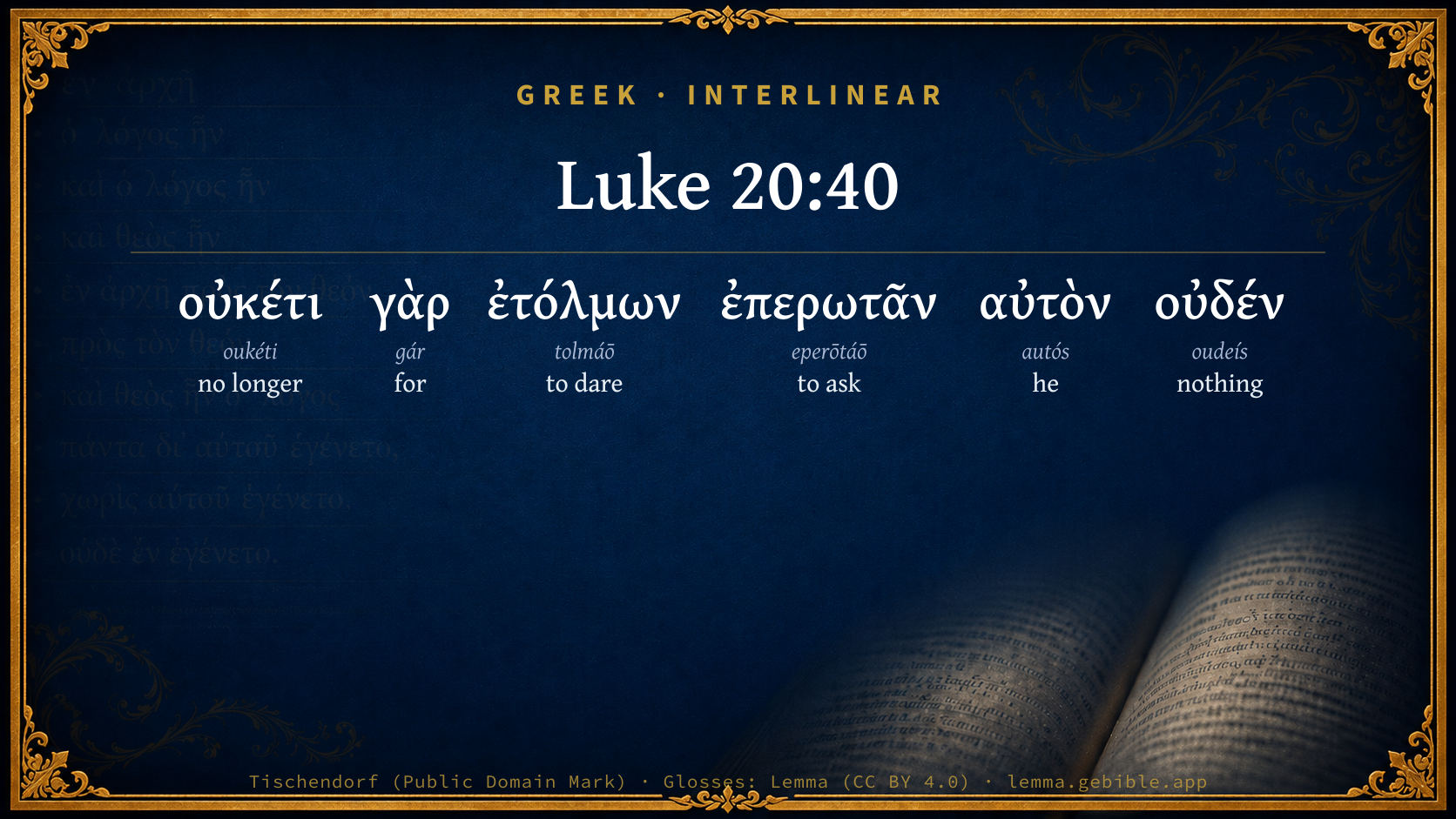
Greek (Tischendorf 8th ed.) Luke 20:40 appears in the Greek New Testament. The text above is from the Tischendorf 8th edition. Each word links to its Strong’s number and a concise gloss. Click any word for its full Thayer’s Greek Lexicon entry.
Download image
Cite this verse

Luke 20:40 (World English Bible). Public Domain. Lemma interlinear Bible study tool, https://lemma.gebible.app/v/luke/20/40.

Show BibTeX & RIS
BibTeX
RIS
English Translation
They didn't dare to ask him any more questions.
World English Bible · Public Domain
Download a study sheet

One document with this verse’s original text, its word-by-word gloss line, the meaning frame, cross-references with their text, attributed commentary, and full source and license credits — printable, and it pastes into notes with its structure intact.

This verse Autodidact and up

Study sheet (.html) Plain text (.txt)

A passage Seminary Student

Up to 50 verses in one chapter. A passage sheet keeps up to 6 commentary sources and 12 cross-references per verse, in the order this page ranks them, and says so on the sheet whenever that leaves anything out. Ask for a single verse and you get the Autodidact verse sheet above.

Everything on this page stays free to read, with no account — the sheet is a download of what is already on screen, not access to it.

Want to remove ads? Support Godless Engineer
Compare translations 3

The same verse in 3 English versions, stacked beneath the original-language interlinear above. Click any original word for its lexicon entry.

Each is an independent rendering of the whole verse — the interlinear is not word-aligned to these translations.

Highlighted words mark where these versions differ — a whole-verse word diff, not a word-by-word alignment.

  • World English Bible Public Domain
    They didn't dare to ask him any more questions.
  • King James Version Public Domain
    And after that they durst not ask him any question at all.
  • unfoldingWord Literal Text CC BY-SA 4.0
    For they no longer dared to ask him anything.

unfoldingWord Literal Text — © unfoldingWord, licensed CC BY-SA 4.0. Word-aligned USFM3 via Door43 (git.door43.org/unfoldingWord/en_ult).

Versions to compare (up to 4)

3 of 4 selected

Show all 19 translations

Every available English version of this verse, each an independent rendering of the whole verse.

  • World English Bible Public Domain
    They didn't dare to ask him any more questions.
  • Berean Standard Bible Public Domain
    And they did not dare to question Him any further.
  • Majority Standard Bible Public Domain
    And they did not dare to question Him any further.
  • King James Version Public Domain
    And after that they durst not ask him any question at all.
  • American Standard Version (1901) Public Domain
    For they durst not any more ask him any question.
  • Revised Version (1885) Public Domain
    For they durst not any more ask him any question.
  • Geneva Bible (1599) Public Domain
    And after that, durst they not aske him any thing at all.
  • Douay-Rheims (1899) Public Domain
    And after that they durst not ask him any more questions.
  • Young's Literal Translation Public Domain
    and no more durst they question him anything.
  • Literal Standard Version CC BY-SA 4.0
    and they no longer dared question Him anything.
  • Unlocked Literal Bible CC BY-SA 4.0
    For they did not dare ask him any more questions.
  • unfoldingWord Literal Text CC BY-SA 4.0
    For they no longer dared to ask him anything.
  • Darby Bible Public Domain
    For they did not dare any more to ask him anything.
  • World Messianic Bible Public Domain
    They didn’t dare to ask him any more questions.
  • Webster's Bible Public Domain
    And after that, they durst not ask him any question at all.
  • Free Bible Version CC BY-SA 4.0
    After this no one dared to ask him any more questions.
  • Bible in Basic English Public Domain
    And they had fear of putting any more questions to him.
  • Text-Critical English NT CC BY 4.0
    And they no longer dared to ask him anything.
  • Tyndale New Testament (1534) Public Domain
    And after that durst they not axe him eny question at all.

Literal Standard Version (2020), Covenant Press — licensed CC BY-SA 4.0. Text via the HelloAO Bible API (eBible.org). Unlocked Literal Bible (unfoldingWord) — licensed CC BY-SA 4.0. Text via the HelloAO Bible API (eBible.org). unfoldingWord Literal Text — © unfoldingWord, licensed CC BY-SA 4.0. Word-aligned USFM3 via Door43 (git.door43.org/unfoldingWord/en_ult). Free Bible Version, Dr. Jonathan Gallagher — licensed CC BY-SA 4.0. Text via the HelloAO Bible API (eBible.org).

Word by word

More ways to search: Search by grammar → Find every occurrence → Compare this word →

Practice this passage: Drill this verse → Learn its vocabulary →

ἐτόλμων
tolmáō
G5111
“to dare”
Verb, Imperfect, Active, Indicative, 3rd person, Plural
Part of Speech
Verb
Tense
Imperfect
Voice
Active
Mood
Indicative
Person
3rd person
Number
Plural
Full Thayer's Definition

Origin: from tolma (boldness, probably itself from the base of G5056 through the idea of extreme conduct)

TDNT: 11:01,1

1. not to dread or shun through fear 2. to bear, endure 3. to bring one's self to 4. to be bold 5. bear one's self boldly, deal boldly
  1. οὐκέτι oukéti G3765 “no longer” Adverb, Negative
  2. γὰρ gár G1063 “for” Conjunction
  3. ἐπερωτᾶν eperōtáō G1905 “to ask” Verb, Present, Active, Infinitive
  4. αὐτὸν autós G846 “he” Personal pronoun, Accusative, Singular, Masculine
  5. οὐδέν oudeís G3762 “nothing” Adjective, Accusative, Singular, Neuter, Negative

About this verse

These counts appear in no published source. They are computed here, from the morphology-tagged text and Lemma’s own curated glosses. What Lemma adds →

6
words
6
distinct lemmas
Gospels
section

Notable vocabulary

The rarest word here is ἐτόλμων to dare G5111 — appearing just 16 times in the whole Greek New Testament.

Shared distinctive vocabulary

ἐτόλμων to dare G5111 occurs in 15 verses of the Greek New Testament. Also found in:

Cross-references

3

Topical passages linked to Luke 20:40 in the Treasury of Scripture Knowledge — connected by theme and wording, ordered by reader-vote popularity; previews shown in the World English Bible.

  • Matthew 22:46 No one was able to answer him a word, neither dared any man from that day forth ask him any more questions.
  • Mark 12:34 When Jesus saw that he answered wisely, he said to him, "You are not far from the Kingdom of God." No one dared ask him any question after that.
  • Proverbs 26:5 Answer a fool according to his folly, Lest he be wise in his own eyes.

Cross-references courtesy of OpenBible.info (CC BY 4.0).

Commentary

Notes on Luke 20:40 from classic Christian and Jewish commentators (each source and its license shown beneath its notes). The classic Christian expositions comment on the surrounding passage and are grouped to its opening verse, so a note may address several verses; the Jewish commentaries on the Tanakh (Rashi and others) are per-verse, so they appear only where the commentator wrote on this verse.

Lemma curates 59 commentaries, every one of them public domain or Creative Commons licensed, each selected and text-cleaned for this edition rather than reprinted as found. About our sources →

Tyndale Open Study Notes

Tyndale Open Resources

20:40 Jesus’ wise answers confounded his opponents, thwarting their attempts to trap him.

Tyndale Open Study Notes — © Tyndale Open Resources, licensed CC BY-SA 4.0. Text via the HelloAO Bible API.

Expositor's Greek Testament

ed. W. Robertson Nicoll

Luk 20:40 . οὐκέτι γὰρ : the γὰρ , if the true reading, must mean: The scribes could do nothing but flatter (Luk 20:39 ), for they were so conscious of His power that they dared no longer ask captious questions.

The Expositor's Greek Testament, edited by W. Robertson Nicoll (1897–1910) — public domain. Text from a community e-Sword module.

Adam Clarke's Commentary

Verse 40. They durst not ask] Or, did not venture to ask any other question, for fear of being again confounded, as they had already been.

Adam Clarke's Commentary on the Bible (1810–1826) — public domain. Text from a community e-Sword/MySword module.

Ellicott's Commentary for English Readers

(40) They durst not ask him any question at all.—The singular omission by St. Luke of the question which is recorded by St. Matthew (Mat_22:34-40) and St. Mark (Mar_12:28-34), and which would have fallen m so well with the general scope and tenor of his Gospel, may take its place, though we cannot account for it except on the supposition that he did not know the facts, as one of the many proofs of his entire independence as a narrator.

A Bible Commentary for English Readers, edited by Charles John Ellicott (1878–1897) — public domain. Text from a community e-Sword module.

The Cambridge Bible for Schools and Colleges

gen. ed. J. J. S. Perowne

40. they durst not ask him any question] The total collapse of their stratagems enhanced our Lord’s peril, by shewing how impossible it was for these rich and learned “pupils of the wise” to pose themselves as superiors to Christ in wisdom and knowledge. Assumed contempt was deepened into real hatred, and all the more after the next incident.

The Cambridge Bible for Schools and Colleges (gen. ed. J. J. S. Perowne; Cambridge University Press, 1878–1918) — public domain. Text from a community e-Sword module.

John Gill's Exposition

Beware of the Scribes,.... And also of the Pharisees; for they are joined together in Matthew:

which desire to walk in long robes: the rule for the length of a scholar's garment was this (a);

"his flesh must not appear under his garments, as the light linen garments, and the like, they make in Egypt; nor must his garments be drawn upon the ground, as the garments of proud men, but must reach to his heel, and his glove must reach the top of his fingers.''

According to this rule, the garments of the doctors were to be so long as to cover the whole body, even down to their heels, but were not to be any longer; and by this it appears their garments were very long; but they did not always go by this rule; some had their garments so long as to have a train after them; See Gill on Mat 23:5.

and love greetings in the markets; or in courts of judicature; they loved to be saluted with the titles of Rabbi, Master, and the like:

and the highest seats in the synagogues; which were next to the place where the book of the law was read and expounded, and where they might be seen by the people:

and the chief rooms at feasts; the uppermost; See Gill on Mat 23:6 and See Gill on Mat 23:7.

(a) Maimon Hilch. Dayot, c. 5. sect. 9. Vid. T. Bab. Bava Bathra, fol. 57. 2. & Gloss. in ib.

John Gill's Exposition of the Whole Bible (1746–1763) — public domain (CC PDM 1.0). Text via the HelloAO Bible API.

Albert Barnes' Notes on the Bible

See the notes at Mat 22:41-46.

Albert Barnes' Notes on the Bible (1834–1885) — public domain. Text from a community e-Sword/MySword module.

The Pulpit Commentary

Vers. 40-44. The lowliness and the greatness of Jesus Christ.

This is the subject of these verses; but they are suggestive of minor truths. We have

I A PROOF OF UTTER FALSITY. (Ver. 40) How came these men to be afraid to ask questions of Christ? Others did not shrink from him, or fear to ask things of him. The children were not afraid of him; nor were "the strangers those not of Israel: nor were the women who waited on him and learned of him; nor the simple-hearted and genuine inquirers. It was only the men who sought his overthrow, because they dreaded his exposure; it was only those who shrank from his heart-searching gaze and his truth-telling words, that dared not approach him and ask questions of him. No man however ignorant, no child however young, need shrink from the Lord of love, from asking of him what he needs; it is only the false who are afraid.

II THE TIME FOR AGGRESSIVE ACTION. The successful general may act long on the defensive, but he waits and looks for the moment of attack. Jesus bore long with the questionings of his enemies, but the time had come for him to ask something of them. We may well bear long with the enemies of Christ, but the hour comes when we must bear down upon them with convincing and humbling power.

III THE OCCASIONAL DUTY OF PUTTING MEN INTO A DIFFICULTY. On this occasion our Lord placed his hearers in a difficulty from which he did not offer to extricate them. His prophetic function was to enlighten, to liberate, to relieve. But here was an occasion when he best served men by placing them in a difficulty from which they found no escape. Such service may be rare for a Christian teacher, but it does occur. There are times when we cannot render a man a better service than that of humbling him, of showing him that there are mysteries in presence of which he is a little child.

IV THE WISDOM OF FURTHER INQUIRY. These Pharisees imagined that they knew everything about the Scriptures that could be known. They were learned, but they were unwise; they had a large verbal and literal acquaintance with their sacred books, but they had missed their deepest meaning. They had not inquired humbly, intelligently, reverently enough. How much more is there in our New Testament than we have yet found! What depth of wisdom in the words of Christi What enlightenment in the letters of his apostles! Though we may not have missed our Way so grievously as the scribes had done, yet may there be very much of Divine truth we have not yet discovered, which patient and devout inquiry will disclose.

V THE LOWLINESS AND THE GREATNESS OF JESUS CHRIST. He is the Son of David, and he is also his Lord. We understand that better than the most advanced and enlightened of his disciples could at that point. "As concerning the flesh" he was "born of a woman, made under Law;" yet is he "exalted to be a Prince and a Savior;" Son of man and Son of God. Only thus could he be what he came to be:

1. Our Mediator between God and man.

2. Our Divine Savior, in whom we put our trust and find mercy unto eternal life; our Divine Friend, of whose perfect sympathy we can be assured; our rightful Lord, to whom we can bring the offering of our hearts and lives. C.

Ver. 40 Luk_21:4. Vindications and judgments.

We saw on the last occasion how Christ had vanquished all who had tried with him the fortunes of debate. And now we find him putting a pertinent question to them about himself, and effectually puzzling them. Not, of course, that he had this in view in presenting it. His purpose was always a clear and pure one; it was, as Godet suggests, to vindicate beforehand those claims to Divine Sonship on the ground of which they are so shortly to condemn him to death.

I CONSIDER CHRIST AS DAVID"S SON AND LORD (Vers. 41-45) It is clear from the Gospels and from the Targums that the Messiah wanted by the Jews was not necessarily to be Divine. It was a temporal prince, a military Messiah, they longed for; and no Divinity was needful to play the role of "conquering hero" which they desired. A merely human Messiah would have suited them admirably. When they got one, therefore, who claimed to be Divine, they condemned him for blasphemy, and never stopped until they had made away with him by crucifixion. Our Lord"s question in the temple was to arouse them to a sense of Messiah"s proper claims. This suggests:

1. How prone we are to be satisfied with mere human saviours. The Jews wanted a Messiah to collect armies, to deliver them from Roman bondage, and to give them all good situations in the new kingdom. They wanted nothing that a clever leader could not do for them. And there are plenty of people whose only desired salvation is from hunger and thirst and discomfort of a physical kind. They have no real longing after deliverance from sin and covetousness and discontent. Their one thought is to find somebody who can help them on a bit.

2. David"s royal line produced a Prince who was also David"s Lord. Now, it is plain from the psalm (Ps 110) which Jesus quotes that David realized in the Messiah his present Lord. He ruled over David, and was recognized by David as his Lord. When we add to this the fact that David was the greatest monarch of his time, we see that the only interpretation of this Lordship is the Divinity of Messiah. This Messiah is made by the Most High to sit at his right hand until his enemies are made his footstool. The whole picture involves and implies Christ"s Divinity. Now, if these scribes and Pharisees had acted honestly, they would have said, "Here is a point which escaped us; this Lordship over David is a claim which the sonship does not cover; there must be more in the Messiahship than we suspect; we must reconsider our attitude towards Jesus, and do him justice." But instead of this, they deliberately ignored the difficulty, and went on with their persecution of the Divine Messiah. Now, this is surely to show us that we need a Divine Savior, for the salvation must be from the power and guilt of sin. We need a Savior who will be our Lord; to whom we not only owe allegiance, but give it cheerfully. It is a Divine Lord of the ages, the King of kings, the Lord of lords, the infinite Majesty, whom we need to give us the emancipation which can alone profit our souls.

II CONSIDER CHRIST"S CONDEMNATION OF THE SCRIBES. (Vers. 45-47) Seeing how they reject the scriptural evidence of his claims, Jesus proceeds to warn his disciples against them. He knows them thoroughly. And:

1. He charges them with skilfully manufacturing a religious reputation. They wore peculiar garments; the man-milliners of the day had been brought into requisition. They welcomed recognition from the people in the markets; they took, as their right, the highest seats in the synagogue and the chief rooms at social feasts. They manufactured such a reputation as secured them abundant honor.

2. They traded upon their reputation. Widows got their advice and intercession, and paid them well for giving it. In fact, our Lord charges them with devouring widows" houses in their greed. Instead of the widows inspiring pity, they seemed eligible because defenceless victims.

3. Their condemnation shall be proportionally great. Professions which are traded upon will ultimately procure a deeper condemnation. How needful that the genuineness of our profession should be tested! If it is for God"s dear sake, and not for the sake of worldly advantage, it will stand the test at last.

III CONSIDER CHRIST"S ECOMNIUM, UPON THE POOR WIDOW. (Luk_21:1-4) Sitting over against the treasury our Lord saw both rich and poor depositing their gifts. Some of the rich gave largely out of their abundance, and Jesus noted doubtless the proportion. But one poor widow came along, and she deposited in the temple-chest a single farthing. It was little, but it was her all. Behind her sackcloth Jesus discerned the biggest heart in all the company. Now, we are taught by this circumstance:

1. That all our gifts are deposited in sight of Christ. As Divine Savior he sits, so to speak, over against every treasury, and notes what the people deposit there. There is no such thing as secret giving so far as Jesus is concerned. We may give so that the right hand knows not what the left is giving, but Jesus knows all the same.

2. It is the heart which determines the character of our liberality. It is not the quantity of money, but the quality of the act, which is important. A farthing from a widow is more in the sight of God than thousands from a millionaire. Hence we ought to examine ourselves, and see clearly what our motives may be.

3. Hence it is possible even for the poorest to be liberal. It is this which we require to have driven home. When poor as well as rich give with large heartedness, the Church"s "golden age" shall come, It is to this that our Lord would lead us. R.M.E.

The Pulpit Commentary (1880–1919), ed. H.D.M. Spence-Jones & Joseph S. Exell — public domain. Text from a community e-Sword module.

John Wesley's Explanatory Notes

They durst not ask him any question - The Sadducees durst not. One of the scribes did, presently after.

John Wesley, Explanatory Notes Upon the Whole Bible (1754–1765) — public domain. Text via the GEBible commentary corpus.

McGarvey & Pendleton's Commentaries

J. W. McGarvey

J. W. McGarvey's The Fourfold Gospel [CIX. C. The Great Commandment].

CIX. JEWISH RULERS SEEK TO ENSNARE JESUS. (Court of the Temple. Tuesday, April 4, A. D. 30.) Subdivision C. A LAWYER ASKS ABOUT THE GREAT COMMANDMENT. aMATT. XXII. 34-40; bMARK XII. 28-34; cLUKE XX. 40.

a34 But the Pharisees, when they heard that he had put the Sadducees to silence, gathered themselves together. 35 And one of them, a lawyer, bone of the scribes came, and heard them questioning together, and knowing that he had answered them well, aasked him a question, trying him [he was evidently deputed by those who counseled to ask this question]: 36 Teacher, which is the great commandment in the law? bWhat commandment is the first of all? [According to the statement of Jewish writers, there had been an old and interminable dispute among the rabbis as to which was the greatest commandment. Some held that it was the law which commanded sacrifices; others, that which commanded the wearing of phylacteries; others contended for those about purification; others, for those about the great feasts. But as they reckoned the commandments of Moses as numbering over six hundred, there was plenty of room for argument. On this memorable day the answers of Jesus had hitherto been of such a nature as to put his questioners to silence. Therefore, in asking this question, they hoped to get an answer about which they could at least find room to wrangle, and thus discredit the wisdom of Jesus.] 29 Jesus answered, a37 And said unto him, bThe first is, Hear, O Israel; The Lord our God, the Lord is one: 30 And aThou shalt love the Lord thy God with all thy heart, and with all thy soul, and with all thy mind. band with all thy strength. a38 This is the great and first commandment. [ Deu_6:4-9. This command is first because it is the foundation of the entire law of God. It is greatest, because, in a sense, it includes all the other laws. Polytheism, atheism, idolatry, and all sins against God are forbidden by it. All sins against man are likewise, in [603] a sense, prohibited by it; for sin against man is sin against God's image, and against the objects of God's love. Those who truly love God can not consistently sin against man ( 1Jo_4:20). The curious may make metaphysical distinctions in the analysis of this required fourfold love, but the sum of it is that we are to love God with our whole being.] 39 And a { b31 The second alike unto it bis this, Thou shalt love thy neighbor as thyself. [Love is the cure for sin, for we can not sin against those whom we truly love. Where we love, we desire to bless. But sin always carries with it a willingness to injure or to curse.] There is none other commandment greater than these. a40 On these two commandments the whole law hangeth, and the prophets. [The generic nature of the law of love is also noted by Paul ( Rom_13:8-10); but love without law is not sufficient. Love begets a desire to bless, but the law guides to the accomplishment of that desire. Perfect righteousness is the result of wisdom as well as affection. Love without law is power without direction, and law without love is machinery without a motor-- 1Co_13:1-3.] b32 And the scribe said unto him, Of a truth, Teacher, thou hast well said that he is one; and there is none other but he: 33 and to love him with all the heart, and with all the understanding, and with all the strength, and to love his neighbor as himself, is much more than all whole burnt-offerings and sacrifices. [Here, as in the preceding subdivision, the answer of Jesus was so clearly right that it enforced admiration.] 34 And when Jesus saw that he answered discreetly, he said unto him, Thou art not far from the kingdom of God. [Prejudice is the great obstacle to entering the kingdom. In proportion as we overcome it we draw near to God.] And no man after that durst { c40 For they durst not any more ask him any question. [They found it expedient to keep silence when their questions only exposed their own shallowness, and made more conspicuous the supreme wisdom of Jesus.] [604]

[FFG 603-604]

J. W. McGarvey (with Philip Y. Pendleton), Commentaries on the New Testament (The Fourfold Gospel, 1914; Acts; and the epistles) — public domain. Text from a community e-Sword/MySword module.

Cambridge Greek Testament for Schools and Colleges

40. οὐκέτι … ἐτόλμων. The total collapse of their stratagems enhanced our Lord’s peril, by shewing how impossible it was for these rich and learned “pupils of the wise” to pose themselves as superiors to Christ in wisdom and knowledge. Assumed contempt was deepened into real hatred.

Cambridge Greek Testament for Schools and Colleges (Cambridge University Press, 1896; 21 vols, various authors incl. Carr, Maclear, Plummer, Farrar, Lumby, Moule, M. R. James, Simcox) — public domain. Text from a community e-Sword module.

Alford’s Greek Testament

Henry Alford

40.] Peculiar to Luke;—implied however in Matt. ver. 34, and Mark ver. 28.

Henry Alford, The Greek Testament (1849–1861) — public domain. Text from a community e-Sword module.

International Critical Commentary

40. γάρ. The fact that this was not understood caused it to be altered in many texts into δέ. Godet maintains that it “has absolutely no sense,” and erroneously states that WH. have abandoned it. It is attested by א B L, 33, Aegyptt., and gives excellent sense. Some of His opponents praised Him, for they saw that He was always victorious, and that they must risk no more defeats.

International Critical Commentary — older volumes (1896–1929), various authors — public domain. Text from a community e-Sword module.

Lesson kit

Teaching starters — assembled from the data on this page, not authored interpretation. Every prompt links to the verse data it draws on. Edit before teaching.

Luke, in the Gospels, opens this verse with 6 words (6 distinct Greek lemmas). Its most distinctive word is tolmáō (“to dare”). A historical commentator’s framing appears above. Read the whole chapter for the surrounding context.

Discussion questions

  1. How does “to dare” (tolmáō) shape what this verse is saying?
  2. How does Matthew 22:46, which shares the word «to dare», read alongside this verse?
  3. These translations render this verse differently; the difference is in the English rendering, not the original. What questions does that raise?
  4. Compare how Tyndale Open Study Notes and Expositor's Greek Testament read this verse. Where do they agree or differ?

Things to notice

Reading settings

Reading text

Shown beneath each verse's original-language words.

Old Testament
Old Testament edition

Read the OT as the Masoretic Hebrew (MT) or the Greek Septuagint (LXX).

English shown for the Greek Septuagint (in the Hebrew ↔ Greek comparison).

Comparing translations? Open the Compare panel on any verse page to stack up to four side by side.