
Deuteronomy 24:5

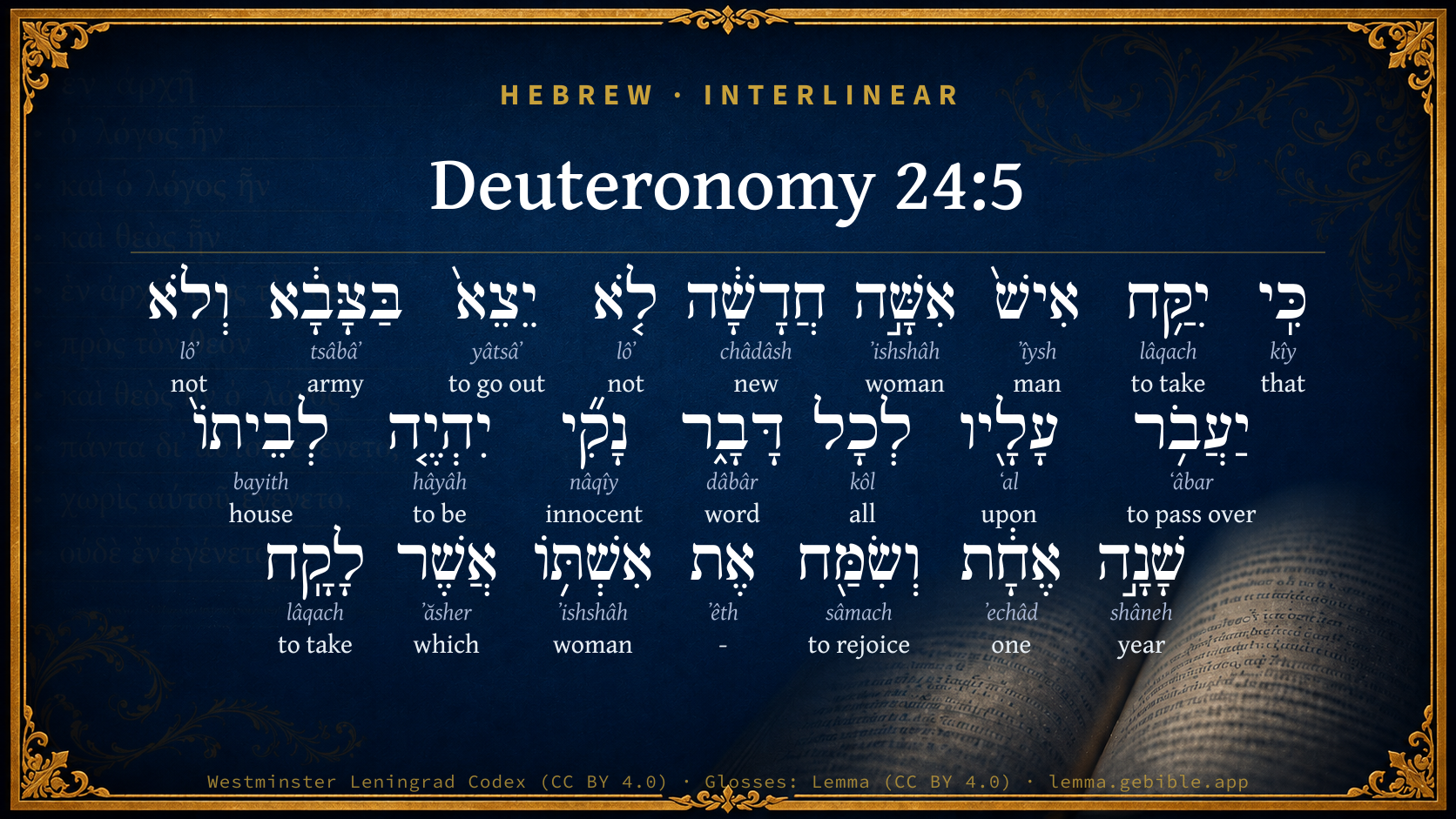
Hebrew (Westminster Leningrad Codex) Deuteronomy 24:5 appears in the Hebrew Old Testament. The text above is from the Westminster Leningrad Codex. Each word links to its Strong’s number, a concise gloss, and parsing drawn from the Open Scriptures Hebrew Bible morphology. Click any word for its full Brown-Driver-Briggs (BDB) entry.
Download image
Cite this verse

Deuteronomy 24:5 (World English Bible). Public Domain. Lemma interlinear Bible study tool, https://lemma.gebible.app/v/deuteronomy/24/5.

Show BibTeX & RIS
BibTeX
RIS
English Translation
When a man takes a new wife, he shall not go out in the host, neither shall he be charged with any business: he shall be free at home one year, and shall cheer his wife whom he has taken.
World English Bible · Public Domain
Download a study sheet

One document with this verse’s original text, its word-by-word gloss line, the meaning frame, cross-references with their text, attributed commentary, and full source and license credits — printable, and it pastes into notes with its structure intact.

This verse Autodidact and up

Study sheet (.html) Plain text (.txt)

A passage Seminary Student

Up to 50 verses in one chapter. A passage sheet keeps up to 6 commentary sources and 12 cross-references per verse, in the order this page ranks them, and says so on the sheet whenever that leaves anything out. Ask for a single verse and you get the Autodidact verse sheet above.

Everything on this page stays free to read, with no account — the sheet is a download of what is already on screen, not access to it.

Want to remove ads? Support Godless Engineer
Compare translations 3

The same verse in 3 English versions, stacked beneath the original-language interlinear above. Click any original word for its lexicon entry.

Each is an independent rendering of the whole verse — the interlinear is not word-aligned to these translations.

Highlighted words mark where these versions differ — a whole-verse word diff, not a word-by-word alignment.

  • World English Bible Public Domain
    When a man takes a new wife, he shall not go out in the host, neither shall he be charged with any business: he shall be free at home one year, and shall cheer his wife whom he has taken.
  • King James Version Public Domain
    When a man hath taken a new wife, he shall not go out to war, neither shall he be charged with any business: but he shall be free at home one year, and shall cheer up his wife which he hath taken.
  • unfoldingWord Literal Text CC BY-SA 4.0
    When a man takes a new wife, he shall not go out with the army, neither shall pass onto him any matter; he shall be free for his house one year and will cheer his wife whom he has taken.

unfoldingWord Literal Text — © unfoldingWord, licensed CC BY-SA 4.0. Word-aligned USFM3 via Door43 (git.door43.org/unfoldingWord/en_ult).

Versions to compare (up to 4)

3 of 4 selected

Show all 18 translations

Every available English version of this verse, each an independent rendering of the whole verse.

  • World English Bible Public Domain
    When a man takes a new wife, he shall not go out in the host, neither shall he be charged with any business: he shall be free at home one year, and shall cheer his wife whom he has taken.
  • Berean Standard Bible Public Domain
    If a man is newly married, he must not be sent to war or be pressed into any duty. For one year he is free to stay at home and bring joy to the wife he has married.
  • Majority Standard Bible Public Domain
    If a man is newly married, he must not be sent to war or be pressed into any duty. For one year he is free to stay at home and bring joy to the wife he has married.
  • King James Version Public Domain
    When a man hath taken a new wife, he shall not go out to war, neither shall he be charged with any business: but he shall be free at home one year, and shall cheer up his wife which he hath taken.
  • American Standard Version (1901) Public Domain
    When a man taketh a new wife, he shall not go out in the host, neither shall he be charged with any business: he shall be free at home one year, and shall cheer his wife whom he hath taken.
  • Revised Version (1885) Public Domain
    When a man taketh a new wife, he shall not go out in the host, neither shall he be charged with any business: he shall be free at home one year, and shall cheer his wife which he hath taken.
  • Geneva Bible (1599) Public Domain
    When a man taketh a new wife, he shall not goe a warfare, neither shalbe charged with any businesse, but shalbe free at home one yeere, and reioyce with his wife which he hath taken.
  • Douay-Rheims (1899) Public Domain
    When a man hath lately taken a wife, he shall not go out to war, neither shall any public business be enjoined him, but he shall be free at home without fault, that for one year he may rejoice with his wife.
  • Young's Literal Translation Public Domain
    `When a man taketh a new wife, he doth not go out into the host, and `one' doth not pass over unto him for anything; free he is at his own house one year, and hath rejoiced his wife whom he hath taken.
  • Literal Standard Version CC BY-SA 4.0
    When a man takes a new wife, he does not go out into the host, and [one] does not pass over to him for anything; he is free at his own house [for] one year, and his wife, whom he has taken, he has made glad.
  • Unlocked Literal Bible CC BY-SA 4.0
    When a man takes a new wife, he will not go to war with the army, neither may he be commanded to go on any forced duty; he will be free to be at home for one year and will cheer his wife whom he has taken.
  • unfoldingWord Literal Text CC BY-SA 4.0
    When a man takes a new wife, he shall not go out with the army, neither shall pass onto him any matter; he shall be free for his house one year and will cheer his wife whom he has taken.
  • Darby Bible Public Domain
    When a man hath newly taken a wife, he shall not go out with the army, neither shall any kind of business be imposed upon him; he shall be free for his house one year, and shall gladden his wife whom he hath taken.
  • World Messianic Bible Public Domain
    When a man takes a new wife, he shall not go out in the army, neither shall he be assigned any business. He shall be free at home one year, and shall cheer his wife whom he has taken.
  • Webster's Bible Public Domain
    When a man hath newly taken a wife, he shall not go out to war, neither shall he be charged with any business: but he shall be free at home one year, and shall cheer his wife which he hath taken.
  • Free Bible Version CC BY-SA 4.0
    If a man has just got married, he is not to be sent to war or made to do any other duties. He is free to stay at home for one year and make his wife happy.
  • Bible in Basic English Public Domain
    A newly married man will not have to go out with the army or undertake any business, but may be free for one year, living in his house for the comfort of his wife.
  • JPS Tanakh (1917) Public Domain
    When a man taketh a new wife, he shall not go out in the host, neither shall he be charged with any business; he shall be free for his house one year, and shall cheer his wife whom he hath taken.

Literal Standard Version (2020), Covenant Press — licensed CC BY-SA 4.0. Text via the HelloAO Bible API (eBible.org). Unlocked Literal Bible (unfoldingWord) — licensed CC BY-SA 4.0. Text via the HelloAO Bible API (eBible.org). unfoldingWord Literal Text — © unfoldingWord, licensed CC BY-SA 4.0. Word-aligned USFM3 via Door43 (git.door43.org/unfoldingWord/en_ult). Free Bible Version, Dr. Jonathan Gallagher — licensed CC BY-SA 4.0. Text via the HelloAO Bible API (eBible.org).

Word by word

More ways to search: Search by grammar → Find every occurrence → Compare this word →

Practice this passage: Drill this verse → Learn its vocabulary →

נָקִ֞י
nâqîy
H5355
“innocent”
Adjective, Adjective, Masculine, Singular, Absolute
Part of Speech
Adjective
Type
Adjective
Gender
Masculine
Number
Singular
State
Absolute
Full BDB Definition

Origin: from H5352

TWOT: 1412a , 1412b

clean, free from, exempt, clear, innocent - free from guilt, clean, innocent - free from punishment - free or exempt from obligations - innocent
  1. כִּֽי kîy H3588 “that” Conjunction
  2. יִקַּ֥ח lâqach H3947 “to take” Verb, Qal, Imperfect, 3rd Person, Masculine, Singular
  3. אִישׁ֙ ʼîysh H376 “man” Noun, Common, Masculine, Singular, Absolute
  4. אִשָּׁ֣ה ʼishshâh H802 “woman” Noun, Common, Feminine, Singular, Absolute
  5. חֲדָשָׁ֔ה châdâsh H2319 “new” Adjective, Adjective, Feminine, Singular, Absolute
  6. לֹ֤א lôʼ H3808 “not” Particle, Negative
  7. יֵצֵא֙ yâtsâʼ H3318 “to go out” Verb, Qal, Imperfect, 3rd Person, Masculine, Singular
  8. בַּצָּבָ֔א tsâbâʼ H6635 “in/at the · army” Preposition, Determined + Noun, Common, Both, Singular, Absolute
  9. וְלֹא lôʼ H3808 “and · not” Conjunction + Particle, Negative
  10. יַעֲבֹ֥ר ʻâbar H5674 “to pass over” Verb, Qal, Imperfect, 3rd Person, Masculine, Singular
  11. עָלָ֖יו ʻal H5921 “upon · him” Preposition + Suffix, Personal, 3rd Person, Masculine, Singular
  12. לְכָל kôl H3605 “to/for · all of” Preposition + Noun, Common, Masculine, Singular, Construct
  13. דָּבָ֑ר dâbâr H1697 “word” Noun, Common, Masculine, Singular, Absolute
  14. יִהְיֶ֤ה hâyâh H1961 “to be” Verb, Qal, Imperfect, 3rd Person, Masculine, Singular
  15. לְבֵיתוֹ֙ bayith H1004 “to/for · house · his” Preposition + Noun, Common, Masculine, Singular, Construct + Suffix, Personal, 3rd Person, Masculine, Singular
  16. שָׁנָ֣ה shâneh H8141 “year” Noun, Common, Feminine, Singular, Absolute
  17. אֶחָ֔ת ʼechâd H259 “one” Adjective, Cardinal number, Feminine, Singular, Absolute
  18. וְשִׂמַּ֖ח sâmach H8055 “and · to rejoice” Conjunction + Verb, Piel, Sequential Perfect, 3rd Person, Masculine, Singular
  19. אֶת ʼêth H853 “-” Particle, Direct Object
  20. אִשְׁתּ֥וֹ ʼishshâh H802 “woman · his” Noun, Common, Feminine, Singular, Construct + Suffix, Personal, 3rd Person, Masculine, Singular
  21. אֲשֶׁר ʼăsher H834 “which” Particle, Relative
  22. לָקָֽח lâqach H3947 “to take” Verb, Qal, Perfect, 3rd Person, Masculine, Singular

About this verse

These counts appear in no published source. They are computed here, from the morphology-tagged text and Lemma’s own curated glosses. What Lemma adds →

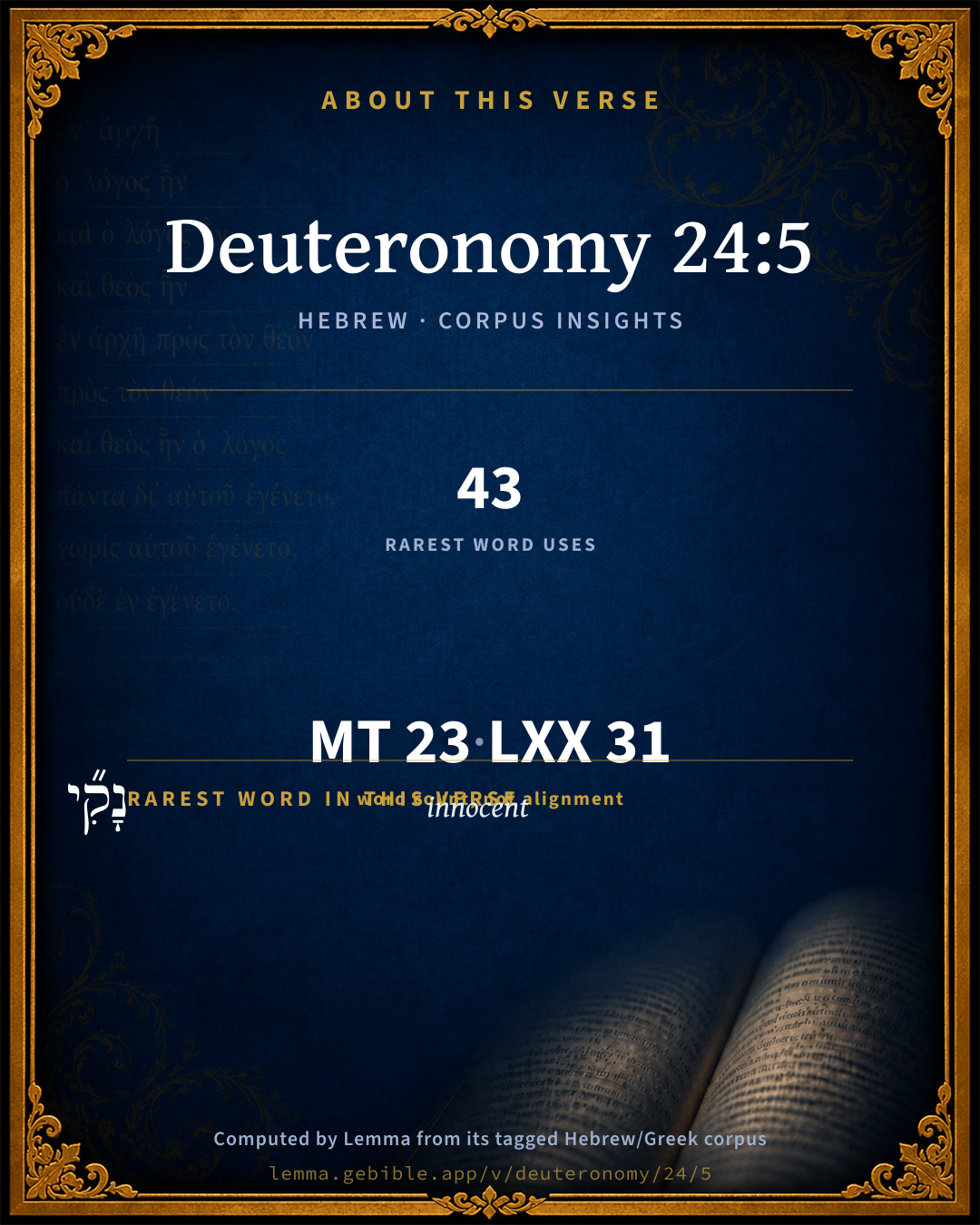
23
words
20
distinct lemmas
Pentateuch
section

Shared distinctive vocabulary

נָקִ֞י innocent H5355 occurs in 42 verses of the Hebrew Bible. Also found in:

Grammatical profile

  • 6 verbs
  • 8 nouns
  • 3 adjectives
  • 1 preposition
  • 1 conjunction
  • 4 particles

Verb forms

  • יִקַּ֥ח Qal · Imperfect
  • יֵצֵא֙ Qal · Imperfect
  • יַעֲבֹ֥ר Qal · Imperfect
  • יִהְיֶ֤ה Qal · Imperfect
  • וְשִׂמַּ֖ח Piel · Sequential Perfect
  • לָקָֽח Qal · Perfect

Repetition

Words recur within this verse — often emphatic in Hebrew:

  • יִקַּ֥ח to take H3947 ×2
  • אִשָּׁ֣ה woman H802 ×2
  • לֹ֤א not H3808 ×2

Hebrew & Septuagint length

In English translation the verse runs 40 words from the Hebrew and 44 from the Septuagint (LXX English) — closely comparable.

A rough comparison of the two English renderings, which tokenize alike — not a word-level alignment.

Word counts can differ between the Hebrew and the Greek without any difference in meaning — e.g. the Hebrew direct-object marker אֵת has no separate Greek word, and Greek often adds the article ὁ.

In the original languages it is 23 Hebrew tokens and 31 Greek tokens — but the two are counted differently (Hebrew bundles its prefixes and suffixes into one token; the Greek is in lemma form), so that isn’t a like-for-like length.

Cross-references

10

Topical passages linked to Deuteronomy 24:5 in the Treasury of Scripture Knowledge — connected by theme and wording, ordered by reader-vote popularity; previews shown in the World English Bible.

  • Deuteronomy 20:7 What man is there who has pledged to be married a wife, and has not taken her? let him go and return to his house, lest he die in the battle, and another man take her.
  • Proverbs 5:18 Let your spring be blessed. Rejoice in the wife of your youth.
  • Genesis 2:24 Therefore a man will leave his father and his mother, and will join with his wife, and they will be one flesh.
  • Titus 2:4–5 that they may train the young women to love their husbands, to love their children,
  • Mark 10:6–9 But from the beginning of the creation, 'God made them male and female.
  • Ecclesiastes 9:9 Live joyfully with the wife whom you love all the days of your life of vanity, which he has given you under the sun, all your days of vanity: for that is your portion in life, and in your labor in which you labor under the sun.
  • Matthew 19:4–6 He answered, "Haven't you read that he who made them from the beginning made them male and female,
  • Ephesians 5:28–29 Even so ought husbands also to love their own wives as their own bodies. He who loves his own wife loves himself.
  • 1 Corinthians 7:10–15 But to the married I command--not I, but the Lord--that the wife not leave her husband
  • 1 Corinthians 7:29 But I say this, brothers: the time is short, that from now on, both those who have wives may be as though they had none;

Cross-references courtesy of OpenBible.info (CC BY 4.0).

Hebrew and Greek witnesses Masoretic Hebrew ↔ Greek Septuagint

The same verse in the two great witnesses to the Old Testament, shown verse-for-verse.

These are two independent witnesses, not word-aligned to each other, and the Septuagint is shown in lemma (dictionary) form.

Hebrew Deuteronomy 24:5 Masoretic · Westminster Leningrad Codex

כִּֽי יִקַּ֥ח אִישׁ֙ אִשָּׁ֣ה חֲדָשָׁ֔ה לֹ֤א יֵצֵא֙ בַּצָּבָ֔א וְלֹא יַעֲבֹ֥ר עָלָ֖יו לְכָל דָּבָ֑ר נָקִ֞י יִהְיֶ֤ה לְבֵיתוֹ֙ שָׁנָ֣ה אֶחָ֔ת וְשִׂמַּ֖ח אֶת אִשְׁתּ֥וֹ אֲשֶׁר לָקָֽח

When a man takes a new wife, he shall not go out in the host, neither shall he be charged with any business: he shall be free at home one year, and shall cheer his wife whom he has taken.

World English Bible · Public Domain

Greek LXX Deuteronomy 24:5 Septuagint · lemma form

ἐάν δέ τις λαμβάνω γυνή προσφάτως οὐ ἐκἔρχομαι εἰς ὁ πόλεμος καί οὐ ἐπιβάλλω αὐτός οὐδείς πρᾶγμα ἀθῷος εἰμί ἐν ὁ οἰκία αὐτός ἐνιαυτός εἷς εὐφραίνω ὁ γυνή αὐτός ὅς λαμβάνω

and the last husband should hate her, and write for her a bill of divorcement; and should give it into her hands, and send her away out of his house, and the last husband should die, who took her to himself for a wife;

LXX2012 (modern English Septuagint) · Public Domain

On this verse, The Cambridge Bible for Schools and Colleges discusses the Septuagint’s reading. Read the note in Commentary ↓

Hebrew: Westminster Leningrad Codex (CC BY 4.0). Greek: Septuagint (public domain); English from LXX2012 (modern English Septuagint) (Public Domain). How the Septuagint differs from the Hebrew →

Targum (Aramaic paraphrase)

2

The Targum is the ancient Jewish Aramaic paraphrase of the Hebrew Scriptures — an interpretive translation, not the Hebrew text itself. Onkelos (literal) and Pseudo-Jonathan (expansive) render the Torah, and Jonathan the Prophets. Coverage is partial: where no permissively-licensed English translation exists for a verse, only the Aramaic is shown. This is verse-level text, not a word-by-word alignment to the Hebrew.

  1. Targum Onkelos Torah (Genesis–Deuteronomy)
    אֲרֵי יִסַב גְבַר אִתְּתָא חַדְתָּא לָא יִפּוֹק בְּחֵילָא וְלָא יֵעִבַר עֲלוֹהִי לְכָל מִדָעַם פָּנֵי יְהֵי לְבֵיתֵהּ שַׁתָּא חֲדָא וְיַחְדֵי יָת אִתְּתֵהּ דִי נְסַב

    (no public-domain English translation for this verse)

    Targum Onkelos — Aramaic: “Onkelos Genesis” (public domain); “Onkelos Exodus” (public domain); “Onkelos Leviticus” (public domain); “Onkelos Numbers” (public domain); “Onkelos Deuteronomy” (public domain). English: “Sefaria Community Translation” (CC0 1.0 (public-domain dedication)); “J.W. Etheridge. The Targums of Onkelos and Jonathan Ben Uzziel on the Pentateuch. London: Longmans, Green, 1862” (public domain). Text via Sefaria.

  2. Targum Pseudo-Jonathan Torah (Genesis–Deuteronomy)
    אֲרוּם יִסַּב גְּבַר אִיתָא חַדְתָּא בְּתוּלְתָּא לָא יִפּוֹק בְּחֵילָא דְּלָא יֶאֱרַע עֲלוֹי כָּל מִדַּעַם בִּישׁ פָּנֵי יְהֵי בְּבֵיתֵיהּ שַׁתָּא חֲדָא וְיִחְדֵי עִם אִנְתְּתֵיהּ דְּנָסִיב

    When a man hath taken a new wife a virgin he shall not go forth with the army, lest anything evil befall him; he shall be at leisure in his house one year, and rejoice with his wife whom he hath taken.

    Targum Pseudo-Jonathan — Aramaic: “Targum Jonathan on Genesis” (public domain); “Targum Jonathan on Exodus” (public domain); “Targum Jonathan on Leviticus” (public domain); “Targum Jonathan on Numbers” (public domain); “Targum Jonathan on Deuteronomy” (public domain). English: “The Targum of Jonathan ben Uzziel, trans. J. W. Etheridge, London, 1862” (public domain). Text via Sefaria.

Commentary

Notes on Deuteronomy 24:5 from classic Christian and Jewish commentators (each source and its license shown beneath its notes). The classic Christian expositions comment on the surrounding passage and are grouped to its opening verse, so a note may address several verses; the Jewish commentaries on the Tanakh (Rashi and others) are per-verse, so they appear only where the commentator wrote on this verse.

Lemma curates 59 commentaries, every one of them public domain or Creative Commons licensed, each selected and text-cleaned for this edition rather than reprinted as found. About our sources →

Matthew Henry's Commentary

Here is, I. Provision made for the preservation and confirmation of love between new-married people, Deu 24:5. This fitly follows upon the laws concerning divorce, which would be prevented if their affection to each other were well settled at first. If the husband were much abroad from his wife the first year, his love to her would be in danger of cooling, and of being drawn aside to others whom he would meet with abroad; therefore his service to his country in war, embassies, or other public business that would call him from home, shall be dispensed with, that he may cheer up the wife that he has taken. Note, 1. It is of great consequence that love be kept up between husband and wife, and that every thing be very carefully avoided which might make them strange one to another, especially at first; for in that relation, where there is not the love that should be, there is an inlet ready to abundance of guilt and grief. 2. One of the duties of that relation is to cheer up one another under the cares and crosses that happen, as helpers of each other's joy; for a cheerful heart does good like a medicine.

II. A law against man-stealing, Deu 24:7. It was not death by the law of Moses to steal cattle or goods; but to steal a child, or a weak and simple man, or one that a man had in his power, and to make merchandize of him, this was a capital crime, and could not be expiated, as other thefts, by restitution - so much is a man better than a sheep, Mat 12:12. It was a very heinous offence, for, 1. It was robbing the public of one of its members. 2. It was taking away a man's liberty, the liberty of a free-born Israelite, which was next in value to his life. 3. It was driving a man out from the inheritance of the land, to the privileges of which he was entitled, and bidding him go serve other gods, as David complains against Saul, Sa1 26:19.

III. A memorandum concerning the leprosy, Deu 24:8, Deu 24:9. 1. The laws concerning it must be carefully observed. The laws concerning it we had, Lev 13:14. They are here said to be commanded to the priests and Levites, and therefore are not repeated in a discourse to the people; but the people are here charged, in case of leprosy, to apply to the priest according to the law, and to abide by his judgment, so far as it agreed with the law and the plain matter of fact. The plague of leprosy being usually a particular mark of God's displeasure for sin, he in whom the signs of it did appear ought not to conceal it, nor cut out the signs of it, nor apply to the physician for relief; but he must go to the priest, and follow his directions. Thus those that feel their consciences under guilt and wrath must not cover it, nor endeavour to shake off their convictions, but by repentance, and prayer, and humble confession, take the appointed way to peace and pardon. 2. The particular case of Miriam, who was smitten with leprosy for quarrelling with Moses, must not be forgotten. It was an explication of the law concerning the leprosy. Remember that, and, (1.) "Take heed of sinning after the similitude of her transgression, by despising dominions and speaking evil of dignities, lest you thereby bring upon yourselves the same judgment." (2.) "If any of you be smitten with a leprosy, expect not that the law should be dispensed with, nor think it hard to be shut out of the camp and so made a spectacle; there is no remedy: Miriam herself, though a prophetess and the sister of Moses, was not exempted, but was forced to submit to this severe discipline when she was under this divine rebuke." Thus David, Hezekiah, Peter, and other great men, when they had sinned, humbled themselves, and took to themselves shame and grief; let us not expect to be reconciled upon easier terms.

IV. Some necessary orders given about pledges for the security of money lent. They are not forbidden to take such securities as would save the lender from loss, and oblige the borrower to be honest; but, 1. They must not take the millstone for a pledge (Deu 24:6), for with that they ground the corn that was to be bread for their families, or, if it were a public mill, with it the miller got his livelihood; and so it forbids the taking of any thing for a pledge by the want of which a man was in danger of being undone. Consonant to this is the ancient common law of England, which provides that no man be distrained of the utensils or instruments of his trade or profession, as the axe of a carpenter, or the books of a scholar, or beasts belonging to the plough, as long as there are other beasts of which distress may be made (Coke, 1 Inst. fol. 47). This teaches us to consult the comfort and subsistence of others as much as our own advantage. That creditor who cares not though his debtor and his family starve, nor is at all concerned what become of them, so he may but get his money or secure it, goes contrary, not only to the law of Christ, but even to the law of Moses too. 2. They must not go into the borrower's house to fetch the pledge, but must stand without, and he must bring it, Deu 24:10, Deu 24:11. The borrower (says Solomon) is servant to the lender; therefore lest the lender should abuse the advantage he has against him, and improve it for his own interest, it is provided that he shall take not what he pleases, but what the borrower can best spare. A man's house is his castle, even the poor man's house is so, and is here taken under the protection of the law. 3. That a poor man's bed-clothes should never be taken for a pledge, Deu 24:12, Deu 24:13. This we had before, Exo 22:26, Exo 22:27. If they were taken in the morning, they must be brought back again at night, which is in effect to say that they must not be taken at all. "Let the poor debtor sleep in his own raiment, and bless thee," that is, "pray for thee, and praise God for thy kindness to him." Note, Poor debtors ought to be sensible (more sensible than commonly they are) of the goodness of those creditors that do not take all the advantage of the law against them, and to repay their kindnesses by their prayers for them, when they are not in a capacity to repay it in any other way. "Nay, thou shalt not only have the prayers and good wishes of thy poor brother, but it shall be righteousness to thee before the Lord thy God," that is, "It shall be accepted and rewarded as an act of mercy to thy brother and obedience to thy God, and an evidence of thy sincere conformity to the law. Though it may be looked upon by men as an act of weakness to deliver up the securities thou hast for thy debt, yet it shall be looked upon by thy God as an act of goodness, which shall in no wise lose its reward."

Matthew Henry's Commentary on the Whole Bible (1708–1710) — public domain (CC PDM 1.0). Text via the HelloAO Bible API.

Ellicott's Commentary for English Readers

Deu_24:5—end of Deuteronomy 25

VARIOUS PRECEPTS OF HUMANITY.

(5) He shall not go out to war, neither shall he be charged with any business.—He shall not go forth in warfare, neither shall warfare pass upon him in any form. In Num_4:23; Num_4:30 the service of the tabernacle is called its “warfare.”

He shall be free at home.—Literally, he shall be clear for his home; free from all charges, so as to belong to that.

A Bible Commentary for English Readers, edited by Charles John Ellicott (1878–1897) — public domain. Text from a community e-Sword module.

The Cambridge Bible for Schools and Colleges

gen. ed. J. J. S. Perowne

5. Exemption of the Newly Married. He shall not go out with the army, nor be under other (public) obligation for a year, for the sake of his house and wife.—See introd. to Deu_20:1-9, and on Deu_20:7, which refers to military service alone. The addition here recalls such royal levies as in 1Sa_8:16, 1Ki_5:13 ff; 1Ki_15:22. Cp. the Babylonian levies which were for service both with the army and on public works (Johns, op. cit. ch. 19). The position of the law just here may be due to its having the same opening as the previous law.

charged with any business] Lit nor shall there pass over upon him [obligation] with regard to any thing, LXX (omitting preposition before any thing) nor shall any business be thrown upon him.

free for his own household, etc.] free, Heb. naḳî (1Ki_15:22) LXX ἀθῷος. One year, till the child be born. For cheer his wife Vulg. (with different Heb. points) read be happy with his wife.

Deu_24:5 to Deu_25:4. Thirteen Laws of Equity and Humanity

Besides the humane temper common to most of them, and a few cue-words, there are no apparent reasons for their being grouped or for the order in which they occur. They have various openings, mostly conditional, otherwise negative. Three are not in the direct form of address, and two only close with this; the rest are in the Sg. form, except one mixed of Sg. and Pl. Some are peculiar to D, others have parallels in E and H. In particular note the separation of the three laws on pledges, and their use of two different terms for ‘pledge.’ All this suggests a compilation from different sources.

The Cambridge Bible for Schools and Colleges (gen. ed. J. J. S. Perowne; Cambridge University Press, 1878–1918) — public domain. Text from a community e-Sword module.

Trapp's Complete Commentary

John Trapp

Deu 24:5 When a man hath taken a new wife, he shall not go out to war, neither shall he be charged with any business: [but] he shall be free at home one year, and shall cheer up his wife which he hath taken.

Ver. 5. Shall cheer up his wife.] For the better knitting of their affections; which, if well done at first, will continue the more firm ever after; as a broken bone well set, or as two boards well glued together, will sooner break in a new place than there.

John Trapp, A Commentary or Exposition upon All the Books of the Old and New Testament (1647–1656) — public domain. Text from a community e-Sword module.

The Biblical Illustrator

Joseph S. Exell

Deu_24:5

Free at home.

Home

Some words contain a history in themselves, and are the monuments of great movements of thought and life. Such a word is home. With something like a sacramental sacredness it enshrines a deep and precious meaning and a history. That the English-speaking people and their congeners alone should have this word, indicates that there are certain peculiar domestic and social traits of character belonging to them. When we study their history we find that from the very first they have been distinguished, as Tacitus tells us, by the manly and womanly virtues of fidelity and chastity; by the faithful devotion of wife to husband and husband to wife; by the recognised headship and guardianship of the married man as indicated in the old word husband, and the domestic dignity and function of the married woman as indicated in the old word wife, betokening the presence of those home-making, home-keeping, home-loving qualities of mind and heart which have always belonged to this sturdy race. And when upon these qualities the vitalising, sanctifying influence of Christianity was brought to bear, the outcome has been the building up of the noblest of all the institutions of the Christian life. No man is poor, no matter what storms of ill-fortune have beaten upon him, who can still find refuge beneath its sacred shelter; and no man is rich, no matter how splendid his fortune or his lot, who cannot claim some spot of earth as his home. My purpose, however, is neither philological nor ethnological; it is rather to speak of the function of Christianity in the home. It is upon Gods special enactment that this great institution rests. Its function is to carry out His purposes in training and ennobling men to do His will. Its perfection is the reflection of His love in the majestic order of His Godhead with fatherhood, sonship, life; its beatitude is the maintenance on earth of the peace and purity of heaven. Taking the Christian home as we know it, then, there are certain broad features of its economy, the mention of which will serve to bring out its character.

I. The first of these is its unity of orderly administration, in the supreme headship of one man, the husband; the supreme dignity of one woman, the wife; the providence of parental love in the nurture of children, and the natural piety of children in their reverence and obedience to their parents.

1. First, with reference to the discipline of the home, it is to be remembered that there is a home discipline to which all the members thereof are subject--the father and mother not less than the children. The husband and father, the wife and mother, while they are the source of authority in the home, are themselves under the authority of the God and Father of all, of whose great economy they are the earthly representatives.

2. The only basis, for instance, on which the headship of the husband can securely rest is in its conformity to the headship of Christ over His Church. From Christ he learns that all his true authority is derived from self-surrender, all his real power from self-sacrifice. Nor is the wife, the husbands consort, exempt from this discipline of self-sacrificing love. Such service, indeed, the fond mother heart of woman is quick to render, and therein lies the hiding of her power. But this service is due not to children only, but to the husband as well. And this is to be shown not only in those gentle ministries of the home which every good wife is glad to render, and in the rendering of which her true queenship lies, but it is to be shown likewise in the reverence which she ought always to feel towards the husband. Whensoever the wife acts on this principle, she calls out what is noblest in her husband. To such parental authority I need not say that children ought to be altogether obedient in all things. Obedience is the crown and grace of childhood, without which no child can learn to be strong and great; without which no child can be lovable or lovely.

II. In the next place, let me speak of three dangers that beset the Christian home--care, worldliness, and passion.

1. First, care. The lives of all earnest men are full of care. Men have to toil and struggle to keep their place while the busy world is moving. There is one thing that can be done, however, and that is, we can keep care away from the sacred precincts of the home.

2. Even more fatal to the peace and safety of the home is worldliness--the worldliness of the husband which takes him away from his home in the calm evenings. But even worse is the worldliness of the wife. No woman is fit to be the queen she ought to be in her own household who does not, no matter what her station may be, find her chief pleasure and count her chief delight in the employments and endearments of her home.

3. And lastly, passion. Not to speak of its darker aspects--the fretful, peevish, ungovernable temper, the hasty word, the harsh unloving look, the little unkindnesses--oh, how often do these break up the peace, and finally desolate the home! Therefore there is need of prayer in the home. Therefore there is need that the fire of sacrifice should be always kept burning on its altars. But when this is so, then we see the blessedness of a Christian home. Beneath its shelter alone can the care-worn toiler and thinker lay his heavy burden down; in its calm haven alone can the weary or storm-tossed spirit find rest. (Bp. S. S. Harris.)

The Biblical Illustrator, edited by Joseph S. Exell (c. 1880s–1900s) — public domain. Text from a community e-Sword module.

Joseph Benson's Commentary

Deu 24:5. Business — Any public office or employment, which may cause an absence from or neglect of his wife. One year — That their affections may be firmly settled, so as there may be no occasion for the divorces last mentioned.

Joseph Benson's Commentary on the Old and New Testaments (1811–1818) — public domain. Text from a community e-Sword module.

Geneva Bible (1599)

Geneva Bible translators

That they might learn to know one another’s conditions, and so afterward live in godly peace.

Geneva Bible (1599) marginal notes — public domain. Text via Bolls.life.

Jamieson, Fausset & Brown

Robert Jamieson, A. R. Fausset & David Brown

When a man hath taken a new wife, he shall not go out to war--This law of exemption was founded on good policy and was favorable to matrimony, as it afforded a full opportunity for the affections of the newly married pair being more firmly rooted, and it diminished or removed occasions for the divorces just mentioned.

Jamieson, Fausset & Brown — Commentary Critical and Explanatory on the Whole Bible (1871) — public domain (CC PDM 1.0). Text via the HelloAO Bible API.

Adam Clarke's Commentary

Verse 5. When a man hath taken a new wife] Other people made a similar provision for such circumstances. Alexander ordered those of his soldiers who had married that year to spend the winter with their wives, while the army was in winter quarters. See Arrian, lib. i.

Adam Clarke's Commentary on the Bible (1810–1826) — public domain. Text from a community e-Sword/MySword module.

John Gill's Exposition

When a man hath taken a new wife,.... A wife he has lately married, new to him, though a widow, as Jarchi observes; but the Targum of Jonathan says a virgin; however this is opposed to his old wife, and divorced; for this, as Jarchi and Ben Melech say, excepts the return of a divorced wife, who cannot be said to be a new one:

he shall not go out to war; this is to be understood of a man that had not only betrothed, but married a wife; a man that had betrothed a wife, and not married her, who went out to war, might return if he would, Deu 20:7; but one that had married a wife was not to go out to war:

neither shall be charged with any business; as betrothed ones were; they, though they had a liberty of returning, yet they were to provide food and drink for the army, and to prepare or mend the highways, as Jarchi observes; but these were not obliged to such things, nor even to keep watch on the walls of the city, or to pay taxes, as Maimonides (b) writes:

but he shall be free at home one year; not only from all tributes and taxes, and everything relative to the affairs of war, but from public offices and employments, which might occasion absence from home. Jarchi remarks, that his house or home comprehends his vineyard; and so he thinks that this respects his house and his vineyard, that if he had built a house and dedicated it, or planted a vineyard and made it common, yet was not to remove from his house because of the necessities of war:

and shall cheer up his wife which he hath taken; or rejoice with his wife which he hath taken, and solace themselves with love; and thereby not only endear himself to her, but settle his affections on her, and be so confirmed in conjugal love, that hereafter no jealousies may arise, or any cause of divorce, which this law seems to be made to guard against. So it is said (c), that Alexander after the battle of Granicus sent home to Macedonia his newly married soldiers, to winter with their wives, and return at spring; which his master Aristotle had taught him, and as he was taught by a Jew.

(b) Hilchot Melachim, c. 7. sect. 10, 11. (c) Arrian. Expedit Alex. l. 1.

John Gill's Exposition of the Whole Bible (1746–1763) — public domain (CC PDM 1.0). Text via the HelloAO Bible API.

Haydock's Catholic Bible Commentary

Wife. This indulgence was granted to those who had married a widow also. Hebrew, "a new wife," as she was new to him, (Haydock) which right he could not claim, if he only resumed the one whom he had divorced. (R. Salom.; Drusius) See chap. xx. 7.

George Leo Haydock (1774–1849), Haydock's Catholic Family Bible and Commentary, 1859 edition — public domain. Excludes Psalms (Douay-Rheims chapter numbering differs from Protestant) and Deuterocanonical books (Catholic canon only).

Matthew Poole's English Annotations

Any business, i.e. any public office or employment, which may cause an absence from or neglect of his wife.

He shall be free at home one year, that their affections newly engaged may be firmly settled, so as there may be no occasions for the divorces last mentioned.

Matthew Poole's English Annotations on the Holy Bible (1683–1685) — public domain. Text from a community e-Sword/MySword module.

The Pulpit Commentary

A man newly married was to be exempt from going to war, and was not to have any public burdens imposed on him for a year after his marriage. Charged with any business; literally, there shall not pass upon him for any matter ; i.e. there shall not be laid on him anything in respect of any business. This is explained by what follows. Free shall he be for his house for one year; i.e. no public burden shall be laid on him, that he may be free to devote himself entirely to his household relations, and be able to cheer and gladden his wife. (comp. Deu_20:7) "By this law God showed how he approved of holy wedlock (as by the former he showed his hatred of unjust divorces) when, to encourage the newly married against the cumbrances which that estate bringeth with it, and to settle their love each to other, he exempted those men from all wars, cares, and expenses, that they might the more comfortably provide for their own estate" (Ainsworth).

The man newly married.

The precept is in addition to those in Deu_20:5-8. It provides that the newly married man shall be left free to enjoy the relation into which he has entered for a whole year, not being required to serve in war, and not being liable to be called from home on public business. It may be inserted here as tending to prevent divorces.

We learn:

1. That it is the duty of the husband to love and cherish the wife. (Eph_5:29)

1. That it is the interest of the State to do what it can to endear the marriage relation.

2. That laws should be framed in a spirit of kindness, and with consideration for the happiness of the subjects. This law shows kindly consideration for the wife,

(1) in not depriving her of the husband of her youth in the months of their early love;

(2) in allowing time for the husband"s affections to become securely fixed, so preventing inconstancy. J.O.

HOMILIES BY D. DAVIES

Nuptial joy.

Joy has its special seasons. The year has but one spring. Human life has but one nuptial feast. The freshness and charm of a first marriage can never be repeated. Around this special joy God has thrown a wall of defense.

I NUPTIAL JOY IS A CARE OF GOD. In every act of Jesus Christ"s earthly life, he could have said, "He that hath seen me hath seen the Father." Thus, when he became a guest at the marriage feast at Cana, he appeared and spake and acted as his Father"s Representative. His miraculous deed was the expression of his Father"s pleasure. On every honorable marriage the sunshine of Jehovah rests. In all the beginnings of human life God"s fatherly interest centers. That human life may be full of joy is his main concern.

II NUPTIAL JOY IS SUPERIOR EVEN TO CARES OF THE STATE. The marriage union is the spring-time of a man"s life; let no rough wind of war blast it! To spoil the nuptial joy is to spoil a man"s life. Other things can wait; this fleeting season of a man"s history cannot be recalled. Others can fight the battles of his country better than can he; for at such a time his heart will be elsewhere than the battle-field. To send such as he is to invite defeat. It is not simply a permissive law; it is obligatory: he shall not go. To be pressed into military service on his marriage day might sour his temper, exasperate his feelings, dissipate his young love, ruin his earthly home, and blast his domestic prospects. Pious homes are the nursery grounds for God"s kingdom.

III NUPTIAL JOY HAS ITS LIMITATIONS. Such exemption prevailed for a year: then it ceased. The fresh and fragrant spring must give way to fruit-bearing autumn. Joy is a preparation for arduous service. It is worse than useless, if it begets only indolence. It is the parent of new exertion. It recreates the mind. It braces and vitalizes all the active energies. As sleep prepares for labor, so pleasure equips us for higher attainments. We need the spirit of wisdom to use our joys to advantage. D.

The Pulpit Commentary (1880–1919), ed. H.D.M. Spence-Jones & Joseph S. Exell — public domain. Text from a community e-Sword module.

John Wesley's Explanatory Notes

Business - Any publick office or employment, which may cause an absence from or neglect of his wife. One year - That their affections may be firmly settled, so as there may be no occasions for the divorces last mentioned.

John Wesley, Explanatory Notes Upon the Whole Bible (1754–1765) — public domain. Text via the GEBible commentary corpus.

unfoldingWord translationNotes

Door43 World Missions Community

General Information:

Moses is still speaking to the people of Israel.

When a man takes a new wife

"When a man is newly married to a woman"

neither may he be commanded to go on any forced duty

This can be stated in active form. AT: "and no one is to force him to live away from his home and do any kind of work" (See: Active or Passive)

he will be free to be at home

"he will be free to live at home"

translationWords

command

free

unfoldingWord translationNotes — © Distant Shores Media and the Door43 World Missions Community, licensed CC BY-SA 4.0. Source: git.door43.org/Door43/en_tn.

Rashi

Rabbi Shlomo Yitzchaki (Rashi)

אשה חדשה [WHEN A MAN HATH TAKEN] A NEW WIFE [HE SHALL NOT GO OUT TO THE HOST] — i.e., one that is new to him, even though she be a widow; but it excludes the case of one who re-marries his divorced wife (Sifrei Devarim 271:1; Sotah 44a; cf., however, Targum Jonathan).

ולא יעבר lit., NEITHER SHALL PASS UPON HIM (i.e., be obligatory upon him) any army matter,

לכל דבר AS REGARDS ANYTHING that is a requirement of the army: not to supply water and food, nor to repair the roads, whilst those who returned from the battle array at the bidding of the priest, e.g., one who had built a new house and had not yet dedicated it, or one who had betrothed a woman and had not yet taken her to wife (Deuteronomy 20:5—7), are bound to supply water and food and to repair roads (Sifrei Devarim 271:2; Sotah 44a).

יהיה לביתו [HE SHALL BE FREE] AT HOME (or, as it may be literally translated: [FREE] FOR HIS HOUSE) — i.e., also on account of his new house (not only on account of his recent marriage, as stated in the text): if he has built a new house and only just dedicated it (not lived in it a full year), and similarly, if he has planted a vineyard and has only just begun to eat of its fruits (not enjoyed its produce the full fourth year), he need not leave his house for the requirements of war. This Halacha is derived from the text as follows:

יהיה HE SHALL BE — This is intended to include the vineyard (Sifrei Devarim 271:4),

לביתו This is the mention of “his house” (Sifrei Devarim 271:3).

ושמח means HE SHALL GLADDEN [HIS WIFE], its correct Targum rendering therefore is: וְיַחְדֵי יַת אִיתְּתֵהּ which expresses this; One who reads in the Targum וְיַחְדֵי עִם אִיתְּתֵהּ “he shall rejoice with his wife” is in error, for this is not the Targum equivalent of וְשִׂמַּח (Piel) but of וְשָׂמַח (Kal).

Rashi on the Tanakh — English translations: “The Judaica Press complete Tanach with Rashi, translated by A. J. Rosenberg” (CC BY 4.0); “Pentateuch with Rashi's commentary by M. Rosenbaum and A.M. Silbermann, 1929-1934” (public domain); “The Metsudah Tanach series, Lakewood, N.J” (CC BY 4.0); and “The Book of Joshua, Metsudah Publications, 1997” (CC BY 4.0). Text via Sefaria.

Ramban (Nachmanides)

Rabbi Moshe ben Nachman (Ramban / Nachmanides)

[WHEN A MAN TAKETH A NEW WIFE, HE SHALL NOT GO OUT IN THE HOST] NEITHER SHALL HE BE CHARGED ‘ALAV L’CHOL DAVAR’ (FOR IT WITH ANY THING). “Davar (thing) refers to ‘the host’ [i.e., military service]. L’chol davar means ‘any thing that is a requirement of the army.’ [Thus he is not] to provide water and food, nor repair the roads. But those who return from the ranks of the army at the bidding of the priest, such as one who built a new house and had not yet dedicated it, or who betrothed a woman and did not take her yet to wife — they are bound to supply water and food and repair the roads.” This is Rashi’s language taken from the words of our Rabbis. And if so, the word alav [‘v’lo ya’avor alav’ — neither shall he be charged ‘for it’] refers to the aforementioned “host.” The verse is thus stating that this man [in the first year of his marriage] shall not be charged with going to the host; nor shall he be charged with any thing, neither to be a captain of the men of the host, nor to muster the people of the land for whatever is needed, such as the provision of water. He is to pay no attention to these matters but only to his rejoicing. This is a correct interpretation.

Ramban (Nachmanides) on the Tanakh — English translation: “Commentary on the Torah by Ramban (Nachmanides). Translated and annotated by Charles B. Chavel. New York, Shilo Pub. House, 1971-1976” (CC BY 4.0). Text via Sefaria.

Lesson kit

Teaching starters — assembled from the data on this page, not authored interpretation. Every prompt links to the verse data it draws on. Edit before teaching.

Deuteronomy, in the Pentateuch, opens this verse with 23 words (20 distinct Hebrew lemmas). Its most distinctive word is nâqîy (“innocent”). A historical commentator’s framing appears above. Read the whole chapter for the surrounding context.

Discussion questions

  1. What does “innocent” (nâqîy) contribute to the verse as a whole?
  2. Genesis 24:41 shares the word «innocent» with this verse. How do the two illuminate each other?
  3. “to take” occurs 2× in this one verse. What is the effect of the repetition?
  4. These translations render this verse differently; the difference is in the English rendering, not the original. What questions does that raise?
  5. The verb «יִקַּ֥ח» is Qal Imperfect. How does its form color the action?
  6. Reading how Matthew Henry's Commentary and Ellicott's Commentary for English Readers read this verse, where do the two commentators agree and where do they part?

Things to notice

Reading settings

Reading text

Shown beneath each verse's original-language words.

Old Testament
Old Testament edition

Read the OT as the Masoretic Hebrew (MT) or the Greek Septuagint (LXX).

English shown for the Greek Septuagint (in the Hebrew ↔ Greek comparison).

Comparing translations? Open the Compare panel on any verse page to stack up to four side by side.