John 3:32

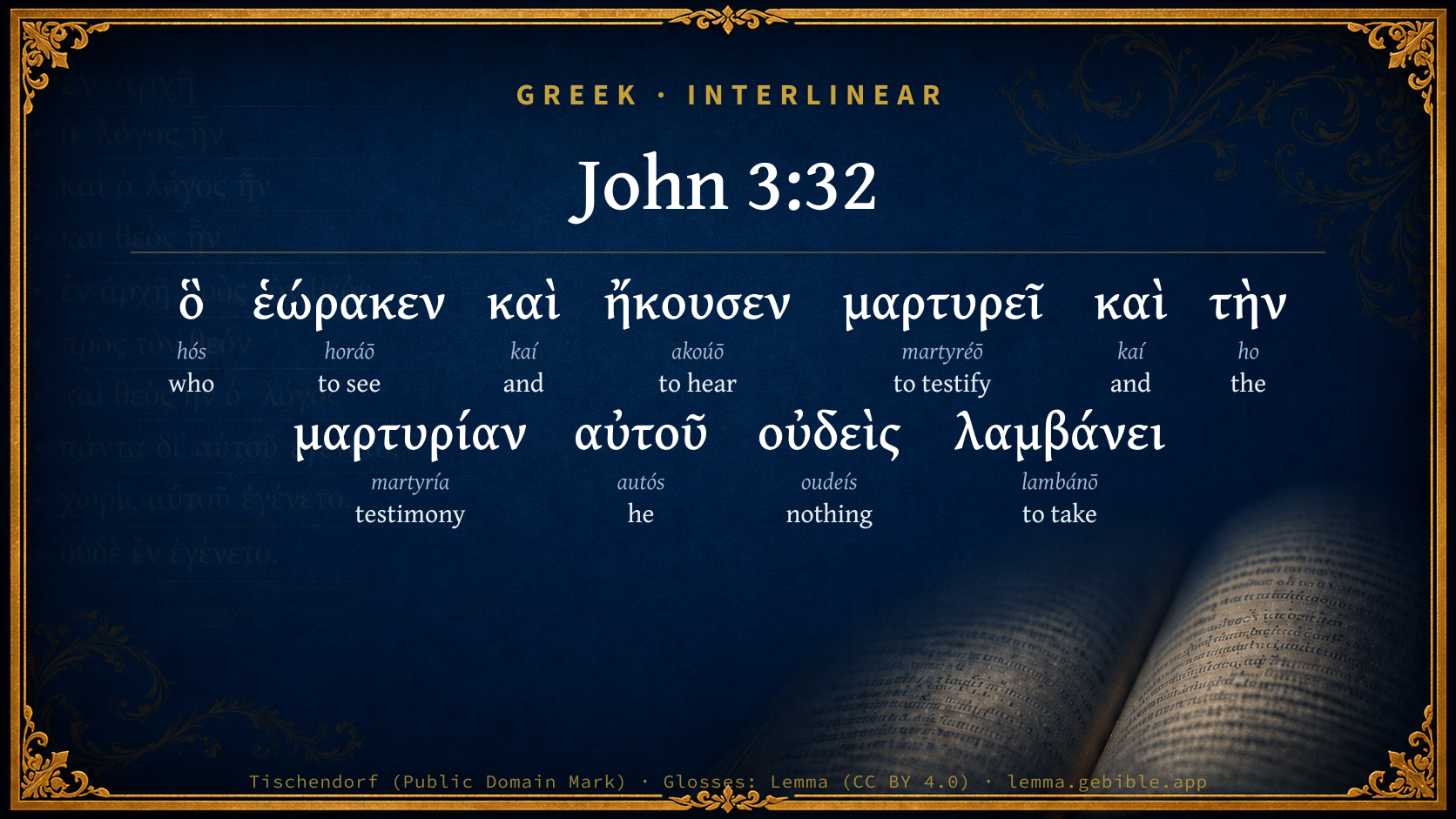
Greek (Tischendorf 8th ed.) John 3:32 appears in the Greek New Testament. The text above is from the Tischendorf 8th edition. Each word links to its Strong’s number and a concise gloss. Click any word for its full Thayer’s Greek Lexicon entry.
Download image
Cite this verse

John 3:32 (World English Bible). Public Domain. Lemma interlinear Bible study tool, https://lemma.gebible.app/v/john/3/32.

Show BibTeX & RIS
BibTeX
RIS
English Translation
What he has seen and heard, of that he testifies; and no one receives his witness.
World English Bible · Public Domain
Download a study sheet

One document with this verse’s original text, its word-by-word gloss line, the meaning frame, cross-references with their text, attributed commentary, and full source and license credits — printable, and it pastes into notes with its structure intact.

This verse Autodidact and up

Study sheet (.html) Plain text (.txt)

A passage Seminary Student

Up to 50 verses in one chapter. A passage sheet keeps up to 6 commentary sources and 12 cross-references per verse, in the order this page ranks them, and says so on the sheet whenever that leaves anything out. Ask for a single verse and you get the Autodidact verse sheet above.

Everything on this page stays free to read, with no account — the sheet is a download of what is already on screen, not access to it.

Want to remove ads? Support Godless Engineer
Compare translations 3

The same verse in 3 English versions, stacked beneath the original-language interlinear above. Click any original word for its lexicon entry.

Each is an independent rendering of the whole verse — the interlinear is not word-aligned to these translations.

Highlighted words mark where these versions differ — a whole-verse word diff, not a word-by-word alignment.

  • World English Bible Public Domain
    What he has seen and heard, of that he testifies; and no one receives his witness.
  • King James Version Public Domain
    And what he hath seen and heard, that he testifieth; and no man receiveth his testimony.
  • unfoldingWord Literal Text CC BY-SA 4.0
    He testifies about that which he has seen and heard, but no one receives his testimony.

unfoldingWord Literal Text — © unfoldingWord, licensed CC BY-SA 4.0. Word-aligned USFM3 via Door43 (git.door43.org/unfoldingWord/en_ult).

Versions to compare (up to 4)

3 of 4 selected

Show all 19 translations

Every available English version of this verse, each an independent rendering of the whole verse.

  • World English Bible Public Domain
    What he has seen and heard, of that he testifies; and no one receives his witness.
  • Berean Standard Bible Public Domain
    He testifies to what He has seen and heard, yet no one accepts His testimony.
  • Majority Standard Bible Public Domain
    He testifies to what He has seen and heard, yet no one accepts His testimony.
  • King James Version Public Domain
    And what he hath seen and heard, that he testifieth; and no man receiveth his testimony.
  • American Standard Version (1901) Public Domain
    What he hath seen and heard, of that he beareth witness; and no man receiveth his witness.
  • Revised Version (1885) Public Domain
    What he hath seen and heard, of that he beareth witness; and no man receiveth his witness.
  • Geneva Bible (1599) Public Domain
    And what hee hath seene and heard, that he testifieth: but no man receiueth his testimonie.
  • Douay-Rheims (1899) Public Domain
    And what he hath seen and heard, that he testifieth: and no man receiveth his testimony.
  • Young's Literal Translation Public Domain
    `And what he hath seen and heard this he doth testify, and his testimony none receiveth;
  • Literal Standard Version CC BY-SA 4.0
    And what He has seen and heard—this He testifies, and none receives His testimony;
  • Unlocked Literal Bible CC BY-SA 4.0
    He testifies about what he has seen and heard, but no one accepts his testimony.
  • unfoldingWord Literal Text CC BY-SA 4.0
    He testifies about that which he has seen and heard, but no one receives his testimony.
  • Darby Bible Public Domain
    [and] what he has seen and has heard, this he testifies; and no one receives his testimony.
  • World Messianic Bible Public Domain
    What he has seen and heard, of that he testifies; and no one receives his witness.
  • Webster's Bible Public Domain
    And what he hath seen and heard, that he testifieth; and no man receiveth his testimony.
  • Free Bible Version CC BY-SA 4.0
    He gives evidence about what he has seen and heard, but no one accepts what he has to say.
  • Bible in Basic English Public Domain
    He gives witness of what he has seen and of what has come to his ears; and no man takes his witness as true.
  • Text-Critical English NT CC BY 4.0
    He testifies to what he has seen and heard, yet no one receives his testimony.
  • Tyndale New Testament (1534) Public Domain
    and what he hath sene and hearde: that he testifieth: but no man receaveth his testimonye.

Literal Standard Version (2020), Covenant Press — licensed CC BY-SA 4.0. Text via the HelloAO Bible API (eBible.org). Unlocked Literal Bible (unfoldingWord) — licensed CC BY-SA 4.0. Text via the HelloAO Bible API (eBible.org). unfoldingWord Literal Text — © unfoldingWord, licensed CC BY-SA 4.0. Word-aligned USFM3 via Door43 (git.door43.org/unfoldingWord/en_ult). Free Bible Version, Dr. Jonathan Gallagher — licensed CC BY-SA 4.0. Text via the HelloAO Bible API (eBible.org).

Word by word

More ways to search: Search by grammar → Find every occurrence → Compare this word →

Practice this passage: Drill this verse → Learn its vocabulary →

About this verse

These counts appear in no published source. They are computed here, from the morphology-tagged text and Lemma’s own curated glosses. What Lemma adds →

11
words
10
distinct lemmas
Gospels
section

Shared distinctive vocabulary

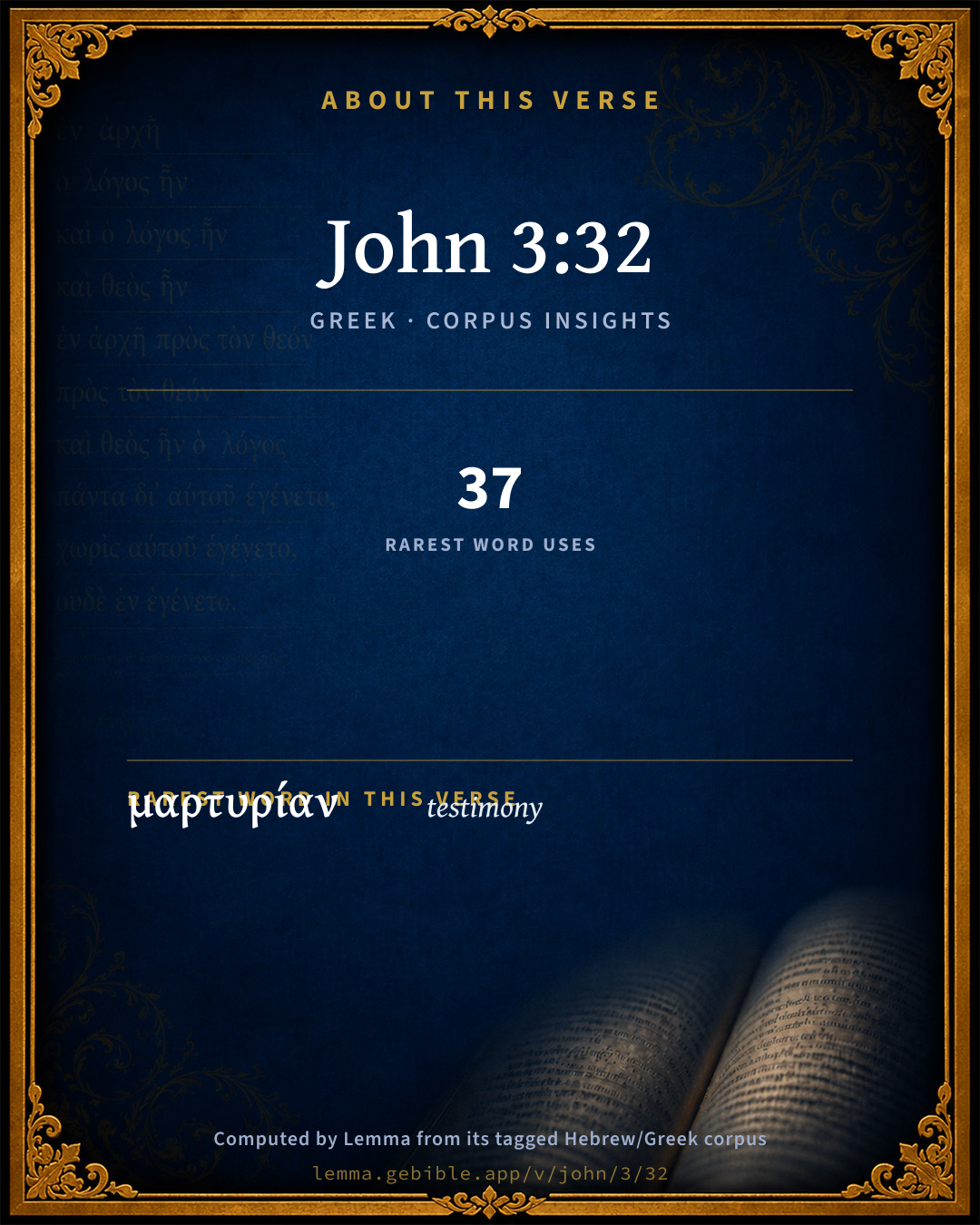
μαρτυρίαν testimony G3141 occurs in 33 verses of the Greek New Testament. Also found in:

Repetition

A word recurs within this verse:

Cross-references

6

Topical passages linked to John 3:32 in the Treasury of Scripture Knowledge — connected by theme and wording, ordered by reader-vote popularity; previews shown in the World English Bible.

  • John 3:11 Most assuredly I tell you, we speak that which we know, and testify of that which we have seen, and you don't receive our witness.
  • John 1:11 He came to his own, and those who were his own didn't receive him.
  • John 8:26 I have many things to speak and to judge concerning you. However he who sent me is true; and the things which I heard from him, these I say to the world."
  • John 15:15 No longer do I call you servants, for the servant doesn't know what his lord does. But I have called you friends, for everything that I heard from my Father, I have made known to you.
  • John 5:20 For the Father has affection for the Son, and shows him all things that he himself does. He will show him greater works than these, that you may marvel.
  • John 3:33 He who has received his witness has set his seal to this, that God is true.

Cross-references courtesy of OpenBible.info (CC BY 4.0).

Commentary

Notes on John 3:32 from classic Christian and Jewish commentators (each source and its license shown beneath its notes). The classic Christian expositions comment on the surrounding passage and are grouped to its opening verse, so a note may address several verses; the Jewish commentaries on the Tanakh (Rashi and others) are per-verse, so they appear only where the commentator wrote on this verse.

Lemma curates 59 commentaries, every one of them public domain or Creative Commons licensed, each selected and text-cleaned for this edition rather than reprinted as found. About our sources →

Joseph Benson's Commentary

Joh 3:32-34. And what he hath seen and heard — This is spoken in allusion to what was said in the preceding verse, of his being from above, where he enjoyed the most intimate communications of the divine counsels; that he testifieth — Clearly, fully, and faithfully; and no man receiveth his testimony — That is, very few receive it, particularly concerning the spiritual nature of the kingdom of God, and the qualifications requisite in his subjects. There is a strong resemblance between this and what our Lord himself said to Nicodemus, Joh 3:11-13. He that hath received his testimony — That hath understood and believed it; hath set to his seal that God is true — Hath made a most just and substantial acknowledgment of the veracity of God, who by his prophets in ancient times foretold what the nature of his kingdom under the Messiah would be, and who speaks to men now by his only-begotten Son, in such a manner as he never did by any other prophet. As sealing was employed for vouching the authenticity of writings, to seal came, by a natural and easy transition, to signify, to vouch, to attest. Our acceptance of God’s message by his Son, through an unshaken faith, vouches on our part the faithfulness of God, and the truth of his promises. For he whom God hath sent — His only-begotten Son; speaketh the words of God — Declareth doctrines which ought to be regarded as divine oracles, showing themselves to be such by their own native light of truth, and proved to be such by a great variety of the most extraordinary miracles. For God giveth not the Spirit by measure unto him — Or, under such limitations, and with such interruptions, as he hath given, or still gives, that blessed gift to all his other messengers; but it dwells in him by a constant presence, and operates through him by a perpetual and unprecedented energy.

Joseph Benson's Commentary on the Old and New Testaments (1811–1818) — public domain. Text from a community e-Sword module.

Bengel's Gnomon

Johann Albrecht Bengel

Joh 3:32. Μαρτυρεῖ, He testifieth) That is much more weighty than He speaks [λαλεῖ, Joh 3:31].—οὐδείς, no man) So ardently does John desire that Christ should obtain universal authority, that instead of that, which his [John’s] disciples say, all [men come to Him], Joh 3:26, John says, no man [receiveth His testimony]: comp. ch. Joh 12:38, “The saying of Esaias fulfilled, Lord who hath believed our report?” etc.—λαμβάνει, receiveth) A form of faith. There must be a receiving, not a mere bodily coming.

Bengel's Gnomon of the New Testament — English translation (T&T Clark, Edinburgh, 1860) — public domain. Text from a community e-Sword module.

Expositor's Greek Testament

ed. W. Robertson Nicoll

Joh 3:32 . The result is ὁ ἑώρακε … μαρτυρεῖ . Seeing and hearing are equivalent to having direct knowledge. The man who is of earth may be trusted when he speaks of earth: he who is from heaven testifies to that of which he has had experimental knowledge ( cf. Joh 3:13 ), and might therefore expect to be listened to, but τὴν μαρτυρίαν αὐτοῦ οὐδεὶς λαμβάνει . The καὶ which connects the clauses implies the meaning “and yet”. This statement could not have been made when crowds were thronging to Jesus’ baptism. They are the reflection of the evangelist, who sees how sporadically the testimony of Christ has been received. Yet it has not been universally rejected: ὁ λαβὼν … ἀληθής ἐστιν . He who received His testimony sealed that God is true. σφραγ . means to stamp with approval, to endorse, to give confirmation. Wetstein quotes from Aristides, Platonic. , i., p. 18: Αἰσχίνης μαρτυρεῖ Πλάτωνι … καὶ τὴν τοῦδε μαρτυρίαν ὥσπερ ἐπισφραγίζεται . But he who believes Christ not only confirms or approves Christ’s truthfulness, but God’s. ὃν γὰρ ἀπέστειλεν … λαλεῖ . For Christ is God’s ambassador and speaks God’s words. This is a thought which pervades this Gospel, see Joh 8:26 ; Joh 8:28 ; Joh 15:5 , etc. “He that sent me,” or “the Father that sent me,” is a phrase occurring over twenty times in the Gospel and is characteristic of the aspect of Christ presented in it, as revealing the Father.

The Expositor's Greek Testament, edited by W. Robertson Nicoll (1897–1910) — public domain. Text from a community e-Sword module.

Geneva Bible (1599)

Geneva Bible translators

That is, very few.

What he knoweth fully and perfectly.

Geneva Bible (1599) marginal notes — public domain. Text via Bolls.life.

Jamieson, Fausset & Brown

Robert Jamieson, A. R. Fausset & David Brown

what he hath seen and heard--(See on Joh 3:11 and Joh 1:18).

and no man receiveth, &c.--John's disciples had said, "All come to Him" (Joh 3:26). The Baptist here virtually says, Would it were so, but alas! they are next to "none" [BENGEL]. They were far readier to receive himself, and obliged him to say, I am not the Christ, and he seems pained at this.

Jamieson, Fausset & Brown — Commentary Critical and Explanatory on the Whole Bible (1871) — public domain (CC PDM 1.0). Text via the HelloAO Bible API.

Adam Clarke's Commentary

Verse 32. And no man receiveth his testimony.] Or, And this his testimony no man taketh up. That is, the testimony which John had borne to the Jews, that Jesus was the promised Messiah. No man taketh up. - No person is found to tread in my steps, and to publish to the Jews that this is the Christ, the Saviour of the world. See this sense of the original fully proved and vindicated by Kypke in loc.

Adam Clarke's Commentary on the Bible (1810–1826) — public domain. Text from a community e-Sword/MySword module.

John Calvin's Commentaries

32. And what he hath seen and heard. John proceeds in the discharge of his office; for, in order to procure disciples for Christ, he commends Christ’s doctrine as certain, because he utters nothing but what he has received from the Father. Seeing and hearing are contrasted with doubtful opinions, unfounded rumors, and every kind of falsehoods; for he means that Christ teaches nothing but what has been fully ascertained. But some one will say that little credit is due to him who has nothing but what he has heard. I reply, this word denotes that Christ has been taught by the Father, so that he brings forward nothing but what is divine, or, in other words, what has been revealed to him by God.

Now this belongs to the whole person of Christ, so far as the Father sent him into the world as His ambassador and interpreter. He afterwards charges the world with ingratitude, in basely and wickedly rejecting such an undoubted and faithful interpreter of God. In this way he meets the offense which might cause many to turn aside from the faith, and might hinder or retard the progress of many; for, as we are accustomed to depend too much on the judgment of the world, a considerable number of persons judge of the Gospel by the contempt of the world, or at least, where they see it everywhere rejected, they are prejudiced by that event, and are rendered more unwilling and more slow to believe. And, therefore, whenever we see such obstinacy in the world, let this admonition hold us in constant obedience to the Gospel, that it is truth which came from God. When he says that NO-MAN, receiveth his testimony, he means that there are very few and almost no believers, when compared with the vast crowd of unbelievers.

John Calvin's Commentaries (1540-1563) — public domain. Text from the Calvin Translation Society English edition (1840s-50s) via the Christian Classics Ethereal Library (ccel.org). Calvin's coverage is partial (roughly two-thirds of the Bible); uncommented books and verses are honest gaps, never fabricated. The 19th-century editor's footnotes and remarks are omitted so the notes are faithfully Calvin's own voice.

Ellicott's Commentary for English Readers

(32) And what he hath seen and heard.—This is the opposite of the third point, the speaking of the earth in the last verse. Divine in origin, divine in nature, He is divine in teaching. That teaching, too, is a witness of things seen and heard. (Comp. Notes on Joh_6:11-12.) It was a message from the Father’s home, brought by the Son Himself. His own message was but that of a servant who did not fully know its meaning.

No man receiveth his testimony.—These words are shown by those which immediately follow to go in their pathos beyond the strict limit of the facts present to his own mind. Yet he may well have said “no man.” Of the crowds that thronged to his own baptism, of those who were then thronging to the baptism of Jesus, how many were there who were receiving like testimony of the things seen and heard? (Comp. again Joh_3:11.) How great the first promise, how bitter the last disappointment, of the Baptist’s life! These words of intense feeling are not to be measured by the cold standard of a formal exactness. And still it may be that the sadness of his tone arises from the fact that of those to whom he speaks, and at the time when he speaks, there was literally no one receiving this testimony, but all were seeking to make the earthly teacher a rival of the divine. The tense is present; those in the next verse are past.

A Bible Commentary for English Readers, edited by Charles John Ellicott (1878–1897) — public domain. Text from a community e-Sword module.

The Cambridge Bible for Schools and Colleges

gen. ed. J. J. S. Perowne

32. what he hath seen and heard] In His pre-existence with God; Joh_3:11, Joh_1:18. He has immediate knowledge of heavenly things.

that he testifieth] Better, that he witnesseth (see on Joh_1:7). Precisely this is the substance of His witness.

and no man] The tragic tone again; see on Joh_1:5, and comp. Joh_3:11. ‘No man’ is an exaggeration resulting from deep feeling: comparatively speaking none, so few were those who accepted the Messiah. Comp. the similar exaggeration on the other side, Joh_3:26, ‘all men come to Him.’ These extreme contradictory statements, placed in such close proximity, confirm our trust in the Evangelist as faithfully reporting what was actually said. He does not soften it down to make it look plausible.

receiveth his testimony] Better, receiveth His witness. The Baptist takes up Christ’s words in Joh_3:11.

The Cambridge Bible for Schools and Colleges (gen. ed. J. J. S. Perowne; Cambridge University Press, 1878–1918) — public domain. Text from a community e-Sword module.

John Gill's Exposition

He that hath received his testimony,.... For there was here and there one that did, who believed in him as the Messiah, and embraced his Gospel, and submitted to his ordinances, and truly and sincerely followed him: and for the encouragement of such, it is said,

hath set to his seal that God is true; faithful in fulfilling the promises he has made concerning the Messiah, and his coming: he firmly believes that God is true to every word of his, and will make good every promise; and this he seals, ratifies, and confirms by his embracing the testimony of Christ; whereas, on the contrary, he that believes not makes God a liar, than which, nothing can be more reproachful to him, Jo1 5:10. The Jews have a saying (z) that "the seal of the blessed God is truth". The Arabic version renders it, "he is already sealed, because God is true"; and the Ethiopic version, "God hath sealed him, because he is true"; namely, with his holy Spirit; see Co2 1:22.

(z) T. Hieros. Sanhedrin, fol. 18. 1. & T. Bab. Sanhedrin, fol. 64. 1. & Yoma, fol. 69. 2.

John Gill's Exposition of the Whole Bible (1746–1763) — public domain (CC PDM 1.0). Text via the HelloAO Bible API.

Trapp's Complete Commentary

John Trapp

32 And what he hath seen and heard, that he testifieth; and no man receiveth his testimony.

Ver. 32. No man receiveth] i.e. None to speak of; comparatively none. Rari quippe boni, Few obviously are good, saith Juvenal. Rari sunt qui philosophantur, There are few who are philosophers, saith Ulpian the lawyer. Perraro grati reperiuntur, Very rare are pleasing men discovered, said Cicero the orator. All men have not faith, saith the apostle, 2Th 3:2; no, not of those that profess the faith. Though a gun be discharged at a whole flight of birds, there are but a few killed. Though the net be spread over the whole pond, but a few fishes are taken; many thrust their heads into the mud and the net passeth over them; so most hearers do busy their heads with their own sensual or worldly thoughts, and so escape the power of the word.

John Trapp, A Commentary or Exposition upon All the Books of the Old and New Testament (1647–1656) — public domain. Text from a community e-Sword module.

Albert Barnes' Notes on the Bible

And what he hath seen ... - See Joh 3:11.

No man receiveth his testimony - The words “no man” are here to be understood in the sense of “few.” Though his doctrine is pure, plain, sublime, yet “few,” comparatively, received it in faith. Though multitudes came to him, drawn by various motives Joh 6:26, yet “few” became his “real” disciples, Mat 26:56; Mat 7:22.

His testimony - His doctrine. The truth to which he bears “witness” as having “seen” and “known” it, Joh 3:11. Often many persons “appear” for a time to become the followers of Christ, who in the end are seen to have known nothing of religion, Mat 13:6; Luk 8:13.

Albert Barnes' Notes on the Bible (1834–1885) — public domain. Text from a community e-Sword/MySword module.

Haydock's Catholic Bible Commentary

Waht he hath seen and heard. The meaning is not by his senses, but what he knows for certain, having the same knowledge as his eternal Father. See chap. v., ver. 19. And no one; i.e. but few now receive his testimony. (Witham)

George Leo Haydock (1774–1849), Haydock's Catholic Family Bible and Commentary, 1859 edition — public domain. Excludes Psalms (Douay-Rheims chapter numbering differs from Protestant) and Deuterocanonical books (Catholic canon only).

Matthew Poole's English Annotations

Another great difference which the Baptist teacheth his disciples to put between his testimony and Christ’s, is, that he, and so all other ministers of the gospel, testify by revelation; Christ testifieth not by revelation, but from his own personal knowledge, what himself hath seen and heard from his Father. See Joh 3:11, where our Saviour had spoken to Nicodemus much the same. So Joh 1:18; Joh 8:26; 15:15. By these two terms is signified the most certain and infallible knowledge of those things which he testified, which made them worthy of all acceptation: but yet very few received his testimony, so as to believe in it: see Joh 1:11; 3:11.

Matthew Poole's English Annotations on the Holy Bible (1683–1685) — public domain. Text from a community e-Sword/MySword module.

Whedon's Commentary on the Bible

Daniel D. Whedon

32. What he hath seen—A messenger from heaven is no second-hand reporter. He daguerreotypes for us the objects his own eyes beheld.

No man receiveth his testimony—The Baptist here discloses who is this messenger from heaven. It is one not yet credited by men. Not Nicodemus, not the Jews at the Passover, not even his own disciples, had as yet risen to the full realization of Jesus as he is now depicted by these words of the Baptist.

Daniel D. Whedon (gen. ed.), Commentary on the Old and New Testaments (1874–1909) — public domain. Text from a community e-Sword module.

The Pulpit Commentary

That which he hath seen and heard, this he testifieth; or, beareth witness to. His pre-existent glory with the Father makes him the adequate Witness to the heavenly things (epourania) of which he hath authoritatively spoken; i.e. the eternal love of the Father, the purpose of the Son being sent into the world from the heart of God, and its ultimate issues eternal life to the believer, and condemnation to those who love the darkness and do not believe. Westcott, who regards these words as the free reflections of the evangelist, thinks that reference is being made to the continued testimony of the Church as the voice of Christ; but the spirit of the passage is obscured by this interpretation. The living present vocal testimony of Christ is being throughout contrasted with that of John. And no man receiveth his witness. This seems in direct antagonism to the language of the disciples, "All men come to him;" and to John"s own language, "He must increase." Westcott regards it, again, as the melancholy reflection of the aged apostle towards the close of the century. This seems to me to be an inadequate explanation. The reception of the witness of Christ had moved the whole world when John wrote his Gospel; and it would be inconsistent with the tone of exhilaration with which the evangelist closes his work. The forerunner may, however, have used this strong expression in purposed contrast to the jealous language of his own followers. "No man in comparison with the multitudes who ought to have already accepted him as the Son of God, as the heavenly Bridegroom. The concourse who crowded to the baptism of Jesus for a little moment did not blind the Baptist to the persistent and malignant opposition which awaited Jesus. "His joy (ver. 29) and his grief (ver. 32) both formed a noble contrast to the jealousy of his own disciples" (Meyer).

The Pulpit Commentary (1880–1919), ed. H.D.M. Spence-Jones & Joseph S. Exell — public domain. Text from a community e-Sword module.

John Wesley's Explanatory Notes

No man - None comparatively, exceeding few; receiveth his testimony - With true faith.

John Wesley, Explanatory Notes Upon the Whole Bible (1754–1765) — public domain. Text via the GEBible commentary corpus.

Burkitt's Expository Notes on the New Testament

William Burkitt

Observe, 1. Another great difference which John the Baptist teacheth his disciples to put betwixt his testimony and Christ’s; to the intent that he might remove the prejustice which was upon his disciples minds against the Messiah, he shews them that his own testimony (which they so much admired) was by revelation only; Christ’s by immediate intuition. John testified only what he had received; but Christ what he had seen; lying in the bosom of the Father: What he hath seen and heard, that he testifieth.

Learn hence, That it is Christ’s (the great Prophet of his church) peculiar prerogrative, to have the knowledge of divine truths immediately from the Father, by special communication; and that all others receive their knowledge from him by gracious illumination only.

Observe, 2. How sadly and sorrowfully the Baptists resents it, that Christ’s testimony was no better received and entertained by the world: He testifieth but no man receiveth his testimony. John’s disciples murdered, That all men came unto Christ, verse 26. But John mourns that their came not more, and complains, that none, that is, very few, received his testimony.

Thence learn, That it ought and will be matter of great regret and sorrow to all the freinds of Jesus Christ, but especially to his faithful ministers and servants, that his doctrine is so ill received and entertained in the world. It greatly affects, and greviously afflicts them, that when they testify of Christ , no man, that is, comparatively, very few men , receive their testimony.

Observe, 3. The eulogy and high commendation given of all true believers, They receive Christ’s testimony, and thereby set to their seal that God is true; that is, have subscribed to, and ratified the truth of God; that God in all his promises of the Messiah, under the Old Testament, is faithful and true.

Learn hence, The great honour that God puts upon the faith of believers. As unbelief defames God, and makes him a liar; so faith gives testimony to the truth of God, and setteth its seal that God is true: He that receiveth his testimony hath set to his seal that God is true.

Observe, 4. The illustrious character which the holy Baptist gives of Christ, his Master; he is the person whom God hath sent, that is, immediately and extraordinarily from heaven: not as the prophets and apostles were sent, but in a way peculiar to himself; having authority for speaking, not only from God, but as being God himself.

And accordingly, it is added, that God giveth not the Spirit by measure unto him; that is, the gifts and graces of the Holy Spirit were poured forth upon Christ, in a measure far above and beyond all finite creatures; there being a double difference betwixt Christ’s fulness of the Spirit, and all other persons whatsoever.

1. In the measure of it. God did not give out the Spirit to Christ sparingly, and with limitation, as he did to the former prophets and John the Baptist, in proportion to what their offices required; but he was anointed more plentifully and abundantly with the Holy Spirit above and beyond his fellows.

2. In the manner of its working. The holy prophets that were filled with the spirit (according to their measures) yet could not do or declare all things, nor act upon all occasions, but sometimes the Spirit restrained them, and sometimes departed from them. But Christ had no limits put upon the vigour of his Spirit, but his own will; therefore could work what, and when he pleased.

Learn from hence, That Christ had an abundant fitness from God for the discharge of his office, and an abundant fulness for his people. God did not measure to him a certain quantity and proportion of the gifts and graces of his spirit, but poured it forth upon him without measure.

William Burkitt's Expository Notes on the New Testament (1700–1703) — public domain. Text from a community e-Sword module.

The People's New Testament

B. W. Johnson

32. No man receiveth his testimony. So few at that time that those who received were as nothing in contrast with the others.

B. W. Johnson's The People's New Testament with Notes (1889–1891) — public domain. Electronic text from the Christian Classics Ethereal Library (CCEL) ThML edition.

Cambridge Greek Testament for Schools and Colleges

32. ὃ ἑώρακεν κ. ἤκ. In His pre-existence with God; Joh 3:11, Joh 1:18. He has immediate knowledge of τὰ ἐπουράνια. Τοῦτο, precisely this is the substance of His witness: comp. Joh 14:13. This use of a retrospective pronoun for emphasis is frequent in S. Joh 5:38; Joh 6:46; Joh 7:18; Joh 8:26; Joh 10:25; Joh 15:5.

καὶ … οὐδεὶς λαμβ. The tragic tone again; see on Joh 1:5, and comp. Joh 3:11. ‘No man’ is an exaggeration resulting from deep feeling: comparatively speaking none, so few were those who accepted the Messiah. Comp. the similar exaggeration on the other side, Joh 3:26, ‘all men come to Him.’ These extreme contradictory statements, placed in such close proximity, confirm our trust in the Evangelist as faithfully reporting what was actually said. He does not soften it down to make it look plausible.

Cambridge Greek Testament for Schools and Colleges (Cambridge University Press, 1896; 21 vols, various authors incl. Carr, Maclear, Plummer, Farrar, Lumby, Moule, M. R. James, Simcox) — public domain. Text from a community e-Sword module.

International Critical Commentary

32. AΓΔΘ read καὶ ὃ ἑώρακεν, but אBDLTbW om. καὶ. In this verse the words of v. 11 are repeated, the evangelist taking them up and amplifying them.

ὃ ἑώρακεν. This is one of the few passages in Jn. where ὁρᾶν in the perf. tense is used of spiritual vision (see also 8:38, 14:7, 15:24, and cf. 1:18).

ὃ … ἤκουσεν, τοῦτο μαρτυρεῖ. It is the constant teaching of Jn. that Jesus proclaimed what He had “heard” from the Father (8:40, 15:15; cf. 12:49). Jesus is the “Faithful Witness,” according to the Apocalypse (Rev 1:5). Cf. Introd., p. xcii.

καὶ τὴν μαρτυρίαν αὐτοῦ οὐδεὶς λαμβάνει. This is reproduced from v. 11, where see note. In the traditional order of the text, this sentence would be inconsistent with v. 26, which tells of the crowds that flocked to hear Jesus; but it is plain that John the Baptist is not the speaker here (see Introd., p. xxiii).

Jn. hastens in v. 33 to correct the rhetorical οὐδείς, just as he corrects 1:11 by 1:12; cf. also 8:15, 16, 12:44f..

For the position of οὐδείς in the sentence, see on 1:18.

International Critical Commentary — older volumes (1896–1929), various authors — public domain. Text from a community e-Sword module.

Godet's Commentaries

Frédéric Louis Godet

Ver. 32. “What he hath seen and heard, of that he beareth witness; and no man receiveth his witness.”

The καί, and, is omitted by the Alexandrian authorities, and no doubt rightly; asyndeta are frequent in this discourse. From the heavenly origin of Jesus follows the perfection of His teaching. He is in filial communion with the Father. When He speaks of divine things, He speaks of them as an immediate witness. This saying is the echo of that of Jesus in Joh 3:11. In reproducing it, the forerunner declares that Jesus has affirmed nothing respecting Himself which is not the exact truth. But how could he know this? We think we have answered this question in the explanation of Joh 3:29.

By the last words, John confirms the severe judgment which Jesus had passed upon the conduct of the people and their rulers (Joh 3:11). However, while declaring, as Jesus had done, the general unbelief of Israel, John does not deny individual exceptions; he brings them out expressly in Joh 3:33. What he means here by the word no one, is that these exceptions which seem so numerous to the view of his disciples that they make the whole (“all” Joh 3:26), are to his view only an imperceptible minority. To the exaggeration of envy, he opposes that of zeal: “Where you say: all, as for me, I say: no one.” He would not be satisfied unless he saw the Sanhedrim in a body, followed by the whole people, coming to render homage to the bridegroom of the Messianic community. Then, he could, himself also, abandon his office as friend of the bridegroom, and come to sit, as spouse, at the Messiah’s feet. We should notice the verbs in the present tense, “he testifies ...no one receives,” which place us in the time of the ministry of Jesus, and do not permit us to put this part of the discourse in the evangelist’s mouth.

Frédéric Louis Godet — Commentaries on Luke, John, Romans, and 1 Corinthians — English translation (T&T Clark, Edinburgh, 1870s–1890s) — public domain. Text from a community e-Sword module.

Lesson kit

Teaching starters — assembled from the data on this page, not authored interpretation. Every prompt links to the verse data it draws on. Edit before teaching.

John, in the Gospels, opens this verse with 11 words (10 distinct Greek lemmas). Its most distinctive word is martyría (“testimony”). A historical commentator’s framing appears above. Read the whole chapter for the surrounding context.

Discussion questions

  1. The word martyría carries the sense “testimony.” How does it shape the verse?
  2. How does Mark 14:55, which shares the word «testimony», read alongside this verse?
  3. What does the repetition of “and” (2× in this one verse) do in this verse?
  4. The translations on this page render this verse differently — a whole-verse word diff, not a word-by-word alignment. What might account for the different wordings?
  5. Compare how Joseph Benson's Commentary and Bengel's Gnomon read this verse. Where do they agree or differ?

Things to notice

Reading settings

Reading text

Shown beneath each verse's original-language words.

Old Testament
Old Testament edition

Read the OT as the Masoretic Hebrew (MT) or the Greek Septuagint (LXX).

English shown for the Greek Septuagint (in the Hebrew ↔ Greek comparison).

Comparing translations? Open the Compare panel on any verse page to stack up to four side by side.