Joshua 8:17

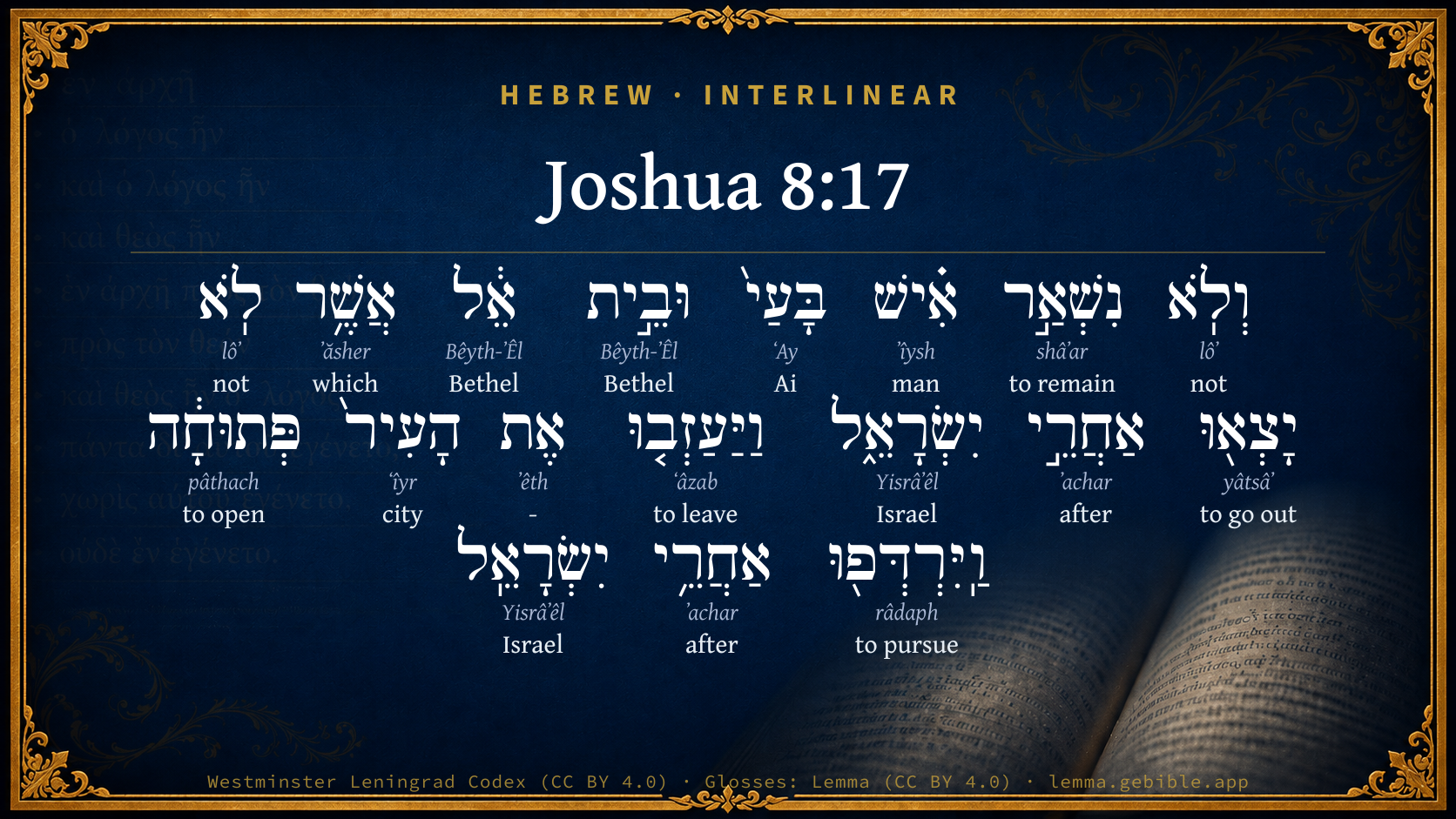
Hebrew (Westminster Leningrad Codex) Joshua 8:17 appears in the Hebrew Old Testament. The text above is from the Westminster Leningrad Codex. Each word links to its Strong’s number, a concise gloss, and parsing drawn from the Open Scriptures Hebrew Bible morphology. Click any word for its full Brown-Driver-Briggs (BDB) entry.
Download image
Cite this verse

Joshua 8:17 (World English Bible). Public Domain. Lemma interlinear Bible study tool, https://lemma.gebible.app/v/joshua/8/17.

Show BibTeX & RIS
BibTeX
RIS
English Translation
There was not a man left in Ai or Beth El, who didn't go out after Israel: and they left the city open, and pursued after Israel.
World English Bible · Public Domain
Download a study sheet

One document with this verse’s original text, its word-by-word gloss line, the meaning frame, cross-references with their text, attributed commentary, and full source and license credits — printable, and it pastes into notes with its structure intact.

This verse Autodidact and up

Study sheet (.html) Plain text (.txt)

A passage Seminary Student

Up to 50 verses in one chapter. A passage sheet keeps up to 6 commentary sources and 12 cross-references per verse, in the order this page ranks them, and says so on the sheet whenever that leaves anything out. Ask for a single verse and you get the Autodidact verse sheet above.

Everything on this page stays free to read, with no account — the sheet is a download of what is already on screen, not access to it.

Want to remove ads? Support Godless Engineer
Compare translations 3

The same verse in 3 English versions, stacked beneath the original-language interlinear above. Click any original word for its lexicon entry.

Each is an independent rendering of the whole verse — the interlinear is not word-aligned to these translations.

Highlighted words mark where these versions differ — a whole-verse word diff, not a word-by-word alignment.

  • World English Bible Public Domain
    There was not a man left in Ai or Beth El, who didn't go out after Israel: and they left the city open, and pursued after Israel.
  • King James Version Public Domain
    And there was not a man left in Ai or Bethel, that went not out after Israel: and they left the city open, and pursued after Israel.
  • unfoldingWord Literal Text CC BY-SA 4.0
    And a man was not left in Ai or Bethel who had not gone out after Israel. And they left the city opened, and they pursued after Israel.

unfoldingWord Literal Text — © unfoldingWord, licensed CC BY-SA 4.0. Word-aligned USFM3 via Door43 (git.door43.org/unfoldingWord/en_ult).

Versions to compare (up to 4)

3 of 4 selected

Show all 18 translations

Every available English version of this verse, each an independent rendering of the whole verse.

  • World English Bible Public Domain
    There was not a man left in Ai or Beth El, who didn't go out after Israel: and they left the city open, and pursued after Israel.
  • Berean Standard Bible Public Domain
    Not a man was left in Ai or Bethel who did not go out after Israel, leaving the city wide open while they pursued Israel.
  • Majority Standard Bible Public Domain
    Not a man was left in Ai or Bethel who did not go out after Israel, leaving the city wide open while they pursued Israel.
  • King James Version Public Domain
    And there was not a man left in Ai or Bethel, that went not out after Israel: and they left the city open, and pursued after Israel.
  • American Standard Version (1901) Public Domain
    And there was not a man left in Ai or Beth-el, that went not out after Israel: and they left the city open, and pursued after Israel.
  • Revised Version (1885) Public Domain
    And there was not a man left in Ai or Beth-el, that went not out after Israel: and they left the city open, and pursued after Israel.
  • Geneva Bible (1599) Public Domain
    So that there was not a man left in Ai, nor in Beth-el, that went not out after Israel: and they left the citie open, and pursued after Israel.
  • Douay-Rheims (1899) Public Domain
    And not one remained in the city of Hai and of Bethel, that did not pursue after Israel, leaving the towns open as they had rushed out,
  • Young's Literal Translation Public Domain
    and there hath not been left a man in Ai and Bethel who hath not gone out after Israel, and they leave the city open, and pursue after Israel.
  • Literal Standard Version CC BY-SA 4.0
    and there has not been a man left in Ai and Bethel who has not gone out after Israel, and they leave the city open, and pursue after Israel.
  • Unlocked Literal Bible CC BY-SA 4.0
    There was not a man left in Ai and Bethel who had not gone out to pursue Israel. They abandoned the city and left it open as they pursued Israel.
  • unfoldingWord Literal Text CC BY-SA 4.0
    And a man was not left in Ai or Bethel who had not gone out after Israel. And they left the city opened, and they pursued after Israel.
  • Darby Bible Public Domain
    And not a man remained in Ai and Bethel that went not out after Israel; and they left the city open, and pursued after Israel.
  • World Messianic Bible Public Domain
    There was not a man left in Ai or Bethel who didn’t go out after Israel. They left the city open, and pursued Israel.
  • Webster's Bible Public Domain
    And there was not a man left in Ai, or Beth-el that went not out after Israel: and they left the city open, and pursued Israel.
  • Free Bible Version CC BY-SA 4.0
    There wasn't a man left in Ai and Bethel who didn't go out to chase the Israelites. They left the town wide open as they pursued the Israelites.
  • Bible in Basic English Public Domain
    There was not a man in Ai and Beth-el who did not go out after Israel; and the town was open and unwatched while they went after Israel.
  • JPS Tanakh (1917) Public Domain
    And there was not a man left in Ai or Beth-el, that went not out after Israel; and they left the city open, and pursued after Israel.

Literal Standard Version (2020), Covenant Press — licensed CC BY-SA 4.0. Text via the HelloAO Bible API (eBible.org). Unlocked Literal Bible (unfoldingWord) — licensed CC BY-SA 4.0. Text via the HelloAO Bible API (eBible.org). unfoldingWord Literal Text — © unfoldingWord, licensed CC BY-SA 4.0. Word-aligned USFM3 via Door43 (git.door43.org/unfoldingWord/en_ult). Free Bible Version, Dr. Jonathan Gallagher — licensed CC BY-SA 4.0. Text via the HelloAO Bible API (eBible.org).

Word by word

More ways to search: Search by grammar → Find every occurrence → Compare this word →

Practice this passage: Drill this verse → Learn its vocabulary →

בָּעַי֙
ʻAy
H5857
“in/at the · Ai”
Preposition, Determined + Noun, Proper
Part of Speech
Preposition + Noun
Type
Proper
Full BDB Definition

Origin: for H5856

TWOT: None

Ai or Aija or Aiath or Hai = "heap of ruins" - a city lying east of Bethel and beside Bethaven near Jericho and the 2nd city taken on the invasion of Canaan - a city of the Ammonites on the east of the Jordan and apparently attached to Heshbon
  1. וְלֹֽא lôʼ H3808 “and · not” Conjunction + Particle, Negative
  2. נִשְׁאַ֣ר shâʼar H7604 “to remain” Verb, Niphal, Perfect, 3rd Person, Masculine, Singular
  3. אִ֗ישׁ ʼîysh H376 “man” Noun, Common, Masculine, Singular, Absolute
  4. וּבֵ֣ית Bêyth-ʼÊl H1008 “and · Bethel” Conjunction + Noun, Proper
  5. אֵ֔ל Bêyth-ʼÊl H1008 “Bethel” Noun, Proper
  6. אֲשֶׁ֥ר ʼăsher H834 “which” Particle, Relative
  7. לֹֽא lôʼ H3808 “not” Particle, Negative
  8. יָצְא֖וּ yâtsâʼ H3318 “to go out” Verb, Qal, Perfect, 3rd Person, Common, Plural
  9. אַחֲרֵ֣י ʼachar H310 “after” Preposition
  10. יִשְׂרָאֵ֑ל Yisrâʼêl H3478 “Israel” Noun, Proper
  11. וַיַּעַזְב֤וּ ʻâzab H5800 “and · to leave” Conjunction + Verb, Qal, Sequential Imperfect, 3rd Person, Masculine, Plural
  12. אֶת ʼêth H853 “-” Particle, Direct Object
  13. הָעִיר֙ ʻîyr H5892 “the · city” Particle, Definite Article + Noun, Common, Feminine, Singular, Absolute
  14. פְּתוּחָ֔ה pâthach H6605 “opened” Verb, Qal, Participle Passive, Feminine, Singular, Absolute
  15. וַֽיִּרְדְּפ֖וּ râdaph H7291 “and · to pursue” Conjunction + Verb, Qal, Sequential Imperfect, 3rd Person, Masculine, Plural
  16. אַחֲרֵ֥י ʼachar H310 “after” Preposition
  17. יִשְׂרָאֵֽל Yisrâʼêl H3478 “Israel” Noun, Proper

About this verse

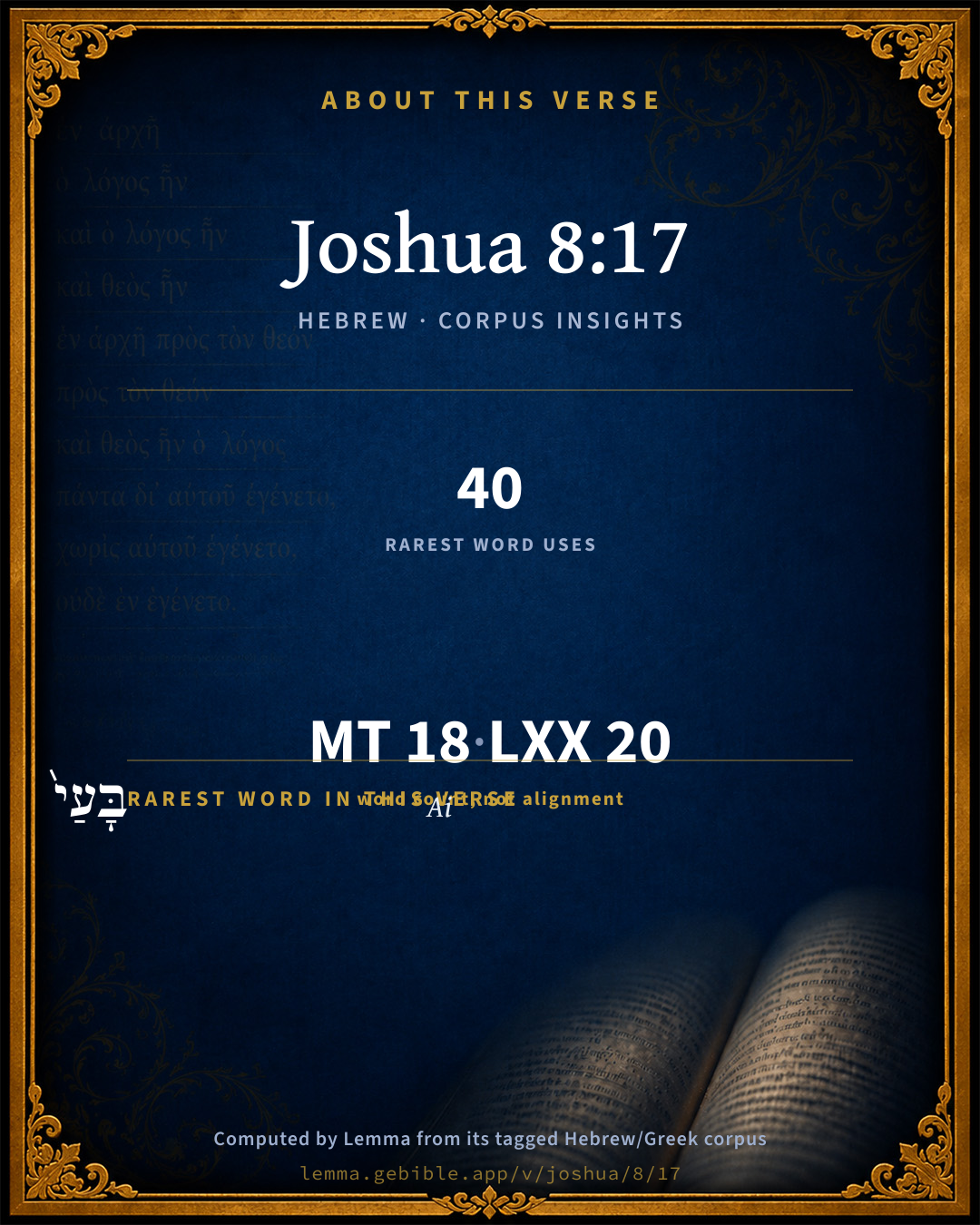
These counts appear in no published source. They are computed here, from the morphology-tagged text and Lemma’s own curated glosses. What Lemma adds →

18
words
14
distinct lemmas
Historical
section

Shared distinctive vocabulary

בָּעַי֙ Ai H5857 occurs in 34 verses of the Hebrew Bible. Also found in:

Grammatical profile

  • 5 verbs
  • 7 nouns
  • 2 prepositions
  • 4 particles

Verb forms

  • נִשְׁאַ֣ר Niphal · Perfect
  • יָצְא֖וּ Qal · Perfect
  • וַיַּעַזְב֤וּ Qal · Sequential Imperfect
  • פְּתוּחָ֔ה Qal · Participle Passive
  • וַֽיִּרְדְּפ֖וּ Qal · Sequential Imperfect

Repetition

Words recur within this verse — often emphatic in Hebrew:

  • וּבֵ֣ית Bethel H1008 ×2
  • אַחֲרֵ֣י after H310 ×2
  • יִשְׂרָאֵ֑ל Israel H3478 ×2
  • וְלֹֽא not H3808 ×2

Hebrew & Septuagint length

In English translation the verse runs 27 words from the Hebrew and 23 from the Septuagint (LXX English) — closely comparable.

A rough comparison of the two English renderings, which tokenize alike — not a word-level alignment.

Word counts can differ between the Hebrew and the Greek without any difference in meaning — e.g. the Hebrew direct-object marker אֵת has no separate Greek word, and Greek often adds the article ὁ.

In the original languages it is 18 Hebrew tokens and 20 Greek tokens — but the two are counted differently (Hebrew bundles its prefixes and suffixes into one token; the Greek is in lemma form), so that isn’t a like-for-like length.

Cross-references

6

Topical passages linked to Joshua 8:17 in the Treasury of Scripture Knowledge — connected by theme and wording, ordered by reader-vote popularity; previews shown in the World English Bible.

  • Deuteronomy 2:30 But Sihon king of Heshbon would not let us pass by him; for Yahweh your God hardened his spirit, and made his heart obstinate, that he might deliver him into your hand, as at this day.
  • Joshua 8:3 So Joshua arose, and all the people of war, to go up to Ai: and Joshua chose out thirty thousand men, the mighty men of valor, and sent them forth by night.
  • Joshua 8:24–25 It happened, when Israel had made an end of killing all the inhabitants of Ai in the field, in the wilderness in which they pursued them, and they were all fallen by the edge of the sword, until they were consumed, that all Israel returned to Ai, and struck it with the edge of the sword.
  • Joshua 11:20 For it was of Yahweh to harden their hearts, to come against Israel in battle, that he might utterly destroy them, that they might have no favor, but that he might destroy them, as Yahweh commanded Moses.
  • Job 5:13 He takes the wise in their own craftiness; The counsel of the cunning is carried headlong.
  • Isaiah 19:11–13 The princes of Zoan are utterly foolish; the counsel of the wisest counselors of Pharaoh is become brutish: how do you say to Pharaoh, I am the son of the wise, the son of ancient kings?

Cross-references courtesy of OpenBible.info (CC BY 4.0).

Hebrew and Greek witnesses Masoretic Hebrew ↔ Greek Septuagint

The same verse in the two great witnesses to the Old Testament, shown verse-for-verse.

These are two independent witnesses, not word-aligned to each other, and the Septuagint is shown in lemma (dictionary) form.

Hebrew Joshua 8:17 Masoretic · Westminster Leningrad Codex

וְלֹֽא נִשְׁאַ֣ר אִ֗ישׁ בָּעַי֙ וּבֵ֣ית אֵ֔ל אֲשֶׁ֥ר לֹֽא יָצְא֖וּ אַחֲרֵ֣י יִשְׂרָאֵ֑ל וַיַּעַזְב֤וּ אֶת הָעִיר֙ פְּתוּחָ֔ה וַֽיִּרְדְּפ֖וּ אַחֲרֵ֥י יִשְׂרָאֵֽל

There was not a man left in Ai or Beth El, who didn't go out after Israel: and they left the city open, and pursued after Israel.

World English Bible · Public Domain

Greek LXX Joshua 8:17 Septuagint · lemma form

οὐ καταλείπω οὐδείς ἐν ὁ γαι ὅς οὐ καταδιώκω ὀπίσω ἰσραήλ καί καταλείπω ὁ πόλις ἀναοἴγω καί καταδιώκω ὀπίσω ἰσραήλ

There was no one left in Gai who did not pursue after Israel; and they left the city open, and pursued after Israel.

LXX2012 (modern English Septuagint) · Public Domain

On this verse, The Pulpit Commentary discusses the Septuagint’s reading. Read the note in Commentary ↓

Hebrew: Westminster Leningrad Codex (CC BY 4.0). Greek: Septuagint (public domain); English from LXX2012 (modern English Septuagint) (Public Domain). How the Septuagint differs from the Hebrew →

Targum (Aramaic paraphrase)

1

The Targum is the ancient Jewish Aramaic paraphrase of the Hebrew Scriptures — an interpretive translation, not the Hebrew text itself. Onkelos (literal) and Pseudo-Jonathan (expansive) render the Torah, and Jonathan the Prophets. Coverage is partial: where no permissively-licensed English translation exists for a verse, only the Aramaic is shown. This is verse-level text, not a word-by-word alignment to the Hebrew.

  1. Targum Jonathan Prophets (Joshua–Malachi)
    וְלָא אִשְׁתְּאַר אֱנַשׁ בְּעַי וּבֵית אֵל דְלָא נְפַקוּ בָּתַר יִשְׂרָאֵל וּשְׁבַקוּ יַת קַרְתָּא כַּד פְּתִיחָא וּרְדַפוּ בָּתַר יִשְׂרָאֵל:

    (no public-domain English translation for this verse)

    Targum Jonathan — Aramaic: “Mikraot Gedolot” (public domain). English: “Sefaria Community Translation” (CC0 1.0 (public-domain dedication)); “London "Chaldee Paraphrase," 1871” (public domain). Text via Sefaria.

Commentary

Notes on Joshua 8:17 from classic Christian and Jewish commentators (each source and its license shown beneath its notes). The classic Christian expositions comment on the surrounding passage and are grouped to its opening verse, so a note may address several verses; the Jewish commentaries on the Tanakh (Rashi and others) are per-verse, so they appear only where the commentator wrote on this verse.

Lemma curates 59 commentaries, every one of them public domain or Creative Commons licensed, each selected and text-cleaned for this edition rather than reprinted as found. About our sources →

Trapp's Complete Commentary

John Trapp

Jos 8:17 And there was not a man left in Ai or Bethel, that went not out after Israel: and they left the city open, and pursued after Israel.

Ver. 17. And there was not a man left in Ai or Bethel.] Thus obdurate sinners are even ambitious of destruction. Judgments need not go to find them out; they run to meet their bane.

And they left the city open.] Security ushereth in destruction. God’s saints are oft outwitted by the devil, whilst by a wile he getteth them out of the city, - the promise and God’s gracious presence, - and then doth what he will with them. "Little children," saith St John, "if ye abide in God’s commandments" (and so keep home), "ye abide in God," and so are in safety. {1Jn 2:28}

John Trapp, A Commentary or Exposition upon All the Books of the Old and New Testament (1647–1656) — public domain. Text from a community e-Sword module.

Tyndale Open Study Notes

Tyndale Open Resources

8:17 not a man left in Ai or Bethel: Much of an individual soldier’s gain from warfare was his share of the spoils taken from the defeated enemy or a reward given by his king for each enemy he killed. • The warriors of Bethel likely joined those of Ai because they also feared Israel’s advance.

Tyndale Open Study Notes — © Tyndale Open Resources, licensed CC BY-SA 4.0. Text via the HelloAO Bible API.

Adam Clarke's Commentary

Verse 17. There was not a man left in Ai or Beth-el] It is very likely that the principal strength of Beth-el had been previously brought into Ai, as the strongest place to make a stand in; Beth-el being but about three miles distant from Ai, and probably not greatly fortified. Therefore Ai contained on this occasion all the men of Beth-el - all the warriors of that city, as well as its own troops and inhabitants. Others think that the Beth-elites, seeing the Israelites fly, sallied out of their city as against a common enemy; but that, finding the men of Ai discomfited, and the city taken, they returned to Beth-el, which Joshua did not think proper to attack at this time. From Jdg 1:24 we find that Beth-el was then a walled city, in the hands of the Canaanites, and was taken by the house of Joseph.

Adam Clarke's Commentary on the Bible (1810–1826) — public domain. Text from a community e-Sword/MySword module.

John Calvin's Commentaries

17. And there was not a man left in Ai, etc It will be clear from the context that some were taken in the city and slain, and therefore we must hold that the sally was not by all universally, and that the old men and women and many others unfit for war, did not rush forth into the fields; the meaning simply is, that no garrison was left to defend the city. The same thing is said of Bethel, and hence we may easily conjecture that Bethel, as it was a small unimportant town, belonged to another power. The inhabitants, however, from being unable to defend their own city, abandoned it, and offered their whole force to the king of Ai, to whom they were perhaps tributaries. It is uncertain whether they went to the king of Ai before the arrival of the Israelites, to unite their forces with his in the contest, but the probability is, that as they were unable to resist they had come by agreement into a fortified and more populous city. They thought that they could not, possibly be safe unless they were preserved under the shadow of a neighboring city superior to their own.

John Calvin's Commentaries (1540-1563) — public domain. Text from the Calvin Translation Society English edition (1840s-50s) via the Christian Classics Ethereal Library (ccel.org). Calvin's coverage is partial (roughly two-thirds of the Bible); uncommented books and verses are honest gaps, never fabricated. The 19th-century editor's footnotes and remarks are omitted so the notes are faithfully Calvin's own voice.

Ellicott's Commentary for English Readers

(17) There was not a man left in Ai or Beth-el.—Another singular justification of the peculiar strategy of Joshua. The road past Beth-el to Ai had been left open. It passes the north end of the two ravines in which Joshua’s ambush was posted. At the same time, it would have been easy to conceal a chain of sentinels that could observe it and tell the 35,000 men in ambush what was going on, so that if any attempt had been made by the men of Beth-el to protect Ai, it could easily have been frustrated. But no one suspected any danger, and therefore no such attempt was made. The men of Beth-el and Ai took the road that was left open to them and pursued the Israelites, probably down the ancient way past Michmash towards the Shebarim, leaving Beth-el and Ai both unprotected. After they had gone some distance, about a mile or a mile and a half from Ai, this road would bring them past the lower end of the ravine in which the ambush was posted. A second chain of outposts would easily take the signal from Joshua when this point had been passed, and then all was over with the town of Ai.

It is curious that we do not hear of the capture of Beth-el at this time, though it would have been perfectly easy to take it. The king of Beth-el is named in the list of those whom Joshua smote (Jos_12:16). We read of its capture in Jdg_1:22, and of the “entrance into the city” being sought for and betrayed. But that can hardly have been the first capture of the town.

A Bible Commentary for English Readers, edited by Charles John Ellicott (1878–1897) — public domain. Text from a community e-Sword module.

The Cambridge Bible for Schools and Colleges

gen. ed. J. J. S. Perowne

17. or Beth-el] The inhabitants of Bethel would seem on this occasion to have sent help to the people of Ai in resisting the attack of Joshua.

The Cambridge Bible for Schools and Colleges (gen. ed. J. J. S. Perowne; Cambridge University Press, 1878–1918) — public domain. Text from a community e-Sword module.

John Gill's Exposition

And there was not a man left in Ai or Bethel that went not out after Israel,.... For as these two places were very near to each other, but a mile apart, they were in confederacy, and acted together, and could easily be called to the help of each other when required: though there is a difficulty how the men of Bethel could join those of Ai, when the ambush lay between them both, Jos 8:12; they either went another way, or the ambush purposely let them pass, for fear of a discovery by a skirmish with them, and that Bethel as well as Ai might be cleared of its armed inhabitants, and so fall an easy prey to them as well as Ai: this must be understood only of men of war; for otherwise there were inhabitants left, as old men, and such as were unfit for war, afterwards slain, Jos 8:24,

and they left the city open: they did not stay to shut the gates, nor left porters or any guards about, to take care of, protect, and defend the city:

and pursued after Israel; with great eagerness and vehemence, not having the least apprehension of their city being in any danger.

John Gill's Exposition of the Whole Bible (1746–1763) — public domain (CC PDM 1.0). Text via the HelloAO Bible API.

Albert Barnes' Notes on the Bible

Or Bethel - See the Jos 8:1 note.

Albert Barnes' Notes on the Bible (1834–1885) — public domain. Text from a community e-Sword/MySword module.

Haydock's Catholic Bible Commentary

Not one fit to bear arms. (Worthington) --- Bethel. As soon as the people of this city perceived the Israelites fleeing, they rushed out to assist the king of Hai in the pursuit. But when they saw the former rally, before they had joined their friends, (Calmet) they very prudently retired, and left the unhappy citizens of Hai to their fate. (Haydock) --- Hence all who were slain belonged to the latter city, ver. 25.

George Leo Haydock (1774–1849), Haydock's Catholic Family Bible and Commentary, 1859 edition — public domain. Excludes Psalms (Douay-Rheims chapter numbering differs from Protestant) and Deuterocanonical books (Catholic canon only).

Matthew Poole's English Annotations

Not a man, to wit, fit for war. Beth-el, being a neighbouring city, and encouraged by the former success, had sent some forces to assist them; and now, upon notice sent to them of the flight of their common enemies, or upon some other signal given, which might easily be done, having been appointed beforehand, as is usual in such cases, all their men of war join with those of Ai in the pursuit.

Matthew Poole's English Annotations on the Holy Bible (1683–1685) — public domain. Text from a community e-Sword/MySword module.

Whedon's Commentary on the Bible

Daniel D. Whedon

17. Or Bethel — This small city, three miles distant on the west, had probably concentrated its military strength at Ai, as the next probable point of attack by Joshua after the conquest of Jericho; for we cannot conceive of their separate and concerted action, with a large undiscovered ambuscade between them. Our interpretation is confirmed by the next statement, and they left the city — not cities — open. We have no further mention in this book of the conquest of Bethel, except that its king is in the list of those subdued by Joshua, in chap. Jos_12:16. “It was not taken at that time, and seems long to have resisted the invaders. At last it fell before the arms, not of the little tribe of Benjamin, within whose territory it was included, but of the powerful house of Joseph, who attacked it from the north, and who thus acquired possession of it. Jdg_1:23-25.” — Stanley.

89504e470d0a1a0a0000000d494844520000002a000000b6080300000098b9ef5100000300504c54450000000101010202020303030404040505050606060707070808080909090a0a0a0b0b0b0c0c0c0d0d0d0e0e0e0f0f0f1010101111111212121313131414141515151616161717171818181919191a1a1a1b1b1b1c1c1c1d1d1d1e1e1e1f1f1f2020202020202222222323232424242424242626262727272828282828282a2a2a2b2b2b2c2c2c2c2c2c2e2e2e2f2f2f3030303030303232323333333434343434343636363737373838383838383a3a3a3b3b3b3c3c3c3c3c3c3e3e3e3f3f3f4040404141414141414343434444444545454646464747474848484949494949494b4b4b4c4c4c4d4d4d4e4e4e4f4f4f5050505151515151515353535454545555555656565757575858585959595959595b5b5b5c5c5c5d5d5d5e5e5e5f5f5f6060606161616161616363636464646565656666666767676868686969696969696b6b6b6c6c6c6d6d6d6e6e6e6f6f6f7070707171717171717373737474747575757676767777777878787979797979797b7b7b7c7c7c7d7d7d7e7e7e7f7f7f8080808181818282828383838383838585858686868787878888888989898a8a8a8b8b8b8c8c8c8d8d8d8e8e8e8f8f8f9090909191919292929393939393939595959696969797979898989999999a9a9a9b9b9b9c9c9c9d9d9d9e9e9e9f9f9fa0a0a0a1a1a1a2a2a2a3a3a3a3a3a3a5a5a5a6a6a6a7a7a7a8a8a8a9a9a9aaaaaaabababacacacadadadaeaeaeafafafb0b0b0b1b1b1b2b2b2b3b3b3b3b3b3b5b5b5b6b6b6b7b7b7b8b8b8b9b9b9babababbbbbbbcbcbcbdbdbdbebebebfbfbfc0c0c0c1c1c1c2c2c2c3c3c3c3c3c3c5c5c5c6c6c6c7c7c7c8c8c8c9c9c9cacacacbcbcbcccccccdcdcdcecececfcfcfd0d0d0d1d1d1d2d2d2d3d3d3d3d3d3d5d5d5d6d6d6d7d7d7d8d8d8d9d9d9dadadadbdbdbdcdcdcdddddddedededfdfdfe0e0e0e1e1e1e2e2e2e3e3e3e3e3e3e5e5e5e6e6e6e7e7e7e8e8e8e9e9e9eaeaeaebebebecececedededeeeeeeefefeff0f0f0f1f1f1f2f2f2f3f3f3f3f3f3f5f5f5f6f6f6f7f7f7f8f8f8f9f9f9fafafafbfbfbfcfcfcfdfdfdfefefeffffff0e79e2e400000001624b47440088051d48000000097048597300000ec400000ec401952b0e1b000008a74944415458858d59096c14e715de921a1bf07daed78bafb521accd196eb3c4c6052b11c41c519406a22840d2a084a8485545694155412d4d53536808a5941e2954690454a5a52486d01813481ccea6145362c036a6f6da5e7b777676eef9facf60c0b3ecf19eacd17afdf9edf7bfe37b6f666d8866b2063d80018c4a9f1b32dfb045854281caaed74624547e81904680566e42e66c558de975884061d0fb5ae5ff621290018e5d1754001b53a5de985e158696f5a98ce47f126a1193ab16609725db3584e01ec52ed1a11244058de33b20a9783b61654c023aee0afafcf19754744e79ac5a8e01e5cda308cf5773dc1e9b4b8ae995b19542506780cbcad0a4585e0720051909f9f2e6a9b9df15d8ab185ebd80c82e93ed395fd7204831a001f06662f30f781c15aa108b2b732389ecea84949804e3bfa213b82531bfc094cdb529a3d013cbab7110f4e349dbfe03b64a2356d1a12c0310c03f5e08d539d5c86bccb8ca1c57fbe325120a5d03316b40f0b153976c6a9a0c756c89a6c7f11af09c6c3febe9876d63202657962e8f72e392af8247865b66d51b09ca126afc65ef34fbcf70e3e3ef89017b09227be520f332026afef4ba2fee5cfad38f00479184de08501e8acaa2b4d97eaa6c657fdb99863f06b02c438de85532dbef838d73cf78967575f1f3d6e948f3a8821801aa1a5e7b17e18333df58e7f3f76cfe481a5c5aaa8a11b9fa35708bba824ddce29ab64e8c6d0472cbfd8854da8a0cdf9b97f7c9a75adc1fab673b4e9fea94dea842c46ce9ecb3269e17ba7afefdd4f6ce77b87d4d90a6cd16ad0498eec0c73e4842f9181ffcc785594b9affd9b5feee553dbd0c8316683f543fabfd7eac729c13bd773b5133e9c2c50baf1cd250f8b468c956c8f84d633eddcbe742fc87f8d5cd754f5cf9bcfdfbb7fc52f20488c270af22fa42d0b4b2bac601c5db8a8e132f2c3fffebd6b33bbec48902048613e07585b9fcf22567a72e20d80f7cfef847178e1d6ec66175c34483def008b09abc334d87f7e8b8ab6aabf4c987f58dd7aa5603db91340dd6c4aa3cc4ae73213f9655fdd5d7239fbfb474df131d18d47c0313928d733c842a3a02dd55ef09dea6fd8a146c53f79d585cb785c54e6fe5b2f30c797d0895d189aabb5eacdd8d976fbfc90ffca2f9b8df9c07bf5332f260910ca3e70f227857c2919bc12d67bb7ffa9d5765c180346066a995abcaa14ac2a7fba16e50dadffff0f0c1893035057b30a344b37065f6061a64f8dfc70f79b1fefc74883c075d174f21dd6994f043a8e09f77a09a25ed65aeefe0edbd7f5e631c044186b988a492b008a0c0c3293cfe70d28bb6cfe6b0521a90cd3e69141c2e2b57e5e90e1f4bd73338e66b1fac811234def4df044e4bf65249b548714060a7781dea6fbbb05265a91b60a22583d7fa91380e967a158c9fd0625cbef85f5659e2c3247a91e680686918d928b4a377f63ffbc22783462bde2776c557598cf02e40e8dbf8fdf23d5bfa8c3a7a603da8cb806e112255d3b0507eae7e9211797fe0fedb03b7513fc2da86cca9b6a81b2bbed961f6d703d3db95d579b2a55cc0857a67415cb34206279a5e1ef8585aac6ac387513b30a98f3bb410418d8729bdf7ec5f21a1c06906e8a157df7bae3b7fa9ee53991b356016a869bd908aaaccdf8695cb4caf56d4348ce53d6bb981ec62d93ae2423bc5292ff68423111a44bacbda0508b554fec05817c24d4156192c04b875532733f28f40451f9c2eddeab52805dd3cf788536f1b0a4a74cb906f9fcb4bf774308c6b6b20b304167dddb58bd5e123e767827f9dcf2b46d830128d1405c3a17dad708d152cc78a6672b738ce1d671a0ed9ad169fed995094696835b6c2fc24c19810f1a12d81eeea1c537be2425900bff62462af8f43f6a982f2c2b0d28e62c78131f3d8e8211d4b494a8f3c8ec3ed08647b0e622f7a43f6ab6ee43b8224af9f310c83fa08d0151c121c34ae3b11cc4932d6c3f8d05f72589f67946b7ce8df79ff8c2cc4bedb18b2778151aeb83ba169cdc0c8d16673c6859e94313a532395cb39454bc9d3744ab66e404fcda311b80ea4e587cb5b643b2de9994e5a691f1390e988b3c10fd9094620072402bb819c4a364708d0c641357bba484aec151f6c59b422bcc8b6b72444dc34c3ed14a45759b950b2f5370c3c974923d00cc16ed349d03b12d2cb7452049a80c47abf21d171a187c0afcd32a77e5ce8cdeb2877f4ea9460e1366c052aa9b282023212cc691217da16846d344d34d926919e8d7837d2f7b176b748526d0dc14467c8981b71a1ac59f33de6abb8507fb79e58685df6a3d9e009357504adb2ba8ea2308d46a0bd05493961b73b51ccd70e5b0e4d5f6f5f5492d3400a16f72e324720e6a384fb76ed6d253387dd3111a0a1634a422a748a66e11a12928c7580209a476077d23a76d766d15908952219cd5b95ac3444be3b0eb77dc84d03a95e030d722a5397584f73ee9bbe13c5a96cbda710d8814a076d1c8b6f69e5c4720934c03e8a26c5e21ee426842dfb514c7f0763c7d0469cf696e2caa2c5157b747b116dc6622ff21c6abc6744f708ec4676a642dadefab62123592741bf5aafa58d0189c0cd35727a322d5bfc6b7a4e0ab15e37c09146dcb517c24d9cdcfa1aa4a62824af1dcfc2ee004f0956f7fce07467dc277af76cb558318623050b3f873d99266ffd3be048a5c91bb68aa536da4ea8ad424101b1b957213f8fa659781ef62c5a65694b554736485c853ab93897d6b1a10552999db694aab5321322d26d2416c965192a091a9a89fc9134cdd25f87fb31dadd06b662bc4ba3e9eb723d615ec8d81de22f24d39032ddb8772710f060462a4d07e45ad1334209902aab5eab9902d230c202d48c246e6f1ed424d184489aa32f4aa1b5a1ecc1d23c22818558554a1c1b4f61ed04f3457c689df64a050daad50a6bdc44d15c866f39223f2d0f37750ebf2d3b4093b759fc36b78f1401d6303b5f8442a95754e1376e9abc89e5900acdaf46e27b9d88eb4421c26c6c2a15483a209501a9c47299cf4b2e9abca1d4f44a81aaa5570f256ab42e78c99e51435b1d5488423fad618cbb0795782c741b5fba3002ff07553b987b6a6747680000000049454e44ae426082

Daniel D. Whedon (gen. ed.), Commentary on the Old and New Testaments (1874–1909) — public domain. Text from a community e-Sword module.

The Pulpit Commentary

Or Bethel. These words are not in the LXX, and they may possibly have been a marginal gloss, for the intervention of the people of Bethel in this battle is very unintelligible. See note on Jos_7:2. On the other hand, it is quite possible that the difficulty involved in their retention may have caused their omission from the LXX, and it may perhaps be thought possible that, on the capture of Ai, the Bethelites returned with all speed to their city, and that Joshua postponed its capture in consequence of the formidable confederacy, (Jos_9:1, Jos_9:2) which his success had called into existence, or, perhaps, by a desire to signalise at once the victory at Ai by the ceremony (vers. 30-35) at Gerizim. We read in Jos_12:16 that Bethel was taken. In Jud_1:22 we read that it was not. (see note on Jos_12:16)

The Pulpit Commentary (1880–1919), ed. H.D.M. Spence-Jones & Joseph S. Exell — public domain. Text from a community e-Sword module.

John Wesley's Explanatory Notes

Not a man - Namely, fit for war. Bethel - Which, being a neighbouring city, and encouraged by the former success, had sent some forces to assist them; and now, upon notice sent to them of the flight of their common enemies, or upon some other signal given, all their men of war join with those of Ai in the pursuit.

John Wesley, Explanatory Notes Upon the Whole Bible (1754–1765) — public domain. Text via the GEBible commentary corpus.

Lesson kit

Teaching starters — assembled from the data on this page, not authored interpretation. Every prompt links to the verse data it draws on. Edit before teaching.

Joshua, in the Historical, opens this verse with 18 words (14 distinct Hebrew lemmas). Its most distinctive word is ʻAy (“Ai”). A historical commentator’s framing appears above. Read the whole chapter for the surrounding context.

Discussion questions

  1. How does “Ai” (ʻAy) shape what this verse is saying?
  2. Genesis 12:8 shares the word «Ai» with this verse. How do the two illuminate each other?
  3. “Bethel” occurs 2× in this one verse. What is the effect of the repetition?
  4. These translations render this verse differently. What is at stake in choosing one wording over another?
  5. The verb «נִשְׁאַ֣ר» is Niphal Perfect. How does its form color the action?
  6. Reading how Trapp's Complete Commentary and Tyndale Open Study Notes read this verse, where do the two commentators agree and where do they part?

Things to notice

Reading settings

Reading text

Shown beneath each verse's original-language words.

Old Testament
Old Testament edition

Read the OT as the Masoretic Hebrew (MT) or the Greek Septuagint (LXX).

English shown for the Greek Septuagint (in the Hebrew ↔ Greek comparison).

Comparing translations? Open the Compare panel on any verse page to stack up to four side by side.