
1 Corinthians 2:8

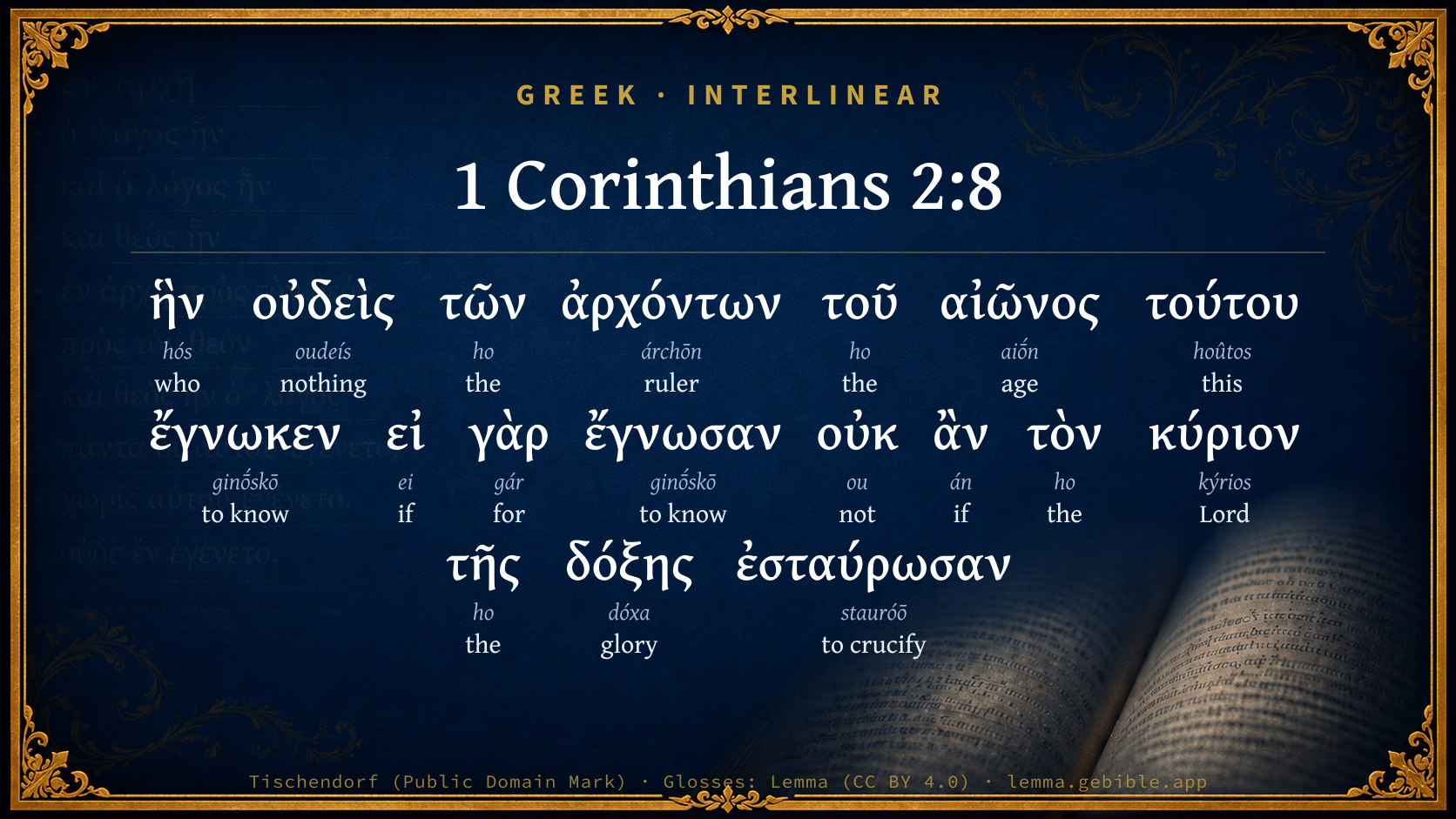
Greek (Tischendorf 8th ed.) 1 Corinthians 2:8 appears in the Greek New Testament. The text above is from the Tischendorf 8th edition. Each word links to its Strong’s number and a concise gloss. Click any word for its full Thayer’s Greek Lexicon entry.
Download image
Cite this verse

1 Corinthians 2:8 (World English Bible). Public Domain. Lemma interlinear Bible study tool, https://lemma.gebible.app/v/1-corinthians/2/8.

Show BibTeX & RIS
BibTeX
RIS
English Translation
which none of the rulers of this world has known. For had they known it, they wouldn't have crucified the Lord of glory.
World English Bible · Public Domain
Download a study sheet

One document with this verse’s original text, its word-by-word gloss line, the meaning frame, cross-references with their text, attributed commentary, and full source and license credits — printable, and it pastes into notes with its structure intact.

This verse Autodidact and up

Study sheet (.html) Plain text (.txt)

A passage Seminary Student

Up to 50 verses in one chapter. A passage sheet keeps up to 6 commentary sources and 12 cross-references per verse, in the order this page ranks them, and says so on the sheet whenever that leaves anything out. Ask for a single verse and you get the Autodidact verse sheet above.

Everything on this page stays free to read, with no account — the sheet is a download of what is already on screen, not access to it.

Want to remove ads? Support Godless Engineer
Compare translations 3

The same verse in 3 English versions, stacked beneath the original-language interlinear above. Click any original word for its lexicon entry.

Each is an independent rendering of the whole verse — the interlinear is not word-aligned to these translations.

Highlighted words mark where these versions differ — a whole-verse word diff, not a word-by-word alignment.

  • World English Bible Public Domain
    which none of the rulers of this world has known. For had they known it, they wouldn't have crucified the Lord of glory.
  • King James Version Public Domain
    Which none of the princes of this world knew: for had they known it, they would not have crucified the Lord of glory.
  • unfoldingWord Literal Text CC BY-SA 4.0
    which none of the rulers of this age understood, for if they had understood, they would not have crucified the Lord of glory.

unfoldingWord Literal Text — © unfoldingWord, licensed CC BY-SA 4.0. Word-aligned USFM3 via Door43 (git.door43.org/unfoldingWord/en_ult).

Versions to compare (up to 4)

3 of 4 selected

Show all 19 translations

Every available English version of this verse, each an independent rendering of the whole verse.

  • World English Bible Public Domain
    which none of the rulers of this world has known. For had they known it, they wouldn't have crucified the Lord of glory.
  • Berean Standard Bible Public Domain
    None of the rulers of this age understood it. For if they had, they would not have crucified the Lord of glory.
  • Majority Standard Bible Public Domain
    None of the rulers of this age understood it. For if they had, they would not have crucified the Lord of glory.
  • King James Version Public Domain
    Which none of the princes of this world knew: for had they known it, they would not have crucified the Lord of glory.
  • American Standard Version (1901) Public Domain
    which none of the rulers of this world hath known: for had they known it, they would not have crucified the Lord of glory:
  • Revised Version (1885) Public Domain
    which none of the rulers of this world knoweth: for had they known it, they would not have crucified the Lord of glory:
  • Geneva Bible (1599) Public Domain
    Which none of the princes of this world hath knowen: for had they knowen it, they would not haue crucified the Lord of glory.
  • Douay-Rheims (1899) Public Domain
    Which none of the princes of this world knew; for if they had known it, they would never have crucified the Lord of glory.
  • Young's Literal Translation Public Domain
    which no one of the rulers of this age did know, for if they had known, the Lord of the glory they would not have crucified;
  • Literal Standard Version CC BY-SA 4.0
    which no one of the rulers of this age knew, for if they had known, they would not have crucified the Lord of Glory;
  • Unlocked Literal Bible CC BY-SA 4.0
    None of the rulers of this age understood it, for if they had understood it, they would not have crucified the Lord of glory.
  • unfoldingWord Literal Text CC BY-SA 4.0
    which none of the rulers of this age understood, for if they had understood, they would not have crucified the Lord of glory.
  • Darby Bible Public Domain
    which none of the princes of this age knew, (for had they known, they would not have crucified the Lord of glory;)
  • World Messianic Bible Public Domain
    which none of the rulers of this world has known. For had they known it, they wouldn’t have crucified the Lord of glory.
  • Webster's Bible Public Domain
    Which none of the princes of this world knew: for had they known it, they would not have crucified the Lord of glory.
  • Free Bible Version CC BY-SA 4.0
    None of the rulers of this world understood anything about this—for if they had, they would not have crucified the Lord of glory.
  • Bible in Basic English Public Domain
    Of which not one of the rulers of this world had knowledge: for if they had, they would not have put the Lord of glory on the cross:
  • Text-Critical English NT CC BY 4.0
    None of the rulers of this age understood this wisdom, for if they had understood it, they would not have crucified the Lord of glory.
  • Tyndale New Testament (1534) Public Domain
    which wysdome none of the rulars of the worlde knewe. For had they knowe it they wolde not have crucified the Lorde of glory.

Literal Standard Version (2020), Covenant Press — licensed CC BY-SA 4.0. Text via the HelloAO Bible API (eBible.org). Unlocked Literal Bible (unfoldingWord) — licensed CC BY-SA 4.0. Text via the HelloAO Bible API (eBible.org). unfoldingWord Literal Text — © unfoldingWord, licensed CC BY-SA 4.0. Word-aligned USFM3 via Door43 (git.door43.org/unfoldingWord/en_ult). Free Bible Version, Dr. Jonathan Gallagher — licensed CC BY-SA 4.0. Text via the HelloAO Bible API (eBible.org).

Word by word

More ways to search: Search by grammar → Find every occurrence → Compare this word →

Practice this passage: Drill this verse → Learn its vocabulary →

ἀρχόντων
árchōn
G758
“ruler”
Noun, Genitive, Plural, Masculine
Part of Speech
Noun
Case
Genitive
Number
Plural
Gender
Masculine
Full Thayer's Definition

Origin: present participle of G757

TDNT: 09:08,8

1. a ruler, commander, chief, leader
  1. ἣν hós G3739 “who” Relative pronoun, Accusative, Singular, Feminine
  2. οὐδεὶς oudeís G3762 “nothing” Adjective, Nominative, Singular, Masculine, Negative
  3. τῶν ho G3588 “the” Article, Genitive, Plural, Masculine
  4. τοῦ ho G3588 “the” Article, Genitive, Singular, Masculine
  5. αἰῶνος aiṓn G165 “age” Noun, Genitive, Singular, Masculine
  6. τούτου hoûtos G3778 “this” Demonstrative pronoun, Genitive, Singular, Masculine
  7. ἔγνωκεν ginṓskō G1097 “to know” Verb, Perfect, Active, Indicative, 3rd person, Singular
  8. εἰ ei G1487 “if” Conditional
  9. γὰρ gár G1063 “for” Conjunction
  10. ἔγνωσαν ginṓskō G1097 “to know” Verb, Aorist, Active, Indicative, 3rd person, Plural
  11. οὐκ ou G3756 “not” Particle, Negative
  12. ἂν án G302 “if” Particle
  13. τὸν ho G3588 “the” Article, Accusative, Singular, Masculine
  14. κύριον kýrios G2962 “Lord” Noun, Accusative, Singular, Masculine
  15. τῆς ho G3588 “the” Article, Genitive, Singular, Feminine
  16. δόξης dóxa G1391 “glory” Noun, Genitive, Singular, Feminine
  17. ἐσταύρωσαν stauróō G4717 “to crucify” Verb, Aorist, Active, Indicative, 3rd person, Plural

About this verse

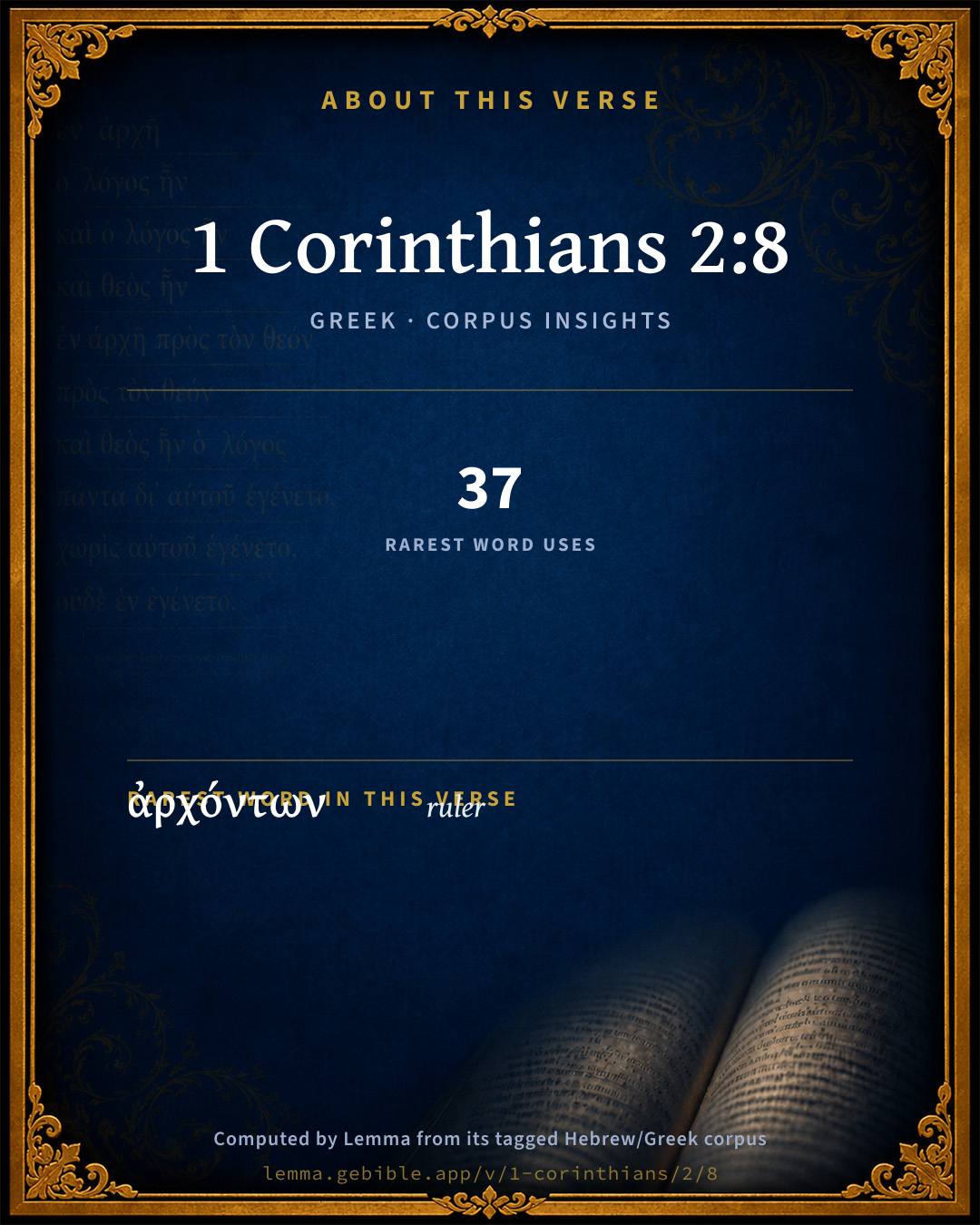
These counts appear in no published source. They are computed here, from the morphology-tagged text and Lemma’s own curated glosses. What Lemma adds →

18
words
14
distinct lemmas
Pauline Epistles
section

Shared distinctive vocabulary

ἀρχόντων ruler G758 occurs in 36 verses of the Greek New Testament. Also found in:
Repetition

Words recur within this verse:

  • ἔγνωκεν to know G1097 ×2
  • τῶν the G3588 ×4

Cross-references

18

Topical passages linked to 1 Corinthians 2:8 in the Treasury of Scripture Knowledge — connected by theme and wording, ordered by reader-vote popularity; previews shown in the World English Bible.

  • Acts 13:27 For those who dwell in Jerusalem, and their rulers, because they didn't know him, nor the voices of the prophets which are read every Sabbath, fulfilled them by condemning him.
  • James 2:1 My brothers, don't hold the faith of our Lord Jesus Christ of glory with partiality.
  • Acts 7:2 He said, "Brothers and fathers, listen. The God of glory appeared to our father Abraham, when he was in Mesopotamia, before he lived in Haran,
  • 1 Corinthians 2:6 We speak wisdom, however, among those who are full grown; yet a wisdom not of this world, nor of the rulers of this world, who are coming to nothing.
  • Psalms 24:7–10 Lift up your heads, you gates; Be lifted up, you everlasting doors: The King of glory will come in.
  • John 8:19 They said therefore to him, "Where is your Father?" Jesus answered, "You know neither me, nor my Father. If you knew me, you would know my Father also."
  • John 15:22–25 If I had not come and spoken to them, they would not have had sin; but now they have no excuse for their sin.
  • John 16:3 They will do these things because they have not known the Father, nor me.
  • Acts 3:16–17 By faith in his name has his name made this man strong, whom you see and know. Yes, the faith which is through him has given him this perfect soundness in the presence of you all.
  • 1 Corinthians 1:26–28 For you see your calling, brothers, that not many are wise according to the flesh, not many mighty, and not many noble;
  • 2 Corinthians 3:14 But their minds were hardened, for until this very day at the reading of the old covenant the same veil remains, because in Christ it passes away.
  • 1 Timothy 1:13 although I was before a blasphemer, a persecutor, and insolent. However, I obtained mercy, because I did it ignorantly in unbelief.
  • Matthew 11:25 At that time, Jesus answered, "I thank you, Father, Lord of heaven and earth, that you hid these things from the wise and understanding, and revealed them to infants.
  • John 3:19–21 This is the judgment, that the light has come into the world, and men loved the darkness rather than the light; for their works were evil.
  • John 7:48 Have any of the rulers believed in him, or of the Pharisees?
  • John 9:39–41 Jesus said, "I came into this world for judgment, that those who don't see may see; and that those who see may become blind."
  • John 12:40–43 "He has blinded their eyes and he hardened their heart, Lest they should see with their eyes, And perceive with their heart, And would turn, And I would heal them."
  • Luke 23:34 Jesus said, "Father, forgive them, for they don't know what they are doing." Dividing his garments among them, they cast lots.

Cross-references courtesy of OpenBible.info (CC BY 4.0).

Commentary

Notes on 1 Corinthians 2:8 from classic Christian and Jewish commentators (each source and its license shown beneath its notes). The classic Christian expositions comment on the surrounding passage and are grouped to its opening verse, so a note may address several verses; the Jewish commentaries on the Tanakh (Rashi and others) are per-verse, so they appear only where the commentator wrote on this verse.

Lemma curates 59 commentaries, every one of them public domain or Creative Commons licensed, each selected and text-cleaned for this edition rather than reprinted as found. About our sources →

The Biblical Illustrator

Joseph S. Exell

1Co_2:8-9

Which none of the princes of this world knew: for had they known it, they would not have crucified the Lord of glory.

Spiritual ignorance, evil, flood

I. The cause of immense evil. These princes of the world, through ignorance, crucified the Lord of glory.

1. A greater crime than this was never perpetrated. It involved--

(1) The grossest injustice. He was embodied virtue. His enemies and judges bore testimony to His innocence.

(2) The basest ingratitude. He not only did no evil, but went about doing good.

(3) Most heartless cruelty. They put Him to a death the most ignominious and excruciating that infernal malignity could desire.

(4) Most daring impiety. Whom did they thus treat? The Lord of glory (Psa_24:8). It is impious to trifle with His laws and rebel against His throne, but how much more so to crucify the universal Lawgiver and King!

2. That this ignorance was the cause of this immense evil is evident.

(1) Because it is itself an evil, and like will produce like. There are two things necessary to knowledge--mind and means. When either of these is absent, ignorance is a calamity, but when they are present it is a crime. These princes had both--they were not idiots, and riley had means by which they could know Christ; the Old Testament Scriptures, John the Baptist, Christ Himself. They need not have been ignorant. Their ignorance was a sin, and sin, like virtue, is propagated.

(2) Had it not existed, such an evil could never have been perpetrated.

II. The occasion of immense good. This crucifixion introduced things that eye had never seen, &c., viz., Gods love to the world and His method of saving it; Divine pardon, spiritual purity, immortal hopes. Conclusion: From this subject learn--

1. That the sinner is always engaged in accomplishing that which he never intended. These princes--

(1) Ruined themselves. It brought upon them and their country in this world tremendous judgments--and what in the world to come? Sinner, what are you doing? You are ruining yourself, but you do not intend it; but you are nevertheless doing it in the commission of every sin.

(2) Executed the plan of the great God. Him being delivered, &c. God overrules for good. So now, we have not to determine whether we shall serve God or not; we have to determine how--by our will or against it.

2. Whatever good a man may accomplish contrary to his intention is destitute of all praiseworthiness. What oceans of blessings come to our world through the crucifixion! Yet who can ever praise the crucifiers?

3. That no man should act without an intelligent conception of what he is doing. How many act from prejudice, custom, blind impulse! How few have a right conception of what they are doing! (D. Thomas, D. D.)

Ignorance of the truth

I. Its awful prevalence.

1. It has abounded in all time.

2. Pervades all classes.

II. Its injurious effects.

1. It occasions the worst crimes.

2. It led to the crucifixion of our Lord.

III. Its fatal issue destruction of both body and soul. (J. Lyth, D. D.)

The guilt of man in crucifying the Lord of glory.

Consider--

I. The deed.

II. Its aggravation.

1. He was the Lord of glory.

2. Came from glory.

3. Conducts to glory--dwells in glory.

III. Its unmitigated guilt. A sin of ignorance.

1. Not therefore relieved, because the ignorance was wilful.

2. Not inevitable through the purpose of God, because had they known they would not have done it. (J. Lyth, D. D.)

Christ the Lord of glory

I. The essential glory of Christ, which He hath as God from everlasting; which is unspeakable and inconceivable glory (Php_2:6). He has a peerage or equality with His Father in glory (Joh_10:30). And again, All things that the Father hath are Mine(Joh_16:15), the same name, the same nature, the same essential properties, the same will, and the same glory.

II. The mediatorial glory of Christ is exceeding great. This is proper to Him as the Head of the Church, which He hath purchased with His own blood (Php_2:9-10).

1. The fulness of grace inherent in Him. The humanity of Christ is filled with grace, as the sun with light (Joh_1:14), excelling all the saints in spiritual lustre and gracious excellencies.

2. The dignity and authority put upon Him. He is crowned King in Sion; all power in heaven and earth is given unto Him (Mat_28:18), He is a Law-giver to the Church (Jam_4:12).

3. Jesus Christ shall have glory and honour ascribed to Him for evermore by angels and saints, upon the account of His mediatorial work; this some divines call His passive glory, the glory which He is said to receive from His redeemed ones (Rev_5:8-10).

Inferences;

1. How wonderful was the love of Christ, the Lord of Glory, to be so abased and humbled as He was for us vile and sinful dust!

2. How transcendently glorious is the advancement of believers by their union with the Lord of Glory!

3. Is Jesus Christ the Lord of Glory? Then, let no man count himself dishonoured by suffering the vilest indignities for His sake.

4. Is Christ the Lord of Glory? How glorious then shall the saints one day be, when they shall be made like this glorious Lord, and partake of His glory in heaven! (Joh_17:22.)

5. How hath the devil blindfolded and deluded them that are frightened off from Christ by the fears of being dishonoured by Him!

6. If Christ be the Lord of Glory, how careful should all be who profess Him that they do not dishonour Jesus Christ, whose name is called upon by them!

7. What delight should Christians take in their daily converse with Jesus Christ in the way of duty!

8. If Christ be so glorious, how should believers long to be with Him, and behold him in His glory above! (John Flavel.)

Eye hath not seen … the things which God hath prepared for them that love Him.--

Spiritual blessings

I. Lie beyond the researches of the unregenerate mind. They are--

1. Not seen by the observation of nature, providence, grace.

2. Not heard by the report of the preacher, &c.

3. Not conceived by reason, speculation, inquiry.

II. Are revealed to those who love God.

1. Much depends on the heart.

2. The revelation is glorious.

3. Is effected by the Spirit.

4. Is completed in glory. (J. Lyth, D. D.)

The excellency and blessings of the gospel

I. The superlative excellency of the gospel.

1. Its discoveries and blessings far exceed all human knowledge or conception.

(1) Eye hath not seen. And yet by the eye we have surveyed many of the works of God; and if we look upon ourselves, we discover displays of infinite wisdom, power, and goodness. All these are glorious discoveries; but they say not how, when, or why they were formed.

(2) Ear hath not heard. When sight is exhausted, we can still drink in knowledge. But we never heard how the spring of moral conduct might be purified, life and heart made holy, and man be fitted for the society of God. We never heard of such powerful motives as the love of Christ, or such rich blessings as the beatitudes on the mount.

(3) Nor hath entered the heart of man, i.e., man never imagined. Every man carries about with him an ideal world of his own. How often have we attempted to paint to ourselves a character just such as we should approve! But it never entered into the heart of man to conceive of true dignity of character, or of the sources of real happiness as suited to the nature of man.

2. The peculiar excellency of this gospel will appear from--

(1) The sublime and interesting truth which it discovers. Briefly, the design of the gospel is to raise man from the ruin of the fall--to wash him from sin--to adorn him with righteousness--to inspire him with sublimity of thought and holiness of affection--to lead him in all the paths of obedience, and finally to exalt him to the society of angels and fellowship with God. But who could have barely thought of such a purpose? Who could have admitted the possibility of the fact? The Divine Being was under no obligations to redeem man. All the motive is revealed to us in the gospel, and is to be found in His own unfathomable love. God so loved the world, &c. And who would ever have conceived of such a simple plan of communicating such blessings! Believe on the Lord, &c.

(2) The pure and intense happiness it imparts. Even the speculative knowledge of these truths raises man in the scale of intelligence. But the gospel does more. The gospel calms the tumult of passion, reconciles man to God, and makes him to be at peace with himself. Now, eye hath not seen, &c. Some have had every advantage and opportunity of knowing this subject, but they are still natural men. They cannot conceive how a man can know his sins forgiven, nor of the joy and peace in believing. The natural man doth not comprehend these things; and even believers do not form conceptions sufficiently noble.

(3) The happy and glorious prospects which it unfolds. Philosophy never found out a remedy for the fear of death. It points to a few instances of apparent calmness and confidence. But it never fully met the evil. Death, to it, has ever been dissembled. But Christianity reveals the immediate consequences of death, and then supplants the fear of death. Where will philosophy show anything like the death of Stephen? And how is this to be explained? (Act_7:55.) And all in whom is the spirit of Stephen have the like glorious prospects. But what are they? Nay, Eye hath not seen, &c. The grandest description is, that it is beyond all description. If we cannot know all that God has prepared for us here, how can we conceive of the joys of heaven? (Joh_3:12.) We walk by faith, and not by sight! We could not possibly understand it; we have no powers of perception suited to such knowledge. Eye hath not seen so glorious a body as that of the Transfiguration, the model of ours; or so glorious a city as that great city, the holy Jerusalem, &c. Ear never heard strains so melting as those John heard--the voice of harpers harping with their harps. It never entered into the heart of man, the pure and unsullied bliss of the redeemed (Rev_7:15-17).

II. The characters for whom these blessings are prepared. For them that love Him. Consider the love of God as--

1. A necessary principle. Mere admiration will not suffice. The infidel may admire the character of the Creator as impressed upon His works, and be without even a desire to enjoy these blessings. Nor will a mere transient impression of the passions be sufficient, such as is frequently felt whilst contemplating gospel truths, even as a matter of speculation. A consideration of the love of God, the sufferings of Christ, &c., produces no permanent effect, but is obliterated by the next consideration. Now this love of God is necessary. Without holiness no man shall see Him. Holiness is the image of God, and God is love. These things are prepared only for them that keep His commandments, &c. But the whole law is comprised in this, Thou shalt love, &c. Hence, this is the love of God, that we keep His commandments. It is only the love of God that gives us the true knowledge of Him. He that loveth not, knoweth not God, for God is love. This love of God is essential to our enjoying God. No man can enjoy what he hates.

2. A Divine principle. No man loves God by nature. Nothing less than Divine love can conquer this enmity of the human heart. A manifested principle. The love of God is the love of holiness, for God is holy. And if we love God we shall keep His commandments. This love cannot possibly exist without influencing the practice, and thus manifesting itself. (F. A. West.)

The gospel a revelation

The things are the gospel in the wealth of its blessings, not only for another world, but also for this. The eye has seen much, the ear has heard much more than the eye has seen, the heart pictures creations more wonderful still; but such truths as the gospel declares belong to a higher world; they are the fruit of Gods hidden wisdom, His deepest thought. They are thus of necessity a mystery to man. It never entered the heart of man that these things would come--

I. From the source they did--from God. Mans ideas of God, apart from revelation, sprang rather from his own heart than from the teaching of nature, and therefore to imagine our salvation would flow from the source it did was impossible. After man sinned he changed God into his own image and likeness. The gods of the heathen consequently were perfectly destitute of those properties from which the gospel blessings could flow. They were destitute of holiness--heathenism has its heroes, but it has no saints. They were destitute of love, and were notorious for their cruelty and their lack of tenderness.

II. In the way they did. As the heavens are higher than the earth, &c. The way God took to save the world--by the incarnation and death of Immanuel--was so strange, that no one could imagine or dared imagine it but Himself. Not only is it so great that man could not in his own strength discover it, but so great that, after being revealed, it baffles man to comprehend it. The gospel is so Divine a conception that it dazzles the wise of this world into blindness. Gods smallest thoughts, His thoughts in nature, perplex man. What then about the thought He conceived in the silence and solitude of eternity?

III. To the degree they did. Paul considered the fact that Christ was preached to the Gentiles a sufficiently great mystery to be put side by side with the Incarnation. Sin makes man selfish. The Romans deemed all others enemies, to be vanquished and made slaves; and once made slaves, they were of less value in their eyes than the beasts which perish. The Greeks judged all others barbarians, who ought to be robbed and slain. The Jews likewise were animated by the spirit of exclusiveness--they deemed all others unclean and worthless. Though our advantages are numerous and important, yet this truth is not properly understood by many in our day. All are not willing, even in this age, that the dew of Gods blessing should fall outside their little garden. The old objections are being revived, that to attempt to evangelise the heathen is sheer waste. Such blind fatuity! The man who would try to stop the clouds to rain and the sun to shine outside the fences of his tiny farm would be looked upon as a lunatic. But his conduct were wisdom itself compared with that of those who in the vanity of their speculations would leave certain races outside the pale of civilisation and salvation. Gods provision for the world is worthy of the high source whence it emanated, and the strange instrumentality whereby it was brought about, at once worthy of the infinite love and the precious sacrifice. To provide for only one nation would not be worthy of Him. Indeed, to provide sparingly for even the whole world would not be according to His custom--plenteousness characterises all His acts. With such fulness of grace in store, no one, be he who and where he may, need be lost. (W. Morris.)

Gods revelation of heaven

Note--

I. The inability of the lower parts of human nature--the natural man--to apprehend the higher truths.

1. Eternal truth is not perceived through sensation or science. Eye hath not seen.

(1) There is a life of mere sensation.

(a) The highest pleasure of sensation comes through the eye. The Corinthians could appreciate this. Theirs was the land of beauty. They read the apostles letter, surrounded by the purest conceptions of Art. Let us not depreciate what God has given. There is a joy in contemplating the manifold forms in which the All Beautiful has concealed His essence. It is a pure delight to see.

(b) But the eye can only reach the finite beautiful. It does not scan the King in His beauty, nor the land that is very far off. And the visible is perishable beauty--not the eternal loveliness for which our spirits pant. Therefore Christ came not in the glory of form; He had no form nor comeliness, &c.; there was no beauty that they should desire Him. The eye did not behold, even in Christ, the things which God had prepared.

(c) This is an eternal truth. This verse is quoted as if the things prepared meant heaven. But the world of which Paul speaks God hath revealed, only not to eye nor ear. In heaven this shall be as true as now. The pure in heart will see God, but never with the eye; only in the same way, but in a different degree, that they see Him now.

(2) Again, no scientific analysis can discover the truths of God. Science proceeds upon observation. Experiment is the test of truth. Now, you cannot, by searching, find out the Almighty to perfection, nor a single one of the blessed truths He has to communicate.

1. It is in vain that we ransack the world for probable evidences of God, and idle to look into the materialism of man for the revelation of his immortality; or to examine the morbid anatomy of the body to find the rule of right. If a man go to the eternal world with convictions of eternity, the resurrection, God, already in his spirit, he will find abundant corroborations of that which he already believes. But if Gods existence be not thrilling every fibre of his heart, if the immortal be not already in him as the proof of the resurrection, if the law of duty be not stamped upon his soul as an eternal truth, science will never reveal these, the physician comes away from the laboratory an infidel. Eye hath not seen the truths which are clear enough to love and to the spirit.

2. Eternal truth is not reached by hearsay--Ear hath not heard.

(1) No revelation can be adequately given by the address of man to man. For all such revelation must be made through words, the mere coins of intellectual exchange. There is as little resemblance between the coin and the bread it purchases, as between the word and the thing it stands for. Looking at the coin, the form of the loaf does not suggest itself. Listening to the word, you do not perceive the idea for which it stands, unless you are already in possession of it. Speak of ice to an inhabitant of the torrid zone, the word does not give him an idea, or if it does, it must be a false one. Talk of blueness to one who cannot distinguish colours, what can your most eloquent description present to him resembling the truth of your sensation? Similarly in matters spiritual, no verbal revelation can give a single simple idea. For instance, what means justice to the unjust, or purity to the licentious? What does infinitude mean to a being who has never stirred beyond a cell? Talk of God to a thousand ears, each has his own different conception. The sensual man hears of God, and understands one thing. The pure man hears and conceives another thing.

(2) See what a hearsay religion is. There are men who believe on authority. Their minister believes all this Christianity true; therefore so do they. He calls this doctrine essential; they echo it. They have heard with the hearing of the ear that God is love, that the ways of holiness are ways of pleasantness. But the Corinthian philosophers heard Paul; the Pharisees heard Christ. How much did the ear convey? He alone believes truth who feels it. He alone has a religion whose soul knows by experience that to serve God and know Him is the richest treasure.

3. Truth is not discoverable by the heart--neither have entered into the heart of man the power of imagining, and the power of loving.

(1) It is a grand thing when thought bursts into flame, or when a great law of the universe reveals itself to the mind of genius, or when the truths of human nature shape themselves forth in the creative fancies of the poet. But the most ethereal creations of fancy were shaped by a mind that could read the life of Christ, and then blaspheme the Adorable. Some of the truest and deepest utterances ever spoken came from one whose life was from first to last selfish. The highest astronomer of this age refused to recognise the Cause of causes. The mighty heart of genius had failed to reach the things which God imparts to a humble spirit.

(2) The heart of man has the power of affection. The highest moment known on earth by the merely natural, is that in which the mysterious union of heart with heart is felt. Yet this attains not to the things prepared by God. Human love is but the faint type of that surpassing blessedness which belongs to those who love God.

II. The nature and laws of revelation.

1. Revelation is made by a Spirit to a spirit. Christ is the voice of God without the man--the Spirit is the voice of God within. The highest revelation is not made by Christ, for He said, The Spirit shall take of Mine and shall show it unto you. And therefore it is written here--The Spirit searches all things, yea, the deep things of God. Now the Spirit of God lies touching, as it were, the soul of man. They mingle. The spiritual in man, by which he might become a recipient of God, may be dulled, deadened, by a life of sense, but in this world never lost. All that is wanted is to become conscious of the nearness of God. God has placed men here to feel after Him if haply they may find Him, albeit He be not far from any one of them.

2. The condition upon which this revelation is made to men is love. These things are prepared for them that love Him, or revealed to those who have the mind of Christ.

(1) Love to man may mean love to his person, or it may mean simply pity. Love to God can only mean love to His character: e.g., God is purity. And to be pure in thought and look is to love God. God is love--and to love men till private attachments have expanded into a philanthropy which embraces all, is to love God. God is truth. To be true--to hate every form of falsehood--to live a brave, true, real life--that is to love God. God is infinite--and to love the boundless, reaching on from grace to grace, and rising upwards ever to see the ideal still above us, aiming insatiably to be perfect even as the Father is perfect--that is love to God.

(2) This love is manifested in obedience.

(a) He that hath My commandments and keepeth them, he it is that loveth Me, &c. We remember the Roman commander who forbade an engagement with the enemy, and the transgressor was his own son. He accepted the challenge of the leader of the other host, slew, spoiled him, and then in triumph carried the spoils to his fathers tent. But the Roman father refused to recognise the instinct which prompted this as deserving of the name of love--disobedience contradicted it and deserved death: weak sentiment, what was it worth? So with God--strong feelings, warm expressions, varied internal experience coexisting with disobedience, God counts not as love.

(b) To love, adoring and obedient, God reveals His truth. As in the natural, so in the spiritual world. By compliance with the laws of the universe we put ourselves in possession of its blessings. Obey the laws of health and you obtain health. Arm yourselves with the laws of nature, and you may call down the lightning from the sky. In the same way there are laws in the world of Spirit, by compliance with which Gods Spirit comes into the soul with all its revelations. The secret of the Lord is with them that fear Him. No man hath seen God at any time. If we love one another, God dwelleth in us. If any man will do His will, he shall know of the doctrine.

(c) These laws are universal and invariable. There is no favourite child of nature who may hold the fire-ball in the hollow of his hand and trifle with it without being burnt; there is no selected child of grace who can live an irregular life without unrest; or be proud, and at the same time have peace; or indolent, and receive fresh inspiration; or remain unloving and cold, and yet see and hear and feel the things that God hath prepared for them that love Him. And if obedience were entire and love were perfect, then would the revelation of the Spirit to the soul of man be perfect too. (F. W. Robertson, M. A.)

Heaven

Every prophet who has stood upon the borders of a new dispensation might have uttered these words. Abraham might have looked forward to the Mosaic dispensation, &c., and have turned to his brethren who lived in the patriarchal age, and said, Eye hath not seen, &c. At the close of the Levitical dispensation the prophets might have thus spoken of the coming glories. And now we stand on the borders of a new era. But persons are curious to know what kind of dispensation the millennial one is to be. Will the temple be erected in Jerusalem? Will the Jews be positively restored to their own land? &c. We cannot answer. Eye hath not seen, &c. And this brings us to make the application of the subject to heaven itself.

I. What heaves is not.

1. It is not a heaven of the senses.

(1) Eye hath not seen it. What glorious things the eye hath seen! Have we not seen the gaudy pageantry of pomp crowding the gay streets? We hear of the magnificence of the old Persian princes, of palaces covered with gold and silver, and floors inlaid with jewels; but we cannot thence gather a thought of heaven, for eye hath not seen it. We have thought, however, when we have come to the works of God, surely we can get some glimpse of what heaven is here. By night we have turned our eye up to the stars, and we have said, If this earth has such a glorious covering, what must that of heaven be? At another time we have seen some glorious landscape, and said, Surely these grandeurs must be something like heaven. It was all a mistake--Eye hath not seen it.

(2) The ear hath not heard it. Have we not sometimes heard the sweet voice of the messenger of God when he has by the Spirit spoken to our souls! We knew something of heaven then, we thought. We have heard music, whether poured from the lungs of man--that noblest instrument in the world--or from some manufacture of harmony, and we have thought, This is what John meant by the voice like many waters, and the voice of harpers harping with their harps. But we made a mistake. Ear hath not heard it.

(3) Others look upon it as a place where they shall be free from bodily pain, and where they will eat to the full and be satisfied. What a mistake! We can get no conceptions of heaven through the senses; they must always come through the Spirit.

2. It is not a heaven of the imagination. Poets let their imaginations fly with loosened wings, or the preacher weaves the filigree work of fancy, and you say, It is sweet to hear that man speak; he made me think I was there. But imagination, when it is most sublime, and freest from the dust of earth, and kept steady by the most extreme caution, cannot picture heaven. It hath not entered the heart of man, &c. Your imaginary heaven you will find by and by to be all a mistake.

3. It is not a heaven of the intellect. Men describe heaven as a place where we shall know all things, and their grandest idea is that they shall discover all secrets there. But It hath not entered into the heart of man.

II. He hath revealed it unto us by His spirit. This means that it was revealed unto the apostles by the Spirit, so that they wrote something of it in the Holy Word. We think also that it means that every believer has glimpses of heaven by the influence of the Spirit. A Christian gets a gaze of what heaven is--

1. When in the midst of trials and troubles he is able to cast all his care upon the Lord, because He careth for him. Heaven is something like that--a place of holy calm and trust.

2. In the season of quiet contemplation, for the joys of heaven are akin to the joys of contemplation.

3. At the Lords table. You get so near the Cross there that your sight becomes clearer, and the air brighter, and you see more of heaven there than anywhere else.

4. When we assemble in our meetings for prayer.

5. In extraordinary closet seasons. (C. H. Spurgeon.)

Heaven

The city of Corinth has been called the Paris of antiquity. Indeed, for splendour, the world holds no such wonder to-day. The commerce of all nations passed through her ports; the mirth of all people sported in her Isthmian games, and the beauty of all lands walked her porticos, and threw itself on the altar of her stupendous dissipations. Column and statue and temple bewildered the beholder. And the best music from the best instruments in the world resounded in her theatres. It was not to rustics who had never seen or heard anything grand that Paul uttered this text, and it was a bold thing for him to stand there amid all that and say, All this is nothing; eye hath not seen, &c. We can in this world get no idea of--

I. The health of heaven. When you were a child you had never felt sorrow or sickness. Perhaps later you felt a glow in your cheek, and a spring in your step, and an exuberance of spirits, and a clearness of eye, that made you thank God you were permitted to live. You thought that you knew what it was to be well, but the most elastic and robust health of earth, compared with that of heaven, is nothing but sickness and emaciation. Look at that soul standing before the throne. On earth she was a life-long invalid. See her step now, and hear her voice now. Health in all the pulses! Health of vision; health of spirits; immortal health. No racking cough, no consuming fevers, no exhausting pains, no hospitals of wounded men. That child that died in the agonies of croup, hear her voice now ringing in the anthem. That old man that went bowed down with the infirmities of age, see him walk now with the step of an immortal athlete--for ever young again. To have neither ache, nor pain, nor weakness, nor fatigue. Eye hath not seen it--ear hath not heard it.

II. The splendour of heaven. John tries to describe it, and as we look through his telescope we see a blaze of jewellery, a mountain of light, a cataract of colour, a sea of glass, and a city like the sun. John bids us look again, and we see thrones; thrones of the prophets, patriarchs, angels, apostles, martyrs, throne of Jesus--throne of God. John bids us look again, and we see the great procession of the redeemed passing. Eye hath not seen it, ear hath not heard it. Skim from the summer waters the brightest sparkles, and you will get no idea of the sheen of the everlasting sea. Pile up the splendours of earthly cities and they would not make a stepping-stone by which you might mount to the city of God. Every house is a palace. Every step a triumph. Every meal is a banquet. Every day is a jubilee, every hour a rapture, and every moment an ecstasy.

III. The re-unions of heaven. If you have ever been across the seas, and met a friend in some strange city, you remember how your blood thrilled, and how glad you were to see him. What then will be our joy to meet in the bright city of the sun those from whom we have long been separated. In this world we only meet to part. It is good-bye, good-bye. But not so in heaven. Welcomes in the air, at the gates, at the house of many mansions--but no good-bye.

IV. The song of heaven. There is nothing more inspiriting to me than a whole congregation lifted up on the wave of holy melody. But, my friends, if music on earth is so sweet what will it be in heaven! They all know the tune there. All the best singers of all the ages will join it--choirs of white-robed children! choirs of patriarchs! choirs of apostles! Harpers with their harps. David of the harp will be there. Gabriel of the trumpet will be there. (T. De Witt Talmage, D. D.)

The things which God has prepared

I. Their nature.

1. The mysteries of the gospel salvation.

2. Extending into the eternal future.

II. Their transcendent value.

1. Worthy of God.

2. Surpassing all human comprehension.

III. Their participation--depends on love to God. (J. Lyth, D. D.)

The things prepared and their enjoyment

I. The things prepared. Suggesting--

1. The Divine forethought, and the infinite fulness and carefulness of Gods love for His children. Remember:

(1) How the world was prepared before man came upon it.

(2) How God prepared a body in which Christ should be one with us, die to be our Saviour, and ascend to hold the sceptre of the universe.

(3) How Christ reminded His disciples that the dignities of the kingdom were only for those for whom it is prepared of the Father.

(4) How He went to prepare a place for us, and sent the Spirit to prepare us for the place.

2. The Divine treasury. The figure suggests a vast building over whose portals we read, Ask and it shall be given, &c.

a building divided into so many stores of Divine love. Let us open their doors.

(1) One contains the purposes of the Divine love, delivering mercy, sustaining grace--purposes that no need can exhaust, no opposition thwart, no eternity unfold.

(2) Another promises Divinely--

(a) Simple, little children can understand them.

(b) Profound, angels cannot fathom them.

(c) Certain, for heaven and earth shall pass away, &c.

(d) Sweet and rich, sweeter than a honeycomb, and more precious than gold.

(3) Divine provisions the mercy-seat where we obtain grace to help; the Cross, its cleansing fount, infinite ransom, Divine righteousness; the Lords Table.

(4) The fulness that is treasured up in Christ--fulness of grace to pardon, of merit to atone, of strength to sustain, of glory to reward.

(5) Things prepared in the ministry of the Holy Spirit--regeneration, comfort, sanctification.

(6) Glories that await us hereafter--the crown of triumph, the harp of praise, the mansion of repose and blessing, the living fountain of joy.

II. The revelation of the Spirit in which these things are made manifest to us.

1. Striking thought! God takes men into His confidence about matters that human reason could never fathom. It was so with Abraham. Shall I hide, &c. Amos declares that the Lord will hide nothing, but will reveal His secret unto His servants. In proportion to our intimacy with God the Divine purposes will be made plain to us. The secret of the Lord is with them that fear Him. The disciples pleaded with John, who reclined on his Masters bosom, to ask Him a secret which they did not venture to ask themselves. He lived so much nearer to Christ, and therefore had more of His secret. We deprive ourselves of unspeakable blessings in regard to Gods dealings in providence from our failure to recognise Gods hand in every gift. And Gods children should feel that in regard to the mysteries of the world around they shall have light resting on their path, and truth revealed by the indwelling Spirit which enables them to trust where others cannot. The man that is nearest the sun will have most of light, and the man who lives nearest the throne will have deeper draughts of the water of life that proceeds therefrom.

2. As to the revelation by the Spirit of Divine things, take the case of Simeon, unto whom it had been revealed by the Holy Ghost that he should not die until he had seen the Christ. How long he waited for the consolation of Israel! But at last it came. So God may have revealed to you in His Word and by His Spirit truths that have yet to come in their Divine significance and power. Wait patiently; Gods time is always the best. Take the case of Peter who, when all were dumb before Whom say ye that I am? received at once a revelation that Jesus was the Christ, &c. You may say We are not Simeons or Peters. No; but remember how Christ thanked God that the things withheld from the wise and prudent were revealed unto babes, i.e., babes in spiritual experience. But even to your children, who shall say at how early an age God, by His Spirit, shall reveal the truth? Remember Samuel.

III. The condition essential to the reception of the blessing. Behold what manner of love the Father hath bestowed on us there is the origin of all Christian love. The love of God is shed abroad in our hearts by the Holy Ghost that is the next step. Then we are the children of God, and the Spirit beareth witness with our spirits, &c. Then the circle is complete. And the Divine love thus enjoyed must manifest itself in self-sacrificing love to men. (J. P. Chown.)

The things prepared for a prepared people

The apostle here is quoting from Isa_64:4, and only intends to give the general sense of the passage. Both passages are generally used as referring to the heavenly state, but we can only apply them thus by accommodation. Yet this is a legitimate application. For if the text is true of our imperfect condition of privilege in this life, much more will it be true as applied to that perfection of bliss that awaits us in the life to come. You cannot judge of the real merits of a story till you see how it ends. You cannot decide about the value of a casket till it is opened and you see the jewels which it enshrines. You cannot pronounce on a campaign till you see what fruits result from its hard-fought battlefields. And so, in estimating the real worth of redemption, we can only form an approximate judgment of it in this life. There are three points of view from which we may contemplate our portion for the future, as set before us in the text.

I. The plain and positive view. Things prepared.

1. Things plural--not one element of joy, but many. It is a caricature of heaven when psalm-singing is represented as its chief occupation. A wonderful variety marks the imagery of the Bible as to the heavenly state--a city that hath foundations, the marriage supper of the Lamb, being present with Christ, and beholding His glory, is being made like Him, &c. These varied expressions suggest that our heaven will be a condition of being in which the mind, with its large desires, its deathless cravings, and the soul, with all the warmth of its affections and sympathies, will find the fullest scope for their development. As the vine puts forth its tendrils, and finds something to cling to for its support and growth; so, doubtless, will all the innocent tastes and longings of our renewed nature find in the heavenly state that which answers to their wants, prepared, as a trellis, to which they may cling, and in clinging to which they will find their delight.

2. And these are not things thrown together at haphazard. They are prepared things. How eloquent all nature is as to the teachings of this word! Note the wonderful care with which God has prepared for the wants of every tree, animal, bird, and fish; yea, for every worm; just that which will best meet its wants and minister to its comfort. Then, when we think of the souls God has redeemed at the price of His Sons death, to whom His love has flowed out in a deeper channel than to any other of His creatures, whom He deigns to say that they are to be His portion; when we think of the things prepared for them in their final home, what shall we say? How shall we put limits to the extent to which His power, wisdom, and goodness will go in seeking to promote their happiness?

II. A negative or comparative view. Heavens happiness is such as eye hath not seen, &c., or to which all the eye hath seen, &c., bears no proportion.

1. It is clearly the inferential teaching of the text, that the things prepared exceed in glory all that we are familiar with in this outer creation.

(1) And the eye sees wondrous beauty as it ranges through the world of nature. But there is no comparison between what the eye sees here and the things prepared for Gods people in the future.

(2) And then the ear opens an avenue to another world of enjoyment peculiarly its own. Yet the highest rapture of the most gifted musician through the organ of hearing bears no comparison to the joy the redeemed will experience in the things which God has prepared for them.

(3) And then the imagination has a wondrous power to call into existence worlds of beauty and loveliness all its own. But when you put these things together--all that the eye can see, &c., of that which is beautiful or grand--they will be infinitely surpassed by the things prepared by God as the future portion of His people.

2. And there is something very sweet in the thought of this instituted connection, between these glories spread over the face of nature and that blessed home which Jesus is preparing for us. It shows how God means that the one should remind us of the other. The Jewish Rabbis inform us that when Joseph had gathered much corn in Egypt he threw the chaff into the Nile, that so flowing down to the neighbouring cities, and nations more remote, it might bear witness to them of the store of good things garnered up in the treasure cities of Egypt. And so God, to make us know what glory there is in heaven, has thrown some husks to us here, that we might draw out our inferences. If we find so much of glory spread over earthly things, what may we expect to find in those that are heavenly? If He give us so much in the land of our pilgrimage, what will He not give us in our own country? If He can lavish so much on His enemies what will He not reserve for His friends?

III. The personal view. For them that love Him. These things are designed for a prepared people. The preparation on the one side is just as necessary as that on the other. What is the use of preparing a feast unless you know that the guests those who are to be admitted to it can see; of preparing a grand concert unless will have appetites; of arranging the paintings of a splendid gallery unless the audience can hear? The glorious things of the future are prepared for a people who love God. The planting of this love in the heart is the great personal preparation for heaven that we need. The necessity for this is absolute. Except a man be born again, He., he cannot see the kingdom of God. These two things--love to God, and a new birth--always go together. (Richard Newton, D. D.)

Love

is the eye that sees, the ear that hears, the heart that realises the things of God (cf. 1Co_13:8; 1Co_13:12; Eph_3:18)

. (Principal Edwards.)

The Biblical Illustrator, edited by Joseph S. Exell (c. 1880s–1900s) — public domain. Text from a community e-Sword module.

Tyndale Open Study Notes

Tyndale Open Resources

2:8 The rulers of this world are probably political rulers rather than spiritual authorities (see also 15:24; cp. Acts 3:14-15; 4:10; 5:29-32).

Tyndale Open Study Notes — © Tyndale Open Resources, licensed CC BY-SA 4.0. Text via the HelloAO Bible API.

Bengel's Gnomon

Johann Albrecht Bengel

1Co 2:8. Ἣν, which) a reference to wisdom.—οὐδεὶς τῶν ἀρχόντων—ἔγνωκεν, none of the princes—knew) none, almost none, nay, none at all, as [quâ] a prince. The antithesis to this predicate is in the but 1Co 2:9; to the subject, in the but 1Co 2:10.—τὸν Κύριο, the Lord) who surpasses all princes.—ἐσταύρωσαν) The cross, the punishment of slaves. It was with this the Lord of glory was slain.

Bengel's Gnomon of the New Testament — English translation (T&T Clark, Edinburgh, 1860) — public domain. Text from a community e-Sword module.

Meyer's Critical & Exegetical Commentary

Heinrich August Wilhelm Meyer

1Co_2:8. Ἥν] Parallel with the preceding ἥν, and referring to Θεοῦ σοφίαν (Calvin, Grotius, and most commentators, including Flatt, Rückert, de Wette, Osiander, Hofmann), not to δόξ. ἡμῶν (Tertullian, contra Marc. v. 6, Camerarius, Pott, Billroth, Maier); for the essential point in the whole context is the non-recognition of that wisdom.[366]

εἰ γὰρ ἔγνωσαν κ.τ.λ[367]] parenthetical proof from fact for what has been just asserted; for the ἀλλά in 1Co_2:9 refers to ἫΝ ΟὐΔΕῚς … ἜΓΝΩΚΕΝ. The crucifixion of Christ, seeing that it was effected by Jewish and heathen rulers together, is here considered as the act of the ἄρχ. τ. αἰῶν. collectively.

τὸν Κύριον τῆς δόξης] Christ is the Lord, and, inasmuch as His qualitative characteristic condition is that of the divine glory in heaven, from which He came and to which He has returned (Joh_17:5; Luk_24:26; Php_3:20 f.; Col_3:1-4, al[368]), the Lord of glory. Comp Jam_2:1. In a precisely analogous way God is called, in Eph_1:17, Ὁ ΠΑΤῊΡ Τῆς ΔΌΞΗς. Comp Act_7:2; Psa_24:7; Heb_9:5. In all these passages the expression of the adjectival notion by the genitive has rhetorical emphasis. Comp Hermann, a[372] Viger. p. 887. This designation of Christ, however, is purposely chosen by way of antithesis to ἐσταύρωσαν; for Ὁ ΣΤΑΥΡῸς ἈΔΟΞΊΑς ΕἾΝΑΙ ΔΟΚΕῖ, Chrysostom. Had the ἌΡΧΟΝΤΕς known that ΣΟΦΊΑ ΘΕΟῦ, then they would also have known Christ as what He is, the ΚΎΡΙΟς Τῆς ΔΌΞΗς, and would have received and honoured instead of shamefully crucifying Him. But what was to them wisdom was simply nothing more than selfish worldly prudence and spiritual foolishness; in accordance with it Annas and Caiaphas, Pilate and Herod, acted. Comp., generally, Luk_23:34; Act_3:17.

[366] The simple uniform continuation of the discourse by ἥν has a solemn emphasis here, as in Act_4:10, and especially often in the Epistle to the Ephesians. All the less reason is there for taking it, with Hofmann, as equivalent in this verse to ταύτην (Buttmann, neut. Gr. p. 243 [E. T. 282]), and as introducing a new principal sentence. The asyndetic similar co-ordination of several relative clauses is, from Homer onward (see Ameis on the Odyss. xxiii. 299, append.), a very common usage in the classics also.

[367] .τ.λ. καὶ τὰ λοιπά.

[368] l. and others; and other passages; and other editions.

[372] d refers to the note of the commentator or editor named on the particular passage.

Meyer — Critical and Exegetical Commentary on the New Testament — English translation by Peter Christie, edited by Frederick Crombie (T&T Clark, 1880) — public domain. Text from a community e-Sword module.

Expositor's Greek Testament

ed. W. Robertson Nicoll

1Co 2:8 . ἣν οὐδεὶς κ . τ . λ .: “which (wisdom) none of the rulers of this age has perceived” all blind to the significance of the rise of Christianity. ἔγνωκεν , a pf., approaching the pr [351] sense ( novi ) which f1οἶδα had reached, but implying, as that does not, a process has come to know, won the knowledge of . οἱ ἄρχοντες κ . τ . λ ., repeated with emphasis from 1Co 2:6 sc. “the rulers of this (great) age,” of the world in its length of history and fulness of experience (see 1Co 10:11 , and note; cf. Eph 1:10 ; Eph 3:5 , Rom 16:25 f.). The leaders of the time showed themselves miserably ignorant of God’s plans and ways in dealing with the world they ruled; “for if they had known, they would not have crucified the Lord of glory”. The Lord of glory is He in whom “our glory” (1Co 2:7 ) has its manifestation and guarantee first in His earthly, then in His heavenly estate ( cf. 1Co 15:43 ; 1Co 15:49 ). τῆς δόξης , gen [352] of characterising quality ( cf. Eph 1:17 , Act 7:2 ). This glory of the Son of God the disciples saw (Joh 1:14 ); of it believers now partake (Rom 8:29 f.), and will partake in full hereafter (2Co 3:18 , Phi 3:21 , etc.), when it culminates in a universal dominion (1Co 15:23-29 , Phi 2:9 ff., Heb 1 ). Paul’s view of Christ always shone with “the glory of that light” in which he first saw Him on the road to Damascus (Act 22:11 ). Caiaphas and the Sanhedrin, Pilate and the Roman court ( cf. Act 13:27 f., 1Ti 6:13 ) saw nothing of the splendour clothing the Lord Jesus as He stood before them; so knowing, they could not have crucified Him. The expression κύριος τῆς δόξης is no syn [353] for Christ’s Godhead; it signifies the entire grandeur of the incarnate Lord, whom the world’s wise and great sentenced to the cross. Their ignorance was a partial excuse (see Luk 23:34 , Act 13:27 ); but it was guilty, like that of Rom 1:18 f. The crucifiers fairly represented worldly governments. Mark the paradox, resembling Peter’s in Act 3:15 : “ Crux servorum supplicium eo Dominum gloriæ affecerunt” (Bg [354] ). The levity of philosophers in rejecting the cross of Christ was only surpassed by the stupidity of politicians in inflicting it; in both acts the wise of the age proved themselves fools, and God thereby brought them to ruin (1Co 1:28 ). For εἰ … ἄν , stating a hypothesis contrary to past fact (the modus tollens of logic), see Bn [355] § 248; and cf. 1Co 11:31 .

[351] present tense.

[352] genitive case.

[353] synonym, synonymous.

[354] Bengel’s Gnomon Novi Testamenti.

[355] E. Burton’s Syntax of the Moods and Tenses in the N.T. (1894).

The Expositor's Greek Testament, edited by W. Robertson Nicoll (1897–1910) — public domain. Text from a community e-Sword module.

Hodge's Commentary on Romans, Ephesians & First Corinthians

Charles Hodge

1Co_2:8

Which none of the princes of this world knew: for had they known (it), they would not have crucified the Lord of glory.

Which refers to wisdom, and not to glory; because the former, and not the latter, is the subject of discourse. Which wisdom none of the princes, i.e. the great men, of this world knew. The reference is here principally to the rulers of the Jews, the authors of the crucifixion of Christ, and the representatives of the class to which they belonged. It was the world in its princes who rejected Christ.

Lord of glory is a title of divinity. It means, possessor of divine excellence. Who is the King of glory? The Lord of hosts, he is the King of glory, Psa_24:10. Act_7:2. Jam_2:1. Eph_1:17. The person crucified, therefore, was a divine person. Hence the deed was evidence of inconceivable blindness and wickedness. It was one that could only be done through ignorance. And now, brethren, said the apostle Peter to the Jews, I wot that through ignorance ye did it, as did also your rulers, Act_3:17. The fact that the princes of this world were so blind as not to see that Christ was the Lord of glory, Paul cites as proof of their ignorance of the wisdom of God. Had they known the one, they would have known the other.

This passage illustrates a very important principle or usage of Scripture. We see that the person of Christ may be designated from his divine nature, when what is affirmed of him is true only of his human nature. The Lord of Glory was crucified; the Son of God was born of a woman; he who was equal with God humbled himself to be obedient unto death. In like manner we speak of the birth or death of a man without meaning that the soul is born or dies; and the Scriptures speak of the birth and death of the Son of God, without meaning that the divine nature is subject to these changes. It is also plain that to predicate ignorance, subjection, suffering, death, or any other limitation of the Son of God, is no more inconsistent with the divinity of the person so designated, than to predicate birth and death of a man, is inconsistent with the immateriality and immortality of the human soul. Whatever is true either of the soul or body may be predicated of a man as a person; and whatever is true of either the divine or human nature of Christ may be predicated of Christ as a person. We need not hesitate therefore to say with Paul, the Lord of glory was crucified; or even, in accordance with the received text in Act_20:28, God purchased the church with his blood. The person who died was truly God, although the divine nature no more died than the soul of man does when the breath leaves his body.

Charles Hodge — Commentary on Romans (1835), First Corinthians (1857), and Ephesians (1856) — public domain. Text from a community e-Sword module.

Geneva Bible (1599)

Geneva Bible translators

That mighty God, full of true majesty and glory: Now this place hath in it a most evident proof of the divinity of Christ, and of his joining of the two natures in one, which hath this in it, that that which is proper to the manhood alone, is vouched of the Godhead joined with the manhood: which kind of speech is called of the old fathers, a making common of things belonging to someone, with other to whom they do not belong.

He taketh away another objection: why then, how cometh it to pass, that this wisdom was so rejected of men of highest authority, that they crucified Christ himself? Paul answereth: because they knew not Christ such as he was.

Geneva Bible (1599) marginal notes — public domain. Text via Bolls.life.

Jamieson, Fausset & Brown

Robert Jamieson, A. R. Fausset & David Brown

Which--wisdom. The strongest proof of the natural man's destitution of heavenly wisdom.

crucified . . . Lord of glory--implying the inseparable connection of Christ's humanity and His divinity. The Lord of glory (which He had in His own right before the world was, Joh 17:4, Joh 17:24) was crucified.

Jamieson, Fausset & Brown — Commentary Critical and Explanatory on the Whole Bible (1871) — public domain (CC PDM 1.0). Text via the HelloAO Bible API.

Adam Clarke's Commentary

Verse 8. Which none of the princes of this world knew] Here it is evident that this world refers to the Jewish state, and to the degree of knowledge in that state: and the rulers, the priests, rabbins, c., who were principally concerned in the crucifixion of our Lord.

The Lord of glory.] Or the glorious Lord, infinitely transcending all the rulers of the universe whose is eternal glory; who gave that glorious Gospel in which his followers may glory, as it affords them such cause of triumph as the heathens had not, who gloried in their philosophers. Here is a teacher who is come from God; who has taught the most glorious truths which it is possible for the soul of man to conceive; and has promised to lead all the followers of his crucified Master to that state of glory which is ineffable and eternal.

Adam Clarke's Commentary on the Bible (1810–1826) — public domain. Text from a community e-Sword/MySword module.

John Calvin's Commentaries

8. None of the princes of this world knew If you supply the words by their own discernment, the statement would not be more applicable to them than to the generality of mankind, and the very lowest of the people; for what are the attainments of all of us as to this matter, from the greatest to the least? Only we may perhaps say, that princes, rather than others, are charged with blindness and ignorance — for this reason, that they alone appear in the view of the word clear-sighted and wise. At the same time I should prefer to understand the expression in a more simple way, agreeably to the common usage of Scripture, which is wont to speak in terms of universality of those things that, happen επι το πολυ, that is commonly, and also to make a negative statement in terms of universality, as to those things that happen only ἐπι ἔλαττον, that is very seldom In this sense there were nothing inconsistent with this statement, though there were found a few men of distinction, and elevated above others in point of dignity, who were at the same time endowed with the pure knowledge of God.

For had they known The wisdom of God shone forth clearly in Christ, and yet there the princes did not perceive it; for those who took the lead in the crucifixion of Christ were on the one hand the chief men of the Jews, high in credit for holiness and wisdom; and on the other hand Pilate and the Roman empire. In this we have a most distinct proof of the utter blindness of all that are wise only according to the flesh. This argument of the Apostle, however, might appear to be weak. “What! do we not every day see persons who, with deliberate malice, fight against the truth of God, as to which they are not ignorant; nay, even if a rebellion so manifest were not to be seen by us with our eyes, what else is the sin against the Holy Ghost than a willful obstinacy against God, when a man knowingly and willingly does not merely oppose his word, but even fights against it. It is on this account, too, that Christ declares that the Pharisees, and others of that description, knew him, (John 7:28,) while he deprives them of all pretext of ignorance, and accuses them of impious cruelty in persecuting him, the faithful servant of the Father, for no other reason but that they hated the truth.”

I answer that there are two kinds of ignorance. The one arises from inconsiderate zeal, not expressly rejecting what is good, but from having an impression that it is evil. No one, it is true, sins in ignorance in such a way as not to be chargeable meanwhile in the sight of God with an evil conscience, there being always a mixture of hypocrisy, or pride, or contempt; but at the same time judgment, and all intelligence in the mind of man, are sometimes so effectually choked, that nothing but bare ignorance is to be seen by others, or even by the individual himself. Such was Paul before he was enlightened; for the reason why he hated Christ and was hostile to his doctrine was, that he was through ignorance hurried away with a preposterous zeal for the law. Yet he was not devoid of hypocrisy, nor exempt from pride, so as to be free from blame in the sight of God, but those vices were so completely covered over with ignorance and blindness as not to be perceived or felt even by himself.

The other kind of ignorance has more of the appearance of insanity and derangement, than of mere ignorance; for those that of their own accord rise up against God, are like persons in a frenzy, who, seeing, see not. (Matthew 13:13.) It must be looked upon, indeed, as a settled point, that infidelity is always blind; but the difference lies here, that in some cases malice is covered over with blindness to such a degree that the individual, through a kind of stupidity, is without any perception of his own wickedness. This is the case with those who, with a good intention, as they speak, or in other words, a foolish imagination, impose upon themselves. In some cases malice has the ascendancy in such a manner, that in spite of the checks of conscience, the individual rushes forward into wickedness of this sort with a kind of madness. Hence it is not to be wondered, if Paul declares that the princes of this world would not have crucified Christ, had they known the wisdom of God. For the Pharisees and Scribes did not know Christ’s doctrine to be true, so as not to be bewildered in their mind, and wander on in their own darkness.

John Calvin's Commentaries (1540-1563) — public domain. Text from the Calvin Translation Society English edition (1840s-50s) via the Christian Classics Ethereal Library (ccel.org). Calvin's coverage is partial (roughly two-thirds of the Bible); uncommented books and verses are honest gaps, never fabricated. The 19th-century editor's footnotes and remarks are omitted so the notes are faithfully Calvin's own voice.

Ellicott's Commentary for English Readers

(8) They would not have crucified.—The conduct of the princes and rulers of this world, alike Jewish and Gentile, illustrates and proves the previous assertion (Joh_8:19; Joh_19:9).

Lord of glory.—In striking contrast to the ignominy of the crucifixion.

A Bible Commentary for English Readers, edited by Charles John Ellicott (1878–1897) — public domain. Text from a community e-Sword module.

The Cambridge Bible for Schools and Colleges

gen. ed. J. J. S. Perowne

8. which none of the princes of this world knew] These words seem to be written for the instruction of the class of persons who attach importance to the opinions of those high in position and influence—the princes, or rather rulers of this world, its statesmen. Such persons, the Apostle points out, are apt, in spite of, or rather in consequence of, their worldly wisdom, to make strange mistakes. The crucifixion of Christ was a memorable instance of the shortsightedness of worldly policy. Not a single calculation of those who compassed the Saviour’s death was destined to be fulfilled. Pilate did not escape the emperor’s displeasure. Caiaphas (St Joh_11:50) did not save Jerusalem. The Scribes and Pharisees did not put down the doctrine of Jesus.

the Lord of glory] The majesty of the Lord, designedly contrasted, says St Chrysostom, with the ignominy of the Cross. Perhaps there is also an allusion to “our glory” in the last verse, of which He is the source. Cf. St Jas_2:1.

The Cambridge Bible for Schools and Colleges (gen. ed. J. J. S. Perowne; Cambridge University Press, 1878–1918) — public domain. Text from a community e-Sword module.

John Gill's Exposition

But as it is written,.... Not in an apocryphal book, called the Apocalypse of Elijah the prophet, as some have thought, but in Isa 64:4 with some variation; and is brought to prove that the Gospel is mysterious and hidden wisdom, unknown to the princes of this world, and ordained before the world was, for the glory of the saints: for the following words are not to be understood of the glories and happiness of the future state; though they are indeed invisible, unheard of, and inconceivable as to the excellency and fulness of them, and are what God has prepared from all eternity, for all those on whom he bestows his grace here; but of the doctrines of grace, and mysteries of the Gospel, as the context and the reason of their citation abundantly show; and are what

eye hath not seen, nor ear heard: which could never have been seen to be read by the eye of man, nor the sound thereof ever heard by the ear of man, had not God been pleased to make a revelation of them; and though they are to be seen and read in the sacred writings, and to be heard either read or expounded, with the outward hearing of the ear; yet are neither to be seen nor heard intellectually, spiritually, and savingly, unless, God gives eyes to see, and ears to hear; the exterior senses of seeing and hearing are not sufficient to come at and discover the sense of them; flesh and blood, human nature cannot search them out, nor reveal them, no nor the internal senses, the intellectual capacity of men:

neither have entered into the heart of man; this clause is not in the original text; but is a phrase often used by the Jews, for that which never came into a man's mind, was never thought of by him, or he ever had any conceptions, or the least notion and idea of; so the elders of the city, at the beheading of the heifer, are represented not only as saying, "our hands have not shed this blood, neither have our eyes seen it"; but also neither , "hath it entered into our hearts", that the sanhedrim hath shed blood (y); and elsewhere (z) it is said, this matter is like to a king, , "into whose heart it entered", to plant in his garden, &c.

The things which God hath prepared for them that love him; in the original text it is, "for him that waiteth for him"; the sense is the same, for such as hope in the Lord and wait for him, are lovers of him; and the meaning is, that God has prepared and laid up in his own breast, in his counsels and covenant, in the types, shadows, and sacrifices of the old law, in the promises and prophecies of the Old Testament, such doctrines and mysteries of grace as were not so seen, heard, known, and understood by the Old Testament prophets and saints; and has reserved for his people under the Gospel dispensation, the times of the Messiah, a more clear discovery of them: so the Jews themselves own that these words belong to the world to come (a), which with them commonly signifies the days of the Messiah; though here they think fit to distinguish them, and interpret the phrase, "eye hath not seen", of the eye of the prophets: their words are these (b);

"all prophesied not, but of the days of the Messiah; but as to the world to come, eye hath not seen, O God, besides thee.''

The gloss on it is,

"the eye of the prophets hath not been able to see it.''

Indeed, the mysteries of the Gospel are more clearly discerned now, than by the prophets formerly.

(y) T. Bab. Sota, fol. 46. 2. (z) Sepher Bahir in Zohar in Gen. fol. 31. 1. (a) Zohar in Exod. fol. 64. 4. & 67. 2. (b) T. Bab. Beracot, fol. 34. 2. Sabbat, fol, 63. 1. Sanhedrin, fol. 99. 1. Maimon. in Misn. Sanhed. c. 11. sect. 1. & Hilch. Teshuva, c. 8. sect. 7. & Jarchi in Isa. lxiv. 4.

John Gill's Exposition of the Whole Bible (1746–1763) — public domain (CC PDM 1.0). Text via the HelloAO Bible API.

Trapp's Complete Commentary

John Trapp

8 Which none of the princes of this world knew: for had they known it, they would not have crucified the Lord of glory.

Ver. 8. Which none of the princes] He calleth the Pharisees and philosophers princes, for their learning, as being himself a scholar. Only he might well have said of them, as Cicero of others in another case, Mihi quidem nulli satis eruditi videntur, quibus nostra sunt ignota, I cannot take them for scholars that partake not of our learning. (Cicero de Poetis Latinis.)

None of the princes of this world knew] Because their learning hung in their light. So it fared with Ulpian the chief lawyer, Galen the chief physician, Porphyry the chiefest Aristotelian, and Plotinus the chief Platonist, who were professed enemies to Christ and his truth. So were Libanius and Lucian, the chief scholars of their time. None miscarry oftener than men of greatest parts. None are so deep in hell as those that are most knowing. They see no more into the mystery of Christ than illiterate men do into the profound points of astronomy. As a man may look on a trade and never see the mystery of it; or he may look on the letter, and never understand the sense; so here.

For had they known it, &c.] It was ignorance then that crucified Christ, Act 3:17. And St Paul thanks his ignorance for his persecuting and blaspheming, 1Ti 1:15; "The dark places of the earth are full of the habitations of cruelty," Psa 74:20. And they proceed from evil to evil, because they know not me, saith the Lord, Jer 9:3. Surely as toads and serpents grow in dark and dirty cellars, so doth all sin and wickedness in an ignorant and blind soul. The Platonist held, that men sin only by ignorance. And Omnis peccans est ignorans, saith Aristotle. In blind ale houses is abundance of disorder, &c.

John Trapp, A Commentary or Exposition upon All the Books of the Old and New Testament (1647–1656) — public domain. Text from a community e-Sword module.

Albert Barnes' Notes on the Bible

Which none of the princes - None of those rulers who were engaged in the crucifixion of the Messiah, referring both to the Jewish rulers, and the Roman governor.

Knew - They did not perceive or appreciate the excellency of his character, the wisdom of his plan, the glory of his scheme of salvation. Their ignorance arose from not understanding the prophecies, and from an unwillingness to be convinced that Jesus of Nazareth had been truly sent by God. In Act 3:17, Peter says that it was through ignorance that the Jews had put him to death; see the note on this place.

For had they known it - Had they fully understood his character, and seen the wisdom of his plan, and his work, they would not have put him to death; see the note on Act 3:17. Had they seen the hidden wisdom in that plan - had they understood the glory of his real character, the truth respecting his incarnation, and the fact that he was the long expected Messiah of their nation, they would not have put him to death. It is incredible that they would have crucified their Messiah, knowing and believing him to be such. They might have known it but they were unwilling to examine the evidence. They expected a different Messiah, and were unwilling to admit the claims of Jesus of Nazareth. For This ignorance, however, there was no excuse. If they did not have a full knowledge, it was their own fault. Jesus had performed miracles which were a complete attestation to his divine mission Joh 5:36; Joh 10:25; but they closed their eyes on those works, and were unwilling to be convinced - God always gives to people sufficient demonstration of the truth, but they close their eyes, and are unwilling to believe. This is the sole reason why they are not converted to God and saved.

They would not have crucified - It is perfectly manifest that the Jews would not have crucified their own Messiah, “knowing him to be such.” He was the hope and expectation of their nation. All their desires were centered in him. And to him they looked for deliverance from all their foes.

The Lord of glory - This expression is a Hebraism, and means “the glorious Lord;” or the “Messiah.” Expressions like this, where a noun performs the office of an adjective, are common in the Hebrew language - Grotius supposes that the expression is taken from that of “the King of glory,” in Psa 24:7-9 -

Lift up your heads, O ye gates,

Be ye lift up, ye everlasting doors,

And the King of glory shall come in.

Who is this King of glory?

Jehovah, strong and mighty.

Jehovah, mighty in battle.

Lift up your heads, O ye gates;

Lift them up, ye everlasting doors;

And the King of glory shall come in.

Who is this King of glory?

Jehovah of hosts, he is the King of glory.

God is called “the God of glory” in Act 7:2 - The fact that this appellation is given to Yahweh in the Old Testament, and to the Lord Jesus in the verse before us, is one of those incidental circumstances which show how the Lord Jesus was estimated by the apostles and how familiarly they applied to him names and titles which belong only to God. The foundation of this appellation is laid in his exalted perfections; and in the honor and majesty which he had with the Father before the world was; Joh 17:1-5.

Albert Barnes' Notes on the Bible (1834–1885) — public domain. Text from a community e-Sword/MySword module.

Haydock's Catholic Bible Commentary

It appears from the gospel, that they suspected Jesus might be the Son of God; but the major part of interpreters judge from this text, that they had not a certain knowledge. (Bible de Vence)

George Leo Haydock (1774–1849), Haydock's Catholic Family Bible and Commentary, 1859 edition — public domain. Excludes Psalms (Douay-Rheims chapter numbering differs from Protestant) and Deuterocanonical books (Catholic canon only).

Matthew Poole's English Annotations

Which none of the princes of this world knew; which Divine wisdom neither Caiaphas, nor Pontius Pilate, nor any considerable number of the rulers of this age, whether amongst the Jews or amongst the heathens, understood, though they heard of it.

For had they known it, they would not have crucified the Lord of glory; for if they had so known it, as to have believed and been persuaded of it, they would never have nailed to the cross that person, who was the Head and Fountain of it, and the Lord of glory; both with respect to his Divine nature, as to which he was God blessed for ever, and also as Mediator, being the Author of glory to those who believe. Nor would this ignorance at all excuse their crucifying of Christ, because it was not invincible, they had means sufficient by which they might have come to the knowledge of him, and have understood what he was; so as their ignorance was affected and voluntary.

Matthew Poole's English Annotations on the Holy Bible (1683–1685) — public domain. Text from a community e-Sword/MySword module.

Whedon's Commentary on the Bible

Daniel D. Whedon

8. Had they known it—How far they were ignorant, and how far their ignorance was an excuse, is discussed in note on Luk_23:34.

Lord of glory—An epithet too lofty for a mere man.

Daniel D. Whedon (gen. ed.), Commentary on the Old and New Testaments (1874–1909) — public domain. Text from a community e-Sword module.

The Pulpit Commentary

Had they known it; literally, had they recognized; had they got to know it. The apostles often dwell on this ignorance as being in part a palliation for the sin of rejecting Christ. (see especially Act_3:17 Act_13:27; comp Isa_2:1) Jews and Romans, emperors, procurators: high priests, Pharisees, had in their ignorance conspired in vain to prevent what God had foreordained. The Lord of glory. This is not a mere equivalent of "the glorious Lord," in Psa_24:10. It is "the Lord of the glory," i.e. "the Lord of the Shechinah". (comp Eph_1:17, "the Father of the glory The Shechinah was the name given by the Jews to the cloud of light which symbolized God"s presence. The cherubim are called, in Heb_9:5, "cherubim of glory," because the Shechinah was borne on their outspread wings. (see however, Act_7:2; Eph_1:17) There would have been to ancient ears a startling and awful paradox in the words crucified the Lord of glory. The words brought into juxtaposition the lowest ignominy and the most splendid exaltation.

Vers. 8, 9.

Spiritual ignorance the cause of immense evil and the occasion, of immense good.

none of the princes of this world," etc. The words lead us to look on spiritual ignorancei.e. , ignorance of God and our obligations to him in two very opposite aspects.

I AS THE CAUSE OF IMMENSE EVIL. These "princes of the world," through ignorance, "crucified the Lord of glory." A greater crime was never perpetrated. It involved:

(1) The grossest injustice. He was innocent.

(2) The basest ingratitude. He did. good, and good only.

(3) The most heartless cruelty. They crucified him the most excruciating death that infernal malignity could desire.

(4) The most daring impiety. Whom did they treat thus? "The Lord of glory." How this spiritual ignorance was the cause of immense evil is evident from two considerations.

1. Because it is in itself an evil, and like will produce like. There is an ignorance that is a calamity. When mind and means are absent, ignorance is a calamity; but when they are present, it is always a crime. These "princes" had both. Their ignorance was a sin, and sin, like virtue, is propagated. That this spiritual ignorance was the cause of evil is clear from the fact that:

2. Had it not existed, such an evil could never have been perpetrated. The words lead us to look at spiritual ignorance

II AS THE OCCASION OF IMMENSE GOOD. Paul tells us that this Crucifixion introduced things that "eye had never seen nor ear heard." Divine pardon, spiritual purity, immortal hopes, are all things that come through the Crucifixion. From the subject learn:

1. That the sinner is always engaged in accomplishing that which he never intended. These "princes" did two things they never intended.

1. They ruined themselves;

2. they served God.

3. That whatever good a man may accomplish contrary to his intention, is destitute of all praiseworthiness. What oceans of blessings come to the world through the Crucifixion! Yet who can ever praise the crucifiers?

1. That no man should act without an intelligent conception of what he is doing. How many act from prejudice and blind impulse! how few trove a right conception of what they are doing!

The Lord of glory.

When the Jews and the Roman governor united in effecting the crucifixion of the Lord Jesus, neither party to the proceeding can be said to have understood and realized what was being done. The enemies and murderers of the Prophet of Nazareth saw neither the glory of his character and person more than very dimly, nor the glory of his redemption in any measure at all. Jesus himself had declared, "They know not what they do;" and Paul here says that, had they known the counsels of God, they would not have crucified Christ. This does not justify or excuse their act; for they certainly knew that they were putting to a cruel death One who was innocent and just. Christ is the Lord of glory

I IN RIGHT OF HIS OWN NATURE AND PERSON. This he himself asserted, when he spoke of the glory which he had with the Father before the world was. And such was the teaching of the apostles concerning him who was "the Emanation, the Effulgence, of the Father"s glory, and the very Image of his substance.

II IN VIRTUE OF THE CHARACTER OF HIS MINISTRY AND SACRIFICE. It is true that the life of Jesus upon earth was accompanied by lowly circumstances, and was not likely to dazzle the carnally minded. In his incarnation he emptied himself of his glory and took the form of a slave. Yet those who had eyes to see could look through the humiliation to the glory behind and within. And they have left their witness on record: "We beheld his glory, the glory as of the only begotten of the Father, full of grace and truth." Spiritual discernment recognized Divine glory even amidst the ignominy of the awful death of the Redeemer.

III BY HIS EXALTATION AND THE EVENTS THAT FOLLOWED IT. The Resurrection and Ascension were the completion of the work which was begun by the Incarnation and the Sacrifice. If in the earlier of these movements constituting the redemptive work the glory was hidden, in the later it was conspicuously revealed. Jesus arose "in the glory of the Father;" he ascended, "carrying captivity captive; "he shed forth the gifts of the Spirit in royal profusion; he occupies his immortal throne. To his people he is the eternal "King of glory.

IV BECAUSE HE SECURES THE GLORIFICATION OF ALL HIS PEOPLE. Christ is described as "bringing many sons unto glory." The context refers especially to "our glory," i.e. to the heavenly happiness, dignity, and reign of those who have a part in Christ"s redemption, who share his conflict here, and to whom it is assured that they shall be partakers of his majesty and of his dominion hereafter. The honour of Christ is bound up with that of his people. It is not intended that they shall behold his majesty and splendour from afar, as something to admire and to adore, but not to share. On the contrary, his glory shall be reflected upon them; as the Lord of glory, he will admit them to participate in it, and this very participation shall be the means of its enhancement. T.

What would have prevented Christ"s crucifixion?

Attention is directed to the second clause of the verse: "For had they known it, they would not have crucified the Lord of glory." From the point of view of merely worldly policy, the crucifixion of Christ was a profound mistake. Martyrdom never effects the objects sought by the persecutors. It tends rather to glorify, in the popular sentiment, the cause for which the martyrs died. "Not a single calculation of those who compassed the Saviour"s death was destined to be fulfilled. Pilate did not escape the emperor"s displeasure. Caiaphas (Joh_11:50) did not save Jerusalem. The scribes and Pharisees did not put down the doctrine of Jesus." Christ"s crucifixion may be regarded from several points of view. As we understand how it actually came about, we are prepared to consider what might conceivably have prevented it.

1. It occurred in the order of Divine providence. Every man"s life is a plan of God. Each event is fitted, and its influence used or overruled. A man"s incoming to life, and outgoing from life, are arranged by the Divine wisdom. The time, the place, and the mode of a man"s death are Divine ordering. This is true of every man; it is recognized and made a secret of calm trustfulness for all the future by the Christian man; it is in sublime and glorious manner true of God"s own Son, in the life on earth, which was a special Divine mission.

2. It occurred as a natural result of operating causes. In considering this point, we put on one side the Divine overrulings, make a fair estimate of the influence exerted by Christ"s character, example, and teaching upon the various classes constituting the people among whom he lived and laboured. When national prejudices are duly weighed, and the character of the public sentiment concerning the expected Messiah, it no longer seems strange that our Lord excited an opposition which culminated in his death.

3. It occurred as a consequence of our Lord"s own conduct. He did not, in any determined way, avoid those circumstances and situations which tended to bring about his death. He might, humanly speaking, have remained in Galilee, or hidden himself in Bethany, or fled from Gethsemane as the arresting party approached. Instead, we find him day by day following the Divine lead; in no way forcing his circumstances, though the issue of them was evident enough to himself. His example in this has not been sufficiently considered, though it bears so directly on his characteristic submission, and on the virtue of his sacrifice as purely a voluntary act. Enemies of Christ endeavour to set this to his disadvantage, but a glorifying light shines upon it from the consideration that he knew the cross to be then and there the consummation of his earthly life as designed by the Father. Yet the apostle suggests that the cross might conceivably have been avoided. We can see three possible ways in which this might have been.

I BY AN EXERCISE OF GOD"S SOVEREIGNTY. It might have pleased God to save mankind in another way. While we see the wonder and the grace of the way God did choose, we are not justified in affirming that it was the only way Divine wisdom could have devised. Or, in God"s sovereignty, he might have read the perfect willingness and obedience of Jesus, and spared him the actual shame and pain of the cross. If such exercise of Divine sovereignty was not made, we may be sure that concern for us and for our full redemption made God send his "Lamb to the slaughter." That which was abstractly possible was impossible to him who "so loved the world" as to make even so extreme a sacrifice that it might be saved and won.

II BY CHRIST"S WILFULNESS. He might have failed in obedience under this last and extreme test. He might have refused the cross, and put away from him his Father"s cup. tie was a free agent, and such wilfulness was possible. But the consequences would have been so serious as to be most painful for us to conceive. Man"s salvation, though in part accomplished by our Lord"s teaching and life, would at last have failed utterly. Christ could have won no saving power. He would have been no more titan a Moses, a Zoroaster, a Socrates, or the Buddha; he could not have been the one only and all sufficient Sin bearer and Saviour.

III BY THE RULERS" KNOWLEDGE OF WHO HE WAS AND WHAT HIS MISSION WAS. This is St. Paul"s point here in the text. The rulers could only put Christ to death while deceiving themselves or deceived as to his character and claims. They could not have put Messiah to death. The whole hope of their race centred in him. But for that very reason their feelings were the more intense against a man of despised Nazareth, who claimed to be the Messiah, and, they thought, dishonoured the very idea of the Messiahship by his imposture. Had they known had they seen his glory, they too would have bowed the knee to him, and crowned him with the many crowns. Had they known, they would have sought no false witnesses, nor started the cruel shout, "Crucify him! crucify him!" Often we go over in our thought what might have been, and wish things had been other than they were; and yet God so overrules for good that we may even rejoice in that they, "crucified the Lord of glory.

From our meditations two things come impressively to view.

1. Our Lord"s death was no accidental circumstance, but a Divine ordination; and this is true though the outworking of the events show what may be called the usual, or common, orderings of Providence.

2. Our Lord"s death was entirely a voluntary act. His will was set on fully carrying out the Divine will, whatever of bearing, doing, or suffering that will might have in it. The virtue of the sacrifice lay partly in the sublime nature of the Victim; partly in the representative character he had taken; but partly also in the flee surrender of his will and life to God, and the unforced voluntariness of his obedience, as tested by a painful and ignominious death. "By the which will we are sanctified. R.T.

The Pulpit Commentary (1880–1919), ed. H.D.M. Spence-Jones & Joseph S. Exell — public domain. Text from a community e-Sword module.

John Wesley's Explanatory Notes

Had they known it - That wisdom. They would not have crucified - Punished as a slave. The Lord of glory - The giving Christ this august title, peculiar to the great Jehovah, plainly shows him to be the supreme God. In like manner the Father is styled, "the Father of glory," Eph. i, 17; and the Holy Ghost, "the Spirit of glory," 1 Pet. iv, 14. The application of this title to all the three, shows that the Father, Son, and Holy Ghost are "the God of glory;" as the only true God is called, Psalm xxix, 3, and Acts vii, 2.

John Wesley, Explanatory Notes Upon the Whole Bible (1754–1765) — public domain. Text via the GEBible commentary corpus.

Burkitt's Expository Notes on the New Testament

William Burkitt

That is, which divine neither Caiphas, nor Herod, nor Pontius Pilate, nor any of the Jewish or Gentile rulers, did understand.

Where note, The apostle calls the learned rabbis, the admired philosophers among the heathen, the celebrated doctors among the Jews, princes: but presently adds a diminutive term, which darkens all their glory: he styles them the princes of this world, utterly unacquainted with the wisdom of the other world.

Observe farther, What a clear and full proof the apostle gives of their ignorance of this divine wisdom which the gospel reveals: had they known it, that is, practically known it, so as to believe it, to be influenced and persuaded by it, they would not have crucified the Lord of glory.

Note here, 1. A royal title given to Christ, The Lord of glory.

There belongs to him, (1.) An essential glory as God, which is unspeakable, yea, inconceivable, He thought it no robbery to be equal with God, that is, to have a peerage or equality with his Father in glory.

(2.) A mediatorial glory as head of the church, which consists in that fullness of grace which is inherent in him, and in that dignity and authority which is put upon him.

(3.) A passive glory, (as some divines call it,) of a glory which shall to all eternity be given to him by his redeemed ones, by saints and angels, upon the account of his mediatorial work: Worthy is the Lamb to receive glory, and honour, and worship, Rev 5:12 for he hath redeemed us, &c.

Note, 2. The indignity offered to this glorious person: They crucified him, they nailed him to an ignominious cross, and put him to death, as the vilest criminal, as the greatest malefactor.

Note, 3. The cause of this indignity, and that was, ignorance; had they known, they would not have crucified, that is, had the princes of this world known, either who Christ was, or the work which he came about, they would not have crucified him, but adored him.

But was their ignorance of Christ a sufficient excuse for crucifying him. In no wise, because it was not an invincible, but a willful ignorance: they had sufficient means of instruction, by which they might have come to the knowledge of him, and of their duty to him; but they closed their eyes, and would not see.

William Burkitt's Expository Notes on the New Testament (1700–1703) — public domain. Text from a community e-Sword module.

Godbey's Commentary on the New Testament

William B. Godbey

8. “Which no one of the princes of this age knew: for if they had known it, they would not have crucified the Lord of glory.” I doubt not but Caiaphas, the high priest of Jerusalem, and the Sanhedrin over whom he presided, in the full approval of their consciences, assigned the death-warrant of Jesus Christ, believing it to be their duty and that God was pleased with their decision. The devil had so succeeded in blinding their eyes that they could not see the Christ of God in Jesus of Nazareth. They could only see in him a disturber of the Church, a blasphemer and a traitor. What was the solution? The devil had achieved a complete victory over them, so thoroughly deceiving them that they were actually worshipping him for the God of Israel, faithfully doing his diabolical will, believing that they were doing the will of Jehovah. Has not the world since the Fall, when Satan’s reign superseded the Eden theocracy, been uniformly characterized by that very state of things? Two hundred millions of martyrs have sealed their fate with their blood, every one being put to death under charges of heresy. The leading men of the popular church, as in the case of Christ, became their murderers, and of course killed them in all good conscience, as the preachers killed Jesus, all under the charge of heresy. It is true they were all heretics for a heretic is one who separates, and these martyrs had all separated themselves from the church authorities, whether Jewish, Paganistic, Moslem or Roman Catholic, and these authorities had them put to death. But we know the solution of the whole matter. These great preachers, standing at the head and claiming the right to rule the church, were actually dominated by the devil, deceiving them, passing himself on them for God, and getting them to worship him and do his cruel will, believing that they were doing the will of their loving heavenly Father. When I was in St. Peter’s Cathedral in Rome, I saw the bronze statue of St. Dominique, and an infuriated dog standing by him holding in his mouth a bundle of fagots. That angry dog represents the rage of this saint (really a devil), and the bundle of fagots was to burn the heretics, i. e., the martyrs. This saint was canonized for his authorship of the Inquisition. We must not think the world has changed, neither has the devil nor sin. The persecutors of God’s saints in all ages have been so blinded by Satan as to think that God’s people are the devil’s people, while they themselves are the very people whom they think they are persecuting. There is no remedy for this state of things. Spirituality can see carnality, but carnality can not see spirituality.

William B. Godbey, Commentary on the New Testament (1896–1900) — public domain. Text from a community e-Sword module.

McGarvey & Pendleton's Commentaries

J. W. McGarvey

which none of the rulers of this world hath known: for had they known it, they would not have crucified the Lord of glory [their conduct proved their ignorance even as Jesus asserted-- Luk_23:34 ]:

J. W. McGarvey (with Philip Y. Pendleton), Commentaries on the New Testament (The Fourfold Gospel, 1914; Acts; and the epistles) — public domain. Text from a community e-Sword/MySword module.

The People's New Testament

B. W. Johnson

8. Which none of the princes … knew. Utterly ignorant of the divine wisdom to be revealed in Christ, they, the high priests, with Pilate and Herod, crucified the Son.

B. W. Johnson's The People's New Testament with Notes (1889–1891) — public domain. Electronic text from the Christian Classics Ethereal Library (CCEL) ThML edition.

unfoldingWord translationNotes

Door43 World Missions Community

the Lord of glory

"Jesus, the glorious Lord"

Things that no eye ... imagined, the things ... who love him

This is an incomplete sentence. Some translations make it a complete sentence: "Things that no eye ... imagined; these are the things ... who love him." Others leave it incomplete but show that it is incomplete by using non-final punctuation here and beginning the next verse as a continuation of this verse: "'Things that no eye ... imagined, the things ... who love him'—"

Things that no eye has seen, no ear has heard, no mind has imagined

This is a triplet referring to all parts of a person to emphasize that no man has ever been aware of the things that God has prepared. (See: Metonymy)

the things that God has prepared for those who love him

The Lord has created in heaven wonderful surprises for those who love him.

translationWords

rule

age

know

wise

crucify

lord

glory

written

love

unfoldingWord translationNotes — © Distant Shores Media and the Door43 World Missions Community, licensed CC BY-SA 4.0. Source: git.door43.org/Door43/en_tn.

Cambridge Greek Testament for Schools and Colleges

8. ἣν οὐδεὶς τῶν ἀρχόντων. These words seem to be written for the instruction of the class of persons who attach importance to the opinions of those high in position and influence—the princes, or rather rulers of this world, its statesmen. Such persons, the Apostle points out, are apt, in spite of, or rather in consequence of their worldly wisdom, to make strange mistakes. The crucifixion of Christ was a memorable instance of the shortsightedness of worldly policy. Not a single calculation of those who compassed the Saviour’s death was destined to be fulfilled. Pilate did not escape the emperor’s displeasure. Caiaphas (Joh 11:50) did not save Jerusalem. The Scribes and Pharisees did not put down the doctrine of Jesus.

ἔγνωκεν. Observe the difference between the general statement, expressed here by the perfect, and its specific instances, indicated by the aorists following.

οὐκ ἂν ἐσταύρωσαν. The aorist indic, with ἄν ordinarily signifies a condition not fulfilled. See Winer, Gr. Gram. Pt III. § 42, and Goodwin, Moods and Tenses, § 48. The unfulfilled condition here is the not crucifying Christ.

τὸν κύριον τῆς δόξης. The Lord of whom glory is an attribute. In other words, ‘the glorious Lord.’ The majesty of the Lord is designedly contrasted, says Chrysostom, with the ignominy of the Cross. Perhaps there is also an allusion to ‘our glory’ in the last verse, of which He is the source. Cf. Jas 2:1.

Cambridge Greek Testament for Schools and Colleges (Cambridge University Press, 1896; 21 vols, various authors incl. Carr, Maclear, Plummer, Farrar, Lumby, Moule, M. R. James, Simcox) — public domain. Text from a community e-Sword module.

Alford’s Greek Testament

Henry Alford

8.] ἥν is in apposition with the former ἥν, and does not refer to δόξαν, as contra v. 6, vol. ii. p. 483,—“subjicit de gloria nostra, quod eam nemo ex principibus hujus ævi scierit …,” for this would be departing from the whole sense of the context, which is, that the wisdom of God was hidden from men.

εἰ γὰρ ἔγν. κ.τ.λ., is a proof from experience, that the rulers of this world, of whom the Jewish rulers were a representative sample, were ignorant of the wisdom of God. Had they known it, they would not have put to a disgraceful death (ὁ σταυρὸς ἀδοξίας εἶναι δοκεῖ, Chrys.) Him who was the Lord of glory (reff.),—i.e. who possesses in his own right glory eternal, see Joh 17:5, Joh 17:24.

These words are not a parenthesis, but continue the sense of the foregoing, completing the proof of man’s ignorance of God’s wisdom;—even this world’s rulers know it not, as they have shewn: how much less then the rest.

9 f.] But (opposition to ver. 8) as it is written, The things which eye saw not, and ear heard not, and which came not up (reff.) upon heart of man, how many things God prepared for them that love Him, to us God revealed through His Spirit. There is no anacoluthon (as De W.) nor irregularity of construction, as some suppose, supplying after ἀλλά, λαλοῦμεν (Estius, &c.) or γέγονεν (Theophyl., Grot., al.); the δέ in the consequent clause after ὅς in the antecedent, which has occasioned these suppositions, is by no means unexampled;—so Herod. iii. 37, ὃς δὲ τούτους μὴ ὀπώπεε, ἐγὼ δέ οἱ σημανέω,—and Soph. Philoct. 86, ἐγὼ μὲν οὓς ἂν τῶν λόγων ἀλγῶ κλύειν, Λαερτίου παῖ, τοὺς δὲ καὶ πράσσειν στυγῶ. See Hartung, Partikellehre, i. 184 f.

Whence is the citation made? Origen says, ‘In nullo regular libro invenitur, nisi in secretis Eliæ prophetæ,’ a lost apocryphal book:—Chrys., Theophyl., give the alternative, either that the words are a paraphrase of Isa 52:15, οἷς οὐκ ἀνηγγέλη περὶ αὐτοῦ ὄψονται, κ. οἳ οὐκ ἀκηκόασι συνήσουσι, or that they were contained in some lost book, of which Chrys. argues that there were very many,—καὶ γὰρ πολλὰ διεφθάρη βιβλία, καὶ ὀλίγα διεσώθη. Jerome, Ep. lvii. (ci.), ad Pammachium, de optimo genere interpretandi, 9, vol. i. p. 314, says, “Solent in hoc loco apocryphorum quidam deliramenta sectari, et dicere quod de Apocalypsi Heliæ testimonium sumptum sit: cum in Esaia juxta Hebraicum ita legatur: A seculo non audierunt, nec auribus perceperunt, oculus non vidit, Deus, absque te, quæ præparas tu expectantibus te. Hoc LXX multo aliter transtulerunt: A seculo non audivimus, neque oculi nostri viderunt Deum absque te: et opera tua vera, et facies expectantibus te misericordiam. Intelligimus, unde sumptum sit testimonium: et tamen Apostolus non verbum expressit e verbo, sed παραφραστικῶς eundem sensum aliis sermonibus indicavit.” I own that probability seems to me to incline to Jerome’s view, especially when we remember, how freely St. Paul is in the habit of citing. The words of Isa 64:4, are quite as near to the general sense of the citation as is the case in many other instances, and the words ἐπὶ καρδίαν οὐκ ἀνέβη may well be a reminiscence from Isa 65:17, not far from the other place, οὐ μὴ ἐπέλθῃ αὐτῶν ἐπὶ τὴν καρδίαν. Such minglings together of clauses from various parts are not unexampled with the Apostle, especially when, as here, he is not citing as authority, but merely illustrating his argument by O. T. expressions.

Henry Alford, The Greek Testament (1849–1861) — public domain. Text from a community e-Sword module.

International Critical Commentary

8. ἣν οὐδεὶς … ἔγνωκεν. The ἥν must refer to σοφίαν, ‘which wisdom none of the rulers of this world hath discerned.’

εἰ γάρ. Parenthetical confirmation of the previous statement. ‘Had they discerned, as they did not, they would not have crucified, as they did.’ It is manifest from this that the ἄρχοντες are neither demons nor angels, but the rulers who took part in crucifying the Christ.

τὸν Κύριον τῆς δοξῆς. Cf. Jas 2:1; Eph 1:17; Act 7:2; also Psa 24:7; Heb 9:5. The genitive is qualifying, but the attributive force is strongly emphatic, bringing out the contrast between the indignity of the Cross (Heb 12:2) and the majesty of the Victim (Luk 22:69, Luk 23:43).*

International Critical Commentary — older volumes (1896–1929), various authors — public domain. Text from a community e-Sword module.

Vincent's Word Studies in the New Testament

Marvin R. Vincent

Lord of glory. The Lord whose attribute is glory. Compare Psa 29:1; Act 7:2; Eph 1:17; Jas 2:1.

Marvin R. Vincent, Word Studies in the New Testament (1887–1900) — public domain. Text from a community e-Sword/MySword module.

Godet's Commentaries

Frédéric Louis Godet

Vv. 8: “which none of the princes of this world knew; for had they known it, they would not have crucified the Lord of glory;”

The idea of wisdom being that which dominates the entire passage, the pronoun ἥν, which, should not be made relative to the word δόξαν, glory, which expresses only a secondary idea, but to the phrase σοφίαν θεοῦ, wisdom of God. What proves this wisdom to be a conception superior to all human thought, is the fact that when it was realized in an individual person, the princes of human thought did not discern it; these princes are those spoken of in 1Co 2:6. They had no perception of the glorious destination which God has assigned to humanity, and hence they rejected and crucified Him, who first realized it in His person. The apostle characterizes Jesus Christ as the Lord of glory. This title is in keeping with the term δόξα, glory, by which he has defined the end of the Divine decree. Glory is the lustre shed by the Divine perfections. This lustre is one day to shine in man, and Jesus Christ, as the first, has realized in Himself that splendour which He is to communicate to all believers. If the representatives of Jewish wisdom and Roman power had understood the higher glory which Jesus was bringing to them, they would undoubtedly have sacrificed that which they possessed. But as they did not discern the former, they chose at any price to maintain their earthly power, and they sought to destroy Him at whose feet they should have abdicated; comp. the parable of the husbandman and the deliberation of the Sanhedrim, Joh 11:47. There is an intentional antithesis between the term crucified, which indicates the lowest degree of humiliation and suffering, and the title Lord of glory. To this proof from fact, the apostle adds the Scriptural demonstration, 1Co 2:9.

Frédéric Louis Godet — Commentaries on Luke, John, Romans, and 1 Corinthians — English translation (T&T Clark, Edinburgh, 1870s–1890s) — public domain. Text from a community e-Sword module.

Lesson kit

Teaching starters — assembled from the data on this page, not authored interpretation. Every prompt links to the verse data it draws on. Edit before teaching.

1 Corinthians, in the Pauline Epistles, opens this verse with 18 words (14 distinct Greek lemmas). Its most distinctive word is árchōn (“ruler”). A historical commentator’s framing appears above. Read the whole chapter for the surrounding context.

Discussion questions

  1. The word árchōn carries the sense “ruler.” How does it shape the verse?
  2. How does Matthew 9:18, which shares the word «ruler», read alongside this verse?
  3. What does the repetition of “to know” (2× in this one verse) do in this verse?
  4. These translations render this verse differently. What is at stake in choosing one wording over another?
  5. Compare how The Biblical Illustrator and Tyndale Open Study Notes read this verse. Where do they agree or differ?

Things to notice

Reading settings

Reading text

Shown beneath each verse's original-language words.

Old Testament
Old Testament edition

Read the OT as the Masoretic Hebrew (MT) or the Greek Septuagint (LXX).

English shown for the Greek Septuagint (in the Hebrew ↔ Greek comparison).

Comparing translations? Open the Compare panel on any verse page to stack up to four side by side.