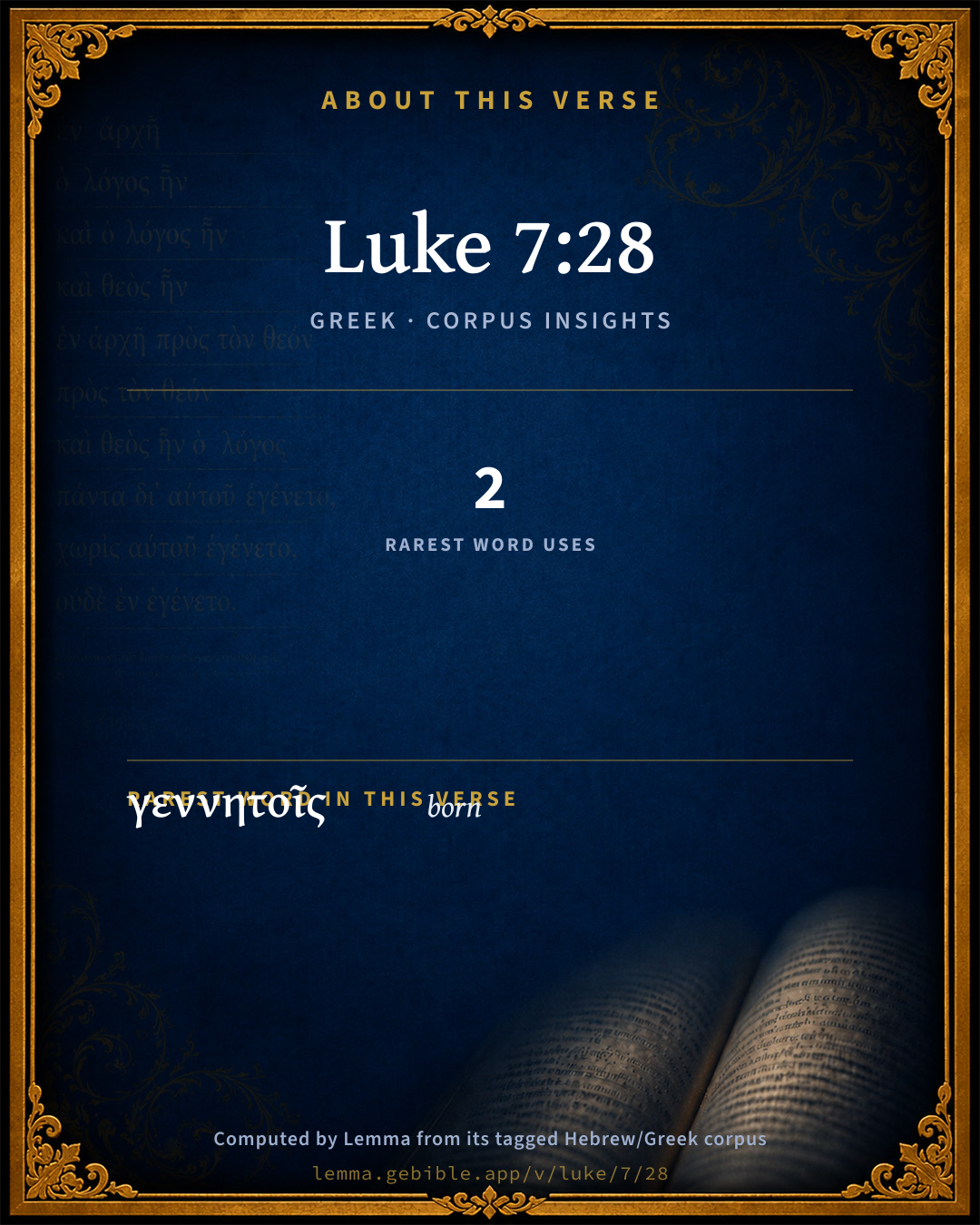
Luke 7:28

Greek (Tischendorf 8th ed.) Luke 7:28 appears in the Greek New Testament. The text above is from the Tischendorf 8th edition. Each word links to its Strong’s number and a concise gloss. Click any word for its full Thayer’s Greek Lexicon entry.
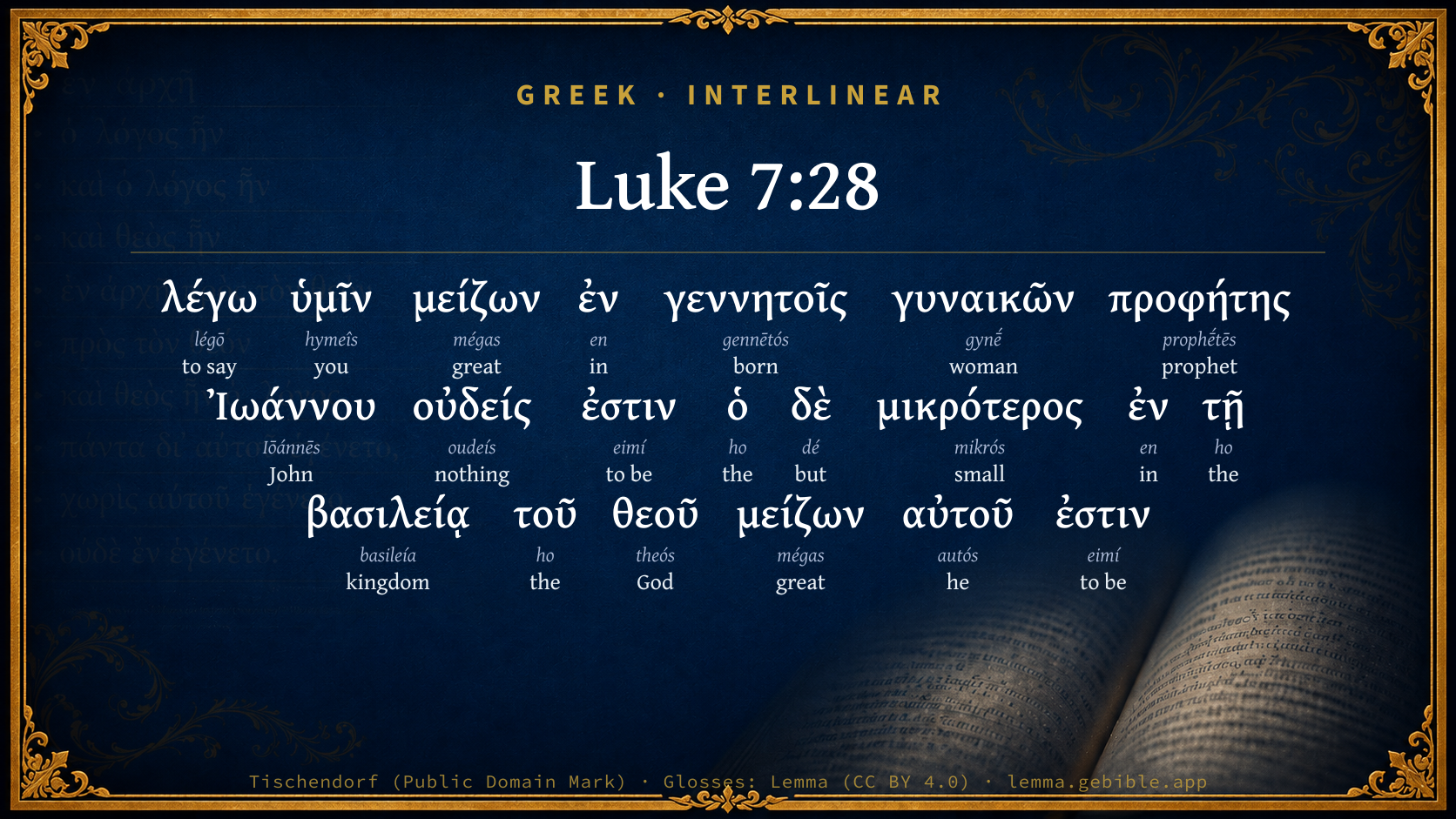
Download image
Cite this verse

Luke 7:28 (World English Bible). Public Domain. Lemma interlinear Bible study tool, https://lemma.gebible.app/v/luke/7/28.

Show BibTeX & RIS
BibTeX
RIS
English Translation
"For I tell you, among those who are born of women there is not a greater prophet than John the Baptizer, yet he who is least in the Kingdom of God is greater than he."
World English Bible · Public Domain
Download a study sheet

One document with this verse’s original text, its word-by-word gloss line, the meaning frame, cross-references with their text, attributed commentary, and full source and license credits — printable, and it pastes into notes with its structure intact.

This verse Autodidact and up

Study sheet (.html) Plain text (.txt)

A passage Seminary Student

Up to 50 verses in one chapter. A passage sheet keeps up to 6 commentary sources and 12 cross-references per verse, in the order this page ranks them, and says so on the sheet whenever that leaves anything out. Ask for a single verse and you get the Autodidact verse sheet above.

Everything on this page stays free to read, with no account — the sheet is a download of what is already on screen, not access to it.

Want to remove ads? Support Godless Engineer
Compare translations 3

The same verse in 3 English versions, stacked beneath the original-language interlinear above. Click any original word for its lexicon entry.

Each is an independent rendering of the whole verse — the interlinear is not word-aligned to these translations.

Highlighted words mark where these versions differ — a whole-verse word diff, not a word-by-word alignment.

  • World English Bible Public Domain
    "For I tell you, among those who are born of women there is not a greater prophet than John the Baptizer, yet he who is least in the Kingdom of God is greater than he."
  • King James Version Public Domain
    For I say unto you, Among those that are born of women there is not a greater prophet than John the Baptist: but he that is least in the kingdom of God is greater than he.
  • unfoldingWord Literal Text CC BY-SA 4.0
    I say to you, among those born of women, no one is greater than John, but the least in the kingdom of God is greater than he.”

unfoldingWord Literal Text — © unfoldingWord, licensed CC BY-SA 4.0. Word-aligned USFM3 via Door43 (git.door43.org/unfoldingWord/en_ult).

Versions to compare (up to 4)

3 of 4 selected

Show all 19 translations

Every available English version of this verse, each an independent rendering of the whole verse.

  • World English Bible Public Domain
    "For I tell you, among those who are born of women there is not a greater prophet than John the Baptizer, yet he who is least in the Kingdom of God is greater than he."
  • Berean Standard Bible Public Domain
    I tell you, among those born of women there is no one greater than John, yet even the least in the kingdom of God is greater than he.”
  • Majority Standard Bible Public Domain
    For I tell you, among those born of women there is no one greater prophet than John the Baptist, yet even the least in the kingdom of God is greater than he.”
  • King James Version Public Domain
    For I say unto you, Among those that are born of women there is not a greater prophet than John the Baptist: but he that is least in the kingdom of God is greater than he.
  • American Standard Version (1901) Public Domain
    I say unto you, Among them that are born of women there is none greater than John: yet he that is but little in the kingdom of God is greater than he.
  • Revised Version (1885) Public Domain
    I say unto you, Among them that are born of women there is none greater than John: yet he that is but little in the kingdom of God is greater than he.
  • Geneva Bible (1599) Public Domain
    For I say vnto you, there is no greater Prophet then Iohn, among them that are begotten of women: neuerthelesse, hee that is the least in the kingdome of God, is greater then he.
  • Douay-Rheims (1899) Public Domain
    For I say to you: Amongst those that are born of women, there is not a greater prophet that John the Baptist. But he that is the lesser in the kingdom of God, is greater than he.
  • Young's Literal Translation Public Domain
    for I say to you, a greater prophet, among those born of women, than John the Baptist there is not; but the least in the reign of God is greater than he.'
  • Literal Standard Version CC BY-SA 4.0
    for I say to you, there is not a greater prophet, among those born of women, than John the Immerser; but the least in the Kingdom of God is greater than he.”
  • Unlocked Literal Bible CC BY-SA 4.0
    I say to you, among those born of women none is greater than John. Yet the one who is least in the kingdom of God is greater than he is.”
  • unfoldingWord Literal Text CC BY-SA 4.0
    I say to you, among those born of women, no one is greater than John, but the least in the kingdom of God is greater than he.”
  • Darby Bible Public Domain
    for I say unto you, Among them that are born of women a greater [prophet] is no one than John [the baptist]; but he who is a little one in the kingdom of God is greater than he.
  • World Messianic Bible Public Domain
    “For I tell you, among those who are born of women there is not a greater prophet than Yochanan the Immerser; yet he who is least in God’s Kingdom is greater than he.”
  • Webster's Bible Public Domain
    For I say to you, Among those that are born of women, there is not a greater prophet than John the Baptist: but he that is least in the kingdom of God, is greater than he.
  • Free Bible Version CC BY-SA 4.0
    I tell you, no one born of women is greater than John, but even the most unimportant person in God's kingdom is greater than he is!”
  • Bible in Basic English Public Domain
    I say to you, Among all the sons of women, not one is greater than John: but he who is least in the kingdom of God is greater than he.
  • Text-Critical English NT CC BY 4.0
    For I tell you, among those born of women there is no prophet greater than John the Baptist, but whoever is least in the kingdom of God is greater than he.”
  • Tyndale New Testament (1534) Public Domain
    For I saye vnto you: a greater prophete then Iohn amonge wemes chyldre is ther none. Neverthelesse one that is lesse in the kyngdo of god is greater the he.

Literal Standard Version (2020), Covenant Press — licensed CC BY-SA 4.0. Text via the HelloAO Bible API (eBible.org). Unlocked Literal Bible (unfoldingWord) — licensed CC BY-SA 4.0. Text via the HelloAO Bible API (eBible.org). unfoldingWord Literal Text — © unfoldingWord, licensed CC BY-SA 4.0. Word-aligned USFM3 via Door43 (git.door43.org/unfoldingWord/en_ult). Free Bible Version, Dr. Jonathan Gallagher — licensed CC BY-SA 4.0. Text via the HelloAO Bible API (eBible.org).

Word by word

More ways to search: Search by grammar → Find every occurrence → Compare this word →

Practice this passage: Drill this verse → Learn its vocabulary →

γεννητοῖς
gennētós
G1084
“born”
Adjective, Dative, Plural, Masculine
Part of Speech
Adjective
Case
Dative
Number
Plural
Gender
Masculine
Full Thayer's Definition

Origin: from G1080

TDNT: 12:12,1

1. begotten, born
  1. λέγω légō G3004 “to say” Verb, Present, Active, Indicative, 1st person, Singular
  2. ὑμῖν hymeîs G5210 “you” Personal pronoun, 2nd person, Dative, Plural
  3. μείζων mégas G3173 “great” Adjective, Nominative, Singular, Masculine, Comparative
  4. ἐν en G1722 “in” Preposition
  5. γυναικῶν gynḗ G1135 “woman” Noun, Genitive, Plural, Feminine
  6. προφήτης prophḗtēs G4396 “prophet” Noun, Nominative, Singular, Masculine
  7. Ἰωάννου Iōánnēs G2491 “John” Noun, Genitive, Singular, Masculine
  8. οὐδείς oudeís G3762 “nothing” Adjective, Nominative, Singular, Masculine, Negative
  9. ἐστιν eimí G1510 “to be” Verb, Present, Active, Indicative, 3rd person, Singular
  10. ὁ ho G3588 “the” Article, Nominative, Singular, Masculine
  11. δὲ dé G1161 “but” Conjunction
  12. μικρότερος mikrós G3398 “small” Adjective, Nominative, Singular, Masculine, Comparative
  13. ἐν en G1722 “in” Preposition
  14. τῇ ho G3588 “the” Article, Dative, Singular, Feminine
  15. βασιλείᾳ basileía G932 “kingdom” Noun, Dative, Singular, Feminine
  16. τοῦ ho G3588 “the” Article, Genitive, Singular, Masculine
  17. θεοῦ theós G2316 “God” Noun, Genitive, Singular, Masculine
  18. μείζων mégas G3173 “great” Adjective, Nominative, Singular, Masculine, Comparative
  19. αὐτοῦ autós G846 “he” Personal pronoun, Genitive, Singular, Masculine
  20. ἐστιν eimí G1510 “to be” Verb, Present, Active, Indicative, 3rd person, Singular

About this verse

These counts appear in no published source. They are computed here, from the morphology-tagged text and Lemma’s own curated glosses. What Lemma adds →

21
words
16
distinct lemmas
Gospels
section

Notable vocabulary

The rarest word here is γεννητοῖς born G1084 — appearing just 2 times in the whole Greek New Testament.

Shared distinctive vocabulary

γεννητοῖς born G1084 occurs in 2 verses of the Greek New Testament. Also found in:

Repetition

Words recur within this verse:

Cross-references

10

Topical passages linked to Luke 7:28 in the Treasury of Scripture Knowledge — connected by theme and wording, ordered by reader-vote popularity; previews shown in the World English Bible.

  • Matthew 11:11 Most assuredly I tell you, among those who are born of women there has not arisen anyone greater than John the Baptizer; yet he who is least in the Kingdom of Heaven is greater than he.
  • Matthew 13:16–17 "But blessed are your eyes, for they see; and your ears, for they hear.
  • Hebrews 11:39–40 These all, having had testimony given to them through their faith, didn't receive the promise,
  • Colossians 1:25–27 of which I was made a servant, according to the stewardship of God which was given me toward you, to fulfill the word of God,
  • Luke 9:48 and said to them, "Whoever receives this little child in my name receives me. Whoever receives me receives him who sent me. For whoever is least among you all, this one will be great."
  • Luke 10:23–24 Turning to the disciples, he said privately, "Blessed are the eyes which see the things that you see,
  • Ephesians 3:8–9 To me, the very least of all saints, was this grace given, to preach to the Gentiles the unsearchable riches of Christ,
  • 1 Peter 1:10–12 Concerning this salvation, the prophets sought and searched diligently, who prophesied of the grace that would come to you,
  • Luke 3:16 John answered them all, "I indeed baptize you with water, but he comes who is mightier than I, the latchet of whose sandals I am not worthy to loosen. He will baptize you in the Holy Spirit and fire,
  • Luke 1:14–15 You will have joy and gladness; and many will rejoice at his birth.

Cross-references courtesy of OpenBible.info (CC BY 4.0).

Where the printed editions differ

2 variants

Places in this verse where the major printed Greek editions disagree on the wording in a way that affects the translation — a comparison of editions, not a manuscript-by-manuscript collation. The editions are the modern critical texts (Nestlé-Aland 28/27, SBL, Westcott-Hort, Tregelles, Tyndale House) and the traditional texts behind the KJV (the Textus Receptus and the Byzantine/Majority text). It is not a claim about which reading is original.

  1. Extra text
    προφήτης

    “prophet”

    In TregTRByz Not in NA28NA27TynSBLWH

    προφήτης (prophētēs) 'prophet' is only in traditional manuscripts (Treg+TR+Byz)

  2. Different wording
    Ἰωάννου

    “than John”

    In NA28NA27TynSBLWHTreg Not in TRByz

    βαπτιστοῦ (baptistou) 'baptist' occurs in traditional manuscripts (TR+Byz) instead of Ἰωάννου (Iōannou) 'than John' in older manuscripts (NA28+NA27+Tyn+SBL+WH+Treg)

Textual data: Translators Amalgamated Greek New Testament (STEPBible TAGNT) · CC BY 4.0.

Commentary

Notes on Luke 7:28 from classic Christian and Jewish commentators (each source and its license shown beneath its notes). The classic Christian expositions comment on the surrounding passage and are grouped to its opening verse, so a note may address several verses; the Jewish commentaries on the Tanakh (Rashi and others) are per-verse, so they appear only where the commentator wrote on this verse.

Lemma curates 59 commentaries, every one of them public domain or Creative Commons licensed, each selected and text-cleaned for this edition rather than reprinted as found. About our sources →

The Biblical Illustrator

Joseph S. Exell

Luk_7:28

For I say unto you, Among those that are born of women there is not a greater prophet than John the Baptist

Much more than a prophet, but less than a Christian worker

Johns greatness not that of function or office only, but of character.

But his greatness bows before the excelling and incomparable greatness of the Lord. Further, our Lord here declares that every lowliest stoner who accepted Him as his very own Saviour, thereby passed into the kingdom of heaven, and by this one act and fact took a stamp of greatness besides which even that of John the Baptist was dwarfed. As our tidal rivers enlarge into bays and reaches of the sea by the seas simple flowing into them, or communicating its own mass and strength and riches to them; so these relatively narrow beings of ours become spacious and Christlike by the indwelling and sway of the Spirit with all the new and august power of the new kingdom. Three practical remarks.

1. Be it ours who are privileged to work for Christ to emulate John the Baptists type of work. No thought of self.

2. Be it ours in the full day of the gospel to realize our greater responsibility.

3. Be it ours to beware of assumption (or presumption) of this excelling greatness. Mere function, mere human recognition, will count for nothing beneath the eye of Him with whom we have to do. (Dr. Grosart.)

Nature and circumstances

Jesus told men that the true greatness of human life must come by following Him. It was inevitable, then, that men should ask, How is it about those great men who are not His followers; those great men who have gone before Him--are they not truly great? And if they are, what has become of His saying that true greatness lies only in Him, and in the Kingdom of God to which He is so earnestly summoning us? To this question Jesus gave answer in the words of the text. Let us study the answer.

I. It is a question which belongs not to the things of Christ nor to religious things alone. All life suggests it; for in all life there are two ways of estimating the probable value of men--one by the direct perception of their characters the other by the institutions to which they belong, and the privileges which they enjoy. Sense in which the school-boy of to-day is greater than Socrates. The two elements of greatness--greatness of nature, and greatness of circumstance. They are distinct from one another; they do not make each other.

II. Christ recognizes the two elements of personal greatness and lofty condition, and He seems almost to suggest another truth, which is at any rate familiar to our experience of life--that personal power which has been manifest in some lower region of life seems sometimes to be temporarily lost cud dimmed with the advance of the person who possesses it into a higher condition. What really is a progress seems, for a time at least, to involve a loss.

III. In ordinary life the power of the temptation to be satisfied with greatness in some lower sphere and not to aspire to the highest sort of existence, is constantly appearing.

IV. See how the truth of the text applies to the explanation and understanding of a true and noble life lived in a false faith. I believe that this is the simple truth which a good many puzzled people among us need to know. The Christian, with his unbelieving friend whose daily life, so pure, upright, and honest, shames the poor half-discouraged believer every day--what can you say to him?

1. Bid him rejoice that his Christ can and does do for that friend of his so much even when that friend denies Him.

2. Bid him see that if that friend of his could conscientiously know and cordially acknowledge the Christ who is doing so much for him already, he would give that Christ a chance to do still more which now He cannot do.

3. Let him, for himself, be filled with an inspiring shame which shall make him determined to be worthier of his higher faith. This is the true ministry which ought to come to any Christian from the presence of a man who believes far less than he does, and is a far better man than he is.

V. See how all of this must tell upon the whole idea of Christian missions. There may have been a time when, in order to make it seem right for the Christian world to send missionaries to the heathen, it required to be made out that all heathen virtue was a falsehood and delusion. That day is past, if it ever existed. May not the Christian glory in every outbreak of the heathens goodness as a sign of the power with which his Christ, even unknown, may fill a human life which in the very darkness of its ignorance is obedient to whatever best spiritual force it feels? May not that very sight reveal to him what that aspiring heathenism might become if it could be made aware of the Christ whom it is in its unconsciousness obeying? May he not, even while he goes out to tell the heathen his completer gospel, be filled with an inspiring shame at his own poor use and exhibition of that gospel which he offers to the heathen world? This is the true attitude of Christendom to paganism. It is not arrogant; it brings no insult; it comes like brother to brother, full of honour for the nature to which it offers the larger knowledge of the Fathers life. To such brave missionary impulse as that let us be sure that the increase of rational and spiritual Christianity will only add ever new and stronger impulse and inspiration. (Phillips Brooks, D. D.)

The judgment of Jesus on John

One thing clear at the outset, viz., that the comparison is not absolute, but relative to certain aspects under which the parties compared are viewed; such as the happiness they respectively enjoy, the spirit by which they are respectively animated, or the nature of the spiritual movements with which they are respectively identified. Christs purpose in making the statement was not to assist the people to take full and accurate measure of Johns genius and character. He did not discuss the question of the Baptists comparative greatness in the spirit in which, in a debating society, youths might discuss the question, Who was the greater man and general--Caesar or Napoleon? He was concerned about far higher matters. His anxiety was to get people to understand the spiritual phenomenon of their time, and in particular to form true, just, and wholesome opinions concerning the religious movements with which John and Himself were identified respectively. For the opinions we form of men very seriously affect our opinions concerning principles and movements. Those who thought too much of John would remain with him, and never join the society of the Christ whose harbinger tie was. On the other hand, those who thought too little of John would think just as little of Christ. It is manifest, then, that the judgment pronounced is not so much on a man as on an era. It is a judgment on the law given by Moses; and the comparison made between the last prophet of law and any little one in the kingdom signifies the immense inferiority of the legal economy to the era of grace which came by Jesus Christ. Paraphrased, the verse means: John, the last prophet of the old time, was a great prophet--none greater. No one who went before ever did better justice to the law than he; preached it with more power and boldness, embodied it in a more upright, blameless life, or gained for its claims more widespread and respectful attention. Still, with all that, nay, just because he is a hero of law, John is a weak, one-sided man. What he has is good, but he wants something of far more value, something which puts its possessors on a different platform altogether from that which he occupies, insomuch that it may be said without extravagance that those who possess it, though immeasurably inferior to John in other respects, are greater than he. He wants the spirit of the new time, of the era of the better hope. Strong in zeal, he is defective in love; strong in denunciation, he is weak in patience towards the sinful; strong in ascetic abstinence, he is weak in the social and sympathetic affections; strong as the whirlwind, the earthquake, and the fire, he is weak in the moral influence that comes through the still small voice of a meek and merciful mind. In these respects, any one in the kingdom of heaven animated by the characteristic spirit of love is greater than he. The programme of Jesus as in contrast to that of John might be summed up in these two principles:--

1. Salvation by Divine mercy, not by penance.

2. New life by regeneration, not by reform. (A. B. Bruce, D. D.)

Was John the Baptist not in the Kingdom?

He was outside it in the same sense in which many excellent men are outside the visible Church, though not, thank God, on that account outside the invisible Church. In former times he had proclaimed the near approach of the kingdom, but at this moment he was in doubt whether either the King or kingdom had come, the actual characteristics of both being so different from what he had expected. In this sense John was outside the kingdom: he was not connected with it as a visible historical movement called by this name. The Kingdom of God was in him, in his heart: in his thoughts continually. His very message of doubting inquiry showed this; for his was a case in which there was more faith in honest earnest doubt than there is in the belief of many men. And in what he said Jesus had no thought of calling in question, or of so much as hinting a suspicion, as to Johns spiritual state. And we must strive in this respect to imitate our Lord, and to bear in mind that because a man is outside the visible Church he is not therefore unsaved; that there may be many who, from one cause or another, are alienated from the visible Church, who nevertheless are children of God and citizens of His kingdom, though in many respects too probably erring, one-sided, defective men. If Christ judged John leniently and charitably, how much more should we abstain from judging those who are without, and full of prejudices against Christianity, when too probably the blame of their prejudice and alienation lies at our own door! Surely this is a very legitimate lesson to draw from the striking saying we have been studying. (A. B. Bruce, D. D.)

Grace is better than power

To insist, in the presence of a successful millionaire, or a triumphant prince, or a victorious soldier, or a medalled artist, that the veriest infant in the class of a Sunday-school, who has intelligently learned the articulate language of love to the Saviour, is better than he, is a brave thing to do, of course. But whether the courage will be rewarded with any prosperity in making him believe it, is quite another consideration. It is power that most men are seeking, and not grace. And it is a pity that they do not all get either, even after the seeking. Think of the unfortunate architecture of Cologne Cathedral. The pile of stone has stood through the ages incomplete; just now it has at last been finished. But--most singular fate of genius--nobody on all this earth knows at the dedication who drew the early plans for the building, or whose is the fame of its beauty. John Keats left for his tombstone in Rome the somewhat violent epitaph: Here lies one whose name was writ in water! Alas1 cannot we hope that it was written in the Lambs Book of Life? It is exceedingly interesting to find the jealous Turners beautiful landscapes between the two Claudes in the British Gallery; for we are glad to know neither of the great canvasses suffered from the comparison. But then who can help putting the tranquil inquiry, What difference does it make to those painters now which of them is considered the better artist? And where is Turner to-day, and where is Claude Lorraine also? For grace settles the long mysterious future; and gift is not grace. Socrates was a great man; but some say he sold his wife at a price. Alexander was a great monarch; but he died in a drunken debauch. Lord Byron was a great man; but his statue at Trinity College has on its front look the divinity of a genius, and on its profile one side is the leer of a lecher. It would be useless to deny that these famous people had power; but grace is better than power. (C. S.Robinson, D. D.)

The smallest diamond is made of more precious substance than the largest flint. (Archdeacon Farrar.)

The greatness of the Baptist

In Joh_10:41 it is stated that John did no miracle, and to some this may seem inconsistent with what our Lord here declared concerning him. Mightiness indeed is reckoned, and very justly reckoned, a considerable element of a prophets greatness. Let us, then, consider how John the Baptist deserves the title of the greatest of the prophets, in spite of his having never wrought a miracle.

1. It is a greater thing to exercise a wide moral and spiritual influence upon our generation, than to work a miracle before their eyes. To work a miracle is to exhibit power over matter; to exercise a wide moral and spiritual influence is to exhibit a power over mind. To be made the means, in Gods hand, of swaying the human will, curbing the unruly human passions, arousing the human conscience to wholesome alarms and sincere inquiries after the way of salvation, is a higher distinction than to be made the means of reversing natures laws, or restraining the fury of the elements, or calling forth the tenants of the sepulchre from their dreamt abode.

2. It is partly, I conceive, in his very lack of miraculous power, that the grandeur of John the Baptist as a prophet consists. Without the aid of miracles to give effect to his words he wrought a national reformation. Without supernatural resources he accomplished what other prophets were only able to effect with their aid.

3. John Baptists magnanimity is another feature which enhances his greatness as a prophet. He sinks self, that he may exalt Christ.

4. Another element in his greatness is the relation in which he stood to Christ as His forerunner, and the opportunity which it afforded him of bearing testimony to the person of our Lord.

Concluding lessons:

1. Learn to estimate aright, and not by the worlds standard, the true greatness of man.

2. The testimony of Christ is the spirit of prophecy.

(Dean Goulburn.)

The Biblical Illustrator, edited by Joseph S. Exell (c. 1880s–1900s) — public domain. Text from a community e-Sword module.

MacLaren's Expositions of Holy Scripture

Alexander MacLaren

Luke

JOHN’S DOUBTS AND CHRIST’S PRAISE

GREATNESS IN THE KINGDOM

Luk 7:28.

We were speaking in a preceding sermon about the elements of true greatness, as represented in the life and character of John the Baptist. As we remarked then, our Lord poured unstinted eulogium upon the head of John, in the audience of the people, at the very moment when he showed himself weakest. ‘None born of women’ was, in Christ’s eyes, ‘greater than John the Baptist.’ The eulogium, authoritative as it was, was immediately followed by a depreciation as authoritative, from Christ’s lips: ‘The least in the kingdom is greater than he.’ Greatness depends, not on character, but on position. The contrast that is drawn is between being in and being out of the kingdom; and this man, great as he was among them ‘that are born of women,’ stood but upon the threshold; therefore, and only therefore, and in that respect, was he ‘less than the least’ who was safely within it.

Now, there are two things in these great words of our Lord to notice by way of introduction. One is the calm assumption which He makes of authority to marshal men, to stand above the greatest of them, and to allocate their places, because He knows all about them; and the other is the equally calm and strange assumption of authority which He makes, in declaring that the least within the kingdom is greater than the greatest without. For the kingdom is embodied in Him, its King, and He claimed to have opened the door of entrance into it. ‘The kingdom of God,’ or of heaven-an old Jewish idea-means, whatever else it means, an order of things in which the will of God is supreme. Jesus Christ says, ‘I have come to make that real reign of God, in the hearts of men, possible and actual.’ So He presents Himself in these words as infinitely higher than the greatest within, or the greatest without the kingdom, and as being Himself the sovereign arbiter of men’s claims to greatness. Greater than the greatest is He, the King; for if to be barely across the threshold stamps dignity upon a man, what shall we say of the conception of His own dignity which He formed who declared that He sat on the throne of that kingdom, and was its Monarch?

I. The first thought that I suggest is the greatness of the little ones in the kingdom.

As I have said, our Lord puts the whole emphasis of His classification on men’s position. Inside all are great, greater than any that are outside. The least in the one order is greater than the greatest in the other. So, then, the question comes, How does a man step across that threshold? Our Lord evidently means the expression to be synonymous with His true disciples. We may avail ourselves, in considering how men come to be in the kingdom, of His own words. Once He said that unless we received it as little children, we should never be within it. There the blending of the two metaphors adds force and completeness to the thought. The kingdom is without us, and is offered to us; we must receive it as a gift, and it must come into us before we can be in it. The point of comparison between the recipients of the kingdom and little children does not lie in any sentimental illusions about the innocence of childhood, but in its dependence, in its absence of pretension, in its sense of clinging helplessness, in its instinctive trust. All these things in the child are natural, spontaneous, unreflecting, and therefore of no value. You and I have to think ourselves back to them, and to work ourselves back to them, and to fight ourselves back to them, and to strip off their opposites which gather round us in the course of our busy, effortful life. Then they become worth infinitely more than their instinctive analogues in the infant. The man’s absence of pretension and consciousness of helplessness and dependent trust are beautiful and great, and through them the kingdom of God, with all its lights and glories, pours into his heart, and he himself steps into it, and becomes a true servant and subject of the King.

Then there is another word of the Master’s, equally illuminative, as to how we pass into the kingdom, when He spoke to the somewhat patronising Pharisee that came to talk to Him by night, and condescended to give the young Rabbi a certificate of approval from the Sanhedrim, ‘We know that Thou art a Teacher come from God.’ Christ’s answer was, in effect, ‘Knowing will not serve your turn. There is something more than that wanted: “Except a man be born of water, and of the Spirit, he cannot enter into the kingdom of God.”‘ So, another condition of entering the kingdom-that is, of coming for myself into the attitude of lowly, glad submission to God’s will-is the reception into our natures of a new life-principle, so that we are not only, like the men whom Christ compared with John, ‘born of women,’ but by a higher birth are made partakers of a higher life, and born of the Spirit of God. These are the conditions-on our side the reception with humility, helplessness, dependent trust like those of children, on God’s side the imparting, in answer to that dependence and trust, of a higher principle of life-these are the conditions on which we can pass out of the realm of darkness into the kingdom of the Son of His love.

This being so, then we have next to consider the greatness that belongs to the least of those who thus have crossed the threshold, and have come to exercise joyous submission to the will of God. The highest dignity of human nature, the loftiest nobility of which it is capable, is to submit to God’s will. ‘Man’s chief end is to glorify God.’ There is nothing that leads life to such sovereign power as when we lay all our will at His feet, and say, ‘Break, bend, mould, fashion it as Thou wilt.’ We are in a higher position when we are in God’s hand. His tools and the pawns on His board, than we are when we are seeking to govern our lives at our pleasure. Dignity comes from submission, and they who keep God’s commandments are the aristocracy of the world.

Then, further, there comes the thought that the greatness that belongs to the least of the little ones within the kingdom springs from their closer relation to the Saviour, whose work they more clearly know and more fully appropriate. It is often said that the Sunday-school child who can repeat the great text, ‘God so loved the world that He gave His only begotten Son, that whosoever believeth in Him should not perish, but have everlasting life,’ stands far above prophet, righteous man, and John himself. This is not exactly true, for knowledge of the truth is not what introduces into the kingdom; but it is true that the weakest, the humblest, the most ignorant amongst us, who grasps that truth of the God-sent Son whose death is the world’s life, and who lives, therefore, nestling close to Jesus Christ, walks in a light far brighter than the twilight that shone upon the Baptist, or the yet dimmer rays that reached prophets and righteous men of old. It is not a question of character; it is a question of position. True greatness is regulated, by closeness to Jesus Christ, and by apprehension and appropriation of His work to myself. The dwarf on the shoulders of the giant sees further than the giant; and ‘the least in the kingdom,’ being nearer to Jesus Christ than the men of old could ever be, because possessing the fuller revelation of God in Him, is greater than the greatest without. They who possess, even in germ, that new life-principle which comes in the measure of a man’s faith in Christ, thereby are lifted above saints and martyrs and prophets of old. The humblest Christian grasps a fuller Christ, and therein possesses a fuller spiritual life, than did the ancient heroes of the faith. Christ’s classification here says nothing about individual character. It says nothing about the question as to the possession of true religion or of spiritual life by the ancient saints, but it simply declares that because we have a completer revelation, we therefore, grasping that revelation, are in a more blessed position, ‘God having provided some better thing for us, that they without us should not be made perfect.’ The lowest in a higher order is higher than the highest in a lower order. As the geologist digs down through the strata, and, as he marks the introduction of new types, declares that the lowest specimen of the mammalia is higher than the highest preceding of the reptiles or of the birds, so Christ says, ‘He that is lowest in the kingdom of heaven is greater than he.’

Brethren! these thoughts should stimulate and should rebuke us that having so much we make so little use of it. We know God more fully, and have mightier motives to serve Him, and larger spiritual helps in serving Him than had any of the mighty men of old. We have a fuller revelation than Abraham had; have we a tithe of his faith? We have a mightier Captain of the Lord’s host with us than stood before Joshua; have we any of his courage? We have a tenderer and fuller revelation of the Father than had psalmists of old; are our aspirations greater after God, whom we know so much better, than were theirs in the twilight of revelation? A savage with a shell and a knife of bone will make delicate carvings that put our workers, with their modern tools, to shame. A Hindoo, weaving in a shed, with bamboos for its walls and palm leaves for its roof, and a rude loom, the same as his ancestors used three thousand years ago, will turn out muslins that Lancashire machinery cannot rival. We are exalted in position, let us see to it that Abraham, and Isaac, and Jacob, and all the saints, do not put us to shame, lest the greatest should become the guiltiest, and exaltation to heaven should lead to dejection to hell.

II. Notice the littleness of the great ones in the kingdom.

Our Lord here recognises the fact that there will be varieties of position, that there will be an outer and an inner court in the Temple, and an aristocracy in the kingdom. ‘In a great house there are not only vessels of gold and silver, but of wood and of clay.’ When a man passes into the territory, it still remains an open question how far into the blessed depths of the land he will penetrate. Or, to put away the figure, if as Christian people we have laid hold of Jesus Christ, and in Him have received the kingdom and the new life-power, there still remains the question, how much and how faithfully we shall utilise the gifts, and what place in the earthly experience and manifestation of His kingdom we shall occupy. There are great and small within it.

So it comes to be a very important question for us all, how we may not merely be content, as so many of us are, with having scraped inside and just got both feet across the boundary line, but may become great in the kingdom. Let me answer that question in three sentences. The little ones in Christ’s kingdom become great by the continual exercise of the same things which admitted them there at first. If greatness depends on position in reference to Jesus Christ, the closer we come to Him and the more we keep ourselves in loving touch and fellowship with Him, the greater in the kingdom we shall be. Again, the little ones in Christ’s kingdom become great by self-forgetting service. ‘He that will be great among you, let him be your minister.’ Self-regard dwarfs a man, self-oblivion magnifies him. If ever you come across, even in the walks of daily life, traces in people of thinking much of themselves, and of living mainly for themselves, down go these men in your estimation at once. Whether you have a beam of the same sort in your own eye or not, you can see the mote in theirs, and you lower your appreciation of them immediately. It is the same in Christ’s kingdom, only in an infinitely loftier fashion. There, to become small is to become great. Again, the little ones in Christ’s kingdom become great, not only by cleaving close to the Source of all greatness, and deriving thence a higher dignity by the suppression and crucifixion of self-esteem and self-regard, but by continual obedience to their Lord’s commandment. As He said on the Sermon on the Mount, ‘Whoso shall do and teach one of the least of these commandments shall be called great in the kingdom of heaven.’ The higher we are, the more we are bound to punctilious obedience to the smallest injunction. The more we are obedient to the lightest of His commandments, the greater we become. Thus the least in the kingdom may become the greatest there, if only, cleaving close to Christ, he forgets himself, and lives for others, and does the Father’s will.

III. Lastly, I travel for a moment beyond my text, and note the perfect greatness of all in the perfected kingdom.

The very notion of a kingdom of God established in reality, however imperfectly here on earth, demands that somewhere, and some time, and somehow, there should be an adequate, a universal and an eternal manifestation and establishment of it. If, here and now, dotted about over the world, there are men who, with much hindrance and many breaks in their obedience, are still the subjects of that realm, and trying to do the will of God, unless we are reduced to utter bewilderment intellectually, there must be a region in which that will shall be perfectly done, shall be continually done, shall be universally done. The obedience that we render to Him, just because it is broken by so much rebellion, slackened by so much indifference, hindered by so many clogs, hampered by so many limitations, points, by its attainments and its imperfections alike, to a region where the clogs and limitations and interruptions shall have all vanished, and the will of the Lord shall be the life and the light thereof.

So there rises up before us the fair prospect of that heavenly kingdom, in which all that here is interrupted and thwarted tendency shall have become realised effect.

That state must necessarily be a state of continual advance. For if greatness consists in apprehension and appropriation of Christ and His work, there are no limits to the possible expansion and assimilation of a human heart to Him, and the wealth of His glory is absolutely boundless. An infinite Christ to be assimilated, and an indefinite capacity of assimilation in us, make the guarantee that eternity shall see the growing progress of the subjects of the kingdom, in resemblance to the King.

If there is this endless progress, which is the only notion of heaven that clothes with joy and peace the awful thought of unending existence, then there will be degrees there too, and the old distinction of ‘least’ and ‘greatest’ in the kingdom will subsist to the end. The army marches onwards, but they are not all abreast. They that are in front do not intercept any of the blessings or of the light that come to the rearmost files; and they that are behind are advancing and envy not those who lead the march.

Only let us remember, brother, that the distinction of least and great in the kingdom, in its imperfect forms on earth, is carried onwards into the kingdom in its perfect form into heaven. The highest point of our attainment here is the starting-point of our progress yonder. ‘An entrance shall be ministered’; it may be ‘ministered abundantly,’ or we may be ‘saved yet so as by fire.’ Let us see to it that, being least in our own eyes, we belong to the greatest in the kingdom. And that we may, let us hold fast by the Source of all greatness, Christ Himself, and so we shall be launched on a career of growing greatness, through the ages of eternity. To be joined to Him is greatness, however small the world may think us. To be separate from Him is to be small, though the hosannas of the world may misname us great.

Alexander MacLaren, Expositions of Holy Scripture (1904–1910) — public domain. Text from a community e-Sword module.

Tyndale Open Study Notes

Tyndale Open Resources

7:28 Jesus praised John as the greatest person who ever lived under the old covenant. But even the least person in the Kingdom of God is greater than John. The blessings of the new covenant—free and complete forgiveness of sins, the indwelling presence of the Holy Spirit, and intimate knowledge of God—give believers in Jesus a new and greater position than even John enjoyed.

Tyndale Open Study Notes — © Tyndale Open Resources, licensed CC BY-SA 4.0. Text via the HelloAO Bible API.

Expositor's Greek Testament

ed. W. Robertson Nicoll

Luk 7:28 . λέγω ὑμῖν : here as elsewhere Lk. omits the Hebrew ἀμὴν , and he otherwise alters and tones down the remarkable statement about John, omitting the solemn ἐγήγερται , and inserting, according to an intrinsically probable reading; though omitted in the best MSS. (and in W.H [75] ), προφήτης , so limiting the wide sweep of the statement. Lk.’s version is secondary. Mt.’s is more like what Jesus speaking strongly would say. Even if He meant : a greater prophet than John there is not among the sons of women, He would say it thus: among those born of women there hath not arisen a greater than John, as if he were the greatest man that ever lived. ὁ δὲ μικ . On this vide at Mt.

[75] Westcott and Hort.

The Expositor's Greek Testament, edited by W. Robertson Nicoll (1897–1910) — public domain. Text from a community e-Sword module.

Ellicott's Commentary for English Readers

(28) There is not a greater prophet.—St. Matthew’s report is somewhat more emphatic, “there has not been raised up.”

A Bible Commentary for English Readers, edited by Charles John Ellicott (1878–1897) — public domain. Text from a community e-Sword module.

The Cambridge Bible for Schools and Colleges

gen. ed. J. J. S. Perowne

28. there is not a greater than John the Baptist] “He was the lamp, kindled and burning,” Joh_5:35. ‘Major Propheta quia finis Prophetarum,’ S. Ambr. He closed the former Aeon and announced the new, Mat_11:11-12.

he that is least in the kingdom of God is greater than he] See by way of comment Mat_13:16-17; Col_1:25-27, and compare Heb_11:13. The simple meaning of these words seems to be that in blessings and privileges, in knowledge, in revealed hope, in conscious admission into fellowship with God, the humblest child of the new kingdom is superior to the greatest prophet of the old; seeing that, as the old legal maxim says, “the least of the greatest is greater than the greatest of the least.” The smallest diamond is made of more precious substance than the largest flint. In the old dispensation “the Holy Ghost was not yet given, because that Jesus was not yet glorified,” Joh_7:39. Of those ‘born of women* there was no greater prophet than John the Baptist, but the members of Christ’s Church are “born of water and of the Spirit.” This saying of our Lord respecting the privileges of the humblest children of His kingdom has seemed so strange that attempts have been made to give another tone to the meaning by interpreting “he that is least” to mean “the younger,” and explain it to mean our Lord Himself as “coming after” the Baptist.

The Cambridge Bible for Schools and Colleges (gen. ed. J. J. S. Perowne; Cambridge University Press, 1878–1918) — public domain. Text from a community e-Sword module.

John Gill's Exposition

And the Lord said,.... This clause is not in the Syriac, Arabic, Persic, and Ethiopic versions, nor in some copies, nor in Beza's most ancient copy; and being omitted, more clearly shows, that the two former verses are the words of Christ, and not an observation the evangelist makes, on the different behaviour of Christ's hearers, upon the commendation he had given of John:

whereunto then shall I liken the men of this generation; or "to what men shall I liken them", as the Persic version: the phrase "men of this generation", is Rabbinical; so , the men of that "generation", are more beautiful in work than these, says the Targumist on Ecc 7:11. "And to what are they like?" To that which follows.

John Gill's Exposition of the Whole Bible (1746–1763) — public domain (CC PDM 1.0). Text via the HelloAO Bible API.

Trapp's Complete Commentary

John Trapp

24 And when the messengers of John were departed, he began to speak unto the people concerning John, What went ye out into the wilderness for to see? A reed shaken with the wind?

25 But what went ye out for to see? A man clothed in soft raiment? Behold, they which are gorgeously apparelled, and live delicately, are in kings’ courts.

26 But what went ye out for to see? A prophet? Yea, I say unto you, and much more than a prophet.

27 This is he, of whom it is written, Behold, I send my messenger before thy face, which shall prepare thy way before thee.

28 For I say unto you, Among those that are born of women there is not a greater prophet than John the Baptist: but he that is least in the kingdom of God is greater than he.

Ver. 28. But he that is least] This is no small comfort to the ministers of the gospel, against the contempts cast upon them by the world. They are somebodies in heaven, whatever men make of them.

John Trapp, A Commentary or Exposition upon All the Books of the Old and New Testament (1647–1656) — public domain. Text from a community e-Sword module.

The Pulpit Commentary

For I say unto you, Among those that are born of women, there is not a greater prophet than John the Baptist: but he that is least in the kingdom of God is greater than he. These striking words close the Master"s splendid testimony to the great pioneer. The usual explanation adopted by most if not all modern theologians of the last clause of the verse is, that, great as John was, yet he that is least among Christians who have been born of God and have accepted as an article of their faith the crucifixion and ascension of the Son of God, is greater than that great prophet; or, in other words, the humblest child of the new kingdom is superior to the greatest prophet of the old. But many of the wisest and best of the Fathers of the Church amongst others Chrysostom, Augustine, Hilary, and Theophylact find grave difficulty in accepting this too sweeping and facile explanation of a hard saying. They suggest what seems to the writer of this Exposition a more reverential meaning to the Lord"s words here. By "the least" we prefer, then, with Chrysostom and other ancient Fathers, to understand Jesus himself. The literal meaning of the Greek mikroterov is "the lesser," not "least" (in the Revised Version, in the text we find "he that is but little," but in the margin "lesser"). By "lesser" or "little" Chrysostom supposes that the Saviour refers to himself as less than John in age and according to the opinions of many. "Thus, then, among the sons of men no prophet greater than John the Baptist has arisen; yet there is one among you lesser in age and perhaps in public estimation, in the kingdom of God, though, greater than he." Wordsworth strengthens the above interpretation by his comment on the words, "among those that are born of women." "No one among those born of human parents had appeared greater than this John the Baptist; but do not suppose that he is greater than I I am not gennhto , but Yeou , and though after him in the gospel because he is my precursor, yet I am greater than he." This great expositor, while on the whole preferring the usual interpretation, yet considers that the explanation which refers "he that is least" to Christ, is not lightly to be set aside. If this interpretation be adopted, the usual punctuation of the passage must be slightly altered thus: "He that is lesser, in the kingdom of God is greater than he."

The Pulpit Commentary (1880–1919), ed. H.D.M. Spence-Jones & Joseph S. Exell — public domain. Text from a community e-Sword module.

John Wesley's Explanatory Notes

There is not a greater prophet than John - A greater teacher. But he that is least in the kingdom of God - The least teacher whom I send forth.

John Wesley, Explanatory Notes Upon the Whole Bible (1754–1765) — public domain. Text via the GEBible commentary corpus.

Kretzmann's Popular Commentary

Paul E. Kretzmann

Further praise of John:

v. 28. For I say unto you, Among those that are born of women there is not a greater prophet than John the Baptist; but he that is least in the kingdom of God is greater than he.

v. 29. And all the people that heard him, and the publicans, justified God, being baptized with the baptism of John.

v. 30. But the Pharisees and lawyers rejected the counsel of God against themselves, being not baptized of him.

High praise indeed: All the prophets of old merely prophesied of the Messiah as one coming in the future, John pointed to the present Christ, testified of Him directly. And yet, by a strange paradox, he that is smaller than all in the kingdom of God is greater than John. Though John bore witness of Jesus as having come into the midst of His people, he yet saw but the dawn, and not the full break of day. His work was finished, his course was run before Christ entered into His glory. And so the children of the New Testament that have the complete fulfillment of the prophecy before their eyes, that know Christ crucified and resurrected, that possess the complete account of salvation in the writings of the evangelists and apostles, these have a greater revelation and a brighter light than even John the Baptist. But in spite of John’s greatness, his ministry did not receive the recognition everywhere that it should have had. The popular judgment, indeed, had agreed with the estimate which Jesus had just given. The whole people, even the publicans, had, by submitting to the baptism of John, acknowledged the power of God in him. had endorsed him as a prophet. But the Pharisees and scribes had been found a sad exception. The counsel of God with regard to the salvation of all men concerned also them, they were invited as well as the others. But they deliberately rejected and spurned this counsel of love; they refused to be baptized by John; they preferred the damnation brought upon them by their hardheartedness. This has always been the fate of the Gospel-message with regard to the majority of people. God calls out to the whole world, He invites all men without exception to become partakers of His grace and mercy in Jesus Christ the Savior. But they refuse to accept His love and the proffered hand of help; they prefer to continue in their life of sin and thus are condemned by their own fault.

Paul E. Kretzmann, Popular Commentary of the Bible (1921–1924) — public domain. Text from a community e-Sword module.

Burkitt's Expository Notes on the New Testament

William Burkitt

Our Saviour having highly commended John in the former verses, here he sets bounds to the honor of his ministry; adding, that though John was greater than all the prophets that went before him, seeing more of Christ than all of them, yet he saw less than those that came after him.

The meanest gospel minister that preaches Christ as come, is to be preferred before all the old prophets who prophesied of Christ to come. That minister who sets forth the life and death, resurrection and ascension, of Christ, is greater in the kingdom of heaven, that is, has an higher office in the church, and a more excellent ministry, than all the prophets, yea, than John himself. The excellency of a ministry consists in the light and clearness of it: now though John’s light did exceed all that went before him, yet it fell short of them that came after him; and thus he that was least in the kingdom of grace on earth, much more he that was least in the kingdom of glory in heaven, was greater than John. See note on Mat 10:11

William Burkitt's Expository Notes on the New Testament (1700–1703) — public domain. Text from a community e-Sword module.

Cambridge Greek Testament for Schools and Colleges

28. προφήτης, omitted by אBL, La[154] W.H[155]

[154] La. Lachmann.

[155] W.H. Westcott and Hort.

28. μείζων. ‘He was the lamp, kindled and burning,’ Joh 5:35. “Major Prophetâ quia finis Prophetarum,” S. Ambr. He closed the former Aeon and announced the new, Mat 11:11-12. Our Lord is alluding to his office not to his moral greatness.

ὁ δὲ μικρότερος. This cannot mean quite the same thing as if the superlative had been used. It may be qualitative, as in our R.V[160] “he that is but little.” Meyer supposes it to mean ‘he that is less than John.’ We find a similar comparative in Luk 9:48 and in Mat 13:32; Mat 18:1. The superlative of μικρός is not used in the N.T.

[160] R.V. Revised Version.

μείζων αὐτοῦ. See by way of comment Mat 13:16-17; Col 1:25-27, and compare Heb 11:13. The simple meaning of these words seems to be that in blessings and privileges, in knowledge, in revealed hope, in conscious admission into fellowship with God, the humblest child of the new kingdom is superior to the greatest prophet of the old; seeing that, as the old legal maxim says, “the least of the greatest is greater than the greatest of the least.” The smallest diamond is made of more precious substance than the largest flint. In the old dispensation “the Holy Ghost was not yet given, because that Jesus was not yet glorified,” Joh 7:39. Of those “born of women” there was no greater prophet than John the Baptist, but the members of Christ’s Church are “born of water and of the Spirit.” This saying of our Lord respecting the privileges of the humblest children of His kingdom has seemed so strange that attempts have been made to give another tone to the meaning by interpreting “he that is least” to mean ‘the younger,’ and by explaining it to mean our Lord Himself as “coming after” the Baptist.

Cambridge Greek Testament for Schools and Colleges (Cambridge University Press, 1896; 21 vols, various authors incl. Carr, Maclear, Plummer, Farrar, Lumby, Moule, M. R. James, Simcox) — public domain. Text from a community e-Sword module.

International Critical Commentary

28. ἐν γεννητοῖς γυναικῶν. A solemn periphrasis for the whole human race; that it implies weakness and frailty is not evident: in Job 14:1 these qualities are expressed. It is human generation as distinct from heavenly regeneration that is meant. John’s superiority lay, not in his personal character, but in his office and mission: the glory of being the immediate forerunner of the Messiah was unique. He was a Prophet, like Moses and Elijah; yet he not only prophesied, but saw and pointed out to others Him of whom he prophesied. Lk. omits the Hebrew ἀμήν.

The word προφήτης is an interpolation. The external evidence against it is immense (א B K L M X Ξ and most Versions), and it is improbable that the possibility of Prophets outside Israel would be indicated.

ὁ δὲ μικρότερος. There is no need to make this a superlative, as AV. alone among English Versions: better, “he that is inferior,” i.e. less than other members of the Kingdom, less than any among the more insignificant. It is most unnatural to explain ὁ μικρότερος of Christ. Chrysostom says, περὶ ἑαυτοῦ λέγων εἰκότως κρύπτει τὸ πρόσωπον διὰ τὴν ἔτι κρατοῦσαν ὑπόνοιαν καὶ διὰ τὸ μὴ δόξαι περὶ ἑαυτοῦ μέγα τι λέγειν (Hom. xxxvii. p. 417), and above he explains μικρότερος as κατὰ τὴν ἡλικίαν καὶ κατὰ τὴν τῶν πολλῶν δόξαν (p. 416). Much the same view is taken by Hilary, Theophylact, Erasmus, Luther, Fritzsche, and others. In that case ἐν τῇ βασιλείᾳ τοῦ Θεοῦ must be taken after μείζων, which is awkward; and we can hardly suppose that Jesus would have so perplexed the people as to affirm that He was inferior to the Baptist, who in all his teaching had enthusiastically maintained the contrary (3:16; Mat 3:11; Mar 1:7 ; Joh 1:15, Joh 1:20, Joh 1:27, Joh 1:30, 3:Joh 1:28-30). By his office John belonged to the old dispensation; he was its last and highest product (major prophetâ, quia finis prophetarum), but he belonged to the era of preparation. In spiritual privileges, in grace, and in knowledge any even of the humbler members of the Kingdom are superior to him. He is a servant, they are sons; he is the friend of the Bridegroom, they are His spouse. It is possible to understand Ἰωάνου after μικρότερος, but it is unnecessary: more probably the comparative refers to others in the Kingdom. The paradox, “He that is less than John is greater than John,” is capable of interpretation; but the principle that the lower members of a higher class are above the highest member of a lower class is simpler. The superlative of μικρός does not occur in N.T.

29, 30 Many have supposed that these two verses are a parenthetical remark of the Evangelist. But a comment inserted in the middle of Christ’s words, and with no indication that it is a comment, is without a parallel and improbable. Joh 3:16-21 and 31-36 are not parallel. There the question is whether comment is added. In both passages it is probable that there is no comment. But, assuming that the Evangelist is in both cases commenting, he appends his comment: he does not insert it into the utterances of others. Here vv. 29 and 30 are part of Christ’s address, who contrasts the effect which John’s preaching had upon the people and upon the hierarchy (see Schanz). The connexion between ver. 30 and ver. 31 is close, as is shown by the οὖν.

International Critical Commentary — older volumes (1896–1929), various authors — public domain. Text from a community e-Sword module.

Lesson kit

Teaching starters — assembled from the data on this page, not authored interpretation. Every prompt links to the verse data it draws on. Edit before teaching.

Luke, in the Gospels, opens this verse with 21 words (16 distinct Greek lemmas). Its most distinctive word is gennētós (“born”). A historical commentator’s framing appears above. Read the whole chapter for the surrounding context.

Discussion questions

  1. What does “born” (gennētós) contribute to the verse as a whole?
  2. Matthew 11:11 shares the word «born» with this verse. How do the two illuminate each other?
  3. “great” occurs 2× in this one verse. What is the effect of the repetition?
  4. The translations on this page render this verse differently — a whole-verse word diff, not a word-by-word alignment. What might account for the different wordings?
  5. Reading how The Biblical Illustrator and MacLaren's Expositions of Holy Scripture read this verse, where do the two commentators agree and where do they part?

Things to notice

  • These translations choose different wording for 8 words in this verse.
  • “great” occurs 2× in this single verse.
  • 16 distinct Greek lemmas span 21 words in this verse.

Reading settings

Reading text

Shown beneath each verse's original-language words.

Old Testament
Old Testament edition

Read the OT as the Masoretic Hebrew (MT) or the Greek Septuagint (LXX).

English shown for the Greek Septuagint (in the Hebrew ↔ Greek comparison).

Comparing translations? Open the Compare panel on any verse page to stack up to four side by side.