
2 Corinthians 11:8

Greek (Tischendorf 8th ed.) 2 Corinthians 11:8 appears in the Greek New Testament. The text above is from the Tischendorf 8th edition. Each word links to its Strong’s number and a concise gloss. Click any word for its full Thayer’s Greek Lexicon entry.

Download image
Cite this verse

2 Corinthians 11:8 (World English Bible). Public Domain. Lemma interlinear Bible study tool, https://lemma.gebible.app/v/2-corinthians/11/8.

Show BibTeX & RIS
BibTeX
RIS
English Translation
I robbed other assemblies, taking wages from them that I might serve you.
World English Bible · Public Domain
Highlights
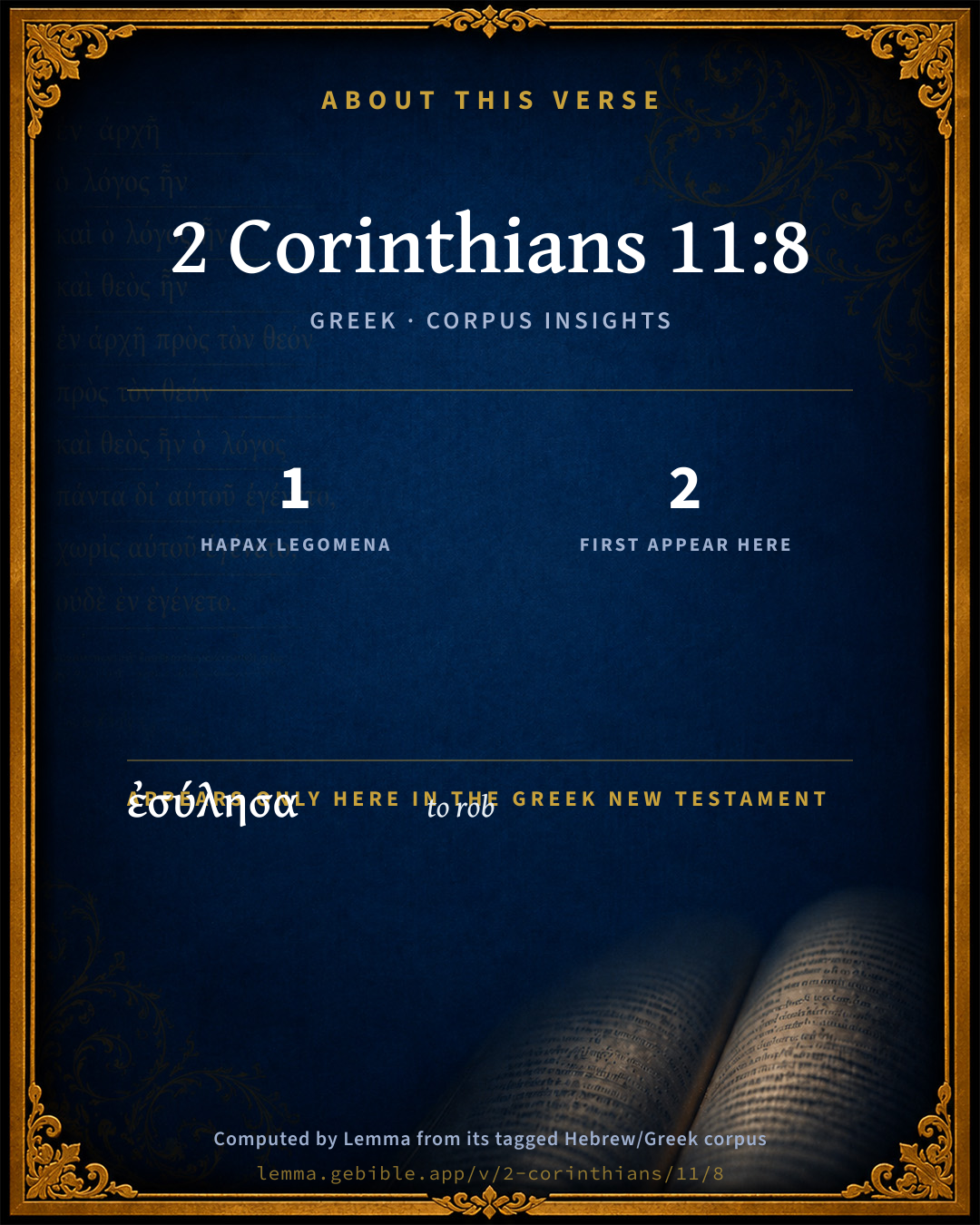
  • 1 hapax legomenon — only here in the Greek New Testament
  • 2 first appearances in the Greek New Testament
Full analysis ↓
Download a study sheet

One document with this verse’s original text, its word-by-word gloss line, the meaning frame, cross-references with their text, attributed commentary, and full source and license credits — printable, and it pastes into notes with its structure intact.

This verse Autodidact and up

Study sheet (.html) Plain text (.txt)

A passage Seminary Student

Up to 50 verses in one chapter. A passage sheet keeps up to 6 commentary sources and 12 cross-references per verse, in the order this page ranks them, and says so on the sheet whenever that leaves anything out. Ask for a single verse and you get the Autodidact verse sheet above.

Everything on this page stays free to read, with no account — the sheet is a download of what is already on screen, not access to it.

Want to remove ads? Support Godless Engineer
Compare translations 3

The same verse in 3 English versions, stacked beneath the original-language interlinear above. Click any original word for its lexicon entry.

Each is an independent rendering of the whole verse — the interlinear is not word-aligned to these translations.

Highlighted words mark where these versions differ — a whole-verse word diff, not a word-by-word alignment.

  • World English Bible Public Domain
    I robbed other assemblies, taking wages from them that I might serve you.
  • King James Version Public Domain
    I robbed other churches, taking wages of them, to do you service.
  • unfoldingWord Literal Text CC BY-SA 4.0
    I robbed other churches, having accepted a wage for the ministry you.

unfoldingWord Literal Text — © unfoldingWord, licensed CC BY-SA 4.0. Word-aligned USFM3 via Door43 (git.door43.org/unfoldingWord/en_ult).

Versions to compare (up to 4)

3 of 4 selected

Show all 19 translations

Every available English version of this verse, each an independent rendering of the whole verse.

  • World English Bible Public Domain
    I robbed other assemblies, taking wages from them that I might serve you.
  • Berean Standard Bible Public Domain
    I robbed other churches by accepting their support in order to serve you.
  • Majority Standard Bible Public Domain
    I robbed other churches by accepting their support in order to serve you.
  • King James Version Public Domain
    I robbed other churches, taking wages of them, to do you service.
  • American Standard Version (1901) Public Domain
    I robbed other churches, taking wages `of them' that I might minister unto you;
  • Revised Version (1885) Public Domain
    I robbed other churches, taking wages of them that I might minister unto you;
  • Geneva Bible (1599) Public Domain
    I robbed other Churches, and tooke wages of them to doe you seruice.
  • Douay-Rheims (1899) Public Domain
    I have taken from other churches, receiving wages of them for your ministry.
  • Young's Literal Translation Public Domain
    other assemblies I did rob, having taken wages, for your ministration;
  • Literal Standard Version CC BY-SA 4.0
    I robbed other assemblies, having taken wages, for your ministry;
  • Unlocked Literal Bible CC BY-SA 4.0
    I robbed other churches by accepting support from them so that I could serve you.
  • unfoldingWord Literal Text CC BY-SA 4.0
    I robbed other churches, having accepted a wage for the ministry you.
  • Darby Bible Public Domain
    I spoiled other assemblies, receiving hire for ministry towards you.
  • World Messianic Bible Public Domain
    I robbed other assemblies, taking wages from them that I might serve you.
  • Webster's Bible Public Domain
    I robbed other churches, taking wages of them, to do you service.
  • Free Bible Version CC BY-SA 4.0
    I robbed as it were other churches, taking pay from them so I could work for you.
  • Bible in Basic English Public Domain
    I took money from other churches as payment for my work, so that I might be your servant;
  • Text-Critical English NT CC BY 4.0
    I “robbed” other churches by receiving support from them in order to serve you!
  • Tyndale New Testament (1534) Public Domain
    I robbed other congregacions and toke wages of the to do you service with all.

Literal Standard Version (2020), Covenant Press — licensed CC BY-SA 4.0. Text via the HelloAO Bible API (eBible.org). Unlocked Literal Bible (unfoldingWord) — licensed CC BY-SA 4.0. Text via the HelloAO Bible API (eBible.org). unfoldingWord Literal Text — © unfoldingWord, licensed CC BY-SA 4.0. Word-aligned USFM3 via Door43 (git.door43.org/unfoldingWord/en_ult). Free Bible Version, Dr. Jonathan Gallagher — licensed CC BY-SA 4.0. Text via the HelloAO Bible API (eBible.org).

Word by word

More ways to search: Search by grammar → Find every occurrence → Compare this word →

Practice this passage: Drill this verse → Learn its vocabulary →

ἐσύλησα
syláō
G4813
“to rob”
Verb, Aorist, Active, Indicative, 1st person, Singular
Part of Speech
Verb
Tense
Aorist
Voice
Active
Mood
Indicative
Person
1st person
Number
Singular
Full Thayer's Definition

Origin: from a derivative of sullo (to strip, probably akin to G138 , cf G4661 )

TDNT: None

1. to rob, despoil
  1. ἄλλας állos G243 “another” Adjective, Accusative, Plural, Feminine
  2. ἐκκλησίας ekklēsía G1577 “assembly” Noun, Accusative, Plural, Feminine
  3. λαβὼν lambánō G2983 “to take” Verb, Aorist, Active, Participle, Nominative, Singular, Masculine
  4. ὀψώνιον opsṓnion G3800 “wages” Noun, Accusative, Singular, Neuter
  5. πρὸς prós G4314 “to” Preposition
  6. τὴν ho G3588 “the” Article, Accusative, Singular, Feminine
  7. ὑμῶν hymeîs G5210 “you” Personal pronoun, 2nd person, Genitive, Plural
  8. διακονίαν diakonía G1248 “service” Noun, Accusative, Singular, Feminine
  9. καὶ kaí G2532 “and” Conjunction
  10. παρὼν páreimi G3918 “to be present” Verb, Present, Active, Participle, Nominative, Singular, Masculine
  11. πρὸς prós G4314 “to” Preposition
  12. ὑμᾶς hymeîs G5210 “you” Personal pronoun, 2nd person, Accusative, Plural
  13. καὶ kaí G2532 “and” Conjunction
  14. ὑστερηθεὶς hysteréō G5302 “to fall short” Verb, Aorist, Passive, Participle, Nominative, Singular, Masculine
  15. οὐ ou G3756 “not” Particle, Negative
  16. κατενάρκησα katanarkáō G2655 “to be numb” Verb, Aorist, Active, Indicative, 1st person, Singular
  17. οὐθενός oudeís G3762 “nothing” Adjective, Genitive, Singular, Masculine, Negative

About this verse

These counts appear in no published source. They are computed here, from the morphology-tagged text and Lemma’s own curated glosses. What Lemma adds →

18
words
15
distinct lemmas
Pauline Epistles
section

Notable vocabulary

1 hapax legomenon — a word that appears only here in the entire Greek New Testament:

  • ἐσύλησα to rob G4813

First appearance in Scripture

These words make their first canonical appearance in the Greek New Testament here:

  • ἐσύλησα to rob G4813
  • κατενάρκησα to be numb G2655

Shared distinctive vocabulary

κατενάρκησα to be numb G2655 occurs in 3 verses of the Greek New Testament. Also found in:
Repetition

Words recur within this verse:

Cross-references

3

Topical passages linked to 2 Corinthians 11:8 in the Treasury of Scripture Knowledge — connected by theme and wording, ordered by reader-vote popularity; previews shown in the World English Bible.

  • 2 Corinthians 11:9 When I was present with you and was in need, I wasn't a burden on anyone, for the brothers, when they came from Macedonia, supplied the measure of my need. In everything I kept myself from being burdensome to you, and I will continue to do so.
  • Philippians 4:14–16 However you did well that you shared in my affliction.
  • Philippians 4:18 But I have all things, and abound. I am filled, having received from Epaphroditus the things that came from you, a sweet-smelling fragrance, an acceptable and well-pleasing sacrifice to God.

Cross-references courtesy of OpenBible.info (CC BY 4.0).

Commentary

Notes on 2 Corinthians 11:8 from classic Christian and Jewish commentators (each source and its license shown beneath its notes). The classic Christian expositions comment on the surrounding passage and are grouped to its opening verse, so a note may address several verses; the Jewish commentaries on the Tanakh (Rashi and others) are per-verse, so they appear only where the commentator wrote on this verse.

Lemma curates 59 commentaries, every one of them public domain or Creative Commons licensed, each selected and text-cleaned for this edition rather than reprinted as found. About our sources →

Tyndale Open Study Notes

Tyndale Open Resources

11:8-9 Paul had been accepting . . . contributions . . . from Macedonia—i.e., Philippi (Phil 4:15-19). Paul’s apparent inconsistency made the Corinthians suspicious of his motives or doubtful of his love toward them (2 Cor 11:11).

Tyndale Open Study Notes — © Tyndale Open Resources, licensed CC BY-SA 4.0. Text via the HelloAO Bible API.

Bengel's Gnomon

Johann Albrecht Bengel

2Co 11:8. Ἐσύλησα, I robbed) He imputes to himself the receiving of payment, to which he was most justly entitled, as robbery, and afterwards as sloth and a burden, comp. notes on 1Co 9:17. This word and wages are figurative expressions derived from military affairs.—λαβὼν, taking wages) for my journey, when I came to you. The antithesis is present, when I was with you [2Co 11:9].

Bengel's Gnomon of the New Testament — English translation (T&T Clark, Edinburgh, 1860) — public domain. Text from a community e-Sword module.

Meyer's Critical & Exegetical Commentary

Heinrich August Wilhelm Meyer

2Co_11:8. Further information as to the previous δωρεὰν κ.τ.λ.

ἐσύλησα] I have stripped, plundered, a hyperbolical, impassioned expression, as is at once shown by λαβὼν ὀψώνιον after it. The ungrateful ones are to be made aware, in a way to put them thoroughly to shame, of the forbearance shown to them.

The ἄλλαι ἐκκλησίαι meant were beyond doubt Macedonian. Comp. 2Co_11:9.

λαβὼν κ.τ.λ.] contemporaneous with ἐσύλησα, and indicating the manner in which it was don.

ὀψώνιον] pay (see on Rom_6:23), i.e. payment for my official labou.

πρὸς τὴν ὑμῶν διακονίαν] Aim of the ἄλλας ἐκκλ. ἐσύλησα λαβὼν ὀψ., so that the emphatic ὑμῶν corresponds to the emphatic ἄλλας. Paul had therefore destined the pay taken from other churches to the purpose of rendering (gratuitously) his official service to the Corinthians, to whom he travelled from Macedonia (Act_17:13 f., Act_18:1) in order to preach to them the gospe.

καὶ παρὼν κ.τ.λ.] and during my presence with you I have, even when want had set in with me, burdened no one. He thus brought with him to Corinth the money received from other churches, and subsisted on it (earning more, withal, by working with his hands); and when, during his residence there, this provision was gradually exhausted, so that even want set in (καὶ ὑστερηθείς), he nevertheless importuned no one, but (2Co_11:9) continued to help himself on by Macedonian pecuniary aid (in addition to the earnings of his handicraft). Comp. on Php_4:15. Rückert thinks that Paul only sought to relieve his want by the manual labour entered on with Aquila, when the money brought with him from Corinth had been exhausted and new contributions had not yet arrived. But, according to Act_18:3, his working at a handicraftof which, moreover, he makes no mention in this passageis to be conceived as continuing from the beginning of his residence at Corinth; how conceivable, nevertheless, is it that, occupied as he was so greatly with other matters, he could not earn his whole livelihood, but still stood in need of supplies! On πρὸς ὑμᾶς, which is not to be taken after my coming to you (Hofmann), comp. 1Co_16:6; Mat_13:56.

κατενάρκησα] Hesychius: ἐβάρυνα, I have lain as a burden on no one. It is to be derived from νάρκη, paralysis, debility, torpidity; thence ναρκάω, torpeo, Il. viii. 328; Plat. Men. p. 80 A B C; LXX. Gen_32:32; Job_33:19; hence καταναρκᾶν τινος: to press down heavily and stiffly on any one (on the genitive, see Matthiae, p. 860). Except in Hippocrates, p. 816 C, 1194 H, in the passive (to be stiffened), the word does not occur elsewhere in Greek; and by Jerome, Aglas. 10, it is declared to be a Cilician expression equivalent to non gravavi vos. Vulgate: nulli onerosus fui. Another explanation, quoted in addition to the above by Theophylact (comp. Oecumenius): I have not become indolent in my office (so Beza, who takes κατὰ … οὐδενός, cum cujusauam incommodo), would be at variance with the context. See 2Co_11:9. Comp. also 2Co_12:13-14. Besides, this sense would not be demonstrable for καταναρκ. but for ἀποναρκ. (Plutarch, Educ. p. 8 F).

Meyer — Critical and Exegetical Commentary on the New Testament — English translation by Peter Christie, edited by Frederick Crombie (T&T Clark, 1880) — public domain. Text from a community e-Sword module.

Expositor's Greek Testament

ed. W. Robertson Nicoll

2Co 11:8 . ἄλλας ἐκκλησίας ἐσύλησα κ . τ . λ .: I robbed other Churches, e.g. , Philippi (Phi 4:15 . He expresses himself hyperbolically to bring out his meaning; συλᾷν is a very strong word, see Act 19:37 , Rom 2:22 ), taking wages of them ( ὀψώνιον primarily means the rations supplied to a soldier, and thence his pay ; see reff.), that I might minister unto you . διακονία is not used here in special reference to the collection for the Judæan Christians, as it was at 2Co 8:4 , 2Co 9:1 ; 2Co 9:13 , but in its most general sense; cf. 2Ti 4:11 , Heb 1:14 . καὶ παρὼν κ . τ . λ .: and when I was present with you, i.e. , during his first visit to Corinth (see Act 18:1 ff.), and was in want (a condition which he recalls again, Phi 4:12 ), I was not a burden on any man . νάρκη is the torpedo-fish, which paralyses its victims by contact, and then preys upon them; so καταναρκᾷν signifies “to oppress heavily”. The compound verb is not found elsewhere in Greek literature (we have ναρκᾷν in Gen 32:25 , Job 33:19 ); Jerome says (Ep. cxxi. ad Algasiam ) that it is a Cilicianism, like ἡμέρα in 1Co 4:3 .

The Expositor's Greek Testament, edited by W. Robertson Nicoll (1897–1910) — public domain. Text from a community e-Sword module.

Jamieson, Fausset & Brown

Robert Jamieson, A. R. Fausset & David Brown

I robbed--that is, took from them in order to spare you more than what was their fair share of contribution to my maintenance, for example, the Philippian Church (Phi 4:15-16).

wages--"subsidy."

to do you service--Greek, "with a view to ministration to you"; compare "supplied" (Greek, "in addition"), Co2 11:9, implying, he brought with him from the Macedonians, supplies towards his maintenance at Corinth; and (Co2 11:9) when those resources failed ("when I wanted") he received a new supply, while there, from the same source.

Jamieson, Fausset & Brown — Commentary Critical and Explanatory on the Whole Bible (1871) — public domain (CC PDM 1.0). Text via the HelloAO Bible API.

Adam Clarke's Commentary

Verse 8. I robbed other Churches] This part of the sentence is explained by the latter, taking wages to do you service. The word οψωνιον signifies the pay of money and provisions given daily to a Roman soldier. As if he had said: I received food and raiment, the bare necessaries of life, from other Churches while labouring for your salvation. Will you esteem this a crime?

Adam Clarke's Commentary on the Bible (1810–1826) — public domain. Text from a community e-Sword/MySword module.

John Calvin's Commentaries

8. I robbed other churches He has intentionally, in my opinion, made use of an offensive term, that he might the more forcibly express the unreasonableness of the matter — in respect of his being despised by the Corinthians. “I have,” says he, “procured pay for myself from the spoils of others, that I might serve you. While I have thus spared you, how unreasonable it is to make me so poor a return!” It is, however, a metaphor, that is taken from what is customary among soldiers; for as conquerors take spoils from the nations that they have conquered, so every thing that Paul took from the Churches that he had gained to Christ was, in a manner, the spoils of his victories, though, at the same time, he never would have taken it from persons against their will, but what they contributed gratuitously was, in a manner, due by right of spiritual warfare.

John Calvin's Commentaries (1540-1563) — public domain. Text from the Calvin Translation Society English edition (1840s-50s) via the Christian Classics Ethereal Library (ccel.org). Calvin's coverage is partial (roughly two-thirds of the Bible); uncommented books and verses are honest gaps, never fabricated. The 19th-century editor's footnotes and remarks are omitted so the notes are faithfully Calvin's own voice.

Ellicott's Commentary for English Readers

(8) I robbed other churches, taking wages of them.—The word for wages—strictly rations, or wages in kind, rather than in money—is found in Luk_3:14; Rom_6:23; 1Co_9:7. Its use in the last-named passage had, perhaps, given occasion for a sneer. “He too can take wages when it suits his purpose.” From St. Paul’s point of view, if what he had received had been wages at all, he had been guilty of an act of spoliation. He had received wages from one employer while he was acting in the service of another.

A Bible Commentary for English Readers, edited by Charles John Ellicott (1878–1897) — public domain. Text from a community e-Sword module.

The Cambridge Bible for Schools and Colleges

gen. ed. J. J. S. Perowne

8. I robbed other churches] “An hyperbolical expression” (Meyer). And yet in one sense it was true, for the Corinthians were just as much bound to support the Apostle when at Corinth as any other Churches were when the Apostle was with them. And, therefore, if when at Corinth he availed himself of assistance from those other Churches, he was taking from them what they ought not to have been called upon to supply. Why he did so we are told in 2Co_11:12.

taking wages of them] The Philippian Church, we learn from Php_4:15-16 (cf. next verse), is the Church referred to. Their liberality, St Paul felt, was not likely to be cast in his teeth, therefore he readily accepted it. In later days he again received their bounty with a willingness which would not, he knew, be misconstrued. This is an instance of that minute but undesigned agreement in points of detail which constitutes so strong an argument for the genuineness of most of the Scriptures of the N. T. For the word translated wages see St Luk_3:14; Rom_6:23; 1Co_9:7. It was most commonly used of a soldier’s pay, when given in kind.

to do you service] Rather, towards my support in my ministry to you.

The Cambridge Bible for Schools and Colleges (gen. ed. J. J. S. Perowne; Cambridge University Press, 1878–1918) — public domain. Text from a community e-Sword module.

John Gill's Exposition

I robbed other churches,.... Meaning the churches of Macedonia; not that what he had of them was by force and rapine, or by plundering of them, and spoiling of their substance, and living upon them against their wills, as soldiers use a conquered people, though the allusion is to such a custom; for what he had of theirs was freely communicated to him; as appears from the following verse: but because these churches from whom he received were poor, and the Corinthians whom he served were rich, he calls it a robbing of the former, though there was no injury in the case, for it was voluntary, because it was expended for the service of the latter:

taking wages of them to do you service; or "for your ministry"; either to supply their poor, or rather to support the ministry of the Gospel among them. The apostle continues the metaphor, taken from soldiers, to whom wages are due for their warfare; as are also to the ministers of the Gospel, the good soldiers of Jesus Christ; since no man goes a warfare at his own charges and expense but is for by those in whose service he is: and therefore, though the apostle did not think it advisable to ask for, and insist upon wages from them at that time, for his service among them, yet he took it of others in lieu of it; and this he mentions, partly to show that wages were due to him for his ministry, and partly to observe to them who they were beholden to for the support of the Gospel at first among them; as also to stir them up to be serviceable to other churches, as others had been to them.

John Gill's Exposition of the Whole Bible (1746–1763) — public domain (CC PDM 1.0). Text via the HelloAO Bible API.

Trapp's Complete Commentary

John Trapp

8 I robbed other churches, taking wages of them, to do you service.

Ver. 8. I robbed other churches] Grandis metaphora, Great metaphor, th Piscator, I took maintenance from them (as the apostle presently expounds himself), I made a prey and prize of them, εσυλησα.

John Trapp, A Commentary or Exposition upon All the Books of the Old and New Testament (1647–1656) — public domain. Text from a community e-Sword module.

Albert Barnes' Notes on the Bible

I robbed other churches - The churches of Macedonia and elsewhere, which had ministered to his needs. Probably he refers especially to the church at Philippi (see Phi 4:15-16), which seems to have done more than almost any other church for his support. By the use of the word “robbed” here Paul does not mean that he had obtained anything from them in a violent or unlawful manner, or anything which they did not give voluntarily. The word (ἐσύλησα esulēsa) means properly, “I spoiled, plundered, robbed,” but the idea of Paul here is, that he, as it were, robbed them, because he did not render an equivalent for what they gave him. They supported him when he was laboring for another people. A conqueror who plunders a country gives no equivalent for what he takes. In this sense only could Paul say that he had plundered the church at Philippi. His general principle was, that “the laborer was worthy of his hire,” and that a man was to receive his support from the people for whom he labored (see 1Co 9:7-14), but this rule he had not observed in this case.

Taking wages of them - Receiving a support from them. They bore my expenses.

To do you service - That I might labor among you without being supposed to be striving to obtain your property, and that I might not be compelled to labor with my own hands, and thus to prevent my preaching the gospel as I could otherwise do. The supply from other churches rendered it unnecessary in a great measure that his time should be taken off from the ministry in order to obtain a support.

Albert Barnes' Notes on the Bible (1834–1885) — public domain. Text from a community e-Sword/MySword module.

Matthew Poole's English Annotations

He interpreteth the term of robbed other churches, by a taking wages of them; which indeed is no robbery, as he had proved, 1Co 9:1-27. All the robbery that was in it lay in this, that his maintenance, in strictness of right, should have been proportionably from this, as well as from other churches; but for some reasons (which he thinks fit to conceal) he refused to receive any thing from this church; but spared them, and lived upon the maintenance he had from other churches, while he was doing them service. Either he saw the members of this church were poor, or that there were some in this clulrch who would sooner have taken advantage to reproach him for it, and so have hindered the success of the gospel. Whatever it was that caused the apostle to do it, certain it is, that he did it, and make it a great piece of his glorying.

Matthew Poole's English Annotations on the Holy Bible (1683–1685) — public domain. Text from a community e-Sword/MySword module.

Whedon's Commentary on the Bible

Daniel D. Whedon

8. Robbed—An indignant hyperbole. When his great ministerial labours interfered with his self-support, he accepted what they voluntarily offered, but were not obligated to give.

Daniel D. Whedon (gen. ed.), Commentary on the Old and New Testaments (1874–1909) — public domain. Text from a community e-Sword module.

The Pulpit Commentary

I robbed; literally, I ravaged, or plundered. The intensity of St. Paul"s feelings, smarting under base calumny and ingratitude, reveals itself by the passionate expression which he here uses. Other Churches. The only Church of which we know as contributing to St. Paul"s needs is that at Philippi. (Php_4:15, 16) Taking wages. The expression is again impassioned. It is meant rather ironically than literally. Literally it means rations. (1Co_9:7)

The Pulpit Commentary (1880–1919), ed. H.D.M. Spence-Jones & Joseph S. Exell — public domain. Text from a community e-Sword module.

John Wesley's Explanatory Notes

I spoiled other churches - I, as it were, took the spoils of them: it is a military term. Taking wages (or pay, another military word) of them - When I came to you at first. And when I was present with you, and wanted - My work not quite supplying my necessities. I was chargeable to no man - Of Corinth.

John Wesley, Explanatory Notes Upon the Whole Bible (1754–1765) — public domain. Text via the GEBible commentary corpus.

McGarvey & Pendleton's Commentaries

J. W. McGarvey

I robbed other churches [Paul again shows his emotion by the indignant hyperbole "robbed"], taking wages of them that I might minister unto you ;

J. W. McGarvey (with Philip Y. Pendleton), Commentaries on the New Testament (The Fourfold Gospel, 1914; Acts; and the epistles) — public domain. Text from a community e-Sword/MySword module.

The People's New Testament

B. W. Johnson

8. I robbed other churches. Other churches sustained him when he came to Corinth. This seems to have been the usual custom. Philippi aided him more than once while preaching in Thessalonica (Phil. 4:16). The churches of Macedonia aided him at Corinth.

B. W. Johnson's The People's New Testament with Notes (1889–1891) — public domain. Electronic text from the Christian Classics Ethereal Library (CCEL) ThML edition.

Cambridge Greek Testament for Schools and Colleges

8. ἅλλας ἐκκλησίας ἐσύλησα. Other churches I robbed; a hyperbolical expression, indicative of strong feeling, but at once preserved from being misleading by the explanation which follows. Here also he may be adopting a phrase used by his enemies. The verb is very rare in Biblical Greek: elsewhere only Ep. Jeremiah 18; comp. Rom 2:22; Col 2:8. He means the Macedonian Churches, from whom he accepted subsidies, which helped to support him while he preached at Corinth. Possibly the plural is rhetorical, and Philippi alone is meant (Php 4:15). In any case the expression ἅλλας ἑκκλ. is more pointed if the whole Church of Corinth is addressed in these chapters, and not the hostile minority: comp. 2Co 12:13 and see on 2Co 11:2.

λαβὼν ὀψώνιον πρὸς τὴν ὑμῶν διακονίαν. In taking wages (Luk 3:14; Rom 6:23) of them for my ministry unto you. He had compared his work to a campaign (2Co 10:3-5), and τίς στρατεύεται ἰδίοις ὀψωνίοις ποτέ; (1Co 9:7). The supplies must come from somewhere: in this case, in order to spare the country in which he was campaigning, he got them, partly by his own labour (ἱδίοις ὀψωνίοις), partly from the Macedonian Churches. The word ὀψώνιον is late (1Es 4:56; 1Ma 3:28; 1Ma 14:32; Polyb.): it means (1) a soldier’s rations; (2) his pay; (3) the means by which a campaign is carried on. See Lightfoot on Rom 6:23. In the agreement between King Eumenes I. and his mercenaries (c. B.C. 265) ὀψώνιον occurs several times in the sense of ‘pay,’ and ὀψώνιον λαμβάνειν occurs once (Deissmann, Bible Studies, p. 226). In this sense the singular is usual in inscriptions. The ὑμῶν, like τοῦ θεοῦ in 2Co 11:7, is emphatic by position: see last note on 2Co 12:19.

Cambridge Greek Testament for Schools and Colleges (Cambridge University Press, 1896; 21 vols, various authors incl. Carr, Maclear, Plummer, Farrar, Lumby, Moule, M. R. James, Simcox) — public domain. Text from a community e-Sword module.

Alford’s Greek Testament

Henry Alford

8.] The ‘other churches’ were the Macedonian, cf. ver. 9. Among them the Philippians were probably conspicuous, retaining as doubtless they did, their former affection to him; see Php 4:15, Php 4:16.

ἐσύλησα is hyperbolic, to bring out the contrast, and shame them.

ὀψ., See reff., wages; more properly here subsidy.

πρὸς τ. ὑμ. διακ.] in order to (to support me in) my ministration to you, gen. obj.

ἄλλας and ὑμῶν stand in the emphatic positions, as contrasted. In the former sentence, he implied that he brought with him from Macedonia supplies towards his maintenance at Corinth: λαβὼν … πρὸς τ. ὑμ. διακ.: here, he speaks of a new supply during his residence with the Corinthians, when those resources failed.

κατενάρκησα] apparently = κατεβάρησα, ch. 12:16. interprets it ἐβάρυνα. Jerome, Ep. cxxi. (cli.) ad Algasiam, quæst. 10, vol. i. p. 879, says, ‘multa sunt verba, quibus juxta morem urbis et provinciæ suæ familiarius Apostolus utitur: e quibus ex. gr. pauca ponenda sunt … Et, οὐ κατενάρκησα ὑμᾶς, hoc est, non gravavi vos … quibus et aliis multis usque hodie utuntur Cilices.’ Theophylact and Œcum. mention a rendering, οὐκ ἠμέλησα, ἢ ῥᾳθυμοτέρως πρὸς τὸ κήρυγμα γέγονα: and Beza, following the etymology; interprets οὐκ ἐνάρκησα κατʼ οὐδενός, ‘cum cujusquam incommodo.’ But the former meaning suits the context better. The word is found no where else in Greek. ἀποναρκάω occurs in Plutarch, de Liber. Educatione, p. 8, f (Wetst.), ἀποναρκῶσι κ. φρίττουσι πρὸς τοὺς πόνους. On the government of the genitive by verbs compounded with κατά, see Matthiæ, § 376.

Henry Alford, The Greek Testament (1849–1861) — public domain. Text from a community e-Sword module.

International Critical Commentary

8. ἄλλας ἐκκλησίας ἐσύλησα. He again uses extreme expressions; ‘Other churches I robbed’—‘you may say that it looked like that.’ It is not likely that his critics said that he plundered Philippi, while refusing maintenance at Corinth; that would rather have marred their argument. His crime was that he declined to be treated as other Apostles were treated, and to have mentioned the subsidies sent by the Philippians would have lessened the crime (Php 4:15). The verb is common enough in class. Grk., esp. of stripping a fallen foe of his armour, but it is very rare in Bibl. Grk.; here and Ep. Jer_18 only.* In Rom 2:22 we have ἱεροσυλεῖς, and Col 2:8 ὁ συλαγωγῶν. The word may be used here in order to mark the contrast between the conduct of the Philippians and that of the Corinthians. He does not blame the Corinthians for allowing him to have his way in working for nothing; but in striking language he indicates what the Macedonian Churches did. The language is saved from being extravagant by being immediately explained.

λαβὼν ὀψώνιον πρὸς τὴν ὑμῶν διακονίαν. (This is where the robbery comes in;) ‘by taking wages of them for my ministry unto you.’ The ὑμῶν, like τοῦ Θεοῦ in v. 7, is emphatic. The Corinthians got his services, and he allowed other Christians to pay him. From ὄψον, ‘cooked food,’ and ὠνέομαι, ‘I buy,’ we get ὀψώνιον, ‘rations’ or ‘ration-money,’ and hence pay of any kind, ‘wages.’* See on 1Co 9:7, on Rom 6:23, and on Luk 3:14. The word occurs in 1 Macc. and often in Polybius in the sense of pay. Still earlier it is found several times, and always in the sing., in an inscription of about b.c. 265 which records an agreement between King Eumenes 1. and his mercenaries. Deissmann, Bib. St. p. 266. The word fits well with the Apostle’s description of his missionary labours as warfare, στρατευόμεθα (10:3), and no one στρατεύεται without being furnished with the necessary supplies (1Co 9:7). He rigidly abstained from aking supplies from the Corinthians. It is possible that he brought some supplies with him from Macedonia; but these, even when supplemented by the work of his own hands, did not suffice; and then it was Macedonia that came to the rescue.

There is doubt here as to the division of the verses. Vulg., AV, RV., and other versions assign what follows to v. 9; but Alford, WH., and many other editors retain καὶ παρὼν … οὐθενός as part of v. 8. There is similar doubt at 1:6, 7, 2:10, 11, 2:12, 13, 5:14, 15.

International Critical Commentary — older volumes (1896–1929), various authors — public domain. Text from a community e-Sword module.

Vincent's Word Studies in the New Testament

Marvin R. Vincent

I robbed [εσυλησα] . Only here in the New Testament, though it appears in the verb iJerosulew to commit sacrilege, Rom 2:22, and in iJerosuloi robbers of churches, Act 19:37. Originally to strip off, as arms from a slain foe, and thence, generally, to rob, plunder, with the accompanying notion of violence. Paul thus strongly expresses the fact that he had accepted from other churches more than their share, that he might not draw on the Corinthians.

Wages [οψωνιον] . See on Rom 6:23.

Marvin R. Vincent, Word Studies in the New Testament (1887–1900) — public domain. Text from a community e-Sword/MySword module.

Lesson kit

Teaching starters — assembled from the data on this page, not authored interpretation. Every prompt links to the verse data it draws on. Edit before teaching.

2 Corinthians, in the Pauline Epistles, opens this verse with 18 words (15 distinct Greek lemmas). Its most distinctive word is syláō (“to rob”). A historical commentator’s framing appears above. Read the whole chapter for the surrounding context.

Discussion questions

  1. How does “to rob” (syláō) shape what this verse is saying?
  2. This verse holds 1 word here found nowhere else in the Greek New Testament. What might the rare word draw attention to?
  3. 2 words here appear for the first time in Scripture. What is being introduced at this debut?
  4. 2 Corinthians 12:13 shares the word «to be numb» with this verse. How do the two illuminate each other?
  5. “to” occurs 2× in this one verse. What is the effect of the repetition?
  6. The translations on this page render this verse differently — a whole-verse word diff, not a word-by-word alignment. What might account for the different wordings?
  7. Reading how Tyndale Open Study Notes and Bengel's Gnomon read this verse, where do the two commentators agree and where do they part?

Things to notice

  • 1 word in this verse appears nowhere else in the Greek New Testament.
  • 2 words make their first canonical appearance in Scripture here.
  • These translations choose different wording for 12 words in this verse.
  • “to” occurs 2× in this single verse.
  • 15 distinct Greek lemmas span 18 words in this verse.

Reading settings

Reading text

Shown beneath each verse's original-language words.

Old Testament
Old Testament edition

Read the OT as the Masoretic Hebrew (MT) or the Greek Septuagint (LXX).

English shown for the Greek Septuagint (in the Hebrew ↔ Greek comparison).

Comparing translations? Open the Compare panel on any verse page to stack up to four side by side.