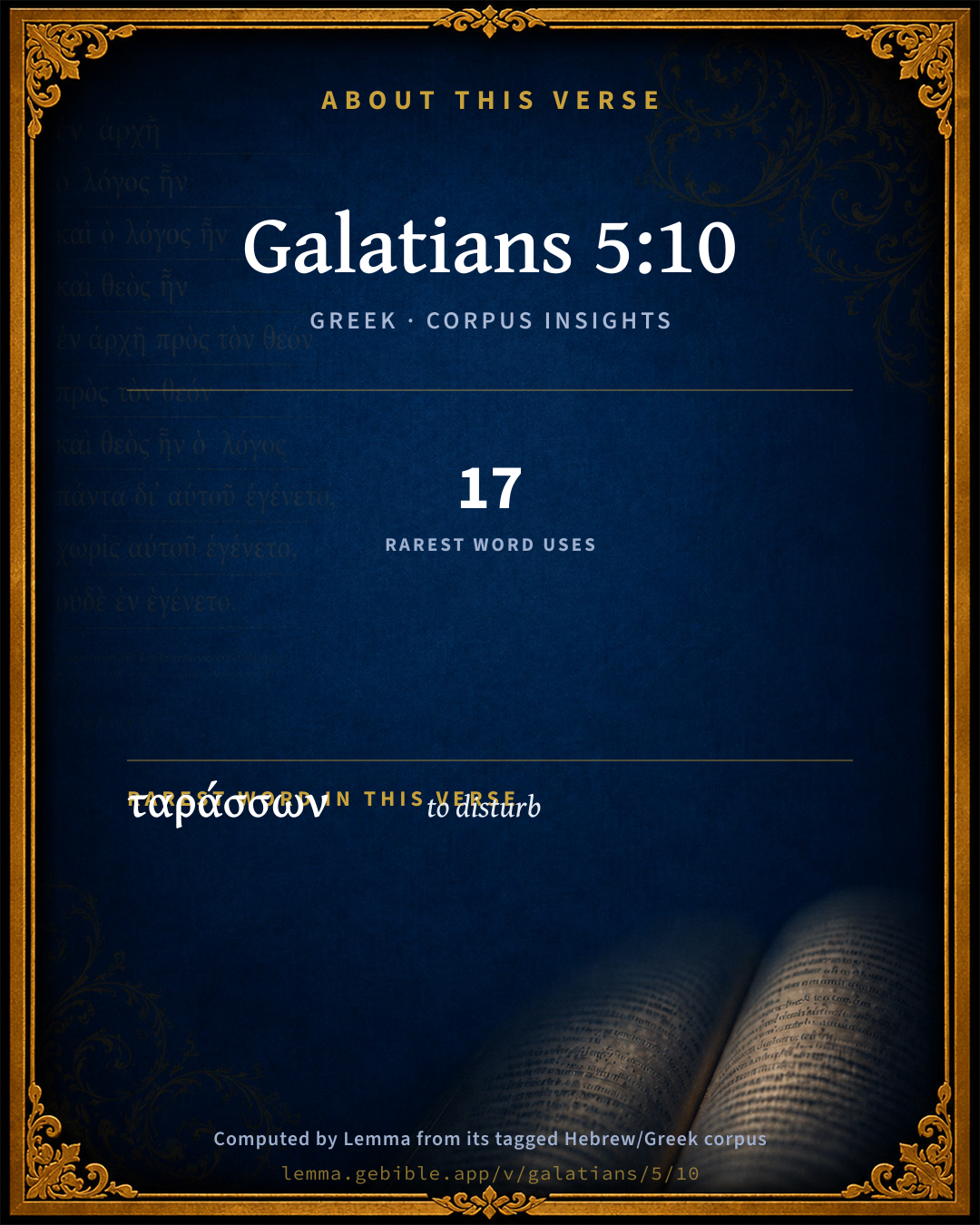
Galatians 5:10

Greek (Tischendorf 8th ed.) Galatians 5:10 appears in the Greek New Testament. The text above is from the Tischendorf 8th edition. Each word links to its Strong’s number and a concise gloss. Click any word for its full Thayer’s Greek Lexicon entry.
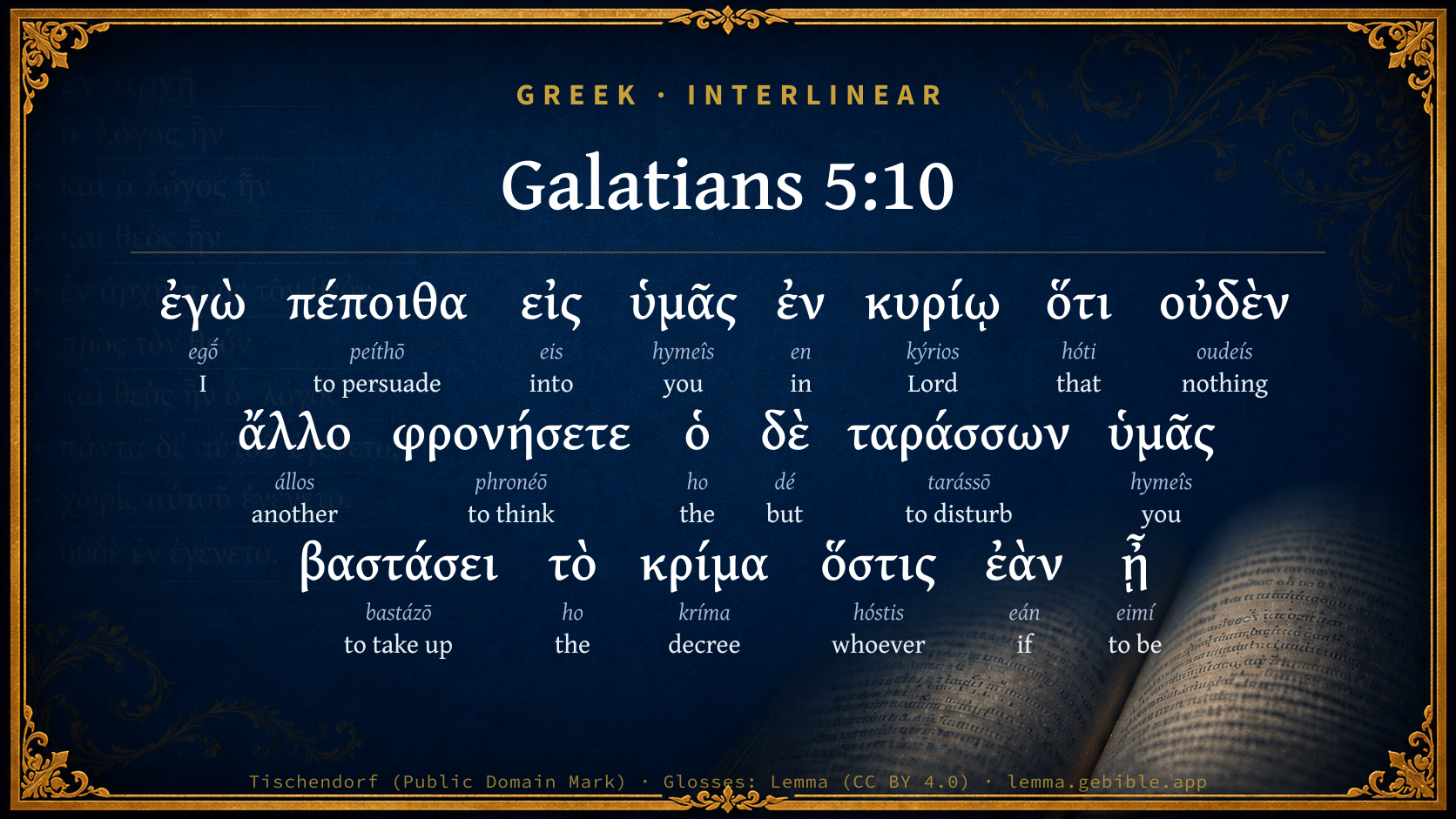
Download image
Cite this verse

Galatians 5:10 (World English Bible). Public Domain. Lemma interlinear Bible study tool, https://lemma.gebible.app/v/galatians/5/10.

Show BibTeX & RIS
BibTeX
RIS
English Translation
I have confidence toward you in the Lord that you will think no other way. But he who troubles you will bear his judgment, whoever he is.
World English Bible · Public Domain
Download a study sheet

One document with this verse’s original text, its word-by-word gloss line, the meaning frame, cross-references with their text, attributed commentary, and full source and license credits — printable, and it pastes into notes with its structure intact.

This verse Autodidact and up

Study sheet (.html) Plain text (.txt)

A passage Seminary Student

Up to 50 verses in one chapter. A passage sheet keeps up to 6 commentary sources and 12 cross-references per verse, in the order this page ranks them, and says so on the sheet whenever that leaves anything out. Ask for a single verse and you get the Autodidact verse sheet above.

Everything on this page stays free to read, with no account — the sheet is a download of what is already on screen, not access to it.

Want to remove ads? Support Godless Engineer
Compare translations 3

The same verse in 3 English versions, stacked beneath the original-language interlinear above. Click any original word for its lexicon entry.

Each is an independent rendering of the whole verse — the interlinear is not word-aligned to these translations.

Highlighted words mark where these versions differ — a whole-verse word diff, not a word-by-word alignment.

  • World English Bible Public Domain
    I have confidence toward you in the Lord that you will think no other way. But he who troubles you will bear his judgment, whoever he is.
  • King James Version Public Domain
    I have confidence in you through the Lord, that ye will be none otherwise minded: but he that troubleth you shall bear his judgment, whosoever he be.
  • unfoldingWord Literal Text CC BY-SA 4.0
    I am confident in you in the Lord that you will think nothing otherwise. But the one troubling you will bear the judgment, whoever he may be.

unfoldingWord Literal Text — © unfoldingWord, licensed CC BY-SA 4.0. Word-aligned USFM3 via Door43 (git.door43.org/unfoldingWord/en_ult).

Versions to compare (up to 4)

3 of 4 selected

Show all 19 translations

Every available English version of this verse, each an independent rendering of the whole verse.

  • World English Bible Public Domain
    I have confidence toward you in the Lord that you will think no other way. But he who troubles you will bear his judgment, whoever he is.
  • Berean Standard Bible Public Domain
    I am confident in the Lord that you will take no other view. The one who is troubling you will bear the judgment, whoever he may be.
  • Majority Standard Bible Public Domain
    I am confident in the Lord that you will take no other view. The one who is troubling you will bear the judgment, whoever he may be.
  • King James Version Public Domain
    I have confidence in you through the Lord, that ye will be none otherwise minded: but he that troubleth you shall bear his judgment, whosoever he be.
  • American Standard Version (1901) Public Domain
    I have confidence to you-ward in the Lord, that ye will be none otherwise minded: but he that troubleth you shall bear his judgment, whosoever he be.
  • Revised Version (1885) Public Domain
    I have confidence to you-ward in the Lord, that ye will be none otherwise minded: but he that troubleth you shall bear his judgment, whosoever he be.
  • Geneva Bible (1599) Public Domain
    I haue trust in you through the Lord, that ye will be none otherwise minded: but hee that troubleth you, shall beare his condemnation, whosoeuer he be.
  • Douay-Rheims (1899) Public Domain
    I have confidence in you in the Lord: that you will not be of another mind: but he that troubleth you, shall bear the judgment, whosoever he be.
  • Young's Literal Translation Public Domain
    I have confidence in regard to you in the Lord, that ye will be none otherwise minded; and he who is troubling you shall bear the judgment, whoever he may be.
  • Literal Standard Version CC BY-SA 4.0
    I have confidence in regard to you in the LORD that you will not be otherwise minded; and he who is troubling you will bear the judgment, whoever he may be.
  • Unlocked Literal Bible CC BY-SA 4.0
    I have confidence in the Lord that you will take no other view. The one who is troubling you will pay the penalty, whoever he is.
  • unfoldingWord Literal Text CC BY-SA 4.0
    I am confident in you in the Lord that you will think nothing otherwise. But the one troubling you will bear the judgment, whoever he may be.
  • Darby Bible Public Domain
    *I* have confidence as to you in [the] Lord, that ye will have no other mind; and he that is troubling you shall bear the guilt [of it], whosoever he may be.
  • World Messianic Bible Public Domain
    I have confidence toward you in the Lord that you will think no other way. But he who troubles you will bear his judgment, whoever he is.
  • Webster's Bible Public Domain
    I have confidence in you through the Lord, that ye will be no otherwise minded: but he that troubleth you shall bear his judgment, whoever he may be.
  • Free Bible Version CC BY-SA 4.0
    I'm confident in the Lord that you won't change the way you think, and that the one who is confusing you will face the consequences, whoever he is.
  • Bible in Basic English Public Domain
    I am certain about you in the Lord, that you will be of no other mind; but he who is troubling you will have his punishment, whoever he is.
  • Text-Critical English NT CC BY 4.0
    I have confidence in you in the Lord that you will adopt no other mindset. But the one who is troubling you will bear his judgment, whoever he may be.
  • Tyndale New Testament (1534) Public Domain
    I have trust towarde you in the Lorde that ye wyll be none other wyse mynded. He that troubleth you shall beare his iudgement what soever he be.

Literal Standard Version (2020), Covenant Press — licensed CC BY-SA 4.0. Text via the HelloAO Bible API (eBible.org). Unlocked Literal Bible (unfoldingWord) — licensed CC BY-SA 4.0. Text via the HelloAO Bible API (eBible.org). unfoldingWord Literal Text — © unfoldingWord, licensed CC BY-SA 4.0. Word-aligned USFM3 via Door43 (git.door43.org/unfoldingWord/en_ult). Free Bible Version, Dr. Jonathan Gallagher — licensed CC BY-SA 4.0. Text via the HelloAO Bible API (eBible.org).

Word by word

More ways to search: Search by grammar → Find every occurrence → Compare this word →

Practice this passage: Drill this verse → Learn its vocabulary →

ταράσσων
tarássō
G5015
“to disturb”
Verb, Present, Active, Participle, Nominative, Singular, Masculine
Part of Speech
Verb
Tense
Present
Voice
Active
Mood
Participle
Case
Nominative
Number
Singular
Gender
Masculine
Full Thayer's Definition

Origin: of uncertain affinity

TDNT: None

1. to agitate, trouble (a thing, by the movement of its parts to and fro) a. to cause one inward commotion, take away his calmness of mind, disturb his equanimity b. to disquiet, make restless c. to stir up d. to trouble 1. to strike one's spirit with fear and dread e. to render anxious or distressed f. to perplex the mind of one by suggesting scruples or doubts
  1. ἐγὼ egṓ G1473 “I” Personal pronoun, 1st person, Nominative, Singular
  2. πέποιθα peíthō G3982 “to persuade” Verb, Perfect, Active, Indicative, 1st person, Singular
  3. εἰς eis G1519 “into” Preposition
  4. ὑμᾶς hymeîs G5210 “you” Personal pronoun, 2nd person, Accusative, Plural
  5. ἐν en G1722 “in” Preposition
  6. κυρίῳ kýrios G2962 “Lord” Noun, Dative, Singular, Masculine
  7. ὅτι hóti G3754 “that” Conjunction
  8. οὐδὲν oudeís G3762 “nothing” Adjective, Accusative, Singular, Neuter, Negative
  9. ἄλλο állos G243 “another” Adjective, Accusative, Singular, Neuter
  10. φρονήσετε phronéō G5426 “to think” Verb, Future, Active, Indicative, 2nd person, Plural
  11. ὁ ho G3588 “the” Article, Nominative, Singular, Masculine
  12. δὲ dé G1161 “but” Conjunction
  13. ὑμᾶς hymeîs G5210 “you” Personal pronoun, 2nd person, Accusative, Plural
  14. βαστάσει bastázō G941 “to take up” Verb, Future, Active, Indicative, 3rd person, Singular
  15. τὸ ho G3588 “the” Article, Accusative, Singular, Neuter
  16. κρίμα kríma G2917 “decree” Noun, Accusative, Singular, Neuter
  17. ὅστις hóstis G3748 “whoever” Relative pronoun, Nominative, Singular, Masculine
  18. ἐὰν eán G1437 “if” Conditional
  19. ᾖ eimí G1510 “to be” Verb, Present, Active, Subjunctive, 3rd person, Singular

About this verse

These counts appear in no published source. They are computed here, from the morphology-tagged text and Lemma’s own curated glosses. What Lemma adds →

20
words
18
distinct lemmas
Pauline Epistles
section

Notable vocabulary

The rarest word here is ταράσσων to disturb G5015 — appearing just 17 times in the whole Greek New Testament.

Shared distinctive vocabulary

ταράσσων to disturb G5015 occurs in 17 verses of the Greek New Testament. Also found in:

Repetition

Words recur within this verse:

Cross-references

27

Topical passages linked to Galatians 5:10 in the Treasury of Scripture Knowledge — connected by theme and wording, ordered by reader-vote popularity; previews shown in the World English Bible.

  • Galatians 5:12 I wish that those who disturb you would cut themselves off.
  • Philippians 3:15 Let us therefore, as many as are perfect, think this way. If in anything you think otherwise, God will also reveal that to you.
  • 2 Corinthians 2:3 And I wrote this very thing to you, so that, when I came, I wouldn't have sorrow from them of whom I ought to rejoice; having confidence in you all, that my joy would be shared by all of you.
  • Galatians 1:7 and there isn't another gospel. Only there are some who trouble you, and want to pervert the Gospel of Christ.
  • Acts 15:24 Because we have heard that some who went out from us have troubled you with words, unsettling your souls, saying, 'You must be circumcised and keep the law,' to whom we gave no commandment;
  • 1 Corinthians 5:5 are to deliver such a one to Satan for the destruction of the flesh, that the spirit may be saved in the day of the Lord Jesus.
  • 2 Corinthians 7:16 I rejoice that in everything I am of good courage concerning you.
  • 2 Corinthians 10:2 Yes, I beg you that I may not, when present, show courage with the confidence with which I intend to be bold against some, who consider us to be walking according to the flesh.
  • 2 Corinthians 10:6 and being in readiness to avenge all disobedience, when your obedience will be made full.
  • Galatians 2:4 This was because of the false brothers secretly brought in, who stole in to spy out our liberty which we have in Christ Jesus, that they might bring us into bondage;
  • Galatians 2:6 But from those who were reputed to be important (whatever they were, it makes no difference to me; God doesn't show partiality to man)--they, I say, who were respected imparted nothing to me,
  • Galatians 3:1 Foolish Galatians, who has bewitched you not to obey the truth, before whose eyes Jesus Christ was openly set forth among you as crucified?
  • Galatians 4:17 They zealously seek you in no good way. No, they desire to alienate you, that you may seek them.
  • Galatians 6:12–13 As many as desire to look good in the flesh, they compel you to be circumcised; only that they may not be persecuted for the cross of Christ.
  • Galatians 6:17 From now on, let no one cause me any trouble, for I bear the marks of the Lord Jesus branded on my body.
  • 1 Timothy 1:20 of whom is Hymenaeus and Alexander; whom I delivered to Satan, that they might be taught not to blaspheme.
  • 1 John 2:18–26 Little children, these are the end times, and as you heard that the Antichrist is coming, even now many antichrists have arisen. By this we know that it is the end times.
  • Acts 15:1–2 Some men came down from Judea and taught the brothers, "Unless you are circumcised after the custom of Moses, you can't be saved."
  • 2 Corinthians 1:15 In this confidence, I was determined to come first to you, that you might have a second benefit;
  • 2 Corinthians 2:6 Sufficient to such a one is this punishment which was inflicted by the many;
  • 2 Corinthians 5:16 Therefore we know no one after the flesh from now on. Even though we have known Christ after the flesh, yet now we know him so no more.
  • 2 Corinthians 8:22 We have sent with them our brother, whom we have many times proved earnest in many things, but now much more earnest, by reason of the great confidence which he has in you.
  • 2 Corinthians 13:10 For this cause I write these things while absent, that I may not deal sharply when present, according to the authority which the Lord gave me for building up, and not for tearing down.
  • Galatians 4:11 I am afraid for you, that I might have wasted my labor for you.
  • Galatians 4:20 but I could wish to be present with you now, and to change my tone, for I am perplexed about you.
  • 2 Thessalonians 3:4 We have confidence in the Lord concerning you, that you both do and will do the things we command.
  • Philemon 1:21 Having confidence in your obedience, I write to you, knowing that you will do even beyond what I say.

Cross-references courtesy of OpenBible.info (CC BY 4.0).

Commentary

Notes on Galatians 5:10 from classic Christian and Jewish commentators (each source and its license shown beneath its notes). The classic Christian expositions comment on the surrounding passage and are grouped to its opening verse, so a note may address several verses; the Jewish commentaries on the Tanakh (Rashi and others) are per-verse, so they appear only where the commentator wrote on this verse.

Lemma curates 59 commentaries, every one of them public domain or Creative Commons licensed, each selected and text-cleaned for this edition rather than reprinted as found. About our sources →

The Biblical Illustrator

Joseph S. Exell

Gal_5:10

I have confidence in you through the Lord that ye will be none otherwise minded--(Comp, Gal_4:11-20).

The troubled Church and its troublers

I. Pauls treatment of the Galatian Church shows us--

1. To hope the best of men so long as they are curable.

(1) Objection: Those that hope the best may be deceived. Answer: In judgment but not in practice. It is the duty of love to hope the best. Those who suspect the worst are the oftenest deceived.

(2) Objection: We must judge of things as they are indeed. Reply: Judgment of things and persons must be distinguished. No uniform rule is sufficient by which to estimate a fellow creature. The worst have repented. The best have fallen.

2. How are we to be hopeful of men?

(1) Only for such things as they are able to perform,

(2) and these in the Lord. He only can give helping grace, exciting grace, and so lead to reformation.

3. Not to excommunicate them unless they are incurable. So long as they are curable we must use means to cure them.

(1) If the sheep or the ox that goes astray must be brought home (Exo_23:4), much more our neighbour.

(2) Christ brings home the lost sheep (Luk_15:1-5). So must every under-shepherd (Eze_34:4).

II. Pauls treatment of the troubles of this church shows us--

1. That God watches over the Church by a special providence.

2. That the apostles doctrine is an infallible certainty.

3. That the troublers of Churches shall be plagued by the just judgment of God. (W. Perkins.)

Bearing the judgment

The consul Q.S. Caepio had taken the city of Toulouse by an act of more than common perfidy and treachery, and possessed himself of the immense hoards of wealth stored in the temples of the Gaulish deities. From this day forth, he was so hunted by calamity, all extremest evils and disasters, all shame and dishonour, fell so thick on himself and all who were his, and were so traced up by the moral instinct of mankind to this accursed thing which he had made his own, that any wicked gains fatal to their possessor acquired this name; and of such a one it would be said, He has gold of Toulouse. (Trench.)

The Biblical Illustrator, edited by Joseph S. Exell (c. 1880s–1900s) — public domain. Text from a community e-Sword module.

Tyndale Open Study Notes

Tyndale Open Resources

5:10 that person, whoever he is: Perhaps Paul did not know who the false teachers were, or perhaps he meant that their credentials were unimportant (cp. 2:6). • confusing you: The false teaching distorted the Good News, so Paul wrote to clear up their thinking.

Tyndale Open Study Notes — © Tyndale Open Resources, licensed CC BY-SA 4.0. Text via the HelloAO Bible API.

Bengel's Gnomon

Johann Albrecht Bengel

Gal 5:10. Ἄλλο, different) from what [“none otherwise minded” than as] I write.—φρονήσετε, you will think) when you read these things; comp. Php 3:15.—ὁ δὲ, but he who) A distinction is drawn hereby between the seducer, of whom there is less hope, and the seduced.—ταράσσων—κρίμα, ὅστις, troubleth—judgment, whosoever) ch. Gal 1:7-8.—βαστάσει, will bear) as a heavy burden.—τὸ κρίμα, the judgment) which certainly hangs over him for so great a crime. The article gives force to the meaning.—ὅστις ἂν ῇ, whosoever he may be) The disturber among the Galatians was a clandestine one. ὅστις, whosoever, of whatsoever character.

Bengel's Gnomon of the New Testament — English translation (T&T Clark, Edinburgh, 1860) — public domain. Text from a community e-Sword module.

Meyer's Critical & Exegetical Commentary

Heinrich August Wilhelm Meyer

Gal_5:10. After the warning in Gal_5:8-9, Paul now assures his readers how he cherishes confidence in them, that their sentiments would be in conformity with this warning; but those who led them astray would meet with punishment.

ἐγώ] with emphasis: I on my part, however much my opponents may think that they have won over your judgment to their side. Groundlessly and arbitrarily Rückert affirms that what Paul says is not altogether what he means, namely, I indeed have done all that was possible, so that I may be allowed to hope, etc.

εἰς ὑμᾶς] towards you. Comp. Wis_16:24. Usually with the dative or ἐπί.

ἐν κυρίῳ] In Christ, in whom Paul lives and moves, he feels also that his confidence rests and is grounded. Comp. Php_2:24; 2Th_3:4; Rom_14:14.

οὐδέν ἄλλο] is referred by most expositors, including Luther, Calvin, Winer, Rückert, Matthies, Schott, Olshausen, Baumgarten-Crusius, de Wette, Ewald, to the previous purport of the epistle generally as directed against Judaism. But what is there to warrant this vague reference? The warning which immediately precedes in Gal_5:8-9 (not Gal_5:7, to which Wieseler, Hofmann, and others arbitrarily go back) has the first claim to have οὐδέν ἄλλο referred to it, and is sufficiently important for the reference. The antithesis ὁ δὲ ταράσσων also suits very appropriately the subjects of that warning, ἡ πεισμονή and ζύμη, both of which terms characterize the action of the seducers. Usteri interprets: that ye will not allow any other than your hitherto subsisting sentiments. No, a change, that is, a correction of the sentiments previously existing, is precisely what Paul hopes for.

φρονήσετε] ye will have no other sentiments (the practical determination of thought). The future (comp. Gal_6:16) refers to the time when the letter would be received. Hitherto, by their submissiveness towards those who were troubling them, they seemed to have given themselves up to another mode of thinking, which was not the right one (ἄλλο, comp. Lys. in Eratosth. 48; ἕτερος is more frequently thus used, see on Php_3:15).

ὁ δὲ ταράσσων ὑμᾶς] The singular denotes not, as in 2Co_11:4, the totum genus, but, as is more appropriate to the subsequent ὅστις ἄν ᾖ, the individual who happened to be the troubler in each actual case. Comp. Bernhardy, p. 315. The idea that the apostle refers to the chief person among his opponents, who was well known to him (Erasmus, Luther, Pareus, Estius, Bengel, Rückert, Olshausen, Ewald, and others; comp. also Usteri),formerly even guessed at by name, and identified with Peter himself (Jerome),has no warrant in the epistle. See, on the contrary, even Gal_5:12, and compare Gal_1:7, Gal_4:17.

ὅστις ἂν ᾖ] is to be left entirely general: without distinction of personal position, be he, when the case occurs, who he will. The reference to high repute (Theodoret, Theophylact, Luther, Estius, and many others; including Koppe, Flatt, Rückert, de Wette) would only be warranted, if ὁ ταράσσ. applied definitely to some particular person.

τὸ κρῖμα] the judicial sentence κατʼ ἐξοχήν, that is, the condemnatory sentence of the (impending) last judgment. Comp. Rom_2:3; Rom_3:8; 1Co_11:29. Of excommunication (Locke, Borger) the context contains nothing.[229]

βαστάσει] the judicial sentence is conceived as something heavily laid on (2Ki_18:14), which the condemned one carries away as he leaves the judgment-seat. The idea of λαυβάνειν κρῖμα (Rom_13:2; Jam_3:1; Luk_20:47, et al.) is not altogether the same.

[229] Jatho also explains the word as referring to this and other ecclesiastical penalties. But it was not the manner of the apostle to call for the discipline of the church in so indirect and veiled a fashion (comp. 1 Corinthians 5).

Meyer — Critical and Exegetical Commentary on the New Testament — English translation by Peter Christie, edited by Frederick Crombie (T&T Clark, 1880) — public domain. Text from a community e-Sword module.

Expositor's Greek Testament

ed. W. Robertson Nicoll

Gal 5:10 . The emphatic ἐγώ with which this verse opens reminds the converts of the Apostle’s personal claims in the Lord on their allegiance. He reckons with confidence on their support in pronouncing the judgment of their church on any who may disregard this warning. Every offender shall bear his own responsibility, whoever he may be.

The Expositor's Greek Testament, edited by W. Robertson Nicoll (1897–1910) — public domain. Text from a community e-Sword module.

Geneva Bible (1599)

Geneva Bible translators

He mitigateth the former reprehension, casting the fault upon the false Apostles, against whom he denounceth the horrible judgment of God.

Geneva Bible (1599) marginal notes — public domain. Text via Bolls.life.

Jamieson, Fausset & Brown

Robert Jamieson, A. R. Fausset & David Brown

Greek, "I (emphatical: 'I on my part') have confidence in the Lord with regard to you (Th2 3:4), that ye will be none otherwise minded" (than what by this Epistle I desire you to be, Phi 3:15).

but he that troubleth you-- (Gal 1:7; Act 15:24; Jos 7:25; Kg1 18:17-18). Some one, probably, was prominent among the seducers, though the denunciation applies to them all (Gal 1:7; Gal 4:17).

shall bear--as a heavy burden.

his--his due and inevitable judgment from God. Paul distinguishes the case of the seduced, who were misled through thoughtlessness, and who, now that they are set right by him, he confidently hopes, in God's goodness, will return to the right way, from that of the seducer who is doomed to judgment.

whosoever he be--whether great (Gal 1:8) or small.

Jamieson, Fausset & Brown — Commentary Critical and Explanatory on the Whole Bible (1871) — public domain (CC PDM 1.0). Text via the HelloAO Bible API.

Adam Clarke's Commentary

Verse 10. I have confidence in you] I now feel a persuasion from the Lord that I shall not be permitted to expostulate with you in vain; that ye will be none otherwise minded - that ye will be aware of the danger to which ye are exposed, that ye will retreat in time, and recover the grace which ye have lost.

But he that troubleth you] The false teacher, who sowed doubtful disputations among you, and thus has troubled the repose of the whole Church, shall bear his judgment - shall meet with the punishment he deserves, for having sown his tares among God's wheat.

Adam Clarke's Commentary on the Bible (1810–1826) — public domain. Text from a community e-Sword/MySword module.

John Calvin's Commentaries

10. I have confidence in you. All his fierceness is again directed against the false apostles. To them the evil is traced, and on them the punishment is threatened. Good hopes are expressed regarding the Galatians, that they will quickly and readily return to a sincere belief. It gives us courage to learn that good hopes are entertained about us; for we reckon it shameful to disappoint those whose feelings towards us are kind and friendly. But to bring back the Galatians to the pure doctrine of faith, from which they had turned aside, was the work of God. The apostle says that he has confidence in them, ἐν Κυρίῳ, through the Lord, by which he reminds them that repentance is a heavenly gift, and that they must ask it from God.

He that troubleth you The sentiment which he had just delivered is confirmed by thus indirectly imputing the greater part of the blame to those impostors by whom the Galatians had been deceived. From the punishment denounced against them, the Galatians are very nearly exempted. Let all who introduce confusion into churches, who break the unity of faith, who destroy their harmony, lend an ear to this; and if they have any right feeling, let them tremble at this word. God declares, by the mouth of Paul, that none “through whom such offenses come” (Luke 17:1) will pass unpunished. The phrase, whosoever he be, is emphatic; for the high sounding language of the false apostles had terrified the ignorant multitude. It became necessary for Paul to defend his doctrine with corresponding warmth and energy, and not to spare any one who dared to raise his voice against it, however eminent or however distinguished.

John Calvin's Commentaries (1540-1563) — public domain. Text from the Calvin Translation Society English edition (1840s-50s) via the Christian Classics Ethereal Library (ccel.org). Calvin's coverage is partial (roughly two-thirds of the Bible); uncommented books and verses are honest gaps, never fabricated. The 19th-century editor's footnotes and remarks are omitted so the notes are faithfully Calvin's own voice.

Ellicott's Commentary for English Readers

(10) I have confidence in you through the Lord.—Literally, I have confidence wish regard to you in the Lord—i.e., such confidence as a Christian teacher ought to have in Christian scholars. This has reference to the main body of the Church; an exception is immediately made as to the disaffected party, and especially their leader.

That ye will be none otherwise minded—i.e., no otherwise than I would have you be.

Shall bear his judgment.—“Judgment” is here not equivalent to “condemnation.” He shall be “put upon his trial,” “shall bear the sentence that shall be passed on him”—viz., by God.

Whosoever he be.—The Apostle does not fix upon any one particular person as the cause of the troubles in the Galatian Church, but he says that, whoever he may be, God will judge him.

A Bible Commentary for English Readers, edited by Charles John Ellicott (1878–1897) — public domain. Text from a community e-Sword module.

The Cambridge Bible for Schools and Colleges

gen. ed. J. J. S. Perowne

10. An abrupt return to a more favourable judgment of the Galatian converts, while strongly noting the guilt of those who sought to unsettle their faith.

I have confidence … the Lord] ‘I’ (emphatic) have confidence with respect to you in the Lord’. The words ‘in the Lord’ are rightly explained by Jowett—‘all acts of the Christian being described as being done in God and Christ’. Comp. 2Th_3:4, ‘We have in the Lord confidence concerning you, that what we enjoin, ye both do and will do’.

be none otherwise minded] The verb here used denotes sometimes the exercise of the judgment, sometimes the bent of the affections—the whole mental and moral disposition in reference to an object. Its force will be best understood by reference to some of the passages in which it occurs. Mat_16:23; Rom_8:5; Php_2:5; Php_3:19. In the last of these passages they ‘who mind earthly things’ are in contrast with those who ‘set their affections on the things that are above’ Col_3:2. The same verb in the Greek.

Here, as in Php_3:15, the meaning appears to be, ‘ye will adopt no new principles other than ye were taught by me’.

he that troubleth you] In c. Gal_1:7 St Paul used the plural. Here by the use of the singular number he seems to have some individual in his mind. We may certainly reject the suggestion of Jerome that St Peter is alluded to. It is hardly likely that after mentioning him by name (c. Gal_2:11) St Paul would thus obscurely denounce him. Besides, though St Peter had by cowardly concession encouraged the Judaizing party, he held the same truth as St Paul and was not a ‘troubler of Israel’.

shall bear his judgment] lit. ‘the sentence’. More than ecclesiastical censure is meant. Used thus absolutely, the word must refer to the judgment of God, which the Apostle regards as a crushing burden. We are reminded of the words of Joshua to Achan, ‘Why hast thou troubled us? The Lord shall trouble thee this day’. Jos_7:25.

The Cambridge Bible for Schools and Colleges (gen. ed. J. J. S. Perowne; Cambridge University Press, 1878–1918) — public domain. Text from a community e-Sword module.

John Gill's Exposition

And I, brethren, if I yet preach circumcision,.... The apostle was traduced by the false teachers, as a preacher of circumcision himself in some places; and this they did partly to show him to be a variable and inconsistent man, who preached one doctrine in one place, and another in another place, and so not to be attended to; and partly with others, to draw them into their scheme upon his authority: what might give them the handle, or at least what they improved to this purpose, might be his circumcising of Timothy; but though he did this as a thing indifferent, and for the sake of the Jews, to make them easy; yet he never preached it after his conversion, and much less as necessary to justification and salvation, as these men did. This calumny he refutes by putting the following question or questions;

why do I yet suffer persecution? as is clear he did, for being against it, and preaching it down; great part of the persecutions the apostle endured was from the Jews, and that on account of his teaching them everywhere, that were among the Gentiles, to forsake Moses, and that they should not circumcise their children, and walk after the customs of their nation; a clear point this, that he did not preach it; had he, persecution from this quarter would not have followed him; and he could have done it with a good conscience, he must act a very weak part in suffering persecution on that account. The Arabic version gives the words a very different turn, and yet furnishes an answer to the calumny; "why do I persecute him that uses it?" that is, if I am a preacher of it, why am I so warm and violent an opposer of those that submit to it? these things are so opposite that there is no reconciling them; to the same purpose is the Ethiopic version: "then is the offence of the cross ceased". The last mentioned version reads it, "the cross of Christ"; and so the Alexandrian copy; meaning not the cross of affliction, reproach, and persecution, which Christ has enjoined every follower of his to take up and bear for his sake, and is offensive to the carnal man; nor the cross on which he suffered, or the sufferings of the cross; but the doctrine of salvation by a crucified Christ, which was an offence and a stumblingblock to the Jews; now if the apostle had preached circumcision as necessary to salvation, the other doctrine must have been dropped, and consequently the offence taken at it must have ceased, whereas it was not. The Syriac version reads by way of question, "is the offence of the cross ceased?" no it is not, a plain case then is, that the apostle did not preach circumcision, but only a crucified Christ, as necessary to salvation. Moreover, the Jews that believed would not have been so offended as they were at his preaching, had he preached the one as well the other; their offence was not that he preached Christ crucified, but that he preached, that, by the cross of Christ, circumcision and the other rituals of the ceremonial law were now abolished.

John Gill's Exposition of the Whole Bible (1746–1763) — public domain (CC PDM 1.0). Text via the HelloAO Bible API.

Trapp's Complete Commentary

John Trapp

10 I have confidence in you through the Lord, that ye will be none otherwise minded: but he that troubleth you shall bear his judgment, whosoever he be.

Ver. 10. But he that troubleth you] That heresiarch, or ringleader of the faction. The beast and the false prophet are taken and cast alive into a lake, &c., when the common sort seduced by them had an easier judgment, Rev 19:20-21.

John Trapp, A Commentary or Exposition upon All the Books of the Old and New Testament (1647–1656) — public domain. Text from a community e-Sword module.

Albert Barnes' Notes on the Bible

I have confidence in you ... - Though they had been led astray, and had embraced many false opinions, yet, on the whole, Paul had confidence in their piety, and believed they would yet return and embrace the truth.

That ye will be none otherwise minded - That is, than you have been taught by me; or than I think and teach on the subject. Paul doubtless means to say, that he had full confidence that they would embrace the views which he was inculcating on the subject of justification, and he makes this remark in order to modify the severity of his tone of reprehension, and to show that, notwithstanding all he had said, he had confidence still in their piety. He believed that they would coincide with him in his opinion, alike on the general subject of justification, and in regard to the cause of their alienation from the truth. He, therefore, gently insinuates that it was not to be traced to themselves that they had departed from the truth, but to the “little leaven” that had leavened the mass; and he adds, that whoever had done this, should be held to be responsible for it.

But he that troubleth you - By leading you into error.

Shall bear his judgment - Shall be responsible for it, and will receive proper treatment from you. He gently states this general principle, which is so obvious; states that he does not believe that the defection is to be traced to themselves; and designs to prepare their minds for a proposition which he intends to submit Gal 5:12, that the offending person or persons should be disowned and cut off.

Whosoever he be - “I do not know who he is. I mention no names; accuse no one by name; and advise no severe measures against any particular individual. I state only the obvious principle that every man should bear his own burden, and be held responsible for what he has done - no matter who he is.”

Albert Barnes' Notes on the Bible (1834–1885) — public domain. Text from a community e-Sword/MySword module.

Matthew Poole's English Annotations

I have confidence in you through the Lord, that ye will be none otherwise minded: the apostle (according to his usual method) sweeteneth his sharp reproof of this church for their deviations from the faith of the gospel, with a declaration of his good opinion of them; declaring that he had a confidence in them, that through the grace of God they would be reduced to the truth, or kept from wandering from it, and that in matters of faith they would be all of the same mind.

But he that troubleth you shall bear his judgment, whosoever he be; and for those who endeavoured to seduce and pervert them, God should reward them according to their works. He seems to aim at some particular false teacher, (whose name he concealeth), who gave this church this trouble.

Matthew Poole's English Annotations on the Holy Bible (1683–1685) — public domain. Text from a community e-Sword/MySword module.

Whedon's Commentary on the Bible

Daniel D. Whedon

10. I… but—Mark the antithesis of this verse. I have confidence in you, the lump; but woe to the little leaven, the disturbers. Paul says this partly to soften his tone to the Church, and partly to induce a division between the Church and its seducers.

Have confidence—His purely personal feeling, expressed as strongly as he was able. It expressed no inspired assurance that they would prove true, nor any theological dogma that all Christians do persevere.

In you—Wavering as you show yourselves.

Through the Lord—Literally, in the Lord. Same sense as in Eph_6:1.

Confidence in… the Lord, is simply not inspired but Christian confidence. Had there been a failure it would have proved St. Paul’s human fallibility, but would not have disparaged his inspiration or apostleship. Far less does it imply that the Lord inevitably secures the perseverance of all who put their faith in him.

Otherwise—Than your acceptance of my gospel.

He that troubleth you—Not necessarily, but probably, the one leader and head of the schism.

Bear his judgment— Divine condemnation, which, for so grievous a sin, would be grievous to bear.

Whosoever he be—Even though he came from Jerusalem and pretended to be commissioned by James the apostle. All this is too pointed and severe not to indicate an individual.

Daniel D. Whedon (gen. ed.), Commentary on the Old and New Testaments (1874–1909) — public domain. Text from a community e-Sword module.

The Pulpit Commentary

I have confidence in you through the Lord (ejgwpoiqa eijv uJmav ejn Kuriw); I for my own part have confidence with respect to you in the Lord. The pronoun ejgw prefixed to the verb, perhaps, distinguishes the writer from some about him, particularly those who had just before brought that un-favourable report of the state of affairs in Galatia which had prompted the writing of this letter. The apostle has himself a vivid remembrance of their warm-hearted acceptance of his message, (Gal_4:13-15) and of their sufferings in the good cause. (Gal_3:4) "Have confidence with respect to you." The preposition eijv is used as in 2Co_8:22, equivalently with ejpi in 2Co_2:3, and 2Th_3:4; in which last passage ("We have confidence in the Lord touching you as well as in Php_2:24 ("I have confidence in the Lord that I myself shall come shortly"), thephrase, "in the Lord," expresses, not the object of trust, but the sphere of consciousness in which he is able to feel this confidence. So also here, in the realized presence of the Lord Jesus, the apostle feels that his care for his people, and his faithfulness towards these in whom "he has begun a good work" so conspicuously as in their case, warrant him in entertaining a strong assurance that, after all, they would not disappoint his hopes. (comp. Php_1:6; 1Th_5:24) This expression of confidence implies, of course, a measure of underlying apprehension; while it is also in effect an admonition, couched in an affectionate form, designed to rally them back to their true allegiance. The phrase, "with respect to you," separates their case from that of any who were "troubling them;" kindly implying that, in the main, they were still unperverted. That ye will be none otherwise minded (oti oujdesete); that is, that your sentiments will continue, or will be found to be, such as I have been setting forth as those inspired by the gospel, and such as you once manifestly entertained. The future tense of the verb seems to point forward to the time when his appeal should have reached them, and have led them to bethink themselves as to what, in spite of perhaps some momentary superficial wavering, their sentiments at bottom really were. (For the sense of the verb fronein, comp. (Act_28:22; Php_3:15) But he that troubleth you (oJ desswn uJmav); but he that is troubling you.

indicating that, even if such a person"s machinations proved abortive, through their steady adherence to the gospel, that man should receive his deserts none the less. Insswn Gal_1:7 we had "There are some that trouble you," Comparing the two expressions, the one in the singular number, the other in the plural, we may conclude, either that the phrase oJ tara) designates any one who shall be found falling under the description of a parasswn, i.e. any one of those referred to in the plural number; or that it points to one particular individual on whom the apostle had his eye as the prime ringleader of the rest. If we adopt the first view, the clause, "whosoever he be," appears to mark the absoluteness of the resolve expressed by the apostle, while leaving in indefiniteness the individual to whom it would apply. With the second view, the same clause would affirm that no circumstances attaching to the offender, such as (suppose) a mission from leading Churchmen in Jerusalem, or official eminence in a Galatian Church, or any other, should shield him, as he or others might suppose that it would, from the effect of the sentence to be pronounced upon him. The second seems the more probable view; and, in unison with it, it appears supposable that the hypothetical case stated in Gal_1:7 ("if we or an angel from heaven") had an eye to the eminent position held by the person here alluded to. This individualization of the threatening would make it the more telling when the letter should arrive a thunder-clap bursting forth upon the head of that arch-troubler. Shall bear his judgment, whosoever he be (bastasei toma, ustiv a h). With the phrase, bastazein krima, compare lambanein krima Luk_20:47; Rom_13:2; Jam_3:1. "Shall bear," as a heavy burden. (comp. Gal_6:2, Gal_6:5) The krima a shall be laid upon him, and carry it he shall, whether he will or no. The krima judgment, is the "sentence;" the decision of the judge upon his conduct, and the consequent punishment. The apostle threatens that he will bring into exercise the "power" which, as he says in 2Co_13:10, the Lord had given him for the edification of his people, and the use of which would be accompanied by consequences proving that "Christ was speaking in him" (ibid., 2, 3). Instances of its exercise are seen in 1Co_5:4; 1Ti_1:20; Act_13:11. How grievous was this offender"s guilt has been strongly declared by the "anathema" of Gal_1:7-9.

The apostle"s sanguine hopes of Galatian recovery.

The swerve toward ritualism was in its mere incipiency. Therefore he assumes a hopeful tone in dealing with the Galatians as a Church. "He fears the worst, but hopes the best.

I THE GROUND OF HIS HOPEFUL CONFIDENCE. "In the Lord." It is good to be of a hopeful temperament, and good to have good men to think well of our state, as their judgment will be according to truth and charity, The ground of the apostle"s confidence was not

(1) that there would be any change in the temper or arts of the seducers; for "they always wax worse and worse"; (2Ti_3:13)

(2) nor in the force of his own argumentative expostulations, nor in a mere return of that affection for him which was once so ardent and so self-sacrificing; but

(3) "in the Lord" himself, who had power to recover them out of their error. "Paul may plant, and Apollos water; but it is God who giveth the increase", (1Co_3:7) It is he, and he only, who can make the Galatians "like-minded" with the apostle, by blessing his reproofs, his arguments, his tender urgencies of appeal.

II THE UNSETTLING TENDENCY OF FALSE TEACHERS, The Greek word is very expressive who excites tumults among you," or who "disturbs you." Perhaps the apostle had in view a particular teacher who was specially dangerous. Such teachers

(1) shake old principles from their firm foundations;

(2) shake the hearts of men by unsettling doubts and distracting conflicts;

(3) and shake the stability of Churches, often scattering the flock as sheep without a shepherd.

III THERE IS A JUDGMENT FOR RELIGIOUS SEDUCERS. He "shall bear his judgment, whosoever he be.

1. It will be a just judgment. It will be according to his works. His end willbe, as the apostle implies, a sure condemnation.

2. The judgment will not be averted by the high opinion seducers entertainof themselves, nor by their high position in the Church, nor by the high esteem in which they may be held by man.

The Pulpit Commentary (1880–1919), ed. H.D.M. Spence-Jones & Joseph S. Exell — public domain. Text from a community e-Sword module.

John Wesley's Explanatory Notes

Yet I have confidence that - After ye have read this. Ye will be no otherwise minded - Than I am, and ye were. But he that troubleth you - It seems to have been one person chiefly who endeavoured to seduce them. Shall bear his judgment - A heavy burden, already hanging over his head.

John Wesley, Explanatory Notes Upon the Whole Bible (1754–1765) — public domain. Text via the GEBible commentary corpus.

Luther on Galatians

Martin Luther

VERSE 10. l have confidence in you through the Lord.

"I have taught, admonished, and reproved you enough. I hope the best for you."

The question occurs to us whether Paul did well to trust the Galatians. Does not Holy Writ forbid us to trust in men? Faith trusts in God and is never wrong. Charity trusts in men and is often wrong. This charitable trust in man is necessary to life. Without it life would be impossible in the world. What kind of life would ours be if nobody could trust anybody else? True Christians are more ready to believe in men than the children of this world. Such charitable confidence is the fruit of the Spirit. Paul had such trust in the Galatians although they had forsaken his doctrine. He trusts them "through the Lord," insofar as they were in Christ and Christ in them. Once they had forsaken Christ altogether, the Apostle will trust the Galatians no longer.

VERSE 10. That ye will be none otherwise minded.

"Not minded otherwise than I have taught you. In other words, I have confidence that you will accept no doctrine that is contrary to the one you have learned from me."

VERSE 10. But be that troubleth you shall bear his judgment, whosoever he be.

Paul assumes the role of a judge and condemns the false apostles as troublers of the Galatians. He wants to frighten the Galatians with his severe judgments of the false apostles into avoiding false doctrine like a contagious disease. We can hear him say to the Galatians: "Why do you give these pestilent fellows a hearing in the first place? They only trouble you. The doctrine they bring causes your conscience only trouble."

The clause, "whosoever he be," seems to indicate that the false apostles in outward appearance at least were very good and devout men. It may be that among them was some outstanding disciple of the apostles, a man of fame and authority. The Apostle must have been faced by this very situation, otherwise his vehemence would have been uncalled for. No doubt many of the Galatians were taken back with the vehemency of the Apostle. They perhaps thought: why should he be so stubborn in such small matters? Why is he so quick to pronounce damnation upon his brethren in the ministry?

I cannot say it often enough, that we must carefully differentiate between doctrine and life. Doctrine is a piece of heaven, life is a piece of earth. Life is sin, error, uncleanness, misery, and charity must forbear, believe, hope, and suffer all things. Forgiveness of sins must be continuous so that sin and error may not be defended and sustained. But with doctrine there must be no error, no need of pardon. There can be no comparison between doctrine and life. The least little point of doctrine is of greater importance than heaven and earth. Therefore we cannot allow the least jot of doctrine to be corrupted. We may overlook the offenses and errors of life, for we daily sin much. Even the saints sin, as they themselves confess in the Lord’s Prayer and in the Creed. But our doctrine, God be praised, is pure, because all the articles of our faith are grounded on the Holy Scriptures.

Martin Luther — Commentary on the Epistle to the Galatians (1535), English translation by Theodore Graebner (Zondervan, 1939) — public domain (U.S. copyright not renewed). Text from a community e-Sword module.

Burkitt's Expository Notes on the New Testament

William Burkitt

Observe here, 1. The apostle’s holy confidence, grounded upon charity; that through the Lord, that is, through the Lord’s assisting his endeavours, and through the Lord’s blessing upon their serious consideration of what he had written to them they would be reclaimed from their errors, and brought to be of the same mind with himself.

Where note, How the holy and zealous apostle was divided betwixt hope and fear concerning these men; he feared the worst of these Galatians, and yet hopes the best: I have confidence in you through the Lord. It is a fault in the ministers of the gospel, when they despair of men too soon, when they cease or slacken their endeavours for their people’s good, looking upon them as resolutely bent upon, and judicially given up unto, all evil. Though our apostle here had not a confidence of faith, or full persuasion, yet he had a confidence of charity, which caused him to hope that they would by like-minded with himself: I have confidence in you through the Lord, that you will be no otherwise minded.

Observe, 2. With what a holy caution, as well as Christian prudence and charity, our apostle applies himself unto them; declaring, that though he hoped they might be reclaimed from their error, yet, lest they should conclude their error not to be very dangerous, he shows them his just indignation against it, by denouncing deserved punishments against those that seduced them into it: He that troubleth you, shall bear his own judgment, his condemnation due to him in hell, without repentance, which is supposed in all threatenings. For the condition of conditional threatenings, though it is not always expressed, yet it is to be understood.

Observe, 3. The universality of the threatening: He shall bear his own judgment, whosoever he be: let him be who he will, or what he will; who he will for abilities and parts, what he will for power or reputation; whoever he is, or whatsoever he be, he shall bear his judgment. Such is the exact justice of God, and such his impartiality in the exercise of it, that he will suffer no impenitent transgressor to escape his indignation, whoever he is, without respect of persons: He that troubleth you shall bear his own judgment, whosoever he be.

William Burkitt's Expository Notes on the New Testament (1700–1703) — public domain. Text from a community e-Sword module.

McGarvey & Pendleton's Commentaries

J. W. McGarvey

I have confidence to you-ward in the Lord, that ye will be none otherwise minded: but he that troubleth you shall bear his judgment, whosoever he be. [The apostle here expresses his confidence that they will take the same view of the situation that he does, and avoid the contaminating influence of the minority by disciplining it or its ringleader, no matter who he may be.]

J. W. McGarvey (with Philip Y. Pendleton), Commentaries on the New Testament (The Fourfold Gospel, 1914; Acts; and the epistles) — public domain. Text from a community e-Sword/MySword module.

The People's New Testament

B. W. Johnson

10. I have confidence. That they will be none otherwise minded than himself. He that troubleth you. All these false teachers shall be brought to condemnation, whoever they may be.

B. W. Johnson's The People's New Testament with Notes (1889–1891) — public domain. Electronic text from the Christian Classics Ethereal Library (CCEL) ThML edition.

Cambridge Greek Testament for Schools and Colleges

10. ἐγὼ. The absence of a conjunction increases the emphasis on both the personality and the assurance. St Paul sets himself over against the τίς.

πέποιθα εἰς ὑμᾶς: still harping on πείθεσθαι, πεισμονή. With εἰς[137] contrast 2Th 3:4.

[137] Is affixed to a word it means that all the passages are mentioned where that word occurs in the New Testament.

ἐν κυρίῳ. In whom St Paul finds all his confidence for both his own actions (Php 2:24) and those of others (2Th 3:4).

ὅτι οὐδὲν ἄλλο φρονήσετε· ὁ δὲ ταράσσων ὑμᾶς. The conjunction of ἄλλο and ταράσσειν makes it probable that St Paul’s thought is similar to that of Gal 1:7. He does not mean, that is to say, that they will hold the truths expressed in Gal 5:8-9, but the main truth of the Gospel, in which they once ran well (Gal 5:7).

φρον. = the set purpose of your mind and heart, Col 3:2 note. Php 3:15 refers only to details, not the essence of the faith.

ὁ δὲ ταράσσων ὑμᾶς, Gal 1:7 note. Even though you are not permanently injured. The singular is perhaps generic, “everyone who” etc.: cf. ὁ ἐρχόμενος, 2Co 11:4, but probably because St Paul had one man of the τινές (Gal 1:7) specially in his mind.

βαστάσει. The first occurrence of a word which occurs no less than three times in the sixth chapter. St Paul employs it elsewhere only twice in Rom. The only biblical parallel to its connexion with κρίμα is in 2Ki 18:14, δ ἐὰν ἐπιθῇς ἐπʼ ἐμὲ βαστάσω. The judgment is thought of as a load carried away from the judgment seat (cf. Meyer).

τὸ κρίμα. The article = that which suits his case.

ὅστις ἐὰν ᾗ. Otiose if St Paul was not thinking of some one person. He was a man of reputation, which was originally (doubtless) well deserved. On ἐάν for ἄν see Gal 5:17, Gal 6:7, Col 3:17 note, and 23; Allen on Mat 11:27. In the papyri “ὃς ἄν was the usual form in the second and third centuries B.C. down to 133 B.C., when ὃς ἐάν begins to come to the front, and from the first century B.C. onwards the latter is always the predominant form” (Thackeray, Grammar of the O.T. in Greek, 1909, p. 68).

Cambridge Greek Testament for Schools and Colleges (Cambridge University Press, 1896; 21 vols, various authors incl. Carr, Maclear, Plummer, Farrar, Lumby, Moule, M. R. James, Simcox) — public domain. Text from a community e-Sword module.

Alford’s Greek Testament

Henry Alford

10.] “After the warning of vv. 8, 9, Paul assures his readers that he has confidence in them, but that their perverters shall not escape punishment. Divide et impera!” Meyer.

ἐγώ, emphatic, I, for my part; ‘quod ad me attinet, …’

εἰς, with regard to, see reff., and Bernhardy, p. 220. On ἐν κυρίῳ, see 2Th 3:4:—it is the element or sphere in which his confidence is conditioned.

οὐδὲν ἄλλο φρον.] See ἑτέρως, Php 3:15: of which this ἄλλο is a kind of softening. We take the meaning here to be, ye will be of no other mind than this, viz. which I enjoin on you,—not in vv. 8, 9 only, but in this Epistle, and in his preaching generally.

ὁ δὲ ταράσσων need not be interpreted as referring necessarily to any one ἐπίσημος among the Judaizers (as Olsh., al.), but simply as individualizing the warning, and carrying home the denunciation to each one’s heart among the perverters. Cf. οἱ ἀναστατοῦντες below, and ch. 1:7; 4:17.

τὸ κρῖμα, the sentence, understood to be unfavourable, is a burden laid on the judged person, which he βαστάζει, bears. The ὅστις ἐὰν ᾖ generalizes the declaration to the fullest extent: see ch. 1:8, 9.

Henry Alford, The Greek Testament (1849–1861) — public domain. Text from a community e-Sword module.

International Critical Commentary

10. ἐγὼ πέποιθα εἰς ὑμᾶς ἐν κυρίῳ ὅτι οὐδὲν ἄλλο φρονήσετε· “I have confidence, in the Lord, respecting you that ye will take no other view than this.” With the abruptness which characterises the whole passage, the apostle turns suddenly from the discouraging aspects of the situation to an expression of hopeful confidence. The use of ἐγώ emphasises the personal, subjective character of the confidence. “I, at least, whatever others think.” εἰς ὑμᾶς designates the persons in reference to whom (Th. εἰς B. II 2 a) the confidence is felt; ἐν κυρίῳ defines the Lord, i. e., Christ, not precisely as the object of trust but as the one who constitutes the basis or ground of confidence (Th. ἐν, I 6 c.; cf. 2:4 and 2:17 and notes on these passages). The whole passage is marked by such abruptness of expression and sudden changes of thought that the words οὐδὲν ἄλλο may mean in general no other view of the true nature of religion or the true interpretation of the gospel than that which Paul had taught them. Most probably they refer directly to the opinion just expressed by Paul in v. 9. In that case the sentence is an expression of confidence that the Galatians will share his conviction that the influence exerted by the judaisers is, in fact, a leaven (of evil) coming not from God but from men, and threatening the religious life of the whole community of Galatian Christians.

The constructions employed by Paul after πέποιθα are various: (a) ἐπί, with a personal object (2Co 1:9, 2Co 1:2:3, 2Th 3:4), and ἐν with an impersonal object (Php 3:3, Php 3:4), designating the object of confidence, that which one trusts; (b) ἐν with a personal object (Php 2:24, 2Th 3:4 and the present passage) designating the ground on which confidence rests; (c) εἰς with the accusative occurring in the present passage, without parallel elsewhere; in accordance with the not infrequent use of εἰς in other connections, the preposition is to be explained, as above, as meaning “in respect to.” To take εἰς ὑμᾶς as denoting the object of faith (Butt. p. 175) is without the support of other examples with this verb, or of the preposition as used with other verbs; for while the accusative after πιστεύω εἰς denotes the object of faith, this construction is practically restricted to use in respect to Christ (cf. detached note on Πιστεύω, p. 480), and furnishes no ground for thinking that πέποιθα εἰς would be used with similar force in respect to other persons. 2Co 8:22, πεποιθήσει πολλῇ τῇ εἰς ὑμᾶς, is indecisive both because it contains not the verb but the noun, and because it shares the ambiguity of the present passage.

The expression ἐν κυρίῳ occurs in the Pauline epistles approximately forty times. That it means “in Christ,” not “in God,” is rendered practically certain by these considerations: (a) of ἐν Χριστῷ or ἐν τῷ Χριστῷ, or ἐν Χριστῷ Ἰησοῦ there are about eighty instances, and in many of these the connection of thought is closely similar to those in which ἐν κυρίῳ is employed. (b) In seven cases (Rom 6:22, Rom 6:14:14, 1Co 15:31, 1Th 1:1, 1Th 1:4:1, 2Th 1:1, 2Th 3:12) κυρίῳ after ἐν is defined by a preceding or following Ἰησοῦ, Χριστῷ, or both together, as referring to Christ, and in these instances, also, the connection of thought is similar to that in which ἐν κυρίῳ alone occurs. (c) ἐν θεῷ and ἐν τῷ θεῷ occur but rarely in Paul (Rom 2:17, Rom 5:11, Eph 3:9, Col 3:3, 1Th 1:1, 1Th 1:2:2, 2Th 1:1), and in two of these instances (1Th 1:1, 2Th 1:1), with θεῷ is joined κυρίῳ in such ways as to show that ἐν κυρίῳ refers to Christ. Against these strong considerations there is only the fact that in general κύριος without the article refers to God, ὁ κύριος to Christ. But the force of this general rule is diminished by the further fact that in set phrases, especially prepositional phrases, the article is frequently omitted without modification of meaning. Cf. detached note on Πατήρ as applied to God, p. 387. On οὐδεὶς ἄλλος cf. Joh 15:24, Act 4:12.

ὁ δὲ ταράσσων ὑμᾶς βαστάσει τὸ κρίμα, ὅστις ἐὰν ᾖ. “but he that troubleth you shall bear his judgment, whoever he may be.” In itself ὁ ταράσσων might refer to a particular individual identified or unidentified, and the troubling might be present, past, or future. But the indefinite relative clause, ὅστις ἐὰν ᾖ, referring to the future (BMT 303, 304; a present general supposition is excluded by the future βαστάσει, and a present particular by the subjunctive ᾖ) requires us to take ὁ ταράσσων as designating not a particular individual mentally identified, but as referring to any one who hereafter may disturb them. The article is distributive generic, as in 3:12, 14, Joh 3:18. Doubtless this is but another way of referring to those who are spoken of in 1:6, τινές εἰσιν οἱ ταράσσοντες ὑμᾶς, καὶ θέλοντες μεταστρέψαι τὸ εὐαγγέλιον τοῦ χριστοῦ, and in v. 12 as οἱ ἀναστατοῦντες ὑμᾶς. Only their conduct is, for rhetorical effect, referred to not as a fact but as a future possibility, as in 1:8, and an indefinite singular takes the place of a definite plural. τὸ κρίμα undoubtedly refers to the judgment of God, which carries with it by implication the consequent punishment. Cf. Rom 2:2, Rom 2:3, Rom 2:3:8, and esp. Rom 13:2. How or when the punishment will be experienced the sentence does not indicate; there is nothing to show that the apostle has especially or exclusively in mind the messianic judgment (Rom 2:16).

Βαστάζω, used by classical writers from Homer down, occurs also in the Lxx, Apocr., and Pat. Ap. It is found in N. T. twenty-seven times. In all periods, apparently, it is employed both in a literal sense of bearing a burden (Mar 14:13, Joh 19:17) and other similar senses, and metaphorically of mental processes. In N. T. it occurs several times in the sense “to endure”: Joh 16:12, Act 15:10, Rom 15:1. Cf. also Gal 6:2, Gal 6:5, Gal 6:17. Of bearing punishment it occurs here only in N. T., but also in 2Ki 18:14.

International Critical Commentary — older volumes (1896–1929), various authors — public domain. Text from a community e-Sword module.

Vincent's Word Studies in the New Testament

Marvin R. Vincent

In the Lord. Const. with I have confidence.

Will be - minded [φρονησετε] . The word denotes a general disposition of the mind rather than a specific act of thought directed at a given point. Comp. Phi 3:15, 19; Phi 4:2; Rom 8:5; Rom 11:20; 1Co 13:11 : and fronhma mind, Rom 8:6, 7, 27. In Class. often with eu well, kalwv honorably, ojrqwv rightly, kakwv mischievously. Ta tinov fronein is to be of one's party.

He that troubleth [ο αρασσων] . Comp. chapter Gal 1:7. Not with reference to any particular individual, as Peter or James (Lipsius), but generally, of any possible person, "whoever he may be." The verb is used by Paul only in this Epistle, and refers to disturbance of faith or unity.

Marvin R. Vincent, Word Studies in the New Testament (1887–1900) — public domain. Text from a community e-Sword/MySword module.

Lesson kit

Teaching starters — assembled from the data on this page, not authored interpretation. Every prompt links to the verse data it draws on. Edit before teaching.

Galatians, in the Pauline Epistles, opens this verse with 20 words (18 distinct Greek lemmas). Its most distinctive word is tarássō (“to disturb”). A historical commentator’s framing appears above. Read the whole chapter for the surrounding context.

Discussion questions

  1. The word tarássō carries the sense “to disturb.” How does it shape the verse?
  2. Matthew 2:3 shares the word «to disturb» with this verse. How do the two illuminate each other?
  3. “you” occurs 2× in this one verse. What is the effect of the repetition?
  4. These translations render this verse differently. What is at stake in choosing one wording over another?
  5. Reading how The Biblical Illustrator and Tyndale Open Study Notes read this verse, where do the two commentators agree and where do they part?

Things to notice

Reading settings

Reading text

Shown beneath each verse's original-language words.

Old Testament
Old Testament edition

Read the OT as the Masoretic Hebrew (MT) or the Greek Septuagint (LXX).

English shown for the Greek Septuagint (in the Hebrew ↔ Greek comparison).

Comparing translations? Open the Compare panel on any verse page to stack up to four side by side.