

Mark 16:8
Greek (Tischendorf 8th ed.) Mark 16:8 appears in the Greek New Testament. The text above is from the Tischendorf 8th edition. Each word links to its Strong’s number and a concise gloss. Click any word for its full Thayer’s Greek Lexicon entry.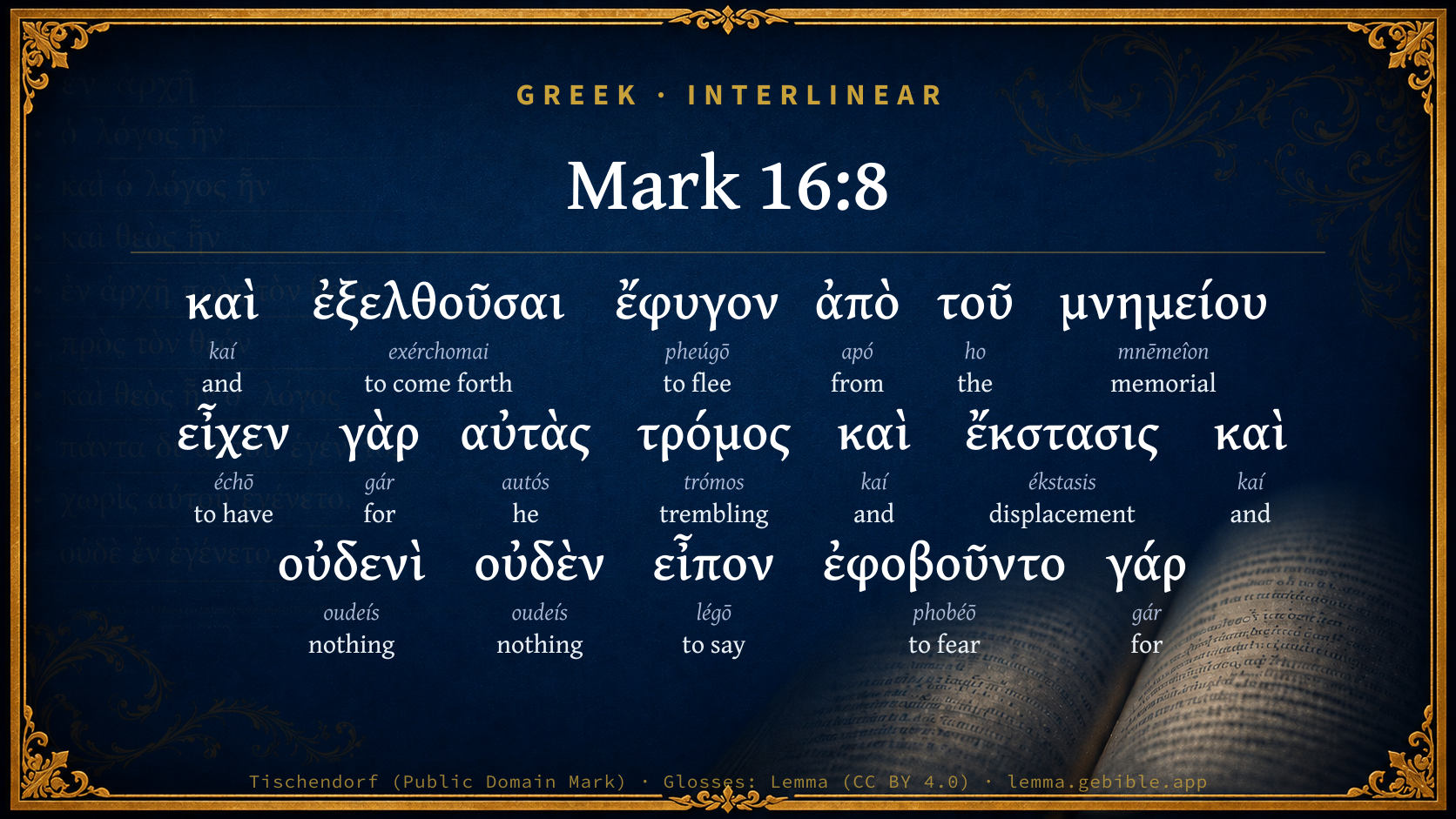
They went out, and fled from the tomb, for trembling and astonishment had come on them. They said nothing to anyone; for they were afraid.
Download a study sheet
One document with this verse’s original text, its word-by-word gloss line, the meaning frame, cross-references with their text, attributed commentary, and full source and license credits — printable, and it pastes into notes with its structure intact.
This verse Autodidact and up
A passage Seminary Student
Up to 50 verses in one chapter. A passage sheet keeps up to 6 commentary sources and 12 cross-references per verse, in the order this page ranks them, and says so on the sheet whenever that leaves anything out. Ask for a single verse and you get the Autodidact verse sheet above.
Everything on this page stays free to read, with no account — the sheet is a download of what is already on screen, not access to it.
Compare translations 3
The same verse in 3 English versions, stacked beneath the original-language interlinear above. Click any original word for its lexicon entry.
Each is an independent rendering of the whole verse — the interlinear is not word-aligned to these translations.
Highlighted words mark where these versions differ — a whole-verse word diff, not a word-by-word alignment.
-
World English Bible Public Domain
They went out, and fled from the tomb, for trembling and astonishment had come on them. They said nothing to anyone; for they were afraid.
-
King James Version Public Domain
And they went out quickly, and fled from the sepulchre; for they trembled and were amazed: neither said they any thing to any man; for they were afraid.
-
unfoldingWord Literal Text CC BY-SA 4.0
And having gone out, they fled from the tomb, for trembling and amazement was gripping them. And they said nothing to anyone, for they were afraid.
unfoldingWord Literal Text — © unfoldingWord, licensed CC BY-SA 4.0. Word-aligned USFM3 via Door43 (git.door43.org/unfoldingWord/en_ult).
Show all 19 translations
Every available English version of this verse, each an independent rendering of the whole verse.
-
World English Bible Public Domain
They went out, and fled from the tomb, for trembling and astonishment had come on them. They said nothing to anyone; for they were afraid.
-
Berean Standard Bible Public Domain
So the women left the tomb and ran away, trembling and bewildered. And in their fear they did not say a word to anyone.
-
Majority Standard Bible Public Domain
So the women left the tomb and ran away, trembling and bewildered. And in their fear they did not say a word to anyone.
-
King James Version Public Domain
And they went out quickly, and fled from the sepulchre; for they trembled and were amazed: neither said they any thing to any man; for they were afraid.
-
American Standard Version (1901) Public Domain
And they went out, and fled from the tomb; for trembling and astonishment had come upon them: and they said nothing to any one; for they were afraid.
-
Revised Version (1885) Public Domain
And they went out, and fled from the tomb; for trembling and astonishment had come upon them: and they said nothing to any one; for they were afraid.
-
Geneva Bible (1599) Public Domain
And they went out quickly, and fled from the sepulchre: for they trembled, and were amased: neither said they any thing to any man: for they were afraide.
-
Douay-Rheims (1899) Public Domain
But they going out, fled from the sepulchre. For a trembling and fear had seized them: and they said nothing to any man; for they were afraid.
-
Young's Literal Translation Public Domain
And, having come forth quickly, they fled from the sepulchre, and trembling and amazement had seized them, and to no one said they anything, for they were afraid.
-
Literal Standard Version CC BY-SA 4.0
And having come forth quickly, they fled from the tomb, and trembling and amazement had seized them, and they said to no one anything, for they were afraid. [[
-
Unlocked Literal Bible CC BY-SA 4.0
They went out and ran from the tomb; they were trembling and amazed. They said nothing to anyone because they were so afraid.
-
unfoldingWord Literal Text CC BY-SA 4.0
And having gone out, they fled from the tomb, for trembling and amazement was gripping them. And they said nothing to anyone, for they were afraid.
-
Darby Bible Public Domain
And they went out, and fled from the sepulchre. And trembling and excessive amazement possessed them, and they said nothing to any one, for they were afraid.
-
World Messianic Bible Public Domain
They went out, and fled from the tomb, for trembling and astonishment had come on them. They said nothing to anyone; for they were afraid.
-
Webster's Bible Public Domain
And they went out quickly, and fled from the sepulcher; for they trembled, and were amazed: neither said they any thing to any man; for they were afraid.
-
Free Bible Version CC BY-SA 4.0
They left and ran from the tomb, shaking and confused. They said nothing to anyone because they were too scared.
-
Bible in Basic English Public Domain
And they went out quickly from the place, because fear and great wonder had come on them: and they said nothing to anyone, because they were full of fear that...
-
Text-Critical English NT CC BY 4.0
So they went out and fled from the tomb, and trembling and amazement seized them. But they did not say anything to anyone, for they were afraid.
-
Tyndale New Testament (1534) Public Domain
And they went oute quickly and fleed from the sepulcre. For they trembled and were amased. Nether sayd they eny thinge to eny man for they were afrayed.
Literal Standard Version (2020), Covenant Press — licensed CC BY-SA 4.0. Text via the HelloAO Bible API (eBible.org). Unlocked Literal Bible (unfoldingWord) — licensed CC BY-SA 4.0. Text via the HelloAO Bible API (eBible.org). unfoldingWord Literal Text — © unfoldingWord, licensed CC BY-SA 4.0. Word-aligned USFM3 via Door43 (git.door43.org/unfoldingWord/en_ult). Free Bible Version, Dr. Jonathan Gallagher — licensed CC BY-SA 4.0. Text via the HelloAO Bible API (eBible.org).
Word by word
More ways to search: Search by grammar → Find every occurrence → Compare this word →
Practice this passage: Drill this verse → Learn its vocabulary →
- Appears 5× in the Greek New Testament
- First appears here
- Part of Speech
- Noun
- Case
- Nominative
- Number
- Singular
- Gender
- Masculine
Full Thayer's Definition
- καὶ kaí G2532 “and” Conjunction
- ἐξελθοῦσαι exérchomai G1831 “to come forth” Verb, Aorist, Active, Participle, Nominative, Plural, Feminine
- ἔφυγον pheúgō G5343 “to flee” Verb, Aorist, Active, Indicative, 3rd person, Plural
- ἀπὸ apó G575 “from” Preposition
- τοῦ ho G3588 “the” Article, Genitive, Singular, Neuter
- μνημείου mnēmeîon G3419 “memorial” Noun, Genitive, Singular, Neuter
- εἶχεν échō G2192 “to have” Verb, Imperfect, Active, Indicative, 3rd person, Singular
- γὰρ gár G1063 “for” Conjunction
- αὐτὰς autós G846 “he” Personal pronoun, Accusative, Plural, Feminine
- τρόμος trómos G5156 “trembling” Noun, Nominative, Singular, Masculine
- καὶ kaí G2532 “and” Conjunction
- ἔκστασις ékstasis G1611 “displacement” Noun, Nominative, Singular, Feminine
- καὶ kaí G2532 “and” Conjunction
- οὐδενὶ oudeís G3762 “nothing” Adjective, Dative, Singular, Masculine, Negative
- οὐδὲν oudeís G3762 “nothing” Adjective, Accusative, Singular, Neuter, Negative
- εἶπον légō G3004 “to say” Verb, Aorist, Active, Indicative, 3rd person, Plural
- ἐφοβοῦντο phobéō G5399 “to fear” Verb, Imperfect, Middle or Passive deponent, Indicative, 3rd person, Plural
- γάρ gár G1063 “for” Conjunction
About this verse
These counts appear in no published source. They are computed here, from the morphology-tagged text and Lemma’s own curated glosses. What Lemma adds →
- 18
- words
- 14
- distinct lemmas
- Gospels
- section
Notable vocabulary
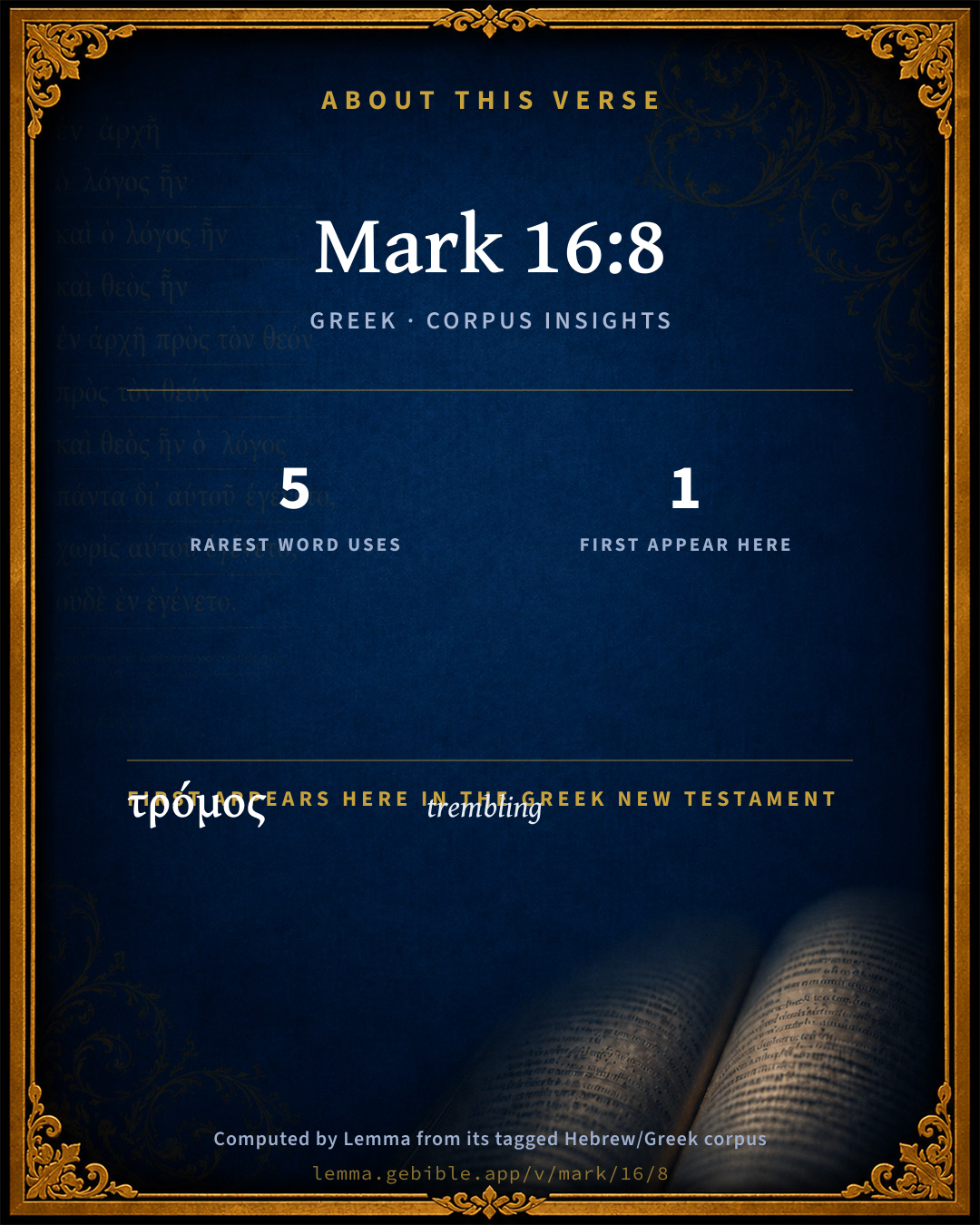
The rarest word here is τρόμος trembling G5156 — appearing just 5 times in the whole Greek New Testament.
First appearance in Scripture
This word makes its first canonical appearance in the Greek New Testament here:
- τρόμος trembling G5156
Shared distinctive vocabulary
τρόμος trembling G5156 occurs in 5 verses of the Greek New Testament. Also found in:
Cross-references
7Topical passages linked to Mark 16:8 in the Treasury of Scripture Knowledge — connected by theme and wording, ordered by reader-vote popularity; previews shown in the World English Bible.
- Matthew 28:8 They departed quickly from the tomb with fear and great joy, and ran to bring his disciples word.
- Mark 16:5–6 Entering into the tomb, they saw a young man sitting on the right side, dressed in a white robe, and they were amazed.
- Luke 24:9–11 returned from the tomb, and told all these things to the eleven, and to all the rest.
- Luke 24:22–24 Also, certain women of our company amazed us, having arrived early at the tomb;
- Luke 24:37 But they were terrified and filled with fear, and supposed that they had seen a spirit.
- 2 Kings 4:29 Then he said to Gehazi, Gird up your loins, and take my staff in your hand, and go your way: if you meet any man, Don't greet him; and if anyone greets you, don't answer him again: and lay my staff on the face of the child.
- Luke 10:4 Carry no purse, nor wallet, nor sandals. Greet no one on the way.
Cross-references courtesy of OpenBible.info (CC BY 4.0).
Where the printed editions differ
2 variantsPlaces in this verse where the major printed Greek editions disagree on the wording in a way that affects the translation — a comparison of editions, not a manuscript-by-manuscript collation. The editions are the modern critical texts (Nestlé-Aland 28/27, SBL, Westcott-Hort, Tregelles, Tyndale House) and the traditional texts behind the KJV (the Textus Receptus and the Byzantine/Majority text). It is not a claim about which reading is original.
-
Extra text
ταχὺ
“quickly”
In TR Not in NA28NA27TynSBLWHTregByzταχὺ (tachu) 'quickly' is only in traditional manuscripts (TR)
-
Extra text
[[Πάντα δὲ τὰ παρηγγελμένα τοῖς περὶ τὸν Πέτρον συντόμως ἐξήγγειλαν. Μετὰ δὲ ταῦτα καὶ αὐτὸς ὁ Ἰησοῦς ἀπὸ ἀνατολῆς καὶ ἄχρι δύσεως ἐξαπέστειλεν δι᾽ αὐτῶν τὸ ἱερὸν καὶ ἄφθαρτον κήρυγμα τῆς αἰωνίου σωτηρίας. ἀμήν.¶]]
“(8b) all now the [things] instructed to [those] around <the> Peter promptly they reported. After now these [things] also Himself <the> Jesus from [the] east and to [the] west sent out through them the sacred and imperishable preaching <the> of eternal salvation. Amen.”
In NA28NA27SBLWH Not in TynTregTRByz[[Πάντα δὲ τὰ παρηγγελμένα τοῖς περὶ τὸν Πέτρον συντόμως ἐξήγγειλαν. Μετὰ δὲ ταῦτα καὶ αὐτὸς ὁ Ἰησοῦς ἀπὸ ἀνατολῆς καὶ ἄχρι δύσεως ἐξαπέστειλεν δι᾽ αὐτῶν τὸ ἱερὸν καὶ ἄφθαρτον κήρυγμα τῆς αἰωνίου σωτηρίας. ἀμήν.¶]] (Panta de ta parēngelmena tois peri ton Petron suntomōs exēngeilan Meta de tauta kai autos ho Iēsous apo anatolēs kai achri duseōs exapesteilen di᾽ autōn to hi'eron kai aphtharton kērugma tēs aiōniou sōtērias amēn) '(8b) all now the [things] instructed to [those] around Peter promptly they reported. After now these [things] also Himself Jesus from [the] east and to [the] west sent out through them the sacred and imperishable preaching of eternal salvation. Amen.' is only in a few manuscripts
Textual data: Translators Amalgamated Greek New Testament (STEPBible TAGNT) · CC BY 4.0.
Lesson kit
Teaching starters — assembled from the data on this page, not authored interpretation. Every prompt links to the verse data it draws on. Edit before teaching.
Mark, in the Gospels, opens this verse with 18 words (14 distinct Greek lemmas). Its most distinctive word is trómos (“trembling”). A historical commentator’s framing appears above. Read the whole chapter for the surrounding context.
Discussion questions
- How does “trembling” (trómos) shape what this verse is saying?
- The word “trembling” first appears here in Scripture. What is being introduced at this debut?
- 1 Corinthians 2:3 shares the word «trembling» with this verse. How do the two illuminate each other?
- “nothing” occurs 2× in this one verse. What is the effect of the repetition?
- These translations render this verse differently. What is at stake in choosing one wording over another?
- Reading how Godbey's Commentary on the New Testament and Tyndale Open Study Notes read this verse, where do the two commentators agree and where do they part?
Things to notice
- 1 word makes its first canonical appearance in Scripture here.
- These translations choose different wording for 20 words in this verse.
- “nothing” occurs 2× in this single verse.
- 14 distinct Greek lemmas span 18 words in this verse.
Commentary
Notes on Mark 16:8 from classic Christian and Jewish commentators (each source and its license shown beneath its notes). The classic Christian expositions comment on the surrounding passage and are grouped to its opening verse, so a note may address several verses; the Jewish commentaries on the Tanakh (Rashi and others) are per-verse, so they appear only where the commentator wrote on this verse.
Lemma curates 59 commentaries, every one of them public domain or Creative Commons licensed, each selected and text-cleaned for this edition rather than reprinted as found. About our sources →
Godbey's Commentary on the New Testament
William B. Godbey
William B. Godbey, Commentary on the New Testament (1896–1900) — public domain. Text from a community e-Sword module.
Tyndale Open Study Notes
Tyndale Open Resources
Tyndale Open Study Notes — © Tyndale Open Resources, licensed CC BY-SA 4.0. Text via the HelloAO Bible API.
Bengel's Gnomon
Johann Albrecht Bengel
Bengel's Gnomon of the New Testament — English translation (T&T Clark, Edinburgh, 1860) — public domain. Text from a community e-Sword module.
Expositor's Greek Testament
ed. W. Robertson Nicoll
The Expositor's Greek Testament, edited by W. Robertson Nicoll (1897–1910) — public domain. Text from a community e-Sword module.
Cambridge Greek Testament for Schools and Colleges
Cambridge Greek Testament for Schools and Colleges (Cambridge University Press, 1896; 21 vols, various authors incl. Carr, Maclear, Plummer, Farrar, Lumby, Moule, M. R. James, Simcox) — public domain. Text from a community e-Sword module.
Ellicott's Commentary for English Readers
A Bible Commentary for English Readers, edited by Charles John Ellicott (1878–1897) — public domain. Text from a community e-Sword module.
The Cambridge Bible for Schools and Colleges
gen. ed. J. J. S. Perowne
The Cambridge Bible for Schools and Colleges (gen. ed. J. J. S. Perowne; Cambridge University Press, 1878–1918) — public domain. Text from a community e-Sword module.
John Gill's Exposition
John Gill's Exposition of the Whole Bible (1746–1763) — public domain (CC PDM 1.0). Text via the HelloAO Bible API.
Trapp's Complete Commentary
John Trapp
John Trapp, A Commentary or Exposition upon All the Books of the Old and New Testament (1647–1656) — public domain. Text from a community e-Sword module.
Whedon's Commentary on the Bible
Daniel D. Whedon
Daniel D. Whedon (gen. ed.), Commentary on the Old and New Testaments (1874–1909) — public domain. Text from a community e-Sword module.
The Pulpit Commentary
The Pulpit Commentary (1880–1919), ed. H.D.M. Spence-Jones & Joseph S. Exell — public domain. Text from a community e-Sword module.
MacLaren's Expositions of Holy Scripture
Alexander MacLaren
Alexander MacLaren, Expositions of Holy Scripture (1904–1910) — public domain. Text from a community e-Sword module.
The People's New Testament
B. W. Johnson
B. W. Johnson's The People's New Testament with Notes (1889–1891) — public domain. Electronic text from the Christian Classics Ethereal Library (CCEL) ThML edition.
unfoldingWord translationNotes
Door43 World Missions Community
unfoldingWord translationNotes — © Distant Shores Media and the Door43 World Missions Community, licensed CC BY-SA 4.0. Source: git.door43.org/Door43/en_tn.
Alford’s Greek Testament
Henry Alford
Henry Alford, The Greek Testament (1849–1861) — public domain. Text from a community e-Sword module.
International Critical Commentary
International Critical Commentary — older volumes (1896–1929), various authors — public domain. Text from a community e-Sword module.
Vincent's Word Studies in the New Testament
Marvin R. Vincent
Marvin R. Vincent, Word Studies in the New Testament (1887–1900) — public domain. Text from a community e-Sword/MySword module.