
Acts 26:22

Greek (Tischendorf 8th ed.) Acts 26:22 appears in the Greek New Testament. The text above is from the Tischendorf 8th edition. Each word links to its Strong’s number and a concise gloss. Click any word for its full Thayer’s Greek Lexicon entry.
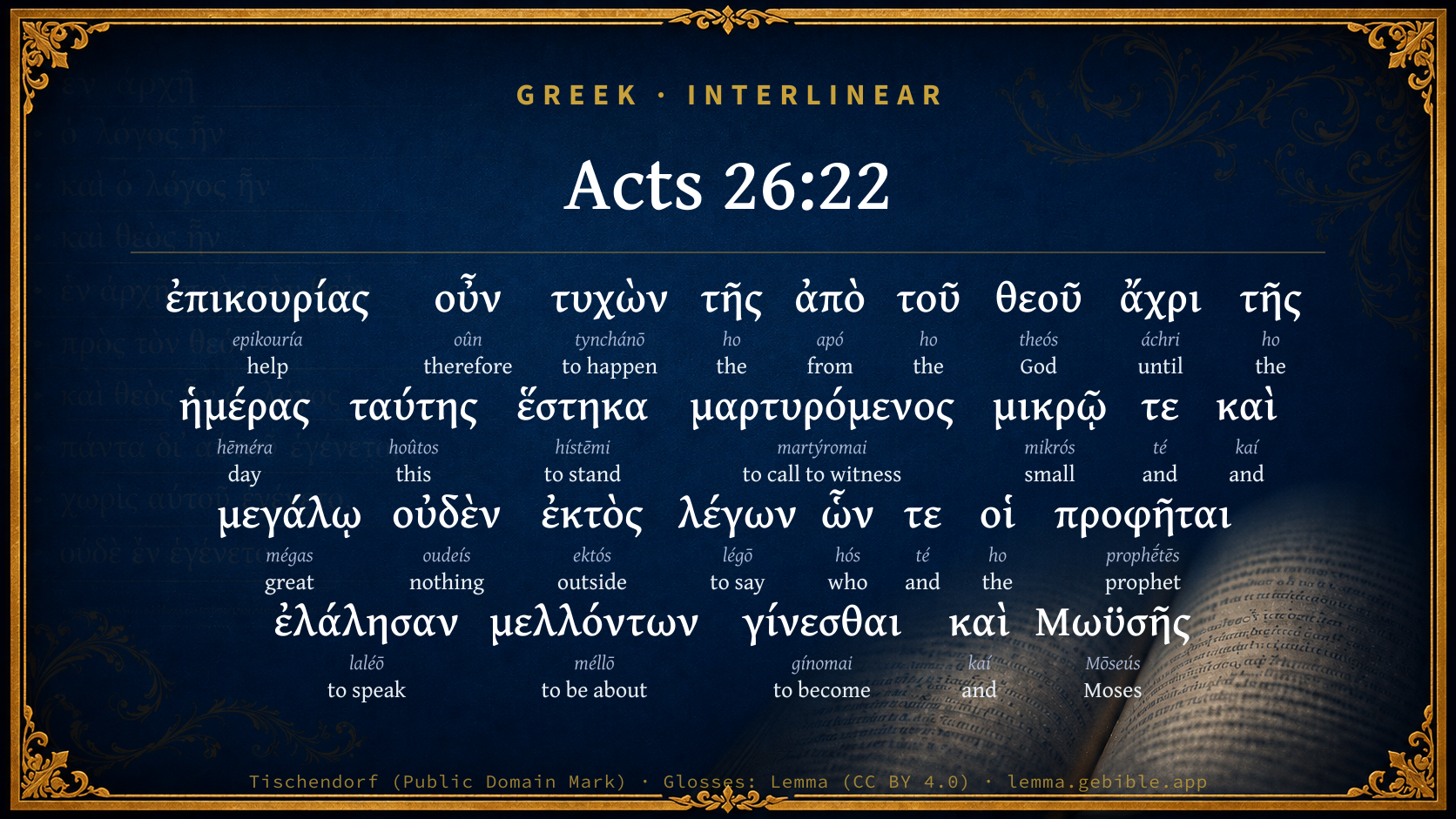
Download image
Cite this verse

Acts 26:22 (World English Bible). Public Domain. Lemma interlinear Bible study tool, https://lemma.gebible.app/v/acts/26/22.

Show BibTeX & RIS
BibTeX
RIS
English Translation
Having therefore obtained the help that is from God, I stand to this day testifying both to small and great, saying nothing but what the prophets and Moses said would happen,
World English Bible · Public Domain
Highlights
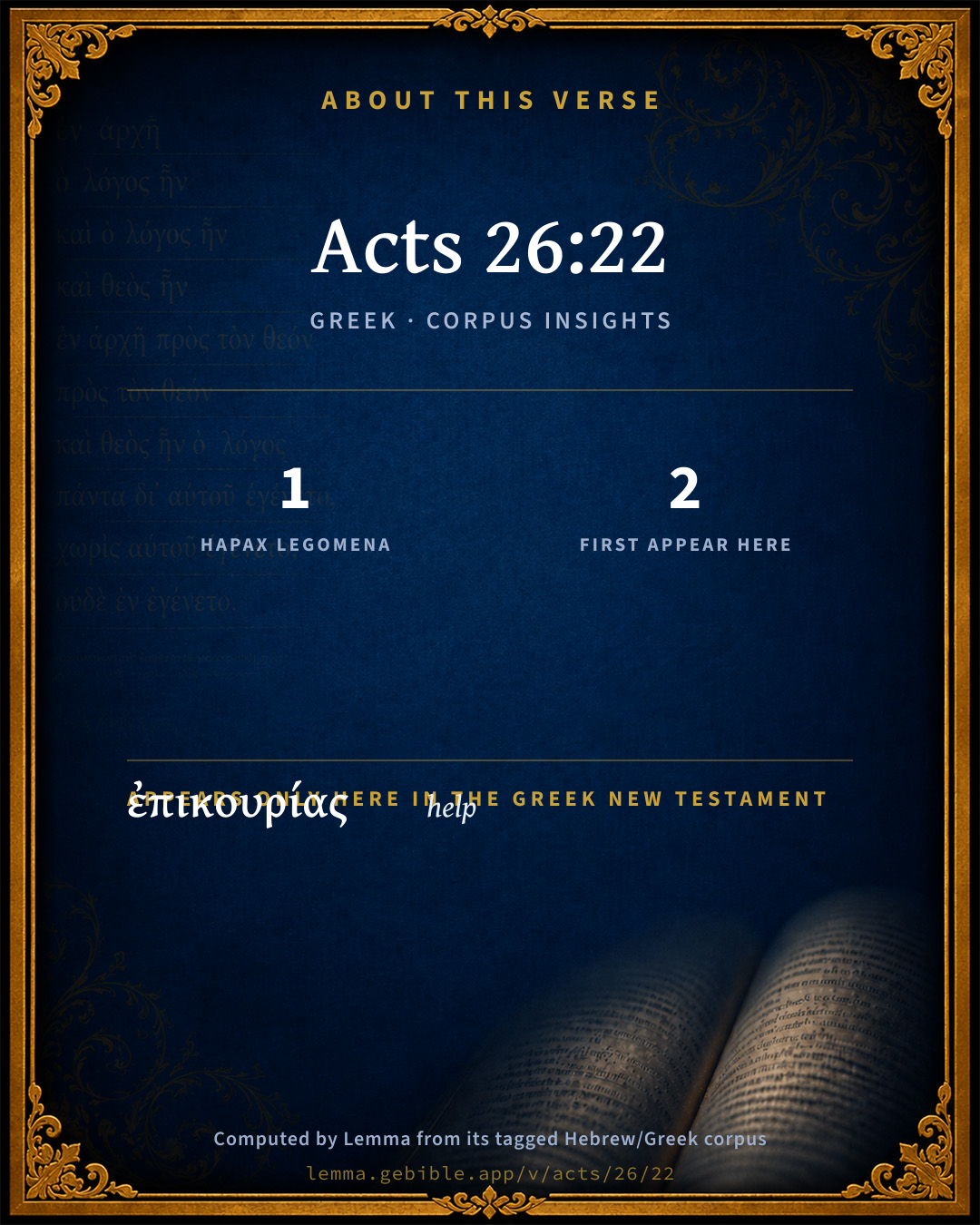
  • 1 hapax legomenon — only here in the Greek New Testament
  • 2 first appearances in the Greek New Testament
Full analysis ↓
Download a study sheet

One document with this verse’s original text, its word-by-word gloss line, the meaning frame, cross-references with their text, attributed commentary, and full source and license credits — printable, and it pastes into notes with its structure intact.

This verse Autodidact and up

Study sheet (.html) Plain text (.txt)

A passage Seminary Student

Up to 50 verses in one chapter. A passage sheet keeps up to 6 commentary sources and 12 cross-references per verse, in the order this page ranks them, and says so on the sheet whenever that leaves anything out. Ask for a single verse and you get the Autodidact verse sheet above.

Everything on this page stays free to read, with no account — the sheet is a download of what is already on screen, not access to it.

Want to remove ads? Support Godless Engineer
Compare translations 3

The same verse in 3 English versions, stacked beneath the original-language interlinear above. Click any original word for its lexicon entry.

Each is an independent rendering of the whole verse — the interlinear is not word-aligned to these translations.

Highlighted words mark where these versions differ — a whole-verse word diff, not a word-by-word alignment.

  • World English Bible Public Domain
    Having therefore obtained the help that is from God, I stand to this day testifying both to small and great, saying nothing but what the prophets and Moses said would happen,
  • King James Version Public Domain
    Having therefore obtained help of God, I continue unto this day, witnessing both to small and great, saying none other things than those which the prophets and Moses did say should come:
  • unfoldingWord Literal Text CC BY-SA 4.0
    Therefore, having received help from God up to this day, I stand, testifying to both small and great, saying nothing except the things that both the prophets and Moses said were going to happen—

unfoldingWord Literal Text — © unfoldingWord, licensed CC BY-SA 4.0. Word-aligned USFM3 via Door43 (git.door43.org/unfoldingWord/en_ult).

Versions to compare (up to 4)

3 of 4 selected

Show all 19 translations

Every available English version of this verse, each an independent rendering of the whole verse.

  • World English Bible Public Domain
    Having therefore obtained the help that is from God, I stand to this day testifying both to small and great, saying nothing but what the prophets and Moses said would happen,
  • Berean Standard Bible Public Domain
    But I have had God’s help to this day, and I stand here to testify to small and great alike. I am saying nothing beyond what the prophets and Moses said would happen:
  • Majority Standard Bible Public Domain
    But I have had God’s help to this day, and I stand here to testify to small and great alike. I am saying nothing beyond what the prophets and Moses said would happen:
  • King James Version Public Domain
    Having therefore obtained help of God, I continue unto this day, witnessing both to small and great, saying none other things than those which the prophets and Moses did say should come:
  • American Standard Version (1901) Public Domain
    Having therefore obtained the help that is from God, I stand unto this day testifying both to small and great, saying nothing but what the prophets and Moses did say should come;
  • Revised Version (1885) Public Domain
    Having therefore obtained the help that is from God, I stand unto this day testifying both to small and great, saying nothing but what the prophets and Moses did say should come;
  • Geneva Bible (1599) Public Domain
    Neuertheles, I obteined helpe of God, and continue vnto this day, witnessing both to small and to great, saying none other things, then those which the Prophets and Moses did say should come,
  • Douay-Rheims (1899) Public Domain
    But being aided by the help of God, I stand unto this day, witnessing both to small and great, saying no other thing than those which the prophets, and Moses did say should come to pass:
  • Young's Literal Translation Public Domain
    `Having obtained, therefore, help from God, till this day, I have stood witnessing both to small and to great, saying nothing besides the things that both the prophets and Moses spake of as about to come,
  • Literal Standard Version CC BY-SA 4.0
    Having obtained, therefore, help from God, until this day, I have stood witnessing both to small and to great, saying nothing besides the things that both the prophets and Moses spoke of as about to come,
  • Unlocked Literal Bible CC BY-SA 4.0
    God has helped me until now, so I stand and testify to the common people and to the great ones about nothing more than what the prophets and Moses said would happen—
  • unfoldingWord Literal Text CC BY-SA 4.0
    Therefore, having received help from God up to this day, I stand, testifying to both small and great, saying nothing except the things that both the prophets and Moses said were going to happen—
  • Darby Bible Public Domain
    Having therefore met with [the] help which is from God, I have stood firm unto this day, witnessing both to small and great, saying nothing else than those things which both the prophets and Moses have said should happen,
  • World Messianic Bible Public Domain
    Having therefore obtained the help that is from God, I stand to this day testifying both to small and great, saying nothing but what the Prophets and Moses said would happen,
  • Webster's Bible Public Domain
    Having therefore obtained help from God, I continue to this day, testifying both to small and great, saying no other things than those which the prophets and Moses did say should come:
  • Free Bible Version CC BY-SA 4.0
    God has looked after me so I can stand here today as a witness to everyone, both to ordinary people and to those who are important. I am only repeating what Moses and the prophets said would happen—
  • Bible in Basic English Public Domain
    And so, by God's help, I am here today, witnessing to small and great, saying nothing but what the prophets and Moses said would come about;
  • Text-Critical English NT CC BY 4.0
    But having obtained help from God, I stand to this day testifying to both small and great, saying nothing except what the Prophets and Moses said would take place:
  • Tyndale New Testament (1534) Public Domain
    Neverthelesse I obtayned helpe of God and cotynew vnto this daye witnessyng bothe to small and to greate saying none other thinges then those which the prophetes and Moses dyd saye shuld come

Literal Standard Version (2020), Covenant Press — licensed CC BY-SA 4.0. Text via the HelloAO Bible API (eBible.org). Unlocked Literal Bible (unfoldingWord) — licensed CC BY-SA 4.0. Text via the HelloAO Bible API (eBible.org). unfoldingWord Literal Text — © unfoldingWord, licensed CC BY-SA 4.0. Word-aligned USFM3 via Door43 (git.door43.org/unfoldingWord/en_ult). Free Bible Version, Dr. Jonathan Gallagher — licensed CC BY-SA 4.0. Text via the HelloAO Bible API (eBible.org).

Word by word

More ways to search: Search by grammar → Find every occurrence → Compare this word →

Practice this passage: Drill this verse → Learn its vocabulary →

ἐπικουρίας
epikouría
G1947
“help”
Noun, Genitive, Singular, Feminine
Part of Speech
Noun
Case
Genitive
Number
Singular
Gender
Feminine
Full Thayer's Definition

Origin: from a compound of G1909 and a (prolonged) form of the base of G2877 (in the sense of servant)

TDNT: None

1. aid, succour, help
  1. οὖν oûn G3767 “therefore” Conjunction
  2. τυχὼν tynchánō G5177 “to happen” Verb, Aorist, Active, Participle, Nominative, Singular, Masculine
  3. τῆς ho G3588 “the” Article, Genitive, Singular, Feminine
  4. ἀπὸ apó G575 “from” Preposition
  5. τοῦ ho G3588 “the” Article, Genitive, Singular, Masculine
  6. θεοῦ theós G2316 “God” Noun, Genitive, Singular, Masculine
  7. ἄχρι áchri G891 “until” Adverb
  8. τῆς ho G3588 “the” Article, Genitive, Singular, Feminine
  9. ἡμέρας hēméra G2250 “day” Noun, Genitive, Singular, Feminine
  10. ταύτης hoûtos G3778 “this” Demonstrative pronoun, Genitive, Singular, Feminine
  11. ἕστηκα hístēmi G2476 “to stand” Verb, Perfect, Active, Indicative, 1st person, Singular
  12. μαρτυρόμενος martýromai G3143 “to call to witness” Verb, Present, Middle or Passive deponent, Participle, Nominative, Singular, Masculine
  13. μικρῷ mikrós G3398 “small” Adjective, Dative, Singular, Masculine
  14. τε té G5037 “and” Particle
  15. καὶ kaí G2532 “and” Conjunction
  16. μεγάλῳ mégas G3173 “great” Adjective, Dative, Singular, Masculine
  17. οὐδὲν oudeís G3762 “nothing” Adjective, Accusative, Singular, Neuter, Negative
  18. ἐκτὸς ektós G1622 “outside” Adverb
  19. λέγων légō G3004 “to say” Verb, Present, Active, Participle, Nominative, Singular, Masculine
  20. ὧν hós G3739 “who” Relative pronoun, Genitive, Plural, Neuter
  21. τε té G5037 “and” Particle
  22. οἱ ho G3588 “the” Article, Nominative, Plural, Masculine
  23. προφῆται prophḗtēs G4396 “prophet” Noun, Nominative, Plural, Masculine
  24. ἐλάλησαν laléō G2980 “to speak” Verb, Aorist, Active, Indicative, 3rd person, Plural
  25. μελλόντων méllō G3195 “to be about” Verb, Present, Active, Participle, Genitive, Plural, Neuter
  26. γίνεσθαι gínomai G1096 “to become” Verb, Present, Middle or Passive deponent, Infinitive
  27. καὶ kaí G2532 “and” Conjunction
  28. Μωϋσῆς Mōseús G3475 “Moses” Noun, Nominative, Singular, Masculine

About this verse

These counts appear in no published source. They are computed here, from the morphology-tagged text and Lemma’s own curated glosses. What Lemma adds →

29
words
24
distinct lemmas
Acts
section

Notable vocabulary

1 hapax legomenon — a word that appears only here in the entire Greek New Testament:

  • ἐπικουρίας help G1947

First appearance in Scripture

These words make their first canonical appearance in the Greek New Testament here:

  • ἐπικουρίας help G1947
  • ἐκτὸς outside G1622

Shared distinctive vocabulary

μαρτυρόμενος to call to witness G3143 occurs in 5 verses of the Greek New Testament. Also found in:
Repetition

Words recur within this verse:

Cross-references

37

Topical passages linked to Acts 26:22 in the Treasury of Scripture Knowledge — connected by theme and wording, ordered by reader-vote popularity; previews shown in the World English Bible.

  • John 5:46 For if you believed Moses, you would believe me; for he wrote about me.
  • Acts 24:14 But this I confess to you, that after the Way, which they call a sect, so I serve the God of our fathers, believing all things which are according to the law, and which are written in the prophets;
  • Luke 24:27 Beginning from Moses and from all the prophets, he explained to them in all the Scriptures the things concerning himself.
  • Luke 24:44 He said to them, "This is what I told you, while I was still with you, that all things which are written in the law of Moses, the prophets, and the psalms, concerning me must be fulfilled."
  • Acts 10:43 All the prophets testify about him, that through his name everyone who believes in him will receive remission of sins."
  • Romans 3:21 But now apart from the law, a righteousness of God has been revealed, being testified by the law and the prophets;
  • 1 Samuel 7:12 Then Samuel took a stone, and set it between Mizpah and Shen, and called the name of it Ebenezer, saying, Hitherto has Yahweh helped us.
  • Psalms 66:12 You allowed men to ride over our heads. We went through fire and through water, But you brought us to the place of abundance.
  • Psalms 118:10–13 All the nations surrounded me, But in the name of Yahweh, I cut them off.
  • Acts 20:20–27 how I didn't shrink from declaring to you anything that was profitable, teaching you publicly and from house to house,
  • 2 Corinthians 1:8–10 For we don't desire to have you uninformed, brothers, concerning our affliction which happened to us in Asia, that we were weighed down exceedingly, beyond our power, so much that we despaired even of life.
  • Revelation 15:3 They sang the song of Moses, the servant of God, and the song of the Lamb, saying, "Great and marvelous are your works, Lord God, the Almighty; Righteous and true are your ways, you King of the nations.
  • Ezra 8:31 Then we departed from the river Ahava on the twelfth [day] of the first month, to go to Jerusalem: and the hand of our God was on us, and he delivered us from the hand of the enemy and the bandit by the way.
  • Psalms 18:47 Even the God who executes vengeance for me, And subdues peoples under me.
  • Psalms 124:1–3 If it had not been Yahweh who was on our side, Let Israel now say,
  • Psalms 124:8 Our help is in the name of Yahweh, Who made heaven and earth.
  • Matthew 17:4–5 Peter answered, and said to Jesus, "Lord, it is good for us to be here. If you want, let's make three tents here: one for you, one for Moses, and one for Elijah."
  • Luke 16:29–31 "But Abraham said to him, 'They have Moses and the prophets. Let them listen to them.'
  • Luke 24:46 He said to them, "Thus it is written, and thus it was necessary for the Christ to suffer and to rise from the dead the third day,
  • John 1:17 For the law was given through Moses. Grace and truth came through Jesus Christ.
  • John 1:45 Philip found Nathanael, and said to him, "We have found him, of whom Moses in the law, and the prophets, wrote: Jesus of Nazareth, the son of Joseph."
  • John 3:14–15 As Moses lifted up the serpent in the wilderness, even so must the Son of Man be lifted up,
  • John 5:39 "You search the Scriptures, because you think that in them you have eternal life; and these are they which testify about me.
  • Acts 3:21–24 whom heaven must receive until the times of restoration of all things, which God spoke long ago by the mouth of his holy prophets.
  • Acts 14:19–20 But some Jews from Antioch and Iconium came there, and having persuaded the multitudes, they stoned Paul, and dragged him out of the city, supposing that he was dead.
  • Acts 16:25–26 But about midnight Paul and Silas were praying and singing hymns to God, and the prisoners were listening to them.
  • Acts 18:9–10 The Lord said to Paul in the night by a vision, "Don't be afraid, but speak and don't be silent;
  • Acts 21:31–33 As they were trying to kill him, news came up to the commanding officer of the regiment that all Jerusalem was in an uproar.
  • Acts 23:10–11 When a great argument arose, the commanding officer, fearing that Paul would be torn in pieces by them, commanded the soldiers to go down and take him by force from among them, and bring him into the barracks.
  • Acts 23:16–22 But Paul's sister's son heard of their lying in wait, and he came and entered into the barracks and told Paul.
  • Acts 26:6 Now I stand here to be judged for the hope of the promise made by God to our fathers,
  • Acts 26:17 delivering you from the people, and from the Gentiles, to whom I send you,
  • Acts 28:23 When they had appointed him a day, many people came to him at his lodging. He explained to them, testifying about the Kingdom of God, and persuading them concerning Jesus, both from the law of Moses and from the prophets, from morning until evening.
  • 2 Timothy 3:11 persecutions, and sufferings: those things that happened to me at Antioch, Iconium, and Lystra. I endured those persecutions. Out of them all the Lord delivered me.
  • 2 Timothy 4:17–18 But the Lord stood by me, and strengthened me, that through me the message might be fully proclaimed, and that all the Gentiles might hear; and I was delivered out of the mouth of the lion.
  • Revelation 11:18 The nations were angry, and your wrath came, as did the time for the dead to be judged, and to give your bondservants the prophets, their reward, as well as to the saints, and those who fear your name, to the small and the great; and to destroy those who destroy the earth."
  • Revelation 20:12 I saw the dead, the great and the small, standing before the throne, and they opened books. Another book was opened, which is the book of life. The dead were judged out of the things which were written in the books, according to their works.

Cross-references courtesy of OpenBible.info (CC BY 4.0).

Commentary

Notes on Acts 26:22 from classic Christian and Jewish commentators (each source and its license shown beneath its notes). The classic Christian expositions comment on the surrounding passage and are grouped to its opening verse, so a note may address several verses; the Jewish commentaries on the Tanakh (Rashi and others) are per-verse, so they appear only where the commentator wrote on this verse.

Lemma curates 59 commentaries, every one of them public domain or Creative Commons licensed, each selected and text-cleaned for this edition rather than reprinted as found. About our sources →

Tyndale Open Study Notes

Tyndale Open Resources

26:22-23 Paul stressed God’s protection as he carried out his witness (cp. 3:18; 10:43; Luke 24:25-27, 44-47). Paul then called on his hearers to believe his message, that Jesus is the Messiah who fulfills the promises of the Old Testament (see Luke 24:27, 44).

Tyndale Open Study Notes — © Tyndale Open Resources, licensed CC BY-SA 4.0. Text via the HelloAO Bible API.

Bengel's Gnomon

Johann Albrecht Bengel

Act 26:22. Ἐπικουρίας, help) Ammonius observes; βοηθεῖ is said of the assistance given by one who is with another; ἐπικουρεῖ, of that of one who comes from without to the help of another. When all the Jews were either attacking, or else not defending Paul, God suddenly sent Romans to his help from the camp. Thus the promise which Jesus had given in Act 26:17 was fulfilled.—τυχὼν) In relation to us, not in relation to GOD, such things are fortuitous [τυγχάνω properly implies chance].—ἕσητκα, I have stood, I stand [continue]) safe and uninjured.—μεγάλῳ, to great) as in the present instance.—μελλόντων) The Genitive depends on ὧν.—καὶ) and, in particular, Moses, an extraordinary prophet.—εἰ) whether. Elegantly used. The fact was clear: the Jews had called it in question; Act 26:3, “questions among the Jews.”—παθητὸς, is liable to—capable of—suffering) The Jews had denied that Messiah can suffer.—πρῶτος, the first) 1Co 15:23.—φῶς, a light) Act 26:13; Act 26:18.—μέλλει καταγγέλλειν, is about to show) by the Gospel, as was foretold.

Bengel's Gnomon of the New Testament — English translation (T&T Clark, Edinburgh, 1860) — public domain. Text from a community e-Sword module.

Expositor's Greek Testament

ed. W. Robertson Nicoll

Act 26:22 . ἐπικουρίας … τῆς παρὰ ( ἀπὸ ) Θεοῦ : “the help that is from God,” R.V., i.e. , the help which cometh from God only; only here in N.T., cf. Wis 13:18 ( ἐμπειρίας , 2 ), for the use of the same phrase cf. instances in Wetstein from Polybius; the word is found in Josephus, but also frequently in classical Greek, of succour against foes. τυχὼν : no idea of chance, cf. 2Ti 2:10 ; the aid was divine, not human. οὖν , see Wendt, and references, Blass, Gram. , p. 267, Winer-Moulton, liii., 10, 4. ἕστηκα : sto salvus , Bengel, after these repeated dangers. The A.V. hardly gives the force of the word; it is a Pauline expression, cf. Eph 6:13-14 , Col 4:12 , so Knabenbauer, subsisto incolumis . μαρτυρούμενος : “testifying,” A.V., yet μαρτυρόμενος , see critical note, would rather signify “testifying,” so R.V., see on Act 6:3 . Grimm-Thayer, if the reading in T.R. is retained, evidently considers that it should be rendered as passive, “testified to both by small and great”. But μαρτυρόμενος marks most appropriately the office of bearing testimony to which Paul was appointed. μικρῷ τε καὶ μεγάλῳ : if taken to mean “both small and great,” the words would have a special force in thus being spoken before Festus and Agrippa, but if = young and old, i.e. , before all men, cf. Act 8:10 , Heb 8:11 ; cf. Gen 19:4 ; Gen 19:11 , etc., but in Rev 11:18 ; Rev 13:16 ; Rev 19:5 , reference is made rather to rank than to age, and the latter meaning may well be included here; cf. Deu 1:17 , Job 3:19 , Wis 6:7 . οὐδὲν ἐκτὸς λ . ὧν τε οἱ πρ .… μελλόντων = οὐδὲν ἐκτὸς τούτων ἅ … ἐλάλησαν μέλλοντᾳ , cf. Rev 17:8 Simcox, Language of the N.T. , p. 135. μελλ . γίγ ., cf. Luk 21:36 ; ἐκτὸς , cf. 1Co 15:27 ; the word is only used by St. Paul elsewhere in N.T. (except Mat 23:26 ), cf. 1Ki 10:13 , 2Ch 9:12 ; 2Ch 17:19 . οἱ προφ .… καὶ Μ .: more naturally Moses and the prophets, Luk 16:29 ; Luk 16:31 , and cf. Act 28:23 , but Moses may have been mentioned to influence the Sadducean element in the audience: the historical Christ was always the subject of St. Paul’s preaching “Jesus is the Christ,” and the historical Christ was also the ideal Christ; cf. Act 3:13 , 1Co 15:3 . See on this verse critical note, and Wendt (1899), p. 397, note.

The Expositor's Greek Testament, edited by W. Robertson Nicoll (1897–1910) — public domain. Text from a community e-Sword module.

Geneva Bible (1599)

Geneva Bible translators

Christ is the end of the Law and the Prophets.

To everyone.

Geneva Bible (1599) marginal notes — public domain. Text via Bolls.life.

Jamieson, Fausset & Brown

Robert Jamieson, A. R. Fausset & David Brown

having obtained help--"succor."

from God--"that [which cometh] from God."

I continue--"stand," "hold my ground."

unto this day, witnessing, &c.--that is, This life of mine, so marvellously preserved, in spite of all the plots against it, is upheld for the Gospel's sake; therefore I "witnessed," &c.

Jamieson, Fausset & Brown — Commentary Critical and Explanatory on the Whole Bible (1871) — public domain (CC PDM 1.0). Text via the HelloAO Bible API.

Adam Clarke's Commentary

Verse 22. Having - obtained help of God] According to the gracious promise made to him: see Ac 26:17.

Witnessing both to small and great] Preaching before kings, rulers, priests, and peasants; fearing no evil, though ever surrounded with evils; nor slackening in my duty, notwithstanding the opposition I have met with both from Jews and Gentiles. And these continual interpositions of God show me that I have not mistaken my call, and encourage me to go forward in my work.

Adam Clarke's Commentary on the Bible (1810–1826) — public domain. Text from a community e-Sword/MySword module.

Ellicott's Commentary for English Readers

(22) Having therefore obtained help of God.—The Greek noun for “help” is not used elsewhere in the New Testament. It implies the kind of assistance which one friend or ally gives to another of inferior power. It is found in the Greek of Wis_13:18. Here the word seems used as being more intelligible to those who are outside the kingdom of God than the more spiritual, more theological, “grace” of which the Apostle habitually spoke.

Witnessing both to small and great.—The English version gives the right rendering of the best supported reading. Some MSS., however, have “witnessed to by small and great;” but this, besides the want of authority, and its involving an unusual construction, is at variance with the context. It was true that St. Paul’s life was spent in bearing witness that Jesus was Christ. It was not true that he had a good report of all men. The words “small and great” were significant as spoken when he was standing before two men like Festus and Agrippa. The phrase may be noted as occurring in Act_8:10, and again in Rev_11:18; Rev_13:16; Rev_19:5; Rev_19:18; Rev_20:12.

The prophets and Moses.—The more natural order of “Moses and the prophets” (Luk_16:29; Luk_16:31), and the order of the words in the Greek, which the prophets said should come, and Moses, suggests the thought that the sentence would have stopped naturally at “come,” and that the name of Moses was added by an instantaneous after-thought to meet the case of those among the hearers who, like the Sadducees, placed the Pentateuch on a higher level of authority than the Prophets.

A Bible Commentary for English Readers, edited by Charles John Ellicott (1878–1897) — public domain. Text from a community e-Sword module.

The Cambridge Bible for Schools and Colleges

gen. ed. J. J. S. Perowne

22. Having therefore obtained help of God [R. V. the help that is from God.] The “therefore” implies that against such attempts the help which alone could deliver him was divine. The word for “help” means the succour of an ally, and recalls God’s promise “Surely I will be with thee.”

I continue [R.V. stand] unto this day] The Apostle has in mind the many attempts to cast him down which had been made by Jews, and Gentiles too, during his missionary journeys. He has been rescued in many ways, and is still there standing safe and sound through the help which God hath sent him. He does not forget human agency, but this, whatever it was, was all sent of God.

witnessing [R. V. testifying] both to small and great] He was now before two who would be named great, and he knew that God had declared that he should testify “before kings” (Act_9:15).

the prophets and Moses] i.e. the whole Old Testament Scriptures. The form of the phrase is usually “Moses and the prophets” according to the order of the O.T. books. Sometimes we have “the Law and the prophets,” and once (Luk_24:44) “the law of Moses, the prophets and the Psalms.”

The Cambridge Bible for Schools and Colleges (gen. ed. J. J. S. Perowne; Cambridge University Press, 1878–1918) — public domain. Text from a community e-Sword module.

John Gill's Exposition

That Christ should suffer,.... Great afflictions in soul and body, and death itself; this is recorded by Moses, Gen 3:15 and is the sense of many of the types, as of the passover, brazen serpent, &c. and of all the sacrifices which from God were appointed by him, and is the constant account of all the prophets from the beginning to the end; see Psa 22:1 Dan 9:26. The sufferer is Christ, or the Messiah, not the Father, nor the Spirit, but the Word, or Son of God, and not in his divine nature, which was incapable of suffering, but in his human nature; though sufferings may be ascribed to his whole person, both natures being united in him: and hence they became efficacious to answer the purposes for which they were endured; and which he endured, not for himself, nor for angels, but for chosen men, sinners, and ungodly persons; in order to make peace and reconciliation for them, procure the pardon of their sins, obtain eternal redemption for them, deliver them from all evil, and from all enemies, and bring them nigh to God: and what he suffered were no other than what had been foretold in the writings of the Old Testament, which all along represent the Messiah as a suffering one; and in particular that he should suffer in his character, be reproached, and accounted a worm, and no man, Isa 53:3 and in his soul and body, and be put to death and buried, as the above prophecies referred to show; the several circumstances leading on to, or attending his sufferings and death, are distinctly expressed; as the betraying him by one of his disciples, selling him for thirty pieces of silver, his being forsaken by all his disciples, his crucifixion between two thieves, the parting of his garments, giving him gall and vinegar to drink, and the piercing his side with a spear, Psa 41:9. And to this agreed the doctrine of the apostle, who taught that Jesus of Nazareth was the Christ that was to come, and that he had suffered all that Moses and the prophets did say should come upon him: but these were not the present sentiments of the Jews, who expected the Messiah to be a temporal Prince and Saviour, and to live in great outward prosperity, and for ever.

And that he should be the first that should rise from the dead: by his own power, and to an immortal life, as Jesus did; and so is the firstborn from the dead, and the first fruits of them that slept: a type of this, in the deliverance of Isaac, is recorded by Moses in Gen 22:12 compared with Heb 11:19 and the thing itself is foretold by many of the prophets, Psa 16:10.

and should show light unto the people, and to the Gentiles: in his own person to the people of the Jews, and by his apostles to the Gentiles. In the writings of Moses he is spoken of as the great prophet God would raise up in Israel, to whom they should hearken; and as the Shiloh to whom the gathering of the people should be, Deu 17:15 and that he should be a light to both Jews and Gentiles, through the ministration of the Gospel, is said by the prophets, Isa 9:2 and these were the things which the apostle asserted in his ministry, in perfect agreement with those writings.

John Gill's Exposition of the Whole Bible (1746–1763) — public domain (CC PDM 1.0). Text via the HelloAO Bible API.

Trapp's Complete Commentary

John Trapp

22 Having therefore obtained help of God, I continue unto this day, witnessing both to small and great, saying none other things than those which the prophets and Moses did say should come:

Ver. 22. Saying none other thing] Truth is one and the same in all ages; it is also ancient, and ever at agreement with itself. As on the other side, error is new, manifold, dissonant, and contradictory to itself, and much more to the truth. Paul delivered no new truths, but stood in the good old way of Moses and the prophets, and followed them, κατα ποδα. Those that stumble from the ancient ways, to walk in "new paths, in a way not cast up," they are people that "forget God," Jer 18:15, to sacrifice to new gods, that came newly up, Deu 32:17; they are none of God’s ancient people, Isa 44:7, but an upstart generation that knew not Joseph.

John Trapp, A Commentary or Exposition upon All the Books of the Old and New Testament (1647–1656) — public domain. Text from a community e-Sword module.

Albert Barnes' Notes on the Bible

Having therefore obtained help of God - Paul had seen and felt his danger. He had known the determined malice of the Jews, and their efforts to take his life. He had been rescued by Lysias, and had made every effort himself to avoid the danger and to save his life; and at the end of all; he traced his safety entirely to the help of God. It was not by any power of his own that he had been preserved; it was because God had interposed and rescued him. Those who have been delivered from danger, if they have just views, will delight to trace it all to God. They will recognize his hand, and will feel that whatever wisdom they may have had, or whatever may have been the kindness of their friends to them, yet that all this also is to be traced to the superintending providence of God.

Witnessing - Bearing testimony to what he had seen, according to the command of Christ, Act 26:16.

To small - To those in humble life; to the poor, the ignorant, and the obscure. Like his Master, he did not despise them, but regarded it as his duty and privilege to preach the gospel to them.

And great - The rich and noble; to kings, princes, and governors. He had thus stood on Mars’ Hill at Athens; he had declared the same gospel before Felix, Festus, and now before Agrippa. He offered salvation to all. He passed by none because they were poor; and he was not deterred by the fear of the rich and the great from making known their sins and calling them to repeatance. What an admirable illustration of the proper duties of a minister of the gospel!

Saying none other things ... - Delivering no new doctrine, but maintaining only that the prophecies had been fulfilled. As he had done this only, there was no reason for the opposition and persecution of the Jews.

Should come - Should come to pass, or should take place. Paul here evidently means to say that the doctrine of the atonement, and of the resurrection of Christ, is taught in the Old Testament.

Albert Barnes' Notes on the Bible (1834–1885) — public domain. Text from a community e-Sword/MySword module.

Matthew Poole's English Annotations

I continue unto this day: that Paul, continued till then alive, notwithstanding all the fraud and force of his enemies, is acknowledged by him to be from God; from whence he infers towards his justification, that what he had done was but in a becoming gratitude towards that God who had maintained him in life unto that very day.

Witnessing both to small and great; witnessing to all sorts, princes or people; implying, that the truths of the gospel, and the things of God, concerned Agrippa as well as the meanest of his auditors; and indeed with God there is no respect of persons, and that we are all one in Christ Jesus, Gal 3:28.

The prophets and Moses; Moses was himself also a prophet, but he is here made especial mention of, because of his excellency above the other prophets, (unto whom God spoke face to face), as also because he was the lawgiver to the Jews, and to whom, upon all occasions, they pretended to yield obedience.

Matthew Poole's English Annotations on the Holy Bible (1683–1685) — public domain. Text from a community e-Sword/MySword module.

Whedon's Commentary on the Bible

Daniel D. Whedon

22. Help—A military term signifying the aid a warrior receives from auxiliary or allied forces. The warrior was the apostle; the enemy the Jews; the auxiliary was God.

Witnessing—According to his apostolic office. (See note on Act_26:16.)

Small and great—Whether of rank, stature, or age.

Prophets and Moses—Hence Christianity is true Old Testament religion, and Paul has not by forsaking his national religion incurred the penalty of death.

Daniel D. Whedon (gen. ed.), Commentary on the Old and New Testaments (1874–1909) — public domain. Text from a community e-Sword module.

The Pulpit Commentary

The help that is from God for help of God, A.V.; stand for continue, A.V.; testifying for witnessing, A.V.; nothing but what for none other things than those which, A.V.. Help, etc.; ejpikouria, here only and in RAPC Wis 13:18, still of Divine help; in medical writers frequently, of aid from medicine and physicians; common also in classical writers, of auxiliary forces. It is properly spoken of help and allies from without (Bengel). I stand; i.e. I continue unmoved, steadfast, and, by God"s help, not crushed by my enemies. Testifying. The natural rendering of the R.T. marturomenov. The T.R. marturoumenov, followed by uJpo, would mean "borne witness to," "approved," as in menov Act_6:3 Act_10:22, etc., and so Meyer understands it here. But marturu makes much better sense, and is much better supported by manuscript authority. It is in close agreement with Act_9:15 and Act_22:15, that St Paul should thus testify" to small and great.

The believing retrospect.

therefore obtained help of God, I continue unto this day." Times when retrospect and the grateful acknowledgment which flows from it are especially profitable. At the critical junctures of life. When a testimony for God is demanded of us for the sake of others. "Unto this day.

I THE HIGHER VIEW OF LIFE.

1. A mission, a testimony.

2. A co-operation with the Divine work, running parallel with the line of infinite wisdom and righteousness.

3. A gracious fruit of heavenly bestowment. "Help from God.

4. A life lived by prayer, linked on to the throne of grace.

II AN ENCOURAGING AND STIMULATING EXAMPLE. The profitable use which should be made of biography. The lessons of Paul"s life. Divine strength made perfect in human weakness, Teaching us:

1. To follow the Spirit.

2. To depend upon the Divine control of circumstances and of the oppositions of men.

3. To maintain confidence and courage by laying hold of a great future.

4. To be bold in speaking for Christ, especially when we can say, as Paul could, that he "said nothing but what the prophets and Moses said." The sure ground is the written Word. To preach ourselves is to obtain no help from God; to magnify his Word is to ensure his blessing and be sustained to the end. R.

Vers. 22, 23. A good confession.

If Festus and Agrippa had known half of what Paul had been passing through since his journey to Damascus was so peremptorily stopped, they would well understand why he interposes the acknowledgment, so full of dependence and of humble gratitude, "Therefore having obtained help of God, I continue unto this day" Paul takes credit to himself for neither his work, nor suffering, nor safety. These are all due to his sovereign Leader" and "Commander" and Protector. But he makes a good confession indeed, one, if true and none deny its truth most worthy of imitation, of all and every one who would in any measure be a follower in his work. He claims justly, and not boastfully, but for manifestly other reason, that he has maintained

I A PERSEVERING WITNESS.

II AN IMPARTIAL WITNESS.

III AN UNCHANGING CONSISTENT SCRIPTURAL WITNESS. Paul wishes to lay stress on this, that he had been to the Law and the testimony and the prophets;" and had been true to them; had not gone beside nor beyond them, and had not fallen short of them, as his people and opponents were, in fact, guilty of doing.

IV A STRONG WITNESS TO FOUR THINGS IN ESPECIAL. These were the four grand truths imbedded in the Law, enshrined in the testimony, and many a time bursting out like hope"s own light from the prophets. These were

(1) the death,

(2) the resurrection, of Christ;

(3) the "great Light" he would be to "his people,

(4) to all the world.

V A WITNESS MARVELLOUSLY OWNED BY THE "HELP OF GOD." In a lower sense, no doubt, but in a very true sense, Paul had done and suffered the things that none other could, "save God were with him. B.

Vers. 22, 23. St. Paul"s message compared with prophecy.

Reference to and support from Holy Scripture was a characteristic feature of the apostle"s public teachings and preachings. To understand the importance of this feature of his work we should take into consideration not only the general views entertained of Scripture as the revealed and authoritative Word of God, but also, and more particularly, the sentiment concerning Scripture cherished by pious Jews. It is almost impossible to exaggerate in speaking of their reverence for it. It was their final court of appeal. It was the voice of their God to them. It was the ground of their hope that Messiah, the Deliverer and Prince, would come. It may also be noticed that they much more readily found Messianic references in prophecy and promise than we can do; and we find it difficult to see the points which even the New Testament writers make, probably because our characteristic logical and critical qualities of mind differ so materially from the figurative and imaginative characteristics of the Eastern mind. How St. Paul used appeals to Scripture, and especially Scripture prophecy, may be illustrated from his speech at Antioch in Pisidia, (Act_13:16-41) and from his Epistles. Further illustration of the method, as peculiar to the apostles and Christian teachers, may be found in St. Peter"s speech at Pentecost, and the Epistle to the Hebrews. In our text Moses is mentioned with the prophets, because there were some who placed the Pentateuch in a higher rank than the rest of the Old Testament Scriptures. St. Paul gives the leading points of his preaching, and affirms, what he would be prepared quite fully to illustrate and to prove, that these points are not really new, but have been all foreshadowed and declared by Jehovah"s prophets. He takes three topics.

1. Messiah was to suffer.

2. Messiah was to rise from the dead.

3. Messiah was to be the Light of life to both Jew and Gentile.

I MESSIAH WAS TO SUFFER, or should be capable of suffering. The great body of the Jews had fixed their thoughts only on the prophetic visions of the glories of the Messiah"s kingdom. Even the disciples of Jesus were slow to receive any other thought than that of conquest and triumph. It was not until they were led, after the Crucifixion and the Resurrection, into our Lord"s own school of prophetic interpretation, and l aught to recognize the under-current of types and prophecies that pointed to a righteous Sufferer as well as to a righteous King, that they were able to receive the truth." Show

(1) the prophetic figure of a suffering Messiah from Psalm 22. and Isaiah lilt., with references to passages in Jeremiah and Lamentations; and

(2) point out how precisely the historical facts of our Lord"s sufferings fit into the preparatory prophecy.

II MESSIAH WAS TO RISE FROM THE DEAD. Illustrate the prophecies on this point from Psa_16:10 Psa_30:3 Psa_41:10 Psa_118:7; Hos_6:2, etc. Show how the fact of his resurrection answers to the prophecy. Aid may be found in St. Peter"s speeches recorded in Ac 2 and Ac 3.

III MESSIAH WAS TO BE THE LIGHT OF LIFE TO BOTH JEW AND GENTILE. This had been one of St. Paul"s strongest points, and he had abundant Old Testament references to show that Messiah"s mission was not limited to Jews. Refer in illustration to Ps 45; Isa_11:10 Isa_42:1, etc. Show that the apostle could direct attention to the fact that God had opened the door of faith to the Gentiles by the vision given to St. Peter at Joppa, and the admission of Cornelius to the Church. He could also plead that in the Gentile cities God had attended the preaching of his gospel with the power of the Holy Ghost, and Churches among the Gentiles had been founded on the faith of Christ. So prophecy had been fulfilled; it was satisfied in Jesus of Nazareth, who suffered for our sins, rose again for our justification, and is preached in all the world as the all-sufficient Savior. R.T.

The Pulpit Commentary (1880–1919), ed. H.D.M. Spence-Jones & Joseph S. Exell — public domain. Text from a community e-Sword module.

John Wesley's Explanatory Notes

Having obtained help from God - When all other help failed, God sent the Roman from the castle, and so fulfilled the promise he had made, ver. 17.

John Wesley, Explanatory Notes Upon the Whole Bible (1754–1765) — public domain. Text via the GEBible commentary corpus.

Godbey's Commentary on the New Testament

William B. Godbey

22. “Therefore having received help from God, I stand unto this day, testifying both to small and great, saying nothing else than those things which the prophets and Moses said would come to pass,

William B. Godbey, Commentary on the New Testament (1896–1900) — public domain. Text from a community e-Sword module.

McGarvey & Pendleton's Commentaries

J. W. McGarvey

22, 23. That the Jews had not succeeded, with all their mobs, and conspiracies, and corruption of rulers, in destroying his life, was a matter of astonishment, and Agrippa might well admit that it was owing to the protecting providence of God. (22) " Having, however, obtained help from God, I have stood until this day, testifying both to small and great, saying nothing else than those things which Moses and the prophets did say should be, (23) that the Christ should suffer, and that he first, by his resurrection from the dead, should show light to the people and to the Gentiles. " Here he assumes that, instead of dishonoring Moses, he and his brethren alone were teaching the things which both Moses and the prophets had foretold; that it was required, by their writings, that the Messiah should suffer and rise from the dead.

By the statement that Christ first showed light to the people and the Gentiles by his resurrection, he must mean that he was the first to bring the subject into clear light, by an actual resurrection to glory; for there had already been some light upon it, as is proved by Paul's previous statement in reference to the hope to which the twelve tribes had been, in all their worship, seeking to attain.

J. W. McGarvey (with Philip Y. Pendleton), Commentaries on the New Testament (The Fourfold Gospel, 1914; Acts; and the epistles) — public domain. Text from a community e-Sword/MySword module.

unfoldingWord translationNotes

Door43 World Missions Community

Connecting Statement:

Paul finishes giving his defense to King Agrippa.

about nothing more than what

This can be stated in positive form. AT: "about the exact thing that"

what the prophets

Paul is referring to the collective writings of the Old Testament prophets.

that Christ must suffer

You can make explicit that Christ must also die. AT: "that Christ must suffer and die" (See: Assumed Knowledge and Implicit Information)

to rise

to come back to life

from the dead

The phrase "the dead" refers to the spirits of people who have died. To rise from among them speaks of becoming alive again.

he would proclaim light

"he would proclaim the message about the light." To tell people about how God saves people is spoken of as if a person were speaking about the light. AT: "he would proclaim the message about how God saves people" (See: Metaphor)

translationWords

God

testimony

prophet

Moses

Christ

suffer

resurrection

die

raise

preach

light

Jew

Gentile

unfoldingWord translationNotes — © Distant Shores Media and the Door43 World Missions Community, licensed CC BY-SA 4.0. Source: git.door43.org/Door43/en_tn.

Cambridge Greek Testament for Schools and Colleges

22. ἐπικουρίας οὖν τυχὲν τῆς ἀπὸ τοῦ θεοῦ, having therefore obtained the help that is from God. The connexion by οὖν implies that only help divine could have saved him in such perils. ἐπικουρία means such succour as an ally gives, and recalls God’s promise, ‘Surely I will be with thee.’

ἄχρι τῆς ἡμέρας ταύτης ἕστηκα, I stand unto this day. The Apostle has in mind the many attempts to cast him down which had been made by Jews, and Gentiles too, during his missionary journeys. He has been rescued in many ways, and is still there standing safe and sound through the help which God hath sent him. He does not forget human agency, but this, whatever it was, was all sent of God.

μαρτυρόμενος μικρῷ τε καὶ μεγάλῳ, testifying both to small and great. St Paul was now in the presence of two who would be named great, and he knew that God had declared he was to testify ‘before kings’ (Act 9:15).

ὧν. For the government, see Act 1:1.

οἱ προφῆται … καὶ Μωϋσῆς, the prophets and Moses, i.e. the whole Old Testament Scriptures. The form of the phrase is usually ‘Moses and the prophets,’ according to the order of the O.T. books. Sometimes we have ‘the Law and the prophets,’ and once (Luk 24:44) ‘the law of Moses, the prophets and the Psalms.’

μελλόντεν γίνεσθαι, were about to come. The attraction of μελλόντων into the case of the relative preceding is an uncommon occurrence. The plain construction of the whole sentence would be ἐκτὸς τούτων ἂ οἱ προφῆται ἐλάλησαν μέλλοντα, ‘except those things which the prophets spake of as about to come.’ But τούτων being dropped, the relative is attracted into the case of the lost antecedent, and draws the participle in its train.

Cambridge Greek Testament for Schools and Colleges (Cambridge University Press, 1896; 21 vols, various authors incl. Carr, Maclear, Plummer, Farrar, Lumby, Moule, M. R. James, Simcox) — public domain. Text from a community e-Sword module.

Alford’s Greek Testament

Henry Alford

22.] The οὖν refers to the whole course of deliverances which he had had from God, not merely to the last. It serves to close the narrative, by shewing how it was that he was there that day,—after such repeated persecutions, crowned by this last attempt to destroy him.

μαρτυρόμενος] The mere love of paradox and difficulty, as it seems to me, has led De Wette and Meyer to prefer the ordinary reading -ρούμενος, although very weakly supported by MSS., and yielding hardly any appropriate sense. μαρτυρούμενος must be passive, and signify (see reff. below) ‘testified to,’ ‘borne witness of:’ the datives μικρῷ and μεγάλῳ must be the agents, ‘by small and great’ (to which there is no objection grammatically, but every objection analogically, see ch. 10:22; 16:2; 22:12, in all which μαρτύρουμαι is followed by ὑπό), and λέγων must be predicative, ‘as saying:’ i.e., ‘that I say.’ But this would be contrary to the fact: Paul was not thus borne witness of by all, but on the contrary accused of being a despiser of the law by a great majority of his own countrymen. There can, I think, be no question either critically or exegetically of the correctness of the other reading μαρτυρόμενος, bearing witness, as directly appropriate to the office to which Paul was appointed,—that of a witness (ver. 16); and then μικρῷ τε καὶ μεγάλῳ, to small and great, so flat and meaningless on the other interpretation, admirably suits the occasion,—standing as he was before an assembly of the greatest of the land.

Henry Alford, The Greek Testament (1849–1861) — public domain. Text from a community e-Sword module.

Vincent's Word Studies in the New Testament

Marvin R. Vincent

Help of God [επικουριας της παρα του θεου] . Lit., "help that is from God." The article defines the nature of the help more sharply than A. V. The word for help originally meant alliance.

Marvin R. Vincent, Word Studies in the New Testament (1887–1900) — public domain. Text from a community e-Sword/MySword module.

Lesson kit

Teaching starters — assembled from the data on this page, not authored interpretation. Every prompt links to the verse data it draws on. Edit before teaching.

Acts, in the Acts, opens this verse with 29 words (24 distinct Greek lemmas). Its most distinctive word is epikouría (“help”). A historical commentator’s framing appears above. Read the whole chapter for the surrounding context.

Discussion questions

  1. How does “help” (epikouría) shape what this verse is saying?
  2. 1 word here appears nowhere else in the Greek New Testament. Why might the author reach for such rare wording?
  3. 2 words make their first appearance in Scripture here. What does this debut establish?
  4. How does Acts 20:26, which shares the word «to call to witness», read alongside this verse?
  5. What does the repetition of “the” (4× in this one verse) do in this verse?
  6. The translations on this page render this verse differently — a whole-verse word diff, not a word-by-word alignment. What might account for the different wordings?
  7. Compare how Tyndale Open Study Notes and Bengel's Gnomon read this verse. Where do they agree or differ?

Things to notice

  • 1 word in this verse appears nowhere else in the Greek New Testament.
  • 2 words make their first canonical appearance in Scripture here.
  • These translations choose different wording for 22 words in this verse.
  • “the” occurs 4× in this single verse.
  • 24 distinct Greek lemmas span 29 words in this verse.

Reading settings

Reading text

Shown beneath each verse's original-language words.

Old Testament
Old Testament edition

Read the OT as the Masoretic Hebrew (MT) or the Greek Septuagint (LXX).

English shown for the Greek Septuagint (in the Hebrew ↔ Greek comparison).

Comparing translations? Open the Compare panel on any verse page to stack up to four side by side.