
Ephesians 5:29

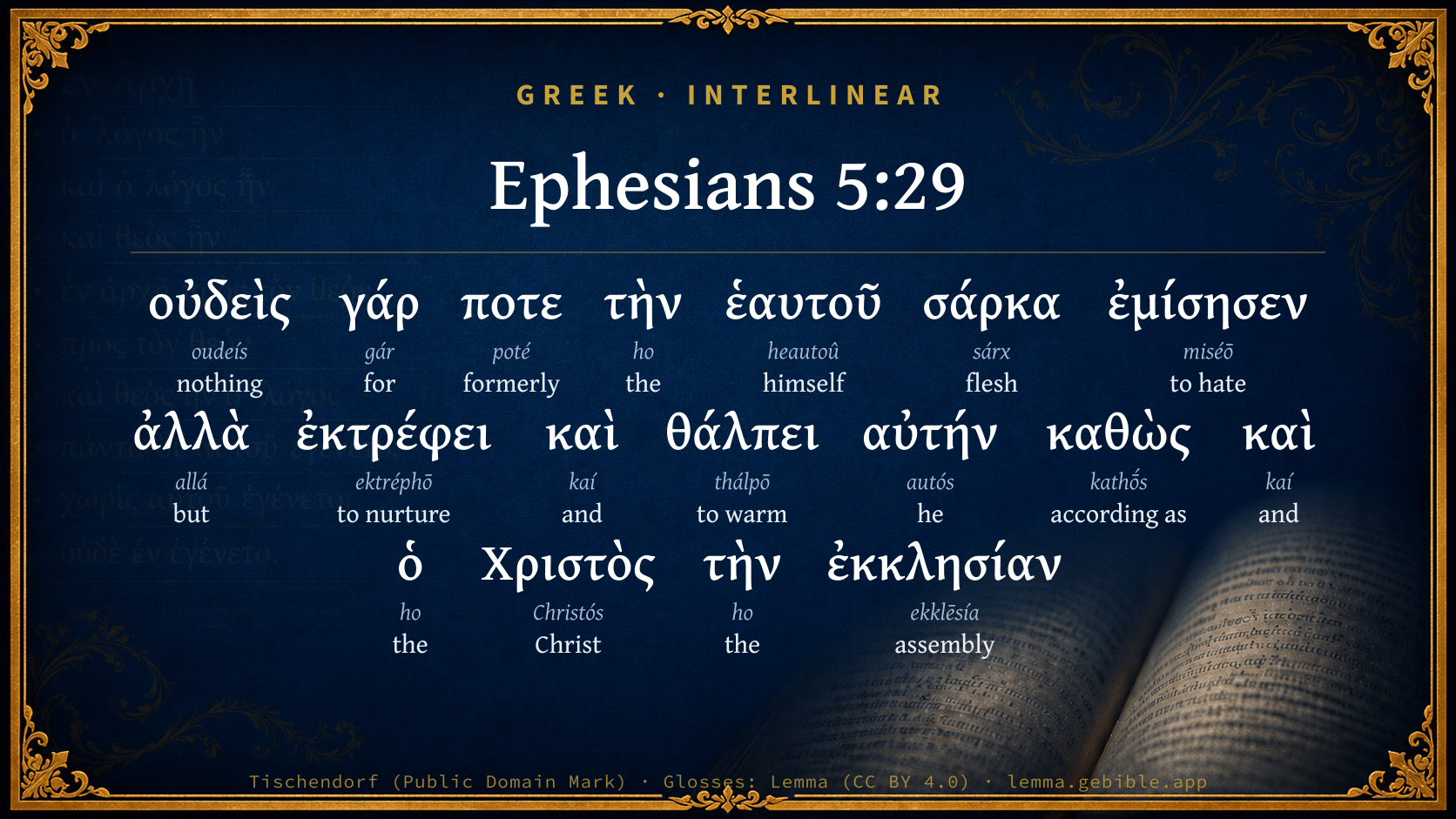
Greek (Tischendorf 8th ed.) Ephesians 5:29 appears in the Greek New Testament. The text above is from the Tischendorf 8th edition. Each word links to its Strong’s number and a concise gloss. Click any word for its full Thayer’s Greek Lexicon entry.
Download image
Cite this verse

Ephesians 5:29 (World English Bible). Public Domain. Lemma interlinear Bible study tool, https://lemma.gebible.app/v/ephesians/5/29.

Show BibTeX & RIS
BibTeX
RIS
English Translation
For no man ever hated his own flesh; but nourishes and cherishes it, even as the Lord also does the assembly;
World English Bible · Public Domain
Highlights
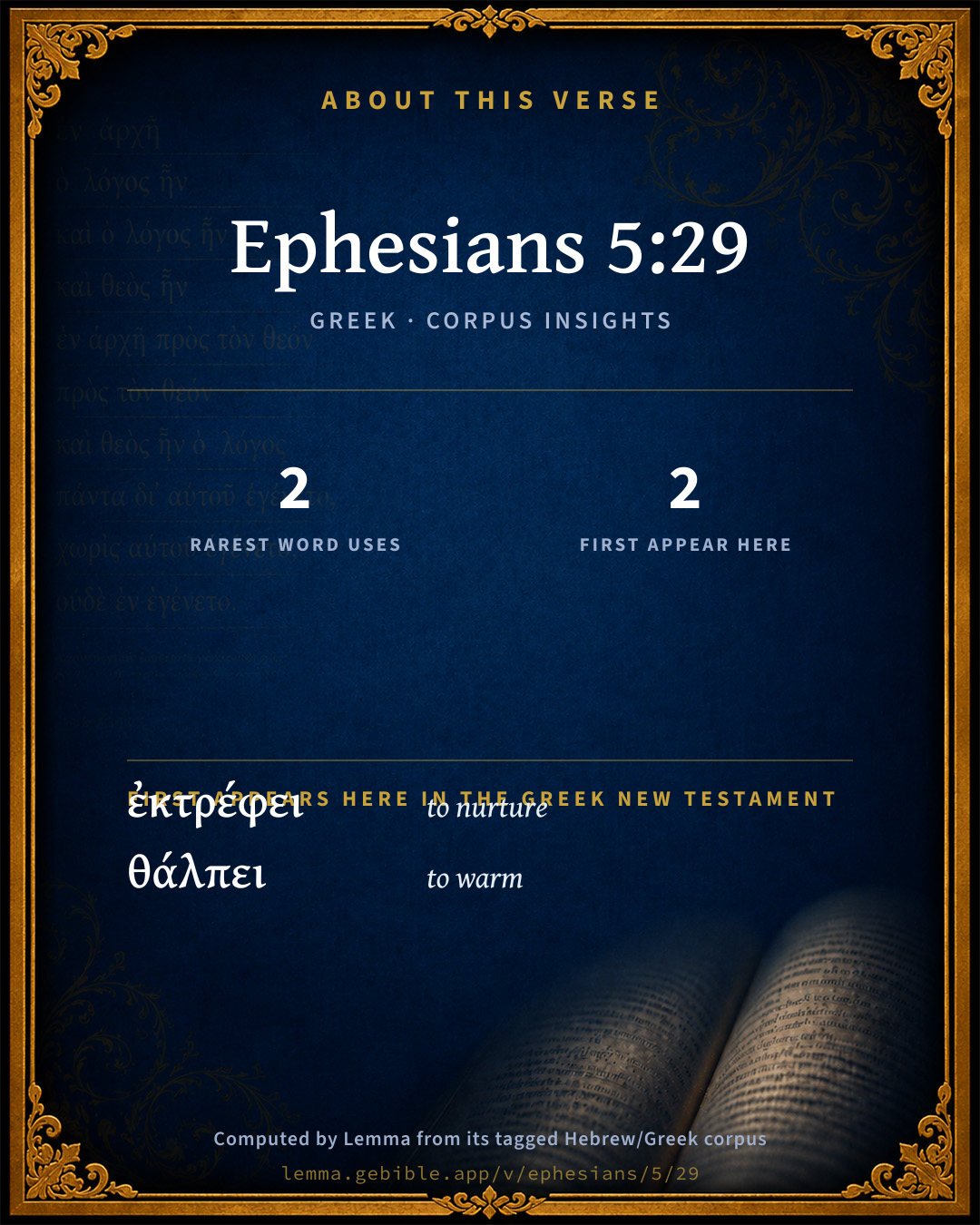
  • 2 first appearances in the Greek New Testament
Full analysis ↓
Download a study sheet

One document with this verse’s original text, its word-by-word gloss line, the meaning frame, cross-references with their text, attributed commentary, and full source and license credits — printable, and it pastes into notes with its structure intact.

This verse Autodidact and up

Study sheet (.html) Plain text (.txt)

A passage Seminary Student

Up to 50 verses in one chapter. A passage sheet keeps up to 6 commentary sources and 12 cross-references per verse, in the order this page ranks them, and says so on the sheet whenever that leaves anything out. Ask for a single verse and you get the Autodidact verse sheet above.

Everything on this page stays free to read, with no account — the sheet is a download of what is already on screen, not access to it.

Want to remove ads? Support Godless Engineer
Compare translations 3

The same verse in 3 English versions, stacked beneath the original-language interlinear above. Click any original word for its lexicon entry.

Each is an independent rendering of the whole verse — the interlinear is not word-aligned to these translations.

Highlighted words mark where these versions differ — a whole-verse word diff, not a word-by-word alignment.

  • World English Bible Public Domain
    For no man ever hated his own flesh; but nourishes and cherishes it, even as the Lord also does the assembly;
  • King James Version Public Domain
    For no man ever yet hated his own flesh; but nourisheth and cherisheth it, even as the Lord the church:
  • unfoldingWord Literal Text CC BY-SA 4.0
    For no one ever hated his own body, but he nourishes and treats it with care, just as Christ also the church,

unfoldingWord Literal Text — © unfoldingWord, licensed CC BY-SA 4.0. Word-aligned USFM3 via Door43 (git.door43.org/unfoldingWord/en_ult).

Versions to compare (up to 4)

3 of 4 selected

Show all 19 translations

Every available English version of this verse, each an independent rendering of the whole verse.

  • World English Bible Public Domain
    For no man ever hated his own flesh; but nourishes and cherishes it, even as the Lord also does the assembly;
  • Berean Standard Bible Public Domain
    Indeed, no one ever hated his own body, but he nourishes and cherishes it, just as Christ does the church.
  • Majority Standard Bible Public Domain
    Indeed, no one ever hated his own body, but he nourishes and cherishes it, just as the Lord does the church.
  • King James Version Public Domain
    For no man ever yet hated his own flesh; but nourisheth and cherisheth it, even as the Lord the church:
  • American Standard Version (1901) Public Domain
    for no man ever hated his own flesh; but nourisheth and cherisheth it, even as Christ also the church;
  • Revised Version (1885) Public Domain
    for no man ever hated his own flesh; but nourisheth and cherisheth it, even as Christ also the church;
  • Geneva Bible (1599) Public Domain
    For no man euer yet hated his owne flesh, but nourisheth and cherisheth it, euen as the Lord doeth the Church.
  • Douay-Rheims (1899) Public Domain
    For no man ever hated his own flesh; but nourisheth and cherisheth it, as also Christ doth the church:
  • Young's Literal Translation Public Domain
    for no one ever his own flesh did hate, but doth nourish and cherish it, as also the Lord -- the assembly,
  • Literal Standard Version CC BY-SA 4.0
    for no one ever hated his own flesh, but nourishes and nurtures it, as also the LORD—the Assembly,
  • Unlocked Literal Bible CC BY-SA 4.0
    For no one ever hated his own body, but nourishes and treats it with care, just as Christ nourishes and treats the church with care,
  • unfoldingWord Literal Text CC BY-SA 4.0
    For no one ever hated his own body, but he nourishes and treats it with care, just as Christ also the church,
  • Darby Bible Public Domain
    For no one has ever hated his own flesh, but nourishes and cherishes it, even as also the Christ the assembly:
  • World Messianic Bible Public Domain
    For no man ever hated his own flesh, but nourishes and cherishes it, even as the Lord also does the assembly,
  • Webster's Bible Public Domain
    For no man ever yet hated his own flesh; but nourisheth and cherisheth it, even as the Lord the church:
  • Free Bible Version CC BY-SA 4.0
    for no one ever hated his own body, but feeds it and looks after it, just as Christ does for the church,
  • Bible in Basic English Public Domain
    For no man ever had hate for his flesh; but he gives it food and takes care of it, even as Christ does for the church;
  • Text-Critical English NT CC BY 4.0
    For no one has ever hated his own flesh, but he nourishes and cares for it, just as the Lord does for the church,
  • Tyndale New Testament (1534) Public Domain
    For no man ever yet hated his awne flesshe: but norissheth and cherisseth it even as the lorde doth the congregacion.

Literal Standard Version (2020), Covenant Press — licensed CC BY-SA 4.0. Text via the HelloAO Bible API (eBible.org). Unlocked Literal Bible (unfoldingWord) — licensed CC BY-SA 4.0. Text via the HelloAO Bible API (eBible.org). unfoldingWord Literal Text — © unfoldingWord, licensed CC BY-SA 4.0. Word-aligned USFM3 via Door43 (git.door43.org/unfoldingWord/en_ult). Free Bible Version, Dr. Jonathan Gallagher — licensed CC BY-SA 4.0. Text via the HelloAO Bible API (eBible.org).

Word by word

More ways to search: Search by grammar → Find every occurrence → Compare this word →

Practice this passage: Drill this verse → Learn its vocabulary →

ἐκτρέφει
ektréphō
G1625
“to nurture”
Verb, Present, Active, Indicative, 3rd person, Singular
Part of Speech
Verb
Tense
Present
Voice
Active
Mood
Indicative
Person
3rd person
Number
Singular
Full Thayer's Definition

Origin: from G1537 and G5142

TDNT: None

1. to nourish up to maturity, to nourish 2. to nurture, bring up
  1. οὐδεὶς oudeís G3762 “nothing” Adjective, Nominative, Singular, Masculine, Negative
  2. γάρ gár G1063 “for” Conjunction
  3. ποτε poté G4218 “formerly” Particle
  4. τὴν ho G3588 “the” Article, Accusative, Singular, Feminine
  5. ἑαυτοῦ heautoû G1438 “himself” Reflexive pronoun, 3rd person, Genitive, Singular, Masculine
  6. σάρκα sárx G4561 “flesh” Noun, Accusative, Singular, Feminine
  7. ἐμίσησεν miséō G3404 “to hate” Verb, Aorist, Active, Indicative, 3rd person, Singular
  8. ἀλλὰ allá G235 “but” Conjunction
  9. καὶ kaí G2532 “and” Conjunction
  10. θάλπει thálpō G2282 “to warm” Verb, Present, Active, Indicative, 3rd person, Singular
  11. αὐτήν autós G846 “he” Personal pronoun, Accusative, Singular, Feminine
  12. καθὼς kathṓs G2531 “according as” Adverb
  13. καὶ kaí G2532 “and” Conjunction
  14. ὁ ho G3588 “the” Article, Nominative, Singular, Masculine
  15. Χριστὸς Christós G5547 “Christ” Noun, Nominative, Singular, Masculine
  16. τὴν ho G3588 “the” Article, Accusative, Singular, Feminine
  17. ἐκκλησίαν ekklēsía G1577 “assembly” Noun, Accusative, Singular, Feminine

About this verse

These counts appear in no published source. They are computed here, from the morphology-tagged text and Lemma’s own curated glosses. What Lemma adds →

18
words
15
distinct lemmas
Pauline Epistles
section

Notable vocabulary

The rarest word here is ἐκτρέφει to nurture G1625 — appearing just 2 times in the whole Greek New Testament.

First appearance in Scripture

These words make their first canonical appearance in the Greek New Testament here:

  • ἐκτρέφει to nurture G1625
  • θάλπει to warm G2282

Shared distinctive vocabulary

ἐκτρέφει to nurture G1625 occurs in 2 verses of the Greek New Testament. Also found in:
Repetition

Words recur within this verse:

Cross-references

9

Topical passages linked to Ephesians 5:29 in the Treasury of Scripture Knowledge — connected by theme and wording, ordered by reader-vote popularity; previews shown in the World English Bible.

  • Ezekiel 34:14–15 I will feed them with good pasture; and on the mountains of the height of Israel shall their fold be: there shall they lie down in a good fold; and on fat pasture shall they feed on the mountains of Israel.
  • Ephesians 5:31 "For this cause a man will leave his father and mother, and will be joined to his wife. The two will become one flesh."
  • Proverbs 11:17 The merciful man does good to his own soul, But he who is cruel troubles his own flesh.
  • Ecclesiastes 4:5 The fool folds his hands together and ruins himself.
  • John 6:50–58 This is the bread which comes down out of heaven, that anyone may eat of it and not die.
  • Isaiah 40:11 He will feed his flock like a shepherd, he will gather the lambs in his arm, and carry them in his bosom, [and] will gently lead those who have their young.
  • Matthew 23:37 "Jerusalem, Jerusalem, who kills the prophets, and stones those who are sent to her! How often would I have gathered your children together, even as a hen gathers her chickens under her wings, and you would not!
  • Ezekiel 34:27 The tree of the field shall yield its fruit, and the earth shall yield its increase, and they shall be secure in their land; and they shall know that I am Yahweh, when I have broken the bars of their yoke, and have delivered them out of the hand of those who made slaves of them.
  • Romans 1:31 without understanding, covenant-breakers, without natural affection, unforgiving, unmerciful;

Cross-references courtesy of OpenBible.info (CC BY 4.0).

Where the printed editions differ

1 variant

Places in this verse where the major printed Greek editions disagree on the wording in a way that affects the translation — a comparison of editions, not a manuscript-by-manuscript collation. The editions are the modern critical texts (Nestlé-Aland 28/27, SBL, Westcott-Hort, Tregelles, Tyndale House) and the traditional texts behind the KJV (the Textus Receptus and the Byzantine/Majority text). It is not a claim about which reading is original.

  1. Different wording
    Χριστὸς

    “Christ”

    In NA28NA27TynSBLWHTreg Not in TRByz

    κύριος (kurios) 'Lord' occurs in traditional manuscripts (TR+Byz) instead of Χριστὸς (Christos) 'Christ' in older manuscripts (NA28+NA27+Tyn+SBL+WH+Treg)

Textual data: Translators Amalgamated Greek New Testament (STEPBible TAGNT) · CC BY 4.0.

Commentary

Notes on Ephesians 5:29 from classic Christian and Jewish commentators (each source and its license shown beneath its notes). The classic Christian expositions comment on the surrounding passage and are grouped to its opening verse, so a note may address several verses; the Jewish commentaries on the Tanakh (Rashi and others) are per-verse, so they appear only where the commentator wrote on this verse.

Lemma curates 59 commentaries, every one of them public domain or Creative Commons licensed, each selected and text-cleaned for this edition rather than reprinted as found. About our sources →

Bengel's Gnomon

Johann Albrecht Bengel

Eph 5:29. Οὐδεὶς) no man, unless indeed he revolts from nature and from himself.—τὴν ἑαυτοῦ σάρκα, his own flesh) Eph 5:31, at the end.—ἐκτρέφει) very much nourishes it, within.—θάλπει) cherishes it, without. The same word occurs in Deu 22:6; Job 39:14; 1Ki 1:2; 1Ki 1:4. This has respect to clothing, as nourishes has to food.—τὴν ἐκκλησίαν, the Church) Nourishes and cherishes to be supplied.

Bengel's Gnomon of the New Testament — English translation (T&T Clark, Edinburgh, 1860) — public domain. Text from a community e-Sword module.

Meyer's Critical & Exegetical Commentary

Heinrich August Wilhelm Meyer

Eph_5:29. Γάρ] assigns the reason of what immediately precedes, and that so, that this statement of the reason is intended to impel to the exercise of the self-love involved in the love to the wife. The connection of the thoughts, namely, is this: He who loves his own wife, loves himself; for, if he did not love her, he would hate his own flesh, which is so repugnant to nature that no one has ever yet done it, but rather every one does the opposite, as also Christand that gives to this natural relation the highest consecrationacts with regard to the church, because this constitutes the members of His body.

ποτέ] ever, not, as Mayerhoff would take it (Koloss. p. 144): formerly, in the heathen state, the contrast to which is supposed to be: but possibly now, under the influence of an asceticism directed against marriagea view, which the present tenses that follow ought to have precluded.

τὴν ἑαυτοῦ σάρκα] σάρξ is here indifferent (comp. Hahn, Theol. d. N.T. I. p. 425) without the conception of what is sinful.[282] Paul might have written σῶμα instead (Curtius, vii. Ephesians 1 : corporibus nostris, quae utique non odimus; Seneca, Ep. 14: fateor insitam nobis esse corporis nostri caritatem), but chose σάρκα, because the idea of the μία σάρξ, which is realized in the married state, is already (see Eph_5:21) present to his mind.

ἀλλʼ] sc. ἕκαστος. See Stallbaum, ad Plat. Rep. p. 366 D; ad Symp. p. 192 E.

ἐκτρέφει] enutrit. The compound form denotes the development that is brought about by the nourishing; comp. Eph_6:4. See the passages in Wetstein.

θάλπει] makes it warm, fovet (Vulgate); Goth: varmeith. It is thus to be taken in its proper signification. Hom. Odyss. xxi. 179, 184, 246; Xen. Cyr. v. 1. 11; Soph. Phil. 38; also Theocr. xiv. 38; Deu_22:6; Job_39:14; 1Th_2:8. Bengel aptly says: id spectat amictum. The usual interpretation is: he fosters it, Luther. Without support from linguistic usage.

It is, we may add, self-evident that οὐδεὶς … αὐτήν expresses a proposition of experience, the correctness of which holds as a general rule, and is not set aside by exceptional cases. The crucifying of the flesh, however, in Gal_5:24, has regard to the sinful σάρξ.

καθὼς καὶ ὁ Χρ. τὴν ἐκκλησ.] sc. ἐκτρέφει καὶ θάλπει, which is here, of course, to be interpreted metaphorically of the loving operation of Christ for the salvation of His church, whose collective prosperity He carefully promotes. To bring out by interpretation specially two elements (Grotius: nutrit eam verbo et Spiritu, vestit virtutibus) is arbitrary. According to Kahnis (Abendm. p. 143 f.), Christ nourishes the church as His body by the communication of His body in the Supper. But apart from the fact that θάλπει does not suit this, there is no mention at all of the Lords Supper in the whole connection. Comp. on παραστ., Eph_5:27, and see on Eph_5:30 ff. The καθὼς καὶ ὁ Χρ. τὴν ἐκκλ. is the sacred refrain of the whole Christian ethics of marriage; comp. Eph_5:23; Eph_5:25.

[282] See also Ernesti, Urspr. d. Sünde, I. p. 54.

Meyer — Critical and Exegetical Commentary on the New Testament — English translation by Peter Christie, edited by Frederick Crombie (T&T Clark, 1880) — public domain. Text from a community e-Sword module.

Expositor's Greek Testament

ed. W. Robertson Nicoll

Eph 5:29 . οὐδεὶς γάρ ποτε τὴν ἑαυτοῦ σάρκα ἐμίσησεν : for no one ever hated his own flesh . The γάρ gives a reason for the preceding statement, looking to the thought , however, rather than to the form of the statement. The thought is the oneness of husband and wife, the position of the wife as part of the husband’s self; and the connection is this “he should love her even as Christ loved the Church, for the wife, I say, is as the body in that natural relationship in which the husband is the head, so that in loving her he loves himself ; and this is the reason in nature why he should love her, for according to this to hate his wife is to hate his own flesh, which is contrary to nature and a thing never seen”. σάρξ has here its non-ethical sense, practically = σῶμα (as in Mat 19:5 ; Mar 10:8 ; 1Co 6:16 , etc.). ἀλλʼ ἐκτρέφει καὶ θάλπει αὐτήν : but nourisheth and cherisheth it . The form ἀλλά is preferred again by LTTr WRV. The ἐκ - in the comp. ἐκτρέφει may point to the careful, continued nourishing from one stage to another, nourishing up to maturity . Ell. takes it to express “the evolution and development produced by the τρέφειν ” (so, too, Mey., etc.). As θάλπειν means primarily to warm , some give it the literal sense here, supposing it to look to the covering and protection of the body as ἐκτρέφει looks to its nourishment “fovet” spectat amictum , says Bengel, ut “nutrit” victum; and so Mey. But the secondary sense seems more appropriate here, especially in view of the following affirmation regarding Christ, and as it is in 1Th 2:7 . καθὼς καὶ ὁ Κύριος [ Χριστὸς ] τὴν ἐκκλησίαν : even as the Lord [ Christ ] also the Church . For the Κύριος of the TR (with [671] 3 [672] [673] , etc.) read with the best critics Χριστός , which is given in [674] [675] [676] [677] 1 [678] , 17, and most Versions and Fathers. That is, “even as Christ also nourisheth and cherisheth the Church” a broad statement of Christ’s loving care for His Church, into which no reference to the Lord’s Supper (which is nowhere in view here) as the means by which the nourishing is effected can be dragged (as, e.g. , by Kahnis, etc.).

[671] Codex Claromontanus (sæc. vi.), a Græco-Latin MS. at Paris, edited by Tischendorf in 1852.

[672] Codex Mosquensis (sæc. ix.), edited by Matthæi in 1782.

[673] Codex Angelicus (sæc. ix.), at Rome, collated by Tischendorf and others.

[674] Codex Vaticanus (sæc. iv.), published in photographic facsimile in 1889 under the care of the Abbate Cozza-Luzi.

[675] Codex Sinaiticus (sæc. iv.), now at St. Petersburg, published in facsimile type by its discoverer, Tischendorf, in 1862.

[676] Codex Alexandrinus (sæc. v.), at the British Museum, published in photographic facsimile by Sir E. M. Thompson (1879).

[677] Codex Claromontanus (sæc. vi.), a Græco-Latin MS. at Paris, edited by Tischendorf in 1852.

[678] Codex Augiensis (sæc. ix.), a Græco-Latin MS., at Trinity College, Cambridge, edited by Scrivener in 1859. Its Greek text is almost identical with that of G, and it is therefore not cited save where it differs from that MS. Its Latin version, f, presents the Vulgate text with some modifications.

The Expositor's Greek Testament, edited by W. Robertson Nicoll (1897–1910) — public domain. Text from a community e-Sword module.

Hodge's Commentary on Romans, Ephesians & First Corinthians

Charles Hodge

Eph_5:29

Conjugal love, therefore, is as much a dictate of nature as self love; and it is just as unnatural for a man to hate his wife, as it would be for him to hate himself, or his own body. A man may have a body which does not altogether suit him. He may wish it were handsomer, healthier, stronger, or more active. Still it is his body, it is himself; and he nourisheth it and cherishes it as tenderly as though it were the best and loveliest man ever had. So a man may have a wife whom he could wish to be better, or more beautiful, or more agreeable; still she is his wife, and by the constitution of nature and ordinance of God, a part of himself. In neglecting or ill-using her he violates the laws of nature as well as the law of God. It is thus Paul presents the matter. If the husband and wife are one flesh, the husband must love his wife, for no man ever yet hated his own flesh, but nourisheth and cherisheth it. Ἐκτρέφειν properly to nourish up, to train up by nurture, as a parent a child; Compare Eph_6:4. Θάλπειν, to warm, to cherish as a mother does an infant in her bosom. Both terms express tenderness and solicitude, and therefore both are suited to express the care with which every man provides for the wants and comfort of his own body.

Καθὼς καὶ, even as also, Χριστὸς τὴν ἐκκλησίαν, Christ the church, i.e. Christ also nourishes and cherishes the church as a man does his own body. The relation between a man and his wife is analogous to that between a man and his own body. And the relation between Christ and his church is analogous to that between a husband and a his wife; therefore Christ nourishes and cherishes the church as man does his own body.

Charles Hodge — Commentary on Romans (1835), First Corinthians (1857), and Ephesians (1856) — public domain. Text from a community e-Sword module.

Geneva Bible (1599)

Geneva Bible translators

His own body.

Geneva Bible (1599) marginal notes — public domain. Text via Bolls.life.

Jamieson, Fausset & Brown

Robert Jamieson, A. R. Fausset & David Brown

For--Supply, and we all love ourselves: "For no man," &c.

his own flesh-- (Eph 5:31, end).

nourisheth--Greek, "nourisheth it up," namely, to maturity. "Nourisheth," refers to food and internal sustenance; "cherisheth," to clothing and external fostering.

even as--Translate, "even as also."

the Lord--The oldest manuscripts read, "Christ." Exo 21:10 prescribes three duties to the husband. The two former (food and raiment) are here alluded to in a spiritual sense, by "nourisheth and cherisheth"; the third "duty of marriage" is not added in consonance with the holy propriety of Scripture language: its antitype is, "know the Lord" (Hos 2:19-20) [BENGEL].

Jamieson, Fausset & Brown — Commentary Critical and Explanatory on the Whole Bible (1871) — public domain (CC PDM 1.0). Text via the HelloAO Bible API.

Adam Clarke's Commentary

Verse 29. No man ever yet hated his own flesh] And this is a natural reason why he should love his wife, and nourish and cherish her.

Adam Clarke's Commentary on the Bible (1810–1826) — public domain. Text from a community e-Sword/MySword module.

John Calvin's Commentaries

29. Even as Christ the church. He proceeds to enforce the obligations of marriage by representing to us Christ and his Church; for a more powerful example could not have been adduced. The strong affection which a husband ought to cherish towards his wife is exemplified by Christ, and an instance of that unity which belongs to marriage is declared to exist between himself and the Church. This is a remarkable passage on the mysterious intercourse which we have with Christ.

John Calvin's Commentaries (1540-1563) — public domain. Text from the Calvin Translation Society English edition (1840s-50s) via the Christian Classics Ethereal Library (ccel.org). Calvin's coverage is partial (roughly two-thirds of the Bible); uncommented books and verses are honest gaps, never fabricated. The 19th-century editor's footnotes and remarks are omitted so the notes are faithfully Calvin's own voice.

Ellicott's Commentary for English Readers

(29) His own flesh—i.e., as above (Eph_5:28), his own body. There are two parts of the natural care for our own bodies; first, “to nourish” (properly, to rear them up from childhood, as in Eph_6:4), and then “to cherish” (literally, to keep them warm), to provide all they need for health, and comfort, and life. In all that corresponds to both, the husband is to show love to the wife, not only as a self, but as a weaker self, for whom he is bound to think and to act. It may be noted in passing that the very comparison accords with the Christian idea of the body as a part of the true self, redeemed to be a temple of God; and is utterly incongruous with the Gnostic conceptions (already beginning at Colossæ, probably not unknown in other Asiatic churches) of all matter as the source of evil, and of the body as that for which the spirit should not deign to care.

(29, 30) Even as the Lord the church: for we . . .—Again St. Paul escapes from the type to rest on the Antitype (see Eph_5:32). The idea of the natural rearing and cherishing the body suggests the thought of the tender care of Christ, in which He “rears up” His Church from weak infancy to full maturity in heaven, and all the while “cherishes it (comp. 1Th_2:7, spoken of His servants) as a nurse cherisheth her children,” “carrying it in His bosom” (Isa_40:11), comforting and cheering its childlike weakness. Hence he goes back again to speak with great and special emphasis of our unity with Him.

Of his flesh, and of his bones.—Literally, made out of His flesh and bones—parts, that is, of His glorified body, having “flesh and bones” (Luk_24:39). The expression is unique, suggested, of course, by Gen_2:23, “This is now bone of my bone, and flesh of my flesh,” but designed to bring out in a startling emphasis the true meaning of the familiar phrase, “the members of His body.” We are grafted into Him. What we grow to be is, so to speak, the product of His divine substance, proceeding from the indwelling life which gradually forms the organised limbs.

A Bible Commentary for English Readers, edited by Charles John Ellicott (1878–1897) — public domain. Text from a community e-Sword module.

The Cambridge Bible for Schools and Colleges

gen. ed. J. J. S. Perowne

29. no man ever] under normal conditions. True, in a distorted mental state a man may “hate his own flesh.” And in obedience to the will of God a man may so act as to be said to hate it; to choose that it should suffer rather than that God’s will should not be done (see, for such a use of “hate”, Luk_14:26). But under normal conditions it is not only man’s instinct but his duty to protect and nourish that mysterious work of God, his body, connected by God’s will in a thousand ways with the action of his spirit. “Self-love,” whether in the direction of flesh or of spirit, acts sinfully only when it acts outside God as the supreme and all-embracing Reason and Good.

the Lord] Read, with full documentary evidence, Christ.

The Cambridge Bible for Schools and Colleges (gen. ed. J. J. S. Perowne; Cambridge University Press, 1878–1918) — public domain. Text from a community e-Sword module.

John Gill's Exposition

For this cause shall a man leave his father and mother,.... These words contain the law of marriage, and are cited from Gen 2:24; and declare what ought to be, and are a prophecy of what should be; and are observed against polygamy, and to stir up mutual affection; See Gill on Mat 19:5.

.

Ephesians 5:32

eph 5:32

eph 5:32

eph 5:32This is a great mystery,.... It has something mysterious in it; it is a figure and emblem of the mysterious union between Christ and his people: for so it follows,

but I speak concerning Christ and the church; or mention this law and institution of marriage, with respect to them; for the leaving of father and mother prefigured Christ's coming forth from the Father, and coming into this world in human nature, and his disregard to his earthly parents, in comparison with his people, and his service for them; the man cleaving to the wife very aptly expresses the strong affection of Christ to his church, and the near communion there is between them; and their being one flesh denotes the union of them; and indeed, the marriage of Adam and Eve was a type of Christ and his church; for in this the first Adam was a figure of him that was to come, as well as in being a federal head to his posterity: Adam was before Eve, so Christ was before his church; God thought it not proper that man should be alone, so neither Christ, but that he should have some fellows and companions with him: the formation of Eve from Adam was typical of the church's production from Christ; she was made of him while he was asleep, which sleep was from the Lord, and it was not an ordinary one; which may resemble the sufferings and death of Christ, which were from the Lord, and were not common; and which are the redemption of his church and people; and which secure their comfort and happiness, and wellbeing: she was taken out of his side, and built up a woman of one of his ribs; both the justification and sanctification of the church are from Christ, from the water and the blood which issued out of his side, when on the cross: the bringing and presentation of Eve to Adam has its mystery; it was God that brought her to him; and she was the same that was made out of him; and to the same Adam was she brought of whose rib she was made, and that not against her will: so it is God that draws souls to Christ, and espouses them to him, even the same that he has chosen in him, and Christ has redeemed by his blood; and to the same are they brought, who was wounded for their transgressions, and bruised for their sins; and they are made willing in the day of his power upon them, to come and give themselves to him. Adam's consent and acknowledgment of Eve to be his wife, shadow forth Christ's hearty reception and acknowledgment of the saints, as being of him, and his, when they are brought unto him under the influences of his grace and Spirit.

John Gill's Exposition of the Whole Bible (1746–1763) — public domain (CC PDM 1.0). Text via the HelloAO Bible API.

Trapp's Complete Commentary

John Trapp

29 For no man ever yet hated his own flesh; but nourisheth and cherisheth it, even as the Lord the church:

Ver. 29. For no man ever hated] No man but a monk, who whips himself, or a mad man, Mar 5:5, who cuts himself. It was the saying of the Emperor Aurelius, a wife is to be often admonished, sometimes reproved, but never beaten. And yet of the Russian women it is reported, that they love that husband best that beats them most, and that they think themselves else not regarded, unless two or three times a day well favouredly swadled. Chrysostom saith, It is the greatest reproach in the world for a man to beat his wife.

But nourisheth it, and cherisheth it] Θαλπει. As the hen doth her chickens, or as the cock pigeon doth the eggs. {a} Contrariwise the magpie hunts away from his mate about autumn, lest he should be forced to keep her all the winter; and so becometh the hieroglyphic of an unkind husband.

Even as the Lord, the Church] Lo, this is the pattern of all true love, whether to ourselves or others.

{a} Columbarum masculus ipse ovis incubat.

John Trapp, A Commentary or Exposition upon All the Books of the Old and New Testament (1647–1656) — public domain. Text from a community e-Sword module.

Albert Barnes' Notes on the Bible

For no man ever yet hated his own flesh - This is urged as an argument why a man should love his wife and show kindness to her. As no man disregards the happiness of his own body, or himself, so he should show equal care to promote the happiness of his wife. A sentiment similar to this is found in the classic writers. Thus, Curtius (lib. vii.) says, “Corporibus nostris quoe utique non odimus” - “We do not hate those things that pertain to our own bodies.” So Seneca (Epis. 14), “Fateor insitam nobis esse corporis nostri charitatem” - “I confess that there is implanted in us the love of our own body.” The word nourisheth here means properly to bring up, as e. g., children. The sense here is, that he provides for it, and guards it from exposure and want. The word “cherisheth” - θάλπει thalpei - means properly to “warm;” and may mean here that he defends it from cold by clothing - and the two expressions denote that he provides food and raiment for the body. So he is to do for his wife; and in like manner the Lord Jesus regards the church, and ministers to its spiritual necessities. But this should not be spiritualized too far. The “general” idea is all that we want - that Christ has a tender concern for the needs of the church, as a man has for his own body, and that the husband should show a similar regard for his wife.

Albert Barnes' Notes on the Bible (1834–1885) — public domain. Text from a community e-Sword/MySword module.

Matthew Poole's English Annotations

No man; none in his right senses; or no man hates his flesh absolutely, but the diseases or miseries of it.

His own flesh; his body.

Nourisheth and cherisheth it; feeds and clothes it, and supplies it with things necessary for it.

Even as the Lord the church, which he furnisheth with all things needful to salvation.

Matthew Poole's English Annotations on the Holy Bible (1683–1685) — public domain. Text from a community e-Sword/MySword module.

Whedon's Commentary on the Bible

Daniel D. Whedon

29. No man—It is hardly necessary to except madmen, who do harm their own bodies, for such act from no normal motive. Nourisheth with aliment, and cherisheth with warmth and clothing.

Daniel D. Whedon (gen. ed.), Commentary on the Old and New Testaments (1874–1909) — public domain. Text from a community e-Sword module.

The Pulpit Commentary

For no man ever hated his own flesh; but nourisheth and cherisheth it, even as Christ also the Church. To hate one"s wife is as irrational as to hate one"s own flesh, and as, on the other hand, men constantly nourish and cherish their flesh, protecting it from hurt, seeking to heal it when hurt, and generally to promote its welfare and comfort, so ought husbands to act towards their wives. In this aspect of the case, too, the sharp eye of the apostle finds an analogy between the relation of the wife to the husband and that of the Church to Christ, expanded in the next verso.

The Pulpit Commentary (1880–1919), ed. H.D.M. Spence-Jones & Joseph S. Exell — public domain. Text from a community e-Sword module.

John Wesley's Explanatory Notes

His own flesh - That is, himself. Nourisheth and cherisheth - That is, feeds and clothes it.

John Wesley, Explanatory Notes Upon the Whole Bible (1754–1765) — public domain. Text via the GEBible commentary corpus.

Godbey's Commentary on the New Testament

William B. Godbey

29. This verse not only recognizes the mysterious problem of conjugal unity; but either is to esteem the other the better half, confirming their mutual fidelity by martyrdom, if necessary.

William B. Godbey, Commentary on the New Testament (1896–1900) — public domain. Text from a community e-Sword module.

The People's New Testament

B. W. Johnson

29. No man ever yet hated his own flesh. Or his own body. Yet, wife and husband are “one flesh” (verse 31).

B. W. Johnson's The People's New Testament with Notes (1889–1891) — public domain. Electronic text from the Christian Classics Ethereal Library (CCEL) ThML edition.

Cambridge Greek Testament for Schools and Colleges

29. τὴν ἑαυτοῦ σάρκα. The change from σῶμα marks the transition to the new aspect of the thought. Husband and wife, though not ‘one body’ as Christ and the Church, are as Genesis 2 witnesses ‘one flesh.’

ἀλλὰ ἐκτρέφει καὶ θάλπει αὐτήν. Both words are used in O.T. esp. of a mother’s care of her children. The love of Christ is generally (e.g. Eph 2:4, Eph 5:2; Eph 5:25; Gal 2:20; Rom 8:37; cf. 1Jn 4:10) expressed by an aorist with reference to its supreme manifestation on the Cross. The use of the present is rare (Rev 1:5; Rev 3:19; cf. Heb 12:6 only). The continued outflowing of the love in all its tender thoughtfulness is implied however in passages like 2Co 1:5; Php 1:8.

Cambridge Greek Testament for Schools and Colleges (Cambridge University Press, 1896; 21 vols, various authors incl. Carr, Maclear, Plummer, Farrar, Lumby, Moule, M. R. James, Simcox) — public domain. Text from a community e-Sword module.

International Critical Commentary

29. τὴν ἑαυτοῦ σάρκα. The word is, no doubt, chosen with reference to the σὰρξ μία, quoted ver. 31. It is not perhaps correct, however, to say that it is so chosen instead of σῶμα, for it is hardly probable that the apostle would have used σῶμα in this connexion in any case. Rather, the whole sentence is suggested by the thought of σὰρξ μία.

International Critical Commentary — older volumes (1896–1929), various authors — public domain. Text from a community e-Sword module.

Vincent's Word Studies in the New Testament

Marvin R. Vincent

Flesh. Instead of body, with reference to Gen 2:23.

Cherisheth [θαλπει] . Only here and 1Th 2:7. Originally, to warm.

Marvin R. Vincent, Word Studies in the New Testament (1887–1900) — public domain. Text from a community e-Sword/MySword module.

Lesson kit

Teaching starters — assembled from the data on this page, not authored interpretation. Every prompt links to the verse data it draws on. Edit before teaching.

Ephesians, in the Pauline Epistles, opens this verse with 18 words (15 distinct Greek lemmas). Its most distinctive word is ektréphō (“to nurture”). A historical commentator’s framing appears above. Read the whole chapter for the surrounding context.

Discussion questions

  1. What does “to nurture” (ektréphō) contribute to the verse as a whole?
  2. 2 words here appear for the first time in Scripture. What is being introduced at this debut?
  3. Ephesians 6:4 shares the word «to nurture» with this verse. How do the two illuminate each other?
  4. “the” occurs 3× in this one verse. What is the effect of the repetition?
  5. These translations render this verse differently; the difference is in the English rendering, not the original. What questions does that raise?
  6. Reading how Bengel's Gnomon and Meyer's Critical & Exegetical Commentary read this verse, where do the two commentators agree and where do they part?

Things to notice

  • 2 words make their first canonical appearance in Scripture here.
  • These translations choose different wording for 18 words in this verse.
  • “the” occurs 3× in this single verse.
  • 15 distinct Greek lemmas span 18 words in this verse.

Reading settings

Reading text

Shown beneath each verse's original-language words.

Old Testament
Old Testament edition

Read the OT as the Masoretic Hebrew (MT) or the Greek Septuagint (LXX).

English shown for the Greek Septuagint (in the Hebrew ↔ Greek comparison).

Comparing translations? Open the Compare panel on any verse page to stack up to four side by side.