
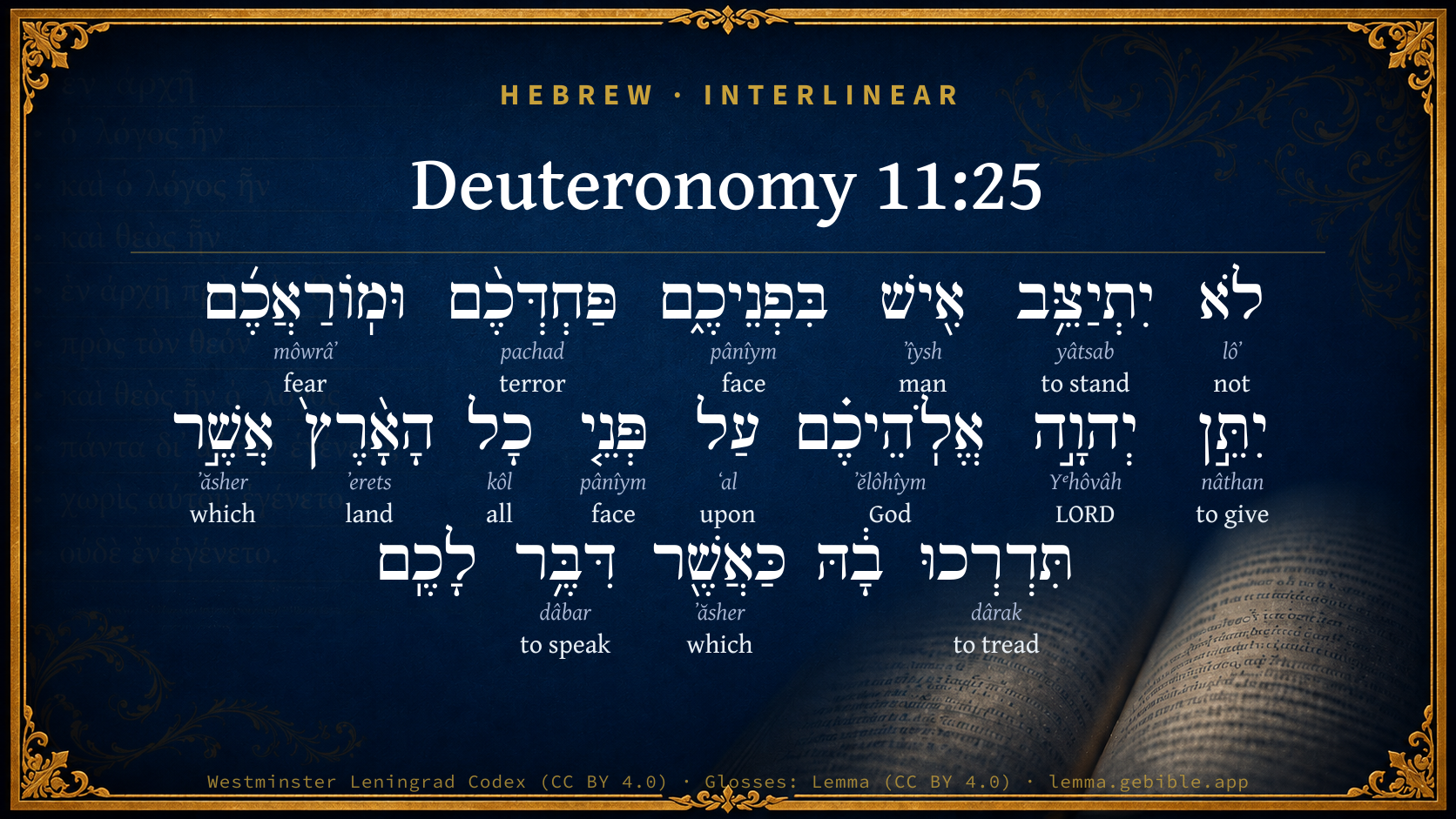
Deuteronomy 11:25

Hebrew (Westminster Leningrad Codex) Deuteronomy 11:25 appears in the Hebrew Old Testament. The text above is from the Westminster Leningrad Codex. Each word links to its Strong’s number, a concise gloss, and parsing drawn from the Open Scriptures Hebrew Bible morphology. Click any word for its full Brown-Driver-Briggs (BDB) entry.
Download image
Cite this verse

Deuteronomy 11:25 (World English Bible). Public Domain. Lemma interlinear Bible study tool, https://lemma.gebible.app/v/deuteronomy/11/25.

Show BibTeX & RIS
BibTeX
RIS
English Translation
There shall no man be able to stand before you: Yahweh your God shall lay the fear of you and the dread of you on all the land that you shall tread on, as he has spoken to you.
World English Bible · Public Domain
Download a study sheet

One document with this verse’s original text, its word-by-word gloss line, the meaning frame, cross-references with their text, attributed commentary, and full source and license credits — printable, and it pastes into notes with its structure intact.

This verse Autodidact and up

Study sheet (.html) Plain text (.txt)

A passage Seminary Student

Up to 50 verses in one chapter. A passage sheet keeps up to 6 commentary sources and 12 cross-references per verse, in the order this page ranks them, and says so on the sheet whenever that leaves anything out. Ask for a single verse and you get the Autodidact verse sheet above.

Everything on this page stays free to read, with no account — the sheet is a download of what is already on screen, not access to it.

Want to remove ads? Support Godless Engineer
Compare translations 3

The same verse in 3 English versions, stacked beneath the original-language interlinear above. Click any original word for its lexicon entry.

Each is an independent rendering of the whole verse — the interlinear is not word-aligned to these translations.

Highlighted words mark where these versions differ — a whole-verse word diff, not a word-by-word alignment.

  • World English Bible Public Domain
    There shall no man be able to stand before you: Yahweh your God shall lay the fear of you and the dread of you on all the land that you shall tread on, as he has spoken to you.
  • King James Version Public Domain
    There shall no man be able to stand before you: for the LORD your God shall lay the fear of you and the dread of you upon all the land that ye shall tread upon, as he hath said unto you.
  • unfoldingWord Literal Text CC BY-SA 4.0
    No man will be able to stand from your faces. Yahweh your God will give the fear of you and the terror of you upon the face of all the land that you tread on, as he has spoken to you.

unfoldingWord Literal Text — © unfoldingWord, licensed CC BY-SA 4.0. Word-aligned USFM3 via Door43 (git.door43.org/unfoldingWord/en_ult).

Versions to compare (up to 4)

3 of 4 selected

Show all 18 translations

Every available English version of this verse, each an independent rendering of the whole verse.

  • World English Bible Public Domain
    There shall no man be able to stand before you: Yahweh your God shall lay the fear of you and the dread of you on all the land that you shall tread on, as he has spoken to you.
  • Berean Standard Bible Public Domain
    No man will be able to stand against you; the LORD your God will put the fear and dread of you upon all the land, wherever you set foot, as He has promised you.
  • Majority Standard Bible Public Domain
    No man will be able to stand against you; the LORD your God will put the fear and dread of you upon all the land, wherever you set foot, as He has promised you.
  • King James Version Public Domain
    There shall no man be able to stand before you: for the LORD your God shall lay the fear of you and the dread of you upon all the land that ye shall tread upon, as he hath said unto you.
  • American Standard Version (1901) Public Domain
    There shall no man be able to stand before you: Jehovah your God shall lay the fear of you and the dread of you upon all the land that ye shall tread upon, as he hath spoken unto you.
  • Revised Version (1885) Public Domain
    There shall no man be able to stand before you: the LORD your God shall lay the fear of you and the dread of you upon all the land that ye shall tread upon, as he hath spoken unto you.
  • Geneva Bible (1599) Public Domain
    No man shall stande against you: for the Lord your God shall cast the feare and dread of you vpon all the land that ye shall treade vpon, as he hath said vnto you.
  • Douay-Rheims (1899) Public Domain
    Every place, that your foot shall tread upon, shall be yours. From the desert, and from Libanus, from the great river Euphrates unto the western sea shall be your borders.
  • Young's Literal Translation Public Domain
    no man doth station himself in your presence; your dread and your fear doth Jehovah your God put on the face of all the land on which ye tread, as He hath spoken to you.
  • Literal Standard Version CC BY-SA 4.0
    No man stations himself in your presence; your God YHWH puts your dread and your fear on the face of all the land on which you tread, as He has spoken to you.
  • Unlocked Literal Bible CC BY-SA 4.0
    No man will be able to stand before you. Yahweh your God will lay the fear of you and the terror of you upon all the land that you tread on, as he has said to you.
  • unfoldingWord Literal Text CC BY-SA 4.0
    No man will be able to stand from your faces. Yahweh your God will give the fear of you and the terror of you upon the face of all the land that you tread on, as he has spoken to you.
  • Darby Bible Public Domain
    No man shall be able to stand before you: the fear of you and the dread of you will Jehovah your God lay upon all the land that ye shall tread upon, as he hath said unto you.
  • World Messianic Bible Public Domain
    No man will be able to stand before you. The LORD your God will lay the fear of you and the dread of you on all the land that you tread on, as he has spoken to you.
  • Webster's Bible Public Domain
    There shall no man be able to stand before you: for the LORD your God shall lay the fear of you, and the dread of you upon all the land that ye shall tread upon, as he hath said to you.
  • Free Bible Version CC BY-SA 4.0
    No one will be able to withstand you; the Lord your God will make everyone living there absolutely terrified of you wherever you go, just as he promised you.
  • Bible in Basic English Public Domain
    All people will give way before you: for the Lord your God will put the fear of you on all the land through which you go, as he has said.
  • JPS Tanakh (1917) Public Domain
    There shall no man be able to stand against you: the LORD your God shall lay the fear of you and the dread of you upon all the land that ye shall tread upon, as He hath spoken unto you.

Literal Standard Version (2020), Covenant Press — licensed CC BY-SA 4.0. Text via the HelloAO Bible API (eBible.org). Unlocked Literal Bible (unfoldingWord) — licensed CC BY-SA 4.0. Text via the HelloAO Bible API (eBible.org). unfoldingWord Literal Text — © unfoldingWord, licensed CC BY-SA 4.0. Word-aligned USFM3 via Door43 (git.door43.org/unfoldingWord/en_ult). Free Bible Version, Dr. Jonathan Gallagher — licensed CC BY-SA 4.0. Text via the HelloAO Bible API (eBible.org).

Word by word

More ways to search: Search by grammar → Find every occurrence → Compare this word →

Practice this passage: Drill this verse → Learn its vocabulary →

וּמֽוֹרַאֲכֶ֜ם
môwrâʼ
H4172
“and · fear · your”
Conjunction + Noun, Common, Masculine, Singular, Construct + Suffix, Personal, 2nd Person, Masculine, Plural
Part of Speech
Conjunction + Noun
Type
Common
Gender
Masculine
Number
Singular
State
Construct
Full BDB Definition

Origin: from H3372

TWOT: 907c , 907d

fear, reverence, terror - fear, terror - reverence - object of reverence - awe-inspiring spectacle or deed
  1. לֹא lôʼ H3808 “not” Particle, Negative
  2. יִתְיַצֵּ֥ב yâtsab H3320 “to stand” Verb, Hithpael, Imperfect, 3rd Person, Masculine, Singular
  3. אִ֖ישׁ ʼîysh H376 “man” Noun, Common, Masculine, Singular, Absolute
  4. בִּפְנֵיכֶ֑ם pânîym H6440 “in/at · face(s) · your” Preposition + Noun, Common, Both, Plural, Construct + Suffix, Personal, 2nd Person, Masculine, Plural
  5. פַּחְדְּכֶ֨ם pachad H6343 “terror · your” Noun, Common, Masculine, Singular, Construct + Suffix, Personal, 2nd Person, Masculine, Plural
  6. יִתֵּ֣ן nâthan H5414 “to give” Verb, Qal, Imperfect, 3rd Person, Masculine, Singular
  7. יְהוָ֣ה Yᵉhôvâh H3068 “LORD” Noun, Proper
  8. אֱלֹֽהֵיכֶ֗ם ʼĕlôhîym H430 “God(s) · your” Noun, Common, Masculine, Plural, Construct + Suffix, Personal, 2nd Person, Masculine, Plural
  9. עַל ʻal H5921 “upon” Preposition
  10. פְּנֵ֤י pânîym H6440 “face(s) of” Noun, Common, Both, Plural, Construct
  11. כָל kôl H3605 “all of” Noun, Common, Masculine, Singular, Construct
  12. הָאָ֨רֶץ֙ ʼerets H776 “the · land” Particle, Definite Article + Noun, Common, Both, Singular, Absolute
  13. אֲשֶׁ֣ר ʼăsher H834 “which” Particle, Relative
  14. תִּדְרְכוּ dârak H1869 “to tread” Verb, Qal, Imperfect, 2nd Person, Masculine, Plural
  15. כַּאֲשֶׁ֖ר ʼăsher H834 “like/as · which” Preposition + Particle, Relative
  16. דִּבֶּ֥ר dâbar H1696 “to speak” Verb, Piel, Perfect, 3rd Person, Masculine, Singular

About this verse

These counts appear in no published source. They are computed here, from the morphology-tagged text and Lemma’s own curated glosses. What Lemma adds →

19
words
15
distinct lemmas
Pentateuch
section

Notable vocabulary

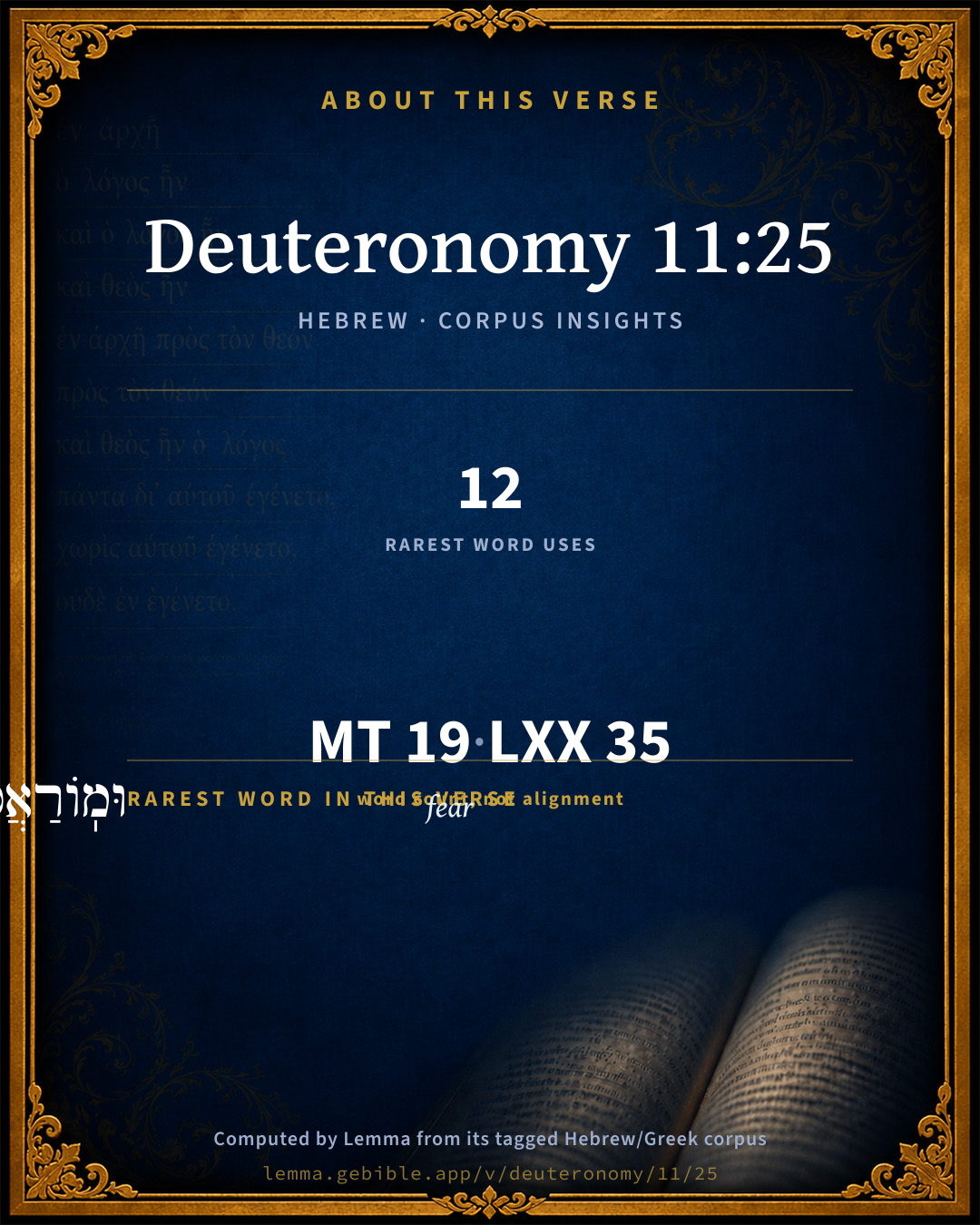
The rarest word here is וּמֽוֹרַאֲכֶ֜ם fear H4172 — appearing just 12 times in the whole Hebrew Bible.

Shared distinctive vocabulary

וּמֽוֹרַאֲכֶ֜ם fear H4172 occurs in 12 verses of the Hebrew Bible. Also found in:

Grammatical profile

  • 4 verbs
  • 9 nouns
  • 3 prepositions
  • 3 particles

Verb forms

  • יִתְיַצֵּ֥ב Hithpael · Imperfect
  • יִתֵּ֣ן Qal · Imperfect
  • תִּדְרְכוּ Qal · Imperfect
  • דִּבֶּ֥ר Piel · Perfect

Repetition

Words recur within this verse — often emphatic in Hebrew:

  • בִּפְנֵיכֶ֑ם face H6440 ×2
  • אֲשֶׁ֣ר which H834 ×2

Hebrew & Septuagint length

In English translation the verse runs 39 words from the Hebrew and 38 from the Septuagint (LXX English) — closely comparable.

A rough comparison of the two English renderings, which tokenize alike — not a word-level alignment.

Word counts can differ between the Hebrew and the Greek without any difference in meaning — e.g. the Hebrew direct-object marker אֵת has no separate Greek word, and Greek often adds the article ὁ.

In the original languages it is 19 Hebrew tokens and 35 Greek tokens — but the two are counted differently (Hebrew bundles its prefixes and suffixes into one token; the Greek is in lemma form), so that isn’t a like-for-like length.

Cross-references

6

Topical passages linked to Deuteronomy 11:25 in the Treasury of Scripture Knowledge — connected by theme and wording, ordered by reader-vote popularity; previews shown in the World English Bible.

  • Exodus 23:27 I will send my terror before you, and will confuse all the people to whom you come, and I will make all your enemies turn their backs to you.
  • Deuteronomy 7:24 He will deliver their kings into your hand, and you shall make their name to perish from under the sky: there shall no man be able to stand before you, until you have destroyed them.
  • Joshua 1:5 There shall not any man be able to stand before you all the days of your life. As I was with Moses, so I will be with you; I will not fail you, nor forsake you.
  • Deuteronomy 2:25 This day will I begin to put the dread of you and the fear of you on the peoples who are under the whole sky, who shall hear the report of you, and shall tremble, and be in anguish because of you.
  • Joshua 5:1 It happened, when all the kings of the Amorites, who were beyond the Jordan westward, and all the kings of the Canaanites, who were by the sea, heard how that Yahweh had dried up the waters of the Jordan from before the children of Israel, until we were passed over, that their heart melted, neither was there spirit in them any more, because of the children of Israel.
  • Joshua 2:9 and she said to the men, I know that Yahweh has given you the land, and that the fear of you is fallen on us, and that all the inhabitants of the land melt away before you.

Cross-references courtesy of OpenBible.info (CC BY 4.0).

Hebrew and Greek witnesses Masoretic Hebrew ↔ Greek Septuagint

The same verse in the two great witnesses to the Old Testament, shown verse-for-verse.

These are two independent witnesses, not word-aligned to each other, and the Septuagint is shown in lemma (dictionary) form.

Hebrew Deuteronomy 11:25 Masoretic · Westminster Leningrad Codex

לֹא יִתְיַצֵּ֥ב אִ֖ישׁ בִּפְנֵיכֶ֑ם פַּחְדְּכֶ֨ם וּמֽוֹרַאֲכֶ֜ם יִתֵּ֣ן יְהוָ֣ה אֱלֹֽהֵיכֶ֗ם עַל פְּנֵ֤י כָל הָאָ֨רֶץ֙ אֲשֶׁ֣ר תִּדְרְכוּ בָ֔הּ כַּאֲשֶׁ֖ר דִּבֶּ֥ר לָכֶֽם

There shall no man be able to stand before you: Yahweh your God shall lay the fear of you and the dread of you on all the land that you shall tread on, as he has spoken to you.

World English Bible · Public Domain

Greek LXX Deuteronomy 11:25 Septuagint · lemma form

οὐ ἀντιἵστημι οὐδείς κατά πρόσωπον σύ ὁ τρόμος σύ καί ὁ φόβος σύ ἐπιτίθημι κύριος ὁ θεός σύ ἐπί πρόσωπον πᾶς ὁ γῆ ἐπί ὅς ἐάν ἐπιβαίνω ἐπί αὐτός ὅς τρόπος λαλέω κύριος πρός σύ

No one shall stand before you; and the Lord your God will put the fear of you and the dread of you on the face of all the land, on which you⌃ shall tread, as he told you.

LXX2012 (modern English Septuagint) · Public Domain

Hebrew: Westminster Leningrad Codex (CC BY 4.0). Greek: Septuagint (public domain); English from LXX2012 (modern English Septuagint) (Public Domain). How the Septuagint differs from the Hebrew →

Targum (Aramaic paraphrase)

2

The Targum is the ancient Jewish Aramaic paraphrase of the Hebrew Scriptures — an interpretive translation, not the Hebrew text itself. Onkelos (literal) and Pseudo-Jonathan (expansive) render the Torah, and Jonathan the Prophets. Coverage is partial: where no permissively-licensed English translation exists for a verse, only the Aramaic is shown. This is verse-level text, not a word-by-word alignment to the Hebrew.

  1. Targum Onkelos Torah (Genesis–Deuteronomy)
    לָא יִתְעַתַּד אֱנָשׁ קֳדָמֵיכוֹן דַחֲלָתְכוֹן וְאֵימָתְכוֹן יִתֵּן יְיָ אֱלָהֲכוֹן עַל אַפֵּי כָל אַרְעָא דִי תִדְרְכוּן בַּהּ כְּמָה דִי מַלִיל לְכוֹן: ססס

    (no public-domain English translation for this verse)

    Targum Onkelos — Aramaic: “Onkelos Genesis” (public domain); “Onkelos Exodus” (public domain); “Onkelos Leviticus” (public domain); “Onkelos Numbers” (public domain); “Onkelos Deuteronomy” (public domain). English: “Sefaria Community Translation” (CC0 1.0 (public-domain dedication)); “J.W. Etheridge. The Targums of Onkelos and Jonathan Ben Uzziel on the Pentateuch. London: Longmans, Green, 1862” (public domain). Text via Sefaria.

  2. Targum Pseudo-Jonathan Torah (Genesis–Deuteronomy)
    לָא יִתְעַתֵּד בַּר נַשׁ בְּאַפֵּיכוֹן דַּחֲלַתְכוֹן וְאֵימַתְכוֹן יִתֵּן יְיָ אֱלָהָכוֹן עַל אַפֵּי כָּל יַתְבֵי אַרְעָא דְּתִדְרְכוּן בָּהּ הֵיכְמָא דְמַלֵּיל לְכוֹן

    Not a man will be able to stand before you; but the Lord your God will set the fear and dread of you upon the faces of all the inhabiters of the land that you tread upon, as it hath been told you.

    Targum Pseudo-Jonathan — Aramaic: “Targum Jonathan on Genesis” (public domain); “Targum Jonathan on Exodus” (public domain); “Targum Jonathan on Leviticus” (public domain); “Targum Jonathan on Numbers” (public domain); “Targum Jonathan on Deuteronomy” (public domain). English: “The Targum of Jonathan ben Uzziel, trans. J. W. Etheridge, London, 1862” (public domain). Text via Sefaria.

Commentary

Notes on Deuteronomy 11:25 from classic Christian and Jewish commentators (each source and its license shown beneath its notes). The classic Christian expositions comment on the surrounding passage and are grouped to its opening verse, so a note may address several verses; the Jewish commentaries on the Tanakh (Rashi and others) are per-verse, so they appear only where the commentator wrote on this verse.

Lemma curates 59 commentaries, every one of them public domain or Creative Commons licensed, each selected and text-cleaned for this edition rather than reprinted as found. About our sources →

Ellicott's Commentary for English Readers

(25) The fear of you and the dread of you.—Rashi says: “The fear of you on those that are near, and the dread upon those that are far off.” It is a very far-reaching prophecy, for it may be read, “upon all the earth that ye shall tread upon.” (See Est_8:2-3, where it was fulfilled throughout the whole Persian Empire.}

A Bible Commentary for English Readers, edited by Charles John Ellicott (1878–1897) — public domain. Text from a community e-Sword module.

John Gill's Exposition

And it shall come to pass, when the Lord thy God hath bought thee into the land whither thou goest to possess it,.... Which is often observed, as being near at hand; and when and where many things were to be done, which could not be done in the place and circumstances they now were, particularly what follows:

that thou shall put the blessing on Mount Gerizim, and the curse upon Mount Ebal; that is, pronounce the one on one mountain, and the other on the other mountain, or at least towards them, or over against them. The Targum of Jonathan is"ye shall set six tribes on Mount Gerizim, and six tribes on Mount Ebal; (#De 27:12,13) blessing they shall turn their faces against Mount Gerizim, and cursing they shall turn their faces against Mount Ebal;''with which agrees the account given in the Misnah;"six tribes went to the top of Mount Gerizim, and six to the top of Mount Ebal; and the priests and the Levites, and the ark, stood below in the middle; the priests surrounded the ark, and the Levites the priests, and all Israel were on this and on that side of the ark, as in Jos 8:33 then they turned their faces against Gerizim, they opened with the blessing, blessed is he that maketh not any graven or molten image, and both answered "Amen"; then they turned their faces against Mount Ebal, and opened with the curse, Deu 27:15 and both answered Amen (s);''see the performance of this command in Jos 8:33.

(s) Sotah, c. 7. sect. 5.

John Gill's Exposition of the Whole Bible (1746–1763) — public domain (CC PDM 1.0). Text via the HelloAO Bible API.

Rashi

Rabbi Shlomo Yitzchaki (Rashi)

לא יתיצב איש וגו׳ NO MAN SHALL STAND [BEFORE YOU] — I have here the statement only regarding a man! Whence may I derive that the same applies to a nation or a family or a woman with her witchcraft? Because it states: לא יתיצב, “there shall be no standing before you” — under any circumstances. — If this be so, why does it speak of a man? It means a man, be he even as Og, king of Bashan (Sifrei Devarim 52:1; cf. Rashi on Deuteronomy 3:11).

פחדם ומוראכם THE DREAD OF YOU AND THE FEAR OF YOU [THE LORD WILL PLACE UPON ALL THE LAND] — Is not, however, פחד the same as מורא? But פחדכם, “the dread of you”, refers to peoples near by, and מוראכם, “the fear of you” to those far away, for פחד denotes “sudden terror”, and מורא denotes apprehension enduring for many days (Sifrei Devarim 52:2; cf. Rashi on Sotah 20b and Niddah 71a; see also Rashi on Exodus 15:16 and Note p. 241 there).

כאשר דבר לכם AS HE HATH SAID TO YOU — And where did He say this? In Exodus 23:27: “I will send My terror before thee” (Sifrei Devarim 52:4).

Rashi on the Tanakh — English translations: “The Judaica Press complete Tanach with Rashi, translated by A. J. Rosenberg” (CC BY 4.0); “Pentateuch with Rashi's commentary by M. Rosenbaum and A.M. Silbermann, 1929-1934” (public domain); “The Metsudah Tanach series, Lakewood, N.J” (CC BY 4.0); and “The Book of Joshua, Metsudah Publications, 1997” (CC BY 4.0). Text via Sefaria.

Lesson kit

Teaching starters — assembled from the data on this page, not authored interpretation. Every prompt links to the verse data it draws on. Edit before teaching.

Deuteronomy, in the Pentateuch, opens this verse with 19 words (15 distinct Hebrew lemmas). Its most distinctive word is môwrâʼ (“fear”). A historical commentator’s framing appears above. Read the whole chapter for the surrounding context.

Discussion questions

  1. How does “fear” (môwrâʼ) shape what this verse is saying?
  2. Genesis 9:2 shares the word «fear» with this verse. How do the two illuminate each other?
  3. “face” occurs 2× in this one verse. What is the effect of the repetition?
  4. The translations on this page render this verse differently — a whole-verse word diff, not a word-by-word alignment. What might account for the different wordings?
  5. The verb «יִתְיַצֵּ֥ב» is Hithpael Imperfect. How does its form color the action?
  6. Reading how Ellicott's Commentary for English Readers and John Gill's Exposition read this verse, where do the two commentators agree and where do they part?

Things to notice

Reading settings

Reading text

Shown beneath each verse's original-language words.

Old Testament
Old Testament edition

Read the OT as the Masoretic Hebrew (MT) or the Greek Septuagint (LXX).

English shown for the Greek Septuagint (in the Hebrew ↔ Greek comparison).

Comparing translations? Open the Compare panel on any verse page to stack up to four side by side.